HAL Id: hal-02309305
https://hal.archives-ouvertes.fr/hal-02309305
Submitted on 9 Oct 2019HAL is a multi-disciplinary open access
archive for the deposit and dissemination of sci-entific research documents, whether they are pub-lished or not. The documents may come from teaching and research institutions in France or abroad, or from public or private research centers.
L’archive ouverte pluridisciplinaire HAL, est destinée au dépôt et à la diffusion de documents scientifiques de niveau recherche, publiés ou non, émanant des établissements d’enseignement et de recherche français ou étrangers, des laboratoires publics ou privés.
Litter carbon and nutrient chemistry control the
magnitude of soil priming effect
Lin Chao, Yanyan Liu, Gregoire Freschet, Weidong Zhang, Xin Yu, Wenhui
Zheng, Xin Guan, Qingpeng Yang, Longchi Chen, Feike Dijkstra, et al.
To cite this version:
Lin Chao, Yanyan Liu, Gregoire Freschet, Weidong Zhang, Xin Yu, et al.. Litter carbon and nutrient chemistry control the magnitude of soil priming effect. Functional Ecology, Wiley, 2019, 33 (5), pp.876-888. �10.1111/1365-2435.13278�. �hal-02309305�
Accepted
Article
This article has been accepted for publication and undergone full peer review but has not been
through the copyediting, typesetting, pagination and proofreading process, which may lead to
differences between this version and the Version of Record. Please cite this article as doi:
10.1111/1365-2435.13278
Functional Ecology
MR LIN CHAO (Orcid ID : 0000-0001-6153-3992)
DR GRÉGOIRE THOMAS FRESCHET (Orcid ID : 0000-0002-8830-3860) DR QINGPENG YANG (Orcid ID : 0000-0003-2471-6233)
Article type : Research Article
Section: Ecosystems Ecology Editor: Dr Emma Sayer
Litter carbon and nutrient chemistry control the magnitude of soil priming effect
Lin Chao1,2, Yanyan Liu3, Grégoire T. Freschet4, Weidong Zhang1,5, Xin Yu1,2, Wenhui Zheng1,2, Xin Guan1,5, Qingpeng Yang1,5, Longchi Chen1,5, Feike A. Dijkstra6, Silong Wang1,5.
1
Institute of Applied Ecology, Chinese Academy of Sciences, Key Laboratory of Forest Ecology and Management, Shenyang, China; 2University of Chinese Academy of Sciences, Beijing, China; 3Key Laboratory of Environment Change and Resources Use in Beibu Gulf, Ministry of Education, Guangxi Teachers Education University, Nanning, China; 4Centre d’Ecologie Fonctionnelle et Evolutive, (CNRS
Université de Montpellier – Université Paul Valéry Montpellier EPHE IRD), Montpellier, France;
5
Huitong Experimental Station of Forest Ecology, Chinese Academy of Sciences, Huitong, China;
6
Sydney Institute of Agriculture, School of Life and Environmental Sciences, The University of Sydney, Camden NSW, Australia.
Accepted
Article
Correspondence: Weidong Zhang and Silong Wang. Email: [email protected]; [email protected].
Abstract
1. Plant litter inputs can promote the decomposition of soil organic matter (OM) through the priming effect (PE). However, whereas leaf litter chemistry has long been identified as the primary driver of litter decomposition within biomes worldwide, little is known about how litter chemical traits influence the occurrence and strength of the PE.
2. Here, we studied the effects of 15 co-occurring C3 leaf litters of contrasting chemistry on C4 soil
respiration by analyzing changes in 13C natural abundance during early and later stages of litter decomposition (up to 125 days).
3. Besides an apparent PE of 16% in the first three days, soil C respiration was increased by 24% on average with leaf litter addition in the initial stage of decomposition (426 d) and by 8% at later stages (27125 d). Most interestingly, soil PE related well to initial litter chemistry and the dominant factors influencing the magnitude of the PE changed with decomposition stage. In the early stage of decomposition, litter leachate C content and litter hemicellulose concentration were positively correlated with the strength of the PE, whereas tannin concentration was negatively associated with soil PE. Together, tannin and hemicellulose explained half of the observed variation in the PE (R2= 0.58). In the later phase of decomposition, lignin and lignin:N ratios were negatively related to the PE, whereas Ca, K and Mg concentrations were positively related to the PE; lignin alone gave the best prediction of the PE (R2 = 0.58) at later
decomposition stages.
4. Our findings provide evidence that the magnitude and direction of the PE is influenced by the chemistry of organic matter inputs and suggest that, as decomposition proceeds differently among litter of contrasting chemistry, litters can also have variable effect on soil PE through
Accepted
Article
time. The predictive power of litter chemical traits on soil PE opens new perspectives for improving our mechanistic understanding of soil PE and improving our abilities to model soil C dynamics at variable scales.
KEYWORDS:13C natural abundance, C4 soil, litter decomposition, litter chemistry, carbon
mineralization, soil organic carbon, soil priming effect
Introduction
Soils contain the largest reservoir of carbon (C) in terrestrial ecosystems (Lin, Zhu & Cheng, 2015), the size and stability of which depend on the balance between C inputs from plant litter and C outputs from soil organic C (SOC) mineralization (Averill & Hawkes, 2016). SOC mineralization is influenced by microbial activities, which are usually nutrient or energy limited in most soils. Leaf litter inputs to soil can release this limitation and stimulate SOC mineralization rates (Kuzyakov, 2010; Wang, Wang, He, Liu & Wu, 2014), a phenomenon known as “the priming effect (PE)” (Kuzyakov, 2010; Zhang & Wang, 2012).
Plant litter decomposition plays an important role in regulating C and nutrient cycling in soil systems (Cornwell et al., 2008; Freschet et al., 2013). Litter decomposition is determined by three main factors: climate, litter quality and decomposer organisms (Bradford et al., 2017; Coûteaux, Bottner, & Berg, 1995; García-Palacios, Mckie, Handa, Frainer, & Hättenschwiler, 2016). Whilst it is well accepted that climate is the predominant factor controlling litter decomposition at the global scale (Aerts, 1997; Makkonen et al., 2012; Zhou et al., 2008), litter quality, which generally varies with plant species, was viewed as the critical factor in determining litter decomposition within biomes (Cornwell et al., 2008). Litter chemistry correlates broadly with initial rates of litter decomposition (Melillo, Aber, & Muratore, 1982; Schmidt et al., 2011). Leaf litter chemical
Accepted
Article
properties that stimulate decomposition rates include low lignin concentrations, high concentrations of nitrogen (N) and cations (potassium: K, calcium: Ca and magnesium: Mg) and low tannin
concentrations (Hättenschwiler, Coq, Barantal, & Handa, 2011; Makkonen et al., 2012; Paudel et al., 2015; Zhang, Hui, & Luo, 2008).
The importance of plant litter for SOC decomposition has long been recognized (Broadbent and Bartholomew, 1949;Sparling, Cheshire, & Mundie, 1982). Over the past several decades, empirical evidence has been growing that the PE plays a crucial role in regulating SOC decomposition and in predicting the responses of soil ecological processes to global change (Fontaine, Bardoux, Abbadie, & Mariotti, 2004; Sullivan & Hart, 2013). However, the strength, direction and duration of the PE can be controlled by multiple factors, including soil physico-chemical properties, the amount and quality of organic substances present in the soil, and microbial community structure and activity
(Blagodatskaya & Kuzyakov, 2008; Kuzyakov, 2010; Luo, Wang, & Smith, 2016). Owing to difficulties associated with disentangling all these influences, the response of SOC decomposition to litter addition remains controversial. Divergent results have been reported, with stimulatory (Luo et al., 2016; Zhang and Wang, 2013), inhibitory (Kuzyakov & Bol., 2006; Potthast, Hamer, & Makeschin, 2010) or no effects (Nottingham, Griffiths, Chamberlain, Stott, & Tanner, 2009; Wang, Wang, He, Liu, & Wu, 2014; Zhang, Wang, & Wang, 2013) on SOC decomposition rates. Several hypotheses have been proposed to explain these inconsistent PEs associated with the input of litter (Blagodatskaya & Kuzyakov, 2008; Fontaine, Mariotti, & Abbadie, 2003; Kuzyakov, Friedel, & Stahr, 2000). Generally, positive PEs could be induced due to increased microbial biomass and associated microbial
production of extracellular enzymes, whereas negative PEs might be caused by the toxic effects of litter to microorganisms and preferential litter utilization by microorganisms (Kuzyakov, Friedel, & Stahr, 2000; Zhang, Wang, Wang, 2013; Xiao, Guenet, Zhou, Su, & Janssens, 2014). More specifically, the balance in microbial competition between microorganism communities specialized in the
Accepted
Article
further explain differences in soil PE (Fontaine, Mariotti, & Abbadie, 2003). In this context, the chemical composition of fresh litter inputs could be a critical driver of SOC degradation by regulating the balance between different functional types of soil microbial communities (Fanin, Hättenschwiler, & Fromin, 2014;Fang, Nazaries, Singh, & Singh, 2018). Despite this, the relationship between litter chemistry and PEs remains largely unexplored.
Although several studies have assessed the effect of litter addition on SOC decomposition, prior PE studies utilized a small number of plant litters (Kuzyakov, 2010; Wang, Wang, He, Liu, & Wu, 2014). Commonly tested litters were typically 13C-labeled plant materials such as ryegrass, wheat straw, and green leaves instead of actual plant litters (Blagodatskaya & Kuzyakov, 2008; Fontaine, Mariotti, & Abbadie, 2003) and poorly represented the global diversity of litter chemistry.
Consequently, to the best of our knowledge, no studies have yet directly investigated the influence of contrasting litter chemistry on the magnitude and direction of the PE. Additionally, as litter decomposition processes change with time (Berg & McClaugherty, 2008; Bray, Kitajima, & Mack, 2012), the influence of the decomposing litter on microbial communities also changes (Fanin, Hättenschwiler, Chavez Soria, & Fromin, 2016), with likely effects on the magnitude of the PE (Luo, Wang, & Smith, 2016). Therefore, it is crucial to gain a better understanding of the dynamics of the PE and the dominant factors controlling the PE at different stages of decomposition (García-Palacios, Maestre, Kattge, & Wall, 2013; Zhang et al., 2016).
The overall objective of this study was to determine the influence of leaf litter chemistry on the strength of the PE at both the initial and intermediate stages of litter decomposition. To do so, we studied the 13C isotopic signature of CO2 respired from microcosms where leaf litters of 15 C3 plant
species with contrasting chemical composition were added to a C4 soil. We hypothesized that the
magnitude of the PE would vary with the chemistry of litter species and differ among decomposition stages. Specifically, assuming that the nutritional competition and balance between microbial communities control the PE (Fontaine et al., 2003), we further hypothesized that litters with high
Accepted
Article
concentrations of easily degradable C compounds (e.g., litter C leachates, cellulose and
hemicellulose) would mostly induce increases in PE in the initial stages of decomposition, as they are likely to stimulate micro-organisms specialized in degrading easily degradable SOC; whereas litters with high recalcitrant compound content (e.g., lignin) would increase the PE in later stage of decomposition, as they are more likely to stimulate micro-organisms specialized in degrading recalcitrant SOC. Alternatively, following the co-metabolism concept, we hypothesized that the rate of litter decomposition and therefore the access of microbial communities to litter compounds would essentially drive the PE, leading to similar prediction of a positive relationship between easily degradable C compounds and PE in the initial stage of decomposition but negative relationship between the concentration of recalcitrant compounds and the PE at later stages of decomposition.
Materials and methods Sampling of soil and leaf litter
The soil used in this study was collected from the plow layer (020 cm) of an agricultural site that has been planted with a C4 maize crop for over 20 years at the experimental station of
Heilongjiang Academy of Agricultural Science (45°69' N, 126°62' E), near Harbin, Heilongjiang Province, northeast China. Local mean annual temperature is 4.5 ºC and annual precipitation is 569 mm. The soil is a clay loam (43% sand, 22% silt, 35 % clay) with a pH of 6.9. Soil C and N
concentrations were 17.3 g kg-1 and 1.5 g kg-1, respectively, corresponding to a C:N ratio of 11.6. The δ13C value of C4 maize soil was -15.8‰. The soil was air-dried, thoroughly homogenized and passed
Accepted
Article
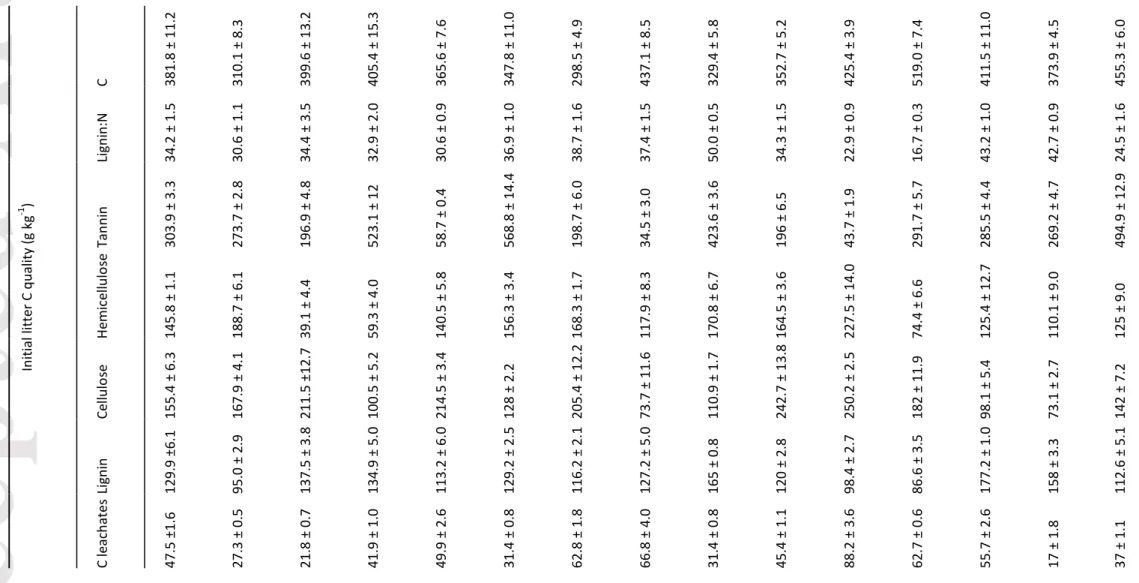
We collected freshly senesced leaf litter from 15 common and relatively abundant tree species in a subtropical forest characterized by a wide range of life strategies, carbon chemistry (Table 1) and nutrient content (Supporting Information Table S1) at the Huitong Natural Research Station of Forest Ecosystem (26°40'27°09'N, 109°26'110°08'E) in the Hunan province, central China. Local mean annual temperature and precipitation are 16.5 ºC and 1200 mm. Only freshly senesced, undamaged leaf litter was picked, whereas leaves with visible signs of herbivory, abrasions, fungal attacks or leaves that were still green were excluded. The litter was pooled by species and dried at 35 ºC immediately after collection.
Experimental setup and soil incubation
We used the natural abundance difference in δ13C values of C3 plant leaf litters and C4 soil to
separate leaf-derived CO2 from soil-derived CO2. The equivalent of 150 g dry soil was weighed into a
1 L Mason jar, and adjusted to 60% water-holding capacity by adding distilled water. Leaf litter samples were ball-milled into fine powder and homogenized by passing through a 0.25 mm mesh sieve. We added ground litter rather than chopped litter, because we were mostly interested in differences in litter chemistry, rather than in aspects of litter morphology, size or anatomy that could (i) affect the homogeneity of litter distribution within the soil in the microcosms and create
non-optimal contact between soil and litter, and (ii) interact with litter chemistry in a non-systematic way and thereby obscure the potential effect of litter chemical compounds on soil PE. Prior to litter addition, all soils were pre-incubated at 25 ºC for 10 days.
After pre-incubation, litter powder was added to the soil and throughly mixed. The amount of added litter C was calculated separately for each species so as to represent 5% of the SOC
concentration (corresponding to 0.25 – 0.43 g of litter material, Supporting Information Table S2). The amount of litter C added to the soil (75 g C m-2 yr-1, considering a soil depth of 10 cm)
Accepted
Article
corresponded to a realistic yearly input of litter in local tree plantations (e.g. Cunninghamia
lanceolata forest; Ning, Xiang, Wang, Fang, Yan, & Deng, 2009). Three analytical replicates were
included for each leaf litter. Soils without litter addition were also included as controls. Two holes were punched in the Mason jar lids and installed with bulkhead connectors (SMC, KQ2E06-00A; Singapore). Polyurethane tubes (TU-0604; SMC, USA) were used for linking the bulkhead connectors with a manual valve (VHK2-06F-06F; SMC, Japan). The manual valve remained open during
incubation, but was kept closed between sampling periods. All incubations were conducted in a laboratory incubator (SPX-500; Jiangnan, Ningbo, China) at a constant temperature of 25 ºC for 125 days.
Analysis of CO2 fluxes
Gas samples were sampled from jars on day 1, 3, 7, 10, 15, 26, 61, 90, and 125 after the
incubation began. To make sure that there was no CO2 at the start of the CO2 flux measurements, we
removed CO2 inside each jars before gas sampling by circulating CO2free air, which was generated
using an air compressor (ACO-318; Hailea, Guangdong, China) pumped through a soda lime column for 2 minutes. Then, jars were immediately sealed by closing the manual valve. Due to the faster CO2
release from soil in the initial stages of decomposition than at later stages, gas was collected 12 (early stage) or 24 h (later stage) after sealing using a portable gas sampling pump (01 L-D; Delin, Dalian, China) and stored in a pre-evacuated gas sampling bag (LB-201-0.2; Delin, Dalian, China). The CO2 concentration and δ13C were analyzed by a High-precision Isotopic CO2 Cavity Ring-Down
Accepted
Article
Measurement of litter chemistry
The ground leaf litter was analyzed for C, N, phosphorus (P), litter C leachates, lignin, hemicellulose, cellulose and tannin using standard methods. Briefly, C and N concentrations were determined using a CN elemental analyzer (ElementarVario, Hanau, Germany). To determine litter C leachates, 2 g litter powder samples were extracted with 60 ml deionized water, by shaking them on a reciprocal shaker for 30 min. The resulting solution was filtered, then analysed using a TOC analyzer (Vario TOC cube, Elementar Analysis system GmbH, Langenselbold, Germany). Lignin, hemicellulose and
cellulose (300 mg litter samples) were measured according to the National Renewable Energy Laboratory Procedure (Sluiter et al., 2008). In brief, we used a two-step acid hydrolysis to fractionate the litter into easily quantified forms. The hydrolysis liquid was used to quantify the cellulose and hemicellulose by high-performance liquid chromatography (HPLC) (Agilent-1260, Agilent
Technologies, Santa, Clara, CA, USA). Two fractionate forms of lignin (acid insoluble material and acid soluble material) were measured by UV-Vis spectroscopy (Lambda 25, PerkinElmer, Singapore). Tannins were determined by an acid-butanol assay as described by Hagerman (2011). The initial total P, Ca, K, Mg and Mn concentrations were measured using inductively coupled plasma mass spectroscopy (ICP-MS) (Elan DRC-e; PerkinElmer, Norwalk, CT, USA) after acid digestion of litter samples with H2SO4 and HClO4 solution.
Calculations and statistical analysis
CO2-C efflux was calculated as follows:
where R is the CO2-C efflux (µg C g1 soil day1); C is the measured CO2 concentration (ppm); V is
Accepted
Article
molar volume of an ideal gas at 1 atm and 273.15 K. W is the gram dry weight of the soil; t is the time of CO2 accumulation (days); and T is the incubation temperature (25 ºC).
Mass balance equations were used to separate leaf-derived CO2 from soil-derived CO2:
Where Ct is the total CO2-C from soil respiration (Ct=CL+CS) during the considered time period, CL
is the amount of C derived from C3 litter, CS is the amount of C derived from C4 soil, δt is the δ13C
value of CO2 emitted from jars containing soil-litter mixtures, and δL and δs are the δ13C values of C3
litter material and C4 soil, respectively.
Soil cumulative production of CO2 (T, mg C kg1 soil) at early and later stages of decomposition
was calculated by the following equation:
where Ri and Ri+1 are soil CO2 efflux at i th and (i+1) th incubation time (mg C kg1 day1),
respectively, ti+1ti is the interval between the i th and (i+1) th incubation time (day), and n is the
number of incubation times.
Mean daily soil CO2 production (mg C kg1 soil d-1) at early and later stages of decomposition
was then calculated by dividing T by the number of days in each stage.
The proportion of litter C decomposition (Ld, %) was calculated using the following equation:
where Td is the cumulative CO2 (mg C kg1) efflux from litter during the incubation period and
Accepted
Article
The early stage of litter decomposition was defined here as the phase presenting a sharp decrease in CO2 efflux with time (i.e., for all litters, from the first to the 26th days after the start of
the incubation), whereas the late phase of decomposition was characterized by relatively stable, lower CO2 efflux rates (as observed for all litters 61, 90, and 125 days after the start of the
incubation). This trend was highly conserved across all 15 species allowing the delineation of the same early versus later phase of decomposition for all 15 litters (Supporting Information Figure S1).
It is generally considered that the initial flush of CO2 occurring during the first three days after
new C input mainly results from an increased turnover or pool substitution of soil microbial biomass (Blagodatskaya & Kuzyakov, 2008; Kuzyakov, 2010). This ‘apparent’ PE occurring during the first three days of incubation was therefore omitted from PE calculations for the early stage of
decomposition (0-26 days) so as to consider only the ‘real’ PE. The PE induced by litter addition on SOC decomposition was expressed as the % change compared to CO2C released from the control.
The magnitude of PE during the considered time period (t) was calculated using the following equation:
where CO2-Ctreatment is the accumulated amount of total emitted CO2 derived from C4 soil in the
litter-amended soil, and CO2-Ccontrol is the amount of CO2 emitted from the control soil. The absolute
change in decomposition of SOC following addition of litter was also calculated by subtracting CO2-Ccontrol from CO2-Ctreatment.
The difference in PE between early and later phases of decomposition was tested across all litter species using paired t-tests. A correlation analysis was carried out, to test collinearity among litter traits. To determine how well variation in multiple aspects of litter chemistry explained variation in the PE, the relationships between leaf litter chemical properties, litter decomposition and the PE were assessed using hierarchical multiple linear regressions. The introduction of ‘added
Accepted
Article
litter mass’ as a covariate with precedence in hierarchical multiple linear regression analyses was necessary to correct for the potentially confounding influence of variable added litter mass (litter input was based on a similar total litter C addition across species). Models with lowest Akaike information criterion (AICc) were retained. All data met the requested assumptions of these parametric tests. Statistical analyses for all data were carried out using SPSS version 16.0 (SPSS Inc., Chicago, Illinois, USA).
Results
Litter decomposition and relationship with litter chemistry
The 15 common species used in this study exhibited a broad range of leaf litter chemistry properties (Table 1, Table S1). Lignin and lignin:N ratio (r=0.86, P < 0.001), P and K (r=0.78, P < 0.001), Ca and Mg (r=0.74, P < 0.01) were highly correlated (Supporting Information Table S3). At the initiation of the experiment, these litters all displayed a high carbon decomposition rate (i.e. high litter-derived CO2 fluxes) that decreased quickly and markedly in the initial stages of litter
decomposition (0-26 d) and then remained low during later stages of litter decay (27-125 d) (Figure 1, Supporting Information Table S4). The fraction of added litter-C decomposed over the entire incubation period was 24% averaged across all 15 species with the lowest for Phoebe bournei (15%) and the highest for Machilus Pauhoi litter (41%) (Figure 2). On average, 65% of the decomposition occurred in the early stage. Initial litter chemistry properties related only poorly to early and later stage leaf litter decomposition (Table 2). Whether in univariate or multivariate analyses, only Mn concentration explained some variation in litter decomposition in the early stage (negative relationship; R2= 0.33, P = 0.03), whereas N concentration explained some variation in litter decomposition in the later stage (negative relationship; R2 = 0.28, P = 0.04) (Table 2,3).
Accepted
Article
CO2 production and PE
Over the 125 days incubation period, mean daily CO2 production from the control soil was 4 mg
C kg-1 soil d-1, but 8 mg C kg-1 soil d-1 from the soil with leaf litter. This ranged from 6 mg C kg-1 soil d-1 (Phoebe zhennan) to 11 mg C kg-1 soil d-1 (Machilus pauhoi) (Figure 3).
Across the 15 species, the magnitude of PE (c. 1 mg C kg-1 soil d-1) at the early stage of
decomposition was significant higher than the later stage (c. 0.2 mg C kg-1 soil d-1; P < 0.001). Overall, in the first 26 days, added leaf litters significantly stimulated the decomposition of SOC by 24 % on average, which was threefold higher than in the 27125 day period (8% on average). Leaf litter addition induced additional SOC decomposition as compared to the control soil for all 15 species in the early stage of incubation (426 d) and all but two species in the later stage (27125 d) (Figure 3). Nevertheless, the magnitude of this PE varied strongly among treatments. The PE ranged from 4% to 51% in the early stage of incubation and from a 7% reduction to a 25% enhancement in the later stage of incubation (Figure 3).
Relationships between PE and leaf litter chemistry
Initial leaf litter chemistry and PE were significantly related, although these relationships differed among earlier and later stages of decomposition (Table 2). In the early stage of litter decomposition, the PE was positively related to the amount of litter C leachates and litter
hemicellulose concentration, and related negatively to tannin concentration (Table 2, Figure 4). In the later stage of litter decomposition, lignin and to a lesser extent the lignin:N ratio was related negatively to the PE, whereas K, Ca and Mg concentrations were positively related to the PE (Table 2, Figure 4). However, the PE was not related to initial N or P concentrations in either the early or later stage of decomposition. Additionally, the added litter mass only had a marginally significant effect on early PE (R2 = 0.20, P = 0.09) and no significant effect on later PE (R2 = 0.00, P = 0.82). Considering
Accepted
Article
all litter traits together, the combination of tannin and hemicellulose concentrations appeared most relevant to explain the PE in the early stage of decomposition (R2 = 0.58, P = 0.006), whereas lignin concentration was the single best explanatory variable in the later stage (R2 =0.58, P = 0.001) (Table 3).
Relationships between litter decomposition and PE
Leaf litter decomposition rate was positively related with the PE during the early stage of litter incubation (R2=0.29, P = 0.04; Figure 5a), i.e. when the largest part of the PE occurred (76% averaged across all species), but there was no relationship between decomposition rates and PE in the later stage (P = 0.28; Figure 5b). Over the entire period of decomposition, litter decomposition rate was positively related with the PE (R2 = 0.32, P = 0.03; Figure 5c).
Discussion
Our findings provide evidence that the magnitude and direction of the PE is influenced by the chemistry of organic matter inputs. In particular, the relative proportion of different C compounds in litter input, such as litter C leachates, hemicellulose, lignin and tannins, can have substantial
influence on the soil PE. Importantly, as decomposition proceeds differently among litters of contrasting chemistry, litters can also have variable effects on soil PE over time. In this context, our results also suggest that in the medium term, litter compounds unrelated to the C resource, such as cation content (Ca, K, Mg), might also influence the magnitude of the soil PE.
Accepted
Article
Variation in soil PE with litter addition and decomposition stages
In line with previous studies showing that different kinds of substrates can trigger PE to different extents (Blagodatskaya & Kuzyakov, 2008; Luo, Wang, & Smith, 2016) we demonstrated here that different litters with contrasting chemistry also trigger variable PEs. The addition of leaf litter generally stimulated the decomposition of native SOC although in a few instances we also observed inhibiting effects or no effect of inputs on native SOC mineralization rates (Blagodatskaya &
Kuzyakov, 2008; Kuzyakov, 2010; Wang, Wang, He, Liu, & Wu, 2014; Zhang & Wang, 2012).
While the PE is generally defined as a short-term change in the turnover of soil organic matter caused by comparatively moderate treatment of the soil (Kuzyakov, Friedel, & Stahr, 2000), the temporal dynamics of the PE has been rarely estimated (Kuzyakov, 2010). In a recent meta-analysis, Luo, Wang & Smith (2016) observed significant positive PEs that strongly decreased over time but persisted up to 100 days after adding complex C substrates (such as plant litter) to soil. Our results support this and other results (Fontaine et al., 2011; Zhang & Wang, 2012) showing long-term effects of complex substrate additions on the soil PE. They further confirm across a range of litters with contrasting chemistry that the magnitude of the PE generally decreases predictably with time (Luo, Wang, & Smith, 2016; Zhang, Wang & Wang, 2013). Among litter species, the significant relationship between litter decomposition and soil PE may suggest that faster litter decomposition rates trigger larger C accessibility to microorganisms and therefore increase the PE. For all litters, the much faster decomposition rate in the initial compared to the later stages of decomposition also relates to the much stronger PE observed in the first 26 d of litter incubation. Previous studies have indeed shown that, as litter decomposition proceeds, labile fractions are quickly exhausted and recalcitrant C compounds like lignin and cellulose remain (Bray, Kitajima, & Mack, 2012; Wickings, Grandy, Reed, & Cleveland, 2012; Yue et al., 2016). The C return on investment in lignolytic enzymes is hypothesized to be low (Talbot & Treseder, 2012), therefore limiting the growth and activity of microbial
Accepted
Article
communities feeding on lignin and potentially explaining the decrease in soil PE occurring in the later stage of decomposition.
Leaf litter chemistry control on soil PE
In support of our overarching hypothesis, leaf litter chemistry strongly influenced the magnitude of the soil PE. The positive relationship between soil PE and the concentrations of litter C leachates and hemicellulose in the initial stages of decomposition may be mainly explained by the co-metabolism concept, resulting from stimulated microbial growth and enzyme production induced by the utilization of litter easily degradable C compounds (i.e. C leachates and hemicellulose), with
consequences for both the decomposition of litter and native SOC (Kuzyakov et al, 2000; Qiao et al., 2013; Xiao, Guenet, Zhou, Su, & Janssens, 2014). While lignin has conventionally been considered as a recalcitrant compound that protects hemicellulose and cellulose from degradation by microbes (Austin & Ballaré, 2010; Hall et al., 2015; Talbot & Treseder, 2012), unshielded hemicellulose is generally abundant in the early stages of decomposition. Therefore, this unshielded hemicellulose may have provided microbial communities with an easily accessible C source and thereby stimulated the soil PE in the early stage of decomposition, until the unshielded portions were exhausted. In contrast, the concentration of tannins was negatively associated with the PE in the early
decomposition stage, possibly resulting from the inhibitory effect of tannins on soil enzyme activity, thus impeding SOC mineralization (Chomel et al., 2016; Liu et al., 2017), before tannin compounds were further degraded by soil microbial communities in the later stage of decomposition (Joanisse, Bradley, Preston, & Munson, 2007; Makkonen et al., 2012; Ushio, Balser, & Kitayama, 2013).
Accepted
Article
In support for our alternative hypothesis, a negative relationship between lignin and the PE was observed in the later stage of litter decomposition. As litter decomposition proceeds, the chemical composition of litter changes; labile C compounds are exhausted whereas recalcitrant litter compounds such as lignin tend to accumulate (Berg & McClaugherty, 2008; Coûteaux, Bottner, & Berg, 1995; Hall, Silver, Timokhin, & Hammel, 2015). A large proportion of lignin in litter would therefore correspond to a lower amount of decomposition byproducts in the form of accessible C substrate at later stages of decomposition that may explain the lower soil PE. The substantial PE observed in the later stage of decomposition suggests nonetheless that other complex C sources may still be available for microbial communities (Luo, Wang, & Smith, 2016) or that additional mineralization of SOC by the microbial community induced by earlier inputs persist after all easily accessible C substrate have been used (Fontaine et al., 2011).
Interestingly, the lack of a relationship between the soil PE and initial leaf litter N and P concentrations contrasts with previous studies that suggested that high soil N and P availability can decrease the soil PE (Fontaine et al., 2011; Wang, Wang, He, Liu, & Wu, 2014). This lack of effect could be due to the already high availability of N (inorganic N = 132 mg kg-1) and P (available P = 70
mg kg-1) in the (chemically fertilized) agricultural soil used in our experiment, preventing any effect of additional N and P from litter on microbial stoichiometry and therefore on litter decomposition (Freschet, Aerts, & Cornelissen, 2012) and the PE (Luo, Wang, & Smith, 2016). In contrast, we found a strong positive influence of several cation concentrations (Ca, K and Mg) on the soil PE in the later stage of litter decomposition. The positive influence of these cations could be linked to their role in relieving a potential deficiency of our experimental soil in such elements, thereby favoring long-term microbial growth, activity and litter decomposition (Cornelissen & Thompson, 1997) and stimulating SOC decomposition rates. However, given the strong correlation between Ca and Mg, their relative influence on later PE cannot be disentangled.
Accepted
Article
Finally, we acknowledge that our work, using only one homogeneous sample of litter per species, demonstrates the effect of between-species litter chemistry effects and does not represent the natural variability of within-species litter chemistry effects on soil PE, which precludes
comparisons among species. Additionally, the use of ground litter was not entirely representative of the effect of typical litter input on soil PE and may have increased soil PE as compared to entire or coarsely chopped litter. For example, Nottingham et al. (2009) found that chopped and ground maize added to soil caused similar increases in the soil CO2 efflux, but that ground maize caused a
larger PE than chopped maize. Nonetheless, our methodological choice allowed us to establish important links between litter chemical quality and PE.
Conclusions
We demonstrated here that leaf litter chemical traits (litter C leachates, hemicellulose, tannin and lignin, or even Ca, K and Mg) and litter decomposition rate strongly influence the magnitude and direction of the PE. Additionally, the dominant factors that control soil PE were different during contrasting stages of decomposition. While the lack of data on microbial biomass and community composition does not allow us to draw conclusions about the mechanisms behind the observed patterns, we note that these results are consistent with the idea that the access of microbial communities to litter-derived compounds (as controlled by litter decomposition rate) plays a role in driving the PE at early and intermediate stages of decomposition. A potential positive effect of high concentrations of recalcitrant compounds in litter, such as lignin, on the PE at later stages of decomposition was not observed. However, our results did not cover the entire period of litter decomposition and do not exclude that microbial competition (e.g. the balance between different functional types of soil microbial communities mediated by litter chemistry effects) could become dominant at the latest stages of decomposition and eventually persist after the complete
Accepted
Article
important effect of litter chemistry on the PE, further experiments using temporally explicit approaches are critically needed to explore the role of microbial biomass and community composition in mediating these effects. Moreover, soils with different properties should also be considered to further strengthen the validity of such experimental results across a range of soils and ecosystems.
Acknowledgements
We are grateful to the editor and two anonymous reviewers for their many useful and constructive comments on this manuscript. We also thank Yakov Kuzyakov for his constructive comments on previous versions of the manuscript. This research was funded by the National Key Research and Development Program of China (2016YFA060080203), the key research program of Frontier Sciences of the Chinese Academy of Sciences (QYZDB-SSW-DQC002-03), the National Natural Science
Foundation of China (41630755) and the Youth Innovation Promotion Association of the Chinese Academy of Sciences (2017239). Lin Chao was further supported by the Youth Talent Exchange and Cooperation Foundation of the Key Laboratory of Forest Ecology and Management of the Chinese Academy of Sciences to work at the CEFE in Montpellier (France).
AUTHORS’S CONTRIBUTION
W. D. Z and S. L. W designed the experiment. L. C. performed the experiment and led the writing of the manuscript with contributions from G. T. F. and F. D., L. C., Y. Y. L. and W. D. Z analysed the data. X. Y, W. H. Z, X. G, Q. P.Y and L. C. C. were involved in fieldwork and laboratory analysis. All authors contributed to revisions of the manuscript.
Accepted
Article
DATA ACCESSIBILITY
The data associated with this paper are available from the Dryad Digital Repository http:// DOI: doi:10.5061/dryad.b4s71jj (Chao et al., 2018).
REFERENCES
Aerts, R. (1997). Climate, leaf litter chemistry and leaf litter decomposition in terrestrial ecosystems: a triangular relationship. Oikos, 79, 439-449. http://doi.org/10.2307/3546886
Austin, A. T., & Ballaré, C. L. (2010). Dual role of lignin in plant litter decomposition in terrestrial ecosystems. Proceedings of the National Academy of Sciences, 107, 4168-4622. http://doi. org/10.1073/pnas.0909396107
Averill, C., & Hawkes, C. V. (2016). Ectomycorrhizal fungi slow soil carbon cycling. Ecology letters, 19, 937-947. http://doi.org/10.1111/ele.12631
Berg, B., & McClaugherty, C. (2008). Plant litter: decomposition, humus formation, carbon sequestration. Springer-Verlag, Berlin, Germany.
Blagodatskaya, E.V., & Kuzyakov, Y. (2008). Mechanisms of real and apparent priming effects and their dependence on soil microbial biomass and community structure: Critical review. Biology &
Fertility of Soils, 45, 115-131. http://doi. org/10.1007/s00374-008-0334-y
Bradford, M. A., Veen, G., Bonis, A., Bradford, E. M., Classen, A. T., Cornelissen, J., … van der Putten, W.H. (2017). A test of the hierarchical model of litter decomposition. Nature Ecology &
Accepted
Article
Bray, S. R., Kitajima, K., & Mack, M. C. (2012). Temporal dynamics of microbial communities on decomposing leaf litter of 10 plant species in relation to decomposition rate. Soil Biology &
Biochemistry, 49, 30-37. http://doi.org/ 10.1016/j.soilbio.2012.02.009
Broadbent, F.E., & Bartholomew, W.V.H.K. (1949). The effect of quantity of plant material added to soil on its rate of decomposition. Soil Science Society of America Journal, 13, 271-274.
https://doi.org/10.2136/sssaj1949.036159950013000C0048x
Chomel, M., Guittonny‐Larchevêque, M., Fernandez, C., Gallet, C., Desrochers, A., Paré, D., … Baldy, V. (2016). Plant secondary metabolites: a key driver of litter decomposition and soil nutrient cycling. Journal of Ecology, 104, 1527-1541. http://doi.org/10.1111/1365-2745.12644
Cornelissen, J. H. C., & Thompson, K. (1997). Functional leaf attributes predict litter decomposition rate in herbaceous plants. New Phytologist, 135, 109-114. http://doi.
org/10.1046/j.1469-8137.1997.00628.x
Cornwell, W. K., Cornelissen, J. H. C, Amatangelo, K., Dorrepaal, E., Eviner, V. T., Godoy, O., …. Westoby, M. (2008). Plant species traits are the predominant control on
litter decomposition rates within biomes worldwide. Ecology Letters,11, 1065-1071. http://doi: 10.1111/j.1461-0248.2008.01219.x
Coûteaux, M. M., Bottner, P., & Berg, B. (1995). Litter decomposition, climate and liter quality. Trends in Ecology & Evolution, 10, 63-66.
http://doi.org/10.1016/S0169-5347(00)88978-8
Fang, Y., Nazaries, L., Singh, B. K., & Singh, B. P. (2018). Microbial mechanisms of carbon priming effects revealed during the interaction of crop residue and nutrient inputs in contrasting soils. Global Chang Biology. http://doi.org/10.1111/gcb.14154
Accepted
Article
Fanin, N., Hättenschwiler, S., & Fromin, N. (2014). Litter fingerprint on microbial biomass, activity, and community structure in the underlying soil. Plant & Soil, 379, 79-91.
https://doi.org/10.1007/s11104-014-2051-7
Fanin, N., Hättenschwiler, S., Chavez Soria, P. F., & Fromin, N. (2016). (A)synchronous availabilities of N and P regulate the activity and structure of the microbial decomposer community. Frontiers
in Microbiology, 6(e49990), 1507. http://doi.org/10.3389/fmicb.2015.01507
Fontaine, S., Bardoux, G., Abbadie, L., & Mariotti, A. (2004). Carbon input to soil may decrease soil carbon content. Ecology Letters, 7, 314-320. https://doi.org/10.1111/j.1461-0248.2004.00579.x
Fontaine, S., Henault, C., Aamor, A., Bdioui, N., Bloor, J. M. G., … Maire, V. (2011). Fungi mediate long term sequestration of carbon and nitrogen in soil through their priming effect. Soil Biology & Biochemistry, 43, 86-96. https://doi.org/10.1016/j.soilbio.2010.09.017
Fontaine, S., Mariotti, A., & Abbadie, L. (2003). The priming effect of organic matter: a question of microbial competition? Soil Biology & Biochemistry, 35, 837-843.
https://doi.org/10.1016/S0038-0717(03)00123-8
Freschet, G. T., Aerts, R., & Cornelissen, J. H. C. (2012). A plant economics spectrum of litt er decomposability. Functional Ecology, 26(1), 56-65. https://doi.org/10.1111/j.1365-2435.2 011.01913.x
Freschet, G. T., Cornwell, W. K., Wardle, D. A., Elumeeva, T. G., Liu, W., Jackson, B. G., … Cornelissen, J. H. C. (2013). Linking litter decomposition of above- and below-ground organs to plant-soil feedbacks worldwide. Journal of Ecology, 101, 943-952.
Accepted
Article
García-Palacios, P., Maestre, F. T., Kattge, J., & Wall, D. H. (2013). Climate and litter quality differently modulate the effects of soil fauna on litter decomposition across biomes. Ecology
Letters, 16, 1045-1053. http://doi.org/10.1111/ele.12137
García-Palacios, P., Mckie, B. G., Handa, I. T., Frainer, A., & Hättenschwiler, S. (2016). The importance of litter traits and decomposers for litter decomposition: a comparison of aquatic and terrestrial ecosystems within and across biomes. Functional Ecology, 30, 819-829.
https://doi.org/10.1111/1365-2435.
12589
Hagerman, A.E. (2011). The Tannin Handbook. Miami University, Oxford, OH 5056. Available at http://www.users.muohio.edu/hagermae/ (Accessed 06/2010).
Hall, S. J., Silver, W. L., Timokhin, V. I., & Hammel, K. E. (2015). Lignin decomposition is sustained under fluctuating redox conditions in humid tropical forest soils. Global Change Biology, 21, 2818-2828. http://doi.org/ 10.1111/gcb.12908
Hättenschwiler, S., Coq, S., Barantal, S., & Handa, I. T. (2011). Leaf traits and decomposition in tropical rainforests: revisiting some commonly held views and towards a new hypothesis. New
Phytologist, 189, 950-965. https://doi.org/10.2307/29783382
Joanisse, G. D., Bradley, R. L., Preston, C. M., & Munson, A. D. (2007). Soil enzyme inhibition by condensed litter tannins may drive ecosystem structure and processes: the case of Kalmia angustifolia. New Phytologist, 175, 535-546. http://doi.org/10.1111/j.1469-8137.2007.02113.x
Kuzyakov, Y. (2010). Priming effects: interactions between living and dead organic matter. Soil
Biology & Biochemistry, 42, 1363-1371. https://doi.org/10.1016/j.
Accepted
Article
Kuzyakov, Y., Friedel, J. K., & Stahr, K. (2000). Review of mechanisms and quantification of priming effects. Soil Biology & Biochemistry, 32, 1485-1498.
http://doi.org/10.1016/S0038-0717(00)00084-5
Kuzyakov,Y., & Bol, R. (2006). Sources and mechanisms of priming effect induced in two grassland soils amended with slurry and sugar. Soil Biology & Biochemistry, 38, 747-758.
https://doi.org/10.1016/j.soilbio.2005.06.025
Lin, J., Zhu, B., & Cheng, W. (2015). Decadally cycling soil carbon is more sensitive to warming than faster-cycling soil carbon. Global Change Biology, 21, 4602-4612. http://doi.org/10.
1111/gcb.13071
Liu, X. J. A., Sun, J., Mau, R. L., Finley, B. K., Compson, Z. G., Gestel, N. V., … Hungate, B. A. (2017). Labile carbon input determines the direction and magnitude of the priming effect. Applied Soil
Ecology, 109, 7-13. http://doi.org/ 10.1016/j.apsoil.2016.10.002
Luo, Z.K., Wang, E., & Smith, C. (2016). Fresh carbon input differentially impacts soil carbon decomposition across natural and managed systems. Ecology, 96, 2806-2813.
http://doi.org/10.1890/14-2228.1
Makkonen, M., Berg, M. P., Handa, I. T., Hättenschwiler, S., Van, J. R., van Bodegom, P. M., & Aerts, R. (2012). Highly consistent effects of plant litter identity and functional traits on decomposition across a latitudinal gradient. Ecology Letters, 15, 1033-1041.
http://doi.org/10.1111/j.1461-0248.2012.01826.x
Melillo, J. M., Aber, J. D., & Muratore, J. F. (1982). Nitrogen and lignin control of hardwood leaf litter decomposition dynamics. Ecology, 63, 621-626. https://doi.org/10.2307/1936780
Accepted
Article
Ning, X. B., Xiang, W. H., Wang, G.J., Fang, X., Yan, W. D., & Deng, X. W. (2009). Litterfall production and dynamic for twenty years of a successive replanting Cunninghamia lanceolata plantation at Huitong, Hunan. Acta Ecological Sinica, 29, 5122-5129.
Nottingham, A. T., Griffiths, H., Chamberlain, P. M., Stott, A. W., & Tanner, E. V. J. (2009). Soil priming by sugar and leaf-litter substrates: a link to microbial groups. Applied Soil E
cology, 42,183-190. https://doi.org/10.1016/
j.apsoil.2009.03.003
Paudel, E., Dossa, G. G. O., De Blécourt, M., Beckschäfer, P., Xu, J., & Harrison, R. D. (2015). Quantifying the factors affecting leaf litter decomposition across a tropical forest disturbance gradient. Ecosphere, 6, 1-20. https://doi.org/10.1890/ES15-00112.1
Potthast, K., Hamer, U., & Makeschin, F. (2010). Impact of litter quality on mineralization processes in managed and abandoned pasture soils in Southern Ecuador. Soil Biology & Biochemistry, 42, 56-64. https://doi.org/10.1016/j.soilbio.2009.09.025
Qiao, N., Schaefer, D., Blagodatskaya, E., Zou, X., Xu, X., & Kuzyakov, Y. (2013). Labile carbon retention compensates for CO2 released by priming in forest soils. Global Change Biology, 20,
1943-1954. http://doi.org/10.1111/gcb.12458
Schmidt, M.W.I., Torn, M.S., Abiven, S., Dittmar, T., Guggenberger, G., Janssens, I. A., … Trumbore, S.E. (2011). Persistence of soil organic matter as an ecosystem property. Nature, 478, 49-56. https://doi.org/10.1038/nature10386
Sluiter, A., Hames, B., Ruiz, R., Scarlata, C., Sluiter, J., Templeton, D., &
Crocker, D. (2008). Determination of structural carbohydrates and lignin inbiomass. Lab
Accepted
Article
Sparling, G. P., Cheshire, M. V., & Mundie, C. M. (1982). Effect of barley plants on the decomposition of 14C‐labelled soil organic matter. European Journal of Soil Science, 33, 89-100.
https://doi.org/10.1111/j.1365-2389.1982.tb01750.x
Sullivan, B. W., & Hart, S. C. (2013). Evaluation of mechanisms controlling the priming of soil carbon along a substrate age gradient. Soil Biology & Biochemistry, 58, 293-301.
https://doi.org/10.1016/j.soilbio.2012.12.007
Talbot, J. M., & Treseder, K. K. (2012). Interactions among lignin, cellulose, and nitrogen drive litter chemistry-decay relationships. Ecology, 93, 345-354. http://doi.org/10.1890/11-0843.1
Ushio, M., Balser, T.C., & Kitayama, K. (2013). Effects of condensed tannins in conifer leaves on the composition and activity of the soil microbial community in a tropical montane forest. Plant &
Soil, 365, 157-170. http://doi.org/10.1007/s11104-012-1365-6
Wang, Q., Wang, S., He, T., Liu, L., & Wu, J. (2014). Response of organic carbon mineralization and microbial community to leaf litter and nutrient additions in subtropical forest soils. Soil Biology
& Biochemistry, 71, 13-20. http://doi.org/ 10.1016/j.soilbio.2014.01.004
Wickings, K., Grandy, A. S., Reed, S. C., & Cleveland, C. C. (2012). The origin of litter chemical complexity during decomposition. Ecology Letters, 15(10), 1180-1188.
https://doi.org/10.1111/j.1461-0248.2012.01837.x
Xiao, C., Guenet, B., Zhou, Y., Su, J., & Janssens, I. A. (2014). Priming of soil organic matter decomposition scales linearly with microbial biomass response to litter input in steppe vegetation. Oikos, 124, 649-657. http://doi.org/ 10.1111/oik.01728
Yue, K., Peng, C., Yang, W., Peng, Y., Zhang, C., Huang, C., & Wu, F. (2016). Degradation of lignin and cellulose during foliar litter decomposition in an alpine forest river. Ecosphere, 7, e01523. http://doi.org/10.1002/ecs2.1523
Accepted
Article
Zhang, D., Hui, D., Luo, Y., & Zhou, G. (2008). Rates of litter decomposition in terrestrial ecosystems: global patterns and controlling factors. Journal of Plant Ecology, 1, 85-93.
https://doi.org/10.1093/jpe/rtn002
Zhang, W., & Wang, S. (2012). Effects of NH4+ and NO3− on litter and soil organic carbon
decomposition in a Chinese fir plantation forest in South China. Soil Biology
&Biochemistry, 47,116-122.http://doi.org/ 10.1016/j.soilbio.2011.12.004
Zhang, W., Chao, L., Yang, Q., Wang, Q., Fang, Y., & Wang, S. (2016). Litter quality mediated nitrogen effect on plant litter decomposition regardless of soil fauna presence. Ecology, 97, 2834-2843. http://doi. org/10.1002/ecy.1515
Zhang, W., Wang, X., & Wang, S. (2013). Addition of external organic carbon and native soil organic carbon decomposition: a meta-analysis. Plos One, 8, e54779.
http://doi.org/10.1371/journal.pone.0054779
Zhou, G., Guan, L., Wei, X., Tang, X., Liu, S., Liu, J., … Yan, J. (2008).
Factors influencing leaf litter decomposition: an intersite decomposition ex-periment acr oss China. Plant & Soil, 311, 61-72. http://doi.org/10.1007/s11104-008-9658-5
SUPPORTING INFORMATION
Additional supporting information may be found online in the Supporting Information section at the end of the article.
How to cite this article: ChaoL, LiuY-Y, FreschetG-T et al. Litter carbon and nutrient chemistry
Accepted
Article
This article is protected by copyright. All rights reserved.
Table 1 Initial litter chemistry of the fifteen subtropical tree species incubated in this study.
In itia l l itt er C q u alit y (g k g -1 ) C 381.8 ± 1 1.2 310.1 ± 8. 3 399.6 ± 1 3.2 405.4 ± 1 5.3 365.6 ± 7. 6 347.8 ± 1 1.0 298.5 ± 4. 9 437.1 ± 8. 5 329.4 ± 5. 8 352.7 ± 5. 2 425.4 ± 3. 9 519.0 ± 7. 4 411.5 ± 1 1.0 373.9 ± 4. 5 455.3 ± 6. 0 Lign in :N 34.2 ± 1.5 30.6 ± 1.1 34.4 ± 3.5 32.9 ± 2.0 30.6 ± 0.9 36.9 ± 1.0 38.7 ± 1.6 37.4 ± 1.5 50.0 ± 0.5 34.3 ± 1.5 22.9 ± 0.9 16.7 ± 0.3 43.2 ± 1.0 42.7 ± 0.9 24.5 ± 1.6 Tan n in 303.9 ± 3. 3 273.7 ± 2. 8 196.9 ± 4. 8 523.1 ± 1 2 58.7 ± 0.4 568.8 ± 1 4.4 198.7 ± 6. 0 34.5 ± 3.0 423.6 ± 3. 6 196 ± 6.5 43.7 ± 1.9 291.7 ± 5. 7 285.5 ± 4. 4 269.2 ± 4. 7 494.9 ± 1 2.9 H em ic ellulo se 145.8 ± 1. 1 188.7 ± 6. 1 39.1 ± 4.4 59.3 ± 4.0 140.5 ± 5. 8 156.3 ± 3. 4 168.3 ± 1. 7 117.9 ± 8. 3 170.8 ± 6. 7 164.5 ± 3. 6 227.5 ± 1 4.0 74.4 ± 6.6 125.4 ± 1 2.7 110.1 ± 9. 0 125 ± 9.0 Ce llulo se 155.4 ± 6. 3 167.9 ± 4. 1 211.5 ± 12.7 100.5 ± 5. 2 214.5 ± 3. 4 128 ± 2.2 205.4 ± 1 2.2 73.7 ± 11. 6 110.9 ± 1. 7 242.7 ± 1 3.8 250.2 ± 2. 5 182 ± 11. 9 98.1 ± 5.4 73.1 ± 2.7 142 ± 7.2 Lign in 129.9 ± 6.1 95.0 ± 2.9 137.5 ± 3. 8 134.9 ± 5. 0 113.2 ± 6. 0 129.2 ± 2. 5 116.2 ± 2. 1 127.2 ± 5. 0 165 ± 0.8 120 ± 2.8 98.4 ± 2.7 86.6 ± 3.5 177.2 ± 1. 0 158 ± 3.3 112.6 ± 5. 1 C le ach at e s 47.5 ± 1. 6 27.3 ± 0.5 21.8 ± 0.7 41.9 ± 1.0 49.9 ± 2.6 31.4 ± 0.8 62.8 ± 1.8 66.8 ± 4.0 31.4 ± 0.8 45.4 ± 1.1 88.2 ± 3.6 62.7 ± 0.6 55.7 ± 2.6 17 ± 1.8 37 ± 1.1
Accepted
Article
This article is protected by copyright. All rights reserved.
G ro w th for m . Ev ergre en b ro ad le af Ev ergre en b ro ad le af Ev ergre en con if er De cidu o u s b ro ad le af De cidu o u s b ro ad le af Ev ergre en b ro ad le af Ev ergre en b ro ad le af Ev ergre en b ro ad le af Ev ergre en b ro ad le af Ev ergre en con if er De cidu o u s b ro ad le af De cidu o u s b ro ad le af De cidu o u s b ro ad le af Ev ergre en b ro ad le af Ev ergre en b ro ad le af Fami ly Faga ce ae Faga ce ae Tax o d iace ae H amame lida ce ae Ma gn o liace ae Ma gn o liace ae La u ra ce ae Ole acea e La u ra ce ae Pin aceae Scrop h u laria ce ae Faga ce ae Faga ce ae Sy m p loca ce ae Th eacea e Sp ecie s C yc lo b a lan o p sis g lau ca C a sta n o p sis h ys tr ix C u n n ing h a m ia lan ce o lat a Liq u ida m b a r fo rm o sa n a Yu lan ia d en u d a ta Mic h elia m a cc lurei Ma ch ilus Pa u h o i O sm a n th u s fr a g ra n s Ph o eb e z h en n a n Pin u s M a ss o n ian a Pa u lo w n ia fo rtu n ei Que rc u s la evis Que rc u s va riab ili s Symp lo co s la u rina Sc h im a su p er b a
Accepted
Article
This article is protected by copyright. All rights reserved.
Table 2 Strength (R2) and significance (P) of linear regressions between initial leaf litter chemical traits and leaf litter decomposition and priming effect
during two decomposition stages.
Early stage
Later stage
Trait Litter decomposition Priming effect Litter decomposition Priming effect R2 (+/-) P-value R2 (+/-) P-value R2 (+/-) P-value R2 (+/-) P-value Litter C leachates 0.078 (+) 0.078 0.298 (+) 0.035 0.049 (-) 0.429 0.241(+) 0.063 Lignin 0.038 (+) 0.489 0.139 (-) 0.171 0.016 (-) 0.656 0.584 (-) 0.001 Cellulose 0.009 (+) 0.734 0.254 (+) 0.056 0.006 (+) 0.782 0.235 (+) 0.067 Hemicellulose 0.193 (+) 0.094 0.342 (+) 0.022 0.268 (+) 0.060 0.166 (+) 0.132 Tannin 0.108 (-) 0.233 0.361 (-) 0.012 0.008 (-) 0.746 0.102 (-) 0.246 Lignin:N 0.000 (-) 0.960 0.006 (-) 0.786 0.022 (+) 0.595 0.389 (-) 0.013 N 0.102 (-) 0.246 0.190 (-) 0.104 0.284 (-) 0.041 0.021 (+) 0.604 P 0.017 (+) 0.644 0.006 (+) 0.791 0.068 (-) 0.347 0.234 (+) 0.068 Ca 0.219 (+) 0.08 0.042 (+) 0.466 0.035 (+) 0.506 0.354 (+) 0.019 K 0.001 (-) 0.922 0.004 (-) 0.821 0.130 (-) 0.187 0.312 (+) 0.031 Mg 0.06 (+) 0.371 0.022 (+) 0.602 0.001 (+) 0.773 0.396 (+) 0.012 Mn 0.331 (-) 0.025 0.085 (-) 0.293 0.135 (-) 0.178 0.238 (-) 0.065
Accepted
Article
Table 3 Outcome of determination of stepwise regressions between initial litter chemical properties
and litter decomposition and priming effect at two decomposition stages. The strength (R2) and significance (P) of models with lowest AICc are displayed.
Model
Early stage Later stage
Traits R2 P Traits R2 P
Litter
decomposition Mn 0.331 0.025 N 0.284 0.041
Priming effect Tannin 0.361 0.018 Lignin 0.584 0.001 Tannin; Hemicellulose 0.575 0.006
Accepted
Article
Figure Captions
Figure 1. CO2 effluxes from soil control (black lines with squares), plant-derived CO2 (red lines with
circles), soil-derived CO2 (blue lines with triangles), total CO2 (pink lines with inverted triangles) and
priming of SOC (green lines with diamonds) during 125 days of incubation.
Figure 2. Cumulative fraction of added plant litter released as CO2 during two stages of
decomposition. Bars are means of 3 replicates ± 1 standard error.
Figure 3. Mean daily SOM-derived CO2 (gray bar), leaf litter-derived CO2 (white bar) and CO2
associated to the PE (data above the bars) in soils amended with litter at early (026 days) (a) and later stage (27125) (b) of decomposition. Bars are means of 3 replicates ±1 standard error.
Figure 4. Relationships between priming effect and litter chemistry at early stage (a) and later stage
(b) of decomposition. Strength (R2) and significance (P) of linear regressions are displayed when significant.
Figure 5. Relationships between litter decomposition and priming effect in the day 0-26 (a), day
27-125 (b) and day 0-125d (c). Strength (R2) and significance (P) of linear regressions are displayed when significant.