Publisher’s version / Version de l'éditeur:
Technical Translation (National Research Council of Canada), 1966
READ THESE TERMS AND CONDITIONS CAREFULLY BEFORE USING THIS WEBSITE.
https://nrc-publications.canada.ca/eng/copyright
Vous avez des questions? Nous pouvons vous aider. Pour communiquer directement avec un auteur, consultez la
première page de la revue dans laquelle son article a été publié afin de trouver ses coordonnées. Si vous n’arrivez pas à les repérer, communiquez avec nous à [email protected].
Questions? Contact the NRC Publications Archive team at
[email protected]. If you wish to email the authors directly, please see the first page of the publication for their contact information.
NRC Publications Archive
Archives des publications du CNRC
For the publisher’s version, please access the DOI link below./ Pour consulter la version de l’éditeur, utilisez le lien DOI ci-dessous.
https://doi.org/10.4224/20331430
Access and use of this website and the material on it are subject to the Terms and Conditions set forth at
Eigen Frequency Statistics and Excitation Statistics in Rooms: Model
Tests with Electrical Waves
Schröder, M.
https://publications-cnrc.canada.ca/fra/droits
L’accès à ce site Web et l’utilisation de son contenu sont assujettis aux conditions présentées dans le site
LISEZ CES CONDITIONS ATTENTIVEMENT AVANT D’UTILISER CE SITE WEB.
NRC Publications Record / Notice d'Archives des publications de CNRC: https://nrc-publications.canada.ca/eng/view/object/?id=0edfffe6-385d-4856-be16-c41ea292d0d4 https://publications-cnrc.canada.ca/fra/voir/objet/?id=0edfffe6-385d-4856-be16-c41ea292d0d4
PREFACE
The mathematica u n d e r l y i n g t h e d i s t r i b u t i o n of n a t u r a l
modes of a c o u s t i c a l v i b r a t i o n s i n a room i s t h e same a s t h a t f o r e l e c t r o m a g n e t i c e i g e n f u n c t i o n s i n a r e s o n a n t e n c l o s u r e .
T h i s paper c o n c e n t r a t e s almost e n t i r e l y on t h e e l e c t r i c a l c a s e and d i s c u s s e s b o t h t h e r e l a t l v e a m p l i t u d e s and t h e frequency s p a c i n g between e i g e n f u n c t i o n s . The t h e o r e t i c a l d e d u c t i o n s a r e supported by e x p e r i m e n t a l o b s e r v a t i o n s on t h e s e q u a n t i t i e s . I t i s shown t h a t when t h e r a t i o of e n c l o s u r e l e n g t h t o wavelength i s around
6
: 1 t h e d e g r e e of degeneracy of modes i n a p e r f e c t cubei s n o t a s g r e a t a s one would expect from t h e o r e t i c a l c o n s i d e r a t i o n s . T h i s i s t a k e n t o mean t h a t t h e i r r e g u l a r i t i e s i n t h e c o n s t r u c t - i o n of t h e c a v i t y i n t r o d u c e a d e g r e e of randomness. When t h e cube i s deformed by about 1.0% s o t h a t t h e s i d e s o r i g i n a l l y 200 mm x 200
mm x 200 mm become 200 mm x 199 mm x 198 mm, t h e randomness becomes complete. Even t h e i n h e r e n t degeneracy of 2 due t o t h e two p o s s i b l e d i r e c t i o n s of p o l a r i s a t i o n i s removed due t o a f u r t h e r d e g r e e o f randomness b e i n g impressed on t h e assumed Poisson t y p e d i s t r i b u t i o n of t h e mode s e p a r a t i o n .
The o t h e r measure of randomness i s provided by t h e r e l a t i v e a m p l i t u d e s of t h e d i f f e r e n t e i g e n f u n c t i o n s . A d e l i b e r a t e amount of degeneracy i s i n t r o d u c e d by a c t u a t i n g t h e modes i n t h e c e n t r e of one f a c e . By i n t r o d u c i n g i r r e g u l a r i t i e s of t h e o r d e r of t h e cube of t h e wavelength, t h e d e g r e e of randomness approaches
i t s
t h e o r e t i c a l maximum.
A l l t h e c o n c l u s i o n s reached f o r t h e e l e c t r o m a g n e t i c e i g e n
f u n c t i o n s should hold f o r t h e a c o u s t i c a l c a s e . The o n l y m o d i f i c a t i o n which must be made t o a l l t h e d e d u c t i o n s i s t h e removal of t h e
p o l a r i s a t i o n degeneracy.
The D i v i s i o n of B u i l d i n g Research wishes t o r e c o r d
i t s
t h a n k s t o M r . D.A. S i n c l a i r , Head, T r a n s l a t i o n s S e c t i o n , N a t i o n a l Research Council, f o r t r a n s l a t i n g t h i s paper and t o D r .R.J.
Donato whochecked t h e t r a n s l a t i o n .
Ottawa
R.F.
LeggetNATIONAL RESEARCH COUNCIL OF CANADA
TECHNICAL TRANSLATION 1261
Title: Eigen frequency statistice and excitation etatietics in roome,
Model tests with electrical waves
(~igenfrequenzstati8tik und Anregungsstatist ik in
gume en.
Modellversuche mit elektrischen Wellen)
Author :
Reference: Aoustica,
4:
457-
468,
1954EIGEN FREQUENCY STATISTICS AND EXCITATION STATISTICS I N ROOMS
MODEL TESTS IJIri'lI E1,ECTRICAL l.IAVES
A b s t r a c t
I n t h e f i r s t p a r t of t h e p r e s e n t paper t h e n a t u r a l frequency spacing s t a t i s t i c s of r e s o n a n t c a v i t i e s i s i n v e s t i g a t e d . It
i s
shown t h a t t h e non-accidental d e g e n e r a t i o n s of r e g u l a r rooms can be e f f e c t i v e l y s p l i t up by minute d e v i a t i o n s from geometric symmetry. With a cube of 20 cm l e n g t h , f o r i n s t a n c e , t h e average degree of d e g e n e r a t i o n i s 24 a t
3
cm wavelength. However, a d i f f e r e n c e between t h e t h r e e dimensions of 0 . 1 cm o n l y s u f f i c e s t o make t h e spacing s t a t i s t i c s a p u r e l y random one.I n t h e second p a r t t h e e x c i t a t i o n s t a t i s t i c s of t h e normal modes i s i n v e s t i g a t e d . Here a g a i n a d e g e n e r a t e c a s e i s t h e
s t a r t i n g p o i n t . A r e c t a n g u l a r c a v i t y i s e x c i t e d a t t h e c e n t r a l p o i n t of one of i t s s u r f a c e s . I n t h i s manner only one f o u r t h of t h e normal modes w i l l be e x c i t e d . But i n t r o d u c i n g a t i n y p e r t u r b i n g element w i t h
a
volume ofp wavelength)^
i n t o t h e r e s o n a t o r r e s u l t s i n a l l t h e modes being e x c i t e d a c c o r d i n g t o a p u r e l y random law.Though t h e p r e s e n t i n v e s t i g a t i o n i a of i n t e r e s t w i t h i n t h e domain of room a c o u s t i c s predominantly, a l l measurements have been performed w i t h microwaves i n m e t a l l i c c a v i t i e s , because of t h e i r h i g h Q which i s i n t h e o r d e r of some 104 Thus t h e i n d i v i d u a l
resonances can be resolved even a t h i g h e r r a t i o s of room dimensions t o wavelength.
1. I n t r o d u c t i o n
The frequency curve of a room can be regarded a s a s u p e r p o s i t i o n of t h e i n d i v i d u a l resonance c u r v e s . It f o l l o w s t h a t t h e frequency curve i s determined by t h r e e d i s t r i b u t i o n s , namely t h e s t a t i s t i c s of t h e spacing, t h e e x c i t a t i o n and t h e damping of t h e i n d i v i d u a l e i g e n f r e q u e n c i e s . I n t h e p r e s e n t s t u d y t h e s p a c i n g and e x c i t a t i o n s t a t i s t i c s a r e i n v e s t i g a t e d .
It i s shown t h a t f o r a l l a c t u a l comparatively l a r g e rooms t h e s p a c i n g and e x c i t a t i o n s t a t i s t i c s a r e t h o s e of a completely random space. Accordingly, t h e v a r i a t i o n s of t h e frequency curve of a room (mean h e i g h t of t h e "peaks", mean d i s t a n c e between maxima, e t c . ) become, i n t h e l i m i t i n g c a s e of " h a l f - v a l u e width l a r g e compared w i t h t h e mean d i s t a n c e between e i g e n f r e q u e n c i e s "
(EF) and " l i n e a r dimensions of t h e room l a r g e compared with t h e wavelength", a f u n c t i o n of t h e r e v e r b e r a t i o n time o n l y .
There
i s
no d i f f i c u l t y i n t r a n s f e r r i n g t h e r e s u l t s obtained from e l e c t r i - c a l r e s o n a n t c a v i t i e s t o corresponding a c o u s t i c a l rooms, provided it i s k e p t i n mind t h a t t h e number of E F i n a given i n t e r v a l i s about twice a s g r e a t a s I n t h e analogous a c o u s t i c a l c a s e . T h i s i s because of t h e t r a n s v e r s a l c h a r a c t e r of e l e c t r o m a g n e t i c waves, f o r t h e complete d e s c r i p t i o n of which i ti s n e c e s s a r y t o s p e c i f y the d l r e c b l o n of p o l a r i z a t i o n a s w e l l a s t h e d a t a ncedcd f o r t h e d c u c ~ ~ l y t l o n of a sound wave i n a i r . For a r e c t a n g u l a r space t h e E F d e n s i t i e s can be g i v e n a s a f u n c t i o n of t h e volume V , t h e a r e a S
and t h e edge l e n g t h L:
Nurnber of a c o u u t i a a l El? ( 1 4
number of e l e c t r i c a l El? ( l b )
where h i s t h e wavelength and ~ f / f t h e r e l a t i v e s i z e of t h e f r e q u e n c y i n t e r v a l . For t h e number of e l e c t r i c a l EF we h e r e c o n s i d e r o n l y t h e term g i v e n by t h e volume. The c o r r e c t i o n r e s u l t i n g from a d d i t i o n of t h e edge l e n g t h term
i s o n l y about -1%. Fortnula ( l b ) can t h e n be w r i t t e n i n t h e f o l l o w i n g simple form
where df/f i s t h e mean r e l a t i v e i n t e r v a l between neighbouring EF.
Another d i f f e r e n c e from a c o u s t i c s c o n s i s t s i n t h e f a c t t h a t i n t h e e l e c t r i c a l c a s e b o t h f i e l d v a l u e s a r e v e c t o r s . For sound i n a i r t h e r e
i s
a s c a l a r f i e l d v a l u e , t h e sound p r e s s u r e . A s a consequence, f o r a r e c t a n g u l a ra-
c o u s t i c r e s o n a t o r t h e r e i s a p o s s i b i l i t y of e x c i t i n g a l l EF u n i f o r m l y , s i n c e a l l n a t u r a l v i b r a t i o n s show a b u l g i n g of t h e sound i n t h e c o r n e r s . With an e l e c t r i c a l r e s o n a n t c a v i t y , however, i t i s i m p o s s i b l e t o produce a n
e x c i t a t i o n a t one p o i n t such t h a t a l l EF a r e u n i f o r m l y e x c i t e d . 2 . The Spacing S t a t i s t i c s of t h e Eigen F r e q u e n c i e s ( a ) D e f i n i t i o n of a s p a c i n g parameter
A s a c h a r a c t e r i s t i c v a l u e f o r t h e more o r l e s s uniform d i s t r i b u t i o n of t h e
El?
t h e second moment of t h e s p a c i n g s t a t i s t i c s between e a c h p a i r ofn e i g h b o u r i n g EF h a s been i n t r o d u c e d by H . H . B o l t ( 1 ~ 2 )
,
and i s r e f e r r e d t o t h e mean i n t e r v a l determined p r i n c i p a l l y by t h e volume. He d e n o t e s t h i s v a l u ewhere df i s t h e d i s t a n c e between n e i g h b o u r i n g EF, Af t h e s i z e of t h e i n t e r v a l i n q u e s t i o n and N t h e number of EF i n t h i s i n t e r v a l .
When t h e i n t e r v a l s between t h e EP a r e e q u a l , t h e n a c c o r d i n g t o t h i s d e f i n i t i o n Y = 1. f o r a completely random d i s t r i b u t i o n , where t h e o c c u r r e n c e of an i n t e r v a l df has a p r o b a b i l i t y p r o p o r t i o n a l t o e x p ( - d f / d f ) , Y = 2 . I n rooms w i t h a h i g h d e g r e e of geometric symmetry ( s p h e r e s , c u b e s , e l l i p s o i d s of r o t a t i o n , b o d i e s with s q u a r e c r o s s - s e c t i o n s , c y l i n d e r s , e t c . ) non-accident
d e g e n e r a t i o n s o c c u r . A c e r t a i n number of EF c o i n c i d e , and l e a v e c o r r e s p o n d - i n g l y l a r g e g a p s on t h e f r e q u e n c y a x i s . The s p a c i n g i n d e x of t h e EF,Y
,
i sl a r g e , s i n c e i n a d d i t i o n t o t h e f r e q u e n c y i n t e r v a l 0, f a i r l y l a r g e i n t e r v a l s o c c u r more f r e q u e n t l y t h a n would be t h e c a s e f o r a p u r e random d i s t r i b u t i o n . The q u e s t i o n i s , how f a r must t h e shape o f t h e r e s o n a t o r d e p a r t from geomet- r i c a l symmetry i n o r d e r t o r e n d e r t h e d i s t r i b u t i o n of t h e EF random. Q , u a n t i t a - t i v e l y s p e a k i n g , t h e d e g r e e of randomness I s measured by t h e c l o s e n e s s of t h e a p p r o a c h of Y t o t h e v a l u e 2 .
I t should be mentioned t h a t i t i s n o t always p o s s i b l e t o i n f e r t h e e x i s t e n c e of p u r e random d i s t r i b u t i o n from t h e c o n d i t i o n % ' = 2 . I n a
c y l i n d r i c a l r e s o n a t o r , f o r example, t h e c r o s s - s e c t i o n of which c a n b e c o n v e r t e d i n t o i t s e l f by a r o t a t i o n w i t h a n a n g l e of l e s s t h a n 1 8 0 ° , and which i s o p e r - a t e d i n t h e fundamental v i b r a t i o n form, t h e EF a r e d e g e n e r a t e and a r e
e q u i d i s t a n t . I n t h e f r e q u e n c y r a n g e i n which t h e r e s o n a t o r c a n v i b r a t e o n l y i n t h e fundamental v i b r a t i o n form, t h i s a l s o g i v e s ! $ = 2 , even though t h e r e c a n be no q u e s t i o n h e r e o f randomness of t h e EF d i s t r i b u t i o n .
( b ) R e s u l t s
The measurements were begun w i t h a r e c t a n g u l a r c a v i t y of d i m e n s i o n s
l 7
x 27 x 43 cm3, c o r r e s p o n d i n g t o a n edge l e n g t h r a t i o of a p p r o x i m a t e l y 2 :3 :
5.
127 EF were counted i n a n i n t e r v a l of 100 MHz a t A = 3 . 2 cm, The t h e o r e t i c a l number of EF f o r t h i s i n t e r v a l i s N =157%
( ~ h u s 30 EF were n o t f o u n d ) . The sum of t h e s q u a r e s of t h e i n t e r v a l s was = 1 2 6 MHz. The s p a c i n g i n d e x t h u s becomes T h i s r e s u l t i m p l i e s , o f c o u r s e , t h a t a l l EF n o t found c o i n c i d e e x a c t l y w i t h o t h e r EF, s o t h a t t h e i n t e r v a l s s t i l l t o be added a r e 0 i n t e r v a l s . T h i s i s c e r t a i n l y o n l y a p p r o x i m a t e l y t r u e . The t r u e v a l u e o f Y f o r t h e e v a l u a t e d i n t e r v a l i s t h u s somewhat l o w e r . The r e s u l t y z 2 shows t h a t t h e d i s t r i b u t i o n of t h e EF i n t h e r e c t a n g u l a r s p a c e i n q u e s t i o n i s random, f o r Y = 2 i s t h e v a l u e f o r a t o t a l l y random d i s t r i b u t i o n . What i s s u r p r i s i n g a b o u t t h i s r e s u l t i s t h e f a c t t h a t t h e r e c t a n g u l a r s p a c e i s n e v e r t h e l e s s s t i l l a v e r y r e g u l a r body. The o r i g i n a l e x p l a n a t i o n f o r t h i s phenomenon was t h e f a c t t h a t t h e d i m e n s i o n s of t h e 3r e c t a n g l e had been c h o s e n i n a c c o r d a n c e w i t h t h e r a t i o 1 :
5/Ti
:3 ~ 6 ,
o r ( 3 )a p p r o x i m a t e l y 2 :
3
:5
.
I n o r d e r t o c l a r i f y t h e s i t u a t i o n , measurements were t h e n c a r r i e d o u t i n a c u b e , and l e d t o no l e s s a s t o n i s h i n g r e s u l t s . A s a consequence t h e above t e s t r e s u l t must be i n t e r p r e t e d a s f o l l o w s : t h e s l i g h t d e p a r t u r e s of t h e s i d e
r a t i o s from t h e oimyle whole numbers 2 : 3 :
5,
combined w i t h t h e s l i g h t g e o m e t r i c a l i r r e g u l a r i t i e s of t h e r e o o n n t o r arc by themoelves s u f f i c i e n t t o produce a completely random d i s t r i b u t i o n of t h e E F . The t h e o r y of t h e magical r a t i o 2 :3
:5
h a s no s i g n i f i c a n c e s h e r e i n view of t h e given r a t i o of wave- l e n g t h t o edge l e n g t h of 1 :6 .
I n t h e c a s e of r e c t a n g u l a r s p a c e s t h e v a l u e of Y i s determined r a t h e r by t h e e x t e n t t o whlch t h e s i d e r a t i o s d e p a r t from s m a l l whole numbers. T h i s becomes even c l e a r e r when we c o n s i d e r t h e t e s t r e s u l t s on t h e cube.The most s t r i k i n g phenomenon i n t h e EF d i s t r i b u t i o n of a cube i s t h e f a c t t h a t t h e r e isaminlmum l n t e r v a l between any two non-coincident EF. The EF of a cube a r e g i v e n by t h e formula
where c i s t h e v e l o c i t y of l i g h t , a t h e s i d e l e n g t h of t h e cube and nx, n Y' nz t h e t h r e e wave i n d i c e s , g i v i n g t h e number of h a l f p e r i o d s i n t h e d i r e c t i o n of t h e t h r e e e d g e s .
The sum of t h e s q u a r e s w i t h i n t h e r o o t i s a whole number. The minimum d i s t a n c e Df between two non-coinciding EF i s g i v e n by t h e i n c r e a s e of t h i s sum by u n i t y . Hence, f o r t h e r e l a t i v e minimum i n t e r v a l we immediately g e t
Comparing e q u a t i o n ( 2 ) f o r t h e mean i n t e r v a l of EF w i t h t h i s ,
i t w i l l be recognized t h a t on t h e average a t l e a s t
EF must c o i n c i d e . I n f a c t , t h e mean degree of d e g e n e r a t i o n i s somewhat g r e a t - e r , s i n c e even i n t e r v a l s 2
.
Df o c c u r . T h i s i s always t h e c a s e whenever awhole number cannot be r e r e s e n t e d a s t h e sum of t h r e e s q u a r e s . A s t h e t h e o r y of numbers shows(i", t h a t i s t h e c a s e i n t h e l i m i t f o r e v e r y s i x t h whole number. When t h e numbers a r e l a r g e t h u s t h e mean d e g r e e of d e g e n e r a t - i o n i s g r e a t e r t h a n t h e v a l u e of
~ f / m
by a f a c t o r of6 / 5 :
Mean degree of d e g e n e r a t i o n of a cube
=-5-
6n
.
a
A '
( 3 4
The s p a c i n g index i s t h e n o b t a i n e d d i r e c t l y frlorn t h e d e f i n i t i o n
given f o r t h e i n t e r v a l
It w i l l be noted t h a t i n g e n e r a l t h e d e g r e e of d e g e n e r a t i o n i s t w i c e a s
g r e a t i n t h e e l e c t r i c a l c a s e a s i n t h e a c o u s t i c a l , s i n c e t h e r e a r e two p o s s i b l e p o l a r i z a t i o n s f o r t h e o b l i q u e e l e c t r i c a l waves, f o r which none of t h e t h r e e wave i n d i c e s nx, n nz v a n i s h e s .
Y'
Under t h e column "pertnutatlons" i s g i v e n t h e number of p o s s i b l e permuta- t i o n s of t h e t h r e e i n d i c e s . Q e r w r a l l y s p e a k i n g t h i s i s s i x , i f two i n d i c e s a r e t h e same, however, i t i s reduced t o t h r e e .
According t o Table I t h e t o t a l number of e l e c t r i c a l EF f o r t h i s i n t e r v a l
i s 249. According t o formula ( l b ) , 25lt
EF
should f a l l w i t h i n t h i s i n t e r v a l , and a c c o r d i n g t o t h e s i m p l i f i e d fortnula ( 2 ) , 255. The t o t a l number ofa c o u s t i c a l EF f o r t h e same i n t e r v a l a c c o r d i n g t o T a b l e I i s
135.
Formula ( l a ) g i v e s t h e v a l u e 143.Of t h e
13
i n d i c e s t a b u l a t e d , 10 a r e occupied by EF. The a v e r a g e d e - g e n e r a t i o n , t h e r e f o r e , i s 24.9 i n t h e e l e c t r i c a l c a s e . According t o formula( 3 c ) t h e mean d e g r e e of d e g e n e r a t i o n f o r t h e r e g i o n about n 2 = 156 should be 23.5. It i s f u r t h e r noted t h a t t h e h i g h e s t d e g r e e of d e g e n e r a t i o n ,
48,
i sj u s t t w i c e t h e mean. R . H . B o l t h a s a l r e a d y p o i n t e d t h i s o u t .
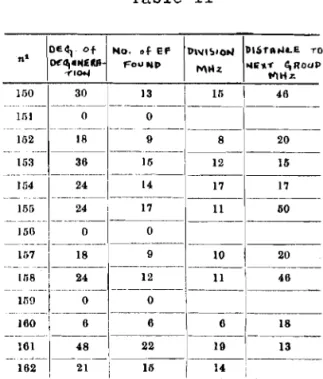
The EF groups l i s t e d i n t h e t a b l e were measured i n a cube of 20 cm s i d e i n a r e g i o n about t h e wavelength 3.2 cm. The r e s u l t s a r e assembled i n Table 11. The e x p e r i m e n t a l a p p a r a t u s w i l l be d e s c r i b e d below. The second column a g a i n g i v e s t h e d e g r e e of d e g e n e r a t i o n a s o b t a i n e d from T a b l e I . I n t h e n e x t column we e n t e r t h e number of
EF
a c t u a l l y found, which, of c o u r s e , i s s t i l l c o n s i d e r a b l y s m a l l e r , s i n c e t h e EF a r e d e c i d e d l y grouped. N e v e r t h e l e s s more EF were found i n more d e n s e l y occupied p l a c e s t h a n f o r more s p a r s e l y occupied o n e s . The 6 EF belonging t o t h e i n d e x n 2 = 160 were a c t u a l l y a l l d e t e c t e d . I n t h e n e x t column t h e spread of t h e i n d i v i d u a l groups i s r e c o r d e d , a s caused by t h e s l i g h t mechanical t o l e r a n c e s i n t h e manufacture of t h e cube. F i n a l l y , t h e l a s t column g i v e s t h e i n t e r v a l between t h e a d j a c e n t EF of two n e i g h b o u r i n g groups.
The measured groups cover a wavelength r e g i o n of 3.268
-
3.143 cm, c o r r e s - ponding t o a frequency i n t e r v a l of 360 MHz. By summation of t h e s p r e a d s and t h e i n t e r v a l s between groups from n2 = 150 t o161
i n accordance w l t h t h e l a s t two columns of Table 11, we o b t a i n 354 MHz. T h i s p r o v i d e s a check on t h e a c c u r a c y w i t h which t h e i n d i v i d u a l frequency i n t e r v a l s have been measured.I f we assume t h a t t h e EF a r e s i t u a t e d randomly w i t h i n t h e i n d i v i d u a l
o b t a i n e d a s
Y
=16.
We a r e l e d t o assume randomness n l t h i n t h e i n d i v i d u a l groups by o b s e r v i n g t h e s p e c t r a on t h e s c r e e n of t h e cathode r a y t u b e . T h i s assumption, however, i s n o t e s s e n t i a l and h a s no g r e a t i n f l u e n c e on t h e v a l u e of y , which i s determined c h i e f l y by t h e g r e a t d i s t a n c e s between t h e g r o u p s .The t h e o r e t i c a l s p a c i n g i n d e x of t h e EF i s c a l c u l a t e d f o r t h e p r e s e n t c a s e from T a b l e 1 and g i v e s
Y
= 2 7 . 8 . Accolading t o f o r n ~ u l a ( j d ) i t should be 2 6 . 2 .A t f i r s t g l a n c e t h e d i f f e r e n c e between t h e measured
Y
=16
and t h e t h e o r e t t c a l v a l u e of 27 i s d i s c o n c e r t i n g . Here we a l r e a d y s e e how v e r ys e n s i t i v e l y t h e s p a c i n g i n d e x r e a c t s t o s m a l l d e p a r t u r e s from t h e i d e a l geomet- r i c a l s h a p e . The mechanical t o l e r a n c e s a r e of t h e o r d e r of a few t e n t h s of a m i l l i m e t r e . i J i t h a s i d e of 20 crn, t h i s comes t o o n l y about 0.1%. The i n f l u - of t h e e x c i t a t i o n o n t h e o t h e r hand i s n e g l i g i b l e , a s can be e s t a b l i s h e d by comparisons f o r e x c i t a t i o n of d i f f e r e n t I n t e n s i t y .
The o s c i l l o g r a m s of F I g u r e s 1 and 2 a r e a good i l l u s t r a t i o n of t h e s e con- d i t i o n s . F i g . l a shows t h e 24 EF of t h e group n 2 =
158,
of which, however, o n l y 12 a r e r e a l l y r e c o g n i z a b l e . F i g u r e s l b t o I d show t h e same group f o r d i f f e r e n t c o n t r a c t i o n s of two o p p o s i t e f a c e s of t h e cube. I n F i g . Id t o t h e r i g h t t h e t r a n s i t i o n t o t h e group n 2 =157
i s a l r e a d y made ( h i g h e r f r e q u e n c i e s a r e p l o t t e d t o t h e l e f t ) , a l t h o u g h t h e " e f f e c t i v e c o n t r a c t i o n " i s o n l y about 0 . 2 5 mrn. (The e f f e c t i v e c o n t r a c t i o n i s d e f i n e d by t h e change of volume d i v i d - ed by t h e a r e a of t h e squeezed f a c e . )I n o r d e r t o c l o s e t h e double gaps a s w e l l , i . e . i n o r d e r t o g e t a t r a n s i - t i o n h e r e t o t h e group n 2 = 160, c o n t r a c t i o n would have t o be t w i c e a s g r e a t . I f t h e group were not a l r e a d y d i v i d e d up, t h e n e c e s s a r y change would o f c o u r s e be somewhat g r e a t e r s t i l l . For t h e c l o s i n g of t h e d o u b l e g a p s 2 - D f of a mathematical cube a r e l a t i v e change of a i d e of 2 - ~ f / f = ( ~ / 2 a ) ~ i s r e q u i r e d .
On c o n t r a c t i o n , t h e EF form i n t o e v e r new combinations, s o t h a t t h e o s c i l l o g r a m changes c o n t i n u o u s l y . Only a few i s o l a t e d EF remain i n t a c t ,
i . e . can be d i f f e r e n t i a t e d , l i k e t h e one f u r t h e s t t o t h e l e f t i n F i g . 1. T h i s one i s r e c o g n i z a b l e i n a l l f o u r o s c i l l o g r a m s .
F i g u r e 2 shows f o u r o s c i l l o g r a m s of t h e
6
E F t s of t h e group n 2 = 160. I n t h i s r a r e c a s e a l l t h e EF a r e v i s i b l e and can be d i f f e r e n t i a t e d . F i g u r e s 2b t o 2d show t h e group f o r a s l i g h t c o n t r B a c t i o n i n each of t h e t h r e e edge d i r e c t i o n s . I t w i l l be s e e n t h a t two of t h e 6 EF a r e always d i s p l a c e d t o - wards h i g h e r f r e q u e n c i e s ( t o t h e l e f t ) , w h i l e t h e o t h e r f o u r a r e s c a r c e l y a f f e c t e d . T h i s i s because t h e6
EF of t h e group n 2 = 160 a r e n o t merelyt a n g e n t i a l waves, because one of t h e t h r e e haves i n d i c e s ( 1 2 ,
4,
0 ) v a n i s h e s , b u t a r e a l s o q u a s i - a x i a l , s i n c e one of t h e two non-vanishing i n d i c e s( 4 )
i sc o n s i d e r a b l y s m a l l e r t h a n t h e o t h e r ( 1 2 ) . The a n g l e s between t h e wave v e c t o r and t h e t h r e e edge d i r e c t i o n s a r e 1 8 O ,
7 z 0
andgo0.
Following t h e measurement of t h e cube, t h e EF a t a t i s t i c s of a n e a r cube w i t h t h e dimensions 200 x 200 x 199 mm3 were r e c o r d e d . The change of s i d e
l e n g t h by 1 mm, corresponding t o
0.5$,
should, on t h e b a s i s of t h e above c o n s i d e r a t i o n s , be enough t o cause t h e widest gaps t o v a n i s h . I n a n i n t e r v a l of 355 MHz,151
EF were found. The t h e o r e t i c a l number i s 231. The sum of t h e s q u a r e s of t h e i n t e r v a l s was 1966 M H Z ~ . Assuming t h a t t h e EF n o t found coincide e x a c t l y w i t h o t h e r s , t h e n t h e missing i n t e r v a l s a r e n u l l i n t e r v a l a , so t h a t a s a n upper boundary f o r t h e r e l a t i v e s p a c i n g index we have Y U = 3 . 6 .However, i f i t be assumed t h a t t h e EF not found do not c o i n c i d e with t h e o t h e r s , then t h e v a l u e of Y i s reduced by t h e r a t i o 1511231. T h i s y i e l d s , a s a lower l i m i t f o r t h e s p a c i n g index,
Y t
= 2 . 4 ( i n t h i s connection s e e S e c t i o n 2 ( ~ 1 ) .The t r u t h l i e s between t h e s e extremes. True, t h e EF n o t found do not c o i n c i d e e x a c t l y w i t h t h e o t h e r s , b u t t h e y w i l l p r e f e r a b l y l i e c l o s e t o them. The f u r t h e r a n EF i s s i t u a t e d from t h e neighbouring one, t h e l e s s l i k e l y i t i s
t h a t i t w i l l be a c c i d e n t a l l y concealed by a more s t r o n g l y e x c i t e d one. The g r e a t e r , t h e r e f o r e , is t h e p r o b a b i l i t y t h a t i t w i l l be found. I f we assume t h a t t h e EF not found a r e s i t u a t e d a t a mean d i s t a n c e of
0.8
MHz from t h e i r n e a r e s t neighbours, t h e n t h e most probable v a l u e f o r t h e index of f l u c t u a t i o n i s given by:-
where N i s t h e t h e o r e t i c a l number of EF, N' t h e number of EF found, d s t h e
-
mean d i s t a n c e between t h e EF n o t found and t h e i r n e a r e s t neighbours, d f t h e t h e o r e t i c a l mean d i s t a n c e between E F . The formula w i l l be d e r i v e d i n S e c t i o n 2 ( c ) .
It w i l l be seen t h a t Y i s reduced t o almost one t e n t h of t h e t h e o r e t i c a l value by t h e r e d u c t i o n of a s i d e from 200 mm t o 199
mm.
For t h i s , of c o u r s e , t h e mechanical t o l e r a n c e s , 1 . e . p r i n c i p a l l y t h e i r r e g u l a r i t i e s i n t h eboundary f a c e s of t h e cube, a r e i n p a r t r e s p o n s i b l e . For i n g e n e r a l f o u r EF should s t i l l c o i n c i d e , and even f o r o t h e r w i s e random d i s t r i b u t i o n t h i s should y i e l d a v a l u e o f Y = 4 - 2 =
8.
(;iil?ce two s i d e s a r e e q u a l , t h e r e a r e two p o s s i b l e p e r m u t a t i o n s . For t h e o b l i q u e waves p r e s e n t i n t h e remainder a f u r t h e r f a c t o r of 2 i s added on account of t h e two independent p o l a r i z a t - i o n s . ) The mechanical t o l e r a n c e s a l s o o f f s e t t h e s t i l l remaining d e g e n e r a t - i o n s . However, a d e f i n i t e d e p a r t u r e from t h e v a l u e of t h e p u r e l y a c c i d e n t a ld i s t r i b u t i o n y = 2 can s t l l l be d i s c e r n e d .
Two o t h e r n e a r cubes w i t h dimensions 200 x 200 x
198
mm3 and 200 x199
x 198 mm3 were t h e n e v a l u a t e d . The f i r s t one i s s i m i l a r t o t h e one j u s td i s c u s s e d e x c e p t t h a t one s i d e i s s t i l l f u r t h e r reduced from
199
t o198
m m .The second n e a r cube now r e t a i n s o n l y t h e symmetry of a g e n e r a l p a r a l l e l e p i p e d . Measurements on t h e n e a r cube of 200 x 200 x
198
mm3 i n an i n t e r v a l of97 MHz
r e v e a l 44 EF. The t h e o r e t i c a l number i s63.
The sum of t h e s q u a r e s of t h e i n t e r v a l s was543
MHZ'. Thus a s a n upper boundary we g e t Y u =3.6
and t h e lower boundary Y 1 = 2.5. The most p r o b a b l e v a l u e o b t a i n e d w i t h t h e formula employed above i s Y = 3 . 2 . A s e x p e c t e d , t h e s t a t i s t i c s of t h e n e a r cube 200 x 200 x
138
mm3 d o n o t d i f f e r from t h a t w i t h t h e dimensions 200 x 200 x 199 m m 3 . lndeed t h e agreement i s even c l o s e r t h a n would be expected i n view of t h e statistical f l u c t u a t i o n s of f i n i t e t e s t i n t e r v a l s .I n t h e p a r a l l e l e p i p e d 200 x
199
x198
m m 3 a n i n t e r v a l o f671 MHz
was measured. 230 of t h e t h e o r e t i c a l 420 EF were found. The sum of t h e s q u a r e s of t h e i n t e r v a l s was 3055 M H Z ' . A s b o u n d a r i e s f o r t h e i n d e x of f l u c t u a t i o n ,t h e r e f o r e we g e t Y U = 2 . 8 and Y =
1 . 6 .
The assumption t h a t t h e t r u e v a l u e o f Y = 2, i s confirmed by comparing t h e r e l a t i v e f r e q u e n c i e s of t h e i n d i v i d u a l i n t e r v a l s w i t h t h e t h e o r e t i c a l f r e q u e n c y d i s t r i b u t i o n of i n t e r v a l s f o r random p o s i t i o n s of t h e El?. T h i s i s done i n F i g . 3 . The smooth c u r v e i s t h e t h e o r e t i c a l d i s t r i b u t i o n , which r u n s p r o p o r t i o n a l l y t o e x p ( - df/dT) w i t h =
1.6 MHz.
The broken l i n e g i v e s t h e measured f r e q u e n c i e s t a k e n i n groups of 0 . 5 MHz w i d t h . A good agreement i s noted above 2 MHz, whereas f o r s m a l l e r f r e q u e n c y i n t e r v a l s t h e number of measured i n t e r v a l s l a g s f a r t h e l , and f a r t h e r behlrld t h e t h e o r e t i c a l number. T h i s i s t h e " c o n c e a l i n g e f f e c t " a l r e a d y mentioned: weakly e x c i t e d EF a r e no l o n g e r d e t e c t a b l e i n t h e immediate v i c i n i t y of more s t r o n g l y e x c i t e d ones.
The r e s u l t Y = 2 f o r t h e p a r a l l e l e p i p e d w i t h dimensions 200 x
199
x198
mm3s t i l l r e q u i r e s some e x p l a n a t i o n . For a n o t h e r w i s e random d i s t r i b u t i o n of t h e E F t h e v a l u e o f y s h o u l d a c t u a l l y be about f o u r , owing t o t h e d e g e n e r a t i o n of p o l a r i z a t i o n always p r e s e n t i n t h e p a r a l l e l e p i p e d . It i s e a s i l y r e a l i z e d , however, t h a t t h e s l i g h t e s t irregularities o f t h e boundary f a c e s a g a i n e l i m i n a t e t h i s c a u s e of d e g e n e r a t i o n . For t h e mathematical p a r a l l e l e p i p e d two EP always c o i n c i d e i n t h e o b l i q u e waves. I f t h e r e i s no o t h e r symmetry
( t h e s i d e s show no simple r e l a t i o n s h i p w i t h e a c h o t h e r ) , t h e s p a c i n g
s t a t i s t i c s of t h e s e simply d e g e n e r a t e d EF obey t h e law of chance, w i t h a mean
-
i n t e r v a l , of c o u r s e , o f 2 d f . I n o r d e r t o e l i m i n a t e t h i s r e g u l a r i t y , t h e
-
EF need merely be d i s p l a c e d r e l a t i v e t o each o t h e r randomly up t o 2
.
d f .-
In the present instance these are approximately
0.03
mm. Since theirregularities of the last measured parallelepiped are almost an order of magnitude greater, we can certainly conclude that the spacing index is equal to two in this case. This finding will be applied below to an estimation of the masking width
s.
From the above measurements on a parallelepiped, a cube, and three near cubes, it can be concluded that the distribution of EF in every actually occurring space of dimensions greater than a few wavelengths follows the law of chance. Moreover, since the phenomenon of polarization degeneration
does not oc.cur in the case of air-transmitted sound, the boundary of the space in the acoustical case can even consist of mathematically smooth surfaces.
(c) An estimate of the fluctuation square
According to the definition given above of the relative fluctuation squareYof the spacing statistics of the El?, we may write
where Af =
C
df is the size of the measured interval. The index"N"
over the summation sign indicates that the sum in this formula has"N"
terms.In reality, however, only
N 1 <
N
intervals were measured and some of them wrongly, that is to say when they were divided up by EF which were notN
'
Yfound. In place of the sum $df2, only the expression df l2 is known,
L_/
where dft represents the measured intervals which agree on$$ partially with the true intervals df.
Now if the intervals not found are equal to zero, then
This assumption is tantamount to saying that the EF not found coincide exactly with other EF, and leads to an upper limit for the fluctuation square:
A lower boundary for the fluctuation square is obtained from the assumption that the EF not found are independent of the others and the spacing statistics remain the same owing to their being added. Then
and c o n s e q u e n t l y ,
I n r e a l i t y t h e EF n o t found a r e n e i t h e r e n t i r e l y independent of t h o s e t h a t a r e found, nor do t h e y c o i n c i d e e x a c t l y w i t h t h e s e . R a t h e r t h e y a r e s i t u a t e d w i t h a c e r t a i n d i s t r i b u t i o n i n t h e v i c i n i t y of more s t r o n g l y e x c i t e d oneB. T h i s i s shown very s t r i k i n g l y by F i g .
3.
The i n t e r v a l s df >2MHz have a l l been found. Of t h e o t h e r i n t e r v a l s , t h e s m a l l e r t h e y a r e t h e more of them a r e m i s s i n g .We a r e t h u s a b l e t o c a l c u l a t e k ' m o r e a c c u r a t e l y t h a n from t h e above boundary v a l u e s Y U and Y1. If we d e n o t e t h e d i s t a n c e s from t h e EF n o t found t o t h e n e a r e s t neighbours by d s , t h e n we may w r i t e :
N 9.N'--N N-N' N - N '
= x d y a + C ( c l ~ - - d ~ ) s + C d . + .
The t h r e e terms on t h e r i g h t s i d e s t a t e t h a t of t h e N 1 measured i n t e r v a l s
N f
-
( N-
N'
) = 2N1-
N remain i n t a c t . N-
N I i n t e r v a l s a r e reduced by d s andN
-
N i n t e r v a l s of t h e s i z e d s a r e newly added.
T h i s theorem, of c o u r s e , i m p l i e s t h a t no many of t h e newly added EF f a l l i n t h e same g a p s . The s m a l l e r N
-
N 1 i s compared w i t h N, t h e b e t t e r s a t i s f i e d t h i s c o n d i t t o n i s . Assuming f u r t h e r t h a t t h e new i n t e r v a l s a r e s q a l l compared w i t h measured d f l , t h e n be n e g l e c t e d compared w i t h l d f' and we o b t a i n
N N ' N-N'
C d l a = z d / l n - 2zfl/'. da ,
o r , i f t h e d i s t r i b u t i o n s of d f s and d s a r e u n c o r r e l a t e d :
From t h e o e sums we a g a i n o b t a i n t h e r e l a t i v e f l u c t u a t i o n s q u a r e s by normaliz- i n g :
I n t h e c a s e of t h e p a r a l l e l e p i p e d measured above, t h i s formula can be used f o r t h e c a l c u l a t i o n of t h e masking width
z.
I J i t h Y = 2 , Y u =2.8, N
= 420, N 1 = 230 anddf
=1.6
MHz, t h e nThis value for the masking width, the mean value of the EF not found, would
-
also be assumed by consideration of Fig.
3.
ds 50.8 MHz
also fits well for the average half-value width of the EF, which was determined with0.5
MHz.
The average half-value width of the more etrongly excited EF, which of couree are the principal causes of the masking effect, is somewhat greater etill. The greatest half-value widths are situated even at 1.4
MHz.
In the corrections of they values in the preceding eection this value for the masking,width
ds
=0.8
MHz
was always employed. The transfer of thie value ofds
to other resonators is valid if the average half-value width of theEF
is the same and the volumes(EF
densities) are not too different.3.
The Excitation Statistics of the Natural Vibrations (a) Definition of an excitation parameterAs an additional parameter of the wave theory, on which the frequency curve of a space is based, the excitation statistics of the natural vibrations have been investigated. Similar toy above, we now define a relative
fluctuation square of the excitation;
where a is a measure of the excitation intensity of the individual natural vibrations, and specifically a 2
-
PabJ
of the energy absorbed for the EF in quest ion.For example, if a rectangular cavity resonator is excited at the centre of one side, only a quarter of all the
EF
are involved. From the definition given above it follows immediately thatmis comparatively large, and in any case greater than4.
@ = 4 only for the case that the EF involved are all equally strong.This case, which is degenerate with respect to the excitation, can be
eliminated by interferences which destroy the original symmetry of the arrange- ment. The new natural vibrations are then combinations of all natural
vibration forms, including those not previously excited. The number of resonances in
a
given frequency interval is increased by a factor of4.
If one of these
EF
is excited, then no longer will only one or two vibration forms of the parallelepiped be excited with a uniform wave vector, as is the case in the undisturbed rectangular box, but an ever greater number simultaneously, the wave vectors of which are pointed in various directions. This wave theory phenomenon of the loss of certain distinctive directions is not to be confused with the concept of diffuseness or direction diffuse- ( 3 , 5 - 9 ) ness used elsewhere in the acoustics of space.(b) Resu1t;s
The measure~nents were carried out on an electromagnetic cavity resonator with dimensions 101 x 150
x
299
mm5.
For the fluctuation square of theintervals of the EF the value Y = 2.2 is obtained. For the round numbers 100 x 150 x
300
mm3, approximatelyY = 10 would have been obtained.First two measurements were made of the excitation statistics in the undisturbed space. The interval employed for all measurements was chosen
such that the theoretical number of EP was 200. Actually
56
and54
EP were observed respectively, 1.e. somewhat more than expected. This was due, of course, to unavoidable departures from perfect symmetry. The excitationparameter in one case was @ = 4.96, and in the other@ =
5.04.
The two measure- ments were made with coupling intensities between resonator and generator differing greatly from each other. The small Influence on the result ofthe measurement will be recognized.
In order to have a better comparison with the theory, the
6
and4
weak-est
El?,
respectively, can be disregarded. We then get @ = 5.22 and 5.18,respectively. The theoretical value 5.33, which will be derived below, is of course unobtainable, because the neglect of the weakest EF is not perfect compensation for the given departure from mathematical symmetry. The agree- ment with the theory is nevertheless good.
The question now arises as to how the interferences of the surface of the resonator must be made in order to mix substantially the
EF
of the parallele- piped, thereby improving the excitation statistics. In this connection the theory, which is outlined further below, states:1. The critical interference volume6V is of the order of h3, regardless of the size of the space.
2. The effect of the interference with respect to the mixing of the
EF
is independent of the geometrical form of the interference, provided Its length is small compared with the wavelength.3.
The local position and distribution of the interference likewise has no effect on the mixing, unless the original symmetry of the set-up is only partially destroyed by the interference.In what follows we shall first mention a series of experiments that confirm these three theoretical results. In Fig.
4
the test results for are plotted against the interference volume 6V. The open circles denotemeasurements with small cubes which were placed on the floor of the resonator as interfering bodies. The filled-in circles give the measurements with
circular cones. The small square denotes a measuring point at which the cube is divided into eight equal parts and distributed over the space. The two circles on the ordinate of the diagram are the two measurements already cited
f o r t h e empty box. The two boundary t a n g e n t s =
5.33
f o r t h e empty box and9 = 1 . 5 7 f o r an e x c i t a t i o n s t a t i s t i c of p u r e chance a r e a l s o included Jn t h e drawing. A s i s e v i d e n t from F l g .
4 ,
i s a f u n c t i o n of t h e i n t e r f e r e n c e volume6 V o n l y . For 6 V > ?/2 t h e v a l u e of 9 i s s t a t i o n a r y . The d e p a r t u r e from t h e t h e o r e t i c a l value 1.57 i s only
3:''.
I n p a r t i c u l a r t h e independence of of t h e p o s i t i o n of t h e i n t e r f e r e n c e h a s been confirmed, whicll i n each c a s e has been chosen p u r e l y a c c i d e n t a l l y by a r b i t r a r y p l a c i n g t h e i n t e r f e r i n g eletnent i n t o t h e s p a c e . Moreover, t h r e e more measurements with t h e h 3 cube have been made i n t h i s c o n n e c t i o n . The r e s u l t s were @ = 1.60, 1 . 6 2 and 1.64, r e s p e c t i v e l y . The remaining f l u c t u a t i o n s a r e of a s t a t i s t i c a l n a t u r e . They would v a n i s h o n l y f o r t h e measurement of an i n f i n i t e l y l a r g e i n t e r v a l .
However, i f t h e p o s i t i o n of t h e i n t e r f e r e n c e element i s d e l i b e r a t e l y p r e s e l e c t e d i n such a way t h a t t h e o r i g i n a l symmetry of t h e space remains wholly o r p a r t i a l l y i n t a c t , t h e n o n l y an i m p e r f e c t i n t e r m i n g l i n g of t h e EF o c c u r s . J( i s g r e a t e r t h a n f o r an e q u a l i n t e r f e r e n c e volume b u t asymmetrical
p o s i t i o n . To i l l u s t r a t e t h i s a measurement w i t h t h e h 3 cube h a s been made, where t h e cube was placed i n t h e c e n t r e of a p l a n e p e r p e n d i c u l a r t o t h e e x c i t a t i o n f a c e . A s a consequence o n l y one of t h e two m i r r o r symmetries
i n
t h e p l a n e o f e x c i t a t i o n i s d e s t r o y e d . I n s t e a d of about 50 EF which would be found i n t h e empty space, i n t h i s c a s e about t w i c e t h a t number ( e x a c t l y 103) EF were o b t a i n e d . For t h e f l u c t u a t i o n parameter of t h e e x c i t a t i o n we g o t0 = 2.77. The t h e o r e t i c a l v a l u e f o r s a t i s f a c t o r y symmetry i s 9 = 2 0 1 . 5 7 = @ 3 . 1 4 .
( c ) Theory of t h e e x c i t a t i o n parameter
According t o t h e d e f i n i t i o n g i v e n above t h e e x c i t a t i o n i n t e n s i t y a i s measured by t h e energy Pab absorbed f o r t h e EF i n v o l v e d . For t h e energy absorbed by t h e r e s o n a t o r , however, we have ( 1 3 ) :
Here do i s t h e i n t e r n a l damping of t h e r e s o n a t o r and d r t h e damping due t o t h e c o u p l i n g . Pin i s t h e energy r e c e i v e d from t h e g e n e r a t o r by r a d i a t i o n . I f Pin i s k e p t c o n s t a n t and t h e c o u p l i n g i s weak ( d r < < d o ) , b o t h of which c o n d i t i o n s a r e e a s i l y r e a l i z e d , t h e f l u c t u a t i o n of t h e i n t e r n a l damping of t h e d i f f e r e n t EF i s r e l a t i v e l y s m a l l , and t h e simple r e l a t i o n s h i p a 2 - d r h o l d s .
-
-
h he
f l u c t u a t i o n of d o was measured on 108 EF. The r e s u l t wasd:
-
d i = 0 . 0 7 ad?.
The c o r r e c t i o n of 9 when t h e f l u c t u a t i o n of d o was t a k e n i n t o account was approximately3 9 ) .
which conducts only the fundamental wave, this can be regarded as a magnetic dipole. The coupling strength is proportional to the component
$
of the magnetic field of the natural vibration involved parallel to the exciting field in the hole (14). For the coupling damping, therefore, we may write dr-
H;.
The relative fluctuation square of the excitation thus becomes:In case of an undistorted parallelepiped which is excited at the centre of a side, we may now write:
H =
(*
Y
sin 3 cos cpfor
2
of all EF, for the remaining&.
Here 3 is the angle between the wave vector of the natural vibration involved and the y direction, the direction of the exciting magnetic field, and 9 the angle of polarization.
In forming the average, 3 should be averaged over all space directions and over all polarizations:
Thus, for the undistorted parallelepiped
10
m 0 = 7 = 6 , 3 3 . .
. .
In the wholly random case the component
H
is made up ofa
large number of Yindependent components. The H values are thus distributed according to Gauss: Y
Hence, we get directly
or, for the fluctuation parameter in the limiting case of strong mixing:
Finally, we shall take up the question of how the interference volume 6 V (the variation of the surface of the parallelepiped) must be produced in order to attain the state of randomness characterized by = 1.57.
d i s t o r t i o n (12)
,
t h e v a r i a t i o n of t h e e i g e n f u n c t i o n s qi o f t h e boundary v a l u e problem a r e r e p r e s e n t e d a s f o l l o w s : If t h e d i s t o r t i o n c o n s i s t s i n a d e f o r m a t i o n of t h e s u r f a c e 6 r , t h e n t h e c o e f f i c i e n t s a r e assuming t h a t t h e u n d i s t o r t e d e i g e n f u n c t i o n s a r e normalized: 02 The ki v a l u e s a r e t h e e i g e n v a l u e s b e l o n g i n g t o t h e v a l u e s . The f i r s t i n t e g r a l should be extended over t h e a r e a S , t h e second o v e r t h e volume V of t h e r e s o n a t o r .I f t h e d i s t o r t i o n i s c o n c e n t r a t e d i n a r e g i o n whose volume
i s
smallcompared w i t h t h e wavelength, we may w r i t e , more simply,
Here t h e e i g e n f u n c t i o n s a r e t o be t a k e n a t t h e p l a c e of t h e d i s t o r t i o n . The independence of b from t h e form of t h e d i s t o r t i o n w i l l be r e c o g n i z e d .
i d
2Now, forming t h e mean v a l u e o f I b f o r a c o n s t a n t d i f f e r e n c e of e i g e n i ,I
1
v a l u e s , t h e n , i f t h e p l a c e p o s s e s s e s no s p e c i a l p r o p e r t i e s of symmetry, by n e g l e c t i n g numerical f a c t o r s of t h e o r d e r of u n i t y and o b s e r v i n g t h e s t a n d - a r d i z a t i o n l z = 1/V, we o b t a i n
I t w i l l be r e a l i z e d t h a t f o r t h i s mean v a l u e f o r m a t i o n a s p e c i f i c p o s i t i o n o f t h e d i s t o r t i o n h a s d i s a p p e a r e d . The mixing c o e f f i c i e n t s a r e now o n l y a
f u n c t i o n of t h e s i z e of t h e d i s t o r t i o n volume and t h e d i s t a n c e between t h e two e i g e n v a l u e s i n v o l v e d .
E x a c t l y t h e same r e s u l t would be o b t a i n e d i f t h e d i s t o r t i o n s were n o t c o n c e n t r a t e d i n one p l a c e , but were d i s t r i b u t e d o v e r s e v e r a l p o s i t i o n s ; assum- i n g t h a t a l l p a r t i a l d i s t o r t i o n s a r e a g a i n s m a l l i n t h e i r geometric volume compared w i t h t h e wavelength. 2
0
Going from t h e e i g e n v a l u e s ki t o t h e f r e q u e n c y s c a l e and d e n o t i n g t h e d i f f e r e n c e of EF w i t h Af
i J '
t h e above formula a c q u i r e s t h e f o l l o w i n g s t i l lT h i s formula p e r m i t s an i n t e r e s t i n g i n t e r p r e t a t i o n i f t h e d i s t o r t e d volume 6 V i s r e p l a c e d by t h e mean d e t u n i n g caused by t h e d i s t o r t i o n . For t h e v a r i a t i o n of e i g e n v a l u e s , t h a t i s , we may w r i t e
o r i n t h e c a s e of c o n c e n t r a t e d d i s t o r t i o n :
Forming t h e mean v a l u e g i v e s
F i n a l l y going o v e r t o t h e frequency s c a l e , we o b t a i n t h e known formula
S u b s t i t u t i n g t h i s r e l a t i o n between d i s t o r t i o n volume 6 V and mean d e t u n i n g
6 T i n e q u a t i o n ( 5 a ) , and n e g l e c t i n g t h e numerical f a c t o r which I s c l o s e t o
u n i t y , we o b t a i n
7
la=---.
A\i/
I n t h i s form i t i s c l e a r t h a t p r e c i s e l y t h o s e EF whose d i s t a n c e a p a r t
i s
l e s s t h a n t h e mean d e t u n i n g a r e t h e ones t h a t a r e i n t e r m i n g l e d .However, r e p l a c i n g t h e Af,, v a l u e s i n e q u a t i o n ( 5 a ) by t h e mean i n t e r v a l
J-d
between two EF acoording t o formula (2), and r e q u i r i n g
7
I
id
= 1, t h e na s a
c r i t i c a l v a l u e f o r t h e d i s t o r t e d volume f o r t h e i n t e r m i n g l i n g of neighbouring n a t u r a l . v i b r a t i o n s , we g e t
E s s e n t i a l l y t h e n , t h e r e q u i r e d d i s t o r t e d volume does n o t depend on t h e dimensions of t h e space b u t only on t h e wavelength.
T h i s r e s u l t h o l d s even i n t h e c a s e of damped n a t u r a l v i b r a t i o n s , even i f t h e h a l f - v a l u e width of t h e resonance c u r v e s
i s
l a r g e compared w i t h t h e mean i n t e r v a l between EF. The r e l a t i v e h a l f - v a l u e , however, must be small compared w i t h u n i t y .Summing up t h e r e s u l t s of t h e i n v e s t i g a t i o n of t h e a t a t i s t i c s of i n t e r v a l s and e x c i t a t i o n of EF once more, i t may be s a i d t h a t f o r every r e l a t i v e l y
l a r g e o c c u r r i n g space b o t h t h e a e s t a t i s t i c s f o l l o w t h e law of chance. The n e c e s s a r y d e p a r t u r e a from mathemtical symmetry a r e implied h e r e i n t h e t h r e e words " o c c u r r i n g i n p r a c t i c e " . Assuming t h a t t h e EF have uniform h a l f - w i d t h ,
o r t h a t t h e h a l f - w i d t h v a r i e s but l i t t l e , i t f o l l o w s t h a t t h e s t a t i s t i c a l parameters of t h e frequency curve of such a space (mean h e i g h t of t h e "peak", mean d i s t a n c e maxima, e t c . ) a r e g i v e n by t h e r e v e r b e r a t i o n time a l o n e .
I f t h e l a t t e r c o n d i t i o n i s not s a t i s f i e d ,
i t
must be expected t h a t , f o r example, t h e mean d i s t a n c e between maxima of t h e frequency curve depends a l s o on t h e f l u c t u a t i o n of t h e r e v e r b e r a t i o n time (10-11)4 .
The ApparatusF i g u r e
5
shows a photograph of t h e microwave p a r t of t h e a p p a r a t u s f o r measuring t h e e x c i t a t i o n s t a t i s t i c s . The K l y s t r o n g e n e r a t o r f o r wavelengths of about 3.2 cm w i l l be r e c o g n i z e d . The K l y s t r o n p a s s e si t s
energy through a( n o t shown) a t t e n u a t o r t o a s o - c a l l e d "magic t e e " (15-16). Here t h e energy i s d i v i d e d i n t o two p a r t s on t h e two s i d e arms. F i f t y p e r c e n t v a n i s h e s i n t h e n o n - r e f l e c t i n g c u t - o f f a t t h e l e f t of t h e p i c t u r e . The o t h e r h a l f p a s s e s t o t h e r e s o n a t o r , which 1s coupled on by a diaphragm. Outside of t h e r e s o n a n c e s a l l energy i s r e f l e c t e d , while a t resonance a c o n s i d e r a b l e p a r t o f t h e energy i s absorbed. The remaining energy r e t u r n s t o t h e magic t e e , where a n o t h e r d i v i s i o n t a k e s p l a c e . F i f t y p e r c e n t goes i n t o t h e g e n e r a t o r arm and i e absorbed t h e r e by t h e a t t e n u a t o r . F i n a l l y , t h e o t h e r h a l f goes i n t o t h e f o u r t h arm t o t h e d e t e c t o r , which h a s been l e f t o u t of F i g .
5
f o r t h e sake of s i m p l i c i t y . A t a maximum, t h e r e f o r e ,25%
of t h e t o t a l energy can r e a c h t h e d e t e c t o r , and i s t h u s a v a i l a b l e f o r t h e r e a d i n g . I t can be shown that t h i s energy l o s s i s unavoidable without any s p e c i a l r e f e r e n c e t o t h e magio t e e , which h e r e a c t s a s a " d i r e c t i o n a l coupler" w i t h a c o u p l i n g f a c t o r of4.
The d i r e c t i o n a l c o u p l i n g p r o p e r t y of t h e magic t e e (17) p r e v e n t s t h e energy from going d i r e c t l y from t h e g e n e r a t o r t o t h e d e t e c t o r without p a s s i n g through t h e r e s o n a t o r . Otherwise i n t e r f e r e n c e w i t h t h e s i g n a l r e f l e c t e d by t h e r e s o n a t o r o c c u r s . The v o l t a g e of t h e d e t e c t o r would be independent o f t h e phase a n g l e o f r e f l e c t i o n a t t h e r e s o n a t o r . The o s c i l l o g r a p h images would no l o n g e r have t h e form of resonance c u r v e s , but i n some c a s e s would look l i k e " d i s c r i m i n a t o r " c u r v e s . From t h e d e t e c t o r t h e r e c t i f i e d energy p a s s e s t o a low frequency a m p l i f i e r t o which t h e cathode r a y t u b e i s connected. The K l y s t r o n i s frequency modulated and t h e time base on t h e o s c i l l o g r a p h r u n s synchronously w i t h i t . The spectrum e m i t t e d by t h e K l y s t r o n , i n c l u d i n g t h e a b s o r p t i o n a t t h e resonances of t h e c a v i t y ( s e e F i g . 6 a ) t h u s a p p e a r s on t h e s c r e e n . I f t h e time base i s s t r e t c h e d o u t and t h e s i g n of t h e image i s r e v e r s e d , an impression of o r d i n a r y resonance c u r v e si s
r e c e i v e d ( ~ i g . 6 b ) .I f t h e c o u p l i n g i s weak, t h e h e i g h t of c u r v e s A i s p r o p o r t i o n a l t o t h e energy Pab, absorbed by t h e r e s o n a t o r , i n d e p e n d e n t l y of t h e c h a r a c t e r i s t i c of t h e d e t e c t o r . T h i s i s why t h e measurements f o r e x c i t a t i o n s t a t i s t i c s were
made a c c o r d i n g t o t h e a b s o r p t i o n method:
Hence f o r A a 1 and Pinput = c o n s t , i t f o l l o w s t h a t A
-
Pab. From t h e d e f i n i t i o n of t h e f l u c t u a t i o n s q u a r e of t h e e x c i t a t i o nt h e measurement c o n d i t i o n
t h e n f o l l o w s .
The measurement of t h e s p a c i n g s t a t i s t i c s , of '4, i s c a r r i e d o u t b a s i c - a l l y i n t h e same manner. However, t h e r e s o n a t o r i s coupled on n o t by
a
diaphragm, b u t by a s m a l l a n t e n n a , t h e e x t e n s i o n of t h e c e n t r a l c o n d u c t o r o f a c o - a x i a l c a b l e , p r o j e c t i n g a s m a l l d i s t a n c e i n t o t h e c a v i t y . A b r i d g e p i e c e from hollow c o n d u c t o r t o c o - a x i a l c a b l e i s t h e n a t t a c h e d t o t h e measuring arm of t h e magic t e e . The shape and l e n g t h of t h e antenna
i s
a d j u s t e d by t r i a l and e r r o r u n t i l a l l EF a r e covered a s u n i f o r m l y a s p o s s i b l e . F i g .7a
i s an example of a v e r y uneven e x c i t a t i o n . R e s u l t of t h i s i s t h a t s e v e r a l ' weaker EF a r e masked by t h e more s t r o n g l y e x c i t e d EF. F i g . 7b shows t h e same p l a c e i n t h e spectrum w i t h b e t t e r a d j u s t m e n t o f t h e a n t e n n a .
For measurement of t h e s p a c i n g s t a t i s t i c s , a f r e q u e n c y s c a l e
i s
a l s o r e q u i r e d on t h e s c r e e n of t h e c a t h o d e r a y t u b e . D e t a i l e d d a t a on s u c h s p e c i a l o s c i l l o g r a p h s may be found i n t h e microwave l i t e r a t u r e ( 1 8 ) . Here i t need o n l y be s a i d t h a t t h e f r e q u e n c y marks a r e produced by i n t e r f e r e n c e of t h e f r e q u e n c y modulated K l y s t r o n w i t h a n unmodulated one. The demodulated i n t e r f e r e n c e s i g n a l i s f e d t o a detuned h i g h f r e q u e n c y a m p l i f i e r and a f t e r a second demodulation goes t o t h e c o n t r o l g r i d of t h e c a t h o d e r a y t u b e , There i tproduces two d a r k marks on t h e t i m e b a s e which a r e t w i c e a s f a r a p a r t
a s
t h e f r e q u e n c y s e l e c t e d f o r t h e h i g h f r e q u e n c y a m p l i f i e r . The marks a r e a d j u s t e d l a t e r a l l y by v a r y i n g t h e f r e q u e n c y of t h e unmodulated K l y s t r o n . Thus e v e r y f r e q u e n c y d i f f e r e n c e a p p e a r i n g on t h e s c r e e n can be e v a l u a t e d w i t h t h e a c c u r a c y of t h e h i g h f r e q u e n c y a m p l i f i e r .I should l i k e t o t a k e t h i s o p p o r t u n i t y of t h a n k i n g P r o f e s s o r D r . E . Meyer f o r h i s generous s u p p o r t of t h e work and h i s many v a l u a b l e s u g g e s t i o n s . I a l s o wish t o t h a n k t h e Deutsche Forshungsgemeinschaft f o r t h e p r o v i s i o n of a stipendium
.
References
1 I ] 1101.~. R. I[., Norlnnl f m q n o ~ ~ c y npncing etnt.inlirn.
-1. noorlet. Sor. Amor. 18 [l047], 71).
(21 liOl.T, 12. H., Noto olr btro norrnnl frorl~lor~cy rl.ntinlir~ of roctn~rgulnr rooms. J. ncount. Boo. Alnor. 18 [1n.If1],
130.
[3] V O I ~ K M A N N , J . I<., Polyo,vlinrlricnl rlilTr~*on ill rnorir nroilolirnl rlnnigrr. .J. ncorlnb. Son. Alnor. 13 1 11142],fi4. [4 ] l>I(:ltSON, L. IE., Modc~.~r oloinol~trry t.l~oory o r nlrln Imru. ['r~ivolnit.~ of Chicnpo l'row, Ct~irngo 11130, H. I I I . [5] SO~llCllVll~l~K, T, l111r1 M'Alll>, lp. T,., I~rveut,ignt.io~r
of ~o111rr1 rIilTll~iolr ill roolnn hy m e n ~ a of r& r ~ ~ o r l ~ r l . Aclr.
HI ~ C I I 1 [ 1I)fi I J, 40.
(61 MI?.VISII. 15. u11d JC11111.. W., I3cinorlc111r)t1>11 nllr gw.
1iiobr.iuc11o11 I2n111nnl~rraf ilc. A C I I R ~ . ~ P U 2 1 In5'21, 77. [7] nlo1LSE, P. h2. lrrtd Hol,T, 12. H . , Rolurd WWOR ill
rooms. ltov. mod. Phye. 16 110441, 09.
[8]nlI~YEll. E. ulrd 1301iN, L., Schnllrefloxiono~c a11 Ylfichoti mit, poriodiechor S t r u k t r ~ r . Acuetica 1 [I0511 BRillnft 4, A13 106.
[!1 J 'I'll I ELP!, R.. R i c h t , c r r r ~ ~ v o r t e i l ~ ~ n g I I I I ~ Zoitfolgo rlor
Sct~nllriick~vilrfe in flii~rmo~r. Acrrntica 3 [1063]. Iloi. hrft 2, 201.
[ l o ] I'UILCEIL, W . r ~ n d I,AIll)ER, A.. Din DiWueion in. dor ltnrln~nlrrrntik. A c u ~ t i c a 2 [IORZ], 251.
[ l l ] Hlr;~ri; J. W., T h o ofTect of t h e wnli shapo on tho docny of eolrnd in nn encloarrre. Acoetico 3 [1IJ63], 174. (121 BOLT. R. H., FR.SIIIIACH. H . irnd CLOG$TON, A. M.,
Portrrrbntior~ of sound wavnn in irregular rooms. J.
nco~iet. Koc. Amor. 13 [1042], 00.
[13] B E R I N O E U . R., Reeonant. eavitiee aa microwqvo c i m ~ t i t elemont,~. M. I. T. Radiation Lnboratorinn forica, Vol. 8, MoGraw Hill Book Co, Now York 11147, SRC. 7.1-7.10.
[14] MONTOODIERY, C. o., Wavepllide circuit elolnent.. M. I. T. Rndintion Laborn$oriv Serion, Vol. R, hIcGraw Hill Qook Co. NOW York 1047. Sec. 0.1 1.
[I61 SLATER. J. C.. Mihrowavo electronics. Van N o e t r a ~ ~ r l Co., Now York 1051. 80c. 7.7.
[10] D I C K E , R. H., a o n e r e l microwavo oircuit thoolan~n. M. 1. T. ltndintion Lnboratoriee Sorioe.Vol. 8, McGrnw Hill Ijook Co., Now York 1047, Soc. 6.8.
[17] MONTOOMERY, C, a. 1t11d DICRE. R . H . , Wnvo. guide junction8 with aevoral arme. M. I. T. Rndintiot~ Laboret,orios Seriee, Val. 8. McOrnw Hill Rook Co., NOW York 1047, Sec. n. 12.
[18] MONTOOMERY, C. Q., Tochniqno of microwavo morulr~remerrts. McOrew Hill Rook Co., Now Y o r k , 1847. Soc. 6-29.
- -
Fig. 1
The
24
eigen frequencies of the group n2 = 158, 12 of which can be seen here. In all four oscillo- grams the distance between the dark marks denotes 15MHz.
In photograph (a) we see the group for the un-contracted cube. The separation due to mechanical irregularities is about 11 MHz. Photographs (b) to ( d )
show this group with progressive contraction of two opposite cube faces. The group spreads out progres- and in id! has already Joined up at the right with the group n 157. The contraction required to fill up this gap was only 0.25 mm. (~igher frequencies are plotted at the left).
Fig. 2
The six eigen frequencies of the group na = 160. The distance between the dark marks in this case signifies
5
MHz.
The separation of the group is approximately6
MHz.
Photograph (a) shows the groupin the uncontracted state. The oscillograms of (b) to (d) show the groups for small contractions in one of the three edge directions of the cube. Since this group involves quasi-axial waves, two of the six eigen frequencies in each case are displaced towards higher frequencies (to the left), while the remaining four remain relatively unchanged.