JANUARY 1984
(Revision of LIDS-P-1320)
COMMENTS ON "BOUNDED ERROR ADAPTIVE CONTROL"
by
David Orlicki, Lena Valavani, and Michael Athans Laboratory for Information and Decision Systems
Massachusetts Institute of Technology Cambridge, Massachusetts 02139
ABSTRACT
The purpose of this note is to discuss the model matching performance of the adaptive control algorithm suggested by Peterson and Narendra in reference [1].
* This research was supported by the Office of Naval Research under grant ONR/N00014-82-K-0582(NR 606-003), by the National Science Foundation under grant NSF/ECS-8210960, and by NASA Ames and Langley Research Centers under grant NASA/NGL-22-009-124.
adaptive control (MRAC) algorithms, during the past two years several researchers, [1] to [5], have been investigating the robustness of MRAC algorithms to unmodeled and unmeasurable disturbances and/or unmodeled high-frequency dynamics. It is now widely
appreciated that standard MRAC algorithms can become unstable if there exist persistent errors (which may be indu-ed by persistent disturbances). The presence of persistent errors, coupled with the adaptive gain mechanism of MRAC algorithms, cause "drifts" in the adaptive gain parameters, which in turn increase the control bandwidth thereby exciting the unmodeled high frequency dynamics and resulting in an unstable control system.
The research of Peterson and Narendra [1] deals with the problem of minimizing the effect of unmeasurable disturbances upon the drift of the adaptive gain parameters; it does not deal with the presence of the inevitable unmodeled dynamics. The basic idea in [1] is to introduce a dead zone nonlinearity in the output error channel, so that small errors due to the disturbances will not "confuse" the adaptive control gain setting mechanism. This is certainly a good idea; Peterson and Narendra [1] present the neces-sary analysis to establish the boundedness of all signals in the adaptive control loop, and infer stability for the direct control configuration. The same notion has been ap-plied to identification algorithms used for indirect configurations [6,7].
The purpose of this note is to examine issues of performance of the resulting adaptive control system using the simulation results presented in Section IV, Fig. 6 by Peterson and Narendra [1]. The published simulation results confirm the claim that the inclusion of the dead-zone leads to bounded steady-state control gains in the presence
-2-of disturbances while in the absence -2-of the dead-zone the control gain parameters could drift (see Fig. 6(a) in [1]).
However, the performance of the bounded error adaptive control scheme has yet to be evaluated. There are many ways by which one could examine the performance of an adaptive control system, and there does not seem to be any agreement on their rank-ordering and performance. In this note we study a particular measure of performance, namely the ability of the adaptive control scheme to "match" the dynamics of the model transfer function once control parameter convergence has taken place. We believe that this is a more relevant and meaningful measure of performance than simple output
matching. In the absence of sufficiently rich excitation for good parameter matching, it is possible in the disturbance free case to obtain exact output matching between plant and model for a particular reference signal with very poor parameter matching. If another reference signal is then applied, output tracking is established only after a transient period of adaptation. If, on the other hand, parameter matching had been achieved with the original reference signal, output tracking for the next signal would have been automatic and instantaneous.
Of course, in the case of additive output disturbances, output matching is impossible even with exactly known control parameters. The philosophy of employing a dead zone in the parameter update law is to recognize this problem and to avoid compounding it via futile attempts at disturbance rejection by means of parameter variation. Such attempts may well lead to overall instability of the MRAC system [2].
NUMERICAL STUDI'ES
The numerical results of Peterson and Narendra [1] assume that the model transfer function is
w (s) =
2
(1)The plant to be controlled has the open-loop transfer function
W (s) = 2 (2)
P s21 (s+l)(s-l)
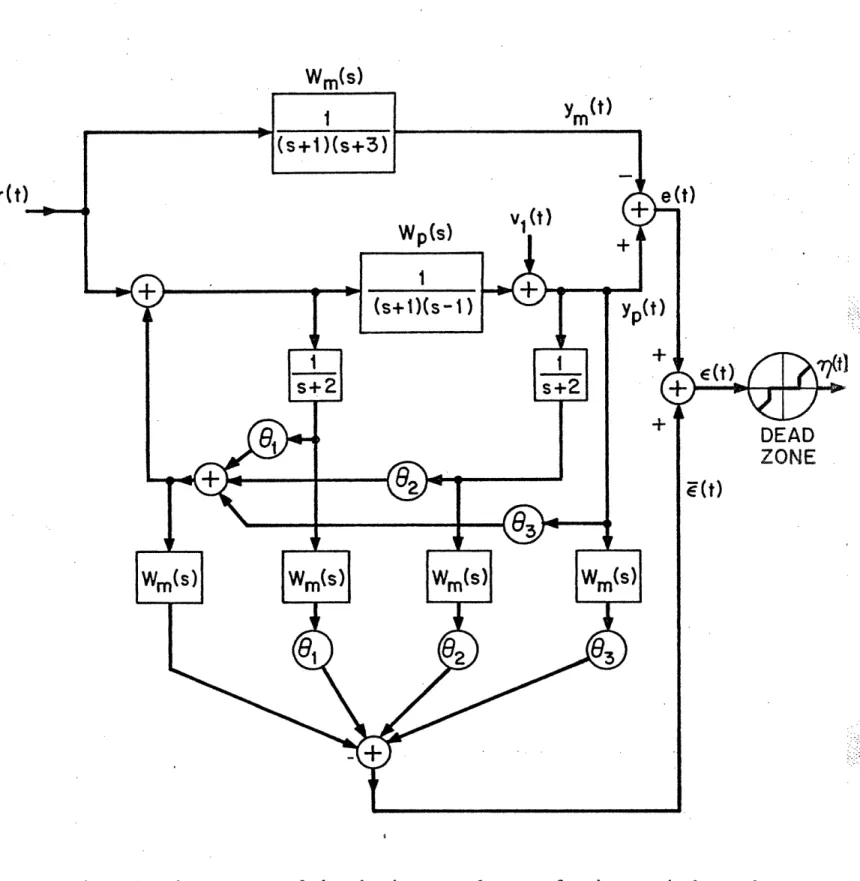
Figure 1 (not included in [1]) shows the structure of the adaptive control system. The structure of Fig. 1 can be deduced from the general equations given in [1]; the three
T A T
adaptive control gains 81, 02 and 03 form the parameter vector e = [010203] and are adjusted on the basis of the signal rn(t) at the dead zone output. When adaptation has proceeded to the point when the magnitude of £(t) is upper bounded by the dead zone cutoff v +6, we have n(t)=O and O(t)=O. This results in £(t)=O and leaves the compensated
0
plant transfer function as
yp (s) s+2
r(s) rus) s +(2-01)s 2(1+03)S+0l-0 -20 -23 2 S 81 3s2 1 2 3
Straightforward algebra confirms that the vector of parameters giving correct model matching (in the absence of the disturbance vl) is
0* T = [-4,12,-12]T (4)
Using Eq. (4), the compensated plant transfer function (3) reduces to
= (s+2) (5)
r(s) m (s+2) (s+l) (s+3) (s+l) (s+3)
Next we compare the correct 0* with the steady state Ssparameter vectors shown in the simulation figures 6c,d,e of [1].
From figure 6c of [1] we have
e = [-0.2,-8.0,-12.2]T (6)
-4-and therefore the adaptation has converged to the transfer function
v
p(S) s+2
r(s) (s+2.52)(s-.16+j3.46)(s-.16-j3.46)
which has two lightly damped poles in the right half plane. The results in figure 6d of [1] yield
S = [- 2.1,-9.2,-12.3]T (8)
which corresponds to the transfer function
y (s) s+2
r(s) (s+3.36) (s+.37+j2.95)(s+.37-j2.95) (9)
The result of figure 6e in [1] yield
8 = [-0.6,- 1 0.2,- 1 7.0] (10)
-- ss
which corresponds to the transfer function
y (s) s+2
( s+) (11)
r(s) (s+2.6) (s+j4) (s-j4)
We would expect the result depicted in figure 6e to be "best" in the sense of model matching since this simulation employs the smallest dead zone and the richest
input. (Unfortunately, the rich input is not defined). In all cases, however, the resultant system is very lightly damped and cannot be considered a very good approxima-tion to the model W (s) it seeks to match. In the case of figure 6c in particular, the compensated plant transfer function (7) is that of an unstable system. This result appears inconsistent with the error time history shown.
from the perspective of model matching performance, the results of adaptive controller design with a dead zone non-linearity in the parameter update law are presently of limited practical value. The theoretical importance of guaranteed state boundedness in the presence of persistent disturbances is a step in the right direction. This development should inspire work aimed at improved model matching in the presence of persistent disturbances as well as under conditions of imperfect model-plant structural matching due to the presence of high order unmodeled dynamics.
Wm(s)
rf~~~~~~~~~~(t),~
e
(t)
Wp(s)
V1(t)
'
VM+D
+-he2
'~
(t)
~~~~~
wi(s)
wi(s)
Wi(s)
wi(s)
Figure 1: The structure of the adaptive control system for the numerical example presented in Ref. [1]. The adjustment mechanism for the adaptive control
REFERENCES
[1] B.P. Peterson and K.S. Narendra, "Bounded Error Adaptive Control" IEEE Trans. on Automatic Control, Vol. AC-27, No. 6, Dec. 1982, pp. 1161-1168.
[2] C.E. Rohrs, L. Valavani, M. Athans, and G. Stein, "Robustness of Adaptive Control Algorithms in the Presence of Unmodeled Dynamics," Proc. 21st. IEEE Conf. on
Decision and Control, Orlando, Fla., Dec. 1982, pp. 3-11.
[3] C.E. Rohrs, "Adaptive Control in the Presence of Unmodeled Dynamics," Ph.D. Thesis, Report LIDS-TH-1254, MIT, August 1982.
[4] P. Ioannou and P. Kokotovic, "Singular Perturbations and Robust Redesign of Adaptive Control," Proc. 21st. IEEE Conf. on Decision and Control, Orlando, Fla., Dec. 1982, pp. 24-29.
[5] P. Ioannou, "Robustness of Model Reference Adaptive Schemes with Respect to Modeling Errors," Ph.D. Thesis, Report DC-53, Univ. of Illinois, August 1982.
[6] B. Egardt, Stability of Adaptive Controllers, Springer-Verlag, Berling, 1979. [7] C. Samson, "Stability Analysis of Adaptively Controlled Systems Subject to Bounded