HAL Id: hal-01244477
https://hal.archives-ouvertes.fr/hal-01244477
Submitted on 15 Dec 2015
HAL is a multi-disciplinary open access
archive for the deposit and dissemination of
sci-entific research documents, whether they are
pub-lished or not. The documents may come from
teaching and research institutions in France or
abroad, or from public or private research centers.
L’archive ouverte pluridisciplinaire HAL, est
destinée au dépôt et à la diffusion de documents
scientifiques de niveau recherche, publiés ou non,
émanant des établissements d’enseignement et de
recherche français ou étrangers, des laboratoires
publics ou privés.
An Open Source Toolkit for Word-level Confidence
Estimation in Machine Translation
Christophe Servan, Ngoc-Tien Le, Ngoc Quang Luong, Benjamin Lecouteux,
Laurent Besacier
To cite this version:
Christophe Servan, Ngoc-Tien Le, Ngoc Quang Luong, Benjamin Lecouteux, Laurent Besacier. An
Open Source Toolkit for Word-level Confidence Estimation in Machine Translation. The 12th
In-ternational Workshop on Spoken Language Translation (IWSLT’15), Dec 2015, Da Nang, Vietnam.
�hal-01244477�
An Open Source Toolkit for Word-level Confidence Estimation
in Machine Translation
Christophe Servan
†, Ngoc Tien Le
†, Ngoc Quang Luong
‡, Benjamin Lecouteux
†and Laurent Besacier
††
GETALP – LIG, University of Grenoble Alpes, France
‡
Idiap Research Institute, 1920 Martigny, Switzerland
Abstract
Recently, a growing need of Confidence Estimation (CE) for Statistical Machine Translation (SMT) systems in Computer Aided Translation (CAT), was observed. However, most of the CE toolkits are optimized for a single target language (mainly English) and, as far as we know, none of them are dedicated to this specific task and freely available.
This paper presents an open-source toolkit for predicting the quality of words of a SMT output, whose novel contribu-tions are (i) support for various target languages, (ii) handle a number of features of different types (system-based, lex-ical, syntactic and semantic). In addition, the toolkit also integrates a wide variety of Natural Language Processing or Machine Learning tools to pre-process data, extract features and estimate confidence at word-level. Features for Word-level Confidence Estimation (WCE) can be easily added / removed using a configuration file.
We validate the toolkit by experimenting in the WCE evaluation framework of WMT shared task with two lan-guage pairs: French-English and English-Spanish. The toolkit is made available to the research community with ready-made scripts to launch full experiments on these language pairs, while achieving state-of-the-art and repro-ducible performances.
1. Introduction
Statistical Machine Translation (SMT) has proven its effi-ciency during the last decade. For Computer Aided Trans-lation (CAT) of documents, the following process is now broadly used: the SMT system produces raw translations then trained professional translators post-edit (correct) trans-lation errors (PE). We believe that this SMT+PE pipeline can be improved using automatic confidence estimation (CE) where the system gives some clues about the quality of the SMT output. For instance, post-editors require to have infor-mation about the possible quality of the translation (Should they just post-edit the translation or rewrite the whole output? What are the main words/phrases they need to focus on?).
Building a method that could point out both correct and incorrect parts in SMT output is a key component to solve the above problems. When we limit the concept “parts”
to “words”, the automatic confidence estimation process is called Word-level Confidence Estimation (WCE).
Past years have seen the emergence of shared tasks to es-timate the translation quality (like WMT CE shared task1).
In 2015, the organizers called for methods to predict the quality of SMT output at run-time on three levels: sentence-level (Task 1), word-sentence-level (Task 2) and (new) document-sentence-level (Task 3). This paper more precisely deals with the second task (WCE) but we believe it might be of interest to re-searchers who work in quality assessment for SMT.
Contributions Our experience in participating in task 2 (WCE) leads us to the following observation: while feature processing is very important to achieve good performance, it requires to call a set of heterogeneous Natural Language Processing tools (for lexical, syntactic, semantic analyses). Thus, we propose to unify the feature processing, together with the call of machine learning algorithms, to facilitate the design of confidence estimation systems. The open-source toolkit proposed (written in Python and made available on GitHub) integrates some standard as well as in-house fea-tures that have proven useful for WCE (based on our experi-ence in WMT 2013 and 2014).
Outline The paper is organized as follow: Section 2 presents WCE task and related works on this topic. Section 3 is an overview of the features we extract while Section 4 describes the toolkit itself. Performances obtained using our WCE toolkit are given in Section 5 while Section 6 illus-trates how one can easily apply feature selection for WCE using the provided code. Finally, Section 7 concludes this work and gives some perspectives.
2. WCE formalisation and related work
2.1. WCE formalisation
Machine translation (MT) consists in finding the most prob-able target language sequence ˆe = (e1, e2, ..., eN) given a
source language sentence f = (f1, f2, ..., fM). We can
represent Word-level Confidence Estimation (WCE) infor-mation as a sequence q (same length N of ˆe) where q =
1Since 2012 (http://www.statmt.org/wmt12/
(q1, q2, ..., qN) and qi ∈ {good, bad}2. Basically, the WCE
component solves the equation3: ˆ
q = argmax
q
{p(q|f, e)} (1)
This is a sequence labelling task that can be solved with several Machine Learning techniques such as Conditional Random Fields (CRF) [1]. However, to train sequence la-belling models, we need a large amount of training data for which a triplet (f, e, q) is available. In our case, we use bi-nary labels associated to each word: Good or Bad to indicate whether a word is “correct” or “incorrect”, respectively. 2.2. Related work
According to [2], features for Word-level Confidence Esti-mation (WCE) can be classified in two types regarding their origin: the “external features” and the “internal features”. On the one hand, internal features are extracted from the SMT system itself like alignment table, N -best list, word graph, etc. On the other hand, external features mainly come from linguistic knowledge sources like syntactic parser, WordNet or BabelNet API, etc. In our approach, we use both types of features. They are mostly detailed in Section 3.
The first works about confidence estimation [3, 4], fo-cused at the word level, was inspired by work done in au-tomatic speech recognition [5]. The combination of a large amount of features, through a Naive Bayes model and a Neu-ral Network, showed that Word Posterior Probability (WPP) was the most relevant internal feature. Later on, [6] inte-grated POS tagging and other external features. In the same way, [7] proposed 70 linguistic features for quality estima-tion at sentence level. Some of these features can be applied at word level. Their work also revealed the need of efficient machine learning algorithms to integrate multiple features and achieve better performance.
Recent workshops proposed some shared evaluation tasks of WCE systems, in which several attempts of partic-ipants to mix internal and external features were successful. The estimation of the confidence score uses mainly classi-fiers like Conditional Random Fields [8, 9], Support Vector Machines [10] or Perceptron [11].
Further, some investigations were conducted to deter-mine which feature seems to be the most relevant. [10] pro-posed to filter features using a forward-backward algorithm to discard linearly correlated features. Using Boosting as learning algorithm, [2] was able to take advantage of the most significant features.
Our work, inspired by all those previous papers, proposes to mix internal and external features and uses CRF as deci-sion algorithm to estimate a WCE score. The technical nov-elty is their integration in a single toolkit, with ready-made scripts, to quickly run reproducible experiments on
differ-2q
icould be also more than 2 labels, or even scores but this paper only
deals with error detection (binary set of labels).
3In the equation, p is a probability but it could be any scoring function.
0 this/0.7 1 that/0.3 2 tactic/1 3 may/0.6 might/0.3 could/0.1 4 be/1 5 working/0.4 operating/0.3 function/0.2 running/0.1
Figure 1: Example of Confusion Network
ent language pairs. It also provides a built-in feature selec-tion approach. Contrarily to the toolkit proposed in [12], our framework allows a quick and easy reproduction of the re-sults presented in this paper and addition of new features is straightforward.
3. Available Features
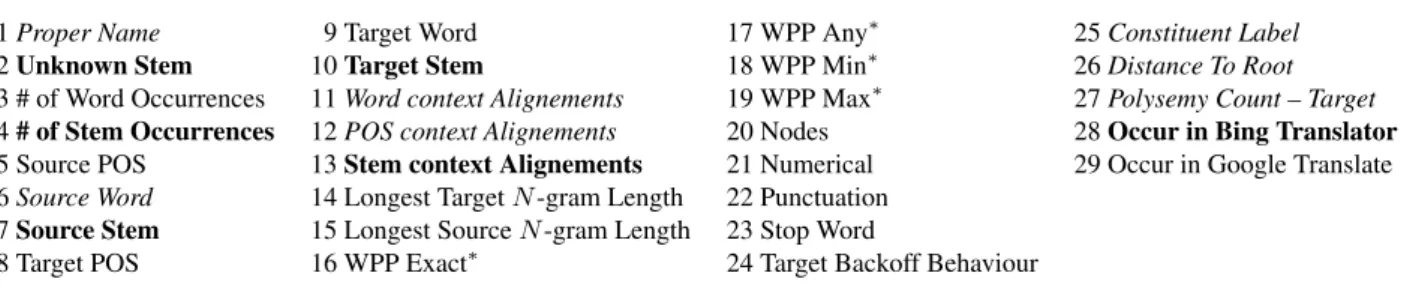
Our toolkit extracts several internal and external features to train a classifier, as indicated in Table 1. These features were chosen because of their relevance in previous Word-level Confidence Estimation tasks [13, 14, 15]. Some of them are already described in detail in some previous papers [5, 3, 4, 6, 10, 2, 16]. Consequently, the novel features, which we added into our current toolkit, are in “bold” in Table 1. Also, the features in “italic” are conventional features but extracted using a new approach.
The feature list could be extended (by us or by other con-tributors) in the future, since the toolkit is made available to the research community. For instance, we plan to integrate the use of monolingual or bilingual word embeddings fol-lowing the works of [17].
It is important to note that our toolkit extracts the features regarding tokens in the machine translation (MT) hypothesis sentence. In other words, one feature is extracted for each token in the MT output. So, in the Table 1, target refers to the feature coming from the MT hypothesis and source refers to a feature extracted from the source word aligned to the considered target word. More details on some of these features are given in the next subsections.
3.1. Internal Features
These features are given by the Machine Translation system, which outputs additional data like N -best list.
In addition to features corresponding to source / target words or POS (feat. 5 to 10), Word Posterior Probabil-ity (WPP), WPP Max, WPP Min and Nodes features are extracted from a confusion network, which comes from the output of the machine translation N -best list. WPP Exact is the WPP value for each word concerned at the exact same po-sition in the graph. WPP Any extract the same information at any position in the graph. WPP Min gives the smallest WPP value concerned by the transition and WPP Max its maximum.
In the example shown in Figure 1, the target word “func-tion”gets a WPP Exact at 0.2, WPP Min at 0.1 and WPP max at 0.4.
1 Proper Name 9 Target Word 17 WPP Any∗ 25 Constituent Label 2 Unknown Stem 10 Target Stem 18 WPP Min∗ 26 Distance To Root 3 # of Word Occurrences 11 Word context Alignements 19 WPP Max∗ 27 Polysemy Count – Target 4 # of Stem Occurrences 12 POS context Alignements 20 Nodes 28 Occur in Bing Translator 5 Source POS 13 Stem context Alignements 21 Numerical 29 Occur in Google Translate 6 Source Word 14 Longest Target N -gram Length 22 Punctuation
7 Source Stem 15 Longest Source N -gram Length 23 Stop Word
8 Target POS 16 WPP Exact∗ 24 Target Backoff Behaviour
Table 1: Features extracted by the toolkit: highlights in “bold” are the new features we propose, the other features are those classically extracted ; we put in “italic” those for which we propose a new extraction method compared to previous work (see Section 4.2.3). Features indicated with “∗” are internal ones.
3.2. External Features
Below is the list of the external features we use in our toolkit: • Proper Name: indicates if a word is a proper name (same binary features are extracted to know if a token is Numerical, Punctuation or Stop Word).
• Unknown Stem: informs whether the stem of the con-sidered word is known or not.
• Number of Word/Stem Occurrences: count the oc-currences of a word/stem in the sentence.
• Alignment context features: these features (#11-13 in Table 1) are based on collocations and proposed by [18]. Collocations could be an indicator for judging if a target word is generated by a particular source word. We also apply the reverse, the collocations regarding the source side:
– Source alignment context features: the combina-tions of the target word, the source word (with which it is aligned), and one source word before and one source word after (left and right contexts respectively).
– Target alignment context features: the combina-tions of the source word, the target word (with which it is aligned), and one target word before and one target word after.
With the example presented in Table 2, the target word “of” is aligned with “de”. The source context extracted corresponds to the two words around “de”, which are “nature” and “l’ ”. The source alignment context fea-turesare “of/nature”, “of/de” and “of/l’ ” In the same way, he target alignment context features of “de” are: “de/nature”, “de/of” and “de/the”.
We applied the same context extraction for Part-of-Speech and Stems.
Target the nature of the independence granted ...
Source la nature de l’ ind´ependance octroy´ee ...
Table 2: Example of parallel sentence where words are aligned one-to-one.
• Longest Target (or Source) N -gram Length: we seek to get the length (n + 1) of the longest left se-quence (wi−n) concerned by the current word (wi) and
known by the language model (LM) concerned (source and target sides). For example, if the longest left se-quence wi−2, wi−1, wi appears in the target LM, the
longest target n-gram value for wiwill be 3. This value
ranges from 0 to the max order of the LM concerned. • The word’s constituent label (Constituent Label) and
its depth in the constituent tree (Distance to Root) are extracted using a syntactic parser, the Figure 2 illus-trates the distance between a word and its root in the tree. In the case of “working”, the Constituent Label is VBG and the Distance to Root value is 6.
Depth 0 1 2 3 4 5 6
Figure 2: Example of constituent tree.
• Target Polysemy Count: we extract the polysemy count, which is the number of meanings of a word in a given language.
• Occurences in Google Translate and Occurences in Bing Translator: in the translation hypothesis, we (optionnally) test the presence of the target word in on-line translations given respectively by Google Trans-lateand Bing Translator.
Training corpus Development corpus Test corpus Classifier Training phase Labelling phase Threshold optimization &
Feature Selection Phase Enrichment
Enrichment
Enrichment
Pre-processing (tokenization, POS tagging, etc.)
Phase
Feature Extraction
Phase
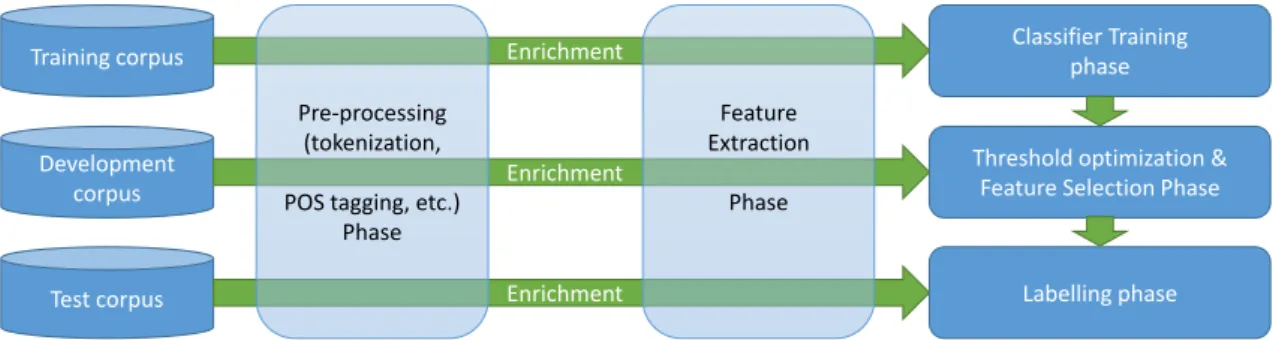
Figure 3: Pipeline of our Word-level Confidence Estimation tool
4. Toolkit
In this section, we detail our toolkit, which is a complete out-of-the-box Word-level Confidence Estimation (WCE) sys-tem. It is a customizable, flexible, and portable platform. 4.1. Pipeline Overview
Our toolkit is described in Figure 3. It contains three essen-tial components: preprocessing, feature extraction and train-ing / labeltrain-ing. It integrates several existtrain-ing Natural Language Processing (NLP) tools and API. It is developed in Python 3 to use efficiently existing libraries/toolkits as well as being object-oriented designed.
The source code is available on a GitHub repository4and
provided with ready-made scripts to run reproducible exper-iments on a French–English WCE task (for which the data is also made available).
4.2. System Design
The first steps are the preprocessing and the feature extrac-tion during which the toolkit processes and adds informaextrac-tion to the initial corpora available. Then, the most important step consists of training a classifier using the features extracted (training phase) or in the labelling of the test corpus (decod-ing phase).
We also added a threshold optimization and a feature se-lection phase which are later described (see Sections 5.5 and 6 respectively for threshold optimization and feature selec-tion).
All these phases can be parameterized using a single con-figuration file.
4.2.1. Configuration file
A configuration file gathers the main WCE parameters. It is stored in YAML5format. The main configuration parame-ters concern the source and target languages involved and the path to the input corpus and its translation.
4.2.2. Preprocessing Phase
Preprocessing consists of obtaining POS tags, word align-ments and all needed analyses from the available parallel
4https://github.com/besacier/WCE-LIG
5http://www.yaml.org/
corpus (the target being a MT output made up of raw text – 1-best and N -best of MT). First, input data is lowercased and/or tokenized if necessary. Then, TreeTagger toolkit [19] is applied to get the Part-Of-Speech (POS) tags and stem of each word in both source and target languages. The different POS extracted are normalized. Finally, word alignments are obtained using GIZA++ [20].
4.2.3. Features Extraction
As said before, the internal features come from the output of the Statistical Machine Translation (SMT) system. In this part we mainly focus on the extraction of the external fea-tures, given by toolkits which are not part of the SMT sys-tem.
The TreeTagger toolkit [19] is involved in the extrac-tion of the following features: “Proper Names”, “Unknown Stems” and “Source/Target Stem”. GIZA++ [20] helps us to extract the context alignment features for POS, Word and Stems. To compute the features “Longest Target N -gram Length” and “Longest Source N -gram Length” we use the SRILM toolkit [21]. The word’s constituent label (“Con-stituent Label”) and its depth in the con(“Con-stituent tree (“Dis-tance to Root”) are also extracted using Bonsai (for French) [22, 23] or Berkeley parser (for other languages) [24]. To represent hierarchical structures and extract the two features, the Natural Language ToolKit (NLTK) [25] in Python is used. The BabelNet [26] API is used to extract the feature “Target polysemy count”.
Finally, the features “Occurences in Google Translate” and “Occurences in Bing Translator” are extracted by using the Google Translate and Bing Translator API, respectively. 4.2.4. Training / Decoding Phase
Once the final feature extraction stage has been completed, we use Conditionnal Random Fields (CRF) as machine learn-ing technique through the Wapiti toolkit [27].
The classifier uses all the chosen features and it is trained on a preliminary labelled corpus (see next section for exam-ple of corpora directly usable with our toolkit). During de-coding phase, the classifier determines, from a test corpus, whether a word should be labelled as “correct” or “incorrect” (respectively Good or Bad).
5. WCE Experiments
This section presents the experiments done for 2 different language pairs: French–English (fr–en) with the corpus pro-vided by [28] and English–Spanish (en–sp) corresponding to the WMT shared task on word confidence estimation (2014 edition6).
5.1. The French–English post-edited corpus
The fr–en corpus contains 10881 translations. It was taken from several French–English news corpora from former WMT evaluation campaigns (from 2006 to 2010) [28].
To obtain the translations, [28] used a French–English phrase-based translation system based on the Moses toolkit [29]. This medium-sized system was trained on Europarl and News parallel corpora for a former WMT evaluation shared-task (system more precisely described in [30] - 1.6M paral-lel sentences and 48M monolingual sentences in target lan-guage).
The hypotheses translated were post-edited according to the methodology described in [28]. 10000 random sentences were extracted to create the training data and the remaining sentences were used for the evaluation corpus.
In order to evaluate our Word-level Confidence Estima-tion (WCE) system, we obtained a sequence q of quality la-bels (recall that q = (q1, q2, ..., qN) and qi ∈ {good, bad})
using TER-Plus toolkit [31]. Each word or phrase in the hy-pothesis ehypis aligned to a word or phrase in the reference
(eref) with different types of edit: “I” (insertions), “S”
(sub-stitutions), “T” (stem matches), “Y” (synonym matches), “P” (phrasal substitutions) and “E” (exact match). Then, we re-categorize the obtained 6-label set into binary set: the “E”, “T” and “Y” belong to the good (“G”), whereas the “S”, “P” and “I” belong to the bad (“B”) category.
An example of output of TER-Plus evaluation tool is shown in Table 3.
Original Ref.: this is enough to shake asset prices Original Hyp.: what is enough to cower prices of assets Ref.: this is enough to ***** shake asset prices Hyp.: what is enough to cower prices of assets Hyp. After Shift: what is enough to cower of assets prices
Alignment: S E E E I S T E
Labels: B G G G B B G G
Table 3: Example of the TER-Plus toolkit’s output processed
5.2. Adaptation to a new language pair
To evaluate our toolkit on another language pair (English– Spanish), we used the official data from WMT 2014 shared task on WCE.
One of the strength of our toolkit is the easiness to adapt it to another language pair within the (so-far) supported lan-guages which are French, English, and Spanish. Thus, a few configuration parameters were changed to move from the French–English (fr–en) to English–Spanish (en–es), which
6http://www.statmt.org/wmt14/
quality-estimation-task.html
are mainly the source language, the target language, and paths associated to input files.
Consequently, our WCE toolkit process en–es task in the same way as for fr–en task, but some features may not be ex-tracted due to language-pair specificities: unavailable tools, no N -best, etc. For instance, for the en–es task, since the N -best list is not available, we cannot extract the five follow-ing internal features: “WPP Exact”, “WPP Any”, “Nodes”, “WPP Min” and “WPP Max”.
5.3. Results
The WCE evaluation measures are the Precision (P ), the Re-call (R) and the F-Measure (F ) of each label (as reminder, the decision label can be either good or bad). We use wapiti [27] to train the CRF model and label the words.
5.4. Comparison with the State-of-the-Art
Systems M-F F(bad) FBK-UPV-UEDIN-1 [32] 62.00 48.73 LIMSI [33] 60.55 47.32 → Our toolkit 60.76 47.17 LIG-1 [9] 63.55 44.47 LIG-2 [9] 63.77 44.11 FBK-UPV-UEDIN-2 [32] 62.17 42.63
Table 4: Results of the best systems at the Word-level Quality Estimation task (en–es) at WMT14 [15], only the Mean F-Measure (M-F) and the F-F-Measure (F) on the bad labels are available to compare the performances of our toolkit.
Using the default decision threshold of our classifier, the Table 4 presents the results obtained in the WMT14 Qual-ity Estimation shared task with the language pair English– Spanish (en–es).
The results show that our toolkit obtained similar perfor-mances compared to the State-of-the-Art. We could not com-pare with the CE toolkit mentionned in [12] since they did not provided full results within the framework of the WMT14 evaluation. Future work could involve a comparison between our toolkit and the toolkit presented in [12].
5.5. Decision threshold optimization
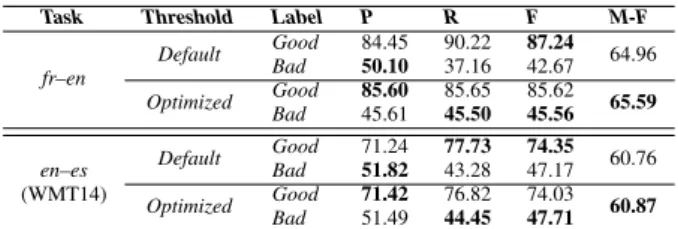
Table 5 shows the classification performances of our toolkit for the two different language pairs: the French–English (fr– en) and the English–Spanish (en–es). The latter corresponds to the Quality Estimation shared task of WMT14 [15].
Our toolkit proposes to optimize the decision threshold but, in this context, what we report can be only considered as an oracle threshold setting since no real development corpus was available for both language pairs. These results are only reported to demonstrate the ability of the toolkit to tune the decision threshold. With this optimization, the scores are im-proved for the bad label (+2.89 points) regarding the results obtained with the default threshold in the fr–en task. In the en–estask, the oracle threshold sightly improves the results, according to the Mean F-Measure (+0.11 points).
Task Threshold Label P R F M-F fr–en Default Good 84.45 90.22 87.24 64.96 Bad 50.10 37.16 42.67 Optimized Good 85.60 85.65 85.62 65.59 Bad 45.61 45.50 45.56 Default Good 71.24 77.73 74.35 60.76 en–es Bad 51.82 43.28 47.17 (WMT14) Optimized Good 71.42 76.82 74.03 60.87 Bad 51.49 44.45 47.71
Table 5: The toolkit’s WCE performances with fr–en and en–es(WMT14) tasks. Note that for each language pair, the first block of results corresponds to the performance obtained with default decision threshold and the second block corre-sponds to the performance with an oracle threshold (to opti-mize Mean F-measure of Good and Bad labels).
6. Features selection
This section illustrates how the toolkit can be used for feature selection and analysis of performance with different feature sets. The next experiments reported were done for the fr–en task with the default decision threshold.
6.1. Experimenting with different feature sets The following feature sets were evaluated in this section:
• the baseline features (Base.) given in Table 1 (not “bold”, not “italic”, no feat. 28-29),
• same as above + modified features estimated with a new method (in “italic” in Table 1) are added (mod.) ; • same as above + the new features (new) mentionned in
Table 1 (the ones in “bold”) ;
• same as above + features 28-29 of Table 1 involving online MT systems (MT). Features Labels P R F M-F Base. Good 81.97 92.22 86.80 58.64 Bad 44.17 23.28 30.48 + mod. Good 83.21 90.99 86.92 62.00 Bad 47.24 30.53 37.09 + new Good 83.55 90.11 86.70 62.65 Bad 46.75 32.86 38.60 + MT Good 84.45 90.22 87.24 64.96 Bad 50.10 37.16 42.67
Table 6: Improvements obtained regarding the features added. For both labels (Good and Bad) we use the Precision (P), Recall (R) and F-Measure (F). The Mean F-Measure of Goodand Bad labels is presented in the last column.
We can observe for all the steps a general improvement of the Mean F-Measure in Table 6. The baseline is 58.64, while the use of modified features enables to get over 62. The new features show their usefulness with a Mean F-Measure score at 62.65 points. Finally, adding occurences coming from on-line Machine Translation systems enables us to get 64.96 points. Even if using online MT systems for WCE can ap-pear as controversial, this seems to bring useful information to our classifier.
6.2. Feature selection using Sequential Forward Selec-tion (SFS) algorithm
Going further, we propose to process a finer feature selection using the Sequential Forward Selection (SFS) algorithm for which scripts are made available in our toolkit distribution.
While feature selection can be made through several ap-proaches [34], we chose to use the SFS method. It is a bottom up algorithm which starts from a feature set noted Yk(which
can be empty or not) and selects as first feature (x) the one that maximizes the Mean F-Measure, M F (Yk+ x), from a
set of features (Jk). The algorithm below summarizes the
whole process:
while size of Jk> 0 do maxval = 0 for x ∈ Jkdo
if maxval < M F (Yk+ x) then maxval ← M F (Yk+ x) bestf eat ← x
end if end for
add bestf eat to Yk remove bestf eat from Jk end while
In Table 7 we present the result of the SFS algorithm, which ranks our new features starting from an empty feature set. The dash line marks the limit of the best feature set ac-cording to the Mean F-Measure (with 65.14 points).
It appears that most of new features we added (in “bold”) bring relevant information associated to classical ones (no highlight and in “italic”). Only the feature “Target Stem” seems to be irrelevant for the fr–en task. One reason for that might be that for the English language, stem and words fea-tures may be highly correlated.
Rank Feature Rank Feature
1 Stem context Alignements 16 Stop Words
2 WPP Exact 17 Nodes
3 Word context Alignements 18 # of Stem Occurrences
4 WPP Max 19 Numeric
5 WPP Any 20 Unknown Stem
6 WPP Min 21 Target Word
7 POS context Alignements 22 Source POS
8 Occur in Google Translate 23 Polysemy Count – Target
9 Longest Target N -gram Length 24 Source Word
10 Occur in Bing Translate 25 Constituent Label
11 Source Stem 26 Punctuation
12 Target Backoff Behaviour 27 Target Stem
13 Longest Source N -gram Length 28 Proper Name
14 # of Word Occurrences 29 Target POS
15 Distance To Root
Table 7: Rank of each feature according to the Sequential Forward Selection algorithm within the framework of the fr– entask. The Dash line marks the best Mean F-Measure score obtained with 65.14 points.
This feature selection functionnality is provided with the toolkit, which means that whatever set of features the user wants to test, he/she can apply the SFS algorithm very easily.
7. Conclusion and Perspectives
This paper presented our Word Confidence Estimation (WCE) approach made available through an open-source toolkit. It combines some classical features as well as some new in-house features. All these features are passed through a Conditional Random Fields (CRF) classifier to estimate the correctness of a word.
The WCE experiments conducted achieve State-of-the-Art and reproducible performances measured on two differ-ent data sets corresponding to two language pairs (French– English and English–Spanish). Thanks to its flexibility, our toolkit is nearly language independent, as long as the user can provide grammars and models for the specified languages.
Our WCE toolkit has been packaged and released for oth-ers to be able to reproduce rapidly the experiments reported in this article. This package is made available on a GitHub repository7under the licence GPL V3.
In addition to this toolkit, comes a special module, which enables feature selection automatically using SFS algorithm (sequential forward selection). A more performant algorithm will be added in the near future like the Sequential Floating Forward Selection algorithm, which has backtracking capa-bilities.
Further work will focus on (i) adding features (based on word embeddings for instance) and (ii) evaluating the toolkit efficiency in a real Computer Assisted Translation (CAT) framework. We also plan to extend our toolkit to the design of WCE for speech recognition and speech translation tasks.
8. Acknowledgement
The authors would like to thank the anonymous reviewers for their valuable comments and suggestions to improve the quality of the paper.
This work was partially founded by the French National Research Agency (ANR) through the KEHATH Project.
9. References
[1] J. Lafferty, A. McCallum, and F. Pereira, “Conditional Random Fields: Probabilistic Models for Segmenting and Labeling Sequence Data,” in Proceedings of 18th International Conference on Machine Learning. Mor-gan Kaufmann, San Francisco, Californie, ´Etats-Unis d’Amrique, 2001, pp. 282–289.
[2] N.-Q. Luong, L. Besacier, and B. Lecouteux, “To-wards Accurate Predictors of Word Quality for Ma-chine Translation: Lessons Learned on French - En-glish and EnEn-glish - Spanish Systems,” Data and Knowl-edge Engineering, p. 11, Apr. 2015.
[3] N. Ueffing, K. Macherey, and H. Ney, “Confidence Measures for Statistical Machine Translation,” in Pro-ceedings of the MT Summit IX, New Orleans, LA, September 2003, pp. 394–401.
7https://github.com/besacier/WCE-LIG
[4] J. Blatz, E. Fitzgerald, G. Foster, S. Gandrabur, C. Goutte, A. Kulesza, A. Sanchis, and N. Ueffing, “Confidence estimation for machine translation,” in Proceedings of COLING 2004, Geneva, April 2004, pp. 315–321.
[5] F. Wessel, R. Schl¨uter, K. Macherey, and H. Ney, “Confidence Measures for Large Vocabulary Continu-ous Speech Recognition,” IEEE TRANSACTIONS ON SPEECH AND AUDIO PROCESSING, 2001.
[6] D. Xiong, M. Zhang, and H. Li, “Error Detection for Statistical Machine Translation Using Linguistic Fea-tures,” in Proceedings of the 48th Association for Com-putational Linguistics, Uppsala, Sweden, July 2010, pp. 604–611.
[7] M. Felice and L. Specia, “Linguistic Features for Qual-ity Estimation,” in Proceedings of the 7th Workshop on Statistical Machine Translation, Montreal, Canada, June 7-8 2012, pp. 96–103.
[8] A. L.-F. Han, Y. Lu, D. F. Wong, L. S. Chao, L. He, and J. Xing, “Quality estimation for machine translation us-ing the joint method of evaluation criteria and statistical modeling,” in Proceedings of the Eighth Workshop on Statistical Machine Translation, Sofia, Bulgaria, Aug. 2013, pp. 365–372.
[9] N.-Q. Luong, L. Besacier, and B. Lecouteux, “LIG System for Word Level QE task at WMT14,” in Pro-ceedings of the Ninth Workshop on Statistical Machine Translation, Baltimore, Maryland USA, June 2014, pp. 335–341.
[10] D. Langlois, S. Raybaud, and K. Sma¨ıli, “Loria sys-tem for the WMT12 quality estimation shared task,” in Proceedings of the Seventh Workshop on Statistical Machine Translation, Baltimore, Maryland USA, June 2012, pp. 114–119.
[11] E. Bicici, “Referential Translation Machines for Qual-ity Estimation,” in Proceedings of the Eighth Work-shop on Statistical Machine Translation. Sofia, Bul-garia: Association for Computational Linguistics, Au-gust 2013, pp. 343–351.
[12] L. Specia, G. Paetzold, and C. Scarton, “Multi-level Translation Quality Prediction with QuEst++,” in 53rd Annual Meeting of the Association for Computational Linguistics and Seventh International Joint Conference on Natural Language Processing of the Asian Federa-tion of Natural Language Processing: System Demon-strations, 2015, pp. 115–120.
[13] C. Callison-Burch, P. Koehn, C. Monz, M. Post, R. Soricut, and L. Specia, “Findings of the 2012 Work-shop on Statistical Machine Translation,” in Proceed-ings of the Seventh Workshop on Statistical Machine
Translation. Montr´eal, Canada: Association for Com-putational Linguistics, June 2012, pp. 10–51.
[14] O. Bojar, C. Buck, C. Callison-Burch, C. Federmann, B. Haddow, P. Koehn, C. Monz, M. Post, R. Sori-cut, and L. Specia, “Findings of the 2013 Workshop on Statistical Machine Translation,” in Proceedings of the Eighth Workshop on Statistical Machine Transla-tion. Sofia, Bulgaria: Association for Computational Linguistics, August 2013, pp. 1–44.
[15] O. Bojar, C. Buck, C. Federmann, B. Haddow, P. Koehn, J. Leveling, C. Monz, P. Pecina, M. Post, H. Saint-Amand, R. Soricut, L. Specia, and A. Tam-chyna, “Findings of the 2014 Workshop on Statisti-cal Machine Translation,” in Proceedings of the Ninth Workshop on Statistical Machine Translation. Balti-more, Maryland, USA: Association for Computational Linguistics, June 2014, pp. 12–58.
[16] S. Raybaud, D. Langlois, and K. Smaili, “”This sen-tence is wrong.” Detecting errors in machine-translated sentences,” Machine Translation, vol. 25, no. 1, pp. p. 1–34, Aug. 2011.
[17] T. Mikolov, I. Sutskever, K. Chen, G. Corrado, and J. Dean, “Distributed Representations of Words and Phrases and their Compositionality,” in NIPS, 2013. [18] N. Bach, F. Huang, and Y. Al-Onaizan, “Goodness:
A Method for Measuring Machine Translation Con-fidence,” in Proceedings of the 49th Annual Meeting of the Association for Computational Linguistics, Port-land, Oregon, June 2011, pp. 211–219.
[19] H. Schmid, “Improvements in Part-of-Speech Tagging with an Application to German,” in Proceedings of the ACL SIGDAT-Workshop, Dublin, Ireland, 1995. [20] F. J. Och and H. Ney, “A Systematic Comparison Of
Various Statistical Alignment Models,” Computational Linguistics, vol. 29, no. 1, pp. 19–51, 2003.
[21] A. Stolcke, “SRILM - An Extensible Language Mod-eling Toolkit,” in Seventh International Conference on Spoken Language Processing, Denver, USA, 2002, pp. 901–904.
[22] A. Laurent, N. Camelin, and C. Raymond, “Boosting bonsai trees for efficient features combination: applica-tion to speaker role identificaapplica-tion,” in InterSpeech, Sin-gapour, September 2014, pp. 76–80.
[23] M. Candito, J. Nivre, P. Denis, and E. H. Anguiano, “Benchmarking of Statistical Dependency Parsers for French,” in Proceedings of COLING’2010, 2010. [24] S. Petrov and D. Klein, “Improved Inference for
Unlex-icalized Parsing,” in HLT-NAACL, 2007.
[25] S. Bird, E. Klein, and E. Loper, Natural Language Pro-cessing with Python. O’Reilly Media Inc, 2009. [26] R. Navigli and S. P. Ponzetto, “BabelNet: The
Auto-matic Construction, Evaluation and Application of a Wide-Coverage Multilingual Semantic Network,” Ar-tificial Intelligence, vol. 193, pp. 217–250, 2012. [27] T. Lavergne, O. Capp´e, and F. Yvon, “Practical Very
Large Scale CRFs,” in Proceedings the 48th Annual Meeting of the Association for Computational Linguis-tics (ACL). Association for Computational LinguisLinguis-tics, July 2010, pp. 504–513.
[28] M. Potet, E. Esperanc¸a-Rodier, L. Besacier, and H. Blanchon, “Collection of a Large Database of French-English SMT Output Corrections,” in Proceed-ings of the eighth international conference on Lan-guage Resources and Evaluation (LREC), Istanbul, Turkey, May 2012.
[29] P. Koehn, H. Hoang, A. Birch, C. Callison-Burch, M. Federico, N. Bertoldi, B. Cowan, W. Shen, C. Moran, R. Zens, C. Dyer, O. Bojar, A. Constantin, and E. Herbst, “Moses: Open source toolkit for statis-tical machine translation,” in Proceedings of the 45th Annual Meeting of the Association for Computational Linguistics, Prague, Czech Republic, June 2007, pp. 177–180.
[30] M. Potet, L. Besacier, and H. Blanchon, “The LIG ma-chine translation system for WMT 2010,” in Proceed-ings of the joint fifth Workshop on Statistical Machine Translation and Metrics MATR (WMT2010), A. Work-shop, Ed., Uppsala, Sweden, 11-17 July 2010.
[31] M. Snover, N. Madnani, B. Dorr, and R. Schwartz, “TERp system description,” in MetricsMATR workshop at AMTA, 2008.
[32] J. G. Camargo de Souza, J. Gonz´alez-Rubio, C. Buck, M. Turchi, and M. Negri, “FBK-UPV-UEdin participa-tion in the WMT14 Quality Estimaparticipa-tion shared-task,” in Proceedings of the Ninth Workshop on Statistical Ma-chine Translation. Baltimore, Maryland, USA: Asso-ciation for Computational Linguistics, June 2014, pp. 322–328.
[33] G. Wisniewski, N. P´echeux, A. Allauzen, and F. Yvon, “LIMSI Submission for WMT’14 QE Task,” in Pro-ceedings of the Ninth Workshop on Statistical Machine Translation. Baltimore, Maryland, USA: Association for Computational Linguistics, June 2014, pp. 348– 354.
[34] M. Kudo and J. Sklansky, “Comparison of algorithms that select features for pattern classifiers,” Pattern recognition, vol. 33, no. 1, pp. 25–41, 2000.