Activity of the novel siderophore cephalosporin cefiderocol
against multidrug-resistant Gram-negative pathogens
J. Dobias
1,2,3,4&V. Dénervaud-Tendon
1,2,3,4&L. Poirel
1,2,3,4&P. Nordmann
1,2,3,4,5Abstract The novel siderophore cephalosporin cefiderocol
(S-649266) with potent activity against Gram-negative
patho-gens was recently developed (Shionogi & Co., Ltd.). Here, we
evaluated the activity of this new molecule and comparators
against a collection of previously characterized Gram-negative
isolates using broth microdilution panels. A total of 753 clinical
multidrug-resistant Gram-negative isolates collected from
hos-pitals worldwide were tested against cefiderocol and antibiotic
comparators (ceftolozane–tazobactam [CT], meropenem
[MEM], ceftazidime [CAZ], ceftazidime–avibactam [CZA],
colistin [CST], aztreonam [ATM], amikacin [AMK],
ciproflox-acin [CIP], cefepime [FEP], and tigecycline [TGC]) for their
susceptibility. The collection included Escherichia coli
(n = 164), Klebsiella pneumoniae (n = 298), Enterobacter sp.
(n = 159), Pseudomonas aeruginosa (n = 45), and
Acinetobacter baumannii (n = 87). Resistance mechanisms
in-cluded producers of carbapenemases and extended-spectrum
β-lactamases (ESBLs). In addition, a series of
colistin-resistant enterobacterial isolates (n = 74), including 15
MCR-1 producers, were tested. The MIC
90of cefiderocol was 2 mg/
L, while those of comparative drugs were >64 mg/L for CT,
MEM, CAZ, CZA, and AMK, >32 mg/L for ATM, >16 mg/L
for FEP, 8 mg/L for CST, and 2 mg/L for TGC. The MIC
50of
cefiderocol was 0.5 mg/L, while those of other drugs were
>64 mg/L for CAZ, 64 mg/L for CT, >32 mg/L for ATM,
>16 mg/L for FEP, 8 mg/L for MEM and AMK, >4 mg/L for
CIP, 1 mg/L for CZA, 0.5 mg/L for TGC, and <0.5 mg/L for
CST. Only 20 out of 753 strains showed MIC values of
cefiderocol
≥8 μg/mL. Compared to the other drugs tested,
cefiderocol was more active, with the exception of colistin
and tigecycline showing equivalent activity against certain
sub-groups of bacteria.
Introduction
Gram-negative bacteria that produce extended-spectrum
β-lactamases (ESBLs) are a major concern in healthcare due to
their ability to spread globally [1]. ESBLs are a major group of
enzymes that confer resistance to several generations of
β-lactam antibiotics, including third-generation cephalosporins
[2,
3]. ESBL-encoding genes that are primarily
plasmid-encoded include mostly TEM-, SHV-, and CTX-M-type
en-zymes [4]. Enterobacteriaceae, such as Klebsiella pneumoniae
and Escherichia coli, are the main ESBL producers that have
been reported globally. Carbapenems are mostly used for the
treatment of infections due to ESBL-producing bacteria, but
carbapenemase-producing bacteria are now extensively
report-ed [5,
6]. Polymyxins (e.g., colistin and polymyxin B) are now
more frequently used as last-resort antibiotics for treating
pa-tients with multidrug-resistant bacterial infections [7].
However, a recent report shows that a novel gene (mcr-1) as
a source of plasmid-encoded resistance encoded on a plasmid
in E. coli may quickly spread to other bacterial strains or
spe-cies [8–10]. Therefore, due to the increasing threat of
* P. Nordmann
1 Emerging Antibiotic Resistance Unit, University of Fribourg, Fribourg, Switzerland
2
National Reference Center for Emerging Antibiotic Resistance (Switzerland), University of Fribourg, Fribourg, Switzerland 3
French INSERM European Unit (LEA/IAME), University of Fribourg, Fribourg, Switzerland
4 Medical and Molecular Microbiology Unit, Department of Medicine, University of Fribourg, rue Albert Gockel 3,
1700 Fribourg, Switzerland 5
Institute for Microbiology, University of Lausanne and University Hospital Centre, Lausanne, Switzerland
http://doc.rero.ch
Published in "European Journal of Clinical Microbiology & Infectious Diseases
doi: 10.1007/s10096-017-3063-z, 2017"
multidrug-resistant and pandrug-resistant bacteria, there is a
need for novel molecules. Cefiderocol (CFDC) is a novel
par-enteral siderophore cephalosporin also known as S-649266. It
possesses a unique mechanism for penetrating efficiently into
Gram-negative pathogens. It uses a
BTrojan horse^ strategy by
binding free iron and is then actively transported into bacterial
cells across the outer membrane of Gram-negative bacteria by
way of the iron-transport system [11,
12]. Cefiderocol is a
cephalosporin molecule with an attached catechol moiety on
the 3-position side chain which binds to ferric iron [11]. Once
across the outer membrane, the iron dissociates and the
cepha-losporin binds to penicillin-binding proteins (PBP), mainly
PBP3, as other cephalosporins do to disrupt cell wall synthesis
[11,
13], contributing to a potent antimicrobial activity against
Gram-negative bacteria. In addition, this antimicrobial activity
of cefiderocol is enhanced by the high stability of cefiderocol to
hydrolysis by nearly all
β-lactamases, including both the serine
and metallo-carbapenemases [14]. The ability to cross the outer
membrane through the active iron-transport system overcomes
resistance due to porin channel mutations and efflux pump
overproducers. It results that cefiderocol exhibits potent
in vitro and in vivo activity against all species of
Gram-negative bacteria, including carbapenem-resistant strains of
Enterobacteriaceae, Pseudomonas aeruginosa, and
Acinetobacter baumannii, and even Stenotrophomonas
maltophilia [15]. Here, we evaluated the antimicrobial activity
of cefiderocol and other Gram-negative antibiotics (aztreonam,
amikacin, cefepime, ceftazidime, ceftazidime–avibactam,
ceftolozane–tazobactam, ciprofloxacin, meropenem, colistin,
and tigecycline) against a panel of 753 multidrug-resistant
bac-terial isolates from human clinical sources with characterized
antibiotic resistance mechanisms.
Materials and methods
Bacterial isolates
A total of 753 clinical multidrug-resistant isolates were
eval-uated in this study (Table
1). They were representative of the
most widespread and broad-spectrum mechanisms of
resis-tance currently observed worldwide in Gram-negative
bacte-ria. The strains were collected from hospitals worldwide (42
countries) from 2000 to 2016, with a majority dating from the
2012–2016 period. They were of various origins (not always
recorded) but mostly from urines, broncho-alveolar
speci-mens, blood, pus, and stools.
In vitro susceptibility test methods
Minimum inhibitory concentrations (MICs) were determined
following the Clinical and Laboratory Standards Institute
(CLSI) broth microdilution (BMD) guidelines [16]. Frozen
96-well broth microdilution panels with pre-loaded
antibiot-ic-growth medium were supplied by International Health
Management Associates, Inc. (Schaumburg, IL, USA).
Cefiderocol was tested in iron-depleted cation-adjusted
Mueller
–Hinton broth (ID-CAMHB) [
17], as recently
ap-proved by the CLSI (http://clsi.org/standards/micro/
microbiology-files/), whereas comparators were tested in
cation-adjusted Mueller
–Hinton broth (CAMHB). Quality
Table 1 Bacterial strains tested in this study Genus (species) Number of
tested isolates Characterized resistance Escherichia coli (164) 43 OXA (-1/48/181/204) 22 VIM (-1/2/4/19), IMP (-1/8) 45 NDM (-1/4/5/6/7) 11 KPC (-2/3) 25 CTX-M (-1/3/15) 15 MCR-1
3 Non-MCR-1 colistin resistant
Klebsiella pneumoniae (298) 101 KPC (-2/3/11) 89 OXA (-48/162/163/181/204/232)a 18 NDMb(-1/4) 20 VIM (-1/4/19), IMP (-1/4/8) 25 CTX-M (-3/15) 45 Colistin R Enterobacteriaceae (159) 26 OXA (-48/163) 10 NDM-1 5 VIM-1 14 IMP (-1/8) 14 KPC-2 49 CTX-M (-3/15) 7 VEB-1 14 SHV-12
9 Plasmid-mediated AmpC and
overproducer of AmpC 11 Colistin R Pseudomonas aeruginosa (45) 6 PER-1 9 SHV (-2a/5/12), GES (-1/9) 20 IMP (-1/2/10/13/15/19/29), KPC-2 10 VIM (-1/2), SPM-1, GIM-1 Acinetobacter baumannii (87) 85 OXA-23/40/58/72 2 NDM-1, IMP-4 Total 753 a
Five strains are OXA-48 producers and colistin resistant b
Five strains are NDM producers and colistin resistant
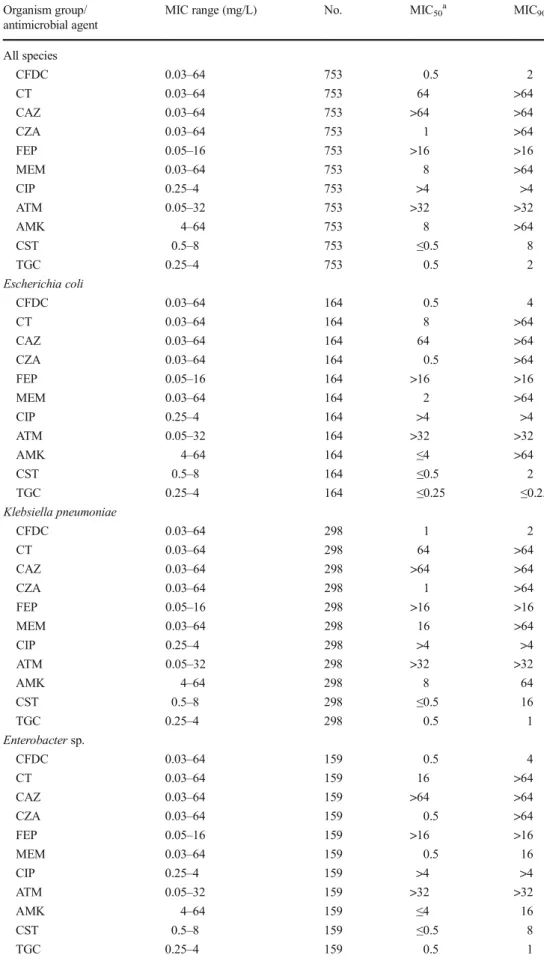
Table 2 In vitro activities of cefiderocol (CFDC), ceftolozane– tazobactam (CT), meropenem (MEM), ceftazidime (CAZ), ceftazidime–avibactam (CZA), colistin (CST), aztreonam (ATM), amikacin (AMK), ciprofloxacin (CIP), cefepime (FEP), and tigecycline (TGC) against E. coli, K. pneumoniae, Enterobacter sp., P. aeruginosa, and A. baumannii
Organism group/ antimicrobial agent
MIC range (mg/L) No. MIC50a MIC90a
All species CFDC 0.03–64 753 0.5 2 CT 0.03–64 753 64 >64 CAZ 0.03–64 753 >64 >64 CZA 0.03–64 753 1 >64 FEP 0.05–16 753 >16 >16 MEM 0.03–64 753 8 >64 CIP 0.25–4 753 >4 >4 ATM 0.05–32 753 >32 >32 AMK 4–64 753 8 >64 CST 0.5–8 753 ≤0.5 8 TGC 0.25–4 753 0.5 2 Escherichia coli CFDC 0.03–64 164 0.5 4 CT 0.03–64 164 8 >64 CAZ 0.03–64 164 64 >64 CZA 0.03–64 164 0.5 >64 FEP 0.05–16 164 >16 >16 MEM 0.03–64 164 2 >64 CIP 0.25–4 164 >4 >4 ATM 0.05–32 164 >32 >32 AMK 4–64 164 ≤4 >64 CST 0.5–8 164 ≤0.5 2 TGC 0.25–4 164 ≤0.25 ≤0.25 Klebsiella pneumoniae CFDC 0.03–64 298 1 2 CT 0.03–64 298 64 >64 CAZ 0.03–64 298 >64 >64 CZA 0.03–64 298 1 >64 FEP 0.05–16 298 >16 >16 MEM 0.03–64 298 16 >64 CIP 0.25–4 298 >4 >4 ATM 0.05–32 298 >32 >32 AMK 4–64 298 8 64 CST 0.5–8 298 ≤0.5 16 TGC 0.25–4 298 0.5 1 Enterobacter sp. CFDC 0.03–64 159 0.5 4 CT 0.03–64 159 16 >64 CAZ 0.03–64 159 >64 >64 CZA 0.03–64 159 0.5 >64 FEP 0.05–16 159 >16 >16 MEM 0.03–64 159 0.5 16 CIP 0.25–4 159 >4 >4 ATM 0.05–32 159 >32 >32 AMK 4–64 159 ≤4 16 CST 0.5–8 159 ≤0.5 8 TGC 0.25–4 159 0.5 1
http://doc.rero.ch
control (QC) strains (E. coli ATCC 25922, K. pneumoniae
ATCC 700603, and P. aeruginosa ATCC 27853) were tested
regularly to ensure the stability of the panels and validity of
the test methods. The acceptable concentration range for QC
strains is 0.06–0.5 mg/L for E. coli and P. aeruginosa and not
yet defined for K. pneumoniae.
All isolates were tested against the following antibiotics for
the given concentration range: cefiderocol (S-649266)
(CFDC, 0.03
–64 mg/L), aztreonam (ATM, 0.5–32 mg/L),
ce-fepime (FEP, 0.5–16 mg/L), ceftolozane–tazobactam (CT,
0.03–64 mg/L), meropenem (MEM, 0.03–64 mg/L),
ceftazi-dime (CAZ, 0.03
–64 mg/L), ceftazidime–avibactam (CZA,
0.03–64 mg/L), colistin (CST, 0.5–8 mg/L), amikacin
(AMK, 4–64 mg/L), ciprofloxacin (CIP, 0.25–4 mg/L), and
tigecycline (TGC, 0.25
–4 mg/L).
The strains were grown overnight on a non-selective agar
medium and two to three colonies were solubilized in 3 mL
sterile 0.85% NaCl. The turbidity was adjusted to 0.5
McFarland with a McFarland densitometer DEN-1B from
Grant Bio (Grant instruments Ltd., Cambridge, UK). One
mil-liliter of inoculum was then diluted in 29 mL of sterile ddH
2O
and 10
μL were added to each BMD panel well. The panels
were incubated for 16–20 h at 35 °C. To ensure an even
thermal distribution during incubation, the panels were
stacked no more than four high. The MIC reading was then
done according to the CLSI guidelines [18].
Results and discussion
The susceptibility test results are listed in Tables
2–7. The
MIC
90(MIC value that inhibits 90% of the isolates) of
cefiderocol was 2 mg/L (Table
2), while those of comparative
drugs were >64 mg/L for CT, MEM, CAZ, CZA, and AMK,
>32 mg/L for ATM, >16 mg/L for FEP, 8 mg/L for CST, and
2 mg/L for TGC. The MIC
50of CFDC was at 0.5 mg/L, while
those of other drugs were >64 mg/L for CAZ, 64 mg/L for CT,
>32 mg/L for ATM, >16 mg/L for FEP, 8 mg/L for MEM and
AMK, >4 mg/L for CIP, 1 mg/L for CZA, 0.5 mg/L for TGC,
and
≤0.5 mg/L for CST. The addition of 4 μg/mL of
avibactam restored the activities of ceftazidime against the
majority of the tested enterobacterial isolates.
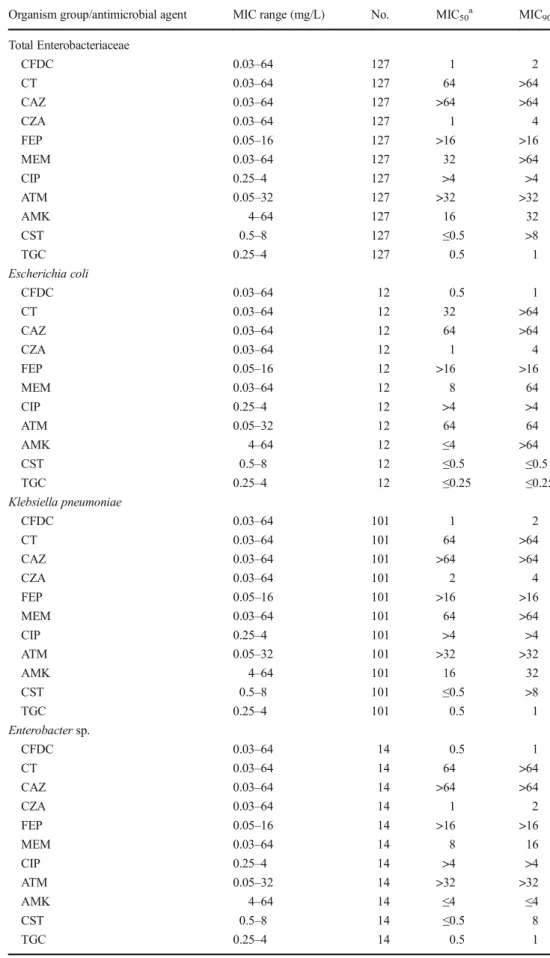
The MIC
50and MIC
90of CFDC for Enterobacteriaceae
producing KPC carbapenemases were
≤1 μg/mL and ≤2 mg/
L, respectively (Table
3). The only competitive comparators
were ceftazidime
–avibactam (MIC
50/90) (1/4), colistin (
≤0.5/
Table 2 (continued)
Organism group/ antimicrobial agent
MIC range (mg/L) No. MIC50a MIC90a
Pseudomonas aeruginosa CFDC 0.03–64 45 0.5 2 CT 0.03–64 45 64 >64 CAZ 0.03–64 45 >64 >64 CZA 0.03–64 45 16 >64 FEP 0.05–16 45 >16 >16 MEM 0.03–64 45 32 >64 CIP 0.25–4 45 >4 >4 ATM 0.05–32 45 16 >32 AMK 4–64 45 8 >64 CST 0.5–8 45 ≤0.5 1 TGC 0.25–4 45 >4 >4 Acinetobacter baumannii CFDC 0.03–64 87 0.12 4 CT 0.03–64 87 16 >64 CAZ 0.03–64 87 >64 >64 CZA 0.03–64 87 16 64 FEP 0.05–16 87 >16 >16 MEM 0.03–64 87 32 64 CIP 0.25–4 87 >4 >4 ATM 0.05–32 87 >32 >32 AMK 4–64 87 64 >64 CST 0.5–8 87 ≤0.5 1 TGC 0.25–4 87 1 2
aMIC, minimum inhibitory concentration; MIC
50/90, MIC that inhibits 50% and 90% of the isolates, respectively
Table 3 In vitro activities of cefiderocol (CFDC), ceftolozane– tazobactam (CT), ceftazidime (CAZ), ceftazidime–avibactam (CZA), cefepime (FEP), meropenem (MEM),
ciprofloxacin (CIP), aztreonam (ATM), amikacin (AMK), colistin (CST), and tigecycline (TGC) against Enterobacteriaceae (E. coli, K. pneumoniae, and Enterobacter sp.) producing a KPC-type carbapenemase
Organism group/antimicrobial agent MIC range (mg/L) No. MIC50a MIC90a
Total Enterobacteriaceae CFDC 0.03–64 127 1 2 CT 0.03–64 127 64 >64 CAZ 0.03–64 127 >64 >64 CZA 0.03–64 127 1 4 FEP 0.05–16 127 >16 >16 MEM 0.03–64 127 32 >64 CIP 0.25–4 127 >4 >4 ATM 0.05–32 127 >32 >32 AMK 4–64 127 16 32 CST 0.5–8 127 ≤0.5 >8 TGC 0.25–4 127 0.5 1 Escherichia coli CFDC 0.03–64 12 0.5 1 CT 0.03–64 12 32 >64 CAZ 0.03–64 12 64 >64 CZA 0.03–64 12 1 4 FEP 0.05–16 12 >16 >16 MEM 0.03–64 12 8 64 CIP 0.25–4 12 >4 >4 ATM 0.05–32 12 64 64 AMK 4–64 12 ≤4 >64 CST 0.5–8 12 ≤0.5 ≤0.5 TGC 0.25–4 12 ≤0.25 ≤0.25 Klebsiella pneumoniae CFDC 0.03–64 101 1 2 CT 0.03–64 101 64 >64 CAZ 0.03–64 101 >64 >64 CZA 0.03–64 101 2 4 FEP 0.05–16 101 >16 >16 MEM 0.03–64 101 64 >64 CIP 0.25–4 101 >4 >4 ATM 0.05–32 101 >32 >32 AMK 4–64 101 16 32 CST 0.5–8 101 ≤0.5 >8 TGC 0.25–4 101 0.5 1 Enterobacter sp. CFDC 0.03–64 14 0.5 1 CT 0.03–64 14 64 >64 CAZ 0.03–64 14 >64 >64 CZA 0.03–64 14 1 2 FEP 0.05–16 14 >16 >16 MEM 0.03–64 14 8 16 CIP 0.25–4 14 >4 >4 ATM 0.05–32 14 >32 >32 AMK 4–64 14 ≤4 ≤4 CST 0.5–8 14 ≤0.5 8 TGC 0.25–4 14 0.5 1
aMIC, minimum inhibitory concentration; MIC
50/90, MIC that inhibits 50% and 90% of the isolates, respectively
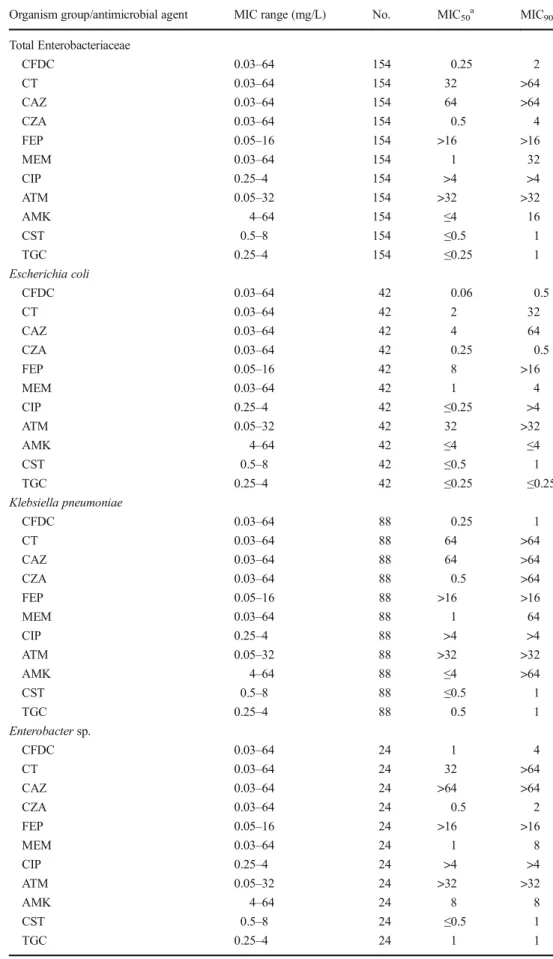
Table 4 In vitro activities of cefiderocol (CFDC), ceftolozane– tazobactam (CT), ceftazidime (CAZ), ceftazidime–avibactam (CZA), cefepime (FEP) meropenem (MEM),
ciprofloxacin (CIP), aztreonam (ATM), amikacin (AMK), colistin (CST), and tigecycline (TGC) against Enterobacteriaceae (E. coli, K. pneumoniae, and Enterobacter sp.) producing an OXA-48-type carbapenemase
Organism group/antimicrobial agent MIC range (mg/L) No. MIC50a MIC90a
Total Enterobacteriaceae CFDC 0.03–64 154 0.25 2 CT 0.03–64 154 32 >64 CAZ 0.03–64 154 64 >64 CZA 0.03–64 154 0.5 4 FEP 0.05–16 154 >16 >16 MEM 0.03–64 154 1 32 CIP 0.25–4 154 >4 >4 ATM 0.05–32 154 >32 >32 AMK 4–64 154 ≤4 16 CST 0.5–8 154 ≤0.5 1 TGC 0.25–4 154 ≤0.25 1 Escherichia coli CFDC 0.03–64 42 0.06 0.5 CT 0.03–64 42 2 32 CAZ 0.03–64 42 4 64 CZA 0.03–64 42 0.25 0.5 FEP 0.05–16 42 8 >16 MEM 0.03–64 42 1 4 CIP 0.25–4 42 ≤0.25 >4 ATM 0.05–32 42 32 >32 AMK 4–64 42 ≤4 ≤4 CST 0.5–8 42 ≤0.5 1 TGC 0.25–4 42 ≤0.25 ≤0.25 Klebsiella pneumoniae CFDC 0.03–64 88 0.25 1 CT 0.03–64 88 64 >64 CAZ 0.03–64 88 64 >64 CZA 0.03–64 88 0.5 >64 FEP 0.05–16 88 >16 >16 MEM 0.03–64 88 1 64 CIP 0.25–4 88 >4 >4 ATM 0.05–32 88 >32 >32 AMK 4–64 88 ≤4 >64 CST 0.5–8 88 ≤0.5 1 TGC 0.25–4 88 0.5 1 Enterobacter sp. CFDC 0.03–64 24 1 4 CT 0.03–64 24 32 >64 CAZ 0.03–64 24 >64 >64 CZA 0.03–64 24 0.5 2 FEP 0.05–16 24 >16 >16 MEM 0.03–64 24 1 8 CIP 0.25–4 24 >4 >4 ATM 0.05–32 24 >32 >32 AMK 4–64 24 8 8 CST 0.5–8 24 ≤0.5 1 TGC 0.25–4 24 1 1
aMIC, minimum inhibitory concentration; MIC
50/90, MIC that inhibits 50% and 90% of the isolates, respectively
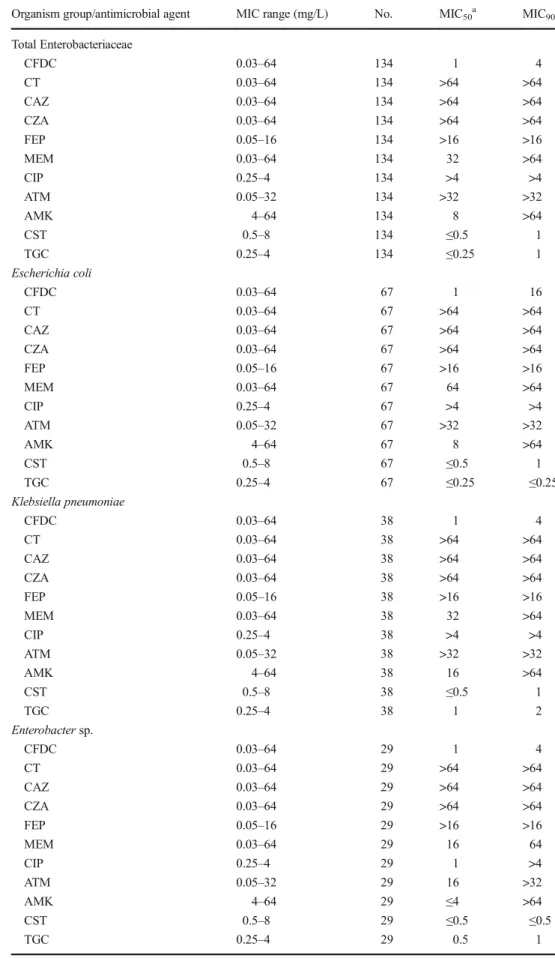
Table 5 In vitro activities of cefiderocol (CFDC), ceftolozane– tazobactam (CT), ceftazidime (CAZ), ceftazidime–avibactam (CZA), cefepime (FEP), meropenem (MEM),
ciprofloxacin (CIP), aztreonam (ATM), amikacin (AMK), colistin (CST), and tigecycline (TGC) against Enterobacteriaceae (E. coli, K. pneumoniae, and Enterobacter sp.) producing NDM, VIM, or IMP carbapenemases
Organism group/antimicrobial agent MIC range (mg/L) No. MIC50a MIC90a
Total Enterobacteriaceae CFDC 0.03–64 134 1 4 CT 0.03–64 134 >64 >64 CAZ 0.03–64 134 >64 >64 CZA 0.03–64 134 >64 >64 FEP 0.05–16 134 >16 >16 MEM 0.03–64 134 32 >64 CIP 0.25–4 134 >4 >4 ATM 0.05–32 134 >32 >32 AMK 4–64 134 8 >64 CST 0.5–8 134 ≤0.5 1 TGC 0.25–4 134 ≤0.25 1 Escherichia coli CFDC 0.03–64 67 1 16 CT 0.03–64 67 >64 >64 CAZ 0.03–64 67 >64 >64 CZA 0.03–64 67 >64 >64 FEP 0.05–16 67 >16 >16 MEM 0.03–64 67 64 >64 CIP 0.25–4 67 >4 >4 ATM 0.05–32 67 >32 >32 AMK 4–64 67 8 >64 CST 0.5–8 67 ≤0.5 1 TGC 0.25–4 67 ≤0.25 ≤0.25 Klebsiella pneumoniae CFDC 0.03–64 38 1 4 CT 0.03–64 38 >64 >64 CAZ 0.03–64 38 >64 >64 CZA 0.03–64 38 >64 >64 FEP 0.05–16 38 >16 >16 MEM 0.03–64 38 32 >64 CIP 0.25–4 38 >4 >4 ATM 0.05–32 38 >32 >32 AMK 4–64 38 16 >64 CST 0.5–8 38 ≤0.5 1 TGC 0.25–4 38 1 2 Enterobacter sp. CFDC 0.03–64 29 1 4 CT 0.03–64 29 >64 >64 CAZ 0.03–64 29 >64 >64 CZA 0.03–64 29 >64 >64 FEP 0.05–16 29 >16 >16 MEM 0.03–64 29 16 64 CIP 0.25–4 29 1 >4 ATM 0.05–32 29 16 >32 AMK 4–64 29 ≤4 >64 CST 0.5–8 29 ≤0.5 ≤0.5 TGC 0.25–4 29 0.5 1
aMIC, minimum inhibitory concentration; MIC
50/90, MIC that inhibits 50% and 90% of the isolates, respectively
≥8), and tigecycline (≤0.5/≤1). Elevated MIC
90values for
co-listin were noted for 17 out of 101 strains for K. pneumoniae
and 2 out of 14 strains for Enterobacter sp. For all other
antibiotics, the MIC
50/90were superior or equal to the upper
limit of the concentration range.
OXA-48-like producing Enterobacteriaceae were
suscepti-ble to a larger number of antibiotics compared to the KPC
producers (Table
4). Again, cefiderocol is one of the
antibi-otics with the lowest MIC
50/90values, at 0.25 and 2
μg/mL,
respectively. Direct competitors were ceftazidime–avibactam
(0.5/4), meropenem (1/32), amikacin (
≤4/16), colistin (≤0.5/
1), and tigecycline (≤0.5/≤1). Again, for Klebsiella sp., the
MIC
90of CZA and MEM were affected by outliers and the
MIC
50values should be considered instead.
For the enterobacterial isolates producing NDM, VIM, or
IMP carbapenemases (Table
5), the only antibiotics that had
strong activity (MIC
50/90) were cefiderocol (1/4), colistin
(≤0.5/≤1), and tigecycline (≤0.25/≤1).
Colistin-resistant strains, mainly Enterobacteriaceae, had
high susceptibility to cefiderocol (≤0.5/≤2) and some activity
for ceftolozane–tazobactam in the case of E. coli (0.25/>64),
ceftazidime–avibactam (0.5/>64), meropenem (0.12/64),
amikacin (≤4/16), and tigecycline (≤1/≤1). Except for
cefiderocol and tigecycline, the MIC
90values were close to
or above the upper limit of the concentration range of the
tested antibiotics for the Enterobacteriaceae being resistant
to colistin. This could be explained by additional resistance
traits, such as expression of genes encoding carbapenemases
and ESBLs, in particular for K. pneumoniae and Enterobacter
sp. The level of resistance to colistin (MIC
90= 2) and of
meropenem (MIC
90= 1) was lower for E. coli than that noted
for K. pneumoniae and Enterobacter sp.
Carbapenemase-producing P. aeruginosa were susceptible
only to cefiderocol (0.5/2) and colistin (≤0.5/1) (Table
6). The
same resistance trend was observed for
carbapenemase-producing A. baumannii strains [CFDC (0.12/4) and CST
Table 6 In vitro activities of cefiderocol (CFDC), ceftolozane– tazobactam (CT), meropenem (MEM), ceftazidime (CAZ), ceftazidime–avibactam (CZA), colistin (CST), aztreonam (ATM), amikacin (AMK), ciprofloxacin (CIP), cefepime (FEP), and tigecycline (TGC) against P. aeruginosa producing a carbapenemase (either IMP, KPC, VIM, SPM, or GIM)
Organism group/antimicrobial agent MIC range (mg/L) No. MIC50a MIC90a
Pseudomonas aeruginosa CFDC 0.03–64 30 0.5 2 CT 0.03–64 30 >64 >64 CAZ 0.03–64 30 >64 >64 CZA 0.03–64 30 >64 >64 FEP 0.05–16 30 >16 >16 MEM 0.03–64 30 64 >64 CIP 0.25–4 30 >4 >4 ATM 0.05–32 30 8 64 AMK 4–64 30 8 >64 CST 0.5–8 30 ≤0.5 1 TGC 0.25–4 30 8 >4
aMIC, minimum inhibitory concentration; MIC
50/90, MIC that inhibits 50% and 90% of the isolates, respectively
Table 7 In vitro activities of cefiderocol (CFDC), ceftolozane– tazobactam (CT), meropenem (MEM), ceftazidime (CAZ), ceftazidime–avibactam (CZA), colistin (CST), aztreonam (ATM), amikacin (AMK), ciprofloxacin (CIP), cefepime (FEP), and tigecycline (TGC) against A. baumannii producing an type carbapenemase (either OXA-23, -40, -58, or -72)
Organism group/antimicrobial agent MIC range (mg/L) No. MIC50a MIC90a
Acinetobacter baumannii CFDC 0.03–64 85 0.12 4 CT 0.03–64 85 16 >64 CAZ 0.03–64 85 >64 >64 CZA 0.03–64 85 16 64 FEP 0.05–16 85 >16 >16 MEM 0.03–64 85 32 64 CIP 0.25–4 85 >4 >4 ATM 0.05–32 85 >32 >32 AMK 4–64 85 64 >64 CST 0.5–8 85 0.5 1 TGC 0.25–4 85 1 2 a
MIC, minimum inhibitory concentration; MIC50/90, MIC that inhibits 50% and 90% of the isolates, respectively
(0.5/1)], except that they were also susceptible to tigecycline
(1/2) (Table
7). The only unexpected result is the overall low
activity of ceftolozane
–tazobactam against those P. aeruginosa
isolates.
Among the 753 isolates tested, only 24 isolates exhibited an
MIC value of cefiderocol
≥8 μg/mL, among which 45% were
NDM producers (n = 11), 30% were OXA-23-producing
A. baumannii (n = 7), and two VEB-, one SHV-, one VIM-,
and one OXA-48-like producers among K. pneumoniae,
P. aeruginosa, and Enterobacter sp. Noteworthy, cefiderocol
was active against 68 out of 79 NDM producers, while most of
the NDM producers co-produced other
β-lactam resistance
mechanisms, such as ESBLs (mostly CTX-M-15), porin
de-fect, plasmid-mediated cephalosporinases, and other
carbapenemases (data not shown). Cefiderocol was more active
(MIC
902–4 mg/L) than the comparators (MIC
90>4 to >64 mg/
L) (cephalosporins, carbapenem, fluoroquinolone, and
monobactam) against all the tested strains. The only
compara-tors with equal activity were colistin and tigecycline, with the
limitation that tigecycline was not active against P. aeruginosa.
Finally, it should be emphasized that cefiderocol displays much
favorable pharmacokinetic parameters (tissue diffusion and use
in renal impairment) than colistin and tigecycline [19], which
will be an important factor for choosing adequate therapy of
infections due to multidrug infections.
Compliance with ethical standards
Funding This work was funded by grants from the University of Fribourg and from Shionogi & Co., Ltd.
Conflict of interest None to declare. Ethical approval Not applicable. Informed consent Not applicable.
References
1. Pitout JDD, Laupland KB (2008) Extended-spectrum β-lactamase-producing Enterobacteriaceae: an emerging public-health concern. Lancet Infect Dis 8(3):159–166
2. Knothe H, Shah P, Krcmery V, Antal M, Mitsuhashi S (1983) Transferable resistance to cefotaxime, cefoxitin, cefamandole and cefuroxime in clinical isolates of Klebsiella pneumoniae and Serratia marcescens. Infection 11(6):315–317
3. Philippon A, Labia R, Jacoby G (1989) Extended-spectrum β-lactamases. Antimicrob Agents Chemother 33(8):1131–1136 4. Livermore DM (2003) Bacterial resistance: origins, epidemiology,
and impact. Clin Infect Dis 36:S11–S23
5. Gupta N, Limbago BM, Patel JB, Kallen AJ (2011) Carbapenem-resistant Enterobacteriaceae: epidemiology and prevention. Clin Infect Dis 53(1):60–67
6. Kanj SS, Kanafani ZA (2011) Current concepts in antimicrobial therapy against resistant gram-negative organisms:
extended-spectrumβ-lactamase-producing Enterobacteriaceae, carbapenem-resistant Enterobacteriaceae, and multidrug-carbapenem-resistant Pseudomonas aeruginosa. Mayo Clin Proc 86(3):250–259
7. Poirel L, Kieffer N, Liassine N, Thanh D, Nordmann P (2016) Plasmid-mediated carbapenem and colistin resistance in a clinical isolate of Escherichia coli. Lancet Infect Dis 16(3):281
8. Liu YY, Wang Y, Walsh TR, Yi LX, Zhang R, Spencer J, Doi Y, Tian G, Dong B, Huang X, Yu LF, Gu D, Ren H, Chen X, Lv L, He D, Zhou H, Liang Z, Liu JH, Shen J (2016) Emergence of plasmid-mediated colistin resistance mechanism MCR-1 in animals and hu-man beings in China: a microbiological and molecular biological study. Lancet Infect Dis 16(2):161–168
9. Haenni M, Poirel L, Kieffer N, Châtre P, Saras E, Métayer V, Dumoulin R, Nordmann P, Madec JY (2016) Co-occurrence of extended spectrumβ lactamase and MCR-1 encoding genes on plasmids. Lancet Infect Dis 16(3):281–282
10. Hasman H, Hammerum AM, Hansen F, Hendriksen RS, Olesen B, Agersø Y, Zankari E, Leekitcharoenphon P, Stegger M, Kaas RS, Cavaco LM, Hansen DS, Aarestrup FM, Skov RL (2015) Detection of mcr-1 encoding plasmid-mediated colistin-resistant Escherichia coli isolates from human bloodstream infection and imported chick-en meat, Dchick-enmark 2015. Euro Surveill 20(49)
11. Kohira N, West J, Ito A, Ito-Horiyama T, Nakamura R, Sato T, Rittenhouse S, Tsuji M, Yamano Y (2015) In vitro antimicrobial activity of a siderophore cephalosporin, S-649266, against Enterobacteriaceae clinical isolates, including carbapenem-resistant strains. Antimicrob Agents Chemother 60(2):729–734 12. Ito A, Nishikawa T, Matsumoto S, Yoshizawa H, Sato T, Nakamura
R, Tsuji M, Yamano Y (2016) Siderophore cephalosporin cefiderocol utilizes ferric iron transporter systems for antibacterial activity against Pseudomonas aeruginosa. Antimicrob Agents Chemother 60(12):7396–7401
13. Tillotson GS (2016) Trojan horse antibiotics—a novel way to cir-cumvent gram-negative bacterial resistance? Infect Dis (Auckl) 9: 45–52
14. Ito-Horiyama T, Ishii Y, Ito A, Sato T, Nakamura R, Fukuhara N, Tsuji M, Yamano Y, Yamaguchi K, Tateda K (2016) Stability of novel siderophore cephalosporin S-649266 against clinically rele-vant carbapenemases. Antimicrob Agents Chemother 60(7):4384– 4386
15. Ito A, Kohira N, Bouchillon SK, West J, Rittenhouse S, Sader HS, Rhomberg PR, Jones RN, Yoshizawa H, Nakamura R, Tsuji M, Yamano Y (2016) In vitro antimicrobial activity of S-649266, a catechol-substituted siderophore cephalosporin, when tested against non-fermenting gram-negative bacteria. J Antimicrob Chemother 71(3):670–677
16. Clinical and Laboratory Standards Institute (CLSI) (2015) Methods for dilution antimicrobial susceptibility tests for bacteria that grow aerobically; Approved standards—tenth edition. CLSI document M07-A10. CLSI, Wayne, PA
17. Huband MD, Ito A, Tsuji M, Sader HS, Fedler KA, Flamm RK (2017) Cefiderocol MIC quality control ranges in iron-depleted cation-adjusted Mueller–Hinton broth using a CLSI M23-A4 multi-laboratory study design. Diagn Microbiol Infect Dis 88(2): 198–200
18. Clinical and Laboratory Standards Institute (CLSI) (2015) Performance standards for antimicrobial susceptibility testing; Twenty-fifth informational supplement. CLSI document M100-S25. CLSI, Wayne, PA
19. Katsube T, Wajima T, Ishibashi T, Camilo Arjona Ferreira J, Echols R (2017) Pharmacokinetic/pharmacodynamic modeling and simu-lation of cefiderocol, a parenteral siderophore cephalosporin, for dose adjustment based on renal function. Antimicrob Agents Chemother 61(1). pii: e01381-16