Active Policy Querying for Dynamic Human-Robot
Collaboration Tasks
by
Jacob Broida
B.A. Carleton College (2017)
Submitted to the Department of Aeronautics and Astronautics
in partial fulfillment of the requirements for the degree of
Master of Science in Aerospace Engineering
at the
MASSACHUSETTS INSTITUTE OF TECHNOLOGY
February 2021
c
○ Massachusetts Institute of Technology 2021. All rights reserved.
Author . . . .
Department of Aeronautics and Astronautics
January 26, 2021
Certified by . . . .
Brian Charles Williams
Professor, Aeronautics and Astronautics
Thesis Supervisor
Accepted by . . . .
Zoltan Spakovszky
Professor, Aeronautics and Astronautics
Chair, Graduate Program Committee
Active Policy Querying for Dynamic Human-Robot
Collaboration Tasks
by
Jacob Broida
Submitted to the Department of Aeronautics and Astronautics on January 26, 2021, in partial fulfillment of the
requirements for the degree of
Master of Science in Aerospace Engineering
Abstract
Success in any group task is dependent upon mutual understanding between the collaborators. Team members can use observation to infer their partner’s plans, but such an approach carries great uncertainty and requires passive collaboration. For robots working alongside humans, verbal communication, especially in the form of questions, can provide definite and preemptive knowledge of a partner’s policy. This knowledge in turn allows the robot to adapt its own plans to maximize team success. To that end, we propose a model and algorithms that will allow a robotic teammate to efficiently select the optimal questions to ask its partner in order to maximize the chances of team success. Our algorithms utilize decision graphs to compactly represent the policy space of team tasks. Using this compact representation, we are able to develop fast and efficient methods for determining the optimal set of questions. We exhibit four algorithms, one each for pre-execution questions, single scheduled questions, and multiple scheduled questions, and questions in tasks with communication restrictions. We show in experimental trials that these algorithm are capable of raising the success rate of a team task by up to 400% of the original value in typical scenarios.
Thesis Supervisor: Brian Charles Williams Title: Professor, Aeronautics and Astronautics
Acknowledgments
First and foremost I would like to thank my advisor, Professor Brian Williams. It goes without saying that without him, none of this work would be possible. But, even more than that, he made the "work", more than work. So thank you, Brian, for welcoming me into your lab, and for giving me the support and encouragement I needed to succeed. Thank you for showing interest and enthusiasm in my work, and for constantly pushing me to dig deeper, and be clearer. Thank you for your patient and thorough approach to mentorship, especially in terms of this thesis. You always kept the focus on learning and improving, and because of that I cannot overstate how much I have learned and grown throughout this process. And most of all, thank you for being a kind and thoughtful advisor. You have a genuine interest in the happiness and well being of your community, and it does not go unnoticed. I never once doubted your investment in my success. Thank you Brian, truly.
A heartfelt thank you to Nelson Christensen, my undergraduate advisor at Car-leton. There is no other single person that has had a greater impact on my success. I am eternally grateful for the time I got to spend working in the LIGO collabora-tion with you. That work was the very beginning of my love of research and coding. And thank you, Nelson, for your selfless support and encouragement throughout my early years as a scientist. When I think back to the best and most exciting parts of my career thus far, I can attribute almost all of them to your support. I am so very thankful to have been given the opportunity to work with you, and to be able to think of you as a friend. Here’s hoping I’ll be able buy you a Miller, once the quarantine lifts and you’re back in town.
I am deeply grateful to the entirety of the MERS lab for all of the support and insight they have given me over the years. I could not have asked for a better group of people to work with. I would also like to single out the following lab members for their above and beyond contributions to my success. Steven Levine, for creating and developing Riker, the foundation upon which this thesis is built. Thank you for leading the way in this exciting and impactful project, I’m grateful to have been
able to continue it. Marlyse Reeves and Charles Dawson, for their friendship and support. Research is always more fun when you do it with friends! Allen Wang, for his steadfast friendship and constant encouragement as we went through this process (mostly) together. You really kept me motivated and grounded, and you helped me keep my eye on the light at the end of the tunnel. Nikhil Bhargava, first of all for being a fantastic TA. But, more importantly, for making my addition to the MERS lab possible, and for being a fantastic friend and mentor once I joined. I truly don’t know where I would be without you. And finally, I would like to give an extra special thank you to Yuening Zhang. For her tireless and patient mentorship, her constant encouragement, and for all of the long hours she spent helping me shape the jumble of ideas in my head into a formal and well thought-out academic work. Yuening, thank you for going above and beyond. Without your mentorship, this thesis would not be what it is today.
I would of course like to thank all of my friends at MIT. The hardest part of quarantine has been having to be away from you all. Daniel Miller, thank you for being such a great friend, from Minnesota to here. We were in the trenches together, but it was much better than it could have been because you were there. Regina and Aaron, for being there to support and guide me through a very difficult time. I really cannot thank you enough for being there for me when I needed you. And Charlotte, for being my MIT BFF. I’m so grateful to have been able to mentor you through your journey. And, now and then, you gave me a little invaluable mentorship in return. I truly could not have reached the finish line without you. And to all the others, thank you for making the community special.
A big thank you to all of my friends, including (in no particular order) Emma, Bethany, Mike and Emily, Allison, Faisal, Nick, Daniel, Dylan, Jordikai, Alix, Brin, Shayna, Caleb, Hunter, Eric, Drew, Sanjay, Rachel and Amelia. Even if you didn’t contribute directly to this work, your love and support allowed me to get to where I am today. From the bottom of my heart thank you all so much.
Finally, I would like to thank my cat Faye for being my most consistent and present friend, especially during quarantine. I would also like to extend an extra special thank
you for all of the times she woke me up while I was sleeping, or attacked me when I was relaxing. You were right kitty, I should have been working on my thesis. I would have made you a co-author if they had let me.
Contents
1 Introduction 17
1.1 Motivating this Work . . . 18
1.2 Outline of this Work . . . 21
2 The Query Problem 23 2.1 Identifying A Need . . . 23
2.1.1 Case Study: Fighting Forest Fires . . . 24
2.1.2 Traits of a Disaster Response Executive . . . 27
2.2 Previous Work . . . 29
2.3 Defining the Problem . . . 32
2.3.1 The Query Problem as a Markov Decision Process . . . 32
2.3.2 The Focus of this Work . . . 35
2.3.3 Problem Specification . . . 35
2.3.4 Example Problem Specification . . . 37
3 Representing the Query Problem 39 3.1 Execution Policy as a Decision Graph . . . 39
3.1.1 Defining the Decision Graph . . . 40
3.1.2 Obtaining the Decision Graph . . . 41
3.2 Query Representation . . . 43
3.2.1 Deterministic Query Model . . . 43
3.2.3 Multi-Query Representation . . . 49
3.3 Case Study Revisited . . . 50
3.3.1 The Problem . . . 50
3.3.2 The Representation . . . 51
4 Solving the Query Problem 53 4.1 Representative Example . . . 53
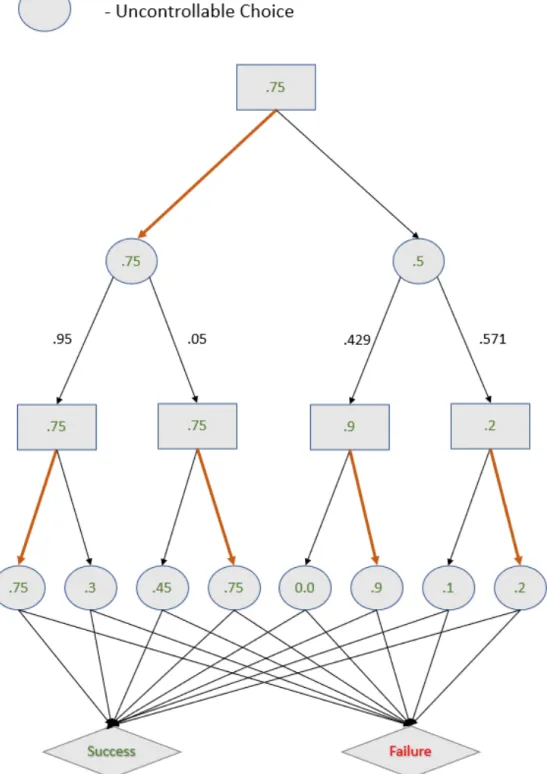
4.2 Compiling an Optimal Base Policy . . . 54
4.3 Pre-Execution Queries . . . 56 4.3.1 Problem Statement . . . 58 4.3.2 Approach . . . 58 4.3.3 Algorithm Notes . . . 62 4.3.4 Example Walkthrough . . . 64 4.3.5 Optimality . . . 66
4.4 Single Query Policy Development . . . 66
4.4.1 Problem Statement . . . 67
4.4.2 Approach . . . 67
4.4.3 Algorithm Notes . . . 68
4.4.4 Example Walkthrough . . . 69
4.4.5 Optimality . . . 71
4.5 Multi-Query Policy Development . . . 72
4.5.1 Problem Statement . . . 72
4.5.2 Approach . . . 73
4.5.3 Algorithm Notes . . . 74
4.5.4 Example Walkthrough . . . 75
4.5.5 Optimality . . . 77
4.6 Querying With Communication Dead Zones . . . 79
4.6.1 Problem Statement . . . 79
4.6.2 Approach . . . 79
5 Experimental Results 83
5.1 Randomized Trials . . . 83
5.1.1 Experimental Methods . . . 83
5.1.2 Depth Tests . . . 84
5.1.3 Branch Factor Tests . . . 86
5.1.4 Query Saturation Tests . . . 87
5.1.5 Base SR Tests . . . 89
5.2 Case Study . . . 91
5.2.1 Fleshing out the Problem . . . 91
5.2.2 The Solution, Intuitively . . . 92
5.2.3 The Solution, Algorithmically . . . 92
6 Discussion 95 6.1 Summary of this Work . . . 95
6.2 Tractability in Practice . . . 96
6.3 Future Work . . . 97
A Pike and Riker 105 A.1 Pike . . . 105
A.1.1 Background . . . 105
A.1.2 Problem Statement . . . 107
A.1.3 Pre-processing . . . 108
A.1.4 Online Execution . . . 112
A.2 Riker . . . 113
A.2.1 Influence Diagrams . . . 114
A.2.2 The Conditional Stochastic Constraint Satisfaction Problem (CSCSP) . . . 114
A.2.3 Solving the CSCSP . . . 115
B Multi-Query Model 119 B.1 Multi-Query Model . . . 119
List of Figures
1-1 Complex group tasks, such as navigating roadways and complicated intersections, require the actors to have a good understanding of others’ intentions. . . 19
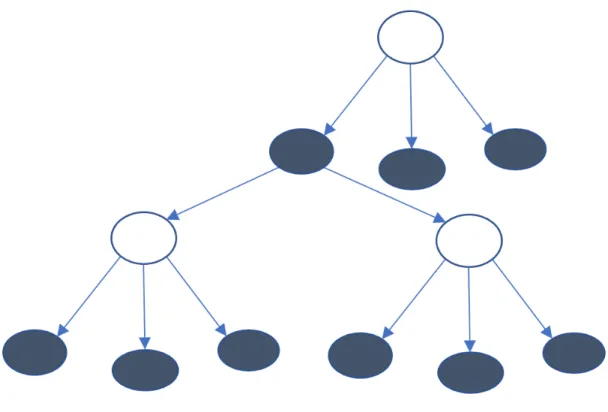
3-1 An example of one section of our decision tree representation. Here filled circles represent controllable decisions while unfilled circles rep-resent uncontrollable decisions. The children of a given node reprep-resent possible successor decision states. Of particular note is the fact that the graph alternates layers. This is an important feature of our problem representation. . . 42 3-2 An example of how a query might affect the distribution over
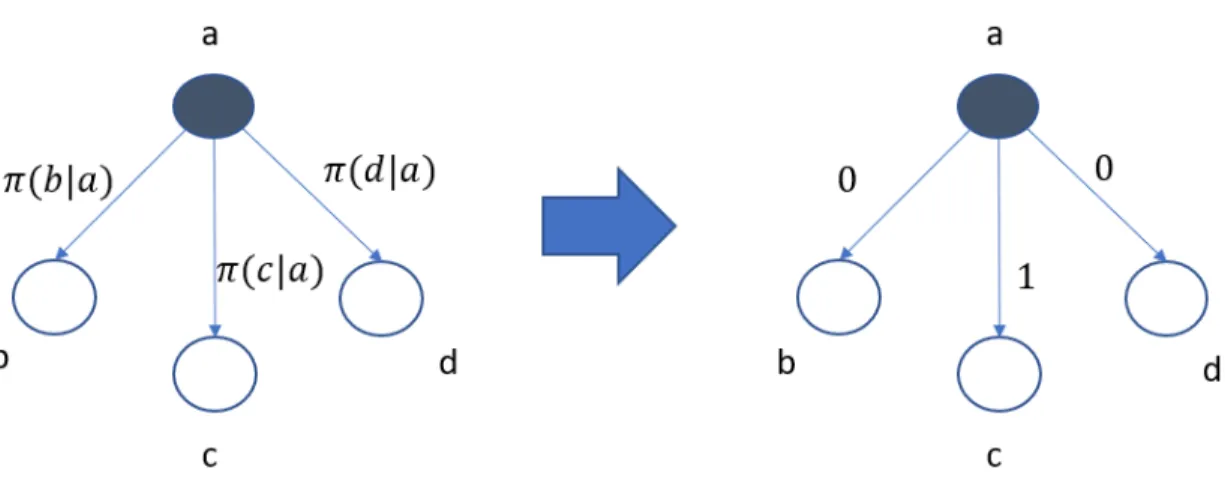
possi-bilities using a deterministic model. After querying, one outcome will have a probability of 1. Different models might sharpen the distribu-tion differently. . . 44 3-3 Effect a question has on expected success rate . . . 46 3-4 A compact representation of a fire fighting task assignment problem.
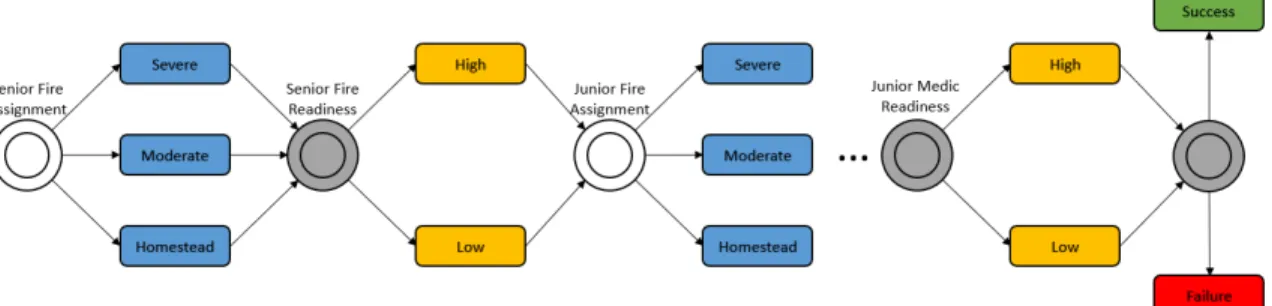
Here controllable decisions are represented with white concentric circles while uncontrollable decisions are grey. The final transition to either a failure or success state is uncontrollable, and depends on both the controllable and uncontrollable choices made throughout execution. . 52
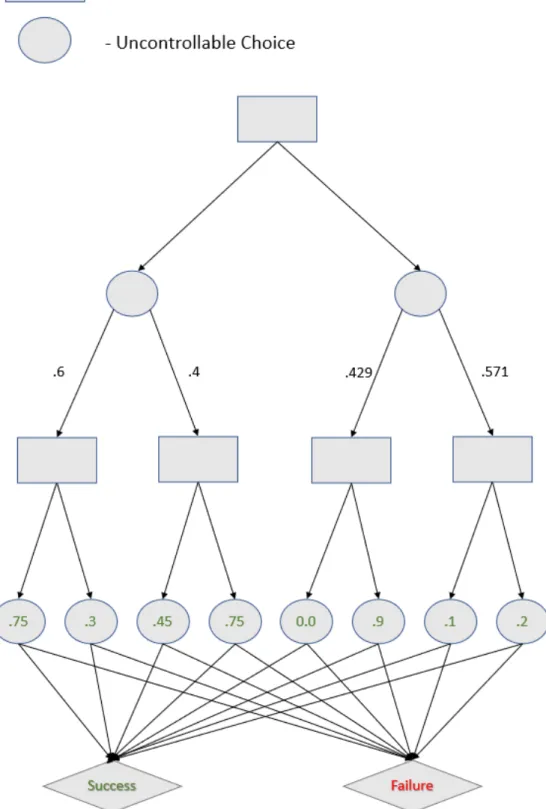
4-1 A representation of a collaborative task with four choices. For image clarity, rather than display the transition probabilities for the terminal uncontrollable nodes, we simply list their success rate in their node. . 55
4-2 Our example scenario after computing the optimal base policy. The optimal policy at each controllable decision is highlighted in orange. . 57
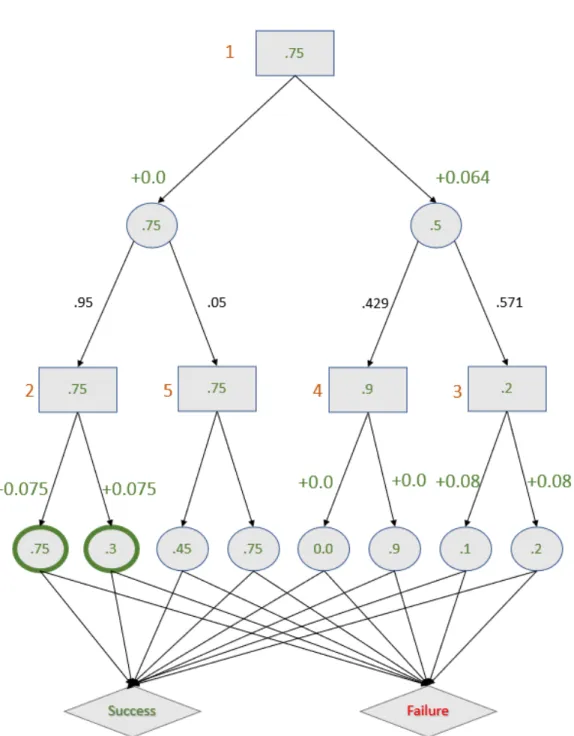
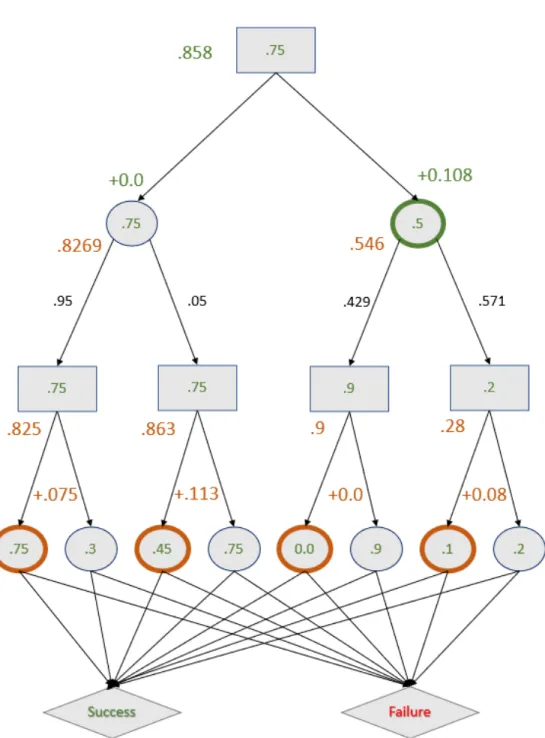
4-3 The example scenario annotated with details of the pre-execution al-gorithm. The ranked order of the nodes is shown in orange. The gain at the parent for asking about uncontrollable nodes is shown in green. The optimal nodes to query are outlined in green. Both are equally optimal. . . 65
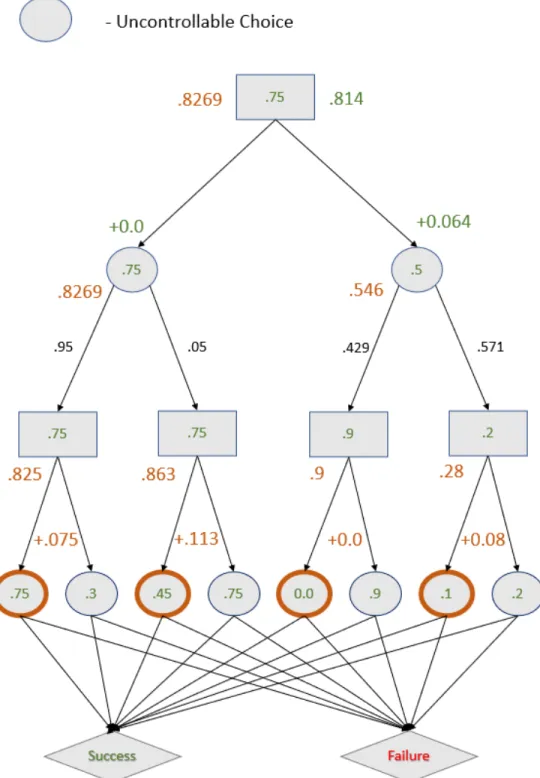
4-4 Annotations of our representative example when we run our single query algorithm. The success rate of saving the question until the third layer is shown in orange, the success rate of asking the question right away at the root is shown in green. As comparison shows, the optimal policy is to save the question for the third layer. . . 70
4-5 Annotations of our representative example when we run our multi query algorithm. The optimal questions are to ask about the green node first, then whichever orange node execution pushes us towards. There is no space for any additional questions in this system. . . 76
5-1 Shown are randomized trials for our algorithms as a function of tree depth. For every depth, we performed 100 random tests and averaged the results. In the top graph, we have the success rate at the root vs. tree depth for each algorithm. In the bottom graph, we show the total time taken by each algorithm to run as the depth increases. . . 85
5-2 Shown are randomized trials for our algorithms as a function of tree branch factor. For every branch factor, we performed 100 random tests and averaged the results. In the top graph, we have the success rate at the root vs. tree branch factor for each algorithm. In the bottom graph, we show the total time taken by each algorithm to run as the depth increases. . . 87
5-3 Shown are randomized trials for our algorithms as a function of number of questions allotted. For every number of questions, we performed 100 random tests over several different tree depths and averaged the results. In the top graph, we have the success rate at the root vs. allotted questions for each algorithm. In the bottom graph, we show the total time taken by each algorithm to run as the questions increase. 88 5-4 Shown are randomized trials for our algorithms as a function of base
SR. For base SR, we performed 100 random tests and averaged the results. In the top graph, we have the success rate at the root vs. base SR for our algorithms. In the bottom graph, we show the total time taken by each algorithm to run as the base SR increases. . . 90
A-1 Pike in action on the Toyota Home Service Robot (HSR). In this image, Pike is assisting a human with a food preparation task. By observing the humans actions and making inferences about their intent, it is able to anticipate items the human will need and retrieve them. . . 106 A-2 An example of a standard TPNU. Concentric circles correspond to
de-cision points in the plan; grey dede-cisions are uncontrollable while white decisions are controllable. Blue events and yellow events correspond to actions by the autonomous agent and a human partner respectively. . 109 A-3 An example of how causal links may be used to annotate a TPNU.
Image a shows the causal interactions between events in one section of a TPNU. Image b shows how a choice made earlier in the plan (𝑥𝐴1)
can be used to prune branches later in the plan. . . 111 A-4 A high level overview of Riker under the hood. We will briefly cover
the inner working of this system, but for a more complete picture see Dr. Levine’s thesis. . . 117
Chapter 1
Introduction
When humans work and live together, much of the communication that happens between them is non-verbal. In fact, humans are quite good at understanding the implications behind someone’s actions and from those implications inferring that per-son’s intent. This is a natural process for us; when a friend comes to our house with a baseball glove, we understand that they want to play catch without them having to explicitly say it. Many of these inferences are not cut and dry however. High stakes tasks, complex actions with unclear implications, and limited observability all make this implicit understanding difficult. Fortunately for society, humans have a leg up on these inferences from years of social conditioning and evolutionary instinct. Un-fortunately for society, when a robot is working with humans it does not have these luxuries. To compensate for this deficit, researchers have been developing ways for a robot build intent recognition capabilities based on observations [8, 16, 17, 27]. These methods are quite effective, but they do not yet capture the full extent of intent recog-nition tools available to humans. In order to enable fluid team work between humans and robots, it is essentially that robots are able to glean as much information about their human partners’ plans as possible. To that end, we propose a simple extension to the observation-based intent recognition processes in use today: if a robot is not certain about what a human is planning, they simply ask. In this thesis, we explore and develop methods for a robot to resolve uncertainty in a human partner’s plan by asking the right questions.
1.1
Motivating this Work
We focus on team plans for the context of the querying system we are developing. The success of a team is dependent upon the teammates having some mutual un-derstanding of each other’s plans and intents. Using this unun-derstanding, teammates can craft their personal plans to complement their partners’. To see this dynamic in action, consider the case of driving. Driving is a collaboration among human vehicle operators with the shared goal of each driver getting to their destinations safely and on time. Successful execution of this task hinges on each driver understanding their collaborators’ intent and being understood by them in turn. For instance, one driver needs to understand when another driver wants to merge into their lane, so they can make space. On the other side, the merging driver needs to know that the other driver understands their plan and is prepared to make space so they can initiate the merge. If there is a mismatch in understanding, for instance if one driver intends to merge and doesn’t realize the other driver hasn’t picked up on this intention, a disastrous collision can result. The same collaboration among mixed human and autonomous teams is no different; if a human wants to merge into an autonomous vehicle’s lane, that vehicle must be able to infer this intent and make space. If we want to build effective autonomous teammates, on the road or otherwise, they must be able to make these kinds of inferences.
Much work has already been done to build these intent recognition capabilities for autonomous team members. The GEORDI project has made advancements in providing exactly this capability for autonomous vehicles [14]. In a more general context, Levine and Williams demonstrated that, given a shared flexible execution plan, an autonomous collaborative agent can extrapolate human policies based on observed actions and act accordingly [18]. But while non-verbal intent recognition is important, it is not always sufficient. To see this, consider a search and rescue scenario. A rescue team might have some number of locations they need to search for a missing person. If the team needs to split up in order to accomplish this goal, the team must reach some level of consensus about who goes where. If one team member
is trying to decide which locations they should search, following another member around to see which locations they go to is not a valid option. Instead, they might ask their partner which direction they plan to travel in and infer their location choices from there. As this example shows, a few strategic questions can provide extensive information about a partner’s plan. Our goal is to leverage this capability to extend the work done by Levine and Williams on collaborative robotic executives.
Figure 1-1: Complex group tasks, such as navigating roadways and complicated in-tersections, require the actors to have a good understanding of others’ intentions.
Previous research in collaborative communication between robots and humans hasn’t yet been able to provide the functionality to ask about intent in an equal-partner collaborative setting. In terms of questions, recent work often focuses on either robots as learners [4], or utilizes queries to account for deficits in perception [11]. In many deployment scenarios however, it is more effective to ask questions as a means of robust execution rather than for learning or as an alternative to sensor deficits. Research that does focus on dynamic collaborative dialogue often casts the robot as a subordinate dependent agent to the human [10]. In such situations, the robot is dependant upon clear and explicit information from the human in order to perform tasks. While safer from an execution standpoint, such restrictions limit the robot’s
utility as well as consume valuable human resources in the form of time and attention. For stressful or high-intensity situations, it would be best for autonomous agents to ask their human partners questions only when necessary, and ensure the questions are strategic enough to maximize the success of their collaborative task.
Recently, Bernardini et. al. exhibited a near-optimal greedy algorithm for sub-modular systems that can be used quite effectively for planning information gathering actions [2]. This work focuses on crafting sequences of actions that are most likely to meet an objective, for instance finding an object via search patterns. Though questions can be viewed as simple information gathering actions, their role in a task under uncertainty will allow us to extend their utility via powerful contingent plan-ning. Another potential approach involves framing the problem as a partially observed Markov decision process (POMDP). Work on that front has modeled singular, full-state "oracle" questions that may put too much strain on the human [1, 23], or allows a wider range of specific questions but suffers from the complexity issues endemic to POMDPs [12]. These issues suggest that a model that keeps the state space of querying related actions implicit may be more successful.
For the purpose of this work, we desire a robot that is able to operate and con-verse on an equal footing with its human counterpart. To that end, we propose a querying system that will allow a robotic executive to select questions about human intent during collaborative execution. Coupled with a robotic system that is both au-tonomous and independent, active querying will greatly enhance the robotic agent’s ability to predict human policies, and thereby pick its own actions to maximize their collaborative success rate.
This thesis offers five main contributions towards the goal of dynamic collaborative dialogue between robots and humans working together on a shared task: a compact decision graph formulation of the problem, an algorithm for planning pre-execution questions, an algorithm for developing a policy for a single question during execution, an extension to that algorithm for any number of questions scheduled throughout execution, and finally an algorithm for planning questions during a scenario with communication dead zones. We show through experimental trials that these querying
strategies have significant impact on the effectiveness of robot-human teams, with up to 400% increases in collaborative success rates.
1.2
Outline of this Work
We begin this work in chapter two by building and motivating the problem we are trying to solve. Our ultimate goal is to advance the capabilities of an autonomous coordination assistant for teams of human agents. To demonstrate a need for such an advancement, we examine a case study on forest firefighting response teams. From that case study, we extract underlying characteristics that make the problem space challenging. Those challenges then inform the capabilities that we desire in an ideal autonomous assistant. Next we examine how recent task executive research done by the MERS lab can be used to satisfy the assistant’s needs. After examining recent work, we identify a gap in capabilities that can be filled by giving the executive the ability to ask questions of the other team members. Finally, we the problem formed by these gaps can naturally be framed as a partially observed Markov decision process. We conclude the chapter by formally defining the problem we are trying to solve and providing a grounded example problem mapped to that definition.
After formally defining the problem, we are free to build a problem representation in chapter three. We demonstrate how a decision graph representation will allow us to keep the question-related states of a POMDP implicit. Next, we model exactly how questions affect the this representation and show how it can be used to select optimal questions in the simplest scenarios. Finally, we return to the firefighting example to show how these representation can be applied to a real world scenario.
In the fourth chapter we develop algorithmic solutions for selecting queries using our problem representation. We begin building solutions to the query problem by starting with the simplest case and increasing the complexity as we go. In order, we develop solutions for a single query before the team plan begins, a single query any time during the plan’s execution, 𝑛 queries any time during the plan’s execution, and finally 𝑛 queries during a plan with questions allowed only at certain times during
task execution.
In the fifth chapter, we provide experimental benchmarks to validate the effective-ness of our algorithms. We show that providing the executives with query capabilities can increase the success rate of a team by up to 400%. Further, we show that the algorithms we develop are generally able to select these queries on time scales of less than a second, laying the groundwork for seamless communication between a human and a robot. We conclude the chapter by running our algorithms on an example from our firefighting case study to illustrate how they would work in the field.
In the sixth and final chapter, we conclude this work with a summary and dis-cussion of the advancements made. Additionally, we discuss potential future work that could build upon the research done here. This future work includes generalizing queries to any informative action, investigating informative actions that affect the world, and developing benchmarks to compare against other possible representations of this problem.
Chapter 2
The Query Problem
In this chapter, we outline how a robust autonomous executive can be impactful in real world scenarios using currently available robotic mediums. To show this, we first examine one such scenario, forest fire fighting, highlighting what makes the problem difficult and interesting. From there, we can specify what traits a robotic executive needs in order to be an asset in fire fighting operations. Among these traits, we emphasise chance constrained execution and strong teamwork skills when working with humans. We then detail previous work by the MERS lab in pursuit of developing just such an executive. Next we identify a gap in recent work that can be filled by adding active estimation capabilities in the form of verbal queries. Finally, we tie the early discussion together with a formal definition of the query problem, which we solve in the remainder of this thesis.
2.1
Identifying A Need
In this section, we will identify a real world problem where autonomous robotic sys-tems can provide a tangible benefit. Based on this problem, we extract capabilities that would give an autonomous system the power to provide that benefit.
The MERS lab has ongoing work on several different paradigms of the human-robot assistant relationship. One of these, human-robots as physical assistant, caters to tasks like handing a human worker a tool when they need one [17]. Another one, robots
as negotiators, helps members of a team arrive at a quick consensus when plans go awry [29]. Finally, robots as coordinators is a paradigm in which it is the robotic assistant’s job to assign tasks to humans. These types of assistants have many traits in common, including communication skills, team-based planning capabilities, and a need for recognizing and understanding a human’s plans based on observed actions. At the same time, each is unique enough that it demands its own focus. In this work, we will be focusing on robots as coordinators. In a team, the coordinator’s primary role is to select actions for field teams to accomplish. Generally such an assistant does not actually perform any physical task, but instead assists the group by taking the onus of coordination away from field teams. We will be investigating ways of improving an autonomous coordinator’s capability to make well informed decisions, which will in turn maximize a team’s chance of accomplishing its objective. We begin by looking at a case study to build motivation for this research and emphasize its potential impact.
2.1.1
Case Study: Fighting Forest Fires
Disaster response is a field in which robotic workers already make significant impacts using widely available platforms. Drones especially have been employed for their ability to quickly and safely scout and map disaster areas [3, 15]. The potential for autonomous systems to further transform and improve the way disaster response operations are conducted is immense, but there remains plenty of work to be done to make this potential impact into a reality. In order to highlight ways that autonomous systems can assist in disaster operations, we will investigate one specific type of disaster response scenario.
For our example, we’ll consider a forest fire fighting scenario. The scenario starts with a poorly managed campfire that has led to a major forest fire in a rural area. To respond to this incident, fire, medical, and engineering teams are called together from the surrounding area to form a task force. In charge of this task force is a small command team of coordinators and dispatchers, who must monitor the developing situation as they send tasks to field teams. The task force’s job is to contain the
fire while rescuing any civilians trapped within the burning forest. They can contain the fire by manning choke-points and fire lines identified in the target region. Un-fortunately, there are two major complications. The first is that, having been called together from a wide area, not all of the individual teams within the task force have experience working with the other teams. This can make it difficult for a given team to anticipate another team’s skills, roles, and personalities, which in turn makes coor-dination difficult. The second complication is that there are a number of homesteads scattered throughout the at-risk area. Though an evacuation order has been issued, it is not clear exactly which homes have been evacuated and which still contain trapped civilians that need to be rescued. The task force must balance fire containment op-erations with search and rescue opop-erations, and must be ready to change plans and adapt at a moment’s notice as the situation develops.
Now that we’ve laid out a scenario, we can identify some underlying factors that make addressing that scenario difficult.
High Uncertainty
Smoke reduces visibility, homesteads may contain trapped civilians, and gusts of wind can rapidly change the tempo and direction of the fire’s spread. Compounding this issue is the fact that the developments themselves can be fast, dangerous, and significantly impact the plans of the disaster workers. For example, if a certain homestead believed to be empty suddenly shows signs of life, the nearest fire team may have to drop everything to begin rescue operations. This action in turn may have ripple effects if they need medical teams on hand, their dropped work is a major priority, or they need an escape route to be maintained by another fire team.
Another significant source of uncertainty comes from the individual teams within the task force. Disaster response task forces can be quite large, numbering 70 or more individual workers organized into teams. While the teams may be familiar with their own members, there is no guarantee there is familiarity between the teams. These teams need to be able to work together well despite not being acquainted with each other or having a full understanding of their partner’s roles or skills. As we shall see,
the issues raised by uncertainty among the teams presents an especially big challenge due to the fact that coordination is vital for disaster response.
Strong Coordination is Vital
Given the large, diverse, and specialized teams that often respond to disaster situa-tions, there is an intrinsic need for good coordination at all levels. Well coordinated teams can protect each other. For example one fire team might maintain an escape route for another. Additionally, well coordinated teams ensure that their skills are applied to the maximum effect, as would be the case in a command team identifying the best possible choke point for a fire team to work on containment. Likewise, poor coordination can put rescuers in danger and reduce the efficacy of rescue operations. If a fire team attempts to rescue civilians and no team shifts to fill in on their contain-ment work, the fire could potentially escape. Managing the team plan is an onerous task for the human coordinators given that they must juggle an immense number of factors, incoming information, and developing situations. At the same time, field teams need to stay up to date on their orders and make sure they see them through properly. All these factors come together to show that robust coordination skills are essential, especially considering the high stakes scenario responders are working with.
High Risk, High Reward
The fire fighting task force’s goal is two-fold: to protect human life and contain the fire. These are high stakes, and failure to accomplish these goals quickly can result in loss of life and significant damage to the environment. At the same time, disaster workers must take their own lives into account when saving lives and fighting fires. The National Outdoor Leadership School, an educational institution that trains wilderness medical responders, teaches that the first priority is always to keep yourself and your teammates safe to avoid creating additional victims [26]. If a fire team rushes into a burning homestead on the verge of collapse to save a trapped civilian, they may become injured themselves and require rescue. This chain reaction can create a snowball effect that drains resources and reduces the effectiveness of the task force.
Thus, our high reward scenario has the additional facet of being extremely high risk. Disaster workers must carefully weigh the danger to themselves and their teammates from each action they take against the prospective lives they could save. This duality puts immense pressure on the individuals making decisions and requires them to be as certain as possible about every choice they make.
2.1.2
Traits of a Disaster Response Executive
Based on the challenges we’ve identified in the fire fighting problem, we can extrap-olate vital properties that an autonomous team member would need in order to be helpful in such a scenario. While there are many facets of disaster response systems that present interesting research questions, we will focus on the task executive. It is the task executive’s job to use the available information to select tasks for agents to perform in order to reach a goal. For example, if the goal is to put out a fire, a drone’s task executive might direct it to first collect water from a reservoir, then navigate to the fire site, and finally drop the water onto a critical point in the fire. Our goal will be to provide the capabilities such an executive would need in order to be an asset in a fire fighting scenario. To provide a focused discussion, we will consider our work in the context of an autonomous planning assistant, who’s job it is to help the task force command center select tasks for its operational teams. From the above facets of our fire fighting scenario, we can identify several important abilities the task executive for such an assistant must posses in order to be helpful:
Dynamic Execution
We are considering a problem that is highly uncertain. Paths may be blocked, victims may not be where we thought they were, unexpected developments may occur that significantly alter the team plan. Our system must be capable of dynamic execu-tion, meaning that it must be able to adapt online to disturbances, developments, or alterations that affect the team plan as it is being executed. If a fire team attempts to rescue a surprise victim for example, the assistant must quickly provide them backup
and compensate for their lost containment work. Of course, it is not enough to simply adapt; we must also ensure that our system adapts well. To that end, we include a specification of robust execution.
Robust Execution
As we have seen, disaster response is an extremely high-risk high-reward scenario due to the unfortunate fact that human rescuers often must put themselves in danger in order to save the victims. To protect the operation and avoid creating more victims, we require robust execution. Robust execution entails the ability to cope with issues that arise while maintaining a high likelihood of plan success. For example, in our fire fighting scenario, an issue that may arise would be a sudden gust of wind that spreads the fire to a previously contained zone. To achieve robust execution, the assistant must be able to respond to that development while still maintaining a high chance of keeping everyone safe and the fire contained. To quantify the level of robustness we wish to achieve, we include the additional goal of chance constrained execution.
Chance Constrained Execution
Chance constrained execution further solidifies the concept of robust execution by specifying a level of robustness we must meet. In practice, this means specifying a chance constraint, which is a constraint on the likelihood of execution success. If we cannot meet that chance constraint, we must enter some sort of failure response mode. Often that means signaling failure and canceling execution. In the fire fighting context, say we want to maintain a 99% chance that the firefighters return from a burning homestead safely. If the fire spreads, it may no longer be possible to certify that level of confidence that the fire fighters can continue their mission and still make it out alive. In that case, we might signal that the situation is no longer tenable and pull the firefighters out.
Teamwork Oriented Planning
We have already discussed both why teamwork is important in a disaster scenario and why it is difficult. A good disaster response assistant should be capable of making sure the teams adhere to the plan and are synchronized with their partners. Key elements of the level of teamwork needed include understanding the intent underlying a team’s actions, picking tasks to synergize the strengths and goals of multiple teams, and communicating when understanding is lost among the teams. This final element, which involves the assistant identifying and compensating for a gap in information, comprises our final key skill: active estimation.
Active Estimation
For our assistant to work in an uncertain and dynamic world, it must be constantly assessing and estimating the state of the world. In a passive system, the assistant must perform these estimations based solely on information that is provided to it. In many cases, that is not enough. Consider the homesteads dotted throughout the fire zone. If there are civilians trapped or unconscious inside a given homestead, they won’t be able to make their presence known. A passive system would never find them, and so their lives would be lost. Thus, our assistant should go a step further and perform active estimation. Active estimation entails a system that identifies crucial and resolvable sources of uncertainty, and dispatches actions that resolve them. With active estimation capabilities, our assistant should be able identify and resolve uncertainties that could threaten the task force’s work before they become a problem.
2.2
Previous Work
So far we have 1) identified a real world scenario where a robust task executive can have an impact and 2) identified facets an executive would need in order to make that impact. In this section we will review work the MERS lab has done in the past that could be used to meet this executive’s needs, as well as identify a way to take that work one step further through active estimation.
The MERS lab has been developing task executives in line with the above ca-pabilities for quite some time. Much of the work in this regard has had a focus on robust execution in coordination with humans. In 2007, Shuonan Dong presented her Master’s thesis on development of automated systems that can recognize human intent. Her system used a statistical learning approach that learned plans and actions based on training data, rather than pre-specified action inputs. Dong’s work built on the concept of temporal plan networks (TPNs). TPNs are a data structure that specify events, activities, choices, and the temporal constraints between them. Dong improved the TPN’s utility in uncertain environments by adding in representations of probabilistic events. In terms of recognizing human activities as actions progress, Dong created an algorithm that constantly updated the probabilities held within the TPN based on information fed to the system as actions were performed. With all of these capabilities together, her system was able to predict future activities planned by the human based on a TPN in the context of data collected online at execution time [8]. By providing the capability to predict human actions, Dong’s system laid the ground work for executives that can coordinate with humans in dynamic tasks.
Shuonan Dong’s work on robust execution in human robot teams was carried forward by former MERS member Professor Julie Shah. In 2011, Shah presented her Ph.D. thesis on fluid coordination of human-robot teams. Shah took Dong’s human intent recognition work to the next level with the creation of Chaski, a task executive for human-robot teams. Chaski was built to emulate coordination behaviors observed in humans, which led to the capability of collaborative planning with deference to verbal and gesture-based cues and commands. This collaborative behavior, along with support for just-in-time scheduling, allowed Chaski to coordinate dynamically with partners without falling prey to the intractable computation times that usually plague high-dimensional plan spaces. [27]. Both Chaski and Drake, a similar task executed focused on decision making in a general context, were demonstrated on JPL’s All-Terrain Hex-Limbed Extra-Terrestrial Explorer (ATHLETE) robot. Chaski was used to handle item passing between the grippers on the ATHLETE robot, while Drake was used to execute a construction task featuring choices [9].
Most recently, Steven Levine focused his 2019 doctoral thesis on folding in risk to a teamwork oriented objective. Levine’s work used an extension of TPNs known as Temporal Plan Networks under Uncertainty (TPNUs). TPNUs include all of the information encoded in a TPN, with the addition of choices that cannot be controlled by the executive. Levine’s first system, Pike, was designed to use causality to infer a partner’s plans based on their actions. For example, Pike might be partnered with a human to help them get ready every morning. During a given morning, Pike might see a human get a mug from a cabinet and infer based on causal logic that the human must be planning to make coffee. Pike can then recognize what the human needs to be successful in their coffee-making task and move to assist them accordingly. Levine then extended the Pike framework by adding in risk and chance constraints to the tasks. This evolution of Pike, named Riker, was able to choose it’s actions in the context of it’s teammates’ plans in order to ensure that the chance of team success met a given chance constraint. The risk might come from an environmental factor, for example the severity of the weather, or it might be in the partner’s plans, such as whether they are planning on biking or driving to work. Riker would account for uncertainty when planning to accomplish team goals, and would be able to pick it’s decisions so that the team’s plan was under some minimum risk value [17]. For a high level view of the Pike and Riker systems, see Appendix A.
One major challenge facing the Riker system was the issue of probabilistic dead-lock, in which there is too much uncertainty to safely continue execution. This chal-lenge highlighted a major area for growth in regards to Riker’s passive approach to gaining information. In the absence of causal influences, Riker must wait for a human to make a decision before it can glean any information about what choice they will make. The issue lies in the fact that, in many cases, for a partnership to be effective, the partners cannot afford to wait and see what the other’s plans are. Fire fighting is a good example of this challenge. If multiple fire fighters learn of a trapped victim at the same time, they can’t afford to simply wait around to see if their partners will respond. They must either act on the situation or ascertain the information that allows them to make the right choice. Riker has a flat-footed approach to
informa-tion it can glean. If there is informainforma-tion that Riker can’t observe directly, such as a human performing an action in another room, it has no way of resolving that source of uncertainty. In a disaster scenario when lives are on the line, it is imperative that an executive system is able to resolve uncertainty when possible. In this case, our system must be able to resolve sources of uncertainty as needed during online execu-tion. Levine included in his thesis preliminary work for one such method of resolving uncertainty: asking insightful questions. In this work, we will continue to develop upon this idea and show it’s efficacy in collaborative tasks.
2.3
Defining the Problem
2.3.1
The Query Problem as a Markov Decision
Process
Before we formally define this problem, we must develop some intuition as to how it behaves. To begin, we note the problem of collaborative execution is fundamentally a decision problem, meaning there are observations interleaved with choices. The observations we are concerned with in this problem are those pertaining to a partner, primarily in regards to what decision they will make or have made. The choices we make must complement our partners’ choices, meaning observations are critical to picking a good policy.
Now consider as an example an arbitrary decision juncture reached at time 𝑡 during a certain team’s work. When a team member is considering what choice to commit to, they may take into account the state of the world as well as any decisions made up to time 𝑡. Generally, the decision they ultimately make may depend greatly upon these factors. In this work, we consider the world state to include all relevant information to a decision, including the mental state information of partners. In other words, a given state 𝑛 is made up of two parts, 𝐸, the physical environment variables, and 𝐼, the mental state, plans, and intents of other agents in the space. With this information, we can claim that this problem obeys the Markov Property.
Definition 2.1 (Markov Property). The transition probabilities of future states de-pend only upon the present state.
How we consider choices to be made based upon the world state can depend greatly upon theory of mind. In a world without free will, we can consider a human’s choice to always be fully determined by the state of the world. In a more relaxed model, even with absolute knowledge of the world, a partner’s decision may still be stochastic to some degree. However, whether we consider the decision making process to be deterministic or fundamentally stochastic, in most contexts the result is the same. Parts of the state, most notably the information contained in 𝐸, may be observable. At the same time, other parts of the state, including the information contained in 𝐼, are not directly unobservable. Since our agent may not have full information, in order to predict what a partner might do, it must maintain a belief state over the current state of the world. In that regard, we can frame the decision problem as a partially observed Markov decision process (POMDP).
Definition 2.2 (Partially Observed Markov Decision Process). POMDPs are a tuple (𝑁, 𝐴, 𝒯 , ℛ, Ω, 𝑂, 𝛾) where
∙ 𝑁 represents the set of states in the decision problem
∙ 𝐴 represents the set of actions in the decision problem
∙ 𝒯 represents the transition probability between states given actions: 𝒯 (𝑛𝑓|𝑛𝑖, 𝑎)
for the transition from states 𝑛𝑖 to 𝑛𝑓 given action 𝑎.
∙ ℛ represents a reward function given a state and an action, 𝑁 × 𝐴 → R
∙ Ω represents the set of observations
∙ 𝑂 represents the probability of an observation, 𝑂(𝑜|𝑛, 𝑎) for observation 𝑜 given state 𝑛 and action 𝑎
If we consider our fire fighting problem in the absence of queries, we can easily map components to the POMDP formulation. In this context, 𝑁 would represent the state space of everything relevant to fighting the fire, 𝐴 represents the task assignment decisions that our coordination assistant can make, 𝒯 represents the probability of developments in the fire space considering the current world state and our decisions so far. Crucially, at each juncture the agent receives an observation 𝑜 ∈ Ω, encompassing the knowledge that our coordination assistant has available to it when it makes its decision. This can be knowledge about a fire team’s status, the status of the fire, weather forecasts, and so on. 𝑂 represents the probability that each piece of relevant information reaches the assistant. In the absence of queries, there may be many pieces of information, such as a partner’s intents, which the agent has no chance of accessing, making their probability of observation 0. The reward function ℛ can provide an indicator of how well our team performs on its fire containment duties.
The primary change to this problem when we add queries is an expansion to the action space 𝐴. For the purposes of this work, queries are special actions which do not affect the state of the world. In other words, when we are in state 𝑛 and take querying action 𝑎𝑞, the transition function maps back to 𝑛: 𝑇 (𝑛|𝑛, 𝑎𝑞) = 1. Instead
of altering the state, queries provide additional observations which allow the agent to update its belief state. We can now broadly define a query as follows:
Definition 2.3 (Query). A query is an action which provides observations and has no impact on the state of the world. These observations allow the agent to update its belief state.
The observations obtained from queries will allow the agent to make better in-formed decisions, and thereby improve the likelihood of achieving a desirable outcome from the POMDP. Our ultimate objective is to develop a method to select the optimal policy for utilizing queries as part of a collaborative task. We have seen that this task can be framed as a POMDP. Further, we have shown that queries can be viewed as a special class of actions within this POMDP. The output of our solution should then be a feasible and optimal policy for a POMDP including these querying actions. The
correctness of this policy entails simply that the mapping of belief states to actions is allowable, meaning that for state 𝑛 ∈ 𝑁 , if the policy dictates that we take action 𝑎, then 𝑎 is an allowable action from state 𝑛. The optimality of this problem is simply optimality in the traditional POMDP sense. In other words. a policy 𝜋 is optimal if the expected outcome of the reward function E[ℛ(𝜋)] is maximized.
2.3.2
The Focus of this Work
So far, we have identified an impactful scenario for the use of autonomous task execu-tives, and from that scenario’s challenges extracted traits we would like our executive to have. We then demonstrated how the components of the problem naturally com-prise a POMDP. Our ultimate goal is to create an executive capable of assisting in our fire fighting case study by advancing the robust execution capabilities of a team coordination assistant. The MERS lab has already done extensive work on execu-tives that operate robustly with humans by thinking ahead to predict the human’s actions and react accordingly. This thesis will extend the capability of the executives developed in the MERS lab by adding in an active estimation component in the form of queries. These querying actions will advance the ultimate goal of robust execution by giving our system the power to reduce uncertainty in a partially observed environ-ment, and thereby better select its actions. With all this in mind, we can formally define the query problem, which will be addressed in the remainder of this work.
2.3.3
Problem Specification
We now formally define the problem we are trying to solve. This problem takes the form of a POMDP and concerns a team comprised of at least two agents executing tasks. The goal of the team is to succeed in their task, meaning there is a set of terminal states 𝑆 ⊂ 𝑁 that are considered to be success states. The reward function ℛ of the POMDP can then be defined as follows: ℛ(𝑛) = 1 ∀ 𝑛 ∈ 𝑆, ℛ(𝑛) = 0 ∀ 𝑛 /∈ 𝑆. In pursuance of that goal, the agent is able to execute a set of actions 𝐴. A subset of those actions, 𝐴𝑞, represents queries. These actions provide observations, but do
not affect the state. The compliment of 𝐴𝑞 is referred to as 𝐶, and comprises the
set of choices that affect the world available to the agent as it completes its task. Uncertainty in the task arises from either a specific partner’s unknown intent, or due to information a partner has that has not been shared with the team. Resolving these sources of uncertainty is vital to the team’s success.
On top of the POMDP we add additional constraints. The first is that the number of querying actions may be limited in number, with the limit given by 𝑛𝑞. The
second is that we desire the plan to have a chance of team success above some chance constraint 𝑐. The final constraint is that the POMDP be acyclic, meaning that for all 𝑛 ∈ 𝑁 , there is no possible sequence of transitions to go from 𝑛 to itself.
To summarize, we can define the Query Problem as follows:
Definition 2.4 (Query Problem). The Query Problem is a special instance of a POMDP, (𝑁, 𝐴, 𝒯 , ℛ, Ω, 𝑂, 𝛾), where
∙ 𝑁 represents the set of states in the decision problem. Each state includes both physical information about the environment and information about partners’ mental states
– 𝑆 is a subset of 𝑁 , comprising terminal states that are considered to be successful
∙ 𝐴 represents the set of actions in the decision problem
– 𝐴𝑞 is a subset of 𝐴 comprising querying actions. These actions provide
observations but do not affect the state
– 𝐶, the complement of 𝐴𝑞, comprises controllable choices in the agent’s
task. These do affect the world state
∙ 𝒯 represents the transition probability between states given actions: 𝒯 (𝑛𝑓|𝑛𝑖, 𝑎)
for the transition from 𝑛𝑖 to 𝑛𝑓 given action 𝑎.
– ℛ returns 1 for 𝑛 ∈ 𝑆 and 0 otherwise ∙ Ω represents the set of observations
∙ 𝑂 represents the probability of an observation, 𝑂(𝑜|𝑛, 𝑎) for observation 𝑜 given state 𝑛 and action 𝑎
∙ 𝛾 = 1 representing no discount on future rewards
We add the following additional constraints to the POMDP: a limit on the number of querying actions, 𝑛𝑞, and a chance constraint on success, 𝑐. The output of the query
problem comprises a correct and optimal execution policy on this POMDP.
2.3.4
Example Problem Specification
We finish this chapter with a detailed example of the problem specification we have outlined. For this example, we will consider a simple search and rescue operation.
Consider a situation in which a robot and a human are searching for a person in need of rescue within 𝑇 time. Let there be 𝑘 different locations where this person could be. Each state 𝑛 ∈ 𝑁 of this problem contains four pieces of information. The first is the current time 𝑡. The second is the locations visited up to time 𝑡 by either the robot or the partner, 𝐿𝑟 and 𝐿ℎ respectively. The third is the order of locations
the human partner plans to visit, 𝜋ℎ. The fourth piece of information is the location
of the target, 𝑙𝑡. Only the time 𝑡 and the past locations visited, 𝐿𝑟∪ 𝐿ℎ, are directly
observable. Thus our belief state is primarily concerned with our partner’s plans and the location of the target. If we have found the target by time 𝑇 , then we get reward 1. Otherwise, we get reward 0. The set 𝑆 then represents all states such that 𝑡 < 𝑇 , and 𝑙𝑡 ∈ 𝐿𝑟∪ 𝐿ℎ. Note that due to the monotonically increasing nature of time, this
process is naturally acyclic.
The choices 𝐶 available to us are what location to search at each time 𝑡. Addi-tionally, we can also ask our human partner a questions about which location they plan to search at a given time. These actions comprise 𝐴𝑞, and take no time. When
to get such an observation. Together, 𝐴𝑞 and 𝐶 comprise 𝐴. At each time step we
choose an action. If we choose an action from 𝐶 time steps forward and our partner also searches a location. 𝒯 then encapsulates both the probability the next location we visit will contain the target, and the likelihood of our partner searching a given location. In order to craft a successful search plan, it is imperative to estimate 𝜋ℎ in
order to craft a complementary strategy.
We put further restrictions on our policy within the POMDP. The first is that we may ask no more than ten questions of our partner. In other words, we may select an action from 𝐴𝑞 no more than ten times. The second is that we want to find the
target before time 𝑇 with a 90% chance. We desire to find a policy that maximizes the success rate of the search operation subject to these constraints. If we cannot do so, we indicate failure so the operation can be replanned.
Chapter 3
Representing the Query Problem
Recall that the goal of this thesis is to develop a methodology for performing active queries to increase the robustness of team task execution by reducing uncertainty about the plan of action. In Chapter 2 we define this problem in terms of a POMDP. In this section, we begin solving this problem by formalizing representations that will be conducive to fast, optimal solutions. Our solutions will hinge on representations of two key concepts: the policy space and queries. First, we build a compact representation for the policy space of the query problem using decision graphs. Next, we define exactly how queries affect that space. Finally in the third section, we demonstrate these representations in context with an instance of our fire fighting case study. These representations lay the groundwork for the algorithmic solutions to the query problem we provide in Chapter 4.
3.1
Execution Policy as a Decision Graph
POMDPs suffer from well know state space explosion issues for large problems. By adding in querying actions, we are only exacerbating this issue. This challenge sug-gests that a representation that keeps the querying actions implicit will provide greater tractability than traditional POMDP approaches. In this section, we show how deci-sion graphs can be used to meet this goal.
3.1.1
Defining the Decision Graph
Our goal in this section is to develop a representation of the policy space of a partially observed Markov decision process that will allow us to represent querying actions implicitly. We start by noting each decision in a POMDP can be broken up into two parts. The first is the controllable part, in which the agent makes a fully controlled choice over the available actions. The next part is the uncontrollable transition, in which a stochastic outcome is determined based upon the state and action. By modeling this process as a controllable choice followed by an uncontrollable choice, we can represent the Markov decision process as a decision graph. In essence, decision graphs represent how controllable and uncontrollable choices lead into each other throughout a task, as well as how those choices effect the tasks outcome. We define a decision graph as follows:
Definition 3.1 (Decision Graph). A decision graph is a directed acyclic graph with the following components:
∙ 𝐶 representing the set of controllable decision states
∙ 𝑈 representing the set of uncontrollable decision states
∙ 𝑇 representing the set of terminal states
∙ 𝒮, a mapping of terminal states to success states, such that 𝒮(𝑡) = 1 if 𝑡 ∈ 𝑇 is considered a successful terminal state, and 𝒮(𝑡) = 0 otherwise.
∙ Π = {𝜋𝑢|𝑢 ∈ 𝑈 } where 𝜋𝑢 : 𝒪(𝑢) → [0, 1] for 𝑢 ∈ 𝑈 is a transition function
representing the probability of transitioning to a successor controllable decision state 𝑐 from an uncontrollable decision state 𝑢.
Here we use 𝒪(𝑢) (and similarly for 𝒪(𝑐)) to represent the set of potential out-comes for 𝑢. Note that the acyclic restriction we put on the query problem in Chapter 2 ensures that the decision graph is a directed acyclic graph (DAG). In this work, we will mostly focus on the most diffusive case of a decision graph, the decision tree, in
which each node in the graph has only one parent. A snippet of this decision tree design is featured in Figure 3-1.
A query problem POMDP can be very naturally mapped onto a decision graph. Each state 𝑛 ∈ 𝑁 in the POMDP corresponds to a controllable decision state 𝑐 ∈ 𝐶. For each action 𝑎 available at a given state in the POMDP, we make an uncontrollable decision state 𝑢 ∈ 𝑈 . In other words, 𝐶 × 𝐴 → 𝑈 . For a given 𝑢 created by a state 𝑐𝑖
and action 𝑎, 𝜋𝑢(𝑐𝑓) then corresponds to 𝒯 (𝑐𝑓|𝑐𝑖, 𝑎 for 𝑐𝑓 ∈ 𝐶}. The terminal states
are simply those state at which the task execution is ended. Since we focus on acyclic scenarios, each execution must end in a terminal state. We can again define the set of success states 𝑆 ⊂ 𝑇 such that 𝑆 = {𝑡 | 𝒮(𝑡) = 1, 𝑡 ∈ 𝑇 }. Note that, given our problem definition, ℛ in a POMDP maps directly to 𝒮. This allows us to represent the success rate of a state 𝑐 given a policy 𝜋 as the likelihood of reaching a state 𝑠 ∈ 𝑆 from 𝑐 by following 𝜋. An optimal policy then is simply a policy that maximizes this success rate at the root node in the graph.
Recall that our definition of queries in the context of POMDPs implies no state change (Definition 2.3). In other words, these actions 𝐴𝑞 are disjoint from 𝐶, and
therefore are not represented in the decision graph. As we shall see in the next section, we can instead represent actions in 𝐴𝑞 by directly operating on the functions in Π,
and therefore avoid having to include explicit representation for this portion of the action space.
3.1.2
Obtaining the Decision Graph
We must now lay out an important scope restriction on this work. This thesis is primarily concerned with understanding how queries can change and improve the policy for a team plan. In other words, creating and framing the plan itself is out of scope. The system developed in this work is designed to perform in conjunction with a larger executive that creates and plans these decision problems without queries. As such, we consider generating the decision graph and optimal base policy without queries to be a pre-process to the algorithms we develop in Chapter 4. To provide intuition on how these systems work, we do outline a basic method for developing the
Figure 3-1: An example of one section of our decision tree representation. Here filled circles represent controllable decisions while unfilled circles represent uncontrollable decisions. The children of a given node represent possible successor decision states. Of particular note is the fact that the graph alternates layers. This is an important feature of our problem representation.
optimal base policy in the next chapter.
There are many task-planning systems that would naturally provide these pre-requisites, or close approximations, for the system developed here. Any system that plans using temporal plan networks under uncertainty (TPNUs) [17], or their cousin probabilistic temporal plan networks (pTPNs) [25], is a natural choice. The system developed in this thesis is designed to complement the processes of Riker, which uses TPNUs [17]. Riker uses binary decision diagrams (BDDs) to represent the explicit graph policies in probabilistic plan space. BDDs are very compact and avoid duplicate structures within the graph. A such, a BDD as provided by Riker would be an excellent input to the querying system developed in this thesis. For more information on Riker, see Appendix A.
3.2
Query Representation
So far we have a workable representation for an agent’s policy space. We must now address our key tool for manipulating that policy space: queries. Queries will allow us to gather more information in order to craft a better-informed policy. Before we can apply them however, we must carefully consider what exactly a query is in the context of a decision graph, and how it affect the policy space.
In this section, we investigate two models for queries and their effects. The first assumes that an answer to a question implies complete certainty. The second model takes a more general view. As a quick note on notation, in general we use lowercase symbols for single states and uppercase for sets of states. A notable example of this is the set 𝑆 being used to represent the set of all success states, or more simply the states in which our team can be said to have correctly completed their tasks. Recall as well that we use the operator 𝒪 to denote the outcomes of an input decision state. Our ultimate goal in the following subsections is to determine exactly how querying a specific decision affects the success rate of the team plan. In other words, we are interested in the probability of entering any state in 𝑆 from a controllable choice 𝑐, given by 𝑃 (𝑆|𝑐). This value is also referred to as the success rate from 𝑐. We represent the augmented success rate from asking about an uncontrollable choice 𝑢 as 𝑃𝑢(𝑆|𝑐).
This information can be used in the algorithms developed in the next chapter to find optimal questions from a robust execution perspective.
3.2.1
Deterministic Query Model
Consider some uncontrollable choice 𝑢 and its set of potential outcomes 𝑂 = 𝒪(𝑢). Further, assume we have a belief state over a partner’s intent given by 𝜋𝑢. In a
deterministic query model, we assume the human has a fully determined plan and answers truthfully based on that plan. This means that they always give a definite answer 𝑎 when asked what state they will transition to. For instance, if we ask a fire team whether they plan to rescue trapped civilians, then if they answer yes we know with certainty that is the plan they will choose. Mathematically, if we have a belief
state over the policy, 𝜋𝑢, and our question receives answer 𝑎, the distribution over
outcomes 𝑜 ∈ 𝑂 goes from 𝑃 (𝑜|𝑢) = 𝜋𝑢(𝑜) to 𝑃 (𝑜|𝑢) = 1 if 𝑜 = 𝑎 and 0 otherwise.
This process is demonstrated in Figure 3-2. With this in mind, we formally define a deterministic query as follows:
Definition 3.2 (Deterministic Query). A deterministic query 𝑄𝑑 is defined as an
operator that operates on a belief state of a partner’s intent. Given an uncontrollable decision state 𝑢, a hidden decision outcome 𝑐, and a belief state over that outcome 𝜋𝑢, 𝑄𝑑{𝜋𝑢} collapses 𝜋𝑢 to 𝑐.
Figure 3-2: An example of how a query might affect the distribution over possibilities using a deterministic model. After querying, one outcome will have a probability of 1. Different models might sharpen the distribution differently.
Now that we have defined what a query means, we must identify how we can expect queries to be answered. We note that in the deterministic model, the probability a team gives a certain answer is the same as the probability that they choose that outcome. This is a tricky concept, but an important one. To give an example, assume based on past experience with a given fire team we know that if they learn of a trapped victim there is a 95% chance they will immediately drop everything and attempt a rescue. 95% of the time, they attempt a rescue, and their answers are always indicative of their plan, so in every such instance they say that they their plan is to rescue. Thus if we ask them what their plan is, 95% of the time they
will answer with rescue. This property allows us to use the probability of a certain uncontrollable decision outcome, 𝑃 (𝑜|𝑢), as the probability of getting that answer when asking about that decision. This relationship between potential answers and actions means that if we know the probability of team success given each potential answer, then the expected rate of success from an uncontrollable decision node is unchanged by questions.
Lemma 3.1. Questions have no passive effect on a plan’s success.
Proof. Consider a generic plan featuring a partner policy 𝜋𝑝 and a nominal
control-lable policy 𝜋𝑐. The success of the plan depends fully upon 𝜋𝑝 and 𝜋𝑐. Since the
partner’s policy is considered unknown, there exists some belief state over 𝜋𝑝. When
a question is asked, part of the belief state over 𝜋𝑝 is collapsed to an exact
represen-tation, however 𝜋𝑝 itself remains unaffected. As a passive application of questions, 𝜋𝑐
remains unchanged as well. Thus the success of the plan remains unchanged.
Lemma 3.1 presents an intuitive yet important property of querying. If we have no immediate decision to make, asking someone what they’re doing doesn’t have any affect on the plan. Mathematically, 𝑃 (𝑆|𝑢) = ∑︀
𝑜∈𝒪(𝑢)𝑃 (𝑜|𝑢) * 𝑃 (𝑆|𝑜). The utility
of the query, and the benefit to the task force, comes when we consider queries from the perspective of our agent’s controllable choices.
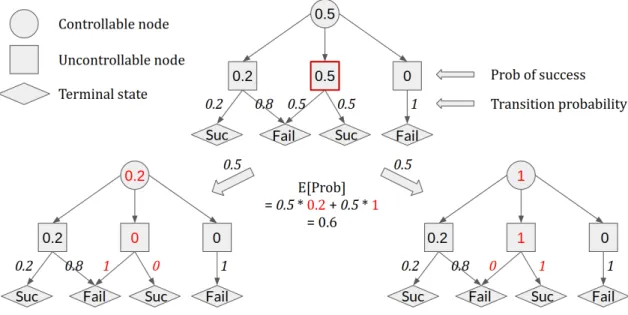
We illustrate the effect of a question on the expected success rate of a parent con-trollable choice with an example in Figure 3-3. In this figure, consider the highlighted node in the graph to be queried. We know that the probability of getting each answer is the same as the transition probability. That means that with probability 0.5 we will obtain an answer that updates the graph to the one shown on the left. On the other hand, there is a probability of 0.5 the graph is updated to the one on the right. The expected success rate after querying is the weighted sum of the probability of success for each outcome. In this case, the expected success rate becomes 0.6 after querying the middle uncontrollable node, with an improvement over the original success rate of 0.1. Evaluating the other uncontrollable nodes in the same manner shows that the leftmost node is the optimal node to query.