VI. APPLIED PLASMA
RIESEARCH
A. Active Plasma Systems
Academic Research Staff Prof. L. D. Smullin
Prof. A. Bers
Prof. iR. iR. Parker Prof. K. I. Thomassen N. J. Fisch S. P. Hirshman C. F. F. Karney J. L. Kulp Graduate Students G. HI. Neilson J. J. Schuss
NI.
D. SimonuttiN1.
S. Tekula A. I. Throop D. C. Watson P. R. \Widing1. EFFICIENCY CONSIDERATIONS FOR A PLASMA GUN SYSTEM\ National Science Foundation (Grant (G -28282X1)
S. P. Hirshman, L. D. Smullin
As reported in Quarterly Progress IReport No.
105
(pp.
89-93),
we have been studying the efficiency of electrical energy conversion to plasma energy in a plasma gun system. This report gives a summary of our latest results.1General Efficiency Criteria
Several measures of efficiency have been proposed by Jahn" and dynamic efficiency is defined by
1 en dl. 3 The
1 2
2 s
i d W p
where V = ft my dT is the total work done on the sheet gas by the magnetic forces
p o s
(including shock heating). In this measure of efficiency, only the final mass nmotion of the plasma is considered as a figure of merit. An alternative definition is the electro-mechanical efficiency, a measure of the ability to couple electric energy into total plasma energy,
o
where E is the initial energy stored in the external power supply. This efficiency takes o
into account the fact that gas particles undergoing inelastic collisions with the snowplow piston are heated and thus represent a useful conversion of electric energy into plasma
(VI. APPLIED PLASMIA IRESEARCHII)
energy. Finally, the kinetic efficiency, a measure of the ability to couple electrical energy to energy of notion of the sheet, is defined by
1 2 E
o
Note that -q1 = cc ; therefore, 1i\ is always less than either -yd or jelll The choice
of p to be used in any efficiency analysis depends on the particular task for which the gun is to be used. For ion thrusters, my is the relevant efficiency to optimize, while
for plasma injection applications, both p i and
n (n
are useful efficiency measures.Ie LR p (t L it ,
Et)V EXTERNAL GUN
CIRCUIT
(a) Fig. VI-1.
(a) General gun circuit. (b) Capacitor
I bank with crowbar.
-.-- TO GUN
CROWBAR APPLIED HERE (b)
To obtain physical insight into the dependence of
mK
and e1m on circuit and gunparameters, it is useful to express all
variables
in terms of the external circuit energyE(t) (Fig. \-I-la) and the gun inductance I,(t), which is proportional to the instantaneous sheet position and hence representative of the "state" of the sheet in the accelerator.
1
rThe
result is L E Lof
1+ +Lif and 1 ftf d 2S=em
er) ,(2)
2 , m f" 0 \ m(VI. APPIED PIASMXA RESEARCH)
where subscript f refers to the final accelerator state. It is clear that to optimize
rlem' Lf >> le is desirable; furthermore, the externally stored energy should be supplied
to the gun as quickly as possible and remain out of the external circuit. One way to prevent energy E from returning to the power circuit is to crowbar the power supply when E is at minimum. A typical circuit of this kind, which will be analyzed in greater
detail, is shown in Fig. VI-1b.
The second term in Eq. 2 represents losses from shock heating, and the effect on efficiency is not as readily interpreted as rln1 was before.
Independent Parameters of a Gun System
In any real gun system, there are numerous performance requirements that impose constraints on the otherwise independent gun parameters. For injection (or thruster) applications, the type of working gas, the final velocity, and the kinetic energy of the accelerated plasma are to be considered prescribed by the requirements imposed by heating capabilities, plasma penetration into magnetic fields, and so forth. These three constraints are sufficient to allow an optimum determuination of all other system
parameters. (In a practical system, the inductance per unit length
Y.
is severely restricted by geometrical considerations and should be chosen as large as possible; cf. Eq. 1.)Our procedure consists in solving a normalized set of equations1 which completely describes the gun system of 'ig. VI-1b. For a uniform distribution of filling gas, we found that il and -e depend only on two coupling parameters:
(i) Energy paramneter, e E
/1
(o1
. Physically,E
is a mieasulre of the energy "match" between the gun and the external circuit.(ii) Time parameter, t / t , where t = /u w, with u0 the snowplow velocity,
and t = E V I . Here j4 is a measure of the matching of circuit (I ) and intrinsic
c O 00 c
(t ) gun time scales. L
1 2 1 e
In the particular case considered here, L = CV and = CV /l., so that C = L
0 0 0
-0
and = 2to/(LC)1/
Therefore, for any gun system driven by a capacitor bank and obeying the snowplow
dynanics, the efficiency of enetrv conversion depends only on the two parameters
E
and Fu. lurthe rmore, %with l, in., and uf= u sp(cified, the remaining system parameters can be expressed solely in terms of
c
and p., provided we make an opti-mum choice of system length.There is an efficiency,
m
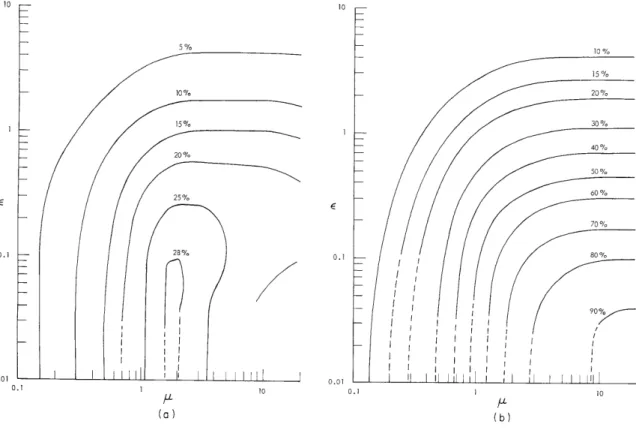
, associated with any pair of coordinates (C, K). In gen-eral, there will be level curves of constant Tj in c, K space, and any point in this space for which 1j is a maximnum represents an optimum solution to the efficiency problem.There are, however, certain practical constraints that limit the region of accessibility
Fig. VI-2.
(b)
(a) Kinetic efficiency level curves.
(b) Electromechanical efficiency level curves.
10
10 0.1 1 10
4 41
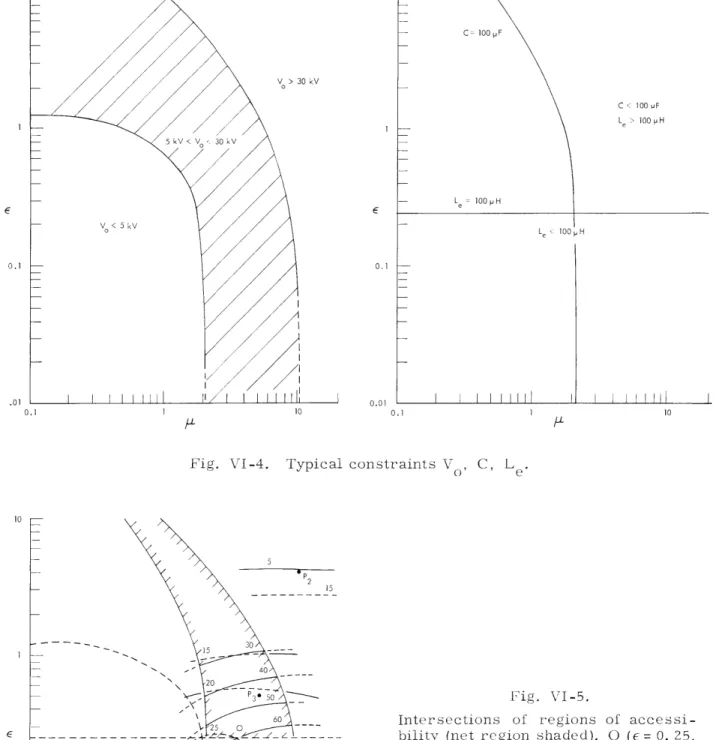
Fig. VI-4. Typical constraints V , C, Le
2 15
Fig. VI-5.
Intersections of regions of accessi-bility (net region shaded). O (E= 0. 25, = 3.5) is the point of optimum attain-able efficiency. 80 i o 10 0.01 L 0.1
QPR No. 109
1010.50 0.25 0.5 1.0 1.5 2.0 2. TIME 0.5 1.0 1.5 2.0 2.5 TIME Fig. VI-6. 0 (t = 0. 25, F = 3. 5): ELECTROMECHANICAL THERMAL 5 . KINETIC 0.5 1.0 1.5 2.0 2.5 CAPACITIVE INDUCTIVE GUN 0.5 1.0 1.5 TIME 2.0 2.5
Optimum realizable parameters.
1.0 r--0.75 Z 0.50 a 3 4 5 TIME ELECTROMECHANICAL THERMAL -/ KINETIC R / 1 2 3 4 5 TIME 1.0 CAPACITIVE 0.75 z 0.50 0.25 1 2 3 TIME S= 5): Optimum parameters. INDUCTIVE GUN 0.75 0.50 1 .0 Z 0.75 Ou - 0.50 0.25 1 2 3 4 5 TIME Fig. VI-7. 0 (E = 0. 04,
(VI. APPLIED PLAS\IA RESEARCH)
in
c,
4
space, and hence the optimum value of jj.The contours of constant kinetic and electromechanical efficiencies were numeri-cally computed and are shown in Fig. VI-2 for the
c,
. space of practical interest. Figure VI-3 shows curves of constant final velocity fraction K(E, k). Note the great sen-sitivity of the efficiency curves onc
~ Le/Lo, as expected from Eq. 1.Once these curves have been obtained, they can be used to design a plasma gun that will operate in the most efficient manner. The typical constraints 5 kV < Vo < 30 kV,
L 10- 7 H, and C < 100 iF are shown in Fig. VI-4 for hydrogen gas of total filling
e 5
mass 10 kg and final velocity 105 m/s. In Figure VI-5, the intersection of all three constraints is plotted, with the net region of accessibility shaded. The point O (E = 0.25, 4= 3. 5) appears to be the point of optimum attainable efficiency for this design, and cor-responds to TK = 25%o and nem = 60%. The (normalized) system variables (velocity,
current, voltage, efficiencies) are plotted in Fig. VI-6 for point () as functions of time. Note how the initial capacitive energy is entirely converted into inductive and plasma
energy.
In Fig. VI-7 the point 0 (E= 0. 04, i= 5) demonstrates the favorable effect obtained
by lowering the circuit inductance Le approximately an order of magnitude. Note the 25% gain in plasma efficiency over point 0.
0.50 0.50 0.25 ELECTROMECHANICAL 0.25 ELECTROMECHANICAL KINETIC KINETIC S_ KINETIC - i---T 4 8 12 16 20 0.4 0.8 1.2 1.6 2.0 TIME TIME 1.0 1.0 0.75 - CAPACITIVE 0.75 2 2 0.50z z 0.50 CAPACITIVE u u 0.25 0.25 TOTAL INDUCTIVE GUN INDUCTIVE 4 8 12 16 20 0.4 0.8 1.2 1.6 2 0 TIME TIME (a) (b)
Fig. VI-8. Inefficient mode of operation. (a) P 1
:
E = 0 025, i = 0. 2. (b) P2:e
= 4, L = 10.(VI. APPLIED PLASMA RESEARCH)
Furthermore, we may conclude that there are only two basically different ways in which the plasma gun system can operate inefficiently. These two cases are represented by P1 and P2 in Fig. VI-5, and correspond to small i and large c (and kL), respec-tively. When i is small, the gun is electrically "too short," and the acceleration process is over before the external circuit can transfer its energy to the plasma (Fig. VI-8a). When E (and i4) are large, energy is transferred only from the capacitor to the external inductor and never gets into the gun circuit. This inefficiency is illus-trated in Fig. VI-8b.
Conclusion
We have found that with reasonable circuit and gun parameters, it is possible to design a plasma gun that meets typical operating specifications with kinetic efficiency of 25% and overall plasma efficiency (including shock heating) of 60%. The efficiency estimates were based on a final plasma velocity of -105 m/s, which is (for hydrogen) below the thermonuclear threshold. It can be shownI that the effect of increasing the final velocity by a factor of 10 is to decrease the system efficiencies to
<
5-10%. Therefore, there is a severe reduction in system efficiency as the velocities required for thermonuclear applications are approached, a situation that casts doubt on the appli-cability of a plasma accelerator for thermonuclear heating.References
1. Detailed results are presented in S. P. Hirshnian, S. M. Thesis, Department of Electrical Engineering, M. I. T. , January 1973 (unpublished).
2. R. G. Jahn, Physics of Electric Propulsion (MIcGraw-Hill Book Company, Inc., New York, 1968).
VI. APPLIED PLASMA RESEARCH
D. Laser-Plasma Interactions
Academic and Research Staff
Prof. E. V. George Prof. II. A. IHaus J. J. McCarthy Prof. A. Bers Dr. P. A. Politzer W. J. Mulligan
Dr. A. H. M. Ross
Graduate Students
Y. Manichaikul D. Prosnitz C. W. Werner
J. L. Miller D. Wildman
1. SHORT PULSE PROPAGATION
National Science Foundation (Grant GK-33843) A. H. M. Ross
A computer code has been developed to solve the wave equation for electromagnetic propagation in resonant media. While the ultimate goal of this effort is to produce a realistic numerical model of short-pulse amplifiers, including the effects of collisional exchange processes and rotational state degeneracy, preliminary testing with the ideal-ized model of a two-level medium has produced new results concerning the so-called 07r pulses.1
The one -dimensional wave equation in the slowly varying envelope approximation is
at
1 aJ
a -oa--+ I a_ 3 e- i 0
,
az c at 2y 2v
where 0- is a phenomenological conductivity included to account for nonresonant losses,
vo = \ i- i the admittance of free space, and s
6'
andY
are the complex amplitudesof the electric field and polarization, respectively.
E(z, t) = LRe [6(z, t) exp{i(ot-ko0 )}]. (1)
Schr6dinger's equation for a gaseous medium is most easily written in terms2 of a den-sity matrix distribution function p(z, v, t).
dp i -dp)
~dt
1- Th collision'd
a
a
where - + v is the convective derivative. The constitutive relation is
(VI. APPLIED PLASMA RESEARICH)
P = n dv Tr (ip(z. V, t)),
where no is the mean particle density. The nornmalization of p is taken to be
S dtv Tr (p) = 1.
For a system of two nondegenerate levels these relations become
apaa ( )
at
- Im p ,! ap + a (2)at
h ab a aa aa
= + - Im ;ab) -bbb + rb b (3)at
(iabab ab i aa-PbbY(z,
t)
=
2no
dv
Pa
(z,
v,
t).(5
-ccThe collision ter'm has been represented by phenonmenological relaxation irates and pumping terms.
In the limit of very short pulse lengths, where all terms in (2)-(5) other than the electromagnetic ones can be neglected, analytical solutions of (1)-(5) can be found.
Among them are the nr pulses, which leave the mnediun in the same state after their passage as before their arrival. 1Particularly interesting are the pulses with bipolar envelopes such that their area is zero(, the Or, pulses. XWhile most coherent propagation effects are drastically modified by degeneracy- of the participating atomic levels, it has been shown, both theoreticallyI and experimentally,3 that On pulses can exist in more complicated mendia.
Since the closed-form solutions have been found only fotr completely unbroadened absorbing media, and because they cannot a(:commodate arbitrary inputs, it it necessary to use numerical methods for mnore realistic situations. Because of the interest in Or pulses, we present solutions of (1 )-(5) in homoneneously and inhonogeneously broadened absorbing (pbb(t= 0) 1, paa(t= 0) = 0) eases for inputs that would otherwise e Obe pulses.
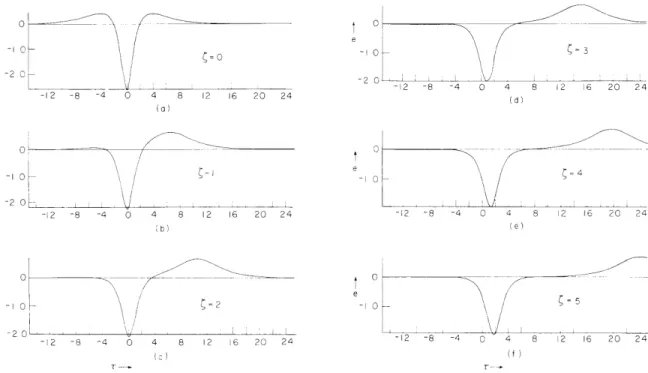
As Lamb has shown, there are two simple types of Or pulses. The first, illus-trated in Fig. VI-9, separates into twvo relatively inverted 2-, pulses. The effect of finite phase damping is shown in Fig. VI-10 where the homnogeneous linewidth has been
0=0
-2 0
0 -12 -8 -4 0 4 8 12 16 20 24 (0 -2 0 -12 -8 -4 0 4 8 12 16 20 240
10 2 -8 -4 0 4 8 12 16 20 24 (c ) 0 -12 -8 -4 0 4 8 i2 6 20 24 (d) 12 -8 -4 0 4 8 2 16 20 24 (e) 0-0 -12 -8 -4 3 4 8 2 16 20 (f TFig.
VI-9. Evolution of a separating 07 pulse in E width. Pulse widths: 1 = 1, 2 3.ordinate the electric field envelope; 6 sionless.)
t
0
e -10999 -12 -8 -4 0 4 8 12 16 20 24 0 e -I 0 2 0 -12 -8 -4 0 4 8 12 16 20 24 T--0 e 5 -1 0 -12 -8 -4 0 4 8 12 16 20 24two-level medium of zero spectral Abscissa represents retarded time; depth in medium. (All units
dimen-Fig. VI-10.
Separating 07T pulse emerging from a homogeneously broadened atten-uator: ab = 1. (Other parameters as in Fig. VI-9.)
Fig. VI-11.
Separating 07, pulse emerging from a Doppler -broadened attenuator: AwD=
1/ -2. (Other parameters as in
Fig. VI-9.)
Fig. VI-12.
Separating OT pulse emerging from an attenuator with both broadening mechanisms: ab = 1, AD = 1 / 2. (Other parameters as in Fig. VI-9.)
QPR No. 109
S= 2
107
t
t e 0 10 e 0 -1 0 0 e 0 -1 .0 0 e -0 e -12 -8 -4 0 4 8 2 6 20 24 (b) SIJ :2 -12 -8 -4 0 4 8 12 16 20 24 (C) T--0 e -12 -8 -4 0 4 8 12 16 20 24 (d) -I 2 -8 4 4 8 12 16 20 24 e 5 -1 10 12 -8 -4 0 4 8 12 16 20 24 (f
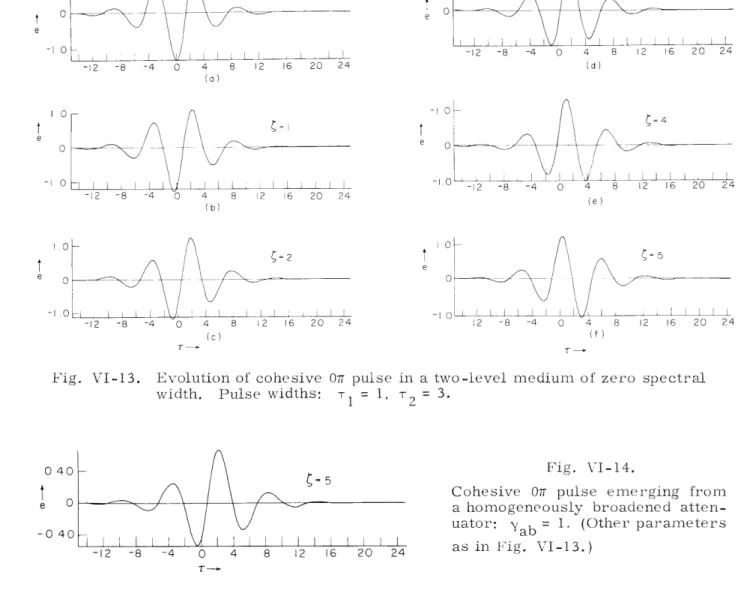
T-Fig. VI-13. Evolution of cohesive O7 pulse in a two-level medium of zero spectral
width. Pulse widths: 1 =1, T2 3.
40 -Fig. VI-14.
4=5
Cohesive O7 pulse emerging from a homogeneously broadened atten-uator: yVab = 1. (Other parameters
Sas in Fig. VI-13.)
-12 -8 -4 0 4 8 12 16 20 24 as in Fig. VI-13.)
7----5 Fig. VI-15.
0 Cohesive OrT pulse emerging from a
Doppler-broadened attenuator: Aw D =
1.0o 1 / -. (Other parameters as in
-12 -8 -4 0 4 8 12 16 20 24 Fig. VI-13.) T-o40 e 0 -0.40 -12 -8 -4 0 4 8 12 16 20 24 T-Fig. VI-16.
Cohesive Om pulse emerging from an attenuator with both broadening mechanisms: yab = 1, AWD = 1/ 2. (Other parameters as in Fig. VI-13.)
(VI. APPLIED PLASMA RESEARCH)
chosen to be equal to the inverse pulse width of the shorter of the two pulses after sep-aration. Figure VI-11 illustrates the same situation for inhomogeneous (Doppler) broadening with no phase damping. Figure VI-12 combines both broadening mecha-nisms.
The second type of 07r pulse, in the absence of broadening, remains localized; it resembles a modulated hyperbolic secant in which the modulation varies with time. Figures VI-13 through VI-16 illustrate the effects of the various broadening mechanisms on this pulse. Note the relative insensitivity of this pulse to the pure inhomogeneous broadening. In all cases, however, energy loss to the medium eventually reduces the pulse to the linear regime.
Work continues on a more sophisticated model of a medium containing the effects of a rotation spectrum. This will be essentially a two-vibrational-level rotator that should provide a reasonably realistic model of many molecular lasers.
References
1. G. L. Lamb, ,Jr., "Analytical Descriptions of Ultrashort Optical Pulse Propagation in a Resonant Medium," Rev. Mod. Phys. 43, 99-124 (1971).
2. A. II. M. Ross, Ph. D. Thesis, 1Department of Electrical Engineering, M. I. T., June 1972.
3. H. P. Grieneisen, J. Goldhar, N. A. Kurnit, A. Javan, and H. 1t. Schlossberg, "Observation of the Transparency of a Resonant Medium to Zero-degree Optical Pulses," Appl. Phys. Ietters 21, 559-562 (1972).