RUGC 2020 AJCE, vol. 38 (1)
189
Studying the mechanical behavior of
reclaimed asphalt pavements using the
grid method.
Ali Moukahal1, Mathilde Morvan1, and Evelyne Toussaint 1
1 Institut Pascal – CNRS : UMR6602, Université Clermont Auvergne, CNRS, SIGMA Clermont, Institut
Pascal – 24 avenue des Landais 63171 Aubière Cedex - France
ABSTRACT. The main objective of this study is to analyze the mechanical performances of several Reclaimed Asphalt Pavement (RAP). A semi-coarse asphalt concrete with a 35/50 pen bitumen is used to produce three formulations containing 0, 30 and 50% reclaimed asphalt pavements, named R0, R30 and R50, respectively. All specimens are tested under indirect tensile strength test, followed by a recovery phase. A full-field measurement method based on the grid method is used to determine and analyze both displacement and strain fields at the surface of the specimens. An analysis is proposed both at the microscopic and macroscopic scale.
Keywords: Reclaimed Asphalt Pavements (RAP), Grid Method (GM), Strain field, Displacement field.
I. INTRODUCTION
At the end of their service life, pavement structures are generally removed and replaced by new asphalt mixtures. The removed material composed of aggregates and aged binder is called Reclaimed Asphalt Pavement (RAP), and can be reused in new construction projects. In this case, the aged bitumen can replace a portion of virgin bitumen as well as the aggregates of RAP replace a portion of virgin aggregates. Today, the demand for aggregates is greater than before and using RAP in new construction projects is a good option because it reduces the need to excavate more virgin aggregates, and it introduces less bituminous binder into the recycling process (Chowdhury et al., 2010). RAP can be-reused by means of hot and cold recycling technologies (Xiao et al., 2018), in different replacement rate, from 30% for highway pavements to 60% for few other applications (European asphalt pavement association, 2011). Hence the interest of evaluating the mechanical performances of bituminous mixes incorporating RAP. Several investigations have studied the effect of RAP on the mechanical properties of asphalt mixtures at the macroscale (Silva et al., 2012). But, the study of different phenomena at the micro scale requires a full-field measurement technique that allows measuring displacement and strain fields at the neighborhood of aggregates. The Grid Method (GM), developed and used in the laboratory, allows measuring displacement fields of materials under solicitation, and then to detect strain values, even for low amplitudes.
RUGC 2020 AJCE, vol. 38 (1)
190 When the substrate is deformed, the grid transferred on its surface faithfully follows its movements. Images are analyzed using a modulation and demodulation approach and deformation fields are deduced (Molimard and Surrel, 2012). In this paper, the first objective is to compare global answer of specimens containing different percentages of RAP, during the loading The second one is to analyze strain fields for the same loading value and more particularly around aggregates.
II. EXPERIMENTAL SET-UP AND CONDITIONS
A. Material and design
The formula used in this study is a BBSG 0/10. The virgin material is constituted from diorite aggregates, limestone filler and 35/50-pen bitumen. The RAP has a 5.72% binder content and a 11.2% fine content (passing to 0.063 mm). The penetration (25°C; 0.1 mm) of the aged and virgin bitumen is 8 mm and 36 mm respectively. Six hot mixtures asphalt containing 0%, 10%, 20%, 30%, 40% and 50% of RAP were made with the same particle size distribution curves. Three of these six mixtures are studied in this paper. The virgin bitumen content is 5.3%, 3.6%, and 2.4% for the R0, R30 and R50 specimens, respectively.
B. Specimen preparation and test conditions
The preparation mode of specimens is according to the method B of the (EN, NF, 2008). Test specimens (diameter = 80 mm, height = 80 to 90 mm), are sawn and then a grid (printed on a polymer film (Piro and Grediac, 2004)) is transferred onto their sawn surface. Indirect tensile tests were carried out in a temperature-controlled room at 23 °C, with a displacement rate of 0.01 mm/s. The response of the specimen is studied in the loading phase and the unloading phase thanks to the information given by the grid method.
III. RESULTS
A. Response at the macroscopic scale
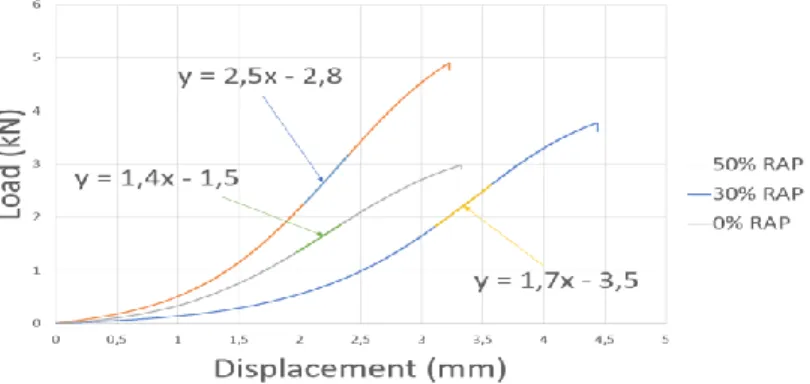
FIGURE 1. Load - Displacement curves for R0, R30 and R50.
The load-displacement curves of different specimens (R0, R30 and R50) are presented in Fig. 1. The initial portion of curves corresponds to the settlement phase of the specimen. The second portion shows the linear force-displacement response followed by a non-linear portion until the load
RUGC 2020 AJCE, vol. 38 (1)
191 reaches its maximum values before the unloading phase. The apparent stiffness increases with the RAP rate (1.4, 1.7 and 2.5 kN/mm for the mixtures R0, R30 and R50 respectively) because of the difference in behavior between virgin and aged binder. This is due to the recycled aggregate binder that is harder than the virgin binder because it was already exposed to aging cycles during its service phase.
B. Response at the microscopic scale
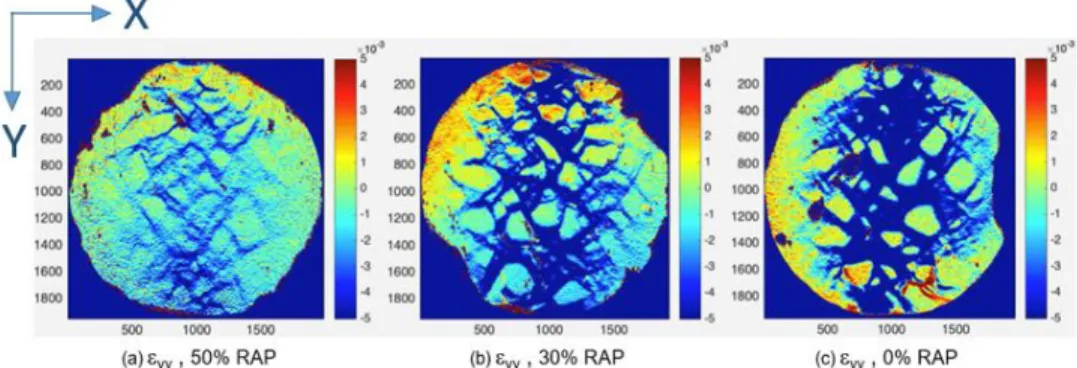
Three examples of strain maps yy, obtained by the grid method for the specimens R0, R30 and R50,
at the same loading level (3 kN) are presented in the Fig. 2. The strain distribution is in good correspondence with the distribution of aggregates and binder. The deformation 𝜀𝑦𝑦 along the compression direction in the whole section reaches the highest values and the widest distribution for the specimen made of virgin materials (0% RAP, see Fig 2c). These values decrease when the RAP increases in the mixture. The mean deformation of the whole section along the yaxis is -4.1×10⁻³, -3.7×10⁻³ and -1.3×10⁻³ for the specimens containing 0%, 30% and 50% of RAP, respectively.
Then, the mixture made with virgin materials is able to deform more than the recycled mixture for the same loading level. In other words, the presence of the aged binder in the mixture increases the ability to withstand compressive stresses.
FIGURE 2. Strain field yy of a)R50, b)R30, and c)R0 samples at the same loading level (3 kN). B. The behavior in the neighborhood of recycled and virgin aggregates
As shown in Fig. 2, the strain is mainly concentrated in the central area of the specimen around the loading axis. On this basis, in order to objectively compare the behavior in the neighborhood of aggregates, it is necessary to concentrate the analysis in this region of high deformability. Indeed, for a better understanding of the behavior of the recycled materials, the mean deformation in the neighborhood of virgin and recycled aggregates, in the zone of high deformability, were calculated and compared.
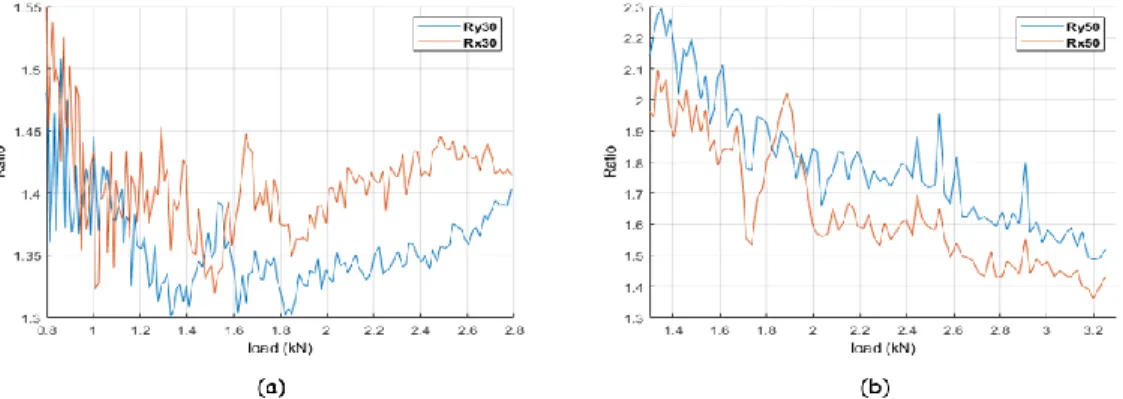
To do this, based on a Matlab script, 0.5 mm thickness areas surrounding aggregates in the strain map are selected. This selection is repeated for the virgin and recycled aggregates in the high deformability area. The average strains of the areas surrounding recycled and virgin aggregates are calculated in both vertical and horizontal directions for the linear portion of the test and are compared. Results show that the strains in the neighborhood of recycled aggregates are always lower than that around virgin aggregates, which confirms the previous conclusions. Besides, the strains around virgin and recycled aggregates in the R30 specimen are higher than those in the R50 specimen. Indeed, for the same loading levels, the R30 specimen deforms more than the R50 one. Ratios denoted Rx and Ry between the deformation around the virgin aggregates and the
RUGC 2020 AJCE, vol. 38 (1)
192 deformation around recycled aggregates are also calculated in the x and y directions, respectively. Results are presented in Figure 3. These ratios are greater than 1 and decrease with the increasing of load, which means that for a significant level of loading, the ageing binder globally tends to have the same behavior as the virgin binder. This result is clearly visible for R50 specimen. It can be concluded that the recycled aggregate binder better withstood the compressive loads than the virgin binder as both Rx and Ry ratios are greater than 1. Finally, by dividing Ry by Rx for both R30 and R50 specimens, one obtains a value that is equal to 0.97 and 1.09 for R30 and R30 specimens, respectively. This means that the Poisson’s ratio of recycled and virgin binder seems to be the same.
FIGURE 3. Rx and Ry ratios for specimens a) R30 and b) R50.
IV. CONCLUSION AND PERSPECTIVE
In this study, three specimens containing different RAP percentages are studied. At the macroscopic scale, the stiffness of the material is improved by increasing the RAP rate in the mixture. At the microscale, the deformation values are higher for specimens containing a small RAP percentage. Besides, the analysis has shown that the mean value of the deformation in the neighborhood of recycled aggregates is smaller than the one in the neighborhood of virgin aggregates. This is justified by the fact that the aged binder is harder than the virgin binder.
REFERENCES
Chowdhury, R., Apul, D., Fry, T., 2010. A life cycle based environmental impacts assessment of construction materials used in road construction. Resources, Conservation and Recycling 54, 250–255. https://doi.org/10.1016/j.resconrec.2009.08.007
EN, NF, 2008. Test method for hot mix asphalt. Determination of the water sensitivity of bituminous specimens. European asphalt pavement association, 2011. The Asphalt Paving Industry A Global Perspective.
Molimard, J., Surrel, Y., 2012. Grid Method, Moiré and Deflectometry, in: Grédiac, M., Hild, F., Pineau, A. (Eds.), Full-Field Measurements and Identification in Solid Mechanics. John Wiley & Sons, Inc., Hoboken, NJ USA, pp. 61–92. https://doi.org/10.1002/9781118578469.ch3
Piro, J.-L., Grediac, M., 2004. producing and transferring low-spatial-frequency grids for measuring displacement fields with Moire and Grid Methods. Experimental Techniques 28, 23–26. https://doi.org/10.1111/j.1747-1567.2004.tb00173.x Silva, H.M.R.D., Oliveira, J.R.M., Jesus, C.M.G., 2012. Are totally recycled hot mix asphalts a sustainable alternative for road
paving? Resources, Conservation and Recycling 60, 38–48. https://doi.org/10.1016/j.resconrec.2011.11.013 Xiao, F., Yao, S., Wang, J., Li, X., Amirkhanian, S., 2018. A literature review on cold recycling technology of asphalt pavement.