All-Optical Switch and Transistor Gated by One Stored Photon
The MIT Faculty has made this article openly available. Please sharehow this access benefits you. Your story matters.
Citation Chen, W., K. M. Beck, R. Bucker, M. Gullans, M. D. Lukin, H. Tanji-Suzuki, and V. Vuletic. “All-Optical Switch and Transistor Gated by One Stored Photon.” Science 341, no. 6147 (July 4, 2013): 768–770.
As Published http://dx.doi.org/10.1126/science.1238169
Publisher American Association for the Advancement of Science (AAAS)
Version Author's final manuscript
Citable link http://hdl.handle.net/1721.1/91680
Terms of Use Article is made available in accordance with the publisher's policy and may be subject to US copyright law. Please refer to the publisher's site for terms of use.
All-Optical Switch and Transistor Gated by One
Stored Photon
Wenlan Chen
1, Kristin M. Beck
1, Robert B¨ucker
1,2,
Michael Gullans
3, Mikhail D. Lukin
3, Haruka Tanji-Suzuki
1,3,4,
Vladan Vuleti´c
1∗1 Department of Physics and Research Laboratory of Electronics,
Massachusetts Institute of Technology, Cambridge, Massachusetts 02139, USA
2Vienna Center for Quantum Science and Technology,
Atominstitut, TU Wien, Stadionallee 2, 1020 Vienna, Austria
3Department of Physics, Harvard University, Cambridge, Massachusetts 02138, USA 4 Photon Science Center, School of Engineering,
The University of Tokyo, 2-11-16 Yayoi, Bunkyo-ku, Tokyo 113-8656, Japan
∗To whom correspondence should be addressed; E-mail: [email protected].
This is the author’s version of the work.
It is posted here by permission of the AAAS for personal use, not for redistribution. The definitive version was published in Science Vol. 341 (16 August 2013), doi:10.1126/science.1238169
The realization of an all-optical transistor where one ‘gate’ photon controls
a ‘source’ light beam, is a long-standing goal in optics. By stopping a light
pulse in an atomic ensemble contained inside an optical resonator, we realize
a device in which one stored gate photon controls the resonator transmission
of subsequently applied source photons. A weak gate pulse induces bimodal
transmission distribution, corresponding to zero and one gate photons. One
stored gate photon produces fivefold source attenuation, and can be retrieved
from the atomic ensemble after switching more than one source photon.
out retrieval, one stored gate photon can switch several hundred source
pho-tons. With improved storage and retrieval efficiency, our work may enable
various new applications, including photonic quantum gates, and
determinis-tic multiphoton entanglement.
Photons are excellent carriers of quantum information, but it is difficult to induce the strong
interactions between individual photons that are required for, e.g., all-optical quantum
infor-mation processing. Nevertheless, advances toward such interactions have been made in
cav-ity quantum electrodynamics (QED) systems with atoms (1–6) or artificial atoms (7–11), and
in a cavity-free system using atomic Rydberg states (12, 13) or dye molecules (14).
All-optical switching of one beam by another (15) and cross-phase modulation (16) have been
demonstrated at the level of a few hundred photons by means of electromagnetically induced
transparency (EIT) (17–21). At the few-photon level, nonclassical light has been generated
(1, 4, 6–9, 11–13, 22), and optical nonlinearities of 16◦ in phase shift (23) and up to ∼20% in
two-photon attenuation (5, 9, 10) have been observed in cavity QED systems. While switching
of the cavity transmission by a single atom has also been achieved (24), the realization of an
optical transistor exhibiting gain with gate signals at the few- or one-photon level (25) remains
a challenge.
We demonstrate a cavity QED version (18) of an optical switch (25) based on EIT in a
four-level system (17–19) where the collective atomic excitation associated with the storage of
one gate photon (20, 26, 27) blocks the resonator transmission. Our system (5) consists of an
ensemble of laser-cooled cesium atoms optically trapped inside a high-finesse optical cavity
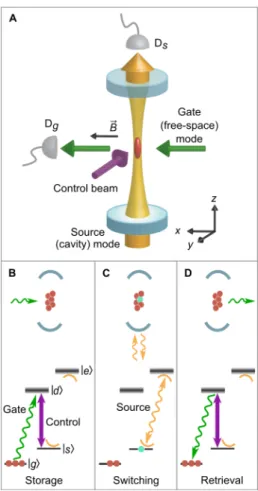
(Fig. 1A) operating in the strong-coupling regime (1–6) of cavity QED. Each atom has a
four-state N -type level structure |gi ↔ |di ↔ |si ↔ |ei with two stable ground four-states |gi, |si,
and two electronic excited states |di, |ei (Fig. 1B). For atoms prepared in state |gi, this atomic
the |gi → |di transition serving as gate photons) and cavity photons (photons resonant with the
|si → |ei transition serving as the source) (17–19). These two transitions are connected via a
control laser that addresses the |di → |si transition and induces transparency (EIT) for the gate
photons. By ramping the control laser power down to zero, we store a weak gate pulse inside
the atomic ensemble (Fig. 1B), and retrieve it at a later time by adiabatically re-applying the
control beam (Fig. 1D) (20, 26, 27). In between storage and retrieval, we apply a source beam
(Fig. 1C). The atomic population in state |si associated with the stored gate pulse can block the
transmission of the source pulse through the cavity (24). Due to the finite optical depth of the
ensemble (OD ≤ 0.9) and sub-optimal control waveform (28), one out of 5 to 10 incident gate
photons is stored.
We first characterize the cavity transmission without gate photon retrieval. To this end,
we measure the average cavity transmission spectrum for different mean stored gate photon
numbers hngi (Fig. 2). Since the gate pulses are weak classical pulses (coherent states), they are
associated with Poissonian distributions in photon number ng, and there is a finite probability
p(0) = e−hngi that the stored gate pulse does not contain any photons. Therefore, even if one
photon were to perfectly switch off the source beam, there is a maximum average switching
contrast 1 − e−hngifor measurements with coherent states of gate photons (solid line in the inset
to Fig. 2). The measured data points lie close to the maximum possible switching contrast, and
within the theoretically expected range (gray area).
The photon number quantization of the gate pulse and the cavity blocking by just one gate
photon are evident when we plot histograms of transmission spectra (Fig. 3) instead of the
aver-age transmission. The histogram shows two clearly separated components (Fig. 3B), where the
high-transmission component corresponds to ng = 0, while the low-transmission component
corresponds to ng ≥ 1 (mostly ng = 1 gate photons. The high-to-low peak transmission ratio
Figure 1: Fig. 1. All-optical switch and transistor. Setup (A) and atomic level scheme with experimental sequence (B-D). An ensemble of laser cooled atoms is trapped inside an optical resonator operating in the single-atom strong-coupling regime on the |si → |ei transition. (B) We first store a gate photon in the medium, which corresponds to a collective atomic excitation to state |si. (C) This collective excitation blocks the transmission of source photons through the cavity and (D) can be retrieved. Retrieved gate and transmitted source photons are mea-sured with photon counters Dg and Ds, respectively. The atomic states of 133Cs used in this
experiment are |gi =
6S1/2, F = 3, mF = 3 E , |di = 6P3/2, 4, 4 E , |si = 6S1/2, 4, 4 E , |ei = 6P3/2, 5, 5 E
, where F and mF denote the hyperfine and magnetic sublevels.
In order to characterize the optical gain of the system, we measure the distribution of the
transmitted source photon number, Ms= T +LT
R
dt mc(t)κ, on cavity resonance. Here mc(t) is
the intracavity photon number at time t, κ is the cavity linewidth, and T +LT = 0.66 (with cavity
intra-Source-cavity detuning (MHz) Tr ansm issio n ( de te ct ed ph oton s) -0.4 -0.2 0.0 0.2 0 5 10 15 0 1 0 1 2 3 Co ntr ast ‹ng›
Figure 2: Fig. 2. Cavity transmission in the presence of stored gate photons. Average transmission spectra of a source beam applied for 24µs for mean stored gate photon numbers hngi = 0, 0.4, 1.4, 2.9 (top to bottom). The solid lines are theoretical curves (29). Error bars
are standard errors of the mean. The inset shows the relative transmission on cavity resonance (switching contrast) versus hngi. The gray area indicates the theoretical prediction. The solid
black line corresponds to the maximum average switching contrast that can be observed with coherent states of gate photons.
cavity photon. Ms can be determined from the detected photon number and the independently
measured detection-path efficiency (29). As Fig. 4A shows, the distribution is double peaked,
with the high-transmission peak with average source photon number hMsi|ng=0 corresponding
no gate photon, while the gray area of low transmission hMsi|ng≥1 corresponds to the blocking
by one or more gate photons. The optical gain per stored gate photon can then be defined as the
gate-photon-induced change in source transmission, G = hMsi|ng=0− hMsi|ng≥1, which is
di-rectly determined from the measured histogram. Fig. 4B shows the measured gain as a function
of the applied source photon number, where the gain saturation occurring around 1000 source
photons is likely due to optical pumping of the atom into magnetic sublevels with weaker cavity
coupling. Remarkably, one stored gate photon can block more than ∼ 600 source photons, of
which ∼ 400 are available outside the cavity.
To operate the device with gate retrieval where the stored photon is recovered in the original
Figure 3: Fig. 3. Histogram of cavity transmission spectra. Cavity transmission without (A) and with hngi = 0.5 gate photons (B). The horizontal axis indicates the detuning of the source
beam from the cavity resonance, the vertical axis the number of detected transmitted source photons in a 24 µs detection window. The color indicates the occurrence rate of a particular detected transmitted source photon number for a given source-cavity detuning. The histogram displays a clear separation between the zero-gate-photon component ng = 0 with high cavity
transmission (17 detected source photons), and the component ng ≥ 1 (ng = 1 with probability
0.8, ng > 1 with 0.2) leading to cavity blocking (1.5 detected photons). (C), (D) show the
cor-responding theoretically expected histograms. The extinction factor 17/1.5 for one gate photon is T−1 = 11 ± 1.
less than the measured lifetime τ = (2.1 ± 0.1) µs of the collective spin excitation. In this case
we can directly measure the cavity transmission probability conditioned on the detection of a
gate photon, given by the gate-source cross-correlation function g(2)
gs = hngnsi/(hngihnsi) in the
limit hngi, hnsi 1. On cavity resonance we measure ggs(2) = 0.29 +0.09
−0.08for 0.2 average retrieved
Figure 4: Fig. 4. Measurement of transistor gain. (A) Histogram of the integrated source photon number Msin a 50 µs window. The graph shows Msfor no applied gate photon (ng = 0,
open red circles) with a Poissonian fit and for a coherent state with hngi = 0.4 stored gate
photons (solid black circles). The gray area indicates the contribution from events with ng ≥ 1,
with average value denoted by hMsi|ng≥1. (B) Transistor gain G = hMsi|ng=0− hMsi|ng≥1 as a function of source strength hMsi|ng=0 for integration times of 25 µs (solid black circles) and
50 µs (open red circles), with a linear fit to the first 9 data points (black dashed line) and with exponential fit for gain saturation (red line). Timing sequence for retrieval operation with input pulses (C) and output pulses (D). (The actual gate, control, and source beam waveforms are shown, but relative powers are not to scale.) First, the control beam is adiabatically ramped down at t = 0 to store a gate photon in the atomic medium. Then a source pulse is sent onto the cavity and its transmission measured. Subsequently, the control beam is adiabatically ramped up to retrieve and detect the gate photon. The combined storage and retrieval efficiency in the absence of source light after a storage time of 1 µs is (3.0 ± 0.1)%. (E) Measurement of transistor gain in retrieval mode. The average fractional retrieval efficiency of the gate photon after 1 µs is plotted vs. hMsi|ng=0 with an exponential fit. The fitted source photon number resulting in e−1 reduction is Ms0 = 1.9 ± 0.1 outside of the cavity (Ms0 = 2.8 ± 0.2
before outcoupling losses, in good agreement with the theoretical value 2.8 ± 0.1).
chosen to minimize the two-photon probability in each beam while ensuring that the
signal-to-background ratio remains sufficiently high. If we subtract independently measured detector
backgrounds (29), we find a corrected value of ¯g(2)
gs = 0.17 +0.08
arising from the effective interaction between two initially uncorrelated photons of different
wavelengths, is in good agreement with the value T = 0.09 ± 0.01 deduced from Fig. 3B, and
the value T = 0.16 ± 0.06 expected from first principles, as discussed below.
Finally, we determine the available gain Gr in retrieval mode by measuring the retrieval
reduction as a function of source photon number, and display the result in Fig. 4E. In the
pro-cess, it is only the scattering of a source photon into free space that reveals the location of the
excited atom, thereby collapsing the collective state into a single-atom state, and preventing the
retrieval. This scattering is suppressed in the strong-coupling limit of cavity QED, as discussed
below, and the observed dependence of retrieval on source photon number agrees well with
the theoretical model. The physical gain of the device operated at 1/e retrieval reduction is
Gr = 2.2 ± 0.2, and the available gain outside the cavity is 1.4 ± 0.1 (lower due to the 0.66
outcoupling efficiency). This demonstrates a gain exceeding unity in transistor operation where
the gate photon is preserved.
Our observations can be quantitatively understood in a simple cavity QED model: One atom
in state |si reduces the cavity transmission (1,4) by a factor T = (1+η)−2, where η is the
single-atom cooperativity (30). In the strong-coupling regime of cavity QED, η 1, already one
stored gate photon can thus switch the source beam from transmission to reflection with high
contrast. The cooperativity parameter η also governs the number of source photons that can
be switched: the destruction probability for the collective excitation is given by the probability
of scattering a photon into free space on the |si → |ei transition. Such scattering probability
is suppressed by cavity to 2η/(1 + η)2 in the regime of continuous cavity excitation (30). For
η 1 high transistor gain can be achieved, and the gate photon can be still retrieved from the
atomic ensemble afterwards. Note that, as the cavity blocking mechanism does not rely on the
collective nature of the atomic excitation, even when the latter is destroyed, the remaining atom
regime.
For the present system (5), the cooperativity for a two-level atom at an antinode is η0 =
8.6 ± 0.4. Averaging over polarization factors, the cavity standing wave, and the gate beam
reduces the available cooperativity. The directly averaged cooperativity value is hηi = 2.8,
while the effective cooperativities for the transmission extinction and the attenuation photon
number are ¯ηT = 1.5, and ¯ηa = 3.3, respectively (29). The theoretical model is in agreement
with our measurements of the transmission reduction induced by one gate photon, and with the
measured dependence of gate photon retrieval efficiency on source photon number, as displayed
in Fig. 4E. The theoretical model, after including optical pumping into other magnetic sublevels
(29), also reproduces the measured cavity transmission histogram, as shown in Fig. 3D.
Our system constitutes a testbed in which we have explored the physical principles relevant
to an all-optical transistor based on cavity QED with an atomic ensemble. Before it can be used
as a practical device, it will be necessary to improve the input and output coupling efficiencies
for the gate and source photons, which limit the usable gain in the system. The combined
storage and retrieval efficiency of 3% for the gate photon is limited primarily by the optical
density. The latter could be improved by using a deeper trap, in combination with further
cooling of the atomic ensemble, which would also increase the gate photon storage time that
is currently limited by Doppler broadening. The cavity outcoupling efficiency for the source
photons of 0.66 could be improved to 0.97 by using state-of-the-art mirrors (1, 2, 4).
The present work opens up new perspectives for all-optical information processing with
strong deterministic interactions between initially uncorrelated, distinguishable photons. The
gain Gr > 1 in operation with gate photon retrieval may enable not only hitherto unexplored
all-optical quantum circuits with feedback and gain, but also the non-destructive detection of
the gate photon, a feat that has so far only been accomplished for microwave photons confined
photons produced by the effective photon-photon interaction can be used to create two-mode
entangled states of many photons. Finally, cavities with larger cooperativity (1–4), may enable
high-fidelity deterministic photonic quantum gates.
References and Notes
1. K. M. Birnbaum, et al., Nature 436, 87 (2005).
2. F. Brennecke, et al., Nature 450, 268 (2007).
3. Y. Colombe, et al., Nature 450, 272 (2007).
4. A. Kubanek, et al., Phys. Rev. Lett. 101, 203602 (2008).
5. H. Tanji-Suzuki, W. Chen, R. Landig, J. Simon, V. Vuleti´c, Science 333, 1266 (2011).
6. D. Brooks, et al., Nature 488, 476 (2012).
7. P. Michler, et al., Science 290, 2282 (2000).
8. D. Press, et al., Phys. Rev. Lett. 98, 117402 (2007).
9. I. Fushman, et al., Science 320, 769 (2008).
10. T. Volz, et al., Nat. Photon. 6, 605 (2012).
11. R. Bose, D. Sridharan, H. Kim, G. S. Solomon, E. Waks, Phys. Rev. Lett. 108, 227402
(2012).
12. Y. O. Dudin, A. Kuzmich, Science 336, 887 (2012).
13. T. Peyronel, et al., Nature 488, 57 (2012).
15. M. Bajcsy, et al., Phys. Rev. Lett. 102, 203902 (2009).
16. H.-Y. Lo, et al., Phys. Rev. A 83, 041804 (2011).
17. H. Schmidt, A. Imamoˇglu, Opt. Lett. 21, 1936 (1996).
18. A. Imamo¯glu, H. Schmidt, G. Woods, M. Deutsch, Phys. Rev. Lett. 79, 1467 (1997).
19. S. Harris, Y. Yamamoto, Phys. Rev. Lett. 81, 3611 (1998).
20. M. Fleischhauer, M. D. Lukin, Phys. Rev. Lett. 84, 5094 (2000).
21. M. Fleischhauer, A. Imamoglu, J. Marangos, Rev. Mod. Phys. 77, 633 (2005).
22. B. Dayan, et al., Science 319, 1062 (2008).
23. Q. A. Turchette, C. J. Hood, W. Lange, H. Mabuchi, H. J. Kimble, Phys. Rev. Lett. 75, 4710
(1995).
24. R. J. Thompson, G. Rempe, H. J. Kimble, Phys. Rev. Lett. 68, 1132 (1992).
25. D. E. Chang, A. S. Sorensen, E. A. Demler, M. D. Lukin, Nat. Phys. 3, 807 (2007).
26. C. Liu, Z. Dutton, C. H. Behroozi, L. Hau, Nature 409, 490 (2001).
27. D. F. Phillips, A. Fleischhauer, A. Mair, R. L. Walsworth, M. D. Lukin, Phys. Rev. Lett. 86,
783 (2001).
28. A. V. Gorshkov, A. Andr´e, M. Fleischhauer, A. S. Sørensen, M. D. Lukin, Phys. Rev. Lett.
98, 123601 (2007).
29. Materials and methods are available as supporting material on Science Online.
31. C. Guerlin, et al., Nature 448, 889 (2007).
Acknowledgements: This work was supported by the NSF and AFOSR. K.B. gratefully
acknowledges support from the National Science Foundation (NSF) through the Graduate
Research Fellowship (0645960). R.B. gratefully acknowledges support from FWF doctoral
Supplementary Materials for
All-Optical Switch and Transistor Gated by One Stored Photon
Wenlan Chen, Kristin M. Beck, Robert Bücker, Michael Gullans, Mikhail D. Lukin, Haruka Tanji-Suzuki, Vladan Vuletić
correspondence to: [email protected]
This PDF file includes:
Materials and Methods Supplementary Text Fig. S1
Table S1
Materials and Methods
To prepare the atomic ensemble, a magneto-optical trap (MOT) of 133Cs atoms is overlapped with a far-off-resonant optical-lattice trap of trap depth U0/h=6.9 MHz
operated at 937 nm in the TEM00 mode of the 1.4 cm-long cavity. We compress the MOT for 27 ms using a magnetic field gradient of 22 G/cm while cooling the atoms in an optical molasses, thus loading typically 5 × 10⁵ Cs atoms into the optical-lattice trap at a temperature of 35 μK. To reduce cavity blocking and shifts due to atoms not addressed by the gate beam, we remove atoms outside this beam by spatially-resolved shelving of atoms into the hyperfine manifold F=3 and then pushing excess atoms out of the trap by radiation pressure on the |6S1/2, F=4>→|6P3/2, F'=5> transition. The remaining
1.6 × 10⁴ atoms are then optically pumped into state |g> along the quantization axis (x axis), defined by a 12 G magnetic field (Fig. 1A), resulting in a typical resonant optical depth OD=0.9 for the σ+-polarized gate beam propagating along the x axis. The
π-polarized control beam is incident along the y axis with a variable Rabi frequency up to Ω=2π × 1.5 MHz.
Supplementary Text
Detection calibration
The gain measurements depend on a careful calibration of the detection efficiency for the source (cavity) mode. We use a PerkinElmer single photon counting module SPCM-AQR-14-FC that has a rate-dependent efficiency E(R) that is well approximated as
E(R)=0.45×(1-3.4×10⁻³-6.5×10⁻⁵R) (1)
where 0.45 is the module photon detection efficiency and R is the photon rate in
kCount/s. The functional form is determined by a fit to detector linearity measurements provided by the company for the detector. The real cavity output rate is then
T ) ( R E b R Rout (2)
where b is the independently measured background count rate and T is the measured optical transmission of the detection path so that the path detection efficiency is
DEs=E(R)·T. The detector efficiency modification only makes an appreciable difference
in Figs. 4B, S1C and S1D. For the highest rates, approximately 130 counts in 50 μs or 2600 kCounts/s, the detector efficiency E(R)≈0.38, a ~20% decrease in the detection efficiency.
The background count rate b is determined for each measurement and is less than 1 kCount/s for the data presented here. These counts come from trap laser photons, stray room light and detector dark counts.
The transmitted source photon number Ms is equal to the photon output rate by the
cavity, simply the measured rate divided by the path detection efficiency for continuous excitation. (For pulsed excitation, as in the measurement of the attenuation photon number in Fig. 4E, the output photon rate is multiplied by 2 because an undriven symmetric cavity decays equally out of each side). Equivalently,
dtm t
Ms c L T Tcavity linewidth, and the ratio L T
T
=0.66 is the cavity outcoupling efficiency with mirror transmission T=27ppm and mirror loss L=14ppm.
Spatial averaging
There are three separate spatially varying factors that enter our theoretical
predictions for the one-atom cooperativity, and quantities derived from it. First, the weak source mode is a standing wave in the cavity. This standing wave modulates the cavity-atom interaction strength, resulting in a position-dependent cooperativity η cos2(kz) with wavevector k=2π/852 nm. The off-resonant dipole trap also forms a standing wave in the cavity. Atoms are confined near to the antinodes of this trap, resulting in a
(937 nm)/2≈469 nm-periodic atomic density function n(z), which we approximate as an array of Gaussian wavepackets with a width of 54 nm, calculated from the temperature, the trap depth U0/h and the trap wavelength. Finally, the location of the excited atom(s) in the ensemble is also spatially dependent because the gate mode is tightly focused to a waist of w=(2.2 ± 0.5) μm in the atomic ensemble.
The predicted values of the cavity transmission T and atomic scattering probability into free space S for a single atom are calculated from the weighted average
2 2/ 2
2
2 2/ 2 ) ( cos ) (z e z w f kz dzn z e z w n dz f
(3)f(x) is replaced by 1/(1+x)2 for the transmission and by 2x/(1+x)2 for the scattering (30). The predicted cross-correlation function is ggs(2) T1, and the predicted attenuation photon number is Ms0 S1.
The effective cooperativity for transmission extinction
T is the cooperativity that satisfies the equation
2
21
1x
T (4)Similarly, the effective cooperativity for attenuation photon number is
2
2 1 2 1 2x x
a
a (5)Theoretical prediction for average cavity transmission
The average transmission of an optical cavity that is coupled to N stored photons with cooperativity η is
1 2 2 2 2 2 2 1 1 2 2 1 1 ,
N N N T (6)where δ is the source-cavity detuning, κ is the cavity linewidth and Γ is the atomic linewidth. If we store a coherent gate pulse with mean photon number ng in the ensemble, the predicted transmission is
N N g n N N T N N n e N T p g , ! , (7)where pN describes the distribution of number states |N> in the coherent state and the
average
T
,N
accounts for the spatially varying cooperativity as described in the previous section.Theoretical prediction for histogrammed cavity transmission
The probability of detecting a fixed transmitted source photon number s at a given source-cavity detuning δ for an optical cavity that is coupled to N stored photons with cooperativity η is
! , , , , s N T e s N P s N T (8) That is, the transmission is Poisson distributed (due to shot noise) with an average value given by the transmission in Eq. (6).If we store a coherent gate pulse in the ensemble, the predicted probability is
N N g n N N P N s N n e s N P p g , , ! , , (9)where pN describes the distribution of number states |N> in the coherent gate pulse and
the average
P
,N,s
accounts for the spatially varying cooperativity. Optical pumping and saturationAt high photon number, the transistor gain saturates (Fig. 4B). This comes from two effects: optical pumping of atoms originally in state |s> into magnetic sublevels with weaker coupling to the cavity, and atomic saturation. This effect is clearly visible in the resonant transmission histograms (Fig. S1), where the peak extinction factor T-1 decreases from approximately 17 to 2 as the source power increases (see Fig. S1). To account for this effect, the prediction in Fig. 2 uses the reduced coupling extracted from the
corresponding resonant transmission histogram for those data. Background correction of the cross correlation function
Measured ggs(2) functions differ from their ideal values as a result of detector backgrounds. Accounting for this effect by expressing the measured (i.e. retrieved or transmitted) photon rates as the sum of the signal ni and the uncorrelated background bi in
each mode, i=g,s, we have:
s g s g s g s g s g s g s g s g s s g g s s g g gs b b b n n b n n b b b n n b n n b n b n b n b n g (2) (10) Dividing through by ng ns , identifying g(2)gs ngns ng ns and gatheringbackground-to-signal ratios into a single term
g s
s g g g s s n b n b b n n b B , we obtain B B g ggs gs 1 (2) (2) (11)which can be inverted to find the background-corrected g(2)gs from measured values for B and g(2)gs
B
g BFig. S1.
Histograms of Ms in a 50 μs integration window. The average detected photon counts for
the empty cavity were (A) 15, (B) 25, (C) 55, and (D) 130, corresponding to
0
g
n s
M
(A) 70, (B) 120, (C) 270 and (D) 700. Each graph shows cavity transmission for ng=0
(open red circles) and cavity transmission with ng ≈0.4 (solid black circles). The
grayed area indicates the contribution to the cavity transmission from ng ≥1 determined
by subtracting a Poissonian curve and a pedestal that are fit to the ng =0 curve from the g
n ≈0.4 cavity transmission. The average value of this area up to
0 ~ g n s M is denoted 1 g n s
Table S1.
Cavity λ=852nm
Mirror separation L 13.7 mm*
Mirror curvature radius RM (10.0 ± 0.2) mm
Mirror transmission T 27 ppm
Mirror loss L 14 ppm
Free spectral range ωFSR/(2π) 10909 MHz*
Linewidth κ/(2π) (142 ± 1) kHz
Finesse F852 (7.71 ± 0.05) × 104
Mode waist w852 (35.5 ± 0.2) μm
Optical dipole trap λ=937nm
Finesse F937 (37.2 ± 0.2) μm
Mode waist w937 368 ± 20
Trap depth U0/h (6.9 ± 0.4) MHz
Gate (free-space) path
Beam waist wg (2.2 ± 0.5) μm
Oscillator strength fgd 0.42
Optical density OD 0.9 ± 0.1
Detection efficiency DEg 0.13 ± 0.01
Background rate ≤1 kHz
Source (cavity) path
Oscillator strength fse 0.50
Antinode cooperativity η 4.3 ± 0.2 Detection efficiency DEs 0.22 ± 0.02
Background rate ≤1 kHz
Experimental parameters. The mirror separation and cavity free spectral range (marked *) have standard deviations better than the precision we quote.
Full Reference List
1. K. M. Birnbaum, et al., Nature, 436, 87 (2005). 2. F. Brennecke, et al., Nature 450, 268 (2007). 3. Y. Colombe, et al., Nature 450, 272 (2007).
4. A. Kubanek, et al., Phys. Rev. Lett. 101, 203602 (2008).
5. H. Tanji-Suzuki, W. Chen, R. Landig, J. Simon, V. Vuletić, Science 333, 1266 (2011).
6. D. Brooks, et al., Nature 488, 476 (2012). 7. P. Michler, et al., Science 290, 2282 (2000).
8. D. Press, et al., Phys. Rev. Lett. 98, 117402 (2007). 9. I. Fushman, et al., Science 320, 769 (2008).
10. T. Volz, et al., Nat. Photon. 6, 605 (2012).
11. R. Bose, D. Sridharan, H. Kim, G. S. Solomon, E. Waks, Phys. Rev. Lett. 108, 227402 (2012).
12. Y. O. Dudin, A. Kuzmich, Science 336, 887 (2012). 13. T. Peyronel, et al., Nature 488, 57 (2012).
14. J. Hwang, et al., Nature 460, 76 (2009).
15. M. Bajcsy, et al., Phys. Rev. Lett. 102, 203902 (2009). 16. H.-Y. Lo, et al., Phys. Rev. A 83, 041804 (2011). 17. H. Schmidt, A. Imamoǧlu, Opt. Lett. 21, 1936 (1996).
18. A. Imamoḡlu, H. Schmidt, G. Woods, M. Deutsch, Phys. Rev. Lett. 79, 1467 (1997). 19. S. Harris, Y. Yamamoto, Phys. Rev. Lett. 81, 3611 (1998).
20. M. Fleischhauer, M. D. Lukin, Phys. Rev. Lett. 84, 5094 (2000).
21. M. Fleischhauer, A. Imamoglu, J. Marangos, Rev. Mod. Phys. 77, 633 (2005). 22. B. Dayan, et al., Science 319, 1062 (2008).
23. Q. A. Turchette, C. J. Hood,W. Lange, H. Mabuchi, H. J. Kimble, Phys. Rev. Lett. 75, 4710 (1995).
24. R. J. Thompson, G. Rempe, H. J. Kimble, Phys. Rev. Lett. 68, 1132 (1992).
25. D. E. Chang, A. S. Sorensen, E. A. Demler, M. D. Lukin, Nat. Phys. 3, 807 (2007). 26. C. Liu, Z. Dutton, C. H. Behroozi, L. Hau, Nature 409, 490 (2001).
27. A. V. Gorshkov, A. André, M. Fleischhauer, A. S. Sørensen, M. D. Lukin, Phys. Rev.
Lett. 98, 123601 (2007).
28. D. F. Phillips, A. Fleischhauer, A. Mair, R. L. Walsworth, M. D. Lukin, Phys. Rev.
Lett. 86, 783 (2001).
29. Materials and methods are available as supporting material on Science online. 30. H. Tanji-Suzuki, et al., Adv. At. Mol Opt. 60, 201 (2011).