HAL Id: halshs-00471234
https://halshs.archives-ouvertes.fr/halshs-00471234
Submitted on 7 Apr 2010
HAL is a multi-disciplinary open access
archive for the deposit and dissemination of
sci-entific research documents, whether they are
pub-lished or not. The documents may come from
L’archive ouverte pluridisciplinaire HAL, est
destinée au dépôt et à la diffusion de documents
scientifiques de niveau recherche, publiés ou non,
émanant des établissements d’enseignement et de
Hybrid Modeling: New Answers to Old Challenges
Jean Charles Hourcade, Mark Jaccard, Chris Bataille, Frédéric Ghersi
To cite this version:
Jean Charles Hourcade, Mark Jaccard, Chris Bataille, Frédéric Ghersi. Hybrid Modeling: New
An-swers to Old Challenges. The Energy Journal, International Association for Energy Economics, 2006,
2 (Special issue), pp.1-12. �halshs-00471234�
Hybrid Modeling:
New Answers to Old Challenges
Jean-Charles Hourcade
Mark Jaccard
Chris Bataille
Frédéric Ghersi
Reprint from The Energy Journal
Hybrid Modeling:
New Answers to Old Challenges
Jean-Charles Hourcade* Mark Jaccard**
Chris Bataille** Frédéric Ghersi***
Abstract
After nearly two decades of debate and fundamental disagreement, top-down and bottom-up energy-economy modelers, sometimes referred to as modeling ‘tribes’, began to engage in productive dialogue in the mid-1990s (IPCC 2001). From this methodological conversation have emerged modeling approaches that offer a hybrid of the two perspectives. Yet, while individual publications over the past decade have described efforts at hybrid modeling, there has not as yet been a systematic assessment of their prospects and chal-lenges. To this end, several research teams that explore hybrid modeling held a workshop in Paris on April 20–21, 2005 to share and compare the strategies and techniques that each has applied to the development of hybrid modeling. This special issue provides the results of the workshop and of follow-up ef-forts between different researchers to exchange ideas.
* CIRED, 45 bis, avenue de la Belle Gabrielle, 94736 Nogent sur Marne CEDEX, France. ** Resource and Environmental Management, Simon Fraser University, Vancouver, V5A 1S6,
Canada.
I.
The original bottom-up / top-down division
Policy-makers are interested in a better understanding of the effective-ness and cost of policies whose purpose is to shift energy systems toward more environmentally desirable technology paths. What technologies would serve this purpose, and how could or would the economy adapt in response to policy to achieve this end? Two contrasting modeling types have developed to answer these questions.
Conventional bottom-up (BU) models have described the current and
prospective competition of energy technologies in detail, both on the supply-side (the substitution possibilities between primary forms of energy) and on the demand-side (the potential for end-use energy efficiency and fuel substitu-tion). These models were helpful in illustrating the possibility for radically different technology futures with significantly different environmental im-pacts. However, they have been criticized for not providing a realistic por-trayal of either micro-economic decision-making by firms and consumers when selecting technologies, or the macro-economic feedbacks of different energy pathways and policies in terms of changes in economic structure, pro-ductivity and trade that would affect the rate, direction and distribution of economic growth.
Conventional top-down (TD) models, in contrast, have addressed the
consequences of policies in terms of public finances, economic competitive-ness and employment. Since the late 1980’s TD energy-economy policy mod-eling has been dominated by computable general equilibrium (CGE) models, reflecting the decline in the influence of other macroeconomic paradigms, such as disequilibrium models. CGE models were assumed to represent real-world micro-economic responsiveness to policies, such as the substitutability of energy for other inputs or consumption goods. What CGE models tend to lack, however, as do TD models in general, is technological flexibility beyond current practice. If the input substitution elasticities critical to technological response in TD models are estimated from historical data, there is no guaran-tee that the values for these parameters would remain valid in a future with ambitious policies for environmental improvement, i.e. shaped by induced technical change. For example, until recently, there was no incentive to inno-vate and commercialize technologies with low greenhouse gas emissions.
To-day, such technologies are under development worldwide, providing house-holds and firms with new choices that may change elasticities at the level of inter-factor substitution and the level of structural change, with significant implications for total economic output. Furthermore, while energy production and use can be treated as a marginal component of the overall economy in the short run, in the long run large changes in energy supply and use can have sig-nificant macroeconomic growth and structure implications. At the extreme, for very long term scenarios and in case of large departures from baseline projec-tions, TD models cannot guarantee that their economic projections are under-pinned by a feasible technical system.
Another limitation of the conventional TD approach is that the con-straints of policy design processes often push policy-makers towards technol-ogy- and building-specific policies in the form of technology or emission stan-dards, regulations, information programs as well as tax credits or subsidies. Conventional TD models represent technological change as an abstract, aggre-gate phenomenon—implicit in their substitution elasticities—an approach well suited to helping policymakers assess economy-wide price instruments such as taxes and tradable permits, but one that has difficulties in assessing the com-bined effect of these price-based policies with technology-specific policies.
The TD/BU debate first came to prominence during the efficiency-gap debate of the 1980s and ‘90s (Grubb et al., 1993). On the one hand, TD mod-elers (notably CGE modmod-elers) generally work with model forms that assume that competitive markets automatically allocate all inputs and final goods effi-ciently. This economic perspective a priori denies the existence of an energy efficiency gap—that there could be a quantity of energy efficiency that society could profitably achieve. On the other hand, bottom-up models suggested that there were significant “no-regrets” possibilities for increasing energy effi-ciency in the economy; this divergence of views is still not completely re-solved, with significant import for energy policy. In the opposite direction, the conventional TD models also underestimate the transition costs of policies due to inertia in the adaptation of markets and to imperfect foresight.
The gap between the two representations of technology became very no-ticeable when the policy debate refocused on shifting the economy to a tech-nology path with dramatically lower greenhouse gas (GHG) emissions. Poli-cymakers need to make decisions today about the magnitude and timing of energy-environment targets, and about the specific policy package that would
best achieve them in terms of the usual policy-making criteria—economic ef-ficiency, environmental effectiveness, and administrative and political feasi-bility. To do so, they need to know the extent to which their policies might influence the characteristics and financial costs of future low or zero GHG emissions technologies, the likely willingness of consumers and businesses to adopt these, and the impact of policies on employment, competitiveness, and economic structure: neither modeling perspective is able to give completely defensible advice for these requirements.
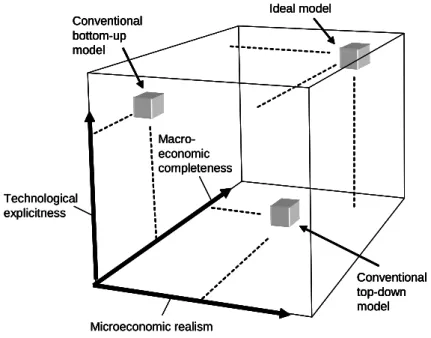
To be particularly useful, an energy-environment policy model should perform fairly well in terms of all three dimensions of Figure 1. It should be technologically explicit, including an assessment of how policies to promote technology commercialization and diffusion might affect the future financial costs of acquiring new technologies. It should be behaviorally realistic, includ-ing an assessment of how policies to increase market share might affect the future in-tangible costs (specific consumer concerns and preferences) of ac-quiring new technologies. It should have macroeconomic feedbacks linking energy supply and demand to the evolution of the economy’s structure and total output. This macroeconomic dimension should include trade and finan-cial feedbacks between countries in cases where the environmental challenge is one that requires a global effort, such as with greenhouse gas abatement.
The characteristics of conventional TD and BU models are compared with respect to each other using the dimensions of Figure 1. Conventional BU models do well in terms of technological explicitness, but less well in terms of the other two attributes. Conventional TD models do well in terms of macro-economic completeness and general micro-macro-economic realism, but they fail to represent the potential for no-regret options over the short run and substan-tially different technological futures over the long run.
The three dimensions of the figure are useful not only for contrasting the two conventional modeling approaches, but for providing a framework for discussion. For example, because they lacked technological explicitness, con-ventional TD models have tended to suggest that efforts to substitute away from specific forms of energy for political or environmental objectives would be relatively costly (i.e. the economy’s potential for technological transforma-tion being somewhat limited as portrayed by historically-based elasticities). These models have therefore often produced high cost estimates for abatement of energy-related greenhouse gas emissions. With their technological
explicit-ness, but failure to include micro- and macro-economic realities (technology-specific risks and preferences, rebounds in demand resulting from greater effi-ciency), conventional BU models have tended to suggest that efforts to substi-tute away from specific forms of energy or to reduce greenhouse gas emissions would be relatively inexpensive and in some cases even profitable.
Ideal model Microeconomic realism Macro-economic completeness Technological explicitness Conventional top-down model Conventional bottom-up model Ideal model Ideal model Ideal model Microeconomic realism Macro-economic completeness Technological explicitness Conventional top-down model Conventional bottom-up model Microeconomic realism Macro-economic completeness Technological explicitness Microeconomic realism Macro-economic completeness Technological explicitness Conventional top-down model Conventional top-down model Conventional top-down model Conventional bottom-up model Conventional bottom-up model Conventional bottom-up model
Figure 1 Three-dimensional assessment of energy-economy models
Figure 1 implies that there is the possibility of a better model, one that scores high on all three requirements, indicated by the “ideal” model in the back, right, and top corner of the cube. An increasing number of modeling teams have recognized the possibility of realizing something closer to this ideal model; we now turn to these approaches.
II. Toward hybrid models
Thus far, we have been careful to refer to “conventional” TD and BU models. While these two conventional modeling approaches are still used a
great deal, a number of researchers are developing “hybrid” models that seek to compensate for the limitations of one approach or the other. Some BU mod-elers have incorporated macro-economic feedbacks in their models, while oth-ers have estimated micro-economic behavioral parametoth-ers for technology choices in their models (see Bataille et al. in this issue for a survey). On their side, some TD modelers have incorporated technological explicitness for the energy supply or transportation sectors in their models. A few of them are now incorporating parameters for endogenous technological change, meaning that energy productivity or green-house gas intensity is somehow linked to policies that foster research and development or market penetration of low-emission technologies (Löschel, 2002).
In terms of Figure 1, these developments imply that some BU models are shifting toward the right and back corner of the cube while some TD mod-els are climbing vertically on the technology explicitness dimension of the cube. It can be misleading to refer to models that have undergone some of these developments using terms like BU or TD—hence our use of the term
hybrid models. We define hybrid models, therefore, as those BU or TD
en-ergy-environment models that have made at least one modification that shifts them substantially away from their conventional placement in the cube of Fig-ure 1. Some hybrids originated as BU models, some as TD models, but all hy-brids have characteristics that differentiate them significantly from conven-tional TD and BU models.
The development of these models faces several challenges related to theoretical consistency, computational complexity, empirical validity and pol-icy relevance. Each of the papers in this issue addresses these challenges to some degree. Thus, each paper explains the theoretical basis for its model de-sign, the structure of the model and its key algorithms, the data requirements, empirical estimation of critical parameters, and illustrates all of this with a policy-relevant application.
III. Summary of the papers
Kim et al. argue for the necessity of a flexible and expandable model, developed in a modular form and capable of easily incorporating detailed,
for-ward looking technological information into a macroeconomic framework. To facilitate this they use an Object-oriented Energy Climate Technology Systems (ObjECTS) Framework, which they demonstrate by modeling transportation in the MiniCAM long-term, global integrated assessment model. This integration is made internally consistent through an ‘object hierarchy’ of the global econ-omy, which links and unifies the top-down and bottom-up representations of technology and identifies the inter-relationship of each class of the hierarchy. This approach requires strong accounting discipline to ensure ‘objects’ do not double-count components of the economy. The authors’ priority is to facilitate interdisciplinary dialogue, and to incorporate sector information of differing types and quality, however it may be found. This is why MiniCAM operates as a recursive partial equilibrium model, where: only markets for energy and ag-ricultural goods are equilibrated; the corresponding prices, including wages and capital costs, are exogenous; and a simple feedback loop of energy prices on GDP allows the assessment of macroeconomic costs.
At the other end of the spectrum of modeling approaches gathered in this issue, the WITCH model of Bosetti et al. incorporates an engineering-based energy supply specification into a Ramsey-type optimal growth model. This choice was made to further the ultimate objective of analyzing interna-tional car-bon policies as optimal strategies in a game-theoretic framework: the interactions between world regions are modeled as a non-cooperative Nash Game in which a social planner in each region takes as given the behavior of other countries. WITCH consists of a very compact growth engine depicting the dynamics of a single final good, but this high level of sectoral aggregation is combined with a more detailed representation of the energy supply sector. Treatment of energy demand remains very aggregate. The challenges met by WITCH are: to have a systematic endogenous technical change framework, including R&D and learning by doing, both for the energy and the composite goods sectors; and to represent investment decisions in the energy sector through a dynamic open loop with perfect foresight. This mix of intertemporal optimization, a limited disaggregation of energy production technologies and of integration of many interdependency channels, including a game-theoretic approach to international policy design, makes WITCH an original endeavor.
Köhler et al. is the only article in this issue that describes a modeling system (E3MG) based on ‘post Keynesian’ dynamic macro-econometrics in-stead of a general equilibrium framework. Until now the use of Keynesian
models has been restricted to short and medium term time horizons, for which they are the favored tool. For longer term analysis, general equilibrium models have been the tool of choice. E3MG, however, challenges this worldview and uses its Keynesian foundation to address questions for which general equilib-rium models are ill-suited, such as the effects of policy in a “second-best” en-vironment. It explores the possibility of representing growth pathways under disequilibrium at a high level of disaggregation: econometrically-calibrated dynamic equations for 41 regional sectors link investment to historical demand and investment trends. It thus provides a direct contrast to the WITCH ap-proach of using a high level of aggregation with a forward-looking decision framework. This representation of economic growth allows for a description of the evolution of the economic structure over the long run; it does not use pro-duction functions, and the evolution of the energy sector is described by a simplified description of the technological dynamics of the ETM model, in-cluding use of a learning curve. ETM receives information from E3MG in each period, and sends back the induced amount of investment and input and final output production costs.
The purpose of the AMIGA modeling system (Laitner and Hanson) is a better representation of the real decision parameters in technology choices, including market imperfections, risk aversion and pervasive principal-agent problems. It does so within a general equilibrium framework at a high level of disaggregation (200 sectors for the United States, 30 for the 20 other world regions). This sectoral disaggregation allows AMIGA to distinguish the behav-ioral responses to policy of different market segments, and just as importantly, between types of capital stocks, in terms of vintages and productive uses. Con-sumers maximize inter-temporal utility but without perfect foresight. Imbed-ded in a nested structure of factor substitution, the substitution of capital to energy consumption is treated as movement along the isoquant of a conven-tional production function informed by BU analysis. This isoquant can be modified by technical change in the future, as in many other models, but a unique characteristic is a focus on the end-use level, based on explicit tech-nologies from a vast data set, and use of a hurdle rate that represents the pref-erences of consumers for specific technologies, which can be modified by pub-lic popub-licies or promotional efforts.
Böhringer and Löschel’s paper is methodological in nature, with an ap-plication to the penetration of renewable energy technologies in Europe. It
addresses the difficulty of representing technology in top-down models using continuously differentiable functions that capture substitution possibilities through constant elasticities. While energy planning can be formulated as an optimization problem with inequality constraints on decision variables, such as capacity restrictions on production quantities, the shadow prices associated with programming constraints may not coincide systematically with market prices. This means that the conditions necessary for use of conventional pro-duction functions (the ‘integrability’ condition) are not respected. Böhringer and Löschel demonstrate how reformulating the issue as a Mixed Complemen-tarity Problem allows for technological explicitness in the electricity sector (with discrete technologies), while aggregate technological options in other sectors can still be represented by means of constant elasticities of substitu-tion—amounting to the assumption of a macro-economic growth engine inde-pendent from the energy systems, which is justified in the analysis of moderate energy policies as the one exemplified. Using this approach, the shadow prices associated with any non-price constraint, such as physical restrictions on ca-pacity for a given technology, can be introduced.
The IMACLIM model (Ghersi and Hourcade) addresses the consistency problem arising from using BU information to describe the transformation of energy supply and demand, which may indicate non-constant input or demand substitution, in the context of the standard general equilibrium practice of us-ing constant elasticities of substitution in production and demand functions. This consistency issue is most pronounced under strong policy, such as in the case of very high carbon prices. The intuition is that large departures from reference energy trends (supply and demand) cannot but impact on the eco-nomic growth engine: there are inherent interdependencies between the long run macroeconomic possibility frontier and engineering based information. IMACLIM uses an innovation possibility curve to describe the envelope of production possibilities generated by various sets of price signals applied to BU data. The same method is used for demand functions. The value of IMACLIM’s method is illustrated by a general equilibrium analysis of the ef-fect of a large set of carbon prices in 2030 on the world economy. Results are compared to those obtained with conventional CES functions calibrated on the same BU data. The latter functions are shown to significantly bias macroeco-nomic costs estimates, especially for BU expertise showing important convexi-ties (i.e. a large set of low-cost mitigation options eventually tending to
satura-tion of a given end-use). The sign of the bias is not systematic, although it generally causes an underestimate of costs for moderate-to-high carbon prices.
Schäfer and Jacoby propose yet another approach to hybridizing, based on the joint use of three models. An optimization model (MARKAL) of trans-portation technologies is loosely coupled to EPPA, a recursive dynamic CGE model. The interface between EPPA’s aggregated transportation demands and the wide range of technologies represented in MARKAL is made by resorting to a modal choice model. This loose coupling addresses two of the main limi-tations of the conventional CGE approach: the substitution between energy and capital in the production of transportation services, together with the sub-stitution between transportation services when available, are either exoge-nously forced or governed by an elasticity that is made to vary over time ac-cording to BU results; and the energy efficiency improvements of households’ self-produced and purchased transportation services vary according to BU re-sults.
The CIMS model (Bataille et al.) provides an alternative to the pre-dominant TD approach to hybridization. Instead of adding technological ex-plicitness to an existing TD model, CIMS was built by bringing together a col-lection of BU models that provide complete coverage of energy use in the economy, models that compete vintaged end-use and energy supply technolo-gies against each other using behaviorally realistic choice algorithms with em-pirically estimated parameters, and link them in an integrated framework using a combination of CGE and macro-econometric approaches. CIMS clears the markets for energy commodities and final goods and services in each time pe-riod using CGE methodologies, with demand for traded goods being repre-sented by Armington elasticities, and that for non-traded goods by mac-roeconometric functions linked to overall activity. Bataille et al. also describes how CIMS can be used to calculate better long run estimates of sectoral capi-tal-for-energy and inter-fuel elasticities of substitution, as well as sectoral autonomous energy efficiency indices (AEEI), both highly debated parameters that are central to the functioning of TD models, and CGE models in particu-lar. These parameters are difficult to estimate using standard econometric methods because future long-run technological development is not necessarily related to past development, and is also endogenous to policy influence. To estimate long run estimates of elasticities of substitution, CIMS was “shocked” with a series of different long run input prices; the resulting 2035 input shares
were regressed using a standard econometric production function, whose pa-rameters were used to calculate elasticities that are sensitive to the future evo-lution of the technology stock. To estimate sectoral estimates of AEEI CIMS was run in two modes from 2000 to 2035: in the first, technology was allowed develop and turn over normally, while in the second firms and consumers were constrained to using the technology mix used in year 2000. The difference in energy consumption between the two modes in 2035 was used to calculate the long run AEEI.
IV. Lessons and prospects
The eight papers of this special issue exemplify the diversity of options and issues in the design and application of hybrid models. Many other ap-proaches are possible and will be explored in the future, but in terms of their fundamental design these attempts will likely fit into one of the following categories.
• A TD model that partly renounces the conventional macroeconomist’s toolkit (constant elasticities of substitution (CES), and the autonomous energy efficiency index (AEEI)), and relies on innovative ways to rep-resent not only energy supply but also energy end-use technologies as described by BU analysis, and technology adoption as described by mi-croeconomic studies, especially regarding households.
• A TD model that increases its disaggregation level and resorts to Leon-tief fixed-input ratios to include a reduced-form BU module of some part of the energy system (e.g. in energy supply or the transport sector).
• A BU model that includes: empirically estimated micro-economic pa-rameters related to technology choice; functions to clear markets for en-ergy, other intermediate inputs, and final goods and services based on changes in the cost of production, using either price elasticities or more advanced CGE techniques that utilize consumer utility and firm profit functions; and functions to balance government budgets, exchange rates, and capital and labor markets.
• A composite hybrid model that includes all of the major theoretical and structural characteristics of the most advanced TD models along with the major characteristics of the most advanced BU models, with techno-logical detail in all sectors and behavioral parameters that are empiri-cally estimated from micro-economic and macro-economic research. While such a model would present the greatest challenge in terms of theoretical consistency, mathematical complexity and empirical estima-tion, it nonetheless represents an objective that some modelers 1might aspire to, and has been colloquially referred to as the “Holy Grail”.1 Many factors influence which of these options might be pursued by a given group of energy-environment policy modelers. To some extent, the choice of model reflects the training and natural inclination of the modeler. Many, but not all, economists are more familiar with and attracted to models that begin from a TD perspective. Many, but not all, technology experts are more attracted to models that begin from a BU perspective.
But if a hybrid model is to be truly useful to the policy-maker, the model’s design should be governed by the objective it is meant to serve. Variations in that objective can have significant implications for the appropri-ateness of the different hybrid modeling strategies listed above. Here are some of the ways in which the modeling objective may differ.
• The specific energy-environment problem: a global problem like green-house gas abatement differs from a regional problem like acid rain or a local problem like urban air pollution. This affects the choice of spatial scale and resolution of the model.
• The policy-making reference point: one reference could be the setting of global energy-environment targets (like greenhouse gas abatement) and the required negotiation of international allocations to achieve them, as well as the design of international mechanisms for achieving targets in a cost-effective and politically feasible manner. Another reference point could be the setting of national energy-environment targets and the de-sign of country-specific policies to achieve these. A third reference point could involve the setting of sub-national targets and policies.
1 Models for simulating greenhouse gas abatement policies are still substantially less complex
• The policy timeframe: some greenhouse gas abatement models operate over a century—long-run stabilization of atmospheric greenhouse gases—while some are focused on a period as short as 10 years—the achievement of national Kyoto commitments or the operation of interna-tional trading mechanisms in the Kyoto timeframe.
• The policy options: a model for assessing the international implications of economy-wide energy or carbon taxes can be simpler in some re-spects than a model for assessing the national implications of technol-ogy- and sector-specific policies that involve a mix of regulations, taxes, subsidies, tradable permits and information provision. Also, a policy that provides future cost information to consumers and firms (such as a scheduled rise in greenhouse gas taxes) requires a model that can simulate foresight by decision-makers.
Whatever the ultimate objective, any effort at hybrid modeling will con-front similar theoretical and methodological issues. Some of them are strictly a matter of modeling approach: accounting for capital stock inertia, aggregating economic sectors, guaranteeing the compatibility of technical change as de-scribed in endogenous growth models, and the shifts of energy systems as ex-plicitly depicted by technology-rich models, etc. But real breakthroughs will not be made unless parallel progress is made in two partly intertwined direc-tions.
The first concerns the need to achieve a better understanding and repre-sentation of business and consumer behavior in the face of uncertainty and diverse policy and market signals. The second concerns the constraints caused by data gaps. Any theoretical advance is bound to confront difficulties because of a lack of data or data mismatches. There may be gaps and inconsistencies of and between national accounts, input-output tables, energy balances and en-ergy prices (type and level of aggregation, time series, etc.). There may also be difficulties in data collection; collected data may not translate easily into mod-eling structures. Data may be available, but only as case studies of real behav-iors in various incentive contexts, which then need to be translated. Finally, there may be gaps in the re-cord, and comparative studies may be required.
Beyond their fruitful direct application to policy analysis, hybrid mod-els should ultimately be regarded as a major avenue of progress in the model-ing discipline. They are communication tools between various fields of
knowl-edge (engineering, macro- and micro-economic analysis, comparative institu-tional studies), and one of their most important contributions may be to help detect missing information and dynamics, and to provide a structure for dis-cussion and progressive consolidation of modeling methods.
Acknowledgements
We are grateful to the funders of the Hybrid Modeling Special Issue. The Conseil Français de l’Énergie and Natural Resources Canada each con-tributed half the necessary funding: we hope they will profit from the knowl-edge gained. We would also like to thank the team at the Energy Journal, es-pecially Dave Williams and his typesetters, whose patience in the late stages of this project was appreciated.
References
Bataille, Chris, Mark Jaccard, John Nyboer and Nic Rivers. (2006). “Towards General Equilibrium in a Technology-Rich Model with Empirically Estimated Behavioral Parameters.” Hybrid modeling of energy-environment
policies: Reconciling bottom-up and top-down – Special Issue of the Energy Journal.
Böhringer, Christoph, and Andreas Löschel. (2006). “Promoting Re-newable Energy in Europe: A Hybrid Computable General Equilibrium Ap-proach.” Hybrid modeling of energy-environment policies: Reconciling bot-tom-up and top-down – Special Issue of the Energy Journal.
Bosetti, Valentina, Carlo Carraro, Marzio Galeotti, Emanuele Massetti, and Massimo Tavoni. (2006). “WITCH: A World Induced Technical Change Hybrid Model.” Hybrid modeling of energy-environment policies: Reconciling
bottom-up and top-down – Special Issue of the Energy Journal.
Ghersi, Frédéric and Jean-Charles Hourcade. (2006). “Macroeconomic Consistency Issues in E3 Modeling: The Continued Fable of the Elephant and
the Rabbit.” Hybrid modeling of energy-environment policies: Reconciling
bottom-up and top-down – Special Issue of the Energy Journal.
Grubb, Michael, Jae A. Edmonds, Patrick ten Brink, and Michael Mor-rison. (1993). “The Cost of Limiting Fossil Fuel CO2 Emissions: A Survey and
Analysis.” Annual Review of Energy and the Environment: 397-478.
Kim, Son H., Jae A. Edmonds, Josh Lurz, Steven J. Smith, and Marshall Wise. (2006). “Hybrid Modeling of Transportation: ObjECTS - A Long-Term, Global Framework with Technology Detail.” Hybrid modeling of
energy-environment policies: Reconciling bottom-up and top-down – Special Issue of the Energy Journal.
Köhler, Jonathan, Terry Barker, Dennis Anderson, and Haoran Pan. (2006). “Combining energy technology dynamics and macroeconometrics: the E3MG model.” Hybrid modeling of energy-environment policies: Reconciling
bottom-up and top-down – Special Issue of the Energy Journal.
Laitner, John A. “Skip” and Donald A. Hanson. (2006). “Modeling De-tailed Energy-Efficiency Technologies and Technology Policies within a CGE Framework.” Hybrid modeling of energy-environment policies: Reconciling
bottom-up and top-down – Special Issue of the Energy Journal.
Löschel, Andreas. (2002). “Technological Change in Economic Models of Environmental Policy: A Survey.” Ecological Economics 43: 105-126.
Schäfer, Andreas, and Henry D. Jacoby. (2006). “Experiments with a Hybrid CGE-MARKAL Model.” Hybrid modeling of energy-environment
poli-cies: Reconciling bottom-up and top-down – Special Issue of the Energy Jour-nal.