Nonlinear Control of Underactuated Mechanical
Systems with Application to Robotics and
Aerospace Vehicles
by
Reza Olfati-Saber
BARKER MASSACHUSETTS INSTITUTE OF TECHNOLOGYAPR 2 4
?001
LIBRARIESSubmitted to the Department of Electrical Engineering and Computer
Science
in partial fulfillment of the requirements for the degree of
Doctor of Philosophy in Electrical Engineering and Computer Science
at the
MASSACHUSETTS INSTITUTE OF TECHNOLOGY
February 2001
@
Massachusetts Institute of Technology 2001. All rights reserved.
Author.
... ... ... ... ...Department of Elecrical Engineering and Computer Science
January 15, 2000
C ertified by ..
...
Alexandre Megretski, Associate ProTessor of Electrical Engineering
Thesis Supervisor
Accepted by
...
...
Arthur C. Smith
Chairman, Department Committee on Graduate Students
Nonlinear Control of Underactuated Mechanical Systems
with Application to Robotics and Aerospace Vehicles
by
Reza Olfati-Saber
Submitted to the Department of Electrical Engineering and Computer Science on January 15, 2000, in partial fulfillment of the
requirements for the degree of
Doctor of Philosophy in Electrical Engineering and Computer Science
Abstract
This thesis is devoted to nonlinear control, reduction, and classification of underac-tuated mechanical systems. Underacunderac-tuated systems are mechanical control systems with fewer controls than the number of configuration variables. Control of underactu-ated systems is currently an active field of research due to their broad applications in Robotics, Aerospace Vehicles, and Marine Vehicles. The examples of underactuated systems include flexible-link robots, mobile robots, walking robots, robots on mo-bile platforms, cars, locomotive systems, snake-type and swimming robots, acrobatic robots, aircraft, spacecraft, helicopters, satellites, surface vessels, and underwater ve-hicles. Based on recent surveys, control of general underactuated systems is a major open problem.
Almost all real-life mechanical systems possess kinetic symmetry properties, i.e. their kinetic energy does not depend on a subset of configuration variables called external variables. In this work, I exploit such symmetry properties as a means of reducing the complexity of control design for underactuated systems. As a result, reduction and nonlinear control of high-order underactuated systems with kinetic symmetry is the main focus of this thesis. By "reduction", we mean a procedure to reduce control design for the original underactuated system to control of a lower-order nonlinear or mechanical system. One way to achieve such a reduction is by transforming an underactuated system to a cascade nonlinear system with structural properties. If all underactuated systems in a class can be transformed into a specific class of nonlinear systems, we refer to the transformed systems as the "normal form" of the corresponding class of underactuated systems.
Our main contribution is to find explicit change of coordinates and control that transform several classes of underactuated systems, which appear in robotics and aerospace applications, into cascade nonlinear systems with structural properties that are convenient for control design purposes. The obtained cascade normal forms are three classes of nonlinear systems, namely, systems in strict feedback form, feedfor-ward form, and nontriangular linear-quadratic form. The names of these three classes are due to the particular lower-triangular, upper-triangular, and nontriangular struc-ture in which the state variables appear in the dynamics of the corresponding nonlin-ear systems. The triangular normal forms of underactuated systems can be controlled using existing backstepping and feedforwarding procedures. However, control of the
nontriangular normal forms is a major open problem. We address this problem for important classes of nontriangular systems of interest by introducing a new stabiliza-tion method based on the solustabiliza-tions of fixed-point equastabiliza-tions as stabilizing nonlinear state feedback laws. This controller is obtained via a simple recursive method that is convenient for implementation. For special classes of nontriangular nonlinear systems, such fixed-point equations can be solved explicitly.
As a result of the reduction process, one obtains a reduced nonlinear subsystem in cascade with a linear subsystem. For many classes of underactuated systems, this reduced nonlinear subsystem is physically meaningful. In fact, the reduced nonlinear subsystem is itself a Lagrangian system with a well-defined lower-order configura-tion vector. In special cases, this allows construcconfigura-tion of Hamiltonian-type Lyapunov functions for the nonlinear subsystem. Such Lyapunov functions can be then used for robustness analysis of normal forms of underactuated systems with perturbations. The Lagrangian of the reduced nonlinear subsystem is parameterized by the shape variables (i.e. the complement set of external variables). It turns out that "a control law that changes the shape variables" to achieve stabilization of the reduced nonlinear subsystem, plays the most fundamental role in control of underactuated systems.
The key analytical tools that allow reduction of high-order underactuated systems using transformations in explicit forms are "normalized generalized momentums and their integrals" (whenever integrable). Both of them can be obtained from the La-grangian of the system. The difficulty is that many real-life and benchmark examples do not possess integrable normalized momentums. For this reason, we introduce a new procedure called "momentum decomposition" which uniquely represents a non-integrable momentum as a sum of an non-integrable momentum term and a non-non-integrable momentum-error term. After this decomposition, the reduction methods for the in-tegrable cases can be applied. The normal forms for underactuated systems with non-integrable momentums are perturbed versions of the normal forms for the inte-grable cases. This perturbation is the time-derivative of the momentum-error and only appears in the equation of the momentum of the reduced nonlinear subsystem.
Based on some basic properties of underactuated systems as actuation/passivity of shape variables, integrability/non-integrability of appropriate normalized momen-tums, and presence/lack of input coupling; I managed to classify underactuated sys-tems to 8 classes. Examples of these 8 classes cover almost all major applications in robotics, aerospace systems, and benchmark systems. In all cases, either new con-trol design methods for open problems are invented, or significant improvements are achieved in terms of the performance of control design compared to the available methods. Some of the applications of our theoretical results are as the following: i) trajectory tracking for flexible-link robots, ii) (almost) global exponential tracking of feasible trajectories for an autonomous helicopter, iii) global attitude and posi-tion stabilizaposi-tion for the VTOL aircraft with strong input coupling, iv) automatic calculation of differentially flat outputs for the VTOL aircraft, v) reduction of the stabilization of a multi-link planar robot underactuated by one to the stabilization of the Acrobot, or the Pendubot, vi) semiglobal stabilization of the Rotating Pendulum, the Beam-and-Ball system, using fixed-point state feedback, vii) global stabilization of the 2D and 3D Cart-Pole systems to an equilibrium point, viii) global asymptotic
stabilization of the Acrobot and the Inertia-Wheel Pendulum.
For underactuated systems with nonholonomic velocity constrains and symmetry, we obtained normal forms as the cascade of the constraint equation and a reduced-order Lagrangian control system which is underactuated or fully-actuated. This de-pends on whether the sum of the number of constraints and controls is less than, or equal to the number of configuration variables. This result allows reduction of a complex locomotive system called the snakeboard. Another result is global exponen-tial stabilization of a two-wheeled mobile robot to an equilibrium point which is C far from the origin (E < 1), using a smooth dynamic state feedback.
Thesis Supervisor: Alexandre Megretski
Title: Associate Professor of Electrical Engineering
Thesis Reader: Munther A. Dahleh Title: Professor of Electrical Engineering
Thesis Reader: George Verghese
Acknowledgments
First and foremost, I would like to thank my advisor Alexandre Megretski. Alex's unique view of control theory and his mathematical discipline taught me to see non-linear control from a new perspective that enhanced my understanding of what con-stitutes an acceptable solution for certain fundamental problems in control theory. I can never thank him enough for giving me the freedom to choose the theoretical fields of my interest and helping me to pursue my goals. I have always valued his advice greatly.
I would like to thank Munther Dahleh for our exciting discussions during the group
seminars and for giving me many useful comments and advice on my work.
I wish to give my very special thanks to both George Verghese and Bernard
Lesieutre who have been a constant source of support and encouragement for me from the beginning of my studies at MIT.
The past years at MIT were a wonderful opportunity for me to get engaged in interesting discussions with several MIT professors and scientists. Sanjoy Mitter has always amazed me with his brilliant view of systems and control theory. I am very grateful for his invaluable advice on many important occasions. I particularly would like to thank Eric Feron for his encouragement and for enthusiastically showing me simulation results and test models related to my work. I wish to thank Dimitri Bertsekas for being a great teacher and giving me important advice as my academic advisor during the past years.
Many thanks goes to Nicola Elia and Ulf J6nsson for our long hours of discussions and their valuable technical comments. I would also like to thank Emilio Frazzoli for many discussions on helicopters and nonlinear control. I would like to take this opportunity to thank all my friends at LIDS for their encouragement, support, and the fun times we shared during our group seminars.
I owe my sincere gratitude to Milena Levak, the Dean of the International Students
Office at MIT, who has greatly helped me during very important situations and times. I am incredibly grateful to my family. My parents, Hassan and Soroor, and my sister, Negin, gave me their unconditional love and support during all these years. While I never had the opportunity to see my family during my five and a half years of studies at MIT, my heart has always been with them. They never stopped believing in me and did everything they could to help me achieve my goals.
At last, my most special thanks goes to Manijeh. Her beautiful smile, emotional support, and strong encouragement were the driving force of my efforts. With her creative mind, she gave me many examples of underactuated systems in nature that I had not thought of myself. Without her help and enthusiasm, this work certainly would not have been possible.
Contents
1 Introduction
1.1 Mechanics and Control Theory . . . .
1.2 Nonlinear Control Systems . . . . 1.2.1 Underactuated Systems. . . . . 1.2.2 Highly Nonlinear Systems . . . . 1.2.3 Cascade Nonlinear Systems . . . .
1.3 Statement of the Contributions . . . . 1.3.1 Normal Forms for Underactuated Systems . . . .
1.3.2 Reduction and Control of Low-Order Underactuated Systems .
1.3.3 Reduction and Control of High-Order Underactuated Systems 1.3.4 Reduction and Control of Underactuated Systems with
Non-holonomic Velocity Constraints . . . .
1.3.5 Applications in Robotics and Aerospace Vehicles . . . .
1.3.6 Control of Nontriangular Cascade Nonlinear Systems . . . . . 1.4 O utline . . . .
2 Mechanical Control Systems
2.1 Introduction . . . . 2.2 Simple Lagrangian Systems . . . .
2.3 Fully-actuated Mechanical Systems . . . . . 2.4 Underactuated Mechanical Systems . . . . .
2.5 Flat Mechanical Systems . . . .
2.6 Nonholonomic Mechanical Systems . . . . .
2.7 Symmetry in Mechanics . . . . 2.8 Normalized Momentums and Integrability 3 Normal Forms for Underactuated Systems
3.1 Introduction . . . . 3.2 Dynamics of Underactuated Systems . . . . 3.3 Examples of Underactuated Systems . . . . 3.3.1 The Acrobot and the Pendubot . . .
3.3.2 3.3.3
3.3.4
3.3.5
The Cart-Pole System and the Rotati The Beam-and-Ball System . . . . . The TORA System . . . .
The Inertia-Wheel Pendulum . . . .
28 . . . . 28 . . . . 28 . . . . 30 . . . . 31 . . . . 32 . . . . 33 . . . . 34 . . . . 36 37 . . . . 37 . . . . 39 . . . . 39 . . . . 40 ng Pendulum . . . . 41 . . . . 42 . . . . 43 . . . . 43 14 14 15 15 17 19 20 22 23 24 26 27 27 27
3.4 3.5 3.6 3.7 3.8 3.9
3.3.6 The VTOL Aircraft ...
Collocated Partial Feedback Linearization . . . . Noncollocated Partial Feedback Linearization . . . . . Partial Feedback Linearization Under Input Coupling . Normal Forms for Underactuated Systems . . . . Classes of Structured Nonlinear Systems . . . . Normal Forms for Underactuated Systems with 2 DOF
. . . . 44 . . . . 45 . . . . 46 . . . . 47 . . . . 49 . . . . 52 . . . . 54
4 Reduction and Control of High-Order Underactuated Systems 4.1 Shape Variables and Kinetic Symmetry . . . . 4.2 Underactuated Systems with Noninteracting Inputs and Integrable Mo-m entuMo-m s . . . . 4.2.1 Underactuated Systems with Actuated Shape Variables . . . . 4.2.2 Underactuated Systems with Unactuated Shape Variables . . 4.3 4.4 4.5 4.6 4.7 Underactuated Systems with Input Coupling . . . . Underactuated Systems with Non-integrable Momentums Momentum Decomposition for Underactuated Systems . Classification of Underactuated Systems . . . . Nonlinear Control of the Core Reduced System . . . . . 59 59 61 61 65 75 82 88 103 109 5 Applications to Robotics and Aerospace Vehicles 5.1 The A crobot . . . . 5.2 The TORA System . . . . 5.3 The Inertia-Wheel Pendulum . . . . 5.4 The Cart-Pole System . . . . 5.4.1 Global Stabilization to an Equilibrium Point . . . 5.4.2 Aggressive Swing-up of the Inverted Pendulum . . 5.4.3 Switching-based Controller . . . . 5.5 The Rotating Pendulum . . . . 5.5.1 Aggressive Swing-up of the Rotating Pendulum 5.6 The Pendubot . . . . 5.7 The Beam-and-Ball System . . . . 5.8 Control of Multi-link Underactuated Planar Robot Arms 5.9 Trajectory Tracking for a Flexible One-Link Robot . . . 5.9.1 Model of a Flexible Link . . . . 5.9.2 The Noncollocated Output . . . . 5.9.3 Tracking Control . . . . 5.10 Configuration Stabilization for the VTOL Aircraft . . . . 5.11 Trajectory Tracking and Stabilization of An Autonomous 5.11.1 Dynamic Model of A Helicopter . . . . 5.11.2 Input Moment Decoupling for A Helicopter . . . . 5.11.3 Nontriangular Normal Form of a Helicopter . . . 116 . . . . 117 . . . . 127 . . . . 131 . . . . 136 . . . . 137 . . . . 140 . . . . 144 . . . . 144 . . . . 147 . . . . 149 . . . . 152 . . . 153 . . . 155 . . . 156 . . . . 157 . . . . 162 . . . . 162 Helicopter . 166 . . . . 166 . . . . 169 . . . . 175
5.11.4 Feedback Linearization of the Unperturbed Model of the Heli-copter ... ...
5.11.5 Desired Control Attitude Rd for Position Tracking . . . .
176 178 7
5.11.6 Asymptotic Tracking of a Desired Attitude Rd E SO(3) . . . . 179
5.11.7 Thrust for Exponential Attitude Stabilization . . . ..188
6 Reduction and Control of Underactuated Nonholonomic Systems 189 6.1 Nonholonomic Systems with Symmetry . . . . 190
6.2 Applications to Nonholonomic Robots . . . . 193
6.2.1 A Rolling Disk . . . . 194
6.2.2 A Nonholonomic Mobile Robot . . . . 195
6.2.3 A C ar . . . . 196
6.2.4 The Snakeboard . . . . 201
6.3 Notions of E-Stabilization and E-Tracking . . . . 212
6.4 Global Exponential E-Stabilization/Tracking for a Mobile Robot . . . 215
6.4.1 Dynamics of a Mobile Robot in SE(2) . . . . 215
6.4.2 Near-Identity Diffeomorphism . . . . 216
6.4.3 Control Design for E-Stabilization/Tracking . . . . 217
7 Control of Nonlinear Systems in Nontriangular Normal Forms 223 7.1 Introduction . . . 224
7.2 Structure of Nontriangular Normal Forms of Underactuated Systems 229 7.3 Stabilization of Nonlinear Systems in Feedback Form . . . . 231
7.3.1 Standard Backstepping Procedure . . . . 231
7.3.2 Cascade Backstepping Procedure . . . . 234
7.4 Stabilization of Nonlinear Systems in Nontriangular Forms . . . . 239
7.4.1 Nontriangular Nonlinear Systems Affine in (6, 2) . . . . 240
7.4.2 Nontriangular Nonlinear Systems Non-affine in (6,6 2) . . . . 250
7.4.3 Global Existence of Fixed-Point Control Laws . . . . 254
7.4.4 Slightly Nontriangular Nonlinear Systems . . . . 262
7.4.5 Notion of Partial Semiglobal Asymptotic Stabilization . . . . . 267
7.5 A pplications . . . . 268
7.5.1 The Cart-Pole System with Small Length/Strong Gravity Effects269 7.5.2 The Cart-Pole System with Large Length/Weak Gravity Effects 271 7.5.3 The Rotating Pendulum . . . . 272
7.5.4 The Generalized Beam-and-Ball System . . . . 275
8 Conclusions 277 8.1 Sum m ary . . . . 278
8.2 Future W ork . . . . 279
8.2.1 Hybrid Lagrangian Systems . . . . 279
8.2.2 Uncertainty and Robustness . . . . 281
8.2.3 Output Feedback Stabilization and Tracking . . . . 281
8.2.4 The Effects of Bounded Control Inputs . . . . 281
8.2.5 Small Underactuated Mechanical Systems (SUMS) . . . . 281
A Dynamics of Mechanical Systems 283 A.1 Underactuated Mechanical Systems with Two DOF and Kinetic
Sym-m etry . . . . 283
A.2 A Three-link Planar Robot . . . 284
A.3 Two-link Planar Robots: the Acrobot and the Pendubot . . . 288
A.4 The Beam-and-Ball System . . . 289
A.5 The Cart-Pole System . . . 291
A.6 The Rotating Pendulum . . . 292
A.7 The 3D Cart-Pole System with Unactuated Roll and Pitch Angles . . 294
A.8 An Underactuated Surface Vessel . . . 295
B Symbolic Calculation of the Flat Outputs of the Helicopter 298 C Proofs of Theorems in Chapter 7 299 C.1 Proof of Theorem 7.4.3: . . . . 299
C.2 Proof of the Stability of p-Subsystem in Theorem 7.4.4 . . . 300
C.3 Proof of Lemma 7.4.4: . . . 301
C.4 Proof of Theorem 7.4.4: . . . 301
C.5 Proof of Theorem 7.4.5: . . . 304
List of Figures
3-1 (a) The Acrobot, (b) The Pendubot. . . . . 40
3-2 (a) The Cart-Pole system, (b) The Rotating Pendulum. . . . . 41
3-3 The Beam-and-Ball System. . . . . 42
3-4 The TORA system. . . . . 43
3-5 The Inertia Wheel Pendulum . . . . 44
3-6 The VTOL aircraft. . . . . 44
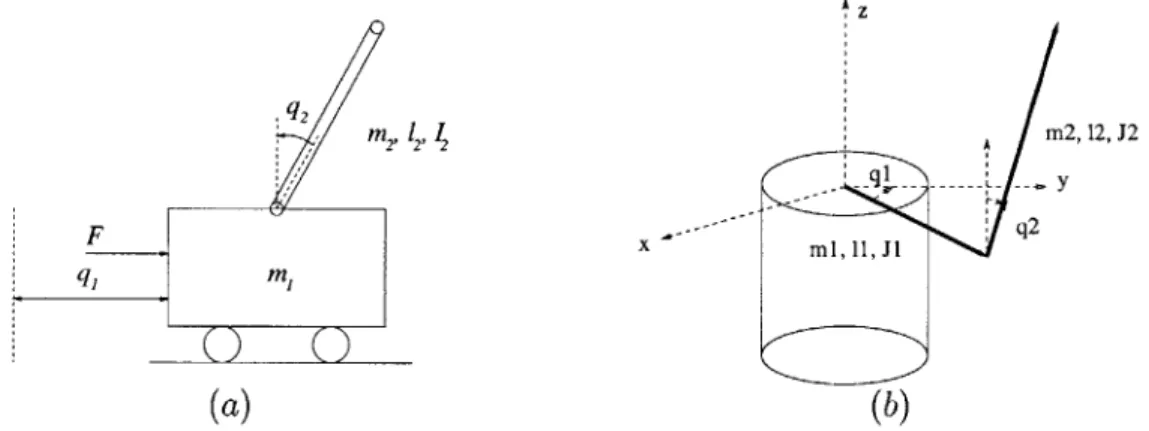
4-1 A flexible one-link robot arm. . . . . 75
4-2 A flying bird. . . . . 79
4-3 A triple-link robot arm with two actuators. . . . . 84
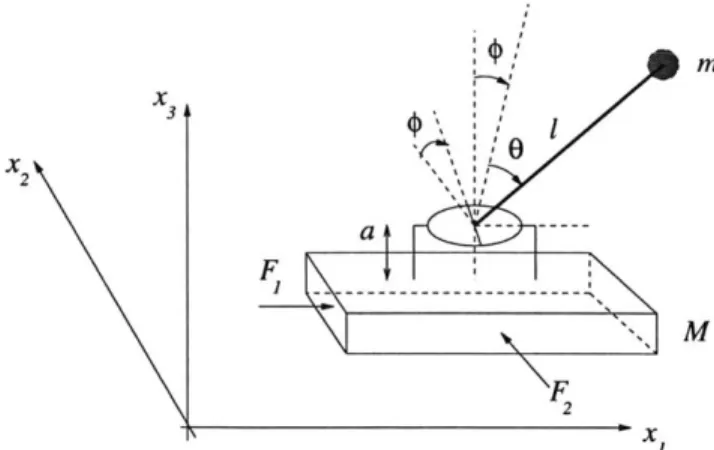
4-4 An inverted pendulum on a moving platform with 4 DOF and 2 controls. 87 4-5 A triple-link robot arm with actuated shape variables . . . . 92
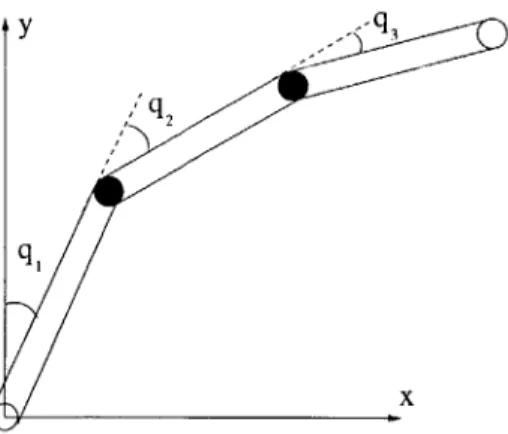
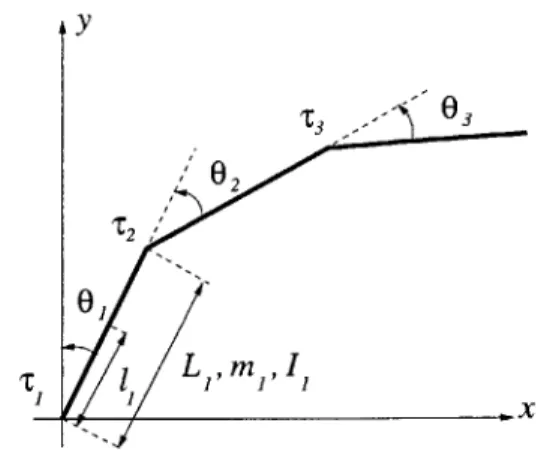
4-6 A planar three-link robot arm. . . . . 97
4-7 Three possible actuation configuration for a planar three-link robot arm. 99 5-1 The A crobot . . . . 118
5-2 The function 7(q2) for a = 20/3, b = 4, c = 4/3 . . . . 119
5-3 The function ac(qr) for mi = m2 =1 and l1= 12= 1 .2 . . . . 123
5-4 Trajectory of (qi, q2) for the Acrobot with initial condition (q1, q2, pI) = (7r/3, 0, 0) and control input P2. .. .. . . . .. . . . 124
5-5 Trajectory of (P1, P2) for the Acrobot with initial condition (qi, q2, pi) = (7/3, 0, 0) and control input P2 . . . . . . . . .. . .. 124
5-6 Trajectory of (qi, q2) for the Acrobot with initial condition (qi, q2, pi) = (7, 0, 0) and control input P2 . . . . .. . . .. . . . . .. . .. 125
5-7 Trajectory of (P1, P2) for the Acrobot with initial condition (qi, q2, pi) = (7, 0, 0) and control input P2. . ... .. . . . . 125
5-8 Trajectory of (qi, q2) for the Acrobot with initial condition (qi, q2, P1) = (0, 7r, 0) and control input P2 . . .. . . . . . . .. . . . . .. . .. 126
5-9 Trajectory of (P1, P2) for the Acrobot with initial condition (q1, q2, pi) = (0, 7, 0) and control input P2 . .. . . . .. . . . .. 126
5-10 The TORA system. . . . . 127
5-11 State trajectories and control input of the TORA system for the ini-tial condition (qi, q2, p1, p2) = (1, 0, 0, 0): (a) (qi, pi), (b) (q2, p2), (c) (qr, pr), and (d) u . . . . 131
5-13 For the initial condition (7r, 0, 0), (a) shows the state trajectories for
(qi, 41), (b) shows the state trajectory in (qi, 41) plane, (c) shows 42,
and (d) shows the control input T. . . . . 135
5-14 For the initial condition (7/2, 0,0), (a) shows the state trajectories for (qi, 41), (b) shows the state trajectory in (qi, 41) plane, (c) shows 42, and (d) shows the control input T. . . . . 136
5-15 The Cart-Pole system. . . . . 137
5-16 (a) State trajectory of the cart-pole system for the initial condition (5, 0, 7/3, 0) and o-i(-) = sat,(.), (b) The force F and control input u. 140 5-17 (a) State trajectory of the cart-pole system for the initial condition (5,0, 7/3, 0) and -i (-) = sato.1(.), (b) The force F and control input u. 141 5-18 The dead-zone nonlinearity. . . . 142
5-19 (a) Aggressive swing-up of an inverted pendulum on a cart from the downward position (q2,P2) = (7, 0), (b) The path of the pendulum in (q2, P2)-plane. . . . . 144
5-20 (a) State trajectory of the cart-pole system for the initial condition (0,0, 7r, 0), (b) The input force F and the trajectory in (q2, P2)-plane. 145 5-21 The Rotating Pendulum . . . 145
5-22 (a) Aggressive swing-up of an inverted pendulum on a rotating arm from the downward position (q2,P2) = (7r, 0), (b) Trajectory of the pendulum in (q2,P2)-plane. . . . 149
5-23 The Pendubot . . . 150
5-24 The Beam-and-Ball System. . . . 152
5-25 A flexible one-link robot arm. . . . 156
5-26 The VTOL aircraft. . . . 162
5-27 (a) The state trajectories of the VTOL aircraft, and (b) The path of the center of mass of the aircraft in (x1, yi)-plane. . . . . 165
5-28 A helicopter . . . 166
6-1 A vertical rolling disk . . . 194
6-2 A m obile robot . . . 196
6-3 The m odel of a car. . . . 197
6-4 The Snakeboard. ... ... 201
6-5 The geometry of the paths of the rear and front wheels of the car with a radius of rotation p. . . . 209
6-6 The geometry of the paths of the rear and front wheels and the center of mass of the snakeboard with a radius of rotation p. . . . 211
6-7 A near identity transformation with a parameter IAl < 1. . . . 216
6-8 Trajectories of the nonholonomic mobile robot in (x1, x2)-plane for ini-tial position x = (2, 3)T (v = 0) and orientation angles 0 = 0, 7/4, 7/2, 37/4.219 6-9 Trajectories of the nonholonomic mobile robot in (XI, x2)-plane for ini-tial position x = (2, 3)T (v - 0) and orientation angles 6 = 7r, 57r/4, 37r/2, 77r/4.220 6-10 Trajectories of the nonholonomic mobile robot in (x1, x2)-plane starting at x = (2, 3)T (v = 0) with angle 0 = 7r/4 . . . 220
6-11 Trajectories of the nonholonomic mobile robot in (x1, x2)-plane for
initial position x (0, 2)T (v 0) and initial orientation angles
0 = 0, ir/4, wr/2, 37/4. . . . . 221
6-12 Evolution of position and controls for the nonholonomic mobile robot in (x1, x2)-plane starting at x = (0, 2)T (v = 0) with angle 0 = 0 . . . 221
6-13 Trace trajectories of a two-wheel nonholonomic robot with initial po-sition (5, 4) and heading angles (a) 0 = 0, (b) 0 = r/2, (c) 0 = ir, and (d) 0 = 37r/2. . . . . 222
6-14 Position trajectory tracking for a mobile robot from the initial point (4, 4, 7r/2). . . . . 222
7-1 A C2 smooth sigmoidal function with flat tails with its derivatives. 256 7-2 Sigmoidal ribbon S and compact set IC. . . . . 258
7-3 The Cart-Pole System . . . . 269
7-4 The state trajectories of the Cart-Pole system. . . . . 271
7-5 The Rotating Pendulum . . . . 272
7-6 The state trajectories for the Rotating Pendulum. . . . . 275
7-7 The state trajectories of the generalized beam-and-ball system with initial condition (1, 0, -7r/6, 0) for g = -9.8 and v = 1, 2, 3. . . . . 276
A-i A planar three-link robot arm. . . . . 284
A-2 The Beam-and-Ball System. . . . . 290
A-3 The Cart-Pole system. . . . . 291
A-4 The Rotating Pendulum. . . . . 293
A-5 The 3D Cart-Pole system with unactuated roll and pitch angles. . . . 294
List of Tables
4.1 Classification of Underactuated Systems . . . . 104
5.1 The Values of F*(E, no). . . . . 143
5.2 The Values of T*(E, no, 1) . . . . 149
Chapter 1
Introduction
1.1
Mechanics and Control Theory
Control of mechanical systems is currently among one of the most active fields of research due to the diverse applications of mechanical systems in real-life. Though, the study of mechanical systems goes back to Euler and Lagrange in the 1700's, it was not until 1850's that mechanical control systems came to the picture in regulation of steam engines. During the past century, a series of scientific, industrial, and military applications motivated rigorous analysis and control design for mechanical systems. On the other hand, theoretically challenging nature of analysis of the behavior of non-linear dynamical systems attracted many mathematicians to study control systems. As a result, the efforts of engineers and scientists together led to creation of Linear
Control, Optimal Control, Adaptive Control, and Nonlinear Control theories. More
recently, Robust Control theory was born and added to the above picture because of an inevitable need to deal with the presence of uncertainties in real-life control sys-tems. Before the creation of most of these theories, humans managed to fulfill their long-time dream to travel in the space and land on the moon. This is one of the great-est accomplishments of control scientists and engineers of the first half of the past century. Aerospace Vehicles and Robotics Systems with ability to explore the surface of other planets are still among the most complex machines built by humans. For the past 50 years, Aerospace and Robotics applications remained as some of the most influential sources of motivation for rigorous analysis and control of both mechanical systems and nonlinear systems. All along the way, advances achieved by researchers in Mechanics and Nonlinear Control Theory mutually affected and enhanced each other. Control of Multi-body Systems [53] in mechanics and rigorous analysis (e.g. controllability and observability) and control design (e.g. stabilization and output tracking) for nonlinear systems affine in control [36, 65], which shaped the field of nonlinear control theory, were just two theoretical consequences of this effort.
1.2
Nonlinear Control Systems
In this section, we provide an overview of the past research on classes of nonlinear control systems and mechanical systems that are relevant to this work. In this thesis, our main focus in is on control design for nonlinear systems that arise from control of an important and broad class of mechanical systems known as underactuated sys-tems. Underactuated Systems are mechanical control systems with fewer actuators (i.e. controls) than configuration variables. One of the main contributions of this thesis is explicit transformation of high-order underactuated systems into cascade nonlinear systems with both triangular and nontriangular structural properties. This transformation is performed using a global/semiglobal change of coordinates obtained from the Lagrangian of the system in closed-form. After applying this transforma-tion, control of the original (possibly) high-order underactuated system, reduces to control of lower-order nonlinear systems (possibly) non-affine in control. This moti-vated us to develop new control design methods for both cascade nonlinear systems
with nontriangular structures and classes of nonlinear systems non-affine in control,
i.e. highly nonlinear systems. As a result, the main body of this thesis involves the following topics:
i) Dynamics, Reduction, and Control of Underactuated Systems ii) Control of Highly Nonlinear Systems
iii) Nonlinear Control of Cascade Systems with Nontriangular Structures
In the following, we present the state-of-the-art of research in each of the above topics.
1.2.1
Underactuated Systems
Underactuated mechanical systems are systems that have fewer control inputs than configuration variables. Underactuated systems appear in a broad range of appli-cations including Robotics, Aerospace Systems, Marine Systems, Flexible Systems,
Mobile Systems, and Locomotive Systems. The "underactuation" property of
under-actuated systems is due to the following four reasons: i) dynamics of the system (e.g. aircraft, spacecraft, helicopters, underwater vehicles, locomotive systems with-out wheels), ii) by design for reduction of the cost or some practical purposes (e.g. satellites with two thrusters and flexible-link robots), iii) actuator failure (e.g. in a surface vessel or aircraft), iv) imposed artificially to create complex low-order nonlin-ear systems for the purpose of gaining insight in control of high-order underactuated systems (e.g. the Acrobot, the Pendubot, the Beam-and-Ball system, the Cart-Pole system, the Rotating Pendulum, the TORA system (all are described in chapter 3)).
The main control methods applied to examples of inverted-pendulum type under-actuated systems is based on swing-up of the pendulum from its downward position and then switching to a balancing controller that is designed using a linearization technique or gain scheduling to balance the pendulum [94]. This includes swing up control using energy-based methods [90] for the Acrobot (i.e. a two-link planar robot
with an actuator at the elbow) [86], the Pendubot (i.e. a two-link planar robot with an actuator at the shoulder) [92], the cart-pole system [21] , a triple-link inverted pen-dulum [90], and the rotating penpen-dulum [6]. The balancing controller for the Acrobot using spline functions can be found in [13, 14].
Due to its complexity, the beam-and-ball has been the focus of study among re-searchers with diverse interests including approximate feedback linearization methods
by Hauser et al. [34], using small nested saturations for stabilization of feedforward
cascade nonlinear systems due to Teel [102] and stabilization by output feedback [103]. Moreover, stabilization of the beam-and-ball by construction of Lyapunov functions is addressed in [80]. This is done based on the original work due to Mazenc and Praly in [56]. Recently, global stabilization of the beam-and-ball system is achieved in [79].
Passivity-based method is mostly used for swing-up control design of underactu-ated systems with inverted-pendulums [28, 90]. Moreover, a passivity-based approach was employed for a special example of a pendulum on a cart (i.e. the TORA sys-tem) that was transformed to a cascade form [37]. The main drawback of these passivity-based methods is their narrow range of applications. In fact, to the best of my knowledge, so far no applications of energy-based methods in control of real-life underactuated systems in Robotics, Aerospace, and Marine applications is known.
The VTOL (vertical take off and landing) aircraft is another example of an under-actuated system that has been extensively used as a test-bed for different methods of trajectory tracking and configuration stabilization. This includes tracking for slightly non-minimum phase systems [35] and hybrid/switching based control methods [58].
Exponential stabilization of examples of underwater vehicles and surface vessels that are underactuated was achieved in [27] and [75] using appropriate coordinate transformations and analysis of a time-varing linear system. A similar type result for attitude control of an underactuated spacecraft is given in [62].
The role of second-order nonholonomic constrains in the necessity of the use of discontinuous stabilizing feedback laws for stabilization of underactuated systems is discussed in [111]. This is mainly based on the famous condition of Brockett on stabilizability of nonlinear systems using time-invariant continuously differentiable state feedbacks [15]. In addition to this issue, accessibility of classes of underactuated mechanical systems has been recently addressed in a recent important work by Rey-hanoglu et al. [78]. This is based on a framework applied to analysis of controllability of nonholonomic systems [11] and a famous controllability theorem due to Sussmann
[97]. An example of a discontinuous stabilizing feedback for a system with an internal
unactuated degree of freedom is given in [77].
Adaptive control [33] and sliding mode control techniques [96] have been also applied to underactuated mechanical systems for rather limited applications.
Flexible-link robots are an important class of underactuated systems that are appropriate for space applications due to their lightweight and fast execution of com-mands. The Euler-Bernoulli model for a flexible arm is an infinite dimensional system
[25]. A truncated modal analysis can be used to obtain a finite dimensional state-space
model for flexible robots [25, 107]. Trajectory tracking for flexible robots is rather complicated and common measurements like the angle of rotation or the position of the tip, respectively, lead to a poor performance and non-minimum phase zero
dy-namics (see [20, 24] and references therein). In [20], a noncollocated minimum-phase output is proposed based on an analysis of the initial infinite dimensional model and then a finite-order compensator is deigned for trajectory tracking. Here, we obtain a nonlinear noncollocated minimum-phase output for a flexible one-link robot arm from a finite-order Euler-Lagrangian equations of the system.
The method of controlled Lagrangians (i.e. applying a control input that preserves the Lagrangian structure of a mechanical system) has been recently applied to local stabilization of the cart-pole system and the rotating pendulum to an equilibrium manifold [10]. However, so far this method has been unable to stabilize the Rotating Pendulum or more general underactuated systems to an equilibrium point.
In addition to more traditional methods, recently, hybrid and switching-based control methods are finding their way in control of underactuated mechanical systems
[7, 41] and bipedal locomotion of walking robots [88, 89, 91].
In conclusion, apart from linearization-based techniques, control of underactuated mechanical systems has been mainly along the line of stabilization of special exam-ples of cascade nonlinear systems and using energy-based methods combined with a supervisory-based switching control. The state-of-the-art of research in control of un-deractuated systems is currently very far from our goal to find control design methods for broad classes of high-order underactuated systems that are effective for Robotics and Aerospace applications.
1.2.2
Highly Nonlinear Systems
To describe what we mean by "highly nonlinear systems", first we present an evolution of control systems from linear systems to nonlinear systems. We start with linear time-invariant control systems in the form
x = Ax+Bu,y=Cx (1.1)
where x E R1, y E R", u E RP. Questions regarding controllability, observability,
stabilization, and tracking for this system using state or output feedback has been quite well-understood for a long time. However, adding constraints or further specifi-cations to the description of the system might make the control design for the system rather complicated. For example, if the system is controllable with bounded control inputs, is there any static or dynamic state feedback that asymptotically stabilizes the system? or what if A, B, C are known up to an uncertainty (i.e. A = Ao + A
where A0 is known and A is unknown but norm-bounded). None of these problems
can be addressed as simple as the control problems for the original linear system (1.1). One can observe that minor deviations from the standard problem of stabilization of an LTI control system and additional constraints make the system rather complex. As a further step, consider the following linear system in feedback connection with a memoryless nonlinearity q
: = Ax + Bu , y = #(Cx) (1.2)
where 0(0) = 0 and 3c2 > ci > 0 :cz 2 < z -5(z) < c2z2, Vz E R. We call these
systems slightly nonlinear systems. Control design and analysis for systems in the form (1.2) with different types of nonlinearities led to Absolute Stability theory in 60's. An
input-output stability approach or a frequency domain analysis are the dominant tools
in dealing with slightly nonlinear systems. In mid-eighties, this notion of feedback interconnection of a linear system and a nonlinearity was generalized to feedback of an LTI system and an uncertainty (or operator) that has bounded gain. This led to Robust Stability theory [23] and more recently Integral Quadratic Constraints (IQC's) [61] due to Megretski and Rantzer. Though, these methods are successful in dealing with linear systems, uncertain linear systems, and slightly nonlinear systems, they are not applicable to truly nonlinear systems (i.e. systems with nonlinear time-evolution of the state) that do not include any basic linear parts. To be more precise, a modification of (1.2) as
=(Ax + Bu) , y = Cx (1.3)
called a recurrent neural network with a saturation-type (i.e. sigmoidal) nonlinearity
-, has no fundamental similarities in terms of controllability and observability to an
LTI control system or a slightly nonlinear system. In addition, the linearity of the output does not simplify analysis of the system due to the fact that time-evolution of the system follows a nonlinear law. Dynamic neural networks are examples of highly nonlinear systems and only recently around mid-nineties conditions for controllability (only the discrete-time case) and observability of these systems were introduced by Albertini and Sontag [2, 3]. The analysis method employed in the preceding work was a rather involved time-domain analysis. Obviously, due to the fact that a frequency domain analysis can only deal with systems that have linear time-evolution of the state.
A rather standard form for nonlinear systems affine in control in analogy to (1.1)
is
i = f (x) + g(x)u , y = h(x) (1.4)
where
f,
g, h are nonlinear smooth functions. By a highly nonlinear system, we meana system in the following form
i =f (x, u) , y = h(x) (1.5)
where
f
is a nonlinear function of (x, u) (regardless of linearity or nonlinearity of h(x)) such that there exist no diffeomorphism (z, v) = (T1(x), T2(x, u)) and matrices A, B satisfying . = Az + By. A comprehensive local theory regarding controllability,ob-servability, stabilization, tracking, and disturbance decoupling for nonlinear systems in (1.4) can be found in [36] (see references therein for further details). The main tools to address these control problems were differential-geometry and Lie theory that became very common in the literature around late 70's and early 80's. Though these methods were rather successful in local analysis of nonlinear systems affine in control they usually fail to work for a global analysis and nonlinear systems that are
non-affine in control. Moreover, lie algebraic conditions are not robust to uncertainties in
f, g, h.
Input-to-State Stability (ISS) theory, essentially developed and introduced by
Son-tag [82, 84], combines both Absolute Stability and Robust Stability theories in one for highly nonlinear systems in the general form (1.5). The main tools in this the-ory for robustness analysis to disturbances are control Lyapunov functions (CLF's). The problem is that in general it is not easy to construct CLF's for highly nonlinear systems.
In many control applications, a global/semiglobal control design and analysis is required. In addition, after applying certain nonlinear coordinate transformation to the dynamics of nonlinear systems affine in control, the transformed system or its subsystems could be nonlinear systems that are non-affine in control. This motivated us to consider global/semiglobal stabilization and analysis of highly nonlinear systems that arise from the study of underactuated mechanical systems and nonholonomic systems. This topic is covered in chapters 4, 5, 6, and 7.
1.2.3
Cascade Nonlinear Systems
Cascade nonlinear systems arise in many control applications either naturally after some change of coordinates, or due to design of an output feedback or a dynamic state feedback. In general, they are in the following form
= f (z,
((1.6)
The most well-known results for cascade systems are related to nonlinear systems in
triangular forms. Namely, nonlinear systems in strict feedback forms and feedforward forms. The backstepping procedure has proven to be successful for systems in strict
feedback form [57, 36, 40, 80]. Control of feedforward cascade nonlinear systems is also well-studied. The simplest example of a feedforward nonlinear system is a per-turbed chain of integrators that can be stabilized using small nested saturations [102]. Then, more general classes of feedforward systems were either controlled using a non-linear small-gain theorem [101] or construction of Lyapunov functions [56]. However, control of cascade nonlinear systems with nontriangular structures has proven to be rather problematic. This is due to a counterexample by Sussmann [98] and existence of the peaking phenomenon [100]. It turns out that if some coupling terms in the dynamics of cascade nonlinear systems satisfy appropriate growth conditions then it is possible to stabilize them using low-gain or high-gain feedback laws [80], [79]. In chapter 5, we show that the Rotating Pendulum and the Pendubot are examples of
underactuated systems that have nontriangular structures and they do not satisfy any
of the aforementioned growth conditions. This suggests developing new stabilization methods for cascade nonlinear systems with nontriangular structures. This stabiliza-tion method is one of the main contribustabiliza-tions of this work which will be presented in chapter 7.
1.3
Statement of the Contributions
In this section, we briefly present the main contributions of this thesis. More detailed statement of the contributions are given in the subsequent sections.
The main focus in this thesis is on nonlinear control of underactuated mechani-cal systems. This is motivated by broad applications of underactuated systems and theoretically challenging problems that they have to offer. Though, control of me-chanical systems with nonholonomic first-order (or velocity) constraints is very well-studied, there is very little known about control of underactuated systems with non-holonomic second-order (or acceleration) constraints. In fact, based on two recent surveys [78, 87], control of general underactuated mechanical systems is currently considered a major open problem.
Our main contribution in this thesis is to provide analytical tools that allow us to translate and solve control problems for broad classes of high-order underactuated systems to equivalent control problems for lower-order nonlinear systems. We call this systematic translation procedure reduction of underactuated systems. Such a reduc-tion process requires an explicit transformareduc-tion, i.e. a global change of coordinates (or diffeomorphism) in closed-form. We introduce these explicit change of coordinates for broad classes of underactuated systems including both real-life examples in robotics and aerospace applications and benchmark nonlinear systems. Under such a diffeo-morphism, the original underactuated system transforms into a nonlinear system that is referred to as a normal form. It turns out that underactuated systems with symme-try properties can be reduced to normal forms that are structured cascade nonlinear
systems. These cascade normal forms are nonlinear systems in strict feedback form
[57], feedforward form [102], and nontriangular linear-quadratic form
[69]
(see section3.8 for definitions). This in turn implies that these normal forms can be controlled
using backstepping procedure [57], feedforwarding [102, 101, 56, 80], and fixed-point state feedback laws [67] (presented in chapter 7), respectively. Therefore, this thesis includes a complete package for control design and analysis of both low-order and high-order underactuated systems with symmetry by providing
i) Classification of underactuated systems,
ii) Reduction of each class to its normal form using an explicit transformation, iii) Control design for each reduced normal form (or class).
All three types of aforementioned cascade normal forms are special classes of
Byrnes-Isidori normal form with a double-integrator linear part [36]. However, the
special structure of each type of normal form allows effective use of the existing and recently developed nonlinear control design methods. This is very important, since even stabilization of the general Byrnes-Isidori normal form with a double-integrator linear part is currently an open problem in nonlinear control theory.
Nearly all current applications of underactuated systems possess certain kinetic symmetry properties. By kinetic symmetry, we mean invariance of the kinetic energy under the action of a cyclic group. Of course, the reader should notice that this
is a different notion than the famous classical symmetry in mechanics [1, 54] which in a simpler form was familiar to Lagrange. The classical symmetry is defined as the invariance of the Lagrangian of a system under a symmetry group action. In simple words, mechanical systems that their inertia matrix is independent of a subset of configuration variables possess kinetic symmetry property w.r.t. this subset of variables. We call this subset of variables external variables. The compliment of the set of external variables are called shape variables. Thus, shape variables are configuration variables that appear in the inertia matrix of a (simple) mechanical system. The key tools in reduction of high-order underactuated systems are normalized
generalized momentums conjugate to external or shape variables together with their integrals (see section 2.8 for the definitions). It turns out that actuation or lack of
actuation of the shape variables of an underactuated system and also integrability of the normalized momentums play the fundamental role in the structure of the corresponding normal form of the system. These two properties together with another two basic properties of underactuated systems led us to classification of underactuated
mechanical systems with kinetic symmetry to 8 classes. For each class, we provide
its associated normal form, control design method, and examples from real-life and benchmark nonlinear systems. A surprising result is that the reduced-order subsystem of the normal form, for several classes of underactuated systems is a Lagrangian system satisfying forced (or unforced) Euler-Lagrange equations. In other words, I obtain Byrnes-Isidori normal forms for underactuated systems with zero-dynamics
that are well-defined lower-order Lagrangian systems. In certain cases, this allows us
to use the Hamiltonian/Lagrangian of the reduced system as a Lyapunov function. Several examples of real-life and benchmark-type high-order underactuated sys-tems possess non-integrable normalized momentums (e.g. a flexible-link robot and a 3D Cart-Pole system). We introduce a method called Momentum Decomposition which uniquely decomposes a non-integrable normalized momentum as the summa-tion of an integrable momentum and a non-integrable momentum. This class of underactuated systems with non-integrable momentums can be then reduced to
cas-cade normal forms plus structured perturbation terms. A possible way to deal with
this problem is to design a nonlinear controller for the nominal unperturbed system that renders the desired equilibrium point of the underactuated system asymptoti-cally stable and makes the perturbation term exponentially vanishing (the details are provided in chapter 4). Then, after performing a Lyapunov-based Robustness
Analy-sis, the stability of the perturbed system in closed-loop with the nominal nonlinear
controller can be verified. A Lyapunov function candidate for this analysis can be calculated via the Lyapunov function of the core reduced system of the unperturbed system.
In chapter 5, we apply our theoretical results in reduction and control of high-order underactuated systems to a number of complex underactuated systems. Here is a list of contributions on these applications:
- Global asymptotic stabilization of the Acrobot to any arbitrary equilibrium point of the system including the upright equilibrium using a nonlinear state feedback.
- Global asymptotic stabilization of the TORA system using a nonlinear state feedback.
- Global asymptotic stabilization of the Inertia-Wheel Pendulum using a nonlin-ear state feedback.
- Almost global exponential stabilization of the Cart-Pole system, and the Ro-tating Pendulum to their upright relative equilibrium point.
- Global asymptotic and local exponential stabilization of the 2D and 3D Cart-Pole systems to their upright equilibrium point.
- Semiglobal asymptotic stabilization of the Cart-Pole system using a fixed-point state feedback law.
- Partial Semiglobal asymptotic stabilization of the Rotating Pendulum and the Beam-and-Ball system using a fixed-point state feedback law.
- Global exponential stabilization of a nonholonomic two-wheeled mobile robot to a point c
<
1 far from the origin using a smooth dynamic state feedback.- Trajectory tracking for a flexible one-link robot arm using a nonlinear noncol-located output.
- Reduction of stabilization of a planar n-link robot underactuated by one to stabilization of the Acrobot or the Pendubot.
- Global position and attitude stabilization for the VTOL aircraft with strong input coupling.
- Almost global exponential tracking of the feasible trajectories of an autonomous helicopter.
- Automatic calculation of differentially flat outputs for the VTOL aircraft as a by-product of the decoupling of the effects of the body torque in the translational dynamics of the VTOL.
- Automatic calculation of weakly differentially flat outputs for a relatively ac-curate model of an autonomous helicopter as a by-product of the approximate decoupling of the effects of the body torque in the translational dynamics of the helicopter.
1.3.1
Normal Forms for Underactuated Systems
Underactuated systems as mechanical systems with fewer inputs than configuration variables with a nonholonomic second-order (or acceleration) constraint are not fully (i.e. exact) feedback linearizable. In [90], Spong showed that actuated configuration variables of an underactuated system with non-interacting inputs (defined in section 3.4) can be globally linearized using an invertible change of control. This is called
collocated partial feedback linearization. This is a important initial step in some of
our results and proves that a broad class of underactuated systems can be partially linearized. However, the main difficulty arises after applying this change of control. Since the new control appears both in the actuated and unactuated subsystems of the original underactuated system. In chapter 3, we propose an appropriate structure for a global change of coordinates that decouples these two subsystems w.r.t. the new control. Sufficient conditions are provided for the existence of this diffeomorphism. The condition is a simple algebraic test on the inertia matrix of the system. After ap-plying this transformation, one obtains a cascade normal form which is a special class of Byrnes-Isidori normal form with a double-integrator linear part [36]. The weakness of this result is that to obtain the change of coordinates, based on Frobenius's theo-rem, it is required to solve a first-order partial differential equation (PDE). Solving this PDE, in turn, reduces to solving a finite number of ODE's which constitute the characterization equations of the PDE. For low-order underactuated systems with 2
DOF, this PDE can be explicitly solved. Solving this PDE explicitly for high-order
underactuated is not a feasible approach. Instead, in chapter 4, we present a new method to resolve this issue. The method mainly relays on the use of normalized generalized momentums and their integrals (wherever possible).
Partial feedback linearization is an initial simplifying step for reduction and con-trol of underactuated, regardless of the method used for decoupling of the actuated and unactuated subsystems. For this purpose, we extended the partial feedback lin-earization result in [90] to two other cases: i) linlin-earization of the dynamics of the unactuated configuration variables which is called noncollocated partial feedback
lin-earization, and ii) linearization of actuated configuration variables for underactuated
systems with input coupling. The former one is used for partial feedback lineariza-tion of underactuated systems with unactuated shape variables (e.g. a flexible-link robot or the Rotating Pendulum). The latter one is very useful in aerospace applica-tions, particularly, for decoupling of the effects of the body torque in the translational dynamics of a VTOL aircraft or a helicopter.
1.3.2
Reduction and Control of Low-Order Underactuated
Systems
In chapter 3, combination of a partial feedback linearization step and an explicit de-coupling change of coordinates is used for reduction of underactuated systems with two degrees of freedom. Derivation of explicit normal forms for low-order underac-tuated systems is important, because we later show that control of special classes of high-order underactuated systems reduces to control of a number of low-order (e.g. 2 DOF) systems. As an example, in chapter 4, we prove that stabilization of an n-link (n > 2) planar robot with (n - 1) controls reduces to stabilization of the Acrobot or
the Pendubot regardless of n.
There is a simple way to classify underactuated systems with 2 DOF and a single shape variable. Either their shape variable is actuated, or it is unactuated. We call these two classes of underactuated systems Class-Iand Class-Il systems, respectively.
Examples of Class-I systems are the Acrobot, the Inertia-Wheel Pendulum, and the TORA system. We proved that all Class-I underactuated systems can be trans-formed into a cascade nonlinear system in strict feedback form and (possibly) globally asymptotically stabilized using backstepping procedure. In contrast, all Class-II un-deractuated systems can be globally/semiglobally transformed into cascade systems in nontriangular quadratic normal form (definition 3.8.5). Examples of Class-II sys-tems include flexible-link robots, the Cart-Pole system, the Rotating Pendulum, the Pendubot, and the Beam-and-Ball system. Stabilization of general partially-linear non-triangular cascade nonlinear systems is currently an open problem [36]. We address this problem for important classes of nontriangular linear-quadratic normal forms and more general nontriangular forms in chapter 7.
We provide sufficient conditions so that under a second change of coordinates, Class-II systems can be reduced to cascade nonlinear systems in feedforward forms. Among all the stated examples, the Cart-Pole system is the only one that falls within this class and can be globally asymptotically stabilized using a state feedback in the form of nested saturations due to Teel [102]. In chapter 5, we present detailed control design for all the aforementioned examples of underactuated systems with 2 DOF.
1.3.3
Reduction and Control of High-Order Underactuated
Systems
Most of real-life underactuated systems are high-order systems. An aircraft or a heli-copter has 6 DOF and 4 controls. A flexible n-link robot with m deformation modes at each link has n(m + 1) DOF, n controls, and nm unactuated degrees of freedom (e.g. for n = 2, m = 3 the system has 8 DOF and 2 controls). This motivated us to focus on
reduction of high-order underactuated systems (in chapter 4). The kinetic symmetry property of underactuated systems and the degree in which the shape variables are actuated are two main factors in reduction of high-order underactuated systems. Our key analytical tools here are the normalized generalized momentums conjugate to ac-tuated/unactuated configuration variables and their integrals (wherever possible). It turns out that the integrability of theses normalized momentums plays a fundamental role in the structure of the normal forms for high-order underactuated systems.
An important property of normal forms for high-order underactuated systems is that they are physically meaningful. To be more precise, consider a class of un-deractuated systems with n degrees of freedom, m actuated shape variables with non-interacting inputs. Assume the normalized momentums conjugate to the (n - m)
external variables of this system are integrable. We call this class of high-order under-actuated systems Class-Isystems. We prove that there exists a global diffeomorphism obtained from the Lagrangian of the system that transforms the dynamics of a Class-I underactuated system into a reduced-order system with a new configuration vector of dimension (n-m) and a well-defined Lagrangian function parameterized by the shape variables which satisfies the unforced Euler-Lagrange equations. This normal form is in fact a cascade nonlinear system in strict feedback form with a zero-dynamics (associated with the shape variables as the output) which is a Lagrangian function