Classification with Noisy Labels:
"Multiple Account" Cheating Detection
in Open Online Courses
by
Curtis George Northcutt
Submitted to
the Department of Electrical Engineering and Computer Science
in partial fulfillment of the requirements for the degree of
Master of Science in Electrical Engineering and Computer Science
at the
MASSACHUSETTS INSTITUTE OF TECHNOLOGY
June 2017
© Curtis George Northcutt, MMXVII. All rights reserved.
The author hereby grants to MIT permission to reproduce and to
distribute publicly paper and electronic copies of this thesis document
in whole or in part in any medium now known or hereafter created.
Author . . . .
Department of Electrical Engineering and Computer Science
May 19, 2017
Certified by. . . .
Isaac L. Chuang
Professor of Physics and Professor of Electrical Engineering and
Computer Science, Senior Associate Dean of Digital Learning
Thesis Supervisor
Accepted by . . . .
Leslie A. Kolodziejski
Professor of Electrical Engineering and Computer Science
Chair, Department Committee on Graduate Students
Classification with Noisy Labels:
"Multiple Account" Cheating Detection
in Open Online Courses
by
Curtis George Northcutt
Submitted to the Department of Electrical Engineering and Computer Science on May 19, 2017, in partial fulfillment of the
requirements for the degree of
Master of Science in Electrical Engineering and Computer Science
Abstract
Massive Open Online Courses (MOOCs) have the potential to enhance socioeconomic
mobility through education. Yet, the viability of this outcome largely depends on the
reputation of MOOC certificates as a credible academic credential.
I describe a cheating strategy that threatens this reputation and holds the po-tential to render the MOOC certificate valueless. The strategy, Copying Answers
using Multiple Existences Online (CAMEO), involves a user who gathers solutions to
assessment questions using one or more harvester accounts and then submits correct answers using one or more separate master accounts. To estimate a lower bound for CAMEO prevalence among 1.9 million course participants in 115 HarvardX and MITx courses, I introduce a filter-based CAMEO detection algorithm and use a small-scale experiment to verify CAMEO use with certainty. I identify preventive strategies that can decrease CAMEO rates and show evidence of their effectiveness in science courses. Because the CAMEO algorithm functions as a lower bound estimate, it fails to detect many CAMEO cheaters. As a novelty of this thesis, instead of improving the shortcomings of the CAMEO algorithm directly, I recognize that we can think of the CAMEO algorithm as a method for producing noisy predicted cheating labels. Then a solution to the more general problem of binary classification with noisy labels ( ˜P ˜N learning) is a solution to CAMEO cheating detection.
˜
P ˜N learning is the problem of binary classification when training examples may
be mislabeled (flipped) uniformly with noise rate ρ1 for positive examples and ρ0
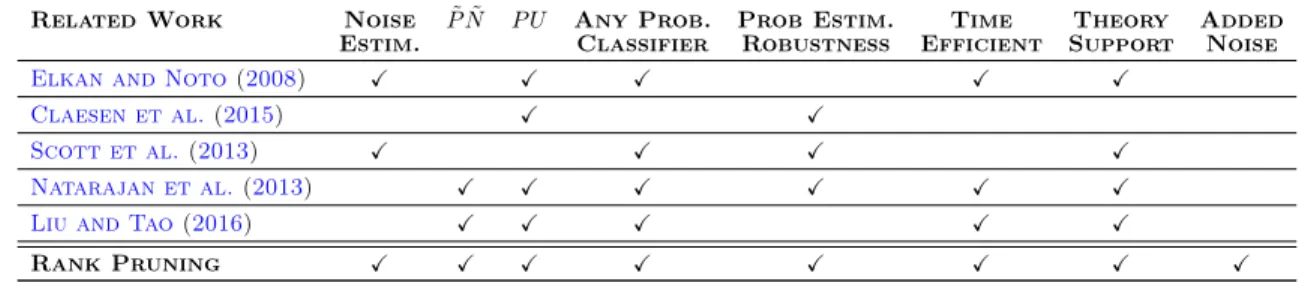
for negative examples. I propose Rank Pruning to solve ˜P ˜N learning and the open
problem of estimating the noise rates. Unlike prior solutions, Rank Pruning is effi-cient and general, requiring O(T ) for any unrestricted choice of probabilistic classifier with T fitting time. I prove Rank Pruning achieves consistent noise estimation and equivalent expected risk as learning with uncorrupted labels in ideal conditions, and derive closed-form solutions when conditions are non-ideal. Rank Pruning achieves
state-of-the-art noise rate estimation and F1, error, and AUC-PR on the MNIST and CIFAR datasets, regardless of noise rates. To highlight, Rank Pruning with a CNN classifier can predict if a MNIST digit is a one or not one with only 0.25% error, and 0.46% error across all digits, even when 50% of positive examples are mislabeled and 50% of observed positive labels are mislabeled negative examples. Rank Pruning achieves similarly impressive results when as large as 50% of training examples are actually just noise drawn from a third distribution.
Together, the CAMEO and Rank Pruning algorithms allow for a robust, general, and time-efficient solution to the CAMEO cheating detection problem. By ensur-ing the validity of MOOC credentials, we enable MOOCs to achieve both openness and value, and thus take one step closer to the greater goal of democratization of education.
Thesis Supervisor: Isaac L. Chuang
Title: Professor of Physics and Professor of Electrical Engineering and Computer Science, Senior Associate Dean of Digital Learning
Acknowledgments
• My advisor, Ike Chuang - for encouraging me to turn my ideas into realities, innovate through exploration, and master the art of scientific communication in all forms. Ike’s advice is as beneficial as it is broadly-scoped. Of all his shared wisdom, I appreciated this one the most, "Choose your metrics for ac-complishments carefully. It’s not research versus award. The causality is that true (and sustained) accolades follow accomplishment. Go for the real thing, and not merely transient public perception... Dig in and make yourself proud of what you’ve done. Earn the right to know you’re one of the top 10 in the world..."
• My family - and in particular my father, Cliff Northcutt, for raising me to re-spect hard work over privilege, honesty over possession. He laid the groundwork for me to become a good man, mastering the juxtaposition of humor, values, and opportunity, with realism, poverty, and hardship. He helped me to avoid many mistakes in life, by vicariously sharing with me the difficulties of his own life. He raised my sisters and me for our own benefit, not for any expected appreciation. Even more than I know the content of this thesis, I know my father will never know how much I love and respect him. But the rest of my family is a large part of the person I am today. My mother, Jackie, never failed to love me with all her heart. She consistently supports my choices without hesitation. Never once has she judged me for who I am or what I’ve done. My sister, Grace, in many ways raised me as a surrogate mother in difficult times. Without her laying the rock of my foundation, I could not stand as strong as I do today. And my sister, Virginia, adds a unique, unscathed joy to my world, unmatched by any other. In quiet moments, I often remind myself of her time-withstanding advice, "Don’t take yourself too seriously," a wisdom she discovered over a decade before I could.
You are a constant motivation, a wonderful partner, and the joy of my tenure at MIT.
• Andrew Ho - For never failing to provide a wonderful and refreshing perspective. Andrew raised the bar of eloquence for me, in all its forms. Without his input, the CAMEO paper would certainly have been an inferior effort. I often hear the comment that someone is "a joy to work with." Andrew defines that standard. • Tailin Wu - For his hard work and contributions to the theoretical development
of Rank Pruning and for long nights running experiments.
• HarvardX and MITx staff - for their timely feedback and continued support. In particular, many thanks to those involved with revoking certificates at MITx. This is how we turn research into impact!
• Jonas Mueller - for never hesitating to let me drill him on all varieties of ma-chine learning and statistics questions. Jonas is a uniquely wonderful friend and brilliant researcher. Although this surely will never be read by any party considering Jonas for employment, if per chance it is, Jonas is your guy. He is as hardworking as he is capable. I wish the world for him.
• Martin Segado - for his incredible kindness and fantastic work on generating cheating labels.
• Cody Coleman - for being a friend, a labmate, a roommate, and someone who I admire, respect, and value.
• My labmates, Rich, Guang Hao, and Ted - for fun times and great discussions. • And to all the others who shaped and influenced my life. The faculty and lecturers that I’ve had the opportunity to learn from at MIT. The friends who have made it fun along the way. The folks who I worked with at FAIR (Y-Lan Boureau!) and Microsoft Research in India. And the Computer Science department at Vanderbilt, who beyond teaching, inspired confidence.
Contents
Glossary and Feature Descriptions 16
1 Massive Open Online Courses: The Challenge of Openness versus
Value 21
1.1 Massive Open Online Courses and Formative Feedback . . . 22
1.2 Cheating Detection in MOOCs is Challenging Because Learner Data is Stochastic and Noisy . . . 23
1.3 The Copying Answers using Multiple Existences Online (CAMEO) Cheating Strategy . . . 26
1.4 The Vision of CAMEO Cheating Detection . . . 27
1.5 Contributions of this Thesis . . . 28
2 Detecting and Preventing “Multiple-Account” Cheating in Massive Open Online Courses 31 2.1 Introduction and Motivation . . . 32
2.2 Methodology . . . 35
2.2.1 Indicators of Copying Answers using Multiple Existences Online (CAMEO) . . . 35
2.2.2 Detection of Copying Answers using Multiple Existences Online (CAMEO) . . . 36
2.2.2.1 Filter 1: the Bayesian criterion . . . 40
2.2.2.2 Filter 2: setting the cutoff threshold . . . 41
2.2.2.4 Filter 4: detecting shared IP address . . . 43
2.2.2.5 Filter 5: excluding shared routers . . . 43
2.2.3 Verification of Copying Answers using Multiple Existences On-line (CAMEO) . . . 44
2.3 Results . . . 44
2.3.1 Prevalence of CAMEO . . . 45
2.3.2 Prevention of CAMEO . . . 47
2.4 Discussion . . . 47
2.5 Summary and Contributions . . . 50
3 From CAMEO to Rank Pruning: Classification with Noisy Labels 52 3.1 Where the CAMEO Algorithm Falls Short . . . 53
3.2 A Good Approach is Choosing No Approach . . . 55
3.3 The Rank Pruning Approach . . . 58
4 Learning with Confident Examples: Rank Pruning for Robust Clas-sification with Noisy Labels 60 4.1 Introduction . . . 61
4.1.1 Related Work . . . 63
4.1.1.1 P U Learning . . . 63
4.1.1.2 P ˜˜N Learning . . . . 64
4.2 Framing the ˜P ˜N Learning Problem . . . 66
4.3 Rank Pruning . . . 68
4.3.1 Deriving Noise Rate Estimators ˆρconf 1 and ˆρ conf 0 . . . 69
4.3.2 Noise Estimation for Unassuming Condition . . . 71
4.3.3 The Rank Pruning Algorithm . . . 73
4.3.4 Rank Pruning: A simple summary . . . 76
4.3.5 Expected Risk Evaluation . . . 76
4.4 Experimental Results . . . 77
4.4.1 Synthetic Dataset . . . 78
4.5 Discussion . . . 84
5 Conclusion 86 5.1 Contributions . . . 87
5.2 CAMEO and Rank Pruning . . . 88
5.3 Cheating Detection versus Prevention . . . 90
5.4 Repurposability . . . 91
5.5 One Small Step for Science, One Giant Leap for Education . . . 92
A 94 A.1 Proofs . . . 94
A.1.1 Proof of Lemma 1 . . . 95
A.1.2 Proof of Theorem 2 . . . 96
A.1.3 Proof of Lemma 3 . . . 97
A.1.4 Proof of Theorem 4 . . . 103
A.1.5 Proof of Theorem 5 . . . 103
A.2 Additional Figures . . . 106
A.3 Additional Tables . . . 107
A.4 Additional Related Work . . . 108
A.4.1 One-class classification . . . 108
List of Figures
2-1 Two types of prototypical behavior when Copying Answers using Mul-tiple Existences Online (CAMEO). A harvester account h records cor-rect solutions, and a master account m submits corcor-rect answers. The time between harvesting in account h (white dot) and correct answer submission by account m (black dot) is estimable from the data and
defined as∆tfor item i in course c. The strategy employed by CAMEO
1 is to alternate harvesting and submission. The strategy of CAMEO
2 is to harvest a batch and then submit a batch. . . 36
2-2 Four types of average theoretical distributions of ∆t (top) with
ex-amples of empirical observed distributions (below). Distribution A illustrates uniformly distributed show answer and correct submission times resulting in a shallow triangular distribution symmetrical around 0. Distribution B illustrates synchronous submission with positive and
negative ∆t values. Distribution C illustrates prototypical Copying
Answers using Multiple Existences Online (CAMEO) behavior, with
candidate harvester accounts passing solutions to candidate master ac-counts over a short time span. Distribution D illustrates consistently and coincidentally ordered submissions over a longer time span. For the empirical distributions, the number of items shared between a har-vester’s show answer and a master’s correct submission is displayed as Ni. . . 39
2-3 Cumulative distribution (line) showing number of CAMEO users
iden-tified versus the cutoff value of90th Percentile of ∆t(Filter 2 in Table
1), together with the associated histogram (bars). The vertical red line depicts the cutoff value chosen. The horizontal red line is the
corresponding number of CAMEO users identified. . . 42
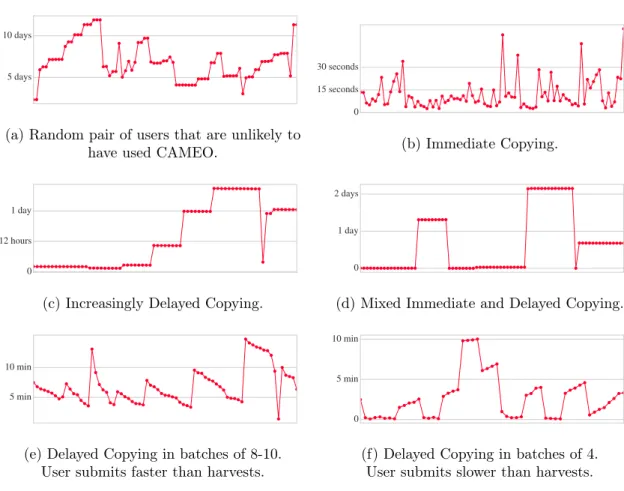
3-1 Six examples of observedCH-CMpair∆tdistributionsfor a suspected
non-cheater in (a) and five known CAMEO cheaters in (b-f). Each plot
represents one pair of accounts. The y-axis of all graphs depicts the∆t
in varying units of time. A red point is plotted for each ∆t > 0. The
points are ordered horizontally along the x-axis by order of submission. 54
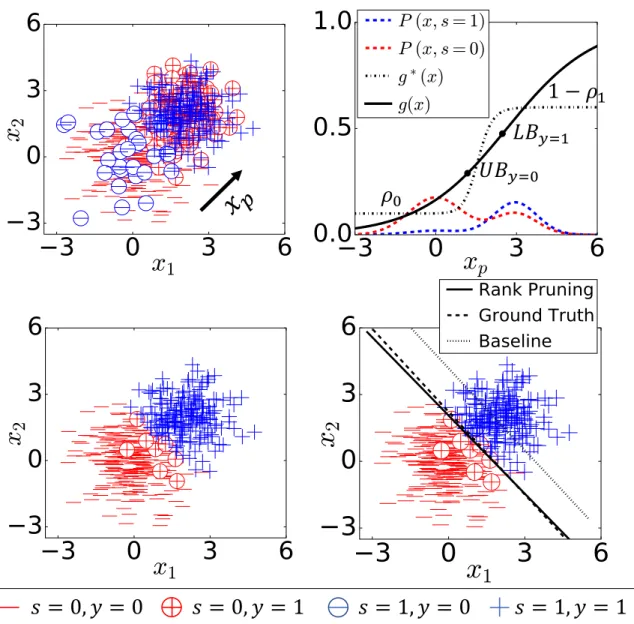
4-1 Illustration of Rank Pruning with a logistic regression classifier (LRθ).
(a): The corrupted training set Dρ with noise rates ρ1 = 0.4 and
ρ0 = 0.1. Rank Pruning is given corrupted colored labels red (s = 0)
and blue (s = 1). True y (+ or −) is hidden. (b): The marginal
distribution of Dρprojected onto the xp axis (indicated in (a)), and the
LRθ’s estimated g(x), from which ˆρconf1 = 0.4237, ˆρ conf
0 = 0.1144 are
estimated. (c): The pruned Xconf, sconf. (d): The classification result
by Rank Pruning ( ˆf = LRθ.fit(Xconf, sconf)), ground truth classifier (f = LRθ.fit(X, y)), and baseline classifier (g = LRθ.fit(X, s)), with
an accuracy of 94.16%, 94.16% and 78.83%, respectively. . . 75
4-2 Sum of absolute difference between theoretically estimated ˆρthry
i and
empirical ˆρi, i = 0, 1, with five different (π1, ρ1), for varying separability
d, dimension, and number of training examples. Note that no figure
exists for percent random noise because the theoretical estimates in
4-3 Comparison of Rank Pruning with different noise ratios (π1, ρ1) on a synthetic dataset for varying separability d, dimension, added random
noise and number of training examples. Default settings for Fig. 4-3,
4-2 and 4-4: d = 4, 2-dimension, 0% random noise, and 5000 training
examples with py1 = 0.2. The lines are an average of 200 trials. . . 80
4-4 Comparison of ˜P ˜N methods for varying separability d, dimension,
added random noise, and number of training examples for π1 = 0.5,
ρ1 = 0.5 (given to all methods). . . 81
4-5 Rank Pruning ˆρ1 estimation consistency, averaged over all digits in
MNIST. Color depicts ˆρ1 − ρ1 with ˆρ1 (upper) and theoretical ˆρthry1
(lower) in each block. . . 82
4-6 Rank Pruning ˆπ1 estimation consistency, averaged over all digits in
MNIST. Color depicts ˆπ1 − π1 with ˆπ1 (upper) and ˆπ1thry (lower) in
List of Tables
2.1 A detection approach that asserts five necessary filtering conditions for
candidate harvester (CH) and candidate master (CM) pairs to be
clas-sified as Copying Answers using Multiple Existences Online (CAMEO). Notes: The filters are chosen to be conservative, and their conjunctive application minimizes the chance of false identification at the cost of conceding missed CAMEO users. In terms of missed identification, Fil-ter 1 excludes small-sample CAMEO users even when their proportions of positive times are 100%. Filter 2 excludes CAMEO users that take more than 5 min to pass solutions between accounts. Filter 3 excludes those who use the CAMEO strategy but do not earn certificates. Filter 4 addresses those who use IP-masking strategies like the Tor browser. Filter 5 excludes CAMEO users within classrooms, cafes, and other
2.2 Distribution and demographics of those identified as Copying Answers
using Multiple Existences Online (CAMEOusers) across courses. (A)
Prevalence and demographic distribution ofCAMEOusers versus
non-CAMEO certificate earners in the 69 courses with nonzero CAMEO
users. (B) Distribution of CAMEO users across four broad curricular
areas, for the 115 courses in the dataset. (C) Observed differences in
CAMEO percentage for Science, Technology, Engineering, and Math courses that do or do not employ mechanisms that logically prevent
CAMEO users, including solutions embargoed until after due dates and algorithmic generation of problems with varying solutions. Note: Survey methods follow those of other studies: Demographic informa-tion collected from edX surveys with response rates >95%; Country is determined by geolocation of the modal IP address; Courses are
divided into curricular areas judgmentally. . . 46
2.3 Rates of CAMEO among unique high performing users, where high
performing defines any user that hasPercent Attempts Correct≥ 99%
and Fraction of Course Problems Completed ≥ 0.65. . . 49
4.1 Variable definitions and descriptions for ˜P ˜N learning and PU learning.
Related work contains a prominent author using each variable. ρ1 is
also referred to as contamination in PU learning literature. . . 64
4.2 Summary of state-of-the-art and selected general solutions to ˜P ˜N and
P U learning for the following features, from left-to-right: (1) noise
rate estimation, (2) a solution to ˜P ˜N learning, (3) a solution to P U
learning, (4) works for any probabilistic classifier, (5) robustness to poor probability estimation, (6) time-efficent for some choice of classi-fier, (7) theoretical justification, and (8) works with added noise drawn from a third distribution mixed into the train set. A checkmark
4.3 Comparison of F1 score for one-vs-rest MNIST and CIFAR-10
(aver-aged over all digits/images) using logistic regression. Except for RPρ,
ρ1, ρ0 are given to all methods. Top model scores are in bold with RPρ
in red if greater than non-RP models. Due to sensitivity to imperfect
g(x), Liu16 often predicts the same label for all examples. . . 84
4.4 F1 score comparison on MNIST and CIFAR-10 using a CNN. Except
List of Algorithms
Glossary and Feature Descriptions
P (Beta(.5+NSAB, .5+N - NSAB) > 0.8) (Variable Type: FLOAT). The
poste-rior Beta probability that the true proportion of CH show answer clicks that
occurred before CM correct answer submissions is greater than 0.9. (i.e. most
show answer clicks occur before correct answer submissions.". 1
P (Beta(.5+NSAB, .5+N - NSAB) > 0.9) (Variable Type: FLOAT). The
poste-rior Beta probability that the true proportion of CH show answer clicks that
occurred before CM correct answer submissions is greater than 0.9. (i.e. most
show answer clicks occur before correct answer submissions.". 1,17
∆t ∆tm,h,c,i = tm,c,i − th,c,i. This is the difference between the time that a master
account, m, submits a correct answer and the time that a harvester account, h, acquires the correct solution, for a problem (item) in common, i, in a given MOOC course, c.. 1,9, 10, 16,26, 27, 35–42, 44, 54, 92
∆t distribution A 1D distribution of all ∆ts for aCM CH pair.. 1, 10, 54, 91
π The true proportion of a CH’s show answer clicks that occur before CM’s correct
answer submissions. 1
25th Percentile of ∆t (Variable Type: FLOAT). The 25th percentile of time
differ-ences 2.1 between the CH show answer clicks that occurred before CMcorrect
answers on the same problem, in seconds.. 1
25th Percentile of CA ∆t (Variable Type: FLOAT). The 25th percentile
times that occurred after a CHshow answer click on the same problem.. 1,25
50th Percentile of ∆t (Variable Type: FLOAT). The 50th percentile (median) of
time differences 2.1 between the CH show answer clicks that occurred before
CM correct answers on the same problem, in seconds.. 1
75th Percentile of ∆t (Variable Type: FLOAT). The 75th percentile of time
differ-ences 2.1 between the CH show answer clicks that occurred before CMcorrect
answers on the same problem, in seconds.. 1
75th Percentile of CA ∆t (Variable Type: FLOAT). The 75th percentile
(me-dian) of the inter-arrival time distribution of theCMcorrect answer submission
times that occurred after a CHshow answer click on the same problem.. 1,25
75th Percentile of Inter-arrival of ∆t (Variable Type: FLOAT). The 75th
per-centile of the absolute values of inter-arrival time distribution of ∆t ordered by
time of CA submission, i.e. the time differences between the CH show answer
clicks that occurred before CM correct answers on the same problem.. 1
90th Percentile of ∆t (Variable Type: FLOAT). The 90th percentile of time
differ-ences 2.1 between the CH show answer clicks that occurred before CMcorrect
answers on the same problem, in seconds.. 1, 10,40–42, 53
90th Percentile of CA ∆t (Variable Type: FLOAT). The 90th percentile of the
inter-arrival time distribution of the CM correct answer submission times that
occurred after a CHshow answer click on the same problem.. 1
90th Percentile of SA ∆t (Variable Type: FLOAT). The 90th percentile of the
inter-arrival time distribution of theCHshow answer click times that occurred
before a CM correct submission on the same problem.. 1
90% Confident π > 0.9 (Variable Type: BOOLEAN). True ifP (Beta(.5+NSAB, .5+N
CA Acronym for Correct Answer. Refers to the submission of a problem on the edX platform resulting in full credit (completely correct answer).. 1, 17, 26, 92
CAMEO Copying Answers using Multiple Existences Online. CAMEO describes
the cheating strategy where a single user employs a harvester account to obtain test answers via the show answer button and a master account to submit the correct answers for full credit. A CAMEO users is one who cheats via the CAMEO strategy.. 1, 2,13, 21, 22,26, 27, 29, 31,35, 44–47,52, 87
CH (Variable Type: STRING). Candidate Harvester. The account used to gather
problem answers via the show answer button. Answers are recorded by the
Candidate Harvester and submitted by the Candidate Master (CM). Show
an-swer is usually available after a problem is answered incorrectly.. 1, 10, 12,
16–20, 26, 37, 38,40–44, 54,90
CH Modal IP (Variable Type: STRING). Modal IP address of CH. 1
CM (Variable Type: STRING). Candidate Master. The account using the CAMEO
cheating strategy to submit correct answers.. 1,10,12,16–20,26,37,38,40–44,
54, 90
CM Modal IP (Variable Type: STRING). Modal IP address ofCM. 1
Fraction of Course Problems Completed (Variable Type: FLOAT). The
num-ber of problems correctly or incorrectly answered by the user, divided by the
total number of problems available to answer.. 1, 13, 49
Item Response Theory Item Reponse Theory (IRT) is a paradigm for the design,
analysis, and scoring of tests, questionnaires, and similar instruments measuring abilities, attitudes, or other variables. In the two-variable case, IRT is used to estimate user proficiency and problem difficulty. IRT may also be used for cheating detection in some contexts.. 1, 56, 88,89
MOOC Massive Open Online Courses. MOOCs are typically free courses offered by universities that replicate some or all of the content of the traditional course in an online platform. MOOCs are open, meaning anyone may create an account, and massive, meaning tens of thousands of active users participate in the online course. MOOCs are typically taken through a MOOC platform provider, like edXedX or Coursera Coursera.. 1, 2, 21, 22, 27,31, 35, 42,48, 50, 52, 90
N (Variable Type: INTEGER). The number of problems for whichCM submitted a
correct answer and CH clicked show answer on the same problem.. 1, 16, 17,
19
NSAB (Variable Type: INTEGER). Number of Show Answers Before. Sometimes
the variable X is also used. The number ofCHshow answer clicks that occurred
before the CMcorrect answer submissions.. 1,16, 17, 19
Percent Attempts Correct (Variable Type: FLOAT). The percentage of all
at-tempts by the user resulting in a correct answer submission. For example, if a learner answered one question correctly on their second attempt, and a sec-ond question correctly on their first attempt, then Percent Correct Attempts =
2
3 = 66.67%. 1,13, 49
Positive-Unlabeled (PU) learning A subset of semi-supervised classification
re-quiring training on a (typically small) subset of true positive labels without any true negative labels, i.e. all other points are unlabeled.. 1, 57
PSAB (Variable Type: FLOAT). Percent Show Answers Before. P SAB = N SABN ∗
100.0. The percentage of CH show answer clicks that occurred before CM
correct answers.. 1
SA Acronym for Show Answer. Refers to the button available on the edX
plat-form that reveals the correct answer to a problem after it has been answered incorrectly.. 1, 26
SA CA ∆t Ordered Correlation (Variable Type: FLOAT). The Pearson
Correla-tion between the CH show answer inter-arrival times occuring before the CM
correct answer inter-arrival times. Before the correlation is computed, both
Chapter 1
Massive Open Online Courses: The
Challenge of Openness versus Value
In this chapter, you will learn about Massive Open Online Courses (MOOCs), the
affordances MOOCs provide, their implications for cheating, and the contributions
of this thesis. In Section 1.1, you will learn about MOOCs and their purpose of
open education and in Section 1.2, you will see a survey of the challenges of cheating
detection created by the stochasticity of massive learner datasets. In Section 1.3,
you will learn about the Copying Answers using Multiple Accounts Online cheating
strategyCAMEOand the challenges specific to CAMEO detection. Along the way in
Section1.4, you will learn about the importance of cheating detection in online courses
as it relates to credentialing and in Section 1.5, you will learn how this thesis serves
to enable a foundation for valuable online course credentials through a statement of contributions.
Throughout the non-technical sections of this and other chapters in this thesis, you will see big ideas stylized in italicized bold. These big ideas capture forward-thinking concepts and questions that drive the progression of this thesis. Big ideas are intended to prepare you for what is to come.
By the end of this chapter, you will have a deeper understanding of MOOCs and how their show answer feature and openness enables new cheating strategies. You
will have seen the implications of the CAMEO cheating strategy and why CAMEO detection and general cheating detection is difficult in MOOCs. Finally, you will know about the contributions of this thesis toward the problem of CAMEO detection and the more general problem of ˜P ˜N learning, i.e. binary classification with noisy labels.
1.1
Massive Open Online Courses and Formative
Feedback
Massive Open Online Courses (MOOCs) are freely-available online university
offer-ings that replicate some or all of the content of a traditional course in an online platform. They provide free, open-access to thousands of courses from the world’s top universities, such as Harvard and MIT, while simultaneously enabling the analysis of massive learner datasets and the dawn of a new era in educational data-mining and
learning analytics. Dubbed a democratization of education (Mazoue, 2014), MOOCs
are open, meaning anyone with an Internet connection may create an account, and
massive, meaning often tens of thousands of users participate in these online courses
(Ho et al., 2014, 2015). MOOCs are typically taken through a MOOC platform
provider, such as edX, Udacity, or Coursera, and vary greatly in difficulty, design,
content, and intent. MOOCs instantiate a learning environment which may repli-cate some aspects of university course instruction, such as recorded video lectures, homework assignments, exams, and peer-to-peer and peer-to-instructor interaction through forums.
Beyond providing an online classroom experience for millions of learners, MOOC platforms often support data aggregation and extraction of client-side learner interac-tions and server-side analysis of problem submissions. These massive learner datasets afford new educational studies and experiments and make possible the educational research conducted in this thesis. I confine our analysis to 115 MITx and HarvardX
courses hosted via theedX platform.
ac-cess without negatively impacting the perceived value of course credentials. For a nominal fee, a learner can earn a certificate of completion in these courses as a representation of their understanding of the material. However, the ability for anyone to create multiple accounts enables new forms of cheating and calls into question the current viability of MOOCs as a credible educational credentialing platform. Are MOOC learners cheating in MOOCs? If so, what strategy are they using and how prevalent is this cheating strategy? Is this strategy detectable, and if so, how can I detect it? Is this method of detection based on human-defined filters and thresholds, and if so, can I instead develop a general solution for detection? Can I prove the correctness of the general solution, and if so, how well does it perform on benchmark
datasets? I delve into these questions in Chapters 2,3, and 4.
The inclusion of a show answer button on the edX platform enables im-mediate, formative feedback, but also new forms of cheating.
The show answer feature allows users to obtain instructor-provided solutions to assessment problems after they have depleted all submission attempts. This method of formative feedback is non-evaluative, supportive, timely, and specific and is known
to improve learning in online courses (Shute,2008;Nicol and Macfarlane-Dick,2006).
Unfortunately, the value of show answer comes at a price. Because MOOCs are open so that anyone can can create one or more accounts, show answer enables new copying strategies through the coordination of multiple accounts. Detection of such a strategy is a focus of this thesis.
1.2
Cheating Detection in MOOCs is Challenging
Because Learner Data is Stochastic and Noisy
MOOCs vary greatly across many dimensions, and within each dimension, the varia-tion of student behavior produces noisy learner data. In this secvaria-tion, I discuss some
MOOC courses differ largely in type, duration, content, format, and purpose, making the task of creating a unified cheating detection system more difficult. George Siemens, credited with coining the term MOOC, described two types of MOOCs (McAuley et al., 2010): (1) xMOOCs, which focus on scalability of learning and
(2) cMOOCs, which focus on connectivity (Mackness et al., 2013) and community
learning. As most forms of cheating do not apply to cMOOCs, I confine my attention
to xMOOCs many of which have ten-thousand or more enrolled learners (Ho et al.,
2015). These larger course sizes complicate cheating detection by increasing the
possibilities of user behavior patterns and increasing run-times of learning analytic algorithms.
If we are to solve the problem of cheating detection in stochastic environ-ments, then we must solve the problem of interpreting noisy predictions.
Our detection algorithm must produce consistently accurate results regardless of whether a user cheats on 10 or 500 problems, even when MOOCs vary drastically
in course duration and content (Ho et al., 2014). If for example, I choose to predict
cheating based on the number of videos watched, the result would be confounded by whether the course relied more on video or textual instruction (content) and how many weeks of video lectures occurred in the course (duration). Within a single course, some users may cheat selectively, while others may cheat on nearly every problem. Approaches to cheating detection must make predictions based on noisy behavioral signals without being confounded by the amount of data and how it varies from learner to learner.
Motivated by these challenges, I created the Rank Pruning algorithm. Rank
Pruning is a robust and general solution to ˜P ˜N learning, the problem of binary
clas-sification with noisy labels. Because cheating prediction is a binary clasclas-sification task and it is often difficult to acquire true positive and true negative cheating labels with
complete certainty, ˜P ˜N learning is a generalization of cheating detection. By solving
of the Rank Pruning algorithm comprises Chapter 4, Rank Pruning is intrinsically motivated by the challenge of behavioral prediction with stochastic learner datasets and noisy labels illustrated by the examples discussed in this section.
Stochasticity across course subject material (Ho et al., 2014, 2015; King et al.,
2013) and user level of expertise exacerbates the difficulty of distinguishing between
experts and cheaters. For example, science courses often begin with prerequisite
material and increase problem complexity over the duration of the course. In these cases, the inter-arrival times of correct answers for a typical non-cheating learner may be smaller between simpler questions versus complex questions. This might motivate us to try to detect cheating by measuring the interquartile range of the inter-arrival
times of correct answers,75th Percentile of CA ∆t-25th Percentile of CA ∆t, with the
expectation that users who cheat consistently are unaffected by problem complexity. However, this method of detection may incorrectly detect non-cheating users with prior knowledge of course content. This simple example illustrates the difficulty of learning a decision boundary that separates cheaters from both non-cheaters and expert users in a complex feature space, a difficulty exacerbated by large variation
among learner types from k-12 to post-doctoral (Ho et al.,2014) and learner intentions
(Reich, 2014).
In addition to the challenges within and among course content and learners,
MOOC platforms are constantly evolving (Henno et al., 2014) and therefore, so must
the definitions of cheating. On December 7th, 2015, edX removed the honor
certifi-cate, a free credentialed recognition of course completion, requiring users who wished
to be certified to pay for an ID-verified certificate. This change dramatically reduced the number of user’s who certify, and required rethinking how to define cheating.
Much of the analysis in Chapter 2 took place before this change, and thus, I only
considered cheaters who were certified, however, a relaxation of this filter should be considered when analyzing courses ending after December 7th, 2015.
The massive population sizes and low cost of MOOCs suggests a need for scalable, inexpensive cheating detection, which precludes the use of human overseers in a proc-tored setting. This restriction to a non-human-procproc-tored setting may increase
cheat-ing risks. For example, in a study across four e-campus courses at Troy University, students scored significantly lower on human-proctored exams versus
non-human-proctored exams (Prince et al., 2009). A non-proctored setting may also prompt
innovations for acquiring certain cheating labels because often a group of proctors is
needed to monitor the student activities to identify cheating (Baker et al., 2004b).
Although requiring grading center examinations in MOOCs would alleviate these
is-sues, it would challenge the MOOC model of free, open education (Mazoue, 2014),
as not every learner can afford or has access to a nearby testing center.
1.3
The Copying Answers using Multiple
Existences Online (CAMEO) Cheating Strategy
A broad goal of this thesis is to accurately detect usage of the Copying Answers using
Multiple Existences Online (CAMEO) cheating strategy. I describe this strategy in
this section. A user employing this strategy, whom I refer to as a CAMEO cheater, earns a certificate by creating at least two MOOC accounts: (1) one or more candidate
harvester (CH) accounts used to acquire correct answers by guessing at test answers
and then accessing instructor-provided solutions via a show answer (SA) button, and
(2) one or more candidate master (CM) accounts used to submit the copied solutions
for full credit as correct answer (CA) submissions. I define ∆t to be the difference
of the time when the master submits the correct answer minus the time when the
harvester clicks show answer, on the same problem.
Variability of CAMEO-use is vast. CAMEO cheaters can delay submission of copied answers, or submit copied answers immediately. They can vary how much they cheat (all or few problems), how often they cheat (seldom or large consecutive groups), and how consistently they cheat (patterned or randomized).
Additionally, any cheating detection algorithm must detect CAMEO-use irrespec-tive of problem type: fill-in-the-blank response, multiple-choice, or multi-select type. This presents many challenges. For example, multi-select problems may contain one
or more questions, called items. Although the edX platform ensures the consistent behavior of show answer buttons across all problem types, there is no show answer for
each individual item. Therefore, the minimum ∆t needed to cheat via the CAMEO
strategy is proportional to the number of items in the multi-select problem. Since
some multi-select problems contain as many as 15 or more items,∆tmay differ greatly
across problem types. Similarly, the minimum∆tneeded to cheat via CAMEO
fill-in-the-blank response is greater than for multiple-choice questions, since fill-in-the-blank
response questions require either copy-and-paste or re-typing of solutions versus the
clicking of a single radio button.
CAMEO detection must generalize to all of these behaviors.
1.4
The Vision of CAMEO Cheating Detection
In this section, I motivate the necessity and implications ofCAMEO cheating
detec-tion within the broader context of MOOC certificadetec-tion.
Although the technical focus of this thesis is to achieve accurate detection of
multiple account cheating in MOOCs, my broader goal is to establish a foundation
of reputable certification in MOOCs. For learners all over the world who hope to
improve their socioeconomic mobility, I strive for a future where MOOCcertification
is recognized as a legitimate credential.
However for such bold claims to be realized, MOOCs must achieve societal accep-tance, and course completion certificates must hold significant societal value. Rep-utable certification is a precursor. Combined with growing evidence that the
reputa-tion and usefulness of MOOC certificareputa-tion are predictors of MOOC persistence (
Al-raimi et al.,2015), I anticipate that widespread awareness of MOOC susceptibility to the CAMEO strategy could depress MOOC popularity and persistence among general users. Although, most MOOC platforms mandate a one account per person policy (courseraterms; edxfaq; udacityterms) making the creation of multiple accounts by a single user grounds for revocation of certification, absolute enforcement of this policy poses restrictions on the MOOC initiative to achieve open-access quality education.
For many courses, a CAMEO user can easily acquire a course certificate without content knowledge in less than an hour. The CAMEO strategy holds the potential to render the MOOC certificate valueless.
In 2015, MIT announced the creation of the MITx Supply-Chain Management MicroMasters, claiming “The MITx MicroMasters in Supply Chain Management is equivalent to a coursework of one semester at MIT. Upon attainment of the MITx Mi-croMasters, learners are eligible to apply for an accelerated, residential, one-semester master’s degree program in Supply Chain Management at MIT. Performance in the
MicroMasters will play a strong role in admissions” (http://scm.mit.edu).
Unexpect-edly, CAMEO cheating prevalence soared in many of these courses, with MIT course instructors complaining of “rampant cheating”. Prevalent cheating in online settings has been corroborated throughout cheating literature. Learner adherence to honor
code policies in traditional classroom settings (McCabe and Trevino, 1993; McCabe
et al., 1999) has been shown to lessen in online settings (LoSchiavo and Shatz, 2011;
Mastin et al., 2009). Additionally, multiple studies have found that participants are
less honest when interacting virtually than in person (Rockmann and Northcraft,
2008; Van Zant and Kray,2014).
Innovations in educational technologies introduce new affordances for cheating. The CAMEO cheating strategy is one example, but users might also plagiarize online
resources or other learner responses using peer-graded assessment (McCabe, 2005).
Because the CAMEO strategy directly threatens the potential for MOOC platforms to evolve into valued academic credentialing services, I confine my attention solely to the detection of CAMEO cheating.
1.5
Contributions of this Thesis
Much of what is achieved in this thesis is the result of a rich, bi-institutional, collabo-rative effort between researchers at MIT and Harvard. In particular, Andrew D. Ho, a Professor of Education at the Harvard Graduate School of Education, and Isaac L.
Chuang, a Professor of Physics, a Professor of Electrical Engineering and Computer Science, and Senior Associate Dean of Digital Learning at MIT, co-authored Chapter
2and contributed substantially to the development of the CAMEO algorithm. Tailin
Wu, a graduate student in the Department of Physics at MIT and Isaac Chuang
co-authored Chapter4and contributed significantly to the theoretical and experimental
development of the Rank Pruning algorithm.
In this thesis, with the help of these colleagues, I define and detect multiple account cheating and discuss its significance for Massive Open Online Courses. For detection, I develop the CAMEO algorithm for multiple account cheating in Massive Open Online Courses and the Rank Pruning algorithm for binary classification with noisy labels, where binary classification is a generalization of cheating detection.
In particular for the CAMEO algorithm, Andrew Ho (Harvard), Isaac Chuang (MIT), and I:
• Define the Copying Answers using Multiple Existences Online (CAMEO)
cheat-ing strategy and estimate a lower bound for its prevalence among 1.9 million course participants in 115 HarvardX and MITx courses.
• Identify preventive strategies that can decrease CAMEO rates and show
evi-dence of their effectiveness in science courses.
• Establish new educational data-mining methodologies for analysis in Massive Open Online Courses.
• Describe a novel honeypot validation technique that verifies cheating by ap-pending unique digit sequences to show answer fields.
• Develop the CAMEO detection algorithm using human-defined filters and thresh-olds as a method for producing noisy CAMEO cheating labels in MOOCs. In particular for the Rank Pruning algorithm, along with Tailin Wu (MIT) and Isaac Chuang (MIT), and I:
• Develop a robust, time-efficient, general solution for both ˜P ˜N learning, i.e. bi-nary classification with noisy labels, and estimation of the fraction of mislabeling in both the positive and negative training sets.
• Introduce the learning with confident examples mantra as a new way to think about robust classification and estimation with mislabeled training data. • Prove that under assumptions, Rank Pruning achieves perfect noise estimation
and equivalent expected risk as learning with correct labels. I provide closed-form solutions when those assumptions are relaxed.
• Demonstrate that Rank Pruning performance generalizes across the number of training examples, feature dimension, fraction of mislabeling, and fraction of added noise examples drawn from a third distribution.
• Improve the state-of-the-art of ˜P ˜N learning across F1 score, AUC-PR, and
Error. In many cases, Rank Pruning achieves nearly the same F1 score as learning with correct labels when 50% of positive examples are mislabeled and 50% of observed positive labels are mislabeled negative examples.
An ancillary contribution of this thesis is the provision of a substantive glossary with detailed descriptions of methods and features for MOOC researchers.
Chapter 2
Detecting and Preventing
“Multiple-Account” Cheating in
Massive Open Online Courses
In this chapter1, you will learn about the Copying Answers using Multiple Existence
Online (CAMEO) strategy, a cheating strategy enabled by the features of massive
open online courses (MOOCs) and detectable by virtue of the sophisticated data
systems that MOOCs provide. The CAMEO strategy involves a user who gathers solutions to assessment questions using a harvester account and then submits correct answers using a separate master account. This chapter serves three main purposes, (1) to define the CAMEO strategy, (2) to establish techniques for detection, and (3) to estimate a lower bound of CAMEO prevalence.
In Section 2.1, we frame the CAMEO strategy within the context of MOOCs and
other cheating strategies. We then define CAMEO in Section 2.2, and establish an
algorithm of five conjunctive filters as a method for detection. In Section 2.3, we
use a small-scale experiment to verify CAMEO and estimate a lower bound for its prevalence among 1.9 million course participants in 115 MOOCs from two universities.
1Andrew Ho, Harvard, and Isaac Chuang, MIT, contributed significantly to the contents of this
Using conservative thresholds, we estimate CAMEO prevalence at 1,237 certificates, accounting for 1.3% of the certificates in the 69 MOOCs with CAMEO users. We discuss the impact of the cheating strategy within the broader context of MOOCs in
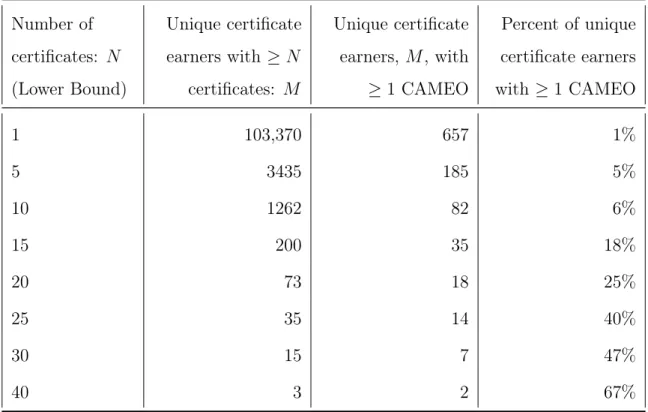
Section 2.4, and find that among earners of 20 or more certificates, 25% have used
the CAMEO strategy. We conclude in Section 2.5 with a discussion of the CAMEO
strategy’s ability to undermine the potential for MOOCs to increase efficiency and spur innovation in higher education.
Once you have finished this chapter, you will know how the CAMEO cheating strategy works and a filter-based algorithm for estimating a lower bound of CAMEO cheating prevalence, as well as new techniques for understanding MOOC learner be-haviors and methods for CAMEO prevention.
2.1
Introduction and Motivation
Massive Open Online Courses began receiving significant media coverage in 2012 (
Mc-Nutt, 2013; Pappano, 2012), coincident with the widespread commitment by estab-lished universities to providing free courses online (Christensen et al.,2013;Ho et al.,
2014;stanfordonline). These MOOCs distinguished themselves from predecessors like
MIT’s Open Courseware (Smith, 2009;d’Oliveira et al., 2010) by providing not only
free content but a course-like structure, including enrollment, synchronous participa-tion, periodic graded assessments, online discussion forums, interactive simulations,
and of greatest relevance for our purposes, certification of successful completion (
De-Boer et al., 2014; Linn et al., 2014). One theory of MOOC proliferation holds that free certification of proficiency in college courses can reduce inefficiencies in higher education by replacing high-cost residential courses with low-cost online certification (Hoxby, 2014).
In this chapter, we reveal a particular cheating strategy that is detectable across the 115 MOOCs in our sample and currently presents a serious threat to the trustwor-thiness of their certifications. We call the strategy, Copying Answers using Multiple Existences Online. A user employing this strategy, whom we refer to as a CAMEO
user, earns a certificate by creating at least two MOOC accounts: (1) one or more
harvester accounts used to acquire correct answers by guessing at test answers and
then accessing instructor-provided solutions via a show answer button, and (2) one or more master accounts used to submit these solutions as correct test answers.
The CAMEO strategy lies at the intersection of a number of other copying tech-niques and contexts. We distinguish between (1) what is copied, (2) why it is copied, (3) how it is copied, and (4) how copying is detected. The CAMEO strategy occurs
in similar contexts as community collaboration in online courses (Yang et al., 2014),
and detection of both involves analyzing the interactions of multiple accounts. How-ever, prior efforts have focused on how communities of different users affect learning
outcomes (Kumar et al., 2007), in contrast with CAMEO behavior, where a single
user exploits multiple accounts, potentially circumventing the learning process en-tirely. CAMEO is most similar to multiple-account sharing strategies in online games
(e.g. (Kafai and Fields, 2009)), where a single user can increase scores or other
in-game outcomes by creating multiple accounts and interacting them strategically. However, CAMEO behavior distinguishes itself from online game strategies due to what is copied (correct answers to tests) and why it is copied (to fake or expedite certification of proficiency). As we show, the specificity of these differences enables targeted detection, quantification, and prevention of CAMEO use in these MOOCs.
Cheating by CAMEO shares similarity in purpose with copying in online and
conventional courses (Baker et al.,2004a;Kauffman and Young,2015;McCabe et al.,
2012; Palazzo et al., 2010). However, three features of CAMEO make it a unique threat as a cheating strategy in online education. First, it is internally sufficient. Whereas most users copy from other learners or external resources, CAMEO users employ multiple accounts to copy from themselves, making the cheating strategy highly accessible by removing dependence on outside resources. As a result, the strategy is extremely effective. Second, in asynchronous MOOCs, where learners can access course materials and assessments at their own pace, a CAMEO user can employ the CAMEO strategy for every question they attempt, allowing certification for full course completion in a single sitting. Third, it is unrestricted, employable in a
non-selective, open admission setting. Degrees from selective institutions assert, at the very least, that users have been pre-screened, but MOOC certificates do not. Because MOOC users, unlike most postsecondary learners, are not selected by any merit-based process or criteria, the considerable accessibility of CAMEO in these MOOCs holds the potential to render their certificates valueless as an academic credential.
The key contributions of this chapter are a detection algorithm for the CAMEO-based cheating that allows for a lower bound estimate of prevalence and a small-scale experiment confirming CAMEO behavior. This latter experiment is an extension of
honey pot cheating detection (Corrigan-Gibbs et al., 2015b), where copied answers
can be confirmed directly. These contributions complement the considerable litera-ture that estimates cheating prevalence through surveys, where survey responses may be influenced by social desirability, interpretation of item prompts, concerns about
anonymity, and inflation in self-reported performance (Mastin et al., 2009). This
chapter investigates a specific cheating strategy using an algorithm customized to big datasets that contain detailed user interactions with online course content, including activity time-stamps. With 115 courses, this is also the largest analysis of cheating in online courses of which we are aware.
CAMEO also represents an example of a more general tendency for open online learning systems to enable both new strategies for cheating and new strategies for
de-tection (Horton et al., 2011; Li et al., 2015; Raines et al., 2011). Although CAMEO
is technically a copying strategy, we argue that its use in MOOCs constitutes
cheat-ing. At a minimum, employing CAMEO is a violation of policy, because MOOC
honor codes forbid the creation of multiple accounts (courseraterms;edxterms;
udac-ityterms). The CAMEO strategy also threatens perceptions of the value of MOOC certification. Any reasonable interpretation of standard MOOC certificates, which
refer to successful completion (edxterms), includes proven learner proficiency with
course content. Yet, the prevalence of the CAMEO strategy justifies a starkly con-trasting interpretation of MOOC certification-that a user merely copied answers from a dummy harvester account. Combined with growing evidence that the reputation
Al-raimi et al.,2015)), we anticipate that widespread awareness of MOOC susceptibility to the CAMEO strategy could depress MOOC popularity and persistence among general users.
2.2
Methodology
We begin by describing aCAMEOdetection algorithm that relies on the distribution
of differences in time between particular user actions across particular user pairs. The CAMEO detection algorithm is comprised of five filters with highly conservative cutoffs intended to reduce false positives, including a Bayesian criterion for the times-tamp difference distributions. After we present these filters, we describe a small-scale experiment that confirms CAMEO cases, and we show that the CAMEO algorithm detects these cases as expected.
2.2.1
Indicators of Copying Answers using Multiple
Existences Online
(CAMEO)
This is the difference between the time that a master account, m, submits a correct answer and the time that a harvester account, h, acquires the correct solution, for a
problem (item) in common, i, in a given MOOC course, c. It is possible for a single
master to have multiple harvesters and a single harvester to have multiple masters. The subscript, c, recognizes that the same master-harvester pair may be employing CAMEO across multiple courses.
Logically, for CAMEO users, these ∆t are predominantly or entirely positive in
sign. The former time, tm,c,i, is recorded in server log files. For the latter time, tm,c,i, we take advantage of the fact that instructors of the moocs in our sample generally allow users to click a show answer option after submitting answers, to display a staff-prepared answer and/or an explanation of the solution, in order for users to obtain
rapid feedback. The timestamp produced by a show answer click defines - tm,c,i. We
distributions of ∆tover items i. Account 1: “Harvester” Account 2: “Master” submit record answer 1 solution 1 submit answer 1 submit record answer 2 solution 2 submit
answer 2 answer 3submit
submit record submit record
answer 3 solution 3 answer 4 solution 4
submit answer 4 Account 3: “Harvester” CAMEO User 1 CAMEO User 2 Δt2,1,1,1 Δt2,1,1,2 Δt2,1,1,3 Δt2,1,1,4 Δt4,3,1,1 Account 4: “Master” Δt4,3,1,2 Δt4,3,1,3 Δt4,3,1,4
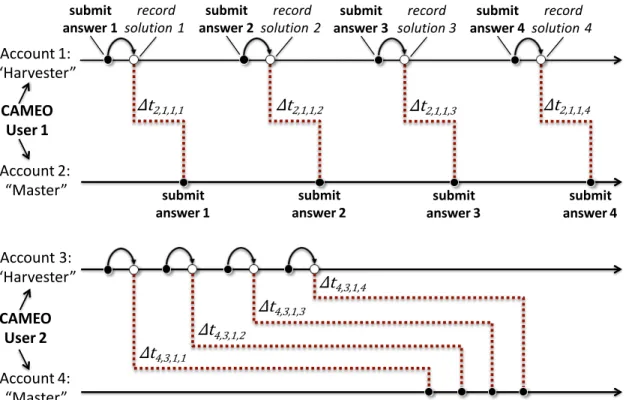
Figure 2-1: Two types of prototypical behavior when Copying Answers using Multiple Existences Online (CAMEO). A harvester account h records correct solutions, and a master account m submits correct answers. The time between harvesting in account h (white dot) and correct answer submission by account m (black dot) is estimable from the data and defined as ∆tfor item i in course c. The strategy employed by CAMEO 1 is to alternate harvesting and submission. The strategy of CAMEO 2 is to harvest a batch and then submit a batch.
Fig. 2-1 illustrates two prototypical CAMEO users, each with two accounts, and
their timeline of interactions with online assessments. For both CAMEO users in Fig.
2-1, we also illustrate the variable:
∆tm,h,c,i= tm,c,i− th,c,i (2.1)
2.2.2
Detection of Copying Answers using Multiple
Existences Online
(CAMEO)
answers from one, the candidate harvester (CH), and correct answers from the other,
the candidate master (CM), is ordered and coincident enough to declare the CH
-CM pair a CAMEO user. In total, we employ five filters to identify CAMEO users
(2.1). These five filters are conjunctive and thus order-independent; we group them
conceptually and order them narratively.
The first two filters reflect the logic that a CAMEO user’s CHoften provides
cor-rect answers to theCMfairly quickly; thus, the distribution of∆tover items i should
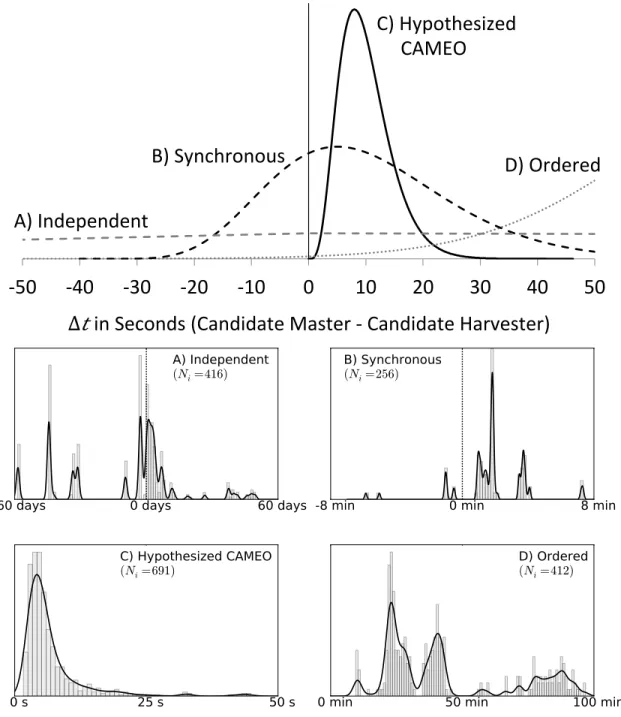
be positive with small magnitudes. Fig. 2-2 shows four contrasting distributions
of ∆t for four different CH-CM pairs. Distribution A illustrates two unrelated and
asynchronous accounts, where one user’s show answer event is sometimes before and sometimes after another user’s correct answer submissions by times that vary widely in magnitude; distributions like this should be common. Distribution B illustrates two users (e.g. siblings, roommates, or learners taking the assessment side-by-side) work-ing in close synchronicity. Due to chance and differences in pacwork-ing, one user’s show
answers will sometimes precede but sometimes follow the other’s correct answers, but
Condition Explanation Operationalization
The∆tdistribution should be positive
The CH should harvest the correct answer before theCM
submits the correct answer.
Bayesian - 90% confident that the proportion of positive ∆t
values is 90% The magnitudes of the ∆t
should be small
The CH should provide an-swers to theCMquickly.
The 90th percentile of the
∆tdistribution should be less than 5 min.
The CH should not be certi-fied, and the CM should be certified
The CH should be guessing, uninterested in certification. The goal of the CM is pre-sumably certification
A CM must be certified. A
CHmust not be certified.
TheCMandCHshould share an IP address or have shared one at some point in their course-taking history.
This increases the likelihood that the CM and CH are in fact the same person.
The CM and CH must share one of the sets determined by the transitive closure of modal IP address and ac-count name over courses. There should be few accounts
that have shared an IP ad-dress with the CMandCH.
This excludes areas, e.g. school networks, where chance coincidence of∆tmay lead to false detection
The number of accounts with a shared modal IP address must not exceed 10.
Table 2.1: A detection approach that asserts five necessary filtering conditions for candidate harvester (CH) and candidate master (CM) pairs to be classified as Copying Answers using Multiple Existences Online (CAMEO).
Notes: The filters are chosen to be conservative, and their conjunctive application minimizes the chance of false identification at the cost of conceding missed CAMEO users. In terms of missed identification, Filter 1 excludes small-sample CAMEO users even when their proportions of positive times are 100%. Filter 2 excludes CAMEO users that take more than 5 min to pass solutions between accounts. Filter 3 excludes those who use the CAMEO strategy but do not earn certificates. Filter 4 addresses those who use IP-masking strategies like the Tor browser. Filter 5 excludes CAMEO users within classrooms, cafes, and other scenarios in which IP addresses are shared.
!50$ !40$ !30$ !20$ !10$ 0$ 10$ 20$ 30$ 40$ 50$ Δ!$in$Seconds$(Candidate$Master$!$Candidate$Harvester)$ 0.04$ 0.06$ 0.08$ 0.1$ 0.12$ Series1$ Series2$ Series3$ C)$Hypothesized$ $$$$$CAMEO$ D)$Ordered$ B)$Synchronous$ A)$Independent$ !50$ !40$ !30$ !20$ !10$ 0$ 10$ 20$ 30$ 40$ 50$ Δ!$in$Seconds$(Candidate$Master$!$Candidate$Harvester)$ 0.04$ 0.06$ 0.08$ 0.1$ 0.12$ Series1$ Series2$ Series3$ C)$Hypothesized$ $$$$$CAMEO$ D)$Ordered$ B)$Synchronous$ A)$Independent$
!50$ !40$ !30$ !20$ !10$
0$
10$
20$
30$
40$
50$
Δ!$in$Seconds$(Candidate$Master$!$Candidate$Harvester)$
C)$Hypothesized$
$$$$$CAMEO$
D)$Ordered$
B)$Synchronous$
A)$Independent$
Figure 2-2: Four types of average theoretical distributions of ∆t (top) with examples of empirical observed distributions (below). Distribution A illustrates uniformly dis-tributed show answer and correct submission times resulting in a shallow triangular distribution symmetrical around 0. Distribution B illustrates synchronous submission with positive and negative ∆t values. Distribution C illustrates prototypical Copying Answers using Multiple Existences Online (CAMEO) behavior, with candidate har-vester accounts passing solutions to candidate master accounts over a short time span. Distribution D illustrates consistently and coincidentally ordered submissions over a longer time span. For the empirical distributions, the number of items shared between a harvester’s show answer and a master’s correct submission is displayed as Ni.
Distribution C reflects prototypical CAMEO behavior, corresponding to Fig.
2-1. All ∆t are positive, and their magnitudes are extremely small, centered in this
illustration at around 10 s. These small∆tmagnitudes are typically possible when the
CAMEO user is logged in simultaneously to both CH and CM accounts on different
internet browsers or computers. Finally, Distribution D is also positive but with
∆t magnitudes that are larger and more variable. This is consistent with ordered
coincidence, where unrelated pairs of users will be offset from each other due to different enrollment dates or time-of-day preferences.
To identify CAMEO users by distributions of ∆t, we considered constraining the
population distribution of ∆t or |∆t| by strong parametric assumptions (e.g.,
log-normal, exponential), but many observed distributions had extreme skew due to
outlying ∆t values. We therefore opt for a less parametric approach that targets
the percentage of positive observations (Filter 1) and the magnitude of the90th
Per-centile of ∆t (Filter 2).
2.2.2.1 Filter 1: the Bayesian criterion
For Filter 1, given variation in the quantity of data shared between any CHandCM,
we use a Bayesian criterion that is more stringent when data are limited (Lehmann
and Casella, 1998). We estimate the parameters of the posterior distribution of a
proportion π, our parameter of interest indicating the proportion of positive∆tvalues,
given n, as the number of in-common items for which a CHhas a show answer and a
CM has a correct answer, and x, as the number of times that the CH time precedes
the CM time: xm,h,c = n X i=1 I(∆tm,h,c,i > 0) (2.2)
Here, I is the indicator function, which is 1 when the argument is true and 0
otherwise. The maximum n for anyCH-CMpair is the number of items. The average
number of graded items is 141, across courses, allowing considerable data for infer-ence. We assume that x is binomially distributed and that π has a Beta distribution.
Following standard rules of conjugacy:
x|n, π ∼Binomial(π, n) (2.3)
π|α, β ∼Binomialπ, n (2.4)
π|x, n, α, β ∼Beta(α + x, β + n − x) (2.5)
We observe x and n in the data. For the prior distribution, we set α = β = 0.5, empirically and judgmentally, using full distributions of observed p = x/n when n is large in our data. This is a gentle U-shape, consistent with the fact that many distributions of tm,c are stochastically or entirely offset from other distributions of th,c in one direction or other, due to the asynchronous nature of moocs.
We operationalize Filter 1 in terms of confidence that π is close to 1, that is, that
CH interaction with an item almost always precedes CM interaction. Specifically,
Filter 1 selects CH-CM pairs with a 90% probability of πm,h,c > 0.9. This is a
conservative, stringent criterion that requires considerable data before concluding
that a distribution is predominantly positive. Even a CH-CM pair with x = 12 out
of n = 12 (p = 100%) positive values is insufficient to meet this criterion.
2.2.2.2 Filter 2: setting the cutoff threshold
Filter 2 addresses the fact that Filter 1 excludes Distributions A and B from CAMEO
consideration, but it cannot distinguish between Distributions C and D (Fig. 2-3).
To exclude ordered accounts that happen to be offset in time in the positive direction,
Filter 2 uses the ∆tdistribution as a criterion, setting a conservative cutoff at 5 min.
In other words, the 90th Percentile of ∆tvalues must be less than 5 min. This cutoff
occurs at an elbow as shown in Fig. 2-3, where shifting the cutoff between 0 and 5
min changes the number of estimated CAMEO users dramatically, and subsequent shifts past 5 min do not.
Figure 2-3: Cumulative distribution (line) showing number of CAMEO users identified versus the cutoff value of 90th Percentile of ∆t(Filter 2 in Table 1), together with the associated histogram (bars). The vertical red line depicts the cutoff value chosen. The horizontal red line is the corresponding number of CAMEO users identified.
2.2.2.3 Filter 3: certified CM - uncertified CH pairs
The first two filters provide considerable evidence that, for CAMEO users, the
distri-bution of ∆t is disproportionately positive and centered at less than 5 min in time.
Filters 3 through 5 provide convergent criteria to further minimize the probability of
false identification. Filter 3 considers only CH-CM pairs for which the CH is
uncer-tified and the CMis certified. Although this may discard CAMEO users who do not
ultimately earn certification, our intention is to address possible threats to MOOC
certificate validity as directly as possible, so we include only certified CMs. In
addi-tion, aCH that earns a certificate is inconsistent with the interpretation of CAMEO
users as a cheating strategy, since it leaves open the possibility that theCHis actually
2.2.2.4 Filter 4: detecting shared IP address
Filter 4 further reduces the candidate pool to those CH-CM pairs who share an IP
address, defined for each account as the modal (most commonly used) IP address across all logged interactions in a given course c. However, considering only users with the same IP address fails to detect users who employ the CAMEO strategy using accounts assigned different modal IP addresses in a given course, either by coincidence or intentional misdirection. To improve detection of these users, we broaden the
definition of sharing an IP address to CH-CM pairs who have ever shared an IP
address in their course-taking history.
To detect CAMEO users with accounts having different modal IP addresses in a given course, we consider every unique (name, IP) tuple across all accounts partici-pating in any of the 115 courses analyzed. We assign each (name, IP) an IP group, initially as a unique integer for each pair. Next, we group by modal IP address such that all (name, IP) tuples sharing the same modal IP address are assigned (merged into) the same IP group. Then, we group by username such that all (name, IP) tuples sharing the same username are merged into the same IP group. We repeat both the
merge by IP and merge by username steps until the IP group no longer changes. This
can be described as a transitive closure of modal IP address and account names for
all accounts across courses. It allows us to consider CM-CH pairs whenever the two
accounts have shared a common modal IP address within a course, across courses, or across other accounts that have shared the same modal IP address within and across courses.
2.2.2.5 Filter 5: excluding shared routers
Filter 5 excludes all CH-CM pairs who are part of a group that has 10 accounts or
more that share a modal IP address. We intend this to exclude shared routers among classrooms or cafes that might increase the likelihood of false positives.
2.2.3
Verification of Copying Answers using Multiple
Existences Online
(CAMEO)
We conducted a small-scale, targeted investigation of registrants in a single, small course to confirm existence of the CAMEO strategy. Through descriptive analyses of usage patterns over time, the instructor identified 3 pairs of users, consisting of 3 candidate master accounts and 3 candidate harvester accounts, whose assessment submissions seemed unusually synchronous. For these three user pairs, we adapted answers to 7 test questions to append a unique random string to the answer displayed to each user. This string took the form of a superfluous symbol (e.g. parentheses), negligible decimal points at the end of a correct answer, or an expression that eval-uates to 1. For example, an answer to the question what is the final momentum of
the particle? could be 3.13, but the answer was displayed as 3.13556 to one user,
and 3.13417 to another. For logistical and pedagogical reasons, this targeting was restricted to these three user pairs.
One of these three pairs never viewed these items. For both of the remaining candidate master accounts, we detect direct copying of at least one unique answer from the harvester accounts. This confirms CAMEO behavior, given that the unique combinations of extra digits and symbols had no reason to be submitted and could not have happened by chance. For small-scale validation, among the 3 pairs of users, the CAMEO detection algorithm identified only and exactly the same two master accounts as CAMEO users. The next section builds from this existence proof to estimate the lower bound prevalence for CAMEO behavior in these moocs.
2.3
Results
We investigate the prevalence of CAMEOusers in 115 online courses from two
insti-tutions, Harvard University and MIT, offered on the MOOC platform, edX.2 We use
2A list of the 115 courses studied, with their classifications into topic areas, and ∆t
distribution data for CM-CH pairs, are archived in the Harvard Dataverse Network, at http://dx.doi.org/10.7910/DVN/3UKVOR.