HAL Id: inria-00000171
https://hal.inria.fr/inria-00000171
Submitted on 20 Jul 2005
HAL is a multi-disciplinary open access
archive for the deposit and dissemination of
sci-entific research documents, whether they are
pub-lished or not. The documents may come from
teaching and research institutions in France or
L’archive ouverte pluridisciplinaire HAL, est
destinée au dépôt et à la diffusion de documents
scientifiques de niveau recherche, publiés ou non,
émanant des établissements d’enseignement et de
recherche français ou étrangers, des laboratoires
Proving Component Interoperability with B Refinement
Samir Chouali, Maritta Heisel, Jeanine Souquières
To cite this version:
Samir Chouali, Maritta Heisel, Jeanine Souquières. Proving Component Interoperability with B
Re-finement. [Research Report] 2005. �inria-00000171�
Proving Component Interoperability with B Refinement
Samir Chouali, Jeanine Souqui`eres
LORIA - University Nancy 2
Campus Scientifique
BP 239, F 54506 Vandoeuvre-ls-Nancy Cedex
{Samir.Chouali, Jeanine.Souquieres}@loria.fr
Maritta Heisel
Universit¨at Duisburg-Essen
Fachbereich Ingenieurwissenschaften
Institut f¨
ur Medientechnik
und Software Engineering
D-47048 Duisburg
[email protected]
Abstract
We use the formal method B for specifying interfaces of software components. Each component interface is equipped with a suitable data model defining all types occurring in the signature of interface operations. Mo-reover, pre- and postconditions have to be given for all interface operations. The interoperability between two components is proved by using a refinement relation between an adaptation of the interface specifications.
1
Introduction
In recent years, the paradigm of component orien-tation [9, 24] has become more and more impor-tant in software engineering. The underlying idea of component-based software development is to develop software systems not from scratch but by assembling pre-fabricated parts, as is common in other enginee-ring disciplines. Component orientation has emerged from object orientation, but the units of deployment are usually more complex than simple objects. As in object orientation, components are encapsulated, and their services are accessible only via interfaces and their operations.
Components adhere to component models. A com-ponent model is designed to allow comcom-ponents to in-teroperate that are implemented according to the stan-dards set by the model. Currently, different component models developed by different parties are available, in-cluding JavaBeans [22], Enterprise Java Beans [23], Microsoft COM+ [15], and the CORBA Component
Model [17].
In order to really exploit the idea of component orientation, it must be possible to acquire components developed by third parties and assemble them in such
a way that the desired behavior of the software system to be implemented is achieved. This approach leads to the following requirements :
1. The description (i.e., specification) of a component must contain sufficient information to decide whe-ther or not to acquire it for integration in a new software system.
First, this requirement concerns the access to the component’s source code. Access to the source code may not be granted in order to protect the component producer’s interests. Moreover, com-ponent consumers should not be obliged to read the source code of a component to decide if it is useful for their purposes or not. Hence, the source code should not be considered to belong to the component specification.
Second, it does not suffice to describe the inter-faces offered by a component (called provided in-terfaces in the following). Often, components need other components to provide their full functiona-lity. Hence, also the required interfaces (called re-quired interfaces in the following) must be part of a component specification. Not all of the existing component models mentioned earlier fulfill this re-quirement.
2. For different components to interoperate, they must agree on the format of the data to be ex-changed between them. Hence, each interface of a component must be equipped with a data model that describes the format of the data accepted and produced by the component. Moreover, it does not suffice to give only the signature of interface ope-rations (e.g., operation foo takes two integers and yields an integer as its result) as is common in current interface description languages. It is also necessary to describe what effect an interface
ope-ration has (e.g., opeope-ration foo takes two integers and yields their sum as a result).
In order to fulfill the above requirements, a com-ponent interface specification must contain the follo-wing information :
– a data model associated with each required and provided interface of a component (interface data model ),
– pre- and postconditions for each interface opera-tion, such that design by contract [13] becomes possible.
We use UML class diagrams [4] to express the inter-face data model and the formal notation B [1]. Based on these ingredients, we prove the interoperability bet-ween two components by using a refinement relation between an adaptation of their interface specifications. Part of this notion of interoperability between com-ponent interfaces is based on a specification matching approach [29].
Note that our approach takes into account only the functional aspects of components. Non-functional as-pects such as security and performance are of course also important, and we aim to treat these issues in fu-ture work.
The rest of the paper is organized as follows : in Section 2, we discuss related work. Then, we present an overview of the B method in Section 3. We introduce the specification of component interfaces (Section 4). The notion of interoperability between two components is defined in Section 5 with its verification using the notion of refinement as it is defined for B. The case study of a hotel reservation system serves to illustrate our approach. The paper finishes with some concluding remarks in Section 6.
2
Related Work
In an earlier paper, we have investigated the role of component models in component specification [10]. The specification of a component model makes it pos-sible to obtain more concise specifications of individual components, because these may refer to the specifica-tion of the component model. The component model specification need not be repeated for each individual component adhering to the component model in ques-tion. In this paper, we investigate the necessary ingre-dients a component specification must have in order to be useful for assembly of a software system out of com-ponents. These ingredients are independent of concrete component models.
Several proposals for component specification have already been made. They have in common that they have no counterpart of our interface data model and
that they do not consider interoperability issues, but only the specification of single components.
A working group of the German “Gesellschaft f¨ur Informatik” (GI) has defined a specification structure for business components [25]. That structure comprises seven levels, namely marketing, task, terminology, qua-lity, coordination, behavioral, and interface. Our speci-fication structure covers the layers terminology, coordi-nation, behavioral, and interface by proposing concrete ways of specifying each of those levels. The other layers of the GI proposal have to do with non-functional as-pects of components.
Beugnard et al. [3] propose to define contracts for components. They distinguish four levels of contracts : syntactic, behavioral, synchronization, and quality of service. The syntactic level specifies only the opera-tion signatures, the behavioral level contains pre- and postconditions, the synchronization level corresponds to usage protocols, and the quality of service level deals with non-functional aspects. Beugnard et al. do not introduce data models for their interfaces. In their example, they use a type called M oney, which is not defined. Therefore, it cannot easily be checked if two components can be combined, because even if both use a type called M oney, it is not guaranteed that the type is the same (or compatible) for both components.
The component specification approach of Lau and Ornaghi [11] is closer to ours, because there, each com-ponent has a context that corresponds to our inter-face data model. A context is an algebraic specifica-tion, consisting of a signature, axioms, and constraints (which constrain the instantiation of parameters). In contrast, we deem it more appropriate to allow for an object-oriented or model-based specification of the data model of a component interface. This makes it possible to take side effects of operations into account and to use inheritance, concepts that are frequently used in practice.
Cheesman and Daniels [6] propose a process to specify component-based software. This process starts with an informal requirements description and pro-duces an architecture showing the components to be developed or reused, their interfaces and their depen-dencies. For each interface operation, a specification is developed, consisting of a precondition, a postcondi-tion and possibly an invariant. This approach follows the principle of design by contract [13]. Our specifi-cation of component interface is inspired by Cheesman and Daniels’ work because that work clearly shows that for each interface, a data model is necessary. However, Cheesman and Daniels do not consider the case that al-ready existing components with possibly different data models have to be combined, and hence they do not
define a notion of interoperability.
Canal et al. [5] use a subset of the polyadic π-calculus to deal with component interoperability only at the protocol level. The π-calculus is well suited for describing component interactions. The limitation of this approach is the low-level description of the used language and its minimalistic semantics.
Bastide et al. [2] use Petri nets to specify the be-havior of CORBA objects, including operation seman-tics and protocols. The difference with our approach is that we take into account the invariants of the inter-face specifications, and we use the B approach to prove interface interoperability.
Zaremenski and Wing [29] propose an interesting ap-proach to compare two software components.It is de-termined whether one component can be substituted for another. They use formal specifications to model the behavior of components and the Larch prover to prove the specification matching of components.
Others [8, 26] have also proposed to enrich com-ponent interface specifications by providing informa-tion at signature, semantic and protocol levels. Despite these enhancements, we believe that in addition, a date model is necessary to perform a formal verification of interface compatibility.
The idea to define component interfaces using B has been introduced in an earlier paper [7].
3
The B method
The B method [1] is a formal software development approach allowing to develop software for critical sys-tems. It covers the entire development process from an abstract specification to an implementation. Its basis is set theory. The basic building block is the abstract machine that is similar to a module or a class in an ob-ject oriented development. A B specification consists of one or several abstract machines (examples of B ma-chines are given in Section 4). Each of them describes a set of variables, invariance properties (also called safety properties) referring to these variables, an initialization which is a predicate initializing the variables, and a list of operations. The specification of an operation consists of a precondition part and a body part. The precondi-tion expresses the requirement that must be met whe-never the operation is called. The body expresses the effect of the operation. The states of a specified system are only modifiable by operations that must preserve its invariant. A B operation OP is defined as : OP def= PRE P THEN S END, where P is a precondition, and S is the body part, expressed as a generalized substi-tution. S may for example take the following shapes :
– assignment statement : S def= x := E where x is a variable and E is an expression,
– multiple assignment : Sdef= x, . . . , y := E, . . . , F , – IF statement : S def= IF P0 THEN S0 ELSE T0
END, where P0 is a predicate, S0 and T0 are
sub-stitutions.
The formula [S]P ost (where S is a substitution, and P ost is a predicate) is called the weakest precondition for S to achieve P ost. It denotes the predicate which is true for any initial state, from which the execution of S is guaranteed to achieve P ost.
The B method provides structuring primitives like INCLUDES, IMPORTS, USES and SEES that allow to compose B machines in various ways. Hence, with B we can specify large systems in a modular way. Finally, B also allows the specification of object-based systems [16, 14, 12].
With the B method, a system is developed by refine-ment. The refinement is used to transform an abstract specification step by step into more concrete ones. For each refinement step, we have to prove that the refi-ned specification is correct with respect to the more abstract specification. In the end, we arrive at an im-plementation that refines its abstract specification.
Verification with the B method is automated. The B theorem prover, Atelier B [21], allows the verification of invariance properties and refinement relation.
4
Specification of component interfaces
Our goal is to propose a way of specifying compo-nents as black boxes, so that component consumers can deploy them without knowing details of their innards. In component-based software development, inspection of the component code may be impossible. Hence, com-ponent interface specifications play an important role, as interfaces are the only access points to a component.
4.1 Definition
A component specification must contain all informa-tion necessary to decide whether the component can be used in a given context or not. This concerns the data used by the component as well as its behaviour visible to its environment. This behaviour is realized by ser-vices which can be used by other components or soft-ware systems. These services are collected in provided interfaces.
However, in many cases, a component depends on services offered by other components. In this case, the component can work correctly only in the presence of other components offering the required services. The
IHotelMgt <<comp spec>> HotelMgr IHotelHandling ... IMakeReservation ... <<comp spec>> Reservation− System ITakeUpReservation ICustomerHandling
Fig. 1. Component architecture of the hotel reservation system
services required by a component are collected in re-quired interfaces. Rere-quired interfaces are an important part of a component specification, because without the knowledge what other components must be acquired in addition, it is impossible to use the component in a component-based system.
An interface specification consists of the following parts :
1. The specification of its interface data model which specifies (i) the types used in the interface, (ii) a data state as far as necessary to express the ef-fects of operations, and (iii) invariants on that data state. In the following, we will use UML class dia-grams [4] to express the data model. This class diagram is then automatically transformed into a B specification [14]. Other languages, such as Object-Z [20], are also suitable for specifying the interface data model (see [10]).
2. A set of operation specifications. An operation specification consists of its signature (i.e., the types of its input and output parameters), its pre-condition expressing under which circumstances the operation may be invoked, and its postcon-dition expressing the effect of the operation. Both pre- and postcondition will refer to the interface data model.
For each component interface, a B machine is defined that contains specifications of the interface data model and of the operations.
4.2 Case study
We illustrate our approach by considering a ho-tel reservation system, a variant of the case study used by Cheesman and Daniels [6]. The architec-ture of the global reservation system using compo-nents is described in Fig. 1 using UML 2 notation [18]. It has two export interfaces, IM akeReservation and IT akeReservation, and two import interfaces IHotelHandling and ICustomerHandling. One of the used components is HotelM gr with its export in-terface IHotelM gt.
In the following, we will consider the interfaces IHotelHandling and IHotelM gt in more detail in
or-HotelDetails id: HotelId name: String ReservationDetails hotel: HotelId dates: DateRange Customer id: CustId Hotel id: HotelId name: String Room number: String
available(during: DateRange): Boolean stayPrice(for: DateRange): Currency allocation * 0..1 1 1..* Reservation dates: DateRange claimed: Boolean 1 * * 1 resRef: Integer
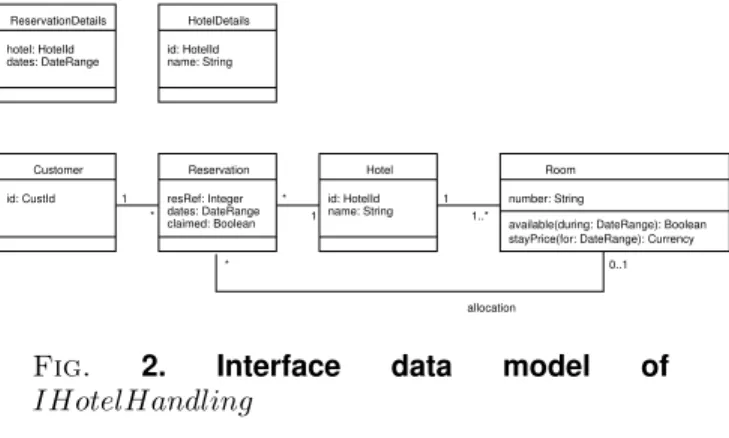
Fig. 2. Interface data model of IHotelHandling
der to prove that the component HotelM gr with its interface IHotelM gt satisfies the needs of the interface IHotelHandling.
4.2.1 Specification of the interface IHotel-Handling
Figure 2 shows the interface data model, expressed as a class diagram.
The corresponding B specification is obtained by systematic transformation rules applied on the UML class diagram in the following way. Since in B all variables must have different names, we use the na-ming convention that all variable names are prefixed by an abbreviation of the name of the class they be-long to. For example, the attribute hotel of the class ReservationDetails becomes the variable RD hotel in the B machine IHotelHandling.
Classes As we can see in Fig. 3, the classes of the in-terface data model and the types of their attributes are represented as sets. Attributes are defined as variables which are functions. The sets of objects that exist in the system, such cust, res, hotels and rooms are also defined as variables. For example, cust is declared to be a subset of the set Customer.
Associations between classes They are specified as variables whose type is a function or relation (de-pending on the multiplicities of the association) bet-ween the sets that model the associated classes. Figure 4 shows the B specification of the associations between the classes : Reservation and Customer, Reservation and Hotel, Reservation and Room.
Integrity constraints They are specified as predi-cates in the INVARIANT clause of the B machine. For example, the constraint which expresses that a reser-vation is claimed if and only if a room is allocated to it is expressed as :
∀(re).((re ∈ res) ⇒ ((RES claimed(re) = T RUE) ⇔ (re ∈ dom(assoc Allocation))))
MACHINE IHotelHandling SETS
ReservationDetails; HotelId; DateRange; HotelDetails; Customer; CustID; Reservation; Hotel; Room; Currency VARIABLES
RD hotel, RD dates, HD id, HD name, C id, cust, RES resRef, RES dates, RES claimed, RES number, Hotel id, Hotel name, hotels, res, R number,
R available, R stayP rice, rooms INVARIANT
/∗ classReservationDetails ∗ /
RD hotel∈ ReservationDetails → HotelID ∧
RD dates∈ ReservationDetails → DateRange ∧
/∗ classHotelDetails ∗ /
HD id∈ HotelDetails → HotelID ∧
HD name∈ HotelDetails → ST RING ∧
/∗ classReservation ∗ /
RES resRef∈ Reservation → INT EGER ∧
RES dates∈ Reservation → DateRange ∧
RES claimed∈ Reservation → BOOL ∧
RES number∈ INT EGER ∧
/∗ classHotel ∗ /
Hotel id∈ Hotel → HotelId ∧
Hotel name∈ Hotel → ST RING
/∗ state of the system ∗ /
cust <: Customer ∧
hotels <: Hotel∧
res <: Reservation∧
rooms <: Room∧
. . .
Fig. 3. B specification of the classes in IHotelHandling
Class operations Operations R availabale and R stayP rice of the class Room are specified as va-riables whose type is a function as expressed in the INVARIANT clause of the B machine as follows : R available∈ Room × DateRange → BOOL R stayP rice∈ Room × DateRange → Currency Operations They are specified in the OP ERAT ION S clause of the B machine. Figure 5 gives two examples of operations. The operation
VARIABLES . . .
assoc ResCust, assoc ResHot, assoc Allocation INVARIANT
. . .
assoc ResCust∈ Reservation → Customer ∧
assoc ResHot∈ Reservation → Hotel ∧
assoc Allocation∈ Reservation 6→ Room
Fig. 4. B specification of associations bet-ween classes
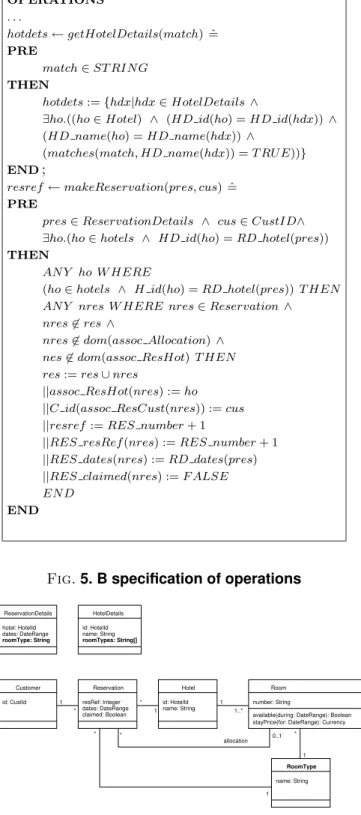
getHotelDetails yields at its result a collection of hotel details, where the hotel name must match the input parameter match. The operation makeReservation creates a reservation, given some customer and some reservation details. It has the precondition that the hotel contained in the reservation details actually exists.
All that information is collected in a single abstract B machine, called IHotelHandling. The complete B specification is available at http ://wwww.loria.fr/~chouali/specB.
4.2.2 Specification of the interface IHotelM gt We assume that a component HotelM gr is available that can manage hotels with different kinds of rooms. Figure 6 shows the interface data model for its provided interface IHotelM gt.
The differences between the interface IHotelHandling and the interface IHotelM gt are due to the new class RoomT ype in IHotelM gt to take into account different kinds of rooms. All the classes present in the interface data model of IHotelHandling are also present in the interface data model of IHotelM gt. However, the classes ReservationDetails and HotelDetails now have one more attribute related to RoomT ype.
In the following we only show a part of the B speci-fication of the interface IHotelM gt that expresses the changes as compared to IHotelHandling.
The class RoomT ype and its associations Fi-gure 7 presents the specification of the class RoomT ype and its attribute. We also show the associations bet-ween the classes Room and Roomtype, Reservation and RoomT ype.
Invariant properties The operations must respect two important invariant properties :
OPERATIONS . . . hotdets← getHotelDetails(match) ˆ= PRE match∈ ST RING THEN hotdets :={hdx|hdx ∈ HotelDetails ∧
∃ho.((ho ∈ Hotel) ∧ (HD id(ho) = HD id(hdx)) ∧
(HD name(ho) = HD name(hdx))∧
(matches(match, HD name(hdx)) = T RU E))}
END;
resref← makeReservation(pres, cus) ˆ=
PRE
pres∈ ReservationDetails ∧ cus ∈ CustID∧
∃ho.(ho ∈ hotels ∧ HD id(ho) = RD hotel(pres)) THEN
AN Y ho W HERE
(ho∈ hotels ∧ H id(ho) = RD hotel(pres)) T HEN
AN Y nres W HERE nres∈ Reservation ∧
nres6∈ res ∧
nres6∈ dom(assoc Allocation) ∧
nes6∈ dom(assoc ResHot) T HEN
res := res∪ nres
||assoc ResHot(nres) := ho ||C id(assoc ResCust(nres)) := cus ||resref := RES number + 1
||RES resRef(nres) := RES number + 1 ||RES dates(nres) := RD dates(pres) ||RES claimed(nres) := F ALSE EN D
END
Fig.5. B specification of operations
Customer id: CustId * 1 Hotel id: HotelId name: String Room number: String
available(during: DateRange): Boolean stayPrice(for: DateRange): Currency 1 1..* 1 * ReservationDetails hotel: HotelId dates: DateRange HotelDetails id: HotelId name: String roomTypes: String[] RoomType name: String roomType: String 0..1 allocation * 1 * 1 * Reservation dates: DateRange claimed: Boolean resRef: Integer
Fig.6. Interface data model of IHotelMgt – for each object of the class ReservationDetails
which is associated to an object of the class Hotel, the value of its variable RD roomT ype is the va-lue of the attribute name of an object of type
MACHINE IHotelM gt SETS . . . RoomT ype VARIABLES . . .
RT name, RD roomT ype, HD roomT ypes INVARIANT
. . .
/∗ classRoomT ype ∗ /
RT name∈ RoomT ype → ST RING ∧
RD roomT ype∈ ReservationDetails → ST RING ∧
HD roomT ypes∈ HotelDetails → P OW (ST RING)
/∗ associations ∗ /
assoc RoomRt∈ Room → RoomT ype ∧
assoc ResRt∈ Reservation → RoomT ype ∧
. . .
Fig.7. B specification of the class RoomT ype in IHotelMgt
RoomT ype associated to a room that belongs to the hotel :
∀(pres, ho).(pres ∈ ReservationDetails ∧ ho ∈ hotels ∧ HD id(ho) = RD hotel(pres) ⇒ RD roomT ype(pres) ∈ {rtn|rtn ∈ ST RING ∧ ∃(rty, ro).((rty ∈ RoomT ype) ∧ ro ∈ Room ∧ ro ∈ assoc ResHot−1[{ho}] ∧
assoc RoomRt(ro) = rty ∧ RT name(rty) = rtn)})
– for each object of class HotelDetails which is associated to a hotel, the value of its variable RD roomT ypes is the set of the attribute name of the objects of class Room- T ype associated to a room that belongs to the hotel :
∀(hdx, ho).(hdx ∈ HotelDetails ∧ ho ∈ hotels ∧ HD id(ho) = HD id(hdx) ⇒ RD roomT ypes(hdx) = {rtn|rtn ∈ ST RING ∧ ∃(rty, ro).((rty ∈ RoomT ype) ∧ ro ∈ Room ∧ ro ∈ assoc ResHot−1[{ho}] ∧
assoc RoomRt(ro) = rty ∧ RT name(rty) = rtn)})
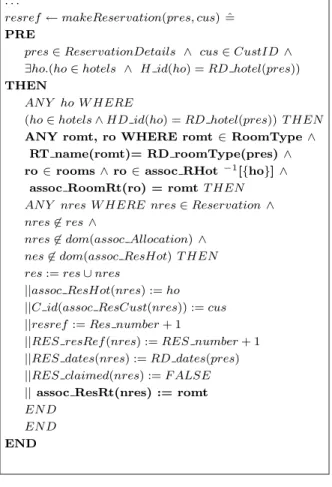
Operations The interface IHotelM gt offers ope-rations having the same names as in the interface IHotelHandling. However, the specification of the operation M akeReservation is different from the spe-cification of the same operation in IHotelHandling, due to the class RoomT ype (see Fig. 8).
OPERATIONS . . .
resref← makeReservation(pres, cus) ˆ=
PRE
pres∈ ReservationDetails ∧ cus ∈ CustID ∧
∃ho.(ho ∈ hotels ∧ H id(ho) = RD hotel(pres)) THEN
AN Y ho W HERE
(ho∈ hotels ∧ HD id(ho) = RD hotel(pres)) T HEN
ANY romt, ro WHERE romt∈ RoomType ∧
RT name(romt)= RD roomType(pres)∧
ro ∈ rooms ∧ ro ∈ assoc RHot−1[{ho}] ∧
assoc RoomRt(ro) = romt T HEN
AN Y nres W HERE nres∈ Reservation ∧
nres6∈ res ∧
nres6∈ dom(assoc Allocation) ∧
nes6∈ dom(assoc ResHot) T HEN
res := res∪ nres
||assoc ResHot(nres) := ho ||C id(assoc ResCust(nres)) := cus ||resref := Res number + 1
||RES resRef(nres) := RES number + 1 ||RES dates(nres) := RD dates(pres) ||RES claimed(nres) := F ALSE || assoc ResRt(nres) := romt EN D
EN D END
Fig.8. makeReservation in IHotelMgt
5
Interoperability
between
Compo-nents
The interoperability means the ability of two (or more) components to communicate and cooperate des-pite differences in their implementation language, the execution environment, or the model abstraction [27]. Three main levels of interoperability have been distin-guished :
1. The signature level : signature of operations ; this level covers the static aspects of component inter-operation.
2. The semantic level : meaning of operations ; this level covers the behavioral aspects of component interoperation.
3. The protocol level : deals with the order in which a component expects its methods to be called. In this paper we only deal with the verification of component interoperability at signature and semantic
levels. Interoperability at protocol level is treated in [7].
Checking component interoperability is crucial for component-based software development and modifica-tion, because it allows system designers and implemen-tors to determine whether two components can inter-operate or whether one component can be replaced by another one.
Since components are described by their interfaces, verifying component interoperability must be perfor-med on the level of component interfaces. Therefore, in order to verify that two components interoperate, it is necessary to verify that their interfaces are compatible. With the notion of compatibility between interfaces, we capture the fact that a provided interface P I of a com-ponent C0 can play the role of the required interface RI of a component C. In other words, it must be pos-sible to implement interface RI, using the operations of interface P I.
To fully exploit the advantages of the component-based approach, it must be possible to check the com-patibility of two interfaces relying on their specifica-tions only and ignoring implementation details. Our approach to specifying component interfaces given in Section 4 has been designed in such a way that a notion of compatibility can be based on it in a straightforward way.
5.1 Definitions
We first give an intuitive description of component interface compatibility in Sections 5.1.1 and 5.1.2. We then show how that intuitive notion can be mapped to refinement in B (Section 5.1.3).
The provided interface P I of a component C0 can play the role of the required interface RI of a com-ponent C, if their interface data models and their ope-rations are compatible.
5.1.1 Compatibility of interface data models The basic idea of compatibility between interface data models is that the interface data model (IDM) of RI is not more restrictive than the one of P I. Only in this case, the IDM of P I can be used in place of the IDM of RI. In particular, each type or class of RI must have a counterpart in P I, but not necessarily vice versa. This means that P I may contain data that are not needed to implement RI. The following cases have to be distinguished :
– Basic types are compatible if they have the same name, or there is an explicit rule stating that the two types are compatible.
– For structured types, in particular class struc-tures, the following conditions must hold :
1. For each class classrof the IDM of RI, there
exists a class classp in the IDM of P I such
that
– For each attribute of classr, there exists an
attribute of classp that has a compatible
type.
– For each operation opr of classr, there
exists an operation oppof classp, such that
for each type of the signature of opr, there
is a compatible type in the signature of opp.1
– There exists an injective function tr : classr→ classp, which transforms an
ob-ject of classrinto an object of classp.
It must be possible to transform RI ob-jects into P I obob-jects in order to use them as input parameters of P I operations. The inverse transformation is necessary to transform the output parameters of P I operations into RI objects.
For data types of P I that have no counter-part in RI, no transformation function is necessary, because such data can be igno-red by RI.
2. Each association in the IDM of RI has a counterpart in the IDM of P I, whose car-dinality constraints are not stronger than in the IDM of P I.
3. The invariant invp of the IDM of P I
im-plies the transformed invariant tr(invr) of
the IDM of RI.
This condition ensures that the states per-mitted by the IDM of RI are also permit-ted by the IDM of P I. However, to show the desired implication, it is necessary that both conditions refer to the same data mo-del. Therefore, the data occurring in the in-variant invr (which belongs to the IDM of
RI) must be replaced by their counterparts in the IDM of P I, as defined by the function tr.
5.1.2 Compatibility of operations
For each operation opr of interface RI there must
exist an operation opp of interface P I such that :
1This is a simple version of signature matching. Different
va-riants of signature matching in an algebraic context are given by Zaremski and Wing [28]. A discussion of signature matching in the context of components can be found in [19].
1. Their signatures are compatible, i.e., for each type of the signature of opr, there is a compatible type
in the signature of opp.
2. The transformed precondition of opr, tr(pre(opi))
implies the precondition of opp.
As for the implication relation on the IDM inva-riants required for compatibility of the IDMs, we must transform the data occurring in the precon-dition of opr.
3. The transformed postcondition of opp,
tr−1(post(op
p)) implies the postcondition of
opr.
This definition of compatibility of operations corres-ponds to the notion of plug-in-matching as defined by Zaremski and Wing [29].
5.1.3 Verification of the interface compatibi-lity with the B refinement
In this section, we show that it is possible to use re-finement in B to prove that two components are com-patible at the signature and semantic levels. We first give the definition of refinement in B [1] and then show how component interface compatibility can be mapped to B refinement.
Let M and N be two B specifications. In the follo-wing we give the main conditions that must hold bet-ween M and N in order to show that N refines M . M is more abstract than N , but it can also be a refine-ment of some other specification ; in the following we refer to M as the abstract specification.
1. The state variables of a refinement machine must be different from the state variables of the abstract machine.
2. The abstract specification M has an initialization Tmthat establishes its invariant Im. A refinement
specification N has an initialization Tn and a
cou-pling invariant Jn. So, if N refines M , then Tn is
required to establish Jnin a way which is coherent
(non-contradictory) with Tm. Formally, Tmis a
re-finement of Tn, if and only if¬[Tm]¬Jn is true for
any state that can be reached from Tn.
3. Every operation defined in M must be defined in N , i.e., all abstract operations must be refined. 4. If an operation OPn defined in N refines an
ope-ration OPm in M , then OPmand OPn must have
the same signature. 5. Let OPm
def
= PRE PmTHEN SmEND and OPn def
= PRE Pn THEN Sn END be two operations in M
and N , respectively. Let Im be the invariant
in N . When the operation OPn is a refinement of
the operation OPm, then the following conditions
hold :
– Im ∧ Jn ∧ Pm⇒ [Sn]¬[Sm]¬Jn, if the
opera-tions have no outputs.
– If outm and outn are the outputs of
respecti-vely OPm and OPn then the following
condi-tion must hold : Im ∧ Jn ∧ Pm ⇒
[Sn[outn/outm]]¬[Sm]¬(Jn ∧ outm= outn).
– Im ∧ Jn ∧ Pm⇒ Pn,
These conditions express that when the operation OPmis refined by OPn, then any refined execution
of Sn on a state in which Im ∧ Jn ∧ Pmholds,
is matched by an abstract execution of S. We can conclude that for any OPm refined by OPn, the
precondition of OPm implies the precondition of
OPn (because the refinement weakens
precondi-tions), and the states in which the postcondition of OPn holds are linked with the states in which
the postcondition of OPmholds.
Let us now consider the case where M is a B cation of a required interface RI, and N is a B specifi-cation of a provided interface P I. Then the refinement conditions of M with N concerning the initialization and the operations imply the conditions for compati-bility between required and provided interfaces, i.e., refinement in B is sufficient for interface compatibility. However, the refinement condition concerning the disjointness of state variables (condition 1) cannot be guaranteed to hold (and is not necessary for the com-patibility of component interfaces). Hence, in order to use B refinement for proving the compatibility between RI and P I, it is necessary to transform the B specifica-tion of P I in order to satisfy the refinement condispecifica-tion 1. That transformation is performed as follows :
– the B specification of P I is transformed into a specification N ew P I which is a refinement spe-cification of RI,
– N ew P I does not contain the sets already defined in both RI and P I,
– the variables defined in both RI and P I are rena-med in N ew P I,
– the invariant of N ew P I consists of the invariant of P I, where the variable renaming has been ap-plied, and a coupling invariant that relates the newly introduced names to their counterparts in RI.
After performing these steps, we can verify that RI is compatible with P I by proving that N ew P I refines RI.
5.2 Case study
We want to prove that the required interface IHotelHandling is compatible with the provided in-terface IHotelM gt using B refinement. Figure 9 pre-sents a part of the B specification N ew IHotelM gt obtained by transforming IHotelM gt according to the steps described above. The main changes concern the renaming of the variables that are also defined in IHotelHandling, the definition of the coupling inva-riant and the definition of the sets and invariance pro-perties that are also defined in IHotelHandling.
We use the tool Atelier B [21] to verify that N ew IHotelM gt refines IHotelHandling. The verifi-cation results are as follows.
– Atelier B generated 197 obvious proof obligations and 22 proof obligations for the B specification IHotelHandling. All these proof obligations were proven automatically.
– Atelier B generated 243 obvious proof obligations and 13 proof obligations for the B specification N ew IHotelM gt. 12 proof obligations were pro-ven automatically, and 1 was easily propro-ven ma-nually.
According to these results, we conclude that N ew IHotelM gt refines IHotelHandling. Conse-quently, the required interface IHotelHandling is com-patible with the provided interface IHotelM gt at the signature and semantic levels.
6
Conclusion and Future Work
In this paper, we have presented a manner of speci-fying component interfaces that is independent of spe-cific component models. Based on that spespe-cification, we have defined a notion of compatibility between com-ponent interfaces that allows one to check whether two components can interoperate via the given interfaces or not. We have shown that it is possible to use refinement in B to prove that two components are compatible at the signature and semantic levels.
In contrast to previous work, our specification contains a data model associated with each component interface. Without such an explicit interface data mo-del, it would not be possible to check the interopera-bility of components without knowing details of the component’s implementation.
To construct a working system out of components, however, it does not suffice just to check our compa-tibility conditions. Once compacompa-tibility is established, the conventions of a chosen component model must be followed in actually combining the components in question. Moreover, glue code, i.e., adapters, have to
REFINEMENT N ew IHotelM gt REFINES IHotelHandling SETS
RoomT ype VARIABLES
RD hotelRef, RD datesRef, HD idRef, HD nameRef, C idRef, custRef,
RES resRef Ref, RES datesRef, RES claimedRef, RES numberRef, Hotel idRef, Hotel nameRef, hotelsRef, resRef, R numberRef, R availableRef, R stayP riceRef, RT name, RD roomT ype, HD roomT ypes, assoc RoomRt, assoc ResRt INVARIANT /∗ renaming variables ∗ / RD hotelRef = RD hotel∧ RD datesRef = RD dates∧ HD idRef = HD id∧ HD nameRef = HD name∧
C idRef = C id ∧ custRef = cust ∧
RES resRef Ref = RES resRef ∧
RES datesRef = RES dates∧
RES claimedRef = RES claimed∧
RES numberRef = RES number∧
Hotel idRef = Hotel id∧
Hotel nameRef = Hotel name∧
hotelsRef = hotels ∧
resRef = res∧
R numberRef = R number ∧
R availableRef = R available∧
R stayP riceRef = R stayP rice∧
/∗ type of the attributes related to RoomT ype ∗ /
RT name∈ RoomT ype → ST RING ∧
RD roomT ype∈ ReservationDetails → ST RING ∧
HDroomT ypes∈ HotelDetails → P OW (ST RING) ∧
assoc RoomRt∈ Room → RoomT ype ∧
assoc ResRt∈ Reservation → RoomT ype ∧
. . .
Fig.9. B specification of New IHotelMgt be developed that implement the transformation of re-quired interface data into provided interface data and vice versa.
In the version of interoperability given in Section 5, the adapters only transform the data and call an ope-ration of the provided interface of the component to be used. However, one can relax the compatibility condi-tions and use more liberal versions of specification mat-ching, e.g., plug-in-post matching [29]. In this case, an adapter must check if the precondition of the provided operation holds. If not, it has to take appropriate ac-tions other than calling the provided operation. Thus,
the construction of adapters becomes a program syn-thesis problem. This problem becomes more complex for weaker versions of specification matching. In the future, we intend to investigate alternative versions of compatibility and their mappings to refinement in B, and to give patterns for the corresponding adapters.
R´
ef´
erences
[1] Jean-Raymond Abrial. The B Book. Cambridge University Press - ISBN 0521-496195, 1996. [2] R. Bastide, O. Sy, and P. A. Palanque.
For-mal specification and prototyping of CORBA sys-tems. In ECOOP ’99 : Proceedings of the 13th Eu-ropean Conference on Object-Oriented Program-ming, pages 474–494. Springer-Verlag, 1999. [3] Antoine Beugnard, Jean-Marc J´ez´equel, No¨el
Plouzeau, and Damien Watkins. Making compo-nents contract aware. IEEE Computer, pages 38– 45, July 1999.
[4] Grady Booch, James Rumbaugh, and Ivar Jacob-son. The Unified Modeling Language User Guide. Addison-Wesley, 1999.
[5] C. Canal, L. Fuentes, E. Pimentel, J-M. Troya, and A. Vallecillo. Extending CORBA interfaces with protocols. Comput. J., 44(5) :448–462, 2001. [6] John Cheesman and John Daniels. UML Components – A Simple Process for Specifying Component-Based Software. Addison-Wesley, 2001.
[7] S. Chouali and J. Souqui`eres. Verifying the com-patibility of component interfaces using the B for-mal method. In CSREA Press, editor, SERP’05, International Conference on Software Engineering Research and Practice, To appear, June 2005. [8] J. Han. A comprehensive interface definition
framework for software components. In The 1998 Asia Pacific software engineering conference, pages 110–117. IEEE Computer Society, 1998. [9] George T. Heineman and William T.
Coun-cill. Component-Based Software Engineering. Addison-Wesley, 2001.
[10] Maritta Heisel, Thomas Santen, and Jeanine Sou-qui`eres. Toward a formal model of software com-ponents. In Chris George and Miao Huaikou, edi-tors, Proc. 4th International Conference on For-mal Engineering Methods, LNCS 2495, pages 57– 68. Springer-Verlag, 2002.
[11] Kung-Kiu Lau and Mario Ornaghi. A formal ap-proach to software component specification. In
G.T. Leavens D. Giannakopoulou and M. Sitara-man, editors, Proceedings of Specification and Ve-rification of Component-based Systems Workshop at OOPSLA2001, pages 88–96, 2001.
[12] Hung Ledang and Jeanine Souqui`eres. Modeling class operations in B : application to UML be-havioral diagrams. ASE2001 : 16th IEEE Inter-national Conference on Automated Software En-gineering, IEEE Computer Society, 2001.
[13] Bertrand Meyer. Object-Oriented Software Construction. Prentice-Hall, second edition, 1997. [14] Eric Meyer and Jeanine Souqui`eres. A systematic approach to transform OMT diagrams to a B spe-cification. In Proceedings of the Formal Method Conference, number 1708 in LNCS, pages 875— 895. Springer-Verlag, 1999.
[15] Microsoft Corporation. COM+, 2002.
http ://www.microsoft.com/com/tech/COMPlus.asp. [16] H. P. Nguyen. D´erivation de Sp´ecifications
Formelles B `a Partir de Sp´ecifications Semi-Formelles. PhD thesis, CNAM, 1998.
[17] The Object Mangagement Group (OMG). Corba Component Model, v3.0, 2002. http ://omg.org/technology/documents/formal/ components.htm.
[18] OMG. UML 2.0 Superstructure Specification. Available at http ://www.omg.org, 2004.
[19] Roberto Rudloff and Maritta Heisel. Signature matching with UML. Available from the authors, 2004.
[20] Graem Smith. The Object-Z Specification Lan-guage. Kluwer Academic Publishers, 1999. [21] STERIA. Atelier B : Preuves et Exemples. [22] Sun Microsystems. JavaBeans
Specification, Version 1.01, 1997. http ://java.sun.com/products/javabeans/docs/ spec.html.
[23] Sun Microsystems. Enterprise Java-Beans Specification, Version 2.0, 2001. http ://java.sun.com/products/ejb/docs.html. [24] Clemens Szyperski. Component Software. ACM
Press, Addison-Wesley, 1999.
[25] Klaus Turowski, editor. Standardized Specification of Business Components. Gesellschaft f¨ur Infor-matik, 2002.
[26] A. Vallacillo, J. Hernandez, and M. Troya. Object interoperability. In Object Oriented Technology : ECOOP’99 Workshop Reader, pages 1–21, 1999.
[27] Daniel M. Yellin and Robert E. Strom. Proto-col specifications and component adaptors. ACM Trans. Program. Lang. Syst., 19(2) :292–333, 1997. [28] Amy Moormann Zaremski and Jeannette M. Wing. Signature matching : a tool for using soft-ware libraries. ACM Transactions on Softsoft-ware En-gineering and Methodology, 4(2) :146–170, 1995. [29] Amy Moormann Zaremski and Jeannette M.
Wing. Specification matching of software compo-nents. ACM Transactions on Software Enginee-ring and Methodology, 6(4) :333–369, 1997.