HAL Id: inria-00070434
https://hal.inria.fr/inria-00070434
Submitted on 19 May 2006
HAL is a multi-disciplinary open access
archive for the deposit and dissemination of
sci-entific research documents, whether they are
pub-lished or not. The documents may come from
L’archive ouverte pluridisciplinaire HAL, est
destinée au dépôt et à la diffusion de documents
scientifiques de niveau recherche, publiés ou non,
émanant des établissements d’enseignement et de
Marc Lavielle, Carenne Ludeña
To cite this version:
Marc Lavielle, Carenne Ludeña. Random thresholds for linear model selection. RR-5572, INRIA.
2005, pp.23. �inria-00070434�
ISRN INRIA/RR--5572--FR+ENG
a p p o r t
d e r e c h e r c h e
Thème COG
Random thresholds for linear model selection
Marc Lavielle — Carenne Ludeña
N° 5572
Marc Lavielle
∗, Carenne Ludeña
†Thème COG — Systèmes cognitifs Projet Select
Rapport de recherche n° 5572 — Mai 2005 — 23 pages
Abstract: A method is introduced to estimate the number of significant coefficients in non ordered model selection problems. The method is based on a convenient random centering of the partial sums of the ordered observations. Based on L−statistics methods we show consistency of the proposed estimator. An extension to unknown parametric distributions is considered. The method is then applied to a regression model and interpreted as a random threshold procedure. Simulated examples are included to show the accuracy of the estimator.
Key-words: adaptive estimation, linear model selection, hard thresholding, random thresholding, L statistics.
This work was supported by ECOS Nord V00M03
∗Université René Descartes and Université Paris-Sud, France. e-mail: [email protected] †IVIC, Venezuela E-mail: [email protected]
Résumé : Une nouvelle méthode est proposée pour estimer le nombre de coefficients significatifs dans un problème de sélection de modèles. Cette méthode utilise un centrage aléatoire bien choisi des sommes cumulées partielles des observations ordonnées. En utilisant des propriétés des L-statistiques, nous montrons la consistance de l’estimateur proposé. Une extension à des distributions paramétriques inconnues est considérée. La procédure est ensuite appliquée à un modèle de régression et est interprétée comme une procédure de seuillage aléatoire. Des exemples numériques illustrent l’intérêt pratique de la méthode.
Mots-clés : estimation adaptative, sélection de modèle linéaire, seuillage dur, seuillage aléatoire, L-statistique.
1
Introduction
Consider the following model
yi= µi+ εi, i = 1, . . . , n
where (µi) is an unknown sequence of constants some of which are zero and (εi) are independent random
variables with common cumulative distribution Fε. The problem we study in this article is choosing the
significant, non zero, coefficients based on the observations (yi). Obviously, significant coefficients will be
those which are greater than a certain threshold, i.e. choose index i if
|yi| > τ. (1)
The choice of τ in (1) will depend on the distribution of the sequence (εi). So in practice τ must
be calibrated in terms of the data. A usual technique is to consider a sequence of thresholds (τj) for
values ranging from very small (many significant coefficients) to very big (few significant coefficients) and study the point where a substantial decrease in the number of significant coefficients occurs. Of course choosing the "right" τ is equivalent to choosing the "right" number k of significant coefficients, with the advantage that this can be done independently of the choice of (τj) by looking at the relative size of
the observations. Indeed, a jump in the relative size of the observations should indicate the existence of significant (not noise) coefficients.
This has been considered by a number of authors (see, for example, [6, 7, 10]) and many adaptive procedures aimed at studying the correct "jump point" have been developed.
A natural approach seems to consider the partial sums of the absolute (or squared) observations ordered decreasingly, and study the fluctuations of these partial sums around some kind of centering factor.
In this article we tackle this problem based on the use of order statistics by considering a convenient random centering: the conditional expectation, with respect to the total sum, of these partial sums. Even when this conditional expectation cannot be computed in a closed form, an exponential change of variable makes this centering possible. We then construct an L− statistic and study its weak convergence. Empirical probability tables or simulated ones based on the limiting process can then be constructed to accept or reject the null hypothesis of all coefficients being equal to zero. If we reject the null hypothesis, further inspection of the test statistic yields the subset of significant coefficients. Indeed, we construct a test statistic based on the minimization of a certain functional of the conveniently centered partial sums and show consistency of the estimated number of significant coefficients under mild assumptions over the gap between significant and non significant coefficients.
The above method requires previous knowledge of Fε. In a parametric setting, Fε = Fε(· ; θ?), we
show that the proposed method can also address the case θ? unknown, assuming the existence of a
consistent estimator of θ?. When θ? is a scale parameter, an appropriate modification of the estimating
procedure yields a scale free statistic, which is also shown to be consistent.
We then apply our method to the problem of estimating the number of significant coefficients for the regression problem
where f is an unknown function in some function space S and ηi are independent random variables
with variance σ2. A usual estimation procedure is to consider f ∈ L2(µ) and a finite orthonormal
system {φλ}Λ, with |Λ| = Mn. Denoting by hy, φjin = 1/nPni=1yiφλ(xi) the empirical coefficients,
Donoho and Johnstone [5] in their seminal article proposed choosing only those coefficients whose absolute value exceeded a certain threshold u =
q
τ σ2log(n)
n . This procedure has since been refereed to as hard
thresholding.
In a very interesting reinterpretation, Barron, Birge and Massart [2] study the problem of hard thresholding in the context of non ordered model selection based on the addition of a penalization term. Their arguments are combinatorial based on the complexity of the underlying linear spaces: the size of the set of all possible models of size k out of K is bounded by (eK/k)kand a logarithmic factor depending on
K must be introduced in order to bound the probabilities. In terms of (1) our observations would now be the empirical coefficientshy, φjin. Of course, except for the case ηi ∼ N(0, σ2), the empirical coefficients
will not be necessarily independent, although uncorrelated, so that the problem does not comply to our assumptions. However, in practice the method works well. As discussed in section 4.3, our method can be interpreted as a random threshold procedure .
The article is organized as follows: in section 2 we introduce the problem and basic notation as well as the proposed test procedure. In section 3 we state and prove theoretical results that justify our procedure, namely consistency of the selected subset of significant coefficients. In section 4.3 we consider certain extensions which include the parametric distribution case, an application to the problem of non ordered linear model selection for the regression setting and interpret out testing scheme in terms of a random penalization procedure. In section 5 we present simulated examples.
2
Describing the procedure
2.1
A first hypothesis testing procedure
Assume we observe yi= µi+ εi. Variables εiare assumed to be independent and identically distributed
with common cumulative distribution Fε. We begin by assuming that the cumulative distribution function
F|ε|of the|εi|’s is known. In section 4 we will deal with the unknown F|ε| case.
Given the collection (yi; 1≤ i ≤ n), we are interested in this section in testing if all the µi’s are null
or not. Thus, we introduce the following hypothesis: Null hypothesis:
H0 : µi ≡ 0 for i = 1, . . . , n. Alternative hypothesis:
H1 : there exists a non empty subset I of{1, 2, . . . , n} such that µi6= 0 for i ∈ I. Then, the test procedure is defined as follows:
ii) For i = 1, . . . , n, let X(i)=− log
¡
1− F|ε|(|y(i)|)
¢ , iii) Let Tj=Pji=1X(i)and Qj= EH0(Tj|Tn).
iv) Define the test statistic Dn = maxj|Tj− Qj|/√n. We will reject the null hypothesis if Dn > dα,
where dα is defined in Section 3.
Remark 1: Under the null hypothesis, the sequence (X(i)) is a decreasing sequence of exponential random
variables with parameter 1. Then, the conditional expectation EH0(Tj|Tn) can easily be computed using
the following proposition (the proof is given in the appendix):
Proposition 2.1 Assume X(1), X(2), . . . , X(n) is an ordered sequence of Exp(1) random variables,
with X(1)≥ X(2)≥ . . . X(n). For any 1≤ j ≤ n, let Tj=Pji=1X(i). Then, for any j≤ K ≤ n,
E¡X(i) ¢ = n X `=1 1 ` (2) E (Tj) = j + j n X i=j+1 1 i (3) E (Tj|TK) = E (Tj) E (TK) TK. (4)
Remark 2: The distribution of the test statistic Dn cannot be computed in a closed form. Nevertheless,
the following standard result will allow us to construct probability tables (the proof is given in the Appendix):
Theorem 2.1 Assume X(1), X(2), . . . , X(n) is an ordered sequence of Exp(1) random variables, with
X(1) ≥ X(2) ≥ . . . X(n). For any 1 ≤ j ≤ n, let Tj =Pji=1X(i). Introduce for t ∈ [0, 1] the random
process dn(t) = T[nt]−E
¡ T[nt]|Tn
¢
. Then, √1
ndn(t), as a stochastic process indexed on t∈ [0, 1], converges
in distribution to a zero mean Gaussian process ∆ with covariance function defined by E (∆(t)∆(s)) =
Z 1 0
Z 1 0
[(1− u) ∧ (1 − v) − (1 − u)(1 − v)][1I[0,t](u)− t + t log(t)]
×[1I[0,s](v)− s + s log(s)]dG−1(u)dG−1(v),
where G(x) is the distribution function of an exponential r.v.
Using Theorem 2.1, we can conclude that statistic Dn defined in the test procedure converges weakly to
∆∞= supt∆(t). Then, dα is defined as the α quantile of ∆∞.
Remark 3: Instead of assuming that the distribution of the |εi| is known, we can assume that there
exists an increasing continuous function h : R+→ R+ such that the cumulative distribution function F h
of h(|ε|) is known. Then, X(i)is defined as − log
¡
1− Fh(h(|y(i)|))
¢
. Without any loss of generality, we will consider the case h = id in the following.
Remark 4: A uniform change of variable can also be used, by setting X(i) = F|ε|(|y(i)|). Indeed, the
conditional expectation of Tj can also be computed here:
E (Tj|TK) = j(K− j)
K + 1 +
j(j + 1) K(K + 1)TK
2.2
Choosing the right coefficients
If we reject the null hypothesis, the next step is to select the significant coefficients.
Let s be the one to one mapping from{1, 2, . . . , n} to {1, 2, . . . , n} defined by Ys(i)= Y(i)(recall that
(Y(i)) is a decreasing sequence).
Then, define the set of alternative hypotheses: Alternative hypothesis:
H1(k) : there exists a subset Ik ⊂ {1, 2, . . . , n} such that, - for any i∈ Ik, s(i)≤ k and EH1(k)(Yi)6= 0,
- for any i6∈ Ik, s(i)≥ k + 1 and EH1(k)(Yi) = 0,
Under H1(k), there are k significant coefficients and|y(k+1)|, . . . , |y(n)| have distribution F|ε|. Then,
we define the following test procedure: i) For i = 1, . . . , n, let X(i)=− log
¡
1− F|ε|(|y(i)|)
¢ ,
ii) Let Kn be some positive integer. For 1≤ k ≤ n − Kn and 1≤ j ≤ Kn, compute
Tk,j = k+j X i=k+1 X(i), (5) Qk,j = EH1(k)(Tk,j|Tk,Kn) , (6) ηk = max 1≤j≤Kn |Tk,j− Qk,j| √ n . (7) iii) Let ˆ k = Arg min 1≤k≤n−Kn ηk
Remark 1: The `1 or the `2 norms can be used instead of the `∞ norm to define η by setting
ηk = n− 3 2 Kn X j=1 |Tk,j− Qk,j| or ηk= n−2 Kn X j=1 (Tk,j− Qk,j)2
Remark 2: Qk,j can easily be computed using the results of the previous section. Indeed, Let Bk,j,n= Ek (Tk,j) Ek(Tk,Kn) = j ³ 1 +Pn−ki=j+11/i´ Kn ³ 1 +Pn−ki=Kn+11/i´ (8)
Then, Proposition 2.1 yields Qk,j = Bk,j,nTk,Kn.
In order to state our main consistency result, we consider the following asymptotic framework:
AF1 There exists t?∈ (0, 1) and a subset Ik?
nof{1, 2, . . . , n} with k
?
n = [t?n], such that µi6= 0 if i ∈ Ik? n.
For all other index, µi = 0.
AF2 For any i ∈ Ik?
n, |µi| ≥ αn, where αn → ∞ according to the distribution of the (εi). Let Φ(1)
be the distribution of max1≤i≤n|εi| and (an, bn) such that Φ(1)(an+ bnx)→ W (x) for some fixed
distribution W . Then (αn) satisfies
αn− 2an
bn → ∞.
(9) AF3 Kn/n→ c such that 0 < c < 1 − t?.
We have the following result
Theorem 2.2 Let (un) be any positive and decreasing sequence such that √n un→ ∞. Then, under the
asymptotic framework defined by AF1, AF2,AF3, P ( ¯ ¯ ¯ ¯ ¯ ˆ k n− t ? ¯ ¯ ¯ ¯ ¯> un)→ 0. (10)
Moreover, for a > 0 there exist constants c1, c2 which depend on a such that if
un= c1αn √ log n 2√n + c2αnlog(n) 2n , then PH1(k?n) Ã |nˆk− t?| > un ! ≤ 2e−a log(n)+ 2P µ max 1≤i≤n|εi| > αn ¶ . (11)
The proof of Theorem 2.2 is given in Section 3.
3
Proof of Theorem 2.2
Our procedure is based on two facts: a)under mild assumptions over the error distribution, if the null hypothesis is rejected, that is, if there is a group of significant coefficients and one of non significant coefficients, both groups of observations will be stochastically in order with high probability and b) for
two separate groups, separated at index k?
n = [t?n], Tkn,j− Qkn,j will only converge at rate
√n for index kn such that|kn− kn?| = o(√n).
Set ui= yi for i∈ Ik?
n and vi = yi for i6∈ Ik?n. Thus (vi) is an i.i.d. sequence with distribution Fε.
We have the following lemma that assures that both collections are stochastically in order with high probability:
Lemma 3.1 Let (u(i)) and (v(i)) be the sequences (|ui|) and (|vi|) in a decreasing order. Then
P¡v(1)> u(k? n) ¢ → 0 and P ³ v(1)> αn 2 ´ → 0
Proof: By assumption (v(1)− an)/bn → W . On the other hand, let (˜vD i) be a sequence of i.i.d. r.v. with
distribution Fε. Then, P¡v(1)> u(k? n) ¢ ≤ P¡v(1)+ ˜v(1) > αn ¢ ≤ P¡v(1)> αn/2¢+ P¡v˜(1) > αn/2¢ ≤ 2P¡v(1)> αn/2 ¢ → 2W (αn/2b− an n )→ 0. ¤
Lemma 3.1 yields the (u(i)) and (v(i)) are stochastically in order with high probability . Let Ωn be
the subset of Ω where v(1)< αn/2 and u(k?
n)> αn/2. Clearly P (Ωn)→ 1. In what follows we will restrict
our proof to Ωn.
We will denote Ek() the expectation under H1(k) (instead of EH1(k)()). On the other hand, let
ai= E0
¡ X(i)
¢
=Pn`=11/`.
1) Consider first the case k > k?
n. On Ωn, Tk,j− Qk,j = Tk,j− Bk,j,nTk,Kn = ¡Tk,j− Ek? n(Tk,j) ¢ − Bk,j,n ¡ T(k,Kn− Ek?n(Tk,Kn) ¢ + Ek? n(Tk,j)− Bk,jEk?n(Tk,Kn) = Rk,j+ Sk,j
We have decomposed the statistics Tk,j − Qk,j into a random part Rk,j and a deterministic part Sk,j.
First, let k = [tn] and j = [sn] for t ≤ s. As in Theorem 2.1, Rk,j1IΩn (normalized by
√n) as a process indexed by (t, s) ∈ (0, 1)2 converges in distribution to a zero-mean Gaussian process Γ
t,s =
On the other hand, Sk,j = Ek? n(Tk,j)− Ek(Tk,j) Ek(Tk,Kn) Ek? n(Tk,Kn) = Ek? n(Tk,j)− Ek(Tk,j)− Ek(Tk,j) Ek(Tk,Kn) ¡ Ek? n(Tk,Kn)− Ek(Tk,Kn) ¢ = j+k−k? n X i=j+1 ai− k−k? n X i=1 ai+ Bk,j,n Kn+k−kX ?n i=Kn+1 ai− k−k? n X i=1 ai = k−k? n X i=1 ¡ ai+j− ai+ Bk,j,n(ai+Kn− ai) ¢
Thus, there exists a constant, γ > 0, which depends on c in [AF3], such that supj|Sk,j| ≥ γ(k − kn?) and
Pk? n ³ k? n− bk > n un ´ ≤ P¡ηk? n> sup ηk , (k− k ? n) > n un ¢ (12) ≤ P µ 2 sup k sup j Rk,j> infk supj |Sk,j| , (k − k ? n) > n un ¶ + P(Ωcn) ≤ P µ 2 sup k sup j Rk,j> γ n un ¶ + P(Ωcn) .
Because of the weak convergence of Rk,j1IΩn the above probability tends to zero when n goes to infinity.
2) Consider now the case k < k?
n. On Ωn, Tk,j− Qk,j = Tk,j− Bk,j,nTk,Kn = (1− Bk,j,n)Tk,k? n−k+ ¡ Tk? n,j− E ¡ Tk? n,j ¢¢ − Bk,j,n ¡ Tk? n,Kn− E ¡ Tk? n,Kn ¢¢ +E¡Tk? n,j ¢ − Bk,j,nE ¡ Tk? n,Kn ¢ = Ak,j+ Rk? n,j + Uk,j where Ak,j = (1− Bk,j,n)Tk,k?
n−k. Remark that over Ωn, |y(i)| > αn/2. Then, there exists c(αn) > 0
such that Tk,k?
n−k > c(αn)(k
?
n− k), thus Ak,j =O(kn?− k). On the other hand, Rk?
n,j1IΩn converges in
distribution to a zero-mean Gaussian process Γt?,s. Consider now the bias term Uk,j:
Uk,j = Ek? n ¡ Tk? n,j ¢ −EEk(Tk,j) k(Tk,Kn) Ek? n ¡ Tk? n,Kn ¢ = Ek? n ¡ Tk? n,j ¢ − Ek ¡ Tk? n,j ¢ − Ek ¡ Tk? n,j ¢ Ek(Tk,Kn) ¡ Ek? n ¡ Tk? n,Kn ¢ − Ek(Tk,Kn) ¢ +Ek?n ¡ Tk? n,Kn ¢ Ek(Tk,Kn) Ek¡Tk,k? n ¢ = j−k X i=j+k−k? n+1 ai− k? n−k X i=1 ai+ Ek¡Tk? n,j ¢ Ek(Tk,Kn) Kn X i=Kn+k−k?n+1 ai − Ek? n ¡ Tk? n,Kn ¢ Ek(Tk,Kn) k? n−k X i=1 ai.
Thus, there exists a constant δ > 0, which depends on c in [AF3], such that supj|Uk,j| ≥ δ(k − kn?) and
Pk? n ³ bk − k? n> n un ´
In order to show (11), sharper bounds on Pk? n
¡
supksupjRk,j > C n un
¢
are required for any given constant C. As above, we will restrict our attention to the set Ωn and drop this fact from the notation.
Consider first as above the case k > k?
n. Write, over Ωn, Rk,j = ¡Tk,j− Ek? n(Tk,j) ¢ − Bk,j,n¡Tk,Kn− Ek?n(Tk,Kn) ¢ = R(1)k,j+ R (2) k,j.
Remark supjBk,j,n= 1. So that supj|R (2)
k,j| = |Tk,Kn− Ekn?(Tk,Kn)|.
Let G denote the common distribution function of the collection (Xi). We can rewrite
Tk,Kn− Ek?n(Tk,Kn) = X i [Xi− Ek? n(Xi)]1I{G−1(1−Kn/n)<Xi}. Thus, Tk,Kn− Ekn?(Tk,Kn) αn/2
is the sum of independent bounded r.v. with variance bounded by 1, so that by Bennet’s inequality
P Ã supj|R (2) k,j| αn/2 > γ/2nun αn/2 ! ≤ P µ |Tk,Kn− Ek?n(Tk,Kn)| αn/2 > c1γ 2√2 p 2n log n +3c2γ 2 log n 3 ¶ ≤ e−(a+1) log(n),
choosing c2≥ 2(a+1)3γ and c1≥ 2 √ 2√a+1 γ . Hence, summing in k P Ã sup k sup j<k+Kn R(2)k,j> γ 2nun ! ≤ e−a log n. For R(1)k,j we have Tk,j− Ek? n(Tk,j) αn/2 =X i [Xi− Ek? n(Xi)]1I{G−1(1−j/n)<Xi}.
Hence in this case we must use a functional version of Bennet’s inequality (Theorem 7.3 in [4]) which yields P Ã supj|R (2) k,j| αn/2 > E Ã supj|R (2) k,j| αn/2 ! +√2xv +x 3 ! ≤ e−x, for v ≥ n + 2E µ supj|R(2)k,j| αn/2 ¶
. Thus it remains to bound A = E µ
supj|R(2)k,j|
αn/2
¶
. This can be done using standard symmetrization and entropy techniques to obtain, A≤ 4√n log n, as the random entropy of the classA = {1IG−1(1−t),t∈[0,1]} (as it is a collection of increasing functions) is bounded by 2 log n.
As above, P Ã supj|R (1) k,j| αn/2 > γ/2nun αn/2 ! ≤ P µ2 |Tk,j− Ek? n(Tk,j)| αn > 4 p n log n + q
2(a + 1) log n(n + 4pn log n) + (a + 1)log n 3 ¶ ≤ e−(a+1) log(n), choosing ci, i = 1, 2 appropriately. The case k < k? n follows analogously.
4
Some extensions
4.1
Unknown distribution
Assume now that the distribution Fε of the εi’s is a parametric distribution Fε(· ; θ?), but where the
parameter θ? is unknown. For any 0≤ k ≤ n − 1, let bθ
k = bθ(y(k+1), y(k+2), . . . , y(n)) be an estimator of
θ. Let F|ε|(· ; θ?) be the distribution of the|ε
i|’s. We will consider the following assumptions:
F1 The cumulative distribution function F|ε| is two times differentiable as a function of θ with a.e. strictly positive derivative at θ = θ?.
F2 θ? belongs to some compact set Θ and there exists, under Hk?
n, a consistent estimator bθk?n =
b θ(y(k?
n+1), y(k?n+2), . . . , y(n)) of θ
?.
F3 There exists (a, b) such that 0 < a < t? < b < 1 and a Lipschitz continuous function ˜θ defined on
[a, b] such that, under Hk?
n, (bθ[tn]) converges uniformly on [a, b] in probability to ( ˜θ(t)).
Remark 1: under hypothesis F2 and F3, bθk?
n is a consistent estimator of ˜θ(t
?) = θ?.
Remark 2: When t < t?, convergence of bθ
[tn] can be difficult to check with any estimator, since bθ[tn]
depends on some yi’s that are not distributed under distribution Fε. Nevertheless, it is possible to use
an estimator based on some empirical quantiles and that only depends on the smallest observations, that is, that depends only on the observations distributed under Fε.
For any θ∈ Θ, let Xi(θ) =− log¡1− F|ε|(|yi|, θ)¢, and Tk,j(θ) =Pk+ji=k+1X(i)(θ).
Then, we define the following procedure:
i) Let Kn≤ [(1 − b) n] be some positive integer. For [a n] ≤ k ≤ n − Kn,
2. for i = 1, . . . , n, let X(i)(bθk) =− log ³ 1− F|ε|(|y(i)|; bθk) ´ , 3. for 1≤ j ≤ Kn, compute Tk,j(bθk) = k+j X i=k+1 X(i)(bθk), Qk,j(bθk) = Bk,j,nTk,Kn(bθk), ηk(bθk) = max k+1≤j≤n |Tk,j(bθk)− Qk,j(bθk)| √n . iii) Let ˆ k = Arg min an≤k≤bnηk(bθk)
Remark: Here, Qk,j(bθk) = Bk,j,nTk,Kn(bθk) is the conditional expectation of Tk,j, conditionally to Tk,Kn,
assuming that k?
n= k and that θ?= bθk.
Then, we have the following result, Theorem 4.1 Assume F1, F2, F3.
i) Introduce for t∈ [0, 1] and s ∈ [a, b] the random process ˆ dn(t, s) = Tk? n,[Knt](bθ[ns])− EHk?n ³ Tk? n,[Knt](bθ[ns])|Tk?n,Kn(bθ[ns]) ´ .
Then, ˆdn(t, s)/√n, as a stochastic process indexed on [0, 1]× [a, b], converges in distribution, under Hk? n,
to a zero mean Gaussian process (Λ(t, s)).
ii) Let (un) be any positive and decreasing sequence such that√n un→ ∞. Then, under the asymptotic
framework defined by AF1, AF2, AF3, PH1(k?n) ﯯ ¯ ¯ ˆ k n− t ? ¯ ¯ ¯ ¯ ¯> un ! → 0. (13)
Proof: We first show i).
With the above notation, for any θ∈ Θ, let Ψj(θ) = Tk?
n,j(θ)− Qk?n,j(θ)
Ψ0j(θ) =
∂Ψj
∂θ (θ) For any t∈ [0, 1] and s ∈ [a, b], let
ˆ
dn(t, s) = Ψ[nt](bθ[ns])
Using the same proof used for the convergence of (Ψ[nt](θ?))/√n (see the Appendix), we show that, for
any s∈ [a, b], (Ψ[nt](˜θ(s)))/√n and (Ψ0[nt](˜θ(s)))/
√n also converge to two zero-mean Gaussian processes. Then, using hypothesis F3, bθ[ns] → ˜θ(s) uniformly over [a, b], and then, ( ˆdn(t, s)) converges to a zero
mean Gaussian process (Λ(t, s)).
We show now ii). For any θ ∈ Θ, let ai(θ) = EH0
¡ X(i)(θ)
¢
. Following the proof of Theorem 2.2, consider first the case k > k?
n. On Ωn, for any θ∈ Θ, Tk,j(θ)− Qk,j(θ) = ¡ Tk,j(θ)− Ek? n(Tk,j(θ)) ¢ − Bk,j,n ¡ Tk,Kn(θ)− Ek?n(Tk,Kn(θ)) ¢ + Ek? n(Tk,j(θ))− Bk,jEk?n(Tk,Kn(θ)) = Rk,j(θ) + Sk,j(θ)
As in Theorem 2.2, Rk,j (normalized by √n) as a process indexed by (t, s)∈ (0, 1)2 converges in
distri-bution on Ωn to a zero-mean Gaussian process Γt,s(θ).
On the other hand,
Sk,j(θ) = k−k? n X i=1 ¡ ai+j(θ)− ai(θ) + Bk,j,n(ai+Kn(θ)− ai(θ)) ¢
Thus, there exists a constant, γ > 0, which depends on a, b in [F3], such that supj|Sk,j(bθk)| ≥ (k − k?n)γ.
We conclude that Pk? n ³ k? n− bk > n un ´
→ 0 using the arguments used for Theorem 2.2. The case k < k? n
is identical. ¤.
4.2
The unknown variance case
When θ?is a scale parameter, i.e. F
ε(y; θ?) = Fε(y/θ?; 1), we introduce the following procedure which is
scale invariant:
i) For i = 1, . . . , n, let X(i)=|y(i)|,
ii) Let Kn be some positive integer. For 1≤ k ≤ n − Kn and 1≤ j ≤ Kn, compute
Tk,j = k+j X i=1 X(i), (14) Qk,j = EH1(k) ³Pk+j i=kX(i) ´ EH1(k) ³Pk+Kn i=k X(i) ´ Tk,Kn, (15) ηk = max 1≤j≤Kn |Tk,j− Qk,j| √n . (16) iii) Let ˆ ku= Arg min 1≤k≤n−Kn ηk
Remark: Notice, the minimization problem at hand is not changed if we consider |Tk,j−Qk,j|
σ√n , so the
procedure is indeed scale invariant. We have the following result, whose proof is omitted as it resembles quite closely that of Theorem 2.2.
Theorem 4.2 Let (un) be any positive and decreasing sequence such that √n un→ ∞. Then, under the
asymptotic framework defined by AF1, AF2,AF3, P (|kˆu
n − t
?
| > un)→ 0.
Moreover, for a > 0 there exist constants c1, c2which depend on a such that if un= c1αn √ log n 2√n + c2αnlog(n) 2n then P (|ˆku n − t ?
| > un)≤ 2e−a log n+ 2P ( max 1≤i≤n
|εi|
σ > αn).
4.3
Application to a regression problem
Consider as discussed in section 1 the following setting.
1. Assume we observe yi = f (xi) + εi for a fixed collection xi. Variables (εi) are assumed to be
independent and identically distributed with variance V ar(ε) = σ2.
2. Associated to the collection (xi), we introduce the empirical inner productht, sin= 1n
P
it(xi)s(xi)
and its associated empirical normk · kn.
3. We are interested in approximating f in terms of a certain orthormal basis{φλ}λ. We assume that
the basis is such that it is also orthonormal in the empirical normh, in. 4. Given the basis define the absolute empirical coefficients bβj =
¯ ¯hy, φjin
¯
¯ √n. More generally, we could consider the collection of the transformed coefficients γj(h) = h( bβj/σ) for any given strictly
increasing function h such that there exists β satisfying h(ax) = aβh(x) for any positive constant
a.
In this section we are interested in the partial sums of the ordered variables bβ. If εi follows a
Gaus-sian distribution then yj =hy, φjin√n/σ are independent normal variables and it is straightforward to
show that the procedure considered in section 4.2 can be applied. More precisely assume the following assumptions are satisfied
R1 εi are an i.i.d. collection of centered normal r.v. with variance σ2.
R2 {φ1, . . . , φn} is orthonormal w.r.t. the empirical norm h, in.
R3 For any i∈ Ik?
n, | hf, φjin| > aσ
√
log 2n/√n, with a≥ 2√2. We have the following result,
Lemma 4.1 Assume AF1, AF3, R1, R2 and R3 hold true. Let ˆku, be the estimator defined in
section 4.2. Then, for b > 0 there exist constants c1, c2 which depend on a and b such that if un =
c1log(n) 2√n + c2log2(n) 2n then P (|kˆnu − t? | > un)≤ 2e−b log n+ 2e−(a/2− √ 2) log(n).
Proof: It follows directly from Theorem 4.2 by checking that if ²i, i = 1, . . . , n are independent standard
normal random variables, then
P ( max
1≤i≤n|²i| > a
√
2n)≤ e−(a/2−√2) log(n).
4.4
Random thresholding
It is interesting we can link this procedure to a random thresholding one, or as in [2, 3] in terms of penalized estimation. This link clearly appears when we use the `2-norm to define ηk:
ηk = n−2
k+KXn
j=k+1
(Tk,j− Qk,j)2
Lemma 2.2 ensures that good choice for the cutpoint between significant and non significant coefficients is bk = arg min ηk. Thus, it is reasonable to assume we are looking from left to right to the first k such
that ηk > ηk−1. We will assume coefficients are significant while ηk < ηk−1. In order to develop this idea
we must understand how ηk− ηk−1looks like. We have
n2(ηk− ηk−1) = Kn X j=1 (Tk,j− Bk,jTk,Kn) 2 − KXn−1 j=1 Tk−1,j− Bk−1,jTk−1,n)2 = (Xk− Bk−1,kTk−1,k−1+Kn) 2+ KXn−1 j=1 (Tk,j− Bk,jTk,Kn)) 2 − KXn−1 j=1 ³ Xk+ Tk,j− Bk,j(Xk+ Tk,Kn)(1 + o(1) ´2 ≈ (Xk− Bk−1,kTk−1,k−1+Kn) 2 + KXn−1 j=1 Xk2(1− Bk,j,n)2+ 2Xk(1− Bk,j,n)(Tk,j− Bk,j,nTk,k+Kn)
Hence coefficients will be significant approximatively until the first k such that Xk ≤ τk,n:= PKn−1 j=1 (Tk,j− Bk,jTk,Kn)(1− Bk,j,n) PKn−1 j=1 (1− Bk,j,n)2 .
Remark: If using the estimator bku, this would yield a scale free random estimator τk,nof the threshold
τ . In the regression case, we obtain the traditional hard threshold scheme ¯ ¯hy, φjin ¯ ¯ >τk,n √n
5
Numerical experiments
We consider here the model
yi= µi+ εi (17)
where (εi) is a collection of i.i.d. r.v.
5.1
Testing the null hypothesis H
0The distribution of Dn = maxj|Tj− bTj|/√n under H0is estimated by Monte-Carlo (using 5000 simulated
samples). Here, the (yi; 1≤ i ≤ n) are i.i.d. N (0, 1) r.v. We set X(i)=− log(1 − F (y2(i))) where F is the
cumulative distribution of a χ2(1) distribution. Then, (Tj), ( bTj) and Dn are computed as described in
Section 2.1.
Table 5.1 displays the estimated percentiles of order 0.50, 0.90, 0.95 and 0.99 obtained with different values of n. We see in this table that the distribution of Dn (except the tail) does not depend on n for
n≥ 20. In particular, PH0(Dn> 0.65)≈ 0.05 for any n ≥ 20.
n\ α 0.50 0.90 0.95 0.99 20 0.27 0.55 0.67 0.93 50 0.29 0.55 0.65 0.82 500 0.29 0.56 0.65 0.83 5000 0.30 0.55 0.64 0.79
Table 1: Estimated percentiles of Dn under H0 obtained with different values of n
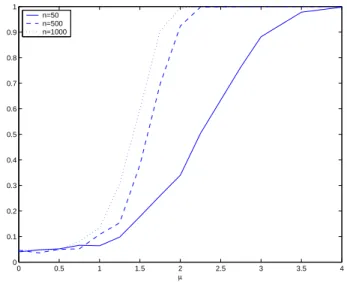
Using a level α = 5%, the test consist in rejecting the null hypothesis H0 if Dn > 0.65. We estimated
the power of this test, by simulating data under H1. Here, the (yi; 1 ≤ i ≤ n/5) are i.i.d. N (µ, 1) r.v.
Figure 5.1 displays the estimated probability to reject the null hypothesis H0for different values of µ and
n.
5.2
Estimating the number of significant coefficients
5.2.1 A Gaussian example
In the following experiment, we have simulated 500 Gaussian random variables, with µi= 4 for 1≤ i ≤
0 0.5 1 1.5 2 2.5 3 3.5 4 0 0.1 0.2 0.3 0.4 0.5 0.6 0.7 0.8 0.9 1 µ n=50 n=500 n=1000
Figure 1: The estimated power of the 5% level test, for different values of µ and n. Assuming that the variance of the εi’s is known, we set
Xi=− log(1 − F (yi2))
where F is the cumulative distribution function of a χ2 r.v.
Then, we used the procedure described in Section 2.1. Figure 5.2.1 displays the two sequences (Tk)
and (Qk). We find Dn= 14.95 and reject the null hypothesis.
0 50 100 150 200 250 300 350 400 450 500 0
500 1000 1500
Figure 2: Example 1. The two sequences (Tk) and (Qk)
After rejecting the null hypothesis, we will estimate the number of significant coefficients, following the procedure described in Section 2.2. We use here K = 200. Then, for k = 1, 2, . . . , 300, we computed the sequences (Tk,j, 1≤ j ≤ 200) and (Qk,j, 1≤ j ≤ 200). Figure 5.2.1 displays these two sequences for
k = 70, k = 100 and k = 130. We see that (Tk,j) concentrates around its conditional expected value
(EH1(k)(Tk,j|Tk,200)) only for k = 100. A bias is clearly present for k = 70 and k = 130. The sequence
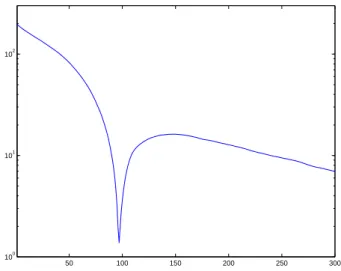
(ηk) defined by ηk = P200j=1(Tk,j− Qk,j)2/
√
n− k is displayed Figure 5.2.1. A minimum at ˆk = 97 is obvious. 80 100 120 140 160 180 200 220 240 260 0 200 400 600 (a) 100 120 140 160 180 200 220 240 260 280 300 0 100 200 300 400 (b) 140 160 180 200 220 240 260 280 300 320 0 100 200 300 (c)
Figure 3: Example 1. The two sequences (Tk,j, 1≤ j ≤ 200) and (Qk,j, 1≤ j ≤ 200)
with (a) k = 70, (b) k = 100, (c) k = 130.
50 100 150 200 250 300 100
101 102
Figure 4: Example 1. The sequence (ηk) (in a semilog scale)
Repeating the same procedure with 100 simulated sequences, we obtained 100 values of ˆk. The mean value of ˆk is 97.6 and the standard deviation is 4.8.
If we consider now that the variance is unknown, we use the procedure described Section 4.1, estimating the variance under H1(k) by
b θk = 1 n− k n X i=k+1 y2(i)
The results obtained when the variance is unknown are very similar than those obtained when the variance is known. The mean value of ˆk is 97.3 and the standard deviation is 5.1.
5.2.2 A Exponential example
In this second example, n = 500 again, but (εi) is a collection of Expo(1) i.i.d. r.v. Here, µiis uniformly
distributed in [3, 6] for 1≤ i ≤ 100, and µi= 0 for 101≤ i ≤ 500.
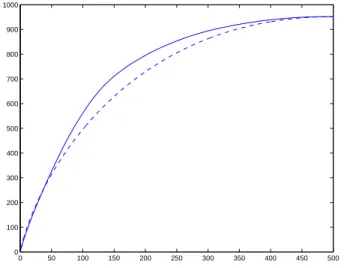
When the parameter of the exponential distribution is known, we use the procedure described Sec-tion 2.1, setting Xi= yi. Figure 5.2.2 displays the two sequences (Tk) and (Qk). We find Dn= 3.72 and
reject the null hypothesis.
0 50 100 150 200 250 300 350 400 450 500 0 100 200 300 400 500 600 700 800 900 1000
Figure 5: Example 2. The two sequences (Tk) and (Qk)
The number of significant coefficients is estimated as before. Figure 5.2.2 displays these two sequences (Tk,j, 1 ≤ j ≤ 200) and (Qk,j, 1 ≤ j ≤ 200) for k = 70, k = 100 and k = 130. In this example, the
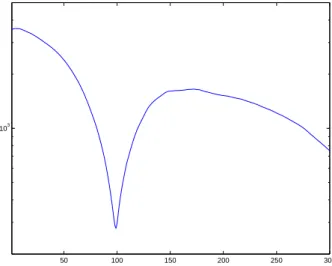
sequence (ηk) displayed Figure 5.2.2 is defined by ηk =P200j=1|Tk,j− Qk,j|/
p
(n− k)3. A minimum at
ˆ
k = 99 is obvious.
Repeating the same procedure with 100 simulated sequences, we obtained 100 values of ˆk. The mean value of ˆk is 103.8 and the standard deviation is 6.2.
The results obtained using the procedure described Section 4.1 when θ? is unknown are very similar:
the mean value of ˆk is 102.9 and the standard deviation is 5.6.
6
Appendix
80 100 120 140 160 180 200 220 240 260 0 200 400 600 (a) 100 120 140 160 180 200 220 240 260 280 300 0 100 200 300 400 (b) 140 160 180 200 220 240 260 280 300 320 0 100 200 300 (c)
Figure 6: Example 2. The two sequences (Tk,j, 1≤ j ≤ 200) and (Qk,j, 1≤ j ≤ 200)
with (a) k = 70, (b) k = 100, (c) k = 130.
50 100 150 200 250 300 103
Figure 7: Example 2. The sequence (ηk) (in a semilog scale)
For any 1≤ i ≤ n, let
Di= Xi− Xi+1
with Xn+1 = 0. Thus, Xi = Pnj=iDj. Next, let Zj = jDj. As is well known, (Zj; 1 ≤ j ≤ n) is a
sequence of i.i.d random variables (Exp(1)), so that, for any 1≤ k ≤ K ≤ n,
E (Tk|TK) = k X i=1 n X j=i E (Dj|TK) = k X i=1 n X j=i 1 j E (Z1|TK)
Since E (TK|TK) = K X i=1 n X j=i 1 j E (Z1|TK) = TK and k X i=1 n X j=i 1 j = k + k n X j=k+1 1 j we obtain E (Tk|TK) = k + kPnj=k+11/j K + KPnj=K+11/j TK = Bk,n BK,n TK. ¤ (18) Proof of Theorem 2.1
Let cnt,i = 1I[0,[nt]](i). By definition E
¡ T[nt]|Tn¢ = B[nt]Tn, so that E¡T[nt] ¢ = Pni cnt,iE¡X(i) ¢ = nB[nt]. Thus, dn(t) = n X i cnt,i[X(i)− E ¡ X(i) ¢ ]− Pn i cnt,iE ¡ X(i) ¢ n (Tn− n) = In(t)− IIn(t).
Let Gn =Pni=1ζn−i stand for the empirical sum of uniform r.v. ζi. Then, as in [9] it can be seen
that 1 √nIn(t) =− 1 √n Z 1 0 [Gn− I](s)1I[0,t](s)dF−1(s) + op(1) and 1 √nIIn(t) =−(t − t log(t)) 1 √n Z 1 0 [Gn− I](s)dF−1(s) + op(1),
where op(1) is uniform for all t∈ [0, 1). So that,
1
√ndn(t) =
Z 1 0
[Rt(u)− (t − t log(t))F−1(u)]d[G
n(s)− (1 − s)] + op(1),
with Rt(u) =Ru
0 dF−1(s)1I[0,t](s)ds. The result now follows because
G = {Rt
− (t − t log(t))F−1, t∈ [0, 1]}
is a Donsker class.
Acknowledgments: We thank very much José Rafael León, Jean-Michel Loubes and Pascal Massart for stimulating discussions.
References
[1] B. Arnold, N. Balakrishnan, and H. Nagaraja. A first course in order statistics. Wiley series in probability, 1993.
[2] A. Barron, L. Birgé, and P. Massart. Risk bounds for model selection via penalization. Probab. Theory Related Fields, 113(3):301–413, 1999.
[3] L. Birgé and P. Massart. Minimal penalties for gaussian model selection. Probab. Theory Related Fields (to appear), 2005.
[4] O. Bousquet. Concentration inequalities for sub-additive functions using the entropy method. In Stochastic inequalities and applications, volume 56 of Progr. Probab., pages 213–247. Birkhäuser, Basel, 2003.
[5] D. Donoho and I. Johnstone. Ideal spatial adaptation by wavelet shrinkage. Biometrika, 81:425–455, 1994.
[6] J. Fan and R. Li. Variable selection via nonconcave penalized likelihood and its oracle properties. J. Amer. Statist. Assoc., 96(456):1348–1360, 2001.
[7] T. Hastie, R. Tibshirani, and J. Friedman. The elements of statistical learning. Springer, series in statistics, 2001.
[8] M. S. Pinsker. Optimal filtration of square-integrable signals in Gaussian noise. Probl. Peredachi Inform., 2(16):52–68, 1980.
[9] G. Shorak and J. Wellner. Empirical processes with Applications to Statistics. Wiley, 1986.
[10] R. Tibshirani. Regression shrinkage and selection via the lasso. J. Royal Statist. Soc. B., 58:267–288, 1996.
Contents
1 Introduction 3
2 Describing the procedure 4
2.1 A first hypothesis testing procedure . . . 4
2.2 Choosing the right coefficients . . . 6
3 Proof of Theorem 2.2 7 4 Some extensions 11 4.1 Unknown distribution . . . 11
4.2 The unknown variance case . . . 13
4.3 Application to a regression problem . . . 14
4.4 Random thresholding . . . 15
5 Numerical experiments 16 5.1 Testing the null hypothesis H0 . . . 16
5.2 Estimating the number of significant coefficients . . . 16
5.2.1 A Gaussian example . . . 16
5.2.2 A Exponential example . . . 19
4, rue Jacques Monod - 91893 ORSAY Cedex (France)
Unité de recherche INRIA Lorraine : LORIA, Technopôle de Nancy-Brabois - Campus scientifique 615, rue du Jardin Botanique - BP 101 - 54602 Villers-lès-Nancy Cedex (France)
Unité de recherche INRIA Rennes : IRISA, Campus universitaire de Beaulieu - 35042 Rennes Cedex (France) Unité de recherche INRIA Rhône-Alpes : 655, avenue de l’Europe - 38334 Montbonnot Saint-Ismier (France) Unité de recherche INRIA Rocquencourt : Domaine de Voluceau - Rocquencourt - BP 105 - 78153 Le Chesnay Cedex (France)
Unité de recherche INRIA Sophia Antipolis : 2004, route des Lucioles - BP 93 - 06902 Sophia Antipolis Cedex (France)