HAL Id: hal-02897434
https://hal.archives-ouvertes.fr/hal-02897434
Submitted on 15 Jul 2020
HAL is a multi-disciplinary open access
archive for the deposit and dissemination of
sci-entific research documents, whether they are
pub-lished or not. The documents may come from
teaching and research institutions in France or
abroad, or from public or private research centers.
L’archive ouverte pluridisciplinaire HAL, est
destinée au dépôt et à la diffusion de documents
scientifiques de niveau recherche, publiés ou non,
émanant des établissements d’enseignement et de
recherche français ou étrangers, des laboratoires
publics ou privés.
for prognostic stratification in stable heart failure
Nils Kuster, Fabien Huet, Anne-marie Dupuy, Mariama Akodad, Pascal
Battistella, Audrey Agullo, Florence Leclercq, Eran Kalmanovich, Alexandra
Meilhac, Sylvain Aguilhon, et al.
To cite this version:
Nils Kuster, Fabien Huet, Anne-marie Dupuy, Mariama Akodad, Pascal Battistella, et al..
Mul-timarker approach including CRP, sST2 and GDF-15 for prognostic stratification in stable heart
failure. ESC Heart Failure, Wiley, In press, �10.1002/ehf2.12680�. �hal-02897434�
Multimarker approach including CRP, sST
2 and
GDF-
15 for prognostic stratification in stable
heart failure
Nils Kuster
1,3, Fabien Huet
2,3, Anne-Marie Dupuy
1, Mariama Akodad
2,3, Pascal Battistella
2, Audrey Agullo
2,
Florence Leclercq
2, Eran Kalmanovich
2, Alexandra Meilhac
2, Sylvain Aguilhon
2, Jean-Paul Cristol
1,3and
Francois Roubille
2,3*
1Department of Biochemistry, Centre Ressources Biologiques de Montpellier, University Hospital of Montpellier, Montpellier, France;2Cardiology Department, University
Hospital of Montpellier, Montpellier, France;3PhyMedExp, University of Montpellier, INSERM U1046, CNRS UMR 9214, Montpellier, France
Abstract
Aims Inflammation and cardiac remodelling are common and synergistic pathways in heart failure (HF). Emerging biomarkers such as soluble suppression of tumorigenicity2 (sST2) and growth differentiation factor-15 (GDF-15), which are linked to inflammation andfibrosis process, have been proposed as prognosis factors. However, their potential additive values remain poorly investigated. Methods and results Here, we aimed at evaluating inflammatory and remodelling biomarkers to predict both short-term and long-term mortality in a population with chronic HF in comparison with other classical clinical or biological markers (i.e. N terminal pro brain natriuretic peptide, hs-cTnT, C-reactive protein) alone or using meta-analysis global group in chronic HF risk score in a cohort of182 patients followed during 80 months (interquartile range: 12.3–90.0). Proportional hazard as-sumption does not hold for sST2 and C-reactive protein, and follow-up was split into short term (less than 1 year), midterm (between1 and 5 years), and long term (after 5 years). In univariate analysis, C-reactive protein and sST2 were predictive of short-term mortality but not of middle term and long term whereas GDF-15 was predictive of short and mid-term but not of long-term mortality. In a multivariate model after adjustment for meta-analysis global group in chronic HF score includ-ing the three markers, only sST2 was predictive of short-term mortality (P = 0.0225), and only GDF-15 was predictive of middle term mortality (P =0.0375). None of the markers was predictive of long-term mortality.
Conclusions Our results demonstrate that both sST2 and GDF-15 significantly improve the prognosis evaluation of HF patients and suggest that the value of GDF-15 is more sustained overtime and could predict middle term events.
Keywords Heart failure; Prognosis; Biomarkers; sST2; C-reactive protein; GDF-15; NT-proBNP; Hs-troponin
Received:19 October 2019; Revised: 11 February 2020; Accepted: 19 February 2020
*Correspondence to: Francois Roubille, Cardiology department, University Hospital of Montpellier, Montpellier, France. Email: [email protected]
Anne-Marie Dupuy and Fabien Huet gave equal contribution to this study.
Introduction
Heart failure (HF) results from multiple conditions leading to structural and functional changes. During the last decade, several biomarkers alone or in combination exploring the dif-ferent pathways involved in the development of HF have been studied to identify subgroups of patients at high risk of poor outcome. Nowadays, inflammation plays a central role and conspire with remodelling pathways in the develop-ment and progression of chronic HF. The interrelationships
between inflammation and remodelling agents are complex, bidirectional, and not yet completely elucidated.1
C-reactive protein has been established a classical marker for systemic inflammation. C-reactive protein is produced mainly by hepatocytes but also by cardiovascular tissues upon infection, cell aggression, or tissue injury.2,3Numerous studies confirmed that patients with HF has local and sys-temic inflammation and reported that elevated serum levels of C-reactive protein is clearly related to cardiovascular events and to mortality independently of natriuretic
O R I G I N A L R E S E A R C H A R T I C L E
©2020 The Authors. ESC Heart Failure published by John Wiley & Sons Ltd on behalf of the European Society of Cardiology
ESC HEART FAILURE
ESC Heart Failure (2020)
Published online in Wiley Online Library (wileyonlinelibrary.com) DOI:10.1002/ehf2.12680
This is an open access article under the terms of the Creative Commons Attribution-NonCommercial License, which permits use, distribution and reproduction in any me-dium, provided the original work is properly cited and is not used for commercial purposes.
peptides.4–6Upon local inflammation and/or mechanical or biochemical stress, cardiac tissues produce protective cyto-kines such as interleukin33 (IL-33) and growth differentiation factor-15 (GDF-15). After binding to the suppression of tumorigenicity–2 (ST2), a transmembrane receptor, IL-33 ex-erts anti-inflammatory, antioxidative, antiapoptotic, and antifibrotic effects on the cardiomyocytes. However, a solu-ble isoform of ST2 (sST2) could be secreted by injured cardiac tissue, act as a decoy receptor for IL-33, and could totally blunt the protective effects of IL-33. As a result, sST2 has emerged as a potential prognostic marker, independent of age, renal function, or body mass index.7,8GDF-15, a member of the transforming growth factor-beta cytokine superfamily, is a stress-responsive cytokine and regulates signalling pathways essential for cardioprotection. GDF-15 exerts cytoprotective, antiapoptotic, and antihypertrophic effects through activation of ALK Type 1 receptors and Smad phos-phorylation.9 During HF GDF-15 seems to be overproduced mainly in peripheral tissues.10 Based on its biology as a stress-regulated gene, the circulating levels of GDF-15 reflect the acute or chronic cell injury and stress.11 As a result, GDF-15 has been identified as a prognostic factor for HF.11
Therefore, to determine the relationship and specific inter-ests of these distinct biomarkers, witnesses of inflammation and remodelling could help clinicians to tailor-specific approaches.
In this context, the aim of our study focused on the evalu-ation of these emerging biomarkers to predict both short-term and long-term mortality in a population with chronic HF in comparison with other classical biological markers [i.e. C-reactive protein, N terminal pro brain natri-uretic peptide (NT-proBNP), hs-cTnT] alone or using the established bioclinical meta-analysis global group in chronic HF (MAGGIC) risk score.12
Material and methods
Study design
Patients with an established final diagnosis of stable HF based on criteria of the European Society of Cardiology were enrolled during their routine follow-up. We collected the blood samples of each patient. The current work was a retrospective study, which was based in a previous bio-logic bank build in 2011 for which we supplemented with specific biomarkers including sST2,13 collagen metabolism biomarkers,14and GDF-15 (this study). A flow chart of stud-ies derived from the collection of samples on the popula-tion with chronic HF was reported in (see Supporting Information, Figure S1). At inclusion of patients, routine pa-rameters such as urea, electrolytes, creatinine, NT-proBNP, hs-cTnT, and C-reactive protein were performed. In
addition, venous blood was collected in dry and EDTA tubes, immediately centrifuged, and frozen ( 80°C) on sev-eral aliquots until tested 4 or 6 years later before analysis of sST2 and GDF-15, respectively.
Population
Between May2010 and February 2011, 182 patients with sta-ble HF were prospectively included in a single university hos-pital (CHRU Montpellier, France). All participants provided written informed consent. The protocol was performed according to the principles of the Declaration of Helsinki, ap-proved by the Ethic Committee of Montpellier and the biolog-ical collection registered by the French government (research Ministery, # DC-2009-1052).
To be eligible to the study, the patients were previously (at least6 months before the inclusion) diagnosed with acute or chronic HF, as recommended by the European Society of Cardiology (13). They should present a stable condition as de-fined by the European Society of Cardiology in 2012. Main in-clusion criteria were the ability to give informed consent, age
>18 years, and confirmed diagnosis of HF, irrespectively of
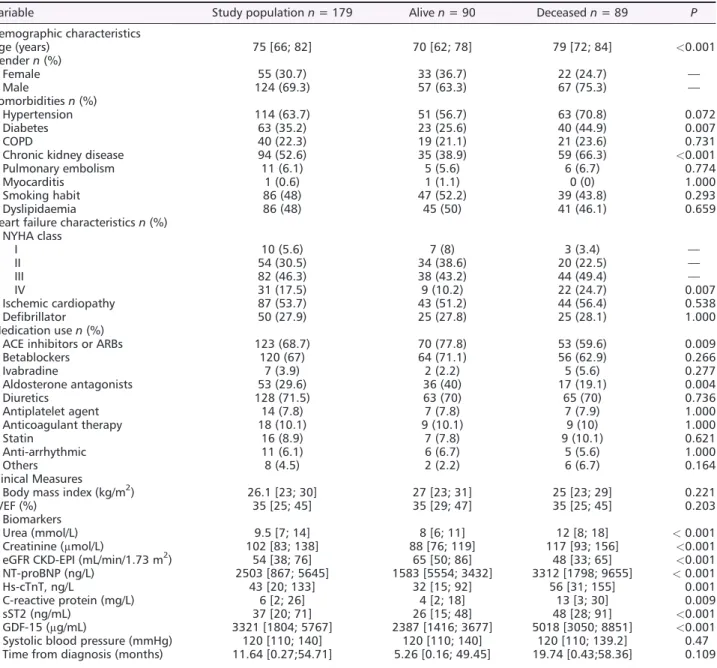
the cause or treatments. All clinical available data at the time of initial visit were collected by two cardiologists from the medical records of each patient. Comorbidities such as hyper-tension, diabetes, chronic obstructive pulmonary disease, chronic kidney disease, pulmonary embolism, myocarditis, smoking habit, and dyslipidaemia were recorded. Other clini-cal variables as age, gender, New York Heart Association (NYHA) class, ischemic aetiology, left ventricular ejection frac-tion (LVEF), medicafrac-tions [angiotensconverting enzyme in-hibitor (ACE) or angiotensin receptor blockers (ARBs), betablockers, Ivabradine, aldosterone antagonists use, uretics use, anti-platelet agents and anticoagulants use, di-goxin, statin, antiarrhythmic, and others medications use] and laboratory values were also reported (Table1). Main ex-clusion criteria were unstable angina or acute coronary syn-drome in the past month, cardiac surgery, and chemotherapy.
Follow-up and outcomes
After inclusion, patients were followed by their cardiologist who decided the monitoring frequency according to guide-lines. In December 2014 then in January 2019, a dedicated physician was in charge of collecting the clinical data: primary endpoint (deaths of all causes) and prescription of drugs in-cluding beta-blockers, ACE inhibitors or ARB, statins, and the dosage of loop diuretics (milligram per day). Data collec-tion was performed by analysing the medical files and by phone with the general practitioner, the patient, or the family.
Biochemical analysis
Determination of C-reactive protein was run on the Cobas8000/e502© analyzer (Roche Diagnostic, Meylan, France) using immunoturbidimetric method. From dry tube, the NT-proBNP and hs-cTnT levels were determined using an immuno-electrochemiluminescence assay on the Cobas8000/e602© immunochemistry system (Roche Diagnostics, Meylan, France). In February 2019, GDF-15 was determined on the same module by
immuno-electrochemiluminescence method with a commer-cial kit from Roche according to the instructions of manufac-turer, from serum aliquot never thawed. sST2 plasma concentrations were measured with a high-sensitivity sand-wich monoclonal immunoassay (Presage© ST2 assay, Critical Diagnostics, San Diego, California, distributed in France by Eurobio society) using an EDTA plasma aliquot never thawed. All other biochemistry parameters as urea and creatinine were performed on Cobas 8000/c7011 (Roche, Meylan, France).
Table 1 Baseline characteristics of all patients with chronic heart failure according to all-cause mortality. Data presented as median (1st
quartile; 3rd quartile) and number of patients with percentage of total
Variable Study population n = 179 Alive n = 90 Deceased n = 89 P
Demographic characteristics Age (years) 75 [66; 82] 70 [62; 78] 79 [72; 84] <0.001 Gender n (%) Female 55 (30.7) 33 (36.7) 22 (24.7) — Male 124 (69.3) 57 (63.3) 67 (75.3) — Comorbidities n (%) Hypertension 114 (63.7) 51 (56.7) 63 (70.8) 0.072 Diabetes 63 (35.2) 23 (25.6) 40 (44.9) 0.007 COPD 40 (22.3) 19 (21.1) 21 (23.6) 0.731
Chronic kidney disease 94 (52.6) 35 (38.9) 59 (66.3) <0.001
Pulmonary embolism 11 (6.1) 5 (5.6) 6 (6.7) 0.774
Myocarditis 1 (0.6) 1 (1.1) 0 (0) 1.000
Smoking habit 86 (48) 47 (52.2) 39 (43.8) 0.293
Dyslipidaemia 86 (48) 45 (50) 41 (46.1) 0.659
Heart failure characteristics n (%) NYHA class I 10 (5.6) 7 (8) 3 (3.4) — II 54 (30.5) 34 (38.6) 20 (22.5) — III 82 (46.3) 38 (43.2) 44 (49.4) — IV 31 (17.5) 9 (10.2) 22 (24.7) 0.007 Ischemic cardiopathy 87 (53.7) 43 (51.2) 44 (56.4) 0.538 Defibrillator 50 (27.9) 25 (27.8) 25 (28.1) 1.000 Medication use n (%)
ACE inhibitors or ARBs 123 (68.7) 70 (77.8) 53 (59.6) 0.009
Betablockers 120 (67) 64 (71.1) 56 (62.9) 0.266 Ivabradine 7 (3.9) 2 (2.2) 5 (5.6) 0.277 Aldosterone antagonists 53 (29.6) 36 (40) 17 (19.1) 0.004 Diuretics 128 (71.5) 63 (70) 65 (70) 0.736 Antiplatelet agent 14 (7.8) 7 (7.8) 7 (7.9) 1.000 Anticoagulant therapy 18 (10.1) 9 (10.1) 9 (10) 1.000 Statin 16 (8.9) 7 (7.8) 9 (10.1) 0.621 Anti-arrhythmic 11 (6.1) 6 (6.7) 5 (5.6) 1.000 Others 8 (4.5) 2 (2.2) 6 (6.7) 0.164 Clinical Measures
Body mass index (kg/m2) 26.1 [23; 30] 27 [23; 31] 25 [23; 29] 0.221
LVEF (%) 35 [25; 45] 35 [29; 47] 35 [25; 45] 0.203
Biomarkers
Urea (mmol/L) 9.5 [7; 14] 8 [6; 11] 12 [8; 18] < 0.001
Creatinine (μmol/L) 102 [83; 138] 88 [76; 119] 117 [93; 156] <0.001 eGFR CKD-EPI (mL/min/1.73 m2) 54 [38; 76] 65 [50; 86] 48 [33; 65] <0.001
NT-proBNP (ng/L) 2503 [867; 5645] 1583 [5554; 3432] 3312 [1798; 9655] < 0.001
Hs-cTnT, ng/L 43 [20; 133] 32 [15; 92] 56 [31; 155] 0.001
C-reactive protein (mg/L) 6 [2; 26] 4 [2; 18] 13 [3; 30] 0.009
sST2 (ng/mL) 37 [20; 71] 26 [15; 48] 48 [28; 91] <0.001
GDF-15 (μg/mL) 3321 [1804; 5767] 2387 [1416; 3677] 5018 [3050; 8851] <0.001
Systolic blood pressure (mmHg) 120 [110; 140] 120 [110; 140] 120 [110; 139.2] 0.47 Time from diagnosis (months) 11.64 [0.27;54.71] 5.26 [0.16; 49.45] 19.74 [0.43;58.36] 0.109 ACE, angiotensin-converting enzyme; ARB, angiotensin receptor blocker; COPD, chronic obstructive pulmonary disease; eGFR CKD–EPI, estimated glomerularfiltration rate chronic kidney disease–epidemiology collaboration; hs-cTnT, high-sensitivity cardiac troponin T; LVEF,
left ventricular ejection fraction; NT-proBNP, N terminal pro brain natriuretic peptide; NYHA, New York Heart Association; sST2, soluble
suppression of tumorigenicity 2; GDF-15, growth differentiation factor-15
ESC Heart Failure (2020)
Statistical analysis
Categorical data are expressed as count (percentage). Contin-uous data are expressed as median (1st quartile; 3rd quar-tile). In descriptive statistics, comparisons between two groups were performed using the Mann–Whitney U test for continuous variables and theχ2test for categorical variables. Kruskal–Wallis test was used to compare continuous variables across more than two groups. Survival curves were generated using a Kaplan–Meier nonparametric estimator, and a log-rank test was used to compare multiple survival distribu-tions. Survival analysis was performed using the Cox propor-tional hazard model to evaluate associations between clinical and biological parameters and all-cause mortality. For each patient, we calculated the MAGGIC project HF risk score, which included 13 routinely available variables.15 Partial correlation analysis was used to evaluate correlations between biomarkers
Cox proportional hazard depends on the assumption that the coefficient of the model, and thus, the hazard ratio (HR) is constant over time. A plot of the Schoenfeld resid-uals according to time of follow-up was used to test whether coefficients of the Cox model could be considered as constant over time. To further explore change of HR over time, follow-up period was split in short term (less than 1 year), middle term (between 1 and 5 years), and long term (after 5 years), and interactions between the time period and the baseline value of the predictors were computed. These periods of time have been chosen be-cause in the overall patient cohort, the 12 and 60-month mortality rates were20% and 47%, respectively. Feature se-lection was performed using stepwise procedure based on the Akaike’s information criterion (AIC). Additional value of biomarkers was assessed by comparing C-index of Cox models including MAGGIC score alone and final model in-cluding biomarkers. Bootstrapping was used to estimate the difference of C-index. Analysis was performed using R 3.5.3 (R Core team, Vienna, Austria) and the survival pack-age. P < 0.05 was considered as significant.
Results
Out of182 consecutive patients included from May 2010 to February 2011, biochemical measurements and vital status were available for 179 patients, which were included in our analysis. Median follow-up period was 80 months (in-terquartile range 12.3 to 90 months), and total follow-up was 834.9 person year. In the overall patient cohort, there were 89 deaths, the 12, 60, and 96 months mortality rates were 20%, 47%, and 51%, respectively. Clinical and bio-chemical variables in survivors vs. deceased are reported in Table 1. Among all comorbidities, only diabetes and
chronic kidney disease were associated with excess mortal-ity. The NYHA class at baseline tended to be higher among decedents than survivors. Median LVEF was not significantly different between the two groups of patients. All median biochemical parameters values including sST2 and GDF-15 biomarkers were statistically significantly higher in deceased patients vs. alive. Mortality, assessed by Kaplan–Meier curves, clearly increased across quartiles of C-reactive pro-tein, sST2, and GDF-15 (Figure1, P < 0.001 for all). In ad-dition, preliminary results show that C-reactive protein, GDF-15, and sST2 predicted mortality in patients with pre-served ejection fraction (see Supporting Information, Table
S1).
Cox analysis after splitting the follow-up in short
term (less than
1 year), middle term (between 1
and
5 years) and long term (after 5 years)
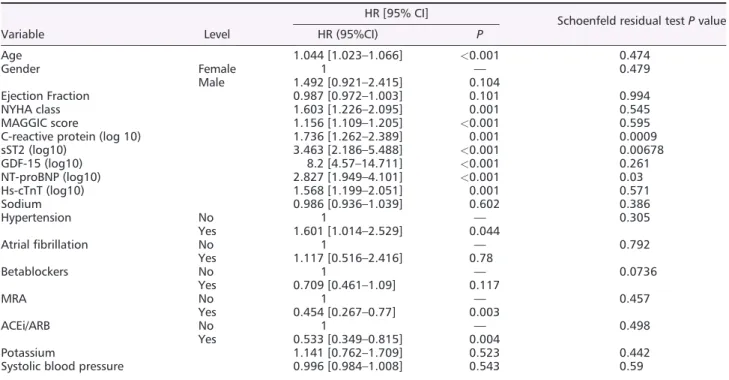
Schoenfeld residuals were used to explore correlation be-tween HRs and time. There was reasonable evidence that proportional hazard assumption does not hold for C-reactive protein (P < 0.001) and sST2 (P = 0.007) (Figure2A and B). As demonstrated by the Schoenfeld plot,
coeffi-cients of the Cox model seem to decrease over time, meaning that C-reactive protein and sST2 could be strong predictors in thefirst years of follow-up. On the other hand, coefficient for GDF-15 seems quite constant over time (Figure 2C). A time-split Cox model was built to investigate HR at different follow-up periods.
In univariate analysis, the three markers were significant predictors of mortality during the whole follow-up (C-reactive protein, P =0.001; sST2, P < 0.001; GDF-15, P < 0.001). Age, NYHA stage and MAGGIC score, hypertension, ACE inhibitor/ARB, and mineralocorticoid receptor antagonist treatments were also significant predictor of mortality (Table2).
In multivariate analysis, after adjustment for the MAGGIC score at enrolment and mineralocorticoid antagonists use, ability of C-reactive protein to predict mortality did not reach significance at short term (HR = 1.48, P = 0.19), middle term (HR =0.87, P = 0.55), or long term (HR = 1.46, P = 0.52). Only sST2 predicted short-term mortality (HR = 2.74, P = 0.046), only GDF-15 predicted middle-term mortality (HR = 2.9, P = 0.046), and none predicted long-term mortality (Figure 3).
MAGGIC score and mineralocorticoid receptor antagonists treatments significantly predicted mortality during the whole follow-up (HR = 1.09, P = 0.001 and HR = 0.46, P = 0.009, respectively).
In order to evaluate the interest of considering biomarkers to predict mortality, we assessed C-index of Cox models based on MAGGIC score only or full multivariate model as se-lected previously. In the study population, C-index of the mul-tivariate model was 0.77 and 0.72 for the MAGGIC model.
Bootstrapping the difference in C-statistic (500 bootstraps) indicated that including biomarkers in the model increased C-statistic by 0.065 (0.04–0.099). Moreover, AIC of the bio-marker model was lower than that of MAGGIC-only model (762 vs. 779).
Discussion
To our knowledge, this study is the first to evaluate utility of inflammation and remodelling biomarkers in mortality
risk in patients with chronic HF in short, middle, and long term.
Here, we showed that these biomarkers are able to pro-vide additional information in multivariate cox analysis:
(1) C-reactive protein and sST2 are independent predictor for short term
(2) GDF-15 significantly predicts mid–term mortality (3) and none of them could significantly predict outcome at
long term. Clearly, these biomarkers could provide com-plementary information to the gold-standard natriuretic peptides.
Figure1 Kaplan–Meier curves for all-cause mortality based on quartiles of C-reactive protein, soluble suppression of tumorigenicity 2, and growth
differentiation factor-15.
Figure2 Test of the proportional hazard assumption of Cox regression for C-reactive protein, soluble suppression of tumorigenicity 2, and growth
dif-ferentiation factor-15. Schoenfeld residuals were computed to test proportional hazard assumption. P values indicate significant correlations between Schoenfeld residuals and time for C-reactive protein and soluble suppression of tumorigenicity2 (A–B). This correlation is not significant for growth differentiation factor-15 (C).
ESC Heart Failure (2020)
Table 2 Univariate Cox model at total follow-up and test of proportional hazard assumption. Schoenfeld residual test represents test of
correlation between Schoenfeld residuals and time in the Cox regression. P values<0.05 indicate that proportional hazard assumption is
not met
Variable Level
HR [95% CI]
Schoenfeld residual test P value
HR (95%CI) P Age 1.044 [1.023–1.066] <0.001 0.474 Gender Female 1 — 0.479 Male 1.492 [0.921–2.415] 0.104 Ejection Fraction 0.987 [0.972–1.003] 0.101 0.994 NYHA class 1.603 [1.226–2.095] 0.001 0.545 MAGGIC score 1.156 [1.109–1.205] <0.001 0.595
C-reactive protein (log 10) 1.736 [1.262–2.389] 0.001 0.0009
sST2 (log10) 3.463 [2.186–5.488] <0.001 0.00678 GDF-15 (log10) 8.2 [4.57–14.711] <0.001 0.261 NT-proBNP (log10) 2.827 [1.949–4.101] <0.001 0.03 Hs-cTnT (log10) 1.568 [1.199–2.051] 0.001 0.571 Sodium 0.986 [0.936–1.039] 0.602 0.386 Hypertension No 1 — 0.305 Yes 1.601 [1.014–2.529] 0.044 Atrialfibrillation No 1 — 0.792 Yes 1.117 [0.516–2.416] 0.78 Betablockers No 1 — 0.0736 Yes 0.709 [0.461–1.09] 0.117 MRA No 1 — 0.457 Yes 0.454 [0.267–0.77] 0.003 ACEi/ARB No 1 — 0.498 Yes 0.533 [0.349–0.815] 0.004 Potassium 1.141 [0.762–1.709] 0.523 0.442
Systolic blood pressure 0.996 [0.984–1.008] 0.543 0.59
ACEi, angiotensin-converting enzyme inhibitor; ARB, angiotensin receptor blocker; CI, confidence interval; GDF-15, growth differentiation factor-15; HR, hazard ratio; Hs-cTnT, high-sensitivity cardiac troponin T; LVEF, left ventricular ejection fraction; NT-proBNP, N terminal pro brain natriuretic peptide; NYHA, New York Heart Association; sST2, soluble suppression of tumorigenicity 2
Figure3 Multivariate Cox model after Akaike’s information criterion-based feature selection. Coloured rectangles indicate biomarker-associated
haz-ard ratios; each biomarker has been assessed for short-term, middle-term, and long-term prediction of mortality. CRP, C-reactive protein; GDF-15, growth differentiation factor-15; LVEF, left ventricular ejection fraction; MAGGIC, meta-analysis global group in chronic heart failure; MRA, mineralo-corticoid receptor antagonist; sST2, soluble suppression of tumorigenicity 2
Interrelated pathophysiological pathways and
additional values of natriuretic peptides, sST
2,
and GDF-
15
First of all, our results confirmed that GDF-15 levels are dra-matically increased in chronic HF because the values ob-served are in agreement with previous data.16–19 In addition, a clear relationship was observed between the GDF-15 level and the NYHA stage (Figure S2). It should be noted that in our clinical centre, we are often dealing with ad-vanced HF, including evaluation for possibilities of chronic mechanical assistance or heart transplantation. Similarly, sST-2 levels were in agreement with the levels published in chronic HF.13,20
Univariate analysis confirmed that both NT-proBNP, hs-TnT, C-reactive protein, sST2, and GDF-15 predict mortality in stable chronic HF (Table2).8,11Although the study popula-tion had mainly reduced ejecpopula-tion fracpopula-tion, complementary analysis in patients showed that C-reactive protein, GDF-15, and sST2 predicted mortality in patients with preserved ejec-tion fracejec-tion (Table S1). This point was previously reported with sST-2,21but our study extended thisfinding to GDF-15. Further studies regarding biomarkers in HF with preserved ejection fraction are thus needed.
Interestingly, multivariate analysis including clinical and bi-ological parameters (Figure 3) or bioclinical score demon-strates that sST2 and GDF-15 are the strongest predictive biomarkers. sST2 and GDF-15 have not proved to be efficient as diagnostic markers22,23but are clearly recognized as prog-nostic biomarkers.8,24,25 sST2 was identified as a valuable prognostic biomarker in HF, independent from age, kidney function, anaemia, or body mass index.26,27 The prognostic value of GDF-15 has first been observed in HF patients followed only2 years,16but has been also suggested to pre-dict development of HF in middle-aged non-HF patients. Im-portantly, GDF-15 had the best level of prediction to predict all-cause mortality and incident HF in comparison with sST2 and BNP.28 In addition, partial correlation analysis only showed a weak relationship was observed between C-reactive protein and GDF-15 suggesting that GDF-15 path-way did not overlap with inflammatory process.29 By con-trast, sST2 is clearly linked to C-reactive protein in Chronic Heart Failure (CHF) suggesting interrelated pathways13 (Figure S3).
Additional values of biomarkers over time
The main finding of our study is the differential information over time of these biomarkers. The multivariate analysis (Table 2), considering time as a continuous variable, sug-gests that C-reactive protein only predicts mortality in the early stage of follow-up, while sST2 seems to be associated at any time to mortality. GDF-15 was strongly associated tothe long-term prognosis. The long-term prognostic value of GDF-15 has been already suggested in large cohort of gen-eral population,17,30,31 coronary heart disease,18 and HF.32 However, taking into account time as a continuous variable is highly dependent of the cumulative mortality and could underestimate the late divergence of survival curves. The difference overtime is further demonstrated by the Schoenfeld plot coefficients showing that the prediction of mortality decreases rapidly for C-reactive protein and sST2 while it remains constant for GDF-15. Thus, we decided to slice the follow-up time in short-term, middle-term, and long-term periods (i.e. <1 year, between 1 and 5 years, and over 5 years). These periods of time have been chosen because in the overall patient cohort, the12 and 60 months mortality rates were 20% and 47%, respectively. Clearly, C-reactive protein and sST2 prediction has the same kinetics, with a significant prognosis value restricted at 1 year, while GDF-15 prediction is sustained over 5 years. Here again, this finding sustains the close relation-ship between inflammation and sST2. In correlation analysis (Figure S3), only a weak relationship was observed between C-reactive protein and GDF-15 suggesting that GDF-15 path-way did not overlap with inflammatory process.29 By con-trast, sST2 is clearly linked to C-reactive protein in CHF suggesting interrelated pathways. Local inflammation has been identified as a main enhancing factor for sST2 secre-tion,33–35which could in turn be a bridge between in flam-mation and fibrosis.13,36–38 By contrast, GDF-15 appears as a more integrative biomarker of global prognosis, thus explaining such a prolonged forecasting effect. Elevated levels of GDF-15 have been found in chronic HF and in acute coronary syndromes,11but also in several conditions likewise diabetes mellitus, renal dysfunction, higher ages, physical inactivity, current smoking, atrial fibrillation, and cancer.11It might precisely be the lack of cardiac specificity, which may explain such a major prediction strength of Car-diovascular (CV) risk and all-cause mortality. Indeed, in HF patients volume overload is frequently associated to other comorbidities, including bad lifestyle, aging, systemic abnor-malities (renal impairment for example), but also bad life-style, aging.31 Interestingly, it has been reported in general population that poor health behaviours (smoking habits, inactivity, nutritional disorders …) and presence of modifiable cardiovascular risk factors (high blood pressure, cholesterol, glucose intolerance, and obesity) are associated with high levels of GDF-15.39In addition, in a cohort of324 same-sex twins, it has been shown that half of the varia-tion in GDF-15 could be attributed to individual-specific en-vironmental influences.40In our study, we have observed a significant relationship between GDF-15 and age [linear re-gression coefficient: β = 0.270.01 (0.005–0.014), P < 0.01], LDL [ 0.106 (-0.176--0.035), P = 0.004] (Table S2), diabetes (median GDF level in diabetic group: 4506 ng/L vs. 2922 in nondiabetic group, P < 0.001). However, no relationship
ESC Heart Failure (2020)
was found between GDF-15, hypertension, body mass in-dex, and active smoking. Taken together, these data sug-gest that in our population of CHF, the relationship between hypertension and lipids could be altered by treat-ments (mainly statins or antihypertensive drugs). GDF-15 could be an indicator of environmental health disorder, which could lead to poor long-term outcome. Indeed, GDF-15 predicted accurately the renal function decline (in-dependent of potential confusing factors),41 noncardiac death from malignant causes and non CV death.42
Multimarker approach
Finally, it has been shown that GDF-15 levels did not decrease despite the therapies prescribed in clinical trials suggesting that GDF-15 could reflect a non-completely understood path-ophysiological axis,19,43the so-called residual risk.
For all these reasons, using a multi-biomarker approach is appealing. In this strategy, each marker reflects distinct path-ophysiological processes,19helping to tailor more accurately a patient-centred approach.
Our study suffered from several limitations
First, this is a single centre study. Patients are then treated according to a single centre experience. Our population of pa-tients has been included between2010 and 2011, then, none of the patients might have been treated by the Sacubitril– Valsartan association. However, every patient was treated according to the previous HF guidelines, using maximal toler-ated dose medications.Second, primary outcome was all-cause mortality, and the proportion of major adverse cardiovascular events or rehos-pitalization for HF hosrehos-pitalization from HF could not be analysed because these data are not available on the whole follow-up period.
Then, our study included only 182 patients. However, those patients were included in the relatively short period of time, representing a real-world chronic HF population. Moreover, all patients were treated according to the European Society of Cardiology guidelines. Importantly, we obtained vital status of179 over the 182 patients (only few loss of follow-up).
Our study is only observational and not powered to inves-tigate the impact of interventions on these biomarkers.
Conclusions
To our knowledge, our study is thefirst to evaluate the infor-mation of different biomarkers representing various patho-physiological pathways involved in inflammation and cardiac
remodelling on both short-term and long-term follow-up. It demonstrated that sST2 and GDF-15 are individually signifi-cantly improving the prognosis evaluation of HF patients. GDF-15 seems to be more representative of the middle-term prognosis, while sST2 is more linked to a short-term prognosis evaluation. Because GDF-15 is less mod-ified by HF treatments, we could propose different uses for these biomarkers. For instance, sST2 could be promising to guide therapy whereas GDF-15 could reflect more long-term outcomes requiring specific long-term adaptations (such as adapted rehabilitation programmes repeated at various frequencies). Prospective trials based on these appealing approaches are lacking until now.
Author Contribution
J.P. Cristol and F. Roubille were responsible for the concep-tualization of the study. N. Kuster formed the methodology and provided the software. Validation was carried out by J. P. Cristol and F. Roubille. Formal analysis was performed by N. Kuster. A.M. Dupuy and F. Huet conducted the investiga-tion; and data curation was carried out by F Huet, A.M. Dupuy, and N. Kuster. The original draft preparation was written by A.M. Dupuy and F. Huet. Review and editing of the written manuscript were also performed by J.P. Cristol, F. Roubille, and F. Huet. J.P. Cristol and F. Roubille were responsible for the visualization, supervision, and pro-ject administration.
Con
flict of interest
None declared.
Funding
This study was not supported by any source of funding.
Ethics
The authors of this manuscript comply with the ethics policies of ESC Heart Failure as stated in the ESC Heart Failure Author Guidelines on its website.
Supporting information
Additional supporting information may be found online in the Supporting Information section at the end of the article.
Figure S1. Flow chart of studies derived from the collection of samples on a population with chronic HF (DC-2009-1052). Figure S2. GDF-15 level according to NYHA stage in the study population P-value indicates kruskal-wallis test of difference between the four groups.
Figure S3. partial correlation network of GDF-15, sST2 and CRP in the study population.
Table S1. Univariate Cox model for prediction of mortality in the study population according to LVEF<40% or LVEF>40%. Table S2. Univariate linear regression of GDF-15 (log10) in the study population.
References
1. Van Linthout S, Tschöpe C. In flamma-tion - cause or consequence of heart fail-ure or both? Curr Heart Fail Rep 2017; 14: 251–265.
2. Libby P. Inflammation in atherosclerosis.
Nature 2002;420: 868–874.
3. Libby P, Ridker PM, Maseri A. In flamma-tion and atherosclerosis. Circulaflamma-tion 2002;105: 1135–1143.
4. Heart Protection Study Collaborative Group, Jonathan Emberson null, Derrick Bennett null, Emma Link null, Sarah Parish null, John Danesh null, Jane Armitage null, Rory Collins null. C-reactive protein concentration and the vascular benefits of statin therapy: an analysis of 20,536 patients in the Heart Protection Study. Lancet Lond Engl 2011; 377: 469–476.
5. Van Tassell BW, Abouzaki NA, Oddi Erdle C, Carbone S, Trankle CR, Mel-chior RD, Turlington JS, Thurber CJ, Christopher S, Dixon DL, Fronk DT, Thomas CS, Rose SW, Buckley LF, Dinarello CA, Biondi-Zoccai G, Abbate A. Interleukin-1 blockade in acute de-compensated heart failure: a randomized, double-blinded, placebo-controlled pilot study. J Cardiovasc Pharmacol 2016; 67: 544–551.
6. Ridker PM, Everett BM, Thuren T, MacFadyen JG, Chang WH, Ballantyne C, Fonseca F, Nicolau J, Koenig W, Anker SD, Kastelein JJP, Cornel JH, Pais P, Pella D, Genest J, Cifkova R, Lorenzatti A, Forster T, Kobalava Z, Vida-Simiti L, Flather M, Shimokawa H, Ogawa H, Dellborg M, Rossi PRF, Troquay RPT, Libby P, Glynn RJ, CANTOS Trial Group. Antiinflammatory therapy with canakinumab for atherosclerotic dis-ease. N Engl J Med 2017; 377: 1119–1131.
7. Dieplinger B, Egger M, Gegenhuber A, Haltmayer M, Mueller T. Analytical and clinical evaluation of a rapid quantitative lateralflow immunoassay for measure-ment of soluble ST2 in human plasma.
Clin Chim Acta Int J Clin Chem 2015;
451: 310–315.
8. Aimo A, Vergaro G, Passino C, Ripoli A, Ky B, Miller WL, Bayes-Genis A, Anand I, Januzzi JL, Emdin M. Prognostic value
of soluble suppression of tumorigenicity-2 in chronic heart fail-ure: a meta-analysis. JACC Heart Fail 2017;5: 280–286.
9. Adela R, Banerjee SK. GDF-15 as a target and biomarker for diabetes and cardio-vascular diseases: a translational pro-spective. J Diabetes Res 2015; 2015: 490842.
10. Lok SI, Winkens B, Goldschmeding R, van Geffen AJP, Nous FMA, van Kuik J, van der Weide P, Klöpping C, Kirkels JH, Lahpor JR, Doevendans PA, de Jonge N, de Weger RA. Circulating growth differentiation factor-15 corre-lates with myocardialfibrosis in patients with non-ischaemic dilated cardiomyop-athy and decreases rapidly after left ven-tricular assist device support. Eur J
Heart Fail 2012;14: 1249–1256.
11. Wollert KC, Kempf T, Wallentin L. Growth differentiation factor 15 as a bio-marker in cardiovascular disease. Clin
Chem 2017;63: 140–151.
12. Pocock SJ, Ariti CA, McMurray JJV, Maggioni A, Køber L, Squire IB, Swedberg K, Dobson J, Poppe KK, Whalley GA, Doughty RN. Meta-analysis global group in chronic heart failure. Predicting survival in heart failure: a risk score based on 39 372 patients from 30 studies. Eur Heart J 2013; 34: 1404–1413.
13. Dupuy AM, Curinier C, Kuster N, Huet F, Leclercq F, Davy JM, Cristol JP, Roubille F. Multi-marker strategy in heart failure: combination of ST2 and CRP predicts poor outcome. PLoS ONE 2016; 11: e0157159.
14. Dupuy AM, Kuster N, Curinier C, Huet F, Plawecki M, Solecki K, Roubille F, Cristol JP. Exploring collagen remodeling and regulation as prognosis biomarkers in stable heart failure. Clin Chim Acta Int J
Clin Chem 2019;490: 167–171.
15. Sartipy U, Dahlström U, Edner M, Lund LH. Predicting survival in heart failure: validation of the MAGGIC heart failure risk score in 51,043 patients from the Swedish heart failure registry. Eur J
Heart Fail 2014;16: 173–179.
16. Kempf T, von Haehling S, Peter T, Allhoff T, Cicoira M, Doehner W, Ponikowski P, Filippatos GS, Rozentryt P, Drexler H, Anker SD, Wollert KC. Prognostic utility
of growth differentiation factor-15 in pa-tients with chronic heart failure. J Am
Coll Cardiol 2007;50: 1054–1060.
17. Eggers KM, Kempf T, Wallentin L, Wollert KC, Lind L. Change in growth differentiation factor 15 concentrations over time independently predicts mor-tality in community-dwelling elderly in-dividuals. Clin Chem 2013; 59: 1091–1098.
18. Hagström E, Held C, Stewart RAH, Aylward PE, Budaj A, Cannon CP, Koenig W, Krug-Gourley S, Mohler ER, Steg PG, Tarka E, Östlund O, White HD, Siegbahn A, Wallentin L, STABIL-ITY Investigators. Growth differentia-tion factor 15 predicts all-cause morbidity and mortality in stable coro-nary heart disease. Clin Chem 2017;63: 325–333.
19. Anand IS, Kempf T, Rector TS, Tapken H, Allhoff T, Jantzen F, Kuskowski M, Cohn JN, Drexler H, Wollert KC. Serial measurement of growth-differentiation factor-15 in heart failure: relation to dis-ease severity and prognosis in the Valsartan Heart Failure Trial. Circulation 2010;122: 1387–1395.
20. Lotierzo M, Dupuy AM, Kalmanovich E, Roubille F, Cristol JP. sST2 as a value-added biomarker in heart failure.
Clin Chim Acta Int J Clin Chem 2020;
501: 120–130.
21. Najjar E, Faxén UL, Hage C, Donal E, Daubert J-C, Linde C, Lund LH. ST2 in heart failure with preserved and reduced ejection fraction.
Scand Cardiovasc J SCJ 2019; 53:
21–27.
22. Mueller T, Leitner I, Egger M, Haltmayer M, Dieplinger B. Association of the bio-markers soluble ST2, galectin-3 and growth-differentiation factor-15 with heart failure and other non-cardiac dis-eases. Clin Chim Acta Int J Clin Chem 2015;445: 155–160.
23. Wu AHB, Wians F, Jaffe A. Biological variation of galectin-3 and soluble ST2 for chronic heart failure: implication on interpretation of test results. Am Heart
J 2013;165: 995–999.
24. Wang Y, Zhen C, Wang R, Wang G. Growth-differentiation factor-15 pre-dicts adverse cardiac events in patients with acute coronary syndrome: a
meta-ESC Heart Failure (2020)
analysis. Am J Emerg Med 2019; 37: 1346–1352.
25. Zeng X, Li L, Wen H, Bi Q. Growth-dif-ferentiation factor 15 as a predictor of mortality in patients with heart failure: a meta-analysis. J Cardiovasc Med
Ha-gerstown Md 2017;18: 53–59.
26. Daniels LB, Bayes-Genis A. Using ST2 in cardiovascular patients: a review. Future
Cardiol 2014;10: 525–539.
27. Mueller T, Dieplinger B, Gegenhuber A, Poelz W, Pacher R, Haltmayer M. In-creased plasma concentrations of soluble ST2 are predictive for 1-year mortality in patients with acute destabilized heart failure. Clin Chem 2008;54: 752–756. 28. Wang TJ, Wollert KC, Larson MG,
Coglianese E, McCabe EL, Cheng S, Ho JE, Fradley MG, Ghorbani A, Xanthakis V, Kempf T, Benjamin EJ, Levy D, Vasan RS, Januzzi JL. Prognostic utility of novel biomarkers of cardiovascular stress: the Framingham Heart Study.
Circulation 2012;126: 1596–1604.
29. Brown DA, Breit SN, Buring J, Fairlie WD, Bauskin AR, Liu T, Ridker PM. Con-centration in plasma of macrophage in-hibitory cytokine-1 and risk of cardiovascular events in women: a nested case-control study. Lancet Lond
Engl 2002;359: 2159–2163.
30. Fluschnik N, Ojeda F, Zeller T, Jørgensen T, Kuulasmaa K, Becher PM, Sinning C, Blankenberg S, Westermann D. Predictive value of long-term changes of growth differenti-ation factor-15 over a 27-year-period for heart failure and death due to coro-nary heart disease. PLoS ONE 2018; 13: e0197497.
31. Eggers KM, Kempf T, Larsson A, Lindahl B, Venge P, Wallentin L, Wollert KC, Lind L. Evaluation of temporal changes in car-diovascular biomarker concentrations improves risk prediction in an elderly
population from the community. Clin
Chem 2016;62: 485–493.
32. Richter B, Koller L, Hohensinner PJ, Zorn G, Brekalo M, Berger R, Mörtl D, Maurer G, Pacher R, Huber K, Wojta J, Hülsmann M, Niessner A. A multi-biomarker risk score improves prediction of long-term mortality in patients with advanced heart failure. Int J Cardiol 2013; 168: 1251–1257.
33. Kakkar R, Lee RT. The IL-33/ST2 path-way: therapeutic target and novel bio-marker. Nat Rev Drug Discov 2008; 7: 827–840.
34. Briasoulis A, Androulakis E, Christophides T, Tousoulis D. The role of inflammation and cell death in the pathogenesis, progression and treat-ment of heart failure. Heart Fail Rev 2016;21: 169–176.
35. Mildner M, Storka A, Lichtenauer M, Mlitz V, Ghannadan M, Hoetzenecker K, Nickl S, Dome B, Tschachler E, Ankersmit HJ. Primary sources and im-munological prerequisites for sST2 se-cretion in humans. Cardiovasc Res
2010;87: 769–777.
36. Paulus WJ, Tschöpe C. A novel paradigm for heart failure with preserved ejection fraction: comorbidities drive myocardial dysfunction and remodeling through coronary microvascular endothelial in-flammation. J Am Coll Cardiol 2013; 62: 263–271.
37. Nagy AI, Hage C, Merkely B, Donal E, Daubert J-C, Linde C, Lund LH, Manouras A. Left atrial rather than left ventricular impaired mechanics are asso-ciated with the pro-fibrotic ST2 marker and outcomes in heart failure with pre-served ejection fraction. J Intern Med 2018;283: 380–391.
38. AbouEzzeddine OF, McKie PM, Dunlay SM, Stevens SR, Felker GM, Borlaug
BA, Chen HH, Tracy RP, Braunwald E, Redfield MM. Suppression of tumorige-nicity 2 in heart failure with preserved ejection fraction. J Am Heart Assoc 2017;6: e004382.
39. Xanthakis V, Enserro DM, Murabito JM, Polak JF, Wollert KC, Januzzi JL, Wang TJ, Tofler G, Vasan RS. Ideal cardiovas-cular health: associations with bio-markers and subclinical disease and impact on incidence of cardiovascular disease in the Framingham Offspring Study. Circulation 2014; 130: 1676–1683.
40. Wiklund FE, Bennet AM, Magnusson PKE, Eriksson UK, Lindmark F, Wu L, Yaghoutyfam N, Marquis CP, Stattin P, Pedersen NL, Adami H-O, Grönberg H, Breit SN, Brown DA. Macrophage inhib-itory cytokine-1 (MIC-1/GDF15): a new marker of all-cause mortality. Aging Cell 2010;9: 1057–1064.
41. Ho JE, Hwang S-J, Wollert KC, Larson MG, Cheng S, Kempf T, Vasan RS, Januzzi JL, Wang TJ, Fox CS. Biomarkers of cardiovascular stress and incident chronic kidney disease. Clin Chem
2013;59: 1613–1620.
42. Daniels LB, Clopton P, Laughlin GA, Maisel AS, Barrett-Connor E. Growth-differentiation factor-15 is a ro-bust, independent predictor of 11-year mortality risk in community-dwelling older adults: the Rancho Bernardo Study. Circulation 2011; 123: 2101–2110.
43. Bonaca MP, Morrow DA, Braunwald E, Cannon CP, Jiang S, Breher S, Sabatine MS, Kempf T, Wallentin L, Wollert KC. Growth differentiation factor-15 and risk of recurrent events in patients stabi-lized after acute coronary syndrome: ob-servations from PROVE IT-TIMI 22.
Arterioscler Thromb Vasc Biol 2011;31: