HAL Id: cea-02338581
https://hal-cea.archives-ouvertes.fr/cea-02338581
Submitted on 21 Feb 2020
HAL is a multi-disciplinary open access
archive for the deposit and dissemination of
sci-entific research documents, whether they are
pub-lished or not. The documents may come from
teaching and research institutions in France or
abroad, or from public or private research centers.
L’archive ouverte pluridisciplinaire HAL, est
destinée au dépôt et à la diffusion de documents
scientifiques de niveau recherche, publiés ou non,
émanant des établissements d’enseignement et de
recherche français ou étrangers, des laboratoires
publics ou privés.
Venditti
To cite this version:
J.-C. Ruiz, Agnès Grandjean, A. Leybros, H. Turc, J. Tronc-Reynard, et al.. POSCEA3: A
Super-Critical Water Oxidation process to destroy organic liquid and solid waste. DEM 2018 - Dismantling
Challenges Industrial Reality, Prospects and Feedback Experience, Oct 2018, Avignon, France.
�cea-02338581�
POSCEA3: A SuperCritical Water Oxidation process to destroy
organic liquid and solid waste
J.C. Ruiz 1,*, A. Grandjean 1, A. Leybros 1, H.A. Turc 1, J. Tronc-Reynard, P. Venditti
1
CEA,DEN,DE2D,SEAD, Laboratoire des Procédés Supercritiques et de Décontamination, F-30207 Bagnols-sur-Céze, France
*Jean Christophe RUIZ, [email protected]
In case of organic liquid waste treatment, SuperCritical Water Oxidation (SCWO) offers a promising process to destroy radioactive organic liquids. Under supercritical conditions (P> 22.1 MPa ; T> 647 K), water, organic com-pounds and gases are completely miscible enabling a fast and complete oxidation reaction. Ionic contaminants remained in the aqueous effluent can be further recovered, for example by conventional precipitation or adsorp-tion processes, leading to a decontaminated final aqueous effluent. The gases generated by this low temperature process are only CO2, O2 and N2, without producing by-products such as NOx or SOx compared to other thermal
oxidation processes.
Several generations of continuous SCWO reactors were designed and studied in CEA for the past 15 years in order to improve the efficiency of the process and adapt it to the nuclear environment constraints. The last gener-ation reactors are double-shelled tubular autoclaves with an internal tube that protects the reactor from corrosion phenomena. Inside this internal tube, a rotating specific equipment enables efficient mass and heat transfers and preventing particles from settling. These innovative reactors patented by CEA make it possible for the SCWO process to treat large range of hazardous liquid wastes containing chlorine, sulfate or phosphate salts or having a high concentration of mineral salts, ensuring degradation rates higher than 99.9%.
We currently set up a new SCWO facility in our laboratory, called POSCEA3, containing various reactors. This facility allows the study of the different process parameters depending on the nature of the different hazardous organic solvents or solids produced by R&D or industry facilities. POSCEA3 facility consists of two continuous reactors with a treatment volume of 0.6 and 2 liters and a 2 L dynamic batch reactor.
KEYWORDS: POSCEA3, Supercritical water oxidation, continuous reactors, batch
reactor
Introduction
The processes developed by the CEA have been previously described [1] and were improved using an extended feedback process and expert’s knowledge [2]. First, the control of the oxidation reaction and its impact over the destruction efficiencies of organics species were improved.
The objectives of the POSCEA3 facility are the following:
- Mechanistical and phenomenological studies of the SCWO of liquid contaminated, toxic or dangerous organic compounds.
- Technical feasibility studies of the injection of suspensions of organic solids (as for example ion exchange resins).
- Degradation or destruction studies of organic solids such as, for example:
• ion exchange resins,
• crude bitumen mixed or not with mineral materials, or packaged in cementitious ma-terials,
• degradation studies of polymers constituting electronic waste for the reuse of materi-als of interest (eg photovoltaic panels, electronic circuits and screens, etc.).
- Scale-up studies by coupling technical feasibility and experiments on batch or continuous pi-lot-scale and numerical modeling.
These continuous SCWO reactors make it possible to treat organic liquids or suspended solids con-tinuously under pressure and temperature. The solids are treated in a stirred reactor with a batch or
semi-continuous operation mode.
1. SCWO continuous reactors
Two continuous stirred double shell reactors were patented by CEA. SCWO reaction occurs inside these innovative reactors and then it allows to treat hazardous waste containing chlorines, sulfates or phosphates salts or having a high concentration of mineral salts with degradation yields higher than 99.9%.
Various qualification tests have shown that the innovative technology used for these reactors allows: - An oxidation reaction confined inside containment equipment (inner tube) and an isobaric
evacuation of the effluents to the outlet where they are evacuated by the cold flange. - Destruction yields greater than 99,9 % for several hours runs.
- The feed of inorganics salts without plugging of the reactors. - An effective stirring that avoids the sedimentation of salts.
- The possibility to treat hazardous wastes containing chlorines, sulfates or phosphates without corrosion problem during a very long operating time.
First generation of continuous stirred double shell reactor (up to 200 g.h-1 of treatment capacity)
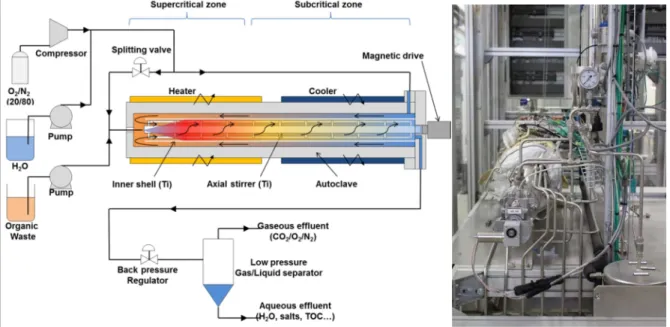
The first generation of SCWO continuous reactor with stirred double shell reactor is the one actually used in radioactive laboratory to treat actual organic liquid waste. Its treatment capacity allows a flow rate of organic liquid up to 200 g.h-1. Figure 1 shows the flowsheet of this process. The external vessel made of 316 stainless steel withstands working pressure of 30 MPa. Along the vessel, four electric heaters are placed, following by a cooling shell, in order to reach operating temperature.
An inner titanium tube inside the reactor prevents the corrosion phenomenon by confining the aggres-sive species. A titanium stirrer inside the inner tube maintains a turbulent flow along the whole reactor so as to enhance heat and mass transfer and prevent the precipitated salts from settling in the ‘’super-critical zone’’ by bringing them into the ‘’sub‘’super-critical zone’’ of the reactor where they are dissolved at low temperature.
The oxidation reaction takes place in the first part of the reactor (in the hot and supercritical zone). In the second part, the flow is cooled by the cooling jackets and the air/water mixture flowing in the annu-lar space. At the outlet, the effluent is depressurized through a back pressure regulator and separated in two phases. The aqueous phase is analyzed by a Total Organic Carbon (TOC) analyzer and the gaseous phase is analyzed by a CO, CO2 and O2 gas analyzer.
Second generation of continuous stirred double shell reactor (treatment volume of 2 Liters):
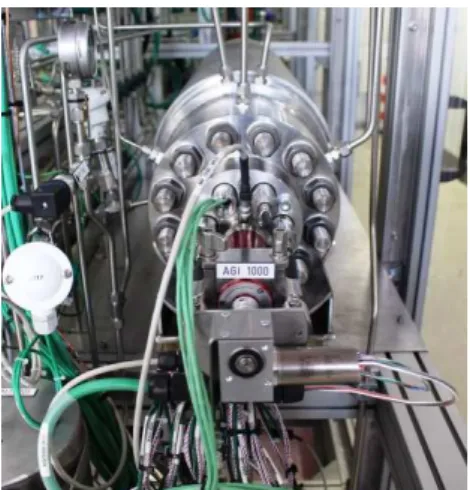
Figure 2 shows the flow sheet of the innovative reactor, designed to increase the organic flow rate and improve the mass and the heat transfer while keeping a mean flow type along the reactor axis and preventing particles from settling. The external vessel made of 316 stainless steel withstands working pressure of 30 MPa. This unique design makes it possible to measure the wall temperature along the reactor to ensure better control of the oxidation reaction. The oxidation reaction takes place in the hot part of the reactor (supercritical zone) whereas the flow is cooled by an inner cold exchanger. The organic waste is introduced directly into the inner tube to avoid contact with the outer walls of the en-closure. Water and air supply can also be introduced using a splitting valve for waste dilution in order to better control temperature in the supercritical zone. In the hot zone of the reactor, where SCWO reaction occurs, the flow (water, oxidant and organic liquid waste) is homogeneous. After SCWO reac-tion, the air/water mixture flows through the annular space (subcritical zone).
At the outlet of the reactor, the fluid is expanded through a pressure regulator before reaching a gas/liquid separator in which the aqueous and gas phase are separated. The gas phase is analyzed online (O2, CO2) to control directly the efficiency of the process.
Figure 2: Second generation of continuous stirred shell reactor (V= 2L)
SCWO dynamic batch reactor
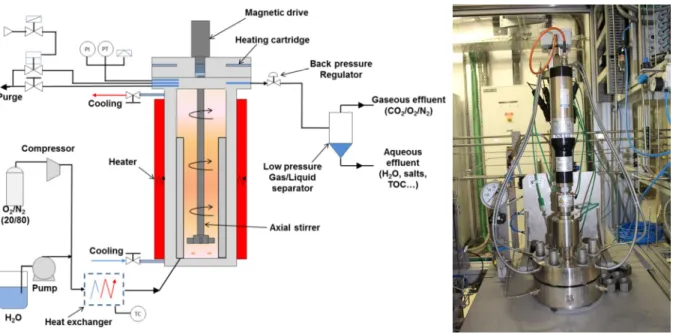
In addition to these continuous reactors available on POSCEA3 facility, a SCWO dynamic batch tor was implemented. The Figure 3 shows the flowsheet of this reactor. The design of this batch reac-tor allows a fine control of the process feed (air/water mixture). This device consists of an Inconel 625 autoclave (inner volume 2L). An axial stirrer ensures the homogeneity inside the reactor with a rotation speed from 50 to 350 rpm. The process fluid (air/water mixture) is heated before its introduction in the reactor by a specific preheater (1.5 kW). Then the heating inside the dynamic batch reactor is ob-tained through heater collars with an electrical power of 3.5 kW. Pressure up to 30 MPa and tempera-ture up to 873 K may be reached. The cooling is done by an external cold exchanger.
The organic waste is directly loaded into the reactor. Air/water heated stream is then introduced by the bottom of the autoclave, allowing rise in pressure and temperature. Like the continuous reactor de-scribed above, the fluid leaving the reactor is expanded through a pressure regulator before reaching a gas/liquid separator in which the aqueous and gas phase are separated. The gas is analyzed online (O2, CO2).
This reactor allows the SCWO process to treat hazardous solid wastes containing chlorine, fluorine, sulfate or phosphate salts or having a high concentration of mineral salts with degradation yields high-er than 99.9%.
In addition, this specific configuration allows studies oxidation reactions of solid materials which can be not studied in a continuous reactor. For example, the degradation of organic solids such as, polymers (
ion exchange resins of electronic waste) or crude bitumen mixed or not with mineral materials, or packaged in cementitious materials could be studied in the SCWO dynamic batch reactor.
Figure 3: Overall Flowsheet of SCWO dynamic batch reactor
Conclusion
Thanks to this emerging technology and its studies of the mechanisms that occur in this complex oxi-dation reaction (SCWO), the CEA has set up a process in nuclear facility (Atalante) in which actual radioactive organic waste are treated. With the POSCEA3 facility, CEA intends to study a wide range of toxic waste treatments, whether conventional or nuclear (liquid or solid waste) in order to demon-strate the applicability of the SCWO technology, taking into account the evolution of the environmental regulatory constraints.
References
1) C. Joussot-Dubien, D. Gerard, H.A. Turc, FR Patent, PCT WO 0230836 A1