Publisher’s version / Version de l'éditeur:
Construction Technology Update, 2000-12-01
READ THESE TERMS AND CONDITIONS CAREFULLY BEFORE USING THIS WEBSITE.
https://nrc-publications.canada.ca/eng/copyright
Vous avez des questions? Nous pouvons vous aider. Pour communiquer directement avec un auteur, consultez la
première page de la revue dans laquelle son article a été publié afin de trouver ses coordonnées. Si vous n’arrivez pas à les repérer, communiquez avec nous à [email protected].
Questions? Contact the NRC Publications Archive team at
[email protected]. If you wish to email the authors directly, please see the first page of the publication for their contact information.
NRC Publications Archive
Archives des publications du CNRC
For the publisher’s version, please access the DOI link below./ Pour consulter la version de l’éditeur, utilisez le lien DOI ci-dessous.
https://doi.org/10.4224/20327478
Access and use of this website and the material on it are subject to the Terms and Conditions set forth at
Basic principles of smoke management for atriums
Lougheed, G. D.
https://publications-cnrc.canada.ca/fra/droits
L’accès à ce site Web et l’utilisation de son contenu sont assujettis aux conditions présentées dans le site LISEZ CES CONDITIONS ATTENTIVEMENT AVANT D’UTILISER CE SITE WEB.
NRC Publications Record / Notice d'Archives des publications de CNRC:
https://nrc-publications.canada.ca/eng/view/object/?id=4638f160-5d9f-400f-90e8-b1c3e1f51389 https://publications-cnrc.canada.ca/fra/voir/objet/?id=4638f160-5d9f-400f-90e8-b1c3e1f51389C o n s t r u c t i o n T e c h n o l o g y U p d a t e N o . 4 7
Atriu m s h ave becom e p op u lar elem en ts in com m ercial, office an d resid en tial bu ild in gs becau se th ey can p rovid e attractive, en vi-ron m en tally con trolled , n atu rally lit sp aces. Su ch sp aces, h ow ever, p resen t a ch allen ge for fire p rotection en gin eers becau se th eir h eigh t (typ ically greater th an 20 m ) d ecreases th e effectiven ess of au tom atic sp rin kler system s an d becau se th ey lack th e floor-to-floor sep aration s th at can lim it th e likelih ood of fire an d sm oke sp read in g from th e floor of fire origin to oth er areas of th e bu ild in g. Evacu ation rou tes in atriu m s are of greatest con cern becau se th ey becom e vu ln erable to sp read in g sm oke u n less sm oke m an agem en t m easu res are u sed .
Sm ok e H a za rds
Most fire-related d eath s are attribu table to sm oke in h alation rath er th an bu rn s. In th e con text of fire-safety en gin eerin g, sm oke is defined as the combination of airborne solids, liqu id p articu lates an d gases p rod u ced w h en a m aterial bu rn s p lu s th e air th at becom es en train ed (in corp orated in to th e m ix).[1] Hazard s from sm oke in bu ild in gs in clu d e: • Toxic gases. Carbon m on oxid e is th e
m ost com m on of th ese. Narcotic gases (w h ich can ren d er a p erson u n con sciou s) su ch as h yd rogen cyan id e an d irritan ts su ch as acid ic h alid es an d acrolein m ay also be p rod u ced , d ep en d in g on th e com -bu stible m aterials p resen t.
• Reduced oxygen levels. Th is can resu lt in su ffocation .
• High temperatures. Extrem e h eat is p oten tially h azard ou s to p eop le im m ersed in th e sm oke or exp osed to its rad iation . • Reduced visibility. Th is can h in d er both
evacu ation an d rescu e efforts.
Th e red u ction in visibility is a m ajor h azard in atriu m fires th at n eed s to be con -sid ered in an y sm oke m an agem en t d esign , esp ecially as it affects occu p an ts w h o are n ot located in th e im m ed iate fire area. If th ey h ave to evacu ate th rou gh th e sm oke, th e occu p an ts m ay becom e d isorien ted . In gen eral, if th ere is en ou gh visibility th rou gh th e sm oke for p eop le to see th e em ergen cy exits, toxic p rod u cts are u n likely to p reven t th em from escap in g. To ach ieve su fficien t visibility, bu ild in g occu p an ts sh ou ld be p h ysically sep arated from th e sm oke or th e sm oke con cen tration sh ou ld be lim ited .
A w id e ran ge of accep table levels of visibility h as been su ggested in th e fire p rotection literatu re.[2] For occu p an ts fam iliar w ith a bu ild in g an d able to evacu ate qu ickly, bein g able to see a d istan ce of 3-5 m m ay be su fficien t. For th ose less fam iliar w ith th e bu ild in g, a d istan ce of u p to 25 m h as been recom m en d ed . Th e latter criterion w as u sed in th e ten ability requ irem en ts for escap e rou tes in h igh -rise bu ild in gs first in trod u ced in th e 1970 ed ition of th e Nation al Bu ild in g Cod e
b y G.D. Loughe e d
Fires in atrium buildings can pose a serious threat to occupants as a result of
smoke migration. This Update, intended for building designers and property
managers, outlines the basic principles of smoke management in atriums
that must be understood in order to enhance occupant safety.
Basic Principles of Smoke
Management for Atriums
2
of Can ad a.[3] In tern ation ally, a d istan ce of 10 m is w id ely accep ted an d u sed .[4]
Th e effects of oth er sm oke h azard s (toxic gases, h igh tem p eratu res an d red u ced oxygen levels) can be seriou s for occu p an ts w h o are close to th e fire w h en it starts or w h o becom e im m ersed in th e sm oke flow. Exten sive d iscu ssion of th e effects of exp o-su re to sm oke, in clu d in g toxic gases, an d of th e ten ability lim its u sed to estim ate th e p robability of in cap acitation or d eath , can be fou n d in th e literatu re.[5]
Obje c t ive s of a Sm ok e M a na ge m e nt Syst e m
Wh ere sm oke from a fire in an atriu m , or in a room ad jacen t to th e atriu m , h as th e p oten tial to sp read to oth er occu p ied p arts of th e bu ild in g, th ere is a th reat to th e safe evacu ation of occu p an ts. Th is th reat is th e p rim ary con sid eration in th e d esign of sm oke m an agem en t system s. It can u su ally be ad d ressed by lim itin g th e p rod u ction of sm oke an d its m igration , th u s m ain tain in g a ten able en viron m en t in th e egress rou tes (corrid ors or stairs).
Sm oke m an agem en t system s can also be d esign ed to assist em ergen cy resp on se p erson n el in con d u ctin g search -an d -rescu e op eration s, an d in locatin g an d con trollin g th e fire. Gen erally, m easu res to p rotect egress rou tes m ake it easier for firefigh ters
to en ter th e bu ild in g, an d can red u ce p rop erty d am age. Su ch m easu res can aid in p ost-fire sm oke rem oval as w ell. Ge ne ra l Approa c he s t o Sm ok e M a na ge m e nt
Variou s en gin eerin g ap p roach es, u sed sin gly or in com bin ation , can red u ce th e p rod u ction of sm oke or m od ify its m ove-m en t, h en ce ove-m itigatin g its effects on occu p an ts. Th ese ap p roach es in clu d e in stallin g au tom atic sp rin klers an d lim itin g th e u se of com bu stible con stru ction m aterials an d fu rn ish in gs.[1,6]
Au tom atic sp rin kler system s are m ost effective in con trollin g fires in sp aces w ith a relatively low ceilin g h eigh t, su ch as th ose fou n d in th e areas ad jacen t to th e atriu m . For fires on th e floor of th e atriu m , th e situ ation is qu ite d ifferen t. Th e sm oke in th e fire p lu m e (see Figu re 1) cools su b-stan tially as it rises to th e ceilin g, an d in th e case of h igh atriu m s (m ore th an 20 m in h eigh t), th e sp rin klers w ill n ot be activated u n til th e fire h as becom e large. Th is m ean s th at su bstan tial sm oke sp read can occu r, both w ith in th e atriu m an d in th e com m u -n icati-n g sp aces,2 before th e sp rin klers are
activated .
Cu rren tly, th ere is very lim ited in form a-tion on th e size of sp rin klered fires in atriu m s. As a resu lt, a variety of ap p roach es
are u sed to d esign ad equ ate sm oke m an agem en t system s for sp rin klered bu ild in gs.[1,6] How ever, th ere is n o con sen su s as to w h ich is th e best
ap p roach .
In ad d ition to sp rin klers, “active” ap p roach es (requ irin g a m an u al or au tom atic
resp on se) to sm oke m an age-m en t in clu d e ven tin g sage-m oke from th e atriu m eith er th rou gh op en in gs in th e ceilin g or by m ean s of m ech an ical exh au st system s (fan s) to lim it its accu m u lation an d red u ce its sp read to oth er (con n ected ) areas of th e bu ild in g. Ven tin g system s can be activated m an u ally or au tom atically in resp on se to h eat or sm oke d etectors.
Th ere are also “p assive,” or bu ilt-in , ap p roach es to sm oke m an agem en t based on lim itin g sm oke m ovem en t; for exam p le, evacu ation rou tes can be sep arated from th e atriu m by u sin g barriers to fire or sm oke, th u s red u cin g th e th reat to occu p an ts. N a t iona l Building Code of Ca na da Re quire m e nt s
Th e Nation al Bu ild in g Cod e of Can ad a 1995 (NBC) ad d resses th e h azard s from sm oke in atriu m s w ith requ irem en ts for in tercon n ected
floor sp ace3(Articles 3.2.8.3. to 3.2.8.9.).[3,7]
Th ese firesafety requ irem en ts can be su m -m arized as follow s:4
1. Construction requirements. Th e bu ild in g sh all be of n on com bu stible con stru ction . (Heavy tim ber con stru ction is p erm itted if Su bsection 3.2.2. p erm its th e bu ild in g to be of com bu stible con stru ction .) 2. Sprinklers (fire suppression). Th e bu ild
-in g sh all be sp r-in klered th rou gh ou t. 3. Vestibules. Th ese are requ ired at each
level for exits op en in g d irectly in to an in tercon n ected floor sp ace. If an elevator h oistw ay op en s in to th e in tercon n ected floor sp ace an d in to storeys above it, vestibu les are requ ired to p rotect eith er th e elevator d oor op en in gs in th e
in tercon n ected floor sp ace or th e elevator d oor op en in gs in th e storeys above th e in tercon n ected floor sp ace (see Figu re 2). 4. Protected floor space. A p rotected floor
sp ace can be u sed to accom m od ate p eak traffic d u rin g evacu ation . It sh all be d esign ed so th at an exit can be reach ed w ith ou t en terin g th e in tercon n ected floor sp ace an d sh all be sep arated from th e in tercon n ected floor sp ace by a vestibu le (see Figu re 2).
Figure 2. Vestibules and protected floor spaces
(to con trol th e fire) an d th e u se of n on com -bu stible m aterials, su ch as m etal, brick, ston e an d gyp su m board , for m ajor bu ild in g elem en ts, in terior fin ish es an d fu rn ish in gs. Th e NFC lim its th e qu an tity of com bu stible con ten t related to th e sp ecific occu p an cy. In ad d ition , exits m u st be p rotected by p ro-vid in g th em w ith vestibu les.
Evolut ion of At rium s a nd Re la t e d Sm ok e M a na ge m e nt I ssue s Wh en atriu m s h ad n o real fu n ction oth er th an as circu lation sp ace (see Figu re 4), th e m ain ap p roach to fire p rotection d esign w as to en su re th at th e atriu m bou n d aries — w all assem blies or glass — w ere fire resis-tan t. Th is ap p roach w as frequ en tly u sed w h en th e atriu m w as basically a covered sp ace lin kin g sep arate bu ild in gs — a “sterile tu be.”[9]
Sin ce exp erien ce w ith atriu m fires, p ar-ticu larly in fu lly sp rin klered bu ild in gs, h as sh ow n th at th e im p act on life safety as a resu lt of flam e sp read is sm all com p ared to th at from th e accu m u lation an d sp read of sm oke to oth er areas, th ere is less n eed to u se fire-resistan t m aterials to sep arate th e atriu m from th e ad jacen t sp aces in a fu lly en closed atriu m .[10,11] Glazed n on -fire-resistan t assem blies (see Figu re 5) can p ro-vid e ad equ ate p rotection again st sm oke sp read as lon g as th e glass rem ain s in tact.
Tod ay, both sterile tu be an d fu lly
en closed (w ith glazin g) atriu m s are con sid -ered too restrictive from both d esign an d u se p ersp ectives. In m ore recen t d esign s,
4 Construction Technology Update No. 47
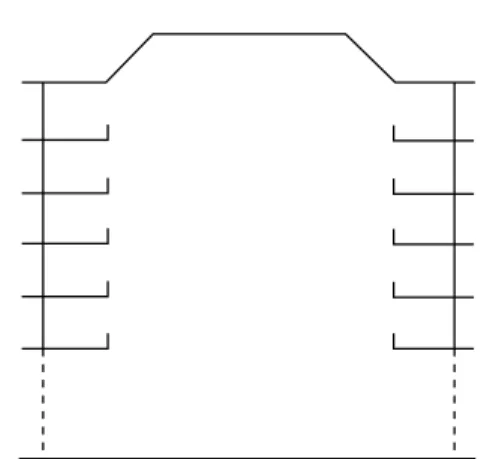
5. Draft stops. Th ese sh all be in stalled at each floor level, im m ed iately ad jacen t to an d su rrou n d in g th e op en in g to p rovid e a sm oke reservoir at th e ceilin g so th at th e sm oke can be d etected . Draft stop s m u st be at least 500 m m d eep , m easu red from th e ceilin g level to th e bottom of th e stop (see Figu re 3, p . 3).
6. Mechanical exhaust system. Th is typ e of system sh all be p rovid ed to rem ove sm oke from th e in tercon n ected floor sp ace at a rate of fou r air ch an ges p er h ou r. Its p u rp ose is to aid firefigh ters in rem ovin g sm oke, an d it is d esign ed to be actu ated m an u ally by th e resp on d in g fire d ep artm en t.
7. Combustible content limit. Th e in tercon -n ected floor sp ace sh all be d esig-n ed so th at th e com bu stible con ten ts, exclu d in g in terior fin ish es, in th ose p arts of a floor area in w h ich th e ceilin g is m ore th an 8 m above th e floor, are lim ited to n ot m ore th an 16 g of com bu stible m aterial (e.g., fu rn ish in gs an d item s related to th e occu p an cy) for each cu bic m etre of th e in tercon n ected floor sp ace. Th is requ ire-m en t is also referen ced in th e Nation al Fire Cod e of Can ad a (NFC), Sen ten ce 2.3.1.4.(1).[8]
Th ese sm oke m an agem en t requ irem en ts p rovid e bu ild in g d esign ers w ith th e basic ap p roach for m eetin g on e of th e objectives of th e NBC, w h ich is to p rotect h u m an life. Su ch ap p roach es are based p rim arily on red u cin g sm oke p rod u ction by requ irin g th e in stallation of au tom atic sp rin kler system s
th e ad jacen t sp aces are often p artially or fu lly op en to th e atriu m (see Figu res 6 an d 7) so as to m axim ize th e u se of th e sp ace. Th is evolu tion in th e d esign an d u se of atriu m sp aces p resen ts tw o m ajor con cern s:
1. Th e greater th e in tercon n ection betw een th e atriu m sp ace an d th e ad jacen t sp aces, th e greater th e p ossibility of sm oke from a fire on th e atriu m floor, or from a room ad jacen t to th e atriu m , sp read in g th rou gh th e atriu m to oth er p arts of th e bu ild in g. Th e com p lexity of th e sm oke m an age-m en t systeage-m d esign is d irectly related to th e d egree of in tercon n ection of th e sp aces.
2. An y ch an ge in or in ten sification of u se alm ost certain ly m ean s a ch an ge in th e typ e an d qu an tity of com bu stible m ateri-als (th e fu el load ), w h ich in tu rn affects th e size of th e fire an d th e (related ) rate of sm oke bu ild -u p , an d h en ce th e d em an d s p laced on th e sm oke m an age-m en t systeage-m .
U se of Engine e re d De sign Approa c he s
Wh ile th e NBC p rovid es p rescrip tive requ irem en ts for th e d esign an d con stru ction of atriu m s, th ere are som e circu m -stan ces th at requ ire a p erform an ce-based ap p roach to d eterm in e w h eth er a p articu lar u se an d d esign w ill m eet th e in ten t of th e cod e. Su ch circu m stan ces in clu d e th e follow in g:
• Wh en a n ew u se for an existin g atriu m is con tem p lated
• Wh en it is d ifficu lt to m eet th e requ ire-m en ts for p rotected floor sp aces
• Wh en a n ew atriu m is d esign ed for a u se th at is n ot covered by th e NBC
• Wh en th e atriu m d esign featu res a h igh d egree of con n ectivity betw een th e atriu m (s) an d th e ad jacen t sp aces.
En gin eered ap p roach es to th e d esign of sm oke m an agem en t system s, as fou n d in d esign gu id es su ch as NFPA 92B (p u blish ed by th e Nation al Fire Protection Association ), p rovid e p erform an ce-based tools in th e form of em p irically based equ ation s an d n u m erical m od els. Th e basics of th is typ e of ap p roach are ou tlin ed in Con stru ction Tech n ology Up d ate No. 48.
Re fe re nc e s
1. NFPA 92B, Gu id e for sm oke m an age-m en t systeage-m s in age-m alls, atria, an d large areas. Nation al Fire Protection
Association , Qu in cy, MA, 2000. 2. Tam u ra, G.T. Sm oke m ovem en t an d
con trol in h igh -rise bu ild in gs. Nation al Fire Protection Association , Qu in cy, MA, 1994.
3. Nation al Bu ild in g Cod e of Can ad a. Can ad ian Com m ission on Bu ild in g an d Fire Cod es, Nation al Research Cou n cil of Can ad a, Ottaw a, 1970 an d 1995. 4. Morgan , H.P., Gh osh , B.K., Garrad , G.,
Pam litsch ka, R., De Sm ed t, J.-C. an d Sch oon baert, L.R. Design m eth od ologies for sm oke an d h eat exh au st ven tilation . BRE 368, Con stru ction Research
Com m u n ication Ltd , Lon d on , UK, 1999.
“Construction Te chnology Up d a te s” is a se rie s of te chnica l a rticle s conta ining p ra ctica l inform a tion d istille d from re ce nt construction re se a rch.
For more information, contact Institute for Research in Construction, National Research Council of Canada, Ottaw a K1A 0R6
Telephone: (613) 993-2607; Facsimile: (613) 952-7673; Internet: http://irc.nrc-cnrc.gc.ca
© 2000
Nation al Research Cou n cil of Can ad a Decem ber 2000
ISSN 1206-1220 5. Pu rser, D. Toxicity assessm en t of
com bu stion p rod u cts. Th e SFPE h an d book of fire p rotection en gin eerin g, Nation al Fire Protection Association , Qu in cy, MA, 1995.
6. Klote, J.H. an d Milke, J.A. Design of sm oke m an agem en t system s. Am erican Society of Heatin g, Refrigeratin g an d Air-Con d ition in g En gin eers, Atlan ta, GA, 1992.
7. User’s gu id e — NBC 1995, fire p rotection , occu p an t safety an d accessibility (Part 3). Can ad ian Com m ission on Bu ild in g an d Fire Cod es, Nation al Research Cou n cil of Can ad a, Ottaw a, 1997.
8. Nation al Fire Cod e of Can ad a. Can ad ian Com m ission on Bu ild in g an d Fire Cod es, Nation al Research Cou n cil of Can ad a, Ottaw a, 1995.
9. Saxon , R. Atriu m bu ild in gs: d evelop -m en t an d d esign . Th e Arch itectu ral Press, Lon d on , UK, 1983.
10. Sh arry, J.A. An atriu m fire. Fire Jou rn al, Volu m e 67, 1973, p p . 39-41.
11. Lath rop , J.K. Atriu m fire p roves d ifficu lt to ven tilate. Fire Jou rn al, Volu m e 73, 1979, p p . 30-31. Foot not e s
1. Alth ou gh th e figu res sh ow a raised roof system , th is is n ot a requ irem en t of th e Nation al Bu ild in g Cod e of Can ad a 1995.
2. “Com m u n icatin g sp aces” refers to th ose sp aces in a bu ild in g w ith an op en p ath w ay to th e atriu m su ch th at sm oke m ovem en t betw een th e sp aces an d th e atriu m is u n im p ed ed . Th is in clu d es sp aces th at op en d irectly in to th e atriu m as w ell as th ose th at con n ect th rou gh p assagew ays.
3. An “in tercon n ected floor sp ace” (as d efin ed by th e NBC, Article 1.1.3.2.) refers to su p erim p osed floor areas or p arts of floor areas in w h ich floor assem -blies th at are requ ired to be fire sep aration s are p en etrated by op en in gs th at are n ot p rovid ed w ith closu res.
4. Th e requ irem en ts p rovid ed in th is Up d ate are lim ited to th ose in clu d ed in th e NBC. Th e sp ecific requ irem en ts of locally ap p licable bu ild in g an d fire cod es m u st be m et for all bu ild in gs.
Dr. G.D. Loughe e d is a sen ior research officer in th e Fire Risk Man agem en t Program of th e N ation al Research Cou n cil’s In stitu te for Research in Con stru ction .