READ THESE TERMS AND CONDITIONS CAREFULLY BEFORE USING THIS WEBSITE.
https://nrc-publications.canada.ca/eng/copyright
Vous avez des questions? Nous pouvons vous aider. Pour communiquer directement avec un auteur, consultez la première page de la revue dans laquelle son article a été publié afin de trouver ses coordonnées. Si vous n’arrivez pas à les repérer, communiquez avec nous à [email protected].
Questions? Contact the NRC Publications Archive team at
[email protected]. If you wish to email the authors directly, please see the first page of the publication for their contact information.
NRC Publications Archive
Archives des publications du CNRC
This publication could be one of several versions: author’s original, accepted manuscript or the publisher’s version. / La version de cette publication peut être l’une des suivantes : la version prépublication de l’auteur, la version acceptée du manuscrit ou la version de l’éditeur.
Access and use of this website and the material on it are subject to the Terms and Conditions set forth at
All-Successful Channel Occupations in PRMA-DCA Mobile Wireless
PCS
Toloo, M; Abu-Hakima, S.
https://publications-cnrc.canada.ca/fra/droits
L’accès à ce site Web et l’utilisation de son contenu sont assujettis aux conditions présentées dans le site LISEZ CES CONDITIONS ATTENTIVEMENT AVANT D’UTILISER CE SITE WEB.
NRC Publications Record / Notice d'Archives des publications de CNRC:
https://nrc-publications.canada.ca/eng/view/object/?id=6b0aeceb-7de8-414f-94cb-fa18813ddafc https://publications-cnrc.canada.ca/fra/voir/objet/?id=6b0aeceb-7de8-414f-94cb-fa18813ddafc
Abstract In this paper we describe the probability of all-successful channel occupations in wireless Personal Com-munication Systems (PCS) employing Packet Reservation Multiple Access (PRMA) and Dynamic Channel Allocation (DCA) techniques. The aim of this paper is to evaluate a measure describing the probability of all-successful channel occupations as a function of the user movement characteris-tics, and channel allocation strategy measures. The evalua-tion is carried out through step by step incorporaevalua-tion of random variables of the relative conditional probability measures. The developed measure is then compared with an already existing channel allocation measure. In addition, it is shown how the channel allocation strategy can affect the developed measures. Finally, a total view of the wireless sys-tem is developed by combining user’s and operational net-work points of view.
1. Introduction
The PRMA [1] is a possible evolution of Time Division Multiple Access (TDMA) technology where users are allo-cated time-channels (similarly positioned slots in consecu-tive frames of a given frequency-channel) on their call basis. Time-channels are allocated at the beginning of the call and are de-allocated at the end of each call (see Figure 2). In other words, in TDMA, channel allocation is not a function of the source’s transmission characteristics. As opposed to the TDMA, in PRMA the time-channel allocation is a func-tion of the source activity, transmission-permission charac-terized as the probability of transmission , and the success in contention for a time-channel. As a source becomes active, it begins contending for the available time-channels. If the source is successful during the contention period, a time-channel is allocated to the source at the begin-ning of its activity. Otherwise, the source continues contend-ing for the remaincontend-ing available time-channels with probability until a time-channel is allocated to the source, and/or there are still packets to contend time-channel access for. Packets at the source may be dropped if they are delayed for more than a predefined threshold. Once the time-channel is allocated, its deallocation is based on the source’s activity and/or source’s type which are categorized as either Periodic or Random for PRMA. For the Periodic sources such as voice and the Periodic data, the time-channel deallo-cation is only dependent on the activity of the source, where the source has an unlimited ownership of its allocated time-channel as long as it is active. For the Random data, how-ever, the source does gain the channel access for only one time slot, and it should contend for an available time-channel on the time slot basis.
The PRMA time-channels are organized as frames where each frame consists of time slots. When a source
P per
P per
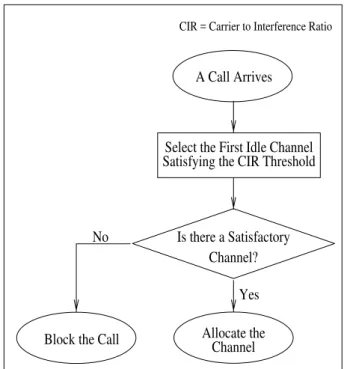
becomes active the first packet is sent through the defined frequency channel [1] knowing that it may collide with simi-larly contending packets of other sources. Thus, the source contends for a time-channel for its first packet. If the packet successfully reaches the Base Station (BS), the channel is then allocated to the source of that packet and the time-chan-nel is reserved as long as the periodic source is active. Once the periodic source becomes inactive, its time-channel becomes available for contention. The main part of current work is concentrated on the development of measures [1], [2], [3], applicability of the possible adjustments, and incor-poration of new techniques that can result in improvement of the quality of services [4], [5], [6]. One of these techniques is DCA in which the frequency-channels are allocated to the BSs in a dynamic fashion, which is a function of the offered load to BSs, as opposed to the Fixed Channel Allocation (FCA) in which the frequency-channel allocation does not change as a function of time. Figure 1, for example, depicts a possible distributed channel allocation process [7]:
Figure 1. Distributed Channel Allocation Process.
The current literature on the development of analytical measures mainly assumes that a particular frequency channel is allocated to a group of users that contend for the available time slots in the frame. The mobility characteristics of users, and the employed DCA technique are not usually factored in. In this paper, our aim is to develop analytical measures for the probability of all-successful channel occupations where the mobility characteristics of users and the employed DCA technique have visible effects on the developed measure.
Is there a Satisfactory Channel?
Channel Allocate the Satisfying the CIR ThresholdSelect the First Idle Channel
Block the Call No
Yes A Call Arrives
CIR = Carrier to Interference Ratio
All-Successful Channel Occupations in PRMA-DCA Mobile Wireless PCS
Mansour Toloo and Suhayya Abu-Hakima
Seamless Personal Information Networking Group
Institute for Information Technology, National Research Council of Canada
Ottawa, Ontario, Canada, K1A 0R6
2. Evaluation of the Probability of All-Successful Chan-nel Occupations
In the context of wireless PRMA employing the DCA technique, let us consider the following channel organization (both time and frequency organization):
Figure 2. Time and Frequency Channel Organization.
Let us further define the following notation: : jth slots of the kth frame duration
: The number of potential users in the domain of a given BS
: Total number of users that can become a potential users of a given BS
: The number of active talk-spurts : Number of available channels to a given BS
: Number of all unsuccessful consecu-tive channel occupations
: number of all successful consecutive channel occupations
: Permission to transmit in a slot
S S S S m-2 S m-1 S m F F F j1 j2 j3 1 2 3 F jk jth Frame Duration Channel of a Time Two Slots 3 S S 2 S 1 F i1 Fi2 Fi3 Duration ith Frame (m-2,i) S m-2 S m-1 S m F in
(i,j) = ith Slots of the jth Frame Duration S = ith time slot
i
F = jth Frame of ith Duration ij j k, ( ) n Users n TotalUsers n Talk–Spurts n Avail–Channels n Unsuccessful n Successful P per
: Probability that MSs successfully occupy the available time slots
: Probability of being inside a given BS domain
: Packet generation rate of the user-sources
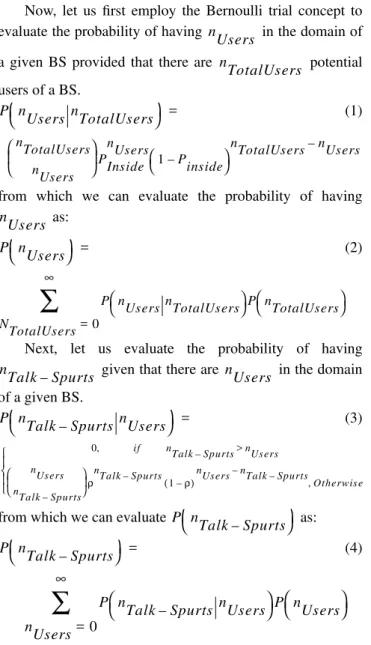
Now, let us first employ the Bernoulli trial concept to evaluate the probability of having in the domain of a given BS provided that there are potential users of a BS.
(1)
from which we can evaluate the probability of having as:
(2)
Next, let us evaluate the probability of having given that there are in the domain of a given BS.
(3)
from which we can evaluate as:
(4)
Now, assuming that the wireless system does not employ a capture mechanism (a mechanism to recover col-lided packets) [4], [5], [6], the upper-bound of the probability of having all-successful channel occupations given that there
are and is:
if ; otherwise
(5) from which we can find the probability of all-successful
P Occ(j k, ) j k, ( ) P inside ρ n Users n TotalUsers P n Users nTotalUsers = n TotalUsers n Users P Inside n Users 1 P inside – nTotalUsers–nUsers n Users P n Users = P n UsersnTotalUsers P n TotalUsers N TotalUsers=0 ∞
∑
nTalk–Spurts nUsers
P n
Talk–Spurts nUsers
= 0, if nTalk Spurts – >nUsers n Users n Talk–Spurts ρnTalk–Spurts(1–ρ)
nUsers nTalk Spurts
– – Otherwise , P n Talk–Spurts P n Talk–Spurts = P n
Talk–Spurts nUsers
P n Users n Users= 0 ∞
∑
nTalk–Spurts nAvail–Channels P
Occj k n, Talk–Spurts,nAvail–Channels = 0 n
Talk–Spurts<nAvail–Channels P
Occj k n, Talk–Spurts,nAvail–Channels = n Talk–Spurts n Avail–Channels p Per n Avail–Channels × 1 p Per –
channel occupations as:
(6)
However,
, where reflects
the channel allocation strategy of the wireless system. In the case of FCA, for example,
where C is a predefined system parameter describing the number of channels allocated to a given BS. In the case of DCA, however, the designer has much more freedom in set-ting up the conditional probability density. The probability density function, for example, may be designed to guarantee a “healthy” operation for a set of given/expected population concentrations at a given BS domain by having higher values at the corresponding . The wireless system “health” may be also related to the blocking probability due to insufficiency of the available channels and/or to the wire-less systems capability to dynamically adapt to the offered load. In the former case, the system designer, may intend to
decrease the for
the cases where and
increase it otherwise so that channel availability is better guaranteed. In the latter case, however, the design should address the rapidness by which channel allocation can respond to load changes, which may be related to the algo-rithm implemented at a given BS and/or a global algoalgo-rithm in charge of distributing channels to a group of BSs. As far as mathematical developments are concerned, the probability theory keeps the discussions here general and abstract while allowing any particular system to use the developments for analytical purposes. However, it should be emphasized that the localized channel allocation requirements are closely related to the global/locally-global requirements.
From , we can find the probability of
hav-ing channel accesses as
(7) and the probability of having channel accesses as:
P
Occ(j k, ) = P
Occj k n, Talk–Spurts,nAvail–Channels ×
n Talk–Spurts=0 nAvail Channels – = 0 ∞
∑
P nTalk–Spurts,nAvail–Channels
P n
Talk–Spurts,nAvail–Channels
=
P n
Avail–ChannelsnTalk–Spurts
P n Talk–Spurts P n
Avail–ChannelsnTalk–Spurts
P n
Avail–ChannelsnTalk–Spurts
= 1, if n Avail–Channels = C 0, Otherwise n Talk–Spurts P n
Avail–Channels nTalk–Spurts
n
Avail–Channels>nTalk–Spurts
P Occ(j k, ) n Unsuccessful P n Unsuccessful P Occ1–POcc n Successful = n Successful (8) from which we can find the following expected values
(9) and
(10)
which give us again the as
(11)
3. Discussions on the Applicability of the Evaluated Measure
The measure we developed here addresses the probabil-ity of all-successful channel occupations of a given wireless PCS system employing PRMA and DCA techniques. The difference between this measure and that developed in [2], [3] is that the latter measure defines the probability of call dropping of a given user assigned to a given channel, while our measure addresses the overall performance of the wire-less system. These two measures, although closely related, address different aspects of the wireless system namely users and outside observer’s or operational network points of view, respectively.
Referring back to the ’s method of evaluation, it is evident that one may not have to or be able to go through all the steps in order to evaluate . If the users’ movement characteristics are available, then it is possible to evaluate by just going through its evaluation in a step by step fashion similar to the method used in describing the user’s point of view [8]. However, in many instances, the move-ment characteristics of the mobile users are not well known and thus one can only consider the overall behaviour of the wireless system. In other words, the outside observer’s point of view [8] is the only available view of the wireless system. In this case then one can just use equation (11) to evaluate the desired , the value of which can be determined to any degree of accuracy due to its convergence properties.
Let us go through an example wireless system setup to further clarify the difference between the measure developed in this paper and that developed by [2], and [3]. Let us assume that there are 5 users of a PRMA-DCA wireless sys-tem, 2 stationary and 3 mobile, producing information pack-ets continuously (i.e. there are no idle periods). As far as the DCA technique is concerned, let us assume that 10 or more channels are assigned to the BS on average. Thus, according to our measure, is 0. However, the measure developed in [2], and [3] would evaluate the least upperbound of the probability of successful channel accesses as 1 showing that
P n Successful P Occ n Successful 1 P Occ – = NSuccessful n SuccessfulP n Successful n Available=0 ∞
∑
= NUnsuccessful n UnsuccessfulP n Unsuccessful n Available=0 ∞∑
= P Occ P Occ NSuccessful NSuccessful NUnsuccessful+ ---= P Occ P Occ P Occ P Occ P Occthe users of such a system would be very satisfied of its per-formance, although the network utilization is quite low. In other words, the user’s point of view measure does measure aspects of the communication directly observed by the user, while the outside observer’s point of view measure, which may be quite different, measures the overall performance and/or utilization of the wireless network as shown in Figure 3.
Figure 3. User and Networking Perspectives of the Wireless System
Finally, it should be noted that a combined view of a wireless system can be constructed from these two different and sometimes conflicting views of the wireless system through employment of conditional probability measure as P(Successful channel allocation by a user | Successful occu-pations of channels). The resulting measure will then take into account both the networking aspect as well as the user’s point of view of the wireless system.
4. Conclusions
In this paper we evaluated a measure describing the probability of all-successful channel occupations in a wire-less PCS system employing PRMA and DCA techniques. The evaluations have been carried out through two parallel paths. On one path, the evaluations require a detailed knowl-edge of the users’ movement and dynamic channel allocation characteristics, while the other method just considers the overall performance of the wireless system. The latter method is based on the expected values of the consecutive all-successful channel occupations. Finally, we pointed out the construction of a total view of a given wireless system. The former method also led to the development of condi-tional probability measure distinguishing among different channel allocation schemes (both localized and global ones). The mathematics of this paper can be extended to more com-plex situations in which a larger number of system parame-ters are available for analysis.
Acknowledgement I would like to express my thanks to the staff of Seamless Personal Information Networking (SPIN) at the National Research Council of Canada (NRC) for their kind guidance.
5. References
[1] D. J. Goodman, R. A. Valenzuela, K. T. Gayliard, and B. Ramamurthi, “Packet Reservation Multiple Access for Local Wireless Communications,” IEEE Transactions on Commu-nications, vol. 37, no. 8, August 1989, pp. 885-890.
BS
BS Domain
(UM)
(UM)
(NM)
(UM): Associated User Measure = Channel Allocation Success (NM): Associated Network Measure =
All-Successful Channel Occupations
[2] F. D. Priscoli, G. Picciano, and F. Sestini, “Dynamic Car-rier Allocation in a PRMA Cellular Network,” Proceedings IEEE Global Telecommunications Conference, Singapore, 1995, pp. 1157-1161.
[3] F. D. Priscoli, “Basic Issues on Dynamic Allocation of PRMA Carriers,” Proceedings IEEE International Confer-ence on Communications, Seattle, WA, USA, 1995, pp. 428-432.
[4] C. Namislo, “Analysis of Mobile Radio Slotted ALOHA Networks,” IEEE Journal on Selected Areas in Communica-tions, vol. SAC-2, July 1984, pp.583-588.
[5] J. C. Arnbak and W. van Blitterswijk, “Capacity of Slot-ted ALOHA in Rayliegh-Fading Channels,” IEEE Journal on Selected Areas in Communications, vol. SAC-5, February 1987, pp. 261-269.
[6] D. J. Goodman and A. A. M. Saleh, “The Near/Far Effect in Local ALOHA Radio Communications,” IEEE Transac-tions on Vehicular Technology, vol. VT-36, February 1987, pp. 19-27.
[7] T. Kanai, “Autonomous Reuse Partitioning in Cellular Systems,” Proceedings IEEE Vehicular Technology Confer-ence, May 1992, Denver, USA, pp. 782-785.
[8] M. Toloo and H. T. Mouftah, “Approaches to the Hando-ver Mechanism in Personal Communication Systems,” Pro-ceedings 17th Biennial Symposium on Communications, Kingston, Ontario, May 30 - June 1, 1994, pp. 143-146.