Business Development Trends and Analysis for the Data
Networking MarketMASSACHUSETTS INSTITUTE OF TECHNOLOGY
By
MAR
0
8 2012
Devadas V. Patil
LIBRARIES
B.E. Mechanical Engineering, National Institute of Technology, Tiruchirapalli, India, 1990 M.S. Mechanical Engineering, University of Hawaii at Manoa, 1992
M.S. Information and Computer Science, University of Hawaii at Manoa, 1994
ARCHIVES
SUBMITTED TO MIT SLOAN SCHOOL OF MANAGEMENT AND SCHOOL OF ENGINEERINGIN PARTIAL FULFILLMENT OF THE REQUIREMENTS FOR SYSTEM DESIGN AND MANAGEMENT PROGRAM FOR THE DEGREE OF
MASTER OF SCIENCE IN ENGINEERING AND MANAGEMENT
AT THE
MASSACHUSETTS INSTITUTE OF TECHNOLOGY
FEBRUARY 2011
0 2011 Devadas V. Patil. All rights reserved
The author hereby grants to MIT permission to reproduce and to distribute publicly paper and electronic copies of this thesis document in whole or in part in any medium now known or hereafter created.
Signature of Author:
DEVADAS PATIL
System Design an 4a a e, nt Pr gram, December 2010
A 17A
Certified by: _ _ _ _ _ _ _ __ _ _
HOWAkVI AN ERON, THESIS SUPERVISOR Bill Porter (1967) Distinguisheenior Lecturer of Entrepreneurship
Accepted by:
PAT HALE
Business Development Trends and Analysis for the Data
Networking Market
By
Devadas V. Patil
Submitted to the System Design and Management Program on December 15, 2010 in Partial Fulfillment of the Requirements for the Degree of Master of Science in Engineering and Management
ABSTRACT
The Internet has come a long way after the widely reported invention by Sandra Lerner and Leonard Bosack of the router, a device that can transmit data from one network to another based on certain protocols and principles. Despite a slow start in the mid 1980s, the Internet has emerged as one of the primary means of communication for people of all walks of life.
Sophisticated, network-aware applications that integrate data, voice and video have helped fuel this growth.
This thesis examines the latest technology trends and historical developments in various market segments of the Internet. Using technology trends as a backdrop, it analyzes business
development at Cisco Systems, Inc., a major player in all Internet market segments. Well-known tools and concepts such as the Familiarity Matrix and Technology S-curve are used for case studies of business development at Cisco.
Business Development is almost always a high-stakes endeavor requiring keen insight on both financial and strategy fronts. What are good strategies for corporate entrepreneurship? What are the challenges in business development by way of acquisitions? Will cyber anonymity continue to make us lonely and distanced, or will there be a new breed of Internet applications that will genuinely bring people closer?
These are some of the questions this thesis explores, drawing on the wisdom and experience of industry experts.
Thesis Supervisor: Howard Anderson
Acknowledgements
As I walked the hallowed hallways of MIT's infinite corridor one chilly morning in Fall
08, I mulled over the prospect of writing a thesis on the Internet "revolution." I decided to
discuss the idea with Professor Howard Anderson, whose articles appeared frequently in Network World magazine. In retrospect, I feel that this thesis would not have been possible
without the strong sense of motivation and enthusiasm I felt after my first meeting with him. His knowledge of networking technology, vast experience in the fast-paced world of technology business development, and down-to-earth objectivity inspired me. I consider myself fortunate to have had the opportunity to work with someone of his status, and thank him for his guidance and encouragement during the course of this thesis.
Professor Val Livada's course on Corporate Entrepreneurship was an eye-opener and equipped me with tools and concepts I needed for this thesis. My initial discussions with Professor Henry Weil and Professor James Utterback were vital for scoping and structuring the work. Pat Hale and Jan Klein were immensely helpful in answering questions about thesis requirements and interviewing guidelines. I wish to thank these faculty members and many others at Sloan and ESD who have helped me all along. The staff at SDM/LGO is wonderful. Chris Bates, Bill Foley, Lisa Hill, and many others were always prompt and courteous.
Finally, I wish to thank my wife, Shama, my children, Pritish and Sohan, my parents, my wonderful boss at Cisco, Rick Trowel, my Cisco team members, my classmates and friends at MIT for their unstinting support and encouragement.
Ann Arbor, MI December 2010
Table of Contents
1 The Ubiquitous Internet -A Snapshot... - 13
-2 A dvanced Technologies ... - 15
-2.1 W eb as a platform ... 15
-2.2 Cloud Com puting... - 16
-2.3 W AN Optim ization... - 18
-2.4 M edianet ... 19
-2.5 Collaboration... - 20
-2.6 D ata Center Trends ... - 22
-2.7 Consum er Solution Trends ... - 23
-2.8 Security ... 24
-2.9 N etw ork Convergence ... .-25
-2.10 M etro Ethernet... -26
-3 LAN Technology Trends... - 28
-3.1 Ethernet ... - 28-3.2 Sw itched Ethernet ... - 29 -3.3 W ireless LAN ... .. -31-4 W AN Technology ... . 33 -4.1 Obsolescence of X .25 ... -34 -4.2 Em ergence of M PLS... 35
-4.3 Adoption of PPP over SON ET ... 36
-5 A ccess Technology Trends... - 37
-5.1 Beginnings of Broadband: ISDN ... - 37
-5.2 M ainstream Broadband: D SL and Cable ... - 38
-6 Business D evelopm ent Trends at Cisco System s ... - 40
-7 Cisco LAN A cquisitions... - 43
-8 Cisco W AN acquisitions ... - 48
-9 Cisco A ccess Technology A cquisitions ... - 53
-10 Cisco A dvanced Technology A cquisitions ... - 59
-11 Conclusions and Expert Opinions... - 63
-12 Appendices ... 66 -12.1 Expert Interview 1 ... . 66-12.2 Expert Interview 2 ... . 72-12.3 Expert Interview 3 ... 77 -12.4 Expert Interview 4 ... 82 -13 G lossary...
List of Figures
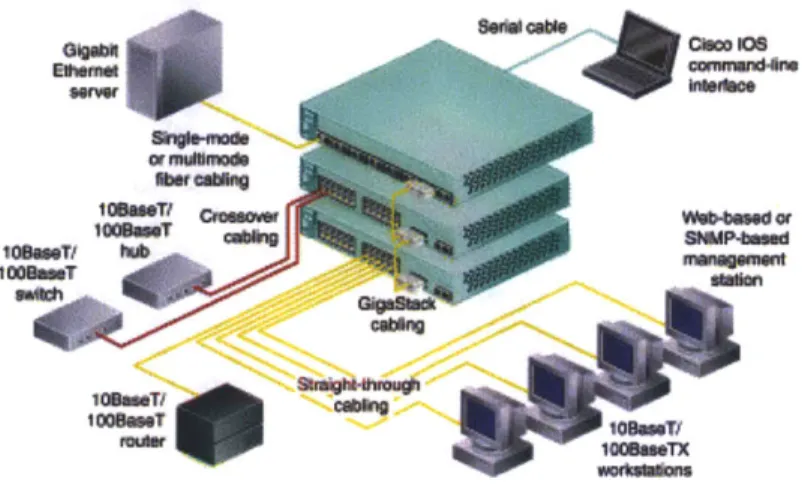
Figure 1. The LAN, WAN, and Access clouds of modem networks comprise of various devices
including routers, switches, and access aggregators. ... - 14
-Figure 2. Arista Networks' EOS Architecure with restartable processes ...- 18
-Figure 3. A collaborative meeting being held on Cisco Telepresence...- 21
-Figure 4. A home entertainment platform with IP networking capabilities...- 23
-Figure 5. VOIP is a form of converged network...- 26
-Figure 6. E-LINE (left) and E-LAN services in a Metro Ethernet Network...- 27
-Figure 7. Evolution of the Ethernet Technology... - 29
-Figure 8. A sw itched N etw ork ... -30
-Figure 9. Major players in the 1.76 billion LAN switching market in 1995...- 30
-Figure 10. LAN switching market share as of Q4 2006 ...- 31
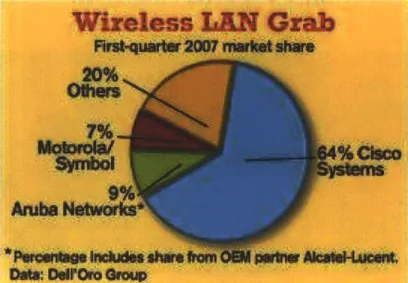
-Figure 11. Wireless LAN market share in Ql 2007...- 32
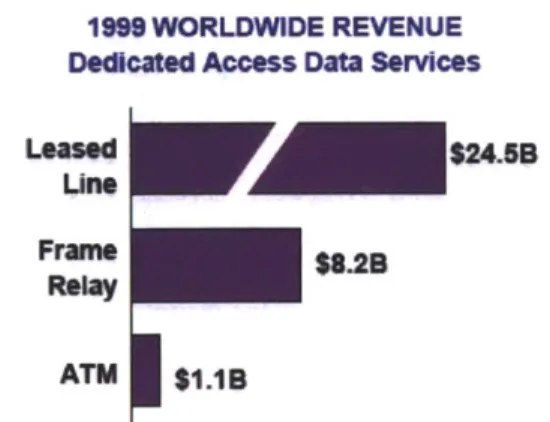
-Figure 12. W AN provider revenue makeup ...- 33
-Figure 13. US Leased lines, ATM, and Frame Relay market trends in the late nineties ... - 34
-Figure 14. A conceptual MPLS cloud with edge and intermediate routers ... - 35
-Figure 15. M PLS edge router m arket share ... - 36
-Figure 16. ISD N service types ...- 37
-Figure 17. Broadband Service Provider Market share ...- 39
-Figure 18. Broadband access m arket penetration... - 39
-Figure 19. Optimum Entry Strategies for Business Development... - 41
-Figure 20. Cisco LAN acquisitions sample on the Familiarity Matrix ... -45
-Figure 21. Cisco LAN acquisitions in the context of switched...- 46
-Figure 22. Cisco WAN acquisitions sample on the Familiarity Matrix...-.... 50
-Figure 23. Cisco WAN acquistions in the context of the WAN optical networking ...- 52
-Figure 24. Cisco Access acquisitions sample on the Familiarity Martix... - 56
-Figure 25. Cisco Access acquisitions in the context of the Access Technology S curves... - 57
List of Tables
Table 1. Cisco LAN acquisitions and their familiarity ratings --- 44
-Table 2. Cisco WAN acquisitions and their familiarity ratings --- 50
-Table 3. Cisco Access Technology acquisitions and their familiarity ratings --- 55
1 The Ubiquitous Internet
-
A Snapshot
The Internet is a great equalizer. Over the past two decades, it has fundamentally changed our outlook on business and communication. This change was largely brought about by two primal forces: (a) the widespread deployment of sophisticated applications that empower users without requiring them to be technically proficient; (b) the development of highly available and scalable network infrastructure devices.
The network infrastructure that forms the basis of the Internet can be considered under the following four sections, as shown in Figure 1 below.
a) Advanced Technologies that enhance the experience of the Internet
b) The Local Area Network (LAN) that provides connectivity in close physical proximity
c) The Wide Areas Network (WAN) that provides connectivity over long distances
d) The Access Network that provides connectivity to end users and businesses with the rest
of the Internet
Network infrastructure technology has seen disruptions in all its market segments such as LAN,
WAN, Access, and Advanced Technologies. In Clay Christensen's words 1, "Disruptive
businesses either create new markets or take the low end of an established market." A large majority of disruptions in networking infrastructure technologies have created new markets. The
disruptive forces have challenged network infrastructure vendors, often requiring them to react quickly. Below, significant technology disruptions and trends that affected network infrastructure
Core / WAN Access
Customer
LAN
Figure 1. The LAN, WAN, and Access clouds of modern networks comprise of various devices including routers, switches, and access aggregators.
Customer
2 Advanced Technologies
Several technologies enhance the performance and the overall experience of the network. In the recent years, the Internet has been recognized as a democratic media, where information and ideas are freely shared by an increasingly connected user population, using sophisticated web applications. Technological innovation continues to happen in several areas, including WAN, Security, Storage, and Convergence among other areas. A few of these advancements are discussed below.
2.1 Web as a platform
The rising popularity of the Internet as a user-driven platform has resulted in the development of several technologies that are collectively termed as Web 2.0. With the Internet as the platform, users control their own data. This democratization of the Web benefits from the following core
competencies2.
- Web services, as opposed to packaged software
- Architecture of Participation
- Cost-effective scalability
- Remixable Data source and transformations
- Software above the level of single device
Examples of Web 2.0 applications are Wikipedia, Flickr, Napster, Blogging, and Youtube. Some internet experts believe that the next generation of the Web (Web 3.0) will be able to handle complex searches and requests from users. Web 3.0 will also act as a personal digital assistant to the user, by attempting to understand user profiles and patterns, and tailoring web content and responses accordingly3.
A fundamental building block of Web 3.0 applications is the Web Application Programming
Interface (API). These APIs will allow developers take advantage of unique capabilities that a particular website or a hosted service can offer. Developers can also combine input from several different sources in the Web to offer powerful web applications. These are commonly called
mashups. An example of a mashup is google maps, which allows users to not only map a
community, but also locate businesses such as restaurants, shopping malls etc.
2.2
Cloud Computing
Cloud computing is becoming popular as corporate Information Technology departments look to cut costs by being able to add capabilities or capacity without investing in new hardware,
software, or personnel. This is made possible, as the Internet or the "cloud" is used as the means to provide computing resources on the fly. Some technologies that enable cloud computing are discussed below4.
1) SaaS (Software As a Service): Using SaaS, providers can host software services on the
web and make it available to thousands of end-users using a multi-tenant architecture. Salesforce.com and Google Apps are examples of SaaS. With the licensing of software for use on demand, the demand for server hardware among end-users will decrease. As
the concept becomes more popular, we could also see an increase in demand for server hardware among the providers of service. With network based access to software, centralized management, software upgrades, and support for integrated delivery of custom features, SaaS is bound to demand superior performance from the underlying network. This includes robustness, speed, and scalability, both in the host enterprise networks and end-user access networks.
2) PaaS (Platform As a Service): PaaS provides the entire computing platform, including hardware and software, as a service. The primary benefit is the simplicity of management where the whole IT arm of organizations appears as an out-sourced service. PaaS offers the whole gamut of typical software activity including software development, testing, database management, storage etc. PaaS is complementary to SaaS. Often PaaS users will subscribe to SaaS based services. Once again, the possibility of many concurrent users imposes demands similar to those of SaaS on the underlying network.
3) Cloud Networking: To meet the networking demands of cloud computing, including
features such as SaaS and PaaS, the network needs to be scalable and should provide low latency and high resiliency. The creation of such a high performance underlying network constitutes cloud networking. In addition to the general network attributes mentioned above, the network needs to also provide predictable performance and extensible
management5. In order to deliver such performance, some companies are looking at new approaches in design and architecture. Arista Networks' Extensible Operation System
(EOS) is an example of innovation in this area. Arista EOS architecture is based on a new
paradigm where the state and the process are maintained separately. The global state is maintained in a centralized component (System Database or sysdb), and various
components access it. For example, if there is a state change on a specific network port, sysdb is the central repository that has the latest state information. All management and protocol processes rely on sysdb, as shown in Figure 2. EOS also lets applications have their own private address space. This enhances performance by allowing applications to be restartable and upgradable without interrupting packet flow.
Figure 2. Arista Networks' EOS Architecure with restartable processes
2.3 WAN Optimization
WAN optimization is done by dedicated devices at either ends of a WAN link to improve
network performance. These devices, called WAN Optimization Controllers (WOCs) help avoid network latency using protocol optimization, reduce data transit using compression and caching, and prioritize traffic streams according to business needs6. These controllers can allow security features such as SSL and encrypted tunnels. Routing functionality such as policy based route
selection can be enabled within the WOC. According to Gartner Inc., Blue Coat Systems has the
.7
highest market share in WAN Optimization.
2.4 Medianet
A Medianet is a network that is optimized to cater to rich media applications over the network8.
Examples of rich media applications are IPTV, online video driven collaboration, media
streaming etc. Many multinational companies are increasingly demanding video applications to run over their enterprise networks. At the same time there is an increasing variety of devices that are connected to the network. For example, video surveillance cameras and digital signs
connected to an IP Network. A Medianet is aware of its end-points, media, and the underlying network. It optimizes the transmission of content to best suit the end-points it caters to. For example, Medianet can effectively handle the transmission and adaptation of video from a surveillance camera to a handheld wireless device. It does it by applying the necessary media transformations (transcoding) and making the necessary signal encoding based on changing network conditions. This results in an enhanced quality of experience while ensuring manageability and security.
From a service provider perspective, it is estimated that 90% of all the IP traffic on the internet will be video by 20129. Service Providers are finding themselves in a new role as "Experience Providers." They are increasingly turning to intelligent IP based infrastructures that can be optimized for video delivery. Preliminary tests have proven that two million video subscribers can be serviced with Quality of Service and a variety of video applications over IP Next
Generation Network (IP NGN). Several Cisco products such as the Carrier Routing System (CRS-1), Nexus 7000, Cisco ASR 9000 series, and Cisco 7600 series enable service providers to offer rich media applications. The ability to configure and serve thousands of multicast groups is critical for service providers that hope to monetize video channels and other rich service
offerings over an IP Network.
2.5
Collaboration
In the past decade, globalization trends have necessitated a new breed of applications for collaborative development. Today's workforce demands the ability to work together at a short notice, around the clock. Companies increasingly want to tap local talent to take advantage of off-shore development opportunities. Employees are often willing and able to make adjustments to their traditional work day routines in order to accommodate the needs of a global economy. For example, Software Architects in United States may conduct design review meetings at midnight with their counterparts and allied development teams in India.
To enable a high degree of collaborative work flow, today's enterprises are equipped with voice
10
and video conferencing solutions that can be classified as follows' .
IP Communications: A full suite of end points that enable employees in the main and branch
Messaging: The ability to access and deliver voice messages via any medium, thereby
improving business processes. For example, Unity Voice Messaging system that lets employees manage calls and voice messages.
Presence and Clients: The ability to connect with other employees directly from a desktop,
without the overhead of using a full-scale email program. For example, IBM Lotus Sametime lets employees maintain lists of other colleagues that they actively work with. It indicates their availability and offers a chat console to exchange information quickly and securely.
Conferencing: The ability to talk and concurrently share desktops is demanded by
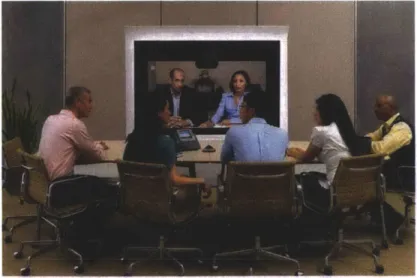
geographically dispersed teams in any of today's multinational companies Several applications like Webex make this possible. Users could make themselves seen using a web camera. More recent applications like Cisco Telepresence take the collaboration experience to a whole new level using conferencing "suites" that will make distant participants feel that they are all sitting in the same room.
2.6 Data Center Trends
Network Virtualization is emerging as a major trend in the Data Center, as it helps customers in two major ways: (a) reduces overall costs and supports green initiatives (b) provides a pool of resources that businesses can use to develop different business models". By making network, computing, and storage resources virtual in a unified platform, today's data centers attempt to offer customers with unprecedented flexibility and manageability. An example of such an integrated platform is the Cisco Unified Computing System. By using service profiles it can provide the flexibility to deploy network, storage and virtualization resources via server blades. The management of virtualization is simplified and it can even be automated. Server migration can be done seamlessly, where resources can be reconfigured without disruption of service.
The underlying technologies that enables data center virtualization is I/O consolidation over 10 GB Ethernet and Virtual Machine Awareness. Traffic of different types such as LAN, SAN and clustered applications can be handled over a single link, using what are called sub-links.
Typically a link is divided into 8 sub-links and these are then dedicated to different traffic types. This is called Priority Flow Controli2. Virtual Machine (VM) Awareness helps bridge the server, network and management domains to make sure changes in one domain are communicated consistently to others. For example, a VM move from one physical server to another triggers corresponding SAN moves, along with changes to network profiles. An example of VM aware networking platform is the Cisco Nexus 1000V, which uses a Distributed Switching
2.7
Consumer Solution Trends
The consumer networking solutions are increasingly becoming more aware of the need to integrate computing and entertainment needs of the modem, connected home. Homeowners and
SOHO customers are seeking solutions that provide (a) simplicity of management (b) integration
of functionality (c) cost effectiveness by reuse of existing home infrastructure.
Consumer entertainment delivery platforms such as set top boxes are now IP Aware. Apart from providing live programming and the ability to record many hours of programming, these devices offer ports for IP based LAN connectivity within the home, along with USB ports. The Cisco Explorer 8550HDC HD DVR, shown in Figure 4, is an example of the trend to integrate IP based networking into entertainment platforms.
Figure 4. A home entertainment platform with IP networking capabilities
Vendors like Linksys have expanded their product portfolios to include storage, video, print servers, range expansion, and powerline equipment for the end user. Such products were not
interesting. It helps convert existing power wiring inside homes into a high speed network, without the need for additional cabling. With speeds of up to 85 Mbps, these can be used for
video and VOIP13
2.8 Security
As internet access became more affordable and access speeds increased, a new breed of
applications have enabled connectivity from virtually anywhere. People are increasingly using a variety of hardware and software applications, and there is an increasing tendency to collaborate over the Internet. However, these trends have also made the end-user more prone to security attacks. Also, the variety of Internet access modes makes the network perimeter increasingly vague and difficult to safeguard.
The current trends in network security follow a systems approach to security whereby security is considered in four major domains: (a) Network and Endpoint Security (b) Content Security (c) Application Security (d) System and Identity Management. For example, the Cisco ACE Web Application Firewall provides comprehensive XML and HTML traffic inspection. Network and content security is brought about by a wide variety of hardware and software solutions like Firewalls, VPN systems, Intrusion detection and prevention systems. Identity management via sophisticated authentication schemes are integrated in all security solutions.
Network security solutions form a classic example of Systems Architecture, with a solution
stakeholders, including end users, enterprises, governmental organizations, financial institutions etc. A complete dissection of the Systems Architecture of Network security merits a thesis in itself, but it is sufficient to conclude that considerations of form, function, cost etc results in numerous solutions at the 2"d and 3rd level of architectural decomposition. For example, VPN is
implemented in both hardware and software; it is the user who chooses based on the need. Typically end users opt for software VPN, while small and medium businesses might be able to afford hardware VPN solutions.
2.9 Network Convergence
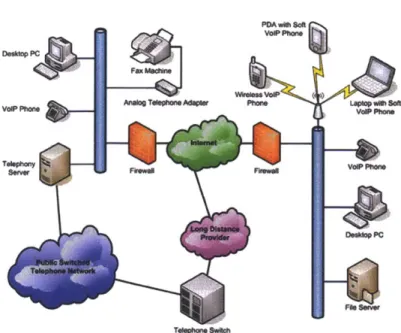
There are architectural changes happening to the network infrastructure to enable the migration of data, voice, and video on a single packet-switched network. This is a major change from the earlier architecture where voice and data existed mainly as circuit-switched and packet-switched networks respectively. The advantage of having a converged network is primarily in the lower capital expenditures for users, and ease of maintenance for service providers.
In the core network, this implies a migration from PSTN to VOIP. Underlying legacy Layer 2 technologies will migrate to using Layer 2 and Layer 3 VPNs, which are protocol independent, and ride on MPLS, a highly efficient switching mechanism. In the access networks, DSL and Cable providers will be accommodating voice ports. At the application layer, Session Initiation Protocol(SIP) and H.323 will be used in the local loop and long haul backbones respectively".
Figure 5. VOIP is a form of converged network
Video over IP is made possible by first converting the video content into MPEG-2 using a video codec. It uses lossy video compression and audio data compression to allow transmission over existing Internet bandwidths. It is then transmitted using IP Multicast by encapsulating MPEG-2 over IP. IP Multicast allows the efficient transmission of content to multiple destinations,
without the overhead of replication incurred in unicast transmission7.
2.10 Metro Ethernet
Based on the Ethernet standard, Metro Ethernet technology provides Internet access to end users and branch offices. Ethernet may be used in its pure form, based on SONET/SDH, or with
MPLS. Pure Ethernet deployments are less expensive, where as SONET/SDH deployments
provide investment protection for underlying SONET infrastructure. MPLS based Metro Ethernet provides reliability and scalability 8
A basic infrastructural element of a Metro Ethernet Network is the Ethernet Virtual Connection
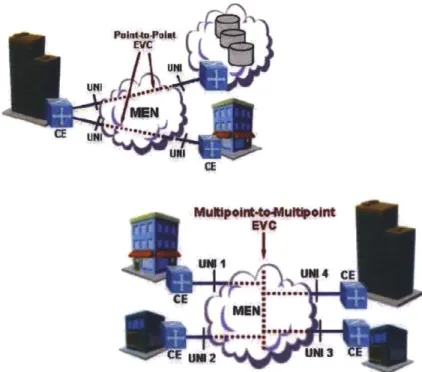
or the EVC. An EVC connects two subscriber sites (UNIs). It provides data protection by
carrying only the frames that belong to the connection. Metro Ethernet offers E-LINE service via point-to-point connections, and E-LAN services via multipoint-to-multipoint connections19. These are shown in Figure 6.
3 LAN Technology Trends
In the early to mid 80s, LANs (Local Area Networks) were dominated by technologies such as
ARCNET and Token Ring 20. The ARCNET used a star-wired bus topology, whereas Token
Ring used a ring topology. These technologies and the high-capacity variant of Token Ring, known as FDDI, all use tokens to access the physical media. Token Ring networks could provide throughputs of 16 Mbits/sec, while FDDI throughputs could reach as high as 1OOMbits/sec.
3.1 Ethernet
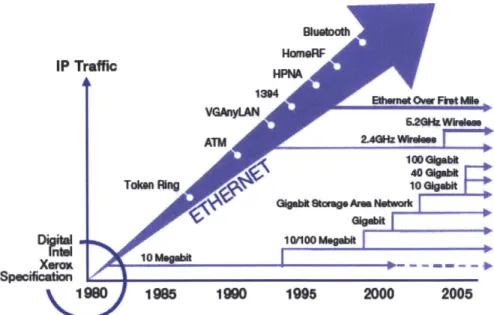
Although Ethernet was patented in the mid-seventies, it did not emerge as a disruptive technology until the development of its variants: (a) switched Ethernet and (b) high speed Ethernet. This disruption caused the original token based LAN technologies to become obsolete. Although Ethernet started at throughput rates of 10 Mbits/sec (a tenth of what FDDI offered), its later versions far exceeded FDDI. Today's high capacity variants of Ethernet, for example, can operate at 10 Gigabits/sec. Figure 7 captures historical trends for the Ethernet technology.
IP Traffic Toan ing 10 Sp nca 19N0 1995 AN AT M A EtmetOvw FAf 2AM Whis 100 Gigafbb 40 pgbit 10ig
GigabG Are NtWoark.n
10/100 MegabR
1990
1995
2000 2005Figure 7. Evolution of the Ethernet Technology
As of 2006, revenues from Ethernet Network Interface Cards at Gigabit speeds totaled about 1.6 billion worldwide.
3.2 Switched Ethernet
In its most basic form of Ethernet, end nodes are connected to an Ethernet hub in a star topology. However, Ethernet hubs have some shortcomings. First, the available bandwidth has to be shared
by all the nodes attached to the hub. Secondly, each end node has to wait for the common bus to
become available before it can transmit its data. Finally, data can be transmitted in one direction only, making it a half-duplex connection.
Switches overcome these shortcomings by establishing a temporary, dedicated connection
between two nodes. They eliminate the need to wait for transmission, since there is no possibility
HomneRF
Mo 06
lme""
ate c
tio.lefft
Wiae/orldwid LA wthmreuS 7 ilo
100BasaomeTPb~
thers Ma6TX
Figure 8. A switched Network
of collision on a dedicated connection. They also enable multiple traffic streams to flow simultaneously in both directions. In summary, they allow highly scalable, full duplex connections between network nodes. The first Ethernet switch was introduced by Kalpana in
1990. By 1995 LAN switching was in high demand. Figure 3 shows the major players in this
market in 1995, and their market share 2
LAN switch rnarket shares, 1995
Worldwide LAN switch market =$1.76 Billion Others 169% Xylan 2% UM 29 Cisco 21% Networks Alantec 29% NMadg 4% Fore 69 3Com 19% Syjstems Cabletron 8%
Digital 9 Bag Networks 11% Source: Dataquest
Figure 9. Major players in the 1.76 billion LAN switching market in 1995
This market has grown significantly. In Q4 2006 alone, the LAN switching market had increased to 4.7 billion. According to the Dell'Oro group, Cisco dominates this market2 3, as shown in
Figure 10.
Market Shares:
Fu4 2100 Ethestwitch LAN a garkerht asSharQ4e00 Tota--l M-ark;e~t $4
38111llon-Vendor Market Share %-HPPrcre 36
So:ur ce: Dell'O rof Febry20
-Figure 10. LAN switching market share as of
Q4
20063.3 Wireless LAN
The possibility of linking computers by wireless connections was originally demonstrated in Hawaii as part of the Aloha Network. IEEE standardized the technology via 802.11 and its variants. It gained popularity in the mid to late nineties, as laptops became more affordable and users increasingly wanted to stay connected. The primary benefits of the Wireless LAN are its convenience, ease of deployment, and mobility. However, even high speed wireless LANs operating at 1OOMbits/s are comparatively slower than their Ethernet counterparts.
The wireless LAN market surpassed 3.6 billion in 2006. Figure 11 shows the market share of major players in this segment in 2007.
4 WAN Technology Trends
A Wide Area Network (WAN) is one that spans a wider geographic area, sometimes across
different continents. It connects different LANs together. Organizations can own their private
WAN or subscribe to one provided by an Internet Service Provider. A WAN can operate in one
of the following modes: Leased Lines, Circuit Switched, Packet Switched, and Cell Relay26
Leased lines are dedicated point-to-point connections between two networks. They use protocols such as PPP, HDLC and SDLC. Switched WANs are less expensive, and can offer speeds of up to 156 Mbits/sec. Circuit switched WANs use protocols such as PPP and ISDN, while packet
switched WANs use X.25 and Frame Relay. Cell Relay, considered a variation of packet switching, uses ATM. Historically, the use of Leased lines has dominated the WAN market segment, as shown in Figure 12. Overall, WAN has seen the following trends: (a) obsolescence
of X.25; (b) emergence of MPLS; (c) adoption of PPP over SONET
1990 WORLDWIDE REVENUE Dedicated Access Data Services
Leased $24.5B
Line
Frae $8.2B
ATM $1.1B
4.1 Obsolescence of
X.25
X.25 was widely used in the 1980s to operate the financial Automated Teller Machine Network.
However, the protocol came with significant overhead in its error correction mechanism. As the underlying WAN hardware became more robust, the protocol was replaced by Frame Relay, which did not have the error correction overhead. Frame Relay uses the concept of virtual circuits (VCs) to establish connections between two end-points. ATM, too, operates using the concept of VCs; however, it uses cell relay to divide the network payload into 52 byte cells. The cells are segmented and reassembled, usually in hardware.
As shown in Figure 1327, ATM and Frame Relay registered significant growth rates in the US in the late nineties, when the Internet became hugely popular. The use of leased lines was still widespread, although it showed a slight downward trend.
1997 1.03 ed 224a3 si; an
- -
3,318Leased Frame Relay ATM
Line Service Service
1,396,426 2000
99720
19,6M
Leased Frame Relay ATM
Line Service Service
Figure 13. US Leased lines, A TM, and Frame Relay market trends in the late nineties
r-om"
4.2 Emergence of MPLS
MPLS (Multi Protocol Label Switching) is a packet switching technology. Network packets are assigned labels, and MPLS capable switches switch packets based on the labels. When packets
enter the MPLS cloud, the edge router (Label Edge Router or LER) pushes a label onto to the protocol stack. This label is popped when the packet leaves the cloud. Intermediate switches
switch packets based on the label stack, and exchange labels using a protocol called Label Distribution Protocol (LDP). Figure 14 shows a conceptual MPLS cloud2 8
The primary advantage of label-based packet switching is that it carries less overhead than cell relay. Secondly label based switching is protocol agnostic. It could operate on any Layer 2 protocol such as Frame Relay, Ethernet or ATM. Accordingly, MPLS is considered to be at Layer 2.5 in the OSI model. Also, MPLS enables class of service (CoS) tagging and
prioritization of network traffic, so administrators may specify which applications should move ahead of others29.
Cisco has dominated the market in MPLS edge routers30, as shown in Figure 15.
Figure 15. MPLS edge router market share
4.3 Adoption of PPP over SONET
Cisco has been actively involved in the creation of a protocol to provide high point-to-point line rates in the WAN. The resulting Packet over SONET (POS) technology uses PPP (point-to-point protocol) over optical fibers that transmit data using lasers. This technology enjoys major
advantages such as low overhead, rapid point to point transmission, self-healing ring structure to reroute traffic, and widely deployed transmission infrastructure3 1
POS served as a viable technology to transport Ethernet LAN traffic over the WAN. However, it
did need a router to convert Ethernet frames to POS. Later, other standards have made the transportation of Ethernet frames directly over SONET more efficient. They are Virtual Concatenation (ITU-T G.707 2000) and Generic Framing Procedure (GFP, ITU-T G.7041)3 2
5
Access Technology Trends
As the Internet became available to general consumers in the mid 80s, the first technology to be used by residential customers was dialup. However, the original dial up access used dedicated telephone lines and was generally slow3 3. Top speeds with typical dial-up were 56kbit/sec.
5.1 Beginnings of Broadband: ISDN
Integrated Services Digital Network (ISDN) uses telephone lines to provide broadband access to residential customers. The technology can be used to transmit both voice and data. It was highly popular in the mid 90s. It used two types of channels, namely B and D channels. The B channel operates at 64 kbps and carries data, voice and video. The D channel operates at 16 kbps and provides signaling support.
Figure 16. ISDN service types
As shown in Figure 16 ISDN service can be offered using a combination of B and D channels.
There are generally two levels of service: Basic Rate Access(BRA) and Primary Rate Access (PRA).
5.2
Mainstream Broadband: DSL and Cable
Digital Subscriber Line (DSL) is a technology that uses higher frequencies on telephone lines to transmit data. The frequency band is 25 kHz and above.. The bandwidth of DSL ranges from
256 kbits/sec to 24000 kbits/sec. Typically, upload speed is lower than download speed for Asymmetric DSL; they are equal for Symmetric DSL35.
Cable broadband works on cable television networks, based on a standard known as DOCSIS (Data Over Cable Service Interface Specification)36. Customers would typically use a cable modem that bridges the home Ethernet LAN and the Cable network. DOCSIS 1.0 and 1.1 uses channel widths between 200kHz and 3.2mHz. Additionally, cable is a shared media in the sense that all users share the available bandwidth. This is done by using Time Division Multiple Access (TDMA), whereby the cable frame is divided into multiple slots and each user is allotted a time slot. Cable offers upstream bandwidth of 30.72 Mbits/sec and a downstream bandwidth of
55.62 Mbits/sec. Compared to DSL, cable is less secure, because of its shared bandwidth. DSL experiences signal degradation with distance; however, this is not an issue for cable broadband".
Figure 17 shows the market share of different broadband service providers in the US38.
Market Share of
Enberq-2% Cabesion 4% 5%Leading
Broadband Service
p FI wrWm cherwr 5%l Cox 7% Tim Wanr w 13% Sow: Park Asocefs Researh02008 Parks Associats Verzn -13% AT&T (Inchding BelSoum) 21% Comas 22%
Note: AT&T and
Verizon's fiber deployments are included in this chart
Figure 17. Broadband Service Provider Market share
internet Connection Type
DSL, ADSL Cable mrodem Dial-up 100% 80% 60% 40% 20% 0% 200 2003 306Source: Consumer Electronics Association
6 Business Development Trends at Cisco Systems
"Certain things have happened that have been very lucky for Cisco along the way, but I think that in a lot of ways you create your own good luck," said Barry Eggers, a Silicon Valley venture capitaliSt.40 Cisco, starting out with a basic routing solution in the mid 80s, has grown to be a leader in end-to-end networking technology with an impressive portfolio of products in all the major areas discussed earlier, namely LAN, WAN, Access, and Advanced Technologies. Two factors have significantly contributed to Cisco's success: (a) a balanced outlook to business development that comprises internal R & D, Acquisitions, and Alliances (b) mistakes made by key competitors.
In this section, we analyze the business development at Cisco in response to the rapid growth in demand for network infrastructure devices. It is fair to say that the company could not have grown at the rate it has by internal R & D alone. Since 1993, a steady stream of acquisitions of relatively small companies has helped Cisco position itself competitively in the market. The data from more than a 100 acquisitions can be analyzed using well-known tools such as the
Familiarity Matrix. The Familiarity Matrix essentially provides optimum entry strategies for business development, using two types of factors that determine the success of for any
technology enterprise: (a) Technology (b) Market41. The terms 'Newness' and 'Familiarity' are used to understand the relative position of a business with respect to a certain technology or
market. Familiarity refers to the degree to which a factor -- technology or market - is known to
the business but may not yet be implemented. Newness takes the opposing viewpoint in that it is the degree to which the factor is not implemented within the business.
With 3 levels of familiarity for both Technology and Market factors, we have a 3 X 3 Familiarity Matrix as shown in Figure 19 below. The optimum entry strategies for each cell of the Matrix
have been indicated.
New Unfamiliar New Familiar Base Base Figure (Legend: New Familiar New Unfamiliar
19. Optimum Entry Strategies for Business Development.
VC -- Venture Capital; VN - Venture Nurturing; JV - Joint Ventures)
In the case of Cisco, enterprising routing technology can be considered as the Base technology factor, and correspondingly, large Enterprises market would be the Base Market factor. Over the course of 25 years, the company has released products in a variety of other technologies and
explored new markets. Analysis of Cisco business development could be done by considering the acquisitions under four sections, similar to the way we analyzed technology trends in the
previous sections: LAN, WAN, Access, and Advanced Technologies. We will analyze the familiarity of the technology and market factors of the acquisition from the perspective of Cisco
Joint VC or VN VC or VN
Ventures Or Educ. Or Educ.
Acquisition Acquisition
Internal IV or VC or VN
Mkt. Dev. Acquisition Or Educ.
or or Acquisition
Acquisition Licensing
Internal Base Internal Prod. New Style
Dev. (or Dev. or JV
Acquisition) Acquisition or Licensing
at the time of acquisition. Thus two acquisitions having a lot of commonality in technology and market perspectives may be viewed differently, because the prevailing conditions from a Cisco perspective at the time of acquisition may be different.
7 Cisco LAN Acquisitions
Enterprise LAN has been one of the fastest growing markets and certainly one where Cisco has market leadership. Although Cisco started out with the base wired routing technology, it had to react quickly to changing technology and market conditions in the LAN business, such as the need for Switched Ethernet and Wireless LAN. Below, we have tabulated some of the interesting
LAN acquisitions along with notes on their technology and market factors at the time of
acquisition.
Company Acquired Date Acquired Technology Factors Market Factors
Crescendo September 21, 1993 This marks Cisco's Cisco had participated
Communications, first entry into LAN actively in the
Inc42 switching, a Enterprise LAN
technology that was market by virtue of its related to Cisco's initial routing
routing base solutions, so the larger technology, but added Enterprise market was a new dimension to familiar. However, workgroup solutions switching was a new and performance addition to the
networking. portfolio.
_______________Rating: New Familiar Rating: Base
Kalpana, Inc43 October 24, 1994 This acquisition added Cisco had familiarity a new dimension to with Enterprise LAN Cisco's switching switching market This portfolio in that it Acquisition targeted a followed stackable niche within that architecture, helped market, namely
low-increase the end switching
throughput of solutions.
Ethernet Networks, and allowed
general Enterprise
LAN switching was a
familiar technology Rating: Base
LightStream December 8, 1994 The technology This was a new
Corporation44 acquired (Enterprise market and Cisco was
Class ATM LAN the pioneer in
Switching) is providing Enterprise
reasonably unfamiliar, class ATM switch that
since ATM is could support
markedly different multimedia
from Ethernet. applications.
4T
Rating: New Familiar Rating: New Familiar
Navarro Network4 May 1, 2002 Navarro's ASIC The Ethernet
components switching market was
technology helped very familiar to Cisco Cisco enhance its at the time of
internal development acquisition. of high-end ASICs for Rating: Base Ethernet switching
platforms. The technology was familiar to Cisco. Rating: Base
Aironet Wireless November 9, 1999 Aironet's Wireless The Wireless LAN
Communications46 LAN access point and market was unfamiliar
access card to Cisco, although it
technology was complemented the
unfamiliar to Cisco, Wired LAN market. although Cisco was
very familiar with the Rating: New wired Enterprise LAN Unfamiliar
Rating: New
Unfamiliar
Table 1. Cisco LAN acquisitions and their familiarity ratings
We have mapped the above observations of technology and market familiarity on to the Familiarity Matrix in Figure 20 below. As we can see, the pasern of LAN acquisitions is in general agreement with the optimum business development strategies of Figure 1; i.e., Cisco
LAN acquisitions seem to be good entry points at the time of acquisitions. Going back to the
LAN technology trends discussed in the previous sections, we can see that Cisco reacted to
changing market conditions in LAN primarily through acquisitions. This includes the shift to Ethernet switching (Crescendo, Kalpana), and more recently, the use of Enterprise class Wireless LANs (Aironet). New Unfamiliar New Familiar Base Base New Familiar New Unfamiliar
Figure 20. Cisco LAN acquisitions sample on the Familiarity Matrix Aironet
LightS ream
Kalpa a0
Cresce do Navarro
1987-92 1992-97 1997 - '02 '02 onwards Navarro Aironet Lightstream Kalpana Crescendo
Time or engineering effort required
Figure 21. Cisco LAN acquisitions in the context of switched
LAN technology S-curve
In Figure 21, we consider Cisco's LAN acquisitions in the context of a technology S-curve as proposed by Christensen. For this purpose we have divided the S curve over periods of 5
years, starting in 1987, when Cisco was developing routing hardware for the enterprise. In our view, the period from 1992 through 1997 saw the highest improvements in Enterprise LAN performance, via the emergence of switched Ethernet. Cisco has made 3 acquisitions in this time period that directly address Enterprise LAN needs. These proved to be very successful in the long run for Cisco. The Navarro acquisition happened as the switching technology matured, and
Cisco sought competitive advantage via the use of high-end ASICs. It is clear from Figure 21 that Cisco's timing of Enterprise LAN acquisitions in the early to mid 90s was critical to its success.
8 Cisco WAN acquisitions
With a strong leadership in the Enterprise LAN market by mid 90s, Cisco looked for growth in the Service Provider segment of the market. The Internet became hugely popular all over the world, providing connectivity to end users and remote branch offices was a multi-billion dollar business. Service Providers demanded speed and ease of configuration. Cisco positioned itself for this opportunity by placing products in three categories: (a) WAN edge routing (b) WAN Switching and (c) Core routing. In parallel, there was an increasing need for optical media to enable higher speeds. The WAN switching nodes had to be fast. The core routers had to be
highly available while also providing the capability to store and handle tens of thousands of
routing updates.
Cisco's foray into the WAN market was greatly aided by its acquisition of Stratacom, Inc. in
1996. Stratacom's ATM and Frame Relay Switches complemented Cisco's routing products in
the WAN market. Cisco has since made other WAN acquisitions that strengthen its optical networking offerings. In Table 2, we have analyzed key Cisco WAN acquisitions.
Company Acquired Date Acquired Technology Factors Market Factors
Stratacom Inc.48 April 22, 1996 ATM and Frame For the first time,
Relay switching for Cisco targeted the
WAN networks were service provider unfamiliar to Cisco, market and attempted although Cisco had to distinguish itself offered Campus ATM with end-to-end
solutions. offerings.
Rating: New Familiar Rating: New Familiar
Skystone Systems June 9, 1997 This marked Cisco's The niche market for
Corp49 commitment to providing integrated
SONET/SDH data, voice, and video technology, which it over backbone was unfamiliar with. networks was new to
Rating: New Cisco
Unfamiliar Rating: New
Unfamiliar
PipeLinks, Inc" December 2, 1998 Cisco built upon its Cisco was already
SONET/SDH familiar with the strengths by acquiring integrated services the Pipelinks' router market for service that integrated circuit providers. The and packet switching. acquisition However, it was strengthened its already familiar with market position for
SONET/SDH integrated data, voice
technology. and video.
______________________________Rating: New Familiar Rating: New Familiar
Monterey August 26, 1999 Cisco acquired optical Cisco was already
Networks/Cerent cross connect familiar with the long
Corporation5 1 technology that would haul optical
instantly allow service networking market. providers to quickly With these
and cost effectively acquisitions, it added add capacity at the products for the core of an optical optical transport network. The general market.
optical networking Rating: New Familiar technology was
already familiar to Cisco.
Seagull
Semiconductor Ltd 52
April 12, 2000 Cisco acquired
semiconductor
technology that would accelerate its ability to develop terabit
routers. The technology was
familiar to Cisco, which had developed high performance routers for the Enterprise Rating: Base
Cisco was very familiar with the service provider core routing market Rating: Base
Table 2. Cisco WAN acquisitions and their familiarity ratings
The corresponding Familiarity Matrix for Cisco WAN acquisitions is shown in Figure 22.
New Unfamiliar New Familiar Base Base New Familiar New Unfamiliar
Figure 22. Cisco WAN acquisitions sample on the Familiarity Matrix Skystone Stratac m Pipelinks Mon erey/ Cere it
0
SeagullAs we can see, acquisitions were central to Cisco's growth from WAN. They helped the company compete on all WAN fronts noted above. Optical networking infrastructure and
SONET/SDH technologies dominated the WAN acquisitions. The acquisitions were also
testament to Cisco's end-to-end growth strategy, as it targeted every segment of the WAN. Cisco has been more adventurous in WAN acquisitions compared to LAN, as we see from the higher concentration of dots away from the base. This is understandable as Cisco's mainstay was the Enterprise routing and switching market prior to its rapid entry into the Service Provider market.
1990-95 1995-00 '00 onwards
Seagull
Pipelinks 'Skystone Stratacom
Time or engineering effort required
Figure 23. Cisco WAN acquisitions in the context of the WAN optical networking technology S-Curve
In Figure 23, we consider the growth of backbone optical networks in three time periods. The maximum benefit of the optical backbone networks came about in the mid to late nineties, when service providers rushed to add capacity. Cisco's WAN acquisition pattern shows a more evenly spread distribution along the optical technology S-curve, compared to the LAN pattern discussed earlier. Having secured a head start with Stratacom's ATM technology, Cisco's commitment to optical backbone networks remained strong and steady. A string of SONET/SDH acquisitions offered performance advantages for the integrated services market, with relatively low time and engineering effort on the part of Cisco.
9 Cisco Access Technology Acquisitions
Although Cisco focused primarily on the Enterprise and Service Provider network infrastructure, it has had its presence in the small and medium business access market. Broadband access, which provides high speed internet access to small/medium businesses and home offices, has seen several waves of technologies in the past 20 years. Cisco has tried to compete in this space
by positioning products for end users and access providers. Its products have incorporated
technologies for several access technologies, including ISDN, DSL and Cable.
One aspect of the Small Office Home Office (SOHO) market is that the end user side of it is dependent on higher volumes, and product margins are generally low. For a direct seller of primarily expensive, high margin equipment, the SOHO market was not Cisco's forte. Cisco acquired companies to provide feature sets for the price points of this market. It partnered with local Internet access providers as a channel for selling the products to end users. For example, Pacific Bell, a leading service provider in the San Francisco Bay Area, deployed thousands of
ISDN (Cisco 1600 series) and DSL (Cisco 675 series) routers to home users in the mid to late 90s. It has more recently participated in sales through retailers like Best Buy, primarily for its
SOHO products acquired by the purchase of Linksys. Below we have analyzed some acquisitions
in the Access Technology space that have helped Cisco be more effective in a difficult and sometimes unfamiliar terrain.
Company Acquired Date Acquired Technology Factors Market Factors
Combinet Inc-' August 10, 1995 Cisco was familiar The market for
with the ISDN telecommuters and the
technology, since it use of resellers to
was already foster sales was
incorporated in its unfamiliar to Cisco. It products such as used the acquisition as Cisco 7000, Cisco a means to access 4000, Cisco 2500 and these sales channels. Cisco 1000 series Rating: New
routers. This Unfamiliar
acquisition would strengthen its
expertise in the ISDN technology.
useRating: Base
DagaZ54 September 2, 1997 Cisco was familiar Cisco was familiar
with the DSL with the DSL market,
technology. It but this acquisition acquired the xDSL expanded its market access multiplexer with the
products which complementary xDSL
strengthened its DSL assets and intellectual
portfolio, property.
D a SRating: New Familiar Rating: New Familiar
Netspeed March 10. 1998 The DSL technology Although Cisco had
was familiar to Cisco. some experience Cisco mainly acquired selling its products via the customer premise resellers, the DSL
DSL products to offer market meant a new an end-to-end DSL set of access providers access solution to its that it needed to
customers. partner with, such as
Rating: Base US West.
Rating: New Familiar Clarity Wireless561 September 15, 1998 This acquisition The market for last
brought in fixed last mile wireless
mile wireless technology was new
technology that to Cisco. The general
complemented market for end user
Cisco's other last mile access was familiar, technologies like DSL though.
and Cable. Rating: New Familiar
sellingitproaRating: New
Maxcomm Technologies57
_ I[Unfamiliar
August 18, 1999 Cisco acquired
technology that would use existing cable and
DSL networks to
provide access to public networks,
giving consumers more choices for
combined data and voice services
Rating: New Familiar
Cisco had experience in the last mile access market. This
acquisition improved its offerings in that market.
Rating: Base
Linksys*" March 20, 2003 The SOHO The marketing of
technologies of SOHO products
Linksys, including meant the use of new wireless, VoIP, print sales channels such as servers, hubs etc were retail stores, which largely familiar to was unfamiliar turf
Cisco. for a direct seller like
Rating: Base Cisco.
Rating: New
Unfamiliar Comcom 9 September 15, 1999 Cisco acquired the The cable access
Digital Video market was already
Broadcasting (DVB) familiar to Cisco. The
technology to acquisition was meant
complement its cable to increase Cisco's
access product competitiveness in
portfolio. However, this market. the base technology Rating: Base was familiar to Cisco
Rating: New Familiar
Table 3. Cisco Access Technology acquisitions and their familiarity ratings
We have located Cisco Access Technology acquisitions in the Familiarity matrix in Figure 24. Cisco has once again focused on acquisitions as a major source of growth in Access Networks, an area which has historically not been its core strength.
New Unfamiliar New Familiar Base Base New Familiar New Unfamiliar
Figure 24. Cisco Access acquisitions sample on the Familiarity Martix
The distribution, with a centre of gravity away from the origin, indicates that Cisco has taken significant risk in offering end-to-end Access solutions. In fact, Access acquisitions exposed Cisco to the retail market for the first time, unlike some of its competitors like 3Com and Bay Networks that had the retail experience much longer than Cisco did. Also, the acquisitions laid the foundation for future opportunities in integration of data, voice, and video. Thus Cisco was not necessarily interested in immediate returns, but it had a long-term network integration focus. For example, with the Maxcomm acquisition, Cisco acquired digital video broadcasting
expertise. Combinet Li Skystone *Li: iksys0 * Dagaz Netspeed Clarity Comcom Maxcomm
1990-95 1995-00 '00 onwards Ma omm Linksys Nets eed / Dagaz 1ComCom Combinet ... IS D N DSL -- Cable
Time or engineering effort required
Figure 25. Cisco Access acquisitions in the context of the Access Technology S curves
In Figure 25, we have analyzed the three primary technologies for Internet Access over a period
of 10 years, namely ISDN, DSL, and Cable. Cisco acquisitions have happened in all the three
areas, with a greater density around the DSL technology. These acquisitions have come about in
the early to mid sections of the S-curves. Although one cannot pre-determine the time span of an
S Curve for any new technology, Cisco's timing for these acquisitions has generally worked in
its favor. Linksys was an exception in the sense that Access side of Linksys' products had
products tailored for the SOHO network. The acquisition would allow Cisco penetrate the SOHO market quickly, and position itself for end-to-end offerings.
10 Cisco Advanced Technology Acquisitions
With a primary focus on 3 core lines of business, namely Enterprise, Service Provider, and Small-Medium businesses, Cisco has acquired technology companies that offered advanced features. These acquisitions are meant to address one of the following needs:
(a) Provide product differentiation by offering value added features and services in existing routing and switching platforms that Cisco already sells
(b) Provide complementary products that result in end-to-end integrated offerings
(c) Provide an entirely new product line or service that would position the company competitively for a new opportunity
Cisco has made advanced technology acquisitions in a multitude of areas, including Network Manageability, TCP/IP services, Network Security, Voice over IP (VoIP), Video, and Collaboration. A majority of Advanced Technology acquisitions happened in the Voice Technology area. This was expected as Cisco found itself competing with companies such as Lucent Technologies and Northern Telecom (Nortel). Cisco's forte has traditionally been data networks; however, in the mid to late 90s, the priorities shifted to providing end-to-end integrated services whereby a single network would carry data, voice and video. Lucent and Nortel had their strengths and experience in voice networks; however, they had their own challenges in positioning themselves for the integrated network. Below, we have analyzed some Advanced Technology acquisitions made by Cisco.
Company Acquired Date Acquired Technology Factors Market Factors
TGV Software Inc60 January 23, 1996 TGV's Multinet As primarily a
TCP/IP stacks for hardware vendor, VAX and Windows Cisco was unfamiliar platforms brought in with the market for Enterprise software shrink-wrapped application expertise desktop software for and products. Cisco either the VAX or the
was familiar with Windows markets
Network protocol Rating: New
stacks as part of Cisco Unfamiliar
'OS.
________________Rating: New Familiar
Telebit Corp6' July 22, 1996 Cisco acquired Cisco was familiar
Modem ISDN channel with the market for integration technology ISDN. MICA made
(MICA). This is a its products more classic example of competitive Cisco acquiring new Rating: Base technology to enhance
its existing offerings Rating: Base
Netsys Technologies62 October 14, 1996 The Network Cisco was familiar
Infrastructure with the market where
management and Netysys' products
Analysis technology would be deployed from Netsys omtitive
complemented Cisco Rating: Base products and helped
customers plan and simulate networks Rating: New Familiar
Global Internet i June 24, 1997 Cisco acquired The market for
Software Group 3 firewall technology Windows NT based
for small-medium firewalls for businesses. By way of small/medium PIX firewall, Cisco businesses was not was already familiar familiar to Cisco, with enterprise class although it was
firewalls. familiar with
Rating: New Familiar Enterprise class firewalls