Publisher’s version / Version de l'éditeur:
Vous avez des questions? Nous pouvons vous aider. Pour communiquer directement avec un auteur, consultez la première page de la revue dans laquelle son article a été publié afin de trouver ses coordonnées. Si vous n’arrivez Questions? Contact the NRC Publications Archive team at
[email protected]. If you wish to email the authors directly, please see the first page of the publication for their contact information.
https://publications-cnrc.canada.ca/fra/droits
L’accès à ce site Web et l’utilisation de son contenu sont assujettis aux conditions présentées dans le site
LISEZ CES CONDITIONS ATTENTIVEMENT AVANT D’UTILISER CE SITE WEB.
Research Report (National Research Council of Canada. Institute for Research in Construction), 2005-04-05
READ THESE TERMS AND CONDITIONS CAREFULLY BEFORE USING THIS WEBSITE.
https://nrc-publications.canada.ca/eng/copyright
NRC Publications Archive Record / Notice des Archives des publications du CNRC :
https://nrc-publications.canada.ca/eng/view/object/?id=7779dbd7-7ed6-428f-a29c-a9ebb6c0bcae https://publications-cnrc.canada.ca/fra/voir/objet/?id=7779dbd7-7ed6-428f-a29c-a9ebb6c0bcae
NRC Publications Archive
Archives des publications du CNRC
For the publisher’s version, please access the DOI link below./ Pour consulter la version de l’éditeur, utilisez le lien DOI ci-dessous.
https://doi.org/10.4224/20378361
Access and use of this website and the material on it are subject to the Terms and Conditions set forth at Methodology for the Analysis of Volatile Organic Compounds in Emission Testing of Building Materials
http://irc.nrc-cnrc.gc.ca
M e t h o d o l o g y f o r A n a l y s i s o f V o l a t i l e O r g a n i c
C o m p o u n d s i n E m i s s i o n T e s t i n g o f B u i l d i n g
M a t e r i a l s
I R C - R R - 2 5 4
L u s z t y k , E . , Y a n g , W . , W o n , D . Y . ,
A p r i l 2 0 0 5
The material in this document is covered by the provisions of the Copyright Act, by Canadian laws, policies, regulations and international agreements. Such provisions serve to identify the information source and, in specific instances, to prohibit reproduction of materials without written permission. For more information visit http://laws.justice.gc.ca/en/showtdm/cs/C-42
Les renseignements dans ce document sont protégés par la Loi sur le droit d'auteur, par les lois, les politiques et les règlements du Canada et des accords internationaux. Ces dispositions permettent d'identifier la source de l'information et, dans certains cas, d'interdire la copie de documents sans permission écrite. Pour obtenir de plus amples renseignements : http://lois.justice.gc.ca/fr/showtdm/cs/C-42
Methodology for Analysis of Volatile Organic Compounds in Emission
Testing of Building Materials
Summary
The methodology for the analysis of compounds emitted from building materials applied in this phase of the project was generally similar to that used in Phase 1 of the CMEIAQ project (CMEIAQ-I), but it was further extended and enhanced.
Firstly, the list of 90 chemicals (IRC Target Compounds) was used as a basis for identification and individual quantification of VOCs in all tested building materials and in all samples taken during the progress of each test. As was used in Phase 1, GC/MS was the primary analytical technique. Some changes in operating parameters for GC/MS were introduced to improve separation and detection of Target Compounds. In addition to GC/MS, HPLC was applied for quantification of low molecular weight carbonyl compounds.
Secondly, the quantitative data analysis of Target Compounds was established using the extracted ion technique for identification and integration of peak areas, and individual response factors for concentration calculations.
Thirdly, a new data analysis approach was applied to the majority of data obtained in Phase 1 of the project, producing higher quality of data compatible with those obtained in the most recent experiments.
Table of Contents
Summary... i
List of Figures: ... iii
List of Tables:... iii
1. Introduction... 1
2. Gas Chromatography Mass Spectrometry Methodology ... 1
2.1 Sampling ... 2
2.2 Apparatus ... 2
2.3 Calibration of the Analytical System... 2
2.4 General Analysis of VOCs Emitted from Tested Materials ... 2
2.4.1 Identification of Compounds ... 3
2.4.2 Toluene Based Quantification of Identified VOCs... 3
2.5 Quantification of Total Volatile Organic Compounds... 3
2.6 Analyses of Target Compounds... 3
2.6.1 Calibration of Target Compounds ... 4
2.6.2 Identification and Quantification of Target Compounds in Air Samples ... 4
2.6.3 Calculation of Target Compounds Concentration in Air... 4
2.7 Quality Control/Quality Assurance... 5
2.7.1 Instrument Performance Quality Control... 5
2.7.2 Analytical Accuracy... 5
2.7.3 Methodology Performance Criteria for Target Compounds Analysis... 5
3. New Quantitative Analysis of Target Compounds from CMEIAQ-I Test Data. 7 3.1 Identification of Target Compounds... 7
3.2 Quantification of Target Compounds individually calibrated ... 7
3.3 Quantification of Target Compounds not individually calibrated ... 7
4. HPLC methodology ... 8 4.1 Sampling ... 8 4.2 Apparatus ... 8 4.3 Calibration... 8 4.4 Performance Criteria... 8 5. References... 9
List of Figures:
Figure 1. Target compounds calibration procedure. ... 21
List of Tables:
Table 1. Operating parameters for GC/MS analyses. ... 10 Table 2. List of standard compounds calibrated in CMEIAQ-II. ... 11 Table 3. List of target compounds individually calibrated in CMEIAQ-II, their retention
time (RT), primary and secondary ions, response factor ratio against toluene (RRC), and method detection limit (MDL)*... 12
Table 4. Target compounds concentration calculated using individual and toluene
response factor for OSB 4 -24h sample... 14 Table 5. Analytical accuracy measurements... 15 Table 6. Audit accuracy* values for selected target compounds... 16 Table 7. List of target compounds individually calibrated in CMEIAQ-I, their retention
time (RT), primary ion and response factor ratio against toluene (RRC). ... 17
Table 8. Target compounds analyzed by GC/MS in CMEIAQ-I, toluene TIC calibrated. ... 19 Table 9. Target compounds analyzed by HPLC. ... 20
Methodology for Analysis of Volatile Organic Compounds in Emission
Testing of Building Materials
1. Introduction
Hundreds of volatile chemical compounds are emitted from building materials. They have different levels of toxicity and are in a wide range of concentrations. Their chemical and physical properties can be very different. The chemical analysis to identify and to quantify all of them could be very complex and expensive. Therefore, an analytical methodology has to set practical and economical criteria within the scope of its application.
In Phase 1 of this project the practical approach was to identify and to quantify ca. 20 most abundant compounds in one, usually 24h sample. Only 5 or 6 model compounds and TVOC (Total Organic Volatile Compounds) were quantified in all test samples. Toluene was used as a calibration standard for quantification of identified VOCs (Volatile Organic Compounds) and TVOC. Model compounds were calibrated individually using their own authentic samples (NRC, 1999).
In this phase of the project the methodology was further extended and elaborated. Most importantly, a list of 90 compounds (Target Compounds) was established to be quantified individually in all samples from emission tests (the list and the basis for its content are presented in Report 1.1). These data should provide more realistic foundations for predictions of cumulative effects of VOCs indoors where different materials and chemicals are present in varied quantities.
The list of Target Compounds to be identified and quantified is very diverse; it contains chemical compounds with very different physical and chemical properties. The
quantitative analysis of these compounds cannot be achieved by applying a single technique. Two analytical techniques were selected in this study: GC/MS and HPLC. As was used in Phase 1, the principal methodology was GC/MS with thermal desorption. However, using Extracted Ion rather than Total Ion technique in data analysis and using individual response factors for mass calculations significantly enhanced the precision and accuracy of analytical methodology applied in GC/MS quantification.
This new approach was also used to reanalyze for the presence of Target Compounds from the stored data from Phase 1 of the project. The data from 43 out of total of 48 tests were reanalyzed using this approach. Other 5 were initially analyzed using FID detection and are not amenable for the new method.
Development of HPLC methodology was required for quantification of 5 compounds from Target Compound list, since they cannot be properly analyzed using GC/MS approach.
2. Gas Chromatography Mass Spectrometry Methodology
Exhaust air from a test chamber was pumped through multi-bed sorbent tubes where VOCs were trapped. The sampled tubes were tightly capped and stored in room
temperature until they were analyzed, which were not later than two weeks. The exposed tubes together with a blank tube and a series of tubes with a calibration mixture were thermally desorbed and analyzed by GC/MS for individual VOCs and TVOC. The mass spectrometer was operated in the scan mode.
Quantitative data analysis of Target Compounds and TVOC were performed for all analyzed emission test samples. Data analysis for major VOCs emitted from tested materials, which may or may not be Target Compounds, was performed for a sample collected at approximately 24h from the start of one emission test.
2.1 Sampling
Supelco Carbotrap 300 tubes were used for air sampling. These three-bed tubes were designed to maximize the collection of VOCs in a wide range of volatility. The volume of the sample, depending on the concentration of the VOCs, was from 10 mL to 10 L with a sampling rate not higher than 200 mL/min.
2.2 Apparatus
Perkin-Elmer ATD400 thermodesorber connected with Gas Chromatography (Agilent GC 6890)/Mass Spectrometry (Agilent MSD 5973) system was used for all analyses. Operating parameters for the analytical system are summarized in Table 1.
2.3 Calibration of the Analytical System
A three-point calibration from the solution of toluene and 11 other standard compounds was performed daily at the beginning and at the end of a sequence of analyzed samples. The solution of pure chemicals in methanol was injected directly into the Carbotrap B/C sorption tubes. Calibration tubes were purged for 2 min to remove solvent prior to desorption. Toluene Response Factor from Total Ion Chromatogram (RFTT) and Ion 91
(RFT) were calculated as a slope of the linear response of its peak area against the
injected amount in ng. Ratios of response factors of other calibrated compounds to toluene were calculated and monitored for quality control purposes. List of standard compounds in a calibration mixture, and their properties are presented in Table 2. The standard compounds were selected to represent ten classes of compounds: ALD (aldehydes), ALOH (alcohols), CL (chlorinated compounds), EST (esters), HC-AL (aliphatic hydrocarbons), HC-AR (aromatic hydrocarbons), HC-CYC (cycloalkanes), KET (ketones), MISC (miscellaneous compounds), TERP (terpenes).
2.4 General Analysis of VOCs Emitted from Tested Materials
A general analysis of emitted VOCs was performed for the sample taken at
approximately 24h from the beginning of one test for all tested building materials. The purpose of the general analysis was to identify all chemicals emitted in a large amount while they may or may not be on the Target Compound list. The information may be used to update the Target Compound list in the future.
Compounds with chromatography peaks exceeding 1% of the TVOC were identified and quantified using the Toluene Response Factor for TIC (RFTT). The sum of their
concentrations represented usually more then 60 % of the TVOC concentration.
2.4.1 Identification of Compounds
Non-target compounds were identified by comparison of mass spectrum with NIST Mass Spectra library. Identification was confirmed by retention time and comparison with previously analyzed samples from different tests. In some cases, no strong match was obtained and the compound was flagged as “unidentified”. Many isomers of
hydrocarbons and cyclohydrocarbons were only identified to a class level, similarly as less-common terpenes and silioxy compounds. Target compounds identification was based on extracted ion analyses, in comparison with authentic sample mass spectra and their retention times.
2.4.2 Toluene Based Quantification of Identified VOCs
Concentrations of all identified compounds were calculated using the toluene response factor (RFTT). Peak area used in Equation 1 was from the integration of Total Ion
Chromatogram (TIC) peaks. In some cases peaks of eluted compounds overlapped one another and they were reported together.
Equation 1 was used for VOC calculations:
V RF A C TT v v = (1) Where:
CV: Concentration of VOC in the air [μg/m3]
AV: Peak area of VOC from TIC [cts]
RFTT: Response Factor for Toluene TIC [cts/ng]
V: Volume of the sample [L]
2.5 Quantification of Total Volatile Organic Compounds
TVOC were quantified for all analyzed emission test samples. Concentrations were calculated from the Total Ion Chromatogram by adding the areas of all peaks with the retention time between 5 and 40 min. Values calculated from Equation 1 were based on toluene response factor from TIC (RFTT). In reported TVOC values, concentrations of
carbonyl compounds not identified by GC/MS (but quantified by HPLC) were not included.
2.6 Analyses of Target Compounds
Target Compounds were analytically defined as compounds which presence was checked in all samples and which concentrations were calculated using their own response factors. A special procedure was established for identification and quantification of 90 Target Compounds.
2.6.1 Calibration of Target Compounds
All Target Compounds were calibrated using pure compounds (authentic samples) diluted in methanol as a solvent. In all calibrated mixtures toluene was used as an internal
standard. Different volumes of the standard mixtures were injected directly onto two-bed sorption tubes. Tubes were next purged with dry nitrogen to remove the solvent and analyzed using the normal procedure. Mass response factors were determined from slopes of the computer-generated line from a multi-point (three to five points) calibration. Ratios (RRC) of the response factor of a target compound’s primary ion (RFC) to a
response factor of toluene ion 91(RFT) were calculated for all 90 Target Compounds.
They are summarized in Table 3.
Variations in ratios of response factors for 12 chemicals (Standard Compounds) from different chemical classes were monitored daily by calibrations of the standard mixture. If the difference in response factors ratio to toluene (RRC) exceeded 20%, old values
were replaced with new ones in new concentration calculations. Ratios of response factors for all compounds were routinely checked (every few months). The diagram in the Figure 1 shows the calibration procedure for Target Compounds.
2.6.2 Identification and Quantification of Target Compounds in Air Samples
Identification of Target Compounds in air samples was based on analyses of extracted primary and secondary ions, which are specific for each compound. Ratio of these ions in mass spectrum (RRc) and retention time (RT) for Target Compounds were established from analyses of authentic samples.
Quantification of Target Compounds was based on the integrated peak area of the compound’s primary ion. Selection of primary ion depended on interfering ions due to the co-elution of compounds as well as ion intensities. For some compounds a primary ion was significantly smaller then the most abundant ion, which had a negative effect on method detection limit (MDL) of those compounds. When the quantity of the Target Compound was below or close to MDL, only its presence was reported.
2.6.3 Calculation of Target Compounds Concentration in Air
Concentrations of Target Compounds were calculated using Equation 2:
V RF A C c c c = (2) Where:
CC: Concentration of target compound ‘C’ in the air [μg/m3]
AC: Peak area of the primary ion of target compound ‘C’ [cts]
RFC: Response Factor for the primary ion of target compound ‘C’ [cts/ng]
V: Volume of the sample [L]
Since not all Target Compounds were used for daily calibrations (see Table 2 for the standard calibration chemicals), the value of RFc was calculated based on Equation 3.
The response factor for primary ion of target compound ‘C’ (RFC) was based on response
factor for ion 91 of toluene (RFT) calculated from daily calibrations and the response
factor ratio (RRC) measured by calibrating the GC/MS system with 90 Target VOCs (see
Section 2.6.1 and Table 4).
T c c RR RF
RF = × (3)
Where:
RFC: Response Factor for Compound ‘C’ primary ion [cts/ng]
RRC: Response Factor Ratio for Compound ‘C’ against toluene [RFC / RFT]
RFT: Response Factor for Toluene ion 91 [cts/ng]
Calculated by this method, concentrations of Target Compounds were usually significantly different from and more accurate than values calculated using toluene response factor and TIC integration. Comparison of results from two calculation methods for some Target Compounds is presented in Table 4.
2.7 Quality Control/Quality Assurance
2.7.1 Instrument Performance Quality Control
The analytical system was set up according to manufacturers’ requirements. The mass calibration and resolution of the mass spectrometer were verified by the analysis of the instrument performance check standard PFDT. Parameters were checked daily. A non-exposed clean tube, as well as series of calibration tubes, was analyzed every time prior to a sequence of test samples as indicators of the instrument performance. Changes in retention times, peak shapes and response factor ratios of Standard Compounds against toluene were monitored.
2.7.2 Analytical Accuracy
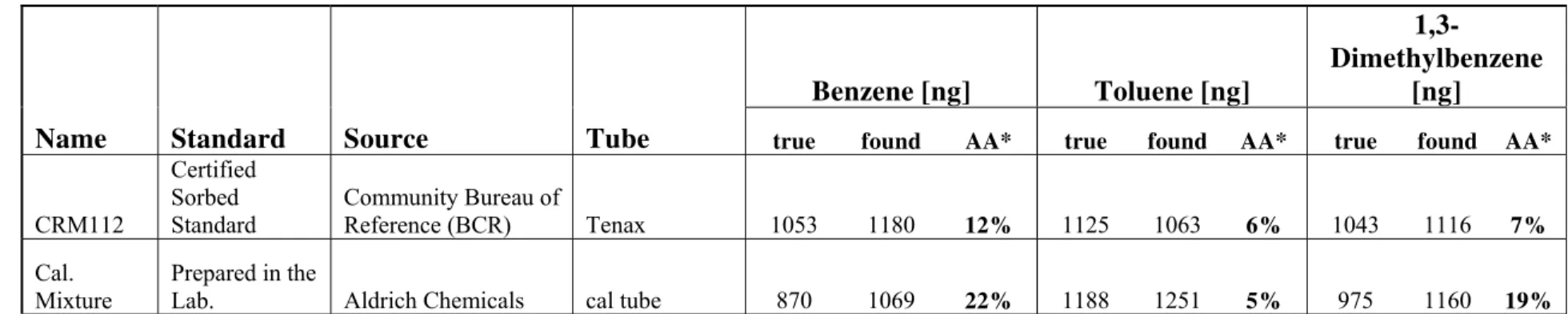
Certified commercial standard tubes from European Community Bureau of Reference (CEC, 1989), which were preloaded with benzene, toluene and 1,3-dimethylbenzene, were used for auditing purposes to establish analytical quality. Their analytical results were compared with the results from a liquid calibration mixture prepared in the laboratory from authentic compounds. The results presented in Table 5 show a good accuracy level in all three standards.
2.7.3 Methodology Performance Criteria for Target Compounds Analysis
The procedure to measure and check the methodology performance criteria followed the routine established by US EPA for Compendium Methods 17 (EPA, 1999a) and TO-15 (EPA, 1999b).
Method Detection Limit (MDL)
The method detection limit is defined as the minimum level of the compound that can be measured with 99 percent confidence that its concentration is greater than zero. Studies of
MLD for Target Compounds were performed in accordance with the Code of Federal Regulations (40CFR136 Appendix B) (EPA, 2004).
MDL was calculated as a product of the standard deviation for seven replicate
measurements of a concentration of the compound of interest near the expected detection limit (within a factor of five) and 3.14 (Student’s “t” value for 99% confidence for seven values). Results of MDL studies for Target Compounds are listed in Table 3.
Analytical Precision
Analytical precision is defined as the absolute value of the relative difference between two samples. 100 (%) Precision = 1− 2× X X X (4) Where:
X1: First measurement value.
X2: Second measurement value.
X: Average of the two values.
There are several factors that may affect the analytical precision of the measurement. A primary influence is the concentration level of the compound of interest in the sample, i.e. precision degrades as the concentration approaches the detection limit. An effect on the precision has the nature of the compound itself such as its molecular weight,
solubility, polarizability, etc. In our analytical conditions polar compounds generally showed poorer precision then most of the non-polar VOCs.
Two types of analytical precision were checked and met the EPA-Compendium Method TO-17 performance criteria:
A) Precision of Duplicate Pairs (within 20% on synthetic samples of a given Target Compound), where X1 and X2 are measurement values for two identical samples, and
B) Precision for the Distributed Volume Pair (within 25% for two defined sample volumes), where X1 and X2 are measurement values for two different volume samples.
Audit Accuracy
Audit accuracy was defined as the relative difference between the measurement result and the nominal concentration of the audit compound.
100 Value Spiked Value Measured -Value Spiked (%) Accuracy Audit = × (5)
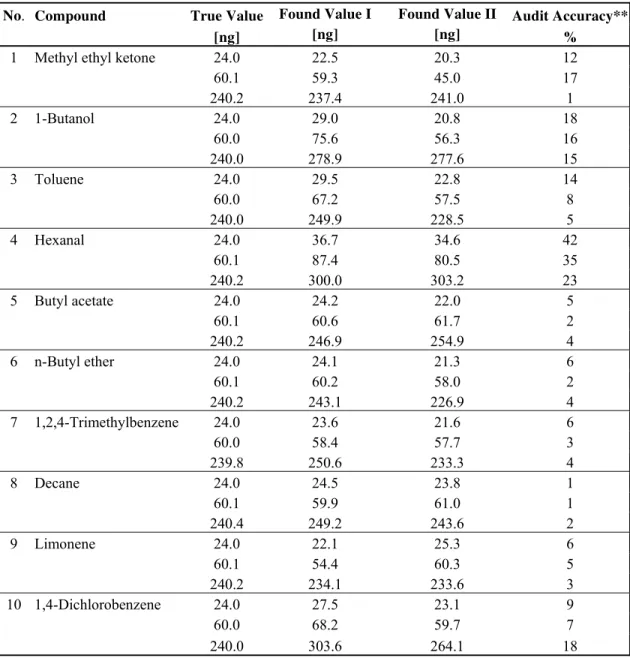
A certified mixture of standard compounds was used as an audit material. EPA-Compendium Method TO-17 audit accuracy criteria of 30% was met for all measured
compounds except for hexanal. For hexanal and other low molecular weight carbonyl compounds, quantification by HPLC was preferable.
Audit accuracy results for selected Target Compounds are presented in Table 6.
3. New Quantitative Analysis of Target Compounds from CMEIAQ-I Test Data
Analytical data collected in Phase 1 were recalculated using the routine similar to that described earlier. Compounds were identified and quantified using the extracted ion analytical technique. Operating conditions of GC/MS in Phase 1 were different from those in Phase 2. As a consequence retention times and mass spectrum for some
compounds were different. Analytical parameters for Phase 1 are summarized in Table 1.
3.1 Identification of Target Compounds
All Target Compounds were identified by their primary and secondary ions as well as retention time. Some compounds were difficult to identify: they were too volatile and not separated at the beginning of the chromatogram (ethanol, 1-propanol, 2-propanol,
acetone, 2-methyl-2-propanol, 2-methylpentane, 3-methylpentane, butanal, hexane) or their primary ions were not detected (ethanol, 1-propanol, 1,2-ethanediol).
3.2 Quantification of Target Compounds individually calibrated
During analyses in Phase 1, ca 20 different calibration mixtures were prepared and run in different times with tested samples. All calibration mixtures had toluene as an internal standard. From those data, ratios (RRC) of the response factor of the primary ion of a
target compound to the response factor of toluene ion 91 were calculated. Concentrations of identified Target Compounds were calculated using Equation 2 as in Phase 2. List of Target Compounds, their retention times, primary ions and Response Factor Ratios to toluene (RRC), which were calculated from multi-point calibrations in Phase 1, are
presented in Table 7.
3.3 Quantification of Target Compounds not individually calibrated
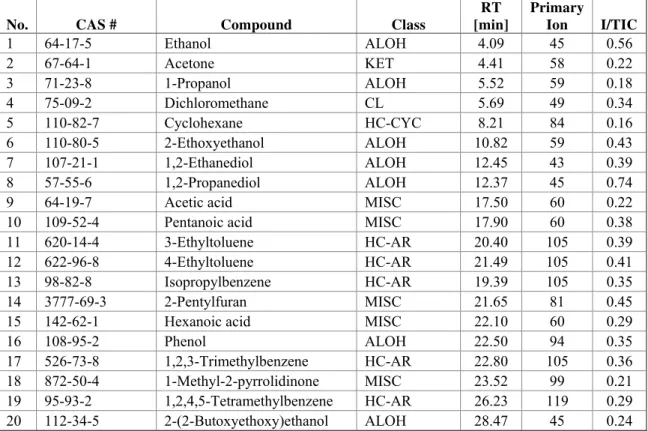
Some compounds were never individually calibrated in Phase 1 (list of them is in the Table 8). In these cases Equation 1 and toluene response factor (RFTT) calculated from
TIC were used for concentration calculations. For better precision, integrations of compounds were performed based on primary ions. Area of Total Ion (Av) used in
Equation 1 was calculated by dividing area of primary ions by its contribution in compound mass spectrum (I/TIC)(reported in Table 8).
4. HPLC methodology
The procedure, similar to ASTM D 5197-03 Test Method for “Determination of
Formaldehyde and Other Carbonyl Compounds in Air (Active Sampler Methodology)” (ASTM, 2003) and EPA Method TO-11A (EPA, 1999c), was applied to the
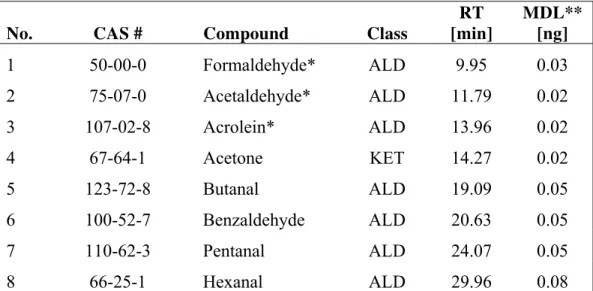
quantification of low molecular weight carbonyl compounds from the Target Compounds list. Table 9 summarizes target compounds analyzed by this method, their retention times and calculated method detection limit (MDL).
Among eight Target Compounds quantified by this method, only formaldehyde, acrolein and acetaldehyde were exclusively analyzed with HPLC. For butanal, pentanal, hexanal and acetone that were analyzed with both GC/MS and HPLC, HPLC data were preferable since the HPLC analysis was specifically designed for these chemicals and, therefore, produced more accurate results. For example, it was observed that GC/MS
underestimated the amount of pure hexanal when it was analyzed with both GC/MS and HPLC.
4.1 Sampling
Exhaust air from a test chamber was pumped through a SPE cartridge (Waters Sep-Pak XpoSure Aldehyde) coated with DNPH (2, 4-dinitrophenylhydrazine) at a rate of 100 mL/min for 120 min. Carboxyl compounds present in the air reacted with DNPH to form stable derivatives. The cartridge was washed with acetonitrile by gravity feed elution. The eluate was diluted volumetrically to 10 ml. Determination of DNPH derivatives was done by isocratic reverse phase HPLC with UV detection at 360nm.
4.2 Apparatus
The HPLC system consisting of Varian 9012 Solvent Delivery System/ 9050 Variable Wavelength UV-VIS Detector (at 360nm) / Prostar 410 Autosampler was used to analyze the extracted sample. Two Supelcosil LC-18 columns (25cm x 4.6mm, 5 μm) in series at 300C and, as a mobile phase, gradient of acetonitrile in water from 60% to 100% were used for separation of compounds.
4.3 Calibration
Six-point calibration from a commercial DNPH derivative mixture (TO-11/IP-6A Aldehyde/Ketone reference standard from Supelco, Inc) was performed.
4.4 Performance Criteria
Method Detection Limit (MDL) for HPLC was calculated in a similar manner as for Target Compounds quantified by GC/MS: as a product of the standard deviation for seven replicate measurements of a concentration of the compound of interest near the expected detection limit (within a factor of five) and 3.14 (Student’s “t” value for 99% confidence for seven values).
5. References
ASTM (2003) Standard test method for determination of formaldehyde and other carbonyl compounds in air (active sampler methodology), ASTM Standard D 5197-03, American Society for Testing and Materials, West Conshohocken, PA.
Commission of the European Communities (CEC) (1989) The Certification of Benzene, Toluene and m-Xylene Sorbed on Tenax in Tubes CRM 112, Report EUR 12308, Bureau of Reference.
EPA (1999a) Compendium Method TO-17, Determination of volatile organic compounds in ambient air using active sampling onto sorbent tubes, EPA/625/R-96/010b, Office of Research and Development, U.S. Environmental Protection Agency
EPA (1999b) Compendium Method TO-15, Determination of volatile organic compounds (VOCs) in air collected in specially-prepared canisters and analyzed by gas
chromatography/mass spectrometry (GC/MS), EPA/625/R-96/010b, Office of Research and Development, U.S. Environmental Protection Agency
EPA (1999c) Compendium of Method TO-11A, Determination of Formaldehyde in Ambient Air Using Adsorbent Cartridge Followed by High Performance Liquid Chromatography (HPLC), EPA/625/R-96/010b, Office of Research and Development, U.S. Environmental Protection Agency
EPA “Code of Federal Regulations, Title 40, Part 136, Appendix B: Definition and Procedure for the Determination of the Method Detection Limit—Revision 1.11.” [Online] 27 February 2004.
<http://ecfr.gpoaccess.gov/cgi/t/text/text-idx?c=ecfr&sid=7052affd1916e8e301b6f4538d0e7749&rgn=div5&view=text&node=40: 20.0.1.1.1&idno=40#40:20.0.1.1.1.0.1.6.2>
National Research Council (1999) CMEIAQ Final Report 1.1, A Method for Sampling and Analysis of Volatile Organic Compounds in Emission Testing of Building Materials.
Table 1. Operating parameters for GC/MS analyses.
Phase 1 Phase 2
Thermal Desorption
Instrument Varian ATD 400 Varian ATD 400
Primary Desorption 3300C 3300C
Cold Trap Low Temperature 10C -200C
Cold Trap High Temperature 3400C 3400C
Gas Chromatography
Instrument HP 5890 Agilent 5890N
Column DB-5MS J&W Scientific 60m / 0.32mm / 25μm 60m / 0.32mm / 25μm
GC Temperature Program
Initial Temperature 100C -200C
Initial Time 4min
Ramp1 50C/min to 1700C 50C/min to 1700C Ramp 2 200C/min to 2800C 250C/min to 2800C
Final Time 5min 2 min
Mass Spectrometry
Instrument HP MS Engine 5989 Agilent MSD 5973
MS Quadruple 1000C 1500C
MS Source 2000C 2300C
Mass Range 35-350amu 30-350 amu
Table 2. List of standard compounds calibrated in CMEIAQ-II.
# Class Compound CAS # RT * b.p. * MW *
1 ALD Hexanal 66-25-1 14.40 131 100.00
2 KET Methyl ethyl ketone 78-93-3 6.51 80 72.11
3 ALOH 1-Butanol 71-36-3 9.04 118 74.00
4 EST Butyl acetate 123-86-4 15.15 127 116.10
5 CL 1,4-Dichlorobenzene 106-46-7 27.70 173 146.00 6 HC-AL Decane 124-18-5 22.34 110 92.14 7 HC-AR Toluene 108-88-3 12.88 110 92.14 8 HC-AR 1,4-Dimethylbenzene 106-42-3 106.17 9 HC-AR 1,2,4-Trimethylbenzene 95-63-6 22.06 168 120.20 10 HC-CYC Propylcyclohexane 1678-92-8 19.55 155 126.24 11 TERP Limonene 138-86-3 23.38 175 136.24
12 MISC n-Butyl ether 142-96-1 17.47 142 130.32
Table 3. List of target compounds individually calibrated in CMEIAQ-II, their
retention time (RT), primary and secondary ions, response factor ratio against toluene (RRC), and method detection limit (MDL)*
No. CAS # Compound Class RT [min] Primary Ion Secondary Ions RRC MDL [ng] 1 64-17-5 Ethanol ALOH 6.02 31 45, 46 0.10 2.52 2 67-64-1 Acetone KET 6.11 58 43 0.07 0.43 3 67-63-0 2-Propanol ALOH 6.13 45 39, 59 0.33 1.27 4 75-65-0 2-Methyl-2-propanol ALOH 7.09 59 41, 31 0.50 1.65 5 107-83-5 2-Methylpentane HC-AL 8.13 43 71, 42, 41 0.26 0.29 6 71-23-8 1-Propanol ALOH 8.59 31 59, 42 0.21 20.00** 7 96-14-0 3-Methylpentane HC-AL 8.64 57 56, 41, 29 0.35 0.83 8 75-09-2 Dichloromethane CL 7.03 49 86, 84 0.27 0.75** 9 123-72-8 Butanal ALD 9.25 72 41, 39 0.09 21.82 10 110-54-3 Hexane HC-AL 9.58 56 86, 57 0.11 0.39 11 78-93-3 Methyl ethyl ketone KET 9.67 43 72, 57, 29 0.46 0.38 12 141-78-6 Ethyl acetate EST 10.20 43 61, 88, 71 0.33 0.19 13 71-43-2 Benzene HC-AR 11.78 78 77, 51 0.71 0.69 14 110-82-7 Cyclohexane HC-CYC 11.79 84 56, 69, 55 0.23 1.03 15 108-21-4 1-Methylethyl acetate EST 12.19 43 61, 87 0.56 13.65 16 71-36-3 1-Butanol ALOH 12.41 56 41, 31 0.22 0.42 17 109-86-4 2-Methoxyethanol ALOH 12.61 45 76, 31, 45 0.62 106.96 18 79-01-6 Trichloroethylene CL 13.72 130 95, 132 0.31 0.45 19 110-62-3 Pentanal ALD 13.60 58 44, 41 0.12 5.41 20 142-82-5 Heptane HC-AL 13.77 71 100, 43, 70 0.17 0.43 21 107-98-2 1-Methoxy-2-propanol ALOH 14.18 45 47, 75, 31 0.46 5.66 22 110-80-5 2-Ethoxyethanol ALOH 14.99 59 31, 29 0.18 24.63 23 108-10-1 Methyl isobutyl ketone KET 15.57 43 58, 100, 85 0.45 0.45 24 107-21-1 1,2-Ethanediol ALOH 15.63 31 43, 62 0.34 107.00** 25 108-88-3 Toluene HC-AR 16.44 91 92 1.00 0.31 26 57-55-6 1,2-Propanediol ALOH 16.17 45 61, 43, 31 0.97 7.22 27 111-65-9 Octane HC-AL 17.95 85 114, 71, 70 0.21 0.73 28 66-25-1 Hexanal ALD 17.97 82 72, 56, 29 0.04 9.73 29 123-86-4 Butyl acetate EST 18.71 43 56, 61, 73 0.45 0.81 30 98-01-1 Furfural ALD 19.23 96 95, 36 0.15 24.00** 31 1678-91-7 Ethylcyclohexane HC-CYC 19.37 83 112, 82, 55 0.59 1.72 32 100-41-4 Ethylbenzene HC-AR 20.40 91 106 1.18 0.83 33 108-38-3 1,3-Dimethylbenzene HC-AR 20.70 91 106 0.97 0.71 34 106-42-3 1,4-Dimethylbenzene HC-AR 20.77 91 106 0.89 0.82 35 64-19-7 Acetic acid MISC 12.42 60 43, 45 0.12 568.5 36 142-96-1 n-Butyl ether MISC 21.35 57 87,56, 41 1.27 2.10 37 109-52-4 Pentanoic acid MISC 24.18 60 73 0.85 871.6 38 95-47-6 1,2-Dimethylbenzene HC-AR 21.67 91 106 0.92 0.75 39 100-42-5 Styrene HC-AR 21.65 104 78, 103, 51 0.87 0.89 40 108-94-1 Cyclohexanone KET 21.76 55 98, 69, 42 0.38 3.48 41 111-84-2 Nonane HC-AL 21.97 85 128, 71, 57 0.18 0.44 42 111-71-7 Heptanal ALD 22.12 81 70, 96 0.08 10.93 43 111-15-9 2-Ethoxyethyl acetate EST 22.26 43 59, 72, 87 0.52 12.89
No. CAS # Compound Class RT [min] Primary Ion Secondary Ions RRC MDL [ng] 44 111-76-2 2-Butoxy ethanol ALOH 22.35 57 87, 41, 75 0.60 35.51 45 1678-92-8 Propylcyclohexane HC-CYC 23.32 83 126, 82, 55 0.67 1.73 46 80-56-8 alpha-Pinene TERP 23.31 93 136, 121 0.64 0.61 47 79-92-5 Camphene TERP 24.08 93 121, 136 0.49 1.01 48 103-65-1 Propylbenzene HC-AR 24.12 91 120 1.43 1.05 49 620-14-4 3-Ethyltoluene HC-AR 24.35 105 120 1.38 0.81 50 100-52-7 Benzaldehyde ALD 24.53 106 105, 77 0.77 2.90 51 622-96-8 4-Ethyltoluene HC-AR 24.48 105 120 1.31 0.69 52 108-67-8 1,3,5-Trimethylbenzene HC-AR 24.67 105 120 1.16 0.65 53 611-14-3 2-Ethyltoluene HC-AR 25.01 105 120 1.40 0.73 54 127-91-3 beta-Pinene TERP 25.04 93 136, 121 0.40 0.81 55 98-82-8 Isopropylbenzene HC-AR 23.10 105 120 1.04 7.73 56 3777-69-3 2-Pentylfuran MISC 25.64 81 138, 82 1.37 4.76 57 95-63-6 1,2,4-Trimethylbenzene HC-AR 25.62 120 105 0.66 0.71 58 142-62-1 Hexanoic acid MISC 26.95 60 73, 87 0.48 400.1 59 124-18-5 Decane HC-AL 25.78 71 142, 85, 99 0.20 0.62 60 124-13-0 Octanal ALD 26.02 84 110, 100 0.11 8.80 61 13466-78-9 3-Carene TERP 26.30 93 136, 121 0.60 0.52 62 108-95-2 Phenol ALOH 25.26 94 66, 39 0.74 10.90 63 106-46-7 1,4-Dichlorobenzene CL 26.45 146 148, 111 0.87 0.69 64 526-73-8 1,2,3-Trimethylbenzene HC-AR 26.63 105 120 1.22 0.80 65 104-76-7 2-Ethyl-1-hexanol ALOH 26.87 70 83, 98, 112 0.15 47.40** 66 99-87-6 4-Isopropyltoluene HC-AR 26.89 119 134 2.24 0.35 67 99-86-5 alpha-Terpinene TERP 26.89 93 121, 136 0.22 1.02 68 138-86-3 Limonene TERP 26.93 68 93, 136 0.36 0.61 69 1678-93-9 Butylcyclohexane HC-CYC 27.19 83 140, 82, 55 0.87 1.72** 70 95-50-1 1,2-Dichlorobenzene CL 27.13 146 148, 111 0.92 0.69 71 872-50-4 1-Methyl-2-pyrrolidinone MISC 27.41 99 98 0.46 16.54 72 99-85-4 gamma-Terpinene TERP 28.09 93 136, 121 0.27 4.53 73 91-17-8 Decahydronaphthalene HC-CYC 28.24 138 96, 67, 82 0.73 0.95** 74 98-86-2 Acetophenone KET 28.31 105 120, 77, 51 1.22 27.90** 75 1120-21-4 Undecane HC-AL 29.37 57 156, 85 0.56 0.65 76 124-19-6 Nonanal ALD 29.65 57 98, 82, 70 0.15 3.98 77 95-93-2 1,2,4,5-Tetramethylbenzene HC-AR 30.03 119 134 1.43 0.83 78 112-34-5 2-(2-Butoxyethoxy)ethanol ALOH 32.62 45 75, 57, 87 0.36 36.72 79 91-20-3 Naphthalene HC-AR 32.59 128 102 2.31 0.57 80 112-40-3 Dodecane HC-AL 32.71 57 170, 71, 85 0.59 0.68 81 112-31-2 Decanal ALD 33.05 57 128, 112 0.10 3.57 82 629-50-5 Tridecane HC-AL 35.83 57 184, 71 0.55 0.68 83 4994-16-5 4-Phenylcyclohexene HC-AR 37.23 104 155, 91 2.22 0.93** 84 629-59-4 Tetradecane HC-AL 38.70 57 198, 71, 85 0.49 0.62 85 629-62-9 Pentadecane HC-AL 40.72 57 212, 71, 85 0.66 1.21 86 6846-50-0 TM-PD-DIB*** EST 42.26 71 43, 56, 159 0.11 3.78 87 544-76-3 Hexadecane HC-AL 42.37 57 226, 71, 85 0.69 2.47 * Method Detection Limit (Product of the standard deviation for seven replicate analyses and 3.14 (student’s “t” test
value for 99% confidence) ** Estimated value.
Table 4. Target compounds concentration calculated using individual and toluene
response factor for OSB 4 -24h sample.
No. Compound Conc. [ng/L] Conc. [ng/L]
Based on Individual RF Toluene RF
1 Acetone 5.16 0.91 2 2-Methylpentane 0.68 3 3-Methylpentane 0.26 4 Butanal 3.11 1.15 5 Hexane 0.71 6 Benzene 0.49 7 Pentanal 5.67 8 Heptane 4.71 3.81 9 Methylcyclohexane 0.07 10 Toluene 1.46 1.57 11 Octane 1.95 12 Hexanal 19.11 5.63 13 Ethylbenzene 0.37 14 1,3-Dimethylbenzene 1.44 1.76 15 1,4-Dimethylbenzene 1.04 1.40 16 Acetic acid 0.09 17 Pentanoic acid 1.40 18 1,2-Dimethylbenzene 1.29 1.89 19 Nonane 3.40 2.87 20 Heptanal 1.13 21 alpha-Pinene 0.24 22 Propylbenzene 0.10 23 3-Ethyltoluene 0.09 24 Benzaldehyde 0.44 25 1,3,5-Trimethylbenzene 0.30 26 2-Ethyltoluene 0.05 27 beta-Pinene 0.05 28 Isopropylbenzene 0.04 29 2-Pentylfuran 8.90 12.19 30 1,2,4-Trimethylbenzene 0.15 31 Hexanoic acid 1.34 32 Decane 1.50 1.71 33 Octanal 0.71 34 1,4-Dichlorobenzene 1.37 2.11 35 1,2,3-Trimethylbenzene 0.03 36 4-Isopropyltoluene 0.01 37 Limonene 0.08 38 Acetophenone 0.11 39 Undecane 0.54 40 Nonanal 1.44 0.98 41 Naphthalene 0.03 42 Dodecane 0.19 43 Decanal 1.27 0.89 44 Tridecane 0.31 45 Tetradecane 1.56 1.77 46 Pentadecane 0.62 0.96 47 Hexadecane 0.13 Sum of TC 75.12 41.61
Sum of identified comp. 54.11
Table 5. Analytical accuracy measurements.
Benzene [ng] Toluene [ng]
1,3-Dimethylbenzene [ng]
Name Standard Source Tube true found AA* true found AA* true found AA*
CRM112 Certified Sorbed Standard Community Bureau of Reference (BCR) Tenax 1053 1180 12% 1125 1063 6% 1043 1116 7% Cal. Mixture Prepared in the
Lab. Aldrich Chemicals cal tube 870 1069 22% 1188 1251 5% 975 1160 19%
AA* -Audit accuracy was defined as the relative difference between the measurement result and the nominal value of the audit compound.
Table 6. Audit accuracy* values for selected target compounds.
No. Compound True Value Found Value I Found Value II Audit Accuracy**
[ng] [ng] [ng] %
1 Methyl ethyl ketone 24.0 22.5 20.3 12
60.1 59.3 45.0 17 240.2 237.4 241.0 1 2 1-Butanol 24.0 29.0 20.8 18 60.0 75.6 56.3 16 240.0 278.9 277.6 15 3 Toluene 24.0 29.5 22.8 14 60.0 67.2 57.5 8 240.0 249.9 228.5 5 4 Hexanal 24.0 36.7 34.6 42 60.1 87.4 80.5 35 240.2 300.0 303.2 23 5 Butyl acetate 24.0 24.2 22.0 5 60.1 60.6 61.7 2 240.2 246.9 254.9 4 6 n-Butyl ether 24.0 24.1 21.3 6 60.1 60.2 58.0 2 240.2 243.1 226.9 4 7 1,2,4-Trimethylbenzene 24.0 23.6 21.6 6 60.0 58.4 57.7 3 239.8 250.6 233.3 4 8 Decane 24.0 24.5 23.8 1 60.1 59.9 61.0 1 240.4 249.2 243.6 2 9 Limonene 24.0 22.1 25.3 6 60.1 54.4 60.3 5 240.2 234.1 233.6 3 10 1,4-Dichlorobenzene 24.0 27.5 23.1 9 60.0 68.2 59.7 7 240.0 303.6 264.1 18
*Audit accuracy was defined as the relative difference between the measurement result and the nominal value of the audit compound.
Table 7. List of target compounds individually calibrated in CMEIAQ-I, their
retention time (RT), primary ion and response factor ratio against toluene (RRC).
CAS # Compound Class
RT [min] Primary Ion RRC 1 67-63-0 2-Propanol ALOH 4.14 45 0.94 2 75-65-0 2-Methyl-2-propanol ALOH 4.50 59 0.85 3 107-83-5 2-Methylpentane HC-AL 5.36 43 0.76 4 96-14-0 3-Methylpentane HC-AL 5.68 57 0.68 5 123-72-8 Butanal ALD 6.09 44 0.17 6 110-54-3 Hexane HC-AL 6.31 56 0.39
7 78-93-3 Methl ethyl ketone KET 6.38 43 1.24
8 141-78-6 Ethyl acetate EST 6.85 43 1.17
9 71-43-2 Benzene HC-AR 8.27 78 1.08
10 108-21-4 1-Methylethyl acetate EST 8.60 43 1.23
11 71-36-3 1-Butanol ALOH 8.97 56 0.56 12 109-86-4 2-Methoxyethanol ALOH 9.06 45 1.15 13 79-01-6 Trichloroethylene CL 9.75 130 0.20 14 110-62-3 Pentanal ALD 9.83 58 0.21 15 142-82-5 Heptane HC-AL 10.28 71 0.38 16 107-98-2 1-Methoxy-2-propanol ALOH 8.99 45 1.01
17 108-10-1 Methyl isobutyl ketone KET 11.60 43 1.16
18 108-88-3 Toluene HC-AR 12.68 91 1.00
19 111-65-9 Octane HC-AL 14.12 85 0.36
20 66-25-1 Hexanal ALD 14.26 82 0.05
21 123-86-4 Butyl acetate EST 15.09 43 0.97
22 98-01-1 Furfural ALD 15.54 96 0.19
23 1678-91-7 Ethylcyclohexane HC-CYC 15.45 83 0.65
24 100-41-4 Ethylbenzene HC-AR 16.61 91 1.16
25 106-42-3 1,4-Ddimethylbenzene HC-AR 16.96 91 0.96
26 108-38-3 1,3-Dimethylbenzene HC-AR 16.96 91 0.96
27 142-96-1 n-Butyl ether MISC 17.56 57 1.85
28 95-47-6 1,2-Dimethylbenzene HC-AR 17.87 91 0.95
29 100-42-5 Styrene HC-AR 18.00 104 0.79
30 108-94-1 Cyclohexanone KET 17.85 55 0.55
31 111-84-2 Nonane HC-AL 18.29 85 0.26
32 111-71-7 Heptanal ALD 18.30 81 0.07
33 111-15-9 2-Ehoxyethyl acetate EST 18.63 43 1.08
34 111-76-2 2-Butoxy ethanol ALOH 18.48 57 1.13
35 1678-92-8 Propylcyclohexane HC-CYC 19.39 83 0.76 36 80-56-8 alpha-Pinene TERP 20.00 93 0.62 37 79-92-5 Camphene TERP 20.56 93 0.52 38 103-65-1 Propylbenzene HC-AR 20.28 91 1.43 39 100-52-7 Benzaldehyde ALD 20.45 106 0.62 40 108-67-8 1,3,5-Trimethylbenzene HC-AR 21.52 105 1.01 41 611-14-3 2-Ethyltoluene HC-AR 21.59 105 1.30 42 127-91-3 beta-Pinene TERP 21.63 93 0.34
CAS # Compound Class RT [min] Primary Ion RRC 43 95-63-6 1,2,4-Trimethylbenzene HC-AR 21.93 120 0.50 44 124-18-5 Decane HC-AL 22.07 71 0.35 45 124-13-0 Octanal ALD 22.18 84 0.13 46 13466-78-9 3-Carene TERP 22.89 93 0.46 47 106-46-7 1,4-Dichlorobenzene CL 22.64 146 0.53 48 104-76-7 2-Ethyl-1-hexanol ALOH 23.18 70 0.22 49 99-87-6 4-Isopropyltoluene HC-AR 23.39 119 1.55 50 99-86-5 alpha-Terpinene TERP 22.89 93 0.32 51 138-86-3 Limonene TERP 23.55 68 0.54 52 1678-93-9 Butylcyclohexane HC-CYC 23.38 83 1.02 53 95-50-1 1,2-Dichlorobenzene CL 23.17 146 0.48 54 99-85-4 gamma-Terpinene TERP 24.62 93 0.44 55 91-17-8 Decahydronaphthalene HC-CYC 24.22 138 0.46 56 98-86-2 Acetophenone KET 24.40 105 0.75 57 1120-21-4 Undecane HC-AL 25.50 57 1.00 58 124-19-6 Nonanal ALD 25.76 57 0.33 59 91-20-3 Naphthalene HC-AR 28.40 128 1.61 60 112-40-3 Dodecane HC-AL 28.76 57 0.93 61 112-31-2 Decanal ALD 29.04 57 0.21 62 629-50-5 Tridecane HC-AL 32.32 57 1.13 63 31017-40-0 4-Phenylcyclohexene HC-AR 33.18 104 1.38 64 629-59-4 Tetradecane HC-AL 35.19 57 0.95 65 629-62-9 Pentadecane HC-AL 37.68 57 0.88 66 6846-50-0 TM-PD-DIB* EST 39.23 71 1.21 67 544-76-3 Hexadecane HC-AL 39.55 57 0.62 *2,2,4-Trimethyl-1,3-pentanediol diisobutyrate
Table 8. Target compounds analyzed by GC/MS in CMEIAQ-I, toluene TIC calibrated.
No. CAS # Compound Class
RT [min] Primary Ion I/TIC 1 64-17-5 Ethanol ALOH 4.09 45 0.56 2 67-64-1 Acetone KET 4.41 58 0.22 3 71-23-8 1-Propanol ALOH 5.52 59 0.18 4 75-09-2 Dichloromethane CL 5.69 49 0.34 5 110-82-7 Cyclohexane HC-CYC 8.21 84 0.16 6 110-80-5 2-Ethoxyethanol ALOH 10.82 59 0.43 7 107-21-1 1,2-Ethanediol ALOH 12.45 43 0.39 8 57-55-6 1,2-Propanediol ALOH 12.37 45 0.74
9 64-19-7 Acetic acid MISC 17.50 60 0.22
10 109-52-4 Pentanoic acid MISC 17.90 60 0.38
11 620-14-4 3-Ethyltoluene HC-AR 20.40 105 0.39
12 622-96-8 4-Ethyltoluene HC-AR 21.49 105 0.41
13 98-82-8 Isopropylbenzene HC-AR 19.39 105 0.35
14 3777-69-3 2-Pentylfuran MISC 21.65 81 0.45
15 142-62-1 Hexanoic acid MISC 22.10 60 0.29
16 108-95-2 Phenol ALOH 22.50 94 0.35
17 526-73-8 1,2,3-Trimethylbenzene HC-AR 22.80 105 0.36 18 872-50-4 1-Methyl-2-pyrrolidinone MISC 23.52 99 0.21 19 95-93-2 1,2,4,5-Tetramethylbenzene HC-AR 26.23 119 0.29 20 112-34-5 2-(2-Butoxyethoxy)ethanol ALOH 28.47 45 0.24
Table 9. Target compounds analyzed by HPLC.
No. CAS # Compound Class
RT [min] MDL** [ng] 1 50-00-0 Formaldehyde* ALD 9.95 0.03 2 75-07-0 Acetaldehyde* ALD 11.79 0.02 3 107-02-8 Acrolein* ALD 13.96 0.02 4 67-64-1 Acetone KET 14.27 0.02 5 123-72-8 Butanal ALD 19.09 0.05 6 100-52-7 Benzaldehyde ALD 20.63 0.05 7 110-62-3 Pentanal ALD 24.07 0.05 8 66-25-1 Hexanal ALD 29.96 0.08 * Compounds quantified exclusively by HPLC
** Method Detection Limit (Product of the standard deviation for seven replicate analyses and 3.14 (student’s “t” test value for 99% confidence).
Figure 1. Target compounds calibration procedure.