Assembling the Crystal Ball: Using Demand Signal Repository to
Forecast Demand
By
Ahmed Rashad
B.S. Mechanical Engineering, Ain-Shams University, 2004 Santiago Spraggon
B.S. Industrial Engineering, Buenos Aires Institute of Technology 2006 Submitted to the Engineering Systems Division in Partial Fulfillment of the
Requirements for the Degree of ARCHWW
ACHM NSTM
Master of Engineering in Logistics MSHUTSITE
OF TECHNOLOGY
at the
r
JUN 19 2013
Massachusetts Institute of Technology
LHB3RARIES
C June 2013
-C 2013 Ahmed Rashad and Santiago Spraggon. All rights reserved.
The authors hereby grants to MIT permission to reproduce and to distribute publicly paper and electronic copies of this document in whole or in part.
Signature of A uthor...: ... .. :...
Master of Engineering in Logistics Program, Engineering Systems Division May 10, 2013
Signature of Author... ...
Master of Engineering in L s Program, Engineering Systems Division May 10, 2013
C ertfied by . .... ... .... .... . . .... . ... ... ...
Certified by...
Dr. Shardul Phadnis
stdoctogal Research Associate Center for Tnsportation and Logistics Thesis Supervisor
A ccepted by ... . ... .. V... .j Prof. Yossi Sheffi Elisha Gray II Professor of Engineering Systems, MIT Director, MIT Center for Transportation and Logistics Professor, Civil and Environmental Engineering, MIT
Assembling the Crystal Ball: Using Demand Signal Repository to
Forecast Demand
By Ahmed Rashad and Santiago SpraggonSubmitted to the Engineering Systems Division in Partial Fulfillment of the Requirements for the Degree of
Master of Engineering in Logistics
at the
Massachusetts Institute of Technology
ABSTRACT
Improving forecast accuracy has positive effects on supply chain performance. Forecast accuracy can reduce inventory levels, increase customer service levels and responsiveness, or a combination of the two. However, the further upstream in the supply chain, the more difficult it becomes to forecast accurately. Demand for consumer products might be subject to factors that are hard to identify and quantify. One way to overcome this is to observe external factors or predictors that might help explain demand.
The purpose of this thesis is to explore the factors that potentially influence the demand of a fast-moving consumer product (bottled water), and build a demand signal repository for these factors to help the manufacturer generate more accurate forecasts. We identified more than 30 such factors that might affect demand, using interviews and industry research. We tested more than 200 causal models of the relationship between observed demand and the predicting factors.
The resulting model explained almost 60% of demand for two out of three customers using daily buckets and over 85% using weekly buckets compared to less than 50% using time-series techniques. Using the results of this extensive analysis, we propose a new forecasting model. We also identified additional factors that could not be included this analysis due to the lack of data; adding these to the model may further improve the forecast accuracy.
Thesis Supervisor: Dr. Shardul Phadnis
Title: Postdoctoral Research Associate, Center for Transportation and Logistics
Table of Contents
A BSTRA CT e ... 2
List of Tables ... 5
List of Figures ... 6
C hapter 1: Introduction and M otivation... 7
1.1 W hatisD SR ... 7
1.2 Why not use conventional forecasting methods instead of DSR? ... 7
1.3 The Com pany and M otivation ... 10
C hapter 2: Literature Review ... 11
2.1 Dem and Signal Repository: W hen to use it? ... 11
2.2 The Bottled W ater Industry ... 15
2.3 D SR at N iagara ... 16
2.4 Sum m ary ... 17
C hapter 3: M ethods ... 18
3.1 M ethod O verview ... 18
3.2 Initiation Steps ... 18
3.3 D ata M anagem ent ... 21
3.3.1 The Variables ... 21 3.3.2 D ata Collection... 25 3.3.3 D ata Validation... 25 3.4 M odeling ... 28 3.4.1 M odel Creation ... 30 3.4.2 Sum m ary ... 30
C hapter 4: A nalysis and M odels... 31
4.1 The M odels ... 31
4.2 D iscussion of M odel Results ... 41
4.2.1 Key Observations ... 41
4.2.2 Effects of temperature on the models ... 41
4.3 Final M odel Results ... 42
4.3.1 M odel Selection Criteria ... 42
4.3.2 The Final M odels ... 43
4.4 Sum m ary ... 46
C hapter 5: C onclusion... 47
5.1 Sum m ary of Findings ... 47
5.2 Challenges faced and anticipated in the project ... 49
5.3 Practical Im plications of Findings... 51
5.4 Lim itations ... 51
5.5 Recom m endations to the Firm ... 52
5.6 Future W ork ... 55
Closing Comments ... 56
Appendix 1: List of Interviewees ... 57
Appendix 2: List of data believed relevant, but excluded due to inaccessibility...58
Appendix 3: List of Holidays and Public Events used in modeling... 59
Bibliography ... 60
List of Tables
Table 1 Decision Matrix for Choosing Forecasting Techniques... 14
Table 2 Causal Factor Scores (Niagara Employees)... 20
T able 3 Initial C ausal Factors... 23
Table 4 List of Causal Factors used in Final Models ... 28
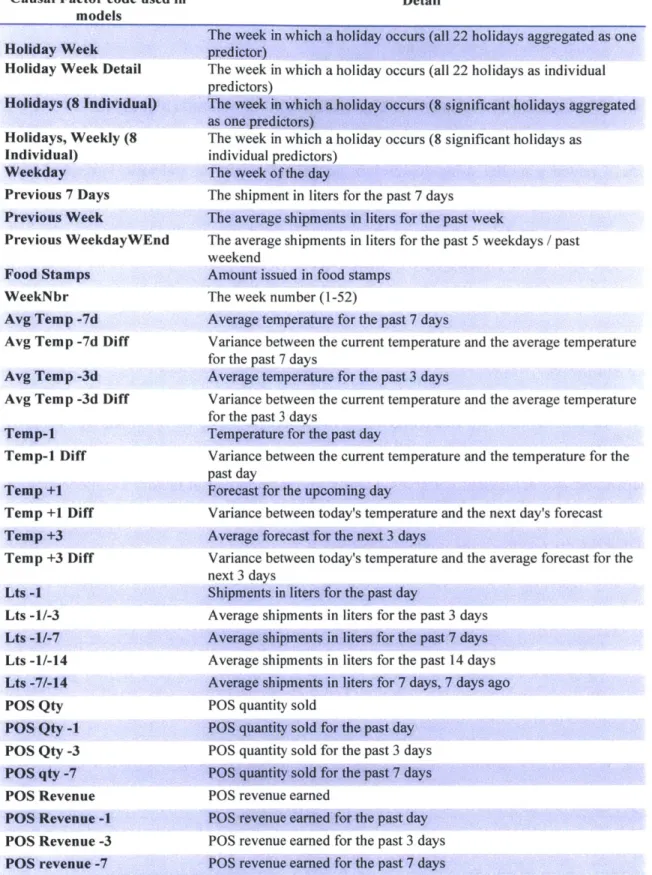
Table 5 Key to variations and codes of Causal factors used ... 29
Table 6 Models created to test the effects of individual holidays ... 32
Table 7 Summary of Models Created for Customer A in California ... 33
Table 8 Summary of Models created for Customer B in California ... 36
Table 9 Summary of models created for Customer B in Ohio... 37
Table 10 Summary of Models creates for Customer C in California... 38
Table 11 Summary of Models created for Customer C in Texas only for 24 pack of 0.5L b o ttle s ... 3 8 Table 12 Summary of Models created for Customer C in Texas using point of sale data and only for 24 pack of 0.5L bottles ... 39
Table 13 Effects of temperature on Model Results... 42
Table 14 Final Model: The effects of multiple causal factors on liters of water shipped 43 T able 15 List of Interview ees ... 57
Table 16 List of holidays and public events... 59
List of Figures
Figure 1 Demand Layers (figure illustrates the demand layers and is not representative of
the actual data) ... . 8
Figure 2 Demand Layers with un-explained behavior (figure illustrates demand layers and is not representative of the actual data)... 9
Figure 3 Product Life-Cycle Stages and corresponding forecasting methods to use... 13
Figure 4 Cost of forecasting versus cost of inaccuracy for a medium-range forecast, given data availability (Chambers, Mullick, and Smith, 1971)... 14
F igure 5 Process Steps ... 18
Figure 6 Data Lag behind actual consumer demand ... 21
Figure 7 Data categories and aggregation levels ... 26
Figure 8 Trends over time per customer for U.S. Mainland ... 31
Chapter 1: Introduction and Motivation
"Forecasts are always wrong" is one thing that comes to mind whenever demand forecasts (or any other type of forecast for that matter) are mentioned, and for good reasons. A forecast is basically what we expect is going to happen in the future. And unless we have a crystal ball that works or develop time travel technology, forecasts will always be wrong. However, there are tools that can help create more accurate demand forecasts, and Demand Signal Repository (DSR) is one of them.
We wish to implement DSR in a simple, extensible, and replicable manner. We believe implementing DSR could improve demand management and supply chain performance.
1.1 What is DSR?
A Demand Signal Repository (DSR) is a pool of data that has influence on
demand in some way and is collected from multiple sources. Once this data is collected, it needs to be normalized and used to create models that help predict how demand is affected by causal factors. The final result is a model that helps predict demand better (Moon, 2009). Some definitions of DSR restrict data sources to points of sale (POS) such as the one used by Margaret Rouse (Rouse, 2010), while others state that signal sources are not limited to POS (Gartner, 2013). We prefer the latter.
Like any other forecasting or demand management technique, DSR is part science, part art. What drives DSR is the art of coming up with potential causal factors and imagining the probable relationships between the product demand and seemingly unrelated events. Only then can specialized software such as Oracle's Demantra or SAP's Demand Planning -- or even free, general software such as SAS' JMP - be used to find causality and create a model.
1.2 Why not use conventional forecasting methods instead of DSR?
Some of the most commonly used forecasting methods such as Holt-Winters and
moving average are discussed extensively in many supply chain references (Silver, Pyke,
& Peterson, 1998; Arnold, Chapman, & Clive, 2011) as well industry publications and
certification material (The Association for Operations Management, APICS, 2012). These methods and other time series methods rely on historical data and use that data to forecast the future, so does DSR.
However, while most techniques rely on identifying a few factors that affect demand, such as seasonality and growth trends, and ignore or attribute everything else to random events. While one of the main purposes of forecasting is to improve predictability of demand and actually attributing the behavior to some factors, a major challenge is to identify these factors in the first place. While computers are capable of performing statistical calculations, they are still incapable of the investigative thinking required to discover such causal factors and are limited to solving the problems that we give them using the variables and tools we program them to use.
In time-series forecasting, we can think of demand as a number of layers on top of each other: the first layer being the base demand, then trend, then seasonality, and finally other factors that are usually attributed to randomness (Figure 1).
Seasonality Random Variation
Bae" Demand
Using DSR to Forecast Demand
Tire n.eks/Mom.ht
Figure I Demand Layers (figure illustrates the demand layers and is not representative of the actual data)
The base is what the demand would be if absolutely nothing changed between the current period and future periods. Trend is the overall growth or decline of demand over a period of time. Seasonality is the change of demand over different time periods (could be weather seasons, months, weekdays, or even time of the day). Random variation (true randomness) is variation that is due to chance.
However, there usually is another layer, un-explained behavior (Figure 2). These are variations in demand that could possibly be quantified but are currently not. All layers except for random variation and un-explained behavior have well established and simple forecasting methods to calculate them fairly accurately such as moving average and exponential smoothing. Even though random variation works against accurate forecasts
by introducing variability, it is difficult to predict chance. Furthermore, these variations
are usually small in amplitude and the normal approach of trend and seasonality could be used. That leaves un-explained behavior.
Seasonality Random Variation Un explained Behaviour
Trend
e Vwease Demand
Figure 2 Demand Layers with un-explained behavior (figure illustrates demand layers and is not representative of the actual data)
Our objective is to introduce another layer into the demand hierarchy, causal factors, and move as much of the demand as possible from the un-explained behavior domain into the quantifiable domain (just like seasonality and trend). We believe (DSR) is one of the ways to achieve this.
1.3 The Company and Motivation
The research in this thesis was motivated by a practical challenge at Niagara
Bottling, LLC (henceforth, "Niagara"), who sponsored this project. Niagara is a family owned company based in Southern California that was started in 1963. Currently, the company operates in all 50 states and exports to several countries including Japan and Mexico bottling water for both Niagara brand and private labels. Niagara operates 12 plants around the United States and is currently the largest family owned bottled water company in the country. Revenues are close to 1 billion dollars annually.
Niagara focuses on high customer service, quality, environmentally responsible production, and controlling costs. The market they operate in is very price conscious, as clearly expressed to us by several Niagara top executives and supply chain professionals during interviews such as the EVP of Sales, and the EVP of Manufacturing. Currently, the company uses ERP from a top vendor and already use an off the shelf statistical forecasting package from another vendor for time series analysis to forecast its demand. They also mentioned that pressure is high from the competition and mild price wars are not uncommon. This has led to great pressure to improve forecast quality in order to remain competitive. Niagara believes it can retain a competitive edge by reducing finished product inventory, getting a better mix of finished products, improving customer service levels and fill rates, and planning production more efficiently.
Niagara believes that DSR and the subsequent modeling will enable the company to achieve these goals by increasing forecast accuracy through analyzing some of the random factors and moving them into the predictable causal factors bin. This motivates our research question:
How can we develop a Demand Signal Repository (DSR) to better predict demand?
Chapter 2: Literature Review
In this section we will first explore a method used to choose a forecasting
technique. Then, we will explore the bottled water industry, and finally, we will discuss if DSR is a good fit for Niagara.
2.1 Demand Signal Repository: When to use it?
Forecasting techniques can be classified into 3 main categories: (Chambers, Mullick, & Smith, 1971)
1. Qualitative techniques
2. Time Series and Projections
3. Causal Models
DSR is simply an application of causal models. It uses the same techniques of causal modeling, but:
- Uses a larger set of data that reflects consumer requirements (Demand), - Consolidates the data into a single large pool (Repository),
- And updates frequently from different sources (Signal). (Makridakis, Hogarth, & Gaba, 2010)
We found that there are 4 questions that need to be addressed when choosing a forecasting method:
1. What are we forecasting?
2. What data is available?
3. What stage in the product lifecycle is the product in?
4. Is the investment in more sophisticated techniques worth it? We will address these questions one by one.
Question 1: What are we forecasting?
Qualitative or judgmental techniques are used for forecasting when little data is available or when forecasting special events. There are several variations of such techniques such as expert opinion methods or role-playing (Armstrong, 2001). These methods rely on intuition and experience of people.
Unfortunately these methods should not be taken at face value as they are often biased (Armstrong, 2001). For this reason, in a stable system, even the most basic quantitative forecasting techniques outperform qualitative techniques (Georgoff & Murdick, 1986). Time series or extrapolation techniques are used for steady or somewhat predictable patterns and rely heavily on history (Armstrong, 2001). However, these methods are not effective when there is anything but stable demand that follows a pattern. When a special event occurs (such as an act of nature or a one-time large sale) these methods are incapable of predicting the effects of such events. Furthermore, such events distort the forecast for future periods as well (Makridakis, Hogarth, & Gaba, 2010).
Finally, casual models lie somewhere in between. Like qualitative techniques, they are used for special events, but they use history to develop an understanding of these events (Chambers, Mullick, & Smith, 1971).
Question 2: What Data is available?
Qualitative techniques are best used when data is not available, time series are best used when there is enough history to enable reliable statistical analysis, and casual models are best used when data is available and enough analysis has been done using time series techniques. Causal models are used to improve accuracy once time series has been used (Evans, 2003). DSR is an extension of causal methods and the same logic could be used (use DSR after time series has been used.)
Furthermore, the fact that data is available and patterns of statistical significance could be deduced does not imply demand predictability (Makridakis, Hogarth, & Gaba, 2010). This further challenges the accuracy of time series models and calls for dynamic models that require more real time inputs from the business and market environment.
Question 3: What stage in the product lifecycle is the product in?
Qualitative methods work best in the early stages of a product's lifecycle (Development and Introduction), time series and Prediction to work best during the growth and maturity phases, and causal models to work best with a product in the steady state or mature phase on top of time series (Chambers, Mullick, & Smith, 1971). Figure 3
below, shows the different stages of a product lifecycle and the corresponding forecasting methods to use.
4
SALESI
9rerom : Matty TIMEFigure 3 Product Life-Cycle Stages and corresponding forecasting methods to use.
Question 4: Is the investment in more sophisticated techniques worth it?
To answer this question, we need to calculate the cost of creating a forecast and compare it to the expected savings or the cost of inaccuracy. As forecast accuracy increases, variability decreases, and we are able to maintain our service levels with less inventory and costs. However, as we invest more resources to gain the extra forecast accuracy, cost of generating the forecast will increase. Theoretically, we can achieve near
100% forecast accuracy if we invest enough resources. However, the question becomes,
are near 100% accurate forecasts worth the investment.
The simplest way to achieve this is to calculate the cost of inventory reduced by reducing variability while maintaining the same customer service levels.
The relationship between inventory and service levels is discussed in a lot literature. We used (Silver, Pyke, & Peterson, 1998) as a reference. One way to calculate such inventory costs is to calculate the cost of buying and holding the extra inventory. There are two
Using DSR to Forecast Demand 13
Tihne-ter;4's
components to these costs, first the change in safety stock required, and second, the reduction in holding costs due to the reduction in inventory. (Chambers, Mullick, & Smith, 1971) also address this issue of balance between cost to generate the forecast and cost of inaccuracy. Figure 4, below, shows their graph of the relationship.
Increasing cost Sophs tate statistical ModlsJ_-Declining accuracy
Figure 4 Cost of forecasting versus cost of inaccuracy for a medium-range forecast, given data availability (Chambers. Mullick, and Smith, 1971)
As we can see from Figure 4, investing in creating more accurate forecasts reduces overall system costs at first. But, returns diminish and costs to improve forecasts increase exponentially until any further investment in forecast accuracy actually increases system costs, as the returns no longer offset the investment. Table 1, below, summarizes the discussion above about which forecasting method to use given the four questions discussed.
Table 1 Decision Matrix for Choosing Forecasting Techniqnes
Decision Point Forecasting Technique
Qualitative Time Series Causal (Including DSR)
Demand Type Special events Trends and patterns Special events + some trends
Data Availability Little or no Data Sufficient History Sufficient History
Product Lifecycle Early (Development Mid (Growth and Mid (Growth and
Stage and Introduction) Maturity) Maturity)
Costs Relatively low Low to high Medium to High
By answering the four questions above we can decide which forecasting
technique to use and whether (DSR) would be worth the investment. We can safely conclude that an investment in (DSR) would be justified if:
1. We are trying to forecast demand for product that has complex patterns and
trends.
2. We have sufficient data (Demand Signals) to build the repository.
3. If the product is in the mature stage.
4. If the financial benefits from increase in forecast accuracy will offset the costs of implementing and maintaining (DSR)
We identified three key areas to implementations of (DSR), Data, Technology, and Organization. The data is used to determine relationships, correlations, and causation between demand and predictors using technology, which could be basic spreadsheets or sophisticated software packages and is to be collected, processed, and used by people (organization). (Makridakis, Hogarth, & Gaba, 2010)
DSR, if successfully implemented, will have great impact on improving forecast accuracy and all the perks and possibilities that accompany better forecasts such as reduction in inventory and improved customer service levels. It is also an exercise in data collection and analysis discipline (Hitachi Consulting Corporation, 2010)
2.2 The Bottled Water Industry
The bottled water industry has seen a 10% compounded growth globally between
1998 and 2003 (Packaging Magazine, 2004) and 6.7% compounded growth between
2004 and 2008 (Brei & Bohm, 2011). Brei and Bohm also mention that in 2008 this was a $77.6 Billion industry and according to (Marketline, 2011) it is expected to reach $126 billion by 2015. The United States' bottled water market was estimated at $17 billion in 2010 with Niagara holding about $1 billion worth of that market.
Part of this growth might be due to the overall population growth in the United States, but it also might be due to the increase in consumption of bottled water per person. Average bottled water consumption in the United States rose from 3.6 Gallons in
1983, to 6.4 gallons in 1987, to 10.4 Gallons in 1994 (Beverage Marketing Corporation, 1996) and has reached 30.8 Gallons in 2012 (Latif, 2013). This growth can be attributed
to an increase in awareness of the health benefits of being hydrated (Packaging Magazine, 2004). Another factor mentioned in the report is concern about availability of safe water, which drives consumers to use bottled water, which they consider as a safer alternative.
According to the International Bottled Water Association (IBWA), 2013, "Domestic, non-sparkling water is the largest and strongest part of the US bottled water market". The IBWA breaks down the bottled water market into two main segments, home and office delivery (20% of the market) and retail bottled water (80% of the market). In this thesis, we focus on retail bottled water because that is the segment of most concern to Niagara.
The IBWA also mentions that the market is mostly fragmented with a lot of small family owned businesses and only a few major players who compete heavily, not only among themselves, but also to consolidate the industry. DATAMONITOR@ supports this assessment: It reports that the largest global players (such as Coca-Cola, Nestle, and Groupe Danone) collectively hold only 36% of the market volume.
Therefore, the steady growth in the industry, the dominance of a specific segment (domestic, non-sparkling water), the fragmented competition, and Niagara's well-established market position present both an opportunity and a challenge: An opportunity for rapid growth and a challenge to remain profitable in a highly competitive and fragmented market.
2.3 DSR at Niagara
Using the decision matrix for choosing forecasting techniques (Table 1) and the industry analysis in the previous section, we can conclude that (DSR) will fit the current situation at Niagara because bottled water is a product in its mature or growing phase and
Niagara is already utilizing time series methods to build forecasts using a significant amount of historical data. Now, the company is attempting to take forecasting to the next level by accounting for the effects of special events and causal factors.
2.4 Summary
In this section we discussed a method for choosing between three forecasting methods (Qualitative, Time series and projections, and Causal models). We found that there are four questions that need to be answered before deciding which method to use:
* What are we trying to forecast?
* What data is available?
* What stage in the product lifecycle are we currently in?
* Are the financial benefits from improving forecast accuracy worth the investment?
We also discussed the bottled water industry including market size, growth patterns, and market fragmentation. Finally, we discussed how DSR is probably a good
fit at Niagara.
In the next chapter we will discuss the methods we used to build the demand signal repository for Niagara.
Chapter 3: Methods
In this section we will discuss the method used to create the demand signal repository (DSR) at Niagara. We will also discuss how we collected, prepared, and used the data for modeling.
3.1 Method Overview
The purpose of this thesis was to build a demand signal repository for Niagara. To
achieve this, we took the following approach. We broke down our methodology into three main phases. First, we undertook initiation steps, then collected and validated the data, and finally developed and tested forecasting models. Figure 5, below, shows the progression through the different stages of the project.
Initiation ePlanning oLiterature Review 'Interviews -Requirements Data Management I 'Collection -Validation Modeling -7 eInitial Models .Analysis *New Models Figure 5 Process Steps
3.2 Initiation Steps
We started with industry and market research (please refer to the literature review, on page 15, for a summary) to get an understanding of the industry. Then, to generate ideas for factors in preparation for the meetings with Niagara personnel, we conducted brainstorming sessions together and with other classmates and faculty. About 25 people participated in brainstorming with group sizes ranging from 4 to 6. We asked each person
3 questions:
* Why would choose to buy bottled water?
* Why would you choose one brand over the other?
e How do you think other people make this decision?
There was no set target for ideas. Instead we encouraged participants to mention any factors they felt were relevant. We asked the questions one at a time and gave each participant, in turn, an opportunity to express his/her ideas. After that, we encouraged the group to interact freely and discuss their opinions. Finally, we would present participants with factors we got from other groups and ask them if they felt those factors were relevant. We repeated the process for each question and at the end asked participants if there were any other questions they think we should be asking.
Brainstorming sessions lasted about 20-30 minutes each and each person generated about 6-7 ideas. Over 60 individual causal factors were generated, 25 of which were unique and relevant. Table 3 lists the initial causal factors generated and their source (brainstorming sessions, interviews, or both).
We defined relevant as the causal factors that we believe could influence demand and could be quantified with enough lead time for us to be able to change inventory and production levels to match supply and demand. The final decision of which factors were relevant and which were not was reached after discussions with the project team at Niagara.
Following that, we began with the scoping and definition phase, in which we visited the company head quarters and met with company executives and several supply chain process owners (16 in total). A complete list of interviewees is in Appendix 1: . Those we couldn't meet with during the visit (regional sales managers), we arranged to have phone interviews or meetings with immediately after the visit. Some of the most critical interviews were those with Sales, Marketing, Supply Chain Planning, and Information Technology.
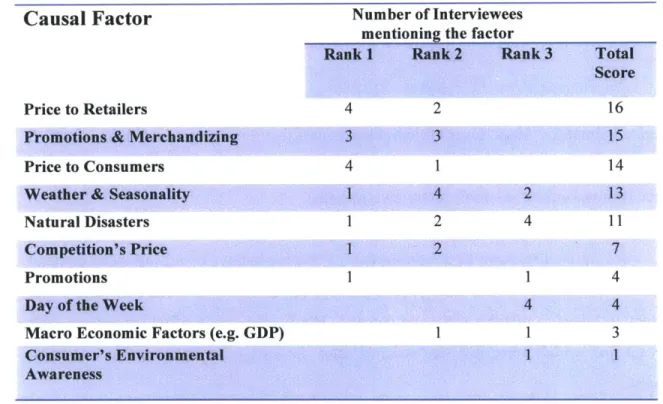
One key question we asked during the interviews was "What are the top causal factors you believe affect sales of bottled water to retailers at Niagara?" Table 2, below, displays the top 10 causal factors mentioned by the respondents during the interviews we conducted along with how many times they were mentioned. We also asked employees to rank the causal factors they believed affected Niagara sales the most (1 being most important). We then gave a score to each ranking (3 points for a rank of 1, 2 points for a rank of 2 and 1 point for a rank of 3) and summed up the scores.
Table 2 Causal Factor Scores (Niagara Employees)
Causal
Factor Number of Intervieweesmentioning the factor
Rank 1 Rank 2 Rank 3 Total
Score
Price to Retailers 4 2 16
Promotions & Merchandizing 3 3 15
Price to Consumers 4 1 14
Weather & Seasonality 1 4 2 13
Natural Disasters 1 2 4 11
Competition's Price 1 2 7
Promotions 1 1 4
Day of the Week 4 4
Macro Economic Factors (e.g. GDP) 1 1 3
Consumer's Environmental 1 1
Awareness
After the initial scoping and problem definition process we were able to identify 9 new causal factors (we will refer to them later as predictors or independent variables) that could possibly help us explain some of the variability that we saw in demand. Causal factors are discussed further in the following section.
3.3 Data Management
After the initial kick-off phase, we moved into the second phase, which was data collection, validation, and review.
3.3.1 The Variables
Dependent Variables
The dependent variable is the variable we are trying to build a model to predict. This variable could be consumer demand, retailer orders, sales orders, or shipments.
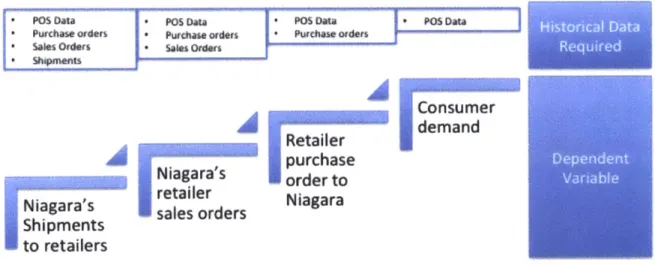
Ideally we would have liked to use a variable as close to consumer demand as possible since this would help us almost eliminate the bullwhip effect and we no longer would need to account for retailer buying patterns, retailer inventory policies, delays in demand relay, delays in requirements realization, and other factors that would affect the quality of demand representative data. (Please refer to the section "Analysis and Models", page 31 to compare the results of using shipments versus point of sale data). However, due to the unavailability of data, we used shipments to retailers as our dependent variable. Figure 6, below, shows the data at each point in the supply chain and how many steps away from real demand the data collection point is.
*P05 Data 0 POS Data 0 P05 Daa POS Data
*Purchase Orden 0 Purhas orders 0 Purchase orders *Sales Orders * Sal"s Ordiers
*Shqmnents
consumer
demand
Retailerpurchase
Niagara's order toNiagara's sales orders Niagara
Shipments
to retailers
Figure 6 Data Lag behind actual consumer demand
We also chose to use liters shipped instead of cartons. This is because there is a lot of cannibalization and interchangeability between the different SKUs. For example, the same bottle could be packaged in 6, 12, 24, or 35 packs. Furthermore, the same bottle
Using DSR to Forecast Demand
Dependent Vaabe
could be packaged with a different label for a different customer or a specific holiday. While this would be a different SKU, it still served to fulfill the same demand.
Independent Variables
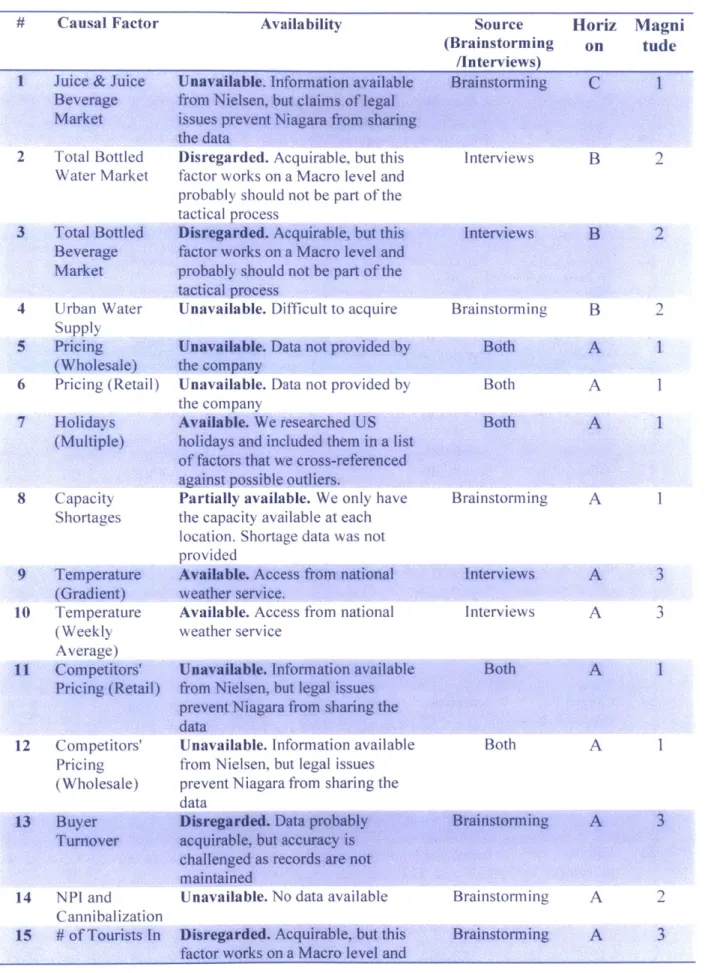
From research, interviews, and brainstorming we created a list of possible causal factors or independent variables. Table 3, below, shows a list of those potential causal factors. We reviewed all the causal factors and categorized them using two criteria,
Horizon of effect and Magnitude of effect.
Under Horizon we have 3 categories, A, B, and C.
Category A: Variables affecting the dependent variable at the tactical horizon (up to 3
months ahead)
Category B: Variables affecting the dependent variable at the strategic horizon (longer
than 3 months ahead)
Category C: Variables affecting the dependent variable at both tactical and strategic
horizons.
Under Magnitude we have three tiers, 1, 2, and 3.
Tier 1: Extreme causality.
Tier 2: Moderate causality (Decision to pursue these factors should be dependent on
time and resources available)
Tier 3: Suspected or minor causality. (These factors should be monitored and reviewed
regularly because of their potential to change.)
Below (Table 3) are all the potential factors and their classification along with an explanation of how we came to believe/suspect the causality.
We arrived at the results of this classification from interviews with Niagara personnel.
Table 3 Initial Causal Factors # Causal Factor
1 Juice & Juice
Beverage Market 2 Total Bottled Water Market 3 Total Bottled Beverage Market 4 Urban Water Supply 5 Pricing (Wholesale) 6 Pricing (Retail) 7 Holidays (Multiple) 8 Capacity Shortages 9 Temperature (Gradient) 10 Temperature (Weekly Average) 11 Competitors' Pricing (Retail) 12 Competitors' Pricing (Wholesale) Availability Source (Brainstorming /Interviews) Horiz Magni on tude I
Disregarded. Acquirable, but this Interviews B factor works on a Macro level and
probably should not be part of the tactical process
Disregarded. Acquirable, but this factor works on a Macro level and probably should not be part of the tactical process
Unavailable. Difficult to acquire
Unavailable. Data not provided by
the company
Unavailable. Data not provided by the company
Available. We researched US
holidays and included them in a list of factors that we cross-referenced
against possible outliers.
Partially available. We only have the capacity available at each location. Shortage data was not provided
Available. Access from national
weather service.
Available. Access from national weather service
Unavailable. Information available from Nielsen, but legal issues prevent Niagara from sharing the
data
Unavailable. Information available from Nielsen, but legal issues prevent Niagara from sharing the data Interviews Brainstorming Both Both Both Brainstorming Interviews Interviews Both Both 2 B 2 B 2 A 1 A 1 A 1 A A 3 A 3 A 1 A 1
14 NPI and Unavailable. No data available Brainstorming A 2 Cannibalization
15 # of Tourists In Disregarded. Acquirable, but this Brainstorming A 3
factor works on a Macro level and
16 # of Tourists Out 18 Economic Indices 20 Food stamps and coupons 21 Day of the Week 22 Day of the Month 23 Week of the Month 24 Week of the Year 25 Region 26 3-Digit Zip Code 27 Customer 28 Ship from location 29 Rainy days (P-recipitatior 30 Snow days Available. Pay monthly, etc..) Available. Day (Bi-Weekly, Available. Available. Available. Available. Available.
Disregarded. Ranked very low by Niagara.
Brainstorming probably should not be part of the
tactical process
Disregarded. Acquirable, but this factor works on a Macro level and probably should not be part of the tactical process
Unavailable. Data not Provided by
the company
Disregarded. Acquirable, but this factor works on a Macro level and probably should not be part of the tactical process
Available. We researched all natur disasters, hitting, theLUS' since 2008. Disregarded. Ranked very low by Niagara. Available Brainstorming A 3 Interviews Interviews Interviews Both Bothw Interviews Both Both Brainstorming
32 Lagged Available. Brainstorming A
Demand -2 weeks
34 Retailer Unavailable. Specifically for Brainstorming C Inventory Customer C where ordering is based
Positions on multiple Stores (Point of Sales) supplied from the same DC.
Using DSR to Forecast Demand
A 3 B 2 A I A 3 A 1 A 2 C C C C 1 I 3 3 A 3 AI 24 Interviews I
3.3.2 Data Collection
We started with the data that we received from the sponsor company. We received several "raw" data files including the following:
1. A history of recorded shipments for 60 months.
2. A map of the company's production and storage facilities.
3. Capacity limits for each production facility.
4. Some Point of Sale data for one of the company's major customers. 5. Some promotional data for some of the very low volume/revenue clients
This data was extracted in an as-is form from the sources with no filtering or scrubbing. Furthermore, the data was spread across multiple spreadsheets, databases, and other online sources.
Second, we collected a history of all public holidays (U.S. Office of Personnel Management, 2013), natural disasters (Federal Emergency Management Agency
(FEMA), 2013), and as many "special" events as we could from interviews with the
Niagara employees.
Finally, we listed the data we believed was relevant but were not able to retrieve due to the lack of availability of data with the sponsor company, inability to share the data due to legal issues, inability to retrieve data from the company's database, or other
similar reasons. For details, please refer to Appendix 2 on page 58
3.3.3 Data Validation
Since the data was spread across multiple spreadsheets, databases, and other sources, the first step was to aggregate the data into one database. To do this we created a database using Microsoft Access and Excel and manually mapped the fields from all sources to the fields that we created in the database. Then we imported the database into Tableau 8.0 for analysis.
Next, we classified the data into four categories (Customer, Geography, Product, and Time). Each category was aggregated at several levels. By choosing different
aggregation levels for the different categories, we were able to view data from multiple perspectives. There was a total of 300 possible combinations, 40 of which were later used for analysis and modeling. (see Figure 7 for a list of categories and levels of aggregation.) Dimensions in red were excluded because customers exhibited different behaviors, not only from other customers, but also in different regions. Furthermore, SKUs were interchangeable; hence, we used the sum of liters sold instead of individual SKUs. We also excluded exports and donations since these were mostly outliers. Finally, we focused on the top 3 customers since they represented almost 50% of total demand.)
All Customers Domestic (US) Top 3 Customers Annual-Quarterly Monthly Weely Daily
Geography
Product
All Niagara All cases
RegionAll liters State
City Category
I3-Digit Zip code SKU
Figure 7 Data categories and aggregation levels
After that, we began scrubbing the data for outliers and other random factors. To do this we looked at different slices of data and analyzed each one individually and went through the following steps:
1. Removed exports and kept only information of shipments made to customers in
the United States mainland because exports are less than 1 % of total revenue, irregular, and are often one time bulk orders that are made well in advance.
2. Broke the data into three categories, one for each of the top 3 customers (Customer A, Customer B, and Customer C). The top 3 customers constitute about 50% of the total revenue and by simple visual inspection we could see that they showed different demand patterns, hence the needed to look at each one independently.
3. Visually inspected the data for trends, peaks, and troughs across all 3 categories.
4. Overlapped the data with data from different slices to figure out if this was a one-time event or was consistent behavior. We then over-laid data from different years, customers, geographies, and products. For example, we examined how a certain customer behaved in a certain region and compared that to other regions, as well as other customers in the same region and over several years.
5. Created an outlier index where we examined each data point by comparing it to the mean of similar data points and how many standard deviations away was to help identify and isolate potential outliers through the 1 million records we had:
a. (1 month) Each day compared the current calendar month
b. (1 week) Each day compared to the current calendar week
c. (3 + 3) Each day compared to the rolling week, the current day, 3 days before the current day and 3 days after.
d. (14 + 14) Each day compared to the rolling month, the current day, 14
days before the current day and 14 days after.
e. (Weekday) the current day (e.g. Monday) plus 2 similar weekdays before and two after.
6. Created a list of potential outliers and crosschecked them with the list of events
that we had collected. If an event did occur on that day, we inspected similar data points to see if the behavior was consistent and probably could be explained. If not, we marked the data point as a suspected outlier.
7. Shared the list of potential outliers with the sponsor company for feedback.
However, we have been advised by Niagara to aggregate the data into larger buckets to smoothen the outliers instead. So, we decided to proceed with their recommendations.
8. Created a new database with adjusted history.
The new database, which aggregated the data from all sources and all entries, followed the same format. (More than 1 million transactions in total)
3.4 Modeling
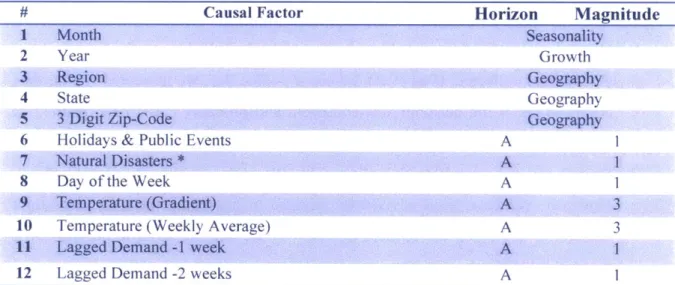
We only created models for the variables that were classified Al or Cl and for which we had data available with the exception of temperature, because the company insisted it had significant effects. A summary of the causal factors used in the models we tested is listed below in Table 4. A list of all the models created and the results are in the (Analysis and Models) section below. We also included variables to account for trend, seasonality, and geographic locations. Below is a list of these variables.
1. Included the year as a causal factor to account for annual growth.
2. Included the month as a causal factor to account for monthly seasonality.
3. Included the Region, State, and 3-digit Zip Code to account for geographic
locations.
Table 4 List of Causal Factors used in Final Models
#Causal Factor Horizon Magnitude
1 Month Seasonality
2 Year G rowth
3 Region Geography
4 State Geography
5 3 Digit Zip-Code Geography
6 Holidays & Public Events A 1
7 Natural Disasters * A 1
8 Day of the Week A 1
9 Temperature (Gradient) A 3
10 Temperature (Weekly Average) A 3
11 Lagged Demand -I week A 1
12 Lagged Demand -2 weeks A 1
* Tsunami Waves, Winter Storms, Flooding, Severe Winter Storms, Debris and Mudflows, Earthquake
We also included other "test" variables (temperature, point of sale, value of food stamps issued). For several variables we included, test or otherwise, we used variations of it such as using the average temperature of the past week or past three days instead of the
absolute temperature for that day.
Table 5, below, lists all the factors and variations used.
Table 5 Key to variations and codes of Causal factors used Causal Factor code used in
models Holiday Week
Holiday Week Detail Holidays (8 Individual) Holidays, Weekly (8 Individual) Weekday Previous 7 Days Previous Week Previous WeekdayWEnd Food Stamps WeekNbr Avg Temp -7d
Avg Temp -7d Diff Avg Temp -3d
Avg Temp -3d Diff Temp-1 Temp-1 Diff Temp +1 Temp +1 Diff Temp +3 Temp +3 Diff Lts -1 Lts -11-3 Lts -1/-Lts -1/-14 Lts -7/-14 POS Qty POS Qty -1 POS Qty -3 POS qty -7 POS Revenue POS Revenue -1 POS Revenue -3 POS revenue -7
The week in which a holiday occurs (all 22 holidays aggregated as one predictor)
The week in which a holiday occurs (all 22 holidays as individual predictors)
The week in which a holiday occurs (8 significant holidays aggregated
as one predictors)
The week in which a holiday occurs (8 significant holidays as individual predictors)
The week of the day
The shipment in liters for the past 7 days
The average shipments in liters for the past week
The average shipments in liters for the past 5 weekdays / past weekend
Amount issued in food stamps The week number (1-52)
Average temperature for the past 7 days
Variance between the current temperature and the average temperature for the past 7 days
Average temperature for the past 3 days
Variance between the current temperature and the average temperature for the past 3 days
Temperature for the past day
Variance between the current temperature and the temperature for the past day
Forecast for the upcoming day
Variance between today's temperature and the next day's forecast Average forecast for the next 3 days
Variance between today's temperature and the average forecast for the next 3 days
Shipments in liters for the past day
Average shipments in liters for the past 3 days
Average shipments in liters for the past 7 days
Average shipments in liters for the past 14 days
Average shipments in liters for 7 days, 7 days ago
POS quantity sold
POS quantity sold for the past day
POS quantity sold for the past 3 days
POS quantity sold for the past 7 days
POS revenue earned
POS revenue earned for the past day
POS revenue earned for the past 3 days
POS revenue earned for the past 7 days
Using DSR to Forecast Demand
Detail
3.4.1 Model Creation
To create the models we performed the following steps for each model:
1. Listed all dependent variables
2. Listed all independent variables (causal factors)
3. Provided a brief explanation of the factors and correlations (if any)
4. Listed the data sources and any assumptions
5. Created a model using regression analysis (for interval and ratio variables) and
ANOVA (for categorical variable), using all the data except the last 6 months. 6. Used the model to attempt to predict the demand over the "hidden" 6 months and
determine the effectiveness of the model.
7. Refine the model and repeat step 6.
3.4.2 Summary
In this chapter we discussed three main topics. First, the methods we used to collect, segment, and analyze the data. Second, the approach taken with choosing independent and dependent variables. Finally, the method causal factors are incorporated into models and the steps taken to create the models. In the next chapter we will present and discuss the results of the modeling process.
Chapter 4: Analysis and Models
In this section we will discuss the resulting models and insights from using the methodology discussed above for the specific case study.
4.1 The Models
First, we refined the data used for the models. Figure 8 below shows the shipments over time for the top three customers (solid lines) and the trend lines for the shipments to these customers (hashed lines). As we can see from the figure, both Customer A and Customer B had relatively very stable overall growth and trends, while Customer C has a sudden increase in activity after 2010 because of new agreements made over the past three years. Therefore; we have decided to use the entire data set for Customer A and Customer B, while only using data starting 2011 for Customer C. This decision was made to exclude data and trends that were no longer relevant to predict the future demand for Customer C. We also decided to restrict the Customer A models to California, Customer B models to Ohio, and Customer C models to Texas as these are the most well-established and stable markets and represent roughly 50% of the total volume shipped in 2012. Furthermore, the goal of this thesis is to demonstrate the concept. The method can be replicated for other customers, regions, and geographies easily.
Customer A Customer C C-u Customer B 2008 2009 2010 2011 2012 Year of Date
Figure 8 Trends over time per customer for U.S. Mainland
Then, we created basic models to test each of the variables independently. We started with only one variable (Weekday) and added one variable in each subsequent model. We also created models to test the effect of each of the 22 holidays (Table 6) on the dependent variable. The result was that several holidays proved to have little or no effect on the dependent variable. We chose to include the top 8 significant holidays in all subsequent models.
Table 6 Models created to test the effects of individual holidays Customer/Region: Customer A / California
Dependent Variable: Shipments made to customers in liters
# Aggregation Independent 1 Adjusted Holiday Comments
R2
1 Daily HI 0.0168 New Yeaes, Day INCLUDED 2 Daily H2 Negative Martin Luther King Day Insignificant
3 Daily H43 0.0035 Super Bowl Not Included 4 Daily H4 0.000091 Valentine's Day Insignificant
5 Daily H5 0.001 Presidents Day Not Included
6 Daily H6 0.0011 Mardi Gras Carnival Not Included
7 Daily H7 Negative St. Patrics Day Insignificant
8 Daily H8 0.0225 Easter Sunday INCLUDED 9 Daily H9 Negative MotsDay Insignificant
10 Daily HIO 0.0183 Memorial Day INCLUDED
11 Daily H11 0.01 IndependenceDay INCLUDED
12 Daily H12 0.0185 Labor Day INCLUDED 13 Daily H13 0.0029 Patriot Day 2013 Not Included 14 Daily H14 Negative Columbus Day Insignificant 15 Daily H15 Negative Halloween Insignificant
16 Daily H16 Negative Veterans' Day Insignificant
17 Daily H17 0.0197 Thanksgiving INCLUDED
18 Daily H18 Negative Black Friday Insignificant
19 Daily H19 0.0009 Christmas Eve Insignificant 20 Daily H20 0.0215 Christmas Day INCLUDED
21 Daily H21 0.0081 New Yes Eve INCLUDED
22 Daily H22 Negative Cesar Chavez Day Insignificant
Using DSR to Forecast Demand 32
I
We also found that natural disasters (fortunately) are too few and far apart to present significant coefficients. Hence, we excluded them from our models. We would recommend treating such events as outliers instead. Finally, we used multiple variables together to create more comprehensive models (243 in total). Table 7, Table 8, Table 9, Table 10 and Table 11 (below) provide a summary of the models created, predictors used, and corresponding values of R2 for Customer A in California, Customer B in Ohio, and Customer C in California and Texas respectively.
We created models using different combinations of variables. Most of the models used shipment data that was aggregated daily. However, Niagara currently forecast on a monthly basis and plan to move soon to a weekly forecast. Hence, we created some models using weekly data so that Niagara can compare the model quality with their future forecasting practices.
Table 7 Summary of Models Created for Customer A in California Customer/Region: Customer A / California
Dependent Variable: Shipments made to customers in liters Data Aggregation: 2008 -2012
# Aggregation Independent Variables Observations Adj R2
1 Daily Weekday; 1825 13.98%
2 Daily Month 1825 12.18%
3 Daily Weekday 1825 12.79%
4 Daily Month 1825 15.24%
5 Daily Year 1825 13.16%
6 Daily Hoidays (22 Aggregate) 1825 7.77% 7 Daily Weekday; Month 1825 28.19%
9 Daily Weekday; Yea 1825 26.07%
9 Daily Month; Year 1825 28.56%
10 Daily Weekday; Holidays (22 Aggregate) 1825 19.56% 11 Daily Weekday; Holidays (22lndividual) 1825 26.83%
12 Daily Weekday; Month; Year 1825 41.64%
13 Daily Weekday; Month; Year; Holidays (22 Individual) 1825 54.39%
'14 Daily WeekNbr 1816 10.52%
15 Weekly Average WeekNbr 1816 19.13% 16 Weekday/Weekend WeekNbr 1816 14.64%
17 Weekday/Weekend WeekNbr; Weekday 1816 28.28%
18 Weekly WeekNbr 260 30.97%
19 Weekly Year
20 Weekly WeekNbr; Year
21 Weekly WeekNbr; Weekday/Weekend 22 Daily WeekNbr; Year
23 Weekly Average WeekNbr; Year 24 Weekday/Weekend WeekNbr; Year
25 Weekday/Weekend WeekNbr; Year; Weekday
26 Daily WeekNbr
27 Weekly Average WeekNbr
28 Weekday/Weekend WeekNbr
29 Weekday/Weekend WeekNbr; Weekday
30 Daily WeekNbr; Year
31 Weekly Average WeekNbr; Year
32 Weekday/Weekend WeekNbr; Year
33 Weekday/Weekend WeekNbr; Year; Weekday
34 Daily Weekday
35 Daily Month
36 Daily Year
37 Daily Previous Day
38 Daily Previous 7 Days
39 Daily Previous Week 40 Daily Previous WeekdayWEnd 41 Daily Previous WeekdayWEnd; Wee 42 Daily Weekday; Previous 7 Days 43 Daily Weekday; Previous 7 Days; M 44 Daily Weekday; Previous 7 Days; M 45 Daily Weekday; Previous 7 Days; Y 46 Daily Weekday; Holidays (8 Individ 47 Daily Weekday
48 Daily Month 49 Daily Year
50 Daily Previous Day
51 Daily Previous 7 Days
52 Daily Previous Week
53 Daily Previous WeekdayWEnd; Wee 54 Daily Weekday; Previous 7 Days
55 Daily Weekday; Previous 7 Days; M
56 Daily Weekday; Previous 7 Days; M
57 Daily Weekday; Previous 7 Days; Y
58 Daily Weekday; Holidays (8 Individ
59 Daily Weekday; Holidays (8 Individ
60 Daily Weekday; Month; Year
61 Daily Weekday; Previous 7 Days; Fo
kday/Weekend onth nth; Year ear ual) kday/Weekend onth onth; Year ear ual) ual) s od Stamps
Using DSR to Forecast Demand
260 260 519 1816 1816 1816 1816 1815 1815 1815 1815 1815 1815 1815 1815 1825 1825 1825 1825 1825 1815 1820 1820 1825 1825 1825 1825 1825 1825 1825 1825 1825 1825 1815 1815 1825 1825 1825 1825 1825 1825 1825 1825 32.50% 72.20% 87.04% 55.09% 92.57% 73.05% 86.87% 14.89% 41.70% 33.18% 36.16% 29.19% 77.46% 62.23% 65.26% 12.79% 15.24% 13.16% 13.87% 25.14% 21.87% 11.28% 23.03% 38.06% 38.87% 42.22% 33.04% 26.83% 12.79% 15.24% 13.16% 13.87% 25.14% 17.56% 19.82% 38.06% 38.87% 42.22% 38.79% 26.83% 25.90% 41.64% 38.16% 34
62 Daily Weekday; Month; Food Stamps 1825 28.64%
63 Daily Weekday; Month; Food Stamps; Year 1825 42.11% 64 Daily Weekday; Month; Year; Holidays (8 Individual) 1825 54.39%
65 Daily Weekday; Month; Year; Holidays (22 Individual) 1825 54.36%
66 Daily Weekday; Month; Year; Holidays (8 Individual); Food Stamps 1825 54.56%
67 Daily Weekday 1825 12.79%
68 Daily Month 1825 15.24%
69 Daily Year 1825 13.16%
70 Daily Holidays (8 Individual) 1825 7.77% 71 Daily Holidays (22 Aggregate) 1825 14.95%
72 Daily Holiday Week 1825 5.54%
73 Daily Holiday Week Detail 1825 5.56% 74 Daily Holidays (8 Individual) 1825 14.54%
75 Daily Holidays, Weekly (8 Individual) 1825 4.15%
76 Daily Weekday; Month; Year;; 1825 41.64% 77 Daily Weekday; Month; Year; Holidays (22 Aggregate) 1825 54.39%
78 Daily Weekday; Month; Year; Holidays (8 Aggregate) 1825 54.39%
79 Daily Lts -1 1825 13.87% 80 Daily Lts -1/-3 1825 15.96% 81 Daily Lts -1/-7 1825 25.20% 82 Daily Lts -1/- 14 1825 25,97% 83 Daily Lts -7/-14 1825 20.56% 84 Daily Lts-1;Lts-1/-7 1825 25.76% 85 Daily Lts -1/-7; Lts -7/-14 1825 26.33% 86 Daily Weekday; Month; Year; Holidays (22 Aggregate); Lts -1/-7 1825 55.06% 87 Daily Weekday; Month; Year; Holidays (8 Individual); Lts -1/-7 1825 55.04%
88 Daily Weekday; Month; Year; Holidays (22 Aggregate); Lts -1/44 1825 54.60%
89 Daily Weekday; Month; Year; Holidays (8 Individual); Lts -1/-14 1825 54.60%
90 Daily Weekday; Month; Year; Lts -1/-7 1825 42.22%
91 Daily Avg Temp -7d; Avg Temp -7d 1825 12.48%
92 Daily Avg Temp -7d Diff, Avg Temp -7d Diff 1825 0.68% 93 Daily Avg Temp -3d; Avg Temp -3d 1825 9.61%
94 Daily Avg Temp, -3d DZ Avg Temp -3d 1825 0.26% 95 Daily Temp-1; Temp-1 1825 7.49%
96 Daily Temp- I DiTmp Pff 1825 0.04%
97 Daily Temp +1; Temp +1 1825 5.48%
98 Daily Temp +1 Diff; Temp +1 Diff 1825 neg
99 Daily Temp +3; Temp +3 1825 5.92%
100 Daily Temp +3 Diff; Temp +3 Diff 1825 0.08% 101 Daily Weekday; Month; Year; Holidays (8 Individual) 1825 54.40%
102 Daily Weekday; Weekday; Month; Year; Avg Tep -7d 1825 44.02%
103 Daily Weekday; Month; Year; Holidays (8 Individual); Avg Temp -7d 1825 56.61%
Table 8 Summary of Models created for Customer B in California
Customer/Region: Customer B / Ohio
Dependent Variable: Shipments made to customers in liters Data Aggregation: 2008 - 2012
# Aggregation Independent Variables Observations Adj R2
104 Daily Weekday 1760 14.18%
105 Daily Month 1760 2.76%
106 Daily Year 1760 6.20%
107 Daily Previous Day 1760 18.48%
108 Daily Previous 7 Days 1760 12.41%
109 Daily Previous Week 1760 3.91%
110 Daily Previous WeekdayWEnd; Weekday/Weekend 1750 12.82% 11I Daily Weekday; Previous 7 Days 1760 27.22%
112 Daily Weekday; Previous 7 Days; Month 1760 27.41% 113 Daily Weekday; Previous 7 Days; Month; Year 1760 28.81%
114 Daily Weekday; Previous 7 Days; Year 1760 28.25% 115 Daily Weekday; Holidays (22 Individual) 1760 16.18% 116 Daily Weekday; Holidays (8 Individual) 1760 15.61% 117 Daily Weekday; Month; Year 1760 24.28% 118 Daily Weekday; Previous 7 Days; Food Stamps 1760 27.19% 119 Daily Weekday; Month; Food Statps 1760 17.24% 120 Daily Weekday; Month; Food Stamps; Year 1760 24.25% 121 Daily Weekday; Month; Year Holidays (22 Individual) 1760 25.88%
122 Daily Weekday; Month; Year; Holidays (8 Individual) 1760 25.86% 123 Daily Weekday; Month; Year; Holidays (8 Individual); Food Stamps 1760 25.85%