P
OSTOPERATIVE pulmonary complications (PPCs)
can have an important impact on the morbidity and
mortality of patients who need major surgery.
1Approxi-mately 5% of patients undergoing general surgery will
develop a PPC, and one of the five patients who developed
a PPC will die within 30 days of surgery.
1Furthermore, the
number of PPCs is strongly associated with postoperative
length of stay and short-term and long-term mortality.
1,2There is growing evidence that intraoperative lung-
protective mechanical ventilation using low tidal volumes,
with or without high levels of positive end-expiratory pressure
(PEEP), and recruitment maneuvers prevents PPCs
com-pared with mechanical ventilation with high tidal volumes
and low levels of PEEP without recruitment maneuvers.
3–6In the current article, we review the definition of and
methods to predict PPCs, the pathophysiology of
ventilator-induced lung injury (VILI) with emphasis on the noninjured
lung, and ventilation strategies to minimize PPCs. To identify
the most recent evidence from the literature on randomized
controlled trials (RCTs) addressing intraoperative
mechani-cal ventilation and nonclinimechani-cal as well as clinimechani-cal
postopera-tive outcome measures, we conducted a MEDLINE review
Copyright © 2015, the American Society of Anesthesiologists, Inc. Wolters Kluwer Health, Inc. All Rights Reserved. Anesthesiology 2015; 123:692–713
ABSTRACT
Postoperative pulmonary complications are associated with increased morbidity, length of hospital stay, and mortality after
major surgery. Intraoperative lung-protective mechanical ventilation has the potential to reduce the incidence of
postopera-tive pulmonary complications. This review discusses the relevant literature on definition and methods to predict the
occur-rence of postoperative pulmonary complication, the pathophysiology of ventilator-induced lung injury with emphasis on the
noninjured lung, and protective ventilation strategies, including the respective roles of tidal volumes, positive end-expiratory
pressure, and recruitment maneuvers. The authors propose an algorithm for protective intraoperative mechanical ventilation
based on evidence from recent randomized controlled trials.
(A
nesthesiology2015; 123:692-713)
This article is featured in “This Month in Anesthesiology,” page 1A. Corresponding article on page 501. Figures 1, 3, and 7 were enhanced by Annemarie B. Johnson, C.M.I., Medical Illustrator, Vivo Visuals, Winston-Salem, North Carolina. The first three authors contributed equally to this article.
Submitted for publication September 4, 2014. Accepted for publication January 31, 2015. From the Department of Anesthesiology and Intensive Care Medicine, Pulmonary Engineering Group, University Hospital Carl Gustav Carus at the Technische Universität Dresden, Dresden, Germany (A.G., T.K., P.M.S., M.G.d.A.); Program of Post-Graduation, Research and Innovation; Faculdade de Medicina do ABC (FMABC), and Department of Critical Care Medicine, Hospital Israelita Albert Einstein, São Paulo, Brazil (A.S.N.); Department of Intensive Care Medicine and the Laboratory for Experimental Intensive Care and Anesthesiology, Academic Medical Center at the University of Amsterdam, Amsterdam, The Netherlands (S.N.T.H., M.J.S.); Department of Anesthesiology and Postoperative Care Unit, Hospital Universitari Germans Trias i Pujol, Badalona, Barcelona, Spain (J.C.); Laboratory of Pulmonary Investigation, Carlos Chagas Filho Institute of Biophysics, Federal University of Rio de Janeiro, Rio de Janeiro, Brazil (P.R.M.R.); and IRCCS (Istituto di Ricovero e Cura a Carattere Scientifico) AOU (Azienda Ospedaliera Universitaria) San Martino IST (Istituto Tumori) Hospital, Department of Surgical Sciences and Integrated Diagnostics, University of Genoa, Genoa, Italy (P.P.). All authors are members of the Protective Ventilation Network (PROVEnet, www.provenet.eu).
David S. Warner, M.D., Editor
Intraoperative Protective Mechanical Ventilation for
Prevention of Postoperative Pulmonary Complications
A Comprehensive Review of the Role of Tidal Volume, Positive
End-expiratory Pressure, and Lung Recruitment Maneuvers
Andreas Güldner, M.D., Thomas Kiss, M.D., Ary Serpa Neto, M.D., M.Sc., Ph.D.,
Sabrine N. T. Hemmes, M.D., Jaume Canet, M.D., Ph.D., Peter M. Spieth, M.D.,
Patricia R. M. Rocco, M.D., Ph.D., Marcus J. Schultz, M.D., Ph.D., Paolo Pelosi, M.D., F.E.R.S.,
Marcelo Gama de Abreu, M.D., M.Sc., Ph.D., D.E.S.A.
This article has been selected for the Anesthesiology CME Program. Learning objectives and disclosure and ordering information can be found in the CME section at the front of this issue.
using the following search terms: “lower tidal volume” OR
“low tidal volume” OR “protective ventilation” OR
“recruit-ment maneuvers” OR “PEEP” OR “positive end expiratory
pressure.” Retrieved articles, and cross-referenced studies
from those articles, were screened for pertinent information.
Definition and Prediction of PPCs
Summary of Current Definitions
Postoperative pulmonary complications are usually
pre-sented as a composite, which then includes possible fatal
and nonfatal respiratory events of new onset occurring in
the postoperative period. Currently, there is no agreement
about which of these events should be considered as PPC,
for example, respiratory failure, lung injury, pneumonia,
prolonged or unplanned mechanical ventilation or
intuba-tion, hypoxemia, atelectasis, bronchospasm, pleural
effu-sion, pneumothorax, ventilatory depreseffu-sion, and aspiration
pneumonitis.
7,8From a clinical standpoint, it is worthwhile
to present PPCs as a composite because any of these events
alone or their associations has a significant impact on the
postoperative outcome,
1using different definitions.
How-ever, it is clear that these events can have different
patho-physiologic mechanisms. For this reason, some studies have
focused on single events, mainly respiratory failure
9and
pneumonia.
10Postoperative pulmonary complications, to be considered
as such, must be related to anesthesia and/or surgery.
Fur-thermore, the time frame must be well defined. Usually, an
event is only considered as PPC if it develops within 5 to 7
days after surgery.
8,11Prediction of PPCs
Prediction of PPCs, or any of the single postoperative
respi-ratory events that is part of that composite, can be useful to
plan perioperative strategies aiming at their prevention and
also to reduce health system costs.
12First, the risk factors
associated with the development of PPCs must be identified.
In 2006, the American College of Physicians published a
sys-tematic review of the literature listing a number of risk factors
for PPCs according to their respective levels of evidence.
13In
recent years, that list has been expanded to include other
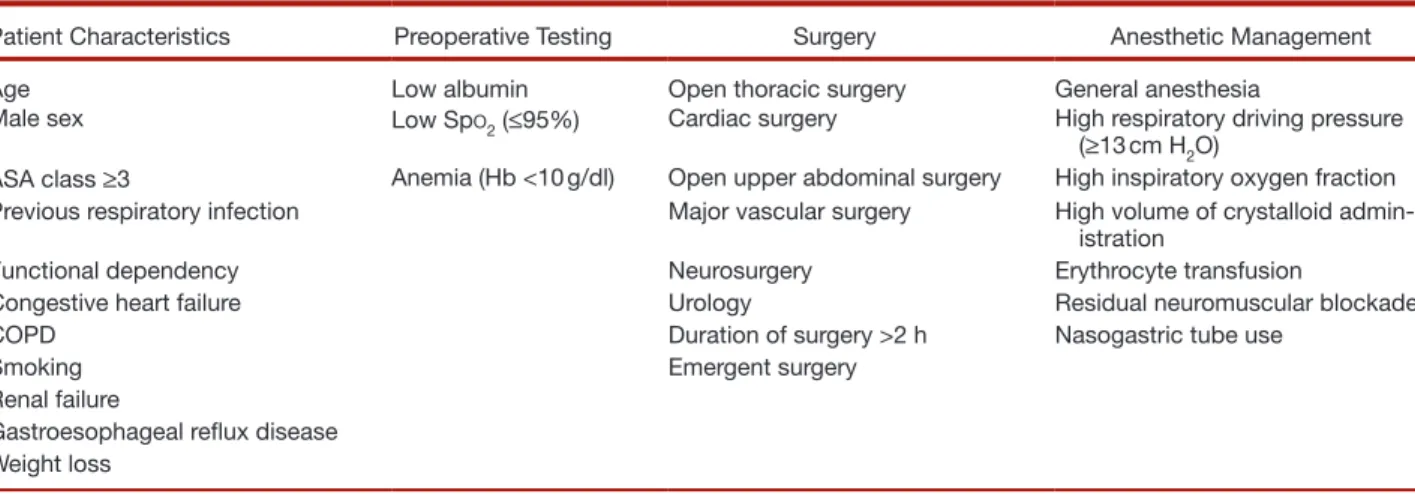
fac-tors found to increase the risk of PPCs. Table 1 depicts the
risk factors associated with PPCs according to the current
literature. Approximately 50% of the risk factors for PPCs
are attributable to the patient’s health conditions, whereas
the other 50% are related to the surgical procedure and the
anesthetic management itself.
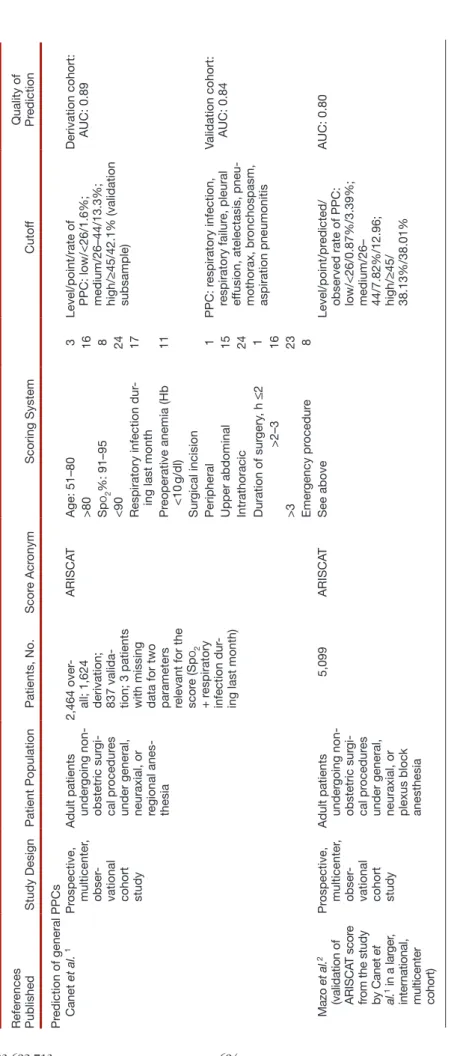
1Based on risk factors, different scores have been
devel-oped that have the potential to predict the occurrence of
PPCs,
6,14–16as shown in table 2. However, their applicability
may be limited because they were derived from restricted
settings,
16retrospective databases,
15or only validated for
specific PPCs.
6,14The Assess Respiratory RIsk in Surgical
Patients in CATalonia (ARISCAT) study was conducted
in a general surgical population of Catalonia, Spain.
1After
a multivariate analysis, a score based on seven risk factors
was developed and underwent internal validation, showing
a clinically relevant predictive capability (c-statistic, 0.90).
Recently, the ARISCAT score was externally validated in a
large European surgical sample (the Prospective Evaluation
of a RIsk Score for Postoperative Pulmonary COmPlications
in Europe study).
2Although differences in the performance
of the ARISCAT score have been observed between
Euro-pean geographic areas, the score was able to discriminate
three levels of PPCs risk (low, intermediate, and high). Thus,
at present, the ARISCAT score may represent the most
valu-able tool for predicting PPCs across different countries and
surgical populations.
Putative Mechanisms of VILI
The coexistence of closed, recruitable, and already
overdis-tended alveolar regions makes the lung vulnerable to
det-rimental effects of mechanical stress and strain induced by
Table 1. Risk Factors for Postoperative Pulmonary Complications
Patient Characteristics Preoperative Testing Surgery Anesthetic Management
Age Low albumin Open thoracic surgery General anesthesia
Male sex Low SpO2 (≤95%) Cardiac surgery High respiratory driving pressure (≥13 cm H2O)
ASA class ≥3 Anemia (Hb <10 g/dl) Open upper abdominal surgery High inspiratory oxygen fraction Previous respiratory infection Major vascular surgery High volume of crystalloid
admin-istration
Functional dependency Neurosurgery Erythrocyte transfusion
Congestive heart failure Urology Residual neuromuscular blockade
COPD Duration of surgery >2 h Nasogastric tube use
Smoking Emergent surgery
Renal failure
Gastroesophageal reflux disease Weight loss
Respiratory driving pressure is defined as inspiratory plateau airway pressure minus positive end-expiratory pressure.
ASA = American Society of Anesthesiologists; COPD = chronic obstructive pulmonary disease; Hb = hemoglobin concentration; SpO2 = oxygen saturation as measured by pulse oximetry.
Table 2. Scor es for Pr ediction of PPCs Refer ences Published Study Design Patient Population Patients, No. Scor e Acr onym Scoring System Cutof f Quality of Prediction Pr
ediction of general PPCs Canet
et al. 1 Pr ospective, multicenter , obser
-vational cohort study Adult patients under
going non -obstetric sur gi -cal pr ocedur es
under general, neuraxial, or regional anes
-thesia
2,464 over
-all; 1,624 derivation; 837 valida
-tion; 3 patients with missing data for two parameters relevant for the scor
e (Sp O2 + r espiratory infection dur
-ing last month)
ARISCA
T
Age: 51–80
3
Level/point/rate of PPC: low/<26/1.6%; medium/26–44/13.3%; high/
≥
45/42.1% (validation
subsample)
Derivation cohort: AUC: 0.89
>80 16 Sp O2 %: 91–95 8 <90 24
Respiratory infection dur
-ing last month
17 Pr eoperative anemia (Hb <10 g/dl) 11 Sur gical incision Peripheral 1 PPC: r espiratory infection, respiratory failur e, pleural ef
fusion, atelectasis, pneu
-mothorax, br
onchospasm,
aspiration pneumonitis
Validation cohort: AUC: 0.84
Upper abdominal 15 Intrathoracic 24 Duration of sur gery , h ≤ 2 1 >2–3 16 >3 23 Emer gency pr ocedur e 8 Mazo et al. 2 (validation of ARISCA T scor e
from the study by Canet
et al. 1 in a lar ger , inter national, multicenter cohort) Pr ospective, multicenter , obser
-vational cohort study Adult patients under
going non -obstetric sur gi -cal pr ocedur es
under general, neuraxial, or plexus block anesthesia
5,099 ARISCA T See above Level/point/pr edicted/
observed rate of PPC: low/<26/0.87%/3.39%; medium/26– 44/7.82%/12.96; high/
≥ 45/ 38.13%/38.01% AUC: 0.80 (Continued )
Pr ediction of selected PPCs Johnson
et al. 14 (reevaluated in a br oader cohort fr om the study by Ar o-zullah et al. 9) Pr ospective, multicenter , obser
-vational cohort study Adult patients under
going
major general or vascular procedur
es per
-formed under general, spinal, or epidural anesthesia
90,055 deriva -tion; 89,948 validation Respiratory fail -ur e Risk Index Type of sur gery Level/point/pr edicted/ observed pr obability of
PRF: low/<8/0.2%/0.08%; medium/8–12/1.0%/0.84%; high/>12/6.6%/6.75% Derivation cohort: AUC: 0.856
Integumentary
1
Respiratory and hemic
3 Heart 2 Aneurysm 2 Mouth, palate 7 Stomach, intestines 2 Endocrine 2 Pr edisposing factors Male sex 1 Age 40–65 2 Age >65 2 ASA class 3 3 ASA class 4–5 5 W ork R VU 10–17 2 W ork R VU >17 4 Emer gency 2 Sepsis 2 History of sever e COPD 2 Ascites 2
PRF: mechanical ventilation for >48
h or unplanned
reintubation
Validation cohort: AUC: 0.863
Dyspnea 1 Impair ed sensorium 1 >2 alcoholic drinks/d in 2 wk 1 Bleeding disor ders 1 W eight loss >10% 1 Acute r enal failur e 2
Congestive heart failur
e 1 Smoker 1 Str oke 1 W
ound class other than clean
1 Pr eoperative albumin <3.5 1 Cr eatinine >1.5 2 Pr eoperative bilirubin >1.0 1
White blood count <2.5/>10
1
Pr
eoperative serum sodium >145
2 Platelet count <150 1 SGOT >40 1 Hematocrit <38 1 Table 2. Continued Refer ences Published Study Design Patient Population Patients, No. Scor e Acr onym Scoring System Cutof f Quality of Prediction (Continued )
Brueckmann et al. 15 Retr ospective, single- center , obser
-vational cohort study
Cases with a sur
gi
-cal pr
ocedur
e if
the adult patient was intubated at the beginning and extubated at the end of the procedur
e 33,769 overall; 16,885 deriva -tion; 16,884 validation Scor e for Pr ediction of
Postoperative Respiratory Complications
ASA scor e ≥ 3 3 Scor e values/pr obability of
reintubation: 0/0.12%; 1–3/0.45%; 4–6/1.64%; 7–11/5.86% (validation subsample) Derivation cohort: AUC: 0.81
Emer
gency pr
ocedur
e
3
Validation cohort: AUC: 0.81
High-risk service
2
Congestive heart failur
e 2 Chr onic pulmonary disease 1 Pr
ediction of ALI/ARDS Gajic
et al.
6 (simi
-lar to the study by T
rillo-Alva -rez et al. 17 but used a lar ger , multicenter cohort) Pr ospective, multicenter , obser
-vational cohort study Adult patients with one or mor
e
ALI risk fac
-tors, including sepsis, shock, pancr
eatitis,
pneumonia, aspiration, high- risk trauma, or high-risk sur
gery 5,584 overall; 2,500 deriva -tion; 3,084 validation Lung Injury Pr ediction Scor e Pr edisposing conditions >4; cutof f for development of ALI/ARDS
Combined: AUC: 0.80; sensitivity: 0.69; specificity: 0.78
Shock 2 Aspiration 2 Sepsis 1 Pneumonia 1.5 High-risk sur gery Orthopedic spine 1 Acute abdomen 2 Car diac 2.5 Aortic vascular 3.5 If emer gency sur gery +1.5
High-risk trauma Traumatic brain injury
2 Smoke inhalation 2 Near dr owning 2 Lung contusion 1.5 Multiple fractur es 1.5
Risk modifiers Alcohol abuse
1 Obesity (BMI >30) 1 Hypoalbuminemia 1 Chemotherapy 1 F IO2 >0.35 (>4 l/min) 2 Tachypnea (RR >30) 1.5 Sp O2 <95% 1 Acidosis (pH <7.35) 1.5 Diabetes mellitus −1, if septic Table 2. Continued Refer ences Published Study Design Patient Population Patients, No. Scor e Acr onym Scoring System Cutof f Quality of Prediction (Continued )
mechanical ventilation.
19,20The physical forces in some
alveolar regions may exceed the elastic properties of the lungs
although gross measurements of airway pressures or lung
mechanics as usually monitored under anesthesia still suggest
mechanical ventilation is in a “safe” zone.
21,22Several
mecha-nisms have been postulated to describe the development of
VILI.
23Increased airway pressure (barotrauma) or the
appli-cation of high tidal volumes (volutrauma) may cause damage
or disruption of alveolar epithelial cells, by generating
trans-pulmonary pressures (stress) that exceed the elastic properties
of the lung parenchyma above its resting volume (strain).
24,25It has been demonstrated that the duration of
mechani-cal stress defined as the stress versus time product affects
the development of pulmonary inflammatory response.
26Although high stress versus time product increased the gene
expression of biological markers associated with
inflamma-tion and alveolar epithelial cell injury and low stress versus
time product increased the molecular markers of endothelial
cell damage, balanced stress versus time product as defined by
an inspiratory to expiratory time ratio of 1:1 was associated
with attenuated lung damage.
26Especially in the presence
of atelectasis, mechanical ventilation may cause damage by
repetitive collapse and reopening of alveolar units, a
phenom-enon known as atelectrauma.
27All three mechanisms, namely
barotrauma, volutrauma, and atelectrauma, may affect
alveo-lar as well as vascualveo-lar epithelial and endothelial cells
28,29and
promote extracellular matrix fragmentation.
30,31The extracellular matrix of the lung parenchyma seems
to be particularly sensitive to stress from mechanical
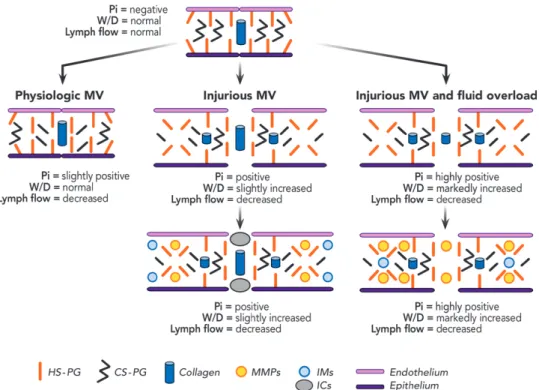
ventila-tion, as illustrated in figure 1. Initially, the proteoglycans on
the endothelial side and between the endothelial and
epi-thelial lines undergo damage dependent on tidal volume,
30as well as breathing pattern.
31The mechanical
fragmenta-tion of the extracellular matrix promotes interstitial edema
and activation of metalloproteinases, further damaging
the extracellular matrix itself. In a second step, fragments
of the extracellular matrix can promote the activation of
inflammatory mediators.
32,33Furthermore, the damage of
the extracellular matrix induced by mechanical ventilation
might be exacerbated by fluid load,
34which is not
uncom-mon during general anesthesia. However, fluid overload
seems to minimize the inflammatory response, likely by
dilution of extracellular matrix fragments or changes in
their structure, thereby down-regulating the local
inflam-matory response.
34This suggests that (1) injurious
mechani-cal ventilation makes the lung more susceptible to further
insults; and (2) in previously healthy lungs, VILI can be
induced without early increase in inflammatory mediators.
At the cellular level, physical stimuli are transformed into
chemical signals, for example, proinflammatory and
antiin-flammatory mediators by means of direct cell injury or
indi-rect activation of cellular signaling pathways. This process
is known as “mechanotransduction.”
35Some mediators may
promote local effects such as proapoptotic or profibrotic
actions, whereas others act as homing molecules recruiting
Kor
et al.
16 (similar to the study by Kor
et al.
18, but
used a lar
ger
,
multicenter cohort; second
-ary analysis of the study by Gajic
et al.
6) Secondary analysis of a pr
ospective,
multicenter cohort study Adult patients pr
esenting with
one or mor
e
ALI risk fac
-tors, including sepsis, shock, pancr
eatitis,
pneumonia, aspiration, high- risk trauma, or high-risk sur
-gery and under
-going a sur gical pr ocedur e 1,562 Sur
gical Lung Injury Pr
edic -tion 2 Sur gical pr ocedur e ≥ 19; cutof f for development of ARDS AUC: 0.84; Sen -sitivity: 0.82; Specificity: 0.75 High-risk car diac sur gery 7
High-risk aortic vascular sur
gery 11 Emer gency sur gery 10
Baseline health status Sepsis
10 Cirrhosis 20 Admission sour ce other than home 9
Physiologic markers of acute illness Respiratory rate 20–29
7 Respiratory rate ≥ 30 14 F IO2 >35% 13 Sp O2 <95% 5
ALI = acute lung injury; ARDS = acute r
espiratory distr
ess syndr
ome; ARISCA
T = Assess Respiratory RIsk in Sur
gical Patients in CA
Talonia; ASA = American Society of Anesthesiologists classification; AUC = ar
ea
under the curve; BMI = body mass index; COPD = chr
onic obstructive pulmonary disease; F
IO2
= fraction of inspir
ed oxygen; Hb = hemoglobin; PPC = postoperative pulmonary complication; PRF = postoperative
respiratory failur e; RR = r espiratory rate; R VU = relative value units (a measur e of sur gical
complexity); SGOT = serum
glutamic-oxaloacetic transaminase; Sp O2 = oxygen saturation as measur ed by pulse oximetry . Table 2. Continued Refer ences Published Study Design Patient Population Patients, No. Scor e Acr onym Scoring System Cutof f Quality of Prediction
local and remote immune cell populations (e.g.,
neutro-phils and macrophages).
36These local effects as well as their
immunological consequences are summarized by the term
“biotrauma.”
37Besides the extracellular matrix, both the endothelial and
the epithelial compartments of the alveolar–capillary unit
are affected by stress and strain originating from
mechani-cal ventilation. In the endothelium, high stress can lead to
direct cell breaks, resulting in capillary stress failure.
38,39Fur-thermore, mechanical stress as well as inflammatory stimuli
(i.e., tumor necrosis factor-α) may trigger contractions of
the cytoskeleton,
40resulting in disruption of adherence
junctions,
41which increase the endothelial permeability and
contribute to edema formation. Similar to the pulmonary
endothelium, mechanical stress and strain increase the
per-meability of the alveolar epithelium,
42a phenomenon found
during ventilation at high
43as well as low
44lung volumes. In
addition, low lung volume ventilation can lead to repetitive
collapse and reopening of lung, affecting the epithelium of
small airways, yielding plasma membrane disruption,
45and
epithelial necrosis and sloughing.
46Alveolar fluid clearance is essential to maintain
intraalve-olar fluid homeostasis, which is usually compromised during
VILI. Whereas ventilation with high tidal volumes directly
decreases Na
+/K
+-adenosine triphosphatase activity,
47venti-lation at low lung volumes may indirectly impair fluid
clear-ance due to hypoxia following increased alveolar collapse.
48Impairment of barrier function of the endothelium
and epithelium, as well as of fluid clearance, leads to the
development of interstitial and alveolar edema, which
sub-sequently causes surfactant dysfunction, and impairs lungs
elastic and resistive properties.
49Dysfunction of the
surfac-tant system makes the lung susceptible to alveolar collapse
contributing to deterioration of lung mechanics and
impair-ing pulmonary host defense.
50Although most evidence of gross structural alterations of
endothelium and epithelium induced by mechanical
ventila-tion originates from in vitro investigaventila-tions of cultured cells or
in vivo investigations in acute lung injury models,
51ventila-tion applying clinically relevant settings in noninjured lungs
can affect the alveolar–capillary barrier function, especially
in the presence of independent inflammatory triggers,
mak-ing mechanical ventilation a powerful hit in the presence of
systemic inflammation.
29Due to the disturbed integrity of the alveolar–capillary
barrier function and consecutive systemic translocation of
pathogens or inflammatory mediators, VILI may lead to a
systemic inflammatory response affecting not only the lungs
but the distal organs as well.
52Lung inhomogeneity, for example, due to atelectasis
formation, is a major contributing factor to the
develop-ment of VILI. However, most experidevelop-mental evidence is
derived from the acute lung injury models. Although their
basic pathogenetic mechanisms may be similar, the
mag-nitude and time course of atelectasis formation in acute
lung injury may be very different from those of
atelecta-sis occurring during anesthesia and relatively short-term
intraoperative mechanical ventilation. Resorption of
Fig. 1. Alterations of the extracellular matrix in lungs during mechanical ventilation and fluid administration. CS-PG =
chondroi-tin sulfate proteoglycans; HS-PG = heparan sulphate proteoglycans; ICs = inflammatory cells; IMs = inflammatory mediators; MMPs = metalloproteases; MV = mechanical ventilation; Pi = interstitial pressure; W/D = wet/dry ratio.
alveolar gas
53,54and compression of lung structures
55–58may lead to atelectasis during short-term mechanical
ven-tilation in noninjured lungs, whereby the former might
play a more important role.
In a porcine model of experimental pneumonia, both
exogenous surfactant administration and ventilation
accord-ing to the open lung approach attenuated bacterial growth
and systemic translocation by minimizing alveolar collapse
and atelectasis formation.
59In a similar model of
experimen-tal pneumonia in mechanically ventilated piglets, bacterial
translocation was lowest with individually tailored PEEP
levels, whereas low and high PEEP promoted bacterial
translocation.
60In isolated nonperfused mouse lungs, both an “open lung
approach” (tidal volume 6 ml/kg, recruitment maneuvers,
and PEEP of 14 to 16 cm H
2O) and a “lung rest strategy”
(tidal volume of 6 ml/kg, PEEP of 8 to 10 cm H
2O, and no
recruitment maneuvers) were associated with reduced
pul-monary inflammatory response and improved respiratory
mechanics compared with injurious mechanical
ventila-tion (tidal volume of 20 ml/kg and PEEP of 0 cm H
2O).
61Interestingly, the “lung rest strategy” was associated with less
apoptosis but more ultrastructural cell damage, most likely
due to increased activation of mitogen-activated protein
kinase pathways as compared with the “open lung strategy.”
61In healthy mice, mechanical ventilation with a tidal
vol-ume of 8 ml/kg and PEEP of 4 cm H
2O induced a
revers-ible increase in plasma and lung tissue cytokines as well as
increased leukocyte influx, but the integrity of the lung tissue
was preserved.
62In another investigation, even least-injurious
ventilator settings were able to induce VILI in the absence of
a previous pulmonary insult in mice.
63Of note, the
delete-rious effects of mechanical ventilation in noninjured lungs
are partly dependent on its duration.
64However, an
experi-mental study demonstrated that large tidal volumes had only
minor if any deleterious effects on lungs, despite prolonged
mechanical ventilation.
25Possibly, this is explained by the
lack of a previous inflammatory insult, as for example,
sur-gery. In fact, systemic inflammation may prime the lungs to
injury by mechanical ventilation.
65Mechanical Ventilation Strategies to Protect
lungs during Surgery
Atelectasis and Intraoperative Mechanical Ventilation
Atelectasis develops in as much as 90% of patients
undergo-ing general anesthesia
66and can persist to different degrees
after surgery, also surrounding pleura effusion, as illustrated
in figure 2. The area of nonaerated lung tissue near to the
diaphragm varies depending on the surgical procedure and
patient characteristics but has been estimated in the range of
3 to 6%
67–69to 20 to 25%
66and even higher if calculated as
amount of tissue.
Different mechanisms have been postulated to favor
atel-ectasis formation during anesthesia, including (1) collapse of
small airways,
70–72(2) compression of lung structures,
55–58(3) absorption of intraalveolar gas content,
53,54and
(4) impairment of lung surfactant function.
73Mechanical
ventilation strategies for general anesthesia have been
impor-tantly influenced by the progressive decrease in oxygenation
Fig. 2. Magnetic resonance imaging scans of lungs of three patients before and on the first day after open abdominal surgery.
Images were obtained throughout spontaneous breathing and represent an average of total lung volume (TLV) during the breath cycles. (A) Minor atelectasis, (B) major atelectasis, (C) pleural effusion. Segmentation of lungs, atelectasis (red lines) and pleura effusion (blue lines), in magnetic resonance imaging scans was performed manually. Values were calculated for whole lungs. Note that the amounts of atelectasis and pleura effusion, two common postoperative pulmonary complications, are relatively low after surgery. L = left side of chest; N/A = arbitrary gray scale; PostOP = postoperative; PreOP = preoperative; R = right side of chest.
and compliance.
74Tidal volumes up to 15 ml/kg of predicted
body weight were advocated to increase the end-expiratory
lung volume (EELV) and counteract atelectasis in the
intra-operative period.
74Provided there is no contraindication,
PEEP and lung recruitment maneuvers may also contribute
to revert or prevent the loss of EELV and closure of small
airways during anesthesia.
Tidal Volumes for Intraoperative Protective Ventilation
Driven by clinical and experimental studies, tidal volumes
during mechanical ventilation have been importantly
reduced in patients suffering from the acute respiratory
dis-tress syndrome (ARDS) to limit lung overdistension.
75Influ-enced by this practice in intensive care unit patients, a similar
trend was observed in the operation room. As reported by
different investigators,
76,77average tidal volumes in the range
of 6 to 9 ml/kg of predicted body weight have gained broad
acceptance for noninjured lungs, in spite of experimental
25,78and clinical
79–81data suggesting that higher values are not
associated with increased lung damage or inflammation.
Furthermore, anesthesiologists have consistently reduced
tidal volumes also during one-lung ventilation. Whereas
val-ues as high as 10 ml/kg have been used in the past,
experi-mental,
82,83and clinical
84–87studies have suggested that
tidal volumes of approximately 4 to 5 ml/kg may be more
appropriate for lung protection, while still allowing adequate
gas exchange. Furthermore, a small RCT showed that
atel-ectasis did not increase significantly with low tidal volume
without PEEP from induction of anesthesia until the end of
surgery.
67This is also supported by the fact that mechanical
ventilation with low tidal volume and PEEP did not result in
a progressive deterioration of the respiratory system
compli-ance and gas exchange during open abdominal surgery in a
larger RCT.
88It must be kept in mind that “set” and “actual”
(i.e., delivered) tidal volumes can differ substantially
89and
that settings should be adjusted judiciously.
PEEP for Intraoperative Protective Ventilation
Clinical studies have shown that a PEEP of 10 cm H
2O is
required to reduce or eliminate atelectasis,
69,90,91improve
compliance without increasing dead space,
92,93and
main-tain EELV during general anesthesia in both nonobese and
obese patients.
94Another study in normal subjects showed
that PEEP of 10 cm H
2O increased lung volume but did
not improve the respiratory function compared with PEEP
of 0 cm H
2O.
56Certainly, the level of PEEP should be
cho-sen according to the patient’s particular characteristics, the
particularities of the surgical approach, and patient
position-ing. Several targets have been proposed for a more
individ-ual titration of PEEP during general anesthesia, including
the following: (1) oxygenation,
95also combined with dead
space
92or EELV,
93(2) mechanical properties of the
respira-tory system,
96and (3) distribution of ventilation using
elec-tric impedance tomography.
97,98However, none of these has
been shown to improve patient outcome.
Although controversial, an alternative approach for PEEP
during general anesthesia is the so-called “intraoperative
per-missive atelectasis,” when PEEP is kept relatively low and
recruitment maneuvers are waived. This concept aims at
reducing the static stress in lungs, which is closely related
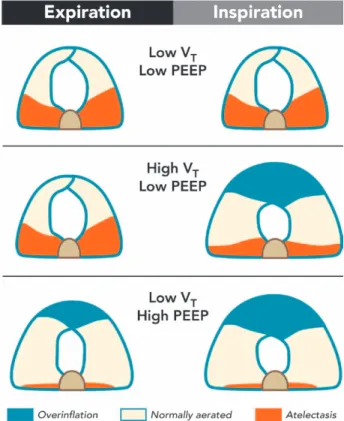
to the mean airway pressure, assuming that collapsed lung
tissue is protected against injury from mechanical
ventila-tion (fig. 3). Intraoperative permissive atelectasis may be
lim-ited by deterioration in oxygenation, which could require
higher inspiratory oxygen fractions. Also, shear stress may
occur at the interface between collapsed and open tissue,
20likely resulting in lung damage and inflammation, even in
presence of low global stress.
99Theoretically, intraoperative
low PEEP could increase the incidence and the amount of
atelectasis even in the postoperative period, resulting in
fur-ther PPCs. A recent large retrospective study investigating
Fig. 3. Effects of high and low tidal volumes (VT) at end-
inspiration and end-expiration with low and high positive end-expiratory pressure (PEEP) during general anesthe-sia. Atelectatic lung regions (red), overinflated lung regions (blue), normally aerated lung regions (white). During ventila-tion with low VT and low PEEP, higher amounts of atelectasis are present at end-expiration and end-inspiration with mini-mal areas of overinflation; during ventilation with high VT and low PEEP, less atelectasis is present at end-expiration and inspiration, with increased areas of overinflation at end-inspiration. Furthermore, a higher amount of tissue collapsing and decollapsing during breathing is present. During ventila-tion with low VT and higher PEEP, less atelectasis is present. However, higher overinflation occurs at end-inspiration and end- expiration, with minimal collapse and reopening during breathing cycling.
the association between intraoperative mechanical ventilator
settings and outcomes suggested that the use of “minimal”
PEEP (2.2 to 5 cm H
2O) combined with low tidal volumes
(6 to 8 ml/kg) is associated with increased risk of 30-day
mortality.
79However, a large international multicenter
RCT challenged the concept that “minimal” PEEP
com-bined with low tidal volumes in the intraoperative period is
harmful.
88Also in elderly patients undergoing major open
abdominal surgery, a strategy consisting of low tidal volume,
PEEP 12 cm H
2O, and recruitment maneuvers increased the
Pa
O2intraoperatively compared with a strategy with high
tidal volume without PEEP, but this effect was not
main-tained in the postoperative period.
100Even without
recruit-ment maneuvers, PEEP improved oxygenation during upper
abdominal surgery compared with zero end-expiratory
pres-sure, but again such effects were limited to the intraoperative
period and did not prevent postoperative complications.
101Lung Recruitment Maneuvers for Intraoperative Protective
Ventilation
Positive end-expiratory pressure is most effective for
pre-serving respiratory function if preceded by a recruitment
maneuver, which must overcome the opening pressures of
up to 40 cm H
2O in nonobese
102and 40 to 50 cm H
2O in
obese patients,
103in the absence of lung injury.
Recruit-ment maneuvers can be performed in different ways using
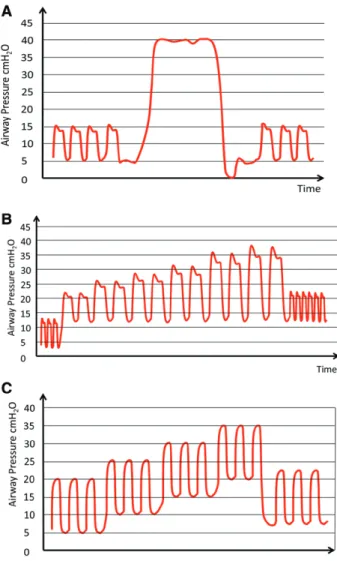
the anesthesia ventilator, as illustrated in figure 4. Most
commonly, such maneuvers are performed by “bag
squeez-ing” using the airway pressure-limiting valve of the
anes-thesia machine (fig. 4A). However, recruitment maneuvers
are better controlled if performed during tidal ventilation,
for example, using a stepwise increase of PEEP, tidal
vol-umes, or a combination of these (fig. 4B). Provided there
are no contraindications, the inspiratory plateau
pres-sure as high as 40 cm H
2O is more likely to result in full
recruitment.
104In anesthesia devices that allow pressure-controlled
ventilation, recruitment maneuvers can be conducted with
a constant driving pressure of 15 to 20 cm H
2O and by
increasing PEEP up to 20 cm H
2O in steps of 5 cm H
2O
(30 to 60 s per step). After three to five breaths at a PEEP
level that allows achieving the target inspiratory pressure,
PEEP and tidal volume are adjusted to the respective
desired levels (fig. 4C).
Recent evidence for Intraoperative
Protective Ventilation
Randomized Controlled Trials Using Nonclinical Primary
Outcomes
The literature search identified 11 RCTs that compared a
protective ventilation strategy with a nonprotective
ven-tilation strategy during general anesthesia for surgery with
regard to nonclinical primary outcome in patients
under-going thoracic surgery,
80,84,85,105,106cardiac surgery,
95,107,108abdominal surgery,
80,100,109or spinal surgery,
110as depicted
in table 3. In eight RCTs, the protective ventilation strategy
consisted of both lower tidal volumes and higher levels of
Fig. 4. Illustrative fluctuation of airway pressure during three
types of lung recruitment maneuvers for intraoperative me-chanical ventilation (red lines). (A) “Bag squeezing” using the airway pressure-limiting valve of the anesthesia machine. The airway pressure is difficult to control, possibly resulting in over-pressure, with the risk of barotrauma, or values lower than the closing pressure of small airways when controlled mechanical ventilation is resumed, with consequent lung derecruitment. (B) “Stepwise increase of tidal volume” during volume-controlled ventilation. Positive end-expiratory pressure (PEEP) is set at 12 cm H2O, the respiratory frequency at 6 to 8 breaths/min, and tidal volume increased from 8 ml/kg in steps of 4 ml/kg until the target opening pressure (e.g., 30 to 40 cm H2O) is achieved. After three to five breaths at that pressure, the PEEP is kept at 12 cm H2O, tidal volume reduced to 6 to 8 ml/kg, and the respiratory frequency adjusted to normocapnia. (C) Stepwise increase of PEEP at a constant driving pressure of 15 to 20 cm H2O in pressure-controlled ventilation. The PEEP is increased in steps of 5 cm H2O (30 to 60 s per step) up to 20 cm H2O. After three to five breaths at a PEEP level that allows achieving the target inspiratory pressure, PEEP and tidal volume are adjusted to the respective desired levels.
Table 3.
Randomized Contr
olled T
rials Using Nonclinical Primary Outcomes
Refer ence Published Study Design Patient Population/ Number Intervention Gr oup(s) Contr ol Gr oup Nonclinical Primary Outcomes Secondary Outcomes Thoracic sur gery W rigge et al. 80 Pr ospective, single-center , randomized con -tr olled trial
Adult patients under
going
major thoracic sur
gery , n = 34 (2 excluded) PV : V T : 6 ml/kg; PEEP: 10 cm H2 O; P aw limit: 35 cm H2 O during TL V and OL V (n = 15) CV : V T : 12–15 ml/kg; ZEEP: P aw limit: 35 cm H2 O during TL V and OL V (n = 17)
Inflammatory mediators in plasma: no dif
fer ences between gr oups for TNF α
, IL-1, IL-6, IL-8,
IL-10, IL-12
Gas exchange: no dif
fer -ences between gr oups Schilling et al. 84 Pr ospective, single-center , randomized con -tr olled trial
Adult patients under
going
elective open thoracic sur
gery (n = 32) PV : V T : 5 ml/kg during TL V and OL V; PEEP: 3 cm H2 O, TL V; PEEP: 0–2 cm H2 O, OL V; P aw limit: 30 cm H 2 O (n = 16) CV : V T : 10 ml/kg during TL V and OL V; PEEP: 3 cm H2 O, TL V; PEEP: 0–2 cm H2 O, OL V; P aw limit: 30 cm H 2 O (n = 16)
Inflammatory mediators in BAL: TNF
α and sICAM lower during PV ; no dif fer ences between gr
oups for cell count,
PMN elastase, total protein, albumin, IL-8, and IL-10
Pa O2 /F IO2 : no dif fer ences between gr oups; Pa CO 2 : higher during PV Michelet et al. 85 Pr ospective, single-center , randomized con -tr olled trial
Adult patients under
going planned esophagec -tomy (n = 52) PV : V T : 9 ml/kg, TL V; V T : 5 ml/kg OL V; PEEP: 5 cm H2 O, TL V and OL V (n = 26) CV : V T : 9 ml/kg, TL V and OL V; ZEEP: TL V and OL V (n = 26)
Inflammatory mediators in plasma: IL-1
β, IL-6,
IL-8 lower during PV
; no dif fer ences between gr oups for TNF α Pa O2 /F IO2 and Pa CO 2 : higher during PV ; EVL
WI: lower during
PV ; time to extubation: shorter during PV Lin et al. 105 Pr ospective, single-center , randomized contr olled trial
Adult patients under
going esophagectomy (n = 40) PV : V T : 10 ml/kg, TL V; V T : 5–6 ml/kg OL V; PEEP: 3–5 cm H2 O, OL V (n = 20) CV : V T : 10 ml/kg, TL V and OL V; ZEEP: TL V and OL V (n = 20)
Inflammatory mediators in plasma: IL-6, IL-8, lower during PV Ppeak , P plat , and R aw : lower during PV Unzueta et al. 106 Pr ospective, single-center , randomized contr olled trial
Adult patients under
going
elective open thoracotomy (n = 40)
PV : V T : 8 ml/kg, TL V; V T : 6 ml/kg OL V; PEEP: 8 cm H2 O, TL V and OL V; RM with stepwise PEEP/P aw incr ease until 20/40 cm H2 O befor e start of OL V (n = 20) CV : V T : 8 ml/kg, TL V; V T : 6 ml/kg OL V; PEEP: 8 cm H2 O, TL V and OL V; no RM befor e start of OL V (n = 20)
Dead space: lower during PV
Pa O2 /F IO2 : higher during PV ; Pa CO 2 : lower during PV Car diac sur gery Koner et al. 107 Pr ospective, single-center , randomized con -tr olled trial
Adult patients under
go
-ing elective on-pump cor
onary artery bypass
grafting sur gery (n = 44) (1) PV : V T : 6 ml/kg; PEEP: 5 cm H2 O (n = 15) (3) CV + ZEEP: V T : 10 ml/ kg; PEEP: 0 cm H 2 O (n = 15)
Inflammatory mediators in plasma: no dif
fer ences between gr oups for TNF α and IL-6 Pplat : lower during PV compar ed with both CV gr
oups; shunt fraction:
lower during PV com
-par ed with both CV + ZEEP; Pa O2 /F IO2 : higher
during ventilation with PEEP
, (1) + (2) (2) CV + PEEP: V T : 10 ml/ kg; PEEP: 5 cm H 2 O (n = 14) Zupancich et al. 108 Pr ospective, single-center , randomized con -tr olled trial
Adult patients under
go
-ing elective on-pump cor
onary artery bypass
grafting sur gery (n = 40) PV : V T : 8 ml/kg; PEEP: 10 cm H2 O (n = 20) CV : V T : 10–12 ml/kg; PEEP: 2–3 cm H 2 O (n = 20)
Inflammatory mediators in plasma and BAL: IL-6, IL-8, lower during PV in both
Pa CO 2 : higher during PV (Continued )
Reis Miranda et al.
95
Pr
ospective, single- center
, rand
-omized contr
olled
trial
Adult patients under
go
-ing elective on-pump cor
onary artery bypass
grafting or valve sur
-gery (n = 62)
(1) Late open lung: V
T : 4–6 ml/kg; PEEP: 10 cm H2 O starting at post
-operative ICU arrival (n = 18)
(3) V T : 6–8 ml/kg; PEEP: 5 cm H2 O (n = 22)
Inflammatory mediators in plasma: IL-8 decr
eased
after CPB in both open lung gr
oups; IL-10
decr
eased faster after
CPB in early open lung group Evidence of perioperative myocar
dial infar
ction
(CK-MB and ECG): no differ
ences between
gr
oups
(2) (1) Early open lung: V
T : 4–6 ml/kg; PEEP: 10 cm H2
O starting after intu
-bation (n = 22) Abdominal sur gery W rigge et al. 80 Pr
ospective, single- center
, rand
-omized contr
olled
trial
Adult patients under
go
-ing major abdominal sur
gery (n = 30) PV : V T : 6 ml/kg; PEEP: 10 cm H2 O; P aw limit 35 cm H2 O (n = 15) CV : V T : 12–15 ml/kg; ZEEP: P aw limit: 35 cm H2 O (n = 15)
Inflammatory mediators in plasma: no dif
fer ences between gr oups for TNF α
, IL-1, IL-6, IL-8,
IL-10, and IL-12
Pa O2 /F IO2 : no dif fer ences between gr oups; Pa CO 2 : higher during PV W olthuis et al. 109 Pr
ospective, single- center
, rand
-omized contr
olled
trial
Adult patients under
going a sur gical pr ocedur e in general anesthesia ≥ 5 h (n = 46) PV : V T : 6 ml/kg; PEEP: 10 cm H2 O (n = 24) CV : V T : 10–12 ml/kg ZEEP: n = 22
Inflammatory mediators in plasma and BAL: lower myeloper
oxidase and
nucleosome level in BAL during PV
Pa CO 2 : higher during PV ; PPCs: no dif fer ences between gr oups W eingarten et al. 100 Pr
ospective, single- center
, rand
-omized contr
olled
trial
Adult patients aged > 65 yr under
going
major open abdominal sur
gery under general
anesthesia (n = 40) PV : V T : 6 ml/kg; PEEP: 12 cm H2 O RM with
stepwise PEEP incr
ease until 15 cm H2 O (n = 20) CV : V T : 10 ml/kg; ZEEP: no RM (n = 20) Inflammatory mediators in plasma: no dif
fer ences between gr oups Pa O2 /F IO2 + Pa CO 2 : higher during PV ; compliance higher and r esistance lower during PV Spinal sur gery Memtsoudis et al. 110 Pr
ospective, single- center
, rand
-omized contr
olled
trial
Adult patients under
going
elective lumbar decom
-pr
ession and fusion in
pr
one position under
general anesthesia (n = 26) PV : V T : 6 ml/kg; PEEP: 8 cm H2 O (n = 13) CV : V T : 12 ml/kg; ZEEP: n = 13
Inflammatory mediators in plasma: no dif
fer ences between gr oups Pa CO 2 : higher during PV BAL = br
onchoalveolar lavage; CK-MB = muscle-brain type cr
eatine kinase; CPB = car
diopulmonary bypass; CV = conventional ventilation; ECG = electr
ocar
diogram; EVL
WI =extravascular lung water index;
F
IO2
= inspir
ed fraction of oxygen; ICAM = inter
cellular adhesion molecule; ICU = intensive car
e unit; IL = interleukin; OL V = one-lung ventilation; Pa CO 2 = partial pr essur
e of arterial carbon dioxide; Pa
O2 = partial pr essur e of arterial oxygen; Pa O2 /F IO2 = ratio of partial pr essur e of arterial oxygen to inspir ed fraction of oxygen; Paw = airway pr essur e; PEEP = positive end-expiratory pr essur e; PMN = polymorphonuclear leuko -cyte; PPCs = postoperative pulmonary complications; Ppeak = peak pr essur e; Pplat = plateau pr essur e; PV = pr otective ventilation; Raw = airway resistance; RM =
recruitment maneuver; sICAM =
soluble inter cellular adhesion molecule; TL V = two-lung ventilation; TNF α = tumor necr osis factor -α ; V T
= tidal volume; ZEEP = zer
o end-expiratory pr essur e. Table 3. Continued Refer ence Published Study Design Patient Population/ Number Intervention Gr oup(s) Contr ol Gr oup Nonclinical Primary Outcomes Secondary Outcomes
PEEP
80,85,100,105,107–110; in two RCTs, it consisted of either
lower tidal volume,
84a higher level of PEEP.
95In one RCT,
lung recruitment maneuvers were used during the protective
ventilation strategy.
106The effects on inflammatory responses are slightly
contra-dictory. Although four RCTs showed no difference in local
levels of inflammatory mediators between patients on
pro-tective and those on nonpropro-tective ventilation,
80,100,107,110six
RCTs
84,85,95,105,108,109showed that protective strategies were
associated with lower levels of inflammatory mediators.
Randomized Controlled Trials Using Clinical Primary
Outcomes
In total, eight RCTs were identified that compared a
pro-tective ventilation strategy with a nonpropro-tective ventilation
strategy during surgery with regard to a clinical primary
out-comes in patients planned for abdominal surgery,
88,111–113thoracic surgery,
87,114cardiac surgery,
115or spinal surgery,
116as shown in table 4. In four RCTs, the protective strategy
consisted of both lower tidal volumes and higher levels of
PEEP,
112–114,116and in the four remaining RCTs, it
con-sisted of either lower tidal volumes
87,111,115or higher levels
of PEEP.
88Four trials reported on PPCs in the first postoperative
days, including bronchitis, hypoxemia, and atelectasis,
116pneumonia, need for invasive or noninvasive ventilation for
acute respiratory failure,
112a modified “Clinical Pulmonary
Infection Score,” and chest radiograph abnormalities,
113and
hypoxemia, bronchospasm, suspected pulmonary infection,
pulmonary infiltrate, aspiration pneumonitis, development
of ARDS, atelectasis, pleural effusion, pulmonary edema,
and pneumothorax.
88In a Chinese single-center RCT,
116investigators
com-pared protective ventilation (tidal volume 6 ml/kg and 10 cm
H
2O PEEP) versus nonprotective (tidal volume 10 to 12 ml/
kg and 0 cm H
2O PEEP) in 60 elderly patients with
Ameri-can Society of Anesthesiologists class II and III scheduled for
spinal surgery. Patients receiving protective ventilation had
less PPCs.
In a French multicenter trial (Intraoperative
PROtec-tive VEntilation),
112protective ventilation (tidal volume 6
to 8 ml/kg and PEEP 6 to 8 cm H
2O) was compared with
nonprotective ventilation (tidal volume 10 to 12 ml/kg and
0 cm H
2O PEEP) in 400 nonobese patients at intermediate
to high risk of pulmonary complications after planned major
abdominal surgery. The primary outcome (postoperative
pulmonary and extrapulmonary complications) occurred
less often in patients receiving “protective” ventilation. Such
complications have been ascribed to the release of
inflam-matory mediators by the lungs into the systemic circulation,
affecting the lungs,
117as well as peripheral organs.
52These
patients also had a shorter length of hospital stay, but
mor-tality was unaffected.
An Italian single-center trial
113investigated the
effective-ness of protective ventilation (tidal volume 7 ml/kg and 10 cm
H
2O PEEP with recruitment maneuvers) versus
nonprotec-tive ventilation (tidal volume 9 ml/kg and zero end-expiratory
pressure) in 56 patients scheduled for open abdominal surgery
lasting more than 2 h. The modified “Clinical Pulmonary
Infection Score” was lower in patients receiving protective
ventilation. These patients also had fewer chest radiograph
abnormalities and higher arterial oxygenation compared with
patients receiving nonprotective ventilation.
Finally, in an international multicenter trial conducted
in Europe and the United States (PROtective Ventilation
using HIgh vs. LOw PEEP [PROVHILO]),
88the
PROtec-tive VEntilation Network investigators compared PEEP of
12 cm H
2O combined with recruitment maneuvers versus
PEEP of 2 cm H
2O without recruitment maneuvers in 900
nonobese patients at high risk for PPCs planned for open
abdominal surgery under ventilation at tidal volumes of
8 ml/kg. The incidence of PPCs was not different between
patients receiving protective ventilation and patients
receiv-ing nonprotective ventilation.
Challenges of Studies Using Bundles
As shown in preceding subsections Randomized
Con-trolled Trials Using Nonclinical Primary Outcomes
and Randomized Controlled Trials Using Clinical
Pri-mary Outcomes, most RCTs addressing intraoperative
mechanical ventilation compared bundles of interventions
consisting of tidal volumes and levels of PEEP, usually
accompanied by a lung recruitment maneuver.
112–114,116Notably, recruitment maneuvers differed between the
tri-als. In the Italian single-center RCT,
113investigators used
incremental titration of tidal volumes until a plateau
pres-sure of 30 cm H
2O, directly after induction of anesthesia,
after any disconnection from the ventilator and
immedi-ately before extubation, similar as in PROVHILO.
88In
Intraoperative PROtective Ventilation trial,
112recruitment
was performed with a continuous positive airway pressure
of 30 cm H
2O for 30 s every 30 min, also known as
sus-tained inflation, after tracheal intubation. Finally, in the
Chinese single-center RCT,
116the recruitment maneuvers
followed a similar approach, but to plateau pressures of
up to 35 cm H
2O, and they were performed every 15 min.
It is difficult, if not impossible, to conclude from these
trials what caused the benefit, tidal volume reduction or
increase of PEEP or both, and to determine the role of
recruitment maneuvers. Moreover, to what extent the
recruitment maneuver has succeeded in reopening lung
has not been analyzed in the different studies.
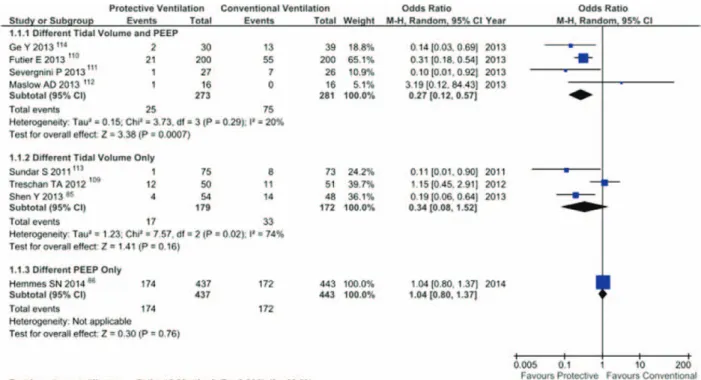
The results of the PROVHILO trial, however, suggest that
low tidal volumes rather than PEEP combined with lung
recruitment maneuvers are responsible for lung protection in
the intraoperative period. This interpretation is also supported
by an analysis of different studies on the odds ratios of lower
tidal volumes,
87,111,115higher levels of PEEP,
88their
combina-tion,
112–114,116regarding the development of PPCs (fig. 5), as
well as a recent individual patient data meta-analysis.
131Table 4.
Randomized Contr
olled T
rials Using Clinical Primary Outcomes
Refer ence Published Study Design Patient Population/Number Intervention Contr ol Gr oup Clinical Primary Outcomes Secondary Outcomes Thoracic sur gery Maslow et al. 114 Pr
ospective, single- center
, randomized
contr
olled trial
Adult patients under
going elective pulmonary r esec -tion (n = 34) PV : V T : 5 ml/kg, TL V and OL V; PEEP: 5 cm H 2 O, TL V and OL V (n = 17) CV : V T : 10 ml/kg, TL V and OL V; ZEEP: TL V and OL V (n = 17)
Rate of atelectasis: lower with CV
; length of
hospital stay: no dif
fer -ences between gr oups Pa CO 2
and alveolar dead
space: higher during PV; C
dyn : higher during CV Shen et al. 87 Pr
ospective, single- center
, randomized
contr
olled trial
Adult patients under
going
elective thoracoscopic esophagectomy (n = 101)
PV : V T : 8 ml/kg TL V; V T : 5 ml/kg OL V; PEEP: 5 cm H2 O, TL V and OL V (n = 53) CV : V T : 8 ml/kg, TL V; VT : 8 ml/kg OL V; ZEEP: TL V and OL V (n = 48)
PPCs: lower rate with PV
; mortality: no dif fer ence between gr oups Pa O2 /F IO2 and Pa CO 2 : higher during PV ; inflammatory media
-tors in BAL: lower IL-1
β, IL-6, and IL-8
Car diac sur gery Sundar et al. 115 Pr
ospective, single- center
, randomized
contr
olled trial
Adult patients under
going elective car diac sur gery (n = 149) PV : V T : 6 ml/kg; PEEP/ F IO2 : accor ding to ARDS Network table (n = 75) CV : V T : 10 ml/kg; PEEP/F IO2 : accor d
-ing to ARDS Net
-work table (n = 74) Rate of r eintubation: lower with PV ; number of patients r equiring ventilation 6 h postop
-eratively: lower with PV
Gas exchange: no dif
fer -ence between gr oups Abdominal sur gery Tr eschan et al. 111 Pr
ospective, single- center
, randomized
contr
olled trial
Adult patients under
going
elective upper abdominal sur
gery lasting
≥
3
h
under
combined general and epi
-dural anesthesia (n = 101) PV : V T : 6 ml/kg; PEEP: 5 cm H2 O (n = 50) CV : V T : 12 ml/kg; PEEP: 5 cm H 2 O (n = 51)
Rate of atelectasis: lower with CV
Pa O2 /F IO2 : higher during CV ; C dyn and R aw : higher during CV ; Pa O2
at postoperative day 5: higher with CV
Futier
et al.
112
Pr
ospective randomized contr
olled multicenter
study
Adults patients at inter
-mediate to high risk of pulmonary complications under
going major abdomi
-nal sur gery (n = 400) PV : V T : 6–8 ml/kg; PEEP: 6–8 cm H2 O (n = 200) CV : V T : 10–12 ml/kg; ZEEP (n = 200)
Composite primary outcome of major pulmonary or extrapul
-monary complications: lower with PV
Reduced rate of atelec
-tasis, pneumonia, need for ventilation within 7 days and sep
-sis with PV
. Reduced
length of hospital stay with PV
Sever
gnini
et al.
113
Pr
ospective, single- center
, randomized
contr
olled trial
Adult patients under
going
elective open abdominal sur
gery ≥ 2 h n = 56 (1 excluded) PV : V T : 7 ml/kg; PEEP: 10 cm H2 O (n = 28) CV : V T : 9 ml/kg; ZEEP (n = 27)
Pulmonary function tests: impr
oved with PV
Modified Clinical Pulmo
-nary Infection Scor
e:
lower with PV
; Pa
O2
at postoperative days 1, 3, and 5: higher with PV
. Rate of chest
radiograph abnormali
-ties: lower with PV
.
Length of hospital stay: no dif
fer
ence
between gr
oups (Continued
Certainly, these conclusions are only valid for the studied
population, that is, nonobese patients at risk of PPCs
under-going elective abdominal surgery. Other patient populations
could still benefit from higher levels of PEEP and
recruit-ment maneuvers.
Challenges of Composite Outcome Measures
Composite outcome measures offer the benefit of an increased
event rate, which is helpful to ensure adequate statistical power
of a trial.
8It is reasonable to combine related outcomes that
rep-resent different aspects of a single underlying pathophysiologic
process, such as PPCs for VILI. There are, though, two major
limitations regarding the use of composite outcomes. First, the
component variables can differ importantly in terms of severity
and frequency. Second, differences in the frequency of
compo-nent variables in a composite outcome may be masked.
Drawbacks of Protective Ventilation
The term “protective” in the context of mechanical
ventila-tion implies a decrease in the major components of VILI,
namely atelectrauma, volutrauma, and biotrauma. However,
a strategy that is protective to lungs may also cause harm
to other organ systems. The potential for harm caused by
protective ventilation was reported in PROVHILO trial,
88in which patients receiving higher PEEP and lung
recruit-ment maneuvers developed intraoperative hypotension more
frequently and needed more vasoactive drugs. These findings
are at least in part in line with the finding that protective
ventilation was associated with a higher incidence of
intra-operative hypotension in the French trial.
112Standard of Care versus Unusual Settings: Were the
Control Groups of Recent Trials Representative of Clinical
Practice?
In RCTs addressing intraoperative protective mechanical
ventilation, the strategy used to treat control groups can
play an important role when drawing conclusions for daily
practice of general anesthesia. Meta-analyses suggest that
lower tidal volumes are protective not only during long-term
ventilation in critically ill patients
118,119but also short-term
ventilation during general anesthesia for surgery.
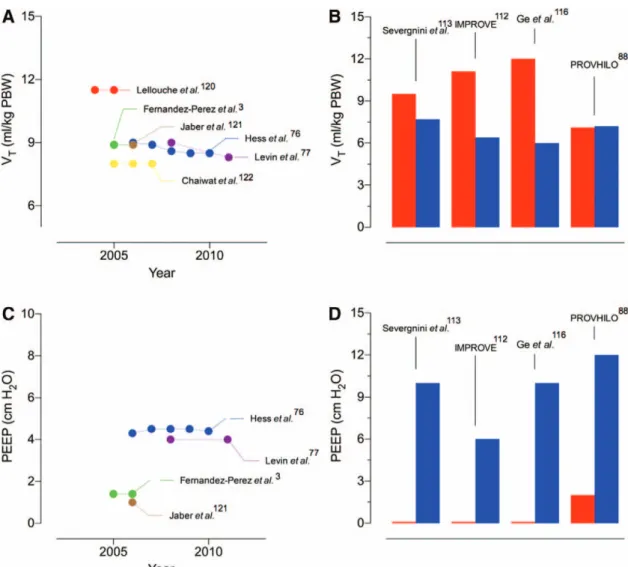
119Accord-ingly, anesthesiologists have been using tidal volumes of
approximately 8 to 9 ml/kg on average, and seldom higher
than 10 ml/kg,
76as also illustrated in figure 6A. In contrast
to this practice, the tidal volumes used in the control groups
of recent RCTs were as high as 9
113to 12 ml/kg,
112except
to PROVHILO
88(fig. 6B), which used a tidal volume of
7 ml/kg both in the intervention and in the control group.
Similarly, levels of PEEP in the control arms of three of four
recent RCTs
112,113,116on protective mechanical ventilation
were much lower than the standard of care at the moment
the respective studies were designed (fig. 6, C and D). Taken
together, these facts suggest that, among the most
impor-tant recent RCTs on intraoperative protective
mechani-cal ventilation, only the PROVHILO trial used a control
PROVE Network Investigators 2014
88 Pr ospective, inter na -tional, multicenter , randomized con -tr olled trial
Adults patients at inter
-mediate to high risk of pulmonary complications under
going major abdomi
-nal sur gery (n = 900) PV : V T : 8 ml/kg; PEEP: 12 cm H2 O; RM with stepwise incr ease of VT
after induction and
befor e extubation (n = 445) CV : V T : 8 ml/kg; PEEP: 0–2 cm H 2 O (n = 449) Rate of PPCs: no dif fer -ence between gr oups
Rate of intraoperative hypotension and amount of vasoactive drugs given: higher during PV
. Rate of
desaturation: lower during PV
. Mortality
and length of hospital stay: no dif
fer ence between gr oups Spinal sur gery Ge et al. 116 Pr
ospective, single- center
, randomized
contr
olled trial
Adult patients under
going spine fusion (n = 60) PV : V T : 6 ml/kg; PEEP: 10 cm H2 O; RM every 15 min (n = 30) CV : V T : 10–12 ml/kg; ZEEP (n = 30)
Rate of PPCs, lower with PV
Pa O2 /F IO2 , higher during PV ARDS = acute r espiratory distr ess syndr ome; BAL = br onchoalveolar lavage; C dyn
= dynamic compliance of the r
espiratory system; CV = conventional ventilation; F
IO2
= inspir
ed fraction of oxygen; IL = interleu
-kin; OL V = one-lung ventilation; Pa CO 2 = partial pr essur
e of arterial carbon dioxide; Pa
O2 = partial pr essur e of arterial oxygen; Pa O2 /F IO2 = ratio of partial pr essur
e of arterial oxygen to inspir
ed fraction of oxygen;
PEEP = positive end-expiratory pr
essur
e; PPCs = postoperative pulmonary complications; PROVE = PROtective VEntilation; PV = pr
otective ventilation; R aw = airway r esistance; RM = r ecruitment maneuver; TL V = two-lung ventilation; V T
= tidal volume; ZEEP = zer
o end-expiratory pr essur e. Table 4. Continued Refer ence Published Study Design Patient Population/Number Intervention Contr ol Gr oup Clinical Primary Outcomes Secondary Outcomes
group that reproduced the standard of anesthesia care at the
time it was conducted. Accordingly, the PROVHILO trial
addressed a major question regarding mechanical
ventila-tion during anesthesia, namely whether the combinaventila-tion of
high PEEP with recruitment maneuvers confers protection
against PPCs. In this study, high PEEP was not
individual-ized, but based on previous findings from computed
tomog-raphy
69,90,91and physiological studies.
92,94Intraoperative Mechanical Ventilation
According to the Utmost Recent evidence
A number of reviews and commentaries have suggested
that intraoperative mechanical ventilation for surgery
should consist of low tidal volumes (6 to 8 ml/kg),
mod-erate levels of PEEP (6 to 8 cm H
2O), and periodic lung
recruitment maneuvers (e.g., every 30 min).
5,123–125How-ever, previous reviews and recommendations have been
based on bundles, which do not permit to infer on the
contribution of individual measures. Furthermore, the
results of the largest RCT in this field (PROVHILO)
could not be taken into account. Also, a
recommenda-tion regarding the use of positive pressure ventilarecommenda-tion
dur-ing induction and emergence of anesthesia, as proposed
recently,
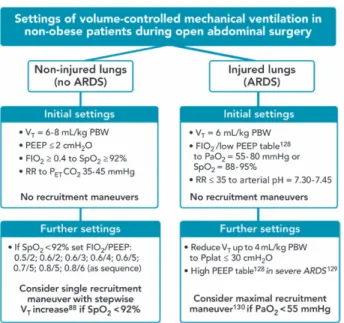
124is not supported by outcome data. Currently,
the only recommendations that can be given for clinical
practice are summarized in figure 7. In nonobese patients
without ARDS
126undergoing open abdominal surgery,
mechanical ventilation should be performed with low tidal
volumes (approximately 6 to 8 ml/kg) combined with low
PEEP (≤2 cm H
2O) because higher PEEP combined with
recruitment maneuvers does not confer further protection
against PPCs and can deteriorate the hemodynamics. If
hypoxemia develops and provided that other causes have
been excluded (e.g., hypotension, hypoventilation, and
pulmonary embolism), the F
IO2should be increased first,
followed by increase of PEEP, and recruitment maneuvers
based on stepwise increase of tidal volume during regular
mechanical ventilation, according to the rescue algorithm
described in the PROVHILO trial,
88provided no
contra-indication is present. In patients with ARDS
126undergo-ing open abdominal surgery, intraoperative mechanical
ventilation should be guided by the ARDS network
pro-tocol,
127whereby higher PEEP values
128may be useful in
more severe ARDS.
129If the target Pa
O2
(55 to 80 mmHg)
or Sp
O2(88 to 95%) cannot be achieved, a maximal lung
recruitment maneuver with a decremental PEEP trial can
be considered.
130Future Perspectives
Despite the increasing number of highly qualitative RCTs
on intraoperative mechanical ventilation, a number of issues
remain unaddressed. Although meta-analyses strongly
sug-gest that low tidal volumes during intraoperative
mechani-cal ventilation protect against postoperative pulmonary
events, no single RCT has been able to prove this claim.
Because meta-analyses in this field frequently include the
studies that tested intervention bundles, for example, low
tidal volume and high PEEP with recruitment maneuvers
Fig. 5. Odds ratios for postoperative pulmonary complications of “protective” versus “nonprotective” ventilation in trials
com-paring different tidal volumes,87,111,115 different tidal volumes and positive end-expiratory pressure (PEEP),112–114,116 and different