HAL Id: hal-01294337
https://hal.archives-ouvertes.fr/hal-01294337
Submitted on 29 Mar 2016
HAL is a multi-disciplinary open access
archive for the deposit and dissemination of
sci-entific research documents, whether they are
pub-lished or not. The documents may come from
teaching and research institutions in France or
abroad, or from public or private research centers.
L’archive ouverte pluridisciplinaire HAL, est
destinée au dépôt et à la diffusion de documents
scientifiques de niveau recherche, publiés ou non,
émanant des établissements d’enseignement et de
recherche français ou étrangers, des laboratoires
publics ou privés.
Touristic site attractiveness seen through Twitter
Aleix Bassolas, Maxime Lenormand, Antonia Tugores, Bruno Goncalves, José
J. Ramasco
To cite this version:
Aleix Bassolas, Maxime Lenormand, Antonia Tugores, Bruno Goncalves, José J. Ramasco.
Touris-tic site attractiveness seen through Twitter.
EPJ Data Science, EDP Sciences, 2016, 5, pp.12.
�10.1140/epjds/s13688-016-0073-5�. �hal-01294337�
Aleix Bassolas,1 Maxime Lenormand,1 Ant`onia Tugores,1 Bruno Gon¸calves,2 and Jos´e J. Ramasco1
1
Instituto de F´ısica Interdisciplinar y Sistemas Complejos IFISC (CSIC-UIB), Campus UIB, 07122 Palma de Mallorca, Spain
2
Center for Data Science, New York University, 726 Broadway, 7th Floor, 10003 New York, USA and Aix Marseille Universit´e, Universit´e de Toulon, CNRS, CPT, UMR 7332, 13288 Marseille, France
Tourism is becoming a significant contributor to medium and long range travels in an increasingly globalized world. Leisure traveling has an important impact on the local and global economy as well as on the environment. The study of touristic trips is thus raising a considerable interest. In this work, we apply a method to assess the attractiveness of 20 of the most popular touristic sites worldwide using geolocated tweets as a proxy for human mobility. We first rank the touristic sites based on the spatial distribution of the visitors’ place of residence. The Taj Mahal, the Pisa Tower and the Eiffel Tower appear consistently in the top 5 in these rankings. We then pass to a coarser scale and classify the travelers by country of residence. Touristic site’s visiting figures are then studied by country of residence showing that the Eiffel Tower, Times Square and the London Tower welcome the majority of the visitors of each country. Finally, we build a network linking sites whenever a user has been detected in more than one site. This allow us to unveil relations between touristic sites and find which ones are more tightly interconnected.
INTRODUCTION
Traveling is getting more accessible in the present era of progressive globalization. It has never been eas-ier to travel, resulting in a significant increase of the volume of leisure trips and tourists around the world (see, for instance, the statistics of the last UNWTO reports [1]). Over the last fifty years, this increasing importance of the economic, social and environmental impact of tourism on a region and its residents has led to a considerable number of studies in the so-called ge-ography of tourism [2]. In particular, geographers and economists have attempted to understand the contri-bution of tourism to global and regional economy [3–
7] and to assess the impact of tourism on local people [8–13].
These researches on tourism have traditionally re-lied on surveys and economic datasets, generally com-posed of small samples with a low spatio-temporal res-olution. However, with the increasing availability of large databases generated by the use of geolocated in-formation and communication technologies (ICT) de-vices such as mobile phones, credit or transport cards, the situation is now changing. Indeed, this flow of in-formation has notably allowed researchers to study human mobility patterns at an unprecedented scale [14–19]. In addition, once these data are recorded, they can be aggregated in order to analyze the city’s spatial structure and function [20–27] and they have also been successfully tested against more traditional data sources [28–30]. In the field of tourism geogra-phy, these new data sources have offered the possibil-ity to study tourism behavior at a very high spatio-temporal resolution [18,31–37].
In this work, we propose a ranking of touristic sites worldwide based on their attractiveness mea-sured with geolocated data as a proxy for human mo-bility. Many different rankings of most visited touris-tic sites exist but they are often based on the number
of visitors, which does not really tell us much about their attractiveness at a global scale. Here we apply an alternative method proposed in [38] to measure the influence of cities. The purpose of this method is to analyze the influence and the attractiveness of a site based on the average radius traveled and the area covered by individuals visiting this site. More specif-ically, we select 20 out of the most popular touristic sites of the world and analyze their attractiveness us-ing a dataset containus-ing about 10 million geolocated tweets, which have already demonstrated their effi-ciency as useful source of data to study mobility at a world scale [18, 38]. In particular, we propose three rankings of the touristic sites’ attractiveness based on the spatial distribution of the visitors’ place of resi-dence, we show that the Taj Mahal, the Pisa Tower and the Eiffel Tower appear always in the top 5. Then, we study the touristic site’s visiting figures by coun-try of residence, demonstrating that the Eiffel Tower, Times Square and the London Tower attract the ma-jority of the visitors. To close the analysis, we focus on users detected in more than one site and explore the relationships between the 20 touristic sites by building a network of undirected trips between them.
MATERIALS AND METHODS
The purpose of this study is to measure the at-tractiveness of 20 touristic sites taking into account the spatial distribution of their visitors’ places of res-idence. To do so, we analyze a database containing 9.6 million geolocated tweets worldwide posted in the period between September 10, 2010 and October 21, 2015. The dataset was built by selecting the geolo-cated tweets sent from the touristic places in the gen-eral streaming and requesting the time-lines of the users posting them. The touristic sites boundaries have been identified manually. Collective accounts and user exhibiting non-human behaviors have been
2
Figure 1. Density of geolocated tweets and positions of the touristic sites.
removed from the data by identifying users tweeting too quickly from the same place, with more than 9 tweets during the same minute and from places sepa-rated in time and space by a distance larger than what is possible to be covered by a commercial flight (with an average speed of 750 km/h). Their spatial distri-butions and that of the touristic sites can be seen in Figure1.
In order to measure the site attractiveness, we need to identify the place of residence of every user who have been at least once in one of the touristic sites. First, we discretize the space by dividing the world into squares of equal area (100 × 100 km2) using a cylindrical equal-area projection. Then, we identify the place most frequented by a user as the cell from which he or she has spent most of his/her time. To en-sure that this most frequented location is the actual user’s place of residence the constraint that at least one third of the tweets has been posted from this loca-tion is imposed. The resulting dataset contains about 59, 000 users’ places of residence. The number of valid users is shown in Table1for each touristic site. In the same way, we identify the country of residence of ev-ery user who have posted a tweets from one of the touristic sites during the time period.
Two metrics have been considered to measure the attractiveness of a touristic site based on the spatial distribution of the places of residence of users who have visited this site:
• Radius: The average distance between the places of residence and the touristic site. The distances are computed using the Haversine for-mula between the latitude and longitude coor-dinates of the centroids of the cells of residence and the centroid of the touristic site. In order
Site Users
Alhambra (Granada, Spain) 1,208 Angkor Wat (Cambodia) 947 Corcovado (Rio, Brazil) 1,708 Eiffel Tower (Paris, France) 11,613 Forbidden City (Beijing, China) 457 Giza (Egypt) 205 Golden Pavilion (Kyoto, Japan) 1,114 Grand Canyon (US) 1,451 Hagia Sophia (Istanbul, Turkey) 2,701 Iguazu Falls (Argentina-Brazil) 583 Kukulcan (Chichen Itz´a, Mexico) 209 London Tower (London, UK) 3,361 Machu Pichu (Peru) 987 Mount Fuji (Japan) 2,241 Niagara Falls (Canada-US) 920 Pisa Tower (Pisa, Italy) 1,270 Saint Basil’s (Moscow, Russia) 262 Taj Mahal (Agra, India) 378 Times Square (NY, US) 13,356 Zocalo (Mexico City, Mexico) 16,193
Table 1. Number of valid Twitter users identified in each touristic sites.
not to penalize isolated touristic sites, the tances have been normalized by the average dis-tance of all the Twitter users’ places of residence to the site. It has been checked that the results are consistent if the median is used instead of the average radius for the rankings.
0.4 0.5 0.6 Radius Times Square Niagara Falls Angkor Wat Grand Canyon Machu Pichu Giza Forbidden City Eiffel Tower Pisa Tower Taj Mahal 80 90 100 110 120 Coverage (cell) Iguazu Falls Giza Times Square Machu Pichu Forbidden City Niagara Falls Eiffel Tower Taj Mahal Grand Canyon Pisa Tower 20 24 28 32 Coverage (country) London Tower Times Square Hagia Sophia Machu Pichu Angkor Wat Forbidden City Pisa Tower Eiffel Tower Giza Taj Mahal
(a)
(b)
(c)
Figure 2. Ranking of the touristic sites according to the radius and the coverage. (a) Radius. (b) Coverage (cell). (c) Coverage (country).
• Coverage: The area covered by the users’ places of residence computed as the number of distinct cells (or countries) of residence.
To fairly compare the different touristic sites which may have different number of visitors, the two met-rics are computed with 200 users’ place of residence selected at random and averaged over 100 independent extractions. Note that unlike the coverage the radius does not depend on the sample size but, to be consis-tent, we decided to use the same sampling procedure for both indicators.
RESULTS
Touristic sites’ attractiveness
We start by analyzing the spatial distribution of the users’ place of residence to assess the attractive-ness of the 20 touristic sites. In Figure2a and Figure
2b, the touristic sites are ranked according to the ra-dius of attraction based on the distance traveled by the users from their cell of residence to the touristic site and the area covered by the users’ cells of resi-dence. In both cases, the results are averaged over 100 random selection of 200 users. The robustness of the results have been assessed with different sample sizes (50, 100 and 150 users), we obtained globally the same rankings for the two metrics. Both mea-sures are very correlated and for most of the site the absolute difference between the two rankings is lower or equal than 2 positions. However, since the met-rics are sensitive to slightly different information both rankings also display some dissimilarities. For exam-ple, the Grand Canyon and the Niagara Falls exhibit a high coverage due to a large number of visitors from many distinct places in the US but a low radius of attraction at the global scale.
To complete the previous results, we also consider the number of countries of origin averaged over 100 random selection of 200 users. This gives us new in-sights on the origin of the visitors. For example, as it can be observed in Figure3, the visitors of the Grand Canyon are mainly coming from the US, whereas in the case of the Taj Mahal the visitors’ country of resi-dence are more uniformly distributed. Also, it is inter-esting to note that in most of the cases the nationals are the main source of visitors except for Angkor Wat (Table 2). Some touristic sites have a national at-tractiveness, such as the Mont Fuji or Zocalo hosting about 84% and 93% of locals, whereas others have a more global attractiveness, this is the case of the Pisa Tower and the Machu Pichu welcoming only 21% of local visitors.
More generally, we plot in Figure2c the ranking of touristic sites based on the country coverage. The re-sults obtained are very different than the ones based on the cell coverage (Figure2b). Indeed, some touris-tic sites can have a low cell coverage but with resi-dence cells located in many different countries, this is the case of the Pyramids of Giza, which went up 7 places and appears now in second position. On the contrary, other touristic sites have a high cell cover-age but with many cells in the same country, as in the previously mentioned cases of the Grand Canyon and the Niagara Falls. Finally, the ranks of the Taj Mahal, the Pisa Tower and Eiffel Tower are consistent with the two previous rankings, these three sites are always in the top 5. Finally, we compare quantitatively the rankings with the Kendall’s τ correlation coefficient which is a measure of association between two mea-sured quantities based on the rank. In agreement with the qualitative observations, we obtain significant cor-relation coefficients comprised between 0.66 and 0.77 confirming the consistency between rankings obtained with the different metrics.
4
Site Top 1 Top 2 Top 3
Alhambra (Spain) Spain 71.14% US 6.06% UK 2.61% Angkor Wat (Cambodia) Malaysia 19.64% Philippines 17.4% US 9.59% Corcovado (Brazil) Brazil 81.13% US 4.92% Chile 3.08% Eiffel Tower (France) France 26.75% US 16.62% UK 8.92% Forbidden City (China) China 26.48% US 14.46% Malaysia 10.95% Giza (Egypt) Egypt 30.65% US 9.8% Kuwait 5.85% Golden Pavilion (Japan) Japan 60.74% Thailand 11.72% US 4.84% Grand Canyon (US) US 75.79% UK 2.87% Spain 2.16% Hagia Sophia (Turkey) Turkey 71.26% US 5.48% Malaysia 1.67% Iguazu Falls (Arg-Brazil-Para) Argentina 48.26% Brazil 26.61% Paraguay 8.63% Kukulcan (Mexico) Mexico 73.78% US 10.07% Spain 2.83% London Tower (UK) UK 65.61% US 10.24% Spain 2.77% Machu Pichu Peru 20.43% US 19.95% Chile 10.43% Mount Fuji (Japan) Japan 84.01% Thailand 5.83% Malaysia 2.66% Niagara Falls (Canada-US) US 60.5% Canada 16.31% Turkey 3.25% Pisa Tower (Italy) Italy 20.85% US 13.56% Turkey 10.95% Sant Basil (Russia) Russia 66.71% US 5.06% Turkey 3.77% Taj Mahal (India) India 27.97% US 15.59% UK 7.61% Times Square (US) US 74.32% Brazil 3.26% UK 2.31% Zocalo (Mexico) Mexico 92.22% US 3.1% Colombia 0.77%
Table 2. The three countries hosting most of the visitors for each touristic site. The countries are ranked by percentage of visitors.
Figure 3. Heat map of the spatial distribution of the vis-itors’ country of origin for the Taj Mahal and the Grand Canyon. The results have been averaged over 100 extrac-tions of 200 randomly selected users.
Touristic site’s visiting figures by country of residence
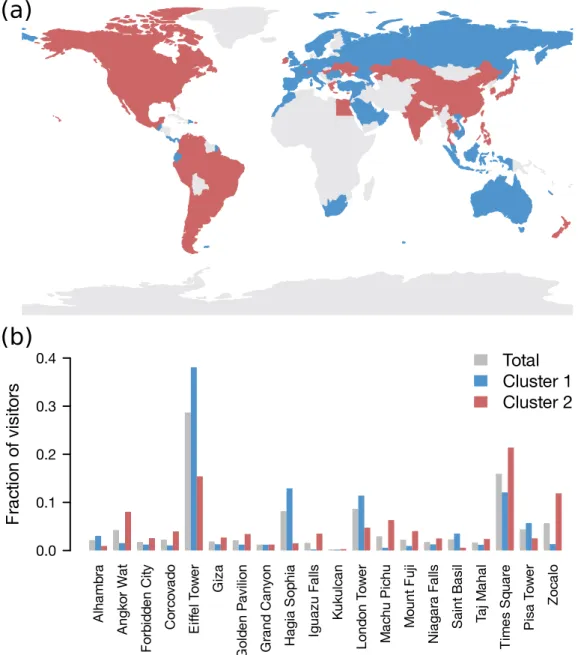
We can also do the opposite by studying the touris-tic preferences of the residents of each country. We ex-tract the distribution of the number of visitors from each country to the touristic sites and normalize by the total number of visitors in order to obtain a prob-ability distribution to visit a touristic site according to the country of origin. This distribution can be aver-aged over the 70 countries with the higher number of residents in our database (gray bars in Figure4). The Eiffel Tower, Times Square and the London Tower welcome in average 50% of the visitors of each coun-try. It is important to note that these most visited touristic sites are not necessarily the ones with the higher attractiveness presented in the previous sec-tion. That is the advantage of the method proposed in [38], which allows us to measure the influence and the power of attraction of regions of the world with different number of local and non-local visitors.
We continue our analysis by performing a hierar-chical cluster analysis to group together countries ex-hibiting similar distribution of the number of visitors according to the touristic sites. Countries are tered together using the ascending hierarchical clus-tering method with the average linkage clusclus-tering as agglomeration method and the Euclidean distance as similarity metric, respectively. To choose the num-ber of clusters, we used the average silhouette index [39]. The results of the clustering analysis are shown
A lha m br a A ng ko r W at Fo rb id de n Cit y Co rc ov ad o E iff el T ow er G iz a G old en P avilio n G ra nd Ca ny on Ha gia S op hia Ig ua zu F alls K uk ulc an Lo nd on T ow er M ac hu P ic hu M ount F uji Nia ga ra F alls S aint B asil Ta j M aha l T im es S qua re P isa T ow er Zo ca lo 0.0 0.1 0.2 0.3 0.4
F
ra
ct
io
n o
f visit
ors
Total
Cluster 1
Cluster 2
(a)
(b)
Figure 4. Clustering analysis. (a) Map of the spatial distribution of the country of residence according to the cluster. (b) Fraction of visitors according to the touristic site.
in Figure 4. Two natural clusters emerge from the data, these clusters are without surprise composed of countries which tend to visit in a more significant way touristic sites located in countries belonging to their cluster. The first cluster gather countries of Amer-ica and Asia whereas the second one is composed of countries from Europe and Oceania.
Network of touristic sites
In the final part of this work, we investigate the rela-tionships between touristic sites based on the number of Twitter users who visited more than one site during a time window between September 2010 and October 2015. More specifically, we built an undirected spa-tial network for which every link between two toursitc
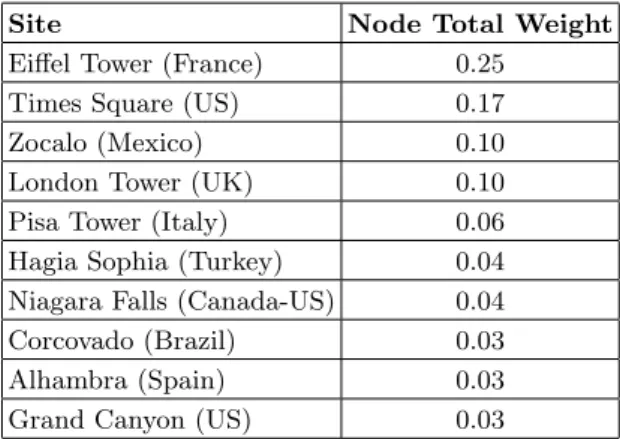
sites represents at least one user who has visited both sites. As a co-occurence network, the weight of a link between two sites is equal to the total number of users visiting the connected sites. The network is repre-sented in Figure5where the width and the brightness of a link is proportional to its weight and the size of a node is proportional to its weighted degree (strenght). The Eiffel Tower, Times Square, Zocalo and the Lon-don Tower appear to be the most central sites playing a key role in the global connectivity of the network (Table3). The Eiffel Tower alone accounted for a 25% of the total weighted degree. The three links exhibit-ing the highest weights connect the Eiffel Tower with Time Square, the London Tower and the Pisa Tower representing 30% the total sum of weights. Zocalo is also well connected with the Eiffel Tower and Time
6
Site Node Total Weight Eiffel Tower (France) 0.25
Times Square (US) 0.17 Zocalo (Mexico) 0.10 London Tower (UK) 0.10 Pisa Tower (Italy) 0.06 Hagia Sophia (Turkey) 0.04 Niagara Falls (Canada-US) 0.04 Corcovado (Brazil) 0.03 Alhambra (Spain) 0.03 Grand Canyon (US) 0.03
Table 3. Ranking of nodes based on the fraction of the total weight.
Square representing 11% of the total sum of weights.
DISCUSSION
We study the global attractiveness of 20 touristic sites worldwide taking into account the spatial dis-tribution of the place of residence of the visitors as detected from Twitter. Instead of studying the most visited places, the focus of the analysis is set on the sites attracting visitors from most diverse parts of the world. A first ranking of the sites is obtained based on cells of residence of the users at a geographical scale of 100 by 100 kilometers. Both the radius of attraction and the coverage of the visitors’ origins consistently point toward the Taj Mahal, the Eiffel tower and the Pisa tower as top rankers. When the users’ place of residence is scaled up to country level, these sites still appear on the top and we are also able to discover particular cases such as the Grand Canyon and the Niagara Falls that are most visited by users residing in their hosting countries. At country level, the top
rankers are the Taj Mahal and the Pyramids of Giza exhibiting a low cell coverage but with residence cells distributed in many different countries.
Our method to use social media as a proxy to mea-sure human mobility lays the foundation for even more involved analysis. For example, when we cluster the sites by the country of the origin of their visitors, two main clusters emerge: one including the Americas and the Far East and the other with Europe, Oceania and South Africa. The relations between sites have been also investigated by considering users who vis-ited more than one place. An undirected network was built connecting sites visited by the same users. The Eiffel Tower, Times Square, Zocalo and the London Tower are the most central sites of the network.
In summary, this manuscript serves to illustrate the power of geolocated data to provide world wide infor-mation regarding leisure related mobility. The data and the method are completely general and can be ap-plied to a large range of geographical locations, travel purposes and scales. We hope thus that this work con-tribute toward a more agile and cost-efficient charac-terization of human mobility.
ACKNOWLEDGEMENTS
Partial financial support has been received from the Spanish Ministry of Economy (MINECO) and FEDER (EU) under project INTENSE@COSYP (FIS2012-30634), and from the EU Commission through project INSIGHT. The work of ML has been funded under the PD/004/2013 project, from the Con-selleria de Educaci´on, Cultura y Universidades of the Government of the Balearic Islands and from the Eu-ropean Social Fund through the Balearic Islands ESF operational program for 2013-2017. JJR acknowl-edges funding from the Ram´on y Cajal program of MINECO. BG was partially supported by the French ANR project HarMS-flu (ANR-12-MONU-0018).
[1] World Tourism Barometer. United Nations World Tourism Organization UNWTO, 2015.
[2] W. Christaller. Some considerations of tourism loca-tion in europe: the pripheral regions-underdeveloped countries-recreation areas. Papers in Regional Sci-ence, 12:95–105, 1964.
[3] A. Williams and G. Shaw. Tourism and Economic Development: Western European Experiences. 2nd Edition, Belhaven Press, London, 1991.
[4] R. Hazari and M. Sgro. Tourism and growth in a dynamic model of trade. The Journal of International Trade and Economic Development, 4:253–256, 1995. [5] R. Durbarry. Tourism and economic growth: the case
of Mauritius. Tourism Economics, 10:389–401, 2004. [6] S. Proen¸ca and E. Soukiazis. Tourism as an economic growth factor: a case study for southern european countries. Tourism Economics, 14:791–806, 2008.
[7] A. Matias, P. Nijkamp, and M. Sarmento. Advances in Tourism Economics: New Developments. Physica-Verlag, Heidelberg, Germany, 2009.
[8] P. T. Long, R. Perdue, and L. Allen. Rural resident tourism perceptions and attitudes by community level of tourism. Journal of Travel Research, 28:3–9, 1990. [9] R. Madrigal. A tale of tourism in two cities. Annals
of Tourism Research, 20:336–353, 1993.
[10] C. Jurowski, M. Uysal, and D.R. Williams. A theoret-ical analysis of host community resident reactions to tourism. Journal of Travel Research, 36:9–11, 1997. [11] K. Lindberg and R.L. Johnson. Modeling resident
at-titudes towards tourism. Annals of Tourism Research, 24:402–424, 1997.
[12] K. L. Andereck and C. Vogt. The relationship between residents’ attitudes toward tourism and tourism devel-opment options. Journal of Travel Research, 39:27–36,
● ● ● ● ● ● ● ● ● ● ● ● ● ● ● ● ● ● ● ●
Figure 5. Network of undirected trips between touristic sites. The width and the brightness of a link is proportional to its weight. The size of a node is proportional to its weighted degree.
2000.
[13] D. Gursoy, C. Jurowski, and M. Uysal. Resident at-titudes: A structural modeling approach. Annals of Tourism Research, 29:79105, 2002.
[14] D. Brockmann, L. Hufnagel, and T. Geisel. The scal-ing laws of human travel. Nature, 439:462–465, 2006. [15] M. C. Gonz´alez, C. A. Hidalgo, and A.-L. Barab´asi. Understanding individual human mobility patterns. Nature, 453:779–782, 2008.
[16] C. Song, Z. Qu, N. Blumm, and A.-L. Barab´asi. Lim-its of Predictability in Human Mobility. Science, 327:1018–1021, 2010.
[17] A. Noulas, S. Scellato, R. Lambiotte, M. Pontil, and C. Mascolo. A tale of many cities: Universal patterns in human urban mobility. PloS ONE, 7:e37027, 2012. [18] B. Hawelka, I. Sitko, E. Beinat, S. Sobolevsky, P. Kazakopoulos, and C. Ratti. Geo-located twitter as a proxy for global mobility patterns. Cartography and Geographic Information Science, 41:260–271, 2014. [19] M. Lenormand, T. Louail, O. Garcia Cant´u, M.
Pi-cornell, R. Herranz, M. Barthelemy, M. San Miguel, and J. J. Ramasco. Influence of sociodemographic characteristics on human mobility. Scientific Reports, 5:10075, 2015.
[20] J. Reades, F. Calabrese, A. Sevtsuk, and C. Ratti. Cellular census: Explorations in urban data collec-tion. Pervasive Computing, IEEE, 6:30–38, 2007. [21] V´ıctor Soto and Enrique Fr´ıas-Mart´ınez. Automated
land use identification using cell-phone records. In Proceedings of the 3rd ACM international workshop on MobiArch, HotPlanet ’11, pages 17–22, New York, NY, USA, 2011. ACM.
[22] Vanessa Fr´ıas-Mart´ınez, Victor Soto, Heath Hohwald, and Enrique Fr´ıas-Mart´ınez. Characterizing ur-ban landscapes using geolocated tweets. In Social-Com/PASSAT, pages 239–248. IEEE, 2012.
[23] T. Pei, S. Sobolevsky, C. Ratti, S. L. Shaw, and C. Zhou. A new insight into land use classification based on aggregated mobile phone data. Interna-tional Journal of Geographical Information Science, 28:1988–2007, 2014.
[24] T. Louail, M. Lenormand, O. Garcia Cant´u, M. Pi-cornell, R. Herranz, E. Fr´ıas-Mart´ınez, J. J. Ramasco, and M. Barthelemy. From mobile phone data to the spatial structure of cities. Scientific Reports, 4, 2014. [25] S. Grauwin, S. Sobolevsky, S. Moritz, I. G´odor, and C. Ratti. Computational Approaches for Urban En-vironments, chapter Towards a comparative science of cities: using mobile traffic records in New York, London and Hong Kong. 2014.
[26] M. Lenormand, M. Picornell, O. Garcia Cant´u, A. Tu-gores, T. Louail, R. Herranz, M. Barthelemy, E. Fr´ıas-Mart´ınez, and J. J. Ramasco. Comparing and mod-eling land use organization in cities. Royal Society Open Science, 2:150449, 2015.
[27] T. Louail, M. Lenormand, M. Picornell, O. Gar-cia Cant´u, R. Herranz, E. Fr´ıas-Mart´ınez, J. J. Ra-masco, and M. Barthelemy. Uncovering the spatial structure of mobility networks. Nature Communica-tions, 6:6007, 2015.
[28] M. Lenormand, M. Picornell, O. Garcia Cant´u, A. Tu-gores, T. Louail, R. Herranz, M. Barth´elemy, E. Fr´ıas-Mart´ınez, and J. J. Ramasco. Cross-checking dif-ferent source of mobility information. PLoS ONE, 9:e105184, 2014.
[29] P. Deville, C. Linard, S. Martin, M. Gilbert, F. R. Stevens, A. E. Gaughan, V. D. Blondel, and A. J. Tatem. Dynamic population mapping using mobile phone data. Proceedings of the National Academy of Sciences U.S.A., 111:15888–15893, 2014.
[30] M. Tizzoni, P. Bajardi, A. Decuyper, G. Kon Kam King, C.M. Schneider, V. Blondel, Z. Smoreda,
8
M.C. Gonz´alez, and V. Colizza. On the use of human mobility proxy for the modeling of epidemics. PLoS Computational Biology, 10:e1003716, 2014.
[31] Y. Asakura and T. Iryo. Analysis of tourist behaviour based on the tracking data collected using a mobile communication instrument. Transportation Research Part A: Policy and Practice, 41:684–690, 2007. [32] N. Shoval and M. Isaacson. Tracking tourists in the
digital age. Annals of Tourism Research, 34:141 – 159, 2007.
[33] F. Girardin, F. Calabrese, F.D. Fiore, C. Ratti, and J. Blat. Digital footprinting: Uncovering tourists with user-generated content. Pervasive Computing, IEEE, 7:36–43, 2008.
[34] T. Freytag. D´ej´a-vu: tourist practices of repeat vis-itors in the city of paris. Social Geography, 5:49–58, 2010.
[35] C. Poletto, M. Tizzoni, and V. Colizza. Heteroge-neous length of stay of hosts’ movements and spatial
epidemic spread. Scientific Reports, 2:476, 2012. [36] C. Poletto, M. Tizzoni, and V. Colizza. Human
mobil-ity and time spent at destination: Impact on spatial epidemic spreading. Journal of Theoretical Biology, 338:41 – 58, 2013.
[37] P. Bajardi, M. Delfino, A. Panisson, G. Petri, and M. Tizzoni. Unveiling patterns of international com-munities in a global city using mobile phone data. EPJ Data Science, 4:3, 2015.
[38] M. Lenormand, B. Gon¸calves, A. Tugores, and J. J. Ramasco. Human diffusion and city influence. Journal of Royal Society Interface, 12:20150473, 2015. [39] PJ. Rousseeuw. Silhouettes: A graphical aid to
the interpretation and validation of cluster analysis. Journal of Computational and Applied Mathematics, 20:53–65, 1987.