MIT Sloan School of Management
Working Paper 4372-02
June 2002
CAPABILITY TRAPS AND SELF-CONFIRMING
ATTRIBUTION ERRORS IN THE DYNAMICS OF PROCESS
IMPORVEMENT
Nelson P. Repenning and John D. Sterman
© 2002 by Nelson P. Repenning and John D. Sterman. All rights reserved. Short sections of text, not to exceed two paragraphs, may be quoted without explicit permission provided that full credit including © notice is given to the
source."
This paper also can be downloaded without charge from the Social Science Research Network Electronic Paper Collection:
CAPABILITY TRAPS AND SELF-CONFIRMING ATTRIBUTION ERRORS IN
THE DYNAMICS OF PROCESS IMPROVEMENT
ABSTRACT
To better understand the factors that support or inhibit internally-focused change, we report the results of an inductive study of one firm’s attempt to improve two of its core business processes. Our data suggest that the critical determinants of success in efforts to learn and improve are the interactions between managers’ attributions regarding the cause of poor organizational
performance and the physical structure of the workplace, particularly delays between investing in improvement and recognizing the rewards. Building on this observation, we propose a dynamic model capturing the mutual evolution of those attributions, managers’ and workers’ actions, and the production technology. We use the model to show how managers’ beliefs about those that work for them, workers’ beliefs about those who manage them, and the physical structure of the environment can coevolve to yield an organization characterized by conflict, mistrust, and control structures that prevent useful change of any type.•
Few ideas are more central to organizational theory than the notion that with time and experience organizations improve their existing capabilities. Theories ranging from those of March and colleagues (e.g., March and Simon 1958/93, Cyert and March 1963/92) to population ecology (Hannan and Freeman 1984) and punctuated equilibrium (Tushman and Romanelli 1985) rest on the premise that learning-by-doing and imitation enable organizations to improve the execution of their core tasks and processes. Studies show that organizations often experience sustained periods of improvement driven by both learning-by-doing and knowledge transferred from others (Argote 1999). Yet, despite its prevalence and theoretical centrality, a closer look suggests that the processes through which organizations achieve internally-focused change are more complex and problematic than the literature suggests.
Consider Total Quality Management (TQM). Recent studies find that firms with serious TQM programs outperform their competitors (Easton and Jarrell 1998, Hendricks and Singhal 1996). Yet, most efforts to implement TQM fail. Easton and Jarrell (1998) found fewer than 10% of the
Fortune 1000 had well-developed TQM programs, and Rigby (2001) reports that between 1993
and 1999 TQM fell from the third most commonly used business tool to 14th in the US. TQM’s efficacy is undeniable, but, paradoxically, it remains little used.
The phenomenon of useful innovations that go unused is not limited to TQM. For example, after carefully documenting the utility of various human resource practices (Pfeffer 1998), Pfeffer and Sutton (2000) report that they remain little used. Similarly, Wheelwright and Clark (1995) lament the poor implementation record of best practices for product development. The inability of many organizations to use the knowledge embodied in administrative innovations like TQM and high performance human resource and product development practices is a central issue facing organizational theorists (Pfeffer 1997:202-203).
The failure of organizations to capitalize on the opportunities presented by TQM and other administrative innovations is also one manifestation of a broader challenge facing organization theory. While firms often experience extended periods of improvement, learning rates vary
significantly both within and across firms (Argote 1999); existing theory offers little to explain why. Without an operational understanding of why learning rates differ, theories built on the assumption that organizations make regular gains in existing capabilities rest on shaky ground. Though the reasons organizations succeed or fail to implement administrative advances remain unclear, the literature offers at least three threads from which theory can be woven. First are the prescriptive writings of the creators of improvement techniques (e.g., Deming 1986, Juran 1995, Crosby 1979, Ishikawa 1985). TQM is important in this respect because it provides both
technical tools (e.g., statistical process control) and behavioral and organizational precepts (e.g., Deming’s Fourteen Points). However, these prescriptive writings contain little underlying theory detailing why these practices are necessary or how results might differ if they are not followed. A second strand, scholarly analyses of TQM, helps fill this void. Hackman and Wagemen (1995) identified a number of gaps between TQM practice and organizational and psychological theory, and Dean and Bowen (1994) concluded that there was little theory to explain why TQM efforts so often fail. Since then TQM has been interpreted from a variety of perspectives including sociology (Zbaracki 1998), institutional theory (Westphal, Gulati and Shortell 1997), strategic management (Powell 1995), economics (Wruck and Jensen 1994, Repenning 2000), contingency theory (Sitkin, Sutcliffe, and Schroeder 1994), and sensemaking (Weick 2000). Though these studies have added to the understanding of programs like TQM, much remains unexplained. The situation is similar for other innovations (Klein and Sorra 1996; Pfeffer 1997). Finally, there is the growing literature on the more general processes of technology
implementation. Following Giddens (1984), these studies highlight the recursive relationships and mutual causal links among technology, institutional structures, beliefs and behavior (e.g., Barley 1986, Orlikowski 1992). Similarly, recent field studies taking an explicitly feedback view confirm the complexity of the dynamics that emerge from efforts to implement
Taken together, these three strands suggest both that such techniques do work, and that despite their documented benefits, we should not be surprised that efforts to implement such innovations sometimes fail—new technologies often produce distinctly different outcomes when introduced into different contexts (e.g., Barley 1986). Despite the contributions of these strands, however, the paradox posed by useful but unused innovations remains. The structures, processes, and feedbacks that influence whether an organization learns or stagnates, whether a promising improvement program is adopted or rejected, remain largely unknown.
In this paper we take some steps toward such a theory. We proceed inductively from two original field studies of process improvement within a division of a US automaker. We chose a grounded-theory approach based on its likelihood of producing novel insights (Eisenhardt 1989). Improvement programs present a useful context in which to study the micro-processes that impede or facilitate competence-enhancing change for at least three reasons. First, most such programs focus on existing capabilities and do not entail radical changes to the firm’s strategic position. Second, such efforts often fail (Dean and Bowen 1994, Easton and Jarrell 1998), thus providing an entry point into understanding the forces that limit success. Third, improvement programs are frequently attempted (and studied) and thus of interest in their own right. Our study offers two contributions to understanding the paradox of useful innovations that go unused. First, working at the individual level, we show how the physical structure of many production systems interacts with perceptual and cognitive biases to create a phenomenon we call the capability trap. The capability trap arises when people’s efforts to achieve performance targets come at the expense of maintenance and learning, thereby eroding the health of the process. As performance erodes, people devote more time to production at the expense of improvement, causing process capability to decay further in a self-reinforcing feedback. The capability trap helps explain why, in situations ranging from starting an exercise program to investing in improvement, people often fail to engage in activities that are in their long-term interest.
Second, moving to the group level, we study how the capability trap manifests when managers interact with workers. Managers’ attributions concerning the causes of low performance determine how they choose to respond. If they conclude the problem is a poor process, they should invest more resources and worker time in improvement. If, however, managers conclude that workers are shirking or undisciplined, they should focus on increasing worker effort and compliance with standard procedures. Attribution theory suggests managers are likely to blame the people that work for them, not the production system itself (a dispositional bias). We show how the outcome feedback managers receive tends to reinforce rather than correct their initial attributions, even when they are erroneous, leading to self-confirming attribution errors. Building on this notion, we also consider interactions with institutional features such as norms, incentive systems, and monitoring technologies. We show how, over time, managers’ beliefs about those who work for them, workers’ beliefs about those who manage them, and the physical structure of the environment can coevolve to yield an organization characterized by conflict, mistrust, and rigid control structures. The result can be a work environment that is likely to thwart the implementation of otherwise useful innovations.
Our study thus identifies a set of processes grounded in the physical structure of production technologies and basic cognition through which people can unwittingly enact a highly undesirable environment. We extend theories of structuration and coevolution by moving beyond general statements concerning the complexity and dynamism of the structuring process to offer an operational and testable characterization of the feedbacks among beliefs, behavior, social institutions, and physical structures.
METHODS
Research Design
The research was conducted within a division of a major US automaker that designs and manufactures electronic components. At the outset of the research, we assembled a team of people working within the division to assist the first author in performing the field research. The
team included a division vice-president, people who had (or previously had) line responsibility in plants or product development, internal consultants, and division staff; most had participated in numerous improvement and change initiatives.
The research design focused on polar types (Eisenhardt 1989: 537), so the team began by identifying initiatives that were dramatic successes or failures. Selection criteria included
program size and scope, the involvement of senior leadership, and impact on organizing practice. Discussions with team members led to two initiatives: a Manufacturing Cycle Time reduction program (the MCT initiative) and a program focused on improving the Product Development Process (the PDP initiative).1
The two initiatives offer a unique opportunity to study process improvement for several reasons. First, they provide a stark contrast in results: MCT was a major success, leading to a twenty-fold reduction in manufacturing cycle time and savings of hundreds of millions of dollars, while PDP failed to achieve most of its objectives. Second, though less successful, PDP conformed better to conventional wisdom concerning successful organizational change. Third, the same executive (the general manager of the division) led both initiatives, providing an opportunity to control for senior leadership and management style.
Data Collection
Both initiatives were completed at the time of the study and the primary data collection method was semi-structured interviews. Sixty-four formal interviews were conducted with fifty-six different people. The formal interviews were supplemented with numerous follow-up conversations via telephone, email and in the hallways. Interview subjects included both a hierarchically stratified sample of the participants in each initiative and a representative sample of those whose work was influenced by them. In the case of MCT, interviewees included the executive who launched the initiative, executives whose functions were influenced by it, the manager charged with promoting MCT, his entire staff, and representatives of the various support groups that assisted with the effort. Two plants that participated in MCT were also studied, the pilot site and a later adopter. At both, the researcher interviewed the plant manager
during the program, members of the staff charged with propagating MCT, line managers whose areas adopted the MCT techniques, and machine operators who used them. For the PDP study, the list included (again) the executive who launched the effort, executives whose areas were influenced by it, members of the team that designed the initiative, and members of the groups charged with supporting it. We also studied two product programs: the alpha pilot, the first to follow the PDP protocol, and a beta pilot, part of the second wave of programs using PDP. Interviewees included the chief engineers overseeing each pilot program, the managers leading the efforts, and participating engineers.
Interviews lasted between 45 and 90 minutes and were taped. Interview subjects were presented with a one-page outline of the topics to be covered. Subjects began by describing their
background and history with the organization. They were then asked to give a detailed account of their experience with the initiative and to assess its successes and failures. Finally, subjects were asked to speculate on what they would do differently were they to participate in a similar initiative again. As soon as practically possible (usually the same evening), the interviewer listened to the tape, reviewed his interview notes, and wrote a detailed summary of the interview and his initial reactions. Later the interview tapes were transcribed.
To reduce hindsight and selection bias we supplemented the interviews with observation of practice and extensive collection of archival data. We collected a wide range of pamphlets, newsletters, instructional books, and video and audiotapes used in the initiatives. For MCT, extensive data on actual cycle times, product quality, productivity, etc. were also available. Fewer data were available on PDP. By observing actual development and manufacturing practice, we were able to test claims about how each initiative influenced day-to-day work. The quantitative, archival, and observational data were used to triangulate the emerging theory.
Data Analysis
notes, and post-interview summaries and wrote two detailed cases describing the initiatives.2 All interview subjects were then given the cases to review their quotations for accuracy. Changes were not permitted unless there was a factual dispute that could be resolved with additional data. Case reviews often led interviewees to provide additional data. Allowing the participants in the study to review the cases helped offset some of the bias normally associated with retrospective interviews. While the recollection of a given participant typically informed only a small portion of the overall narrative, they read and reviewed the entire case, often identifying issues that had not arisen in their original interview. Where possible these challenges were resolved using the archival data or with additional interviews. The research team also reviewed the cases,
identifying gaps in the narrative and suggesting data to be collected.
Causal Loop Diagrams. We next turned to developing a theory to explain the evolution of each
initiative. We used the causal loop diagramming method common in system dynamics (e.g., Sterman 2000).3 The process begins with the identification of the patterns of interest, and then continues with the iterative development of categories into which the observations can be coded (as in Glaser and Strauss 1967). The variables and causal links among them emerging from this analysis form the feedback processes that generate the dynamics of the system.
We began by developing causal diagrams describing particular episodes within each initiative. We then integrated these episode-specific diagrams into a unified framework explaining both successes and failures. The result is a single set of feedback processes capable of generating the multiple patterns of implementation activity we observed. During this phase we often returned to the data to check for and resolve any anomalies or contradictions. We regularly reviewed our results with members of the research team, who often suggested additions and clarifications.
Connections to the Literature. As our model emerged, we reviewed each link in the causal
map to assess whether the relationship was supported by existing studies. The operations management and quality literatures were helpful in specifying those links capturing the physics of the production process. The behavioral decision-making and social psychology literatures
were helpful in specifying the behavior of those working within the physical system. These methods help ensure that our model is grounded in the field data and consistent with principles of operations and quality management, organization theory, and the experimental literature on human decision-making.
OVERVIEW OF THE TWO INITIATIVES Manufacturing Cycle Time (MCT)
Prior to the MCT effort, the division’s plants were operated like those of many firms whose business requires substantial capital investment and labor expense. Line supervisors were charged with keeping each piece of equipment and each worker fully utilized. The performance measurement and evaluation system emphasized labor productivity (roughly, the number of units produced per person per day) and gave supervisors a strong incentive to keep high levels of work-in-process inventory (WIP) to ensure that breakdowns and quality problems at upstream machines did not force downstream machines to shut down. Consequently, a large portion of each plant’s floor space was dedicated to holding WIP inventory.
High WIP levels hobbled plant performance in several ways. WIP was expensive, it delayed quality feedback—a machine could produce many defective parts before these defects would be discovered by downstream operations—and it increased cycle time, making it difficult for plants to change production on short notice without costly expediting. Many materials managers recognized these problems, but, every time they cut inventory, part shortages idled machines, causing plant managers to demand that the inventory be added back. High WIP levels and expediting were adaptations through which the system had evolved to accommodate quality and reliability problems.
A new general manufacturing manager (GM), recently recruited from a leading electronics firm, launched the MCT initiative. He described the genesis of the effort:
the product and we were adding value to the product 0.5% of the time.
Building on this analysis, the GM targeted the time products spent between operations instead of the conventional focus on reducing the time parts spent on a particular machine. He recalls:
They were looking at reducing the time a part spent on a particular piece of equipment from 20 seconds to 10 seconds. My feeling was when you are at 18 days who gives a rat’s ass about the cycle time of specific machines.
To launch the program, the GM spent much of his time visiting the division’s plants:
I wanted to show them examples…I might look at the shipping labels in the warehouse. If it was May, I’d usually find parts that had been received the previous August, and I would ask, “if you aren’t using this stuff until May, why has it been sitting here since last August?”
These trips stimulated interest in cycle time reduction. Early efforts at the plants focused on developing metrics for cycle time and value added percentage. Improvement began almost immediately. In the first year, cycle time at the pilot plant fell more than fifty percent. In the second year, the GM created a four-person group at headquarters to promote MCT division-wide. They began by requiring each plant to calculate and report a metric called Manufacturing Cycle Efficiency (MCE), defined as the ratio of value-add time (time in which a function or feature was being added to the product) to total manufacturing cycle time. Early results were not encouraging—the value-added percentages were often less than 1%—but the process proved valuable. A staff member recalled:
...you had to walk through the shop floor and ask the question, “Is this value added?” for every step in the process.... After calculating MCE, we…knew where value was being added, and, more importantly, where value was not being added.
Armed with this knowledge, the division cut its cycle time from fifteen to less than five days. Two years into the initiative, with the MCE analysis well underway in most facilities, the
corporate group chose the Theory of Constraints (TOC) method offered by the Goldratt Institute (Goldratt and Cox 1986). Within six months almost every manufacturing engineer and
supervisor had participated in a two-day TOC class. The following year they trained almost every operator and material handler in the division. TOC became widely accepted and continues to play an important role in managing the plants.
The MCT effort was a great success. Between 1988 and 1995 the average manufacturing cycle time fell from approximately fifteen days to less than one day. Product quality improved, and revenue, profit, and cash flow all increased significantly. Many facilities are now able to change their production schedule on a daily basis, something that was impossible before MCT. Finally, the reduction in WIP freed enough floor space in existing plants that two of five planned new facilities were not needed, saving hundreds of millions in capital expenditures.
Product Development Process (PDP)
Following the success of MCT, the general manufacturing manager was promoted. As head of the division he was now also responsible for product development. He launched the PDP initiative by forming a dedicated task force with the following charge:
We need a development process that is fast, is the best in the industry, and it needs to increase throughput by 50% in two years. And everyone must adhere to the same process.
The task force included representatives from the major functions within the organization. Following standard practice, they hired a consultant, benchmarked other companies, and documented the current process. PDP was not the first attempt to speed product development; previous programs, however, had met with mixed results. The PDP team consolidated two initiatives already underway, along with the benchmarking results, to produce the new development process. Three elements distinguished PDP from prior practice.
evolved. To combat this build and bust cycle, PDP mandated thorough documentation of customer requirements, which would then be frozen before detailed design began. Combined with extensive use of computer-aided design tools, they hoped to develop new products with one physical prototype and little rework.
Second, to propagate learning, PDP included the “bookshelf,” a library of reusable technologies and subsystems. Engineers were expected to document the uses, capabilities and limitations of all new technologies, then place them on the bookshelf for others to use. To complement the bookshelf, PDP also specified a “wall of innovation.” New technologies often led to delays or quality problems. To prevent projects from proceeding too far with unproven technologies, the wall of innovation marked the point beyond which every component and technology in a design had to be proven, documented, and posted to the bookshelf.
Third, PDP was designed to increase discipline. The process was divided into six major phases, and required development teams to undergo “phase exit quality reviews” before proceeding from one phase to the next. The reviews, which were conducted by senior managers, required project teams to document their progress and conformance to objectives in detail. PDP also sought to increase accountability by requiring engineers to use project management software and Gantt charts between reviews.
Hoping to identify and correct problems in the new process, the design team tested PDP on a number of pilot projects. If successful, the pilot projects could also be used to promote PDP through the organization. The first pilot was a high profile product critical to the corporation’s image and financial success. The pilots suffered, however, from inadequate support
infrastructure. Engineers did not have computers powerful enough to use the new design software. Once new computers did arrive, the rest of the organization could not accept their output due to software incompatibility. Solving these problems and learning to use the new tools imposed a substantial burden on the already overworked engineers. One recalled:
this stuff work.... it was really exhausting trying to learn how to use the tools and do the design at the same time.
The pilot project also used many new and unproven technologies. As the first test of the new process, the bookshelf of documented designs was nearly bare; consequently, engineers were not able to achieve the one-pass design dictated by PDP. Instead, much of the design was
substantially reworked late in the development cycle, increasing stress on the project team. To meet the project schedule engineers working on the pilots abandoned much of PDP’s methodology. One recalled, “...we crashed through the wall of innovation and never looked back.” These problems sapped morale—every interviewee reported frustration with PDP. Many felt management had imposed the new process and then immediately gave them a time line that could not be accomplished using it. An engineer expressed a common sentiment, “...I believe PDP is a good process. Some day I’d really like to work on a project that actually follows it.” Assessing the success of the PDP initiative is difficult. The division and parent company have since undergone numerous reorganizations. Further, there is little quantitative data with which to evaluate it. The lack of data, caused by long cycle times for development projects, is a key feature of the feedback structure governing the success of the program, not just a problem for researchers. Without rapid feedback on results, people formed judgments about the effectiveness of PDP through personal experience, anecdote and rumor. Indeed, despite the lack of hard data, many people developed strong feelings about the program’s impact. The GM rated the effort a fifty-percent success. The executive in charge believed they achieved eighty to ninety percent of their objectives for the use of new tools but less than twenty percent of their objectives for documentation of customer requirements, using project management, and developing a more rigorous and repeatable process. Members of the design team also believed the effort failed to achieve its goals, but hoped it would provide a catalyst for future improvements. Among the engineers interviewed, not one believed the initiative had materially influenced his or her job.
CONFLICTING OBJECTIVES AND CONFLICTING ATTRIBUTIONS
Our initial analysis of the data revealed two findings. First, nearly all participants, in both manufacturing and development, described a trade-off between doing their “real” work and the improvement work required by the initiative (e.g., run experiments to reduce cycle time in MCT, or place designs on the bookshelf in PDP). A staff member recalled the system prior to MCT:
In the minds of the [operations team leaders] they had to hit their pack counts. This meant if you were having a bad day and your yield had fallen ... you had to run like crazy to hit your target. You could say, “you are making 20% garbage, stop the line and fix the problem”, and they would say, “I can’t hit my pack count without running like crazy.” Similarly, an engineer from a PDP pilot project explained the difficulty he experienced in trying to use the project management techniques required by the PDP process:
...[under PDP] none of our old tasks went away, so the new workload was all increase...in some cases your workload could have doubled...many times you were forced to choose between doing the physical design and doing the project and administrative work [and] you had to do the design work first.
An engineer from a different pilot project was more blunt, “People had to do their normal work as well as keep track of the work plan. There just weren’t enough hours in the day, and the work wasn’t going to wait.” While both report lacking the time for the activities required by PDP, neither, like other interviewees, contested its benefits. As one said, “The tenets of PDP are good; using them is a different story.”
Beyond highlighting the trade-off between long-run improvements and short-run production targets, interviewees also reported intense pressure to achieve production objectives, often feeling compelled to cut the time spent on improvement. Before MCT, supervisors and operators, afraid to miss throughput objectives, would not stop their machines to do preventive maintenance, fix problems or run experiments. As one manager said, “... supervisors who missed their targets knew they were going to get ‘beat up’ by their managers.” Similarly,
product development engineers would not use project management software, learn CAD tools, or document their uses of new technology for fear of missing deadlines. As one engineer said, “The only thing they shoot you for around here is missing product launch. Everything else is
negotiable.”
We are not the first scholars to identify the trade-off between improving and working. It appears in previous studies of process improvement (e.g., Carroll, Marcus, and Sterman 1997), has been the subject of formal, rational-actor models (e.g., Fine 1986), and has become a staple of
personal and business books (e.g., Covey 1989, Senge 1990). The interesting question for theory is why, despite ample evidence suggesting that improvement and learning are worth substantial investment, and the vast array of scholars and consultants who preach its virtues, do many people still grossly under-invest in such activities (Easton and Jarrell 1998; Pfeffer and Sutton 2000)? The second observation arose initially from the PDP effort. While the engineering staff reported conflicting objectives and having little time for improvement, senior managers attributed the failure of the initiative to lack of discipline among the engineers. The executive in charge of the PDP design team recalled the results of its initial assessment, “...we found...[the existing
development process] was...poorly documented and poorly disciplined.” Similarly, a chief engineer characterized his view of the process before PDP:
We went through a period [prior to PDP] where we had so little discipline that we really had the “process du jour.” Get the job done and how you did it was up to you.
Based on these assessments, the executive in charge declared that the prime objective of PDP was “to instill some rigor, repeatability, and discipline into the process.”
Despite their efforts, the leaders of PDP felt that they were not successful in achieving this objective and attributed the failure to the engineering staff. One chief engineer said, “…it was fair to say that a lot of engineers viewed [PDP] as a neat way to get some fancy tools and to hell with the process.” Similarly, the leader of PDP recalled, “A lot of the engineers felt that …they
should have spent all their time doing engineering, not filling out project worksheets. [PDP] was brushed off as bureaucratic.”
Given the gap in the assessments of engineers and managers, we turned to the question of whether such a contrast existed in manufacturing prior to or during the MCT initiative.
Operators and line supervisors highlighted the basic trade-off between improvement and meeting aggressive production objectives, but managers typically did not reveal much information about their pre-MCT assessments. They did, however, provide detailed information about the
measurement and performance evaluation schemes used in the plants.
Before MCT the plants operated under a tightly constraining measurement scheme, designed, in the words of one supervisor, “...[to] make sure every worker and every machine was busy all the time.” Line supervisors were evaluated on their labor efficiency—roughly the number of units produced per person—on a daily basis, and performance was scrutinized by managers at the highest levels. It was not unusual for division vice-presidents to focus on the performance of specific machines. The combination of tightly specified production targets and an incentive scheme that strongly discouraged missing those objectives had a predictable effect on behavior. As one operations manager recalled, “...supervisors would always hit their exact targets. If the goal was 200, they would pack [produce] 200, never 198, never 202.”
Thus, the manufacturing environment before MCT was similar to that in product development. Employees in both areas faced a strong trade-off between doing their work and engaging in process improvement. The incentive and measurement schemes in both had evolved to the point where people did not feel that they could risk missing their objectives by participating in
improvement. Managers evaluated machine operators on a daily basis and imposed severe penalties for low performance. Engineers were required to produce detailed documentation concerning their development activities. These observations turned our attention to explaining why the system evolved so that engineers and operators, despite feeling it was not the best thing to do, focused exclusively on their self-described “real work” and never invested in process
improvement, while, at the same time, managers did not acknowledge the trade-off and, instead, felt that their attempts at improvement failed because the workers lacked discipline.
THE MODEL
The Physical Structure of Improvement
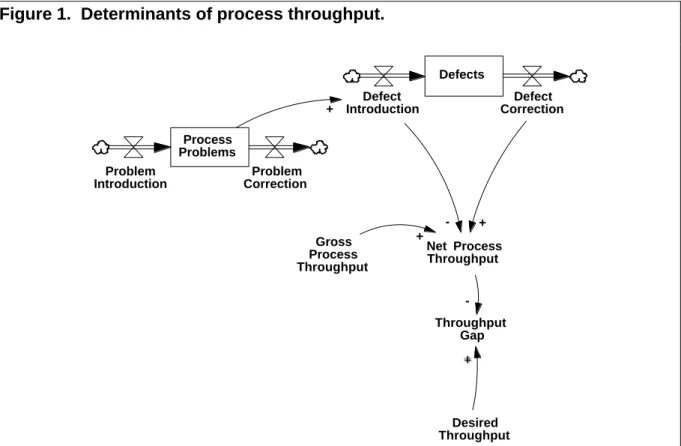
The first construct in our model is Net Process Throughput. Net process throughput is the rate at which inputs are successfully converted into outputs (e.g., saleable products manufactured per day or usable designs completed per month), and represents the “real work” of the organization. Net throughput is determined by three variables: Gross Process Throughput, the total quantity of new work accomplished (e.g., widgets per day or designs per month); Defect Introduction, the flow of new work that is unusable because it was done incorrectly (e.g., defective widgets per day, flawed designs per month); and Defect Correction, the rate at which previously defective work receives additional attention and becomes usable. The term Defect includes any
undesirable outcome of a conversion process (Schneiderman 1988). For example, products produced correctly but delivered late are defective if customers value timely delivery. Figure 1 shows these physical relationships in the form of a causal diagram. 4
Figure 1 also shows the stock of defects, the accumulation of the rate at which defects are introduced less the rate at which defects are corrected. A stock, denoted by a rectangle, is the integration (accumulation) of its inflows less its outflows. Flows are denoted by straight arrows with valves. Stocks and flows complement feedback loops in representing system structure. Because they accumulate past actions, stocks give systems inertia, create delays, and provide systems with memory. Stock and flow structures are critical in creating dynamics: stocks characterize the states of the system upon which decisions are based; these decisions then change the rates of flow that alter the stocks, thereby closing the feedback loops in the system.
Figure 1 about here
until machines are stopped and the defect-causing elements eliminated. To capture this permanence, we draw on a fundamental contribution of the quality movement: the distinction between correcting defects that have already been produced and preventing them from occurring (Deming 1986). We label the causes of defects Process Problems (also known as root causes, Ishikawa 1985). Process problems are any features of the system, either physical or behavioral, that generate defects. The stock of process problems determines the defect introduction rate. The stock of process problems is increased by Problem Introduction and reduced by Problem Correction. Process problems arise as equipment ages and wears, and as changes in products, processes or customer requirements create conflicts with existing routines, skills, or equipment. Learning and process improvement activity may lead to the identification and elimination of the root causes of defects, reducing the stock of process problems, decreasing the defect introduction rate, and improving net process throughput. Explicitly representing the key stocks in the system highlights the importance of distinguishing between defect correction and defect prevention (e.g. Deming 1986). Notice that the stock of process problems determines the flow of defects. One process problem creates a continual inflow of defects, forever reducing net process throughput unless each and every defect is corrected. Conversely, eliminating a single process problem forever reduces the stream of defects. The challenge of process improvement lies in shifting attention from reducing the stock of defects to reducing the stock of process problems.
Responding to Throughput Pressure
Figure 1 also shows the Throughput Gap, defined as the difference between Desired Net Throughput and Net Process Throughput. Large gaps indicate a strong need for corrective action. Desired net throughput is, from the perspective of most managers, including those at our research sites, an exogenous demand: a plant manager must produce enough to fill orders; a project manager strives to meet deadlines for the launch of new products.5
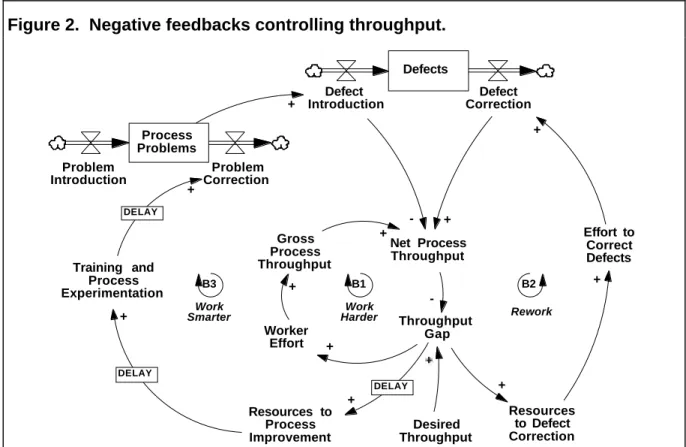
Workers and managers have several options they can use to regulate production. Each forms a negative or balancing feedback loop that works to eliminate the throughput gap by raising net process
throughput towards the desired rate. We divide these options into two classes: first- and second-order improvements.
First-order Improvement. First-order improvement activities seek to extract greater useable
output from the existing process. First, net process throughput can be increased through greater Worker Effort, which directly boosts gross throughput and, given the defect rate (process yield), net throughput. Increasing the utilization of existing resources by getting people to Work Harder forms a balancing feedback loop, labeled B1 in Figure 2. Effort can be increased through greater focus on task, shorter breaks, and speeding the line. Before MCT, line supervisors primarily relied on the work harder loop to achieve production objectives. Second, managers can allocate resources to correct existing defects, forming the balancing Rework loop B2. In product
development, the rework loop was used extensively to complete projects on time. 6 Figure 2 about here
Second-order Improvement. First-order improvement can close the throughput gap, but only at
significant and recurring cost. A more effective solution is to eliminate the process problems that generate defects (Deming 1986). Instead of raising gross throughput by working harder, managers can allocate resources to improvement activities, eventually increasing the rate at which process problems are discovered and corrected. As the stock of process problems falls, the rate of defect introduction drops, boosting net throughput and reducing the throughput gap—creating the negative Work Smarter loop B3 shown in Figure 2. Such second-order
improvements require managers to train the workforce in improvement techniques, give them the freedom to deviate from established routines and experiment with potential solutions, and release them from their normal responsibilities (Deming 1986, Wruck and Jensen 1994).
Working Smarter, while yielding more enduring gains than Working Harder, does take longer. Building up the needed resources, learning to use improvement methods, carrying out
particular process. Schneiderman (1988) found that the improvement half-life—the time required to cut the defects generated by a process in half—depends on the technical and organizational complexity of the process. Relatively simple processes, such as improving the yield of a machine tool, have short half-lives, often less than a year. More complex processes such as product development have half-lives of several years or more.7
INTERACTIONS OF PHYSICAL STRUCTURE AND DECISION MAKING AT THE INDIVIDUAL LEVEL
We now use our model to understand how the system evolved to the undesirable state described above, first pursuing the question at an individual level of analysis and then extending our model to include both managers and workers. We begin with the question of how participants choose to close a persistent throughput gap.
Cognitive and Perceptual Biases Against Improvement
While the value of eliminating process problems has long been recognized (Deming 1986, Crosby 1979, Juran 1995), there are at least four reasons, rooted in basic cognitive processes, why working harder and defect correction often take precedence over defect prevention.
Salience. Process outputs (the actual products that are produced) are more salient and tangible
than process problems, and people have repeatedly been shown to overweight available and salient features of the environment (Kahneman, Slovic and Tversky 1982; Taylor and Fiske 1975). In manufacturing, defective products are physical objects, easily seen and touched. They accumulate in a pile sitting on the production floor. They are literally in the way. In contrast, process problems are often invisible, hidden in equipment or in relationships among components of the process. Similarly, in product development, projects close to launch are tangible and salient, while those in the early phases are concepts with few physical manifestations. A chief engineer described his organization’s reluctance to allocate resources to the early phases of development as the PDP process dictated:
ready to ship your product, that’s a very visible and apparent problem.…Now, [suppose] you are thirty months ahead of job one, 2.5 years away, and you are lacking customer definition. You are trying to get the same level of attention [but] there is much more of a tendency to say, “Come on, quit crying and get on with it.”
Delays. The delays between the start of an improvement program and results are long and
variable, while working harder quickly boosts throughput. Shifting resources from working harder and rework to improvement therefore often causes an immediate drop in throughput. Faced with this worse-before-better trade off, people under pressure to close a throughput gap are likely to choose working harder and defect correction over prevention, even if they
understand that doing so suppresses the symptoms without curing the disease. The executive in charge of PDP discussed the problem created by the long time delays in product development:
Imagine…the general manager…going up in front of the president and saying, “We missed our profitability numbers because we spent extra money developing our new design process that won’t be fully deployed…[for] five years…. Wasn’t that a good move?”
Uncertainty. First-order work yields more certain outcomes than second-order activities. It is
usually clear when a defect has been corrected or how many widgets will be produced by an extra hour spent working harder. In contrast, the complexity and unobservability of process problems make it difficult to assess whether and when a proposed process change will result in fewer defects. Risk aversion is a basic feature of decision making, and people have also been shown to be ambiguity averse (Einhorn and Hogarth 1985). Faced with a throughput gap, many managers prefer the more certain gain of production and defect correction to the ambiguous and uncertain yield of defect prevention. The executive in charge of PDP explains:
...taking the risk and spending incremental money that’s not in your budget—even though in the long run it would have been the right thing…—is a difficult thing to do.… The budget is something that’s easy for your boss to tell you whether you hit it or not.
the stock of defects already generated. The stock of defective output represents a substantial and tangible investment in materials, labor and capital. Most accounting systems report the value of the inputs to each product, making it is easy to assess the benefit of investing in correction. In contrast, assessing the value of defect prevention is difficult. As one manager in our study said, “...nobody ever gets credit for fixing problems that never happened.” The well-known sunk cost fallacy (Arkes and Blumer 1985; Staw 1976, 1981; Thaler 1980) reinforces the bias towards correction. Managers often favor defect correction over prevention, to, as they see it, recoup past investments in defective outputs, even though those investments are sunk costs.
Linkages between First- and Second-order Improvement
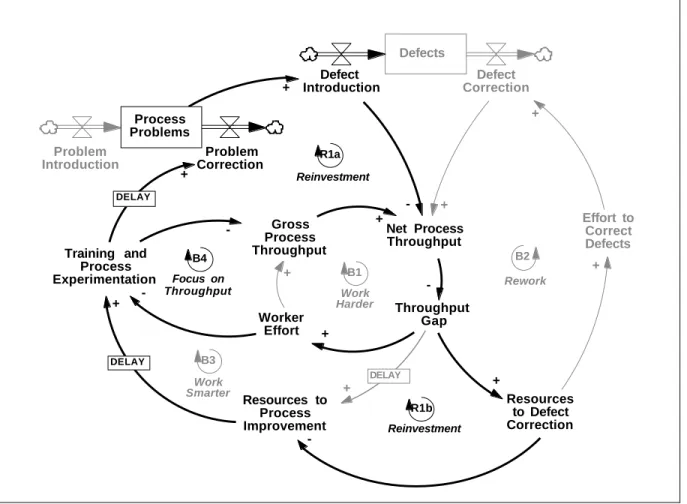
The challenge of investing in improvement and learning is increased by the coupling between first- and second-order improvement activities. Interconnections arise for two reasons. First, resources are finite. Line workers have limited time to allocate among production, defect correction, and process improvement; engineers must trade off doing their “real” design work against investing in process capability. Resource constraints coupled with the biases against improvement lead to two negative links, shown in Figure 3: as Worker Effort rises, Training and Process Experimentation suffer. Likewise, Resources to Process Improvement fall when people increase Resources to Defect Correction.
A second interconnection arises because improvement usually requires a temporary reduction in throughput. In manufacturing, time devoted to improvement cannot be used for production. Further, machines must usually be taken off-line to conduct experiments and correct process problems. Similarly, engineers attending training, practicing with new development tools, or experimenting with new technologies are not completing designs. We capture these short-run costs with the negative link from Training and Process Experimentation to Gross Process Throughput. The strength of this link depends on the available slack. If experiments can be run when machines are normally idle, and engineers can carry out improvement activity when their services are not required on development projects, then the link is weak and the marginal cost of
improvement is low. If machines and people are fully utilized, however, improvement activity cuts throughput sharply.
Figure 3 about here
The new links close three important feedback loops. The first is the balancing Focus on Throughput loop (B4). Cutting improvement activity enables workers to increase gross output and close the throughput gap. However, the resulting gains are temporary: Less improvement activity cuts the rate of problem correction, eventually leading to more process problems, more defects, and lower net throughput. Workers then face even more pressure to focus on throughput and respond by cutting improvement activity further, forming the self-reinforcing Reinvestment loops R1a and R1b. Unlike the loops described so far, the Reinvestment loops are positive feedbacks that tend to reinforce and amplify changes in throughput.
Imagine a large throughput gap. Training and experimentation fall as workers focus on
throughput. The drop in improvement activity causes process problems to accumulate, boosting defect generation and causing a still greater throughput gap (Reinvestment loop R1a). Similarly, a larger throughput gap shifts resources towards defect correction and away from improvement. Process problems accumulate at a faster rate, leading to still more defects and a still greater throughput gap (Reinvestment loop R1b). These loops operate in a variety of settings. For example, deferring preventive maintenance can lead to more machine breakdowns and still greater pressure to reassign maintenance mechanics from preventive to reactive work (Carroll et al. 1997). Similarly, allocating resources to correct design defects late in a development cycle reduces the resources available to projects in earlier phases, leading to future problems and still fewer resources for new projects (Repenning 2001). In such situations the reinvestment loops operate as vicious cycles that accelerate the deterioration of the process, cutting throughput even as people work ever harder. Conversely, the reinvestment loops can operate as virtuous cycles. Successful improvement reduces defect generation and increases net process throughput,
allowing workers to meet throughput goals with less time and effort and freeing additional resources for learning and improvement.
The Capability Trap
The feedback loops created by the interactions between judgmental biases and the physical structure of work processes generate a phenomenon we call the Capability Trap. Consider a machine operator or a design engineer facing a shortfall. She may initially Work Harder (loop B1), do more Rework (loop B2), or Focus on Throughput (loop B4) all of which reduce the time available for improvement. These responses are tempting since they yield immediate gains, while their costs are distant in time and space, uncertain, and hard to detect. But, while
throughput improves in the short run, the reduction in time dedicated to learning causes process capability to decline. Eventually our hypothetical worker finds herself again falling short of her throughput target, forcing a further shift towards working and away from improving. Instead of making up for the improvement activity she skipped earlier, her own past actions, by causing the Reinvestment loops (R1a and R1b) to work as vicious cycles, trap her in a downward spiral of eroding process capability, increasing work hours, and less and less time for improvement. The capability trap played an important role in the failure of improvement efforts in manufacturing prior to MCT. A line supervisor recalled:
...supervisors never had time to make improvements or do preventive maintenance on their lines...they had to spend all their time just trying to keep the line going, but this meant it was always in a state of flux, which in turn, caused them to want to hold lots of protective inventory, because everything was so unpredictable. It was a kind of snowball effect that just kept getting worse.
In this case, supervisors rely on the Work Harder and Focus on Throughput loops to hit their objectives, spending “all their time just trying to keep the line going.” The Reinvestment loops operate as vicious cycles, trapping the line at a minimal level of capability and preventing supervisors from engaging in improvement activities.
Similarly, in product development, the capability trap prevented the organization from reaping the gains of PDP. An engineering manager described the problems they had trying to implement the bookshelf of reusable designs:
An engineer might not take the time to document her steps or put the results of a simulation on the bookshelf and because of that she saved engineering time and did her project more efficiently. But in the long run it prevented us from being able to deploy the reusability concepts that we were looking for.
Just as machine operators faced a trade-off between producing and improving, development engineers were forced to choose between completing their assigned tasks and documenting what they learned for the benefit of future projects. And, just as the self-reinforcing reinvestment loops trapped the manufacturing operation in a state of low process capability, so too they prevented the organization from realizing potential productivity gains in product development.8
Misperceptions of Feedback
While the literature and field data support the linkages in the model, our account of the capability trap raises several questions. First, wouldn’t people recognize the existence of the reinforcing feedbacks that create the trap and take actions to avoid it? Second, if they find themselves stuck in the trap, wouldn’t people learn to escape it by making appropriate short-term sacrifices? Studies of decision making in dynamic environments suggest that such learning is far from automatic.
Consider the outcome feedback received from a decision to spend more time working and less on improvement. Performance quickly increases, producing a clear, salient, unambiguous outcome. In contrast, the negative consequences of this action—the decline in process capability—take time, are hard to observe, and may have ambiguous interpretations. In experiments ranging from running a simulated production and distribution system (Sterman 1989), to fighting a simulated forest fire (Brehmer 1992), to managing a simulated fishery (Moxnes 1999), subjects have been shown to grossly overweight the short-run positive benefits of their decisions while ignoring the
long run, negative consequences. Participants in these experiments produce wildly oscillating production rates, allow their fire-fighting headquarters to burn down, and find their fleets idled after overexploiting their fisheries. Applying these results to the system we study suggests that learning will be slow at best and likely to lead to dynamically impoverished mental models that emphasize short run gains at the expense of long run improvements.
Learning to avoid the capability trap is further complicated by the stock and flow structure relating improvement, process problems, and defect introduction. As long as the rate of problem correction exceeds the rate of problem generation, the stock of process problems declines and the reinvestment loops operate as virtuous cycles: fewer problems lead to fewer defects, increasing net process throughput, and freeing more time for improvement. Reducing improvement activity may cause the rate of problem correction to drop, but as long as problems are corrected faster than they are introduced the stock continues to fall. The positive Reinvestment loops are
weakened, but continue to operate as virtuous cycles, generating improvement (albeit at a slower pace) and a sense that improvement can be cut back with little risk.
Continued cuts in improvement, however, eventually cause the rate of problem correction to fall below the rate of problem introduction. At this point, the stock of process problems stops falling and begins to swell, switching the reinforcing loops from virtuous to vicious cycles. Defects grow and net throughput falls, leading to still more pressure to cut improvement. Worse, the resulting decline in process capability occurs only with a long delay and is difficult to observe. While process capability erodes many other variables are also changing, making it hard to associate any subsequent rise in defects with cuts in improvement effort made weeks, months, or even years before. By the time persuasive signals arrive to reveal the problem, the system is mired in the capability trap.
Once caught in the capability trap, people are also unlikely to learn to escape it. A new
improvement program, by reducing the time available for throughput, causes an immediate and salient drop in performance, while its benefits are uncertain, delayed, difficult to assess, and may
be insufficient to switch the positive feedbacks to virtuous cycles. People are likely to conclude that the improvement program they attempted does not work and should be abandoned.
INTERACTIONS OF PHYSICAL STRUCTURE AND DECISION MAKING AT THE GROUP LEVEL
While the analysis so far suggests that the dynamic complexity of process improvement can bias individuals against fundamental improvement, triggering a vicious cycle of declining learning and intensifying work pressure, process improvement is not an individual activity. Those assessing the throughput gap and giving directives are typically managers, while those actually allocating their time between working and improving are engineers and machine operators. The resulting group and organizational dynamics intensify the bias towards working harder.
Biased Attributions About the Causes of Low Throughput
When choosing to emphasize first- or second-order improvement managers must make a judgment about the causes of low process throughput. If managers believe the cause of low performance lies in the physical structure of the process, they are likely to focus their efforts on process improvement. If, however, low throughput is thought to result from lack of worker effort or discipline, then managers are better off focusing on increasing the quantity of work. How do managers make such attributions? The cues people use to make causal attributions include temporal order, covariation, and contiguity in time and space (Einhorn and Hogarth 1986). Attributing low throughput to inadequate worker effort is consistent with all these cues: worker effort immediately precedes the production of an item, production is highly correlated with worker effort, and workers and the items they produce are contiguous in time and space. In contrast, process problems typically precede low throughput with longer, variable, and often unobservable delays, are imperfectly correlated with low throughput, and can be located far from the defects they create. Managers are thus likely to attribute a throughput shortfall to inadequate worker effort, even when the true causes are systemic process problems.9
Managers’ tendency to attribute performance shortfalls to problems with the workforce rather than the production system is reinforced by the so-called fundamental attribution error (FAE), or dispositional bias. Attributing a problem or behavior to individuals rather than the systems in which they are embedded is a pervasive and robust phenomenon (Ross 1977, Ross and Nisbett 1991, Gilbert and Malone 1995, Jones 1979). While the degree to which the FAE is either fundamental or an error continues to be debated (Harvey 1981; see also Sabini, Seipman, and Stein 2001), studies identifying the conditions that moderate dispositional bias suggest that managers in the situations we study are particularly prone to overly dispositional attributions. For example, recent studies suggest that dispositional attributions are moderated: when the salience of situational factors is enhanced (Quattrone 1982; Krull and Dill 1996); when additional cognitive effort is dedicated to generating alternative explanations for observed behavior (Krull and Dill 1996; Lee, Hallahan, and Herzog 1996; Krull et al. 1999); when people envision that they might be in the same role or position of those they are judging (Lee and Hallahan 2001); and when people expect to justify their attributions to an authority (Tetlock 1985). None of these conditions is, however, likely to hold in the situations we study. As discussed above, process problems are often invisible and distant in time and space from the defects they create, while the connection between worker behavior and output is salient, immediate, and obvious. Similarly, at our study site, as in most organizations, managers and workers faced heavy workloads, reducing the time and attention available to consider alternative explanations that might moderate dispositional attributions. Moreover, few managers expect to ever be in workers’ positions. And, while managers are accountable to their superiors, they are accountable for results—their ability to hit targets for throughput, cost, productivity, etc.—not their attributions about subordinates. Existing research thus suggests that managers facing throughput gaps are likely to conclude that workers, not the process, are the cause of low throughput, reinforcing the bias against fundamental improvement.
The Self-Confirming Attribution Error
Blaming employees often leads to actions that emphasize working harder. Managers making such dispositional attributions may toughen the penalties for failure, as in manufacturing before MCT when “…supervisors who missed their objectives knew they were going to get beat up by their managers” and in product development where “…they shoot you for missing product launch.” More subtly, managers may also increase the frequency and granularity with which worker performance is monitored. For example, prior to MCT, utilization was often reported on a per machine, per shift basis. Similarly, a project manager we interviewed recalled that when a subsystem for which he was responsible fell behind schedule, his boss required him to call every hour with a status report until the prototype met the specifications.
But, with experience, shouldn’t managers correct their erroneous attributions, eventually realizing that low performance results from inadequate process capability rather than lazy employees? To the contrary, we argue that the cues people receive tend to reinforce rather than offset the dispositional bias, leading to the phenomenon of self-confirming attribution errors. Consider what happens if managers attribute low performance to inadequate employee effort rather than process problems. The intendedly rational response is to pressure them to work harder. If, however, the workers are fully utilized, they will likely respond by focusing on throughput and cutting improvement effort. Managers observe that throughput rises, but cannot easily determine how much of the gain is due to increased effort and how much results from cuts in learning, improvement or maintenance. Because managers do not fully observe the reduction in improvement activity (they fail to account for the Focus on Throughput loop), they
overestimate the impact of their get-tough policy. The rise in output provides powerful evidence reinforcing their initial, but incorrect, attribution that the workers just needed a kick in the pants. Managers quickly learn that boosting production pressure works—throughput rises when they turn up the pressure. Recall the project manager required to provide hourly status reports: The problem was soon solved, confirming the boss’s belief that he had intervened appropriately,
indeed had decisively taken charge of the situation, though the team was already working around the clock and his interference drained precious time from their efforts to solve the problem. Workers may unwittingly conspire in strengthening managers’ attributions. Workers are naturally reluctant to tell supervisors they can’t meet all their objectives. The more effectively workers cover up the process shortcuts they take, the less aware managers will be of the true costs of production pressure. Unaware that improvement activity, maintenance, and problem solving have been cut back, throughput appears to rise without requiring any sacrifices, reinforcing management’s attribution that the workers really were lazy. Moreover, while throughput will eventually decline with decreased attention to working smarter, due to the delayed and diffuse nature of the cues indicating an erosion in process capability, managers are unlikely to attribute a throughput gap to pressure they placed on workers weeks or months before. They are likely to conclude instead that the workers have once more slacked off and require another dose of production pressure.
Managers’ initial attributions that throughput problems result from the workers rather than the process are strongly self-confirming, driving the organization into the capability trap where high production pressure squeezes out the improvement activity that could boost throughput and ease the pressure. Far more importantly, the vicious cycle of self-confirming attribution errors also changes managers’ mental models by providing them with increasingly compelling evidence that the source of low throughput lies in the poor attitudes and weak character of the workforce. Evidence of these self-confirming attributions appears in two different guises in our data. As discussed earlier, senior managers in the PDP effort repeatedly attributed the difficulties they experienced to the undisciplined character of the engineering staff. When pressed to explain, many managers resorted to even deeper attributions. For example, when asked why engineers resisted project management, the manager in charge of PDP replied:
Program management and the disciplines associated with it continue to be a problem in my opinion in most Western cultures. The people that are particularly rigorous and
disciplined, the Japanese and the Germans, tend to be so by cultural norms. I can’t tell you if it’s hereditary or society or where it is they get it, but…there’s a strong push back from the western type of engineer for much of this.
There is no mention of structural features of the system or the pressure, felt throughout the organization, to deliver ambitious projects on time. Instead, this manager blames the failure on the undisciplined character of “Western” engineers. Such attributions, here generalized to entire nations, and invoking a disturbing racial and ethnic subtext, are typical of the fundamental attribution error. Shared and repeated, such stereotypes become institutionalized in the corporate culture and can strengthen prejudices in society at large.
Whereas in PDP dispositional attributions appeared in explanations for failure, many managers attributed the success of the MCT effort to overcoming their tendency to blame workers. One supervisor, asked to account for the success of MCT, articulated this point clearly:
There are two theories. One says “there’s a problem, let’s fix it.” The other says “we have a problem, someone is screwing up, let’s go beat them up.” To make improvement we could no longer embrace the second theory, we had to use the first.
The general manager responsible for both MCT and PDP also reported a similar focus as a key component of both MCT and his success as a manager. He explains the source of his views:
[At a previous job] I became a plant manager… I’ll never forget as long as I live… [The previous manager] started blaming his people for all his problems.… He was really on one guy very badly.… His view was the whole reason for the poor performance of the plant was because of this guy. So I didn’t say anything or do anything and I took my time and I gave it about two or three months. Then I gave the guy more responsibility…as much responsibility as he’d take. He ended up being one of the best people in the plant. I guess that was probably the turning point.
Thus, while many managers in the PDP effort attributed the initiative’s failure to the engineers, managers in manufacturing often attributed MCT’s success to changing their own attributions, from people to the production system.
Institutionalizing the Attribution Error
While initially significant, the benefits of additional production pressure eventually decline. As workers become fully focused on throughput, they can no longer boost production by cutting the time spent on improvement. Faced with the declining efficacy of production pressure and given their attribution that employees are just not working hard enough, managers are likely to make physical changes to the production technology in an effort to monitor and control the activities of the workers (e.g., detailed work reporting systems, video surveillance, and software that
measures data entry keystroke rate). Unfortunately, such investments and workers reactions’ to them not only worsen the attribution error dynamics, but also progressively embed those errors in the physical and institutional structure of the organization.
Substantial investments in monitoring and control systems not only reinforce managers’ belief that these technologies are required (Strickland 1958), but also potentially lead them to create evidence justifying their investments in surveillance (Lingle, Brock, and Cialdini 1977). Conversely, tightly specified objectives and sophisticated monitoring technologies have been shown to create the behaviors that they are designed to prevent (e.g., Wilson and Lassiter 1982). And, even if workers and managers do not fall prey to these psychological dynamics, the
combination of intense production pressure and close monitoring creates a set of incompatible objectives. Workers eventually have no choice but to evade or subvert management’s controls, play games with performance metrics, or make ad hoc changes to the process. Once discovered, these workarounds provide powerful evidence confirming managers’ initial attributions,
justifying still greater investments in monitoring and control. But as managers strengthen incentives and controls, they make departures from them ever more necessary. What begins as a false attribution by management that workers are slothful, undisciplined, and untrustworthy
becomes reality, creating an increasingly hostile and adversarial relationship between superiors and subordinates in the process. Both managers’ and workers’ worst fears are realized as a consequence of their own actions.
These dynamics were particularly clear in the pre-MCT period in manufacturing. Previous initiatives targeted at reducing WIP inventory created a direct conflict with the objectives of high machine and labor utilization. Operators and supervisors reacted by making ad hoc changes to the manufacturing process that allowed them to appear to satisfy both objectives. Many
accumulated secret work-in-process inventories so they could keep their machines running, even when the output wasn’t needed. A manager explained:
Supervisors at that time were evaluated on labor performance on a daily basis. It didn’t take long for them to develop a buffer in front of their line so that if the schedule called for 700 and their line was fully utilized at 800, they could still run 800 units every day, and still make their labor performance.
While the extra inventory helped supervisors hit their local objectives, it also increased cycle times, delayed quality feedback and increased costs. The consequent low performance caused managers to scrutinize workers and supervisors more closely.
Similarly, while PDP required teams to pass a series of checkpoints requiring detailed progress reports, engineers often reported design phases as complete when, in fact, they were not. One engineer recalled that weekly project review meetings were labeled the “liar’s club” because the engineers responsible for each subsystem always claimed to be on schedule, even when they were far behind. In response, managers would often tell the engineers they had less time than there actually was. A manager responsible for facilitating the use of PDP reported,
...[one] executive engineer used to have what I would call “fighting meetings”.… His attitude was we should tell everybody that they’re all red [behind schedule], they're all failing, they have to make changes faster [and] if we don’t…we’re going to shut the whole division down.