Coordination and Competition in
Resource-Constrained Channels
by
Navid Sabbaghi
B.A., Applied Mathematics, University of California at Berkeley
B.S., Electrical Engineering and Computer Science, University of California at Berkeley M.S., Electrical Engineering and Computer Science, Massachusetts Institute of Technology
Submitted to the
Department of Electrical Engineering and Computer Science
in partial fulfillment of the requirements for the degree of
Doctor ot lhllosophy
in Electrical Engineering and Computer Science
at the
Massachusetts Institute of Technology
MASSACHLUSETTS INSTITUTE OF TECHC••NOLG • .Y
OCT 2 22008
LIBRARIES
SepitemlDer
200u
@ Massachusetts Institute of Technology 2008. All rights reserved.
ARCHIVL
Author...
...
...
Department of Electrical Engineering and Computer Science
-,
A
July 25, 2008
Certified by ....
...
/
V
Yossi Sheffi
Professor of Engineering Systems and Civil & Environmental
Engineering
Thesis Supervisor
Certified by ...
I
.JohnN. Tsitsiklis
Clarence J Lebel Professor of Electrical Engineering
.A /1
.-
Thesis Supervisor
A ccepted by ...
....
....
...
Terry P. Orlando
Professor of Electrical Engineering
Chair, Department Committee on Graduate Students
Coordination and Competition in Resource-Constrained
Channels
by
Navid Sabbaghi
Submitted to the Department of Electrical Engineering and Computer Science on July 25, 2008, in partial fulfillment of the
requirements for the degree of
Doctor of Philosophy in Electrical Engineering and Computer Science
Abstract
This thesis deals with five important ideas pertaining to supply chains and supply contracts: coordination, flexibility in allocating profit, the push-pull boundary, the
valuation of capacity, and cooperation versus competition and its efects on profit and prices. Throughout the thesis, we focus on capacity-constrained supply channels,
motivated by the fact that most real-world supply chains have physical or monetary constraints.
In the first part of this thesis, we show that when a supply channel is capacity-constrained and the constraint is tight, there is a set of linear wholesale price con-tracts that coordinates the channel while allowing the supplier to make a profit. We prove this for the one-supplier/one-newsvendor supply channel as well as the many-supplier/one-newsvendor channel configuration (with each supplier selling a unique product). We analyze how this set of wholesale prices changes as we change the channel's capacity constraint. We also explore conditions under which these channel-efficient linear wholesale price contracts result from the equilibrium behavior of a newsvendor procurement game. Our newsvendor procurement game generalizes the Stackelberg game introduced in Lariviere and Porteus (2001) to allow for multiple suppliers as well as a capacity constraint at the newsvendor. In order to convey the worst-case channel performance when these channel-efficient contracts are not used in equilibrium, we quantify the worst-case efficiency loss for the supply channel using a distribution-free method. We also identify the set of Pareto-dominated contracts in a negotiation setting. Furthermore, unlike the unconstrained setting, we show that in the constrained setting wholesale price contracts can be flexible in allocating the channel profit without necessarily sacrificing coordination. Finally, we find the set of risk-sharing contracts (such as buy-back and revenue-sharing contracts) that coordi-nate a constrained supply channel and contrast that set with the set of risk-sharing contracts that coordinate an unconstrained channel. We show that in a capacity constrained channel, even risk-sharing contracts gain extra flexibility because for any
given level of risk, there is now a range of possible allocations of the system optimal profit between the supplier and retailer. (Without a capacity constraint, for any given level of risk, there is only one allowable allocation of channel optimal profit between the supplier and retailer.) In other words, in a capacity-constrained environment, using risk-sharing contracts, for any given level of risk, we show there is flexibility in allocating the channel optimal profit.
In the second part of this thesis, we consider a supply channel with a capacity constraint in which the retailer makes an order quantity decision that depends only on realized demand rather than a forecast, and instead the supplier is the newsvendor for the channel making a stocking decision based on a forecast. In other words, the retailer now 'pulls' inventory from the supplier as demand is realized which differs from the model in the first part of this thesis wherein the supplier 'pushes' inventory onto the retailer before the sales season begins. We find that for the new supply channel similar results hold. Namely, when the retailer is operating in 'pull-mode', there is a set of 'pull' wholesale price contracts that coordinates the channel while allowing the retailer to make a profit. We analyze how this set of wholesale prices changes as we change the channel's capacity constraint. We also explore conditions under which these channel-efficient 'pull' wholesale price contracts result from the equilibrium behavior of a newsvendor procurement game. Our newsvendor procurement game generalizes the Stackelberg game introduced in Cachon and Lariviere (2001) to allow for multiple retailers as well as a capacity constraint at the newsvendor. We assess the worst-case channel performance in equilibrium when these channel-efficient contracts are not selected. Furthermore, we identify the set of Pareto-dominated 'pull' contracts in a negotiation setting. Finally, we identify the wholesale price contracts that coordinate regardless of the supply chain's mode of operation.
In the third part of this thesis, we consider a supply channel, operating in 'push'-mode, with multiple suppliers selling differentiated products to one newsvendor with limited capacity, using wholesale price contracts. We show that both in a negotiation setting as well as in an equilibrium setting, with the suppliers selecting wholesale prices followed by the newsvendor choosing order quantities, each supplier incurs an endogenous price for their share of the newsvendor's capacity. We intrepret this price as the value of the newsvendor's capacity and analyze the capacity's price in both a negotiation and an equilibrium setting. Furthermore, we show that our capacity valuation technique can be applied to different supply chain settings by analyzing the capacity price for a different supply chain, operating in 'pull'-mode, with one supplier with limited capacity selling differentiated products to multiple retailers. Finally, we analyze the effects of collusion on prices and profits in both these settings.
Thesis Supervisor: Yossi Sheffi
Title: Professor of Engineering Systems and Civil & Environmental Engineering Thesis Supervisor: John N. Tsitsiklis
Acknowledgments
First and foremost, I am extremely grateful to both of my thesis advisors, Professor Sheffi and Professor Tsitsiklis. Their advice, encouragement, enthusiasm, insights, support, and mentorship have been immensely valuable. From the first day that they started guiding me, I knew that I was extremely fortunate to be privy to their deep research vision and vast experiences. I am very thankful for their genuine concern, efforts, and patience towards my development from a student to a researcher. I am deeply indebted to them.
I am also very much in the debt of Professor Cachon and Professor Lariviere for their leadership and contributions to the supply contracts literature. Professor Sheffi introduced me to this amazing literature when he handed me Professor Cachon's survey article on supply contracts. This thesis might have been in an entirely different area, if they did not publish the papers that we cite in this thesis. I thank them for being clear, patient, motivated, and inspirational in this literature.
I am very grateful to my thesis committee members, Professor Cachon and Pro-fessor Ozdaglar. Their insightful feedback led to many improvements for the final version of this thesis.
Special thanks go to the administrators in the Course 6 Graduate Student Office and the Laboratory for Information and Decision Systems. I am very grateful for their support and thoughtfulness throughout my time at MIT.
This research was supported by the MIT-Zaragoza Project funded by the
Contents
1 Introduction and Contributions 17
1.1 Coordinating a constrained channel ... 17
1.2 Additional flexibility in allocating profit without sacrificing coordination 18 1.2.1 W holesale price contracts ... 18
1.2.2 Risk-sharing contracts ... 19
1.3 Push versus Pull ... 19
1.4 A valuation technique for capacity . ... . 19
1.5 Cooperation versus Competition ... .. 19
1.5.1 Equilibrium setting: 1 supplier/1 retailer . ... . . . 20
1.5.2 Competition versus Collusion within an echelon ... 20
1.6 Organization of this Thesis ... 20
1.7 A survey of the literature ... ... .. 22
2 Coordinating a constrained channel 25 2.1 M odel . . . .. .. . 26
2.1.2 Channel's problem ...
2.1.3 Definition: Coordinating the retailer's action . ...
2.2 Set of coordinating wholesale prices . ... . . .
2.2.1 Size of W(k). ...
2.3 Equilibrium setting...
2.4 When can both parties be better off? ...
2.5 Efficiency Loss. ... ...
2.6 Proofs . . . . 2.6.1 Proof: 1-supplier/1-retailer, Set of wholesale prices W(k) . . . 2.6.2 Proof: Impact of size of Market on size of W(k) ...
2.6.3 Proof: When is the equilibrium of the Stackelberg game channel optim al? . . . .. .. . 2.6.4 Proof: The set of Pareto-dominated contracts D(k) as a
func-tion of capacity ...
2.6.5 Proof: Efficiency loss for a two-stage push channel with capac-ity constraint . . . . 3 Flexibility in allocating profit
3.1 Revenue requirement implicit in W(k) . . . . . 3.2 Wholesale price contracts and flexibility in allocating channel-optimal
p rofit . . . . 3.3 Risk sharing contracts ...
3.3.1 Buyback and revenue-sharing contracts for unconstrained newsven-dor's still coordinate ...
3.3.2 Necessary and sufficient conditions for coordination . . . . 3.3.3 Flexibility in allocating channel optimal profit, for a given level
of risk . . . . 3.4 Proofs
3.4.1 3.4.2
. . . . . . . . . . . . . . . . . . . . . . . . . . . . . . . . . . .
Proof: Revenue requirement implicit in W(k) . . . . Proof: Revenue requirement as we 'vary' F ...
36 37 37 38 39 40 45 46 47 49 50 50 51
3.4.3 Proof: W(k)'s flexibility in allocating the channel-optimal profit 56 3.4.4 Proof: Flexibility in allocating the channel-optimal profit as we
'vary' F . .. . .. . . . .. . . .. . . .. . 58
3.4.5 Proof: Buyback and revenue-sharing contracts continue to co-ordinate . . . .... . . . . . . .. . . . . 58
3.4.6 Proof: Necessary and suff. conditions for risk-sharing contracts to coordinate . . . .. . . . .. . . . . .. . . . . . 61
3.4.7 Proof: Buyback flexibility in allocating the channel-optimal profit 62 3.4.8 Proof: Buyback flexibility in allocating the channel-optimal profit as we 'vary' F ... 63
4 An Extension: Coordinating a constrained channel with multiple suppliers 65 4.1 Many-suppliers/1-retailer model . . . . 66
4.1.1 Retailer's problem ... 67
4.1.2 Channel's problem ... 68
4.2 The set W (k) .. . . . .. . . .... .. . 68
4.3 The Stackelberg game with multiple suppliers . . . . 69
4.4 Proofs . . . .. .. . 70
4.4.1 Proof: m-suppliers/1-retailer, Set of wholesale prices W(k) . 70 4.4.2 Proof: m-suppliers/1-retailer, equilibrium setting ... . . 73
5 Coordinating a constrained channel: 'make-to-order' retailer 75 5.1 M odel . . . .. . 77
5.1.1 Supplier's problem ... 78
5.1.2 Channel's problem ... ... 79
5.1.3 Definition: Coordinating the supplier's action . . . . 79
5.2 Set of coordinating wholesale prices .... .. . . . 79
5.2.1 Size of Wpun(k)... ... .. 80
5.3 Equilibrium setting... ... 81
5.5 Efficiency Loss. ...
5.6 Coordinating wholesale prices for both push-mode and pull-mode . . 5.6.1 Size of W both(kr, k,) . ...
r 7 DV f 1
U.
5.7.1 Proof: 1-supplier/i-retailer, Set of wholesale prices Wpul(k) 5.7.2 Proof: Impact of size of Market on size of Wp,,(k) . . . . 5.7.3 Proof: When is the equilibrium of the Stackelberg game channel
optimal? . .. . . . 5.7.4 Proof: The set of Pareto-dominated contracts Dnpll(k) as a
function of capacity ...
5.7.5 Proof: Efficiency loss for a two-stage pull channel with capacity constraint . . . . 5.7.6 Proof: 1-supplier/i-retailer, Set of wholesale prices Wboth(kr, k, 5.7.7 Proof: Impact of changing 3push, Opull . . . . ... . 6 Multiple suppliers selling to a newsvendor 101
6.1 Model Framework ... 102
6.1.1 Equilibrium setting ... 104
6.1.2 Retailer's problem in the second stage . ... 104
6.1.3 Supplier's problem in the first stage . ... 106
6.1.4 Equilibrium with an unconstrained newsvendor ... . 107
6.1.5 Definition: Valuation for capacity . ... 107
6.2 The newsvendor's problem and an endogenous price for capacity k . . 108
6.3 Comparative statics, the game's geometry, and reformulation. ... . 111
6.3.1 The newsvendor's shadow price for capacity when a wholesale price drops ... .. 111
6.3.2 An invariance property on the retailer's shadow price for capacity 112 6.3.3 Set of wholesale prices for a particular capacity price A or ca-pacity allocation q ... 114
6.4.1 Recasting a supplier's problem & its shadow price for allocated
retail capacity ... 116
6.4.2 Existence of equilibrium ... .. 122
6.4.3 An economic assumption ... .. 123
6.4.4 Uniqueness of equilibrium shadow price . ... 124
6.5 Supplier collusion... 126
6.6 Proofs . . . ... 127
6.6.1 Proof: The shadow price for capacity and the goods ordered. . 127 6.6.2 Proof: The shadow price for capacity as the minimum of some set... 128
6.6.3 Proof: A)(w) is nondecreasing as wt decreases, and the increase is bounded. . . ... . ... .. ... . ... .. .... 129
6.6.4 Proof: The effect of a price drop on the retailer's order. .... 131
6.6.5 Proof: A supplier effects the price for capacity via its induced allocation . . . . 132
6.6.6 Proof: A newsvendor's price for capacity is continuous and in-creasing . . . . 134
6.6.7 Proof: The marginal price for capacity is increasing ... 135
6.6.8 Proof: Partitioning the set of wholesale prices by 'capacity charge'. . . . . 138
6.6.9 Proof: Partitioning the 'binding' wholesale prices by 'induced allocation'... . . . . . . . ... 140
6.6.10 Proof: The shadow price for supplier Y's aggregate induced order. 141 6.6.11 Proof: Any induced aggregate order above t is not optimal. . 144 6.6.12 Proof: Optimal aggregate order for a fixed w .. ... 145
6.6.13 Proof: Characterizing Wr(wy). . . . . 148
6.6.14 Proof: Existence of an equilibrium when s suppliers compete. 152 6.6.15 Proof: Unique equilibrium shadow price for capacity when s suppliers compete. ... 154
6.6.17 Proof: Supplier collusion ... .. . . 159
7 Multiple retailers buying from a newsvendor 161 7.1 M odel . . . . 162
7.1.1 Equilibrium setting ... 163
7.1.2 Supplier's problem in the second stage . ... 163
7.1.3 Retailer's problem in the first stage . ... 164
7.1.4 Equilibrium with an unconstrained supplier . ... 165
7.1.5 Definition: Valuation for capacity . ... 166
7.2 An endogenous valuation for the supplier's capacity k ... . 166
7.3 Comparative statics, and the game's geometry. . ... 169
7.3.1 The supplier's shadow price for capacity when a wholesale price increases ... 170
7.3.2 An invariance property on the supplier's shadow price for capacity 171 7.3.3 Set of wholesale prices for a particular capacity price A or ca-pacity allocation q ... 172
7.4 Analysis for the two-stage game ... 174
7.4.1 Recasting a retailer's problem & its shadow price for allocated supplier capacity ... 174
7.4.2 Existence of equilibrium ... .. 181
7.4.3 An economic assumption . . . ... .. . . 182
7.4.4 Uniqueness of equilibrium shadow price . ... 183
7.5 Retailer collusion. ... ... ... 184
7.6 Proofs . . . ... 185
7.6.1 Proof: The shadow price for capacity and the goods ordered. . 185 7.6.2 Proof: The shadow price for capacity as the minimum of some set . . . .. . . 187
7.6.3 Proof: AV(w) is nondecreasing as wt increases, and the increase is bounded. . ... ... . . 187
7.6.4 Proof: The effect of a wholesale price increase on the supplier's
inventory. ... 189
7.6.5 Proof: A retailer effects the price for capacity via its induced allocation . . . . 190
7.6.6 Proof: The supplier's price for capacity is continuous and in-creasing . . . . 193
7.6.7 Proof: The marginal price for capacity is increasing ... 194
7.6.8 Proof: Partitioning the set of wholesale prices by 'capacity charge'. . . . .. . . . 197
7.6.9 Proof: Partitioning the 'binding' wholesale prices by 'induced allocation'... . . . . 199
7.6.10 Proof: The shadow price for retailer Y's aggregate induced order.200 7.6.11 Proof: Any induced aggregate order above t is not optimal. . 203 7.6.12 Proof: Optimal aggregate order for a fixed uy... 205
7.6.13 Proof: Characterizing Wbr(wy). . ... ... . 207
7.6.14 Proof: Existence of an equilibrium when s retailers compete.. 211
7.6.15 Proof: Unique equilibrium shadow price for capacity when s retailers com pete ... 212
7.6.16 Proof: Unique capacity allocation when s suppliers compete. . 215 7.6.17 Proof: Retailer collusion ... 217
8 Conclusions and future work 219 8.1 Resource parameters versus contract parameters . ... 220
8.2 Extra flexibility in allocating profit . ... 221
8.3 Efficiency loss . ... ... ... ... . . ... ... . 221
8.4 Coordination when there are multiple goods . ... 221
8.5 Capacity valuation and collusion ... .. 222
List of Figures
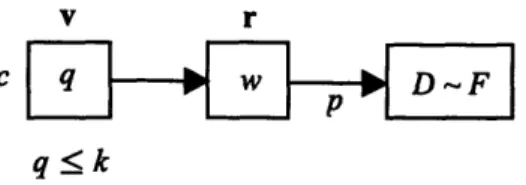
2-1 "single supplier & single capacity constrained retailer" model ... 27 2-2 The set of wholesale prices that coordinates the actions of a single
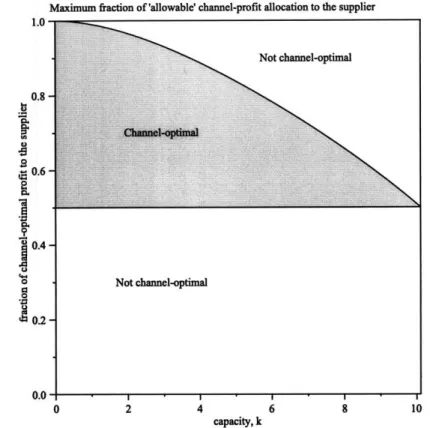
retailer when procuring from a single supplier. ... . 30 2-3 An example illustrating W(k) and D(k). . ... 34 2-4 An example illustrating Eff(k, P) when m = 0.35. ... . . 36 3-1 Flexibility in allocating channel-optimal profit as a function of the
capacity constraint. ... . . . .... 49 3-2 Some buyback contracts (w, b) that channel-coordinate a constrained
newsvendor. . . . . . . . ..... . . . 51
3-3 Necessary and sufficient conditions for a buyback contract (w, b) to
channel-coordinate a constrained newsvendor. ... 52
3-4 Flexibility in allocating channel-optimal profit as a function of the
capacity constraint. .. . ... . . . ... 54
4-1 "m suppliers & 1 capacity constrained retailer" model with
5-1 "single capacity constrained supplier & single build-to-order retailer"
model. ... 78
5-2 The set of wholesale prices that coordinates the actions of a single supplier when building to stock for a single retailer that 'pulls' from
that supplier. ... 81
5-3 An example illustrating Wpunl(k) and Dpul(k). . ... 84 5-4 An example illustrating Eff(k, 3) when m = 0.35. . ... . . 87 5-5 The set of wholesale prices that coordinates a 1-supplier/1-retailer
con-figuration regardless of whether it is operating in push-mode or
pull-mode. ... .. 89
6-1 "n goods & 1 capacity constrained retailer" model. . ... 103 6-2 The shadow price Ar(w) as a 'threshold rule' on a retailer's marginal
expected profit (rmep) curve. ... 110 6-3 Wholesale price vectors that induce a particular capacity charge or
capacity allocation... 116 7-1 "n goods & 1 capacity constrained supplier" model. . ... 162 7-2 The shadow price A'(w) as a 'threshold rule' on the supplier's marginal
expected profit (smep) curves ... 168 7-3 Wholesale price vectors that induce a particular capacity charge or
CHAPTER
1
Introduction and Contributions
This thesis deals with five important ideas pertaining to supply chains and supply contracts: coordination, flexibility in allocating profit, the push-pull boundary, the
valuation of capacity, and cooperation versus competition and its effects on profit
and prices. Throughout the thesis, we focus on capacity-constrained supply channels,
motivated by the fact that most real-world supply chains have physical or monetary constraints.
U 1.1 Coordinating a constrained channel
There is a wealth of supply contracts available that coordinate a newsvendor's deci-sion for unconstrained supplier-retailer channels: buy-back contracts, revenue-sharing contracts, etc. (Cachon 2003) A contract coordinates the actions of a newsvendor for a supply channel if the contract causes the newsvendor to take actions when solving his own decision problem that are also optimal for the channel.' Our thesis shows that simpler contracts, namely linear wholesale price contracts (which are thought to be unable to coordinate a newsvendor's decision for unconstrained channels) can, in
1
Sometimes we also say a contract channel-coordinates a newsvendor's decision. Therefore, achieving co-ordination for the channel equates to attaining channel optimality (and thus efficiency) when the newsvendor is allowed to decide for himself.
CHAPTER 1. INTRODUCTION AND CONTRIBUTIONS
fact, coordinate a newsvendor's procurement decision for resource-constrained chan-nels. This is relevant for supply channels in which capacity of some resource is limited. For example, shelf space at retail stores, seats on airlines, warehouse space, procure-ment budgets, time available for manufacturing, raw materials, etc. (Corsten 2006)
In this thesis, we also show how risk-sharing contracts such as buy-back and revenue-sharing coordinate the procurement decision of a resource-constrained newsven-dor thereby generalizing the treatment of these contracts. But the primary insight we show in the first part of this thesis, is that if newsvendor capacity is a binding constraint, then a set of linear wholesale-price contracts can coordinate the procure-ment decision of a capacity-constrained newsvendor (when the supply chain operates in 'pull-mode').2 Furthermore, this set includes wholesale prices that allow both the supplier and the newsvendor to profit.
U 1.2 Additional flexibility in allocating profit
with-out sacrificing coordination
In addition to coordination capability, another important feature of any supply contract is its flexibility in allocating profit while maintaining coordination (Cachon 2003). Buyback contracts and revenue sharing contracts in unconstrained channels are well known to have this advantage. But wholesale price contracts in unconstrained settings lack the flexibility in allocating channel profit while maintaining coordination.
1.2.1
Wholesale price contracts
Our thesis shows that when the channel is constrained, wholesale price contracts gain some flexibility (in allocating channel profit) while maintaining coordination.
2In addition to capacity being a binding constraint, the relative power of the parties and their competitive environments are also important for the wholesale-price contract to coordinate the actions of the newsvendor in practice. For example, even if the set of wholesale prices W(k) that coordinate the retailer's actions is enlarged beyond the supplier's marginal cost (due to the retailer's capacity constraint k), the retailer and supplier still need to agree upon some wholesale price in that set. Their outside-alternatives and the power in the supply channel could determine if some wholesale price in the set W(k) is acceptable for the parties involved.
SECTION 1.3. PUSH VERSUS PULL
1.2.2
Risk-sharing contracts
However, this extra gain in flexibility is not limited to wholesale price contracts. We also show that when the channel is constrained, buyback contracts also gain some flexibility. In particular, we show that buyback contracts gain a feature that they do not have in the unconstrained setting: the flexibility in allocating channel optimal profit, for any fixed level of risk.
U 1.3 Push versus Pull
In the supply chain literature, the 'push-pull boundary' in a supply chain refers to the point in the supply chain at which the supply chain's mode of operation switches from 'building to forecast' to 'reacting to realized demand' (Chopra and Lariviere 2005). This is also called The 'Fulcrum Point' by Martin Christopher; the BTF/BTO boundary (build to forecast/build to order).
In this thesis, we also show that our results on the coordination capability of wholesale price contracts are independent of where we place the 'push-pull boundary', i.e., the supply chain's mode of operation. We go on to highlight the wholesale price contracts that coordinate the supply chain regardless of mode of operation.
* 1.4 A valuation technique for capacity
When considering multiple suppliers selling to a capacity constrained newsvendor (i.e., push-mode) or multiple retailers buying from a capacity constrained newsvendor (i.e., pull-mode), we analyze the capacity constraint's shadow price in equilibrium, motivated by the fact that the shadow price is important in 'valuing' the newsvendor's capacity.
U
1.5 Cooperation versus Competition
CHAPTER 1. INTRODUCTION AND CONTRIBUTIONS
1.5.1
Equilibrium setting: 1 supplier/1 retailer
In addition to understanding the wholesale prices that coordinate a channel, we also analyze equilibrium settings (push and pull modes) to answer the question: when do wholesale price contracts coordinate in a competitive setting? Or equivalently, when is the equilibrium outcome equivalent to the outcome of the integrated firm. We find that when capacity is small enough, wholesale price contracts induce a channel profit that is as large as any cooperative or integrated outcome. In other words, for small enough channel capacities there are no gains to be had from integration or cooperation. We show this for a single supplier/single retailer supply chain and we show that this feature holds regardless of the supply chain's mode of operation (push or pull).
1.5.2
Competition versus Collusion within an echelon
We also consider a supply chain operating in push-mode with multiple suppliers selling to a retailer. We show that when there is supplier collusion, every supplier can be better off in terms of profit.
Furthermore, we consider a supply chain operating in pull-mode with multiple retailers buying from a single supplier. We show that when there is retailer collusion,
every retailer can be better off in terms of profit.
U
1.6 Organization of this Thesis
In Section 1.7, we provide an overview of the supply contracts literature, empha-sizing the point that the literature has underestimated the coordination capability of wholesale price contracts for a constrained supply channel.
Chapter 2 focuses on single supplier/single retailer supply chain (with a capac-ity constraint) operating in push-mode (i.e., we have a make-to-stock retailer). We formally define coordination and analyze the set of coordinating wholesale price con-tracts. Then we consider an equilibrium setting, proving a unique equilibrium exists,
SECTION 1.6. ORGANIZATION OF THIS THESIS
and providing necessary and sufficient conditions for the equilibrium wholesale price contract to coordinate the supply chain. Furthermore, we analyze the set of Pareto-dominated contracts (contracts that should be avoided in both a negotiation and equilibrium setting). Finally, recognizing that the outcome can be inefficient in an equilibrium setting, we provide a worst-case efficiency bound for the equilibrium set-ting using a distribution-independent technique.
Chapter 3 uses the model presented in Chapter 2 in order to characterize the fractions of revenue and profit that can be allocated to a supplier and retailer when they use a coordinating contract. In particular, we show that wholesale price contracts have some flexibility in allocating the channel-optimal profit between the supplier and retailer (a flexibility that does not exist in the unconstrained setting). We conduct some comparative statics and analyze how this flexibility changes as a function of capacity and market demand. Then we move on and consider risk-sharing contracts for the same supply chain model. We show that they still coordinate a capacity-constrained channel and, furthermore, there is even more flexibility in the choice of risk-sharing contracts (for coordinating the channel). In particular, for any given level of risk (represented by the buyback parameter of a buyback contract), there is now flexibility in allocating the channel profit (without sacrificing coordination), a flexibility that is not present in the unconstrained setting.
Chapter 4 extends the push-mode supply chain model used in Chapter 2 and Chapter 3 by having multiple suppliers (each offering one differentiated good) in-stead of a single supplier. The chapter's focus is on coordination in this expanded setting. We provide conditions for wholesale price contracts to coordinate the chan-nel. Then we consider an equilibrium setting and find conditions guaranteeing that the equilibrium wholesale price is a coordinating contract.
Chapter 5 considers the supply chain model in Chapter 2 but changes the mode of operation to pull and places the capacity constraint at the supplier. In other words, we have a make-to-order 'lean' retailer. In this chapter, we analyze the set of coordi-nating 'pull' wholesale price contracts, showing that when capacity is 'small enough', coordination becomes possible. Then we consider an equilibrium setting, proving
CHAPTER 1. INTRODUCTION AND CONTRIBUTIONS
that a unique equilibrium exists and providing necessary and sufficient conditions for the equilibrium 'pull' wholesale price contract to be a coordinating contract. We then analyze the set of Pareto-dominated 'pull' wholesale price contracts which are to be avoided in a negotiation setting (and will be avoided in an equilibrium setting). Recognizing that in an equilibrium setting we may not achieve the channel-optimal outcome, we analyze the worst-case efficiency loss using a distribution-independent technique. Finally, combining our results from Chapter 2 and Chapter 5, we describe the wholesale price contracts that coordinate the supply chain regardless of its mode of operation (push or pull).
Chapter 6 considers a more general supply chain model with multiple suppliers selling multiple goods to one capacity constrained retailer, extending the model in Chapter 2. The supply chain operates in push-mode (i.e., the retailer is a make-to-stock retailer). We analyze the retailer's order decision and derive an endogenous price for the retailer's capacity, i.e., the retailer's shadow price. Focusing on an equilibrium setting, we provide conditions for the existence and uniqueness of an equilibrium shadow price. We conduct comparative statics. Finally, we consider the effect of supplier collusion on the retailer's (shadow) price for capacity and on supplier profit. Chapter 7 considers an extension of the 'pull' supply chain model presented in Chapter 5 by having multiple retailers pulling multiple goods from a single supplier. We focus on an equilibrium setting, conduct comparative statics and provide con-ditions for the existence and uniqueness of an equilibrium. Finally, we consider the effect of retailer collusion on the supplier's (shadow) price for capacity and on retailer profit.
Finally, we summarize our findings and provide insights in Chapter 8.
U 1.7 A survey of the literature
The supply contracts literature has been based on the observation, pointed out, for example, by Lariviere and Porteus (2001), that wholesale price contracts are simple but do not coordinate the retailer's order quantity decision for a supplier-retailer
SECTION 1.7. A SURVEY OF THE LITERATURE
supply chain in a newsvendor setting. This observation has led to the study of an assortment of alternative contracts. For example, buy back contracts (Pasternack 1985), quantity flexibility contracts (Tsay 1999), and many others. Cachon (2003) provides an excellent survey of the many contracts and models that have been studied in the supply contracts literature. The mindset surrounding wholesale price contract's inability to channel-coordinate is true under appropriate assumptions- which the supply contracts literature has been implicitly assuming: that there are no capacity constraints (e.g., shelf space, budget, etc.).
As mentioned before, we also consider the case of multiple suppliers serving a single retailer. This exploration is motivated, in part, by Cachon (2003) and Cachon and Lariviere (2005), who emphasize that coordination for channel configurations with multiple suppliers has yet to be explored. The relevant literature on multi-product newsvendors with side constraints (which has developed independently from the coordination literature) includes Lau and Lau (1995), Abdel-Malek and Montanari (2005a,b).
Considering capacity constraints in a supply channel is not new to the supply contracts literature. However, most other papers in the literature consider choosing capacity as one stage of a game (before downstream demand is realized) that also involves a production decision after demand is finally realized (Cachon and Lariviere 2001, Gerchak and Wang 2004, Wang and Gerchak 2003, Tomlin 2003). Our paper, although complementary to this stream of literature, does not involve an endoge-nous capacity choice for any party but rather analyzes how an exogeendoge-nous capacity constraint determines the set of wholesale prices that can coordinate the retailer's de-cision for the channel. Pasternack (2001) considers an exogenous budget constraint, but not for the purposes of studying coordination. Rather, he analyzes a retailer's optimal procurement decision when the retailer has two available strategies: buying on consignment and outright purchase.
Also our work is not the first to reconsider wholesale price contracts and their benefits beyond simplicity. Cachon (2004) looks at how inventory risk is allocated according to wholesale price contracts and the resulting impact on supply chain
ef-24 CHAPTER 1. INTRODUCTION AND CONTRIBUTIONS
ficiency. As far as we are aware, our paper is the first to consider the coordination-capability of linear wholesale price contracts under a simple capacity-constrained production/procurement newsvendor model.
CHAPTER
2
Coordinating a constrained channel
Wholesale price contracts are commonplace since they are straightforward and easy to implement. While risk-sharing contracts such as revenue-sharing agreements can coordinate a retailer's decision in a newsvendor setting, Cachon and Lariviere (2005) note that these alternative contracts impose a heavier administrative burden. For example, these alternative contracts may require an investment in information tech-nology or a higher level of trust between the trading partners due to the additional processes involved. Our stylized capacity-constrained newsvendor setting provides a laboratory for understanding the set of wholesale price contracts that lead the retailer to take coordinating actions under various channel configurations: one-supplier/one-retailer (this chapter's focus) and multiple-suppliers/one-one-supplier/one-retailer (Chapter 4's focus). In this chapter, we are concerned with the coordination capability of wholesale price contracts for a supply channel in both a negotiation setting and an equilibrium setting. In our negotiation setting, we are concerned with the entire set of coordinat-ing wholesale-price contracts. The wholesale prices in this set are Pareto-optimal, a useful property for getting 'win/win' results in negotiation settings. This is in contrast to an equilibrium setting, where choosing the wholesale price(s) is an initial stage of a game for the supplier(s). In the equilibrium setting we explore conditions for the game's equilibrium wholesale-price vectors to coordinate the newsvendor's procure-ment decision for the channel (i.e., necessary and sufficient conditions so that the
CHAPTER 2. COORDINATING A CONSTRAINED CHANNEL
game's equilibria are included in the set of coordinating wholesale price contracts), and characterize the extent of the efficiency loss when these conditions are violated.
Chapter Outline
In Section 2.1, we provide a stylized 1-supplier/1-retailer model and formally define what it means for a wholesale price contract to coordinate the retailer's ordering decision for a supply channel. Then, in Section 2.2, we describe the set of coordinating wholesale price contracts for this model and analyze the size of this set in Section 2.2.1.
In Section 2.3, we consider a 1-supplier/1-retailer equilibrium model and prove that a unique equilibrium exists. Then, we provide necessary and sufficient conditions for the equilibrium wholesale price contract to coordinate the retailer's ordering decision (i.e., the equilibrium wholesale price contract is included in the set of coordinating contracts). In Section 2.4, we analyze the set of wholesale price contracts that are Pareto-dominated (i.e., a different contract exists that enables one firm to better off without making the other firms worse off). The Pareto-dominated contracts are important because they should be avoided in both a negotiation setting as well as an equilibrium setting. Recognizing that in an equilibrium setting the equilibrium wholesale price contract need not be a coordinating contract (due to the conditions we state in Section 2.3), in Section 2.5, we characterize the worst case efficiency loss in an equilibrium setting. In order to maintain the flow of presentation, the proofs for all our results in this chapter are contained in Section 2.6.
U
2.1 Model
A risk-neutral retailer r faces a newsvendor problem in ordering from a risk-neutral supplier for a single good: there is a single sales season, the retailer decides on an order quantity q and orders well in advance of the season, the entire order arrives before the start of the season, and finally demand is realized, resulting in sales for the retailer (without an opportunity for replenishment). Without loss of generality,
SECTION 2.1. MODEL
we assume that units remaining at the end of the season have no salvage value and that there is no cost for stocking out.
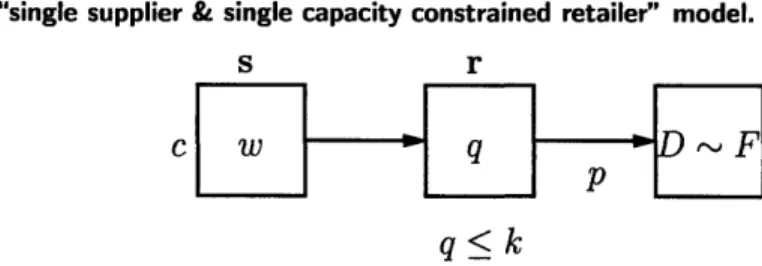
The model's parameters are summarized in Figure 2-1 with the arrows denoting the direction of product flow. In particular, the supplier has a fixed marginal cost of c per unit supplied and charges the retailer a wholesale price w > c per unit ordered. The retailer's price p per unit to the market is fixed, and we assume that
p > w. For that price, the demand D is random with probability density function
(p.d.f.) f and cumulative distribution function (c.d.f.) F. We also define F(x) de=
1 - F(x) = P(D > x). We say that a c.d.f. F has the IGFR property (increasing generalized failure rate), if g(x) def f is weakly increasing on the set of all x for which F(x) > 0 (Lariviere and Porteus 2001). Most distributions used in practice (such as the Normal, the Uniform, the Gamma, and the Weibull distribution) have the IGFR property.
We assume that the retailer's capacity is constrained by some k > 0; for example, the retailer can only hold k units of inventory, or accept a shipment not larger than
k. For a different interpretation, k could represent a constraint on the capacity of the
channel or a budget constraint.
Figure 2-1 "single supplier & single capacity constrained retailer" model.
S r
c
w[
-IJ-
q -D
j
F
qlk
Note. Supplier s with marginal cost c (per unit) offers a product at wholesale price w (per unit) to a capacity-constrained retailer r that faces uncertain demand D downstream, when the price for the product is fixed at p (per unit). The retailer must decide on a quantity q to order from the supplier.
ASSUMPTION 2.1. The probability density function (p.d.f.) f for the demand D has support [0,1], with 1 > k, on which it is positive and continuous.
As a consequence, F(0) = 1 and F is continuously differentiable, strictly decreasing,
and invertible on (0, 1). There is no additional restriction on the value of 1. This is not a restrictive assumption and is made for technical reasons as shown in our proofs.
CHAPTER 2. COORDINATING A CONSTRAINED CHANNEL
2.1.1
Retailer's problem
def
Faced with uncertain sales S(q) = min{q, D} (when ordering q units) and a wholesale price w (from the supplier), the retailer decides on a quantity to order from the supplier in order to maximize expected profit Wr (q) E[pS(q)] - wq while satisfying
the capacity constraint k. Namely, it solves the following convex program with linear constraints in the decision variable, q:
RETAILER(k,w)
maximize pE[S(q)] - wq (2.1)
subject to k-q 0
q> 0.
Because of our assumptions on the c.d.f. F, it can be shown that RETAILER(k,w) has a unique solution which we denote by qr (w).
2.1.2
Channel's problem
def
Denote the channel's expected profit by 7,(q) E[pS(q) - cq]. Under capacity
con-straint k, the optimal order quantity qS for the system/channel is the solution to vex program (2.2), CHANNEL(k). Note that CHANNEL(k) has identical linear con-straints but a slightly altered objective function when compared to RETAILER(k,w):
CHANNEL(k)
maximize pE[S(q)] - cq (2.2)
subject to k -q 0 q > 0.
Again because of our assumptions on the c.d.f. F it can be shown that CHANNEL(k) also has a unique solution which we denote by q". We denote the unique solution, arg maXO<q<oo r(q), for the unconstrained channel problem by q*. It is well known
SECTION 2.2. SET OF COORDINATING WHOLESALE PRICES
that q* = F-l(c/p) (e.g., Cachon and Terwiesch (2006)). Because of convexity, it is
also easily seen that q1 = min{q*, k}.
2.1.3
Definition: Coordinating the retailer's action
A wholesale price contract w coordinates the retailer's ordering decision for the supply channel when it causes the retailer to order the channel-optimal amount, i.e., q'r(w) = qS. In Section 2.2 we are interested in the following questions: For a fixed capacity
k, what is the set of wholesale prices W(k) for which qr(w) = q'? What does this set W(k) resemble geometrically?
If there is no capacity constraint (or equivalently if k is very large), 'double marginalization' results in the retailer not ordering enough (i.e., qr(w) < q') under any wholesale price contract, w > c. In the next section, we will show that when the capacity constraint k is small relative to demand, there exist a set of wholesale price contracts w > c that can coordinate the retailer's order quantity, i.e., qr(w) = qS.
U 2.2 Set of coordinating wholesale prices
Our first result describes the set of coordinating wholesale prices under a capacity constraint.
THEOREM 2.1. In a 1-supplier/I-retailer configuration where the retailer faces a newsvendor problem and has a capacity constraint k, any wholesale price
wE W(k) d[ [c, pPf(min{q*, k})]
will coordinate the retailer's ordering decision for the supply channel, i.e., qr(w) =
qS. Furthermore, if qr(w) = q8 and c < w < p, then w E W(k).
Proof. See Section 2.6.1.
Notice that if the capacity constraint k is larger than or equal to the unconstrained channel's optimal order quantity, q*, then pF(min{q*, k}) = pF(q*) = c, reducing
CHAPTER 2. COORDINATING A CONSTRAINED CHANNEL
when the capacity constraint is not binding for the channel (i.e., q* < k). When the
capacity constraint k is binding for the channel (i.e., q* > k), then any wholesale
price w E [c, pF(k)] will coordinate the retailer's action and only wholesale prices in the range [c, pF(k)] can coordinate the retailer's action.
Many factors such as 'power in the channel', 'outside alternatives', 'inventory risk exposure', and 'competitive environment' ultimately influence the actual wholesale price (selected from the set [c, p]) charged by the supplier. In the unconstrained set-ting, regardless of these factors, coordination is not possible with a linear wholesale price contract (because the supplier presumably would not agree to price at cost). However, when the capacity constraint is binding for the channel, coordination be-comes possible (because the set of coordinating wholesale price contracts bebe-comes
[c, pF(k)] (rather than {c}) and ultimately depends on these other factors.
Theo-rem 2.2 in Section 2.3 considers a equilibrium setting where the retailer takes on all the inventory risk (akin to the 'Stackelberg game' in Lariviere and Porteus (2001) and 'push mode' in Cachon (2004)), and provides additional conditions that must be met so that the 'equilibrium' wholesale price contract is a member of the set of coordinating wholesale price contracts, [c, pF(k)].
2.2.1
Size of W(k).
The geometry of the set of wholesale prices W(k) that coordinate the retailer's deci-sion for the supply channel is depicted in Figure 2-2.
Figure 2-2 The set of wholesale prices that coordinates the actions of a single retailer when procuring from a single supplier.
pF(q*) pF(k)
c p
Note. Note that pF(q*) = c and W(k) = [c, pF(k)] (the interval denoted in bold) when k < q*.
Note that the size of W(k) is increasing as k decreases. Corollary 2.1 formalizes this notion and follows directly from Theorem 2.1 because F(k) is decreasing in k.
SECTION 2.3. EQUILIBRIUM SETTING.
COROLLARY 2.1. If 0 < ki <5 k2, then W(k2)
c
W(ki)c
[c,p].Thus, the more constrained the channel is with respect to the channel optimal order quantity, q*, the larger the set of coordinating wholesale price contracts W(k).
Consider two supply channels selling the same good with the same retail price
p and supplier cost c. Assume that the probability of excess demand in the first
channel is larger, in the sense F1(k) _ F2(k). Let Wi(k) denote the set of coordinating wholesale price contracts for channel i when the channel is constrained by k units. The channel with the higher probability of excess demand has a larger set of coordinating wholesale prices. Corollary 2.2 to Theorem 2.1 makes this precise.
COROLLARY 2.2. Given two demand distributions F1 and F2, if F(k) Ž F2(k) > 0, then
W2(k) 9 Wl(k) c [c,p].
Proof. See Section 2.6.2.
U
2.3 Equilibrium setting.
The equilibrium setting we analyze is a two-stage (Stackelberg) game. In the first stage, the supplier (the 'leader') sets a wholesale price w. In the second stage, the retailer (the 'follower') chooses an optimal response q, given the wholesale price w. The supplier produces and delivers q units before the sales season starts and offers no replenishments. Both the supplier and retailer aim to maximize their own profit. The supplier's payoff function is r, (w; q) = (w - c)q and the retailer's payoff function
is r, (q; w) = E[pS(q) - wq]. Lariviere and Porteus (2001) analyze this Stackelberg
game, for an unconstrained channel with one supplier and one retailer. They find that when F has the IGFR property, the game results in a unique outcome (qe, We) defined implicitly in terms of the equations
pF(qe) (1 - g(qe)) - c = 0, (2.3)
CHAPTER 2. COORDINATING A CONSTRAINED CHANNEL
where g is the generalized failure rate function g(y) d yf(y)/F(y). Furthermore, they show that the outcome is not channel optimal. In this section, and in Section 2.5, we explore the efficiency of the outcome when the channel has a capacity constraint (i.e., q < k).
Theorem 2.2 provides necessary and sufficient conditions on the channel's capacity constraint k for the Stackelberg game to result in a channel-optimal equilibrium.
THEOREM 2.2. Assume F has the IGFR property. Consider the above described
game, when the channel capacity is k units. This game has a unique equilibrium, given by qeq(k) = min{k, qe} and weq(k) = max{pF(k), we}, where qe and we are de-fined by equations (2.3) and (2.4), respectively. This equilibrium is channel optimal if and only if
k < qe. (2.5)
Under this condition, we have qeq = k and weq = pF(k). Proof. See Section 2.6.3.
The function pF(y) (1 - g(y)) - c represents the supplier's marginal profit on the yth unit, when y < k. When F has the IGFR property, the supplier's marginal
profit is decreasing in y, while the marginal profit is nonnegative. This fact and equa-tion (2.3) imply that inequality (2.5) is equivalent to the inequality pF(k) (1 - g(k))-c > 0, whig(k))-ch g(k))-can be interpreted as a statement that the supplier's marginal profit
(when relaxing the capacity constraint) on the kth unit is greater than zero. There-fore, inequality (2.5) suggests that when the capacity constraint is binding for the supplier's problem (the 'leader' in the Stackelberg game), then the outcome of the game is channel optimal and vice-versa.
If the channel capacity k is 'large enough', so that inequality (2.5) is not satis-fied, how inefficient is the channel? In Section 2.5, we provide a distribution-free 'measuring stick' for the efficiency loss in channels with a capacity constraint.
SECTION 2.4. WHEN CAN BOTH PARTIES BE BETTER OFF?
U 2.4 When can both parties be better off?
The set of coordinating wholesale price contracts W(k) introduced in Theorem 2.1 has many merits in a negotiation setting. For example, such contracts are Pareto optimal. In contrast, Theorem 2.3 examines the set of wholesale price contracts D(k) that have little merit in that they are Pareto-dominated by some other wholesale price contract in [c, p]. A contract is Pareto-dominated if there exists an alternative linear wholesale price contract that makes one party better off without making any other party worse off. Having a complete picture of the contracts that are channel-optimal and the contracts that are Pareto-dominated is helpful in a negotiation setting.
THEOREM 2.3. Assume F has the IGFR property and that the quantity qe and
wholesale price we are defined implicitly in terms of equations (2.3) and (2.4). If k < q*, then the set of Pareto-dominated wholesale price contracts 7D(k) is
DZ(k) d= (max{we, pF(k)},p] = (pF(minqqe, k}), p].
Proof. See Section 2.6.4.
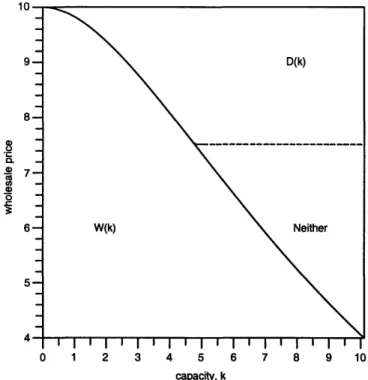
Note that W(k) and 7D(k) are disjoint. Corollary 2.3 to Theorem 2.3 formalizes the idea that when k is 'small enough', W(k) and 7D(k) partition the set [c, p]. Figure 2-3 illustrates these ideas when demand has a Gamma distribution.
COROLLARY 2.3. Assume F has the IGFR property. If k < qe, then
W(k) U D(k) = [c, p], (2.6)
W(k) n D(k) = 0. (2.7)
Corollary 2.3 is especially interesting: it asserts that when capacity is small enough there are only two types of contracts: 'good contracts', W(k), and 'bad contracts',
7D(k). Furthermore, both parties will always have a reason to avoid the 'bad contracts'
34 CHAPTER 2. COORDINATING A CONSTRAINED CHANNEL
Figure 2-3 An example illustrating W(k) and D(k).
Two sets of wholesale prices as a function of capacity: W(k) and D(k)
0._ C. S a0 0, 0 0 1 2 3 4 5 6 7 8 9 10 capacity, k
Note. We use the same parameters as in Figure 3-1, resulting in q* , 10.112, qe s, 4.784, and we :t 7.516. The set of coordinating wholesale price contracts W(k) lies under the solid curve. The set of Pareto-dominated wholesale price contracts 7D(k) lies above both the solid and dashed curves. The set of contracts that lie between the solid and dashed curves are neither in W(k) nor in D(k). Such contracts do not coordinate the channel, but nevertheless, are not Pareto dominated by coordinating wholesale contracts.
U 2.5 Efficiency Loss.
When the outcome of the Stackelberg game we described in Section 2.3 results in a wholesale price contract that is not channel optimal, how much does the channel 'lose' as a result? What is the 'price' paid for the 'gaming' between the supplier and retailer? To quantify the answer we analyze the worst-case efficiency. Our definition of efficiency is related to the concept of Price of Anarchy, "PoA", as used by Koutsou-pias and Papadimitriou (1999), and Papadimitriou (2001). PoA has been used as a 'measuring stick' in an assortment of gaming contexts: facility location (Vetta 2002), traffic networks (Schulz and Moses 2003), resource allocation (Johari and Tsitsiklis 2004). More recently Perakis and Roels (2006) analyze the PoA for an assortment of supply channel configurations with the IGFR restriction, but not for resource con-strained channels. Theorem 2.4 complements their results, by providing an efficiency
SECTION 2.5. EFFICIENCY LOSS.
result for the Stackelberg game of Section 2.3, in the presence of a capacity constraint
k.
For a channel with a capacity constraint k and probability F(k) of excess demand,
we define the parameter 0 def max{F(k),c/p} The parameter 3 depends on the
prob-ability F(k) of excess demand and takes values from the set [1,p/c]. It quantifies how constrained the channel is with respect to the channel optimal order quantity
q*, because de max{Fk),c/p} - max{(k),(q*)} . In the Stackelberg game with a
ca-c/, p
c/p F(q*)
pacity constraint k and parameter
3,
the efficiency, Eff(k,/),
is defined according to equation (2.8) below.Channel profit under 'gaming' E[pS(qeq(k)) - cqeq(k)]
Eff(k,
/3)
= inf = infFe~(k,3)
Optimal channel profit
FE~(k,3) E[pS(qs(k)) - cqs(k)] (2.8) The set F(k,/)
represents the set of probability distributions that satisfy Assump-tion 2.1, have the IGFR property, and such that the probability F(k) of excess demand satisfies `m{(k),c/p = 3. Note that Eff(k,/3)
is a distribution-free method of quanti-fying the worst-case efficiency. When Eff(k,/3)
is low (much smaller than one), there is significant efficiency loss due to 'gaming'.def
THEOREM 2.4. Define m = (p - c)/p (the channel's gross profit margin). For
the Stackelberg game described in Section 2.3, we have
(1
- I + m 1 1 1/mEff(k, = )) (2.9)
Proof. See Section 2.6.5.
Note that Eff(k,
/)
is decreasing in the channel's gross profit margin m and in-creasing in 3. When 3 = 1, the channel is not constrained and Eff(k,/3) equals1 / 1
((1 )1/m _- ) - which, after some algebraic manipulation, matches the result
in Perakis and Roels (2006). On the other hand, when the channel is most constrained (i.e., k - 0, F(k) _ 1, and
/3
p/c), then Eff(k, P) simplifies to 1. In other wordsthere is no efficiency loss because the equilibrium outcome involves the retailer order-ing exactly k. Our result is thus a more general version of the 'two-stage push-mode
CHAPTER 2. COORDINATING A CONSTRAINED CHANNEL
PoA' result in Perakis and Roels (2006) in that we account for a capacity constraint. Also our proof technique differs from and complements Perakis and Roels (2006), in that we indirectly optimize over the space of probability distributions by optimizing over the space of generalized failure rates.
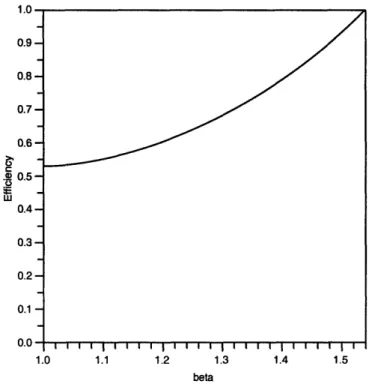
Figure 2-4 An example illustrating Eff(k, 3) when m = 0.35.
.o
w
1.0 1.1 1.2 1.3 1.4 1.5
beta
Note. We fix the margin (p - c)/p = 0.35 and see how Eff(k, ,) changes as a function of 0.
Figure 2-4 provides an example of the Eff(k, 3) when the channel's gross profit margin is 35 percent. Figure 2-4 illustrates that for channels with smaller capacity (i.e., higher 0), the worst-case efficiency (as measured by Eff(k, p3)) is larger.
M
2.6 Proofs
In order to not disrupt the flow of presentation, the proofs for our results in this chapter are contained here.
SECTION 2.6. PROOFS
2.6.1
Proof: 1-supplier/l-retailer, Set of wholesale prices
W(k)
Proof of Theorem 2.1. We start by proving that if w E W(k), then qr(w) = qs.
Suppose first that q* < k. We then have pF(min{q*, k}) = pF(q*) = c.
There-fore, W(k) = {c}. Thus, for any w E W(k), the problems RETAILER(k,w) and CHANNEL(k) are the same and qr(w) = q .
Suppose now that q* > k. We then have q3 = k and, furthermore, pF(min{q*, k}) =
pF(k) > pF(q*) = c. (The strict inequality is obtained because F is strictly
decreas-ing.) Therefore, W(k) = [c, p(k)]. Solving 1 (E[pS(x)] - pf(k)x) = 0 for x E [0, ]
and noting os( ax = F(x), we obtain qr(pF(k)) = k. Since qr(w) is nondecreasing as
we decrease w, we see that for all w E W(k), qr(w) = k = qS.
Suppose now that qT (w) = qs and c < w < p. We have shown that
W(k) = {c},
if q* < k;
[c,pF(k)], if q* > k.When q* < k, the first order conditions imply that pF(qr(w)) - w = 0 = pF(q8 ) - c
for any w > c, which implies w must equal c. When q* > k, we know that qS = k.
Assume w > pF(k) when qr(w) = qS. Due to invertibility around k, qr(w) < k. This
is a contradiction because qs = qr(w) < k. O
2.6.2
Proof: Impact of size of Market on size of W(k)
Proof of Corollary 2.2. Let q* = Fj'(c/p) be the order quantity (for an
uncon-strained channel) under the demand distribution Fi.
If k < q*, then c/p 5< F2(k) • F1(k), which implies that k < q*. Thus, Wi(k) =
[c,p~i(k)] for i 1, 2. Since F2(k) • FI(k), we can conclude that W2(k) C Wl(k) c [c, p].
CHAPTER 2. COORDINATING A CONSTRAINED CHANNEL
2.6.3
Proof: When is the equilibrium of the Stackelberg
game channel optimal?
Proof of Theorem 2.2. The retailer's profit function .r (q; w) under a wholesale
def
price contract w is defined as wr(q; w) d E[pS(q) - wq]. Since ,r(q; w) is concave,
in q, we can use the first order conditions and conclude that for a wholesale price
w E [c, p], the constrained retailer's order quantity qr(w) is given by
qr(w) = min{k, F-'(w/p)}. (2.10)
The supplier's profit function 7,(w; q) under a wholesale price contract w is defined
def
as r, (w; q) = (w - c)q. Since qr(w) is the retailer's best response in the second stage to a wholesale price w by the supplier in the first stage, equation (2.10) allows us to express the supplier's objective function as follows:
S(w) = (w - c)k, if c < w < max{c, pF(k)}; (2.11)
(pF(qr(w)) - c) qr(w), if max{c,pF(k)} < w < p.
For w > max{c,pF(k)}, note that w) = (pF(qr(w)) (1 - g(qr(w))) - c)
Oq (w) Since the function pF(y) (1 - g(y))
-c is stri-ctly de-creasing in y when
it is nonnegative and equals zero at qe (see equation (2.3)), we can deduce that
(pF(qr(w)) (1 - g(qr(w))) - c) > 0 for w > We (because qr(w) < qe). Further-more, w) < 0 for w > pF(k). Therefore, we can conclude that ar(w) < 0 for
w > max{we,pF(k)}.
Either the inequality pF(k) < We holds or the inequality we < pF(k) holds.
First assume the inequality pF(k) < We holds. Equation (2.11) implies that i,(w) is
increasing linearly between c and max{c, pF(k)}. Furthermore, since