HAL Id: tel-01245077
https://tel.archives-ouvertes.fr/tel-01245077
Submitted on 16 Dec 2015HAL is a multi-disciplinary open access
archive for the deposit and dissemination of sci-entific research documents, whether they are pub-lished or not. The documents may come from teaching and research institutions in France or abroad, or from public or private research centers.
L’archive ouverte pluridisciplinaire HAL, est destinée au dépôt et à la diffusion de documents scientifiques de niveau recherche, publiés ou non, émanant des établissements d’enseignement et de recherche français ou étrangers, des laboratoires publics ou privés.
Improving skewed data dissemination in structured
overlays
Maeva Antoine
To cite this version:
Maeva Antoine. Improving skewed data dissemination in structured overlays. Other [cs.OH]. Univer-sité Nice Sophia Antipolis, 2015. English. �NNT : 2015NICE4054�. �tel-01245077�
UNIVERSITÉ NICE SOPHIA ANTIPOLIS École Doctorale STIC
Sciences et Technologies de l’Information et de la Communication
THÈSE
pour l’obtention du grade de
Docteur en Sciences
de l’Université Nice Sophia AntipolisMention Informatique
présentée et soutenue par
Maeva ANTOINE
Improving Skewed Data Dissemination
in Structured Overlays
Thèse dirigée par Éric Madelaine
Soutenue le 23 septembre 2015
Jury
Examinateur Jean-Louis Pazat INSA Rennes
Rapporteurs Esther Pacitti Université de Montpellier 2
Pierre Sens Université de Paris 6
Directeur de thèse Éric Madelaine INRIA Sophia Antipolis
Encadrant scientifique Fabrice Huet Université Nice Sophia Antipolis
iii
Résumé
De nombreux systèmes Pair-à-Pair structurés gérant des données sont confrontés au problème du déséquilibre de charge entre machines. Ce phénomène s’est amplifié avec l’émergence du Big Data où de larges volumes de données, aux valeurs souvent biaisées, sont produits par des sources hétérogènes pour être stockés et/ou analy-sés, souvent en temps réel. Les systèmes doivent donc être capables de s’adapter aux variations de volume/contenu/provenance des données entrantes. Dans cette thèse, nous nous intéressons aux données RDF, un format du Web Sémantique. En partant du constat établi avec notre propre système de stockage RDF, nous proposons une nouvelle approche pour améliorer la répartition des données, basée sur l’utilisation de plusieurs fonctions de hachage préservant l’ordre naturel des données dans le réseau. Cela permet à chaque pair de pouvoir indépendamment modifier la fonction de hachage qu’il applique sur les données afin de réduire l’inter-valle de valeurs dont il est responsable. Ainsi, nous montrons comment différentes fonctions de hachage peuvent être appliquées par différents pairs sans nécessiter que chacun connaisse toutes les fonctions utilisées et tout en maintenant la to-pologie et le routage cohérents. Plus généralement, pour résoudre le problème du déséquilibre de charge, il existe presque autant de stratégies qu’il y a de systèmes différents. En outre, les solutions proposées sont souvent couplées à une API qui leur est propre, ce qui rend difficile le portage d’une solution d’un système à un autre. Dans cette thèse, nous montrons que de nombreux dispositifs d’équilibrage de charge sont constitués des mêmes éléments de base, et que seules la mise en œuvre et l’interconnexion de ces éléments varient. Partant de ce constat, nous dé-crivons les concepts derrière la construction d’une API générique pour appliquer une stratégie d’équilibrage de charge qui est indépendante du reste du code. Puis, nous montrons comment l’API est compatible avec certains systèmes existants et leur solution d’équilibrage de charge. Mise en place sur notre système, l’API a un impact minimal sur le code métier et permet de changer une partie d’une stratégie sans modifier d’autres composants. Nous montrons aussi comment la variation de certains paramètres permet d’obtenir des différences significatives de résultat.
iv
Abstract
Many structured Peer-to-Peer systems for data management face the problem of load imbalance between machines. With the advent of Big Data, large datasets whose values are often highly skewed are produced by heterogeneous sources to be stored and/or analysed, often in real time. Thus, distributed systems must be able to adapt to the variations of size/content/source of the incoming data. In this thesis, we focus on RDF data, a format of the Semantic Web. Based on the observations made on our own distributed platform for RDF data storage, we propose a novel approach to improve data distribution, based on the use of several order-preserving hash functions. This allows an overloaded peer to independently modify its hash function in order to reduce the interval of values it is responsible for. We show how different hash functions can be used by different peers without requiring that each peer knows all the hash functions used in the system, while maintaining the same network topology and the overlay consistent. More generally, to address the load imbalance issue, there exist almost as many load balancing strategies as there are different systems. Besides, the proposed solutions are often coupled to their own API, making it difficult to port a scheme from a system to another. In this thesis, we show that many load balancing schemes are comprised of the same basic elements, and only the implementation and interconnection of these elements vary. Based on this observation, we describe the concepts behind the building of a common API to implement any load balancing strategy independently from the rest of the code. We then show how this API is compatible with famous existing systems and their load balancing scheme. Implemented on our distributed storage system, the API has a minimal impact on the business code and allows to change only a part of a strategy without modifying its other components. We also show how modifying some parameters can lead to significant improvements in terms of results.
Remerciements
Je tiens à remercier mes encadrants de l’équipe SCALE, Françoise Baude, Fabrice Huet et Eric Madelaine, pour leurs enseignements sur le monde de la recherche. Un grand merci également à Laurent Pellegrino, avec qui ce fut un véritable plaisir de travailler et sur qui j’ai toujours pu compter depuis mon arrivée à l’INRIA. Je n’oublie pas non plus mes collègues doctorantes Justine Rochas et Sophie Ge Song avec lesquelles j’ai eu l’occasion de collaborer.
Enfin, merci aux membres du jury, Esther Pacitti, Pierre Sens et Jean-Louis Pazat, d’avoir accepté d’accorder un peu de leur temps à l’évaluation de mes travaux.
Table of Contents
List of Figures xi
List of Listings xiii
List of Tables xv
1 Introduction 1
1.1 Motivation and Problem Definition . . . 1
1.2 Outline and Contributions . . . 3
2 Background 7 2.1 Semantic Web . . . 8
2.1.1 RDF data model . . . 9
2.1.2 SPARQL query language . . . 11
2.2 Peer-to-Peer Systems . . . 13
2.2.1 Overview . . . 13
2.2.2 CAN . . . 14
2.2.3 Chord . . . 17
2.3 The EventCloud RDF Store . . . 19
2.3.1 Architecture . . . 19
2.3.2 Unicode . . . 21
2.3.3 Subscription matching . . . 22
2.3.4 Optimal broadcast algorithm . . . 23
2.4 Other Existing RDF Storage Systems . . . 24
2.4.1 Centralized approaches . . . 26
2.4.2 Distributed approaches . . . 26 vii
viii TABLE OF CONTENTS
2.5 Load Balancing Challenge . . . 28
3 Existing Load Balancing Strategies 31 3.1 Load Balancing in non-P2P Systems . . . 33
3.1.1 NoSQL . . . 33
3.1.2 Stream processing . . . 34
3.1.3 Cloud . . . 35
3.2 Load Balancing in Structured P2P Systems . . . 36
3.2.1 Load balancing for RDF data . . . 37
3.2.2 Virtual servers reassignment . . . 39
3.2.3 Data/Node replication . . . 41
3.2.4 Keys reassignment . . . 45
4 Variable Hash Functions 49 4.1 State of the Art . . . 50
4.1.1 Multiple hash functions for popular items . . . 50
4.1.2 Multiple hash functions for data dissemination . . . 53
4.2 Principles and Interest of our Approach . . . 55
4.2.1 CAN for data storage . . . 57
4.2.2 Skewed data, skewed distribution . . . 59
4.2.3 Variable hash functions for overloaded zones . . . 60
4.3 Hash Function Update Process . . . 64
4.3.1 Update propagation . . . 64
4.3.2 Bound reduction in a torus-like topology . . . 67
4.3.3 Optimal update propagation in a torus-like CAN . . . 68
4.3.4 Concurrency and message filtering . . . 71
4.3.5 Data movement and lookup . . . 73
4.3.6 Main rules . . . 77
4.4 Summary . . . 79
5 Generic API for Load Balancing 81 5.1 Motivation . . . 81
5.2 Load Balancing Differentiators . . . 83
TABLE OF CONTENTS ix
5.3.1 High-level abstractions . . . 88
5.3.2 Core API . . . 89
5.4 Case Studies . . . 92
5.4.1 Big Data management systems . . . 93
5.4.2 P2P systems . . . 94
5.5 Summary . . . 97
6 Load Balancing Implementation and Experiments 99 6.1 Load Balancing Implementation on EventCloud . . . 100
6.1.1 Variations on components . . . 100
6.1.2 Experiments . . . 103
6.2 Experiments on Variable Hash Functions . . . 108
6.2.1 Computing a new hash function . . . 108
6.2.2 Load balancing policies . . . 109
6.2.3 Experiments . . . 114
6.3 Variable Hash Functions on a Chord Ring . . . 125
6.3.1 Concept and specificities . . . 125
6.3.2 Experiments . . . 130 6.4 Summary . . . 132 7 Conclusion 135 7.1 Summary . . . 135 7.2 Perspectives . . . 137 A Version française 141 A.1 Introduction . . . 142
A.1.1 Motivation et Problématique . . . 142
A.1.2 Plan et Contributions . . . 144
A.2 Résumé du contenu de la thèse . . . 146
A.2.1 Fonctions de Hachage Variables . . . 146
A.2.2 API Générique pour l’Equilibrage de Charge . . . 147
A.2.3 Implémentation et Expériences . . . 149
A.3 Conclusion . . . 151
x TABLE OF CONTENTS A.3.2 Perspectives . . . 153
List of Figures
2.1 Presentation vs. Semantics. . . 9
2.2 Example of an RDF graph. . . 11
2.3 Example of a 2-dimensional CAN. . . 15
2.4 Node arrival process in a CAN overlay. . . 15
2.5 Node departure process in a CAN overlay. . . 16
2.6 Example of a Chord overlay. . . 18
2.7 EC architecture. . . 20
2.8 Peers potentially matching with a subscription. . . 23
3.1 Taxonomy of load balancing solutions in P2P systems. . . 37
3.2 HotRoD architecture. . . 43
3.3 NIXMIG approach proposed by Konstantinou et al. . . 47
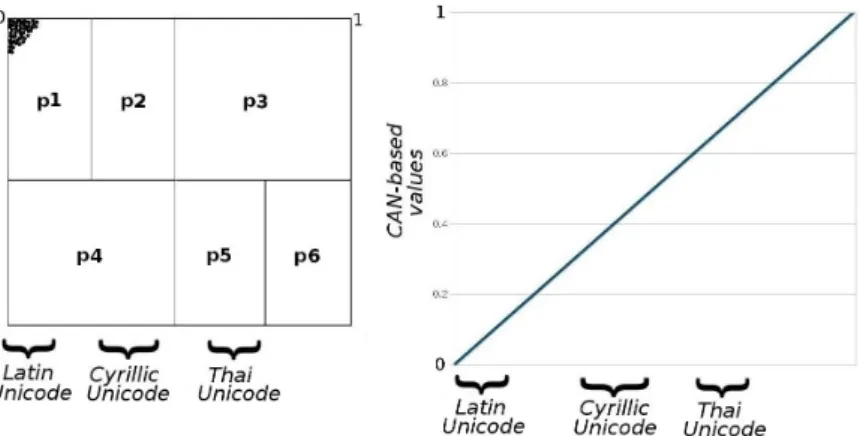
4.1 Standard hash function of a CAN. . . 58
4.2 Default hash function inefficient to disseminate data. . . 59
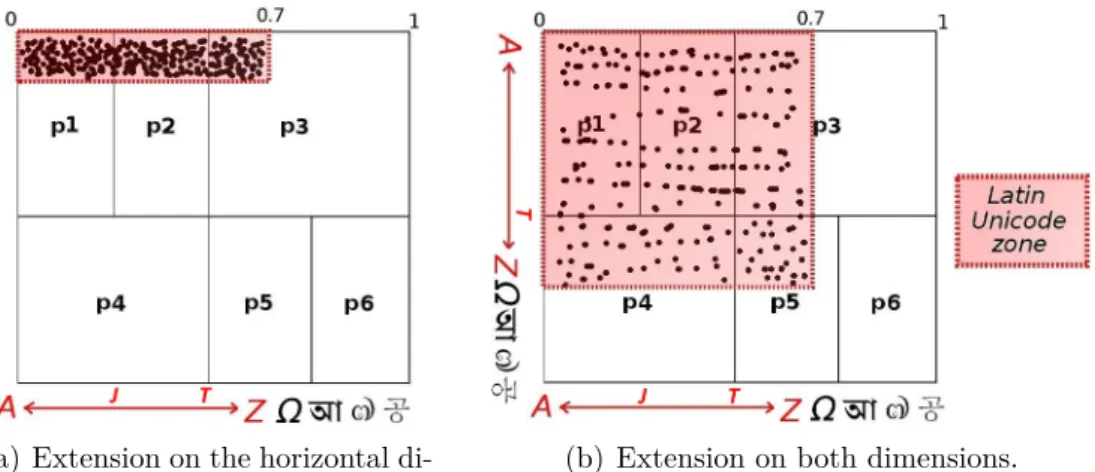
4.3 Enlargement of the area dedicated to Latin data. . . 61
4.4 Hash function associated with an enlarged area for skewed values. . 62
4.5 Successive updates on hash functions. . . 63
4.6 Consequences of not spreading the new Unicode value of a bound. . 66
4.7 Hash function update message routing. . . 67
4.8 Unicode reduction process on the Cmax bound. . . 68
4.9 Inconsistent reductions for the same CAN-based value (0.5). . . 72
4.10 Bound reduction on peers responsible for two Unicode intervals. . . 73
4.11 Propagation of a new Unicode value and consequences. . . 75
4.12 Overall hash function knowledge of a peer. . . 76 xi
xii LIST OF FIGURES
4.13 Possible routing path associated to an item lookup. . . 79
5.1 Basic abstractions for a generic API. . . 88
5.2 Workflow associated with the second scheme proposed by Rao et al. 95 6.1 Middle vs. Centroid split strategies. . . 104
6.2 Load balancing partitioning using middle vs centroid. . . 105
6.3 Middle split strategy unable to move data. . . 106
6.4 Load distribution before and after rebalancing. . . 110
6.5 Threshold-based limit strategy. . . 113
6.6 Load distribution depending on the strategy used. . . 119
6.7 Load distribution (excluding peers storing no data) . . . 121
6.8 Variable hash functions on a Chord overlay. . . 128
List of Listings
2.1 RDF triple example. . . 10
2.2 RDF triple example. . . 10
2.3 Basic SPARQL query example. . . 11
2.4 SPARQL query using the FILTER clause. . . 12
2.5 Subscription example. . . 20
2.6 Event pattern example. . . 20
List of Tables
2.1 Unicode character ranges associated to some alphabets/symbols. . . 22
5.1 Load balancing strategies for Big Data systems. . . 86
5.2 Load balancing strategies for P2P systems. . . 87
6.1 Load balancing strategies comparison in the EC. . . 107
6.2 Data dissemination over peers. . . 118
6.3 Data distribution when using various implementations. . . 124
6.4 Load balancing results for each strategy applied on a Chord ring. . . 131
Chapter 1
Introduction
Contents
1.1 Motivation and Problem Definition . . . . 1 1.2 Outline and Contributions . . . . 3
1.1
Motivation and Problem Definition
Many applications need to integrate data at Web scale to extract information and knowledge. The use of Web data can be related to social networking, media sharing or even business intelligence. Among the new Web 3.0 technologies, the Semantic Web brings meaning to every Web element and provides useful tools for describing knowledge and reasoning on Web data. As the Internet is growing ex-ponentially, more and more data is generated every day, which led to the notion of Big Data, referring to large collections of heterogeneous data produced by various sources. As a result, such data is usually loosely structured and hence the differ-ences of size, popularity or content between resources can vary substantially. For this reason, real world datasets, including those produced on the Web, are known to potentially contain highly skewed values.
With the advent of Big Data, it becomes incredibly difficult to manage realistic datasets on a single machine. To face the incredible amount of information to
2 CHAPTER 1. INTRODUCTION age and capitalize on it, while providing sufficient performance to users in various contexts, many distributed solutions are available, including Peer-to-Peer (P2P) systems, distributed Not only SQL (NoSQL) databases, Cloud computing services or stream processing engines. All these systems represent efficient and scalable solutions for data storage and processing in large distributed environments. The work behind this thesis was strongly motivated by the building in our research team of a P2P-based system for Semantic Web data storage and retrieval, geared towards situational-driven adaptability, taking the form of an event marketplace platform.
This thesis covers some challenges associated with the dissemination of biased data among nodes, which is a growing load imbalance problem for distributed systems. With the emergence of the Semantic Web and Big Data, the storage of items in an order-preserving way has become very frequent to retrieve sets of close values faster from contiguous nodes, which limits the number of hops when solving a query. Consequently, the same subset of nodes is systematically contacted for incoming data/queries, which may overload these nodes. Based on the observa-tions made on our distributed platform, using such architecture and facing this problem of load imbalance, we propose in this thesis a novel approach to improve data distribution among nodes in Structured Overlay Networks (SONs). Our tech-nique preserves the ordering of data and does not require node migration, nor data replication, which are common but costly solutions regarding the update of the overlay topology or the consistency constraints on data. Our contribution aims at dynamically managing load imbalance by allowing different peers to use different hash functions, while maintaining consistency of the overlay. In SONs, the hash function applied by peers to insert or retrieve an item is at the heart of data dis-tribution. However, few load balancing solutions rely on multiple hash functions, and usually these strategies aim at replicating popular data. In our approach, we allow a peer to change its hash function to reduce its load. Since this can be done at runtime, without a priori knowledge regarding data distribution, this provides an efficient and adaptive load balancing mechanism.
1.2. OUTLINE AND CONTRIBUTIONS 3 systems geared towards data dissemination. Imbalances are usually caused by an unfair partitioning of keys/network identifiers, frequent node arrival and depar-ture or heterogeneity in terms of bandwidth, storage and processing capacities between nodes. As the produced data needs increasingly to be analysed/manipu-lated/retrieved in real time by a potentially large number of users, addressing load imbalance is necessary, especially to minimize response time and avoid workload being handled by only one or few nodes. To do so, there exist almost as many load balancing strategies as there are different systems. Besides, the proposed solutions are often coupled to their own API, making it difficult to port a scheme from a system to another. Yet when developing a distributed system, we believe it would be useful to be able to try on different solutions, as it is often not so easy to anticipate which strategy would be the most efficient and suitable for a particular system. In this thesis, we propose to build a common API to implement any load balancing strategy independently from the rest of the code. We show that many load balancing schemes are comprised of the same basic elements, and only the implementation and interconnection of these elements vary. By properly defining these elements and their behavior, an unlimited number of possible load balancing strategies may be conceived and implemented.
1.2
Outline and Contributions
This thesis relates to load balancing in distributed systems for data storage and processing. The contribution is mainly organized into three chapters, which are Chapters 4, 5 and 6. We first present our load balancing strategy using variable hash functions for skewed data dissemination. Then, we propose an API to easily implement any load balancing strategy in a distributed system. Finally, we detail the experiments we performed using this API, in particular to implement our variable hash functions strategy. Overall, this thesis is organized as follows:
• Chapter 2 gives an overview of the concepts covered by this thesis. We first introduce the notion of Semantic Web, with a focus on how to represent and query data. Then, we present the Peer-to-Peer paradigm and its different types of overlays. Finally, we detail the EventCloud architecture, a
Peer-to-4 CHAPTER 1. INTRODUCTION Peer system for Semantic Web data storage and retrieval developed in our research team, which provides the technical basis of this work.
• Chapter 3 presents a state of the art of load balancing solutions for dis-tributed systems for Big Data storage and processing. We describe the main existing techniques to address imbalances regarding workload distribution among nodes. We especially consider P2P systems for storage and retrieval of skewed/popular values and/or preserving the natural ordering of data, to correlate with the architecture and the issues faced by the EventCloud. • Chapter 4 describes the solution we propose to address load imbalances
regarding skewed data distribution in P2P systems preserving the natural ordering of data. As hash functions are at the heart of data distribution for Distributed Hash Table (DHT)-based overlays, we propose the use of several hash functions at the same time in a network, to improve skewed data dissemination. Our goal is to allow an overloaded peer to modify the hash function it applies on data, in order to be responsible for a smaller interval of values and hence store less items. This contribution has been presented at the PDCAT conference in 2014 [1].
• Chapter 5 presents a generic API to implement most existing load balancing strategies for distributed data storage systems. We show how any strategy can be decomposed into criteria and how changing the behavior of these criteria allows to create an unlimited number of different strategies. The API is useful to switch from a strategy to another in a few lines of code, which can be helpful when developing a system, to easily experiment various behaviors. This work was first presented as part of the SBAC-PAD 2014 workshops [2]. A revised and expanded version was then published as a special issue paper in Wiley’s Concurrency and Computation: Practice and
Experience journal in 2015 [3].
• Chapter 6 presents the experiments we performed using our generic API. We show how load balancing was implemented on the EventCloud, as well as the various strategies we tested before eventually choosing the most effi-cient one to disseminate Semantic Web data among peers. Then, we present
1.2. OUTLINE AND CONTRIBUTIONS 5 our simulated experiments in a CAN and a Chord overlay to improve data distribution using variable hash functions.
• Chapter 7 concludes this thesis. It reviews the presented contributions and opens the perspective for some new research initiatives resulting from this work.
Chapter 2
Background: Distributed Systems
for RDF Data Storage and
Retrieval
Contents
2.1 Semantic Web . . . . 8
2.1.1 RDF data model . . . 9 2.1.2 SPARQL query language . . . 11
2.2 Peer-to-Peer Systems . . . . 13
2.2.1 Overview . . . 13 2.2.2 CAN . . . 14
2.2.3 Chord . . . 17
2.3 The EventCloud RDF Store . . . . 19
2.3.1 Architecture . . . 19 2.3.2 Unicode . . . 21 2.3.3 Subscription matching . . . 22 2.3.4 Optimal broadcast algorithm . . . 23
2.4 Other Existing RDF Storage Systems . . . . 24
2.4.1 Centralized approaches . . . 26
8 CHAPTER 2. BACKGROUND
2.4.2 Distributed approaches . . . 26
2.5 Load Balancing Challenge . . . . 28
Over the recent years, our research group has developed the EventCloud (EC)1,
that can be seen as a distributed database for Semantic Web data on an under-lying P2P structure, allowing the continuous injection of large amounts of events and their retrieval. The EC development was originally motivated by the PLAY project2 which aimed at designing a platform that allows for “event-driven
interac-tion in large highly distributed and heterogeneous service systems”. The purpose of this thesis was strongly influenced by the work carried out on the EC.
In this chapter, we first introduce a number of concepts essential to proper understanding of this thesis. Then, we present the EC architecture. Further details about the EC can be found in Laurent Pellegrino’s thesis [5]. Finally, we review the existing solutions to store and retrieve Semantic Web data.
2.1
Semantic Web
The Semantic Web refers to the W3C’s vision of the Web of linked data3,
provid-ing machine-understandable information in order to build a kind of global Web database. As such, the Semantic Web may be seen as a metadata provider to Big Data, as it is meant to add a meaning to large collections of Web resources. Figure 2.1, taken from [6], presents a concrete example of how powerful the Se-mantic Web is. The goal of such concept is to add a meaning (seSe-mantics) to every element that can be found on the Web, and correlate these elements based on their semantics. Ultimately, this is meant to provide new reasoning capacities on these elements. To achieve this, the Semantic Web relies on several well-known Web standards and technologies. As Web data is mostly made of text and these resources are accessed by links, the Semantic Web data is represented by Unicode
1“Event” because, ultimately, data is meant to represent events, and “Cloud” as the system
can be deployed on a Cloud infrastructure. The EventCloud has been deposited at the APP (Agence pour la Protection des Programmes) [4]
2
http://www.play-project.eu
3
2.1. SEMANTIC WEB 9 characters and frequently makes use of IRIs4 pointing to these Web resources.
Figure 2.1 – Presentation vs. Semantics (taken from [6]).
2.1.1
RDF data model
The Resource Description Framework (RDF) [7] is a W3C technology used to represent machine-processable semantic data. RDF provides a powerful abstract data model for structured knowledge representation and is used to describe se-mantic relationships between data. Resources are represented as triples in the form of < subject, predicate, object > expressions. The subject of a triple indicates the resource that the statement is about, the predicate defines a property of the
subject, and the object is the value of the property. An example of a basic RDF
triple is shown in Listing 2.1. It represents a resource about the city of Vienna, with which an abstract is associated. The subject and predicate values are in the form of IRIs because they refer to online resources. These IRIs are made of a prefix, representing the namespace to which the values belong. This triple is taken from one of the DBpedia [8] datasets available online5. DBpedia is one of the most
popular provider of Semantic Web data to date. It is the semantic version of the famous online encyclopedia Wikipedia, and provides datasets containing extracted
4Internationalized Resource Identifier (IRI) is an extension of Uniform Resource Identifier
(URI), created in order to represent any Unicode character, unlike traditional URIs that are restricted to the ASCII characters.
5
10 CHAPTER 2. BACKGROUND information from Wikipedia, to which is added a layer of semantics, offering new reasoning possibilities on such data. Nowadays, more and more organizations ex-tract information from DBpedia to provide their users a new experience when searching for information. A non-exhaustive list of such organizations includes the BBC [9], New York Times6 and Thomson Reuters7.
P R E F I X d b p e d i a : < h t t p :// d b p e d i a . org / r e s o u r c e / >
P R E F I X r d f s : < h t t p :// www . w3 . org / 2 0 0 0 / 0 1 / rdf - s c h e m a # >
T R I P L E : ( d b p e d i a : Vienna , r d f s : a b s t r a c t , " V i e n n a is the c a p i t a l . . . " ) Listing 2.1 – RDF triple example taken from a DBpedia dataset.
The most interesting aspect of RDF lies in its linking structure. Predicate val-ues act as links between resources, and these links bring semantics to data. When processing the two triples of Listing 2.2, a machine should be able to understand that Helen and Elsie are sisters and form a family along with J ohn (i.e. semantic relations). To help machines capture the meaning of a family and the links be-tween siblings, the structure of a family must have been defined beforehand. In the Semantic Web world, this is done in a so-called ontology. An ontology represents a set of knowledge about a particular domain (e.g., medicine, cinema, linguistics) and precises, among others, the interrelationships that exist between things in this domain. Thus, very often, a predicate is defined in an ontology to add a meaning (meta-data) to its value. The most common standards to design an ontology are RDF Schema (RDFS) and Web Ontology Language (OWL).
T R I P L E 1: ( Helen , h a s F a t h e r , J o h n ) T R I P L E 2: ( Elsie , h a s F a t h e r , J o h n )
Listing 2.2 – RDF triple example taken from a DBpedia dataset.
When connected together, triples form a directed graph where arcs are always directed from resources (subjects) to values (objects). The label associated to an arc refers to the predicate value of the triple. For this reason, there exist fewer distinct values of predicates than for the other parts of a triple, as a single predicate
6
http://data.nytimes.com/
7
2.1. SEMANTIC WEB 11 John Helen Elsie hasFather hasFather
Figure 2.2 – Example of an RDF graph for the triples of Listing 2.2. value may be associated n times to n different resources. This low diversity among terms makes RDF data very skewed. To support this claim, the authors of [10] have shown a DBpedia dataset may contain the same popular term in up to 55% of its triples.
A graph built using the triples of Listing 2.2 is depicted in Figure 2.2. Such graphs can potentially extend massively, like social graphs, for instance. A graph may be identified by a value (an IRI) to provide more information on data provenance. In this case, the graph is called a named graph [11]. This explains why the notion of
triple is sometimes replaced by that of quadruple, that is composed of a triple to
which a graph value is associated.
2.1.2
SPARQL query language
1 P R E F I X dc : < h t t p :// p u r l . org / dc / t e r m s / > 2 S E L E C T ? a u t h o r 3 W H E R E { 4 G R A P H ? g { 5 ? b o o k dc : s u b j e c t dc : S c i e n c e . 6 ? b o o k dc : c r e a t o r ? a u t h o r 7 } 8 }
Listing 2.3 – Basic SPARQL query example retrieving all authors of a scientific book.
SPARQL Protocol and RDF Query Language (SPARQL) [12] is a W3C rec-ommendation to query RDF data. This query language is based on the concept of
12 CHAPTER 2. BACKGROUND triple patterns. A triple pattern refers to triple whose values are either constant or variable. Two triple patterns may be linked with each other if they share a common variable. Conjunctions can be performed on triple patterns sharing a common variable in order to join values matching each independent triple pattern. To support quadruples, the notion of triple pattern can be extended to that of
quadruple pattern in order to query for triples present in the same graph or not.
An example of a join query is presented in Listing 2.3. The SPARQL syntax is similar to that of SQL: the SELECT clause returns the variables to retrieve. It is worth mentioning that, in SPARQL, all variables are identified by the “?” character preceding the variable name. The WHERE clause contains all the triple patterns to match against RDF data. In the present case, two triple patterns are joined using the “.” character, hence they are linked together on their common variable ?book. The dc prefix of the constants refer to the Dublin Core [13] namespace, that provides an ontology for describing resources such as publications. Finally, the GRAPH clause identifies the graph to which the values must belong. In our case, they can belong to any graph as a variable (?g) is used to identify the graph. Therefore, the query of Listing 2.3 returns all authors of a scientific book.
1 P R E F I X dc : < h t t p :// p u r l . org / dc / t e r m s / > 2 S E L E C T ? a u t h o r 3 W H E R E { 4 G R A P H ? g { 5 ? b o o k dc : s u b j e c t dc : S c i e n c e . 6 ? b o o k dc : c r e a t o r ? a u t h o r . 7 ? b o o k dc : d a t e C o p y r i g h t e d ? d a t e . 8 F I L T E R (? d a t e >= 2 0 1 2 && ? d a t e < 2 0 1 6 ) 9 } 10 }
Listing 2.4 – SPARQL query using the FILTER clause to retrieve the authors of scientific books copyrighted between 2012 and 2015.
To add more constraints on the results, a FILTER clause may be added to the WHERE clause. It is used to refine the results of a query in order to return
2.2. PEER-TO-PEER SYSTEMS 13 only those that validate the constraints defined in the FILTER clause. Usually, filtering is done on text, numbers or dates. An example of a SPARQL query using the FILTER clause is presented in Listing 2.4. It sets a specific condition for the authors of scientific books: only those that wrote a book copyrighted between 2012 and 2015 will be included in the results.
2.2
Peer-to-Peer Systems
2.2.1
Overview
A P2P system refers to a distributed architecture for applications like file sharing (e.g., BitTorrent [14]), data storage (e.g., Dynamo [15]) or distributed computing (e.g., SETI@home [16]). Unlike the client/server model, each machine (also de-noted as peer or node) can be both client and server. The network is made of interconnected nodes sharing their resources with each other. Among the main benefits of P2P, we can highlight the scalability (new peers can be added to the network to adapt to demand), fault-tolerance (should one peer fail, another one will take over in a transparent way for the user) and a full decentralization (the sys-tem can run without any central coordination). P2P overlays are usually classified into three main categories: unstructured, structured or hierarchical overlays.
Unstructured overlays In these systems, there is no constraint regarding the architecture. The overlay is built with peers joining at random locations, thus creating random links between peers. This offers robustness to frequent peer arrival and departure (also known as churn). Therefore, this is a very simple technique to build a P2P overlay. However, data is also arbitrarily placed on peers, which leads to a more complicated solution when searching for data. The most common technique consists in flooding the whole network to lookup a resource, which results in increased overhead, especially when searching for a very rare resource. Many protocols for file sharing were based on unstructured overlays, like BitTorrent [14] and Gnutella [17].
14 CHAPTER 2. BACKGROUND
Structured overlays In order to address the shortcomings of unstructured over-lays, a new type of overlay was developed: the Structured Overlay Network (SON). Many P2P systems are based on a SON, like Chord [18], CAN [19], Kademlia [20] and Pastry [21]. Such overlays are organized into a geometrical topology (e.g., cube, ring) and usually implement a DHT to distribute and locate data. Each node is assigned a set of identifiers from a common identifier space. A DHT maps data into the identifier space by using a consistent hash function [22] (usually SHA1 or MD5): each data item is associated with a key, and hashing this key provides the coordinate in the identifier space to which this item belongs. Usually, in an overlay, all peers apply the same uniform hash function to place and locate data. Thus, a peer can more easily locate a resource than with unstructured over-lays. To route a lookup query, peers use information they maintain about other peers in the overlay, like their neighbors (the peers they are linked with). This allows to build efficient routing strategies in order to minimize the number of hops to reach the desired resource. However, this implies that peers always maintain a consistent view of the network which may increase the overhead in case of a high churn rate.
Hierarchical overlays These systems exploit properties of both unstructured and structured overlays. Peers are organized into groups and these groups are organized into overlays. A hierarchical architecture is made of several overlays interconnected into a tree-like structure. The different overlays in this hierarchy can use different routing mechanisms. Examples of hierarchical overlays can be found in [23], [24] and [25].
In the following subsections, we introduce two types of structured overlays: CAN and Chord.
2.2.2
CAN
A Content Addressable Network (CAN) network is a decentralized and structured P2P infrastructure that can be represented as a d-dimensional coordinate space containing n peers. Each peer is responsible for the zone it holds in the network
2.2. PEER-TO-PEER SYSTEMS 15 (a set of intervals in this space). All dimensions have a minimum and a maximum CAN-based value Cmin and Cmax (0 and 1 in Figure 2.3). Each peer p owns an
interval [mind
p; maxdp[ delimited by 2 bounds (lower and upper bounds) between Cmin and Cmax on each dimension d. A CAN-based interval is fixed and can only
be modified during join or leave node operations.
Figure 2.3 – Example of a 2-dimensional CAN.
(a) Overlay made of 4 peers. (b) Arrival of a fifth peer that splits with p3.
Figure 2.4 – Node arrival process in a CAN overlay.
Node arrival The join procedure consists in adding a new peer pnew in the
network by splitting in two even surfaces z1 and z2 the randomly chosen zone z of
an existing peer pold. Half of z remains managed by poldin z1, while the other half
(z2) becomes pnew’s zone. As a result, all data items that were included in z2 are
16 CHAPTER 2. BACKGROUND peers holding the zones adjacent to z2 are no longer neighbors of pold but become
the neighbors of pnew. For more clarity, the node arrival process in a CAN overlay
is depicted in Figure 2.4.
(a) Overlay made of 5 peers. (b) After the departure of p5,
p3’s zone gets enlarged.
Figure 2.5 – Node departure process in a CAN overlay.
Node departure Conversely, the leave procedure consists in merging the zone
zleave of the leaving peer pleave with the zone zchosen of one of its neighbors pchosen.
If zleave and zchosen can be merged to create a new valid CAN zone, then pchosen is
definitely selected and both peers start merging. Otherwise, if merging with this chosen neighbor does not work, pleave picks its neighbor with the smallest zone as
the new pchosen. Finally, pchosen hands over pleave’s data items along with pleave’s
neighbors on zleave. The node departure process is depicted in Figure 2.5.
Message routing Each peer can only communicate with its neighbors, thus routing from neighbor to neighbor has to be done in order to reach remote zones in the network. The CAN topology is a torus which means, in Figure 2.3, that peers p1 and p3 are neighbors on the horizontal dimension. CAN provides a DHT abstraction, with resources being indexed on keys. An item it, in a d-dimensional CAN, is associated with a key that is a set of d coordinates (one for each dimension) obtained by applying d uniform hash functions on it. The obtained coordinates correspond to a point in the CAN coordinate space. Thus, when a peer receives a new data item to insert or a query to execute, it has to hash it to check whether it is responsible for it or not. If the hash value does not
2.2. PEER-TO-PEER SYSTEMS 17 match the peer’s CAN coordinates, it means the peer is not responsible for the corresponding item. In this case, the peer chooses a dimension and forwards the item/query on the same dimension until it reaches the correct coordinate for this dimension, then on another dimension and so on until the message reaches the right peer.
2.2.3
Chord
In Chord, nodes are organized in a ring topology. Each node is identified by its
node identifier (obtained by hashing its IP address) and all nodes are ordered in
the circular identifier space according to their node identifier value. The neighbors of a node are its predecessor and successor in the ring.
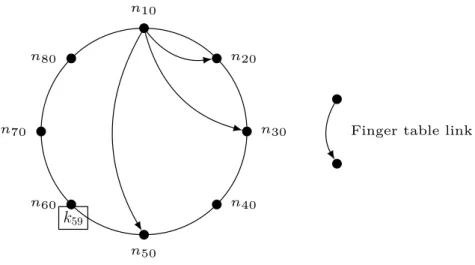
A key identifier is associated to each node and each item. By default, a node’s key identifier corresponds to its node identifier under the consistent hash function used in the overlay. A node is responsible for storing items whose key identifier falls between its predecessor’s key identifier (excluded) and its own key identifier (included). Thus, a key k is stored at the first node after k in the ring order, i.e. successor(k). For example, in Figure 2.6, key k59 is located at node n60.
Chord uses a consistent hash function to distribute key identifiers on peers, that is supposed to naturally balance the load evenly among nodes as each peer should approximately be responsible for the same number of keys.
Message routing In Chord, routing is done in a clockwise direction, i.e. from a peer to its successor. A node n that receives a lookup query for a key k has to evaluate whether k is included in ]keyn; keyn.successor] or not. If so, it means that n’s successor is responsible for k and routing will be stopped when reaching
n.successor. Otherwise, the same process will be executed by n.successor and
so forth until the peer managing k is found. In order to accelerate this routing process, nodes also maintain links in a routing table called finger table that contains the identity (node/key identifier, IP address) of other peers, located possibly far away in the overlay. Thus, when receiving a lookup for k, if n’s successor is not responsible for k, n can pick an entry in its finger table that is closer to k in
18 CHAPTER 2. BACKGROUND n10 n20 n30 n40 n50 n60 n70 n80
Finger table link
k59
Figure 2.6 – Example of a Chord overlay.
the identifier space than n’s successor. The message will be routed to the node corresponding to this finger table entry instead of being routed to n’s successor. For instance, in Figure 2.6, if node n10 is looking for key k59 (stored by n60), it
can send lookup(k59)directly to n50, because n50 is closer to k59 in terms of hops than n10’s successor n20.
Node joins and departures Let us consider two existing nodes n10 and n30,
with n10 being the predecessor node of n30. When a new node n20 arrives in the
overlay between these two peers, n20 becomes the new successor of n10 and the
new predecessor of n30. Thus, n20 becomes responsible for all the keys comprised
between ]n10; n20]. This implies that n20acquires n30’s items whose key is included
in this interval. The reverse process would be applied if n20 decided to leave the
network: the keys and data managed by n20 would be acquired by its successor
n30. In order to maintain up-to-date information about their neighbors and finger
table entries, all nodes periodically run a stabilization protocol. This protocol verifies the correctness of a peer’s links and allows a peer to update its knowledge if necessary, for example after a node has arrived or left.
2.3. THE EVENTCLOUD RDF STORE 19
2.3
The EventCloud RDF Store
The EC is a Java software platform that offers the possibility for services to com-municate in an asynchronous and loosely coupled fashion thanks to the publish-subscribe paradigm but also to store and to retrieve past events in a synchronous manner. The EC enables publish/subscribe interactions by means of its event-driven architecture. Subscribers register their interest in some types of events in order to asynchronously receive the ones that match their concerns. Events are semantically described as a list of quadruples. Quadruples are in the form of <graph, subject, predicate, object > tuples where each element is named an RDF term in the RDF [7] terminology. All quadruples included in the same event are closely related and share the same graph value that identifies the event. Alter-natively, a synchronous mode allows to query for past events that were published earlier and are now stored in the system. The underlying EC architecture is based on a slightly modified version of the CAN [19] P2P infrastructure as described next.
2.3.1
Architecture
An EC is defined with four dimensions to map each RDF term of a quadruple to a dimension of the P2P network. The first dimension is associated to the graph value, the second dimension to the subject value, and so on. The overall EC ar-chitecture is depicted in Figure 2.7. Also, in contrary to the default CAN protocol that makes use of consistent hashing to map data onto nodes, the EC uses the lexicographic order to index data. Thus, a quadruple directly matches a point in a 4-dimensional coordinate space. The lexicographic order helps cluster items sharing similar values from a syntactic point of view, which often means that these values are semantically close as well (e.g., if they share a common prefix). As a result, range queries, for instance, can be resolved with a minimum number of hops. In this way, as we consider an event is made of lexicographically close data, we can expect all of an event’s quadruples to be stored by the same peer or at least in contiguous peers in the CAN. As we consider that a user’s query/subscription is likely to include a set of related information, the use of the lexicographic order
20 CHAPTER 2. BACKGROUND simplifies range queries execution (e.g., when querying for a range of temperatures) and data retrieval (e.g., content related to a city, a football match or even a friend from a social network) by limiting communication between peers when solving a query or matching a publication against a subscription.
Figure 2.7 – EC architecture. For clarity purposes, the graph value axis has been occulted. 1 P R E F I X f o o t : < h t t p :// e x a m p l e . org / f o o t b a l l _ m a t c h e s / > 2 S E L E C T ? e v e n t W H E R E { 3 G R A P H ? g { 4 f o o t : B a r c e l o n a _ v s _ B a y e r n ? o c c u r s ? e v e n t 5 } 6 }
Listing 2.5 – Example of a subscription notifying its subscriber about any event occuring during the match Barcelona vs. Bayern Munich.
E V E N T f o o t b a l l _ g r a p h {
f o o t : B a r c e l o n a _ v s _ B a y e r n f o o t : g o a l S c o r e d f o o t : g o a l 1 2 3 4 . f o o t : g o a l 1 2 3 4 f o o t : s c o r e r p l a y e r : M e s s i .
f o o t : B a r c e l o n a _ v s _ B a y e r n f o o t : c u r r e n t S c o r e ‘ ‘2 -0 ’ ’ }
2.3. THE EVENTCLOUD RDF STORE 21 Listing 2.5 presents an example of subscription to retrieve information about any event (e.g., goals, yellow cards, substitutions) that takes place during the football match Barcelona against Bayern Munich. A subscription takes the form of a SPARQL query made of one or more quadruple patterns (in the present example there is one). An event is made of several quadruples (sharing the same graph value). An example of event for a goal scored by Messi during this match (Barcelona_vs_Bayern) is shown in Listing 2.6. The main advantage of using the lexicographic order is that all of the triples that make up this event will necessarily share identical values on some axis. Obviously, the graph axis is concerned as there is only one value for the whole event, but also potentially other axis such as the subject in Listing 2.6 (Barcelona_vs_Bayern is shared by two quadruples). When using a randomizing hash function, these triples would have been scattered across the network, making it more costly to bring them all together to answer a query/subscription.
2.3.2
Unicode
To support the lexicographic order in the EC, and as RDF data is made of Unicode characters, each CAN bound in the EC is associated with Unicode characters. This allows to define the Unicode values that can be stored between two bounds. A Unicode character is encoded as a 32-bit integer, also known as codepoint, whose value may range from 0 to 10F F F F16 =1114111. To date, the Unicode table of characters includes nearly all of the world’s alphabets, along with symbols like mathematical operators or emoticons. The interested reader can find more infor-mation on these characters on the Unicode Consortium website8.
Table 2.1 provides an overview of the codepoint ranges associated with some of the most used characters worldwide. Latin characters are the first in the Unicode table of characters. For instance, the character “A” corresponds to the codepoint value 65. The basic ASCII subset includes about 100 characters, while East Asian char-acters (Chinese, Japanese, Korean), located farther in the table, occupy a much wider range, representing more than 70000 characters when including extensions9.
8
http://unicode.org/
9An extension refers to a range of codepoints in the Unicode table that usually contains
22 CHAPTER 2. BACKGROUND The fact that Latin characters represent such a small interval of values among the one million characters of the Unicode table makes the distribution of Latin data very skewed when using the lexicographic order. To decrease this impact on dis-tribution, the EC allows to define at startup the lower and upper Unicode bounds of the CAN space. Hence, one may exclude non-Latin characters if the data to be stored is known beforehand.
Script Range Number of
characters
Basic Latin (ASCII) 0000–007F 128
Greek 0370–03FF 144 Cyrillic 0400–04FF 256 Thai 0E00–0E7F 128 Mathematical Operators 2200–22FF 256 Emoticons 1F600–1F64F 80 CJK (Chinese, Japanese, Korean) extension B 20000–2A6D6 42711
Table 2.1 – Unicode character ranges associated to some alphabets/symbols.
2.3.3
Subscription matching
For more clarity, we will consider a simplified subscription S that may be repre-sented as a single quadruple pattern with some wildcards denoted by “?”, such as S=(g, s, p, ?). Indexing this subscription in the EC simply consists in sending
S to all the peers that manage the fixed attributes g, s and p on the first three
dimensions. Unlike some other RDF stores (see Section 2.4.2), publications (i.e. events) are indexed only once. However, a subscription that contains wildcard(s) is indexed on several peers as all the peers on the wildcard(s) axis may potentially match this subscription. Consequently, the number of peers concerned by a sub-scription depends, in part, on the number of fixed attributes of the subsub-scription: the fewer fixed attributes, the more concerned peers there are.
2.3. THE EVENTCLOUD RDF STORE 23 Figure 2.8(c), the subscription S=(s, ?, ?) aims at retrieving all data concerning the specified subject s. To index this subscription on peers that may store such data, S must be sent to peers whose bounds on the subject dimension include s. As no particular value is specified for the predicate and object, the subscription could match with any value and hence there is no constraint regarding the predicate and object intervals of peers. Therefore, many peers may store this subscription as it will be propagated on the whole predicate and object dimensions. The same principles apply when synchronously querying for past events stored by one or more peers [26]. In the standard implementation, each peer owns a Jena TDB [27] component that acts as an RDF storage engine responsible for executing queries and indexing data.
(a) S=(s, p, o): Fixed subject, object and predicate.
(b) S=(s, p, ?): Fixed subject and predicate.
(c) S=(s, ?, ?): Fixed subject. (d) S=(?, ?, ?): No fixed part.
Figure 2.8 – Peers potentially matching with a subscription S, depending on the constant parts in S (taken from [26]).
2.3.4
Optimal broadcast algorithm
To solve queries like those presented in Figure 2.8, the initial peer sending a query cannot know exactly how many peers potentially match the query criteria. Thus, to propagate a query, a naive approach consists in using message flooding through
24 CHAPTER 2. BACKGROUND each peer’s neighbors, which results in duplicate messages sent to peers. Although such messages are ignored, their routing consumes bandwidth and they may over-load peers processing them. In order to reduce the number of messages propagated through the whole network to an absolute minimum, an optimal broadcast algo-rithm for CAN [28] has been implemented in the EC. This algoalgo-rithm is said to be optimal because a peer receives a broadcasted message once and only once. In the EC, this algorithm is also used for other purposes: for example, each peer periodi-cally broadcasts information about its load state, which is useful when performing a load balancing operation.
Algorithm 2.1 presents a simplified version of the optimal broadcast algorithm. The behavior of this algorithm can be summarized as follows: when a peer wants to broadcast a message, this peer selects all its neighbors and forwards them the message if they validate two main constraints (lines 14 and 22). A message is routed on a given direction in the CAN (backwards or forwards, regarding the sender’s location). Initially, the routing process occurs on all dimensions and both directions. Recipients continue routing the message following the same principle, until none of their neighbors can validate the constraints or Cmin/Cmax has been
reached on a routing dimension. If so, the recipient continues routing only on the lower dimension(s), until Cmin/Cmax has been reached on dimension 0 or no
neighbor matches the constraints.
2.4
Other Existing RDF Storage Systems
As the Semantic Web is growing in popularity, there exist more and more RDF storage systems, consisting in either centralized or distributed repositories. A non-exhaustive list of existing solutions includes Relational Database Management Systems (RDBMS), NoSQL stores, structured or unstructured P2P systems. In the following, we briefly describe the main concepts behind each of these solutions.
2.4. OTHER EXISTING RDF STORAGE SYSTEMS 25
1: function route_update_bound_message(msg, dim, direction) 2: if direction = f orwards & maxdimpeer=Cmax then
3: stop routing
4: else if direction = backwards & mindimpeer=Cmin then
5: stop routing
6: else
7: for each neighbor ∈ peer.getNeighbors(dim,direction) do
8: if check_corner_constraint(neighbor, msg)
& check_spatial_constraint(neighbor, msg) then
9: route(msg, neighbor)
10: end if
11: end for each
12: end if
13: end function
14: function check_corner_constraint(neighbor, msg): Boolean 15: for all dim > msg.current_routing_dimension do
16: if mindimneighbor<mindimpeer then
17: return f alse
18: end if
19: end for
20: return true
21: end function
22: function check_spatial_constraint(neighbor, msg): Boolean 23: for all dim < msg.current_routing_dimension do
24: if !(mindimneighbor≤mindimpeer≤maxdimneighbor) then
25: return f alse
26: end if
27: end for
28: return true
29: end function
Algorithm 2.1 – Default optimal broadcast algorithm. In this algorithm, peer refers to the current peer processing the message.
26 CHAPTER 2. BACKGROUND
2.4.1
Centralized approaches
The first solutions for RDF data storage, like Oracle RDF Match [29], Sesame [30] and 3store [31], consisted in converting triples into tuples in order to store them like any other record in an RDBMS. Using this approach, the tables can take different forms. A table can be made of an identity column along with three columns corresponding to each part of a triple. Alternatively, the suject value can be used as the key column of the triple with the other parts corresponding to normal columns. Finally, another approach uses vertical partitioning [32], which corresponds to creating a table for each distinct predicate (as they should be few in number). These tables are made of two columns storing respectively subject and object values. However, the structure of traditional RDBMS was created a long time ago and these systems were not designed to store RDF data. They have no notion of semantics, which may complicate the execution of queries based on an RDF graph model (i.e. how to convert a SPARQL query into SQL). This is why specific databases called native RDF stores, like Jena TDB [27], were created to store and query RDF data. These native RDF stores are similar to RDBMS but use an optimized structure for managing triples and support SPARQL, which should provide better performance regarding their query processing mechanism. However, storing RDF triples generally requires to manage large volumes of data, thus scalability. This is why native RDF stores tend to be deployed on distributed architectures, like the EC that uses a Jena TDB instance on each peer.
2.4.2
Distributed approaches
With the increasing amount of data to process, distributed solutions become more and more popular as they provide scalability and are more reliable than centralized solutions suffering from bottlenecks and a single point of failure.
NoSQL Over the last years has emerged the NoSQL movement. NoSQL databases relax some of the relational and transactional constraints specific to RDBMS (the ACID properties) in order to provide better scalability and fast access to store and retrieve data. Solutions based on NoSQL include key/value-oriented stores (e.g., Apache Cassandra [33]), column-oriented stores (e.g., HBase [34]),
2.4. OTHER EXISTING RDF STORAGE SYSTEMS 27 document-oriented databases (e.g., MongoDB [35]) and graph-oriented stores (e.g., AllegroGraph [36]). Some NoSQL databases use an underlying P2P structure, like Cassandra, which is fully distributed and uses consistent hashing in a Chord-like topology. In Cassandra, rows can embed several levels of nested key-value pairs. In the overlay, rows are assigned to nodes depending on the hashed value of their key: a row r will be located at successor(hash(rkey)).
NoSQL databases can be used to store RDF data. For instance, CumulusRDF [37] is a distributed system for RDF data storage implemented on Cassandra. Cumu-lusRDF uses Cassandra’s features to index triples. A triple is indexed three times according to three different patterns: SP O (i.e. Subject-Predicate-Object), P OS and OSP . This technique is meant to help retrieve triples faster when performing a lookup. For instance, to retrieve data matching the triple pattern (?s, ?p, o), the OSP index should be used as only the object value is defined in the query. For each different index, triples are stored in Cassandra using different nested key-value pairs, for example {o: {s: {p: -}}} with the OSP index, where o is the key for value {s: {p: -}} which is itself a key-value pair, too.
Pure P2P solutions There also exist many RDF stores based on pure P2P solutions. As this thesis mainly focuses on structured P2P overlays, we give below an overview of some existing distributed RDF stores built on top of a structured P2P overlay. An exhaustive review of existing structured P2P storage systems for RDF data can be found in [38]. We will not go into details on RDF stores based on unstructured P2P overlays, like Bibster [39] and S-RDF [40].
Most DHT-based approaches index an RDF triple three times at three different locations by hashing its subject, predicate and object. As all peers use the same hash function to locate data, this eases the retrieval of triples matching a given triple pattern, as presented above for CumulusRDF. Among the existing structured P2P solutions, RDFPeers [41] is a distributed RDF repository built on Multiple Attribute Addressable Network (MAAN) [42], an extension of Chord. In this sys-tem, a triple is stored three times at the following locations: successor(hash(s)),
successor(hash(p)) and successor(hash(o)). RDFPeers benefits from an efficient
range queries resolution thanks to its order-preserving hash function. Another ap-proach, proposed by Battré et al. [43], uses a DHT architecture where each node
28 CHAPTER 2. BACKGROUND owns several RDF repositories. The first one acts as a local database used by a peer to store triples that originate from it. As in most other papers for this topic, peers also disseminate their local triples at three different locations by separately hashing the three parts of a triple. These disseminated triples, when received by the corresponding peer, are stored in a received triples repository. Finally, two other triplestores are maintained by peers: a replica database for fault tolerance and a generated triples database for reasoning on RDF data.
Very few distributed RDF repositories are implemented on a CAN overlay like the EC. RDFCube [44] is one of the closest systems to the EC, from a topological point of view. RDFCube is built on a 3-dimensional CAN (one dimension for each part of a triple) and its coordinate space is split into cells of equal sizes. Each cell contains an existence-flag, indicating if a triple is present or not in that cell. However, RDFCube is not meant to store data. It is an indexation scheme of RDFPeers to speed up the processing of join queries over an RDFPeers repository, by reducing the amount of data that has to be transferred between nodes.
2.5
Load Balancing Challenge
Throughout this section, we have presented the notion of Semantic Web along with technologies to represent and query Web data, namely RDF and SPARQL. RDF data is known to be highly skewed, for several reasons. First, as it is meant to represent Web data, most values are in the form of IRIs and hence potentially many triples may share the same prefix. Secondly, the format representing data as a resource-attribute-value triple (known as subject-predicate-object) necessarily im-plies the redundant use of identical attributes when describing different resources. Finally, RDF is made of Unicode-encoded values, and whereas the Unicode table of characters contains about one million characters, very often only a very small subset of these characters is found in a dataset.
The EventCloud (EC) that has been developed in our research team is a dis-tributed platform for RDF data storage and retrieval. In the EC, data can take the form of events, consisting in several quadruples semantically linked and published together. Based on a CAN overlay, the 4-dimensional architecture of the EC uses
2.5. LOAD BALANCING CHALLENGE 29 the lexicographic order to place data among peers. This choice was motivated by the fact that a randomizing hash function would destroy the syntactic links between RDF quadruples (for example, the quadruples that compose an event) by randomly placing these items in the overlay. Gathering this scattered data may slow down query execution as the users requests very often imply to retrieve sets of related data. On the contrary, when using an order-preserving hash function, syntactically close values can be stored by contiguous peers. Thus, they can be retrieved in a minimum number of hops, which eases range queries execution, for instance.
Due to this architecture, the EC suffers from an important drawback regarding data dissemination among nodes. It is common that a few peers manage most data items, which may overload these peers regarding their storage and/or processing capacities. Even though RDF data is made of Unicode characters, the size of a single quadruple may be greater than one megabyte (e.g., DBpedia), which will inevitably affect the disk space capacity and more generally the performance of the peer managing such data. Regarding the processing capacity, the few peers responsible for managing a large set of skewed data receive most subscriptions and execute most queries. This necessarily has bad consequences, especially on the overall system performance towards the users sending these queries/subscriptions. These reasons naturally led us to implement load balancing in the EC. In the next chapter, we present a state of the art of existing solutions that relate to the challenges faced by the EC, namely the distribution of skewed values and the preservation of the natural ordering of data.
Chapter 3
Existing Load Balancing
Strategies for Distributed Data
Storage
Contents
3.1 Load Balancing in non-P2P Systems . . . . 33
3.1.1 NoSQL . . . 33
3.1.2 Stream processing . . . 34
3.1.3 Cloud . . . 35
3.2 Load Balancing in Structured P2P Systems . . . . 36
3.2.1 Load balancing for RDF data . . . 37
3.2.2 Virtual servers reassignment . . . 39
3.2.3 Data/Node replication . . . 41
3.2.4 Keys reassignment . . . 45
With the advent of Big Data, it becomes incredibly difficult to manage realistic datasets on a single machine. To face the large volume of information to manage and capitalize on it, while providing sufficient performance to users in various contexts, many distributed solutions are available, encompassing P2P systems,
32 CHAPTER 3. EXISTING LOAD BALANCING STRATEGIES distributed NoSQL databases, cloud computing services or stream processing en-gines. However, one key issue with all these distributed systems concerns load balancing, in particular for systems geared towards data storage and retrieval. Some nodes may be overloaded compared to others, regarding various load crite-ria like disk space, CPU or bandwidth consumption. These load imbalances may be caused by one or several factors, including the specifics of a distributed sys-tem and its architecture, differences of capacities between nodes, the variation of the popularity of resources over time, and even the nature of the data being stored.
Current distributed systems for Big Data storage and processing exploit real world datasets and, as presented in the previous chapter, these datasets, like Se-mantic Web data, are known to be highly skewed [10]. The main reason for this lies in the variation of size, popularity and lexicographic similarities among re-sources. Information that is stored, shared or more generally manipulated can come from different sources, be expressed in various languages (world wide data) and be more or less structured using various formats providing reasoning capa-bilities, like RDF [7]. A bad dissemination of skewed datasets can quickly create a bottleneck since a biased data distribution can lead to large workloads sent to very few nodes. Also, as more and more data is produced, often to be processed in real time, it becomes crucial to dynamically adapt the allocation of resources depending on the popularity of data (the so-called “trends”), i.e. the frequency of some terms in the produced datasets or the amount of queries generated for a particular resource. These issues typically correspond to the challenges facing the EventCloud to balance skewed Web data (RDF) using non-randomizing hash functions.
More generally, imbalances in distributed systems may also be caused by an unfair partitioning of network identifiers, frequent node arrival and departure or heterogeneity in terms of bandwidth, storage and processing capacities between nodes. To address all these possible load imbalances, many load balancing strate-gies have been proposed over the last decades, and new stratestrate-gies still continue to appear in the literature as new types of distributed systems arise. However, regardless of the type of distributed system, most existing strategies usually rely
3.1. LOAD BALANCING IN NON-P2P SYSTEMS 33 on similar principles, like node/data relocation, replication, caching or keys reas-signment.
In this chapter, we present the main load balancing solutions for distributed storage systems. We first give a brief overview of those used by well-known non-P2P architectures for Big Data storage and/or processing. Then, we discuss exist-ing solutions used by structured P2P systems in more detail, as they are the main topic of this thesis. We especially focus on load balancing strategies used in the context of skewed/popular data storage and/or maintaining data placement in an order-preserving manner, to remain in the context of the EventCloud architecture.
3.1
Load Balancing in non-P2P Systems for Data
Management
3.1.1
NoSQL
MongoDB
MongoDB [45] is a document-oriented NoSQL database using sharding (horizontal scaling) to distribute datasets across many machines. Sharding consists in split-ting these datasets into chunks to distribute them among several servers (shards). Splitting is performed using either range based or hash based partitioning. A chunk has a maximum size value, and whenever it is exceeded, the chunk gets divided into two chunks. Routing instances (routers) are responsible for routing queries to the right shard and provide results to the user. These routers use metadata in-formation stored by special instances called Config Servers to find the right shard responsible for storing a specific data item. Whenever a shard becomes respon-sible for a chunk, this information is sent to Config Servers in order to keep the database consistent. Routers also embark a balancer process that periodically ac-quires a lock (so that there is no other router trying to rebalance at the same time) and retrieve from Config Servers the number of chunks stored by each shard. A rebalance will occur only if the heaviest shard stores x (migration threshold) more chunks than the lightest shard. If so, the balancer starts migrating chunks from
![Figure 2.1 – Presentation vs. Semantics (taken from [6]).](https://thumb-eu.123doks.com/thumbv2/123doknet/12921496.373379/26.892.205.635.198.445/figure-presentation-vs-semantics-taken.webp)

![Figure 2.8 – Peers potentially matching with a subscription S, depending on the constant parts in S (taken from [26]).](https://thumb-eu.123doks.com/thumbv2/123doknet/12921496.373379/40.892.187.656.468.803/figure-peers-potentially-matching-subscription-depending-constant-parts.webp)
![Figure 3.1 – Taxonomy of load balancing solutions in P2P systems (taken from [50]).](https://thumb-eu.123doks.com/thumbv2/123doknet/12921496.373379/54.892.249.594.194.557/figure-taxonomy-load-balancing-solutions-p-systems-taken.webp)
![Figure 3.2 – HotRoD architecture (taken from [53]).](https://thumb-eu.123doks.com/thumbv2/123doknet/12921496.373379/60.892.215.625.253.489/figure-hotrod-architecture-taken-from.webp)
![Figure 3.3 – NIXMIG approach proposed by Konstantinou et al. (taken from [56]).](https://thumb-eu.123doks.com/thumbv2/123doknet/12921496.373379/64.892.196.644.374.666/figure-nixmig-approach-proposed-by-konstantinou-taken-from.webp)
![Figure 4.1 – Standard hash function of a CAN, that determines Unicode values between [A; Z] to be associated with the CAN bounds of peers on the interval [0; 1].](https://thumb-eu.123doks.com/thumbv2/123doknet/12921496.373379/75.892.316.635.218.501/figure-standard-function-determines-unicode-values-associated-interval.webp)