
HAL Id: tel-01968837
https://tel.archives-ouvertes.fr/tel-01968837v2
Submitted on 20 Feb 2019HAL is a multi-disciplinary open access archive for the deposit and dissemination of sci-entific research documents, whether they are pub-lished or not. The documents may come from teaching and research institutions in France or abroad, or from public or private research centers.
L’archive ouverte pluridisciplinaire HAL, est destinée au dépôt et à la diffusion de documents scientifiques de niveau recherche, publiés ou non, émanant des établissements d’enseignement et de recherche français ou étrangers, des laboratoires publics ou privés.
Combining in-network caching, HTTP adaptive
streaming and multipath to improve video quality of
experience
Vitalii Poliakov
To cite this version:
Vitalii Poliakov. Combining in-network caching, HTTP adaptive streaming and multipath to improve video quality of experience. Networking and Internet Architecture [cs.NI]. Université Côte d’Azur, 2018. English. �NNT : 2018AZUR4203�. �tel-01968837v2�
Amélioration de la Qualité d’Expérience
vidéo en combinant Streaming Adaptif,
Caching Réseau et Multipath
Vitalii POLIAKOV
Université Côte d’Azur, CNRS, I3S
Présentée en vue de l’obtention du grade de docteur en Informatique d’Université Côte d’Azur
Dirigée par : Dr. Lucile Sassatelli Dr. Damien Saucez
Soutenue le : 11 décembre 2018
Devant le jury, composé de :
Prof. César Viho……….Examinateur, Président du jury, Université de Rennes I
Prof. Rachid El-Azouzi..Rapporteur, Université d’Avignon et Pays de Vaucluse
Prof. Stefano Secci……..Rapporteur, CNAM
Dr. Jérémie Leguay……Invité, Huawei Research France Dr. Paolo Medagliani….Invité, Huawei Research France Dr. Lucile Sassatelli…....Directrice de thèse, Université
Côte d’Azur, CNRS, I3S Dr. Damien Saucez…….Co-encadrant, Université Côte
d’Azur, INRIA Méditerranée
Combining in-network caching, HTTP
Adaptive Streaming and Multipath to
improve video Quality Of Experience
Vitalii Poliakov
Université Côte d’Azur, CNRS, I3S
This dissertation is submitted for the degree of
Doctor of Philosophy
Abstract
Volume of video traffic has grown considerably in recent years: Cisco has predicted that its share in the Internet will attain 81% by 2021, doubling its net traffic volume as compared to 2016. Such an abrupt increase in video traffic is pushing the capabilities of Internet Service Providers’ networks (ISPs) to their limits, which results in their overutilisation and, consequently, decreased users’ Quality of Experience (QoE) of video sessions.
This thesis attempts to tackle the problem of improving users’ video QoE without relying on ISPs to upgrade their networks. To achieve this, we have chosen to combine such technologies as in-network caching, HTTP Adaptive Streaming (HAS), and multipath data transport. We start with exploration of interaction between HAS and caching. We design an optimal boundary for performance of a HAS quality adaptation algorithm, and compare it to the performance of Rate-Based, Buffer-Based, and state-of-the-art optimisation-based algorithm called Fast MPC. We confirm the benefits of achieving cache-awareness in quality adaptation when operating in a presence of proxy cache, and propose such an extension to Fast MPC.
Concluding on the difficulty of achieving cache-awareness, we take a step back to study a video delivery system on a large scale, where in-network caches are represented by Content Delivery Networks (CDNs). They deploy caches inside ISPs and dispose of their own outside video servers. As a novelty, we consider users to have a simultaneous multipath connectivity to several ISP networks. We anticipate, however, that in-network caches cannot be accessed with multipath as they are not accessible from outside networks. This brings two new operational points to the system: video clients can either access outside multipath servers with aggregate bandwidth (which may increase their QoE, but will also bring more traffic into ISP), or stream their content from a closer cache through only single connectivity (bringing less traffic into ISP). This potential disagreement in ISP and CDN objectives leads to suboptimal system performance, which we identify by modelling an optimal boundary for joint ISP – CP performance. In response to this, we develop two collaboration schemes between two actors, performance of which can approach optimal boundary for our settings, and discuss its practical implementation.
iv
Keywords–Internet video streaming, HTTP Adaptive Streaming, Caching, Multipath, Quality of Experience, Content Delivery Network, Linear optimisation
Résumé
Le volume de trafic vidéo s’est considérablement accru pendant ces dernières années: selon Cisco, sa part dans l’Internet atteindra 81% d’ici 2021, soit le double du volume de son trafic net par rapport à 2016. Cette augmentation aussi importante du trafic vidéo repousse les capacités des réseaux des Fournisseurs de Access Internet (FAI), ce qui entraîne leur surutilisation et, par conséquent, la dégradation de la Qualité d’Expérience (QoE) vidéo perçu par leurs utilisateurs.
Cette thèse tente de résoudre le problème de l’amélioration de la QoE vidéo des utilisa-teurs sans compter sur les FAI pour mettre à niveau leurs réseaux. Pour ce faire, nous avons choisi de combiner des technologies telles que la mise en cache (Caching), le streaming adap-tatif HTTP (HAS) et le transport de données Multipath. Nous commençons par l’exploration de l’interaction entre HAS et le Caching. Nous concevons une limite optimale pour la performance d’un algorithme d’adaptation de la qualité pour la HAS et la comparons à la performance de l’algorithmes basés de débit, de buffer, et à la pointe de l’optimisation appelé Fast MPC. Nous confirmons les avantages de la reconnaissance du cache dans l’adaptation de la qualité lors de l’utilisation d’un cache proxy et proposons une telle extension à Fast MPC.
Concluant sur la difficulté de la reconnaissance de la cache, nous prenons un pas en arrière pour étudier un système de diffusion vidéo à grande échelle, où les caches en réseau sont représentés par des réseaux de distribution de contenu (Content Delivery Networks, CDN). Ils déploient des caches à l’intérieur des réseaux des FAI et disposent de leurs propres serveurs vidéo externes. Comme nouveauté, nous considérons que les utilisateurs disposent d’une connectivité multi-accès simultanée vers plusieurs réseaux de FAI. Nous prévoyons toutefois que l’accès aux caches dans le réseau ne soit pas possible par Multipath, car ils ne sont pas accessibles depuis des réseaux extérieurs. Cela apporte deux nouveaux régimes opérationnels au système: les clients vidéo peuvent accéder aux serveurs Multipath extérieurs avec une bande passante agrégée (ce qui peut augmenter leur QoE, mais apportera également plus de trafic au FAI), ou diffuser leur contenu à partir d’un cache plus étroit via une seule connexion (apportant moins de trafic dans FAI). Ce désaccord potentiel dans les objectifs FAI et CDN conduit à des performances système non optimales, que nous identifions en
vi
modélisant une limite optimale pour les performances FAI – CP conjointes. En réponse à cela, nous développons deux schémas de collaboration entre deux acteurs, dont les performances peuvent s’approcher des limites optimales pour nos paramètres, et nous discutons de sa mise en oeuvre pratique.
Keywords–Diffusion vidéo sur Internet, HTTP Adaptive Streaming, Caching, Multipath, Qualité d’Experience, Réseau de diffusion de contenu, Optimisation linéaire
Acknowledgements
Indeed, the first and foremost acknowledgement goes to my supervisors: Lucile Sassatelli and Damien Saucez. Indeed, I would not be able to finish the presented PhD project without their support and input, but instead I would like to express my gratitude for the efforts, time and devotion they have put to make me a better researcher. The path ahead is long and winding, but their advising have for sure made myself a better thinker (not for me to judge by how much though). Their radically different outlook on the domain had certainly not made my time easier, but in return it granted me with a wider understanding of internetworking research and differences in the ways to tackle it. I will never forget the unending patience of Lucile in the process of my (often slow) general and mathematical training, nor the hours-long discussions with Damien on most different subjects that always carried some useful message. I thank you for this.
Karyna, my love, has been an indissociable part of my time as a doctoral student. I went all this path holding hands with her, receiving her support and growing together with her. I can’t thank her enough for helping me keep my mind intact in the finishing months of my thesis, when the nights were the most dark and full of terrors. See you on the other side!
I should thank all the folks at I3S and INRIA, both permanent and not, both graduated and present. I had interesting discussions with many of you, and being a part of these two labs have helped to make my three years bright and amusing.
I’d like also to say thanks to Prof. Eric Rondeau and Dr. Jean-Philippe Georges, whose eventual decision to respond to my several days-late message have ultimately given me an opportunity to behold the incomprehensible beauty of an arbutus tree.
This thesis marks the end of my studentship, which happened to be quite long. Numerous people have taken part in shaping my skills and personality over all these years (for good or bad), but the most important of those are my parents and relatives. They are in most part responsible in letting me see this day alive and become the person I am today, and there will never be a word good enough to express my recognition of this.
Vitalii Poliakov, 10 Dec 2018
Table of contents
List of figures xiii
List of tables xvii
1 Introduction and background 1
1.1 Evolution of Internet video streaming . . . 7
1.1.1 Early days of video streaming . . . 7
1.1.2 Video streaming becomes viable . . . 12
1.1.3 Modern day video streaming . . . 18
2 HAS quality adaptation and caching 31 2.1 Theoretical performance boundary under cache presence . . . 34
2.2 Performance of an optimal quality selection and comparison with commonly-implemented algorithms . . . 37
2.3 Model Predictive Control as a technique to implement optimal quality adap-tation algorithms . . . 43
2.3.1 Background on MPC . . . 43
2.3.2 MPC in presence of a cache . . . 44
2.4 The need for cache-awareness in MPC-based algorithm . . . 46
2.5 Evaluation of cache-aware MPC-based algorithm . . . 47
2.5.1 Simulation settings . . . 47
2.5.2 Observed metrics . . . 49
2.5.3 Cache-aware predictor evaluation . . . 50
2.5.4 Sensitivity analysis . . . 52
2.5.5 Practical issues of achieving cache-awareness . . . 53
2.6 Conclusion . . . 54
3 The interplay of multipath and caching 57 3.1 Decision modelling for system’s actors . . . 62
x Table of contents
3.1.1 Content Provider . . . 62
3.1.2 Internet Service Providers . . . 65
3.1.3 Clients . . . 67
3.2 Multipath and caching: balancing between video bitrate and ISP congestion 67 3.3 Theoretical limit for collaboration between ISP and CP . . . 72
3.4 Performance of today’s video delivery system against theoretical boundary . 76 3.4.1 Impact of choosing a greedy formulation . . . 78
3.4.2 Observations on instantaneous behaviour of considered relation strategies . . . 80
3.4.3 Performance of Full-collaboration Pareto front as compared to other relation strategies . . . 81
3.5 Conclusion . . . 83
4 Collaboration schemes between CDN and ISP for better quality-congestion tradeoffs 87 4.1 Design of collaboration schemes between ISP and CP . . . 90
4.1.1 Giving the ISP power to refuse CP’s subflow establishment choices 90 4.1.2 Giving the CP visibility over ISP decisions: an active collaboration scheme . . . 94
4.1.3 Discussion on the real-world implementation of collaboration . . . 103
4.2 Experimenting with ISP-CP collaboration . . . 105
4.2.1 Performance of collaboration schemes at base settings . . . 108
4.2.2 Sensitivity analysis . . . 113
4.2.3 Reducing CP’s bandwidth estimation re-initialisation timeout . . . 119
4.3 Discussion . . . 122
5 Conclusions and future work 127 5.1 Conclusions . . . 127
5.2 Future work . . . 129
Appendix A An ns-3 distribution supporting MPTCP and MPEG-DASH obtained by merging community models 131 A.1 Selecting models for Multipath and MPEG-DASH . . . 132
A.2 Putting MPTCP and MPEG-DASH together . . . 132
A.2.1 Modifications for MPTCP . . . 133
A.2.2 Modifications for AMuSt-DASH . . . 134
Table of contents xi
A.4 Conclusion . . . 135
Appendix B Traductions Françaises 137 B.1 Introduction . . . 137 B.2 Résumé du Chapitre 2 . . . 144 B.3 Résumé du Chapitre 3 . . . 145 B.4 Résumé du Chapitre 4 . . . 146 B.5 Conclusion . . . 148 B.6 Travail futur . . . 150 References 153
List of figures
1.1 Visual presentation of a CDN . . . 25
1.2 Video delivery in HTTP Adaptive Streaming . . . 28
2.1 Reference environment . . . 32
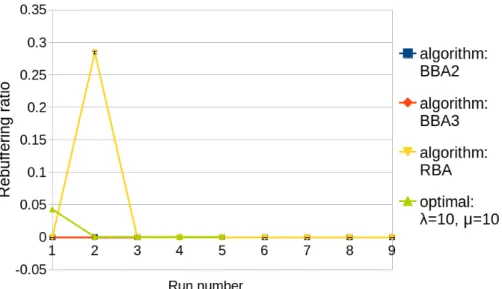
2.2 Comparison of RBA and BBAs to the optimal policy for average video bitrate, for all condecutive clients runs. . . 39
2.3 Comparison of RBA and BBAs to the optimal policy for stall ratio, for all condecutive clients runs. . . 39
2.4 Comparison of RBA and BBAs to the optimal policy for quality instability, for all condecutive clients runs. . . 40
2.5 Reference environment . . . 41
2.6 Comparison of RBA and BBAs to the optimal policy for average video bitrate. 41 2.7 Comparison of RBA and BBAs to the optimal policy for stall ratio. . . 42
2.8 Comparison of RBA and BBAs to the optimal policy for quality instability. 42 2.9 MPC performance depending on cache presence and cache-awareness for average video quality. . . 45
2.10 MPC performance depending on cache presence and cache-awareness for stall ratio. . . 45
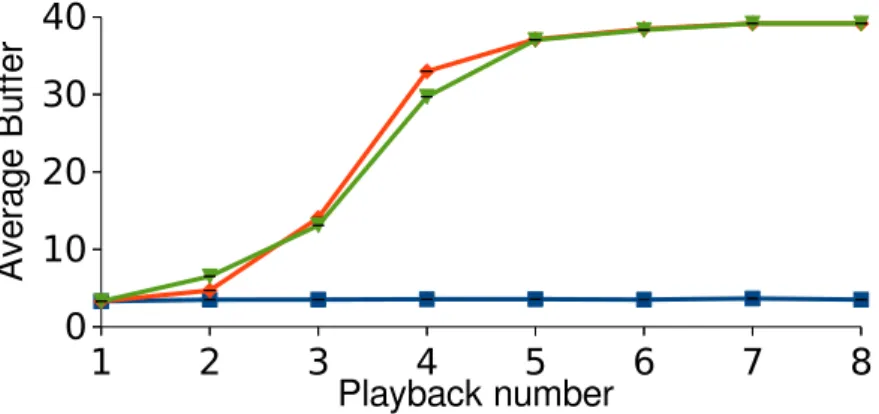
2.11 MPC performance depending on cache presence and cache-awareness for average buffer level. . . 45
2.12 Relative advantage of cache-aware MPC to cache-unaware MPC in a pres-ence of a cache, for referpres-ence parameters . . . 50
2.13 Total stall time over runs for sv connectivity configuration and reference maximum buffer, look-ahead window and weights . . . 51
2.14 Sensitivity to maximum buffer capacity . . . 51
2.15 Sensitivity to look-ahead window length . . . 51
xiv List of figures
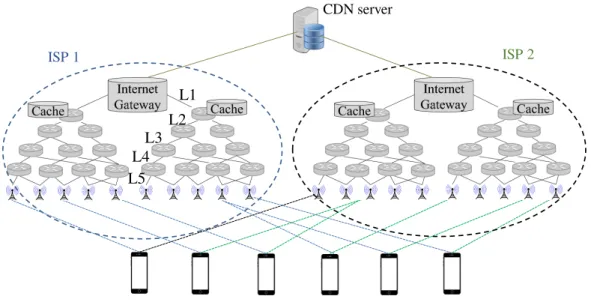
3.1 Clients connected to two access networks, with in-network caches and the external CDN server. “L1”, “L2” and so on indicate the ISP topology level. 59 3.2 Users’ duration of viewing in the incoming workload . . . 70 3.3 Average request bitrate vs request acceptance rate. . . 71 3.4 ISP congestion. Different components of the bars represent the share of total
congestion taking place on an indicated topology level (as designated on Fig. 3.1). . . 71 3.5 Box plots for achieved request bitrate at low load with caches. . . 72 3.6 Box plots for achieved request bitrate at high load with caches. . . 72 3.7 Time series of studied system metrics for requests of 4, 15 and 60 minutes
minutes long. . . 79 3.8 Time series of studied system metrics for requests of 2 minutes long. All
CP – ISP relation strategies are considered with multipath enabled . . . 81 3.9 Performance of different strategies as compared to themselves and the
theo-retical boundary (Full-collaboration) at base settings, 2 minutes long requests. Confidence intervals in both dimensions are shown as ellipses around respec-tive points . . . 82 3.10 Average fraction of requests obtaining maximum video rate, for different
strategies (taking into account available access link bandwidth), 2 minutes long requests . . . 83 3.11 Average fraction of requests obtaining video rate higher than without
multi-path minus fraction of requests obtaining a rate lower than without multimulti-path, for different strategies, 2 minute long requests . . . 84 4.1 Clients connected to two access networks, with in-network caches and the
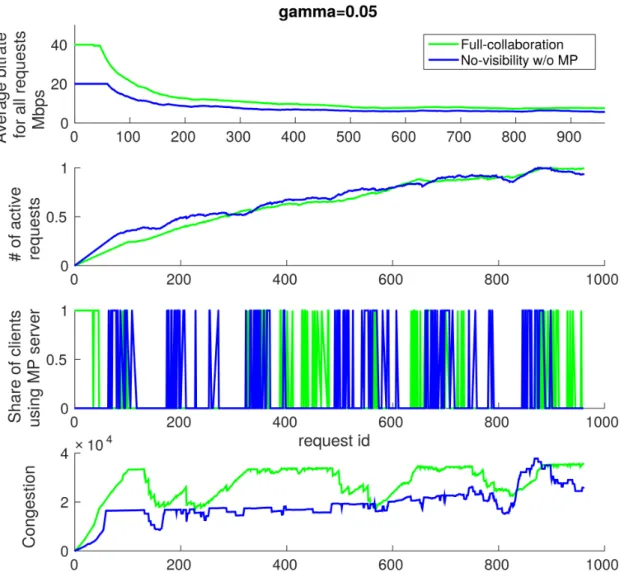
external CDN server. “L1”, “L2” and so on indicate the ISP topology level. 106 4.2 Base experiment with requests of 2 minutes long: Evolution of system’s
metrics over time. . . 109 4.3 Performance of different strategies as compared to themselves and the
theo-retical boundary (full-collaboration) at base settings, 2 minutes long requests. Confidence intervals in both dimensions are shown as ellipses around respec-tive points. . . 110 4.4 Average fraction of requests obtaining maximum video rate, for different
strategies at base settings (taking into account available access link band-width), 2 minutes long requests . . . 111
List of figures xv
4.5 Average fraction of requests obtaining video rate higher than without multi-path minus fraction of requests obtaining a rate lower than without multimulti-path, for different strategies at base settings, 2 minute long requests . . . 112 4.6 Case of varying maximum video bitrate: Evolution of system’s metrics over
time. . . 114 4.7 Performance of different strategies as compared to themselves and the
theo-retical boundary (full-collaboration) with varying maximum video bitrate, 2 minutes long requests. . . 115 4.8 Case of varying access connectivity capacity: Evolution of system’s metrics
over time. . . 116 4.9 Performance of different strategies as compared to themselves and the
theoret-ical boundary (full-collaboration) with varying access connectivity capacity, 2 minutes long requests. . . 117 4.10 Case of varying maximum video bitrate and access capacity: Evolution of
system’s metrics over time. . . 118 4.11 Performance of different strategies as compared to themselves and the
the-oretical boundary (full-collaboration) with varying maximum video bitrate andaccess connectivity capacity, 2 minutes long requests. . . 119 4.12 Case of increased bandwidth estimation timeout at CP: Evolution of system’s
metrics over time, at base settings. . . 120 4.13 Performance of different strategies as compared to themselves and the
theo-retical boundary (full-collaboration) at base settings but with CP’s bandwidth estimation re-initialisation happening every 1000 seconds, 2 minutes long requests. . . 121 4.14 Comparison of Collaboration-light and Collaboraton-extended in case of
variable maximum video quality and access capacity: Evolution of system’s metrics over time. . . 124 B.1 Clients connected to two access networks, with in-network caches and the
external CDN server. “L1”, “L2” and so on indicate the ISP topology level. 145 B.2 Performance of different strategies as compared to themselves and the
theo-retical boundary (full-collaboration) at base settings, 2 minutes long requests. Confidence intervals in both dimensions are shown as ellipses around respec-tive points. . . 147
List of tables
3.1 CP problem Input Parameters . . . 63
3.2 CP problem Decision variables . . . 63
3.3 ISP problem Input Parameters . . . 65
3.4 ISP problem Decision variables . . . 66
3.5 Full-Visibility CP problem Input Parameters . . . 73
3.6 Full-Visibility CP problem Decision Variables . . . 73
3.7 Perfect joint optimisation Input Parameters . . . 76
3.8 Perfect joint optimisation Decision Variables . . . 76
4.1 Collaboration-light Input Parameters . . . 92
Chapter 1
Introduction and background
Ever since computer networking left comfortable and well-controlled confines of university research, the battle between Internet Service Providers (ISPs) and increasing user demands has been taking place in all its ferociousness. Since the very beginning, the answer to increased bandwidth demand has been to over-provision ISP networks. This race has been one of the main driving force behind advancements in data transport technologies for local, metropolitan, and wide-area networks. However, two main factors make such an approach insufficient to meet users’ expectations already today.
First, proliferation of broadband internet access in the 2000s and emergence of Internet video platforms (most notably, Youtube and online Video-on-Demand providers) has brought a manyfold increase in video demands. Being a very bandwidth-consuming kind of appli-cation, together with unprecedented demand volumes, video traffic is forecasted by Cisco to represent 82% of all Internet traffic by 2021 up from already observed 60% in 2016 [35]. This is not a limit: a very recent proliferation of devices supporting viewing and creation of Ultra High Definition (4096+ lines) video content with elevated framerates (60+ frames per second) and Virtual Reality applications suggest that video traffic volumes today are far from being on their peak: for instance, the same Cisco report [35] predicts 20-fold increase in VR (virtual reality) and AR (augmented reality) traffic by 2021.
Second, the amount of Internet users does not yet seem to have attained its limit. Only about half of Earth population has continuous access to Internet today (4.2 billion persons, according to Internet World Stats1), mostly living in developed or actively developing countries. Internet connectivity becoming a commodity nowadays, we can, perhaps, expect the rest of human population to become connected in coming (though maybe not nearest) years. In addition to that, report [20] suggests that the number of Internet-capable devices
2 Introduction and background
per capita will increase up to 3.5 by 2021, being a consequence of Internet of Things industry development.
These two factors demonstrate how the future of Internet demand may become too overwhelming for both ISPs and technological advancements in telecoms they rely on. In the shed of this perspective, a part of today’s internetworking research is attempting to tackle the coming challenges by improving efficiency of infrastructure utilisation, rather than by increasing its capacity, especially in the domain of Internet video.
One of the basic techniques to decrease the volume of video traffic circulating in the networks is in-network caching [97, 163, 120]. Though mainly developed as a solution to improve client’s access latency to web-services, the idea of storing content close to the user has proven to have a potential in the video delivery domain. Quite often, network topologies are designed with larger capacity close to the user [25, 37]. Placing a cache in the closer-to-user, well-provisioned part of the network may help ISP to avoid transporting video (and other) traffic through its entire backhaul network multiple times – but, instead, to carry it only once and then stream from the cache for other interested users. Research in the area of caching has got boosted recently with introduction of Mobile Edge Computing (MEC [17, 56]) and Edge Caching [94]. In the context of video delivery, these ideas stress upon an opportunity to use network edge (mainly wireless) to cache video content and to perform transcoding in order to reduce the amounts of video traffic in the backhaul and above.
Until recently, there existed no specific standard for Internet video transmission and its functionality, in particular, quality adaptation and ability to be cached. Real Time Protocol (RTP [140]) and its family was designed to facilitate streaming of multimedia content in best-effort networks. This includes Multicast delivery, flow monitoring, media payload identification and sequence timestamping. However, being an OSI protocol, RTP did not address content storage format or its quality adaptation. HTTP could also be used to transport media, though treating it as regular web-content. Range-requests headers could be used to have a limited control over video playback. Not only this was complicating the task of video caching (with objects being too large or too unique, like in range-request byte ranges that can be different for every individual user), but it also made quality adaptation rather complex. The emergence of the concept of HTTP Adaptive Streaming [122, das] has given a significant advance towards solving these two tasks. With video files being transmitted by HTTP and stored in pre-defined segments (also called chunks) that are the same for everybody within the service, it finally became possible to easily (even transparently) cache video content with high hit-rates and to switch video qualities on-the-fly without complicated calculations of byte ranges. An indissociable part of HAS is its quality adaptation algorithm; having started
3
with simple downlink bitrate estimations (Rate-Based algorithm), research in this direction made quite a long way to even exploiting machine learning for quality selection [102].
With development of multipath data transport (such as MPTCP [15]) and emerging concept of Multi-RAT [27], a new perspective on serving heavy content to the clients have opened. Originally, multipath transport has been meant mainly for resiliency [90, 137]; our consideration is to use multipath bandwidth aggregation so as to improve clients’ connectivity. Today, even with all the recent advancements in mobile radio technologies, average LTE downlink bandwidth is less than 15 Mbps in many developed countries (e.g., 13.4 Mbps in France and 12.3 Mbps in USA [fra]), which gives no room for future video applications as described above [3]. Even the advent of 5G mostly promises improvements in radio-access bandwidth for users, though observing the LTE figures just above can make one wonder if the promise of 1 Gbps downlink rate would hold in real environment with typical consumer devices. Since mobile video consumption becomes more and more prevalent, developing a solution to alleviate slow (on average) mobile connectivity becomes an important endeavour. MPTCP gives an opportunity to use several wireless connectivities (for instance, Wi-Fi and LTE) simultaneously as to obtain a higher aggregate connectivity bandwidth which may help in serving demanding video applications.
Different to technological advancements in Internet video delivery referenced above, the concept of Quality of Experience (QoE [111, 130, 157]) is helping researchers to measure and quantify the improvements in the domain of video delivery (among others). As opposed to the concept of Quality of Service (QoS), low latency or high bandwidth might not always result in good user experience [75]. Instead, subjective assessment, like Mean Opinion Score (MOS [129, 154]), or application-level video metrics, like duration of stalls or video frame Peak Signal-to-Noise-Ratio (PSNR), can be used to assess exact user experience. Direct focus on the latter, therefore, provides a good base to design and test novel video delivery techniques.
This thesis presents a work on the intersection of these technologies (in-network caching, HAS, multipath transport), with a goal of improving Quality of Experience in video applications in the shed of the mentioned future challenges. We consider caching to be the enabler in reducing video traffic volume in ISP networks, while HAS is the key to provide video users with as much QoE as possible given the changing level of QoS in best-effort networks. Multipath transport, in its turn, is expected to allow consumption of very high bitrate video types. Using them altogether to achieve our goal, however, has proven to not be straightforward. The problems and contributions of this thesis are outlined as following:
4 Introduction and background
• It has been reported that Rate-Based quality adaptation algorithm for HAS can be fooled by the presence of a transparent in-network cache; this effect has been given a name of bitrate oscillations [84]. This happens due to inability of such an algorithm to predict the provenance of an incoming video segment (close cache or far away server), and therefore, its download bitrate. We conduct a study of this phenomenon with a goal of identifying the magnitude of its effect on video QoE. To achieve this, we ask the following questions. If we would imagine a perfectly cache-aware quality adaptation algorithm that would always know the download bitrate of future segments in any quality – how would it perform in terms of QoE metrics in the case of cache presence, and how far from this perfect boundary would commonly-implemented algorithms perform? Considering that novel Fast MPC quality adaptation algorithm was developed as an optimisation-based algorithm, how would it perform under cache presence? To answer presented questions, this thesis offers the following contributions:
1. By applying Mixed-Integer Linear Programming (MILP), we define a perfor-mance boundary for a quality adaptation algorithm in a presence of cache; 2. We test Rate-Based and Buffer-Based adaptation algorithms against this
bound-ary in a realistic experimental testbed (based on modified VLC media player), monitoring important operational QoE metrics (video quality, stall duration and quality changes) and observe a room for improvement in their performance – as compared to the boundary;
3. We test a novel Fast MPC adaptation algorithm and find that it, though being rather close to the boundary, offers suboptimal performance for some clients. We then examine whether cache-awareness (i.e., knowing the provenance of future segments, but not their exact bitrate) can help alleviate this drawback – and conclude that it can effectively decrease the amount of quality switches for those clients and generally improve performance of others in terms of quality switches and stall duration;
4. We discuss the implementability of cache-awareness.
• We see a potential in using multiple connectivity at the client’s device in terms of bandwidth aggregation (that may lead to higher service QoE). On the other hand, CPs and their Content Delivery Networks (CDNs) often deploy their own caches at ISPs in addition to the servers deployed in their own premises. Since caches inside ISPs are not meant to be reachable from outside of their networks, we can either serve clients from in-network caches using singlepath transport (lower traffic strain on ISP but possibly lower client QoE), or give up on caching benefits in order to use the outside
5
server using multipath transport (higher ISP traffic strain but possibly higher user QoE). Having two parties, namely, ISP and CP with such a potentially contradicting interest may render the operation of a video delivery system suboptimal in multipath scenario. Nevertheless, multipath brings new operational points to a video delivery system by introducing such a contradiction. What benefit do these new operational points bring for the different interest of Content Provider (higher client quality) and Internet Service Provider (need to serve new and more demanding services, quality for all services, low congestion)? Or, in other words, what strategy is better for both of those actors and for which use-cases: serving from higher in the network to potentially achieve higher bandwidth, or closer to the client edge to decrease network congestion? Then, in case if CP and ISP collaborated in order to achieve a mutually-beneficial performance of a video delivery system in terms of their objectives, how would this performance differ from a present-day scenario (where independent ISPs and CPs do not collaborate? To study these new options, this thesis provides the following contributions:
1. Using MILP, we define a theoretical boundary for perfect joint ISP – CP per-formance in terms of their objectives (network congestion and achieved video bitrate correspondingly) in a multipath-enabled system;
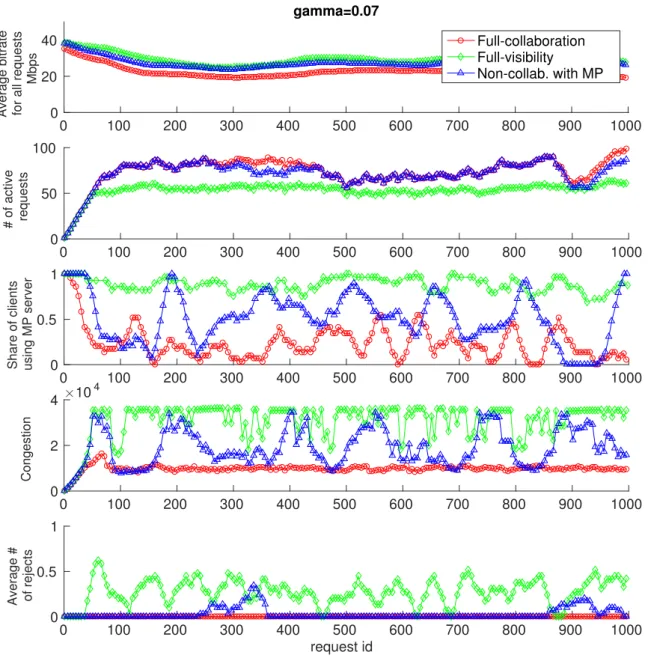
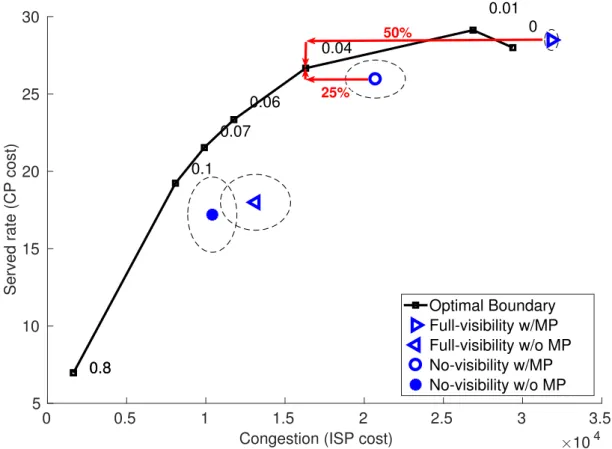
2. In the same way, we model the behaviour of two actors of a video delivery system: an ISP and CP. We conduct a numerical evaluation of the new operational points, that are brought by multipath, with respect to actors’ objectives. We find that, according to the perfect boundary, performance of both actors can be significantly improved if we depart from non-collaborative strategies, by as far as up to 50% less network congestion at the same level of video quality in our simulation settings;
3. We design two collaboration schemes that involve a different amount of inter-action and test them against the perfect theoretical boundary. Our evaluation proves that these strategies, despite light and distributed (thanks to Lagrangian Relaxation), bring substantial improvement to the performance of both ISP and CP as compared to non-collaborative strategy, as well as in fairness between their objectives;
4. We discuss the real-world implementability of those collaboration schemes. • Research in video delivery systems involving HAS and multipath often necessitates
a focus on large systems. Big research groups with connections in content provider industry can use real infrastructures to conduct their research. Other researchers are left with resorting to simulations or numerical evaluations for this kind of studies.
6 Introduction and background
However, there exist no open-source network simulator that would support HAS and multipath transport out-of-the-box. There exist several isolated community models for MPEG-DASH and MPTCP (representing both technologies) for the NS-3 [51] network simulator, but we found it highly difficult to integrate them together so as to obtain a distribution with both features built-in. Having a network simulator with such features would help the community to continue conducting quality research on large-scale video delivery beyond numerical evaluations. In this thesis, we will briefly present our efforts on building an NS-3 distribution that includes MPEG-DASH and MPTCP, which is our last contribution.
The manuscript is organised in four chapters, apart from this introduction, and an Ap-pendix.
A brief overview of internet video delivery evolution and current state of the art, which is the subject of Chapter 1 right after this introduction.
HAS quality adaptation and caching: in Chapter 2, we confirm that indeed, in certain conditions, Rate-Based quality adaptation of HAS can be fooled by the cache presence resulting in bitrate oscillations. We formulate an optimal boundary for a performance of hypothetical perfectly cache-aware adaptation algorithm for our scenario. Then we test Rate-Based and Buffer-Rate-Based algorithms against this issue and compare their QoE performance to the boundary. After that we present a recently-proposed optimisation-based algorithm called Fast MPC and proceed to its evaluation against the optimal boundary. We find that Fast MPC still suffers from cache presence in our realistic settings, we discuss a cache-aware extension to it. We demonstrate that cache-awareness can greatly decrease the amount of quality switches and stall duration for the clients that are among the first to request a popular video from the outside network. We discuss how is it possible to achieve cache-awareness for a quality-adaptation algorithm, and come to a conclusion that caching infrastructure may benefit from being managed by the CP or having explicit or implicit signalling with the CP or its users.
Interplay between multipath and caching: after previous conclusion, in Chapter 3 we take a step back and consider a video delivery system at large. We consider a multipath-enabled system where ISP and CP might potentially have different preference on multipath. We attempt to evaluate the benefit (or lack thereof) of using multipath data transport for such a system. We start by modelling the optimization problems of both actors, ISPs and CDN, and designing a simulation testbed using a mobile operator topology. After that, in order to determine the potential benefit of ISP – CP collaboration, we define a theoretical boundary for their joint performance as to find whether there is a room for improvement (in terms of actors’ objectives) – which happens to be quite significant.
1.1 Evolution of Internet video streaming 7
Collaboration strategies: in previous chapter we demonstrated the interest of collabo-ration between ISP and CDN as to better take advantage of both caching and multipath. In Chapter 4, we develop the idea of collaboration by introducing two joint distributed models with different volume of information exchange. After that, we proceed with a numerical eval-uation of devised strategies. Finally, we discuss the implementability of our two collaboration strategies considering the real-world political and technological constraints.
Efforts in NS-3: in Appendix A, we briefly present the motivations and proceed to details about the resulting distribution and its limitations.
1.1
Evolution of Internet video streaming
1.1.1
Early days of video streaming
Proliferation of the internet in the beginning of 1990s has motivated academia and industry to think about new applications for it. I would like to quote Little and Venkatesh [93]: “If one believes the claims, we will soon be able to view movies, play video games, browse libraries, order pizza, and participate in office meetings (in our bare feet!) from within the confines of our homes”. I think this passage is a great artefact demonstrating the excitement for the new opportunities which I could not (sadly) experience at my age. The one which is related to this thesis is indeed the ability to “view movies”, which back then was known as a VoD (Video-on-Demand) service. At that time, neither Internet nor video content providers were capable of supporting online video streaming due to a multitude of limitations; the issues were not even quite formulated, and of course far from being solved.
It’s important to establish that in the beginning VoD was considered as an over-the-top service exclusive to content providers, akin to CATV channels. Today, in contrast, video streaming is just another way of surfing the internet, being a highly interactive entertainment that often has rather loose relation between its content provider and the streaming platform. Perhaps one of the first complete surveys discussing them is the paper I have just quoted. For one, it lays down quite a detailed prospective on different actors of the online video streaming system. According to them, one of the obstacles on the way of implementing such a system are the content producers and their lack of understanding of the financial incentives for it. Visual entertainment industry then was based on television broadcasting with its very particular and defined end-user behaviour. Advertisers feared that introduction of the VoD would have broken the established dayparts, plus users could potentially have a possibility to skip advertisements. In addition to that, digitalizing the content and viewing it on a general-purpose computer device would inevitably give endless opportunities for copyright
8 Introduction and background
infringement and piracy. Already these two problems were driving down the industry’s interest in a new internet service. Nevertheless, as we can see today, it wasn’t overly complicated to overcome those: advertising experienced a “second birth” with ad targeting systems and isolated advertisement frames that could not be skipped, and copyright security is arguably improved with rather controversial Digital Rights Management (DRM, [47, 155]) system.
The main technological limitation, according to this survey [93], was indeed the band-width capabilities of the Internet. Authors note that while ADSL (considered fast enough for VoD) client connectivity was already rather widely deployed back then, Internet Service Providers (ISP) and Content Providers (CP) were expected to have difficulties with managing a finite amount of their resources challenged by a big amount of VoD users. To overcome this issue, they discussed several techniques. First, user traffic characterisation could help the content being distributed closer to the end-users at certain time periods or at occasions of increased popularity; this idea is very notable as, in a nutshell, it describes something very close to a video CDN already in 1994! Another interesting proposition from them was bandwidth reservation, even as far as enforcing the end users to book their viewing time in advance. It can be argued whether this would be a good idea from user experience point of view, but we do know that the idea of resource reservation in internet did not happen to be very popular as of today.
Among other things, this survey gives a glimpse on a problem of relating the network QoS to the viewing quality in a VoD scenario. Authors conclude that, ideally, two quality metrics should be developed and monitored: one for the system (they call it “system QoS”), and another one for the viewer (“delivery quality”). One can immediately notice that what they are talking is the QoE, and it is quite impressive that researchers were already thinking about this, even without having a real commercial internet VoD system in front of their eyes (though some limited deployments already existed back then).
Even though technological and commercial limitations were yet to be defied, competition has inevitably forced video content providers to implement such a service with some degree of interactivity; those degrees are described by Gelman and others in [7]. According to them, a Pay-Per View (PPV) scheme is merely a broadcasting of a desired content at a particular timeslot, without giving the end-user any control over the playback. Some implementations of this sort worked rather well - e.g., a user could buy temporary access to a channel2 broadcasting a very new film 24/7 in sequence, essentially offering a “home cinema”; such an approach, nevertheless, can be hardly justified as a real VoD system. An evolution of a PPV
2in an Internet video delivery system, the term “channel” is used in a meaning of an isolated flow incoming
from the video server having a bitrate, that is calculated with respect to other flow requirements and link or server capacity.
1.1 Evolution of Internet video streaming 9
is a Quasi-VoD, which represents a system broadcasting some content over several channels (physical or logical) with a certain time shift, such that a user could access demanded video with a reduced delay. Still, it doesn’t provide any playback control but adds a burden of managing the interest thresholds when deciding the showing schedule. In spite of these, Quasi-VoD appeared as a sensible solution and happened to be interesting for the researchers (as we will see later). Finally, a True VoD system should represent a video streaming service as we experience it today, or, as authors say, “...equivalent, in terms of user control, to the VCR playback of rental programs”.
Quasi-VoD systems has caught attention from research community in the end of 1990s. Multicast enabled video services has happened to be feasible for both CPs and their sub-scribers, but their drawback initially was in a quite obvious lack of flexibility in time for the user (thus making it not much different from a usual television. However, since the internet channels’ bandwidths, available for the CPs, were already rather bigger than the required video bitrate, researchers started to think on how to use this property in an efficient way. Viswanathan and Imielinski in [160] propose a method to dramatically decrease the end-user waiting time while maintaining the broadcasting nature of the service; they call it Pyramidal Broadcasting. Their approach is to divide the content into several segments: the first segment of the video should be very short and thus repeated very often over the channel, but subsequent segments are longer with the last segment being a substantial part of the video. In addition to that, the system would leverage the fact that communication channel’s bandwidth is probably much higher than the video’s bitrate, so video segments could be transmitted faster than their consumption “rate”. Finally, the end-user equipment is supposed to have memory in order to store the quickly transported video segments in order to later show them at normal rate. In this way the end-user could quickly access the beginning of the video, which was delivered to it faster than real-time and so would give the system some time to access next, longer video segments. Juhn and Tseng develop this idea with Harmonic Broadcasting [66], which reduces the amount of channel bandwidth needed to broadcast a video while preserving low start-up delay. The drawback of these two solutions is the requirement for a relatively big buffer space at the end-user device, which could be quite expensive at that time. Hua and Sheu in [58] propose a so-called Skyscraper Broadcasting technique that aims at reducing the lengths of segments and by so also reducing buffer requirements. Several other algorithms (some of them also have architecture-related names) has been developed at the same time; reader could refer to [69] for a more detailed survey on this topic.
Another interesting technique to improve efficiency of a multicast Quasi-VoD is called patching[57]. Hua et al. in their article propose to dynamically allocate streaming channels
10 Introduction and background
as a function of users’ demand. Basic approach assumes that every channel streams a video (or its part) in its entirety for a fixed amount of time. In contrary to this, patching will try to minimise the channel utilization time by using neighbour channels and client buffering. Imagine a scenario: a channel has recently started a transmission, but a considerable amount of users have requested the same content some time after that. Instead of waiting for the next scheduled channel, and/or using pyramidal techniques, the system will accept those clients and instruct their settopbox to buffer the transmission on that recent channel. Meanwhile, a new channel will be allocated which will broadcast the same video but only a part of it - the one which has already been streamed on the neighbour channel. Once this part has finished streaming to the new clients, the newly-allocated channel will be released, and their settopbox will continue showing the buffered frames from neighbour channel until the end. The advantage is that some channels in the system become busy only for a short amount of time, and that client admission becomes more flexible - compared to basic broadcasting. On the other hand, depending on the delay between the beginning of a scheduled transmission and the admission of new clients, the buffer requirements might be quite heavy; this issue will be discussed shortly.
While the measures I have just described did not yet qualify for a True VoD, they could definitely make Quasi-VoD a temporary measure before necessary technological and financial advancements happened. The next step in this direction was providing a user with control over the playback. While today a playback control functionality is an integral part of any video viewing experience, it was quite a novel service for the online video streaming at that time. Since digital video had only make its way in developed countries just on the brink of millennia, the reference way of controlling was the one of the video cassette recorders’ (VCRs). It was providing a possibility to pause the playback, set it to fast-forward and to rewindthe video. The seek functionality (which is essential nowadays) was not available on consumer VCR devices and thus was not considered at that time.
Such a functionality is usually associated with a True VoD because playback control should (quite obviously) only affect the person who is in fact controlling. Quasi-VoD with its broadcasting nature cannot allow the streaming to be altered by a single user without affecting everyone else, however, it has been proven to be possible to exploit the buffered data from scheduled broadcasting schemes (including pyramidal ones and related) to achieve limited playback control. Almerot and Ammar in [7] explain two ways of implementing VCR functionality in a multicast video broadcasting system with scheduled showing repetition (which is one of Quasi-VoD variants):
• First of them is called continuous interactivity. According to it, the user joins the closest by time broadcasting channel; whenever he or she invokes, for example, the
1.1 Evolution of Internet video streaming 11
pauseaction, the playback is paused but the video streaming continues. The client’s buffer is supposed to store the arriving video frames, such that when the client resumes they could be used to continue the playback without changing the broadcast channel. In case the resumed video is being shown at normal rate (in real time), the buffer will stay filled with the same amount of stored video until the end of the showing, as the broadcasting channel is now pause-duration seconds ahead of the client and this difference in playback positions will have to be buffered. This means that in order to keep the same broadcasting channel, the total pause duration during the video showing has to be lower than the buffer capacity at the client, otherwise a channel change will be required with possible service interruption. The fast-forward and rewind functions are naturally operating over the buffered parts of the video in a straightforward way, or otherwise require channel change. The notable drawback of this approach is, indeed, the buffer space requirements. Works of that time refer to video bitrate of 1.5 Mbps (MPEG-1 SIF/PAL resolution) that needs 112.5 MByte of disk space to buffer 10 minutes. On the other hand, changing channels may result in service refusal, and continuous interactivity decreases the need in changing.
• The second approach is discontinuous interactivity. It exploits the fact of scheduled repetition of the video broadcasts over multiple channels: every invocation of any control operation requires channel change, such that no buffering is required but the pausehas a fixed duration of a factor of the time slot length (which is the difference in time between two consecutive broadcasts). The range of fast-forward and rewind will also be bound to the time slot duration and will happen immediately. While such a scheme needs no buffer, it could be arguably less convenient for the subscribers, especially if the time slot length is big; additionally, service blocking can be an issue when changing channels.
A slightly different way of implementing video broadcasting and VCR functions was demonstrated by Poon and Lo in [127]. Instead of allocating the entire CP’s available bandwidth to multicast channels, they consider a case when some of the bandwidth is left for intermittent unicast streaming sessions. Clients start by joining a multicast channel, but are moved to individual multicast channels once they invoke VCR functions. Authors propose to keep unicast channel bandwidth much higher than the required video bitrate, such that the client could quickly replenish his buffer with video frames up until the playback moment of some close multicast channel, then change to it and release the unicast channel. The main focus of this article was on reducing the service blocking, so together with certain server-side logic their solution is in fact quite effective in regards to that focus.
12 Introduction and background
1.1.2
Video streaming becomes viable
The beginning of 2000s gave rise to many internet technologies; some helped to increase network resources, others proposed new ways of being connected to the internet. This inevitably led to an explosion in the number of subscribers, together with many internet applications (like video streaming) becoming more accessible to them. Among those events, the key once in proliferation of research on video streaming are: emergence of peer-to-peer networks, advances in wireless networks, increase in interest for video caching and development of scalable video codecs.
Peer-to-peer video streaming
Research on ad-hoc and peer-to-peer networks attracted great attention in the beginning of 2000s. It has been quickly understood that peer-to-peer technology has a big potential in the domain of video streaming: instead of streaming the content from a far-away server or an in-network cache, subscribers could pull their content from other subscribers in their area. With popular enough service this could help to move the video transmission load to the pre-last-mile network section (which often has more available resources than the usually aggregated backhaul sections). As Liu et al. report in [96], two types of peer-to-peer topologies can be pinpointed: tree-based and mesh-based.
The first type represents a tree topology overlay constructed by peers; such a clear hierarchy is supposed to keep the maintenance burden low while providing the interesting concept of peering. On of the disadvantages of a tree-based peer-to-peer network is the user churn: in our case not only the actual user leaves the system, but also all the peers below him on the tree would become disconnected from the hierarchy. This disadvantage is quite important for a video streaming system, which requires timely content reception and, thus, benefits from uninterrupted connectivity. This issue has been addressed in several research works that, together with discussing other necessary arrangements, offer their vision on a tree-based VoD system. Jin and Bestavros in [64] propose to cache a sliding window worth of video frames at the clients, such that whenever a client comes later within the duration of this sliding window, the cached content could be relayed and forwarded from the first client to the new one. Since the cache content “slides” forward together with the playback of the clients, the system requires only one stream channel to serve all the clients that have arrived within a sliding window duration between each other. A somewhat different approach is presented by Guo et al. in [48] intend to extend the already-discussed patching technique to the peer-to-peer delivery system. The core of their work is in designing an algorithm to construct a peer-to-peer multicast tree that fits best for employing patched video transmission:
1.1 Evolution of Internet video streaming 13
a tree should span across clients of roughly the same arrival time such that they can be served with one multicast stream while using patches to mitigate the difference in their join time. In addition, they define measures to protect streaming continuity from network disruptions (mainly by re-contacting the video server as to recover stream flows)
In contrary to the tree-based approach, the mesh-based peer-to-peer network is not supposed to have a vertical hierarchy. Vlavianos et al. in [161] demonstrate their take on a mesh-based VoD: their idea is to use BitTorrent for this purpose. The video file is broken into small pieces that are retrieved and cached by the peers, such that they could be shared with newer peers. They notice that the fact of BitTorrent protocol prioritizing retrieval of rare file pieces is not suitable for VoD where streaming clients/peers prefer pieces to arrive more or less in the order of playback. To alleviate this issue, they develop a piece selection policy to better respond the VoD requirements in a face of quickly changing peer availability in the network. A more recent mesh-based VoD solution is presented by Magharei and Rejaie in [99]. They identify that a peer in a mesh might suffer from bandwidth bottleneck (the aggregate bandwidth with other peers is not enough to fully exploit its own connectivity) and from content bottleneck (when there is not enough unique content pieces around to fully exploit the connectivity with other peers). Their work, consequently, proposes strategies for network overlay construction and piece retrieval as to more efficiently use network resources and avoid the aforementioned bottlenecks. At the same time, they uncover many other insights about the operation of such a system.
While large content providers (like Youtube) have skipped peer-to-peer networking in their content delivery strategies (judging from the lack of reports one that matter), such an approach became rather popular in live video streaming services that has been successfully introduced to the market between 2005 and 2010 (like [149, 167]). Notwithstanding such a (limited) popularity, later years have seen a business model shift for online video distribution that happened to be incompatible with peer-to-peer approach (due to associated copyright protection considerations), which lead to its decay after 2010s – just to be reborn within context of hybrid Content Delivery Networks [172, 176, 11, 173], which benefit from peer-to-peer connectivity to cache and deliver video content.
Video streaming over wireless networks
The timeframe under discussion was a period of global adoption of high-speed packet-switched wireless networks, such as IMT2000 and IEE 802.11. Theoretical data bitrates provided with these technologies was quite enough to ensure an acceptably good video streaming quality (i.e., at least an uninterrupted service at a resolution adapted to the device screen). On the other hand, radio medium quality changes very fast, so transmission bitrate
14 Introduction and background
and delays during a wireless transmission vary significantly as well. Initial studies have found that then-current generation wireless network do not provide enough inter-layer cooperation [144] as to respond well to the prerequisites of video streaming (e.g., tight arrival deadline requirements). This was, perhaps, the main research direction on the intersection of wireless networks and video streaming.
Advances in channel-adaptive video streaming... gives important video parameters. Khan et al in [70] propose their variant of a cross-layer optimisation framework for video streaming in wireless networks. They use a centralised mechanism that has access to all network layers in order to observe their state and impose operational parameters. Since the parameter space to optimise on is quite large, they count on reducing them by abstraction. Once the optimisation is done for the abstracted parameters, they are distributed to their respective layers which then translate them back into operational parameters. Some of the described layers and their operational parameters are: application layer (video bitrate, encoding), data-link layer (TDMA slots/CDMA carriers, directional beams), physical layer (channel coding, modulation, power). The objective function for the optimisation is chosen to be the average of all users’ (within optimisation realm) Peak Signal-to-Noise Ration, PSNR [169]. Authors discover that the cost of performing such an optimisation increases quickly with growing number of radio clients and available parameter value ranges; on the other hand, they conclude that their approach performs well even after limited degrees of freedom for the parameters.
Slightly more practical approaches were proposed to improve video streaming over wireless, such as modifications of ARQ, application layer scheduling [144] and transport layer congestion control [29].
Overall, considerations of cross-layer protocol collaboration appear to be an important subject of research on ameliorating video streaming over wireless networks - even for subsequent wireless technology generations.
Video caching
The concept of caching has been used for improving QoS in the internet since the early days of Web [97, 163]. The idea is that a storage server is placed close to the end-user such that whenever he requests something from internet, the objects transmitted to him are stored at that server. Stored objects then could serve later users requesting the same content, improving latency and often providing higher bandwidth [163]. These two benefits come from offloading the demand from main servers, and because caches can be deployed in a highly-provisioned parts of the network thus avoiding architectural bottlenecks.
1.1 Evolution of Internet video streaming 15
Just as with peer-to-peer networks, potential of caching technologies in video streaming was quickly uncovered by industry and research. Normally, video content is rarely updated so it can be considered as fixed content and thus suits well for caching. Nevertheless, several particularities has to be taken into account:
• Disk space requirements: even at relatively low resolutions, full video files of a film-long duration need a considerable amount of storage space (as was demonstrated in previous section). Taking into account the storage costs in the beginning of 2000s together with the amount of popular video content at a single timeframe, a large-scale video caching solution could become too expensive.
• Bandwidth and I/O requirements: video streaming is a demanding application not only in terms of network bandwidth, but also with respect to the storage bandwidth. Designing a caching solution has no bottleneck in these aspects is a complex task, so developing a cache policy that respects such limitations might be a good investment. • Management overhead of caching parts of a video: it is often needed to cache videos
not in a single piece but in parts or even incomplete (e.g., due to some parts of a video being not popular enough to justify caching). At that time video content was stored at the source as a single video file, and was requested by the client in byte ranges - so it was quite difficult to align cached ranges, original source ranges and the ranges in the client’s buffer.
Research community gladly accepted these challenges, resulting in a number of original architectural solutions. A most straightforward way of battling the bandwidth and disk limitations is to reduce the volume of video content cached. Liu and Xu [95] provide a good summary of common solutions for that. They distinguish between homogeneous and heterogeneous client demands, which defines a caching solution.
The first type, homogeneous, defines that video clients have similar hardware config-uration and network connectivity, so that they would request the same version/resolution of the video content. Having homogeneous client demand simplifies cache management, since often only a single version of a video content has to be be stored and used later for subsequent requests. This assumption was certainly applicable in the first decade of new millenium, when displays and digital video existed in rather limited range of resolutions. The second type, heterogeneous, means that clients have a wide range of devices with different characteristics, which also makes their requested content different in its version/resolution. This complicates the caching process; we touch upon on of the related issues in Chapter 2.
16 Introduction and background
Several caching solutions for homogeneous clients have been brought to the light at that time, as outlined in [95]. One of them, called Sliding-Interval Caching [30], suggests that a cache should not store the entire video transmission passing through it, but only a short window of it – thus, in essence, a storage-limited LRU per each video instance. With the course of the playback, new video frames will arrive to the cache’s “stack” which will cause the eviction of the oldest frames in the window. As a result, in case another client will request the same content shortly after (in the same time window), cache could serve him from its storage. Past the specified time window, of course, client will have to request the content from the server. Such a solution is demonstrated by the authors to greatly reduce disk storage requirements with some degree of cache hit ration decrease (for the clients who arrive too late), but can potentially work very well when client demand times are well-defined. Another caching solution described is called Prefix caching [142]. It proposes to cache an initial video portion, called prefix; whenever a client starts accessing the prefix of a video, cache would start prefetching the remaining part of the video (a suffix in order to serve it to the client when he finishes watching the prefix part. Such a scheme can smooth out transmission bitrate peaks, while maintaining high video quality for the client. Finally, in order to achieve higher byte-hit ratio (that can improve disk space usage efficiency), Segment caching has been proposed [171]. This solution entails dividing video files into segments of a certain length and “utility”, that can help manage their caching.
One of the most important mechanics in web-caching is caching policies, which define how to maintain constrained cache storage as to maximise cache hit-rate. In a realistic environment, where the amount of unique requested cacheable objects is much greater than cache storage capabilities, proper selection of caching policy can be of a crucial importance for cache operation. The most basic strategy is called Least-Recently-Used, which implies that when cache storage is full, the oldest object on the disk will be evicted upon an event of a new incoming object. There exist plenty of other, presumably more smart policies; interested reader can address, for example, the work of Ali et al. [6] for more insight.
One could already notice that solutions like prefix or segment caching assume some degree of interaction between client, cache and server. Also one should remember that one of the video caching challenges was a burden of managing the cached video parts, which might also be alleviated using interaction between entities. At that time, however, there was no standard framework for such an interoperation, so one possibility to implement it was using control protocols such as RTCP and RTSP (for QoS guarantee and content streaming control). We can already imagine the complexity of the entire caching architecture that was under consideration of researchers at that time; such a level of interoperation suggested that caching infrastructure could be consolidated into bigger entity and benefit from extended
1.1 Evolution of Internet video streaming 17
geographical visibility – which sounds exactly like a video Content Delivery Network (CDN). Being an enormous network of caches tailored to deliver content from a certain provider (like Youtube or Vimeo), distributed all over the world, they make use of aforementioned (and not only) research to greatly improve users’ QoS. CDNs and their advanced caching techniques, without any doubts, are the main contributors to today’s unprecedented performance of the video streaming.
Early stages in adapting video quality
Even though advancements in caching technologies have certainly contributed to growing of the video streaming, beginning of 2000s have seen another research direction born that happened to be just as important: quality adaptation. Until now, we have been mostly assuming that clients cannot request different video qualities once they requested the content. That is a considerable omission, since the real-life internet connectivity can suffer huge variations, calling for an ability to adapt the requested quality accordingly in order to be able to efficiently use client’s achievable bandwidth.
As a first attempt, researchers studied the possibility to make use of layered video encoding schemes. In this way, the video is being encoded into several layers – a base layer and a set of enhancement ones. The base layer provides basic information for the video series to be decoded at a base quality, while supplementing enhancement layers at the moment of decoding will provide additional information to improve the resulting quality of a reconstructed video. While the studies on layered video encoding started even around the beginning of 1990s [153], the approach have only received its standard in 2007 [141]. Theoretical background of layered encoding is out of scope of this document; we are, however, interested in how was it used for video quality adaptation during streaming. A particular attention has been devoted to this subject in the beginning of 2000s, resulting in a number of research pieces. Rejaie et al. in [134] discuss a mechanism that helps to absorb bandwidth fluctuations caused by transport congestion control. According to them, this approach can trade short-term video quality improvement for long-term quality stability and general better viewing experience. A more general look on the variation of available bandwidth is taken by Kim and Ammar [77]. They propose an optimal video quality adaptation algorithm that is focused on minimizing quality fluctuations while maintaining high bandwidth utility. Finally, a rather modern approach is presented by Wang et al. [165]: they develop a machine learning framework for performing quality adaptation for layered codecs. In contrast to other works, they are dealing with all compression domains in a systematic manner; in addition, this paper is one of the rare ones that performs subjective studies to validate their approach.
18 Introduction and background
Continuing research on layered video encoding and its application to internet video streaming has demonstrated the viability and benefits of adapting video quality according to available bandwidth. Together with this, the observations conducted during this time would pave the way to the development of modern streaming systems - that would bring substantial improvement in user perceived quality, would focus on QoE, rather than on QoS, and be built to be adaptive. Quality adaptation is discussed in more detail in Section 1.1.3.
1.1.3
Modern day video streaming
Until the middle of 2000s Video on Demand over Internet was a rather localised business case. Such providers existed mostly as subsidiaries of bigger cable companies, and rarely scaled even to country-wide deployments. In addition to that, the audience of such services was quite low due to slow development of broadband Internet connectivity and old habits of preferring physical copies of the content. These factors were making the problem of VoD scaling doable, yet challenging.
Nevertheless, penetration of fast Internet connectivity made VoD much more accessible, and content providers’ business models started to change as to accommodate the new potential market opportunities, which is turn started to change the peoples’ habits. The launch of Vimeo in 2004, Youtube in 2005, Netflix (online streaming branch of it) in 2007, and a myriad of other local and global video streaming services of a VoD type overall was an event of such an immense magnitude that it would shape people culture very shortly. Immediate availability of the content, added social aspect (in case of Youtube/Vimeo/etc), endless interactivity -these are only few reasons why modern video streaming effectively replaced the traditional TV for quite a large slice of the society; in addition to this, global character of the Internet called for consolidation of the market in hands of several large global content providers.
Rapid increase of user base required an equivalent increase in network capabilities as to fully take advantage of the new market. At the same, research and development actions in higher definition video also started to affect network providers. Such an abrupt increase in network traffic did not go well along with ISPs’ financially-justified plans on hardware upgrades, so research essentially had to continue the work on improving the qualitative parameters of the video streaming in a constrained network environment - just like it was before.
This section will, therefore, present the state of three important research directions that, in our opinion, shaped the modern Internet video streaming and that helped the Internet to rather successfully deliver the required capabilities for it - thus being a part of its success nowadays. Those research directions are Content Delivery Networks, Adaptive video streaming, and focus on Quality of Experience.
![[PDF] Documentation complet pour apprendre à programmer avec PHP | Cours php](data:image/gif;base64,R0lGODlhAQABAIAAAP///wAAACH5BAEAAAAALAAAAAABAAEAAAICRAEAOw==)