
HAL Id: hal-01393802
https://hal.sorbonne-universite.fr/hal-01393802
Submitted on 8 Nov 2016HAL is a multi-disciplinary open access archive for the deposit and dissemination of sci-entific research documents, whether they are pub-lished or not. The documents may come from teaching and research institutions in France or abroad, or from public or private research centers.
L’archive ouverte pluridisciplinaire HAL, est destinée au dépôt et à la diffusion de documents scientifiques de niveau recherche, publiés ou non, émanant des établissements d’enseignement et de recherche français ou étrangers, des laboratoires publics ou privés.
refractory cardiogenic shock post-cardiac arrest
Marc Pineton de Chambrun, Nicolas Bréchot, Guillaume Lebreton, Matthieu
Schmidt, Guillaume Hekimian, Pierre Demondion, Jean Trouillet, Pascal
Leprince, Jean Chastre, Alain Combes, et al.
To cite this version:
Marc Pineton de Chambrun, Nicolas Bréchot, Guillaume Lebreton, Matthieu Schmidt, Guillaume Hekimian, et al.. Venoarterial extracorporeal membrane oxygenation for refractory cardiogenic shock post-cardiac arrest. Intensive Care Medicine, Springer Verlag, 2016, �10.1007/s00134-016-4541-y�. �hal-01393802�
1 Venoarterial-Extracorporeal Membrane Oxygenation for Refractory Cardiogenic Shock 1
Post-Cardiac Arrest 2
3
Marc Pineton de Chambrun1, Nicolas Bréchot1, Guillaume Lebreton2, Matthieu Schmidt1,
4
Guillaume Hekimian1, Pierre Demondion2, Jean-Louis Trouillet1, Pascal Leprince2, Jean
5
Chastre1, Alain Combes1, Charles-Edouard Luyt1*
6 1
Service de Réanimation Médicale, Groupe Hospitalier La Pitié–Salpêtrière, Assistance
7
Publique–Hôpitaux de Paris, Paris, France. Sorbonne Universités, UPMC Université Paris 06,
8
INSERM, UMRS_1166-ICAN Institute of Cardiometabolism and Nutrition, Paris, France.
9 2
Service de Chirurgie Thoracique et Cardiovasculaire, Groupe Hospitalier La Pitié–Salpêtrière,
10
Assistance Publique Hôpitaux de Paris, Paris, France.
11
Short Title: VA-ECMO for Cardiogenic Shock Post-Cardiac Arrest 12
*Correspondence: Charles-Edouard Luyt, MD, PhD, Service de Réanimation Médicale, iCAN,
13
Groupe Hospitalier La Pitié–Salpêtrière, 47–83, boulevard de l'Hôpital, 75651 Paris Cedex 13,
14
France. tel: +33 (0)1 42 16 38 24; fax: +33 (0)1 42 16 38 17; email:
charles-15
16
Total word count: 3003 words. 17
Conflicts of Interest 18
Dr Combes is the primary investigator of the EOLIA trial (NCT01470703), a randomized trial of
19
VV-ECMO, supported in part by MAQUET. Drs Bréchot, Lebreton and Combes have received
20
honoraria for lectures by MAQUET. The other authors declare that they have no conflicts of
21
interest related to the purpose of this manuscript.
22 23
2 Abstract: Word count: 245
1
Purpose: To describe the characteristics, outcomes and risk factors associated with poor outcome 2
of venoarterial-extracorporeal membrane oxygenation (VA-ECMO)-treated patients with
3
refractory shock post-cardiac arrest.
4
Methods: We retrospectively analyzed data collected prospectively (March 2007– January 2015) 5
in a 26-bed tertiary hospital intensive care unit. All patients implanted with VA-ECMO for
6
refractory cardiogenic shock after successful resuscitation from cardiac arrest were included.
7
Refractory cardiac arrest patients, given VA-ECMO under cardiopulmonary resuscitation, were
8
excluded.
9
Results: Ninety-four patients received VA-ECMO for refractory shock post-cardiac arrest. Their 10
hospital and 12-month survival rates were 28% and 27%, respectively. All 1-year survivors were
11
cerebral performance category 1. Multivariable analysis retained INR >2.4 (OR 4.9; 95% CI
12
1.4–17.2), admission SOFA score >14 (OR 5.3; 95% CI 1.7–16.5) and shockable rhythm (OR
13
0.3; 95% CI 0.1–0.9) as independent predictors of hospital mortality, but not SAPS II,
out-of-14
hospital cardiac arrest score or other cardiac arrest variables. Only 10% of patients with an
15
admission SOFA score >14 survived, whereas 50% of those with scores ≤14 were alive at 1 year.
16
Restricting the analysis to the 67 patients with out-of-hospital cardiac arrest of coronary cause
17
yielded similar results.
18
Conclusion: Among 94 patients implanted with VA-ECMO for refractory cardiogenic shock 19
post-cardiac arrest resuscitation, the 24 (27%) 1-year survivors had good neurological outcomes,
20
but survival was significantly better for patients with admission SOFA scores <14, shockable
21
rhythm and INR ≤2.4. VA-ECMO might be considered a rescue therapy for patients with
22
refractory cardiogenic shock post-cardiac arrest resuscitation.
3 1
Keywords: Cardiac arrest Cardiogenic shock Extracorporeal membrane oxygenation
Post-2
cardiac arrest syndrome
3 4
Take-home message: Refractory cardiogenic shock is one of the leading causes of early death 5
after successful cardiac arrest resuscitation. In this setting, venoarterial-extracorporeal membrane
6
oxygenation is associated with 27% 1-year survival. Patients with SOFA scores >14 have poorer
7
outcomes than the others (respective survival 10% vs. 50%), raising the question of futility in
8
these patients.
9 10
4
Introduction
1
Hospital mortality of patients post-cardiac arrest resuscitation remains particularly high, ranging
2
from 40% to 90% [1–9]. The main causes of death are multiorgan failure within the first hours
3
following the return of spontaneous circulation and neurological damage (mainly anoxic cerebral
4
lesions) several days later [10]. Early multiorgan failure may result from post-cardiac arrest
5
syndrome or myocardial disease-related cardiogenic shock that led to cardiac arrest. Post-cardiac
6
arrest syndrome exhibits a set of relatively stereotypical events, among which cardiocirculatory
7
failure usually dominates the clinical picture and often leads to multiorgan failure. Post-cardiac
8
arrest syndrome usually combines cardiogenic and vasodilatory components: left ventricular
9
dysfunction begins early, within minutes after the return of spontaneous circulation and can be
10
secondarily associated with severe vasodilatation, attributable to a generalized inflammatory
11
syndrome, or myogenic and/or metabolic autoregulation [11–14]; it spontaneously reverses after
12
several hours, but can sometimes be very severe, leading to multiorgan failure and death.
13
However, cardiogenic shock may also occur without that syndrome, depending on cardiac disease
14
origin (ischemic disease, drug overdose…).
15
Venoarterial-extracorporeal membrane oxygenation (VA-ECMO) is an effective
16
technique to rescue patients with refractory cardiogenic shock [15–17]. In the setting of cardiac
17
arrest, many studies focusing on VA-ECMO’s role in extracorporeal cardiopulmonary
18
resuscitation (e-CPR) for refractory cardiac arrest yielded conflicting results [18–20]. However,
19
VA-ECMO usefulness in patients with refractory cardiogenic shock post-cardiac arrest has not
20
yet been reported. Using such an invasive and expensive technique in this context is debatable
21
because the neurological prognosis at the time of implantation is unknown. Therefore, we
22
undertook this retrospective analysis of patients treated with VA-ECMO for refractory
5
cardiogenic shock post-cardiac arrest to describe their characteristics, outcomes and risk factors
1
associated with poor outcome.
2 3
Methods
4 Patients 5We retrospectively reviewed the prospectively constituted ECMO database of our 26-bed
6
intensive care unit (ICU) to identify patients who received (March 2007–January 2015)
VA-7
ECMO for refractory cardiogenic shock post-cardiac arrest resuscitation. Before VA-ECMO
8
implantation, every patient underwent Doppler echocardiography to evaluate cardiac and
9
hemodynamic status. In our unit and for this study, VA-ECMO for acute-refractory cardiogenic
10
shock is usually indicated when the following criteria are met: persistence or aggravation of
11
tissue hypoxia (extensive skin mottling, anuria, neurological impairment, elevated blood
12
lactate…) despite adequate fluid loading; severely depressed left ventricle ejection fraction
13
(<25%) with low cardiac output (defined as aortic velocity-time integral <8 cm and sustained
14
hypotension despite infusion of very high-dose catecholamines (epinephrine >1 μg/kg/min or
15
dobutamine >20 μg/kg/min with norepinephrine >1 μg/kg/min). However, because most ECMO
16
systems were implanted in other hospitals, it was impossible to precisely verify that all patients
17
satisfied all these criteria. Patients implanted with VA-ECMO for refractory cardiac arrest under
18
CPR were excluded from this study.
19 20
ECMO implantation 21
The detailed surgical procedure for femoral–femoral VA-ECMO placement was described
22
previously [16, 17, 21]. Briefly, trained cardiovascular surgeons performed all procedures at the
6
bedside or in the cardiac angiography room because of patient’s hemodynamic instability.
1
Femoral vessels were cannulated after limited cut-down using the Seldinger technique and an
2
additional 7F catheter was systematically inserted distally into the femoral artery to prevent
3
severe leg ischemia. For highly unstable patients diagnosed with refractory cardiogenic shock in
4
other hospitals, our institution’s Mobile Circulatory Assistance Unit traveled rapidly to
primary-5
care hospitals with a portable ECMO system, installed the device before refractory multiorgan
6
failure or cardiac arrest took hold, and then transported the patient to our tertiary-care center [22].
7 8
Patient management 9
The detailed management of patients under VA-ECMO was described previously [13, 14, 18,
10
20,21]. Briefly, pump speed was adjusted to obtain blood flow at 4–5 L/min, although at these
11
flow rates there is a risk of poor left ventricle unloading with the possibility of further left
12
ventricle-function deterioration. Intravenous unfractionated heparin was given to maintain the
13
activated partial thromboplastin time at 1.5–2-times normal. When a pulsatile arterial waveform
14
had been maintained for at least 24 h, an ECMO-weaning trial was undertaken as described
15
elsewhere [21]. Therapeutic hypothermia (32–34°C) was initiated during the first 24 h
post-16
cardiac arrest, according to the ILCOR guidelines [12]. Patients who could not be weaned-off
17
VA-ECMO because of persistent heart failure underwent comprehensive predictive neurological
18
work-ups, including clinical examination and electroencephalography (see online supplement).
19
When neurological prognosis was favorable, patients were bridged to a long-term left ventricle
20
assist device or cardiac transplantation, whereas patients with predicted poor neurological
21
outcomes were weaned-off VA-ECMO during withdrawal of life-sustaining therapies.
22 23
Outcome variables 24
7
Main outcome variables were 28-day, hospital and 12-month mortality rates. Secondary outcome
1
measures included survival to VA-ECMO weaning, number of patients bridged to a long-term
2
left ventricle assist device or cardiac transplantation, times on VA-ECMO and on mechanical
3
ventilation, duration of ICU stay, cause of mortality and multiple organ donations. Survivors to
4
hospital discharge were contacted by phone 1-year post-cardiac arrest to evaluate neurological
5
outcomes using the Cerebral Performance Category score [24].
6 7
Statistical analyses 8
Results are expressed as number (%), continuous variables as mean (standard deviation, SD) or
9
median [interquartile range, IQR] and compared using Student’s t-test or Wilcoxon’s rank test.
10
Categorical variables were compared with χ2 tests. Patients’ demographic, clinical and biological
11
characteristics were tested in univariable analyses for association with hospital mortality.
12
Continuous variables were transformed into categorical variables (by defining the best thresholds
13
after analyzing mortality in each corresponding-variable quartile). Thereafter, multiple
logistic-14
regression analyses using backward-stepwise variable elimination were run (with the
variable-15
exit threshold set at P>0.10). Factors achieving P0.10 in our univariable analyses and
16
parameters previously reported to be strongly associated with death were entered into the
17
multivariable model. All potential explanatory variables included in the multivariable analyses
18
were subjected to collinearity analysis with a correlation matrix. Variables associated with one
19
another were not includedin the model. Model goodness-of-fit was assessed with the
20
determination coefficient (R2). P<0.05 defined statistical significance. Analyses were computed
21
with IBM SPSS Statistics v22.0 software (IBM Corp, Armonk, NY).
22 23
8 Ethics
1
In accordance with the ethical standards of our hospital’s institutional review board, the
2
Committee for the Protection of Human Subjects, informed consent was not obtained for
3
demographic, physiological and hospital-outcome data analyses because this observational study
4
did not modify existing diagnostic or therapeutic strategies. However, patients and/or relatives
5
were informed about the anonymous data collection and that they could decline inclusion. The
6
National Commission for Informatics and Liberties (CNIL) approved this study (no. 1950673).
7 8
Results
9 Study population 10Among the 954 VA-ECMO–treated patients in our ICU, 94 implanted for refractory cardiogenic
11
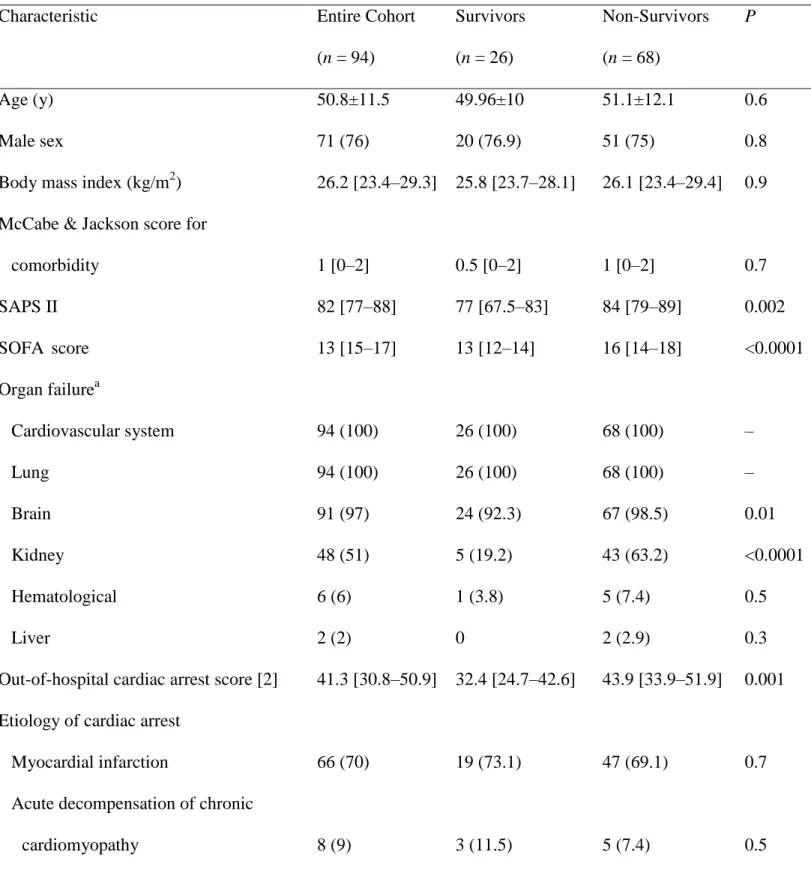
shock post-cardiac arrest were included (Fig. 1). Their characteristics are reported in Table 1 and
12
Table E1 (online supplement). Most patients had no or few comorbidities but were severely ill, as
13
assessed by the high simplified acute physiology score II (SAPS II) and sequential organ failure
14
assessment (SOFA) score. Median left ventricle ejection fraction was 15% [10–20%] (87/94
15
assessable) and aortic velocity-time integral was 7 [5–9] cm (67/94 assessable). Median cardiac
16
arrest-to-VA-ECMO-implantation interval was 7.4 [3.3–14] h and median ECMO-support
17
duration was 4 [2–6] days. VA-ECMO was implanted by our institution’s Mobile Unit surgeon at
18
another hospital in 60 (64%) patients, in our ICU in 17 (18%), in the catheterization lab in 14
19
(15%) and by another institution’s surgeon at another hospital in three (3%) patients. Median
20
cardiac arrest-to-VA-ECMO-implantation interval was similar for patients implanted by the
21
Mobile Unit vs. the others (7.9 [3.9–18.5] vs. 5.4 [3.9–11.1] h, respectively, P = 0.08).
22 23
9 Outcomes
1
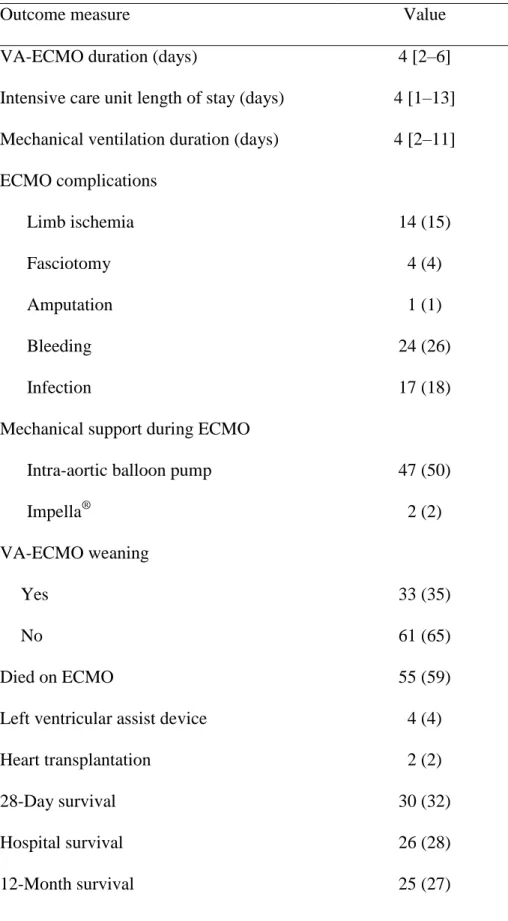
Respective 28-day, hospital and 12-month survival rates were 32%, 28% and 27% (Table 2).
2
Fifty-five (59%) patients died on VA-ECMO, 33 (35%) were successfully weaned, four (4%)
3
were bridged to a left ventricle assist device and two (2%) to heart transplantation. Causes of
4
death were multiorgan failure for 45 (65%) patients, brain death for 11 (16%), post-anoxic
5
encephalopathy for 10 (14%) and recurrent-cardiac arrest for three (4%; one after day 28) (Figure
6
E1, online supplement). The 25 (27%) 1-year survivors had good neurological outcomes
7
(cerebral performance category 1). Among the 11 patients with confirmed brain death, five
8
became multiple organ donors. Forty-seven (50%) patients received an intra-aortic balloon pump
9
(Table 2); vascular complications and outcomes were similar for patients with or without a pump
10
(Table E1, online supplement).
11 12
Comparisons between survivors and non-survivors 13
The 26 survivors to hospital discharge and 68 non-survivors were comparable for age, sex, body
14
mass index, comorbidities, cardiac arrest cause and place of occurrence, duration of resuscitation
15
and median left ventricle ejection fraction before VA-ECMO implantation (Tables 1 and E1).
16
Survivor’s first rhythm was more frequently ventricular fibrillation, their aortic velocity-time
17
integral pre-VA-ECMO was higher and their cardiac arrest-to-VA-ECMO-implantation intervals
18
were longer. Non-survivors had higher SAPS II, SOFA and out-of-hospital cardiac arrest scores,
19
higher rates of neurological and renal failures at ICU admission, higher arterial blood lactate,
20
alanine aminotransferase and serum creatinine levels, lower prothrombin activity and urinary
21
output on the ECMO-implantation day. According to multivariable analyses (Table 3),
22
independent predictors of hospital mortality were international normalized ratio (INR) >2.4 (odds
23
ratio (OR) 4.9; 95% confidence interval (CI) 1.4–17.2), admission SOFA score >14 (OR 5.3;
10
95% CI 1.7–16.5) and shockable rhythm (OR 0.3; 95% CI 0.1–0.9). The Survival After
Veno-1
arterial Extracorporeal membrane oxygenation (SAVE) score [15] was not independently
2
associated with outcome (see online supplement).
3
Comparable results were obtained when analyzing factors associated with 1-year
4
mortality: INR and admission SOFA score were independent predictors of 1-year mortality
5
(Tables E3 and E4 in the online supplement).
6
Figure 2 shows the Kaplan–Meyer survival-probability curves according to SOFA-score
7
quartiles, and Figures E1 and E2 for all patients and according to pre-ECMO SOFA scores
8
(online supplement). Only 10% of patients with pre-ECMO SOFA scores >14 survived; almost
9
all deaths occurred during the first 24 h, whereas patients with pre-ECMO SOFA scores ≤14 had
10 50% 1-year survival. 11 12
Discussion
13This large cohort of patients with refractory cardiogenic shock post-cardiac arrest showed that
14
VA-ECMO was an effective rescue technique, with 27%1-year survival; all survivors had
15
favorable neurological outcomes. When analyzing survival according to disease severity at
16
ECMO initiation, 50% of patients with admission SOFA scores ≤14 survived, whereas only 10%
17
with pre-ECMO multiorgan failure (i.e., SOFA scores >14) survived, raising the question of
18
futility for this population. Interestingly, most patients died early of multiorgan failure. Because
19
we included a wide variety of patients (i.e., in- or out-of-hospital cardiac arrest of various
20
causes), we analyzed a subgroup of patients with out-of-hospital cardiac arrest of coronary origin
21
and found comparable results: one-third survived at 1 year, and survival poor for the most
22
severely ill (see online supplement).
11
Few data are available on the potential usefulness of circulatory support for patients in
1
cardiogenic shock after return of spontaneous circulation post-cardiac arrest; however, post-
2
cardiac arrest myocardial dysfunction contributes to the low survival rate after in- and
out-of-3
hospital cardiac arrests. In a retrospective study on 205 in-hospital and out-of-hospital cardiac
4
arrest patients, 33% died of cardiovascular failure and multiorgan failure [25]. In another
out-of-5
hospital cardiac arrest cohort, 73/165 (44%) patients suffered from hemodynamic instability with
6
significant left ventricle dysfunction (median left ventricle ejection fraction, 32%) and 8% of the
7
total (19.2% of the 73 with hemodynamic instability) died of early shock [26]. In a more recent
8
study on 1152 cardiac arrests, 789 (68%) developed post-cardiac arrest shock, with 73%
9
mortality; the etiology of shock was not reported but it is highly probable that some patients had
10
pure cardiogenic shock, some pure vasoplegia and others both [27]. Some data indicate that this
11
phenomenon is responsive to therapy and reversible [26, 28].
12
However, myocardial dysfunction persists in some patients and may lead to cardiogenic
13
shock refractory to conventional medical therapies (fluid resuscitation and inotropic drugs).
14
Mechanical circulatory support could be considered at that time until myocardial recovery or to
15
bridge patients with predicted favorable neurological outcomes toward long-term assist device or
16
heart transplantation. Intra-aortic balloon pumps have been evaluated in the setting of cardiogenic
17
shock, with 45% of patients post-cardiac arrest resuscitation, but results were disappointing [29].
18
The Impella percutaneous left ventricle assist device has also been proposed to treat refractory
19
cardiogenic shock post-cardiac arrest but with limited data [30, 31]. VA-ECMO has been
20
extensively investigated for e-CPR for refractory cardiac arrest but with discordant findings [18–
21
20].
22
However, no studies have specifically investigated the possible VA-ECMO usefulness
23
and risk factors associated with mortality in patients with refractory cardiogenic shock
12
cardiac arrest, as most of the studies that focused on VA-ECMO for refractory cardiogenic shock
1
mixed patients with or without cardiac arrest and even refractory cardiac arrest [30, 31]. In the
2
most recent [32], among 138 patients implanted with VA-ECMO for acute myocardial
infarction-3
related cardiogenic shock in two French ECMO centers, 79 (57%) suffered cardiac arrest
pre-4
VA-ECMO implantation, including 19 (14%) with implantation during CPR; 65 (47%) survived
5
to discharge. Factors independently associated with mortality were age >60 years, female sex,
6
body mass index >25 kg/m2, Glasgow Coma Score <6, serum creatinine >150 µmol/L, elevated
7
serum arterial lactate and prothrombin activity <50%. In the Extracorporeal Life Support
8
Organization cohort of 3846 refractory cardiogenic shock patients, 1240 (32%) had experienced
9
pre-ECMO cardiac arrest; 456 (37%) of them survived and were discharged [15]. Again,
long-10
term follow-up and neurological outcomes were not available. According to their multivariable
11
analysis, cardiac arrest was independently associated with poorer survival. Although our cohort’s
12
survival to discharge seems to be slightly lower than that of cardiogenic shock patients without
13
prior cardiac arrest, we reported long-term survival and 1-year neurological outcomes,
14
information often lacking in earlier publications. Moreover, we were able to identify factors
15
associated with mortality in this specific population, whereas other studies mixed patients put on
16
ECMO for cardiogenic shock, post-cardiac arrest cardiogenic shock or refractory cardiac arrest.
17
Our findings support VA-ECMO feasibility for extremely severe patients with refractory
18
cardiogenic shock post-cardiac arrest, with 27% 1-year survival and good neurological
19
outcomes, comparable to those of patients not requiring ECMO implantation [12]. Patient
20
selection (reflected partly by their low mean age) may have played a role in this outcome.
21
Moreover, our 1-year survivors’ good neurological outcomes are partly explained by selective
22
pressure: those with severe neurological injury died early (12% had initial poor neurological
23
outcome prediction and care was withdrawn) and hospital survivors with severe brain injury
13
usually die early after hospital discharge. However, patients with severe multiorgan failure have
1
very poor prognoses and, in our experience, survival of patients with pre-ECMO ICU-admission
2
SOFA scores >14 was very low, raising the question of futility. This crucial decision might be
3
addressed by survival-predictive models, which aim to help clinicians select patients who are
4
more likely to survive on ECMO [15, 32]. For acute myocardial infarction, the ENCOURAGE
5
score, which integrates extracardiac organ failure, showed good performance to predict survival
6
in this context [32]. In our population, ENCOURAGE and SAVE scores seem less accurate than
7
the SOFA score for our patients, since multivariable analyses retained only the SOFA score as
8
being associated with hospital and 1-year mortality. This lack of association is probably
9
explained by almost all patients being in the high-risk classes of both scores, with low survival
10
probability.
11
Notably, ECMO is not an obstacle to care withdrawal: seven of our patients could not be
12
weaned-off ECMO and had dismal neurological prognoses. Their ECMO was removed during
13
care withdrawal. Strikingly, cardiac arrest variables (witnessed status, bystander CPR, low-flow
14
and no-flow times…) and other traditional post-arrest predictors (SAPS II score, blood lactate
15
level, acute renal failure or out-of-hospital cardiac arrest score) were not independently
16
associated with mortality. We have no clear explanation for these findings, but it is highly
17
possible that due to our population’s specifics, patient survival mostly reflected shock intensity
18
(and the related organ failures) rather than “traditional” cardiac arrest parameters or scores.
19
Although not statistically significant herein, cardiac-arrest-to-ECMO-start interval could also be
20
an important factor to consider for patient selection, with longer times being associated with more
21
severe multiorgan failure.
22
This study has several limitations. First, it is a retrospective, monocenter-cohort analysis
23
of information collected prospectively. Second, included patients might not reflect the global
14
cardiogenic shock population post-cardiac arrest resuscitation, the cardiogenic shock post-cardiac
1
arrest frequency or the number of refractory shock patients requiring VA-ECMO. Indeed, most
2
patients were admitted to other hospitals’ ICUs and referred to us for VA-ECMO assistance.
3
Moribund, elderly or highly comorbid patients may not have been considered for ECMO or may
4
have been rejected because of obvious futility. Third, despite our ICU’s strict
ECMO-5
implantation criteria, we are not sure that all criteria were fulfilled by all the patients included.
6
Indeed, because most of our patients (63/94, 67%) were put on ECMO in another hospital, data
7
on pre-ECMO echocardiography, blood pressure and catecholamine use were not always entered
8
in the medical charts, meaning all these criteria could not be verified. However, because our
9
policy is to implant VA-ECMO only in patients with cardiogenic shock (and not those with
10
vasoplegia and hyperkinetic state), it is highly probable that all patients had severe cardiogenic
11
shock with hypotension, tissue hypoxia, low cardiac output and high inotrope doses. Moreover,
12
post-ECMO echocardiography showed left ventricle ejection fraction <25% with aortic
velocity-13
time integral <8 cm in all patients. Fourth, we mixed patients with different cardiac arrest causes.
14
However, when the analysis was restricted to patients with out-of-hospital cardiac arrest due to
15
acute coronary syndrome, the same results were obtained. Fifth, circulatory failure in our cohort
16
reflected left ventricular dysfunction (i.e. cardiogenic shock). Thus, our results cannot be
17
generalized to patients with refractory post-cardiac arrest syndrome and preserved (or moderately
18
decreased) cardiac output and vasoplegia. Lastly, we would have liked to have a control group
19
with cardiogenic shock post-cardiac arrest for comparison; however, the severity of our patients’
20
cardiogenic shock made it impossible to match our cases with controls.
21 22
CONCLUSION 23
In this retrospective cohort of severely ill patients who received VA-ECMO for refractory
15
cardiogenic shock post-cardiac arrest resuscitation, 27% were alive at 1 year with good
1
neurological outcomes. VA-ECMO might be considered a rescue therapy for patients with
2
refractory cardiogenic shock post-cardiac arrest. Patients with multiorgan failure (defined as
3
SOFA score >14), high INR (>2.4) and no shockable rhythm at the time of implantation had
4
poorer outcomes, raising the question of the futility of this technique for such patients.
5 6 7 8 9 10
16 References
1
1. Donnino MW, Miller JC, Bivens M et al (2012) A pilot study examining the severity and
2
outcome of the post-cardiac arrest syndrome: a comparative analysis of two geographically
3
distinct hospitals. Circulation 126:1478–1483. doi:
4
10.1161/CIRCULATIONAHA.111.067256
5
2. Adrie C, Cariou A, Mourvillier B et al (2006) Predicting survival with good neurological
6
recovery at hospital admission after successful resuscitation of out-of-hospital cardiac
7
arrest: the OHCA score. Eur Heart J 27:2840–2845. doi: 10.1093/eurheartj/ehl335
8
3. Girotra S, Nallamothu BK, Spertus JA et al (2012) Trends in survival after in-hospital
9
cardiac arrest. N Engl J Med 367:1912–1920. doi: 10.1056/NEJMoa1109148
10
4. Eisenberg MS, Mengert TJ (2001) Cardiac resuscitation. N Engl J Med 344:1304–1313. doi:
11
10.1056/NEJM200104263441707
12
5. Bunch TJ, White RD, Gersh BJ et al (2003) Long-term outcomes of out-of-hospital cardiac
13
arrest after successful early defibrillation. N Engl J Med 348:2626–2633. doi:
14
10.1056/NEJMoa023053
15
6. Bernard SA, Gray TW, Buist MD et al (2002) Treatment of comatose survivors of
out-of-16
hospital cardiac arrest with induced hypothermia. N Engl J Med 346:557–563. doi:
17
10.1056/NEJMoa003289
18
7. Hypothermia after Cardiac Arrest Study Group (2002) Mild therapeutic hypothermia to
19
improve the neurologic outcome after cardiac arrest. N Engl J Med 346:549–556. doi:
20
10.1056/NEJMoa012689
21
8. Bougouin W, Lamhaut L, Marijon E et al (2014) Characteristics and prognosis of sudden
22
cardiac death in greater Paris. Intensive Care Med 40:846–854. doi:
10.1007/s00134-014-23
3270-3
17
9. Citerio G, Bakker J, Bassetti M et al (2015) Year in review in Intensive Care Medicine
1
2014: I. Cardiac dysfunction and cardiac arrest, ultrasound, neurocritical care, ICU-acquired
2
weakness, nutrition, acute kidney injury, and miscellaneous. Intensive Care Med 41:179–
3
191. doi: 10.1007/s00134-015-3665-9
4
10. Paul M, Bougouin W, Geri G et al (2016) Delayed awakening after cardiac arrest:
5
prevalence and risk factors in the Parisian registry. Intensive Care Med 42:1128–1136. doi:
6
10.1007/s00134-016-4349-9
7
11. Mongardon N, Dumas F, Ricome S et al (2011) Postcardiac arrest syndrome: from
8
immediate resuscitation to long-term outcome. Ann Intensive Care 1:45. doi:
10.1186/2110-9
5820-1-45
10
12. Nolan JP, Neumar RW, Adrie C et al (2008) Post-cardiac arrest syndrome: epidemiology,
11
pathophysiology, treatment, and prognostication. A Scientific Statement from the
12
International Liaison Committee on Resuscitation; the American Heart Association
13
Emergency Cardiovascular Care Committee; the Council on Cardiovascular Surgery and
14
Anesthesia; the Council on Cardiopulmonary, Perioperative, and Critical Care; the Council
15
on Clinical Cardiology; the Council on Stroke. Resuscitation 79:350–379. doi:
16
10.1016/j.resuscitation.2008.09.017
17
13. Perner A, Citerio G, Bakker J et al (2015) Year in review in Intensive Care Medicine 2014:
18
II. ARDS, airway management, ventilation, adjuvants in sepsis, hepatic failure, symptoms
19
assessment and management, palliative care and support for families, prognostication, organ
20
donation, outcome, organisation and research methodology. Intensive Care Med 41:389–
21
401. doi: 10.1007/s00134-015-3707-3
22
14. Timsit J-F, Perner A, Bakker J et al (2015) Year in review in Intensive Care Medicine 2014:
23
III. Severe infections, septic shock, healthcare-associated infections, highly resistant
18
bacteria, invasive fungal infections, severe viral infections, Ebola virus disease and
1
paediatrics. Intensive Care Med 41:575–588. doi: 10.1007/s00134-015-3755-8
2
15. Schmidt M, Burrell A, Roberts L et al (2015) Predicting survival after ECMO for refractory
3
cardiogenic shock: the Survival After Veno-arterial-ECMO (SAVE)-score. Eur Heart J
4
36:2246–2256. doi: 10.1093/eurheartj/ehv194
5
16. Mirabel M, Luyt C-E, Leprince P et al (2011) Outcomes, long-term quality of life, and
6
psychologic assessment of fulminant myocarditis patients rescued by mechanical circulatory
7
support. Crit Care Med 39:1029–1035. doi: 10.1097/CCM.0b013e31820ead45
8
17. Combes A, Leprince P, Luyt C-E et al (2008) Outcomes and long-term quality-of-life of
9
patients supported by extracorporeal membrane oxygenation for refractory cardiogenic
10
shock. Crit Care Med 36:1404–1411. doi: 10.1097/CCM.0b013e31816f7cf7
11
18. Le Guen M, Nicolas-Robin A, Carreira S et al (2011) Extracorporeal life support following
12
out-of-hospital refractory cardiac arrest. Crit Care 15:R29. doi: 10.1186/cc9976
13
19. Abrams D, Combes A, Brodie D (2014) What’s new in extracorporeal membrane
14
oxygenation for cardiac failure and cardiac arrest in adults? Intensive Care Med 40:609–
15
612. doi: 10.1007/s00134-014-3212-0
16
20. Xie A, Phan K, Tsai Y-C et al (2015) Venoarterial extracorporeal membrane oxygenation
17
for cardiogenic shock and cardiac arrest: a meta-analysis. J Cardiothorac Vasc Anesth
18
29:637–645. doi: 10.1053/j.jvca.2014.09.005
19
21. Aissaoui N, Luyt C-E, Leprince P et al (2011) Predictors of successful extracorporeal
20
membrane oxygenation (ECMO) weaning after assistance for refractory cardiogenic shock.
21
Intensive Care Med 37:1738–1745. doi: 10.1007/s00134-011-2358-2
22
22. Beurtheret S, Mordant P, Paoletti X et al (2013) Emergency circulatory support in refractory
23
cardiogenic shock patients in remote institutions: a pilot study (the cardiac-RESCUE
19
program). Eur Heart J 34:112–120. doi: 10.1093/eurheartj/ehs081
1
23. Luyt C-E, Bréchot N, Demondion P et al (2016) Brain injury during venovenous
2
extracorporeal membrane oxygenation. Intensive Care Med 42:897–907. doi:
3
10.1007/s00134-016-4318-3
4
24. Rittenberger JC, Raina K, Holm MB et al (2011) Association between Cerebral
5
Performance Category, Modified Rankin Scale, and discharge disposition after cardiac
6
arrest. Resuscitation 82:1036–1040. doi: 10.1016/j.resuscitation.2011.03.034
7
25. Laver S, Farrow C, Turner D, Nolan J (2004) Mode of death after admission to an intensive
8
care unit following cardiac arrest. Intensive Care Med 30:2126–2128. doi:
10.1007/s00134-9
004-2425-z
10
26. Laurent I, Monchi M, Chiche J-D et al (2002) Reversible myocardial dysfunction in
11
survivors of out-of-hospital cardiac arrest. J Am Coll Cardiol 40:2110–2116.
12
27. Lemiale V, Dumas F, Mongardon N et al (2013) Intensive care unit mortality after cardiac
13
arrest: the relative contribution of shock and brain injury in a large cohort. Intensive Care
14
Med 39:1972–1980. doi: 10.1007/s00134-013-3043-4
15
28. Ruiz-Bailén M, Aguayo de Hoyos E, Ruiz-Navarro S et al (2005) Reversible myocardial
16
dysfunction after cardiopulmonary resuscitation. Resuscitation 66:175–181. doi:
17
10.1016/j.resuscitation.2005.01.012
18
29. Thiele H, Zeymer U, Neumann F-J et al (2012) Intraaortic balloon support for myocardial
19
infarction with cardiogenic shock. N Engl J Med 367:1287–1296. doi:
20
10.1056/NEJMoa1208410
21
30. Manzo-Silberman S, Fichet J, Mathonnet A et al (2013) Percutaneous left ventricular
22
assistance in post cardiac arrest shock: comparison of intra aortic blood pump and Impella
23
Recover LP2.5. Resuscitation 84:609–615. doi: 10.1016/j.resuscitation.2012.10.001
20
31. Mukku VK, Cai Q, Gilani S et al (2012) Use of Impella ventricular assist device in patients
1
with severe coronary artery disease presenting with cardiac arrest. Int J Angiol 21:163–166.
2
doi: 10.1055/s-0032-1324736
3
32. Muller G, Flecher E, Lebreton G et al (2016) The ENCOURAGE mortality risk score and
4
analysis of long-term outcomes after VA-ECMO for acute myocardial infarction with
5
cardiogenic shock. Intensive Care Med 42:370–378. doi: 10.1007/s00134-016-4223-9
6 7 8
21 Table 1. Main characteristics of all venoarterial extracorporeal membrane oxygenation–treated 1
patients at ICU admission and comparisons between hospital survivors and non-survivors
2
Characteristic Entire Cohort (n = 94) Survivors (n = 26) Non-Survivors (n = 68) P Age (y) 50.8±11.5 49.96±10 51.1±12.1 0.6 Male sex 71 (76) 20 (76.9) 51 (75) 0.8 Body mass index (kg/m2) 26.2 [23.4–29.3] 25.8 [23.7–28.1] 26.1 [23.4–29.4] 0.9 McCabe & Jackson score for
comorbidity 1 [0–2] 0.5 [0–2] 1 [0–2] 0.7 SAPS II 82 [77–88] 77 [67.5–83] 84 [79–89] 0.002 SOFA score 13 [15–17] 13 [12–14] 16 [14–18] <0.0001 Organ failurea Cardiovascular system 94 (100) 26 (100) 68 (100) – Lung 94 (100) 26 (100) 68 (100) – Brain 91 (97) 24 (92.3) 67 (98.5) 0.01 Kidney 48 (51) 5 (19.2) 43 (63.2) <0.0001 Hematological 6 (6) 1 (3.8) 5 (7.4) 0.5 Liver 2 (2) 0 2 (2.9) 0.3
Out-of-hospital cardiac arrest score [2] 41.3 [30.8–50.9] 32.4 [24.7–42.6] 43.9 [33.9–51.9] 0.001 Etiology of cardiac arrest
Myocardial infarction 66 (70) 19 (73.1) 47 (69.1) 0.7 Acute decompensation of chronic
22
Pulmonary embolism 4 (4) 2 (7.7) 2 (2.9) 0.3 Drug intoxication 3 (3) 0 3 (4.4) 0.2 Anaphylactic shock 3 (3) 2 (7) 1 (1.5) 0.1 Miscellaneousb 10 (11) 0 (0) 10 (14.7) 0.04 Witnessed cardiac arrest 88 (94) 25 (96) 63 (93) 0.5 Attempted defibrillation 56 (60) 21 (80.8) 35 (51.5) 0.01 Bystander-attempted CPR 76 (81) 21 (80.8) 55 (80.9) 0.9 No flow (min) 0 [0–5] 0 [0–3.5] 0 [0–5] 0.9 Low flow (min) 30 [15–43] 27.5 [10–40] 30 [16–45] 0.3 Out-of-hospital cardiac arrest 78 (83) 22 (85) 56 (82) 0.7 Shockable rhythm 56 (60) 21 (81) 35 (52) 0.02 Cardiac arrest-to-VA-ECMO interval (h) 7.4 [3.3–14] 10.7 [4.1–18.8] 6.3 [3–13] 0.07 ECMO implanted by mobile team 60 (64) 15 (58) 45 (66) 0.5 Therapeutic hypothermia 75 (80) 19 (73) 56 (82) 0.3 Pre-ECMO echocardiographic findings
Left ventricular ejection fractionc (%) 15 [10–20] 15 [10–20] 15 [10–20] 0.3 Aortic velocity-time integrald (cm) 7 [5–9] 8 [6–10] 6 [5–8] 0.06 SAVE-score risk class [15]
I II III IV V 0 0 6 (6) 28 (30) 60 (64) 0 0 1 (4) 14 (54) 11 (42) 0 0 5 (7) 14 (21) 49 (72) 0.007
23
Abbreviations: SAPS simplified acute physiology score, SOFA sequential organ failure assessment, CPR cardiopulmonary resuscitation,VA-ECMO venoarterial extracorporeal membrane oxygenation, SAVE Survival
after VA-ECMO
Continuous variables are expressed as mean ± SD or median [IQR] and compared using Student’s t-test or Wilcoxon’s rank test. Categorical variables are expressed as n (%) and were compared with χ2
tests.
a
Deemed present when the corresponding SOFA score was >2.
b
Miscellaneous causes of cardiac arrest: hypoxic cardiac arrest and/or potassium disorders: 2 each; and 1 each: near drowning, myocarditis, subarachnoid hemorrhage, amniotic fluid embolism, postpartum hemorrhage or idiopathic cardiac arrhythmia.
c
Available for 87 patients (27 survivors and 59 non-survivors).
d
Available for 67 patients (25 survivors and 42 non-survivors).
24 Table 2. Outcome measures for all 94 VA-ECMO–treated patients
1
Outcome measure Value VA-ECMO duration (days) 4 [2–6] Intensive care unit length of stay (days) 4 [1–13] Mechanical ventilation duration (days) 4 [2–11] ECMO complications Limb ischemia Fasciotomy Amputation Bleeding Infection 14 (15) 4 (4) 1 (1) 24 (26) 17 (18) Mechanical support during ECMO
Intra-aortic balloon pump Impella® 47 (50) 2 (2) VA-ECMO weaning Yes 33 (35) No 61 (65) Died on ECMO 55 (59) Left ventricular assist device 4 (4) Heart transplantation 2 (2) 28-Day survival 30 (32) Hospital survival 26 (28) 12-Month survival 25 (27)
25
Cause of death (n=69)
Multiorgan failure 45 (65) Brain death 11 (16) Post-anoxic encephalopathy 10 (14) Cardiac arrest recurrence 3 (4) Multiple organ donationa 5 (5)
Abbreviations: VA-ECMO venoarterial extracorporeal membrane oxygenation
1
Continuous variables are expressed as median [IQR] and categorical variables as n (%).
2 a
Reasons for refusing organ donation: 3 with persistent multiorgan failure, and 1 each with
3
family refusal, pregnancy or liver transplantation.
4 5
26 Table 3. Univariable and multivariable analyses of factors associated with hospital mortality 1 Factor Univariable analysis OR [95% CI] P Multivariable analysis OR [95% CI] P
Arterial lactate >11.5, mmol/L 4.7 [1.7–12.7] 0.003
International normalized ratio >2.4 7.8 [2.4–25.3] 0.0006 4.9 [1.4–17.2] 0.01 Renal failure at ICU admissiona 7.2 [2.4–21.5] 0.0004
Pre-VA-ECMO SOFA score >14 7.5 [2.6–21.3] 0.0002 5.3 [1.7–16.5] 0.004 SAPS II >82 3.4 [1.3–9.3] 0.01
Shockable rhythm 0.3 [0.1–0.7] 0.01 0.3 [0.1–0.9] 0.04 Abbreviations: INR international normalized ratio, VA-ECMO venoarterial-extracorporeal
membrane oxygenation, SOFA sequential organ failure assessment, SAPS simplified acute physiology score
a
Defined as a renal SOFA score of 3 or 4.
The following variables were included in the multivariable model: arterial lactate >11.5 mmol/L, INR >2.4, pre-VA-ECMO SOFA score >14 and shockable rhythm. SAPS II and renal failure at ICU admission were not included in the final model because they were strongly associated with the SOFA score. Model R2 = 0.26.
27 Figure legends
1
Fig. 1 Flow-chart of the study 2
Fig. 2 Kaplan–Meier probability of survival curves according to Sequential Organ Failure 3
Assessment score quartile at admission
4
Fig. 3 Cause of death (neurological injury or multiorgan failure) according to the time between 5
extracorporeal membrane oxygenation start and death
28 Fig 1 1 2 954 Venoarterial-extracorporeal membrane oxygenation‒treated patients 94 Patients in cardiogenic
shock post-cardiac arrest resuscitation
860 Patients without prior
cardiac arrest or refractory cardiac arrest
6 28-day Survivors
(4 with left ventricle assist devices, 2 heart transplantations)
24 28-day Survivors
22 1-year Survivors 3 1-year Survivors
61 Patients not
weaned-off venoarterial-extracorporeal membrane
oxygenation
33 Patients successfully
weaned -off venoarterial-extracorporeal membrane oxygenation 55 Deaths 39 Multiorgan failures 7 Anoxic encephalopathies 9 Brain deaths 9 Deaths 2 Multiorgan failures 2 Anoxic encephalopathies 2 Brain deaths
3 Recurrent cardiac arrrests
2 Deaths after day 28 3 Deaths after day 28
954 Venoarterial-extracorporeal membrane
oxygenation‒treated patients
94 Patients in cardiogenic
shock post-cardiac arrest resuscitation
860 Patients without prior
cardiac arrest or refractory cardiac arrest
6 28-day Survivors
(4 with left ventricle assist devices, 2 heart transplantations)
24 28-day Survivors
22 1-year Survivors 3 1-year Survivors
61 Patients not
weaned-off venoarterial-extracorporeal membrane
oxygenation
33 Patients successfully
weaned -off venoarterial-extracorporeal membrane oxygenation 55 Deaths 39 Multiorgan failures 7 Anoxic encephalopathies 9 Brain deaths 9 Deaths 2 Multiorgan failures 2 Anoxic encephalopathies 2 Brain deaths
3 Recurrent cardiac arrrests
2 Deaths after day 28 3 Deaths after day 28
29 Fig 2 1 2
0
0.1
0.2
0.3
0.4
0.5
0.6
0.7
0.8
0.9
1
0
1
2
3
4
5
6
7
8
9
10
11
12
Prob
abili
ty
of
s
urv
iv
al
Months after cardiac arrest
≤13
>13 & ≤15
≥17
>15 & <17
0
0.1
0.2
0.3
0.4
0.5
0.6
0.7
0.8
0.9
1
0
1
2
3
4
5
6
7
8
9
10
11
12
Prob
abili
ty
of
s
urv
iv
al
Months after cardiac arrest
≤13
>13 & ≤15
≥17
30 Fig 3 1 2
![Table 3. Univariable and multivariable analyses of factors associated with hospital mortality 1 Factor Univariable analysis OR [95% CI] P Multivariable analysis OR [95% CI] P](https://thumb-eu.123doks.com/thumbv2/123doknet/14626706.547675/27.918.88.838.131.502/univariable-multivariable-analyses-associated-hospital-mortality-univariable-multivariable.webp)
