Publisher’s version / Version de l'éditeur:
ANTEC2011 - Conference Proceedings, 2011-01-01
READ THESE TERMS AND CONDITIONS CAREFULLY BEFORE USING THIS WEBSITE.
https://nrc-publications.canada.ca/eng/copyright
Vous avez des questions? Nous pouvons vous aider. Pour communiquer directement avec un auteur, consultez la première page de la revue dans laquelle son article a été publié afin de trouver ses coordonnées. Si vous n’arrivez pas à les repérer, communiquez avec nous à [email protected].
Questions? Contact the NRC Publications Archive team at
[email protected]. If you wish to email the authors directly, please see the first page of the publication for their contact information.
NRC Publications Archive
Archives des publications du CNRC
This publication could be one of several versions: author’s original, accepted manuscript or the publisher’s version. / La version de cette publication peut être l’une des suivantes : la version prépublication de l’auteur, la version acceptée du manuscrit ou la version de l’éditeur.
Access and use of this website and the material on it are subject to the Terms and Conditions set forth at
New polypropylene/triticale composites : Relationship between
formulation and properties
Mihai, Mihaela; Ton That, Minh Tan; Ngo, Tri-Dung; Busnel, Frederic; Hu,
Wei
https://publications-cnrc.canada.ca/fra/droits
L’accès à ce site Web et l’utilisation de son contenu sont assujettis aux conditions présentées dans le site LISEZ CES CONDITIONS ATTENTIVEMENT AVANT D’UTILISER CE SITE WEB.
NRC Publications Record / Notice d'Archives des publications de CNRC:
https://nrc-publications.canada.ca/eng/view/object/?id=b6afe88c-91f5-4504-a47d-f06fce7f59f3 https://publications-cnrc.canada.ca/fra/voir/objet/?id=b6afe88c-91f5-4504-a47d-f06fce7f59f3
NEW POLYPROPYLENE/TRITICALE COMPOSITES: RELATIONSHIP BETWEEN
FORMULATION AND PROPERTIES
Mihaela Mihai*, Minh-Tan Ton-That, Tri-Dung Ngo, Frederic Busnel, Wei Hu
Industrial Materials Institute, National Research Council of Canada, Boucherville, QC, Canada
Abstract
This paper discusses the relationship between formulation and properties of polypropylene/triticale straw composites. The composites were prepared by twin-screw extrusion process followed by injection molding with different triticale content from 10 to 40 vol% in the PP matrix in the presence of 3.75 vol% of maleic anhydride grafted polypropylene (PP-g-MA) as coupling agent. Composites with CaO as reactive agent were also prepared. The composites were characterized in terms of morphology, as well as microstructure, rheology, thermal and mechanical properties (tensile, flexural and impact). The flammability behavior of composites was also evaluated. Morphological observations show a good dispersion of triticale in polypropylene and a good polymer/fiber adhesion due to the presence of coupling and reactive agent. Composite viscosity and mechanical properties were increased with triticale content. The tensile strength was increased accordingly with triticale content. The reactive additive (CaO) provides superior strength and modulus and upgrades the triticale from regular filler to reinforcement categories. The observed improvements in composite strength can be interpreted by the enhancement of the fiber-matrix interface due to the presence of the reactive additive. The results demonstrate that triticale fibers are a good reinforcement with a great potential in thermoplastic composites field if the processing procedure and formulation are appropriate.
Introduction
Triticale is a hybrid crop obtained by crossing wheat and rye and has high agronomic performance, higher stability and weather adaptability comparing with conventional crops. Canada has become world leader in developing triticale into a crop for industrial uses. Beside the carbohydrate-rich triticale grain, the cellulose-rich triticale straw can be used in composites for industrial application similar to wheat straw. Wheat and triticale straw have interesting application for paper, board, chemicals and composites. However, it attracts also attention because of its large quantities, very low cost, annually renewability and environmentally friendliness. Comparing to flax and hemp that have cellulose content about 43-47%, triticale and wheat straw contains only
35-40% cellulose. Comparing with wood, triticale has higher wax content on straw surface that limits a lot its wettability when combined with water-based resins. Steam treatment is necessary to reduce this wax content and improve water-based resin/triticale adhesion [1].
The existing literature and work on triticale and its thermoplastic composites is very scarce, and for comparison purpose, it properties and behavior can be referred to wheat. When wheat straw is processed to thermoplastic composites, the weak interfacial adhesion has a negative influence on interfacial bonding between fiber and matrix hence the composite properties. Improvements in this interfacial adhesion between wheat and thermoplastics is recommended to be improved by chemical modification of wheat surface [2-5], enzymes treatment [6], steam explosion [7, 8], and by using coupling agents [9-13].
This work investigates for the first time the processing of PP/triticale composites at a semi-industrial scale using a co-rotating twin-screw extruder. Coupling and reactive agent were added and their influence on the composite properties was evaluated. The PP/triticale composites were characterized by means of various techniques such as microscopy, rheology, TGA, mechanical tests, and fire resistance.
Experimental Part
MaterialsIsotactic homopolypropylene (PP) Pro-fax 1274 (Hoofddorp, Netherlands) with weight average molecular weight of 300,000 obtained from Basell BV was used as the matrix. Triticale fibers were provided by Agri-Food Discovery, Place Bio-Industrial Development Branch, Edmonton, Alberta. The maleic anhydride grafted polypropylene used as coupling agent was Eastman Epolene-43 (AN = 45, Mw = 9,100, with around 4.81
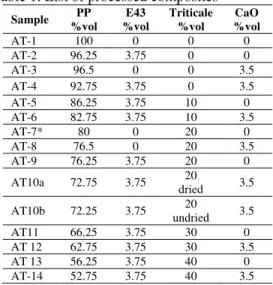
wt% of MA). The CaO with 98% purity from Laboratoire MAT Inc was used as reactive filler. It is a basic reactive filler that has the role to absorb moisture in fibers, neutralize acidity in fiber impurities and therefore to minimize the oxidation and degradation of fibers. Furthermore, the CaO helps also to increase strength and modulus of final composites [14]. Table 1 presents the list of processed samples.
Table 1. List of processed composites Sample PP %vol E43 %vol Triticale %vol CaO %vol AT-1 100 0 0 0 AT-2 96.25 3.75 0 0 AT-3 96.5 0 0 3.5 AT-4 92.75 3.75 0 3.5 AT-5 86.25 3.75 10 0 AT-6 82.75 3.75 10 3.5 AT-7* 80 0 20 0 AT-8 76.5 0 20 3.5 AT-9 76.25 3.75 20 0 AT10a 72.75 3.75 20 dried 3.5 AT10b 72.25 3.75 undried 20 3.5 AT11 66.25 3.75 30 0 AT 12 62.75 3.75 30 3.5 AT 13 56.25 3.75 40 0 AT-14 52.75 3.75 40 3.5 Extrusion Process
Regarding the appropriate way to feed natural fibers into the process, a proprietary pelletizing step of fibers is necessary because triticale straw has high volume/weight ratio and are hard to be fed without compromise the consistency of fibers flow rate. To facilitate the pelletizing, the triticale fibers were first wetted using an amount of water equivalent to triticale straw weight. Then the wetted fibers were pressed through a die plate using a two rotating roll mills. The physical aspect of triticale fibers before and after pelletizing is presented in Figure 1. Finally, the triticale pellets were dried at 80oC for 48 hours before extrusion.
The Leistritz 34 mm co-rotating twin-screw extruder composed of 12 zones was used to prepare the composites. Polypropylene and additives were fed in the first zone and the pelletized triticale in the 5th zone. The extruder was operated at a constant screw rotation speed of 100 rpm and a temperature of 185oC. The used capillary die had a diameter of 2 mm and the extrusion total flow rate was adjusted at 10 kg/h. A vacuum zone was considered in the 9th zone of the extruder in order to eliminate the volatiles and humidity from materials.
Morphology and Microstructure
Scanning electron microscopy (SEM) was carried out on polished composite surfaces coated with a gold/palladium alloy prior to the observation. JEOL JSM-6100 SEM at a voltage of 10 kV was used to analyze the dispersion of triticale fibers into the matrix using polished surfaces and the interface between triticale and PP matrix using the fractured specimens resulted from mechanical testing.
Rheology
The rheological properties of PP, PP/triticale without and with CaO were measured at 185oC using a rotational rheometer with a plate-plate geometry in dynamic mode. The plate diameter was 25 mm while the gap was
approximately 1.7 mm. Frequency sweeps were carried out to determine complex viscosity over a frequency ranging from 0.1 to 100 rad/s. The tests were conducted for a deformation of 15%. Care was taken to dry the materials at 80oC for 48 hours right before testing and to test the stability of composites materials during rheological measurement. The tests were conducted under a nitrogen blanket to minimize oxidation and to maintain a dried environment.
Dynamic Mechanical Thermal Analysis
Dynamic mechanical properties of the composites were measured using a strain controlled bending mode in a DMTA V apparatus from Rheometric Scientific Ltd with single cantilever geometry. The 14x17x1.7 mm3 rectangular samples were obtained by compression in a Carver press. The results were obtained at a constant frequency of 1 Hz, and an imposed strain of 0.2%. The samples were analyzed from -50°C to 150°C at a heating rate of 2°C/min.
Thermogravimetric Analysis
The thermal stability and decomposition of the composites with selected formulations were carried out on a Mettler Toledo TGA/DTA 1 apparatus at a scan rate of 10°C/min from 30°C to 700°C under nitrogen.
Mechanical Properties
The samples used for mechanical testing were first dried then injection molded using a Boy injection machine at a temperature of 200oC and mold temperature of 30oC. The tensile testing was carried out according to ASTM D638. The flexural and Izod impact testing were carried out according to ASTM D790 and ASTM D259, respectively. At least 5 specimens were tested for each formulation.
Fire Resistance
Horizontal Burning Test was conducted on the Govmark UL94. A set of three specimens are tested for each sample.
Results
Figure 1 presents the physical aspect of triticale fibers in their original state and after the pelletizing step. There was no thermal degradation observed during the pelletizing step. Due to the high shear during the pelletizing the temperature of wet triticale fibers was raised only up to 70-80oC. It is well known that natural fibers start to degrade at 205-210oC. Nevertheless, at this temperature, it was difficult to maintain the integrity of flax straw pellets after pelletizing. This could be explained by the high waxes content on triticale straw surface that probably circumvent the triticale fibres from stick together and form the pellets. A continuous liquid
nitrogen flow was purged into the pelletizer in order to lower the temperature.
Original Triticale Pelletized Triticale
Figure 1. Physical aspect of triticale fibers: as received and after pelletized
10% Triticale 20% Triticale
30% Triticale 40% Triticale
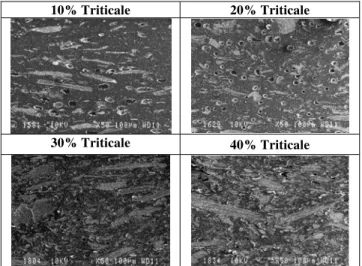
Figure 2. SEM micrographs of longitudinal polished surfaces of composites obtained with 10, 20, 30 and 40% fibers in the presence of E43 and CaO.
Two series of composites were obtained with 10, 20, 30 and 40 %vol triticale by twin screw extrusion. In the first run the composites contain only 3.75 %vol E43 while for the second one 3.5 %vol of CaO was added additionally. Figure 2 illustrates the morphologies of PP/triticale composites obtained in the presence of E43 and CaO. It can be seen that triticale particles consist in a low content of fibers and high content of shives. In general an uniform dispersion of triticale straw pellets was observed for low triticale contents. At high triticale concentrations, some triticale agglomerations can be observed because of the low resin content cannot ensure a good resin wetting and resin diffusion into the triticale (30 and 40 %vol correspond at 40 and 50 %w).
Shive Fiber bundle
Figure 3. Shive and fiber bundle SEM micrographs
The images presented in Figure 3 disclose the morphologies of shives and fiber bundles observed in composites at high magnifications.
Figure 4 shows the effect of increasing triticale content and of the CaO presence on the viscosity of PP/ triticale composites measured at 185oC. The viscosity of as received PP is also presented for comparison. The curves, typical for a pseudo-plastic material, show a decrease in viscosity at increasing the shear rate. The viscosity highly increased with triticale content. For the same triticale content, the addition of CaO was reflected into an increment of viscosity as it acts as filler. However, PP/triticale/E43/CaO composite is a complex system from rheological point of view. Indeed interaction between fibers, fiber-matrix, and the presence of the filler increased the viscosity, while the presence of fibers at wall-plate interfaces can decrease the measured viscosity because the wall-slip effect.
PP/Triticale composites 185oC
Freq [rad/s]
1e-1 1e+0 1e+1 1e+2
1e+2 1e+3 1e+4 1e+5 1e+6 PP pellets 10% Triticale + E43 10% Triticale +E43 + CaO 20% Triticale + E43 20% Triticale + E43 +CaO 30% Triticale + E43
E
ta
* [
P
a.s] 30% Triticale + E43 + CaO40% Triticale + E43 40% Triticale + E43 +CaO
Figure 4. Complex viscosity as a function of frequency for pure PP, PP/triticale without and with CaO respectively.
Thermal behavior was investigated only for composites with 20 %vol of triticale with different matrix formulations. Composite without any additive, with CaO alone, with E43 alone, and with a combination of E43 and CaO respectively were selected with the purpose to study the effect of each additive and also their combination on the composite behavior. The curves obtained from a TGA ramp up to 700oC are presented in Figure 5. The PP alone and PP with 20 %vol glass fibers were used as comparison. PP and its composite with glass fibers presented the highest thermal resistance in which they started to degrade significantly at around 455oC. The addition of 20 %vol of triticale, no matter the matrix formulation was, resulted in split of material degradation in a two step. The first weight loss of composites, which should be related to the degradation of the triticale, started at 335 and 333oC for the one without CaO. When the composite contained CaO alone
or CaO+E43, the first step of thermal degradation started at a bit higher temperature (340oC) but the weight loss took place very gradually. CaO presence slightly postponed the thermal degradation, phenomenon confirmed in addition for the second degradation step (457oC versus 463oC).
Figure 5. TGA curves for PP/20% triticale at different matrix formulations.
a
b
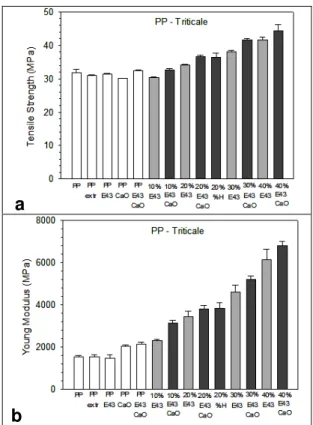
Figure 6. Tensile properties of PP/triticale composites: a) strength and b) modulus.
Mechanical properties of PP/triticale composites are shown in Figures 6-8. The tensile properties of composites are unveiled in Figure 6. Tensile strength of extruded PP and PP with different additives, in the absence of triticale, were similar to that of pure PP. Addition of 10 %vol triticale did not change the tensile
strength value, but it increased subsequently with triticale content. It can be explained by the fact that the presence of E43 improved triticale/PP interaction. The CaO addition in each formulation improved further the tensile strength. The latter was continuously increased from 32.5 MPa up to 44.4 MPa when triticale content increases from 10 at 40 vol%. This can be explained by the further enhancement of the fiber-matrix interface due to the presence of this reactive additive. At 20 %vol triticale a composite was supplementary extruded without drying the triticale pellets, (sample 20% %H), with the purpose to study the effect of humidity on composite properties. The tensile strength of this sample remains unchanged as compared to that of the dried one. This confirms the advantage of CaO in the formulation which can eliminate the drying step prior processing as discovered in [14]. This can be very useful in terms of energy reduction during processing. Tensile modulus has similar trend as tensile strength (Figure 6b).
a
b
Figure 7. Flexural properties of PP/triticale composites: a) strength and b) modulus.
As can be observed in the Figure 7, flexural properties, strength and modulus, increase with triticale content and improve at CaO addition with a similar trend as for tensile properties. The flexural strength increased from 44.5 MPa up to 71 MPa when the triticale content increased from 10 to 40 %vol. On the other hand, flexural modulus increased from 1268 up to 3947 MPa for the same formulations that include 3.75 %vol E43 and 3.5 %vol CaO. Once again, this reactive additive enhances the fiber-matrix interface. Flexural behaviour
of composites was also confirmed by DMTA analysis (results were not showed here). Figure 8 discloses the Izod-impact behavior of composites. All composite impact strengths are similar in comparison with that of pure PP when standard deviation is taken into account.
Figure 8.Izod-impact strength of PP/triticale composites. Figure 9 presents SEM images obtained on fractured surfaces of specimen under tensile test. As for TGA analysis, only composites with 20 %vol triticale with different formulations were tested (i.e. without additives, with CaO, with E43 and CaO+E43 respectively). The purpose was to study the effect of each additive on fiber/matrix interface. For composite that contains no additive, there is a smooth rupture surface and also more holes in matrix left by the pull-out triticale. All these proved a bad fiber-matrix interface. For composites that contained either CaO or E43 alone, fibrilar-like rupture and short pull-out triticale could be observed. It proved that, at some level, a recovering of their good interface took place. When the matrix formulation contains both E43 and CaO, there is matrix attached or even covered on surface of the fractured triticale, which presented the best interface. This observation corroborates with tensile and flexural results explaining the roll of each additive in the adhesion between the matrix and the triticale.
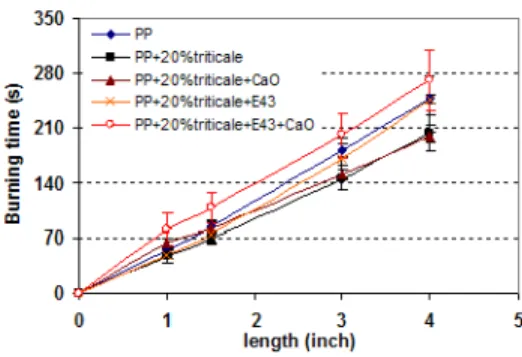
The result for UL94 burning test is shown in Figure 10. The tested samples consist of 20 %vol triticale but having matrix formulation. These tests were carried out to investigate the effect of fibers and reactive additives in fire behaviour. During the test, the dripping of PP droplets was observed for pure PP samples. Composite samples do not show this drip, however the composite specimens deform during the test. The result indicates that the presence of triticale alone or even with coupling agent (E43) does not benefit to the fire resistance of the PP but rather facilitate the burning. Ca(OH)2 is
considered to be flam retardant for polymer systems although it is less effective as Mg(OH)2 and Al(OH)3.
CaO used in the composite formulation could transform to Ca(OH)2 due to the presence of moisture (hydrogen
bond) in triticale during compounding. The presence of CaO alone in the composite formulation does not show
any reduction on the burning rate although the ignition is more difficult.
PP+20% Triticale
PP+20% Triticale+CaO
PP+20% Triticale+E43
PP+20% Triticale+E43+CaO
Figure 9. SEM microstructural details of surface fracture of injected samples for PP/20% triticale at different matrix formulations.
References
1. L. Zhao, Y. Boluk, Applied Surface Science, 257, 180-185 (2010).
2. G. F. Fanta, R. C. Burr, W. M. Doane, Journal of
Applied Polymer Science, 33, 899-906 (1987).
3. G. Chauvelon, L. Saulnier, A. Buleon, J.-F. Thibault, C. Gourson, R. Benhaddou, R. Granet, P. Krausz, Journal of Applied Polymer Science, 74, 1933–1940 (1999).
Figure 10. Burning of PP/20% triticale composites at
different matrix formulations. 4. Y. P. Patil, B. Gajre, D. Dusane, S. Chavan, S. Mishra, Journal of Applied Polymer Science, 77, 2963–2967 (2000).
This may be due to the poor dispersion of CaO in the matrix because of the lack of E43 in composites formulation. The combination of E43 and CaO in composite formulation shows better fire resistance in term of difficulty to ignite and also the burning time. It is speculated that the coupling agent and CaO helps to disperse well the CaO in the composite thus it can provide a better protection to fire. This combination led to the formation of char during burning and slowed down the burning.
5. R.-C. Sun, X. F. Sun, Journal of Applied Polymer
Science, 87, 1277–1284 (2003).
6. A. A. Mohamed, J. Xu, Journal of Applied Polymer
Science, 106, 214–219 (2007).
7. M. Avella, E. Martuscelli, B. Pascucci, M. Raimo, B. Focher, A. Marzetti, Journal of Applied Polymer
Science, 49, 2091-2103 (1993).
8. M. Avella, G. La Rota, E. Martuscelli, M. Raimo,
Journal of Materials Science, 35, 829– 836 (2000).
9. H. Wang, X. Sun, P. Seib, Journal of Applied
Polymer Science, 84, 1257–1262 (2002).
Conclusions
10. F. Le Digabe, N. Boquillon, P. Dole, B. Monties, L. Averous, Journal of Applied Polymer Science, 93, 428–436 (2004).Polypropylene/triticale composites were successfully processed for the first time using a semi-industrial scale co-rotating twin screw extruder. The original triticale feeding into the extrusion process consisted in using dense triticale pellets to maintain a consistent feeding flow rate. Triticale content was increased as up as 40 %vol while the formulations contained coupling agent or a combination of coupling agent and reactive agent. Rheological and mechanical properties increased with fibers concentration. The presence of coupling agent helped to improve the fiber/polymer adhesion and increased mechanical properties. The use of a reactive agent further ameliorated adhesion and, therefore, the mechanical behavior. The unexpected synergy between reactive agent and coupling agent assists the promotion of triticale particles from regular filler to reinforcement category and also bring further advantage in term of thermal stability and fire resistance.
11. A. Ashori, A. Nourbakhsh, Journal of Applied Polymer Science, 111, 2616–2620 (2009).
12. M. Pan, S. Y. Zhang, D. Zhou, Journal of Composite
Materials, 44, 1061-1073 (2010)
13. T.-D. Ngo, W. Hu, M.-T. Ton-That, J Denault, C. Belanger, W. Chute, T. Kloeck, 18th Annual BEPS Meeting, (2010).
14. M.-T. Ton-That, F. Perrin-Sarazin, J. Denault, US Patent 7,041,716 B2 (2006).
Key Words: polypropylene, triticale, CaO, composites
Acknowledgements
The authors acknowledge the financial support from Agriculture Agri-Food Canada for the CTBI Network via the ABIP research program. The kind supply of triticale particles from Dr. Wade Chute, and Mr. Trevor Kloeck Alberta Innovate Technology Futures is well appreciated.