HAL Id: hal-02124314
https://hal.archives-ouvertes.fr/hal-02124314
Submitted on 9 May 2019
HAL is a multi-disciplinary open access
archive for the deposit and dissemination of
sci-entific research documents, whether they are
pub-lished or not. The documents may come from
teaching and research institutions in France or
abroad, or from public or private research centers.
L’archive ouverte pluridisciplinaire HAL, est
destinée au dépôt et à la diffusion de documents
scientifiques de niveau recherche, publiés ou non,
émanant des établissements d’enseignement et de
recherche français ou étrangers, des laboratoires
publics ou privés.
Selecting Parents with Wake-Up Radios for Load
Balancing in RPL
Sebastian Sampayo, Julien Montavont, Thomas Noel
To cite this version:
Sebastian Sampayo, Julien Montavont, Thomas Noel. Selecting Parents with Wake-Up Radios for
Load Balancing in RPL. CoRes 2019, 2019, Narbonne, France. �hal-02124314�
for Load Balancing in RPL
Sebasti´an L. Sampayo
1
et Julien Montavont
1
et Thomas No¨el
1
1ICube Laboratory, University of Strasbourg, 300 Bd S´ebastien Brant, F-67412 Illkirch, France
Wake-Up Radios is an emerging technology, aiming at pushing forward the frontiers of energy efficiency without trading it off for latency nor reliability. Extending the lifetime of the nodes as much as possible is one of the main goals in Multi-hop Wireless Sensor Networks. The Routing Protocol for Low Power and Lossy Networks (RPL) is commonly used in these applications. However, there is still an open problem in its design when it comes to achieving both stability and efficient routing at the same time. In this article, we present Load Balancing Parent Selection (LoBaPS), an algorithm to select opportunistically the next hop, based on RPL. It capitalizes on the Wake-Up Radio and its always-on feature, as well as its Ultra-Low Power consumption. We compare the performance of LoBaPS with that of W-MAC, a reference protocol that uses Wake-Up Radio and supports RPL in its traditional way. The results are obtained through simulations in COOJA for a network of nodes running ContikiOS, and show that the lifetime can be improved up to 55%, while the Packet Delivery Ratio (PDR) can raise a maximum of 20%, keeping a reasonable level of latency. In addition, the network is more robust to node shutdowns and requires less control overhead.
Mots-clefs : WSN, Wake-Up Radio, RPL, opportunistic routing, Contiki, load balancing
1
Introduction
Wireless Sensor Networks (WSN) comprise low power and resource-constrained devices. Traditionally, the energy consumption was controlled in these networks by some form of duty-cycle in the communication protocol at the MAC layer trading off latency for energy efficiency. In recent years the Wake-Up Radio (WuR) technology has advanced with increasing acceptance because it promises the end of this tradeoff [PMK+17]. The essentials of it are explained in Section 2.
The Routing Protocol for Low Power and Lossy Networks (RPL [Win12]), has been suggested by the In-ternet Engineering Task Force (IETF), for multi-hop communications. In RPL, the network is a Destination Oriented Directed Acyclic Graph (DODAG), where the sink is the root. One of the key features of this pro-tocol is the rank of each node. The rank is a level of how far away a node is from the sink. To calculate the rank, RPL uses a metric , for example the minimum amount of hops (MinHop), and an Objective Function, which translates the metric into the rank value. A commonly used Objective Function is Objective Function Zero (OF0) [Thu12] because of its stability and simple implementation. OF0 selects as the preferred parent the one with the best metric and a backup feasible successor.
However, RPL still presents some open problems: inefficient parent selection, slow recovery time after a preferred parent dies and energy bottleneck (the preferred parent consumes way more energy than the rest of its siblings limiting the lifetime of the network).
In this article, we present LoBaPS, an approach to combine the best of both worlds: the power efficiency and always-on feature of WuR with the stability of OF0 and MinHop in RPL. The algorithm is described in Section 3. Moreover, we put the focus on load balancing in order to extend the lifetime of the network. This also provides robustness to the network that can adapt quickly to shutdowns of nodes. This is reflected in the resulting Packet Delivery Ratio. This metric, together with the latency and the lifetime of the network are compared to that of W-MAC in Section 4. Finally, we conclude the article and discuss future work in Section 5.
Sebasti´an L. Sampayo et Julien Montavont et Thomas No¨el
2
Wake-Up Radio
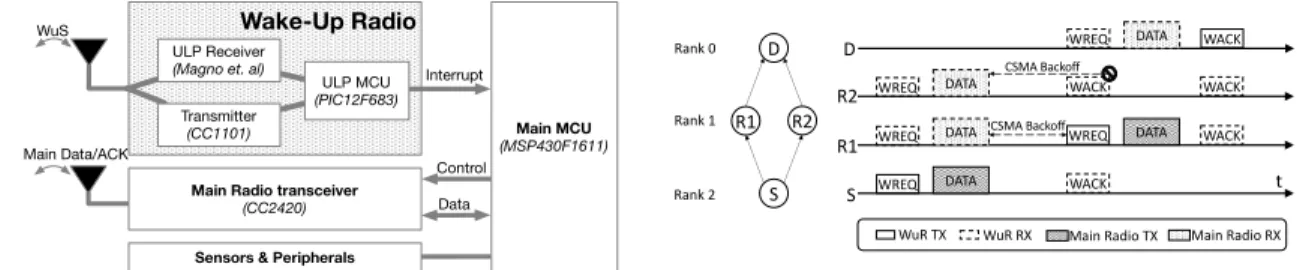
The Wake-Up Radio (WuR) is a secondary module connected to the main node microcontroller (MCU), that contains a Wake-Up Receiver (WuRx), as illustrated in Fig 1. The distinction of this receiver is its Ultra-Low Power (ULP) consumption in listening mode between 4 and 5 orders of magnitude less than that of the traditional radios [PMK+17]. In most of the designs presented in the literature [PMK+17], the way to achieve this is using a simple On-Off Keying (OOK) modulation which requires uncomplicated circuits, and a low data rate up to 10 kbps.
As a result of this architecture, there are two communication channels. In the Main Radio (MR) channel the node uses its traditional transceiver (e.g. CC2420, etc.). In order to listen to the WuR channel, the node uses the WuRx. In contrast, to transmit on this channel, it must use some existing radio transmitter, which can be the same as that of the MR or another one, as long as it is able to modulate the signal into OOK and low data rate. The signal received on the WuRx is called the Wake-Up signal. Thanks to the ULP feature, the nodes can listen to the WuR channel continuously.
In addition, the WuR module might contain an optional sub-module to decode the data received. For this task, it is common to use a ULP MCU that is placed in between the WuRx circuit and the main MCU through some sort of digital connection such as SPI or I2C [MJS+16]. In general, the information transmitted in the Wake-Up signal is the address of the destination, so that a receiver node maximizes the sleeping period of the MR and only wakes up when another node addresses it. For this reason, the WuR is especially interesting for asynchronous communications.
With this in mind, an example of how this architecture might work is given in the W-MAC protocol presented in [PIM17]. There, the WuR is driven in the MAC layer. Whenever a node wants to communicate, it transmits a Wake-Up signal with the address of the destination, so that other nodes overhearing the WuR channel do not wake up their MR in vain. A short time (called sync delay) after the Wake-Up signal has been transmitted, the source transmits the data packet over the MR channel. Upon reception of this packet, the receiver sends back an ACK on the MR channel.
3
LoBaPS
The main contribution of this article is the Load Balancing Parent Selection (LoBaPS) protocol that takes advantage of the Wake-Up Radio (WuR) to select opportunistic parents in RPL. LoBaPS starts operating once RPL has converged and only supports convergecast data traffic.
The source of the application packet initiates the communication by transmitting a packet over the WuR channel, called Wake-Up Request (WREQ), which contains the node’s own rank, as depicted in Fig. 2. All nodes in the vicinity of the sender will receive this WREQ as they are continuously listening to the WuR channel. Whenever a node receives a WREQ, it compares the received rank with its own rank, and only wakes up its main radio if the former is higher than the latter. This way, only nodes with lower rank can forward the packet, avoiding routing loops.
A short time after transmitting the initial WREQ, the source sends the data packet over the main channel, turns off its main radio, and starts a timer to wait for the acknowledgment. When the sink (which is the final destination of all data packets) wakes up its main radio and receives a data packet, it sends back an acknowledgment via the WuR channel. In the case of an intermediate node, it tries to forward it by transmitting a new WREQ with its own rank. The purpose of this WREQ is threefold: to wake up next hops toward the sink and to acknowledge data reception for the sender (the third purpose is detailed later). As a result, an acknowledgment (WACK) only differs from the WREQ that triggered its transmission by the fact that the advertised rank is lower than the one included in the WREQ.
A single data packet may be received by more than one parent (cf. R1 and R2 in Fig. 2). To limit collision, the Carrier Sense Multiple Access (CSMA) layer of each forwarding node calculates a random backoff period before the transmission of the new WREQ. The node for which the backoff expires first will send a WREQ, cancelling the ongoing backoff of the other forwarders. This random backoff ensures that the feasible successors do not try to retransmit the packet at the same time generating collisions.
Collision on initial WREQ can also occur, especially when the WuR works at low data rates, because the time over the air is significant and can be longer than the one of the main data. In consequence, the channel
Main Radio transceiver
(CC2420)
Sensors & Peripherals
Control Interrupt Main MCU (MSP430F1611) Data Wake-Up Radio ULP Receiver
(Magno et. al)
Transmitter (CC1101) ULP MCU (PIC12F683) WuS Main Data/ACK
Fig. 1: Wake-Up Radio Architecture
D S R2 R1 Rank 1 Rank 0
Rank 2 S WREQ DATA WACK t
CSMA Backoff
WREQ
R1 DATA WREQ DATA WACK
WREQ
R2 DATA WACK WACK
CSMA Backoff
D WREQ DATA WACK
WuR TX WuR RX Main Radio TX Main Radio RX
Fig. 2: Example of the algorithm in a timeline
is extremely sensitive to collisions because the transmission opportunities are very limited. Thus, a Clear Channel Assessment (CCA) function is implemented in the WuR driver and is used every time a message is transmitted over the WuR channel. When the WuR channel is sensed as busy, a collision error is passed to the CSMA layer. Although CCA is very common in traditional radio transceivers, we are part of the only few proposals investigating its usage in WuR [GLP18]. We are convinced that such a feature is required to increase the overall network performance as supported by the results presented in Section 4.
4
Results
For the purpose of studying the benefits of the proposed algorithm, we analyze the network lifetime (that is the time elapsed when the first node dies) and the average Packet Delivery Ratio (PDR). For the PDR, we analyze the evolution of its value over time through the whole simulation (that is, while the network is a connected graph). Both LoBaPS and W-MAC are implemented in two versions: regular and without acknowledgments (identified by the suffix ’NA’). We use an extension of COOJA, called WaCo [PIM17], to simulate a network of ContikiOS nodes supporting the Wake-Up Radio because it reproduces the actual firmware that runs on real devices. Additionally, the simulations are performed in a triangular grid topology where the nodes are at a maximum of 2 hops away from the sink and with a node density (i.e. number of nodes per unit area) such that each leaf can have between 2 and 7 feasible parents.
The network lifetime results are shown in Fig. 3. In the best case, LoBaPS achieves a 55% better lifetime than W-MAC, and the improvement in mean values is of 17%. The reason why is that the network balancing does not depend on the initial DIOs exchange. All feasible successors of a node can compete to be its parent every time the node transmits. At the same time, in the versions of the protocol without ACKs we can see that there is an inversion: W-MAC NA achieves a longer lifetime in median value, though with less precision. This is because in LoBaPS every feasible successor wakes up and listen through the Main Radio wasting energy.
In Fig. 4 we can see the decline of the PDR when the first node dies. In the case of W-MAC, this is between 750 s and 1200 s, whereas in LoBaPS it is around 1100 s. We can see that in W-MAC protocols the PDR goes down fast and with high variability. On the contrary, LoBaPS versions provide good stability during the network lifetime and a precise and controlled decline slope. The final PDR can be between 2% and 20% better in LoBaPS because of its robustness to parents dying.
5
Conclusions and future work
This article introduces LoBaPS a load balancing parent selection algorithm. We showed that it overcomes the single point of failure problem at the preferred parent of traditional RPL with Objective Function Zero and MinHop metric. This way, it also extends the network lifetime up to 55% by consuming the battery of the feasible successors in a balanced way. Furthermore, we found that the nature of this mechanism is more precise, providing more reproducibility than the traditional implementation of RPL. This together with an improvement of the Packet Delivery Ratio of up to 20% gives more reliability to the network infrastructure. The main drawback of the proposed algorithm is the amount of energy wasted in listening mode when all the feasible successors wake up their main radio, limiting the network lifetime. Although in the long run, the parents with the best quality links probably win the competition more often than parents with bad links,
Sebasti´an L. Sampayo et Julien Montavont et Thomas No¨el LoBaPS W-MAC LoBaPS NA W-MAC NA 800 1000 1200 1400 1600 Lifetime [s]
Fig. 3: Network lifetime
0 500 1000 1500 2000 Time [s] 50 60 70 80 90 100 PDR [%] protocol LoBaPS W-MAC LoBaPS NA W-MAC NA
Fig. 4: Packet Delivery Ratio
nothing ensures that the most reliable route is chosen. This is another limitation of this work and we plan to investigate a solution in the future.
In our next steps, we plan to extend this algorithm to balance arbitrary metrics and not only packet transmissions as well as experiments on real devices.
Acknowledgments
This work is part of the project WakeUp funded by the French National Research Agency (ANR).
References
[GLP18] D. Ghose, F. Y. Li, and V. Pla. MAC Protocols for Wake-Up Radio: Principles, Modeling and Performance Analysis. IEEE Transactions on Industrial Informatics, 14(5):2294–2306, May 2018.
[ITN13] O. Iova, F. Theoleyre, and T. Noel. Stability and efficiency of RPL under realistic conditions in Wireless Sensor Networks. In 2013 IEEE 24th Annual International Symposium on Personal, Indoor, and Mobile Radio Communications (PIMRC), pages 2098–2102, September 2013. [MJS+16] M. Magno, V. Jelicic, B. Srbinovski, V. Bilas, E. Popovici, and L. Benini. Design,
implemen-tation, and performance evaluation of a flexible low-latency nanowatt wake-up radio receiver. IEEE Transactions on Industrial Informatics, 12(2):633–644, April 2016.
[PIM17] Rajeev Piyare, Timofei Istomin, and Amy L. Murphy. Waco: A wake-up radio cooja extension for simulating ultra low power radios. In EWSN, 2017.
[PMK+17] R. Piyare, A. L. Murphy, C. Kiraly, P. Tosato, and D. Brunelli. Ultra low power wake-up radios: A hardware and networking survey. IEEE Communications Surveys Tutorials, 19(4):2117– 2157, Fourthquarter 2017.
[Thu12] P. Thubert. Objective function zero for the routing protocol for low-power and lossy networks (rpl). RFC 6552, RFC Editor, March 2012.
[Win12] T. Winter. Rpl: Ipv6 routing protocol for low-power and lossy networks. RFC 6550, RFC Editor, March 2012.