HAL Id: hal-03123231
https://hal.archives-ouvertes.fr/hal-03123231
Submitted on 27 Jan 2021HAL is a multi-disciplinary open access archive for the deposit and dissemination of sci-entific research documents, whether they are pub-lished or not. The documents may come from teaching and research institutions in France or abroad, or from public or private research centers.
L’archive ouverte pluridisciplinaire HAL, est destinée au dépôt et à la diffusion de documents scientifiques de niveau recherche, publiés ou non, émanant des établissements d’enseignement et de recherche français ou étrangers, des laboratoires publics ou privés.
How We Got Fuzzy (1976 - 1980)
Didier Dubois, Henri Prade
To cite this version:
Didier Dubois, Henri Prade. How We Got Fuzzy (1976 - 1980). Seising, R.; Trillas, E.; Moraga, C.; Termini, S. On Fuzziness: A Homage to Lotfi A. Zadeh, Volume 2., 299, Springer, pp.777-796, 2013, Studies in Fuzziness and Soft Computing book series (STUDFUZZ ), 978-3-642-35644-5. �10.1007/978-3-642-35644-5_49�. �hal-03123231�
How
We Got Fuzzy (1976 - 1980)
Didier Dubois , Henri Prade
Abstract. This short note reports on our beginnings in fuzzy set theory and
possi-bility theory, indicating our interests and concerns at that time, also acknowledging the support of many persons who in some way or other have helped us develop our research work.
1
Introduction
This paper is unusual in our writings. It does not not contain any scientific results or proposals, nor does it offer a survey of some topic. It is not even just a piece of testimony on the development of research in fuzzy set theory in the late seventies. It rather intends to illustrate how research is a matter of personal taste and interest, but also of good or bad luck, of perseverance through the hazards of life, of persons encountered who were sympathetic, critical or just indifferent to your enterprise. It also makes it clear that research is not an activity whose development can be fully planned and evaluated in advance, although more and more people in charge of its organization would like to make us believe to the contrary, in these days of unrea-sonable love of money and short-term profit.
We first explain in which circumstances we heard of fuzzy sets for the first time, why we decided to work on this topic, and at which point in time we finally started to better understand what they may be useful for. We highlight the opportunity offered to us of enjoying a one-year post-doctoral position in American universities with a lot of freedom for writing our first book. Finally we show how, back to France, we continued to develop our ideas, while experiencing how badly considered and poorly understood were fuzzy sets in that time, but also encountering various supports and encouragements from key people.
2
Encountering Fuzzy Sets
After getting our engineering degrees in aeronautics that we both obtained in 1975 from the Ecole Nationale Supérieure de l’Aéronautique et de l’Espace, a French “Grande Ecole" (usually abbreviated as “Sup’Aéro"), we prepared a Doctor-Engineer thesis for two years (the usual duration at that time for a French PhD the-sis) at the Department of Automatic Control in the “Centre d’Etude de Recherche de Toulouse" (CERT-DERA) in France. Our respective thesis topics were the
optimization of bus transportation networks (DD1) and the real time management of scheduling problems (HP). Nine months after starting our thesis research works, in June 1976, at lunch time, a friend2 mentioned the arrival, at the Sup’Aéro library, of several volumes dealing with a strange thing called “sous-ensemble flou"3. He explained us that it had something to do with a generalized set theory with graded membership. Actually, these were the three first volumes of an introductory treatise in French (“for the benefit of engineers", as said in the complete title) by Arnold Kaufmann (1911-1994) [39, 40, 41], a series also including [42, 44], only the first volume of which was translated in English [43].
In fact, we had heard of fuzzy sets for the very first time some weeks before, in a prospective working paper about future lines of research in production engineering by a French professor, Lucas Pun, from Bordeaux. Indeed, in this report, he advo-cated the relevance of the general idea of using fuzzy sets in this area (see, e.g. [62] – another paper we saw later on). However, the working paper we had in hands gave absolutely no detail about fuzzy sets. So, when our friend reported us about the arrival of Kaufmann’s books and a bit about their contents, our curiosity was immedi-ately aroused, because we soon realized that it might be connected to multiple-valued logic, a topic for which one of us (HP) had an older personal interest4. This inter-est was connected to a general concern for logic in general, that both of us shared, since, during the last year of our engineering school, we had attended an optional course on propositional and first-order logics, given for the first time by Hervé Gal-laire [36], a professor of computer sciences at Sup’Aéro, and a renowned database specialist. So, in the afternoon of the same day, we borrowed the three volumes from the library, and started to look at their contents. Very rapidly, we got convinced of the close relation between fuzzy sets and min/max-based multiple-valued logic, and were impressed by the large range of potential applications advocated by the author, including tools for linguistics [40] and decision modeling [41]. We got excited by this new idea, and we asked our respective PhD advisors5 the permission to devote one month of our PhD time to a bibliographical study in order to see if, as suggested by L. Pun, fuzzy sets had any potential for the respective topics of our theses. We got their green light immediately without any problem (as we expected) since they
1In the following we indicate by ‘DD’ (for ‘Didier’) and ‘HP’ (for ‘Henri’) to whom a particular piece of information refers, when necessary.
2Georges Aicardi, also from “Sup’Aéro" and preparing a thesis in another field. 3The French translation of fuzzy sets.
4This interest for logic as a tool for describing the world had prompted him four years before to read an introductory book in logic [11]. This excellent treatise also presented the Piaget group of transformations of propositional sentences, and non-classical logics were mentioned within half a page. This triggered a desire to understand how a multiple-valued logic works in terms of truth tables, and led to reinvent the min-based conjunction and the max-based disjunction, before discovering two years later that such things were already known for a long time, in another more advanced introductory book [8] including a whole chapter on non-classical calculi.
5Jean-François Le Maître, a specialist of urban systems (DD), and Jacques Delmas, a spe-cialist of automatic control and production systems (HP).
were open-minded, and Kaufmann was at the time a highly regarded name [31] as the author of many books introducing new topics in engineering such as matrix cal-culus and operations research in the two previous decades. He was famous at least in the engineering circles to which our advisors belonged6.
3
First Writings
The result of this first (fuzzy) month of bibliographical search was a (handwritten !) CERT-DERA technical report [19] with an unorthodox title7. Following the advice of our supervisors, we were bold enough to send this report to professor Kaufmann himself. To our surprise, he quickly replied in a very encouraging letter (See Fig. 111.1). This report was a synthesis of the main basic notions of fuzzy set theory. It also emphasized the potential interest of fuzzy constraints and fuzzy algorithms in ar-eas such as the ones we were dealing with in our theses. At this stage, we had mainly identified the capability of fuzzy logic for expressing trade-offs between constraints and goals, and more generally its possible use for modeling linguistically described procedures (in that respect the paper by Zadeh [73] where he outlined his “linguis-tic" rule-based approach made a great impression on us, when we discovered it a bit later). Still, we felt that the impact of fuzzy sets as a tool for solving the problems to be addressed in our theses remained limited. However, we still found the idea attrac-tive and tried to keep up with the publication of new results in the fuzzy set area until the beginning of 1977, when we finally discovered an article by Ramesh Jain [46] advocating the interest of computations with fuzzy numbers based on Zadeh’s exten-sion principle [74]. We were immediately convinced that fuzzy numbers were the kind of notion that would be very useful for modeling ill-known task duration times or transportation times in our problems. Yet at that time, no practical computation method with fuzzy intervals had been published, even for particular cases. The pi-oneering investigations of Mizumoto and Tanaka [47] mainly dealt with algebraic properties of fuzzy arithmetic operations. After some joint research, we were lucky enough to discover a parametric representation of fuzzy numbers (the so-called L-R representation, now quite popular). We could then perform arithmetic operations on fuzzy numbers, as well as extended max and min operations between intervals, by
6It might have been quite a different situation, had we prepared our theses directly in the university world: For instance, we later heard that at about the same time some young colleague working at the university lab that we joined later on (and whom we still know), was strongly advised by older colleagues not to pursue the research line on fuzzy sets that she had just started. In fact, we later on received several testimonies of such states of fact in different places: Toulouse, Lyon, Paris, etc... Fuzzy sets were really a controversial topic at that time.
7“Le flou, kouackseksa ?, meaning “Fuzzy, what is this?", where “kouackseksa" is an ono-matopoeia for the French “quoi que c’est que çà", a young child phonetic approximation of the standard French query “qu’est-ce que c’est que çà".
Fig. 1. 1st letter by A. Kaufmann, after he received “Le flou, kouackseksa ?" in 1976. Note
his generosity, the broadness of his view, and his care to put people in relation: the letter encouraged us to contact M. Sugeno, R. Sambuc, and C. Ponsard.
simple computations on the parameters. These results first appeared in [20]8; they were later published in [24, 23] and soon applied to shortest path problems [25]. In the meantime, we had become aware of the work of Nahmias [48] and realized that his findings on the addition of fuzzy intervals were particular cases of ours, restricted to triangular membership functions. We had also realized that fuzzy arithmetics generalized interval arithmetics through the use of cuts. But it was only later on (in 1978, before writing our first book) that we read Nguyen’s fundamental paper on the extension principle [51], where its cut-worthiness was studied in depth.
We were also lucky enough to meet several key people that in some way or other influenced our future works in Toulouse before the 1977 summer vacations. First, in december 1976, we heard that a fuzzy set researcher, Michio Sugeno, was a vis-iting scholar in another neighboring laboratory on the same campus, the L.A.A.S.,9 for several months (it was pointed out in Kaufmann’s letter on Fig. 111.1). He was there thanks to the support of Georges Giralt, the future father of robotics research in France. After a recent sabbatical in Berkeley, Giralt had become a sympathizer of fuzzy sets. Thus, we had the privilege to discuss very early with Michio Sugeno, who gave us a copy of his landmark PhD dissertation [69]. It was also the opportunity to meet a young CNRS researcher from the same laboratory, Gérald Banon, interested in fuzzy measures and Shafer’s belief functions [68], whose work [5] would be the de-parture point of our chapter on this topic in our 1980 book [28]. A bit later we also had the chance to meet Elie Sanchez, back from Berkeley, who also gave us a copy of his remarkable PhD thesis on fuzzy relation equations and their applications to medicine. He was the first scholar to reveal the existence of possibility theory [75] to us10. This was a brand new topic at that time, to which he had just contributed [64]. These lucky encounters clearly contributed to enrich our view of the field and led to new devel-opments [21], while we were completing our PhD dissertations [13, 14, 55, 57] that we finally defended in October 1977. We had successfully applied for post-doctoral fellowships so as to pursue our works in the US. Just before our departure, Kaufmann strongly suggested us to take this opportunity and write a book on fuzzy sets. It was an unexpected advice given by a very unusual, generous and experienced man to 25 year old researchers! In fact, we decided to take this advice seriously.
8The title of this report “Le flou, mécédonksa !, meaning “Fuzzy ? this is it!", where “mécé-donksa" is an onomatopoeia for the French “mais c’est donc çà". It was echoing, in the same style as in the title of our first opus, our feeling to have finally identified a reason for advocating the usefulness of fuzzy sets.
9L.A.A.S. stands for “Laboratoire d’Automatique et d’Analyse des Systèmes". It was already at that time a very important French CNRS laboratory.
10Thanks to Shafer’s book [68], we became aware almost at the same time that an English economist, George Lennox Sharman Shackle (1903-1992) [66] had already felt the need for a similar calculus [18], but on the basis of quite different motivations. This is a good example of the fact that the emergence of new theories may be the result of multiple attempts. A bit later HP had the chance, at a PhD committee, to meet Shackle, a delightful old-fashioned English professor, who was glad to discover that his ideas were starting to have a revival [67], to which we later contributed when providing a decision-theoretic axiomatization of possibility theory.
4
Discovering North-American Research
In November 1977, we left for Purdue University (DD) and Stanford University (HP) respectively, supported by one-year IRIA11 scholarships, with one idea in mind: to write that book. The choice of these universities was differently motivated. On the one hand, Prof. King-Sun Fu (1930-1985), a leading figure in pattern recognition in that time, had already done some remarkable work on fuzzy automata, but also on the axiomatics of fuzzy set connectives in relation to decision analysis [35]. DD sent a letter to him expressing his high interest for Fu’s paper on connectives, and the latter was kind enough to welcome the visit in his group of a young researcher interested in fuzzy sets. On the other hand, the Stanford AI Lab. was one of the very few leading research places in artificial intelligence in those days. Thanks to the support of Georges Giralt, HP was accepted in the group of Tom Binford in order to learn AI and robotics, and more particularly, planning. At that time, nobody was interested in fuzzy sets12 at the Stanford AI Lab. On the other hand, Stanford was only one hour
by car from Berkeley University and the Electronics Research Laboratory at Evans Hall, where Prof. Zadeh’s seminar was taking place.
American university libraries were a paradise for two young French researchers willing to write a research monograph: they were generally open all day long (even late in the evening), the whole week, and they allowed you to have a direct access to books and journals. Moreover they contained almost everything you may need. It was for us an enormous difference with the French system, even if we were very priv-ileged at the time of our thesis since our laboratory had access to the French Army library “CEDOCAR" (Centre de Documentation de l’Armement) where it was at least possible to order copies of articles. In order to work together on our project, we decided to spend one month in Albuquerque, New Mexico around Christmas vacations, since it was sort of mid-way between LaFayette, Indiana (where Purdue University is) and San Franciso: it took each of us about 36 hours by bus to reach the place! Apart from visiting Santa Fé, we spent days of intensive work, trying to build an organized view of our readings, and to develop our own ideas: we wrote there the first versions of 5 papers which later were published in journals, and a long analysis of Zadeh’s paper on the PRUF representation language. It resulted in a thick Purdue University technical report [22] (see Fig. 111.2.a). Later, in April we met again for several weeks in Menlo Park (near Stanford) for preparing the tentative table of contents of the future book, that we then presented to Prof. Zadeh. As he wrote it later in the foreword to the book, he “was rather skeptical" on the possibility of
11IRIA, now INRIA (Institut National de Recherche en Informatique et Automatique), is a French organization for research in applied mathematics, computer sciences and automatic control, which in that time was offering some scholarships every year for post-doctoral staying in foreign research laboratories.
12It was not just indifference, since HP was then encouraged to write a note [56] in order to make it clear that robotics and fuzzy set had nothing to do with each other. This rare piece should have appeared in an annual report, but, fortunately was finally never published. However, due to his broadmindedness, Tom Binford left the freedom of their research lines to members of his group.
(a) (b)
Fig. 2. (a): Purdue Univ. TR-EE 78-13 [22] (b): 1st issue of BUSEFAL, Jan. 1980
“writing an up-to-date research monograph on fuzzy sets and systems". Neverthe-less, we decided to go on, and we spent almost three months (from the end of June to mid-September) writing the book, during a hot summer in Purdue. It was hand-written, since at that time, text processing tools were in their infancy, and not in current use. Prof. King-Sun Fu encouraged us continuously during this period, even reading the manuscript and making some suggestions. Once the writing was over, we had the text type-written by a professional typist (at our own expense). Prof. Fu was then instrumental for recommending our work and having it accepted in the presti-gious “Mathematics in Science and Engineering" series edited by Richard Bellman (1920-1984) at Academic Press. After receiving the galley proofs and making a sub-stantial update during the fall of 1979 (we were then back in France), the book was finally published the next year [28] and proposed at an affordable price for interested researchers, while paying significant royalties (this situation fully contrasts with the one that became usual about 20 years later, when books became much more expen-sive, while publishers were just printing ready-to-process files in low cost countries, while significantly reducing royalties).
Our year in the US was clearly a very rich experience for each of us, not only because of the success of the project and the publication of the book, but also because of the new style of life and research we experienced, and all the people, colleagues, friends we encountered. It is clearly not possible to mention them here. Let us just report that one of us (DD), just before leaving back to France, attended his first conference in Philadelphia, where he presented results from his thesis work [14], and had thus the opportunity to meet Ronald Yager [71] for the first time. Ron presented
a family of new connectives for fuzzy sets (his now widely acknowledged subclass of t-norms and co-t-norms), a work quite unorthodox at that time where operators other than min and max were not really considered.
5
Back to France
When we came back to France in the last term of 1978, our professional situation was not the same. HP had just got a CNRS “attaché de recherche" position in an artificial intelligence research group [10] in a Toulouse university laboratory, later to become part of our present IRIT laboratory at the very beginning of the nineties. DD still had to find a position; during one year he worked first in Paris then at Grenoble IMAG laboratory as an engineer (where he could often visit Arnold Kaufmann, now retired, but still active), and finally got a permanent research engineer position at CERT-DERA laboratory in Toulouse in March 1980, in the very lab where he had worked on his Ph. D. thesis. Finally, we became both CNRS “chargés de recherche" in the same group at Toulouse university in 1984.
At that time, there were not so many people in France interested in fuzzy sets, apart from Kaufmann. The main others were Elie Sanchez in Marseille working in computer-assisted medical diagnosis (as well as Roland Sambuc [63], the first to propose the use of interval-valued fuzzy sets), Claude Ponsard (1928-1990), a professor of economics in Dijon [54], Robert Féron [32, 33, 4] in econometrics, Daniel Ponasse [53] (with Nicole Blanchard [6] who died early, Achille Achache, and Josette and Jean-Louis Coulon [12]) in pure mathematics in Lyon, Noël Mal-vache (1943-2007) and Didier Willaeys [70] in automatic control in Valenciennes, and Bernadette Bouchon [9] a young CNRS researcher in Paris, working in Claude-François Picard group. Picard was the father of questionnaire theory [52], one of the very rare influent persons in the academic world to be interested in fuzzy sets; unfor-tunately he died very early from a heart attack by the end of 1979. We should also mention the early work of Jean-Pierre Aubin [3] introducing the idea of fuzzy coali-tion in game theory. As can be seen, the interest for fuzzy sets had quite different motivations. Besides, fuzzy sets at that time remained controversial in most aca-demic circles, even if it was becoming possible to publicize them in large audience journals or newspapers, e.g. [59].
In order to foster international communication between researchers in fuzzy sets, who, at that time, were topically and geographically scattered (remember Europe was cut in two blocks, and Internet was still in infancy, operating in a few American univer-sities only), we had the idea by the end of 1979 to launch a quarterly bulletin BUSEFAL (a double acronym in English and French as can be read on the cover (Fig. 111.2.b). Each issue of this international bulletin reached about 100 pages from the beginning, and later went beyond 300 pages, publishing short contributions on new research trends, as well as many news on recently published papers. It published announce-ments and programs of scientific manifestations. It has been edited and published in our laboratory in Toulouse for 19 years since 1980 (issues 1 to 76), until the research assistant of our group, Yves Luvisutto, who took care of the assembling, printing and
mailing, retired (and was not replaced)13. BUSEFAL played an important role for scientific communication between the West and the East, and China as well; many now renowned scholars in Fuzzy Sets from Eastern European countries (Krassimir Atanassov, Slavka Bodjanova, Arkady N. Borisov, Ernest Czogała (1941-1998), Józef Drewniak, Janos Fodor, Robert Fuller, Siegfried Gottwald, Janusz Kacprzyk, Leonid Kitainik, Lazlo Koczy, V. B. Kuz’min, Jiri Mockor, Wolfgang Näther, Constantin Ne-goita, Vilém Novák, Maria Nowakowska (1928-1989), Walenty Ostasiewicz, Witold Pedrycz, Radko Mesiar, Jaroslav Ramik, Beloslav Riecan, H.-N. Teodorescu, Ma-ciej Wygralak to name a few), and from China (Cao Zhi-Qiang, Li Hongxing, Liu Yingming, Wang Peizhuang, Wang Zhenyuan, Zhang Jinwen (1930-1993)), published short notes in BUSEFAL in the eighties and nineties.
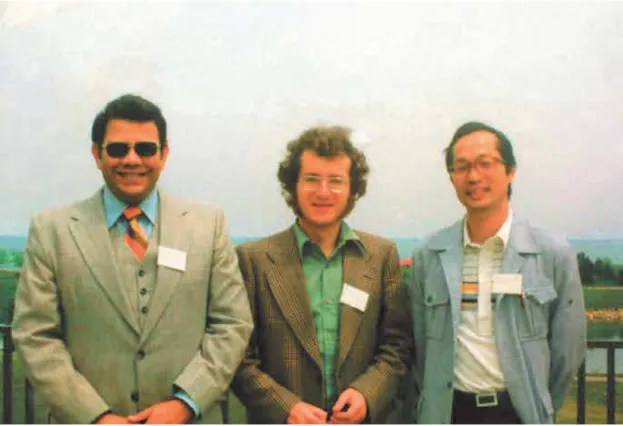
Fig. 3. Abraham Kandel, Henri Prade, Masao Mukaidono, in Evanston, IL, 3-5 June,
1980, at the 10th IEEE International Symposium on Multiple-Valued Logic
In other respects, the years 1979-1980 for us were rich in events of different kinds which durably influenced our future work. First, 1979 is the year of the “arrival" of triangular norms and co-norms in the fuzzy set world. It happened almost simulta-neously in two different places. On June 28, 1979, in Duke University at Durham, one of us (HP) was presenting our joint work [26] on different fuzzy set theoretic
13 The bulletin continued until issue 92, at LISTIC laboratory in Annecy, where the contents of issues 15 to 92 are available on line http://www.listic.univ-savoie.org/ modules.php?name=Busefal, thanks to the efforts of Laurent Foulloy and the help of Patrick Bosc.
operators, when Ulrich Höhle came to him after the talk and told him “Do you know that the operators you just presented are triangular norms and have been studied for a long time"? It was the first encounter with Ulrich who was also using the binary operation max(0,a+ b − 1) in his presentation, but in the setting of much more elab-orated mathematics [37]. The conference in Durham was also the opportunity to meet Peter Klement [45] for the first time. Thanks to Ulrich, we rapidly learnt about the solutions to the functional equation of associativity and the work of Berthold Schweizer (1929-2010) and Abe Sklar on triangular norms [65] after Karl Menger (1902-1985), and even one of us (HP) had the chance to receive a full collection of reprints on the topic from the hands of Abe Sklar, taking advantage of a conference at Northwestern University in June 1980 (see Fig. 111.3). We rapidly realized the interest of triangular for fuzzy set theory both as fuzzy set connectives (see the fi-nal version of [26] and [28, 15, 17, 60]), but also for defining decomposable fuzzy measures [61, 29]. But, triangular norms and co-norms were independently known in another “fuzzy circle". Indeed, Claudi Alsina and Enric Trillas had been for sev-eral years studying probabilistic metric spaces [1] and functional equations, before starting to work on fuzzy sets in the late seventies [2].
1979 was also the year of the first International Seminar on Theory of Fuzzy Sets in Linz (Austria) organized by Peter Klement at J. Kepler Universität, in Linz (Aus-tria). We attended the seminar from the beginning: in 1979, one of us (HP) presented the nomenclature of fuzzy measures [58] that was going to appear in our book [28], while the second year (see Fig. 111.4) the other (DD) emphasized the interest of tri-angular norms for fuzzy sets [17]. This yearly seminar, that is still going on to-day, was bound to play a major role in the development of fuzzy set mathematics, and we were again lucky enough to be among the few (less than 10) early participants, that included Ron Yager and the pioneer of fuzzy topology Robert Lowen. After at-tending the 1st Linz Seminar, HP continued from Linz towards Bucharest and visited Constantin Negoita14 [49], whose book written with Dan Ralescu [50] we regarded highly. In 1979, DD presented the first works in interactive and constrained fuzzy arithmetics (t-norm-based additions, and fuzzy expectations [30]) at the IEEE conf. on Decision and Control (Fig. 111.5).
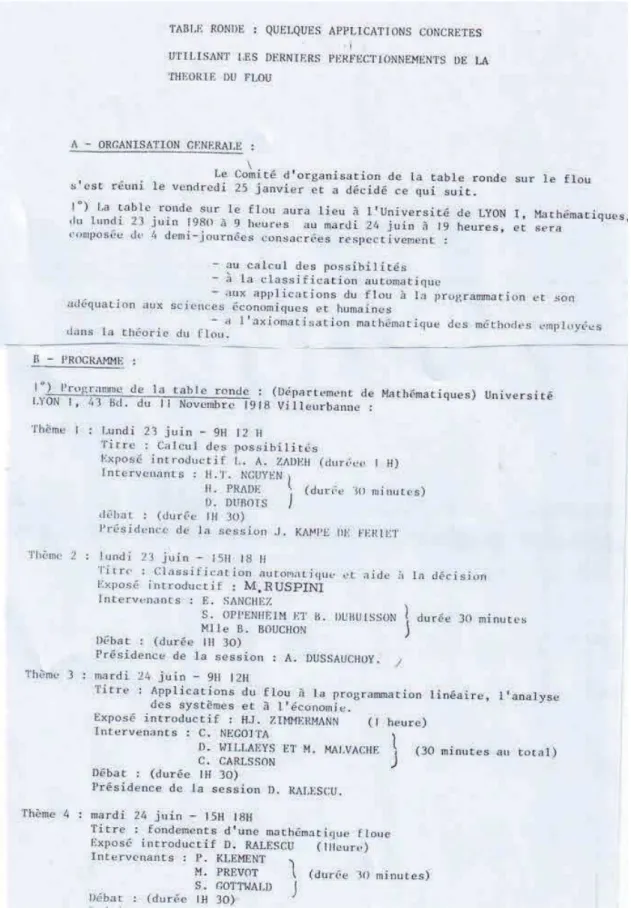
In 1980, in Lyon, Robert Féron15(the inventor of fuzzy random variables, also a follower of Maurice Fréchet (1878-1973)) took the initiative to organize a CNRS Round Table: “Quelques applications concrètes utilisant les derniers perfection-nements de la théorie du flou" (“Some concrete applications using the most recent
14Quite naively, especially if we consider that Rumania was under the law of a communist regime, the travel to Bucharest was rather unprepared, and the visit was done without pre-liminary announcement. It had funny aspects: when arriving at Negoita’s address as given in Fuzzy Sets and Systems, i.e. Str. Traian 204, HP discovered an orthodox church. It turns out that Negoita’s father was a pope! Fortunately, his mother was outside hanging out washed clothes, and she called his son who arrived half an hour later fully amazed to meet an absolutely unexpected visitor. In spite of it, an impromptu scientific visit of his laboratory was organized.
15He also came to the Acapulco Inter. Cong. on Applied Systems Research & Cybernetics; see Fig. 111.6
Fig. 4. H. W. Martin, Didier Dubois, Robert Lowen, Ronald R. Yager, Ulrich Höhle, Erich
Peter Klement. Photo by W. Schwyla. 2nd International Seminar on Fuzzy Set Theory, Linz, Sept. 1980.
advances in fuzzy theory") on June 23-25. Interestingly enough, the organizing com-mittee (in Lyon, on January 25, 1980, to which one of us (HP) took part thanks to Negoita’s support), included highly reputed mathematicians, such as Joseph Kampé de Feriet (1893-1982), Robert Fortet (1912-1998) [34], and Gustave Choquet (1915-2006) (at a time where Choquet integral was not yet considered by fuzzy set re-searchers!). However, only Kampé de Feriet, who was the first to point out the interpretation of a fuzzy set membership function as the contour function in a Shafer belief structure [38], came and participated to the meeting in June.
We were fortunate enough to take part in this meeting with two presentations each, including preliminary versions of our works on links between probability and
Fig. 5. Masaharu Mizumoto, Elie Sanchez, Didier Dubois, Ronald R. Yager, J. Baldwin, Lotfi
A. Zadeh. 18th IEEE Conference on Decision & Control, Fort Lauderdale, Dec. 12-14, 1979.
Fig. 6. G. Jumarie, Henri Prade, Masao Mukaidono, Ronald R. Yager, Robert Féron, Lotfi A.
Fig. 7. Preliminary program of the first 2 days of the meeting organized by R. Féron in Lyon
possibility [16] and triangular-based decomposable measures16[61] (we discovered only later that Kampé de Feriet’s theory of information measures used the same struc-ture). Participants to the Lyon meeting included many other scholars who were going to be involved in fuzzy set research in a way or another in the following years. Here is an incomplete list: G. Banon, E. Backer, J. Baldwin, B. Bouchon, N. Blanchard, C. Carlsson, A. Di Nola, B. Dubuisson, C. Dujet, H. Emptoz, M. Gupta, S. Gottwald, E. Hisdal, K. Hirota, U. Höhle, L. Itturioz, A. Kaufmann, A. Kandel, E. P. Klement, R. Lopez de Mantaras, R. Lowen, N. Malvache, C. Negoita, H. Nguyen, S. Oppen-chaim, C. Ponsard, D. Ponasse, M. Prévot, D. Ralescu, E. Ruspini, E. Sanchez, P. Smets, R. Vallée, A. Ventre, D. Willaeys, R. Yager, L. Zadeh, H. Zimmermann. See Fig. 111.7 for the program of the two first days. It is also at this event that we had the chance to meet Philippe Smets (1938-2005) [7] for the first time, who became our friend and with whom we were going to share many happy days in joint European projects and works.
Fig. 8. Ronald Yager in Acapulco, Dec. 12-15, 1980, at the International Congress on
Applied Systems Research & Cybernetics; photo H. Prade
16 A funny experience, a bit later the same year, was to present this idea in a seminar in Berkeley in front of Dennis Lindley, a very gentle man, and a leading advocate of Bayesian statistics who was visiting Zadeh at that time and to see how puzzled he was by the claim that probabilities were (also) characterized by the postulate ∀A,B s.t. A∪B = X,g(A ∩ B) = max(0,g(A) + g(B) − 1). This small story is just to illustrate how any of us may be confined
Many more scattered facts or events that contributed to our formation in these years are omitted here (for instance, the Inter. Cong. on Applied Systems Research & Cybernetics, where Ron Yager organised an important session track on fuzzy sets and possibility theory, see Fig. 111.8). This was the beginning of several years of efforts for having fuzzy set theory and possibility theory more largely accepted. In that respect, the first important misunderstandings we had to face were about their relations with probability theory (and a decade later with formal logic). Thanks to supports and circumstances, we were lucky enough to approach two renowned researchers in probability theory, Michel Métivier (1931-1988) and then Alain Ben-soussan, to show them the potentials of fuzzy sets and possibility theory. They were part of our Doctorat d’Etat or Habilitation committees a few years later.
Fig. 9. Didier Dubois and Henri Prade, in Marseille, July. 19-21, 1983, IFAC Sympo-sium
on Fuzzy Information, Knowledge Representation and Decision Analysis; photo by L. A.
Zadeh
6
To Conclude
In these concluding remarks, we would like first to recall mottos that we often heard from by L. A. Zadeh (but also A. Kaufmann) as pieces of advice in those years: “Be thick-skinned", “Whatever is said to you, take it as a compliment". The latter guiding rule is to be understood as an injunction not to give up in face of criticisms, especially partisan ones, when your own ideas and intuitions are the result of serious thinking. However, this should go together with a form of humility, since we should always
remember that often comments or remarks made by others may bring us references or ideas that we have ignored until now. In that sense, research is a collective ven-ture. Practicing it regularly in a joint manner, as we have done for more than three decades, is certainly a good way of coping with criticisms, and more importantly to cross-fertilize ideas. It is also important to keep in mind that what may appear later simple, straightforward, or even obvious has not always been so, that apparently easy steps may take time as soon as they are devoted to new directions, and that the path towards new conceptual and methodological advances is a long chaotic route with difficulties, but also rich in joys and encounters. This specificity of research makes it distinct from teaching and engineering tasks, which are respectively aiming at organizing and transmitting what is already known and at looking for practical solutions immediately applicable in particular areas. This is poorly understood by state agencies that highly privilege application-oriented research those days, forget-ting that ideas and tools that are really new are only discovered thanks to a mixture of dedicated work and chance, which takes time.
References
1. Alsina, C., Trillas, E.: Sobre las t-normas cont’nuas por la izquierda. Actas XII R. A. M. E., Málaga (1976, Abstract), pp. 223–225 (1983)
2. Alsina, C., Trillas, E., Valverde, L.: On Non-distributive Logical Connectives for Fuzzy Sets Theory. In: BUSEFAL, n◦3, L.S.I., Univ. Paul Sabatier, Toulouse, pp. 18–29 (1980) 3. Aubin, J.-P.: Fuzzy Core and Equilibrium of Games Defined in Strategic Form. In: Ho, Y.-C., Mitter, S.K. (eds.) Directions in Large-Scale Systems, pp. 371–388. Plenum, New York (1976)
4. Auray, J.-P., Prade, H., Féron, R.: A Pioneer in Soft Methods for Probability and Statis-tics. In: Dubois, D., Lubiano, M.A., Prade, H., Gil, M.Á., Grzegorzewski, P., Hryniewicz, O. (eds.) Proceedings of the 4th International Conference on Soft Methods in Probability and Statistics (SMPS 2008), Toulouse, September 8-10, pp. 27–32. Springer (2008) 5. Banon, G.J.F.: Distinction entre plusieurs sous-ensembles de mesures floues. Note
in-terne n◦78.1.11 L.A.A.S.-A.S., Toulouse, France. Also in: Proceedings Colloque Interna-tional sur la Théorie et les Applications des Sous-Ensembles Flous, Marseille, pp. 20–24 (September 1978)
6. Blanchard, N.: Injections, surjections, bijections floues, cardinaux flous. In: Busefal, n◦ 2, L.S.I., Univ. Paul Sabatier, Toulouse, pp. 8–18 (1980)
7. Bersini, H., Denoeux, T., Dubois, D., Prade, H.: In Memoriam Philippe Smets (1938-2005). Fuzzy Sets and Systems 157, 3–7 (2006)
8. Blanché, R.: Introduction à la Logique Contemporaine. Collection U2, Armand Colin (1968)
9. Bouchon, B.: Fuzzy Questionnaires. Fuzzy Sets and Systems 6, 1–10 (1981)
10. Cayrol, M., Farreny, H., Prade, H.: Possibility and Necessity in a Pattern-matching Pro-cess. In: Proceedings of the IXth International Congress on Cybernetics, Namur, Bel-gium, September 8-13, pp. 53–65 (1980)
11. Chauvineau, J.: La Logique Moderne. Que Sais-Je? n◦ 745. Presses Universitaires de France, Paris (1969)
12. Coulon, J., Coulon, J-L.: Engendrement des sous-espaces vectoriels flous et fermetures de Moore floues. In: Busefal, n◦3, L.S.I., Université Paul Sabatier, Toulouse, pp. 10–17 (1980)
13. Dubois, D.: Quelques outils méthodologiques pour la synthèse de réseaux de transport. Thèse de Docteur-Ingénieur, ENSAE Toulouse (1977)
14. Dubois, D.: An Application of Fuzzy Sets Theory to Bus Transportation Network Mod-ification. In: Proceedings of the Joint Automatic Control Conference “Control Theory Meets the Real World of Application”, Philadelphia, October 15-20, vol. III, pp. 53–60 15. Dubois, D.: Quelques classes d’opérateurs remarquables pour combiner des ensembles
flous. In: BUSEFAL, n◦1, L.S.I., Université Paul Sabatier, Toulouse, pp. 29–35 (1980) 16. Dubois, D.: Sur les liens entre les notions de probabilité et de possibilité. Table ronde
C.N.R.S., “Quelques applications concrêtes utilisant les derniers perfectionnements de la théorie du flou", Dept. of Mathématiques, Université de Lyon-1, Lyon, June 23-24 (1980) 17. Dubois, D.: Triangular Norms for Fuzzy Sets. In: Proceedings of the 2nd International Seminar on Fuzzy Set Theory, Johannes Kepler Universität, Linz, Austria, September 15-20, pp. 39–68 (1980)
18. Dubois, D.: Un précurseur de la théorie des possibilités: G. L. S. Shackle. In: BUSEFAL, n◦2, L.S.I., Université Paul Sabatier, Toulouse, pp. 70–73 (1980)
19. Dubois, D., Prade, H.: Le flou, kouacksexa? (170 p.), Note interne D.E.R.A., Toulouse (October 1976)
20. Dubois, D., Prade, H.: Le flou, mécédonksa! (243 p.), Note interne D.E.R.A., Toulouse (April 1977)
21. Dubois, D., Prade, H.: Flou et catastrophes dans les systèmes (Le flou, cétenkorsa!) (224 p.), Rapport Scientifique – DERA, Toulouse (October 1977)
22. Dubois, D., Prade, H.: Fuzzy Algebra, Analysis, Logics. Technical Reports, Purdue Uni-versity, n◦TR-EE 78-13 (March 1978). Contents: A. Fuzzy Real Algebra: Some Results (37 p.); B. Systems of Linear Fuzzy Constraints (21 p.); C. Towards Fuzzy Analysis: Integration and Differentiation of Fuzzy Functions (51 p.); D. Operations in a Fuzzy-valued Logic (21 p.); E. A Summary Comment on ’Theory of Approximate Reasoning’ & ’PRUF-A Meaning Representation Language for Natural Languages’ by Zadeh, L.A. (20 p.); F. An Alternative Fuzzy Logic (12 p.)
23. Dubois, D., Prade, H.: Comment on ’Tolerance Analysis Using Fuzzy Sets’ and ’A Procedure for Multiple Aspect Decision-making’. International Journal of Systems Sci-ence 9(3), 357–360 (1978)
24. Dubois, D., Prade, H.: Operations on Fuzzy Numbers. International Journal of Systems Science 9(6), 613–626 (1978)
25. Dubois, D., Prade, H.: Algorithmes de plus courts chemins pour traiter des donnŽes floues. R.A.I.R.O. – Operations Research 12(2), 213–227 (1978)
26. Dubois, D., Prade, H.: New Results about Properties and Semantics of Fuzzy-set-theoretic Operators. In: Proceedings of the 1st Internatuional Symposium on Policy Anal-ysis & Information Systems, Durham, N.C., June 28-30, pp. 167–174 (1979); Revised version in: Wang, P.P., Chang, S.-K. (eds.): Fuzzy Sets: Theory and Applications to Policy Analysis and Information Systems, pp. 59–75. Plenum Publ. (1980)
27. Dubois, D., Prade, H.: Various Kinds of Interactive Addition of Fuzzy Numbers. Ap-plication to Decision Analysis in Presence of Linguistic Probabilities. In: Proceedings of the 18th IEEE Conference on Decision & Control, Fort Lauderdale, FL, pp. 783–787 (December 1979)
28. Dubois, D., Prade, H.: Fuzzy Sets and Systems: Theory and Applications. Mathematics in Science and Engineering Series, vol. 144. Academic Press, New York (1980)
29. Dubois, D., Prade, H.: A Class of Fuzzy Measures Based on Triangular Norms. A Gen-eral Framework for the Combination of Uncertain Information. International Journal of General Systems 8(1), 43–61 (1982)
30. Dubois, D., Prade, H.: Unfair Coins and Necessity Measures: A Possibilistic Interpreta-tion of Histograms. Fuzzy Sets and Systems 10(1), 15–20 (1983); Preliminary version in: Klement, E.P. (ed.): Proceedings of the 3rd International Seminar on Fuzzy Set Theory, Johannes Kepler Universität, Linz, Austria, September 7-11, pp. 223–231 (1981)
31. Dubois, D., Prade, H., Sanchez, E.: Professor Arnold Kaufmann (18 August, 1911–15 June, 1994). Fuzzy Sets and Systems 84(2), 121–123 (1996)
32. Féron, R.: Ensembles aléatoires flous. Comptes Rendus de l’Académie des Science de París, Série A 282, 903–906 (1976)
33. Féron, R.: Economie d’échange aléatoire floue. Comptes Rendus de l’Académie des Sci-ence, Série A 282, 1379–1382 (1976)
34. Fortet, R., Kambouzia, M.: Ensembles aléatoires et ensembles flous. Publications Econométriques 9(1) (1976)
35. Fung, L.-W., Fu, K.S.: An Axiomatic Approach to Rational Decision-making in a Fuzzy Environment. In: Zadeh, L.A., Fu, K.S., Tanaka, K., Shimura, M. (eds.) Fuzzy Sets and Their Application to Cognitive and Decision Processes, pp. 227–256. Academic Press, New York (1975)
36. Gallaire, H.: Eléments d’informatique théorique – Théorie des automates. Théorie des langages. Calculabilité. Logique. Cours Sup’aéro (1974)
37. Höhle, U.: Minkowski Functionals of L-fuzzy Sets. In: Proceedings of the 1st Interna-tional Symposium on Policy Analysis & Information Systems, Durham, N.C., June 28-30, pp. 178–186 (1979)
38. Kampé de Fériet, J.: Une interprŽtation des mesures de plausibilitŽ et de crŽdibilitŽ au sens de G. Shafer et de la fonction d’appartenance dŽfinissant un ensemble flou de L. Zadeh. Publ. I.R.M.A. de Lille I 2(6), II.01–II.20 (1980). Translated into “Interpretation of Membership Functions of Fuzzy Sets in Terms of Plausibility and Belief”. In: Gupta, M.M., Sanchez, E. (eds.) Fuzzy Information and Decision Processes, pp. 93–98. North-Holland, Amsterdam (1982)
39. Kaufmann, A.: Introduction à la Théorie des Sous-Ensembles Flous à l’usage des in-génieurs. 1 Eléments Théoriques de Base, Masson et Cie., Paris (1973)
40. Kaufmann, A.: Introduction à la Théorie des Sous-Ensembles Flous à l’usage des in-génieurs. 2. Applications à la Linguistique et à la Sémantique, Masson et Cie., Paris (1975)
41. Kaufmann, A.: Introduction à la Théorie des Sous-Ensembles Flous à l’usage des in-génieurs. 3. Applications à la Classification, et la Reconnaissance des Formes, aux Auto-mates et aux Systèmes, aux Choix des Critères, Masson et Cie., Paris (1975)
42. Kaufmann, A.: Introduction à la Théorie des Sous-Ensembles Flous à l’usage des in-génieurs. 4. Compléments et Nouvelles Applications. Masson et Cie., Paris (1976) 43. Kaufmann, A.: Introduction to the Theory of Fuzzy Subsets. Fundamental Theoretical
Elements, vol. 1. Academic Press, New York (1975)
44. Kaufmann, A., Dubois, T., Cools, M.: Exercices avec solutions sur la théorie des sous-ensembles flous, Masson (1975)
45. Klement, E.P.: Characterization of Fuzzy Measures by Classical Measures. In: Proceed-ings of the 1st International Symposium on Policy Analysis & Information Systems, Durham, N.C, June 28-30, pp. 187–194 (1979)
46. Jain, R.: Tolerance Analysis Using Fuzzy Sets. International Journal of Systems Sci-ence 7, 1393–1401 (1976)
47. Mizumoto, M., Tanaka, K.: The Four Operations of Arithmetic on Fuzzy Numbers. Sys-tems, Computers, Controls 7(5), 73–81 (1976)
48. Nahmias, S.: Fuzzy Variables. Fuzzy Sets and Systems 1, 97–110 (1978) 49. Negoita, C.V.: Fuzzy Sets. New Falcon Publications, Tempe (2001)
50. Negoita, C.V., Ralescu, D.A.: Applications of Fuzzy Sets to Systems Analysis. Interdis-ciplinary Systems Research Series, vol. 11. Birkhaüser, Halsted Press, Basel, Stuttgart (1975)
51. Nguyen, H.T.: A Note on the Extension Principle for Fuzzy Sets. Journal of Mathematical Analysis and Applications 64, 369–380 (1978)
52. Picard, C.: Théorie des Questionnaires. Gauthier-Villars (1965)
53. Ponasse, D.: Algèbres floues et algèbres de Łukasiewicz. Revue Roumaine de Mathéma-tiques Pures et Appliquées 23(1), 103–113 (1978)
54. Ponsard, C.: Contribution à une théorie des espaces économiques imprécis. Publications Econométriques 8(2), 1–43 (1975)
55. Prade, H.: Ordonnancement et temps réel. Thèse de Docteur-Ingenieur, C.E.R.T./ E.N.S.A.E., Toulouse, vol. 1 (125 p.), vol. 2 (101 p.) (October 1977)
56. Prade, H.: Why Fuzzy Set Theory Does Not Seem Very Useful for Industrial Robotic Systems ... But May Be Relevant for a Lot of Other Applications. Unpublished research note (7 p.), Stanford A.I. Lab. (1978)
57. Prade, H.: Using Fuzzy Set Theory in a Scheduling Problem: A Case Study. Fuzzy Sets and Systems 2(2), 153–165 (1979)
58. Prade, H.: Nomenclature of Fuzzy Measures. In: Proceedings of the 1st International Seminar on Theory of Fuzzy Sets, Johannes Kepler Universität, Linz, Austria, September 24-29, pp. 9–25 (1979)
59. Prade, H.: Le flou devient mathématique. Le Monde-Dimanche, XV (Mai 11, 1980) 60. Prade, H.: Unions et intersections d’ensembles flous. In: BUSEFAL, n◦ 3, L.S.I., Univ.
Paul Sabatier, Toulouse, pp. 58–62 (1980)
61. Prade, H.: Une approche des ’mesures floues’ basée sur les normes triangulaires. Table Ronde CNRS sur le flou, Lyon, Juin 23-25 (1980)
62. Pun, L.: Use of Fuzzy Formalism in Problems With Various Degrees of Subjectivity. In: Gupta, M.M., Saridis, G.N., Gaines, B.R. (eds.) Fuzzy Automata and Decision Processes, pp. 357–378. North-Holland (1977)
63. Sambuc, R.: Fonctionsφ-floues. Application à l’aide au diagnostic en pathologie thyroi-dienne. Thèse, Université de Marseille
64. Sanchez, E.: On Possibility Qualification in Natural Languages. Electronics Research Laboratory Memorandum M77/28. University of California, Berkeley, 1977. Information Sciences 15, 45–76 (1978)
65. Schweizer, B., Sklar, A.: Probabilistic Metric Spaces. North Holland, Amsterdam (1983) 66. Shackle, G.L.S.: Decision, Order & Time: In Human Affairs. Cambridge University
Press, Cambridge (1961) (2nd edn., 1969)
67. Shackle, G.L.S.: Foreword to “Espérance Mathématique de l’Utilité FIoue (by B. Mathieu-Nicot)", Collection de I’I.M.E. No. 29, Dijon, Sirey (1985)
68. Shafer, G.: A Mathematical Theory of Evidence. Princeton University Press (1976) 69. Sugeno, M.: Theory of Fuzzy Integrals and its Applications. Doctor of Engineering
dis-sertation. Tokyo Institute of Technology, Tokyo (1974)
70. Willaeys, D., Malvache, N., Hammad, P.: Utilization of Fuzzy Sets for Systems Mod-elling and Control. In: Proceedings of the IEEE Conference on Decision and Control, Including the 16th Symposium on Adaptive Processes Fairmont Hotel, New Orleans, LA, December 7-9, pp. 1435–1439 (1977)
71. Yager, R.R.: On a General Class of Fuzzy Connectives. Fuzzy Sets and Systems 4, 235– 242 (1980)
72. Zadeh, L.A.: Fuzzy Sets. Information and Control 8, 338–353 (1965)
73. Zadeh, L.A.: Outline of a New Approach to the Analysis of Complex Systems and Deci-sion Processes. IEEE Transactions on Systems, Man and Cybernetics 3, 28–44 (1973) 74. Zadeh, L.A.: The Concept of a Linguistic Variable and its Application to Approximate
Reasoning. Information Sciences, Part 1: 8, 199–249, Part 2: 8, 301–357, Part 3: 9, 43–80 (1975)
75. Zadeh, L.A.: Fuzzy Sets as a Basis for a Theory of Possibility. Fuzzy Sets and Systems 1, 3–28 (1978)

![Fig. 2. (a): Purdue Univ. TR-EE 78-13 [22] (b): 1st issue of BUSEFAL, Jan. 1980](https://thumb-eu.123doks.com/thumbv2/123doknet/14339989.499123/8.892.148.746.99.526/fig-purdue-univ-tr-ee-issue-busefal-jan.webp)