Publisher’s version / Version de l'éditeur:
Vous avez des questions? Nous pouvons vous aider. Pour communiquer directement avec un auteur, consultez la première page de la revue dans laquelle son article a été publié afin de trouver ses coordonnées. Si vous n’arrivez pas à les repérer, communiquez avec nous à [email protected].
Questions? Contact the NRC Publications Archive team at
[email protected]. If you wish to email the authors directly, please see the first page of the publication for their contact information.
https://publications-cnrc.canada.ca/fra/droits
L’accès à ce site Web et l’utilisation de son contenu sont assujettis aux conditions présentées dans le site LISEZ CES CONDITIONS ATTENTIVEMENT AVANT D’UTILISER CE SITE WEB.
Journal of the Acoustical Society of America, 76, 2, pp. 475-478, 1984-08
READ THESE TERMS AND CONDITIONS CAREFULLY BEFORE USING THIS WEBSITE.
https://nrc-publications.canada.ca/eng/copyright
NRC Publications Archive Record / Notice des Archives des publications du CNRC :
https://nrc-publications.canada.ca/eng/view/object/?id=da08ac99-049f-4934-9735-be34884838b1 https://publications-cnrc.canada.ca/fra/voir/objet/?id=da08ac99-049f-4934-9735-be34884838b1
NRC Publications Archive
Archives des publications du CNRC
This publication could be one of several versions: author’s original, accepted manuscript or the publisher’s version. / La version de cette publication peut être l’une des suivantes : la version prépublication de l’auteur, la version acceptée du manuscrit ou la version de l’éditeur.
Access and use of this website and the material on it are subject to the Terms and Conditions set forth at
Architectural acoustic measurements using periodic pseudorandom
sequences and FFT
Ser
I TIUN21d 1
no. 1233 I
&
National Research
Conseil national
c . 2
BEG:
Council Canada
de recherches Canada
ARCHITECTURAL ACOUSTIC MEASUREMENTS USING PERIODIC PSEUDORANDOM SEQUENCES AND FFT
by W.T. Chu
ANALYZED.
Reprinted from
Journal of the Acoustical Society of America,
Vol. 76, No. 2, August 1984 p. 475
-
478DBR Paper No. 1233
Division of Building Research
Price $1.00 N R C
-
C I B T TBLDG.
RES.
L I B R A R Y
84-
11.
, O Z
BIBX.IOTHSQUE
Rech.
Bdtirn. OTTAWA NRCC 23736GSUME
La c r ' e a t i o n , e t c e r t a i n e s c a r a c t ' e r i s t i q u e s p e r t i n e n t e s , d ' u n e c a t d g o r i e d e sgquences p s r i o d i q u e s pseudo-al'eatoires appel'ee "s'equence d e l o n g u e u r maximale", f a i t 1 'o b j e t d ' u n e c o u r t e d e s c r i p t i o n . h e mgthode s i m p l e e t p r a t i q u e p o u r l a r ' e s o l u t i o n p a r l a t r a n s f o r m a t i o n r a p i d e d e F o u r i e r d ' u n problsme t e c h n i q u e
1 3 l ' u t i l i s a t i o f i d e c e s s s q u e n c e s , e s t d g c r i t e . Les a v a n t a g e s p o s s i b l e s d e l ' u t i l i s a t i o n d ' u n e s'equence d e l o n g u e u r maximale comme s i g n a l d ' e s s a i d a n s l e s mesures a c o u s t i q u e s e n
Architectural acoustic measurements using periodic.
pseudorandom sequences and
FFT
W. T. Chu
Noise and Vibration Section, Division of Building Research, National Research Council of Canada, Montreal Road. Building M-27, Ottawa, Ontario, Canada KIAOR6
(Received 9 March 1984; accepted for publication 4 May 1984)
The generation and some relevant properties of a class of periodic pseudorandom sequences called the maximum-length sequence is described briefly. A simple and practical method is proposed to resolve a technical ddliculty in using these sequences with FFT processing. The potential advantage of using a maximum-length sequence as a test signal for architectural acoustic measurements is discussed and illustrated by an example.
PACS numbers: 43.55.Br, 43.85.Fm
INTRODUCTION
In acoustics, especially in architectural acoustics, pseu- dorandom sequences have been used primarily as a substi- tute for the conventional white noise generators employing gas discharge tubes or temperature-limited diodes. Al- though the pseudorandom sequence is a signal which looks and acts like random noise, it is in fact periodic and deter- ministic. That is, it has a repeated pulse pattern. Thus, under steady-state excitation, the output of a time invariant system will also be periodic and deterministic. As a result of the special characteristics of the source, no ensemble averaging will be required if exactly one period of data, taken from any segment of the time record, is used. (Averaging can still be applied, of course, to reduce the system noise.) This advan- tage can be obtained with modern digital signal processing. When the pseudorandom sequence is used in this manner, we will label it a periodic pseudorandom sequence. Such an application was overlooked in the field of architectural acoustics until the mid-seventies when Schroeder and his
colleague^'.^ proposed some new measurement techniques. Since then, this test signal has not gained much popularity beyond the Gottingen group, with only a couple of excep- t i o n ~ . ~ , ~
In order to popularize this potentially very useful test- ing signal, we will present a brief description of its generation and some relevant properties, a simple and practical method to overcome a technical difficulty in using the sequence with the fast Fourier transform (FFT), and a few example applica- tions. The advantage of using the sequences as a test signal for architectural acoustic measurements will be emphasized. I. GENERATION
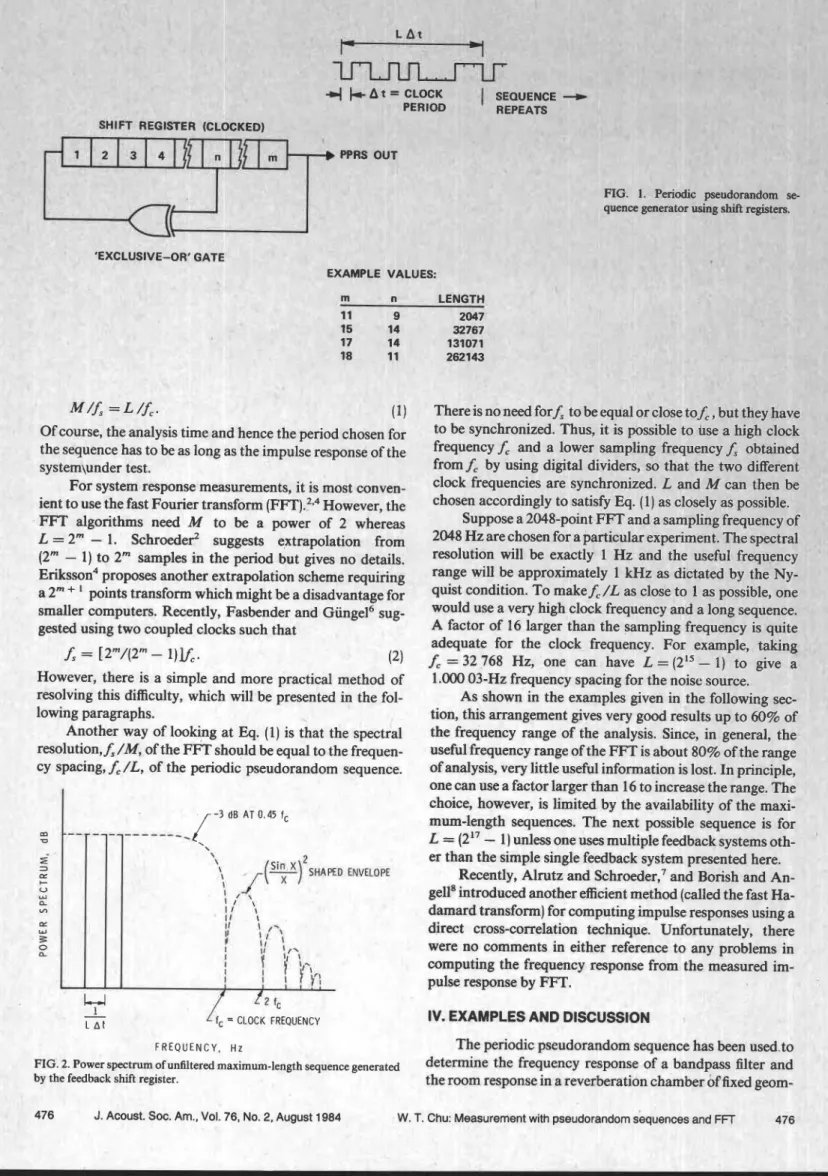
The most popular and simplest periodic pseudorandom sequence is generated by a feedback shift register arrange- ment shown in Fig. 1.' The m bits shift register is clocked at some fixed frequencyf,. An EXCLUSIVE-OR gate (other- wise known as modulo-two adder), is used to generate the feedback signal from the combination of the nth bit and the last (mth) bit of the shift register. The circuit goes through a set of states repeating itself after L clock pulses. Since the shift register contains m stages, there is a maximum of 2"
conceivable states. (However, the case of zeros in all the stages must be prevented to avoid a "hung up" situation.) If m and n are chosen correctly, the shift register will go through the maximum number of allowable states before repeating itself. Thus, the largest possible number of pulses in a repeated pattern at the output is L = (2"
-
1); heme the name maximum-length sequence is also given to this period- ic pseudorandom binary sequence. These m and n values are listed in Ref. 5. A few of them are shown in Fig. 1.II. SPECTRUM OF THE BINARY OUTPUT
If the binary states are chosen to be
+
1 and - 1, the autocorrelation function of a maximum-length sequence is always 1 for zero shift and drops to - 1/L for any other shift repeating after each period of the sequence. The correspond- ing power spectrum is a line spectrum,' the envelope of which is a [(sin x)/xI2 curve, as shown in Fig. 2. The harmon- ic spacing is a function of the sequence length L and the clock frequencyf,
.
It is equal tof,
/L or l/LAt, where A t is the clock period.The upper 3-dB roll-off point is about 0.45f,. Hence, by adjusting the clock frequency, one can adjust the upper 3-dB< frequency over a very wide range.
It is interesting to note that regardless of what clock frequency or sequence length is selected, the binary wave- form always switches between the same two amplitude lev- els. This means that its rms value, and therefore its total power, is not affected by a change of bandwidth. Conven- tional white noise generators do not have this property. Ill. DIGITAL PROCESSING
An important advantage in using periodic pseudoran- dom sequences for testing linear time invariant systems is that, under steady-state excitations, the output is also peri- odic and hence deterministic. Only one period of data will be required for the experiment if it can be determined exactly. The data can be taken from any segment of the time record. This can be accomplished easily with digital processing. Thus iff, is the sampling frequency and M is the total num- ber of data points, the requirement for the analysis time will be
4
A t = CLOCK ( SEQUENCE+
PERlOl REPEATS
SHIFT REGISTER (CLOCKED)
Y
'EXCLUSICEXAMPLE VALUES:
m n LENGTH
11 9 2047
Of course, the analysis time and hence the period chosen for the sequence has to be as long as the impulse response of the systemiunder test.
For system response measurements, it is most conven- ient to use the fast Fourier transform (FFT).2,4 However, the
FFT
algorithms need M to be a power of 2 whereas L = 2"-
1. Schroedef suggests extrapolation from (2"-
1) to 2" samples in the period but gives no details. Eriksson4 proposes another extrapolation scheme requiring a 2" + points transform which might be a disadvantage forsmaller computers. Recently, Fasbender and Giinge16 sug- gested using two coupled clocks such that
However, there is a simple and more practical method of resolving this difficulty, which will be presented in the fol- lowing paragraphs.
Another way of looking at Eq. (1) is that the spectral resolution,f, /M, of the FFT should be equal to the frequen- cy spacing,
f,
/L, of the periodic pseudorandom sequence.1
-
L A t Lfc = CLOCK FREQUENCY IG. 1 . Pes lence genen iodic pseui stor using sl dorandom se- hift registers.There is no need forf, to be equal or close tof, , but they have to be synchronized. Thus, it is possible to hse a high clock frequency
f,
and a lower sampling frequency f, obtain-A from fc by using digital dividers, so that the two differ< clock frequencies are synchronized. L and M can then chosen accordingly to satisfy Eq. (1) as closely as possiblt.Suppose a 2048-point FFT and a sampling frequency 2048 Hz are chosen for a particular experiment. The spect resolution will be exactly 1 Hz and the useful frequen range will be approximately 1 kHz as dictated by the Ny- quist condition. To make f,/L as close to 1 as possible, one would use a very high clock frequency and a long sequence. A factor of 16 larger than the sampling frequency is quite adequate for the clock frequency. For example, taking
f,
= 32 768 Hz, one can have L = (215 - 1) to give a 1.000 03-Hz frequency spacing for the noise source.As shown in the examples given in the following sec- tion, this arrangement gives very good results up to 60% of the frequency range of the analysis. Since, in general, the useful frequency range of the FFT is about 80% of the range of analysis, very little useful information is lost. In principle, one can use a factor larger than 16 to increase the range. The choice, however, is limited by the availability of the ma mum-length sequences. The next possible sequence is 1 L = (2"
-
1) unless one uses multiple feedback systems 01 er than the simple single feedback system presented here.Recently, Alrutz and Schroeder,' and Borish and A
ge118 introduced another efficient method (called the fast H damard transform) for computing impulse responses usinl direct cross-correlation technique. Unfortunately, thc were no comments in either reference to any problems computing the frequency response from the measured i~ pulse response by FFT.
IV. EXAMPLES AND DISCUSSION
F R E Q U E N C Y , H Z The periodic pseudorandom sequence has been used
FIG. 2. Power spectrum of unfiltered maximum-length sequence generated determine the a bandpass
by the feedback shift register. the room response in a reverberation chamber of fixed geol
.of ral ICY .n- [a- i l l - 176 476 J. Acoust. Soc. Am., Vol. 76, No. 2, August 1984 W. T. Chu: Measurement with pseudorandom sequences and FFT 1
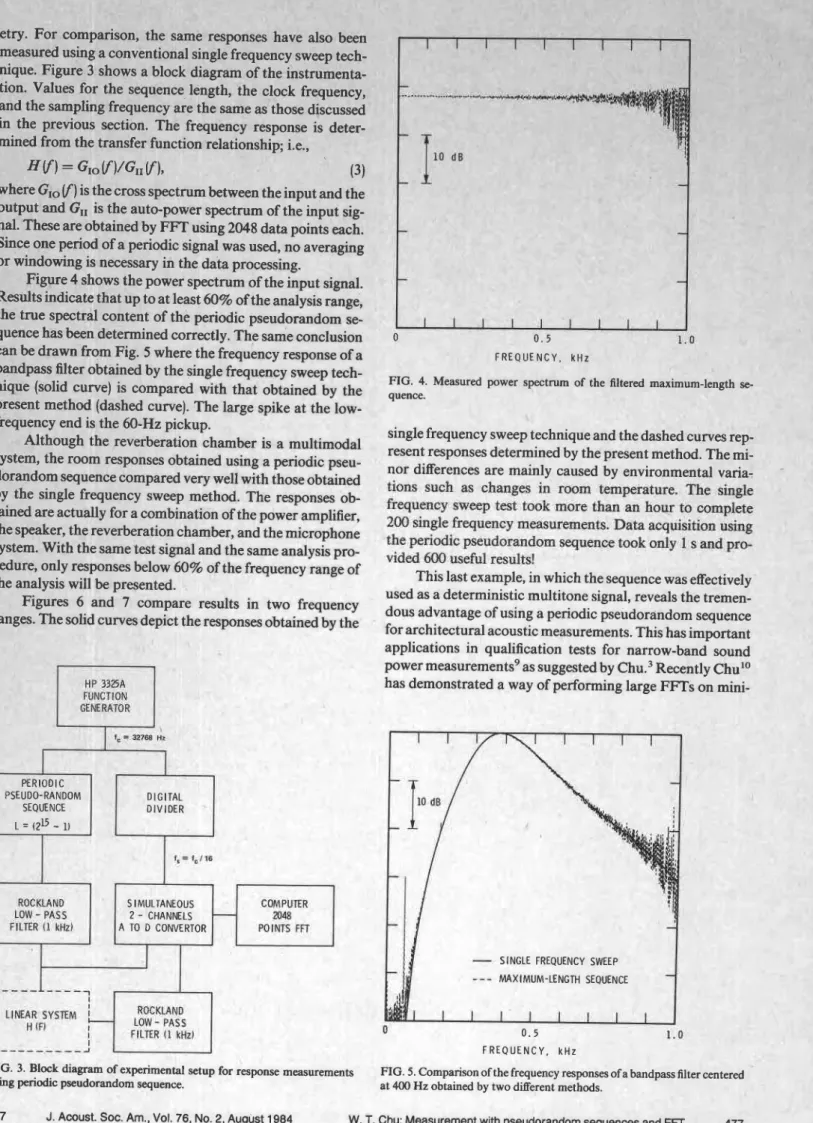
-+ y. For comparison, the same responses have also beer asured using a conventional single frequency sweep tech lue. Figure 3 shows a block diagram of the instrumenta
non. Values for the sequence length, the clock frequency
1 the sampling frequency are the same as those discussec the previous section. The frequency response is deter ned from the transfer function relationship; i.e.,
,
whereGIo
(f) is the cross spectrum between the input and the output andG,,
is the auto-power spectrum of the input sig- nal. These are obtained by FFT using 2048 data points each.I Since one period of a periodic signal was used, no averaging
or windowing is necessary in the data processing.
Figure 4 shows the power spectrum of the input signal Results indicate that up to at least 60940 of the analysis range the true spectral content of the periodic pseudorandom se quence has been determined correctly. The same conclusion can be drawn from Fig. 5 where the frequency response of a bandpass filter obtained by the single frequency sweep tech- nique (solid curve) is compared with that obtained by the present method (dashed curve). The large spike at the low- frequency end is the 60-Hz pickup.
Although the reverberation chamber is a multimodal system, the room responses obtained using a periodic pseu- dorandom sequence compared very well with those obtained by the single frequency sweep method. The responses ob- tained are actually for a combination oft amplifier, the speaker, the reverberation chamber, r icrophone system. With the same test signal and the salnL: a~~alysis pro- cedure, only responses below 60% of the frequency range of the analysis will be presented.
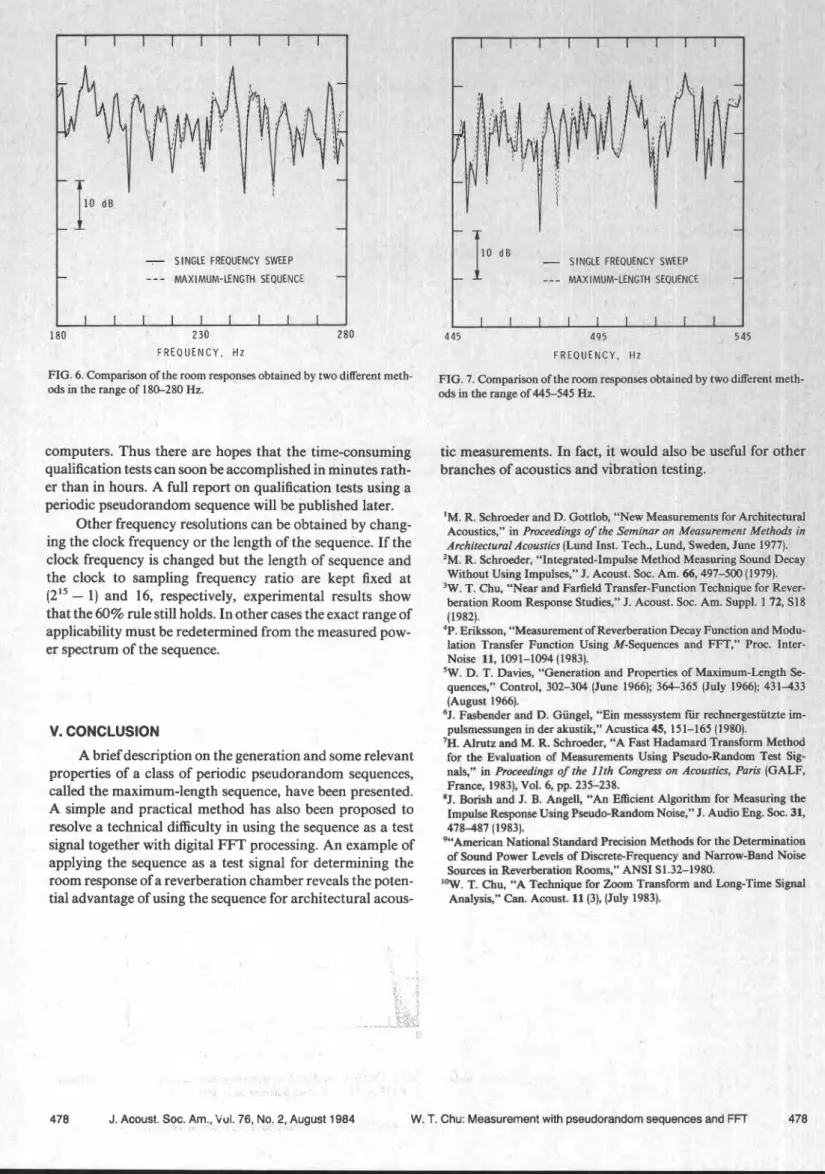
Figures 6 and 7 compare results in two frequency lges. The ! ~ s e s obtained by the
rar solid cum es depict
-
the respor HP 3325A FUNCTION GENERATOR PSEUDO-RANDOM SEQUENCE L = (215-
1) he power ind the m .- - -
- - -
5 l MULTANEOUS1
ROCK,MNDI
I
,
,
""
I
LOW-
PASS 2 - CHANNELSFILTER (1 kHz1 A TO D CONVERTOR POINTS FFT
r 7
ROCKLAMD
I
H l f l1
LlNtAK srslEM LOW-
PASSFILTER (1 kHz)
I
FIG. 3. Block diagram of experimental setup for response measurements using periodic pseudorandom sequence.
477 J. Acoust. Soc. Am., Vol. 76, No. 2, August 1984 W.
E N C Y , k H z
FIG. 4. Measurea power spectrum of the filtered maximum-length se- quence. easureme dom sequ I :nts. Data ~ence took - rves rep- single frequency sweep technique and the dashed cu
resent responses determined by the present method. The mi- nor differences are mainly caused by environmental varia- tions such as changes in room temperature.
The
single frequency sweep test took more than an hour to m p I e t e 200 single frer . acquisition using the periodic p i Dnly 1 s and pro- vided 600 uselu~ IC~UILY!This last example, in which the sequence was effectively used as a deterministic multitone signal, reveals the tremen- dous advantage of using a periodic pseudorandom sequence for architectural acoustic measurements. This has important applications in qualification tests for narrow-band sound power measurements9 as suggested by C ~ U . ~ Recently Chu'' has demonstrated a way of performing large FFTs on mini-
-
SINGLE FREQUENCY SWEEP0 0 . 5 1 . 0
F R E Q U E N C Y . k H z
FIG. 5. Comparison of the frequency responses of a bandpass filter centered at 400 Hz obtained by two different methods.
1 I I I I I I I I
I
180 230 280
F R E Q U E N C Y , H z
FIG. 6. Comparison of the room responses obtained by two different meth- ods in the range of 180-280 Hz.
computers. Thus there are hopes that the time-consuming qualification tests can soon be accomplished in minutes rath- er than in hours. A full report on qualification tests using a periodic pseudorandom sequence will be published later.
Other frequency resolutions can be obtained by chang- ing the clock frequency or the length of the sequence. If the clock frequency is changed but the length of sequence and the clock to sampling frequency ratio are kept fixed at
(215 - 1) and 16, respectively, experimental results show that the 60% rule still holds. In other cases the exact range of applicability must be redetermined from the measured pow- er spectrum of the sequence.
V. CONCLUSION
A brief description on the generation and some relevant properties of a class of periodic pseudorandom sequences, called the maximum-length sequence, have been presented. A simple and practical method has also been proposed to resolve a technical difficulty in using the sequence as a test signal together with digital FFT processing. An example of applying the sequence as a test signal for determining the room response of a reverberation chamber reveals the poten- tial advantage of using the sequence for architectural acous-
-
I I I I
SINGLE FREQUENCY SWEEP
--- MAXIMUM-LENGTH SEQUENCE
445 Y 7 ,
F R E Q U E N C Y . H z
FIG. 7. Comparison of the room responses obl ods in the range of 445-545 Hz.
545
,o different r neth-
tic measurements. In fact, it would also be useful for ~ , X A , A
branches of acoustics and vibration 1 testing.
'M. R. Schroeder and D. Gottlob, "New Measurements for Architec Acoustics," in Proceedings of the Seminar on Measurement Methc: Architectural Acoustics (Lund Inst. Tech., Lund, Sweden, June 197: 'M. R. Schroeder, "Integrated-Impulse Method Measuring Sound I
Without Using Impulses," J. Acoust. Soc. Am. 66,497-500 (1979). 3W. T. Chu, "Near and Farfield Transfer-Function Technique for R
beration Room Response Studies," J. Acoust. Soc. Am. Suppl. 1 72 (1982).
4P. Eriksson, "Measurement of Reverberation Decay Function and Modu- lation Transfer Function Using M-Sequences and FFT," Proc. Inter- Noise 11, 1091-1094 (1983).
'W. D. T. Davies, "Generation and Properties of Maximum-Length Se- quences,'? Control, 302-304 (June 1966); 364365 (July 1966); 43 1 - - - (August 1966).
6J. Fasbender and D. Giingel, "Ein messsystem fiir rechnergestiitzt pulsmessungen in der akustik," Acustica 45, 151-165 (1980).
'H. Alrutz and M. R. Schroeder, "A Fast Hadamard Transform MI for the Evaluation of Measurements Using Pseudo-Random Tesl nals," in Proceedings of the 11th Congress on Acoustics, Paris (G. France, 1983), Vol. 6, pp. 235-238.
'J. Borish and J. B. Angell, "An Efficient Algorithm for Measurine LUG
Impulse Response Using Pseudo-Random Noise," J. Audio Eng. Soc. 31, 478487 (1983).
g"American National Standard Precision Methods for the Determination of Sound Power Levels of Discrete-Frequency and Narrow-Band Noise Sources in Reverberation Rooms," ANSI S1.32-1980.
'"W. T. Chu, "A Technique for Zoom Transform and Long-Time Signal Analysis," Can. Acoust. 11 (3), (July 1983).
1 4 3 3 .e im- ..
.
:tnw t Sig- ALE,T h i s paper, w h i l e b e i n g d i s t r i b u t e d i n r e p r i n t form by t h e D i v i s i o n of B u i l d i n g Research, remains t h e c o p y r i g h t of t h e o r i g i n a l p u b l i s h e r . It s h o u l d n o t be reproduced i n whole o r i n p a r t w i t h o u t t h e p e r m i s s i o n of t h e p u b l i s h e r . A l i s t of a l l p u b l i c a t i o n s a v a i l a b l e from t h e D i v i s i o n may be o b t a i n e d by w r i t i n g t o t h e P u b l i c a t i o n s S e c t i o n , D i v i s i o n o f B u i l d i n g R e s e a r c h , N a t i o n a l R e s e a r c h C o u n c i l o f C a n a d a , O t t a w a , O n t a r i o , K1A OR6.