Book Reviews
KIERAN EGAN. How cognitive toots shape our understanding. Chicago & London: University of Chicago Press (/997). 312 pp. US$24.95 (paper) ISBN 0-226-19036-6.
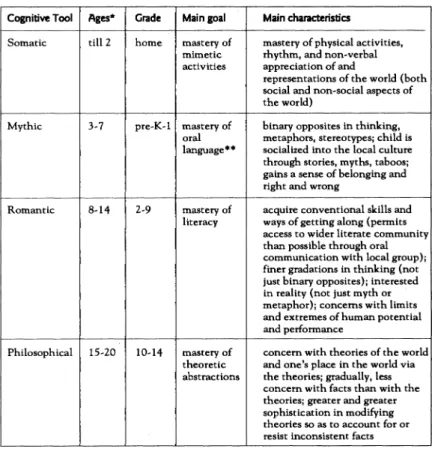
Kieran Egan, a professor of education at Simon Frasier University, proposes an innovative theory of curriculum and teaching relevant to K-16 education. Central to his approach is his concept of five kinds of understanding ("cognitive tools"j see Figure 1) usually mastered in a particular order during a child's development. The ordering of these resources mirrors the history of the "discovery" and development of these kinds of understanding in human civilizationj Egan's is the first serious recapitulationist theory in education since at least the early part of this century. The theory emphasizes literacy and the development of facility in the deployment of language-related competencies. He also champions the value of even earlier mastery (in the mYthic phase) of oral language use ("Too often, literacy is taught without much regard for the richness of children's oral-culture background"). Each cognitive tool is associated not only with learning at a particular stage or age range, but rather can continue over the entire lifespan. Nevertheless, Egan assumes that there exists a phase of maximum potency of ability to acquire the particular mode of understanding, within a sequence that is ordered through a set of interacting factors that are psychological, epistemological, and cultural. AIso, elements of each mastered cogni-tive tool are brought - albeit in a truncated and incomplete way - the growth of subsequent, more complex cognitive tools, so that the capac-ity to deploy a cognitive tool acquired earlier in the sequence remains latent in every adult.
Egan provides excellent suggestions for how to develop curricula and teaching methods that use and develop each of these kinds of under-standing while also imparting important skills and knowledge to stu-dents. Among educators, Egan is perhaps best known for championing the use of story-telling as a central instructional tool, and the book describes (as do his previous works) ways in which story-telling may be incorporated appropriately into the teaching process.
Egan's work is scholarly and he builds his arguments from the work of a dizzying array of philosophers, theorists, and researchers (e.g., Socra-tes and Plato, Aristotle, Rousseau, Wordsworth, Darwin, Dewey, Vygotsky, Piaget, Bruner). He also attempts to integrate recent work in developmental neuroscience into his developmental approachj unfor-tunately, the strength of the bridge between education and
Book Reuieuis
science has been roundly challenged (Bruer, 1997), and readers should approach his neuroscience claims with additional caution (an ironie approach to reading Egan of which Egan would undoubtedly approve). 1also harbor strong reservations regarding Egan's claims that aptitudinal differences between individuals are relatively insignificant; 1 believe that people differ widely in aptitudes, and that effective educational practice is sensitive and responsive to such differences. However, read .. ing Egan has prompted for me questions such as whether individual differences in aptitudes might have their continuing impact through, say, somatic understanding, and that their impact in subsequentely mastered forms of understanding might not be mediated through a somatic understanding that becomes progressively enfolded in these more complex forms of understanding. In a related vein, Egan correctly identifies a major problem of education as how to preserve the capacity for leaming through a "generalized leaming capacity"intoadulthood; he centers on educating the imagination as a primary solution. Egan's assertions find sorne support in the aptitudeliteraturethat suggests that g, or general cognitive ability (and presumably related to Egan's gener.. alized leaming capacity), is in fact closely related to personality traits associated with imagination and openness (Carson, Stalikas,& Bizot, 1997). There exists little doubt that g is a useful thing to foster through education; it is extremely useful in modem life (Gottfredson, 1997). Yet g is not the only royal road to learning, as Gardner (1983) and others have pointed out. There exists a variety of specifie aptitudes that may facilitate learning in particular domains; itis unclear that fostering the imagination is the best way to stimulate continued leaming capac.. ity associated with the various other specifie aptitudes. It is also un .. known whether fostering the growth of generalized leaming capacity (read: g) might have the unintended consequence of inhibiting growth of sorne other more specifie forms of leaming capacity.
ln spite of my reservations centering around Egan's treatment of apti .. tudes, 1 believe his theory is extremely important, and that it has implications beyond education per se. For example, 1 am in the process of adapting itto career education and career development. Through separate communication with Egan, 1 understand that only two schools (both in Australia) have attempted to explicitly model themselves on the grounds of his theory. 1 have attempted to develop a charter schoo 1 using his theory as a model, and although the parents participating in the design of the charter school were enthusiastic about the ideas Egan sets forth in
The Educated Mind,
it has proved substantially more diffi..Book Reviews cult to excite established education professionals (teachers and existing researchers) about the merits of his approach. 1 wish others more success in applying his ideas.
REFERENCES
Bruer,
J.
T. (1997). Education and the brain: A bridge toofar. EducationalResearcher, 26,4-16.
Carson, A. D., Stalikas, A., & Bizot, E. B. (1997). Correlations between the Myers-Briggs Type Indicator and measures of aptitudes. Journal ofCareer Assessment, 5, 81-104. Egan, K. (1997). The educated mind: How cognitive tools shape our understanding. Chicago, IL: University of Chicago Press.
Gardner, H. (1983). Frames ofmind: The theory of multiple inteUigences. New York: Basic Books.
Gottfredson, L. S. (1997). Why gmatters: The complexity of everyday life. InteUigence, 24, 79-132.
FIGURE 1: Egan's cognitive tools. typical ages and grade levels. main features
Cognitive Tooi Ages* Grade Main goal Main characteristics
Somatie til! 2 home mastery of mastery of physical activities,
mimetic rhythm, and non-verbal
activities appreciation of and
representations of the world (both social and non-social aspects of the world)
Mythie 3-7 pre-K-1 mastery of binary opposites in thinking, oral metaphors, stereotypes; child is language·· socialized into the local culture through stories, myths, taboos; gains a sense of belonging and right and wrong
Romande 8-14 2-9 mastery of acquire conventional skills and literacy ways of getting along (permits
access to wider literate community than possible through oral communication with local group); finer gradations in thinking (not just binary opposites); interested in reality (not just myth or metaphor); concems with limits and extremes ofhuman potential and performance
Philosophical 15-20 10-14 mastery of concem with theories of the world theoretic and one's place in the world via abstractions the theories; gradually, less
concem with facts than with the
theories; greater and greater
sophistication in modifying theodes so as to account for or
resist inconsistent facts
I;JOO/( KeVleWS
Cognitive Tooi Ages* Grade Main goal Main characteristics
Ironie 21+ 15+ mastery of questions ability to know things as refined re- true through any of the other flexi veness cognitive tools, except perhaps
somatic; skepticism ranges from extreme ta more reflex ive (skepticism tumed on itsdO *These are rough ages.
** Although children are taught the alphabet and reading skil!. in this period, it also is important to
continue to develop the mythical understanding. More information about Egan's theory and implica-tions for education may be found at his website at http://www.educ.sfu.ca/people/faculty/kegan/ . (This table copyright 1998 Andrew D. Carson, ail rights reserved, except for fair-use associated with this single instance of publication, or through such reprints as authorized by this journal.)
ANDREW D. CARSON Bali Founda!ion (Chicago)
BRUCE PIRIE. Reshaping High School Eng/ish. Urbana, IL: National Council of Teachers of English (/997). 107 pp. US $14.95 (NCTE members $10.95). ISBN 0-8141-5668-1.
Despite the diversity of history and practice found in the educational landscapes of school, college, and university, the consensus, to quote cultural anthropologist Clifford Geertz, is that the traditional bounda-ries that have separated the various disciplines and genres ofknowledge are collapsing. English language arts, the language in which much of teaching-Ieaming is negotiated across the curriculum, as weU as a disciplinary field in its own right, stands arguably on the "front lines" of such a transformation to the way we think, teach, leam, and con-struct knowledge. English language arts teachers have become aware of the impact of coUapsing boundaries upon their discipline in a variety of ways, although what to do about it can seem bewildering. In a sense, the question we ask is how to get a foothold in an apparently explosive, yet intricate landscape. Where does one begin the re-visioning process? lt is in the context of this compeUing need that Bruce Pirie's 10VelY book,