. . . .
. . . .
Interventional cardiology
Combined anatomical and clinical factors
for the long-term risk stratification of patients
undergoing percutaneous coronary intervention:
the Logistic Clinical SYNTAX score
Vasim Farooq
1†
, Yvonne Vergouwe
2†
, Lorenz Ra¨ber
1
, Pascal Vranckx
1
,
Hector Garcia-Garcia
1
, Roberto Diletti
1
, Arie Pieter Kappetein
3
,
Marie Ange`le Morel
4
, Ton de Vries
4
, Michael Swart
4
, Marco Valgimigli
5
,
Keith D. Dawkins
6
, Stephan Windecker
7
, Ewout W. Steyerberg
2
, and
Patrick W. Serruys
1
*
1
Department of Interventional Cardiology, Erasmus University Medical Centre, Thoraxcenter, ’s-Gravendijkwal 230, 3015 CE, Rotterdam, The Netherlands;2
Department of Public Health, Erasmus University Medical Center, Rotterdam, The Netherlands;3
Department of Cardiothoracic Surgery, Erasmus University Medical Centre, Thoraxcenter, Rotterdam, The Netherlands;4
Cardialysis BV, Rotterdam, The Netherlands;5
Department of Interventional Cardiology, Cardiovascular Institute, University of Ferrara, Ferrara, Italy;6
Boston Scientific Corporation, Natick, MA, USA; and7
Cardiology Department, Bern University Hospital, Bern, Switzerland Received 6 December 2011; revised 22 July 2012; accepted 9 August 2012; online publish-ahead-of-print 9 October 2012
See page 3008 for the editorial comment on this article (doi:10.1093/eurheartj/ehs346)
Background
The SYNTAX score (SXscore), an anatomical-based scoring tool reflecting the complexity of coronary anatomy, has
established itself as an important long-term prognostic factor in patients undergoing percutaneous coronary
interven-tion (PCI). The incorporainterven-tion of clinical factors may further augment the utility of the SXscore to longer-term risk
stratify the individual patient for clinical outcomes.
Methods
and results
Patient-level merged data from .6000 patients in seven contemporary coronary stent trials was used to develop a
logistic regression model—the Logistic Clinical SXscore—to predict 1-year risk for all-cause death and major adverse
cardiac events (MACE). A core model (composed of the SXscore, age, creatinine clearance, and left ventricular
ejec-tion fracejec-tion) and an extended model [incorporating the core model and six addiejec-tional (best performing) clinical
vari-ables] were developed and validated in a cross-validation procedure. The core model demonstrated a substantial
improvement in predictive ability for 1-year all-cause death compared with the SXscore in isolation [area under
the receiver operator curve (AUC): core model: 0.753, SXscore: 0.660]. A minor incremental benefit of the extended
model was shown (AUC: 0.791). Consequently the core model alone was retained in the final the Logistic Clinical
SXscore model. Validation plots confirmed the model predictions to be well calibrated. For 1-year MACE, the
add-ition of clinical variables did not improve the predictive ability of the SXscore, secondary to the SXscore being the
predominant determinant of all-cause revascularization.
Conclusion
The Logistic Clinical SXscore substantially enhances the prediction of 1-year mortality after PCI compared with the
SXscore, and allows for an accurate personalized assessment of patient risk.
Introduction
The SYNTAX score
1–4(SXscore) has established itself as an
im-portant prognostic tool in risk stratifying patients in the Synergy
between Percutaneous Coronary Intervention with Taxus and
Cardiac Surgery (SYNTAX) pioneered Heart Team approach,
and has since been validated in patients undergoing percutaneous
coronary intervention (PCI) at a short and longer-term
follow-†Both authors equally contributed to this research paper.
*Corresponding author. Tel:+31 10 7035260, Fax: +31 10 4369154, Email:[email protected]
Published on behalf of the European Society of Cardiology. All rights reserved.
&
The Author 2012. For permissions please email: [email protected]up.
5–9More recently the SXscore has been applied to
contempor-ary ‘All-Comers’ coroncontempor-ary stent trials, and has consistently been
shown to be an independent predictor of 1-year mortality and
major adverse cardiac events (MACE).
10–12In contrast, traditional
risk scores for patients undergoing PCI principally allow for the
estimation of procedural risk.
13–18The addition of clinical risk factors to the SXscore has been
shown to potentially further augment its utility to objectively
select the most appropriate revascularization strategy for patients
planning to undergo surgical or percutaneous revascularization.
19–23These approaches have involved the amalgamation of cardiac
surgery-based summary risk scores to the SXscore to form the
‘Global Risk’ (SXscore and additive EuroSCORE)
23and the ‘clinical
SXscore’ (SXscore and the modified ACEF score).
19–22As the
in-dividual clinical components of the cardiac surgery-based summary
risk scores were not incorporated into the development of the
combined risk models, and that these risk scores contained
redun-dant information not relevant to the prediction of mortality after
PCI—such as the chronic obstructive pulmonary disease and
pul-monary hypertension in the EuroSCORE—this may have limited
the predictive ability of the final risk models.
23Furthermore,
these approaches categorized patient risk without giving a more
personalized risk assessment—with the Clinical SXscore
19–22being able to identify a high-risk population only, and the Global
Risk
23a lower-risk population.
The aims of the present study are to combine the individual
components of the Clinical SXscore—namely the continuous
vari-ables age, creatinine or creatinine clearance (CrCl), left ventricular
ejection fraction (LVEF), and the SXscore—to form the Logistic
Clinical SYNTAX score (Logistic Clinical SXscore). The underlying
hypothesis being that the addition of these ‘Core’ clinical variables
would provide the majority of the improvement to the 1-year
pre-dictive ability of the SXscore compared with the addition of further
clinical variables. The second aim of this study was to allow for a
more personalized approach to risk stratification, compared with
the categorical approaches of previous risk models.
19–23Methods
Patients
Patient-level data from seven contemporary coronary stent trials
3,24–29incorporating 6508 patients with a calculated SXscore were pooled
for the present study and have previously been described.
19An
add-itional trial was excluded from the original database (n ¼ 187)
30due
to permission being unobtainable from the study sponsor, and a
further 12 patients excluded due to missing values for death, leading
to a total of 6309 patients in the present analysis. The endpoints
for the prognostic analyses were 1-year all-cause death and MACE
[a composite of cause death, myocardial infarction (MI) and
all-cause revascularization].
Predictors and model development
During the development phase, two risk models were defined: (i) a
core model that incorporated the SXscore and components of the
ACEF and modified ACEF scores
31(age, creatinine or CrCl and
LVEF); (ii) an extended model that included the core model and the
addition of best performing clinical variables that improved the
performance of the core model. The CrCl was defined by the
Cock-croft and Gault formula.
32The left ventricular ejection fraction was
defined as the percentage LVEF taken by transthoracic
echocardiog-raphy or left ventriculogechocardiog-raphy taken at the time of the diagnostic
cor-onary angiogram.
As the Logistic Clinical SXscore was to be developed for predicting
future longer-term (1-year) clinical outcomes, relatively weaker
predic-tors (of borderline significance) were selected and retained in the
extended model only if there was an appropriate increase in AUC
when added to the core model in the multivariable logistic regression
model, in line with work described by Harrell and others.
33,34Within all the coronary stent trials predictor values generally were
.90% complete if the predictor was recorded. Multiple imputation of
missing values in the trials with predictors recorded was undertaken
using an advanced imputation strategy that takes the correlation
between all potential predictors into account [method of chained
equations (MICE algorithm in R software)].
35–37Statistical analysis
Logistic regression analyses were performed to examine individual and
joint relations between the core model, other clinical characteristics
(extended model), and the binary outcome of 1-year all-cause death
and MACE. Interaction terms between predictors were examined
with likelihood ratio tests, but none was of sufficient relevance to
extend the models beyond the main effects for each predictor. All
ana-lyses were stratified by the coronary stent trial.
Determining how the variables should be modelled was a vital step
in identifying which variables were most strongly related to 1-year
clin-ical outcomes. For the continuous predictors, possible non-linearity
with clinical outcomes was assessed with restricted cubic spline
func-tions. These are flexible functions that can accommodate curves in the
form of the association to assess the assumption that patient
charac-teristics are linearly related to the log odds of the outcome
event.
33,34To allow for a direct comparison of the prognostic value
of predictors recorded in different units or scales, the odds ratios
(ORs) for continuous predictors were scaled to correspond to a
change from the 25th to 75th percentile of the predictor
distribu-tion.
37Pooled ORs were estimated over the imputed data set, and
repeated using only the complete data, which gave similar results
(un-published data). Statistical analyses were performed with R software
37and SPSS Version 17.0 (SPSS, Inc., Chicago IL, USA).
Validation
The predictive performance of the model was cross-validated by the
omission of each of the coronary stent trials in turn, with the model
fitted on the remaining pooled population, and the resulting fit
tested on the omitted trial.
38–40This methodology allowed for the
es-timation of the extent to which the predictive accuracy of the model
(based on the entire sample) was affected by any differences
between the seven coronary stent trials.
3,24–29This form of
cross-validation by trial was hence a stronger test of validity than if, for
example, the study population had been divided at random into a
de-velopment and validation cohort.
34,41,42The measure of predictive discrimination used to characterize the
model performance in the original and the validation samples, was
by the area under the receiver operating characteristic curve (AUC),
and is equal to the c-statistic (the ability to distinguish a patient with
and without a clinical outcome—and ranges from 0.50 (no better
than flipping a coin) to 1.0 (model is 100% correct). Calibration—
the agreement between observed and predicted risks—was assessed
with the Hosmer – Lemeshow test and validation plots.
33,40Model presentation
The final model is presented in a score chart with the scores based on
the original logistic regression coefficients and can be used to obtain
approximate predictions for individual patients.
34,40Scores were
based on rounding of the regression coefficients. A constant was
sub-tracted or added to rescale the scores in positive integers. The sum
scores were related to the risks of 1-year mortality with logistic
regres-sion. The score chart can be used to obtain approximate predictions
for individual patients.
Results
Development of the model
Within the analysed data set 175 all-cause deaths (2.8%) and 797
MACE (15.8%) were observed. The univariate associations of the
SXscore and clinical variables to 1-year all-cause death and
MACE are shown in Table
1
. Creatinine clearance was
demonstrated to be a stronger univariate predictor of 1-year
all-cause death compared with serum creatinine and was therefore
incorporated into the core model (CrCl, OR: 2.2; 95% CI: 1.8 –
2.8; creatinine, OR: 1.4; 95% CI: 1.2 – 1.6). Linear relationships
were a good approximation for the SXscore, age, CrCl, and
LVEF with 1-year mortality, except that constant risk was
evident at higher values for the LVEF (
≥50%) and CrCl
(
≥90 mL/min) (Supplementary material online, Appendix). The
four factors (SXscore, age, CrCl, and LVEF) were entered into a
multivariable logistic regression model (Table
2
) and confirmed
to be strong independent predictors of 1-year mortality, thus
forming the core model.
Similar analyses were repeated with the core model and the best
performing clinical variables (six clinical variables: presentation,
body mass index (BMI), peripheral vascular disease, diabetes,
pre-vious MI, smoking) for 1-year mortality to form the extended
model.
. . . .
. . . .
. . . .
. . . .
Table 1
Univariate associations between predictors of 1-year death and 1-year major adverse cardiac events in the
pooled database of seven contemporary coronary stent trials
Characteristics Coding Death (n 5 6309) MACE (n 5 5048)a
Number (%) Univariateb Number (%) Univariateb Core model SYNTAX scorec 23 vs. 8 — 1.7 (1.6 – 1.8) — 1.8 (1.7 – 1.8) Age (years)c 72 vs. 56 — 2.9 (2.7 – 3.1) — 1.2 (1.2 – 1.2) CrClc 67 vs. 109 — 2.2 (1.8 – 2.6) — 1.2 (1.1 – 1.3) Ejection fractiond 40 vs. 50 — 2.2 (1.8 – 2.8) — 1.3 (1.1 – 1.5) Extended model Presentation (%) Stable 72 (2.4) 1.0 386 (15.1) 1.0 UA 32 (2.5) 1.0 (0.7 – 1.6) 185 (15.2) 1.0 (0.8 – 1.2) NSTEMI 25 (3.1) 1.8 (1.1 – 2.9) 102 (16.5) 1.1 (0.8 – 1.4) STEMI 46 (3.6) 1.7 (1.1 – 2.9) 97 (14.9) 1.0 (0.8 – 1.3) Female 58 (3.7) 1.5 (1.1 – 2.1) 215 (17.1) 1.2 (1.0 – 1.4) BMIc 30 vs. 25 — 1.1 (1.0 – 1.1) — 1.0 (1.0 – 1.1) PVD 20 (6.9) 2.5 (1.5 – 4.1) 49 (20.6) 1.3 (0.9 – 1.8) Diabetes (%) Non-insulin treated 32 (3.8) 1.8 (1.2 – 2.8) 146 (17.4) 1.3 (1.1 – 1.6) Insulin treated 27 (6.8) 3.1 (2.0 – 4.8) 101 (25.4) 2.1 (1.6 – 2.6) Hypertension (%) 134 (3.1) 1.5 (1.1 – 2.2) 579 (16.1) 1.2 (1.0 – 1.5) Hyperlipidaemia (%) 95 (2.3) 0.6 (0.5 – 0.9) 523 (15.3) 1.0 (0.9 – 1.2) Glycoprotein 2b3a use (%) 57 (3.3) 1.2 (0.8 – 1.9) 173 (16.3) 1.1 (0.9 – 1.4) Previous smoking (%) 48 (2.3) 0.8 (0.6 – 1.2) 259 (13.9) 1.0 (0.8 – 1.2) Current smoking (%) 37 (2.2) 0.8 (0.5 – 1.1) 178 (14.3) 0.9 (0.7 – 1.1) Previous MI (%) 68 (3.9) 1.8 (1.3 – 2.4) 250 (16.8) 1.2 (1.0 – 1.4) Previous PCI (%) 23 (1.9) 0.7 (0.4 – 1.1) 179 (16.9) 1.2 (0.9 – 1.4) TIA or CVA (%) 10 (5.5) 1.5 (0.7 – 2.8) 33 (22.8) 1.4 (0.9 – 2.1) Stent generation (%) Newer generation 58 (2.1) 0.9 (0.5 – 1.6) 382 (14.1) 0.8 (0.6 – 1.1)
CrCl, creatinine clearance; Yrs, years; UA, unstable angina; NSTEMI, non-ST-elevation myocardial infarction; STEMI, ST-elevation myocardial infarction; BMI, body mass index; PVD, peripheral vascular disease; MI, myocardial infarction; PCI, percutaneous coronary intervention; TIA, transient ischaemic attack; CVA, cerebrovascular accident.
a
n ¼ 5048 without STRATEGY/MULTI-STRATEGY24,28
and SIRTAX26
trials secondary to all-cause revascularization not being recorded in the trials.
b
Odds ratio (95% confidence interval).
c
Odds ratios for continuous variables are given for the inter-quartile range.
d
Model performances
1-Year all-cause death (death)
The core model (SXscore, age, CrCl, and LVEF) demonstrated a
significantly better predictive ability for 1-year all-cause death
com-pared with the SXscore in isolation (Table
3
). Within the pooled
population (combining all trials), the AUC was substantially
higher for the core model compared with the SXscore in isolation
(core model: 0.753, SXscore 0.660). A minor incremental benefit
of the extended model (AUC: 0.791) compared with the core
model was evident. Consequently, the core model was retained
in the final Logistic Clinical SXscore, and the extended model
excluded. The Hosmer – Lemeshow test confirmed that there
was no evidence of poor calibration for the core model in
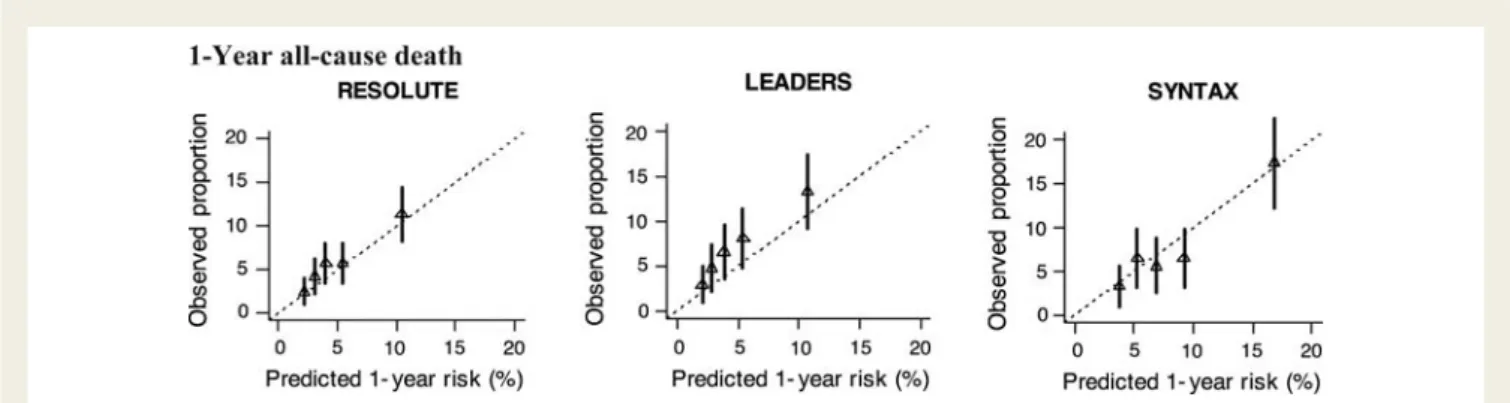
pooled analyses of the seven trials (P ¼ 0.55). Validation plots of
the core model indicated a good agreement between the observed
and predicted risks in the three largest coronary stent trials
(n . 1000) (Figure
1
). Within the SYNTAX trial recalibration of
the validation plots was necessary to prevent generalized
under-estimation of predicted risk, and involved resetting the intercept
of the calibration slope to zero.
1-Year major adverse cardiac events
For the outcome of 1-year MACE, the core and extended models
added little incremental increase in predictive ability compared
with the SXscore in isolation (AUC core model: 0.609, AUC
extended model: 0.618, SXscore: 0.605) (Tables
2
and
3
).
Further analyses indicated that all-cause revascularization least
benefited from the addition of clinical variables compared with
death or MI (Supplementary material online, Appendix). Since
the Logistic Clinical SXscore conferred no major additional
benefit to the SXscore in predicting MACE, further analyses for
this endpoint are not reported.
. . . .
. . . .
. . . .
Table 3
Performances of the Logistic Clinical SYNTAX score (core model) at cross-validation
Study Death MACE
SYNTAX score Core model SYNTAX score Core model ARTS II25 0.69 0.75 0.69 0.70 LEADERS27 0.63 0.74 0.62 0.61 STRATEGY24/MULTI-STRATEGY28 0.62 0.84 — — RESOLUTE29 0.57 0.77 0.63 0.63 SIRTAX26 0.64 0.71 — — SYNTAX3 0.67 0.73 0.58 0.59 Overalla 0.660 0.753 0.605b 0.609b
The core model was developed by omitting each study in turn, with the model fitted on the remaining pooled population, and validated by testing the resulting fit on the omitted trial.38–40
Values shown are c-statistics for testing the resulting fit on the omitted trial (cross-validation).
LEADERS, biolimus-eluting stent with biodegradable polymer vs. sirolimus-eluting stent with durable polymer for coronary revascularization trial;27MACE, major adverse cardiac events; RESOLUTE, RESOLUTE all-comers trial;29
SIRTAX, the sirolimus-eluting vs. paclitaxel-eluting stents for coronary revascularization trial;26
SYNTAX, Synergy between PCI with Taxus and cardiac surgery trial;3ARTS II, the arterial revascularization therapies study part II trial;25STRATEGY, the single high-dose bolus tirofiban and sirolimus-eluting stent vs. abciximab and bare metal stent in myocardial infarction trial;24
MULTISTRATEGY, comparison of angioplasty with infusion of tirofiban or abciximab and with implantation of sirolimus-eluting or uncoated stents for acute myocardial infarctiontrial.28
a
Pooled population (combining all trials).
b
n ¼ 5048 without STRATEGY/MULTI-STRATEGY and SIRTAX secondary to all-cause revascularization not being recorded in the trial.
. . . .
Table 2
Multivariable associations [odds ratio (95% CI)], between the individual components of the core model, for
1-year death and 1-year major adverse cardiac events in the pooled database of seven contemporary coronary stent trials
Characteristics Coding Death (n 5 6309) MACE (n 5 5048)a
Core model
SYNTAX Scoreb 23 vs. 8 1.41 (1.15 – 1.73) 1.72 (1.54 – 1.91) Age (years)b 72 vs. 56 2.06 (1.51 – 2.82) 1.06 (0.92 – 1.22) CrCl (ml/min)b 67 vs. 109 1.53 (1.12 – 2.09) 1.11 (0.94 – 1.31) LVEF (%)c 40 vs. 50 1.97 (1.61 – 2.41) 1.10 (0.93 – 1.30)
CrCl, creatinine clearance, LVEF, left ventricular ejection fraction; MACE, major adverse cardiac events.
a
n ¼ 5048 without STRATEGY/MULTI-STRATEGY24,28
and SIRTAX26
trials secondary to all-cause revascularization not being recorded in the trials.
b
Odds ratios for continuous variables are given for the inter-quartile range (indicated in coding column).
c
Score charts for 1-year all-cause death
A simple score chart for the bedside application of the final Logistic
Clinical SXscore for predicting 1-year all-cause death after PCI is
illu-strated (Figure
2
). An extra score is included for a ‘‘SYNTAX-like’’
patient, i.e. a patient presenting with left main disease (isolated or
associated with 1, 2, or 3-vessel disease) or 3-vessel disease, due
to the need to recalibrate risks to the SYNTAX trial patients as
described previously. One-year mortality can be accurately
esti-mated by the summation of scores. Similar charts for the extended
model are enclosed in the Supplementary material online, Appendix.
Discussion
The main findings from this study are that: (i) the Logistic Clinical
SXscore—consisting of four continuous variables (SXscore, age,
CrCl, LVEF)—substantially enhances the risk stratification of PCI
patients for the outcome of 1-year all-cause death compared
with the SXscore in isolation; (ii) the Logistic Clinical SXscore
was able to accurately distinguish patients with or without a clinical
outcome (discrimination) and could accurately predict individual
patient risk (calibration) without under or over-estimating risk;
(iii) the addition of further clinical variables to the four key
predic-tors of the Logistic Clinical SXscore (SXscore, age, CrCl, and
LVEF) did not substantially increase its predictive ability; (iv) an
individualized approach to the longer-term (1-year) risk
stratifica-tion of patients after PCI was achievable utilizing the SXscore and
(v) the SXscore in isolation was the predominant determinant of
1-year MACE with little additional predictive benefit of clinical
variables, predominantly secondary to the SXscore being the
main determinant of all-cause revascularization.
Figure 1
Validation plots at cross-validation for the three largest coronary stent trials (n . 1000). Plots are shown for the core model
pre-dicting 1-year all-cause death. The triangles indicate the observed frequencies by quintile of predicted probabilities with a 95% confidence
inter-val. Good agreement was evident between observed and predicted risks, indicating that the core model did not over or under-estimate 1-year
mortality (i.e. good calibration).
Figure 2
The Logistic Clinical SYNTAX score for the prediction of 1-year death. *SYNTAX-like patient defined as fulfilling the enrolment
criteria for the SYNTAX All-Comers trial, i.e. left main stem (isolated or associated with one-, two-, or three-vessel disease) or three-vessel
disease alone. CrCl, creatinine clearance, LV ejection fraction, left ventricular ejection fraction.
The logistic clinical SYNTAX score:
predicting 1-year death
The findings of the Logistic Clinical SXscore, namely that a few
strongly predictive clinical variables leading to the accurate
predic-tion of 1-year all-cause death after PCI, are consistent with the
concepts of the ‘‘law of parsimony’’ or ‘‘Occam’s razor.’’ Age,
CrCl, and LVEF are objectively measured continuous clinical
vari-ables in line with the ACEF methodology, which has previously
been shown to match or even surpass the EuroSCORE (consisting
of 17 clinical variables) in predicting in-hospital mortality after
elective coronary artery bypass graft surgery.
31,43,44Explanations
for this comparability have included that the clinical variables of
the ACEF score were objectively defined and continuous.
31Notably the addition of a further six clinical variables to the
Lo-gistic Clinical SXscore to form the extended model lead to a minor
incremental increase in its predictive ability. This is likely related to
the inter correlation between the core model and the additional
clinical variables. Clear correlations were evident (Pearson
correl-ation coefficient 0.2 or greater, P , 0.001) for age and gender/
hypertension; CrCl and gender/BMI; LVEF and MI; SXscore and
prior PCI; BMI and diabetes mellitus. In addition the presence of
diabetes has historically been associated with adverse outcomes
after PCI.
45,46It is however likely that patients with more severe
diabetes were captured by the continuous variables in the Logistic
Clinical SXscore, in particular a reduced CrCl. Both a reduced
CrCl and proteinuria—a marker of diabetic nephropathy—have
previously been shown to be significant determinants of adverse
risk following PCI.
47–49Furthermore diabetics without evidence of
proteinuria have also previously been reported to have a similar
survival compared with non-diabetics.
47SYNTAX score
The SXscore calculation has previously been reported to have
moderate inter-observer variability when performed by
interven-tional cardiologists,
4,50which may be perceived as a limitation of
the Logistic Clinical SXscore. Appropriate training of SXscore
reporting has, however, been shown to substantially reduce
in-ter-observer variability.
1,2,50It has previously been suggested that
the SXscore is a reflection of the underlying co-morbidity of the
patient,
23for which the present study provides further supportive
evidence. This notion is also supported by the 10-year predicted
Framingham risk scores being recently shown to have a significant
and direct relationship with the prevalence and magnitude of
coronary artery calcium scores.
51Comparisons with the clinical SYNTAX
score
The Clinical SXscore, on which the Logistic Clinical SXscore is
based, multiplied a variant of the surgical-based ACEF (age,
creatin-ine, and ejection fraction) score (modified ACEF score) to the
SXscore. In doing so the Clinical SXscore was shown to
over-estimate predicted risks (i.e. relatively poor calibration) despite
modest increases in the discriminative ability of the Clinical
SXscore being obtained.
20,23The application of the Clinical
SXscore to the present study (full data not shown) showed that
it was able to identify a high-risk population only (mortality: 6.6%
of the study population), compared with the intermediate- and
low-risk groups (mortality: 2.3 and 1.1% of the study population,
respectively) consistent with the previously reported
litera-ture.
19–23Comparatively the Logistic Clinical SXscore within the
present study was demonstrated to accurately predict risk across
all risk groups (i.e. well calibrated) and importantly was able to
provide an individualized risk assessment.
Comparisons with other risk models
The recently reported Functional SXscore (FSS)—a fractional flow
reserve (FFR)-guided SYNTAX scoring methodology—has been
shown to potentially improve the predictive accuracy of the
SXscore.
52Within this study, the more objective assessment of
coronary stenoses compared with visual assessment (to form the
FSS) lead to incremental increases in the predictive accuracies
for the outcomes of 1-year MACE (AUC: SXscore, 0.630; FSS,
0.677), 1-year death or MI (AUC: SXscore, 0.621; FSS, 0.676)
and 1-year all-cause revascularization (AUC: SXscore, 0.627; FSS,
0.657).
52Notably, improvements in the predictive accuracy for
1-year death were not reported with the FSS. Comparatively the
Logistic Clinical SXscore in the present study demonstrated a
sub-stantial increase in the prediction of 1-year death (AUC: SXscore,
0.660; core model, 0.753), and improvements in the prediction of
1-year death or MI (AUC: SXscore, 0.594; core model, 0.657,
extended model 0.666—Supplementary material online,
Appen-dix) without the need for invasive pressure-wire coronary
assessment.
The longer-term (1-year) mortality predictions provided by the
Logistic Clinical SXscore are the principle differences compared
with other reported risk scores, namely the National
Cardio-vascular Data Registry
16score, the Mayo Clinical Risk score,
13,15the EuroHeart PCI score,
18and the New York PCI risk score,
14in that they report in-hospital Death
14,16,18or in-hospital
MACE,
50,51or at the most 30-day mortality
16after PCI. Other
risk scores that longer-term risk stratify patients include the
New Risk Stratification score (NERS).
53As previously described
with the Clinical SXscore, NERS categorized patients into levels
of risk (high and low risk) without giving an individualized
assess-ment of patient risk, which was achievable with the Logistic Clinical
SXscore. Furthermore NERS is a more complicated score that
consists of 17 clinical variables, 33 anatomical factors, and 4
procedural details, and was developed for patients with left main
coronary artery disease undergoing PCI.
53Potential clinical application
Although the patient and clinician may wish to know the
short-term risk of procedural complications associated with PCI, a
longer-term perspective may also be beneficial. Not only would
this appropriately inform the patient, but may also prove to be
of benefit in determining whether surgical or percutaneous
re-vascularization would be more appropriate as part of the Heart
Team consensus. As recently reported, high co-morbidity patients
may confer prognostic and morbidity benefits from undergoing
surgical revascularization compared with PCI provided a certain
Limitations
Although the Logistic Clinical SXscore was derived from
‘All-Comers’ types patients in contemporary stent trials, each trial
still retained certain inclusion and exclusion criteria.
11These
cri-teria were, however, minimal which should legitimize the
applica-tion of the Logistic Clinical SXscore to contemporary clinical
practice. The authors recognize that further external validation
of the Logistic Clinical SXscore in ‘real-world’ ‘unrestricted’
regis-try populations is necessary when these registries reporting the
SXscore become available. This would further strengthen the
results of this study, although the present analyses were already
undertaken in a pooled analysis of seven different contemporary
stent trials and internally validated with a cross-validation
proced-ure. Comparisons of the Logistic Clinical SXscore with the Global
Risk
23were not possible since the EuroSCORE was not collected
in the seven contemporary stent trials.
Cardiogenic shock is a risk variable that has consistently been
shown to be a powerful predictor of in-hospital mortality.
13–18This important subset of patients, although not an exclusion
criteria in the ‘All-Comers’ trials, by practice lead to the
under-recruitment of these patient types predominantly due to the
inabil-ity to gain appropriate informed consent or refusal to participate.
54Consequently, the Logistic Clinical SXscore should at present not
be applied to these patients where other risk scores would be
better suited.
13–18Future directions
Potentially the integration of the Logistic Clinical SXscore into an
online algorithm with the currently available SXscore
1may serve
to simultaneously allow for risk stratification of patients based on
anatomical and clinical variables. In addition, the application of
the Logistic Clinical SXscore in place of the SXscore to aid in
determining the optimal revascularization modality in patients
with complex coronary disease is a potential future application.
The incorporation of the FSS as previously described,
52to
allow for a more objective assessment of the coronary
anatomy, may enhance the predictive accuracy of the Logistic
Clinical SXscore even further. Future direction with non-invasive
imaging and FFR calculation
55—utilizing computational fluid
dynam-ics applied to coronary computed tomography angiography—may
be feasible. The expansion of other risk variables to the Logistic
Clinical SXscore such as the haemodynamic status as previously
discussed may expand the use of this risk score to other patient
types.
Conclusion
Compared with the SXscore in isolation, the Logistic Clinical
SXscore substantially enhances the risk stratification of PCI
patients for death at 1-year and allows for an accurate
individua-lized assessment of patient risk. The use of the Logistic Clinical
SXscore may also further aid in the Heart Team consensus in
determining the optimal revascularization modality.
Supplementary material
Supplementary material is available at European Heart Journal
online.
Acknowledgements
The authors express their gratitude to all of the study participants
and the principal investigators of the trials whose work made this
study possible. V.F. thanks the Dickinson Trust Travelling
Scholar-ship, Manchester Royal Infirmary, Manchester, England, UK. Y.V.
was supported by The Netherlands Organization for Scientific
Research (917.11.383).
Funding
The SYNTAX Trial was funded by Boston Scientific Corporation.
Conflict of interest: M.V. reports research grants for lecturers and
ad-visory boards: Iroko, Eli Lilly, Medtronic, and honoraria for lecturers and/
or advisory boards: Cordis, Medtronic, Abbott, Eisai, Merck,
AstraZe-neca, Med Co, and Terumo. K.D.D. is a full-time employee of Boston
Sci-entific and holds stock in Boston SciSci-entific. S.W. received research grants
from Abbott, Biosensors, Biotronik, Cordis, Boston Scientific, and
Med-tronic. The other authors report no conflicts of interest.
References
1. SYNTAX score calculator. http://www.syntaxscore.com. SYNTAX working-group. Launched 19th May 2009.
2. Sianos G, Morel MA, Kappetein AP, Morice MC, Colombo A, Dawkins K, van den Brand M, Dyck NV, Russell ME, Mohr FW, Serruys PW. The SYNTAX Score: an angiographic tool grading the complexity of coronary artery disease. Euro Interven-tion 2005;1:219 – 227.
3. Serruys PW, Morice MC, Kappetein AP, Colombo A, Holmes DR, Mack MJ, Stahle E, Feldman TE, van den Brand M, Bass EJ, Van Dyck N, Leadley K, Dawkins KD, Mohr FW. Percutaneous coronary intervention versus coronary-artery bypass grafting for severe coronary artery disease. N Engl J Med 2009;360:961 – 972.
4. Serruys PW, Onuma Y, Garg S, Sarno G, van den Brand M, Kappetein AP, Van Dyck N, Mack M, Holmes D, Feldman T, Morice MC, Colombo A, Bass E, Leadley K, Dawkins KD, van Es GA, Morel MA, Mohr FW. Assessment of the SYNTAX score in the Syntax study. EuroIntervention 2009;5:50 – 56.
5. Valgimigli M, Serruys PW, Tsuchida K, Vaina S, Morel MA, van den Brand MJ, Colombo A, Morice MC, Dawkins K, de Bruyne B, Kornowski R, de Servi S, Guagliumi G, Jukema JW, Mohr FW, Kappetein AP, Wittebols K, Stoll HP, Boersma E, Parrinello G. Cyphering the complexity of coronary artery disease using the syntax score to predict clinical outcome in patients with three-vessel lumen obstruction undergoing percutaneous coronary intervention. Am J Cardiol 2007;99:1072 – 1081.
6. Capodanno D, Capranzano P, Di Salvo ME, Caggegi A, Tomasello D, Cincotta G, Miano M, Patane M, Tamburino C, Tolaro S, Patane L, Calafiore AM. Usefulness of SYNTAX score to select patients with left main coronary artery disease to be treated with coronary artery bypass graft. JACC Cardiovasc Interv 2009;2:731 – 738. 7. Kim Y-H, Park D-W, Kim W-J, Lee J-Y, Yun S-C, Kang S-J, Lee S-W, Lee CW, Park S-W, Park S-J. Validation of SYNTAX (Synergy between PCI with Taxus and Cardiac Surgery) score for prediction of outcomes after unprotected left main coronary revascularization. J Am Coll Cardiol Interv 2010;3:612 – 623. 8. Park DW, Kim YH, Yun SC, Song HG, Ahn JM, Oh JH, Kim WJ, Lee JY, Kang SJ,
Lee SW, Lee CW, Park SW, Park SJ. Complexity of atherosclerotic coronary artery disease and long-term outcomes in patients with unprotected left main disease treated with drug-eluting stents or coronary artery bypass grafting. J Am Coll Cardiol 2011;57:2152 – 2159.
9. Chakravarty T, Buch MH, Naik H, White AJ, Doctor N, Schapira J, Mirocha JM, Fontana G, Forrester JS, Makkar R. Predictive accuracy of SYNTAX score for pre-dicting long-term outcomes of unprotected left main coronary artery revascular-ization. Am J Cardiol 2011;107:360 – 366.
10. Wykrzykowska JJ, Garg S, Girasis C, de Vries T, Morel MA, van Es GA, Buszman P, Linke A, Ischinger T, Klauss V, Corti R, Eberli F, Wijns W, Morice MC, di Mario C, van Geuns RJ, Juni P, Windecker S, Serruys PW. Value of the SYNTAX score for risk assessment in the all-comers population of the randomized multicenter
LEADERS (Limus Eluted from A Durable versus ERodable Stent coating) trial. J Am Coll Cardiol 2010;56:272 – 277.
11. Garg S, Sarno G, Girasis C, Vranckx P, de Vries T, Swart M, Bressers M, Garcia-Garcia HM, van Es GA, Raber L, Campo G, Valgimigli M, Dawkins KD, Windecker S, Serruys PW. A patient-level pooled analysis assessing the impact of the SYNTAX (Synergy between Percutaneous Coronary Intervention with Taxus and Cardiac Surgery) score on 1-year clinical outcomes in 6508 patients enrolled in contemporary coronary stent trials. JACC. Cardiovasc Interv 2011;4: 645 – 653.
12. Palmerini T, Genereux P, Caixeta A, Cristea E, Lansky A, Mehran R, Dangas G, Lazar D, Sanchez R, Fahy M, Xu K, Stone GW. Prognostic value of the SYNTAX score in patients with acute coronary syndromes undergoing percutan-eous coronary intervention: analysis from the ACUITY (Acute Catheterization and Urgent Intervention Triage StrategY) trial. J Am Coll Cardiol 2011;57: 2389 – 2397.
13. Singh M, Rihal CS, Selzer F, Kip KE, Detre K, Holmes DR. Validation of Mayo Clinic risk adjustment model for in-hospital complications after percutaneous coronary interventions, using the National Heart, Lung, and Blood Institute dynamic registry. J Am Coll Cardiol 2003;42:1722 – 1728.
14. Wu C, Hannan EL, Walford G, Ambrose JA, Holmes DR Jr, King SB III, Clark LT, Katz S, Sharma S, Jones RH. A risk score to predict in-hospital mortality for per-cutaneous coronary interventions. J Am Coll Cardiol 2006;47:654 – 660. 15. Singh M, Rihal CS, Lennon RJ, Spertus J, Rumsfeld JS, Holmes DR Jr. Bedside
es-timation of risk from percutaneous coronary intervention: the new Mayo Clinic risk scores. Mayo Clin Proc 2007;82:701 – 708.
16. Peterson ED, Dai D, DeLong ER, Brennan JM, Singh M, Rao SV, Shaw RE, Roe MT, Ho KK, Klein LW, Krone RJ, Weintraub WS, Brindis RG, Rumsfeld JS, Spertus JA. Contemporary mortality risk prediction for percutaneous coronary intervention: results from 588 398 procedures in the National Cardiovascular Data Registry. J Am Coll Cardiol 2010;55:1923 – 1932.
17. Farooq V, Brugaletta S, Serruys PW. Contemporary and evolving risk scoring algo-rithms for percutaneous coronary intervention. Heart 2011;97:1902 – 1913. 18. de Mulder M, Gitt A, van Domburg R, Hochadel M, Seabra-Gomes R,
Serruys PW, Silber S, Weidinger F, Wijns W, Zeymer U, Hamm C, Boersma E. EuroHeart score for the evaluation of in-hospital mortality in patients undergoing percutaneous coronary intervention. Eur Heart J 2011;32:1398 – 1408. 19. Garg S, Sarno G, Garcia-Garcia HM, Girasis C, Wykrzykowska J, Dawkins KD,
Serruys PW. A new tool for the risk stratification of patients with complex cor-onary artery disease: the Clinical SYNTAX Score. Circ Cardiovasc Interv 2010;3: 317 – 326.
20. Capodanno D, Caggegi A, Miano M, Cincotta G, Dipasqua F, Giacchi G, Capranzano P, Ussia G, Di Salvo ME, La Manna A, Tamburino C. Global risk clas-sification and clinical SYNTAX (Synergy between Percutaneous Coronary Inter-vention with TAXUS and Cardiac Surgery) score in patients undergoing percutaneous or surgical left main revascularization. J Am Coll Cardiol Interv 2011;4:287 – 297.
21. Girasis C, Garg S, Raber L, Sarno G, Morel MA, Garcia-Garcia HM, Luscher TF, Serruys PW, Windecker S. SYNTAX score and Clinical SYNTAX score as predic-tors of very long-term clinical outcomes in patients undergoing percutaneous coronary interventions: a substudy of SIRolimus-eluting stent compared with pacliTAXel-eluting stent for coronary revascularization (SIRTAX) trial. Eur Heart J 2011;32:3115 – 3127.
22. Wykrzykowska JJ, Garg S, Onuma Y, de Vries T, Goedhart D, Morel MA, van Es GA, Buszman P, Linke A, Ischinger T, Klauss V, Corti R, Eberli F, Wijns W, Morice MC, di Mario C, van Geuns RJ, Juni P, Windecker S, Serruys PW. Value of age, creatinine, and ejection fraction (ACEF score) in assessing risk in patients undergoing percutaneous coronary interventions in the ‘All-Comers’ LEADERS trial. Circ Cardiovasc Interv 2011;4:47 – 56.
23. Serruys PW, Farooq V, Vrancx P, Girasis C, Brugaletta S, Garcia-Garcia HM, Holmes DR, Jr., Kappetein AP, Mack MJ, Feldman T, Morice MC, Stahle E, James S, Colombo A, Pereda P, Huang J, Morel MA, Van Es GA, Dawkins KD, Mohr FW, Steyerberg EW. A global risk approach to identify patients with left main or 3-vessel disease who could safely and efficaciously be treated with per-cutaneous coronary intervention. The SYNTAX trial at 3 years. JACC Cardiovasc Interv 2012;5:606 – 617.
24. Valgimigli M, Percoco G, Malagutti P, Campo G, Ferrari F, Barbieri D, Cicchitelli G, McFadden EP, Merlini F, Ansani L, Guardigli G, Bettini A, Parrinello G, Boersma E, Ferrari R. Tirofiban and sirolimus-eluting stent vs abciximab and bare-metal stent for acute myocardial infarction: a randomized trial. JAMA 2005;293:2109 – 2117. 25. Serruys PW, Ong AT, Morice MC, De Bruyne B, Colombo A, Macaya C,
Richardt G, Fajadet J, Hamm C, Dawkins K, O’Malley AJ, Bressers M, Donohoe D. Arterial revascularisation therapies study part II - Sirolimus-eluting stents for the treatment of patients with multivessel de novo coronary artery lesions. Euro Intervention 2005;1:147 – 156.
26. Windecker S, Remondino A, Eberli FR, Juni P, Raber L, Wenaweser P, Togni M, Billinger M, Tuller D, Seiler C, Roffi M, Corti R, Sutsch G, Maier W, Luscher T, Hess OM, Egger M, Meier B. Sirolimus-eluting and paclitaxel-eluting stents for coronary revascularization. N Engl J Med 2005;353:653 – 662.
27. Windecker S, Serruys PW, Wandel S, Buszman P, Trznadel S, Linke A, Lenk K, Ischinger T, Klauss V, Eberli F, Corti R, Wijns W, Morice MC, di Mario C, Davies S, van Geuns RJ, Eerdmans P, van Es GA, Meier B, Juni P. Biolimus-eluting stent with biodegradable polymer versus sirolimus-eluting stent with durable polymer for coronary revascularisation (LEADERS): a randomised non-inferiority trial. Lancet 2008;372:1163 – 1173.
28. Valgimigli M, Campo G, Percoco G, Bolognese L, Vassanelli C, Colangelo S, de Cesare N, Rodriguez AE, Ferrario M, Moreno R, Piva T, Sheiban I, Pasquetto G, Prati F, Nazzaro MS, Parrinello G, Ferrari R. Comparison of angio-plasty with infusion of tirofiban or abciximab and with implantation of sirolimus-eluting or uncoated stents for acute myocardial infarction: the MULTI-STRATEGY randomized trial. JAMA 2008;299:1788 – 1799.
29. Serruys PW, Silber S, Garg S, van Geuns RJ, Richardt G, Buszman PE, KelbA˜ fk H, van Boven AJ, Hofma SH, Linke A, Klauss V, Wijns W, Macaya C, Garot P, DiMario C, Manoharan G, Kornowski R, Ischinger T, Bartorelli A, Ronden J, Bressers M, Gobbens P, Negoita M, van Leeuwen F, Windecker S. Comparison of zotarolimus-eluting and everolimus-eluting coronary stents. N Engl J Med 2010;363:136 – 146.
30. Serruys PW, Garg S, Abizaid A, Ormiston J, Windecker S, Verheye S, Dubois C, Stewart J, Hauptmann KE, Schofer J, Stangl K, Witzenbichler B, Wiemer M, Barbato E, de Vries T, den Drijver AM, Otake H, Meredith L, Toyloy S, Fitzgerald P. A randomised comparison of novolimus-eluting and zotarolimus-eluting coronary stents: 9-month follow-up results of the EXCELLA II study. Euro Intervention2010;6:195 – 205.
31. Ranucci M, Castelvecchio S. The ACEF score one year after: a skeleton waiting for muscles, skin, and internal organs. Euro Intervention 2010;6:549 – 553.
32. Cockcroft DW, Gault MH. Prediction of creatinine clearance from serum creatin-ine. Nephron 1976;16:31 – 41.
33. Harrell FE. Regression Modeling Strategies: With Applications to Linear Models, Logistic Regression, and Survival Analysis (Springer Series in Statistics) New York: Springer-Verlag, Inc. 2001.
34. Steyerberg EW. Clinical Prediction Models: A Practical Approach to Development, Val-idation, and Updating (Statistics for Biology and Health). New York: Springer Scien-ce+Business Media, LLC, 2009.
35. Rubin DB, Schenker N. Multiple imputation in health-care databases: an overview and some applications. Stat Med 1991;10:585 – 598.
36. Schafer JL, Graham JW. Missing data: our view of the state of the art. Psychol Methods 2002;7:147 – 177.
37. R Development Core Team. A Language and Environment for Statistical Comput-ing. R Foundation for Statistical Computing, Vienna (Austria) 2006. Available: http://www.R-project.org/. Accessed 1 August 2011.
38. Efron B, Gong G. A leisurely look at the bootstrap, the jackknife, and cross-validation. Am Statistician 1983;37:36 – 48.
39. Lee KL, Woodlief LH, Topol EJ, Weaver WD, Betriu A, Col J, Simoons M, Aylward P, Van de Werf F, Califf RM. Predictors of 30-day mortality in the era of reperfusion for acute myocardial infarction. Results from an international trial of 41 021 patients. GUSTO-I Investigators. Circulation 1995;91:1659 – 1668. 40. Steyerberg EW, Vickers AJ, Cook NR, Gerds T, Gonen M, Obuchowski N,
Pencina MJ, Kattan MW. Assessing the performance of prediction models: a framework for traditional and novel measures. Epidemiology 2010;21:128 – 138. 41. Justice AC, Covinsky KE, Berlin JA. Assessing the generalizability of prognostic
in-formation. Ann Intern Med 1999;130:515 – 524.
42. Altman DG, Royston P. What do we mean by validating a prognostic model? Stat Med 2000;19:453 – 473.
43. Ranucci M, Castelvecchio S, Menicanti L, Frigiola A, Pelissero G. Risk of assessing mortality risk in elective cardiac operations: age, creatinine, ejection fraction, and the law of parsimony. Circulation 2009;119:3053 – 3061.
44. Ranucci M, Castelvecchio S, Conte M, Megliola G, Speziale G, Fiore F, Guarracino F, Scolletta S, Escobar RM, Falco M, Bignami E, Landoni G. The easier, the better: age, creatinine, ejection fraction score for operative mortality risk stratification in a series of 29 659 patients undergoing elective cardiac surgery. J Thorac Cardiovasc Surg 2011;142:581 – 586.
45. Weber FD, Schneider H, Wiemer M, Pfannebecker T, Tebbe U, Hamm CW, Senges J, Schneider S, Nienaber CA. Sirolimus eluting stent (Cypher) in patients with diabetes mellitus: results from the German Cypher Stent Registry. Clin Res Cardiol 2008;97:105 – 109.
46. Mack MJ, Banning AP, Serruys PW, Morice MC, Taeymans Y, Van Nooten G, Possati G, Crea F, Hood KL, Leadley K, Dawkins KD, Kappetein AP. Bypass versus drug-eluting stents at three years in SYNTAX patients with diabetes mel-litus or metabolic syndrome. Ann Thorac Surg 2011;92:2140 – 2146.
47. Marso SP, Ellis SG, Tuzcu M, Whitlow PL, Franco I, Raymond RE, Topol EJ. The importance of proteinuria as a determinant of mortality following percutaneous coronary revascularization in diabetics. J Am Coll Cardiol 1999;33:1269 – 1277. 48. Mercado N, Brugts JJ, Ix JH, Shlipak MG, Dixon SR, Gersh BJ, Lemos PA,
Guarneri M, Teirstein PS, Wijns W, Serruys PW, Boersma E, O’Neill WW. Use-fulness of proteinuria as a prognostic marker of mortality and cardiovascular events among patients undergoing percutaneous coronary intervention (data from the Evaluation of Oral Xemilofiban in Controlling Thrombotic Events [EXCITE] trial). Am J Cardiol 2008;102:1151 – 1155.
49. Shaw JA, Andrianopoulos N, Duffy S, Walton AS, Clark D, Lew R, Sebastian M, New G, Brennan A, Reid C, Ajani AE. Renal impairment is an independent pre-dictor of adverse events post coronary intervention in patients with and without drug-eluting stents. Cardiovasc Revasc Med 2008;9:218 – 223.
50. Genereux P, Palmerini T, Caixeta A, Cristea E, Mehran R, Sanchez R, Lazar D, Jankovic I, Corral MD, Dressler O, Fahy MP, Parise H, Lansky AJ, Stone GW. SYNTAX score reproducibility and variability between interventional cardiolo-gists, core laboratory technicians, and quantitative coronary measurements. Circ Cardiovasc Interv 2011;4:553 – 561.
51. Okwuosa TM, Greenland P, Ning H, Liu K, Bild DE, Burke GL, Eng J, Lloyd-Jones DM. Distribution of coronary artery calcium scores by framingham
10-year risk strata in the MESA (Multi-Ethnic Study of Atherosclerosis) potential implications for coronary risk assessment. J Am Coll Cardiol 2011;57:1838 – 1845. 52. Nam CW, Mangiacapra F, Entjes R, Chung IS, Sels JW, Tonino PA, De Bruyne B, Pijls NH, Fearon WF. Functional SYNTAX score for risk assessment in multivessel coronary artery disease. J Am Coll Cardiol 2011;58:1211 – 1218.
53. Chen S-L, Chen JP, Mintz G, Xu B, Kan J, Ye F, Zhang J, Sun X, Xu Y, Jiang Q, Zhang A, Stone GW. Comparison between the NERS (New Risk Stratification) score and the SYNTAX (Synergy Between Percutaneous Coronary Intervention With Taxus and Cardiac Surgery) score in outcome prediction for unprotected left main stenting. J Am Coll Cardiol Interv 2010;3:632 – 641.
54. de Boer SP, Lenzen MJ, Oemrawsingh RM, Simsek C, Duckers HJ, van der Giessen WJ, Serruys PW, Boersma E. Evaluating the ’all-comers’ design: a com-parison of participants in two ’all-comers’ PCI trials with non-participants. Eur Heart J 2011;32:2161 – 2167.
55. Koo BK, Erglis A, Doh JH, Daniels DV, Jegere S, Kim HS, Dunning A, Defrance T, Lansky A, Leipsic J, Min JK. Diagnosis of ischemia-causing coronary stenoses by noninvasive fractional flow reserve computed from coronary com-puted tomographic angiograms results from the prospective multicenter DISCOVER-FLOW (Diagnosis of Ischemia-Causing Stenoses Obtained Via Noninvasive Fractional Flow Reserve) study. J Am Coll Cardiol 2011;58: 1989 – 1997.