Comprehensive comparison of pore-scale
models for multiphase flow in porous media
The MIT Faculty has made this article openly available.
Please share
how this access benefits you. Your story matters.
Citation
Zhao, Benzhong et al. "Comprehensive comparison of pore-scale
models for multiphase flow in porous media." Proceedings of the
National Academy of Sciences of the United States of America 116
(2019): 13799-13806 © 2019 The Author(s)
As Published
10.1073/pnas.1901619116
Publisher
Proceedings of the National Academy of Sciences
Version
Final published version
Citable link
https://hdl.handle.net/1721.1/124440
Terms of Use
Article is made available in accordance with the publisher's
policy and may be subject to US copyright law. Please refer to the
publisher's site for terms of use.
APPLIED
PHYSICAL
SCIENCES
Comprehensive comparison of pore-scale models
for multiphase flow in porous media
Benzhong Zhaoa, Christopher W. MacMinnb, Bauyrzhan K. Primkulovc, Yu Chend, Albert J. Valocchid, Jianlin Zhaoe, Qinjun Kangf, Kelsey Bruningg, James E. McClureh, Cass T. Millerg, Abbas Fakharii, Diogo Bolsteri, Thomas Hillerj,
Martin Brinkmannk, Luis Cueto-Felguerosol, Daniel A. Cogswellm, Rahul Verman, Maˇsa Prodanovi´cn, Julien Maeso, Sebastian Geigero, Morten Vassvikp, Alex Hansenp, Enrico Segreq, Ran Holtzmanr,s, Zhibing Yangt, Chao Yuanu,
Bruno Chareyreu, and Ruben Juanesc,1
aDepartment of Civil Engineering, McMaster University, Hamilton, ON L8S 4L7, Canada;bDepartment of Engineering Science, University of Oxford, Oxford
OX1 3PJ, United Kingdom;cDepartment of Civil and Environmental Engineering, Massachusetts Institute of Technology, Cambridge, MA 02139;
dDepartment of Civil and Environmental Engineering, University of Illinois at Urbana–Champaign, Urbana, IL 61801;eDepartment of Mechanical and
Process Engineering, Swiss Federal Institute of Technology in Z ¨urich, 8092 Z ¨urich, Switzerland;fEarth and Environmental Sciences Division, Los Alamos
National Laboratory, Los Alamos, NM 87545;gDepartment of Environmental Sciences and Engineering, University of North Carolina at Chapel Hill, Chapel
Hill, NC 27516;hAdvanced Research Computing, Virginia Polytechnic Institute & State University, Blacksburg, VA 24061;iDepartment of Civil and
Environmental Engineering and Earth Sciences, University of Notre Dame, Notre Dame, IN 46556;jLeibniz Institute for Applied Geophysics, 30655
Hannover, Germany;kDepartment of Experimental Physics, Saarland University, 66123 Saarbr ¨ucken, Germany;lDepartment of Civil Engineering,
Universidad Polit ´ecnica de Madrid, 28040 Madrid, Spain;mAramco Research Center-Boston, Aramco Services Company, Cambridge, MA 02139;
nDepartment of Petroleum and Geosystems Engineering, University of Texas at Austin, Austin, TX 78712;oInstitute of Petroleum Engineering, Heriot-Watt
University, Edinburgh EH14 4AS, United Kingdom;pDepartment of Physics, Norwegian University of Science and Technology, 7491 Trondheim, Norway;
qDepartment of Physics Core Facilities, Weizmann Institute of Science, Rehovot 76100, Israel;rFaculty of Agriculture, Food and Environment, The Hebrew
University of Jerusalem, Rehovot 7610001, Israel;sFaculty of Engineering, Environment and Computing, Coventry University, Coventry CV1 2JH, United
Kingdom;tState Key Laboratory of Water Resources and Hydropower Engineering Science, Wuhan University, Wuhan 430072, China; anduLaboratoire 3SR,
Universit ´e Grenoble Alpes, 38041 Grenoble, France
Edited by David A. Weitz, Harvard University, Cambridge, MA, and approved May 21, 2019 (received for review January 28, 2019)
Multiphase flows in porous media are important in many nat-ural and industrial processes. Pore-scale models for multiphase flows have seen rapid development in recent years and are becoming increasingly useful as predictive tools in both academic and industrial applications. However, quantitative comparisons between different pore-scale models, and between these mod-els and experimental data, are lacking. Here, we perform an objective comparison of a variety of state-of-the-art pore-scale models, including lattice Boltzmann, stochastic rotation dynamics, volume-of-fluid, level-set, phase-field, and pore-network models. As the basis for this comparison, we use a dataset from recent microfluidic experiments with precisely controlled pore geome-try and wettability conditions, which offers an unprecedented benchmarking opportunity. We compare the results of the 14 participating teams both qualitatively and quantitatively using several standard metrics, such as fractal dimension, finger width, and displacement efficiency. We find that no single method excels across all conditions and that thin films and corner flow present substantial modeling and computational challenges.
porous media | capillarity | wettability | pattern formation | simulation
M
ultiphase flows in porous media are central to a wide range of natural and industrial processes, including geologic CO2 sequestration, enhanced oil recovery, and water infiltra-tion into soil. Predictive modeling of these processes requires a clear understanding of the pore-scale mechanisms of fluid– fluid displacement. These pore-scale processes can be simulated using a variety of different approaches, including lattice/particle-based methods such as the lattice Boltzmann method, upscaled continuum methods such as phase-field models, and topological methods such as pore-network models (1). All of these mod-els must confront a variety of fundamental challenges related to resolving the combined effects of capillarity, wetting, and viscous instability within a complex geometry, including thin films, mov-ing contact lines, and the pinch off and mergmov-ing of interfaces. These mechanisms combine to produce macroscopic displace-ment patterns that are strongly dependent on the relative affinity of the solid for the different fluids (i.e., wettability), the impor-tance of viscous forces relative to capillary forces (i.e., capillary number), and the pore geometry. As a result, pore-scale model-ing of multiphase flow in porous media, even for relatively simplepore geometries, remains an open challenge and a very active area of research.
Historically, comparisons between pore-scale models and experimental data have been hampered by limitations on both fronts. The vast majority of existing experimental observations have been limited to macroscopic features and a narrow range of wettability conditions (strong drainage), and do not include a precise description of the associated pore geometry. In addi-tion, most pore-scale models are very computationally expensive; only recently have these methods been able to simulate flow through a sufficiently large number of pores to reproduce macro-scopic observables due to advances in both modeling methods
Significance
The simultaneous flow of multiple fluid phases through a porous solid occurs in many natural and industrial processes. Microscale physical mechanisms such as the relative affinity of the solid for the fluids (i.e., wettability), capillarity, and viscosity combine with pore geometry to produce a wide vari-ety of macroscopic flow patterns. Pore-scale modeling is an essential tool to connect microscale mechanisms with macro-scopic patterns, but quantitative comparisons between differ-ent models, and with experimdiffer-ental data, are lacking. Here, we perform an unprecedented comparison of state-of-the-art models from 14 leading groups with a recent experimental dataset. The results underscore the challenges of simulating multiphase flows through porous media, highlighting specific areas for further effort in what is already a flourishing field of research.
Author contributions: B.Z., C.W.M., and R.J. designed research; B.Z., C.W.M., B.K.P., Y.C., A.J.V., J.Z., Q.K., K.B., J.E.M., C.T.M., A.F., D.B., T.H., M.B., L.C.-F., D.A.C., R.V., M.P., J.M., S.G., M.V., A.H., E.S., R.H., Z.Y., C.Y., and B.C. performed research; B.Z. and C.W.M. analyzed data; and B.Z., C.W.M., and R.J. wrote the paper.y
The authors declare no conflict of interest.y
This article is a PNAS Direct Submission.y
Published under thePNAS license.y
1To whom correspondence may be addressed. Email: [email protected].y
This article contains supporting information online atwww.pnas.org/lookup/suppl/doi:10. 1073/pnas.1901619116/-/DCSupplemental.y
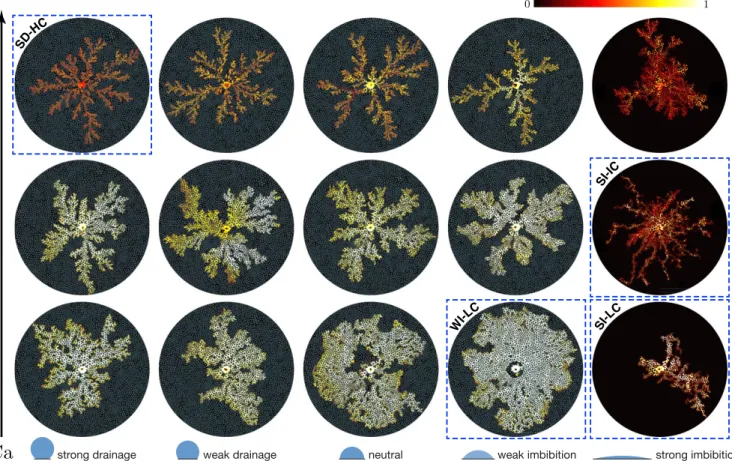
Fig. 1. Experimental phase diagram showing the displacement pattern at breakthrough for different wettability conditions (Left to Right:
θ =150◦, 120◦, 90◦, 60◦, 7◦) and capillary numbers (Bottom to Top: Ca = 0.029, 0.29, 2.9). The colormap shows the gap-averaged saturation of the
invading fluid. The four “priority cases” for the benchmark study are outlined in dashed blue: strong drainage at high Ca (SD-HC), weak imbibition at low Ca (WI-LC), strong imbibition at intermediate Ca (SI-IC), and strong imbibition at low Ca (SI-LC). Diagram is adapted from ref. 2.
and computing power. At the same time, modern experimental techniques now allow for high-resolution experimental observa-tions and detailed characterization of pore geometry (1). One recent dataset, in particular, provides high-resolution observa-tions across a wide range of wettabilities and capillary numbers in a well-defined and relatively simple pore geometry (2). These observations offer an unprecedented benchmarking opportu-nity for pore-scale models. The goal of this benchmark is to compare a wide variety of state-of-the-art pore-scale model-ing approaches with experimental observations in terms of both pore-scale mechanisms and macroscopic displacement patterns. Results
Dataset. The benchmark study is based on the experiments of Zhao et al. (2) (Fig. 1). In the experiments, water (ηwater= 0.99 mPa · s) was injected into a viscous silicone oil (ηoil= 340 mPa · s) in quasi-2D microfluidic flow cells patterned with vertical posts. This is a strongly viscously unstable displacement with viscosity ratio M = ηoil/ηwater≈ 340. The large unfavor-able viscosity ratio of the experimental dataset was motivated by several considerations: It allows for direct comparison with previous wettability-related experimental studies (3, 4), it helps to highlight the impact of wettability on viscous instabilities, and it is directly relevant to applications like waterflooding of heavy crude oil (5).
The importance of viscous forces relative to capillary forces in the experiments was characterized using the classical cap-illary number Ca = ηoilvinj/γ, where γ = 13 ± 2 mN/m is the interfacial tension between the fluids and vinj= Q /(bd )is the characteristic injection velocity as constrained by the gap
thick-ness b = 100 µm and the median pore-throat size d = 300 µm. The experiments were conducted at three distinct values of Ca spanning two orders of magnitude: Ca = 0.029 (“low Ca”), 0.29 (“intermediate Ca”), and 2.9 (“high Ca”).∗ Note that these val-ues of Ca provide a nominal macroscopic characterization of the flow, but the actual strength of viscous to capillary forces varies locally due pore-scale heterogeneity, preferential path-ways, and the radial flow geometry. Note also that the lowest value of Ca considered here is still moderate relative to a truly quasi-static displacement. The wettability of the flow cell was characterized using the static advancing contact angle θ of water immersed in silicone oil. The experiments were conducted at five distinct values of θ spanning the full range of wet-tability conditions: θ = 150◦ (“strong drainage”), 120◦ (“weak drainage”), 90◦ (“neutral”), 60◦ (“weak imbibition”), and 7◦ (“strong imbibition”). The participating teams were given the exact geometry of the post pattern and, for each experimental condition, a series of data files describing the time evolution of the gap-averaged water saturation S at high spatial resolution. To allow for qualitative and quantitative comparisons between methods without imposing an excessive computational burden on participants, we identified four “priority cases” that best rep-resent the diversity of patterns and physical mechanisms that emerge from fluid–fluid displacement under different Ca and wettability conditions: (i) strong drainage at high Ca (SD-HC), canonical viscous fingering pattern with incomplete pore-scale
*Note that the Ca values reported in ref. 2 are incorrect—they are too small by one order of magnitude.
APPLIED
PHYSICAL
SCIENCES
displacement due to formation of trailing films of the defending fluid; (ii) weak imbibition at low Ca (WI-LC), compact dis-placement pattern due to cooperative pore filling; (iii) strong imbibition at intermediate Ca (SI-IC), thin-film flow of the invad-ing fluid along the top and bottom walls, accompanied by a ramified fingering pattern formed by corner flow; and (iv) strong imbibition at low Ca (SI-LC), corner-flow–driven “chaining” of posts.
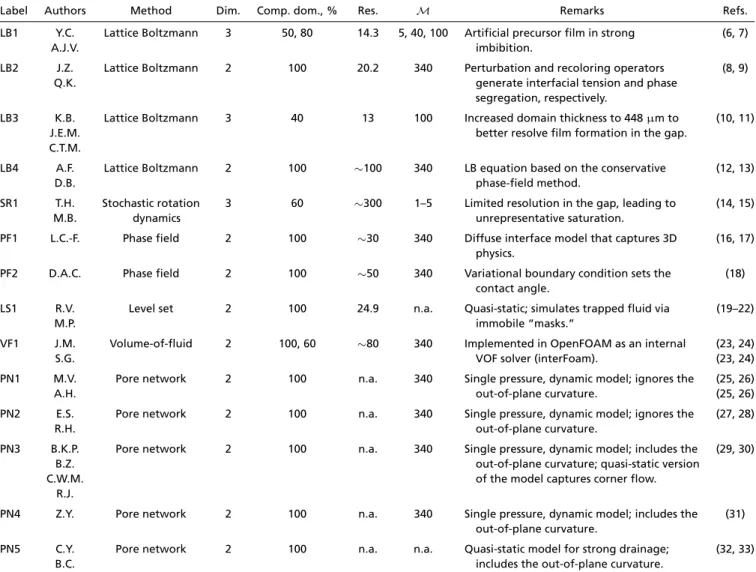
Participating Teams and Methods. A total of 14 teams contributed modeling results to the benchmark study (Table 1). Together, they applied many different pore-scale modeling methods (Table 1 andSI Appendix, Note 1). The methods can be catego-rized into three major classes: lattice/particle-based models, con-tinuum models, and pore-network models. Lattice/particle-based models simulate the motion and interaction of a large number of microscopic particles that collectively give rise to macro-scopic behavior satisfying the relevant continuum equations (e.g., Navier–Stokes). The fluid–fluid interface is captured implicitly as the boundary between the multicolored particles that rep-resent the different fluid phases. These models include lattice Boltzmann (LB) methods (34) and stochastic rotation dynamics (SR) models (35). Continuum models solve macroscopic
equa-tions for fluid flow while tracking the interface implicitly via the evolution of an indicator variable. These models include volume-of-fluid (VF) methods (36), level-set (LS) methods (37), and phase-field (PF) models (38). Pore-network (PN) models sim-ulate fluid flow through an idealized network of pores connected by throats (39). The macroscopic interface is represented explic-itly as the boundary between invaded and noninvaded pores. It speaks to the physical complexity of this problem that only one of the contributions (VF1) attempted direct simulation of the Navier–Stokes (or Stokes) equations with evolving fluid–fluid interfaces. Note also that only LB1, LB3, and SR1 conducted truly 3D simulations.
Qualitative Performance Measures.The interplay between wetta-bility and Ca generates a wide spectrum of 2D displacement patterns that range from ramified fingers to compact fronts (Fig. 1). Additional 3D information is provided by the local gap-averaged saturation of the invading fluid (Fig. 1). The dis-placement pattern and saturation distribution at the end of the simulation, when the invading fluid reaches the outer edge of the computational domain, serve as a good basis for qual-itative and quantqual-itative comparisons (e.g., Figs. 2 and 3 and
SI Appendix).
Table 1. Summary of contributions
Label Authors Method Dim. Comp. dom., % Res. M Remarks Refs.
LB1 Y.C. Lattice Boltzmann 3 50, 80 14.3 5, 40, 100 Artificial precursor film in strong (6, 7)
A.J.V. imbibition.
LB2 J.Z. Lattice Boltzmann 2 100 20.2 340 Perturbation and recoloring operators (8, 9)
Q.K. generate interfacial tension and phase
segregation, respectively.
LB3 K.B. Lattice Boltzmann 3 40 13 100 Increased domain thickness to 448 µm to (10, 11)
J.E.M. better resolve film formation in the gap.
C.T.M.
LB4 A.F. Lattice Boltzmann 2 100 ∼100 340 LB equation based on the conservative (12, 13)
D.B. phase-field method.
SR1 T.H. Stochastic rotation 3 60 ∼300 1–5 Limited resolution in the gap, leading to (14, 15)
M.B. dynamics unrepresentative saturation.
PF1 L.C.-F. Phase field 2 100 ∼30 340 Diffuse interface model that captures 3D (16, 17) physics.
PF2 D.A.C. Phase field 2 100 ∼50 340 Variational boundary condition sets the (18)
contact angle.
LS1 R.V. Level set 2 100 24.9 n.a. Quasi-static; simulates trapped fluid via (19–22)
M.P. immobile “masks.”
VF1 J.M. Volume-of-fluid 2 100, 60 ∼80 340 Implemented in OpenFOAM as an internal (23, 24)
S.G. VOF solver (interFoam). (23, 24)
PN1 M.V. Pore network 2 100 n.a. 340 Single pressure, dynamic model; ignores the (25, 26)
A.H. out-of-plane curvature. (25, 26)
PN2 E.S. Pore network 2 100 n.a. 340 Single pressure, dynamic model; ignores the (27, 28)
R.H. out-of-plane curvature.
PN3 B.K.P. Pore network 2 100 n.a. 340 Single pressure, dynamic model; includes the (29, 30)
B.Z. out-of-plane curvature; quasi-static version
C.W.M. of the model captures corner flow.
R.J.
PN4 Z.Y. Pore network 2 100 n.a. 340 Single pressure, dynamic model; includes the (31) out-of-plane curvature.
PN5 C.Y. Pore network 2 100 n.a. n.a. Quasi-static model for strong drainage; (32, 33)
B.C. includes the out-of-plane curvature.
SeeSI Appendix, Notes 3–5for further details on methods. Dim., dimensionality; Comp. dom., radius of computational domain as a percentage of the radius of the experimental domain; Res., resolution of the computational domain in micrometers per grid block/lattice; n.a., not applicable. LB1, LB2, LB3, LB4, SR1, blue in Fig. 4; PF1, PF2, LS1, VF1, orange in Fig. 4; PN1, PN2, PN3, PN4, PN5, green in Fig. 4.
Quantitative Performance Measures. For quantitative comparison, we calculate four performance measures from the displacement pattern at the end of each simulation, when the invading fluid reaches the outer edge of the domain:
i) Fractal dimension Df, as calculated via the box-counting
method. This is a classical measure of the degree to which a pattern fills space in 2D (40).
ii) Average dimensionless finger width Wf, as measured at half
the radius of the computational domain and scaled by the median post diameter. Note that this measure is very sensi-tive to domain size for compact displacements and that not all groups used the same domain size.
iii) Gap-averaged saturation S of the invading fluid in invaded
regions, as represented by its median value as well as the first and third quartiles. Note that many methods ignore films and therefore assume S = 1 in invaded regions.
iv) Displacement efficiency Ed, which is the fraction of the
defending fluid that has been displaced from the domain. Details on how we calculated the quantitative performance measures can be found inSI Appendix, Note 2.
Submission of Simulation Results.While some teams submitted results for many of the conditions in the experimental phase dia-gram (Fig. 1), most teams only contributed results for a relevant subset of the priority cases (Table 1 andSI Appendix). For exam-ple, some methods were developed for quasi-static displacement (i.e., small Ca) and therefore could not be applied to interme-diate or high Ca conditions (LS1, PN5). Other methods were developed for drainage only and therefore could not be applied to imbibition scenarios (PN4, PN5). Additionally, some teams simulated a subset of the experimental domain (i.e., truncated at
EXP PF1 LB1 PN3
A
B
C
D
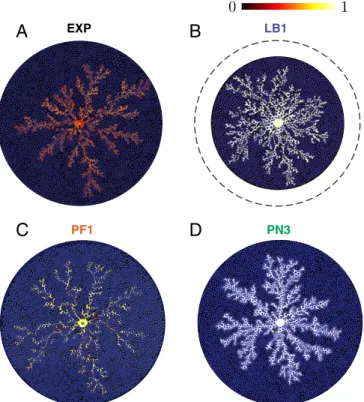
Fig. 2. (A–D) Comparison between (A) the experimental displacement pat-tern (EXP) and (B–D) selected simulated displacement patpat-terns for the case of strong drainage at high Ca (SD-HC). The simulations capture the slender, ramified fingering patterns of SD-HC well, although they are produced by three distinctly different classes of modeling methods. The three methods differ most strongly in how well they reproduce the residual wetting films, as illustrated by the colormap.
Fig. 3. Selection of simulated displacement patterns for the priority cases. (A) Strong drainage at high Ca (SD-HC) as simulated by a phase-field model. (B) Weak imbibition at low Ca (WI-LC) as simulated by a pore-network model. (C) Strong imbibition at intermediate Ca (SI-IC) as simulated by a lattice Boltzmann model at a reduced viscosity ratio (M = 40). (D) Strong imbibition at low Ca (SI-LC) as simulated by a pore-network model.
a smaller outer radius) due to computational constraints (LB1, LB3, SR1, VF1).
Performance of the Methods.
SD-HC. The experimental displacement pattern for SD-HC dis-plays classical viscous fingering, known for the slender, rami-fied fingers mimicked by diffusion-limited aggregation (Figs. 1 and 2A) (41, 42). Remarkably, all three classes of methods are able to capture these patterns (Fig. 2 and SI Appendix,
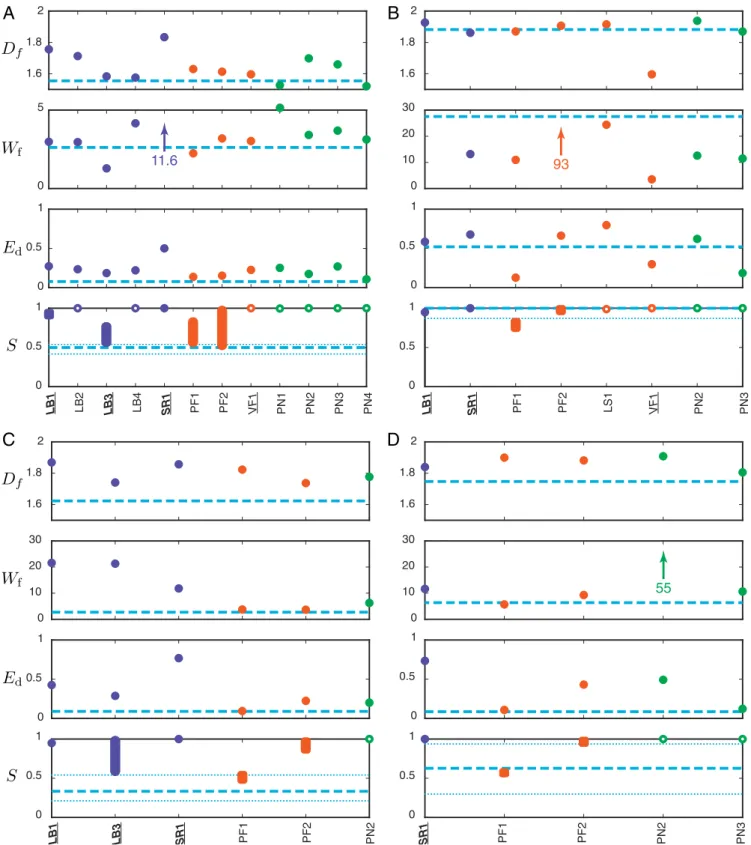
Fig. S1). Quantitative analysis of the simulated patterns reveals that while most methods reproduce Wf to within a factor of 60%, most methods overpredict Df, and all methods overpre-dict Ed, often by severalfold (Fig. 4A). The latter discrepancy is a consequence of incomplete pore-scale displacement due to the well-known formation of thin trailing films of the defend-ing fluid in drainage at high Ca (43, 44). Most methods ignore these films, and those that capture them tend to underpredict their thickness, which corresponds to overpredicting S (Fig. 4A). The PF methods appear to do a reasonable job of capturing this incomplete displacement without simulating the full 3D prob-lem. Note that LB1, LB3, SR1, and VF1 simulate a subset of the full domain and that LB1, LB3, and SR1 simulate at a reduced M. Displacement at high Ca is very sensitive to viscos-ity ratio, and the predictions of the latter methods are affected accordingly.
WI-LC.The experimental displacement pattern for WI-LC shows compact displacement as a result of cooperative pore filling (27, 45). Qualitatively, all three classes of methods are again able to capture these patterns (SI Appendix, Fig. S2). Most methods cap-ture Df to within a few percent, suggesting that the methods reproduce the 2D features of the pattern (Fig. 4B). This case does not feature thin films, so S is nearly 1; as a result, those methods that capture Df also capture Ed. Note that LB1, SR1, and VF1 simulate a subset of the full domain, and LB1 and SR1
APPLIED PHYSICAL SCIENCES 0 10 20 30 0 0.5 1 0 0.5 1 0 0.5 1 LB1 LB2 LB3 LB4 SR1 PF1 PF2 VF1 PN1 PN2 PN3 PN4 LB1 SR1 PF1 PF2 LS1 VF1 PN2 PN3 93
A
B
LB1 LB3 SR1 PF1 PF2 PN2 0 10 20 30 0 0.5 1C
D
0 0.5 1 SR1 PF1 PF2 PN2 PN3 1.6 1.8 2 0 0.5 1 0 0.5 1 0 0.5 1 1.6 1.8 2 1.6 1.8 2 1.6 1.8 2 0 5 11.6 0 10 20 30 55Fig. 4. (A–D) Quantitative performance results for (A) SD-HC, (B) WI-LC, (C) SI-IC, and (D) SI-LC. First row: Fractal dimension Df. Second row: Average
dimensionless finger width Wf. Third row: Displacement efficiency Ed. Fourth row: Gap-averaged saturation S of the invading fluid in invaded regions, with
symbols spanning the range from first quartile to third quartile. In the latter, open circles indicate methods that neglect films and therefore assume S = 1 in invaded regions. In all cases, we also plot the corresponding experimental measurement (dashed blue line); for S, we show the first and third quartiles (dotted blue lines) in addition to the median value. Italic and underlined labels on the horizontal axis denote contributions that simulate a subset of the experimental domain, while labels in boldface type denote contributions that simulate at a reduced M relative to the experiments.
simulate at a reduced M. Displacement at low Ca is not very sensitive to viscosity ratio, so the latter two methods still perform well in this scenario.
SI-IC.The experimental displacement pattern for SI-IC shows a highly ramified, yet roughly axisymmetric fingering pattern, the backbone of which is formed by the successive “chaining” of
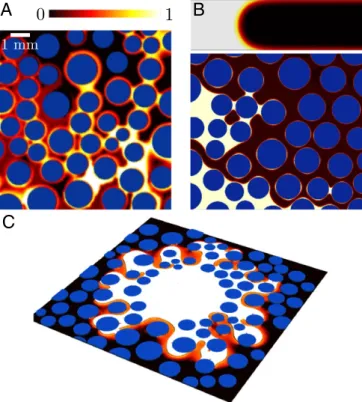
posts by preferential flow along the postwall corners (2). The resulting pattern has low values of S because the strongly wet-ting invading fluid propagates primarily by corner flow and in thin films along the top and bottom walls, bypassing pore bod-ies (2, 46, 47). Qualitatively, none of the methods reproduce the ramified backbone of linked posts (SI Appendix, Fig. S3). Most methods fail to capture the emergence of corner flow, typically overestimating Wfand greatly overestimating Ed(Fig. 4C). Fully 3D methods should be able to capture corner flow and film flow, and images from the 3D simulations (LB1, LB3, SR1) suggest that they do, at least to some extent (Fig. 5). However, because of the high computational demands, all three of these meth-ods simulate subsets of the full domain at greatly reduced M; the latter suppresses the strong preferential flow through thin films that should occur for large M. Quasi-3D (gap-averaged) phase-field methods (PF1, PF2) can capture film flow through their upscaled representation of the affinity of the invading fluid for both the walls and the posts, but cannot capture corner flow without an explicit submodel for the presence of corners. Pore-network models would require explicit submodels for both film flow and corner flow.
SI-LC. The experimental displacement pattern for SI-LC is com-pletely controlled by nearly quasi-static invasion through corner flow. Corner films link groups of posts via bursts, and then sur-rounded pores fill slowly and almost completely. Unlike SI-IC, these patterns have a relatively large value of S and no axial symmetry or well-defined fingers or branches. Relatively few par-ticipants attempted this case because it involves both low Ca (computationally demanding for 3D methods) and corner flow (absent from most methods). Qualitatively, the simulation results
A
B
C
Fig. 5. (A) Experimental snapshot of SI-IC at the pore scale, which is char-acterized by the coexistence of thin films and corner flow. (B) Simulation results of LB1 for SI-IC (M = 40). (B, Top) Cross-sectional view showing the leading thin films along the top and bottom walls. (B, Bottom) Plan view showing the coexistence of thin films and corner flow, as well as pendular rings that link neighboring posts. (C) Isometric projection of the 3D simu-lation results of LB3 for SI-IC (M = 100), showing the propagation of thin films ahead of the main invasion front.
are quite variable (SI Appendix, Fig. S4). PN3 captures postchain-ing via corner flow with a dedicated submodel for corner flow, but does not capture the subsequent filling in (Fig. 3); PF1 captures the rough shape, but without clear postchains. Quantitatively, all methods overpredict Df, but all methods are relatively close to the experimental value (Fig. 4D). All methods except for PF1 also overpredict Wf by a factor of 2 or more. Only PF1 and PF2 are able to make quantitative predictions of S (SR1, PN2, and PN3 assume S = 1); PF1 reproduces the experimental value of S very closely, whereas PF2 significantly overpredicts S . PF1 and PN3 both capture Ed relatively well; PF1 is arguably the best match overall.
Thin Films and Corner Flow. The complex nature of interfacial flows in the presence of solid surfaces lends an inherently 3D nature to fluid–fluid displacement processes, even in quasi-1D geometries such as capillary tubes (48) and quasi-2D geometries such as Hele–Shaw cells (46). In a patterned micromodel, these 3D effects include the propagation of thin films along the top and bottom walls and the surfaces of the posts, and in the cor-ners where the walls and posts meet (2, 47). While both fully 3D methods (LB1, LB3) and quasi-3D (gap-averaged) methods (PF1, PF2) predict the formation of trailing films in SD-HC, only fully 3D methods (LB1, LB3) capture films in SI-IC. The color-gradient wetting model used in LB1 leads to an artificial film (∼14 µm) that slowly permeates the entire simulation domain. This film accumulates on the posts to form corner films and pendular rings that resemble those observed in the experiments (Fig. 5B). However, this film also uniformly coats the top and bottom walls, and the resulting mass transport appears to sup-press the strong preferential flows observed in the experiment. LB3 uses a similar wetting model and should therefore have the same feature (Fig. 5C). Both of these methods are very compu-tationally demanding due to the very large number of particles needed to resolve a 3D flow. For a given scenario, the compu-tational cost also scales with the number of timesteps and the timestep size. The timestep size is constrained by M for numer-ical stability, whereas the number of timesteps to breakthrough scales with the domain size. As a result, LB1 and LB3 simulate a subset of the full domain and at a reduced M.
Discussion
The goal of this benchmark study was to assess the degree to which different state-of-the-art modeling strategies could reproduce the correct macroscopic features (and some pore-scale features) of fluid–fluid displacement in a porous medium under different wetting conditions. These pore-scale models have become widely used tools in extracting macroscopic proper-ties of geologic porous media (e.g., relative permeability) (49–52) and in designing synthetic porous materials with desirable trans-port properties for use in electrochemical devices (53, 54). In all of these cases, the accuracy of the model output hinges upon its ability to correctly account for the impact of wettability at different capillary numbers.
Most methods were able to capture viscous instability and fin-gering at high flow rates (IC and HC), and most were also able to capture the more subtle broadening of features in WI where the low contact angle enables cooperative pore filling. In contrast, few methods were able to capture the thin trailing films that form for SD-HC, the thin leading films that occur for SI-IC, and the corner films that dominate SI-LC, all of which are inherently 3D. For 2D models, films present a modeling challenge. Gap-averaged PF models were able to capture trailing films in SD-HC, although leading films in SI-IC and corner flow in SI-LC remain elusive. Other 2D models were unable to capture films to any noteworthy extent. PN3 was the only model to explic-itly account for corner flow and was reasonably successful in doing so for quasi-static displacement. However, extending such
APPLIED
PHYSICAL
SCIENCES
a model to include viscous effects and residual films is nontrivial because many of the underlying physical phenomena, such as flow through corner networks, film bridging from post to post, and postchaining avalanches, are poorly understood.
For 3D models, films present a serious computational chal-lenge. Resolving films is nontrivial due to the large aspect ratio of the problem—the radius of the flow cell is 100 mm, the gap thickness is 100 µm, and the film thickness ranges from tens of micrometers to a few micrometers or less. LB1, LB2, and LB3 addressed this challenge most directly, running 3D simu-lations with ∼160 million, ∼160 million, and ∼300 million lattice sites, respectively. Even after reducing the viscosity ratio and truncating the domain to relax timestep restrictions, these sim-ulations required world-class computational resources. Despite this substantial effort, these simulations could achieve a spa-tial resolution of only 10–20 µm, which is barely small enough to allow for films and certainly not small enough to resolve them. All three groups agree that this problem pushes the limits of what is currently possible. More importantly, these simula-tions showed both qualitatively and quantitatively that failure to resolve films at the small scale can have important consequences for the macroscopic flow pattern.
It is well known that preexisting wetting films are common in subsurface applications such as enhanced oil recovery and that their presence has a significant impact on the macroscopic transport properties such as relative permeability (55, 56). These preexisting films would be an active, evolving component of the displacement as they swell, disconnect, reconnect, and pinch off—particularly in partial wetting conditions. Resolving them (and the flow within them) would be an essential and challenging part of the problem.
This benchmark targets the “many-pore” scale (hundreds to thousands of pores), as this is a scale large enough to manifest the collective dynamics characteristic of fluid–fluid displacements in porous media (viscous fingering, capillary fingering, avalanches, etc.) and small enough that computational models are routinely used to make predictions. Thus, it is natural to ask whether those predictions are accurate. There is, however, an underly-ing scale at which “sunderly-ingle-pore” mechanisms emerge (such as meniscus deformation and merging, contact-line pinning and motion, contact-angle hysteresis, post wetting dynamics, etc.). The inclusion of these effects will further increase the compu-tational complexity of the problem, which makes it impractical at the scale of hundreds to thousands of pores considered in the current study. The comparison of different methods at this single-pore scale would require an altogether different type of benchmark study in a simpler geometry (e.g., Verma et al. (21)).
Furthermore, real rocks such as carbonates also have a wider pore-size distribution than the one from our micromodel (57), a feature that would likely have an effect on the correlation between pore occupancy and pore size that is absent from our experimental benchmark.
A key contribution of this benchmark is to demonstrate the capabilities and limitations of three major classes of pore-scale models (i.e., lattice/particle-based models, continuum models, and pore-network models) in predicting the macroscopic features of unstable two-phase flows in the presence of solid surfaces. We find that all three classes of models are capable of predicting the transition from strong drainage to weak imbibition. Specifically, pore-network models offer superior computational efficiency, but they lack the ability to resolve gap-averaged saturations that the more computationally intensive lattice/particle-based models and continuum models offer. Only 3D lattice/particle-based models could simulate leading films and corner flow in strong imbibition, but their spatial and temporal resolutions are severely limited by computational demand. Our results highlight the need for further effort along multiple complementary avenues in what is already a very active area of research.
Materials and Methods
The simulated displacement patterns for all priority cases are presented in
SI Appendix, Figs. S1–S4. Details on how we calculated the quantitative
per-formance measures of the priority cases can be found inSI Appendix, Note
2. Descriptions of all of the models, including their derivation and numerical
implementation, are included inSI Appendix, Notes 3–5.
ACKNOWLEDGMENTS. A.J.V. and Y.C. acknowledge the Center for
Geo-logic Storage of CO2, an Energy Frontier Research Center funded by the
US Department of Energy (DOE), Office of Science, Basic Energy Sciences (Award DE-SC0C12504), and Texas Advanced Computing Center Stampede 2 system (Allocation EAR160028) provided by the Extreme Science and Engi-neering Discovery Environment; Q.K. acknowledges Los Alamos National Laboratory’s Laboratory-Directed Research & Development Program and Institutional Computing Program; K.B., J.E.M., and C.T.M. acknowledge the US Army Research Office (Grant W911NF1410287), US National Science Foundation (NSF) (Grant 1619767), the US DOE Innovative and Novel Com-putational Impact on Theory and Experiment program (computer time), and the Oak Ridge Leadership Computing Facility (computing resources), which is a US DOE Office of Science User Facility (Contract DE-AC05-00OR22725); A.F. and D.B. acknowledge the US NSF (Grant CBET-1705770); R.V. and M.P. acknowledge US NSF Division of Earth Sciences Faculty Early Career Development Program (Grant 1255622); J.M. and S.G. acknowl-edge the UK Engineering and Physical Sciences Research Council (Grant EP/P031307/1) and funding from Energi Simulation; M.V. and A.H. acknowl-edge the Centers of Excellence funding scheme, Research Council of Norway (Project 262644); R.H. acknowledges the Israeli Science Foundation (Grant ISF-867/13); Z.Y. acknowledges the National Natural Science Foundation of China (Grant 41877203); and B.K.P. and R.J. acknowledge the US DOE (Grant DE-SC0018357).
1. M. J. Blunt et al., Pore-scale imaging and modelling. Adv. Water Resour. 51, 197–216 (2013).
2. B. Zhao, C. W. MacMinn, R. Juanes, Wettability control on multiphase flow in patterned microfluidics. Proc. Natl. Acad. Sci. U.S.A. 113, 10251–10256 (2016). 3. J. P. Stokes et al., Interfacial stability of immiscible displacement in a porous medium.
Phys. Rev. Lett. 57, 1718–1721 (1986).
4. M. Trojer, M. L. Szulczewski, R. Juanes, Stabilizing fluid-fluid displacements in porous media through wettability alteration. Phys. Rev. Appl. 3, 054008 (2015).
5. J. M. Al-Besharah, O. A. Salman, S. A. Akashah, Viscosity of crude oil blends. Ind. Eng.
Chem. Res. 26, 2445–2449 (1987).
6. Y. Chen, Y. Li, A. J. Valocchi, K. T. Christensen, Lattice Boltzmann simulations of liq-uid CO2displacing water in a 2D heterogeneous micromodel at reservoir pressure conditions. J. Contam. Hydrol. 212, 14–27 (2018).
7. J. Zhao et al., Simulation of microscale gas flow in heterogeneous porous media based on the lattice Boltzmann method. J. Appl. Phys. 120, 084306 (2016).
8. H. Liu, A. J. Valocchi, Q. Kang, Three-dimensional lattice Boltzmann model for immiscible two-phase flow simulations. Phys. Rev. E 85, 046309 (2012).
9. H. Liu, A. J. Valocchi, C. Werth, Q. Kang, M. Oostrom, Pore-scale simulation of liquid CO2displacement of water using a two-phase lattice Boltzmann model. Adv. Water Resour. 73, 144–158 (2014).
10. J. E. McClure, J. F. Prins, C. T. Miller, A novel heterogeneous algorithm to simulate multiphase flow in porous media on multicore CPU-GUP systems. Comput. Phys.
Commun. 185, 1865–1874 (2014).
11. J. E. McClure, M. A. Berrill, W. G. Gray, C. T. Miller, Tracking interface and common curve dynamics for two-fluid-phase flow in porous media. J. Fluid Mech. 796, 211–232 (2016).
12. A. Fakhari, D. Bolster, Diffuse interface modeling of three-phase contact line dynam-ics on curved boundaries: A lattice Boltzmann model for large density and viscosity ratios. J. Comput. Phys. 334, 620–638 (2017).
13. A. Fakhari, Y. Li, D. Bolster, K. T. Christensen, A phase-field lattice Boltzmann model for simulating multiphase flows in porous media: Application and comparison to experiments of CO2sequestration at pore scale. Adv. Water Resour. 114, 119–134 (2018).
14. T. Hiller, M. S. De La Lama, M. Brinkmann, Stochastic rotation dynamics of wetting multi-phase flows. J. Comput. Phys. 315, 554–576 (2016).
15. M. Jung et al., Wettability controls slow immiscible displacement through local interface instabilities. Phys. Rev. Fluids 1, 074202 (2016).
16. L. Cueto-Felgueroso, R. Juanes, A phase-field model of two-phase Hele-Shaw flow. J.
Fluid Mech. 758, 522–552 (2014).
17. L. Cueto-Felgueroso, R. Juanes, Macroscopic phase-field model of partial wetting: Bubbles in a capillary tube. Phys. Rev. Lett. 108, 144502 (2012).
18. D. A. Cogswell, M. L. Szulczewski, Simulation of incompressible two-phase flow in porous media with large timesteps. J. Comput. Phys. 345, 856–865 (2017).
19. M. Prodanovi´c, S. L. Bryant, A level set method for determining critical cur-vatures for drainage and imbibition. J. Colloid Interf. Sci. 304, 442–458 (2006).
20. E. Jettestuen, J. O. Helland, M. Prodanovi´c, A level set method for simulating capillary-controlled displacements at the pore scale with nonzero contact angles.
Water Resour. Res. 49, 4645–4661 (2013).
21. R. Verma, M. Icardi, M. Prodanovi´c, Effect of wettability on two-phase quasi-static displacement: Validation of two pore scale modeling approaches. J. Contam. Hydrol. 212, 115–133 (2018).
22. R. Verma, “Pore scale modeling of multiphase flow in heterogeneously wet media,” PhD thesis, The University of Texas at Austin, Austin, TX (2018).
23. S. Pavuluri, J. Maes, F. Doster, Spontaneous imbibition in a microchannel: Analytical solution and assessment of volume of fluid formulations. Microfluidic Nanofluidic 22, 90 (2018).
24. J. Maes, S. Geiger, Direct pore-scale reactive transport modelling of dynamic wet-tability changes induced by surface complexation. Adv. Water Resour. 111, 6–19 (2018).
25. E. Aker, K. J. M ˚aløy, A. Hansen, G. G. Batrouni, A two-dimensional network simulator for two-phase flow in porous media. Transp. Porous Med. 32, 163–186 (1998). 26. H. A. Knudsen, E. Aker, A. Hansen, Bulk flow regimes and fractional flow in 2D porous
media by numerical simulations. Transp. Porous Med. 47, 99–121 (2002).
27. R. Holtzman, E. Segre, Wettability stabilizes fluid invasion into porous media via nonlocal, cooperative pore filling. Phys. Rev. Lett. 115, 164501 (2015).
28. R. Holtzman, Effects of pore-scale disorder on fluid displacement in partially-wettable porous media. Sci. Rep. 6, 36221 (2016).
29. B. K. Primkulov et al., Quasi-static fluid-fluid displacement in porous media: Invasion-percolation through a wetting transition. Phys. Rev. Fluids 3, 104001 (2018). 30. B. K. Primkulov et al., Signatures of fluid-fluid displacement in porous media:
Wettability, patterns, and pressures. arXiv:1906.02364 (6 June 2019).
31. Z. Yang, A. Niemi, F. Fagerlund, T. Illangasekare, Two-phase flow in rough-walled fractures: Comparison of continuum and invasion-percolation models. Water Resour.
Res. 49, 993–1002 (2013).
32. C. Yuan, B. Chareyre, F. Darve, Pore-scale simulations of drainage in granular materi-als: Finite size effects and the representative elementary volume. Adv. Water Resour. 97, 109–124 (2016).
33. C. Yuan, B. Chareyre, A pore-scale method for hydromechanical coupling in deformable granular media. Comput. Methods Appl. Mech. Eng. 318, 1066–1079 (2017).
34. S. Chen, G. D. Doolen, Lattice Boltzmann method for fluid flows. Annu. Rev. Fluid
Mech. 30, 329–364 (1998).
35. T. Ihle, D. M. Kroll, Stochastic rotation dynamics: A Galilean-invariant mesoscopic model for fluid flow. Phys. Rev. E 63, 020201 (2001).
36. C. W. Hirt, B. D. Nichols, Volume of fluid (VOF) method for the dynamics of free boundaries. J. Comput. Phys. 39, 201–225 (1981).
37. J. A. Sethian, P. Smereka, Level set methods for fluid interfaces. Annu. Rev. Fluid
Mech. 35, 341–372 (2003).
38. V. E. Badalassi, H. D. Ceniceros, S. Banerjee, Computation of multiphase systems with phase field models. J. Comput. Phys. 190, 371–397 (2003).
39. M. J. Blunt, Flow in porous media—pore-network models and multiphase flow. Curr.
Opin. Colloid Interf. Sci. 6, 197–207 (2001).
40. M. R. Schroeder, Fractals, Chaos, Power Laws: Minutes From an Infinite Paradise (W. H. Freeman and Company, Dover ed., 2009).
41. L. Paterson, Diffusion-limited aggregation and two-fluid displacements in porous media. Phys. Rev. Lett. 52, 1621–1624 (1984).
42. K. J. M ˚aløy, J. Feder, T. Jøssang, Viscous fingering fractals in porous media. Phys. Rev.
Lett. 55, 2688–2691 (1985).
43. G. I. Taylor, Deposition of a viscous fluid on the wall of a tube. J. Fluid Mech. 10, 161–165 (1961).
44. F. P. Bretherton, The motion of long bubbles in tubes. J. Fluid Mech. 10, 166–188 (1961).
45. M. Cieplak, M. O. Robbins, Influence of contact angle on quasistatic fluid invasion of porous media. Phys. Rev. B, 41, 11508–11521 (1990).
46. B. Levach ´e, D. Bartolo, Revisiting the Saffman-Taylor experiment: Imbibi-tion patterns and liquid-entrainment transiImbibi-tions. Phys. Rev. Lett. 113, 044501 (2014).
47. C. Odier, B. Levach ´e, E. Santanach-Carreras, D. Bartolo, Forced imbibition in porous media: A fourfold scenario. Phys. Rev. Lett. 119, 208005 (2017).
48. B. Zhao, A. A. Pahlavan, L. Cueto-Felgueroso, R. Juanes, Forced wetting tran-sition and bubble pinch-off in a capillary tube. Phys. Rev. Lett. 120, 084501 (2018).
49. P. C. Reeves, M. A. Celia, A functional relationship between capillary pressure, satura-tion, and interfacial area as revealed by a pore-scale network model. Water Resour.
Res. 32, 2345–2358 (1996).
50. H. Rajaram, L. A. Ferrand, M. A. Celia, Prediction of relative permeabilities for unconsolidated soils using pore-scale network models. Water Resour. Res. 33, 43–52 (1997).
51. P. H. Valvatne, M. J. Blunt, Predictive pore-scale modeling of two-phase flow in mixed wet media. Water Resour. Res. 40, W07406 (2004).
52. L. Hao, P. Cheng, Pore-scale simulations on relative permeabilities of porous media by lattice Boltzmann method. Int. J. Heat Mass Transf. 53, 1908–1913 (2010). 53. P. P. Mukherjee, Q. Kang, C. Y. Wang, Pore-scale modeling of two-phase transport
in polymer electrolyte fuel cells – progress and perspective. Energy Environ. Sci. 4, 346–369 (2011).
54. F. Arbabi, H. Montazeri, R. Abouatallah, R. Wang, A. Bazylak, Three dimensional computational fluid dynamics modelling of oxygen bubble transport in polymer electrolyte membrane electrolyzer porous transport layers. J. Electrochem. Soc. 163, F3062–F3069 (2016).
55. M. Blunt, M. J. King, H. Scher, Simulation and theory of two-phase flow in porous media. Phys. Rev. A 46, 7680–7699 (1992).
56. M.-H. Hui, M. Blunt, Effects of wettability on three-phase flow in porous media. J.
Phys. Chem. B 104, 3833–3845 (2000).
57. M. J. Blunt, Multiphase Flow in Permeable Media: A Pore-Scale Perspective (Cambridge University Press, 2017).