DOI 10.1007/s11301-008-0032-8 S T A T E - O F - T H E - A R T - A R T I K E L
Customer value from a customer perspective:
a comprehensive review
Albert Graf · Peter Maas
Received: 27 April 2007 / Accepted: 18 February 2008 / Published online: 13 March 2008
©Wirtschaftsuniversit¨at Wien, Austria 2008
Abstract The value concept is one of marketing theory’s basic elements.
Identi-fying and creating customer value (CV) – understood as value for customers – is regarded as an essential prerequisite for future company success. Nevertheless, not until quite recently has CV received much research attention. Ideas on how to concep-tualize and link the concept to other constructs vary widely. The literature contains a multitude of different definitions, models, and measurement approaches. This art-icle provides a broad overview, analysis, and critical evaluation of the different trends and approaches found to date in this research field, encompassing the development of perceived and desired customer value research, the relationships between the CV construct and other central marketing constructs, and the linkage between CV and the company interpretation of the value of the customer, like customer lifetime value (CLV). The article concludes by pointing out some of the challenges this field of research will face in the future.
Keywords Customer value· Desired customer value · Perceived customer value ·
Consumer behaviour
Zusammenfassung Die Identifizierung und Schaffung von Wert f¨ur den Kunden
– Customer Value (CV) – wird als zentrale Voraussetzung f¨ur zuk¨unftige Erfolge
A. Graf (u)
Research Associate, Institute of Insurance Economics, University of St. Gallen, Kirchlistrasse 2, 9010 St. Gallen, Switzerland
e-mail: [email protected] P. Maas
Member of the Executive Board, Institute of Insurance Economics, University of St. Gallen, Kirchlistrasse 2, 9010 St. Gallen, Switzerland
e-mail: [email protected]
von Unternehmen betrachtet. Obwohl das Wertekonzept als eines der Basiselemente in der Marketingtheorie gilt, wurde das CV-Konstrukt erst in den letzten Jahren zu einem viel erforschten Untersuchungsobjekt. Es entstand eine Vielzahl von Defini-tionen, Modellen und Erhebungsans¨atzen, die teils stark divergieren. Dieser Beitrag liefert einen ¨Uberblick der verschiedenen Ans¨atze und Trends in diesem Forschungs-feld. Dieser umfasst die Analyse der Entwicklung des ,,Perceived“ und ,,Desired“ CV, die Beziehungen zwischen dem CV and anderen zentralen Marketingkonstruk-ten, sowie den Zusammenhang zwischen CV und Wert des Kunden f¨ur Unternehmen, z. B. in Form des Customer Lifetime Value. Abschliessend wird ein Ausblick auf die zuk¨unftigen Herausforderungen der CV-Forschung gegeben.
Schl ¨usselw¨orter Customer value· Desired customer value · Perceived customer value· Konsumentenverhalten
1 Introduction
The study of customer value (CV) is becoming significantly more important, both in research and in practice. For example, the American Marketing Association re-cently revised its definition of “marketing” to encompass the notion of customer value, and there have been important discussions in the literature about the dom-inant logic in the field and over the central role customer value plays (American Marketing Association 2006; Vargo and Lusch 2004). Identifying and creating CV is regarded as an essential prerequisite for long-term company survival and success (Porter 1996; Woodruff 1997; Payne and Holt 2001; Huber et al. 2001). Understand-ing the way customers judge and value a service or product is crucial to achievUnderstand-ing a competitive advantage. Scientists and practitioners have recognized the power of the CV concept in identifying value for customers and managing customer behaviour (Johnson et al. 2006; Kothari and Lackner 2006; Setijono and Dahlgaard 2007). The goal of CV research is to describe, analyze, and make empirically measur-able the value that companies create for their customers and to link these insights to further marketing constructs. Recently, the research has also begun to link CV with concepts such as customer lifetime value (CLV) or customer equity in order to assess the return on marketing actions and the financial impact of CV on the com-pany.
A multitude of CV approaches have emerged, and somewhat ambiguous empiri-cal results have been presented. Thus far there is remarkably little consensus in the literature regarding notation and conception in this research field. Even the term CV is used and evaluated in very different ways in the marketing literature (Woodruff 1997). There is no consistent definition for “customer value” by now. Generally, there are two theoretical differentiable approaches:
CV from a company perspective: Here, the value of the customer is central for the
provider. The goal is to evaluate how attractive individual customers (customer life-time value) or customer groups (customer equity) are from a company perspective. This approach became a popular research topic in the last few years (see Reinartz and Kumar 2003; Rust et al. 2004; Krafft et al. 2005). This research stream is closely
lated to relationship marketing, which aims at developing and maintaining profitable business relationships with selected customers.
CV from a customer perspective: The focus here is on value generated by a
com-pany’s product or service as perceived by the customer or the fulfilment of customer goals and desires by company products and/or services.
In this article, we concentrate on the customer perspective and use the term
cus-tomer value (CV) to refer to that perspective and the term cuscus-tomer lifetime value
(CLV) to refer to a company perspective. The article is divided into five sections. The first section provides a general understanding of CV. Section two describes, analyzes, and evaluates different CV approaches. Next, relationships between the CV construct and other central marketing concepts are analyzed, which is followed by a section fo-cusing on the merger of the customer and company perspectives by linking CV with CLV. Finally, questions and directions for future research are discussed.
2 Understanding of customer value
Although CV has become the object of much investigation only during the last few years, the value concept has always been “the fundamental basis for all marketing activity” (Holbrook 1994). This is due to its close relation to the guiding principle of marketing – the voluntary exchange among competent market participants. This exchange view of marketing has a long tradition of acceptance among leading mar-keting scholars (e. g. Alderson 1957; Kotler 1972). The voluntary exchange takes place in markets where all involved expect a gain in value and buyers select that of-fering which amongst all offers afford him the highest expected gain in value (Kotler and Bliemel 2001).
However, CV approaches often have their foundation not only in marketing re-search but also in a variety of other rere-search fields, such as strategy and organizational development, as well as in psychology and sociology. According to Payne and Holt (2001), CV research has been shaped and influenced by research in fields such as value chain, augmented product concept, value research, customer behaviour, cus-tomer satisfaction, and quality. In particular, the constructs of cuscus-tomer satisfaction (CS) and perceived quality are closely linked to CV and sometimes even used syn-onymously in the literature (Walker et al. 2006; Gilbert and Veloutsou 2006; Rust and Chung 2006).
A comparison of the concepts of CV, quality1, and CS demonstrates that the three
are closely linked, but yet separate, constructs (see also Sect. 4.1). As quality mostly is defined to be the result of a customer’s subjective evaluation of a company’s product or service, most researchers consider quality as antecedent to CV and as a significant variable with strong influence on customers’ innate behaviour (e. g. Zeit-haml 1988; Bolton and Drew 1991; Allen and Grisaffe 2001; Ralston 2003). The CV
1For the sake of simplicity, “product and/or service quality” is often referred to as simply “quality” in
this paper furthermore using this term we refer to perceived quality. Other approaches measure quality in a more objective way especially for products (see Rust and Chung 2006). But in regard to the adoption level theory, quality of products and especially of services is evaluated regarding the individual adoption level and not objective criteria.
approach encompasses many more facets than quality alone, e. g., by taking into ac-count cost or risk attributes (Bolton and Drew 1991; Zeithaml 1988). Regarding CS, most researchers agree that CS is a post-consumption assessment by the user about the purchased product or service, and conclude – supported by empirical evidence – that CV is an antecedent of customer satisfaction. CS research generally focuses on benefits (Eggert and Ulaga 2002; Sweeney and Soutar 2001; De Ruyter et al. 1997) and current post-purchase customers. In contrast, CV concepts allow a comparison of both expected benefits and sacrifices in different phases of the purchasing process by both current and potential customers (Woodruff 1997; Sweeny and Soutar 2001).
The influence of other research fields is reflected by the various definitions of CV used in the literature (see Table 1). Terminology such as utility, quality, advantage, or preference is used to define CV even though these terms themselves are not clearly defined (Woodruff 1997; Ulaga 2003; Spiteri and Dion 2004). Yet, the definitions have in common that CV is considered as a theoretical construct having to do with a customer perspective of provider products or services (Huber et al. 2001; Spiteri and Dion 2004). CV thus differs from “personal or organisational values, those centrally held and enduring beliefs about right and wrong, good and bad that cut across situ-ations and products or services” (Woodruff 1997). Furthermore, CV is a subjective construct made up of multiple value components (Ulaga 2003; Huber et al. 2001).
Despite certain commonalities, the CV definitions presented in Table 1, as well as the related CV models, represent different streams of CV research. In principle, CV models can be divided into two categories:
Perceived customer value (PCV): CV is conceptualized as tradeoff between
ben-efits and sacrifices with a focus on the concrete performance characteristics of the products/services (see Zeithaml 1988; Gale 1994).
Desired customer value (DCV): CV is conceptualized as a part of the customers’
value system. The focus of DCV is on abstract value dimensions, or consequences, derived from specific performance characteristics (see Holbrook 1994; Woodruff 1997).
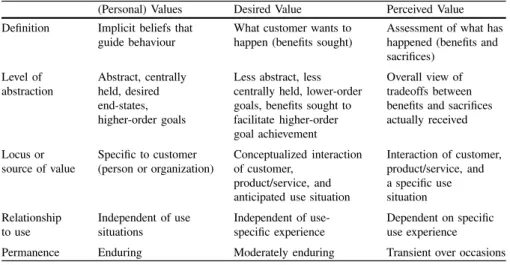
The two categories differ in their levels of abstraction and in their focus (see Table 2). However, despite the heterogeneity of the definitions and models, the two CV categories are not mutually exclusive; on the contrary, in many ways the two overlap and several CV approaches are a combination of both concepts. For example, PCV attributes are also crucial for DCV in fulfilling higher-order goals of customers.
Table 1 Definitions of Customer Value
Zeithaml (1988) “Perceived value is a customer’s overall assessment of the utility of a product based on perceptions of what is received and what is given.”
Gale (1994) “Customer value is market perceived quality adjusted for the relative price of your product. [It is] your customer’s opinion of your products (or services) as compared to that of your competitors.”
Holbrook (1994) Customer value is “a relativistic (comparative, personal, situational) preference characterizing a subject’s [consumer’s] experience of interacting with some object
. . .i.e., any good, service, person, place, thing, event, or idea.”
Woodruff (1997) Customer value is a “customer’s perceived preference for and evaluation of those product attributes, attribute performance, and consequences arising from use that facilitate (or block) achieving the customer’s goals and purposes in use situations.”
Table 2 Three Forms of Value (Flint et al. 1997)
(Personal) Values Desired Value Perceived Value Definition Implicit beliefs that What customer wants to Assessment of what has
guide behaviour happen (benefits sought) happened (benefits and sacrifices)
Level of Abstract, centrally Less abstract, less Overall view of abstraction held, desired centrally held, lower-order tradeoffs between
end-states, goals, benefits sought to benefits and sacrifices higher-order goals facilitate higher-order actually received
goal achievement
Locus or Specific to customer Conceptualized interaction Interaction of customer, source of value (person or organization) of customer, product/service, and
product/service, and a specific use anticipated use situation situation
Relationship Independent of use Independent of use- Dependent on specific to use situations specific experience use experience Permanence Enduring Moderately enduring Transient over occasions Thus, only a comprehensive and integrated analysis of both categories provides a full understanding of the complexity of the CV construct.
3 Customer value approaches 3.1 Perceived customer value (PCV)
Most research efforts concentrate on conceptualising CV as trade-off between bene-fits and sacrifices of a product or service. In framing PCV, opinions vary widely on what aspects should be included. Generally, the approaches can be divided into an either more product-oriented or more relationship-oriented one.
3.1.1 Product-oriented PCV
Product-oriented PCV approaches limit CV on the trade-off between perceived qual-ity and price of a product or service. For many authors, empirically clarifying the relationships between the individual CV elements is of pre-eminent importance, such as the positive relationship between perceived quality and PCV, the negative relation-ship between perceived price and PCV and the relationrelation-ship between price and quality (Bolton and Drew 1991; Gale 1994; Oh 1999; Kashyap and Bojanic 2000; Desarbo et al. 2001).
In addition to the fundamental concept of PCV as a trade-off, analysis of the ex-trinsic indicators of perceived product quality and sacrifice is a core element in much PCV research. Authors such as Zeithaml (1988), Dodds et al. (1991), Andreassen and Lindestad (1998), Teas and Agarwal (2000) and Ralston (2003) differentiate between intrinsic and extrinsic indicators in their PCV concepts. Intrinsic indicators, such as product quality, are a part of the product. They can be changed only if the product is modified. Extrinsic indicators such as price, brand name, level of advertising or
try of origin are related to the product, but are not inherent in the product itself, and thus can change over time. In this context, quality is considered as mediator in the relationship between all extrinsic indicators and PCV. Perceived sacrifice acts as me-diator in the relationship between price and PCV. Thus, price serves as an extrinsic indicator for both perceived sacrifice and perceived quality.
Several authors (e. g. Thaler 1985; Monroe and Chapman 1987; Grewal et al. 1998; Al-Sabbahy et al. 2004) incorporate an internal reference price in their product-oriented PCV concepts – a price in buyers’ memories that serves as a basis for judging or comparing actual prices (Grewal et al. 1998). These authors differentiate between “acquisition value” and “transaction value”, where by a cquisition value refers to the buyers’ trade-off from acquiring the product or service and transaction value to the perception of psychological satisfaction or pleasure obtained from taking advan-tage of the financial term of a price deal (Grewal et al. 1998). Some authors, e. g. Thaler (1985) and Monroe and Chapman (1987), consider the acquisition value and the transaction value as two independent dimensions; however, Grewal et al. (1998) have shown empirically that acquisition value is a function of perceived quality and perceived transaction value.
3.1.2 Relationship-oriented PCV
Many researchers have broadened their CV concepts to include, in addition to product and service attributes, relationship, process, and risk components. In this context, a significant enhancement of the PCV construct is the addition of rela-tional attributes. In their PCV approach, Ravald and Gr¨onroos (1996) assume that the relationship between a customer and a company has great influence on the perceived value of a customer. The longer a relationship endures and the greater its intensity, the more the focus of how the product or service is judged shifts to a judgment of the benefit/sacrifice attributes of the relationship. This suggests that in determining the PCV of an episode, the positive and negative effects of preserving the relationship with the company must be included in addition to the utility and expenditure of a good and its supplementary services (Gr¨onroos 1997 and 2004). For example, Cannon and Homburg (2001) identified three sources of value creation through cost reductions in business relationships: the core product, the sourcing process, and the customer firm’s internal operations. Based on empiri-cal results, Ulaga and Eggert (2006) demonstrated that this categorization of value sources is not limited to cost reductions but also applies to generic benefit dimen-sions.
An increasing number of researchers have extended the product-oriented PCV by including process elements. The benefit dimension is often expanded to include pro-cess utility components, particularly aspects of the post-purchase phase (e. g., supply, maintenance, warranty) in order to take into account temporal components (see Lai 1995; Ravald and Gr¨onroos 1996; Huber et al. 2001; Chen and Dubinsky 2003; Eg-gert et al. 2006). However, the pre-purchase phase can likewise significantly influence PCV, as, for example the empirical study of Chen and Dubinsky (2003) in the area of eBusiness shows. On the cost side, these authors add costs of procurement, and utilisation difficulties to the cost calculation.
Some authors (e. g. Lai 1995; Cronin et al. 1997; Sweeney et al. 1999; Agarwal and Teas 2001; Huber et al. 2001; Chen and Dubinsky 2003; Kleijnen et al. 2004) extend the product-oriented PCV concept by including aspects of risk. These authors define risks as those uncertainties that the customer must accept before, during, or after the purchase of a product or a service. Risks arise due to, for instance, uncertain-ties or potential negative consequences such as purchasing unnecessary or incorrectly sized products or services, unusually high costs of maintenance and repair, or so-cial costs such as soso-cial disapproval (Lai 1995). Whereas Cronin et al. (1997) regard risks as a component of sacrifice, Sweeny et al. (1999) and Agarwal and Teas (2001) consider risks as separate dimensions.
3.2 Desired customer value
In the literature, it is assumed that customers differentiate between perceived cus-tomer value (PCV) and desired cuscus-tomer value (DCV) (Flint et al. 2002; Bagozzi 1999; Holbrook 1994; Richins 1994). PCV focuses on the assessment of specific benefits and sacrifices; DCV focuses on the customer’s needs and desires and thus involves a higher level of abstraction on the customer’s part. DCV is independent of use-specific experience and more enduring than PCV (Flint et al. 1997). DCV re-search seeks to explain what needs, desires, and values (dimensions) customers seek to fulfil by buying and/or using a certain product or service.
Answering this question, an increasing number of authors (e. g. Zeithaml 1988; Holbrook 1994; Lai 1995; Flint et al. 1997; Woodruff 1997; Huber et al. 2001; Van der Haar et al. 2001; Flint et al. 2002; Beverland and Lockshin 2003) use means-end theory as the theoretical foundation for their CV models. Means-end theory seeks to explain how an individual’s choice of a product or service enables him/her to achieve his/her desired end states (Gutman 1982 and 1997). The main assumption of this theory is that customers choose actions that produce desired effects and minimize undesired effects (Peter and Olson 1990).
Based on the means-end theory, Woodruff (1997) developed a CV hierarchy model that facilitates exploration of PCV and at the same time contributes to a better un-derstanding of customer needs and desires – DCV (Payne and Holt 2001). As per this model, customers learn to perceive products or services as a bundle of posi-tive and negaposi-tive attributes at the lowest level of the hierarchy (PCV level). Before purchasing or using the product/service, customers develop ideas with respect to spe-cific attributes that they believe will contribute to realising their desired consequences (DCV level). The creation and formulation of these desired consequences depend on the customer’s experiences regarding the extent to which these consequences will contribute to realising the customer’s personal goals at the highest hierarchic level (Woodruff 1997). In this context, exploring DCV changes – defined as any alteration in what a customer desires – based on the CV hierarchy is an important contribution (e. g., Flint et al. 1997 and 2002; Flint and Woodruff 2001; Beverland and Lockshin 2003; Blocker and Flint 2007).
The literature contains other DCV approaches as well, such as those that develop and identify needs or value dimensions that customers are seeking to fulfil through their purchase of products and services. For example, Holbrook (1994) developed
a CV typology according to which the “consumption experience” can be sorted into eight dimensions of CV: efficiency, excellence, politics, esteem, play, aesthetics, morality, and spirituality. It is assumed that any given individual “consumption expe-rience” involves several CV dimensions simultaneously. Sheth’s et al. (1991) “theory of consumption value” is another important contribution to the field. According to these authors, a consumer’s decision to buy (or not) a product or service can be de-scribed as a function of multiple “consumption value dimensions.” The individual dimensions are understood as being independent of each other and as contributing different perceived benefits in specific situations. The authors identified five value dimensions: functional, social, emotional, epistemic, and conditional. Many authors have used the “theory of consumption value” as a basis for their empirical work (e. g., Wang et al. 2004; Sweeny and Soutar 2001). In contrast to DCV approaches, which explore generic value dimensions and focus on individuals, Ulaga (2003) focuses on value dimensions in a Business-to-Business (B2B) context. Based on a qualitative approach, he identified eight dimensions of value creation in manufacturer-provider relationships: product quality, service support, delivery, provider know-how, time to market, personal interaction, direct product costs, and process costs. The goal of this strand of research is to develop a practice-oriented CV concept having a special em-phasis on relational aspects.
3.3 Research gaps and further issues
The above overview of CV approaches demonstrates the complexity and breadth of the field. Despite the diversity in these approaches to CV, several commonalties can be identified. CV is a subjective concept, as the value of a product or service is the result of the customer’s subjective judgement (Zeithaml 1988; Woodruff and Gar-dial 1996; Huber et al. 2007). Value perceptions are relative and comparative because products and services are always assessed in relation to a competing offer and/or for-mer experience. Researchers are also in agreement that CV is a dynamic construct, and that it is a theoretical and “higher-order” construct with multiple dimensions and several levels of abstraction. CV concepts are based on trade-off considerations, e. g., between benefits and sacrifices or between desired and undesired consequences.
Research on potential relationships, causalities, and dependencies between in-dividual variables (e. g., extrinsic or intrinsic indicators) and CV constructs (e. g., quality, benefits, or sacrifices) at different levels of abstraction (PCV and DCV) has made a valuable contribution to understanding CV and customer decision making. However, CV research is beset by contradictions and research gaps, both conceptual and empirical, some of which are set out in more detail below.
Dependence or independence of benefits and sacrifices: Opinions vary both
con-ceptually and empirically, as to whether there is a correlation between the two dimensions. A majority of the authors consider benefits and sacrifices to be dis-tinct, independent constructs. But authors as Zeithaml (1988), Sweeney et al. (1999), Lapierre (2000), Teas and Agarwal (2000) and Ralston (2003) assume a direct depen-dency between the two constructs based on the idea that price is an extrinsic indicator for both. On the one hand, (monetary) price is perceived as sacrifice and on the other hand, a positive price-quality relationship is assumed as price is also perceived as
dicator for quality. The empirical results of Sweeney et al. (1999), Teas and Agarwal (2000) and Lapierre (2000) support these assumptions. However, empirical studies carried out by Oh (1999) and Chen and Dubinsky (2003) have shown the relationship between the two constructs to be insignificant.
Accounting model for benefits and sacrifices: Opinion also varies with regard to
whether PCV should be conceived and computed as the difference between benefits and sacrifices (compensatory model) or as the quotient of benefits and sacrifices (mul-tiplicative model). The mul(mul-tiplicative model has many champions, including e. g., Zeithaml (1988), Monroe (1990), Gale (1994), and Ravald and Gr¨onroos (1996). In contrast are other CV models where PCV is a result of a linear, compensatory un-derstanding, meaning that customers subtract perceived expenditure from perceived utility (Thaler 1985; Bolton and Drew 1991; Lai 1995; Grewal et al. 1998; Ander-son and Narus 1998; DeSarbo et al. 2001). The wide acceptance of the multiplicative approach is surprising because, according to Cronin et al. (1997), in the sociological literature, cognitive processes are conceived in a linear additive form. Studies carried out by Cronin et al. (1997), DeSarbo et al. (2001), and Grewal et al. (1998), which examined this aspect empirically for different products and services, all came to the conclusion that the compensatory model dominates and is more representative than the multiplicative model. A further limitation in this regard is that a great majority of CV approaches assume a linear relationship between value dimensions (e. g., benefits and sacrifices) or between value attributes. However, in the case of, for instance, de-creasing marginal utilities or inde-creasing marginal costs, assuming linearity may not be realistic (Matzler 2000).
Weighting benefits and sacrifices: Researchers disagree as to how benefits and
sacrifices should be weighted. Many paradigms within the field of consumer re-search, such as “expectance value research” or “elimination by aspects analysis,” do not allocate the same weight to both benefits and sacrifices (Lai 1995). Most CV researchers do not even address the issue; however, Monroe (1990) questions the bal-anced weighting of utility and costs and assumes that customers value a reduction in costs more highly than they do an equivalent increase in utility. Based on prospect theory, Varki and Colgate (2001) show in their empirical study that price percep-tions or negative events have a stronger influence on PCV than do quality or positive events. Wangenheim and Bay´on’s (2007) analysis of behavioural consequences of negative events – based on fairness theory – support this view. However, they note that the influence of positive and negative events differs between customer segments depending on the customer status and therefore the customer’s own investment in the relationship. In contrast, Sweeny et al. (1999) show that perceived risk, as measured by elements of performance and financial risk, has a more powerful, direct effect on PCV than does price or product quality.
The implications of the contradictions discussed above are highly significant for CV management with regard to the question of how CV can evolve or be optimised. For example, CV can be enhanced by creating additional gains in benefits or by re-ducing certain costs and expenditures (Ravald and Gr ¨onroos 1996), but the question remains: Which of these strategies is the most efficient or least expensive? Empirical evidence is needed to answer this question, evidence that is sadly missing to date. In addition to this research gap, there are a variety of others, as discussed below.
Although CV in research is regarded as a hypothetical and “higher-order” con-struct, it is mostly operationalized with simple product/service characteristics. DCV research tries to close this gap, but research in this field is still in its infancy. So far, DCV approaches are far more focused on benefits and generally pay little attention to the sacrifice aspects, like time costs or physical, social, and psychological risks, or the destruction of value. Furthermore, in DCV approaches the assumed customer calculation of benefits and sacrifices, or the relationship between value drivers and value destroyers, is not conceptually integrated. Collecting and evaluating vague and changing desires or goals is a great challenge. But this is exactly why understand-ing DCV is so important: once it is possible to evaluate and apply DCV tools, it will be feasible not only to bring to market exactly those products and services that will most satisfy customers, it will also be possible to react dynamically (and quickly) to changing customer desires and wishes.
The biggest deficit and challenge in CV research lies in its empirical research. Un-fortunately, because there is so much ground to cover, and in so many directions, there is not much sound, empirical research into CV. Most of the empirical work has been done in the field of PCV. However, many PCV approaches take into ac-count only a limited number of aspects. Generally, very few sacrifices are covered and numerous aspects affecting the benefit side of the equation still require empiri-cal examination. For example, aspects such as warranties, packaging, or advertising have been identified as extrinsic factors in quality research (Agarwal and Teas 2000 and 2001), but they have not yet been examined in the CV context. The increasing de-gree of complexity, e. g., in relationship-oriented PCV or DCV approaches, makes it especially difficult to empirically investigate CV. The dynamics and complexity of the CV construct presents great methodical challenges to empirical research. A few ap-proaches incorporate dynamic aspects by using, for example, a longitudinal approach (Beverland and Lockshin 2003) or by integrating the relationship life cycle as a dy-namic element (Eggert et al. 2006), but the large majority of concepts and empirical investigations provide only a snapshot of PCV or DCV.
4 Relationships between customer value and other marketing constructs Understanding and sorting out the relationships between CV and other central con-structs of marketing theory is another huge challenge in CV research. So far, from a theoretical point of view, it is still not clear how CV interacts with related marketing variables (Ulaga 2001). What are its antecedents and consequences?
4.1 Relationships between quality, customer value, and customer satisfaction The inception of CV research made it necessary to develop a general understanding of CV’s relationship to other marketing constructs. The primary focus here was on the relationships between quality, CS, and CV. A great deal of conceptual and empirical work investigates these relationships.
The quality-CV relationship: There is very broad support in the literature –
partic-ularly within the field of PCV research – for the assumption that perceived quality
is antecedent to and an important component in how customers perceive prod-ucts’/service utility and thus PCV. Extensive empirical work has confirmed that there is a positive relationship between the two constructs.
The CV-CS relationship: Most authors who have investigated this relationship
as-sume that CV and CS are two different constructs; CV is seen as an antecedent of CS. Numerous empirical studies support this assumption (e. g. Patterson and Spreng 1997; Oh 1999; Cronin et al. 2000; Eggert and Ulaga 2002; Liu et al. 2003; Spi-teri and Dion 2004; Yang and Peterson 2004). However, the theoretical reasoning behind this assumed relationship varies. Because CV is primarily seen as a cogni-tive construct and CS as an affeccogni-tive-cognicogni-tive construct, Eggert and Ulaga (2002) and Yang and Petterson (2004), derive the relationship between CV and CS from Fishbein and Ajzen’s (1975) theory of reasoned action according to which, “cogni-tive variables are mediated by affec“cogni-tive ones to result in cogni“cogni-tive outcomes” (Eggert and Ulaga 2002). Liu et al. (2005) point to Thibeaut and Kelley’s (1959) social ex-change theory and Rusbult’s (1980) “investment model”. Cronin et al. (2000) refer to Bagozzi’s (1992) “appraisal→ emotional response → coping framework”, ac-cording to which a performance evaluation causes an emotional reaction, which then defines customer behaviour. Although the conceptualisation between the two market-ing constructs finds broad support, some authors are in disagreement and consider CS as an antecedent of CV (cf. Bolton and Drew 1991; Matzler 2000). For example, Bolton and Drew (1991) view CS as antecedent of perceived quality, which in turn is a key defining factor of CV.
The quality-CS relationship: In CS research, quality is regarded as antecedent of
CS (see Liljander and Strandvik 1995; Cronin et al. 2000). This relationship has also been found, and reconfirmed empirically in the context of CV. It is assumed that qual-ity is a significant factor in both CV and CS (Patterson and Spreng 1997; Sirohi et al. 1998; Oh 1999; Cronin et al. 2000, Ball et al. 2004; Durvasula et al. 2004). In addition to an indirect effect by means of CV moderating influences, the quality of a product or service also directly influences CS. However, this relationship generally receives attention only in models where quality, CS, or other constructs are the central focus instead of CV itself. To date, few articles (see Patterson and Spreng 1997; Oh 1999) have examined this relationship with CV as focal construct.
4.2 Relationships between customer value and customer behaviour
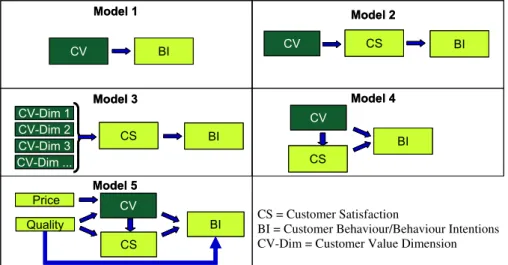
There is broad agreement in the literature on the relationships between CV, quality, and CS. However, there is much disagreement among the various approaches with regard to the interdependencies between these three constructs and the variables of customer behaviour and/or behaviour intentions. Many competitive models can be identified in the literature, which are summarised in Fig. 1.
Numerous authors (e. g. Zeithamel 1988, Cronin et al. 1997; Grewal et al. 1998, Sweeney et al. 1999; Kashyap and Bojanic 2000; Chen and Dubinsky 2003) assume that there is a direct relationship between CV and behavioural intentions, without ex-plicitly involving CS as a relevant construct (Model 1). In contrast, in Model 2 the assumption is that there is no direct relationship between CV and behavioural inten-tions. Thus, authors such as Andreassen and Lindestad (1998) and Ball et al. (2004)
Fig. 1 Relationships between CV and Customer Behaviour
suppose that satisfaction is the moderating variable for CV and that there is no direct relationship between CV and loyalty. In a cross-industry survey comparing Models 1 and 2, Eggert and Ulaga (2002) came to the conclusion that CS is a moderating variable between CV and customer behaviour. CS is seen as a better indicator of cus-tomer behaviour, with a stronger effect on cognitive variables such as repurchasing behaviour and recommendation than the cognitive construct CV.
Papers of the Model 3 type support the relationships assumed in Model 2, but in-stead of considering CV to be a construct of higher order, it is inin-stead viewed as being comprised of individual value dimensions. Authors such as Wang et al. (2004), Liang and Wang (2004), and Spiteri and Dion (2004) assume that a direct relationship exists between individual value dimensions and satisfaction. For example, in their empirical study involving veterinary surgeons, Spiteri and Dion (2004) came to the conclusion that “the SEM [Structural Equation Modelling] did not support the use of a higher order construct of customer value, as proposed in the earlier theory” (2004).
Model 4 posits a close relationship between CV and CS as well as a direct effect of the two constructs on customer behaviour and there is empirical support for these as-sumptions (Oh 1999; Durvasula et al. 2004; Lam et al. 2004; Yang and Peterson 2004; Liu et al. 2005). In Liu, Leach and Bernhardt’s (2005) empirical study in the financial staffing service industry these relationships were confirmed but only for long-term business relationships. With regard to short-term business relationships, it was found that only “customer value is the critical factor influencing share allocation” (2005), unlike CS and CV.
Cronin, Brady and Hult (2000) and Durvasula et al. (2004) investigated whether, in addition to CV and CS, quality is also directly relevant to customer behaviour, as is assumed in Model 5. The two papers tested different models. On the one hand, Durvasula et al. (2004) were able to show that CV and CS have a direct influence on customer recommendation and repurchasing behaviour, but that quality only had an indirect effect on customer behaviour by means of CV and CS. On the other hand, in an empirical study of six service industries, Cronin et al. (2000) confirmed the direct
influence of quality, CV, and CS on recommendation and repurchasing behaviour. In their comparison of Models 1, 2, 4, and 5, Model 5 proved to be superior.
4.3 Research gaps and further issues
This analysis of the relationships between CV and other central constructs of mar-keting theory has shown that CV research is a unique, independent field. However, the CV construct is not in competition with the other constructs; instead, combined with other marketing theory, CV makes a valuable contribution to better understand customer decisions and behaviour. Thus, CV can be considered as an important antecedent with significant impact on CS and many forms of customer behaviour. Un-fortunately, however, the heterogeneity of the approaches makes it difficult to discern exactly how the different constructs are related to each other.
Cronin et al. (2000) explain this heterogeneity as being due, at least in part, to “model structure appear[ing to be] highly dependent on the nature of the study.” That said, they do not disparage or doubt the various and differing research results, but in-stead point out that most studies focus on specific relationships and variables and, as a consequence, do not take other variables and interdependencies into account. Therefore, it may be said that a certain model is “CV oriented” (e. g., Model 1), whereas other models focus more on quality, satisfaction, or trust, for instance. An-other explanation for the partially contradictory concepts and empirical results is that the relationships have been investigated in different contexts. Individual variables, such as emotions, commitment, or confidence, have a different connotation in the service industry than they do in the industrial goods sector or in B2B. Furthermore, Ulaga (2001) points out that, as yet, there has been little work done that particularly focuses on the CV construct. A great deal of research will be necessary to fill this la-cuna and gain a better, more nuanced understanding of the relationships between CV and customer behaviour. In summary and based on the empirical results discussed in Sect. 4.2, it can be assumed that both, CV and CS directly, however in different forms, influence customer behaviour depending on the forms of customer behaviour.
There are many other issues in this research field that need to be addressed and researched. For example, researchers agree that CV is a multidimensional and dy-namic construct but, so far, analysis of relationships between CV and other marketing concepts is mainly based on an unidimensional conception of CV, with no consid-eration given to its dynamic aspects. One exception to this oversight is the work of Huber et al. (2007), who, in their analysis of the CV-CS relationship, empirically con-firmed that the importance of certain value drivers and dimensions varies based on the particular service episode. Furthermore, according to these authors, there is a clear hi-erarchy of service episodes with regard to their impact on overall satisfaction (Huber et al. 2007).
Another area that we believe deserves attention involves the postulated linear causal relationship that underpins almost all studies in this field. We suspect that the relationships may be more complex than assumed, and may, in fact, be characterised by nonlinear elements. Ignoring this possibility leads to the risk of drawing inaccurate conclusions and thus making poor management decisions, especially when it comes to targeted use of marketing resources.
5 Relationship between customer value and customer lifetime value
This section discusses the link between the concept of “value for customers – CV” and the supplier-oriented concept of “value of the customers”. A key element of the company perspective is customer lifetime value (CLV), which is the present value of all future profits generated from a customer (Gupta and Lehmann 2003). Customer
equity (CE), another element of the company perspective, can be defined as the
over-all value of the current and future customer base (Rust et al. 2004) and is often seen as a proxy for firm value or stock price (Gupta et al. 2006).
5.1 CV-CLV approaches
Based on the assumption that CV is an essential prerequisite for future company suc-cess, the link between them, in particular, CV’s financial impact on the company, has been investigated by a number of authors (Clealand and Bruno 1997; Laitam¨aki and Kordupleski 1997; Payne and Holt 2001; Eggert 2001; Hinterhuber and Matzler 2002; Boulding et al. 2005; Shah et al. 2006; Berger et al. 2006). For example, the customer centricity approach of Boulding et al. (2005) is concerned with the process of dual value creation, that is, value for both the customer and for the firm (Boulding et al. 2005). In their customer-based view, Hinterhuber and Matzler (2002) conceptu-alize a relationship between a product-oriented PCV approach, CS, CE, and the core competencies of a company, in which CS is a mediator of PCV and CE. Clealand and Bruno (1997) assume a relationship between CV and shareholder value but postu-late that the only enduringly successful strategy is to focus on both. A company must “make sure that its customer value strategies deliver rigorous revenue to. . . build wealth for shareholders.. . . We start with CV because it opens the opportunity for shareholder value, although it by no means leads automatically to it” (Clealand and Bruno 1997). All these concepts are of a strategic and theoretical nature and while very interesting and thought-provoking, are not backed up by any empirical evidence or support.
Empirical exploration of the CV-CLV link is still in its infancy. The most promis-ing approaches are found in the CLV research. CLV is increaspromis-ingly considered and used as an appropriate measure for assessing the return on marketing actions and for developing customer-level and firm-level strategies (Berger et al. 2006; Rust et al. 2004; Venkatesan and Kumar 2004). To date, most of the research that investigates the relationship between customer view and CLV has focused on establishing a link between CS and CLV. After examining many published studies, Gupta and Zeithaml (2006) concluded that there is, indeed, a strong positive correlation between the two. Just recently, scholars have begun to integrate CV attributes, such as quality, price, and learning effect, into their CLV concepts. For example, Iyengar, Ansari, and Gupta (2007) show that, in the wireless service industry, a 1% increase in quality leads to a $2 increase in CLV per customer, whereas a price decrease leads to higher CLV than results from an equivalent price increase.
5.2 Research gaps and further issues
During the last few years, marketing expenditures have come under increasing pres-sure, making it crucial to understand how marketing actions affect CLV (Gupta and Zeithaml 2006; Shah et al. 2006; Wangenheim and Bayon 2007). The extension or even the merger of CV and CLV concepts may be able to provide the information that will lead to more efficient use of marketing resources. However, due to large gaps in the existing research, little is known about the actual link between CV and CLV. For example, the relationship between marketing action and CV may be more complex than initially assumed, which is quite likely also true of other postulated relation-ships, including that between CV and the CLV components of customer acquisition, retention, and expansion; between CLV components and CLV; and between CLV and shareholder value. These latter relationships may, indeed, turn out to be nonlinear, as has been demonstrated for the relationship between CS and CLV components. Fur-thermore, dynamic CV aspects have not been considered so far in this context. Berger et al. (2006) thus argue for implementing option theory into marketing research, but no empirical work has been done on the subject. This is an unfortunate oversight, as option theory would make it possible to incorporate CV shifts.
6 Outlook
This analysis of the different CV research streams has shown that CV is a unique, independent area of research that can make a valuable contribution to better under-standing customer needs, decisions, and behaviour, as well as aiding in better or more accurate management decisions. Current development is threefold: one research stream focuses on individual aspects of CV (e. g., relationship, brand, or risk value); the second stream involves empirical examination of numerous contentious and open questions in CV research, especially the relationships between CV and other market-ing constructs; and the third stream emphasizes the relationships between CV and CLV concepts. However, as is obvious from the frequent mention of research gaps throughout this paper, CV research is still in its infancy. To increase its value at the theoretical and practical levels, CV research will need to confront and overcome – apart from the earlier outlined specific issues – the following general challenges: • To date, CV researchers have not taken into consideration cultural differences and
industry-specific characteristics. However, first cross-cultural studies in this field (see Huber et al. 2007; Cunningham et al. 2006) have shown that the impact of cer-tain value drivers on CV and also satisfaction differs between countries. Further, it must be assumed that there are industry-specific influencing factors (see Maas and Graf 2008), e. g. the industry culture, the significance of certain risks, or the degree of product innovation in certain industries and product categories, which affect the defining factors of CV and also the related marketing and CLV constructs. • Until recently, CV approaches have always assumed that the roles of companies
and customers are clearly and coherently allocated. In this assumed scheme, com-panies are the producers and customers are the buyers and users. However, current
marketing research has shown that this is an outdated concept for many industries. For instance, Vargo and Lusch (2004) hypothesise that customers are always “co-producers” in the creation of value. Increasingly, customers want and take over more active roles e. g. as source of competence, as innovator or even as advocates in order to co-create their own product or service experience (Graf 2007; Maas and Graf 2004). Therefore, customer involvement and integration in co-creation and co-production activities may become important element regarding the value of the customer and the value creation for customers.
• Furthermore, in most research, the value of one customer is considered indepen-dently of other customers (Gupta and Zeithaml 2006), but, in reality, there could be strong indirect networks between customers that could have strong direct ef-fects on the firm. Especially community efef-fects for example of brand communities (Algesheimer et al. 2005) may influence the value for and of customers. Broaden-ing the perspective to include network effects appears as a promisBroaden-ing opportunity for future research.
• To gain a better understanding of the CV construct and its relationships with other constructs, a comprehensive conceptualisation that includes various multifaceted perspectives is required. In addition to different levels of abstraction (PCV, DCV, and personal values), it is necessary to more strongly emphasise individual cus-tomer experience and learning effects. A first analysis of the impact of consumer learning on CLV from Iyengar et al. (2007) strongly supports this necessity. The different levels of experience customers have with a product or service and the du-ration and/or phase of a customer-provider relationship (pre-purchase, purchase, or post-purchase) are critical pieces of information that have not yet been fully integrated into this research field.
Although CV research in many areas stands still at the beginning it has already generated a lot of fruitful insights into the value creation processes from customer and company perspectives. Latest progress in this research field has been made by differentiating conceptualisations, models and methodologies. Regarding the impact for research and practice the main task for CV researchers will be to overcome the silos of specialised streams with different origins and to integrate the findings on the basis of a broader CV concept level. Especially, a closer – theoretical and empirical – look should be directed at the coherences and interfaces between CV, customer behaviour, CLV and shareholder value to better understand the differences in the value creation processes on both the company and the customer side. At least these efforts may also contribute to an ongoing paradigmatic shift in marketing from an inside-out management perspective towards a more radical outside-in customer view.
References
Agarwal S, Teas RK (2000) The effects of extrinsic product cues on consumers’ perceptions of quality, sacrifice, and value. J Acad Mark Sci 28(2):278–290
Agarwal S, Teas RK (2001) Perceived value: mediating role of perceived risk. J Mark Theor Pract 9(3):1–14
Alderson W (1957) Marketing behaviour and executive action: a functional approach to marketing theory. Richard D. Irwin Inc., Homewood, IL
Algesheimer R, Dholakia UM, Herrmann A (2005) The social influence of brand community: evidence from european car clubs. J Mark 69(3):19–34
Allen NJ, Grisaffe DB (2001) Employee commitment to the organization and customer reactions map-ping the linkages. Hum Resour Manag Rev 11(3):209–236
Al-Sabbahy HZ, Ekinci Y, Riley M (2004) An investigation of perceived value dimensions: implications for hospitality research. J Travel Res 42(February):226–234
American Marketing Association (2006) Dictionary of marketing terms, http://www.marketingpower.com/mgdictionary.php. Abgerufen am 14.8.2006
Anderson JC, Jain DC, Chintagunta PK (1993) Customer value assessment in business markets. J Bus-to-Bus Mark 1(1):3–29
Anderson JC, Narus JA (1998) Business marketing: understand what customers value. Harv Bus Rev (November) 76(6):53–65
Andreassen TW, Lindestad B (1998) Customer loyalty and complex services – the impact of corporate image on quality, customer satisfaction and loyalty for customers with varying degrees of service expertise. Int J Serv Ind Manag 9(1):7–23
Bagozzi RP (1992) The self regulation of attitudes, intentions and behavior. Soc Psychol Q 55:178–204 Bagozzi RP (1999) Goal setting and goal striving consumer behavior. J Mark 63(Special Issue):19–32 Ball D, Coelho PS, Machas A (2004) The role of communication and trust in explaining customer loyalty
– an extension to the ECSI model. Eur J Mark 38(9/10):1272–1293
Berger PD, Eechambadi N, George M, Lehmann DR, Rizley R, Venkatesan R (2006) From customer lifetime value to shareholder value. J Serv Res 9(2):156–167
Beverland M, Lockshin L (2003) A longitudinal study of customers’ desired value change in business-to-business markets. Ind Mark Manag 32(8):653–666
Blocker CP, Flint DJ (2007) Customer segments as moving targets: integrating customer value dimen-sions into segment instability logic. Ind Mark Manag 36:810–822
Bolton RN, Drew JH (1991) A multistage model of customers’ assessments of services quality and value. J Consumer Res 17:375–384
Boulding W, Stealin R, Ehret M, Johnston WJ (2005) A customer relationship management roadmap: what is known, potential pitfalls, and where to go. J Mark 69(4):155–166
Cannon JP, Homburg C (2001) Buyer supplier relationships and customer firm costs. J Mark 65(1):29–43 Chen Z, Dubinsky AJ (2003) Conceptual model of perceived customer value in e-commerce: a
prelimi-nary investigation. Psychol Mark 20(4):323–347
Cleland AS, Bruno AV (1997) Building customer and shareholder value. Strategy Leadersh 25(3):22–28 Cronin Jr JJ, Brady MK, Brand RR, Hightower Jr R, Shemwell DJ (1997) A cross-sectional test of the
effect and conceptualization of service value. J Serv Mark 11(6):375–391
Cronin Jr, JJ, Brady MK, Hult GTM (2000) Assessing the effects of quality, value, and customer satisfaction on consumer behavioral intentions in service environments. J Retailing 76(2):193–218 Cunningham LF, Young CE, Lee M, Ulaga W (2006) Customer perceptions of service dimensions:
cross-cultural analysis and perspective. Int Mark Rev 23(2):192–210
De Ruyter K, Wetzels M, Lemmink J, Mattsson J (1997) The dynamics of the service delivery process: a ompa-based approach. Int J Res Mark 14:231–243
DeSarbo WS, Jedidi K, Shina I (2001) Customer value analysis in a heterogeneous market. Strateg Manag J 22:845–857
Dodds WB, Monroe KB, Grewal D (1991) Effects of price, brand, and store information on buyers’ product evaluations. J Mark Res 23:307–319
Durvasula S, Lysonski S, Mehta SC, Tang BP (2004) Forging relationships with services: the antecedents that have an impact on behavioural outcomes in the life insurance industry. J Financial Serv Mark 8(4):314–326
Eggert A (2001) Die zwei Perspektiven des Kundenwerts: Darstellung und Versuch einer Integration. In: G¨unter B, Helm S, Kundenwert. Betriebswirtschaftlicher Verlag Dr. Th. Gabler GmbH, Wiesbaden Eggert A, Ulaga W (2002) Customer perceived value: a substitute for satisfaction in business markets?
J Bus Ind Mark 17(2/3):107–118
Eggert A, Ulaga W, Schultz F (2005) Value creation in the relationship life cycle: a quasi-longitudinal analysis. Ind Mark Manag 35:20–27
Fishbein M, Ajzen I (1975) Belief, attitude, intention and behavior: an introduction to theory and re-search. Addison-Wesley, Reading, MA
Flint DJ, Woodruff RB (2001) The initiators of changes in customer desired value – results from a theory building study. Ind Mark Manag 30:321–337
Flint DJ, Woodruff RB, Gardial SF (1997) Customer value change in industrial marketing relationships: a call for new strategies and research. Ind Mark Manag 26:163–175
Flint DJ, Woodruff RB, Gardial SF (2002) Exploring the phenomenon of customers’ desired value change in a business-to-business context. J Mark 66:102–117
Gale BT (1994) Managing customer value: creating quality and service that customer can see. The Free Press, New York, NY
Gilbert G, Veloutsou C (2006) A cross-industry comparison of customer satisfaction. J Serv Mark 20(5):298–308
Graf A (2007) Changing roles of customers: consequences for HRM. Int J Serv Ind Manag 18(5):491– 509
Grewal D, Monroe KB, Krishnan R (1998) The effects of price-comparison advertising on buyers’ perceptions of acquisition value, transaction value, behavioral intentions. J Mark 62:46–59 Gr¨onroos C (1990) Service management and marketing: managing the moments of truth in service
competition. Lexington Books, Lexington, MA
Gr¨onroos C (1997) Value-driven relational marketing: from products to resources and competencies. J Mark Manag 13:407–419
Gr¨onroos C (2004) The relationship marketing process: communication, interaction, dialogue, value. J Bus Ind Mark 19(2):99–113
Gupta S, Hanssens D, Hardie B, Kahn W, Kumar V, Lin N, Sriram NRS (2006) Modeling customer lifetime value. J Serv Res 9(2):139–155
Gupta S, Lehmann DR (2003) Customer as assets. J Interact Mark 17(1):9–24 Gupta S, Lehmann DR, Stuart JA (2004) Valuing customer. J Mark Res 41:7–18
Gupta S, Zeithaml V (2006) Customer metrics and their impact on financial performance. Mark Sci 25(6):718–739
Gutman J (1982) A means–end chain model based on consumer categorization processes. J Mark 46: 60–72
Gutman J (1997) Means–end chains as goal hierarchies. Psychol Mark 14(6):45–60
Hinterhuber HH, Matzler K (2002) Kundenorientierte Unternehmensf¨uhrung: Kundenorientierung, Kun-denzufriedenheit, Kundenbindung. Gabler, Wiesbaden
Holbrook MB (1994) The nature of customer value. In: Rust RT, Oliver R (eds) Service quality: new directions in theory and practice. Sage Publications, Thousand Oaks, CA
Huber F, Herrmann A, Morgan RE (2001) Gaining competitive advantage through customer value ori-ented management. J Consumer Mark 18(1):41–53
Huber F, Herrmann A, Henneberg SC (2007) Measuring customer value and satisfaction in services transactions, scale development, validation and cross-cultural ompareson. Int J Consumer Stud 31:554–564
Iyengar R, Ansari A, Gupta S (2007) A model of consumer learning for service quality and usage. J Mark Res 44:529–544
Johnson MD, Herrmann A, Huber F (2006) The evolution of loyalty intentions. Am Mark Assoc 70:122– 132
Kashyap R, Bojanic DC (2000) A structural analysis of value, quality, and price perceptions of business and leisure travellers. J Travel Res 39:45–51
Kleijnen M, De Ruyter K, Wetzels M (2004) Consumer adoption of wireless services: discovering the rules, while playing the game. J Interact Mark 18(2):51–61
Kothari A, Lackner J (2006) A value based approach to management. J Bus Ind Mark 21(4):243–249 Kotler P (1972) A generic concept of marketing. J Mark 36:46–54
Kotler P, Bliemel FW (2001) Marketing-Management: Analysen, Planung und Verwirklichung. 10. Aufl, Sch¨affer-Poeschel Verlag, Stuttgart
Krafft M, Rudolf M, Rudolf-Sip¨otz E (2005) Valuation of customers in growth companies – a scenario based model. Schmalenbach Bus Rev 57(2):103–127
Lai AW (1995) Consumer value, product benefits and customer value: a consumption behaviour ap-proach. Adv Consum Res 22:381–388
Laitam¨aki J, Kordupleski R (1997) Building and developing profitable growth strategies based on the waterfall of customer value added. Eur Manag J 15(2):158–166
Lam SY, Shankar V, Erramilli MK, Murthy B (2004) Customer value, satisfaction, loyalty, and switching costs: an illustration from a business-to-business service context. J Acad Mark Sci 32(3):293–311
1 3
Lapierre J (2000) Customer-perceived value in industrial contexts. J Bus Ind Mark 15(2/3):122–140 Liang C-J, Wang WH (2004) Attributes, benefits, customer satisfaction and behavioural loyalty – an
integrative research of financial services industry in Taiwan. J Serv Res 4(1):57–91
Liljander V, Strandvik T (1995) The nature of customer relationships in services. Adv Serv Mark Manag 4:141–167
Liu AH, Leach MP, Bernhardt KL (2005) Examining customer value perceptions of organizational buyers when sourcing from multiple vendors. J Bus Res 58:559–568
Maas P, Graf A (2004) Leadership by customers? New roles of service companies’ customers. Z Perso-nalforsch 18(3):329–345
Maas P, Graf A (2008) Customer value analysis in financial services. J Financ Serv Mark 13(1) Matzler K (2000) Customer value management. Die Unternehmung 54(4):289–308
Monroe KB (1990) Pricing: making profitable decisions, 2nd ed. Mc Graw-Hill, New York, NY Monroe KB, Chapman JD (1987) Framing effects on buyers’ subjective product evaluations. Adv
Con-sum Res 14:193–197
Oh H (1999) Service quality, customer satisfaction, and customer value: a holistic perspective. Int J Hospitality Manag 18:67–82
Parasuraman A (2006) Modeling opportunities in service recovery and customer-managed interactions. Mark Sci 26(6):590–593
Patterson PG, Spreng RA (1997) Modelling the relationship between perceived value, satisfaction and re-purchase intentions in a business-to-business, services context: an empirical examination. Int J Serv Ind Manag 8(5):414–434
Payne A, Holt S (2001) Diagnosing customer value: integrating the value process and relationship marketing. Br J Manag 12:159–182
Peter JP, Olson JC (1990) Consumer behaviour and marketing strategy, 2nd ed., Illinois
Pfeifer PE, Farris PW (2004) The elasticity of customer value to retention: the duration of a customer relationship. J Interact Mark 18(2):20–32
Porter ME (1996) What is strategy? Harv Bus Rev 44:61–78
Ralston RW (2003) The effects of customer service, branding, and price on the perceived value of local telephone service. J Bus Res 56:201–213
Ravald A, Gr¨onroos C (1996) The value concept and relationship marketing. Eur J Mark 30(2):19–30 Reinartz WJ, Kumar V (2003) The impact of customer relationship characteristics on profitable lifetime
duration. J Mark 67:77–99
Richins ML (1994) Valuing things: the public and private meanings of possessions. J Consumer Res 21:504–521
Rusbult CE (1980) Satisfaction and commitment in friendships. Represent Res Soc Psychol 11:96–105 Rust RT, Lemon KN, Zeithaml VA (2004) Return on marketing: using customer equity to focus
market-ing strategy. J Mark 68:109–127
Rust RT, Chung TS (2006) Marketing models of service and relationships. Mark Sci 25(6):560–580 Saravanan R, Rao KSP (2007) Measurement of service quality from the customer’s perspective – an
empirical study. Total Qual Manag Bus Excellence 18(4):435–449
Setijono D, Dahlgard JJ (2007) Customer value as a key performance indicator (KPI) and a key improve-ment indicator (KII). Meas Bus Excellence 11(2):44–61
Shah D, Rust TR, Parasuraman A, Stealin R, Day GS (2006) The path to customer centricity. J Serv Res 9(2):113–124
Shet JN, Newman BI, Gross BL (1991) Why we buy what we buy: a theory of consumption value. J Bus Res 22:159–170
Sirohi N, McLaughlin EW, Wittink DR (1998) A model of consumer perceptions and store loyalty intentions for a supermarket retailer. J Retail 74(2):223–245
Smith JB, Colgate M (2007) Customer value creation: a practical framework. J Mark Theory Pract 15(1):7–23
Spiteri JM, Dion PA (2004) Customer value, overall satisfaction, end-user loyalty, and market perform-ance in detail intensive industries. Ind Mark Manag 33:675–687
Sweeney JC, Soutar GN (2001) Consumer perceived value: the development of a multiple item scale. J Retail 77:203–220
Sweeny JC, Soutar GN, Johnson LW (1999) The role of perceived risk in the quality-value relationship: a study in a retail environment. J Retail 75(1):77–105
Teas KR, Agarwal S (2000) The effects of extrinsic product cues on consumers’ perceptions of quality, sacrifice, and value. J Acad Mark Sci 28(2):278–290
Thaler R (1985) Mental accounting and consumer choice. Mark Sci 4:199–214
Thibaut JW, Kelley H (1959) The social psychology of groups. John Wiley & Sons Inc., New York, NY Thomas JS, Reinartz WJ, Kumar V (2004) Getting the most out of all your customers. Harv Bus Rev
82(8):117–123
Tzokas N, Saren M (1999) Value transformation in relationship marketing. Aust Mark J 7(1):52–62 Ulaga W (2001) Customer value in business markets – an agenda for inquiry. Ind Mark Manag 30:315–
319
Ulaga W (2003) Capturing value creation in business relationships: a customer perspective. Ind Mark Manag 32:677–693
Ulaga W, Eggert A (2006) Value based differentiation in business relationships: gaining and sustaining key supplier status. J Mark 70:119–136
Van der Haar JW, Kemp R, Omta O (2001) Creating value that cannot be copied. Ind Mark Manag 30:627–636
Vargo SL, Lusch RF (2004) Evolving to a new dominant logic for marketing. J Mark 68:1–17 Varki S, Colgate M (2001) The role of price perceptions in an integrated model of behavioral intentions.
J Serv Res 3(3):232–240
Venkatesan R, Kumar V (2004) A customer lifetime value framework for customer selection and re-source allocation strategy. J Mark 68(4):106–125
Wangenheim F v, Bayon T (2007) Behavioural consequences of overbooking service capacity. J Mark 71:36–47
Walker RH, Johnson RW, Leonard S (2006) Re-thinking the conceptualization of customer value and service quality within the service-profit chain. Manag Serv Qual 16(1):23–36
Wang Y, Lo HP, Chi R, Yang Y (2004) An integrated framework for customer value and customer-relationship-management performance: a customer-based perspective from China. Manag Serv Qual 14(2/3):169–182
Woodruff RB (1997) Customer value: the next source of competitive advantage. J Acad Mark Sci 25(2):139–153
Woodruff RB, Gardial SF (1996) Know your customer: new approaches to customer value and satisfac-tion, Cambridge
Yang Z, Peterson RT (2004) Customer perceived value, satisfaction, and loyalty: the role of switching costs. Psychol Mark 21(10):799–822
Zeithaml VA (1988) Consumer perceptions of price, quality, and value: a means-end model and synthesis of evidence. J Mark 52:2–22