DOI 10.1007/s00405-012-2002-y
R H I N O L O G Y
Posttransplant sinus surgery in lung transplant recipients
with cystic
Wbrosis: a single institutional experience
Domenic Vital · Markus Hofer · Annette Boehler · David Holzmann
Received: 14 October 2011 / Accepted: 14 March 2012 / Published online: 30 March 2012
© Springer-Verlag 2012
Abstract Chronic rhinosinusitis is hypothesised to play a major role in lung transplant recipients with cystic Wbrosis. Paranasal sinuses are considered to accumulate a signiWcant bacterial load, potentially leading to lung allograft infection with ensuing complications such as bronchiolitis obliterans syndrome, i.e. allograft rejection. We therefore would like to present our combined medical and surgical treatment plan, which consists of an endoscopic fronto-spheno-eth-moidectomy as well as a meticulous daily nasal care pro-gram. The microbiological results show that our combined concept is eVective, whereas especially daily nasal care with isotonic saline solution is the cornerstone in prevent-ing signiWcant colonisation of the sinuses and spreadprevent-ing bacteria to the lower respiratory tract causing lung allograft infection. Regarding the surgical part of our treatment, it should be emphasised that all sinuses and ethmoidal air cells should be widely opened. Edges such as bony over-hangs should be smoothened to avoid mucus retention and consecutive bacterial recolonisation requiring subsequent revision surgery.
Keywords Cystic Wbrosis · Lung transplantation · Sinus surgery · Chronic rhinosinusitis · Microbiology
Introduction
Chronic rhinosinusitis (CRS) is common in patients with cystic Wbrosis (CF). CF patients may suVer from nasal obstruction due to nasal polyps and mucosal swelling or their sinuses are asymptomatically colonised with bacterial germs. CRS was hypothesised to play an important role in lung transplant recipients with CF as the sinuses can be considered as a bacterial reservoir, from where bacteria may be spread to the lower airways causing lung allograft infection [1–5]. Chronic bacterial infection with Pseudomo-nas aeruginosa and other bacteria leads to the accumulation of neutrophils as seen in bronchoalveolar lavage (BAL) Xuid and to unopposed neutrophil elastase. The latter corre-lates with poor outcome due to bronchiolitis obliterans syn-drome (BOS) and progressive irreversible graft dysfunction as described by Nunley et al. [6].
We support this hypothesis of a bacterial reservoir in the sinuses and consequently followed a combined medical and surgical treatment plan for CF-related CRS. This treatment approach was established at the beginning of our lung transplant program in 1992. The results of our 10-year experience were reported in 2004 [7]. There, we already could demonstrate a signiWcant correlation of the sinus bac-teriology obtained by sinus aspirates and BAL. Patients with a low colonisation rate in the paranasal sinuses had a signiWcantly lower incidence of tracheobronchitis and pneumonia as well as a trend towards a lower incidence of BOS [7]. In contrast, some authors maintain that surgery is not eVective in treating CRS in CF patients [8, 9]. How-ever, they do not clearly deWne the extent of their surgery and the postoperative care regimen. The objective of this paper is to describe our surgical protocol such as the metic-ulous postoperative nasal care program and to study its eYcacy by analysing microbiological data.
D. Vital (&) · D. Holzmann
Division of Otorhinolaryngology, Head and Neck Surgery, University Hospital, Frauenklinikstrasse 24,
8091 Zurich, Switzerland e-mail: [email protected]
M. Hofer · A. Boehler
Division of Pulmonary Medicine, University Hospital, Zurich, Switzerland
Method
Selection of candidates and timing of surgery
As all CF candidates for lung transplantation (LTx) are far too ill to undergo extensive sinus surgery, it became our standard to perform sinus surgery after LTx. After LTx, patients are treated with at least two antibiotics active against P. aeruginosa for a minimal duration of 2 weeks. Sinus surgery is performed after clinical recovery from lung transplantation. Exclusion criteria for sinus surgery are poor outcome after LTx including allograft deWciency, multi organ failure and severe infections/sepsis.
Surgical technique
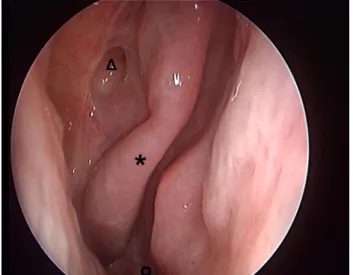
The surgery begins with a fronto-spheno-ethmoidectomy as described elsewhere [10]. In this procedure, all sinuses are widely opened and explored no matter how well they are pneumatised. Taking into account that the nasal mucosa in CF patients will swell up due to subepithelial cysts, all eth-moidal cells and sinuses are exposed and opened widely to prevent Xuid retention. By doing so, rinsing the sinuses will reach almost every corner of the nasal cavities and sinuses. To achieve such cavities, we use diamond drills to smoothen edges and bony overhangs as best as possible. If signiWcant Xuid retention with consecutive colonisation and/or polyp formation is encountered (see Fig.1), revision surgery frequently comprises the removal of the middle tur-binate on both sides. Figures2, 3 shows such cavities. Postoperative care
Nasal packs are removed the day after surgery. Patients start nasal irrigation with isotonic saline solution 6 h
there-after and continue this rinsing care twice daily. The postop-erative follow-up visits are arranged in cooperation with the chest physicians. The objectives of these visits are to super-vise and to instruct the nasal care as well as to detect poten-tial infections by nasal inspection and endoscopy. Sinus aspirates are taken and sent for microbiological analysis. Bacterial colonisation was considered signiWcant if CF-rel-evant pathogens (P. aeruginosa, Staphylococcus aureus, Stenotrophomonas maltophilia, Achromobacter (Alcalige-nes) xylodoxidans and Burkholderia cepacia complex) were cultured and bacterial counts were 104
colony-forming units/ml or more. Patients with cultures positive Fig. 1 Retention of purulent secretion and polyp formation in the right
maxillary sinus (cross): typical intraoperative Wnding during endo-scopic surgery
Fig. 2 Endoscopy of the right nasal cavity (2 years after
fronto-sphe-no-ethmoidectomy with removal of the middle turbinate) showing the right sphenoethmoid recess with the sphenoid sinus (open triangle) and the superior turbinate (asterisk). Open circle indicating the direc-tion of the choanae
Fig. 3 Endoscopy of the right nasal cavity (2 years after
fronto-sphe-no-ethmoidectomy with removal of the middle turbinate) showing the maxillary sinus with little crusting (cross), the superior turbinate (asterisk) and the choanae (open circle)
for these pathogens received speciWc antibiotic treatment according to the chest physician’s recommendation and were instructed speciWcally to intensify nasal care. Postop-eratively, the patient is seen on the occasion of every sur-veillance bronchoscopy, which is performed monthly during the Wrst 6 months and depending on clinical Wndings thereafter. From the second year after LTx, sinonasal checks are performed depending on several parameters including inXammation of nasal mucosa, polyp formation, crusting and patient’s compliance for nasal care. Emer-gency follow-ups are performed at the request of the chest physician to check the nasal and sinus cavities e.g. in case of lower airway infection or marked deterioration of FEV1. Analysis of data
Microbiological culture results were assessed retrospec-tively and recorded for the period before (preSS), such as the period of the Wrst 12 months after lung transplantation and sinus surgery (postSS). If three or more cultures postSS showed signiWcant bacterial growth of CF-relevant bacte-ria, the sinuses were considered as “chronically colonised” despite sinus surgery and consecutive nasal care. The status of chronic colonisation postSS was correlated with the sta-tus of posttransplant allograft infection. Any growth of CF-relevant bacteria in bronchoalveolar lavage (BAL) Xuid was deWned as a posttransplant allograft infection. Statisti-cal comparisons were performed using Fisher’s exact test.
Results
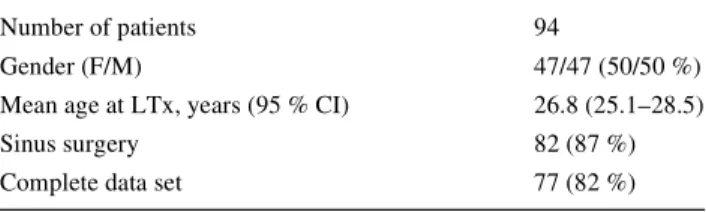
Baseline characteristics of the patients were listed in Table1. Since the beginning of our lung transplant pro-gram, only 12 (13 %) out of 94 CF lung transplant recipi-ents had to be excluded from sinus surgery due to allograft deWciency, multiorgan failure or severe infections/sepsis. Further Wve patients (5 %) had to be excluded because of incomplete data sets.
Eradication of CF-relevant bacteria
Sixty-one of the 77 patients (79 %) were harbouring P. aeruginosa preSS of whom more than one-third could be
eradicated with sinus surgery and consecutive daily nasal care. Of the six patients (8 %) with S. aureus in their sinuses preSS, 4 patients (5 %) had persistent sinonasal col-onisation. The patients with S. maltophilia (3 patients, 4 %) and A. xylodoxidans (4 patients, 5 %) preSS were success-fully eradicated. One (1 %) of the two patients (2 %) with B. cepacia complex had cultures positive for this pathogen postSS (Table2).
Correlation of chronic sinonasal colonisation and allograft infection
Chronic sinonasal colonisation postSS could be prevented in 41 patients (53 %) of whom 38 patients (49 %) also had sterile BAL Xuid. Nineteen patients (25 %) with chronic sinonasal colonisation showed allograft infection whereas 17 patients (22 %) had sterile BAL Xuids although the sinuses were chronically colonised. Fisher’s exact test showed a highly signiWcant correlation of sinus colonisa-tion and lung allograft infeccolonisa-tion (p < 0.0001, Table3). Evolution of the surgical concept
The Wrst lung transplant recipients with CF underwent limited surgical procedures consisting of a bilateral Table 1 Baseline characteristics of the CF patients, which underwent
LTx between 1992 and 2009
Number of patients 94
Gender (F/M) 47/47 (50/50 %)
Mean age at LTx, years (95 % CI) 26.8 (25.1–28.5)
Sinus surgery 82 (87 %)
Complete data set 77 (82 %)
Table 2 Sinus microbiology before (preSS) and after (postSS) sinus
surgery
Absolute and relative numbers of patients which harboured CF-rele-vant bacteria preSS and postSS such as the relative number of patients eradicated for each pathogen are given
PreSS PostSS Eradication rate (%) S. aureus 6 (8 %) 4 (5 %) 33 P. aeruginosa 61 (79 %) 40 (52 %) 35 A. xyloxidans 4 (5 %) 0 100 S. maltophilia 3 (4 %) 0 100 B. cepacia complex 2 (3 %) 1 (1 %) 50
Table 3 Chronic sinonasal colonisation versus lung allograft
infec-tion
Absolute and relative numbers of patients with or without chronic sinonasal colonisation and lung allograft infection are given in cross tabulation. Statistical correlations were performed using Fisher’s exact test
Fisher’s exact test p < 0.0001
Chronic sinonasal colonisation
Yes No
Lung allograft infection
Yes 19 (25 %) 3 (4 %)
ethmoidectomy and wide exposure of the maxillary sinus. At that time, many patients required revision surgery due to recurrent bacterial colonisation of the sinuses and subse-quent bronchopulmonal infections of allograft. We noticed in all revision cases mucus retention was due to insuYcient exposure of the sinuses. Hence we are now exposing all sinuses aggressively to prevent mucous retention. Mucous and Xuid retention correlate more with insuYcient opening of the sinus than with its poor pneumatisation. Even small sinuses, e.g. the frontal or the sphenoid sinuses, may retain colonised Xuid in CF-related rhinosinusitis. In all the patients requiring revision surgery, we found excavations with signiWcant load of purulent mucus. Consequently, we learned that bony overhangs, especially the Xoor of the sphenoid sinus, should be removed extensively. We found this could be best achieved with the use of diamond drills. In this context, we also observed an advantage to remove the middle turbinate, which improves the sinus-rinsing pro-cess with isotonic saline solution. None of the patients, whose middle turbinate was resected, had any adverse eVects.
Post-surgical care
Experiences from the posttransplant care showed that the main factor aVecting outcome is patient’s compliance in daily nasal care. Irrigation with isotonic saline solution is suYcient in most of the cases and topic antibiotics (e.g. tobramycin) are rarely used. Outcome was also dependent on early detection of infections and resistance-adjusted antimicrobial treatment. A close collaboration between chest physician and otorhinolaryngologist, therefore, is the condition sine qua non.
Discussion
There is an ongoing controversy regarding the eVectiveness of sinus surgery in CRS of CF patients. Some authors con-clude that sinus surgery might not be eVective in preventing bacterial spread to the allograft [8, 9]: Leung et al. [8] recorded a persistent sinonasal colonisation with P. aeru-ginosa in 82 % of the cases and the patients of Osborn et al. [9] showed an identical Xora before and after surgery in 49 %, whereas in only 15 % a preoperative pathogen was absent postoperatively. In contrast, sinus surgery with con-secutive nasal care was able to eradicate P. aeurignosa in more than one-third of our patients and similar or higher rates in other pathogens. An absent pathologic sinonasal colonisation postSS furthermore had direct impact on the transplanted lung reducing allograft infections signiWcantly. We are convinced that only extensive surgery with wide opening of all sinuses together with a meticulous nasal care
including regular follow-up visits lead to signiWcant suc-cess with signiWcant reduction of sinus colonisation with CF-relevant bacteria and prevention of allograft infection. Consequently, we conclude that the concepts of Leung et al. [8] and Osborn et al. [9] show two major deWcits. First of all, their surgical techniques were not clearly deWned and limited to the maxillary sinus and the ethmoid. Secondly, a postoperative nasal care program was not included in their concepts [8, 9].
It has been proved that the likelihood of penetration of the sinuses by irrigation is increased by enlarging the dimension of the sinus ostia [11] conWrming our strategy of aggressive exposure of all sinuses. In this context, it is also beneWcial to resect the middle turbinates, a decision taken in relation to the severity and impact of chronic rhi-nosinusitis. Bilateral middle turbinate resections are not indicated in most of the cases of non-CF associated rhi-nosinusitis. In the speciWc group of CF patients after lung transplantation, however, severity of the disease is mostly always high and its impact vital. According to our almost 20 year experience, we more and more recommend the resection of the middle turbinates so that nasal douching of the maxillary and ethmoid sinus becomes more eVec-tive. Up until now, none of our patients have had any side eVects such as atrophic rhinitis, anosmia or other iatro-genic problems. The advantages of a better control of sinonasal colonisation by nasal care predominate. As we did, Soler et al. [12] observed a good outcome after bilat-eral middle turbinate resection with no apparent negative consequences in a non-CF population. Other options such as medialisation of the middle turbinate by sutures were not studied.
Good experiences regarding the eVectiveness, handling and costs of a daily rinsing device were made by the use of the “Emser Nasendusche®” (SIEMENS & CO, Heilwasser und Quellenprodukte des Staatsbades Bad Ems GmbH & Co. KG). This device consists of a re Wll-able plastic device (volume 250 ml) and a connection piece, which can be held to the nostrils while the twice daily rinsing is performed. The rinsing itself prevents sinonasal colonisation by increasing mucociliary Xow, hydrating the mucosa and by Xushing away toxic (micro-bial) agents [13, 14]. Regarding the osmolarity of saline solution, it is unclear whether iso- or hypertonic solution is more beneWcial. Though hypertonic solution might increase mucociliary Xow [13, 14], it may decrease patient’s compliance due to the side eVects of hyperos-molarity (e.g. nasal burning, pain or other irritations) so we prefer isotonic saline solution. Daily nasal care (and related patient’s compliance) is the cornerstone in pre-venting signiWcant colonisation of the nasal and sinus cavities leading to airway infection and consequently worse outcome.
Conclusion
Posttransplant sinus surgery in lung transplant recipients combined with postoperative daily nasal care is an eVective way to treat CRS in patients with CF and its complications. A consequent postoperative daily nasal care is necessary and crucial for the eVectiveness of the therapeutic approach.
Acknowledgments We would like to express our gratitude to Dr. Thomas Pézier, MD, for his helpful editorial work and the proof-reading of the manuscript.
ConXict of interest The authors declare that they have no conXict of
interest.
References
1. Walter S, Gudowius P, Bosshammer J, Romling U, Weissbrodt H, Schurmann W, von der Hardt H, Tummler B (1997) Epidemiology of chronic Pseudomonas aeruginosa infections in the airways of lung transplant recipients with cystic Wbrosis. Thorax 52(4):318– 321
2. Mainz JG, Naehrlich L, Schien M, Käding M, Schiller I, Mayr S, Schneider G, Wiedemann B, Wiehlmann L, Cramer N, PWster W, Kahl BC, Beck JF, Tümmler B (2009) Concordant genotype of upper and lower airways P. aeruginosa and S. aureus isolates in cystic Wbrosis. Thorax 64(6):535–540
3. Roby BB, McNamara J, Finkelstein M, Sidman J (2008) Sinus surgery in cystic Wbrosis patients: comparison of sinus and lower airway cultures. Int J Pediatr Otorhinolaryngol 72(9):1365–1369 4. Dosanjh A, Lakhani S, ElashoV D, Chin C, Hsu V, Hilman B
(2000) A comparison of microbiologic Xora of the sinuses and
airway among cystic Wbrosis patients with maxillary antrostomies. Pediatr Transpl 4(3):182–185
5. Dosanjh AK, ElashoV D, Robbins RC (1998) The bronchoalveolar lavage Xuid of cystic Wbrosis lung transplant recipients demon-strates increased interleukin-8 and elastase and decreased IL-10. J Interferon Cytokine Res 18(10):851–854
6. Nunley D, Dauber J, Iacono A, Keenan R, Zeevi A, Cornwell R, Love R, Meyer K, Soergel P, Peterson K (1999) Unopposed neutrophil elastase in bronchoalveolar lavage from transplant recipients with cystic Wbrosis. Am J Respir Crit Care Med 159(1):258–261
7. Holzmann D, Speich R, Kaufmann T, Laube I, Russi EW, Simmen D, Weder W, Boehler A (2004) EVects of sinus surgery in patients with cystic Wbrosis after lung transplantation: a 10-year experi-ence. Transplantation 77(1):134–136
8. Leung MK, Rachakonda L, Weill D, Hwang PH (2008) EVects of sinus surgery on lung transplantation outcomes in cystic Wbrosis. Am J Rhinol 22(2):192–196
9. Osborn AJ, Leung R, Ratjen F, James AL (2011) EVect of endo-scopic sinus surgery on pulmonary function and microbial patho-gens in a pediatric population with cystic Wbrosis. Arch Otolaryngol Head Neck Surg 137(6):542–547
10. Soyka MB, Holzmann D (2005) Correlation of complications during endoscopic sinus surgery with surgeon skill level and extent of surgery. Am J Rhinol 19(3):274–281
11. Grobler A, Weitzel EK, Buele A, Jardeleza C, Cheong YC, Field J, Wormald PJ (2008) Pre- and postoperative sinus penetration of nasal irrigation. Laryngoscope 118(11):2078–2081
12. Soler ZM, Hwang PH, Mace J, Smith TL (2010) Outcomes after middle turbinate resection: revisiting a controversial topic. Laryn-goscope 120(4):832–837
13. Desrosiers MY, Kilty SJ (2008) Treatment alternatives for chronic rhinosinusitis persisting after ESS: what to do when antibiotics, steroids and surgery fail. Rhinology 46(1):3–14
14. Harvey R, Hannan SA, Badia L, Scadding G (2007) Nasal saline irrigations for the symptoms of chronic rhinosinusitis. Cochrane Database Syst Rev 18(3):CD006394