Collaborative Scientific Publishing:
A New Research Ecosystem
by
Travis Rich
B.S., Boston University (2010)
M.S., Boston University (2011)
S.M., Massachusetts Institute of Technology (2013)
MASSAC TIUT
OFTECHN LOGY
JUL 3
2017
LIBRARIES
ARCHIVES
Submitted to the Program in Media Arts and Sciences,
School of Architecture and Planning
in partial fulfillment of the requirements for the degree of
Doctor of Philosophy in Media Arts and Sciences
at the
MASSACHUSETTS INSTITUTE OF TECHNOLOGY
June 2017
@
Massachusetts Institute of Technology 2017. All rights reserved.
Signature redacted
A u th o r ...
~<
AProgram in Media Arts and Sciences,
May 5, 2017
Signature redacted
Certified by ... ...
Andrew Lippman
Associate Director & Senior Research Scientist, MIT Media Lab
Sig
nature
redacted
Thesis Supervisor
Accepted by ...
Professor Patricia Maes
Academic Head, Program in Media Arts and Sciences
Collaborative Scientific Publishing:
A New Research Ecosystem
by
Travis Rich
Submitted to the Program in Media Arts and Sciences,, School of Architecture and Planning
on May 5, 2017, in partial fulfillment of the requirements for the degree of
Doctor of Philosophy in Media Arts and Sciences
Abstract
This thesis introduces PubPub, a complete publishing system that is consonant with the way software and research ideas are developed. It is author-driven, continuous, collaborative, and allows for data and code to be directly integrated into the docu-ment. PubPub is optimized for collaboration and iterative document creation; taking inspiration from the software development cycle it allows for more participatory forms of review. We hypothesize that by changing the scientific review process from one of static critique to one of interactive collaboration we can increase the error-detection rate of scientific review. We present an experiment to test this hypothesis by mea-suring error detection rates across several interactive and non-interactive documents. This work is motivated by a growing recognition that in many fields, notably those that rely on data analysis and computing, the existing review process is not
suffi-ciently fair, accurate, or timely. Thesis Supervisor: Andrew Lippman
Collaborative Scientific Publishing:
A New Research Ecosystem
by
Travis Rich
The following people served as readers for this thesis:
Signature redacted
Thesis Reader ...
CUSA' Hidalgo
Associate Professor
MIT Media Lab
Signature redacted
Thesis Reader.
W. Daniel Hillis
Visiting Professor
MIT Media Lab
Acknowledgments
This thesis is the result of countless moments of support, ideation, generosity, and brilliance from many people. First and foremost, I'd like to thank Andy Lippman for providing me with an amazing home at MIT for the past 6 years. Andy's enthusiasm, insights, and relentless energy for improving the world have helped me grow in count-less ways. I am also incredibly grateful for the contributions, support, and guidance of my committee members, Cesar Hidalgo and Danny Hillis. Their perspectives and challenges have been instrumental in pushing me to better myself and my research.
Thank you to the long list of Media Lab students who have been relentlessly awesome. To Deb Widener, Joi Ito, and the Media Lab staff that have provided
endless support - thanks for making this lab a home.
Thank you to Thariq Shihipar, Kevin Hu, and Tomer Weller for helping a hard-ware kid turn into a softhard-ware developer. I feel unbelievably lucky to have spent my time in the Viral Communications group with all the amazing people who have crossed paths during my time here.
The MIT Press and MIT Libraries have become amazing partners in this quest for a better science. Thank you to Patsy Baudoin, Amy Brand, Nick Lindsay, Phoebe Ayers, Sean Thomas, Helen Bailey, Ellen Finnie, and Natalie Saltiel.
Thank you to all of the external collaborators that have helped me move beyond the bubble of the Lab into the real world: SJ Klein, Jess Polka, Gabriella Gomez-Mont, Daniel Tello, Gopal Sarma, Devin Berg, and Kent McFarland.
Thank you to my Dad, Mom, Josh, and Peter for bringing me up in an environment that nurtured curiosity and for being selflessly supportive of my ambitions and goals. Thanks for teaching me how to learn, rather than what to learn. Kate, thank you for being the most incredible teammate I've known. Thank you to my second family, Jasmin, Steve, Erin, Mike, Maisam, and Gabe.
Contents
1 Introduction
1.1 Thesis Structure . . . .
2 Context
2.1 The History of Scientific Review . . . .
2.2 Current Publishing Ecosystem . . . .
2.3 Related Work . . . .
2.3.1 Tools for Writing . . . .
2.3.2 Tools for Review . . . .
2.3.3 Tools for Journals . . . .
2.4 Transforming Reviewers Into Collaborators
3 PubPub: A platform for collaborative publishing
3.1 Stage 1 - Rich, Collaborative, Versioned Documents
3.1.1 Why Versioning Matters: Scientific Retractions 3.1.2 Retraction Experiment Results . . . .
3.1.3 Deployment: Government of Mexico City . . . .
3.1.4 Deployment: Impacts of Engineering . . . .
3.2 Stage 2 - Accessible Data . . . .
3.2.1 DbDb: Versioned and Interactive Data . . . . .
3.3 Stage 3 - Emergent Journals . . . .
3.3.1 Deployment: Journal of Design and Science . . 3.3.2 Deployment: Natural History Observer . . . . .
15 16 19 . . . . 20 . . . . 23 . . . . 27 . . . . 28 . . . . 28 . . . . 29 . . . . 3 1 35 . . . . 36 . . . . 39 . . . . 43 . . . . 47 . . . . 48 . . . . 50 . . . . 51 . . . . 55 . . . . 57 . . . . 58
3.4 3.5 3.6 3.7
3.3.3 Deployment: Responsive Science
Stage 4 - Decentralization . . . .
Use to Date . . . . Architecture . . . .
Continuing Efforts . . . .
4 Experiment: Testing the Influence of Interactive 4.1 Prior A rt . . . .
4.2 Experiment Architecture . . . .
4.3 Experimental Articles . . . .
4.3.1 Article 1: Dinosaur Bone Growth . . . . .
4.3.2 Article 2: Beef and Death . . . .
4.3.3 Article 3: Politics and Economy . . . .
4.4 Results and Analysis . . . .
4.4.1 Interactivity . . . . 4.4.2 Tim ing . . . . 4.4.3 User Background . . . . 4.5 Limitations . . . . 4.6 Conclusions . . . . 5 Discussion 5.1 Contributions . . . . 5.2 Future Experiments. . . . . Research 59 61 63 66 69 71 72 73 74 74 75 77 79 81 88 90 95 95 97 97 98
List of Figures
1-1 The GIFGIF results screen that allows users to search for gifs using an
interactive multi-dimensional UI. . . . . 16
2-1 The Journal des savans and Royal Society of London's Philosophical Transactions . . . . 21
2-2 The New York Times announcement of the launch of Sputnik. . . . . 22
2-3 Table by Edwards and Roy detailing attempts to change scientific pub-lishing incentives and the unintended consequences . . . . 24
2-4 Quality of protein structure crystals published in a variety of journals, showing top journals have some of the worst quality result. . . . . 26
2-5 Research by Ziemann et al. showing rates of spreadsheet errors across
journals
. . . . 272-6 ArXiv. One of the earliest scientific publishing communities on the web. 30 3-1 Early mockups of PubPub. The unifying theme of contextual dis-cussions alongside the body of the article remains in all iterations of PubPub... ... 37
3-2 Discussions and annotations in the first launched version of PubPub . 38 3-3 A view of versions in an early stage of PubPub . . . . 39
3-4 Retraction Stacked Chart . . . . 44
3-5 The CDMX Global landing page . . . . 47
3-6 A Pub on CDMX Global . . . . 48
3-7 A second Journal accepting input articles relating to the Constitution 49 3-8 Impacts of Engineering Landing Page . . . . 50
3-9 Forking a new branch using the DbDb interface. . . . . 53
3-10 Interacting with and exploring a full DbDb tree. . . . . 54
3-11 A DbDb tree with multiple branches and node labels displayed. . . . 55
3-12 The Journal of Design and Science landing page . . . . 58
3-13 Article from The Natural History Observer . . . . 59
3-14 John Lloyd's photograph capturing a cannibalistic barred owl . . . . 60
3-15 Landing page of the Responsive Science journal . . . . 61
3-16 Map of PubPub visitor locations . . . . 63
3-17 Usage rates of Journal features . . . . 64
3-18 Usage rates of Pub features . . . . 65
4-1 Interactive figure of dinosaur experiment . . . . 75
4-2 Interactive figure of diet experiment . . . . 77
4-3 The visualization created by 538 which serves as an inspiration for this article. . . . . 78
4-4 Interactive figure of economy experiment . . . . 79
4-5 Three sample reviews using the review interface. Red represents a false value, green represents a true value, and grey represents a null value. 80 4-6 Percentage of users finding errors and alternative conclusions depen-dent on whether they were presented an interactive article or not. Table shows count of users and associated p-values. . . . . 82
4-7 Percentage of users finding errors and alternative conclusions depen-dent on whether they did not use interactivity because it was not pre-sented, or because they skipped the interactivity. Table shows count of users and associated p-values. . . . . 83
4-8 Percentage of users finding errors and alternative conclusions depen-dent on whether they used the interactive elements or not. All users in this figure were presented the interactive elements. Table shows count of users and associated p-values. . . . . 84
4-10 Distribution of Scores split between users who did find the error and
those who did not. . . . . 86
4-11 Distribution of Scores split between users who did find the correct
alternative conclusion and those who did not. . . . . 87
4-12 Time spent versus error . . . . 88
4-13 Time Reading and Writing versus Result . . . . 89
4-14 Average time spent reading and reviewing for each possible score. . . 90
4-15 Percentage of users finding errors and alternative conclusions depen-dent on whether they self-idepen-dentified as a scientist. Table shows count
of users and associated p-values. . . . . 91
4-16 Percentage of users finding errors and alternative conclusions depen-dent on whether they self-idepen-dentified as having previously peer reviewed.
Table shows count of users and associated p-values. . . . . 92
4-17 Percentage of users finding errors and alternative conclusions depen-dent on whether they self-idepen-dentified as having previously been subject
to peer review. Table shows count of users and associated p-values. . 93
4-18 Percentage of users finding errors and alternative conclusions depen-dent on whether they self-idepen-dentified as being interested in the topic.
List of Tables
3.1 Number of citations before, during, and after retraction
3.2 Number of citations before, during, and after retraction
4.1 Number of participants for each experimental article. .
43 43
Chapter 1
Introduction
Scientific publishing is the means by which new research and discoveries are shared with peer communities and the public. A researcher's history of published work is critical to their ability to fundraise, advance their career, and have their ideas be taken seriously. For these reasons, the existing ecosystem of scientific publishing is enormously important to the process of science itself. Unfortunately, groups have be-gun to critique the existing publication model for not being sufficiently fair, accurate, or timely. This thesis explores these critiques, the history of scientific publishing, and presents work done to create an open source publication platform, conduct peer review experiments, and deploy projects to a diversity of communities. The goal of this research is to create a pathway that describes how we move from our current ecosystem to one that is more fair, adaptable, and performant.
This work began out of frustration with attempts to share a highly-interactive,
data-rich project. After building GIFGIF [1], an interactive GIF-emotion rating game,
we wanted a means to share our data and publish our findings while maintaining the interactivity of the project. Our goal was not to get credit for the work, but rather to open a discussion that would generate feedback on how we could best iterate to improve the work. Publishing the work as a PDF in a scientific journal or conference, spending months waiting for a decision, and receiving feedback that could be months to a year late did not fit the bill for our goals.
and was something the community was actively seeking. One group used this data to use the emotion captured in gifs as a machine learning training set for human
reactions
[2].
The goals we sought are ones we had heard from other re-searchers in our labs, at confer-ences, and at non-academic or-ganizations. Our goals seemed to be common and we assumed others must have begun work-ing to enable similar capabili-ties. We began exploring what scientists with complex
publish-Figure 1-1: The GIFGIF results screen that allows ing needs do to achieve these
users to search for gifs using an interactive
multi-goals. This exploration is the
dimensional UI. catalyst for this thesis work.
1.1
Thesis Structure
This thesis describes the processes that guide the development of PubPub and cre-ation of our experiment. The processes are necessary structures that would allow a peer to transform their role as a critical reviewer into one as a critical collaborator. Many of these structures and features are tested through real-world deployments and one is tested through a contained, focused experiment. To communicate these fea-tures, our deployments, and our experiment, we structure the thesis document into four major sections:
1. Context: We describe the context of the work and state of scientific publishing.
We outline the history of scientific publishing and peer review to identify how we have arrived at the current publishing ecosystem. We review what others in this domain of research have studied and built so far and finish with a list of
processes we posit are necessary for a collaborative research platform.
2. PubPub: A platform for collaborative publishing: We describe the tools
that we have built as a result of this research. We step through each of the major iterations of the tools built and identify motivations and lessons learned. Lastly, we identify future goals for the tools that we still actively develop.
3. Experiment: Testing the Influence of Interactive Research: We test a key hypotheses of this research. Namely, we craft an experiment to test the
hypothesis: 'reviewers with interactive data and figures more frequently identify incorrect methods and incorrect analysis that lead to wrong conclusions'. The experiment is one of the first steps in building a catalog of data around how to best design collaborative research communication platforms.
4. Discussion: We outline the major contributions of this thesis and identify opportunities to continue this research.
Chapter 2
Context
To begin, we outline the current process of academic publishing as it is commonly experienced in scientific fields.
At the conclusion of a research project the authors may wish to communicate their findings with others in their field. This action serves both to inform the com-munity of their results, as well as provide a badge of accomplishment that can be used when fundraising, looking for jobs, or applying for awards. It is common for authors to publish their work through an academic conference or scholarly journals. Before publication though, authors must first submit their work for consideration to these conferences and journals. The submitted materials typically consist of a text document with static images, equations, tables, and figures. Supplementary data, videos, and documents sometimes accompany the main submission depending on the capacity of the journal or conference that the work is submitted to. After submission, it is common for the work to go through a peer review process that deems whether the work is of sufficient quality and relevance to the conference or journal.
The main focus of much of the scientific publishing process (and indeed, much of this thesis) is this peer review process. During peer review a group of outside experts (typically 2-4) evaluate a work to decide whether it should be accepted for publication, requires editing, or should be rejected. If the work is accepted, it is deemed by the community to be reputable and of a particular level of quality. To reduce the effects of personal bias, it is common that the identity of the author and
the reviewers is kept secret (called double-blind peer review). The reviewer and the critique they provide is, as John Ziman states, "the lynchpin about which the whole business of Science is pivoted" [3]. Given the importance of this review process for the advancement of science, it is critical that it be a fair, logical, and accurate tool.
To understand how peer review in its current form became so critically important and why the scientific publishing structure is what it is, we look at the history of scientific publishing.
2.1
The History of Scientific Review
While the practice of scientific methods and inquiry date back for many hundreds of years, the use of scientific journals did not establish until the late 1600s. Before this time, scientific luminaries were either self-published in larger manuscripts, such as Newton's Principia, or were subject to the oversight of a larger governing body, such as the Church in Galileo's case [4]. The first journals, Journal des savans and the Royal Society of London's Philosophical Transactions came about in 1665 [5]. These predecessors to the modern scientific journal were managed by editors whose sole discretion decided what content filled their publications [6].
As the quantity of work grew throughout the 1700s and 1800s, many journals
be-gan employing the help of external committees to make recommendations [7].
How-ever, the exact function of these committees varied between journals and fields. In
many cases, these external committees reported privately to the editor - excluding the
author of the work from the process. In fact, before the mid 1900s, the processes and traditions of publishing scientific results were heterogeneous [8]. There is no single history of scientific review.
The shift towards the modern and ubiquitous peer review we use ay occurred in the mid 1900s [9]. Science historians highlight that the mid 1900s ushered in a new era of science as its role in the public sphere grew [10]. During this time, events such as the Cold War and the Russian launch of the first satellite, Sputnik, led to enormous amounts of public funding being poured into science. Along with this funding came
J 0 U R N A L
D E S
SCAVANS
L' NffE M. DC LX.
Par le Saur 1)E H EP 93 L L L
NOUVELLE EDITION.
A PARIS, ChCZ P I a i L 1 TT , ruE Saint Jacqu , vis-a-vh ih 14
rua de la Patcheminerie, i l'Ange Garden.
M. DCCX C 111. SCC ? rAiriLlG X0.,V THIL-OSOPHICAL TRANSACT IONS: GIVING SOME OP THE PRESENT
Undertakings , Studies , and Labours
OF THE
SN G E N 1 0 U S
IN -MAN Y CON'SIDERABLE PARTS * of THE W OR L D--. ol L.For ano 1661, and 1666.
In the SAVO T,
Pr ntedby T. N. for 7,nMaryx at thcBcll, a little with--on raV4a.Ea, uid 7-aus Alh in Dark-Lm,'
Priatas to the irly Secn A.
~rsntke t&g. Aukar tL y 3) J6
67_
4V
Figure 2-1: The Journal des savans and Royal Society of London's Philosophical Transactions
higher levels of public scrutiny and a demand for greater accountability. To avoid some more constraining proposals, such as having Congress review all science grants and publications, the scientific community quickly adopted peer review as the self-regulation and self-correction mechanism where society could place its faith [11].
Unfortunately, many find the ubiquitous current peer review system to be failing in its goal of serving as a tool for fair and effective quality control [12] [13] [14] [15]. In response to this growing doubt, researchers have begun to systematically collect and analyze data about the peer review process. One group took previously accepted journal articles, edited them slightly, changed the institutional names to fake univer-sities, and resubmitted the manuscripts to the original journals that had published them. Only three of twelve resubmissions were correctly identified as fraudulent, while eight of twelve were rejected for low quality [16]. This inconsistent behavior is problematic in its own regard, but also suggests a bias against authors from lesser
I
known universities.
Additional results have shown
unchecked nepotism [17], sexism ,__
k n
[18], and inconsistency [13] to VIET FIRES EARTH SA TELLITE INTO SPA CE;
IT IS CIRCLING THE GLOBE AT 18 000 M. P. H.;
be consistent problems. Oth-
-SPHERE TRACKED IN 4 CROSSINGS OVER U. S.
ers have called into doubt the fhE n mu
ability of peer review to effec- ..
-tively curate quality science, as -
--a study found only 36 of 100 p--a-
pa-pers published across three psy- -. ___
chology journals to have repro- -aft - nU
-ducible results [19]. . .
.-The ubiquity of the cur-rent peer review process makes
these shortcomings more perni- Figure 2-2: The New York Times announcement of cious as these errors therefore the launch of Sputnik.
exist across the entire spectrum
of scientific fields and practices. One cause of this ubiquity is the homogenization of scientific journals and publishers. For decades, scientific journals were led by a di-versity of scientific societies who used these publications as a means to communicate results within their field. However, around the same time as the emergence of the current peer review process, the 1960s, commercial publishers began to see a busi-ness opportunity in owning leading scientific journals. Contrasting a heterogeneous landscape of diverse scientific societies, by 2013, 50% of all published scientific work was published through 5 for-profit publishers [20]. As this trend was becoming clear Deutsche Bank released a research report [21] on the impact of these large publishing empires, claiming:
We believe the publisher adds relatively little value to the publishing process. We are not attempting to dismiss what 7,000 people at [Reed-Elsevier] do for a living. We are simply observing that if the process really
were as complex, costly and value-added as the publishers protest that it is, 40% margins wouldn't be available.
The homogenization not only represents a risk in that it appears to be an effort with financial goals rather than scientific motives, but it unifies the process for most scientific endeavors [22]. Taylor [23] expresses the risk this unified process presents in relation to the incentives scientists are under by citing Goodhart's Law:
When a measure becomes a target, it ceases to be a good measure. [24]
He continues by recalling Campbell's Law which provides a less succinct but more specific version of this idea:
The more any quantitative social indicator is used for social decision-making, the more subject it will be to corruption pressures and the more apt it will be to distort and corrupt the social processes it is intended to monitor. [25]
2.2
Current Publishing Ecosystem
Many of the challenges facing the scientific publishing process are attributed to mis-aligned incentives [26] [27] [28] [29]. An example of these mismis-aligned incentives are that universities often hire new professors based on the number of citations in top-tier journals. If a scientist's goal is to continue in academia and run their own research lab, their priorities must often shift towards publishing in top-tier journals no matter the cost. Rankings such as the h-index or citation counts are often seen as the basis
by which a researcher should be judged.
Given the homogenization of the publishing process, the metrics whose goal is to measure scientific contribution have in turn also become uniform. For the sake of maintaining their opportunity to do science, scientists are encouraged to do what is good for the scientist rather than what is good for science [30]. A direct cost of this is the fact that the publication of negative results or of the reproduction of existing
work is not as valued as the publication of seemingly novel work. Without negative results and reproduction studies, the same false hypothesis or inaccurate procedure may be used over and over by labs that, in turn, opt not to communicate their failure. Unfortunately, there is often no direct value in doing so for these scientists, as the publication of negative results or reproduction studies may carry little weight when it comes to applying for grants or faculty positions.
Edwards and Roy explore the history of attempts to change these homogenized incentives, which unfortunately consistently result in other corrupted homogenized
incentives. The table below enumerates these attempts and their side effects.
Table 1: Griowing Pervrse Incwntives in Academia (inhiti hao. Etnin R. 20171 1i.10/1.4ttAi)MAY23, mi,. he tema, of th ie aitie
lcent.ive Ii~rnded ofriet Actual efrext Ite-hrcho ronwd"I Por imoroqr:
.. n.nmunbcr of publications. Improve research prnductivity, prianie a meants of evaluating performanem . Avahanche of substandand, incretental )iaprs;
Ioor methodi aim itcreaie in falw disosvry rates leading to a natural kewetion or foal shit Sunkdiuo-Mcstic 2016);
litnftimd quality of poer revIew
... mmber of citations. Reward quahry work that influences t other, Extmnd"d refrecnce lists to intfate citatins:
Ite-viewprn raoftnt cia0 in (of Ltheir work itroigli 1 r reviw
. grant funding Eunure that research prograns are funded, proniote growth, generate overhead IoEcramed tine writing proposals and Inss time gatherig and rhinking abour data:
Overselling pnitive rsult. and downplay of negttivte rtults
Icn PhD 4o.I'htls i.tiident rt ivyeIft ltti o l s oraning a m * I.". u .ig of prograi 1i (noat s nlard and -t+aale afnsopt ly of 1i).:
P'.atdocf iten rvquind for nitr-lrvev academic jxsitiono, and P10s hired for work MS students used to do
Its) -e Iear bing lomd reearcht - iie -arulty Nema-ey .,ti pire - tdiioa pesirwi"gnaol lg I detro n dln iarr tetnr"d, aodojovrli Foelly t, Iotld
clames
Teochers mrarted lor inreard:
...stdent evaluation scota Imapoel anrunMAbility: Eanure ustmAnit satisfaction Rceild noure tork, grade inflation
.ratdeot W sc(res improve lea-her elect ivreot. Tearling to Ihe tiets;
Emphasis on ahort-term lcarnirg
Dvpor1ieit rewrtided foe incrensinig:
t.. News ranking Stronger deportmonTA Fatenoer efforts to revers engineer. game., and cheat
rakirgs
nomimers of BS, MS. and PhD drgrow granted Pnanir efficiency: Stop orurdets from being trapped in degree prograins; Class sizts increaw;
Impre the state legilatre itriance reqiireernts dcrase;
Iedt i greiuaiot rmquireraent. ... sandent eredit/mnntact homrs (SCH) The rtniversity's tearhittg ismn is ffilled SCH-maximization gamis are played:
DIulcation i elnn" s
Figure 2-3: Table by Edwards and Roy detailing attempts to change scientific pub-lishing incentives and the unintended consequences
Research from Foster et al. focuses on the types of research questions that are asked under these incentive systems and finds that scientists are not sufficiently re-warded for breaking the status quo. Lower-risk questions with more certainty of falling into some established model of understanding is a more worthwhile use of time
if their goal is to be rewarded by the existing incentive system [31]. The research notes that while many journals do stress impact, novelty, and innovation, the associ-ated reward is not justifiably large given the risk that such work entails. As analogy,
I may promise to pay you more to train a lion than a dog, but if it's only a dollar
more, you'll likely forgo the higher pay and take the safer option of training a dog. Kevin Esvelt details other undesired behaviors that the incentive system creates such as data hoarding, research secrecy, and refusing to publish negative findings [32]. Ioannidis argues that such incentives silo research into very specific domains. Given the complexity of much research, this can cause situations where the reviewers of work are insufficiently qualified to conduct a complete peer review. A cardiologist submitting work to a major cardiology journal is likely to get reviewers who are also trained cardiologists. However, much of the research may rely on statistical analysis, of which none of the cardiologists are formally trained. Ioannidis argues that the re-viewers and scientific focuses have become too narrow to be effective, results in huge numbers of incorrectly stated conclusions [33].
Other analyses of publishing data suggest the journals with the highest levels of prestige provide the least reliable science [34] [35] [36]. For example, taking a field that has quantifiable quality measurements, Brown and Ramaswamy looked at the quality of protein structure crystals presented in research published in a variety of journals. They found that top journals, such as Cell, Nature, and Science had the
worst quality measures (see images below) [37].
Other research by Ziemann et al. found that top journals also had a higher rate of gene name errors in their supplementary data than those publishing in 'lower' quality journals [38].
An additional danger that has been identified due to a homogenized system whose incentives are gamed is that it erodes the public's trust in said system. For scientific research, these dangers come about because 1) the public only sees the end result of
this process - not the iteration, and 2) the public often sees over-hyped results that
have been pushed for the sake of optimizing novelty rather than sustainability [39]. This erodes the public's trust in science as conflicting results and over-dramatized
I
6-* 4-3 2- -1 4 I, ~X norm . -2 -4 111551 1111111 11111 'S LII 1 1Figure 2-4: Quality of protein structure crystals published in a variety of journals, showing top journals have some of the worst quality result.
findings are presented, yet with no lasting effect [40].
The need for trust in publishing is not rooted in a 'wouldn't it be nice' mind-set, but rather, the society-level importance of decisions and advancements that are being made in recent research. The advancement of powerful learning algorithms, self-driving cars, and genetically altered biology experiments are technologies that will have the potential for extreme social impact [41] [32]. Gangarosa et al. show the danger of a lack of public trust in science, demonstrating the anti-vaccine movements relation to a revival of pertussis [42]. Such topics have life or death consequences
-1*
#VALUE! error
Genomics papers with spreadsheet errors in supplementary files, 2005-15, % By publishing journal
Nature
Genes & Development Genome Research Genome Biology Evolution Nature Genetics Nucleic Acids Research BMC Genomics Overall Average RNA PLoS Computational Biology PLoS Biology PLoS One Human Molecular Genetics Science BMC Bioinformatics Bioinformatics Genome Biology Evolution DNA Research Molecular Biology and Evolution 0 5 10 15 20 25
--
-
-
-
---
-
-
-
---
-
--
U--
-
-
--
-
-
-
--
-
-
-
I-
-
----
-
---
--U U U I I Supplemeni Suntgene-nam rrr 30 35 40 tary files ---- 200 hgene-name errors -150 - 100 -l --50 2005 07 09 11 13 15 Source: "Gene name errors are now widespread in the scientific literature", Ziemann, Eren and EI-Osta, 2016
Economnist .corn
Figure 2-5: Research by Ziemann et al. showing rates of spreadsheet errors across journals
in the public domain, yet face little controversy or argument in the scientific circles they call home. This inability for scientific consensus to permeate past the academic boundary is critically important and a major motivator in the quest to advance sci-entific communication.
These problems can appear often to scientists and have catalyzed groups to begin working on solutions.
2.3
Related Work
Many for-profit, non-profit, and academic groups have begun building solutions that address specific dimensions of these problems. The efforts commonly isolate a certain
I
component of the science publication process, be it writing, journal creation, or peer review. While their goals are often larger than we will discuss, the products typically fall into one of three categories:
1. Tools for writing
2. Tools for review
3. Tools for journals
2.3.1
Tools for Writing
One component of modern research that many groups identify is the collaborative nature of writing work. Teams are often large and collaborations are sometimes spread across countries. Given this, a common focus of writing tools is to support collaborative writing environments. Tools like Overleaf [43] or ShareLatex [44] allow authors to write Latex in real-time with one another. Other products like Authorea [45] or Google Docs [46] allows editing of WSYWIG documents. Many of these tools focus on streamlining the submission process as well. Authorea and Overleaf allow
authors to export their work in many different formats for submission - or even direct
submission - to existing traditional journals and conferences.
Groups have also begun contributing to a growing body of open source technologies that facilitate some of the core writing processes. Substance.io [47] have released an open source javascript library that enables rich editing of scholarly articles. The Coko Foundation have detailed and are working on tools such as PubSweet and INK which facilitate the entire writing pipeline, from authorship to formatting [48].
2.3.2
Tools for Review
Other groups identify the peer review process as an important area to provide alter-native solutions. Altmetric [49] [50] adds a measurement of social impact (through tweets, Facebook shares, url shares, citations) to articles allowing the review pro-cess to be both formally understood through the journal and informally understood
through the articles impact in social circles. This can create bias though, where shocking articles are rated more highly than quality-yet-boring articles.
Publons [51][52] is a tool that seeks to reward reviewers for their work. Tradi-tionally, a peer reviewer does their work unpaid and anonymously and thus has no means for broadcasting their contribution to society. Given the importance of peer review and the complexity and difficulty of the task, being unrewarded for the task can have detrimental effects on the quality and commitment to reviews. Publons allows reviewing to aggregate their contributions and build a profile of activity which can be shared.
The effort of these projects is one that is shared closely with the motivations behind PubPub. We feel that the fair compensation of social acknowledgment and reputation is deserved by all who participate in a component of the scientific process. While the authors of a work typically receive the majority of credit, the role of the reviewer, copy-editor, data-visualizer, and others is critical to the way science is dis-tributed, understood, and built upon. We feel that fairly rewarded all players creates a more honest account of how research progresses and can be critical to maintaining a healthy ecosystem of research, communication, and trust. This intent is shared
by Brand et al. who have published the Credit system which creates a taxonomy
of contribution types that people associated with a scholarly article can be assigned
[53][54].
2.3.3
Tools for Journals
A number of groups have created tools that allow groups to create their own journal
environment. One such example of a tool that facilitates this is Open Journal Systems
(OJS) [55]. OJS allows organizations to implement their own review process and
sub-mission pipeline outside of traditional, larger journaling organizations. The platform offered by OJS is important in that it allows groups a path that is not beholden to for-profit journals and review processes.
Others groups have taken the opportunity to create new journals that offer critical alterations to the publication process. F1000 [56] is a journal that was one of the
first to allow post-publication, double open review. They argue that such a process allows for results to be publicly available much more quickly without sacrificing the benefits of a traditional review process. eLife [57] is a non-profit that similarly explores alternative tools for publishing and open peer review. The eLife team dedicates many resources to integrating new, open-source publishing and writing technologies into their platform. Finally, PLoS [58] is a non-profit that offers open reviews and opportunities for more rapid publishing. PLoS was also one of the first groups to enforce that all of their work be made open access and freely available to read.
ArXiv [59], started in 1991, is one of the earliest projects to approach an alternative journal structure. ArXiv allows physi-cists, mathematicians, and as-tronomers to upload and share PDFs of their research without
any formal peer review. The
work is understood by the com-munity to be unreviewed and many articles are often submit-ted to more traditional journals
25 Ja 2016 A=g1m .9t M [ss.py1 a~I. k 295.h20h.9.,p...d
See9. kId.511hP9 bed~o~1go ne 0 wr-d d-0,20d
Physics
ASUVOW90 (astre-0 mere. blmfdi
Indudes::= 211 9.h91r091 C..Ig.M0db1ASK91W11. Erh & Mns h rehyk No01.11 Energ 10 Astrpy~1111Fr209
CoWenseP 1a0pe ami-nat a.h~0h1 nin~pn, An* ,1919y12 lerIghs ftylk. MA ownnn houn-ing (9,,9C ene102 er.
1191 Energyft91111 -119. 21209.2.P11O Ma 69.8), Ad
flome0 F9Co. flo
F4iurae ie 2fe-: Aryreciv Onafthnalis cinii publi desi.ng c.tommnte onthwb
or conferences at a later date. The key achievement of ArXiv and their community is the increase in speed at which these fields are able to share their results and findings. The enduring success of ArXiv has inspired many similar attempts at what is more commonly being referred to as 'pre-print' servers. Notable examples include BioRxiv and higher-level organization efforts like ASAPBio [60].
One major split we identify between these projects is whether they are led by for-profit or non-profit organizations. In many aspects of life, competitive for-profit organizations are best suited to deliver the highest quality product and most sustain-able business model. Unfortunately, given the time-scales and incentives of scientific research, we find these models to be less optimal. Like health care, we see scientific
research as a public utility whose value is weakened when key for-profit players have high-stakes in the direction of scientific discovery. As seen by the large transition
to for-profit journals - organizations are often incentivized to be exclusive,
headline-worthy, or secure in a way that advances their own goals rather than the unpredictable trends of scientific inquiry [61].
Given the large numbers of groups that are working towards a more productive scientific publication environment, it is fair to ask what aspects have been left un-touched. We suggest that a unifying aspect of all of these works is that they focus on improving the tools for the existing scientific community. There is little focus on making these tools available or accessible to the broader public. More importantly, there is little focus on how these tools allow the public, or scientists in other do-mains, to more meaningfully engage in the work. Little effort is made to break down the boundaries in which researchers are forced to exist, resulting in less job-mobility for academics [62], less public trust in research, and more self-serving behaviors in publication.
2.4
Transforming Reviewers Into Collaborators
A key function of a peer review is to communicate a social signal that a given piece of
work is - to the best of its ability -a good-faith effort towards advancing our
under-standing of the topic. It is necessary because research often describes the exploration of topics whose truths are not completely known at the given time. In modern pub-lishing, not all peer-reviews are equal. Journals, in this sense, have a ranking. Those journals that are considered top-tier are ones whose peer-review is deemed to be more valid and influential. However, as previously mentioned, there is data showing that 'top' journals have the least reputable science [38] [37] [36] [35] [34]. However, the need for a strong signal of quality still remains.
One possible means of avoiding erroneous signals of quality is to have a multitude of groups review and deem a piece of work as qualifying. That will only come from a diversity of people who can acknowledge, reward, and employ based on scientific
efforts. A more functional peer review ecosystem may allow for continuing peer reviews from this diverse set of perspectives, rather than a finite opinion of three or four judges.
A more functional peer review system would also need to encourage fairness in
publishing. Citing the problems with sexism, nepotism, and prestige noted above, few tools acknowledge a balanced review field as one of their core responsibilities.
A hallmark of research, as we often see at the Media Lab, is that new areas
of interest are can be extremely difficult to predict. The ability for communities to quickly assemble and emerge based on small communities is critical to enabling diverse sets of research and understanding to exist. A more functional peer review system would allow these grassroots groups to quickly assemble to tools needed to communicate what their brand of peer review means and how it is conducted.
Grouping these ideas with the history and challenges described above, we propose the following requirements for a collaborative publishing ecosystem. A key goal of these requirements is to provide existing peer reviewers with the tools and processes to transform from critics into collaborators. Many of these ideas are pulled from the software development community and processes that they have outlined, such as the OpenSource Maturity Model [63] which articulates aspects required for an advanced, functional open source software community.
1. Conversations: A collaborative process must allow all contributors to discuss
and iterate on ideas. The ability to create a conversation and have it influence the work is also critical. For this reason, we argue that documents should be a 'living', versioned piece of work that can be updated and edited as new ideas and perspectives emerge. Tools for readers to create discussions and view versions of the work are built into PubPub. We test the function of this feature through deployment to several communities.
2. Credit for Contribution: Following from the previous item, conversations and updates must be credited to those who contributed to their creation. Col-laborators are more likely to participate when their efforts are acknowledged
and rewarded.
3. Meaningful Access to the Research: Collaborative reviewers must have
access to the research in a way that allows them to understand the depth of the work. In many cases, this may mean having access to the raw data, code, lab notes, etc. Furthermore, this content must be accessible. The burden of accessing and manipulating this content must be sufficiently low. Requiring special hardware, large time commitments, or particular expertise will greatly reduce the ability of a reviewer to become collaborative. In many cases, the proper tool may be an interactive visualization of the research's data, allowing reviewers to have a designed interface allowing their participation. We test this feature, through an experiment focused on the use of interactive articles and peer review performance, in Chapter 4.
4. Free, Open to All: To encourage multiple perspectives and expertise from
all fields of inquiry, the act of participating must be free and open. While this does not reduce the role of experts in such a process, it encourages experts to understand that they must participate in a way that facilitates experts from other fields or laypeople to join the conversation.
In order to test these processes and features, we have developed a web publishing platform, PubPub. A key goal of the platform is to explore the development of more powerful peer review mechanisms that allow peers, scientists, and the public to access research in a manner that allows them to have faith and understanding in the described work. Given the emergence of the current peer review ecosystem as a means for science to self-police itself in the face of congressional and public scrutiny, it is unsurprising that the publishing and review process is more suited for competition than collaboration. We hope that the realization of this platform and the listed features enables reviewers to transform into collaborative participants who are recognized for their contributions.
Over the course of this thesis we use PubPub to test the above requirements through a series of real-world deployments and experimentation.
Chapter 3
PubPub: A platform for
collaborative publishing
Throughout the course of this thesis, Thariq Shihipar and I have built and launched several iterations of PubPub. PubPub is a complete publishing system that is con-sonant with the way software and research ideas are developed. It is author-driven, continuous, collaborative, and allows for data and code to be directly integrated into the document. PubPub seeks to be both a modern, dynamic research communication platform and a tool to generate evidence and data that can guide the design of fu-ture publishing systems. Bilder et al [64] suggest some critical keys of open scholarly infrastructure, such as an open source codebase, accessible data practices, and keen choice of licensing options. We have built PubPub with many of these key tactics in mind.
The mission of PubPub has evolved and changed shape over the months we have worked on it, so to give a thorough understanding of the platform, we present four major stages of PubPub and the motivation behind them. After viewing each of the stages, a unifying thread that appears is that each stage of the platform has sought to enable research communication to be self-evident and a mechanism for trust creation. The story of PubPub is the story of building attempts to answer the question, 'How do we make this enable a collaborative community to prosper around this work?'.
Most ideas are bad - which is fine - as long as we have a process to debug
ideas. Science is a tool to debug ideas, and problems arise when we refuse to debug the idea.
We hope that PubPub and the open, collaborative, fair review process it strives for can enable people to see and use science as this process for debugging ideas, rather than a series of stated facts. Not all science will uncover truths of the universe, but that doesn't mean it isn't an important step in the process of arriving at these truths.
3.1
Stage 1
-
Rich, Collaborative, Versioned
Doc-uments
We began building PubPub to publish our work on GIFGIF [1] - an interactive and
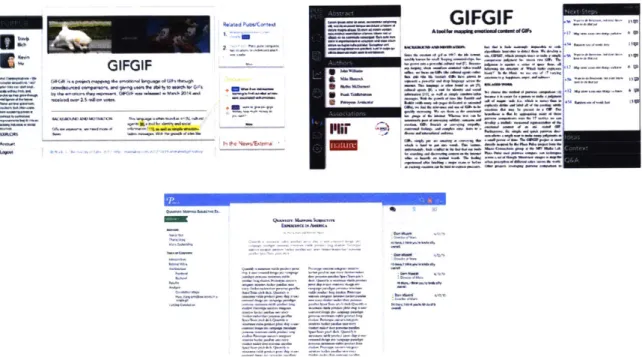
data-rich project that sought to measure the emotional content of animated GIFs through pairwise comparison. GIFGIF's playful and animated design is much more engaging on web platforms than in a PDF. Furthermore, given that GIFGIF was a project that relied on many users, we wanted to gather feedback about how to improve the project from an audience as wide as our userbase. For these reasons, the first focuses of PubPub were to allow for 1) the creation of rich, interactive documents and 2) direct reader interaction. Interaction in this case means both with the document itself (where interaction is added) and in a conversation alongside the document. Much of our inspiration for interactive documents comes from Jupyter Notebooks which are encapsulated code blocks that come with an associated kernel, allowing readers of a Jupyter notebook to rerun, alter, and interact with the code accompanying a technical writeup [65]. Early designs showing conversation alongside the rich-document are show below.
The conversation aspect is key to the feature set of early PubPub designs. The goals of the conversation are to provide new readers with context into any community consensus regarding the work and to create a pathway for readers to ask questions, identify errors, and suggest future directions. PubPub implemented in-line annotating
GIFGIF-GIFGIF
090 -Auii *&- -im 1
Figure 3-1: Early mockups of PubPub. The unifying theme of contextual discussions alongside the body of the article remains in all iterations of PubPub.
and commenting, inspired in part by projects like Hypothesis [66][67]. In order to further facilitate conversation and make discussions and suggestions actionable, it was critical that PubPub allow authors to quickly update their work. To maintain an honest account of these changes and how they came to be, a versioning system was implemented. These versions allowed readers to view the evolution of the documents. In early versions of PubPub, we allowed each user to give each comment a '+1' or '-1' rating. We would use these votes to prioritize the order in which discussion items were displayed. The intent is to have a system that allows the best discussions to bubble to the top, while unproductive discussions fall to the end. This is a system similar to upvotes on Reddit or HackerNews, likes on Facebook, or thumbs-up on Youtube. Of these platforms, Reddit has provided the most detailed documentation of how they use these votes to determine ranking. The Reddit team notes the complex social dynamics that exist in such voting schemes [68]. Common pitfalls include the fact that the earliest comments have the highest votes due to preferential attachment
mechanisms -those that got votes first remain at the top because more people see them
propose iteratively designing a new antldlaciplinary journal with an open collaborative model of interaction in contrast to the structured and formal peer review system in order to tackle the most pressing and most interesting problems and ideas of our times and itself be an experiment.
The Media Lab has thrived 30 years without losing its relevance or its passion when most research labs that focus on a discipline have difficulty retaining relevance for so long. Why? I think it's because our focus is on a way of thinking and doing rather than on a field of study or a particular language. I believe the key is a focus on developing a better system of design and a better theory of deployment and impact.
As participant designers, we focus on changing ourselves and the way we do things in order to change the world. With this new perspective, we will be able to tackle extremely important problems that don't fit neatly into current academic systems: instead of designing other people's systems, we will redesign our way of thinking and working and impact the world by impacting
ourselves [7] [sN.
Dan"y Hllis .1/24/2016 Per"Ialnk I Ply
Unr the past wher there was a keater separaion
beivea those Uhgs that reasentad the artdiaI and
those that reptesented the orguns* the cLAWtaa and the
nattIt appers t atr and the a ae
This is what I have beow oalling The EntenglemsMt that is, the entaglement of nature and technology so that
the dtintion becomes increasingly meaningless.
SStewrt
Brand -2/9/2016
Agreed. I ended my WHOLE EARTH DISCIPLINE
book with the line: "What we cal natural and what we call human are Inseparable. We lWe one flfe.*
Figure 3-2: Discussions and annotations in the first launched version of PubPub a post into its score in some situations [69]. HackerNews approaches similar problems
by giving users who have a demonstrated history of participation more weight in their
votes. Early versions of PubPub used a combination of these techniques in an effort to provide a fair score. While early versions of the platform did not have a sufficient number of discussions to reliably test the quality of our metrics, our goals were to:
" Provide more weight to authors and invited reviewers
* Provide more weight to discussions that had many responses
" Provide more weight to discussions that had responses from the author or invited reviewer
" Provide more weight to discussions that caused updates to the article
* Provide more weight to discussions with many '+1' votes
* Provide more weight to new discussions so they have an opportunity to be seen and voted on
* Provide more weight to discussions that include a highlighted section of the work, as they demonstrate direct relation to the article
Many of these parameters are simple to include in our ranking algorithm, though we were unable to find proper relative weights (e.g. which is more important, a discussion with many responses or a discussion by the author) given the low number of discussions in early versions of PubPub.
In the software development world, the practice of having richly versioned and collaborative projects has been successful. One current demonstration of this success
is git [70] and Github [71] -where open-source projects are documented, maintained,
and built by communities. We argue that versioning and collaborative development is equally important for scientific publishing and communication. To motivate this belief we focus on retractions in scientific publishing, the problems associated with them, and argue that many challenges would be alleviated by a rich and accepted versioning system.
PUBPUB
BETA AL;THORS res ich CONTENTS ad'mPrbicles Header2 Heder3 Maco-scale In~isbilt Clock using NenorefectMtyMacro
A cMilityClock using
documenerepeallase, )
Nanor
"E
hanced
Particles
efractvty E perinentW
toggle Edit/Preview Mode
___________~ ~ ~ Da a 41011 __________________
U YAG law tes"n
Your New F arly emphasis something super important.
D~vaoj~i~r*04/10,15
Welcome to your n--
Feences
button in the top-rigU ExpIOQ a
The following text p psible ideas References to the right and cite them using content to see how I 041015 Cite'Tag! [I
WSYWIG support coming soon! Lists go like this
Figure 3-3: A view of versions in an early stage of PubPub
3.1.1
Why Versioning Matters: Scientific Retractions
Scientists are not infallible. Unsurprisingly, the work produced and published by these scientists is sometimes found to be wrong. Currently, the central mechanism
for correcting these published errors is for the publisher to issue a retraction notice. This mechanism is bundled with such strong social and political context that its use and value deviates from the core goal of enabling science to be a self-correcting process. Alberts et al. expand upon this notion and even suggest that reliance on the word "retraction" causes behavior that is against the best interest of the scientific process [72].
Literature that discusses retractions tend to articulate four underlying reasons for a published piece of work may be invalidated and retracted [73][74].
1. Honest mistakes in documentation (e.g. typos, calculation errors, etc.)
2. Findings invalidated by newer science (e.g. the discovery of a new piece of evidence invalidating a conclusion)
3. Fraudulent reporting (e.g. creating false data, fabricating results)
4. Incompetence (e.g. not being sufficiently skilled in a technique or domain to identify a mistake)
Of these, two of them are contributory towards the scientific process (items 1 and
2), and two of them are detrimental to the scientific process and require corrective repercussions (items 3 and 4). Two questions that can be asked are 1) How does one identify and discriminate between different types of retractions, and 2) What is the proportion of retractions due to each type?
A comprehensive analysis of retracted work, performed by Grieneisen et al., found
that 47% of retracted work was due to publishing misconduct, 20% due to research misconduct, and 42% due to questionable results interpretation (multiple causes can be assigned to a single retraction, hence the greater than 100% total) [75]. This work differs in their analysis of types of causes, and almost entirely ignores the use of retraction as a tool for correction and progress (items 1 and 2 in the above numbered list).
The tendency to view retractions as a purely negative process has led some to encourage the adoption of multiple terms (such as 'withdrawal by author' or
'with-drawal due to causes') to distinguish between the underlying cause of a retraction
[72].
Unfortunately, little effort is made to differentiate, and the effect is a generalized and very strong professional stigma against scientific retractions. While such stigma is appropriate for retractions due to fraud or incompetence, it creates an environment where even small risks are avoided due to the fear of potential retraction. Such risk aversion is seen to have negative effects in other domains as well, such as the culture of entrepreneurship in many European countries.
In Europe, a serious social stigma is attached to bankruptcy. In the USA bankruptcy laws allow entrepreneurs who fail to start again relatively quickly and failure is considered to be part of the learning process. In Europe those who go bankrupt tend to be considered as 'losers'. They face great difficulty to finance a new venture. Communication by the
European Commission, 1998 [76]
If you start a company in London or Paris and go bust, you have just
ruined your future; do it in Silicon Valley and you have simply completed your entrepreneurial training. The Economist, 1998 [76]
The current realization of the scientific process has been increasingly critiqued as a large number of papers, notably in the life and health sciences, have been found to be irreproducible. One form of critique has been analyses of retracted papers to understand trends in their countries of origin, field of science, and publishing journal
[75] [77] [78]. However, little work is done to understand whether retractions are even
an effective tool for enabling science to be self-correcting and so below we attempt to provide some data towards that question.
One startling aspect of the retraction process is that there is no centralized mech-anism for how a journal retracts a publication, how scientists are notified, or where retracted work can be checked. There is no central database to crosscheck a new work's references with those that are known to be retracted.