HAL Id: hal-02442021
https://hal.archives-ouvertes.fr/hal-02442021
Submitted on 16 Jan 2020HAL is a multi-disciplinary open access archive for the deposit and dissemination of sci-entific research documents, whether they are pub-lished or not. The documents may come from teaching and research institutions in France or abroad, or from public or private research centers.
L’archive ouverte pluridisciplinaire HAL, est destinée au dépôt et à la diffusion de documents scientifiques de niveau recherche, publiés ou non, émanant des établissements d’enseignement et de recherche français ou étrangers, des laboratoires publics ou privés.
Multicriteria Web-Based Dss for Resource Allocation in
Higher Education Organizations
Carolina Lino Martins, Pascale Zaraté, Adiel Teixeira de Almeida, Danielle
Costa Morais
To cite this version:
Carolina Lino Martins, Pascale Zaraté, Adiel Teixeira de Almeida, Danielle Costa Morais. Multicri-teria Web-Based Dss for Resource Allocation in Higher Education Organizations. 5th International Conference on Decision Support Systems Technologies (ICDSST 2019), May 2019, Funchal, Madeira, Portugal. pp.179-185. �hal-02442021�
Any correspondence concerning this service should be sent to the repository administrator: [email protected]
This is an author’s version published in:
http://oatao.univ-toulouse.fr/24954 Open Archive Toulouse Archive Ouverte
OATAO is an open access repository that collects the work of Toulouse researchers and makes it freely available over the web where possible
To cite this version: Martins, Carolina Lino and Zaraté, Pascale and
Teixeira De Almeida, Adiel and Costa Morais, Danielle Multicriteria
Web-Based Dss for Resource Allocation in Higher Education Organizations. (2019) In: 5th International Conference on Decision Support Systems Technologies (ICDSST 2019), 27 May 2019 - 29 May 2019 (Funchal, Madeira, Portugal).
Multicriteria Web-Based Dss for Resource Allocation in Higher Education
Organizations
Carolina Lino Martins 1,2, Pascale Zaraté 1 Adiel Teixeira de Almeida 2, Danielle Costa Morais 2
1IRIT – Toulouse Capitole University – 2 rue du Doyen Gabriel Marty 31042 Toulouse
Cedex 9 – France [email protected] web-page: https:// www.irit.fr/
2UFPE - Production Engineering Department, Federal University of Pernambuco
Av. Avenida da Arquitetura, s/n, Cidade Universitária, Recife-PE, Brazil [email protected], [email protected], [email protected]
web-page: http://www.cdsid.org.br/
ABSTRACT
The allocation of scarce resources is a complex problem, specially when it comes to budget constraints. Therefore, this work aims to propose a multicriteria web-based Decision Support System for resource allocation in the context of higher education organizations, more precisely, public universities that have budget constraints, such as Brazilian federal universities. To do so, a Brazilian federal university was chosen as a parameter to make a numerical application to validate the multicriteria model for resource allocation proposed and, afterward, a web-based DSS was developed. For the MCDM resource allocation model, an additive value function was considered to set the percentage of the total budget that every alternative should receive. The problem was seen as a particular case of project portfolio selection problem because its approach is deemed to be appropriate for a resource allocation decision context. The results were satisfactory, and the system provided a clear vision on how the resource allocation procedure works, the entire process became more transparent to the ones that are affected by it, to the decision makers and the government, enabling them to take more efficient and reasonable decisions.
Keywords: Resource allocation, Budgeting, MCDM /A, Universities, Web-based DSS,
Model-driven DSS.
INTRODUCTION
Resource allocation problems usually involve conflicting decisions and are confronted by organizations of every size, type, and purpose, once their capacity to borrow funds or raise equity capital, for instance, has practical limits [1]. For public universities, it is even more challenging to deal with budgeting problems because they use their taxpayers' money to provide education services [2]. Hence, there is a tremendous societal interest (or at least should exist) in the way such money is allocated, where the cost of failure is seen as something unacceptable [3].
Multiple criteria decision making/aid (MCDM / A) area has been claimed as an effective way to assist decision makers (DMs) to deal with the challenges that involve resource allocation problems or budgeting problems [4], specially in higher education organizations [5]. Also, Turban et. al. and Power [6, 7] affirm that Decision Support Systems (DSS) can improve decision quality. Therefore, the use of a suitable web-based Decision Support System (DSS) meant to integrate MCDA / M analysis into the decision aiding process is an essential tool to respond to this ongoing challenge.
Multiple Criteria Decision Support Systems (MCDSS) are considered a "particular" type of system within the broad family of DSS [8]. MCDSS use different multicriteria decision methods to estimate efficient solutions, and they incorporate user's input in numerous phases of modelling and solving a problem [8].
According to [4], despite the growing attention to MCDA-based modelling approaches for resource allocation [9, 1, 10], there is still little indication in the operational research and decision sciences literature on how to structure these models in practice.
Besides, when considering the case of a university, the use of a suitable multi-attribute decision method integrated with a web-based Decision Support System to better distribute the limited budget could mean to reach the best compromise solution, to apply all the available resources with efficiency.
Thus, this work aims to fill this gap by proposing a multicriteria web-based Decision Support System to solve a resource allocation problem in the context of hig her education organizations, more specifically, public universities that have budget constraints. For this reason, a Brazilian public university was chosen to validate the model; once, currently, the university does not have a model or system for such a problem. The research can contribute to the decision question of how to allocate universities internal budget properly [2].
The case study conducted in this work considers the results of previous studies related to MCDM portfolio selection problems, such as: [2, 11, 12, 13].
METHODOLOGY
The problem considered here is a special case of portfolio problematic, seen as a resource allocation problem. The decision maker of the problem was the director of the budget and planning department of the university, and the analyst was the author of this study. The university studied has 21 sectoral administrative units (called UAS) that are divided by areas, such as human sciences, biological sciences, engineering, faculty of medicine, etc. These administrative units are the alternatives, projects or budgetary units of the MCDM model. Therefore, the set of alternatives is A = {UAS 1, UAS 2, UAS 3, UAS 4, UAS 5, UAS 6, UAS 7, UAS 8, UAS 9, UAS 10, UAS 11, UAS 12, UAS 13, UAS 14, UAS 15, UAS 16, UAS 17, UAS 18, UAS 19, UAS 20, UAS 21}.
(1.0)
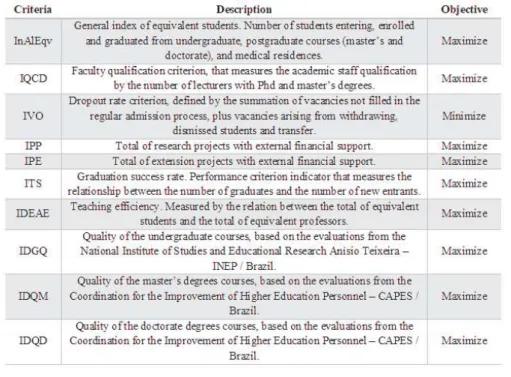
(2.0) Figure 4: Criteria of the Model
The weights (scale constants) of the model were also defined by the DM and are presented in Figure 2.
Figure 2: Weights of the Model
The model adopted was an additive aggregation procedure for portfolio problematic with compensatory rationality, because of the characteristics of the problem. The primary goal of the model is to maximize the objective function, considering the given constraints [1], that is a budget constraint. Therefore, the objective function (1.0) and the constraints (2.0) are written as: !" # "=1 $(%") Subject to: !" &" # "=1 ' *
Where i represents every UAS from the university, zi is defined as a binary variable
indicating whether item Aiis included or not in the portfolio, thus zi = 1 if it is included and zi
= 0 if it is not [14]. v(Ai) is the value of item Ai obtained from the multi-attribute evaluation
[15].
C and ciare related to the constraints, where C is the budgeted amount available to fund all
the UAS and ciis the budget of each administrative unit, and it could be seen, for instance, as
the cost to develop project i.
When considering a public university, no administrative unit can stay without receiving a part of the budget because of the minimum amount required to maintain the UAS, in services such as security, for example. Consequently, the decision problem here lies in defining which are the administrative units that will receive a part of the budget above the minimum value that
(3.0)
(4.0) each one must receive, that is, the total budget requested by the UAS, considering their performance for the set of criteria, and that is a project portfolio selection problem.
Moreover, to adequate the model in this study and taking into account equation (1.0) and inequation (2.0), the variables of the model can also be described as:
ci= the budget requested by the administrative unit or the budget above the minimum limit
that each UAS want to receive;
min ci= minimum percentage of the budget that each UAS should receive;
zi= binary variable that is equal to 1 when the UAS will receive the requested budget or
equal to 0 otherwise;
zici= the budget allocated to UAS “i”, which is equal to ciwhen ziis equal to 1;
B = total budget from the university available to be allocated;
C = total budget amount that is above the minimum percentage of the budget that each UAS
should receive, that is:
! "#$% &$ ='
% $=1
Finally, the evaluation results from an additive value function it is of the form [15]: (!") = # $% %&'"%*
+ % =1
Where xijis the outcome obtained by item Aiin attribute j, vjis the marginal value function
of attribute j, kjis the weight (scaling constant) for attribute j, and its summation must be equal
to 1; v(Ai) is the value of item Aiobtained from the multi-attribute evaluation [15].
The total budget available (B) considered for the problem was R$ 850,000.00, a value that represents 85% from 2018 total budget of the university, once that was the amount released by the Ministry of Education in 2018, due to government budget cuts. The minimum value
considered that each administrative unit must receive (min ci) was 70% from the last budget, a
total of R$ 700,000.00 since that is the minimum amount considered to maintain the UAS. Thus, C = R$ 150,000.00. Following, the results from the model are shown in Table 1.
RESULTS
Table 1 - Resource allocation model results
Table 1 shows the alternatives, their respective value from the additive model (Vi ) using a
problem [11], the percentage (Pi %) of the total budget that each administrative unit should receive, the alternatives that are selected to receive the budget amount above the minimum budget (Go?) and the total value, that represents the objective function of the model.
From the use of the additive model, the results indicate a portfolio with 15 projects, and in terms of budget value, the solution consumes R$ 148,831.30 from the available budget (R$ 150,000.00). When deeply analyzing the results, although UAS 1, for instance, has a satisfactory performance in the criteria considered, the summation of the results of more than one UAS brings additional outcomes to the overall portfolio value than choosing only one project with a valuable performance. Such a solution means that the resources are distributed in a more balanced way among all items of the portfolio, and that is the best compromise solution for the case.
Given this consideration on the problem, it was possible to implement the multicriteria web-based DSS, web-based on the user’s primary needs. The name defined for the web system was: MDSSFRA (Multicriteria Decision Support System for Resource Allocation). The principal DSS component is the multicriteria model, and the target users are the administrative staff from the budgeting unit of the university considered, DMs participants from every UAS, since they are affected by the allocation procedure, facilitators, developers, and administrators.
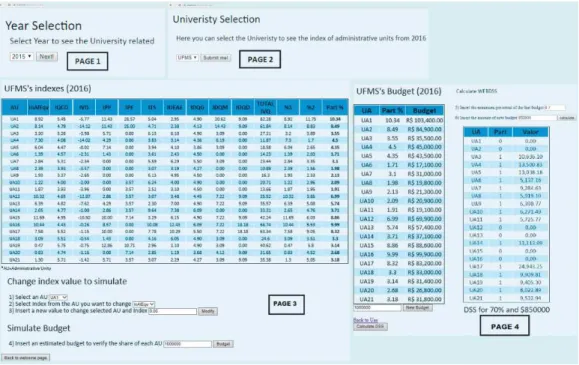
To implement the multicriteria web-based DSS, a PHP web platform was developed on the server side integrated with Python and a Database system MySQL was applied to store and retrieve data using Structured Query Language (SQL). The components of the system are shown in Figure 3, and they evidence results from previous studies [2, 12, 13], which served as the basis for establishing Pages 1, 2 and 3 of the system, already explained in these previous studies. Page 4 was the result of the implementation of the multicriteria model developed by this study
Figure 3 – Web system pages – user interface
Thus, Page 4 has two main tables. The first one shows the budget in financial and percentage terms and the possibility of simulating the results with a different budget. The last column (Budget) of the first table is the multiplication of the participation percentage of each UAS with the total budget available. The second table represents the MCDM model results evidencing the units that will receive a part of the budget above the minimum established by
the university.
PERSPECTIVES AND CONCLUSION
This study presented a multicriteria web-based Decision Support System for resource allocation in the context of higher education organizations, more specifically, public universities that have budget constraints, with the aim of demonstrating how the use of a suitable multi-attribute decision method combined with a DSS could improve the distribution of a limited budget, which it could mean to reach the best compromise solution, by applying all the available resources with efficiency.
To validate the multicriteria model, a Brazilian federal university was chosen as a parameter to make a numerical application. The model was able to define the percentage of the budget that every budgetary unity of the university should receive. The model established 21 alternatives, which were the sectoral administrative units from the university, and ten criteria were defined by the DM, which was the director of the budget and planning department. A portfolio of 15 projects was found. Also, a multicriteria web-based DSS prototype was established for the problem.
The method proved to be valuable for managing the allocation of resources through a set of alternatives which were distributed rationally by explicit consideration of the real importance of the different criteria. An advantage provided by the system is that when there is a clear vision of how the resource allocation procedure works, the entire process becomes more transparent to the ones that are affected by it. Besides, the multicriteria web-based DSS could be used to provide background for the university considered or other universities when defining strategic resource allocation planning.
ACKNOWLEDGEMENT
This work is part of a research program funded by the Brazilian Research Council (CNPq), FACEPE (Foundation for support of Research by the State of Pernambuco) and Federal University of Mato Grosso do Sul (UFMS).
REFERENCES
[1] D. N. Kleinmuntz, Resource allocation decisions. In Edwards, W., Miles, R.F. and von Winterfeldt, D. (Eds), “Advances in Decision Analysis”. Cambridge University Press, New York, NY, pp. 400-418, 2007.
[2] C. L. Martins, A. T. de Almeida, & D. C. Morais, Design of a Decision Support System for Resource Allocation in Brazil Public Universities. “International Journal of Decision Support System Technology (IJDSST)”, 11(1), 20-34, 2019.
[3] G. Williams, Applying Management of Risk (M_o_R®) for Public Services. “GSW Consultancy”, 2009.
[4] G. Montibeller et al., Structuring resource allocation decisions: A framework for building multi-criteria portfolio models with area-grouped options. “European Journal of Operational Research”, 199(3), 846-856, 2009.
A. Mustafa, M. Goh, Multi-criterion models for higher education administration. “Omega”, v. 24, n. 2, p. 167-178, 1996.
[5] E. Turban, R. Sharda, D. Delen, “Decision Support and Business Intelligence Systems”. 9th Edition. New Jersey: Prentice Hall, 2011.
[6] D. J. Power, Computerized decision support case study research: concepts and suggestions. In “Real-World Decision Support Systems” (pp. 1-13). Springer International Publishing, 2016.
[7] P. Korhonen, A. Lewandowski, J. Wallenius, Multiple Criteria Decision Support; Proceedings of an International Workshop, Helsinki, Finland, August 7-11, 1989. “Lecture Notes in Economics and Mathematical Systems”. Springer-Verlag, 1991. [8] K. Golabi, C. W. Kirkwoo, A. Sicherman, Selecting a portfolio of solar energy projects
using multiattribute preference theory. “Management Science”, v. 27, n. 2, p. 174-189, 1981.
[9] L. D. Phillips, C. A. Bana e Costa, Transparent prioritization, budgeting and resource allocation with multi-criteria decision analysis and decision conferencing. “Annals of Operations Research”, v. 154, n. 1, p. 51-68, 2007.
[10] C. L. Martins et al., An MCDM project portfolio web-based DSS for sustainable
strategic decision making in an electricity company. “Industrial Management & Data Systems”, v. 117, p. 1362-1375, 2017.
[11] C. L. Martins et al., Decision Support System for resource allocation in Brazil
public universities (short paper). “Proceedings of the 2017 International Conference on Decision Support System Technology: Data, Information and Knowledge Visualization in Decision Making”. Isabelle Linden, Shaofeng Liu, Jason Papathanasiou, Christian Colot (Eds.), ISBN: 978-2-917490-28-0, p. 119-124, may 2017.
[12] C. L. Martins, P. Zaraté, A. T. de Almeida, D. C. Morais, K. C. Peters, A
web-based DSS for resource allocation in a Brazilian public University (short paper). “Proceedings of the 2018 International Conference on Decision Support System Technology: Sustainable Data-Driven & Evidence-based Decision Support with applications to the Environment and Energy sector”. Panagiota Digkoglou, George Tsaples, Fatima Dargam, Isabelle Linden, Bertrand Mareschal, Jason Papathanasiou (Eds.), ISBN: 978-2-917490-29-7, p. 304-310, may 2018.
[13] R. T. Clemen, J. E. Smith, On the choice of baselines in multiattribute portfolio
analysis: a cautionary note, “Decision Analysis”, Vol. 6 No. 4, pp. 256–262, 2009.
[14] T. de Almeida, R. Vetschera, J. A. Almeida, Scaling issues in additive
multicriteria portfolio analysis, in Dargam, F. et al. (Eds), Decision Support Systems III – Impact of Decision Support Systems for Global Environments, “Lecture Notes in Business Information Processing”, Vol. 184, Springer, Cham, pp. 131-140, 2014.