October 1985
LIDS-P-1510
CALCULATING TIME-RELATED PERFORMANCE MEASURES OF A DISTRIBUTED TACTICAL DECISIONMAKING ORGANIZATION
USING STOCHASTIC TIMED PETRI NETS1 R.Paul Wiley and Robert R. Tenney Laboratory for Information and Decision Systems
Massachusetts Institute of Technology Cambridge, MA 02139
I. INTRODUCTION the captain of each battle group will request the use of the helicopter.2 We assume that the probability One of the key categories in which a distributed distribution for the time between requests for each tactical decision making organization must be evaluated battle group captain is known, as well as the to assess its effectiveness is time-related performance probability distribution for the time that the measures. Examples of these measures include: the helicopters will spend in each sector. In addition, we rates at which different tasks are completed, the assume that the protocol or decision rule that decides probability that shared resources are available when which among the three captains will get use of the requested, the average number of tasks waiting to be helicopter, in case of a conflict, is assumed (or performed, the percentage of tasks successfully hypothesized). Given the required information, this completed, etc. These performance measures depend shared resource problem can be modeled with a STPN and strongly on the delays in decisionmaking due to such questions as the percentage of time the organizational architecture and associated helicopter (the shared resource) is being used and by coordination protocols. If we are able to understand whom, the average amount of time that each captain must the effects of these architectures and protocols on wait after he has requested use of the helicopter, the the performance measures, we will be one step closer to rates at which each captain will get use of the fleet, being able to design effective distributed, real-time etc., can be answered.
dec is ionmaking organizations. An overview of this paper goes as follows. We A realistic model of distributed real-time start by defining STPNs and presenting the relevant decisionmaking organizations must incorporate at least concepts. We then show how the operation of a STPN can three features: asynchronous protocols, concurrent be viewed in terms of the operation of an infinite operations, and random task-completion times. The collection of Unfolded STPNs. This decomposition is asynchronous protocols are necessary since the groups then used to write state equations for the system, or agents which compose the organization cannot be which in turn can be used to analyze the STPN (and the tightly synchronized; i.e. they do not communicate with organization it models) with respect to time-related each other at prespecified times. The concurrent performance measures.
operations are necessary since different parts of the organization work independently, coordinating their
activities regularly to make sure the overall objective II. STOCHASTIC TIMED PETRI NETS is being achieved. Finally, random task-completion
times are necessary since most agents or groups perform Stochastic Timed Petri Nets are graphs with two a wide variety of tasks under many different types of nodes: places (drawn as a circle and labeled
conditions. Pi) and transitions (drawn as a line segment and
Stochastic Timed Petri Nets (STPNs) naturally labelled ti), along with directed arcs going from one incorporate all of these features. The basic objective type of node to the other (see Figure 1). Besides of this paper is to introduce a methdology that can be
used to analyze the dynamic and steady state behavior of these nets and, consequently, enhance our
understanding of the time-related issues of the - - - - -organizations they model.
The methodology presented in this paper can be used to analyze live and save STPNs (terms defined
later). This class of STPNs can model organizations
I
with finite queues and interesting protocols such as t[
P
priorities
and/or
probabilistic
choices.
For
organizations that can be modeled with this class of
STPNs, the time-related performance measures listed in
4Pn
t'
the first paragraph, among others, can be calculated. I So as not to lose sight of applications in the
abstraction of mathematics, all steps of the \I1
tS
tmethodology will be illustrated by an example. This example models the use of a shared resource by three groups. The groups could correspond to three naval battle groups, each responsible for a geographical
sector, collectively in charge of defending a naval - Battile [ I Battle I Battle task force against submarine attacks. The shared Group Group Group resource in this situation could correspond to a No. 1o. 2 No. 3
special purpose helicopter, based on the main carrier L 1_
of the task force, equipped with bouys and sonar
equipment (i.e., a LAMPS helicopter). Periodically, Figure 1. STPN Model of Naval Defense Shared Resource Example lThis research was supported by the Office of Naval
Research under grant ONR/N00014-77-C-0532 (NR 041-519) nodes and arcs, a STPN assigns to every place a non-and ONR/N00014-84-K-0519 (NR 649-003).
negative number of tokens, called the marking of the the future behavior of the system. That is, we need to net, and a nonnegative random processing time3. When a determine the Estate' of a STPN. One fact we need to token arrives at a place, it is defined to be know, certainly, is the position of every token (the unavailable (following Sifakis [3]). The token remains marking of the net) since this specifies what in this state until the instant when the processing has transitions will potentially be enabled. In addition, finished. At this time, the token becomes available. we need to know the amount of time that each token has We assume that the processing time probability been in each place to determine whether it is available distributions for every place are given, and that they or not. One way of determining the amount of time a are stationary and independent from place to place. particular token has been processed is to remember the
In the STPN shown in Figure 1, the shared-resource time at which the transition that created that token example, a token arriving at P1 represents the fired, and subtracting that time from real time. In helicopter being sent to geographical sector No. 1. the next section, we will take this last approach. The token being processed in that place represents the Thus, a state for a STPN consists of the marking of the helicopter performing its tasks in that sector. And net plus the time that each token has been in each finally, the token becoming available again represents place. We can further argue that if any of this the helicopter completing its tasks, a time after which information is missing, then we do not have enough it is available to be sent elsewhere. information to predict the future behavior of the
Tokens move around by transition firings. A system. Thus, the mentioned state is also minimal. transition is enabled, that is, it may fire, only when There is one last item that we must specify in all of its input places have available tokens. When a order to follow the evolution of a STPN, and that is transition does fire, it removes a token from all of the initial conditions. Given the previous discussion its input places and adds a token to all of its output on the state of a STPN, we assume that the initial places. If transition t1 in Fig. 1 fires, for example, marking and the time that each token has been in each
we remove a token from places po and P1 and add a token place at time zero are given. With the given initial to place P2' conditions, the known decision rules, and the The firing of the mentioned transition tl, in processing times determined by their respective terms of the naval example, represents the act of probability distributions, the STPN evolves sending the LAMPS to the first geographical sector. autonomously in time. It is this autonomous evolution Before the LAMPS will be dispatched, however, two facts what we wish to study, understand, and compute must be true. The LAMPS (represented by a token in po) performance measures for.
must be available, and the captain of the first One can think of the operation of a STPN as a geographical sector must request its use (request succession of markings, with the changes from, one represented by a token in p7). Thus, transition tl marking to another specified by the transition firings
coordinates the requests from the captain of Battle and the rules for moving tokens. If the number of Group No. 1 with the availability of the shared tokens in any particular place can never exceed one, resource. Moreover, while the LAMPS is performing its regardless of what processing time probability tasks in the first geographical sector, the captains of distributions and decision rules are assigned, the STPN
the other geographical sectors cannot use it. In the is said to be safe. If the probability that any
STPN, this restriction is enforced by the fact that, particular transition firing gets arbitrarily close to during this time, no token is available in po to fire one if we wait long enough, regardless of what state transitions t3 or t5. the STPN has reached, the STPN is defined to be live. Two or more transitions are said to be in conflict And finally, if there exists a directed path from any if firing one will disable the others. In Fig. 1, node (place or transition) to any other node, the STPN transitions tl, t3 and t5 are in conflict. If an is strongly connected.
enabled transition is not in conflict, it fires Throughout this paper, we will assume that the instantly. If several enabled transitions are in STPNs we are studying are strongly connected, live, conflict, then a decision rule, specified a priori, safe, and with a finite number of nodes. The first selects one and that transition fires instantly. These assumption is a necessary condition for the STPN to be decision rules can depend on the relative firing times safe (Ramchandani [2]) and also ensures that we are not of the transitions that feed tokens into the input solving a problem that could be split into two or more places of the transitions which are in conflict. independent problems. The second assumption, liveness, In the naval defense example, this conflict says that all parts of the system will operate represents the situation where two or more captains regularly. If there exists a transition that is not request the use of the LAMPS, while it is in service in live, then the part of the system associated with that the area. A decision rule must be provided to settle transition should be deleted since it is not performing this conflict. This decision rule can be a function of any activities. Liveness is also a necessary condition the relative firing times of t7, t8, t9 and either t for convergence. The third condition, safeness, is
t4 or t6 (whichever transition fed the token into pOf. necessary to impose ordering. If we allowed multiple Possible decision rules include priorities, and the tokens in a place, then they would be free to cross fleet assigned accordingly, or probabilistic choices, each other depending on their variable processing whereby the fleet is assigned according to some times. In order not to keep track of all possible probabilistic rule (which might account for varying orderings of tokens, we require safeness. Notice that battle conditions), or some combination of the above. this still allows us to model (bounded) finite first-in In the preceding paragraphs, we have formulated first-out queues by concatenating a series of safe the rules of operation for a STPN. In order to places, as shown in Figure 2.
implement these rules, it is important to determine Now that all the necessary concepts have been what information must be recorded in order to predict defined, we can specify the performance measures that we are interested in obtaining. These performance For simplicity, we assume that there is only one measures are the average transition firing rates, the helicopter. Generalization to many is easy. average number of tokens in each place, the average amount of time a token spends in each place, and
3
Many authors, Ramchandani [2], Zuberek [5] and Molloy finally, the probability that a token will enable one [1], associate processing times with transitions of several transitions which may be in conflict. The instead of places. The distribution makes no basic methodology actually obtains much more since we difference for the class of problems studied in this also obtain the probability distribution (and not just paper. the mean value) for the time a token spends in each
~
the
..
A
7it
7-
t
Figure 2. STPN Model of a Finite First-In First-Out
t
KQueue
place. From the list of performance measures, most, if not all, of the time-related performance measures of
the original organization can be answered.
III. STATE EQUATIONS
III.a Introduction T t'+ t
In the previous section, we established that the state of a STPN consists of the marking of the net and the time each token has spent in each place. We also mentioned that one could deduce the time a token spends
in each place by recording the firing time of the
transition that fed the token into that place. In this
section, we will derive equations which keep track of K K K K K K
the
transition firing times and from
which
the marking
tKq
\
1
t
can be deduced.
Thus,
in light of the previous
discussion, these equations can be used to follow the state of the STPN as it evolves.
The derivation is performed in two steps. In the first step, we show that the evolution of a STPN can be
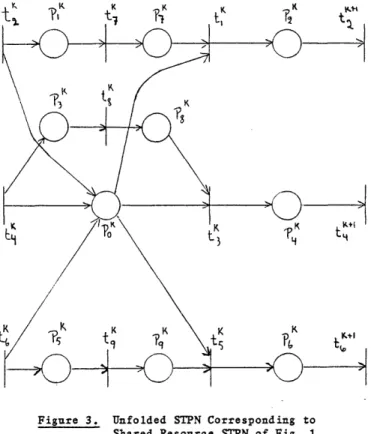
visualized in terms of the evolution of an infinite Figure 3. Unfolded STPN Corresponding to collection of Unfolded STPNs. This visualization Shared Resource STPN of Fig. 1 provides an ordered index that can be used to decribe
the system mathematically. In the second step, the an infinite collection of Unfolded STPNs. Since the mentioned index is used to write firing time state latter form a disjoint collection, we must specify what equations. we mean by the operation of the collection Unfolded
STPNs. We do this now.
III.b Unfolded STPNs Imagine having an infinite collection of Unfolded One of the main difficulties of analyzing STPNs, STPNs numbered k=1,2,3,... The k copy of this or any other mathematical model of asynchronous collection is referred to as the kth stage. Now concurrent systems, is obtaining an ordered index which suppose we place a token in every place of stage 1 for can be used to describe the system mathematically. The which the corresponding place in the regular STPN usual index, time, is not appropriate since different contains a token in the initial marking. Also suppose parts of the system work independently. But STPNs are that the time each of these tokens has been processed causal systems, that is, certain transitions must fire at time 0 is initialized to be the same as the initial and certain tokens must be processed before other times specified for the regular STPN. Then we can transitions can fire. The Unfolded STPNs, which we implement the rules of operation that we describe in discuss in this subsection, capture this causality and the previous section for stage 1. Since the Unfolded provide the ordered index that we seek. STPN contains no directed circuits, two things can An Unfolded STPN is constructed by taking the happen to the tokens. The first possibility is that original STPN, cutting every directed circuit at an they will leave the stage by having some of the appropriate transition, and 'unfolding' the net. For transitions labelled with the superscript 2 fire. The example, Figure 3 shows the Unfolded STPN corresponding other possibility is that the tokens will be
to the STPN of Fig. 1. deadlocked.
As can be seen from this example, every place and As an illustration, consider the STPN of Fig. 1 transition is labeled by the superscript k. This along with its corresponding Unfolded STPN in Fig. 3. variable indicates to which copy of the Unfolded STPN Initially, stage 1 contains a token in p0, p7, p8 and
1
the places and transitions belong. This labelling is p9. Also initialized are the firing times for
important since, as we already mentioned, the operation
transitions t2
1t7
1t
1and t (this is equivalent to
of the regular STPN can be viewed in terms of the initializing the times each token has been processed at operation of an infinite collection of Unfolded STPNs. time 0). Now, suppose the given decision rule picks t} Also observe that the Unfolded STPN begins and ends as the transition to fire (since t1, t3 and t3 are
with the same set of transitions, each transition in in conflict). This firing takes a token from p0 and p1 the first set labeled with the variable k and each and places a token into p2, where it is processed.
transition in the second set labeled with the variable After that token is processed, transition t2 fires, and k+l. This fact does not mean that subsequent copies of that token leaves stage 1. Meanwhile, the tokens in p3 the Unfolded STPN are connected. Rather, it means that and p1 are deadlocked since the output of those there are two copies of each of these transitions. The transitions will never fire.
reason we need duplicate copies of these transitions So far we have explained how stage 1 of an will become obvious later. Unfolded STPN will operate. To initialize stage 2, we As mentioned previously, the operation of the must remember which transitions fired at the end of regular STPN can be viewed in terms of the operation of stage 1. A token is placed in the output place of
every transition that fired.
Thus, for the example
max
x
2(k), 13(k)].
We can deduce this last fact since
2 we know o t fired, and the latest firing is
that we have been considering, a token is placed of p we know only or 3 ired, and the latest firing is and pl. We also place a token in every place of stage the one which fed the token into P2. After each token 2 whose corresponding place in stage 1 contains a enters their respective places, they are processed. deadlocked token. In the example, this corresponds to When both tokens have finished being processed,
2 2 k
placing a token in pl and pg. The transition firing transition t4k fires. We conclude that times that originally fed these tokens are also
recorded in stage 2. In the example, the firing time x (k) = maxzl(k) + x(k),
of t4(t6) is set to be the same as the firing time of
t4(t6). Now, stage 2 has all the necessary state (k)
variables initialized and we can implement the rules of (k) + ax (k) 3
operation for it. k
Thus, the collection of Unfolded STPNs operates If transition t4 had contained more than two input
one stage at a time. Each stage evolves according to places, then the main maximization operator in this the rules of operation until every token has left the last equation would have contained more terms stage or is deadlocked. Then the following stage is Similarly, more input transitions to places p2 or p3
initialized according to the discussion given above, could also be easily handled.
and the collection of Unfolded STPNs keeps operating in Firing time equations can be written in the manner this manner forever. prescribed above for all transitions that fire in the It is not hard to see that the operation of the kth stage. Which transitions fire in each stage depend Unfolded STPNs reflects the operation of the original on the initial marking of that stage and the decision STPN. In mathematical terms, there exists a one to one rules. As specified previously, the evolution of the correspondence between the sample paths of the Unfolded kth stage of the Unfolded STPN will terminate when
STPNs and the sample paths of the regular STPN (see [4] transitions corresponding to the next stage fire or for proof). This correspondence allows us to study the when the tokens become deadlocked. To initialize the evolution of the regular STPN by studying the evolution calculations in the next stage, the deadlocked tokens of the corresponding Unfolded STPNs. This approach is must be 'transported' to the corresponding places in exactly the one we shall take. the next stage and the firing times of the transitions
that fed these tokens must also be initialized.
III.c Transition Firing Times Let us illustrate this discussion with the shared The evolution of the Unfolded STPNs can be divided resource example. Suppose the initial marking of stage into two separate processes. The first process keeps k places a token in po, pl, p8 and p , and that the track of the evolution from one marking to the next known firing times are x2(k), x8(k), and xg(k).
which results from transition firings. The second Further assume that tk is the transition that fed the process keeps track of the transition firing times and token into po The only transition that can fire from the processing of tokens. The two processes are this state is t7, and
connected since the first process, through its
markings, determines which transitions will potentially x(k) = z (k) + x2(). be enabled while the second process actually picks the
transition which fires next. The rules for keeping k
track of markings have already been given in Now let the token in pk be processed. Once this has track of mar gs have already been gsven w wbeen Sectionon accomplished, the decision rule picks tk, t or tk
II.
Therefore,
in this
section, we will derive
tf.
Sos
itcs k
1 3o
to fire. Suppose it picks tk. As a result of that equations which will enable us to keep track of the decision + ill also fire 3
~transition
times.decision firing t will also fire. The equations are transition firing times.In order to perform this derivation, consider the
STPN shown in Figure 4, which we assume is part of a 3 8 8 0 2 larger Unfolded STPN. Let xi(k) be the firing time for
and
4(k+l) = z4(k) + x3(k).
KK 4
't ~ As a result of all these firings, a token is
placed in p+l and p
+l
Meanwhile, the tokens in k ~K~ and p9 are .eadlocked. Therefore, these tokens must be9 +1 k+l
moved to P+1 and , respectively, and the firing times of t 7 and tg initialized as follows:
x
(k+l)
=x
Ck
KK and
xg(k+l) = x9(k)
Thus, we started with a state in stage k and ended up with a state in stage k+l. The state equations can be Figure 4: STPN for Derivation of State Equations used in this manner to follow the evolution of the Unfolded STPNs, and of the regular STPN that it is transition tk and zi(k) be the processing time for derived from.
k
tiplace pi. Our objective is to obtain an equation which
will give us the numerical value of x4(k) given xl(k), III.d Basic Methodology
x2(k), x3(k), zl(k) and z2(k). In order to do this, we Similar state equations to the ones just discussed
must know at what times the tokens entered p1 and p2. can be derived for any live and safe STPN. Once these The time the token entered p1 is given by xl(k), and equations are obtained, they can be used to analyze the