HAL Id: hal-00412020
https://hal.archives-ouvertes.fr/hal-00412020
Submitted on 26 Apr 2021
HAL is a multi-disciplinary open access
archive for the deposit and dissemination of
sci-entific research documents, whether they are
pub-lished or not. The documents may come from
teaching and research institutions in France or
abroad, or from public or private research centers.
L’archive ouverte pluridisciplinaire HAL, est
destinée au dépôt et à la diffusion de documents
scientifiques de niveau recherche, publiés ou non,
émanant des établissements d’enseignement et de
recherche français ou étrangers, des laboratoires
publics ou privés.
Shear strength and force transmission in granular media
with rolling resistance
Nicolas Estrada, Alfredo Taboada, Farhang Radjai
To cite this version:
Nicolas Estrada, Alfredo Taboada, Farhang Radjai. Shear strength and force transmission in granular
media with rolling resistance. Physical Review E : Statistical, Nonlinear, and Soft Matter Physics,
American Physical Society, 2008, 78 (2), pp.021301. �10.1103/PhysRevE.78.021301�. �hal-00412020�
Shear strength and force transmission in granular media with rolling resistance
Nicolas Estrada*
and Alfredo TaboadaGéosciences Montpellier, Université de Montpellier II and CNRS, cc060, Place Eugène Bataillon, 34095 Montpellier cédex 5, France
Farhang Radjaï
LMGC, Université de Montpellier II and CNRS, cc048, Place Eugène Bataillon, 34095 Montpellier cédex 5, France
共Received 8 May 2008; published 1 August 2008兲
We investigate a class of granular materials characterized by the possibility of interlocking between the particles. The interlocking is modeled by its effect through rolling resistance depending on relative rotation and normal force at the contact points and involving a single parameter analogous to the sliding friction coefficient. The model, which is introduced in the framework of the contact dynamics method, is applied to simulate the simple shear of a large granular sample. We present a detailed analysis regarding the influence of rolling and sliding friction parameters on the macroscopic response in terms of shear strength, fabric properties, and force transmission. Interestingly, two distinct regimes can be distinguished in which the steady-state shear strength is controlled by either rolling resistance or sliding friction. The relative contributions of rolling and sliding contacts to the shear strength are consistent with the same two regimes. Interlocking strongly affects the force network by enhancing the arching effect and thus increasing the relative importance of weak contact forces and torques, which is reflected in a decreasing power-law probability distribution of the contact forces and torques below the mean. Due to the combined effect of friction and interlocking, the force-carrying backbone takes an increasingly columnar aspect involving a low fraction of particles. Our data suggest that the nature of the weak contact network is strongly affected by the formation of these columns of particles which do not need to be propped laterally. In particular, in the limit of high rolling resistance and sliding friction, the role of the weak network of contacts is no longer to prop the force chains, but, like the strong contact network, to actively sustain the deviatoric load imposed on the system.
DOI:10.1103/PhysRevE.78.021301 PACS number共s兲: 83.80.Fg, 81.05.Rm, 45.70.Mg
I. INTRODUCTION
Granular materials are characterized by a shear strength depending on both the stress level and density. As a result of the quasirigidity of the grains and Coulomb friction, the maximum shear stresson a slip plane varies proportionally to the normal stress , so that the strength is generally de-scribed by the ratio=/which depends only on the solid fraction. Only in a steady state reached after sufficiently long shearing can, this ratio be considered as a material property. This state, often called the “critical state” in soil mechanics, is thus characterized by a critical solid fraction and a 共nor-malized兲 shear strength*, also described as the coefficient of internal friction of the granular material关1,2兴.
Unlike solid friction, which is a surface property, the shear strength*represents a bulk property resulting from a collective process, which depends on the nature of grain in-teractions and their geometrical arrangement. However, the link between shear strength and grain interactions is still a largely open issue. Early models of shear strength in granular media were based on the assumption that the dominant mechanism of failure and dissipation at the contact scale is sliding. These models predicted that * increased indefi-nitely with the coefficient of sliding frictionsbetween the grains 关3–5兴. However, it was later found, both
experimen-tally and theoretically, that *increases indeed withsbut
saturates rapidly to a limit value that is independent of s
关6,7兴. This behavior highlights the fact that, even though
slid-ing friction is the dominant source of dissipation in plastic flow of granular materials, the major grain-scale mode of deformation is the rolling of grains over each other which keeps *at a low level. Recent numerical simulations indi-cate that, in granular media composed of spherical grains, sliding occurs only at a small proportion 共⬍10%兲 of con-tacts, and these sliding contacts are basically those carrying weak normal forces关8,9兴.
These observations suggest that the shear strength should be strongly affected when the relative rolling is restrained by a mechanism of interlocking between the grains. Weak roll-ing resistance can result from interactions between grain sur-face irregularities or asperities. Larger rolling resistance may be due to interlocking between grains of nonconvex or an-gular shapes often occurring in geomaterials共gouge material, ballast, etc.兲 or in materials with dendritic grain surface structures 共flake-shaped metallic powder, snowflakes, etc.兲. The presence of a cementing material between grains can be another cause of interlocking. In all cases, independently of the underlying mechanisms, interlocking implies rolling re-sistance between the grains.
In order to be able to simulate real materials by means of discrete element methods, several authors have specifically incorporated rolling resistance at the level of contact interac-tions between grains关10–16兴. Other authors have simply
hin-dered grain rotations. This approach can be a useful trick to achieve very high values of *whilst using spherical-shape particles关17–20兴. Even though the practical interest of
intro-ducing rolling resistance is evident, the joint effect of sliding friction and rolling resistance on the macroscopic behavior *[email protected]
of granular materials has not been systematically investi-gated.
In this paper, we use a model of interlocking in the frame-work of the contact dynamics method in order to study the steady-state strength properties and microstructure of sheared granular media. In our model, the interlocking between grains is introduced through a rolling friction law relating the relative rotation of the grains with a contact torque which is proportional to the normal force. This law involves thus a rolling friction coefficientranalogous to the sliding friction
coefficient s. Polydisperse two-dimensional 共2D兲 granular
samples were sheared under simple shear boundary condi-tions and analyzed in the steady state for a broad range of friction parameters s and r in terms of shear strength, fabric properties and force transmission. An interesting find-ing of this work is that the saturation of*occurs also as a function ofrwith a saturation value that increases withs,
and, symmetrically, as a function of s with a saturation value increasing with r. As a result, two distinct regimes
can be distinguished in which*is controlled by eithersor
r. We consider in detail the effect of interlocking on the
microstructure and force transmission in these two regimes. The outline of this paper is as follows. We first describe, in Sec. II, the numerical method, system characteristics, and loading parameters. In Sec. III, we present a parametric study of the shear strength as a function of the two friction coeffi-cients. In Sec. IV, we focus on the solid fraction and structure of the force-carrying backbone. Section V is devoted to the force distributions and the influence of rolling friction on the bimodal behavior of our granular system. We conclude, in Sec. VI, with a summary of the main results and a brief discussion about the extensions of this work.
II. MODEL DESCRIPTION A. Contact dynamics method
The simulations were carried out using the contact dy-namics method, which is suitable for simulating large assem-blies of rigid particles 关21–24兴. This method is based on a
nonsmooth formulation of the equations of motion in which the accelerations are replaced by possible velocity jumps re-sulting from collisions. The frictional and collisional interac-tions are described as “complementarity relainterac-tions” between the relative velocities and the corresponding forces at the contact points.
In the normal direction, the condition of impenetrability of the grains at a contact, i.e., when the gap␦= 0, implies the following complementary relation:
un= 0 ⇒ fn艌 0,
un⬎ 0 ⇒ fn= 0, 共1兲
where unis the relative normal velocity and fnis the normal
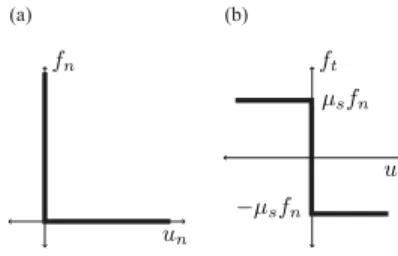
contact force. This relation, called Signorini’s conditions for velocities, is shown as a graph in Fig.1共a兲. Remark that this relation cannot be reduced to a共mono兲valued functional de-pendence between the two variables. In the same way, in the tangential direction, the Coulomb friction law can be
de-scribed by the following complementary relation:
ut⬎ 0 ⇒ ft= −sfn,
ut= 0 ⇒ −sfn艋 ft艋sfn,
ut⬍ 0 ⇒ ft=sfn, 共2兲
where ut is the sliding velocity and ft is the friction force.
Figure 1共b兲 displays Coulomb’s conditions as a graph. Like Signorini’s relation, this is a nonsmooth contact law in the sense that it is a set-valued function.
Both contact laws are implemented within the contact dy-namics method without introducing further regularizing or damping parameters. The formulation of the contact laws at the velocity level implies an implicit time-stepping scheme and the determination of the forces and velocities at each time step through an iterative procedure similar to a Gauss-Seidel scheme 关21,23–27兴.
B. Rolling resistance
In order to introduce interlocking between grains, the idea is to replace the effect of grain shape共nonconvex or angular shapes兲 by a contact law allowing for rolling resistance. The local kinematic variable is the relative angular velocityrat
the contacts between grains. For two disks with angular ve-locities iandj, we have
rij
=i
−j
. 共3兲
Interlocking between the grains i and j corresponds to rij = 0. From a dynamic point of view, this condition requires the transmission of a torque M at the contact point. This is analogous to the nonsliding condition ut= 0 which requires
the activation of the friction force ft共vertical branch of
Cou-lomb’s law in Fig.1兲. In the same way, the rolling resistance
corresponds to a threshold Mcon the contact torque. Hence,
by analogy with Coulomb’s friction law, we introduce the following complementarity relation between rand M:
r⬎ 0 ⇒ M = − Mc,
r= 0 ⇒ − Mc艋 M 艋 Mc,
r⬍ 0 ⇒ M = Mc. 共4兲
To push this analogy further, let us compare the force balance for a block and a disk of radius R placed on an
(b) (a)
FIG. 1. 共a兲 Signorini’s conditions relating the normal force fn
and the relative normal velocity un.共b兲 Coulomb friction law relat-ing the tangential force ftand the relative tangential veolcity ut.
inclined plane; see Fig.2. The stability of the block is due to the friction force ft= mg sin⬍smgcos. Sliding occurs
for =s, for which ft=sfn. The stability of the disk, with
respect to rolling, can only be ensured by a contact torque M balancing exactly the moment of its weight about the contact point M = mgR sin⬍ Mc. Assuming that, as for sliding,
roll-ing occurs for an inclination =r of the plane, we get Mc
=rRmgcosr=rRfn, where r= tanr is the coefficient
of rolling friction. With this choice, the complementarity re-lation defining the rolling friction law between two grains of radii Riand Rjbecomes
r⬎ 0 ⇒ M = −rᐉ fn,
r= 0 ⇒ −rᐉ fn艋 M 艋rᐉ fn,
r⬍ 0 ⇒ M =rᐉ fn, 共5兲
where ᐉ = Ri+ Rj. The graph of this relation is displayed in
Fig.3.
The scaling of the rolling threshold Mc with ᐉ leads to
comparable values of r ands. In the example of the
in-clined plane illustrated in Fig.2,s=rimplies that sliding
of the block and rolling of the disk begin for the same incli-nation angles=r.
Although this model is basically meant to isolate the ef-fect of moment transfer between particles, a relevant ques-tion is whether a rolling resistance proporques-tional to the normal force, as in relation共5兲, can be identified with a real physical
mechanism in a noncohesive material. As weak rolling resis-tance results from micro slidings between the asperities,
large rolling resistance can stem from a similar mechanism at a larger scale, e.g., between particles with dendritic surfaces. Indeed, strongly angular and nonconvex particles can inter-lock and form several contact points, each resisting to sliding through a Coulomb friction. The order of magnitude of Mcis
then proportional to the mean normal force fn between the
two particles, the coefficient of sliding friction at individual contact points, and the typical separation distance between these contact points.
We implemented the above rolling friction law in the framework of the contact dynamics method. Below, we in-vestigate in detail the influence of the two friction parameters on the shear strength and force transmission.
C. Simple shear test
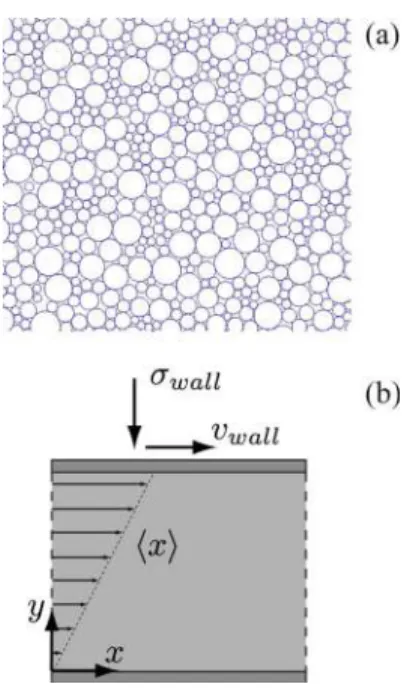
Our numerical samples are composed of 7500 disks with diameters uniformly distributed by volume fractions between 0.6具d典 and 2.4具d典, where 具d典 is the mean diameter. The par-ticles are initially placed in a semiperiodic box 100具d典 wide, using a geometrical procedure 关26,28兴; see Fig. 4共a兲. Next, the packing is sheared by imposing to the upper wall a con-stant horizontal velocity vwall and a constant pressure wall;
see Fig. 4共b兲. To avoid strain localization at the boundaries, sliding and rolling are inhibited for the particles in contact with the walls. The gravity is set to zero.
Since we are interested in the steady state behavior, the samples are sheared and maintained in the steady state up to a large cumulative shear strain ␥= xwall/ywall= 5, where xwall
is the horizontal displacement of the upper wall and ywall is
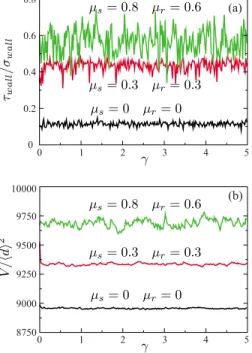
its vertical position. Figures 5共a兲 and 5共b兲 show the shear ratio wall/wall, where wall is the tangential stress at the
moving wall, and the normalized volume of the packing (b)
(a)
FIG. 2. Analogy between a block共a兲 and a disk of radius R 共b兲 placed on an inclined plane. The stability of the block is ensured by the friction force ft; the stability of the disk, with respect to rolling,
is ensured by the contact moment M.
FIG. 3. Complementary relations defining the rolling friction law. M is the torque and ris the relative angular velocity at the
contacts between grains.
FIG. 4. 共Color online兲 共a兲 Snapshot of a portion of the packing before shearing. 共b兲 Schematic representation of the simple shear test; the dashed lines represent periodic boundaries. vwallis the hori-zontal velocity of the wall, wallis the confining pressure, and具x典 is the averaged horizontal displacement of the particles
V /具d典2 as a function of the shear strain␥ for three different
values ofsandr. The packing is at the steady state since wall/walland V /具d典2 fluctuate around a mean value. Figure 6shows the profiles of the averaged horizontal displacement 具x典 of the particles versus their vertical position y for five extreme values ofsandr. These profiles are almost linear,
showing that the shear strain is uniform in the bulk. We may also evaluate the average level of inertia in our simple shear tests by evaluating the inertia parameter I de-fined as 关29–31兴
I=
冑
␥˙具d典 wall/, 共6兲
where␥˙ is the shear rate,具d典 is the average grain size, and is the density. A sheared system is in a quasistatic state if I
Ⰶ 1. In all our tests we have ␥˙ = 1 ⫻ 10−6/⌬t and wall= 1
⫻ 10−4共具d典/⌬兲2. Hence, I⯝10−4, which means that our
sheared samples can reasonably be considered to be in a quasistatic state.
III. SHEAR STRENGTH
The steady-state shear strength of a frictional granular material is characterized by the coefficient of internal friction *, which should be calculated from an estimate of the stress tensor. The latter can be calculated at any stage of defor-mation from the simulation data which give access to the contact network and forces. We first compute the internal moment tensor Mpfor each grain defined by关32,33兴
M␣p =
兺
c苸p
f␣crc, 共7兲
where␣ and represent the components in an orthonormal reference frame, fcis the force exerted on particle p at con-tact c, and rcis the position vector of the same contact. The
summation runs over all the contacts c of particle p. The average stress tensor in the volume V of the granular as-sembly is given by ␣= 1 Vp苸V
兺
M␣ p . 共8兲This expression allows us to calculate the vertical normal stressyyand the tangential stress=xy⬵yxin the steady
state, and thus the coefficient of internal friction which in simple shear is
*=
yy
. 共9兲
The dissipation rate in the steady state is simply given by
W=*␥˙yy.
We performed a large number of shear simulations for a broad set of combinations of the friction coefficients. The sliding friction coefficient s was varied from 0 to 0.8 by
steps of 0.05, and, for each value of s, the rolling friction coefficient r was varied from 0 to 0.6 by steps of 0.05.
Hence, a total number of 221 simulations, each for a total cumulative shear strain of 5, were performed. For each com-bination, the average value of * was taken over the last 60% of the cumulative shear strain in order to get a repre-sentative steady-state value of*.
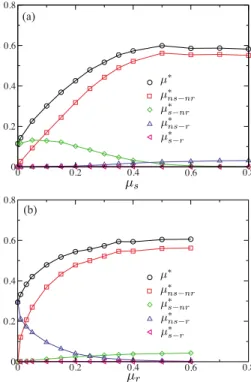
Figure7共a兲shows*as a function ofsfor several fixed
values ofr. We see that, for each value ofr, the coefficient
of internal friction*increases as a function ofsand
satu-rates after a short transient at a saturation value that increases withr. This result generalizes a behavior previously
estab-lished in the case r= 0 关26兴. Symmetrically, as shown in
Fig.7共b兲, for each value ofs,*increases and saturates as
a function ofr. These data also show that the internal fric-tion coefficient in the absence of rolling resistance 共r= 0兲
cannot exceed 0.3. On the other hand, it takes a constant value of 0.15 with rolling resistance in the absence of sliding friction共s= 0兲.
The contour map of*is represented in Fig.8as a func-tion ofsandrfor the whole set of our shear simulations.
2 3 4 1 0 5 2 3 4 1 0 5 0.6 0.8 0 0.2 0.4 10000 9250 8750 9000 9500 9750 (a) (b)
FIG. 5. 共Color online兲 共a兲 Shear ratio wall/wall, and 共b兲 nor-malized volume of the packing V /具d典2, as functions of the shear strain ␥. 0.4 0.6 0.8 0.2 0 1 0.4 0.6 0.8 0.2 0 1
FIG. 6. Profiles of the normalized averaged horizontal displace-ment of the particles具x典/xwall, versus their normalized vertical po-sition in the sample y / ywall, at the end of the shear test, for five extreme combinations共see inset兲 of the two friction coefficients s
This map reveals a rather simple structure with an approxi-mate symmetry with respect to the line s=r. We observe
again the saturation effect both with s andr, so that two
phases can clearly be distinguished on the contour map:共1兲 a
sliding phase in which * depends only on s, and 共2兲 a
rolling phasein which*depends only onr. The transition
zone between these two phases, marked by a gray stripe in Fig.8, is narrow共⯝0.15兲.
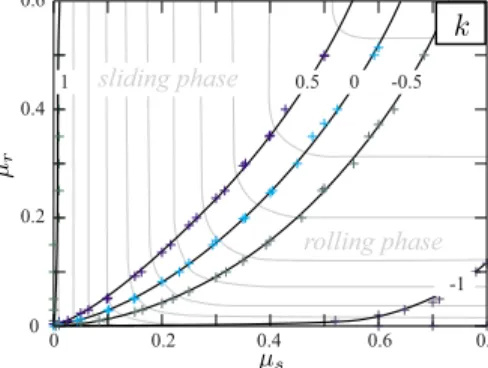
This two-phase behavior suggests that the system orga-nizes itself so as to favor the mode of relative motion at the contacts共sliding or rolling兲 for which the friction parameter is lower. This behavior can be elucidated by considering the populations of contacts depending on their rolling and slid-ing status. There are four categories: 共1兲 sliding-nonrolling 共s-nr兲, 共2兲 nonsliding-rolling 共ns-r兲, 共3兲 sliding-rolling 共s-r兲
and共4兲 nonsliding-nonrolling 共ns-nr兲. The first three popula-tions correspond to the “mobilized” contacts whereas the last population defines the “interlocked” contact network. The contribution of each population to the total shear stress can be calculated from the general expression of the stress tensor 关i.e., Eq. 共8兲兴 by restricting the summation to the contacts
belonging to that population. Hence, partial friction coeffi-cients s-nr* , ns-r * , s-r *, and ns-nr
* can be defined for each population. This is an additive decomposition so that
*=s-nr* + ns-r * + s-r * + ns-nr * . 共10兲
Figure 9shows the evolution of the partial friction coef-ficients with s for r= 0.3, and with r for s= 0.4. The
contribution s-r* of both sliding and rolling contacts is neg-ligibly small. On the contrary, the contribution ns-nr* of in-terlocked contacts prevails except at low sliding or rolling coefficients 共s⬍ 0.1 and r⬍ 0.05兲 where the dominant
contribution comes from sliding or rolling contacts, respec-tively. On the other hand, as s increases, the contribution
s-nr* of sliding-nonrolling contacts declines in favor of
ns-r
* which increases at the same time. Symmetrically, as r
in-creases, the contribution ns-r* of nonsliding-rolling contacts declines in favor ofs-nr* which increases.
In order to characterize the dominant mode of relative motion at the contacts, we consider these two last popula-tions and define the parameter k by
k=s-nr * − ns-r * s-nr* + ns-r * . 共11兲
This parameter varies in the range关−1,1兴 as a function ofs
andr. The dominant mode is sliding if k ⬎ 0 and rolling if
(b) (a) 0 0.2 0.4 0.6 0.8 0 0.2 0.4 0.6 0.8 0 0.2 0.4 0.6 0.8 0 0.2 0.4 0.6 0.8
FIG. 7. 共Color online兲 Internal friction coefficient *as a func-tion of sfor several fixed values of r共a兲, and as a function of s
for several fixed values of r共b兲.
0.4 0.6 0.8 0.2 0 0.4 0.6 0.2 0 0.4 0.2 0.6 sliding phase rolling phase
FIG. 8. 共Color online兲 Contour map of the internal friction co-efficient *as a function of sliding and rolling friction coefficients sand r. The gray stripe represents the transition zone between a phase where *depends only on the coefficient of sliding friction sand a phase where *depends only on the coefficient of rolling
friction r. (b) (a) 0 0.2 0.4 0.6 0.8 0 0.2 0.4 0.6 0.8 0 0.2 0.4 0.6 0.8 0 0.2 0.4 0.6 0.8
FIG. 9. 共Color online兲 Partial friction coefficients as a function of sfor r= 0.3共a兲, and as a function of rfor s= 0.4共b兲.
k⬍ 0. Figure10shows the contour map of k as a function of sandrtogether with the contour lines of*. We see that the contour for k = 0 matches closely the transition between the sliding phase and the rolling phase. In other words, the partial friction coefficientss-nr* and
ns-r
* reflect the effect of the contact friction coefficientssandrwith respect to*.
IV. SOLID FRACTION AND COLUMN-LIKE STRUCTURES
In this section, we study the packing structures in the steady state as a function ofs andr. The compactness of the structure can be represented by the solid fraction de-fined by
= Vp
V , 共12兲
where Vpis the total volume of the particles and V is the total
volume of the packing. Figure11shows the contour map of as a function ofsandr. We see that, as for*, at low
values ofs, the solid fractionsaturates with increasingr.
However, the behavior is different at higher values ofsand r, breaking thus the expected symmetry between the two
phases.
In fact, in contrast to*, the solid fraction as defined by Eq.共12兲 comprises both load-carrying and floating particles.
But the fraction of floating particles is expected to increase with s and r as a result of enhanced arching effect. We
thus consider the solid fraction*of load-carrying particles defined by
*= Vp *
V , 共13兲
where Vp*is the volume of the load-carrying particles. Figure
12shows the contour map of*as a function ofsandr. Interestingly, the global aspect of this map is now symmetric with respect to the two friction parameters. By comparison with Fig.8, we see that the highest levels of shear strength correspond to the least compact structures. The reason is that steady state shearing implies larger free volumes accessible to the particles when the relative degrees of freedom between particles are restrained due to higher rolling or sliding con-tact friction. Remark that the solid fraction * can be as small as 0.3 and even lower共see the contour map in Fig.12兲.
Low values of solid fraction*coincide with the forma-tion of column-like structures, i.e. long chains of particles with only two contacts. Figure 13 shows snapshots of the load-carrying contact network and normal forces in two packings denoted S1 and S2. The coefficients of friction are s= 0.4 and r= 0 in S1, and s= 0.7 andr= 0.5 in S2. We
observe two important differences between the load-carrying structures in these packings. 共1兲 In packing S1 almost all particles belong to the load-carrying network, whereas in S2 most particles are floating and the load-carrying particles form columns.共2兲 In packing S1 the contacts carrying large forces共strong contacts兲 form chainlike structures propped by contacts carrying small forces共weak contacts兲. In contrast, in packing S2, the force chains are not propped everywhere. This aspect is analyzed in more detail in the following sec-tion.
V. STRESS TRANSMISSION A. Probability density functions
In close correlation with shear strength and solid fraction, the stress transmission is strongly influenced by rolling and sliding friction. Figure 14 displays the probability density functions Pnof normal forces fnin the packings S1 and S2.
The data are cumulated from several snapshots in the steady state, corresponding to a total number of 1.3⫻ 106 contact
forces for packing S1 and of 0.4⫻ 106 contact forces for sliding phase rolling phase 0.4 0.6 0.8 0.2 0 0.4 0.6 0.2 0 1 0.5 0 -0.5 -1
FIG. 10. 共Color online兲 Contour map of the parameter k 共see text兲 as a function of the contact friction coefficients sand r.
0.4 0.6 0.8 0.2 0 0.4 0.6 0.2 0 0.84 0.79 0.8 0.82
FIG. 11. 共Color online兲 Contour map of the solid fraction as a function of sand r. 0.4 0.6 0.8 0.2 0 0.4 0.6 0.2 0 0.3 0.6 0.5 0.4 0.7
FIG. 12. 共Color online兲 Contour map of the solid fraction *of the load-carrying particles as a function of sand r.
packing S2. As often observed in granular media关34,35兴, we
find that the function Pn is characterized by an exponential
falloff for the forces above the average force 具fn典 and a
power-law distribution for the forces below具fn典:
Pn共fn兲 ⬀
冦
冉
fn 具fn典冊
−␣n , fn⬍具fn典, en关1−fn/具fn典兴, f n⬎具fn典,冧
共14兲 with ␣n⯝−0.17 and n⯝1.8 in S1, and ␣n⯝0.37 and n⯝0.81 in S2. Hence, the normal force distribution Pn in
packing S2 共with r= 0.5兲 is considerably broader in the
range of strong forces, and the fraction of weak forces di-verges as fn→ 0.
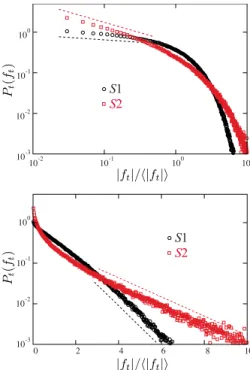
Figure 15 shows the probability density function Pt of
friction forces ft, which is also characterized by an
exponen-tial falloff for the forces above the average force 具兩ft兩典 and a
power-law distribution for the forces below具兩ft兩典:
Pt共ft兲 ⬀
冦
冉
兩ft兩 具兩ft兩典冊
−␣t , 兩ft兩 ⬍ 具兩ft兩典, et关1−兩ft兩/具兩ft兩典兴, 兩f t兩 ⬎ 具兩ft兩典,冧
共15兲 with ␣t⯝0.17 and t⯝1.1 in S1, and ␣t⯝0.52 and t⯝0.57 in S2.
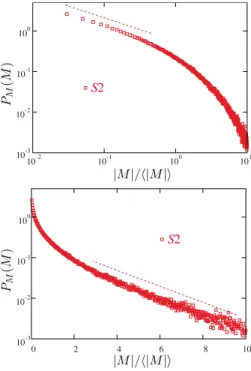
The probability density function PMof contact torques is
defined only in the packing S2 with nonzero rolling resis-tance. As shown in Fig. 16, it can be also be described by
PM共M兲 ⬀
冦
冉
兩M兩 具兩M兩典冊
−␣M , 兩M兩 ⬍ 具兩M兩典, eM关1−兩M兩/具兩M兩典兴, 兩M兩 ⬎ 具兩M兩典,冧
共16兲 with␣M⯝0.66 andM⯝0.49.These distributions show clearly the larger inhomogeneity of stress transmission in a granular packing in the presence of rolling resistance. A systematic investigation of force dis-tributions will be reported elsewhere关36兴. In addition, Figs.
FIG. 13. 共Color online兲 Snapshots of 共a兲 the load-carrying net-work in packing S1, 共b兲 the normal forces in packing S1, 共c兲 the load-carrying network in packing S2, and共d兲 the normal forces in packing S2. In共a兲 and 共c兲 the particles that participate in the load-carrying network are in gray, and the black lines represent the con-tact network. In共b兲 and 共d兲 the black lines represent strong forces 共fn⬎具fn典, where 具fn典 is the mean normal force兲 and red 共gray兲 lines
represent weak forces 共fn⬍具fn典兲. Line thickness is proportional to
the force magnitude.
10-3 10-2 10-1 100 10-3 10-2 10-2 10-1 101 10-1 100 100 10 8 6 4 2 0 (b) (a) S2 S1 S2 S1
FIG. 14. 共Color online兲 Probability density functions Pnof
nor-mal forces fnin the packings S1 and S2 in log-log共a兲 and log-linear
共b兲 scales. The dashed lines are guides to the eyes.
10-3 10-2 10-1 100 10-3 10-2 10-1 100 10-2 10-1 100 101 10 8 6 4 2 0 S2 S1 S2 S1
FIG. 15. 共Color online兲 Probability density functions Ptof
tan-gential forces ftin the packings S1 and S2 in log-log共a兲 and log-linear共b兲 scales. The dashed lines are guides to the eyes.
14–16show that, independently of the friction coefficients, the contacts can be classified in two sets characterized by a different distribution of contact forces. We will analyze this bimodal character of the contact network in the next section.
B. Strong and weak force networks
As mentioned in the previous section, it is a well-known feature of sheared granular media that the contacts belong to two coexisting networks termed strong and weak networks following Radjai et al. 关37兴. Moreover, these two networks
are known to have different topologies and play different mechanical roles in the system. The contacts in the strong network correspond to chainlike structures distinctly ob-served in photoelastic images and called force chains; their function is to sustain the deviatoric load imposed on the system. The weak network is less visible, but its contacts are more important in number and have the essential function of propping the force chains. This property can be evidenced by considering the anisotropy of contact orientations. The strong contacts are oriented mainly along the major principal stress direction whereas the weak contacts are, on average, perpen-dicular. The average normal force具fn典 is generally found to
be the approximate characteristic force differentiating be-tween the two types of contacts. Here, we would like to study the effect of rolling friction on the nature of these two networks.
Let us consider the distribution P共兲 of contact
orienta-tions苸 关0 ,兴. Fig.17displays P in polar coordinates for
strong and weak contacts in packings S1 with s= 0.4 and
r= 0, and S2 with s= 0.7 andr= 0.5. We see that in the
packing S1, where there is no rolling resistance, the strong network is indeed more anisotropic than the weak network
and the privileged directions of the two networks 共longer axis of each diagram兲 are orthogonal. In contrast, in packing
S2, where both rolling and sliding friction coefficients are high, the privileged directions of the two populations are similar and coincide with the major principal stress direction = 3/4. This observation suggests that the function of the
weak contacts in the packing S2 is no longer to prop the force chains laterally, implying that the nature of the weak network is fundamentally different in the two packings. In the following, we analyze this point in terms of the anisotro-pies of the distributions of contact orientations.
The anisotropy of the distributions can be calculated by expanding P on the Fourier basis. Since P is periodic,
we have
P共兲 = 1
关1 + a cos 2共−a兲 + b cos 4共−b兲 + ¯ 兴, 共17兲 where the coefficients a , b , . . . are the anisotropy parameters of increasing order and the anglesa,b, . . . are the phases.
Generally the first-order anisotropy a captures the main trend. It can be calculated from the lowest-order fabric tensor
F defined by F␣= 1 Ncc苸V
兺
n␣ cn  c , 共18兲where␣ and represent the components in an orthonormal reference frame, ncis the normal unit vector at contact c, and
the summation runs over all contacts c in the control volume
V. It is easily shown that
a= 2共F1− F2兲, 共19兲
where F1and F2are the principal values of F. By definition,
the anisotropy a is zero or positive. For the analysis of the anisotropy in strong and weak networks, or in subsets of contacts, where the directions a are not similar, it is more
convenient to introduce the phase factor by multiplying a by cos 2共a−兲, where is the direction of the major
princi-pal stress. Hence, we define the “signed” anisotropy a
⬘
bya
⬘
= 2共F1− F2兲cos 2共a−兲. 共20兲This anisotropy is positive when the two major principal directions are in phase, i.e., when 兩a−兩⬍/4, otherwise the anisotropy is negative. In our simple shear tests, we have = 3/4. 10-3 10-2 10-1 100 10-3 10-2 10-1 100 10-2 10-1 100 101 10 8 6 4 2 0 S2 S2
FIG. 16. 共Color online兲 Probability density function PMof con-tact torques M in the packing S2 in log-log 共a兲 and log-linear 共b兲 scales. The dashed lines are guides to the eyes.
S2 S1 (b) -0.3 -0.3 0 0 0.3 -0.3-0.3 0 0 0.3 (a)
FIG. 17.共Color online兲 Pin polar coordinates for strong共black
line兲 and weak 关red 共gray兲 line兴 contacts in packings S1 with s
= 0.4 and r= 0共a兲, and S2 with s= 0.7 and r= 0.5共b兲. The gray circle represents a reference isotropic distribution.
In order to analyze the anisotropy of force networks, we consider the subsets S共兲 of contacts carrying a normal force level= fn/具fn典苸关−⌬,+ ⌬兴 so that each contact belongs
to only one subset. The weak and strong networks corre-spond to 艛⬍1S共兲 and 艛⬎1S共兲, respectively. The
aniso-tropy a
⬘
共兲 of each set S共兲 can be calculated from the defi-nition of the fabric tensor by restricting the summation to the contacts belonging to this set:F␣共兲 = 1
Nc共兲c苸S共兲
兺
n␣cnc, 共21兲
where Nc
is the cardinal of the set S共兲.
Figure 18 shows a
⬘
共兲 in packings S1 with s= 0.4 and r= 0, and S2 with s= 0.7 andr= 0.5. We see that in thepacking S1, where there is no rolling resistance, the anisotro-pies at weak force levels are negative 共corresponding to a privileged orientation along the minor principal stress direc-tion兲 up to a point0where a
⬘
共兲 changes sign and becomespositive. In contrast, in the packing S2, where there is rolling resistance, the anisotropies at both weak and strong force levels are positive, showing that, on average, the privileged orientation of all subsets of contacts is the same. This shows that all the contacts in the weak network do not play the same role in the system. Rather, the propping role seems to be a property of a subnetwork of contacts inside the weak network carrying forces below a characteristic value 0具fn典.
Interestingly, this “propping network” of contacts is com-pletely absent in the limit of high rolling resistance and roll-ing friction共i.e., in packing S2兲.
To push this analysis further, let us consider the contribu-tion *共兲 of each subset S共兲 of contacts to the friction coefficient*, which is given by
*共兲 =共兲
, 共22兲
where共兲 is the tangential stress calculated from the defi-nition of the stress tensor by restricting the summation to the contacts belonging to S共兲 and is the normal stress when considering all contacts. Figure 19 shows 共兲 in packings
S1 and S2. We see that in the packing S1, where there is no rolling resistance, the contribution of the contacts with force levels⬍0to the strength of the packing is nearly zero, and
the contribution of the contacts with force levels⬎0to*
is positive. This means that the deviatoric load applied to the system is totally sustained by the contacts carrying forces above 0具fn典. In contrast, in the packing S2, where there is
rolling resistance, the contribution of all contacts, regardless of their force level, is positive, which means that, in this packing, the function of the weak network is also to sustain the deviatoric load applied to the system.
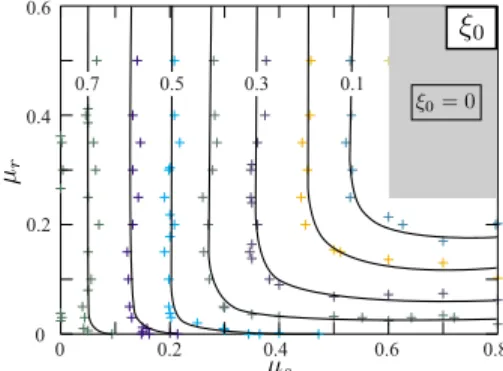
Figure 20 shows the contour map of the characteristic force level 0 as a function of s and r. As s and r
increase,0 decreases and even vanishes for large values of
friction coefficients. This is consistent with the observation that the force chains are gradually replaced by columns of particles which do not need to be propped. However, the total vanishing of the propping network 共i.e., 0= 0兲 takes
place ats= 0.6 andr= 0.25, and thus it cannot occur
with-out rolling friction. This transition reflects a qualitative change in the condition of local force and torque balance in the presence of interlocking.
VI. SUMMARY AND DISCUSSION
In summary, by means of contact dynamics simulations, we investigated a class of granular material involving inter-locking actions between the particles. Interinter-locking was mod-eled as a rolling friction law relating the contact torque to the relative rotation between two particles with a rolling friction coefficientranalogous to the sliding friction coefficients.
0 1 1.5 2 0 0.3 0.6 0.9 S2 S1
FIG. 18.共Color online兲 Signed anisotropy a⬘as a function of the force level in packings S1 with s= 0.4 and r= 0, and S2 with
s= 0.7 and r= 0.5. 0 0 1 4 0.02 0.015 0.01 0.01 0.005 0 0 2 6 8 S2 S1
FIG. 19. 共Color online兲 Contribution to the coefficient of fric-tion *as a function of the force level in packings S1 with s
= 0.4 and r= 0, and S2 with s= 0.7 and r= 0.5.
0.4 0.6 0.8 0.2 0 0.4 0.6 0.2 0 0.1 0.3 0.5 0.7
FIG. 20. 共Color online兲 Contour map of 0共see text兲 as a func-tion of sand r.
A large number of 2D polydisperse numerical samples were sheared for a broad range of friction parameterssetrand
the steady state was analyzed in terms of shear strength, fabric properties, and force transmission.
We found an interesting symmetry between the effects of s and r on the macroscopic response of the packing. In
particular, the coefficient of internal friction*saturates as a function ofswith a saturation value that increases withr,
and, symmetrically, it saturates as a function of r with a saturation value that increases with s. As a result, two
dis-tinct phases can be distinguished in which*is controlled by eithers orr. This suggests that the dominant mode of
relative motion at the contacts 共sliding or rolling兲 is the one which minimizes the coefficient of internal friction. This be-havior was shown to be consistent with the relative contri-butions of sliding and rolling contacts to *.
These findings are in agreement with those reported in 关7,20,38兴, stating that contact rolling plays a major role in the
shear strength of granular media. Nevertheless, our results show quantitatively when contact rolling prevails. Contact rolling is the dominant mode whensis large compared to
r, but contact sliding is the dominant mode whenris large compared tos. The reason is that high values of one of the
two friction coefficients tend to block the corresponding de-gree of freedom enhancing thus the alternative mode of rela-tive motion at the contacts.
We also found that the combined effect of sliding friction and interlocking strongly affects the microstructure of the packing. In particular, high values ofsandrenhance the
arching effect, causing the force carrying backbone to take an increasingly columnar aspect. The formation of these col-umns affects also the mechanical role played by the weak network. A transition occurs for particular values of s and
r to a phase where the fraction of the weak network that
props the force chains 共i.e., the propping network兲 is com-pletely absent 共0= 0兲, and both networks, weak and strong,
contribute to sustain the deviatoric load applied to the sys-tem. In this phase, columns are the dominant force transmit-ting structure, and, as a consequence of an enhanced arching effect, the solid fraction of the load-carrying backbone can be extremely low, e.g., 0.3.
We also presented the probability distributions of contact forces and torques. These distributions were shown to follow a power law in the range of weak forces and fall off expo-nentially for strong forces. Another important point is that the vanishing of the propping network does not imply a de-crease in the fraction of contacts carrying weak forces. Ac-tually, the proportion of weak contacts increases, even if their mechanical role evolves with friction coefficients. This is a consequence of significant changes in the local equilib-rium conditions as the contacts are allowed to exert torques. It is evident that the complex interactions between par-ticles in real granular materials cannot be fully captured by a simple model of circular particles with sliding and rolling friction at their contacts. Nevertheless, we think that some of the trends presented in this paper, such as the occurrence of a dominant mode at the contacts, the formation of new struc-tures of force transmission and the changes in the mechanical role of the weak network, are robust features of granular media involving rolling resistance. We believe that these findings are relevant for a better understanding of the role played by the local thresholds on the rich behavior of sheared granular materials.
An important issue not tackled in this paper concerns the effect of rolling resistance with respect to particle displace-ments and rotations between successive equilibrium states. Clearly, as shown in Fig.5, the particle motions are increas-ingly fluctuating as rolling friction is higher. This shows that the transition is increasingly dynamic due to the breakdown of the supporting structures shown in Fig. 13. These kine-matic aspects involving the formation and breakdown of lo-cal rigid structures, spatial correlations of nonaffine particle velocities, dynamic rearrangements, and dissipation of ki-netic energy are presently under investigation.
ACKNOWLEDGMENTS
We warmly thank E. Azéma for useful and stimulating discussions, and J. Tack for technical support. This work was supported by the project Ecos Nord No. C08U01.
关1兴 D. M. Wood, Soil Behaviour and Critical State Soil Mechanics 共Cambridge University Press, Cambridge, England, 1990兲. 关2兴 J. K. Mitchell and K. Soga, Fundamentals of Soil Behavior,
3rd ed.共Wiley, New York, 2005兲.
关3兴 A. Caquot, Équilibre des Massifs à Frottement Interne—
Stabilité des Terres Pulvérulentes ou Cohérentes
共Gauthier-Villars, Paris, 1934兲.
关4兴 A. W. Bishop, Geotechnique 4, 43 共1954兲.
关5兴 P. W. Rowe, Proc. R. Soc. London, Ser. A 269, 500 共1962兲. 关6兴 A. E. Skinner, Geotechnique 19, 150 共1969兲.
关7兴 M. Oda, J. Konishi, and S. Nemat-Nasser, Mech. Mater. 1, 269共1982兲.
关8兴 F. Radjai, D. E. Wolf, S. Roux, M. Jean, and J. J. Moreau, in
Powders and Grains 97, edited by R. P. Behringer and J. T. Jenkins共Balkema, Rotterdam, 1997兲, pp. 211–214.
关9兴 F. Radjai, D. E. Wolf, M. Jean, and J. J. Moreau, Phys. Rev. Lett. 80, 61共1998兲.
关10兴 K. Iwashita and M. Oda, J. Eng. Mech. 124, 285 共1998兲. 关11兴 Y. C. Zhou, B. D. Wright, R. Y. Yang, B. H. Xu, and A. B. Yu,
Physica A 269, 536共1999兲.
关12兴 J.-Y. Delenne, M. S. El Youssoufi, F. Cherblanc, and J.-C. Bé-net, Int. J. Numer. Analyt. Meth. Geomech. 28, 1577共2004兲. 关13兴 I. Bratberg, F. Radjai, and A. Hansen, Phys. Rev. E 66,
031303共2002兲.
关14兴 D. Kadau, G. Bartels, L. Brendel, and D. E. Wolf, Comput. Phys. Commun. 147, 190共2002兲.
关15兴 M. J. Jiang, H. S. Yu, and D. Harris, Int. J. Numer. Analyt. Meth. Geomech. 30, 723共2006兲.
关16兴 F. A. Gilabert, J.-N. Roux, and A. Castellanos, Phys. Rev. E
关17兴 S. Latham, S. Abe, and P. Mora, in Powders and Grains, Fifth
International Conference on Micromechanics of Granular Media, Stuttgart, edited by H. H. R. García Rojo and S. McNamara 共A. A. Balkema, Rotterdam, 2005兲, Vol. 1, pp. 213–217.
关18兴 F. Calvetti and R. Nova, in Powders and Grains, Fifth
Inter-national Conference on Micromechanics of Granular Media, Stuttgart共Ref. 关17兴兲, Vol. 1, pp. 245–249.
关19兴 F. Calvetti, R. Nova, and S. Utili, in Powders and Grains, Fifth
International Conference on Micromechanics of Granular Media, Stuttgart共Ref. 关17兴兲, Vol. 1, pp. 671–675.
关20兴 F. Alonso-Marroquín, I. Vardoulakis, H. J. Herrmann, D. Weatherley, and P. Mora, Phys. Rev. E 74, 031306共2006兲. 关21兴 J. J. Moreau, Eur. J. Mech. A/Solids 13 共Suppl.兲, 93 共1994兲. 关22兴 M. Jean, Mechanics of Geometrical Interfaces 共Elsevier, New
York, 1995兲, pp. 463–486.
关23兴 M. Jean, Comput. Methods Appl. Mech. Eng. 117, 235 共1999兲. 关24兴 M. Jean, Micromécanique des Matériaux Granulaires
共Her-mes, Paris, 2001兲, pp. 199–324.
关25兴 F. Radjaï, in Physics of Dry Granular Media, edited by H. J. Herrmann, J. P. Hovi, and S. Luding共Kluwer Academic Pub-lishers, Dordrecht, 1998兲, pp. 305–312.
关26兴 A. Taboada, K.-J. Chang, F. Radjai, and F. Bouchette, J. Geo-phys. Res. 110, B09202共2005兲.
关27兴 M. Renouf, F. Dubois, and P. Alart, J. Comput. Appl. Math.
168, 375共2004兲.
关28兴 C. Voivret, F. Radjaï, J.-Y. Delenne, and M. S. El Youssoufi, Phys. Rev. E 76, 021301共2007兲.
关29兴 G. MiDi, Eur. Phys. J. E 14, 341 共2004兲.
关30兴 F. da Cruz, S. Emam, M. Prochnow, J.-N. Roux, and F. Chev-oir, Phys. Rev. E 72, 021309共2005兲.
关31兴 I. Agnolin and J.-N. Roux, Phys. Rev. E 76, 061303 共2007兲. 关32兴 J. J. Moreau, in Friction, Arching, Contact Dynamics 共World
Scientific, Singapore, 1997兲, pp. 233–247.
关33兴 L. Staron, F. Radjaï, and J.-P. Vilotte, Eur. Phys. J. E 18, 311 共2005兲.
关34兴 F. Radjai, M. Jean, J.-J. Moreau, and S. Roux, Phys. Rev. Lett.
77, 274共1996兲.
关35兴 D. M. Mueth, H. M. Jaeger, and S. R. Nagel, Phys. Rev. E 57, 3164共1998兲.
关36兴 N. Estrada, A. Taboada, and F. Radjaï 共unpublished兲. 关37兴 F. Radjaï, D. E. Wolf, M. Jean, and J. J. Moreau, Phys. Rev.
Lett. 80, 61共1998兲.