HAL Id: hal-01123895
https://hal.inria.fr/hal-01123895
Submitted on 5 Mar 2015HAL is a multi-disciplinary open access archive for the deposit and dissemination of sci-entific research documents, whether they are pub-lished or not. The documents may come from
L’archive ouverte pluridisciplinaire HAL, est destinée au dépôt et à la diffusion de documents scientifiques de niveau recherche, publiés ou non, émanant des établissements d’enseignement et de
Unsupervised discovery of human activities from
long-time videos
Salma Elloumi, Serhan Cosar, Guido Pusiol, Francois Bremond, Monique
Thonnat
To cite this version:
Salma Elloumi, Serhan Cosar, Guido Pusiol, Francois Bremond, Monique Thonnat. Unsupervised discovery of human activities from long-time videos. IET Computer Vision, IET, 2015, pp.1. �hal-01123895�
Unsupervised discovery of human activities
from long-time videos
Salma Elloumi , Serhan Cosar , Guido Pusiol , Francois
Bremond , and Monique Thonnat
STARS Team, INRIA Sophia Antipolis - Mediterranee,
2004 Route des Lucioles, BP 93, Sophia Antipolis, France
∗Abstract
In this paper, we propose a complete framework based on a
Hierar-chical Activity Models (HAMs) to understand and recognise Activities
of Daily Living (ADL) in unstructured scenes. At each particular time
of a long-time video, the framework extracts a set of space-time
tra-jectory features describing the global position of an observed person
and the motion of his/her body parts. Human motion information
is gathered in a new feature that we call Perceptual Feature Chunks
(PFC). The set of PFC is used to learn, in an unsupervised way,
par-ticular regions of the scene (topology) where the important activities
occur. Using topologies and PFCs, we break the video into a set of
small events (Primitive Events) that have a semantic meaning. The
sequences of Primitive Events and topologies are used to construct
hierarchical models for activities. The proposed approach has been
experimented in the medical field application to monitor patients
suf-fering from Alzheimer and dementia. We have compared our approach
with our previous study and a rule-based approach. Experimental
re-sults show that the framework achieves better performance than
ex-isting works and has a potential to be used as a monitoring tool in
medical field applications.
1
Introduction
1
Nowadays, there are many applications (such as surveillance, human-computer 2
interaction, etc.) that require an efficient and accurate analysis of human ac-3
tivities using video input. For example, in the medical field, the behaviour 4
of patients (e.g. suffering from dementia or Alzheimer disease) needs to be 5
studied on a long-period of time (days and weeks) in order to help medical 6
staff (doctors, carers and nurses) to understand the difficulties of patients 7
and propose solutions that can ameliorate their daily living conditions [3]. 8
9
Modelling and recognising activities is a rising field in computer vision and 10
machine learning. Recent approaches [10, 26] address the problem of detect-11
ing complex daily activities using egocentric wearable cameras which enable 12
to have a close view and see the objects in their natural positions. However, 13
a wearable camera can be very intrusive for the user, especially for people 14
suffering from dementia. Visual information can also be obtained with fixed 15
cameras. The majority of work in activity recognition using fixed cameras 16
addresses short-term actions (i.e. few seconds) in acted footages of posture-17
defined classes such as “punching” [29, 13]. In order to recognise human 18
activities, scenes need to be analysed from a sequence of frames (low-level 19
task of computer vision) and interpreted (high-level task). The inability of 20
connecting these two levels (high-level and low-level tasks) is called semantic 21
gap problem [31] and its reduction is still a challenging task. 22
In this paper, we propose a new approach to reduce this gap by constructing, 24
in an unsupervised manner, an intermediate layer between low-level informa-25
tion (tracked objects from video) and high-level interpretation of activity (e.g 26
cooking, eating, sitting). Our method is a novel approach allowing the detec-27
tion of complex activities with long-duration in an unstructured scene. We 28
have developed a complete vision-based framework that enables to model, 29
discover and recognise activities online while monitoring a patient. Two 30
main contributions of this work are as follows: 31
1. An intermediate representation of features (the Primitive Events) com-32
posed of basic activities which structures the person motion with re-33
spect to a spatial topology. 34
2. A hierarchical activity model, that can categorize complex activities 35
using increasing granularity levels of the spatio-temporal structure of 36
basic activities. 37
In our previous study [28], by using the same tracking and topology learning 38
procedures, we have proposed an unsupervised method that models activi-39
ties only based on frequency histograms of two features: i) type of primitive 40
events and ii) the direction of local dynamics. One drawback of this method 41
is that the models are characterized without considering the hierarchical links 42
between primitive events. In order to cope with this drawback, in this paper, 43
we have proposed a new activity model, called hierarchical activity models 44
(HAMs) that take into account the hierarchical structure of primitive events. 45
In addition, we have extended the evaluation by using a dataset that includes 46
non-guided activities of daily living (ADL) and demonstrated that,by using 47
HAM, we achieve better performance than existing works. 48
49
We start in Section 2 by presenting the related work and previous approaches 50
in the field of activity recognition. An overview of the proposed activity dis-51
covery framework is presented in Section 3 . In Section 4, we describe the 52
low-level video processing and the primitive events. We introduce the process 53
of building the hierarchical activity model in Section 5. Experimental results 54
are discussed in Section 6 and the conclusion is presented in Section 7. 55
2
Related work
56
Activity analysis and recognition using video is a fast-growing field based 57
on different methods and techniques. The goal of activity recognition is 58
analysing human activities from an unknown video based on the movements 59
of the person. In general, videos are captured either by a fixed camera 60
[13, 12, 35] or by a wearable camera [25, 32, 11, 10, 26]. A complete overview 61
of the previous methods on human activity recognition is proposed in [2] 62
in which the authors emphasize the importance of high-level activity under-63
standing for several important applications, namely those related to ADL. 64
65
A major group of previous work in activity recognition includes knowledge 66
and logic-based approaches [23, 16]. For example, authors in [35] proposed 67
a monitoring system for analysis and recognition of human activities. It in-68
cludes detecting, tracking people and recognising some pre-defined activities 69
using posture information. Three sources of knowledge were exploited: the 70
model of activities, the 3D model of the observed scene, and the 3D model 71
of the mobile object present in the observed scene. In [7], a knowledge-based 72
method is proposed for older people monitoring. Events are modelled as a 73
function of human body context (e.g., sitting, standing, walking), that is 74
obtained from images, and the environment context, which is obtained from 75
accelerometers attached to objects of daily living (e.g., TV remote control or 76
doors use). A rule-based reasoning engine is used for processing, analysing 77
both context types and detect events that fit in rules. While logic-based 78
approach is a natural way of incorporating domain knowledge, for every 79
deployment it requires an extensive enumeration by a domain expert. In 80
addition, there are some methods that utilise Markov logic networks (MLN) 81
to model events using first-order logic in a Markov network [18, 8]. In [18], 82
they represent each target activity as weighted and undirected trees, starting 83
from primitive actions at the bottom to activities at the top. In [8], an MLN 84
is constructed to recognise ADL in a smarthome using visual and non-85
wearable sensors. To overcome the noisy and unreliable observations coming 86
from the sensors, they build logical models can be checked by human and 87
linked to domain knowledge. 88
89
Recently, in order to understand long-term activities a particular attention 90
has been given to trajectory-based approaches that utilize the object tra-91
jectory information over time. In general, these approaches can be classified 92
into supervised and unsupervised methods. Using a labelled training dataset, 93
supervised methods [15, 20] can build very precise activity models. However, 94
they require large manually labelled training datasets. Also, Hidden Markov 95
[9] introduces the Switching Hidden Semi-Markov Model (S-HSMM), a two-97
layered extension of the hidden semi-Markov model (HSMM) for modelling 98
low-level and high-level temporal structures of activities. They show that the 99
proposed S-HSMM performs better than the HSMMs and the HMMs in the 100
recognition of frequent and infrequent activities. A recent trajectory-based 101
approach for human activity recognition [14] combines hierarchical Dirichlet 102
process and HMM to address some limitations of HMM, especially in pre-103
dicting the number of human motion states in videos. But it requires a lot 104
of computation to obtain the number of motion states. The HMM-based 105
approaches tries to recognise activities by modelling the time-series func-106
tion of events and learning the parameters of the function using supervised 107
learning techniques. However, recognising complex events, such as “prepar-108
ing meal”, using time sequence is very difficult since the sequential pattern 109
is person-dependent. The unsupervised methods include works such as [17] 110
in which authors learn motion patterns in traffic surveillance videos by us-111
ing a two-layered trajectory clustering in space and time via fuzzy k-means 112
algorithm. This idea has been extended in [24] and a three-layered cluster-113
ing is performed on trajectories in order to learn the variations in spatial 114
routes, time duration and speed. Then, the spatio-temporal dynamics of 115
each cluster is encoded by training HMMs using the most representative ex-116
amples of clusters. Other methods [4, 6] use dynamic programming based 117
approaches to classify activities. These methods are only effective when 118
time ordering constraints hold. The approach in [27] uses HMM to repre-119
sent trajectory paths by clustering and captures spatio-temporal patterns in 120
trajectory paths. Clustering is based on finding the number of clusters by 121
checking how well eigenvectors of the trajectory correlation matrix span the 122
subspace. This approach allows high-level analysis of activities for detecting 123
abnormalities in traffic videos. However, since ADL are more complex than 124
traffic dynamics, using only trajectories are not sufficient to capture spatio-125
temporal modalities of ADL and make distinction between activities (e.g. 126
there will be no difference between “standing next to table“ and ”eating at 127
the table“). 128
129
In the literature, there are some methods that use hierarchical models for 130
activity recognition [19, 1, 34]. The described system in [34], extracts fea-131
tures from wearable sensor data and use a two-layered Bayesian network to 132
model the relation between sub-activities and activities. The sub-activities 133
manually specified. A method that uses passive sensors in smart home en-135
vironment and a two-layered HMM to model relation between sub-activities 136
and activities is proposed in [19]. Similarly, the system learns sub-activities 137
from data by clustering. For high-level activities, a HMM is trained using 138
manually labelled data. In [1], using the trajectories extracted from a fixed 139
camera, a human behavioural analysis system is proposed. Using time delay 140
neural networks, first, trajectories are classified into four groups: walking, 141
running,loitering and stopping. Then, a rule-based fuzzy system is used to 142
infer macro and group behaviours. The disadvantages of this system is that 143
training is required for neural networks and the fuzzy system requires specific 144
rules to recognise activities, which is not an easy task for complex activities. 145
On the contrary, in our method, without the need of manually annotated 146
ground truth, we automatically learn the hierarchical relations between ac-147
tivities and sub-activities in an unsupervised way. 148
149
The next section gives an overview of the proposed approach in this paper. 150
3
Overview of the proposed Activity
Discov-151
ery framework
152
The complete framework that we proposed in this paper can recognise long-153
term activities (hours) in an unsupervised manner and can be used in un-154
structured scenes. In order to build a hierarchical activity model that char-155
acterizes a complex activity, it uses contextual information to create auto-156
matically an intermediate structure of a basic activity. This is performed 157
by following steps: (i) long-term videos are processed in order to obtain 158
important information (features) about an observed person (i.e. global po-159
sitions and the motion of his/her body parts), (ii) features are used to learn 160
the multi-resolution levels of the scene regions (topology), (iii) features and 161
scene regions are combined together to build primitive events which repre-162
sent a primitive state transitions within regions, (iv) based on the primitive 163
events, activities are discovered and the model of an activity is built, (v) the 164
recognition is performed by comparing similarity between models of activity. 165
4
Low-level video processing and primitive
166
events
167
4.1
Low-level video processing
168
Our low-level processing is based on two phases: extracting Perceptual Fea-169
ture Chunks and learning Topologies. 170
4.1.1 Perceptual Feature Chunks
171
We define the Perceptual Feature Chunks (PFCs) as a set of particular infor-172
mation (i.e. global and local dynamics) associated to human motion in the 173
video. This information is obtained after decomposing the video into short 174
sequences of images (i.e. video chunks) based on the significant changes of 175
human motion (e.g. speed). 176
177
The position of a person, is estimated using a set of tracklets which is com-178
puted for each video chunk by tracking particular corner points. First, 500 179
corner points [30] are randomly initialized and tracked over time using KLT 180
[5]. Second, we compute 4 clusters (k-means) of the points with respect to 181
their speed and position, representing static, slow, medium and fast motion. 182
Finally, we compute the global position ptof the person at time t, by
averag-183
ing the centroids of the 3 point clusters (i.e. slow, medium and fast motion). 184
185
Due to noise in images, ptcan be unreliable. Therefore, we obtain a smoothed
186
global position ˜pf by applying a Kalman filter K1 to pt in combination with
187
the last ns smoothed positions:
188 ˜ pt= 1 ns+ 1 (pt+ ns ∑ i=0 K1(˜pt−i)) (1)
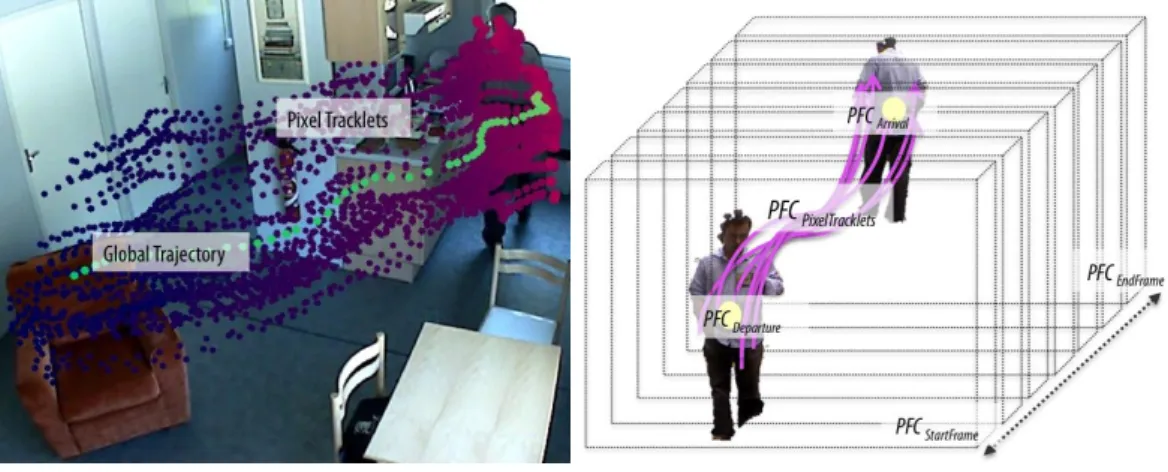
The sequence of{˜pt} represents the global trajectory which is represented in
189
Figure 1-(a) by green points. 190
191
We compute the speed of the person st at time t as the difference of the
192
position of the person at time t and t− 1. Similarly, we compute a smoothed 193
speed, ˜st, by applying a Kalman filter K2 to st, in combination with the last
194 ns smoothed speeds: 195 ˜ st= 1 ns+ 1 (st+ ns ∑ i=0 K2(˜st−i)) (2)
Finally, the video is decomposed into video chunks by comparing ˜st with a
196
threshold. 197
Consequently, each video chunk is associated with a PFC that includes fol-199
lowing attributes : DepartureP F C, ArrivalP F C which are two Gaussian
dis-200
tributions characterizing the position of the person at the beginning and the 201
end of the video chunk. The mean and standard deviation (µ, σ) of the po-202
sition distributions are computed using the first (or last) ng points of the
203
global trajectory. StartF rameP F C, EndF rameP F C represent the first and
204
last frame number of the video chunk, respectively. P ixelT rackletsP F C are
205
the pixel-based tracklets used to calculate the global trajectory of the person. 206
An example of P ixelT rackletsP F C (pink to purple) of a person moving from
207
the armchair to the kitchen is represented in Figure 1-(a). An illustration of 208
the PFC attributes are presented in Figure 1-(b). The feature chunks enable 209
to collect the necessary information for activity understanding and to avoid 210
expensive computational time, especially for long-term activities. The repre-211
sentation contains minimal but important information about the activity in 212
the scene. For instance, we can store the trajectory information of a 4-hour 213
video in less than 14Kb of memory. 214
4.1.2 The Topology
215
When a tracked person performs activities, he/she interacts with many ob-216
jects that can be represented by fixed regions (e.g. the person interacts with 217
the kitchen to prepare meal). We name each set of scene regions a topology 218
(or contextual information) and learn each topology by clustering trajectory 219
points ({˜pt}).
220 221
To learn a topology, we use the PFCs associated to one or several peo-222
ple performing activities in the same scene at various time. From this set 223
of sequences, we extract a set of points, that we call P ointsSeq, using the
224
DepartureP F C and ArrivalP F C of all videos.
225
P ointsSeq ={DepartureP F C(µ)} ∪ {ArrivalP F C(µ)} (3)
We perform k-means clustering [22] over P ointsSeq. The number of clusters
226
represents the level of granularity of the topology, where lower numbers im-227
ply smaller number of regions that are wider. Each cluster defines a Scene 228
Region (SR). We denote a topology at level l associated with k clusters as
229 Tl= { SRl 0, ..., SRlk−1 } . 230
We represent a scene model as a vector of topologies of different resolution 232
levels: {Tl}. We build this scene model by calculating 3 levels of
topolo-233
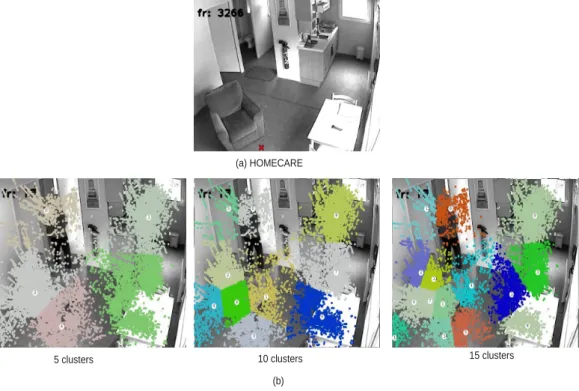
gies that correspond to 5, 10 and 15 clusters. Figure 2 describes the scene 234
model obtained by clustering extracted points in the HOMECARE dataset 235
(described in Section 6), corresponding to high, medium and low-level activ-236
ities. 237
4.2
Primitive Events
238
We propose an intermediate layer called P rimitive Events that enable to 239
link gradually the extracted features from images (low-level information) to 240
the semantic interpretation of the scene (high-level information). 241
242
P rimitive Events are the events characterizing Perceptual Feature Chunks
243
(section 4.1.1) over a single topology (section 4.1.2). For each person, a se-244
quence of P rimitive Events is built using the sequence of PFCs and a topol-245
ogy Tl. In practice, we build 3 sequences of P rimitive Events (for l = 1, 2
246
and 3) for a single video. 247
248
P rimitive Events has 2 attributes, called T ransitionP E and LocalDynamicsP E,
that contain extracted features and their semantic interpretation. 250
4.2.1 The T ransitionP E
251
It describes the movement of a person over the scene by extracting the transi-252
tion information performed between learned scene regions SRilat one level, l. 253
254
The T ransitionP E is represented as a directed region pair:
255
T ransitionP E = (StartRegion→ EndRegion) (4)
where StartRegion and EndRegion are the labels of the nearest SRl
i (ithscene
256
region from Tl) to the DepartureP F C(µ) and ArrivalP F C(µ) positions.
257
4.2.2 The LocalDynamicsP E
258
The T ransitionP E can only describe the global motion of the person while
259
he/she performs an activity over the scene (moving from one region to an-260
other one or staying in a region). To be able to model finer activities (low-261
level activities), we compute the LocalDynamicsP E attribute that contains
262
finer information (point tracklets) on the movement of the human body parts 263
(hands, arms, torso, etc). 264
The LocalDynamicsP E are obtained by clustering the P ixelT rackletsP F C
266
(section 4.1.1). For clustering, we use the mean-shift algorithm [33]. In the 267
literature, the methods for tuning the bandwidth of the mean-shift algorithm 268
are not appropriate to compute a finer description of the local motion. Thus, 269
we adapt the mean-shift bandwidth automatically as a function of the global 270
position of the person: 271
h =||DepartureP F C(µ)− ArrivalP F C(µ)|| (5)
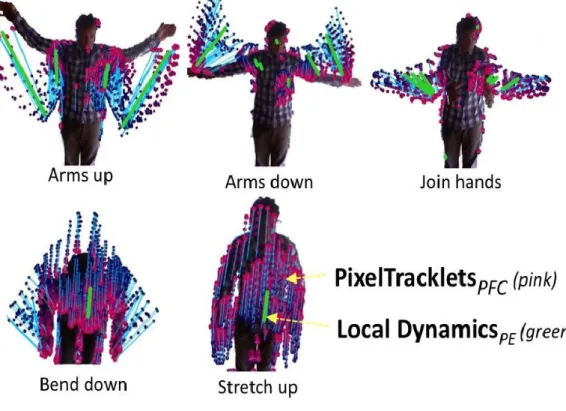
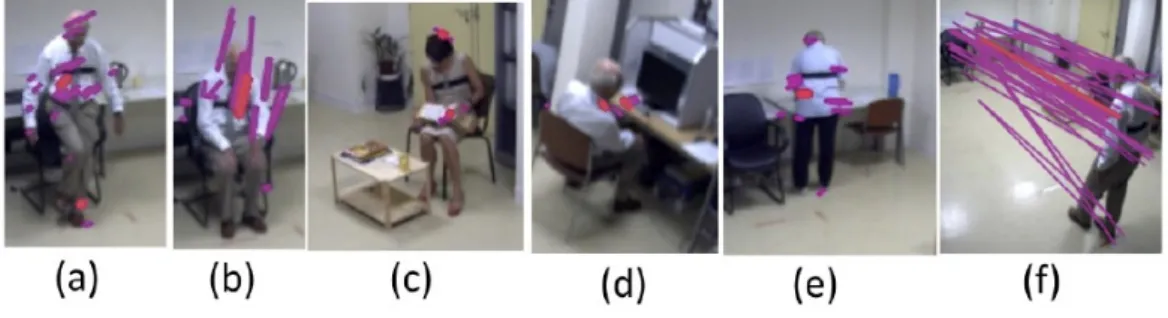
where h is the bandwidth window. Figure 3 illustrates five examples of the 272
computed LocalDynamics (green) from the clustering of the P ixelT rackletsP F C
273
(pink) associated to the following movements: arms up, arms down, join 274
hands, bend down and stretch up. It can be seen in the figure how local dy-275
namics (green tracklets) can capture five activities while the person remains 276
at the same location. 277
5
Building the Hierarchical Activity Model
278
5.1
The process of Activity Discovery
279
The sequences of P rimitive Events are very informative about the activity 280
occurring in the video. However, a P rimitive Event can only describe a 281
snapshot of the person motion. In order to provide more meaning, a better 282
representation of the discovered activity is needed. 283
284
If a person stays in a region for a certain amount of time, we need to fuse the 285
sequences of P rimitive Events to obtain one global activity corresponding 286
to all the time he/she stayed in the region. Another kind of activity occurs 287
when the person moves from one region to another. Therefore, we consider 288
two patterns, Change and Stay, to describe the two types of activity: 289
• The Stay pattern characterizes an activity occurring within a single
290
topology region like ”at.region.P”, and it is defined as a maximal sub-291
sequence of P rimitive Events with the same T ransitionP E:
292
StayP−P = (P → P )+ (6)
• The Change pattern describes the transition of the person between
re-293
gions like ”changing.from.P.to.Q” which is composed of a single P rimitive Event: 294
ChangeP−Q= (P → Q), P ̸= Q (7)
We define a discovered activity (DA) at a level l as an extracted StayP−P or
295
ChangeP−Q pattern:
The process of activity discovery is performed over the three granularity lev-297
els (l = 1, 2, 3) by using the three sequences of P rimitive Events. Therefore, 298
based on the hierarchy of the scene regions, the discovered activities are also 299
classified to coarse, medium and fine and each of them is a sub-activity of an 300
activity at a coarser resolution. 301
302
In the following sections, we replace P − Q and P − P by the index s that 303
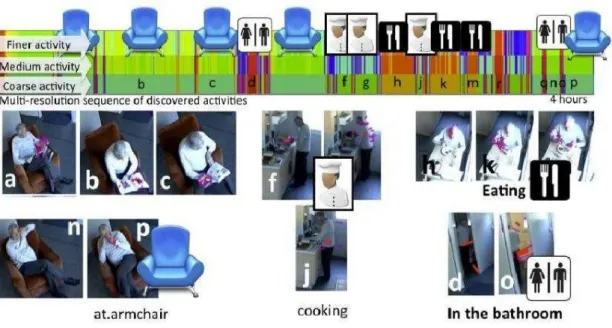
represents the semantic of an activity. Each activity are mapped to a colour 304
on the graphical interface to categorize the activities in the video. Figure 4 305
shows the coloured segments representing the discovered activities at three 306
levels of resolution. Same colours correspond to the same activity at each 307
resolution level. 308
5.2
The Hierarchical Activity Model
309
5.2.1 Definition of the model
310
We represent the model of an activity as a tree of nodes that is obtained 311
by merging the set of {DAl=1,2,3
s } (s is the semantics of the activity) and
312
has a hierarchical structure based on the three levels of granularity (i.e. 313
{Nl=1,{Nl=2
i }1≤i≤n,{Njl=3}1≤j≤m}). The tree of nodes represents how
ferent activities and sub-activities are connected to each other thanks to a 315
set of attributes and sub− attributes obtained from the properties such as 316
type, duration, etc. In other words, a node N is characterized by attributes 317
and sub− attributes: 318
• The attributes is a set of parameters over the DAs at the current level
319
l that characterizes the node Nl.
320
• The sub−attributes constitutes the set of parameters that characterizes
321
the attributes of the sub-nodes Nil+1, where i is the index of the child 322
node of Nl. 323
5.2.2 Learning phase of the model
324
For a selected instances of the same discovered activities DAls(e.g. s= “cook-325
ing”), we learn the model of activity by constructing a tree of nodes where 326
each node of level l is built from the set of discovered activities that are at the 327
same resolution level l, {DAls1, DAls2, ..., DAlsn} where s1, s2, ..., sn are parts
328
of s (i.e. sub-activities of cooking). An example of the constructing pro-329
cess of a tree of nodes from three sequences of discovered activities classified 330
from the coarser to the finer one is illustrated in Figure 5-(a). We construct 331
subsections, we describe the parameters of attributes and sub− attributes. 333
The attribute of a node For a node Nl, we define 3 attributes to describe
334
temporal and spatial properties of a node: 335
• T ype: it is adopted from the DAs composing a node. For a node N,
336
typeN = typeDAs
337
• Instances: the amount of training instance of activities composing a
338
node. 339
• Duration: a Gaussian distribution N(µd, σ2d) describing the temporal
340
duration of the training instances. 341
• Histogram of Local Dynamics H(θ) : is a histogram that
charac-342
terizes the length and the angle of local motion. As it is presented in 343
Figure 5-(b), the length is the magnitude of the local motion vector 344
and the angle is orientation of the vector with respect to x-axis, which 345
is discretised into 8 bins. 346
The sub-attribute of a node The sub-attributes enable us to get infor-347
mation from the child nodes. To compute the sub-attributes of a node, we use 348
the attributes of its child nodes. For a node Nl, we define two sub-attributes
named mixturesub−activity and timelapsesub−activity which aim at describing
350
two properties of the child nodes Nil+1 of Nl: 351
1. mixturesub−activity: Describes the amount of time a child node with the
352
same T ype appears. It is represented as a mixture of Gaussians (MOG) 353
of (θmixture
type ) with the following parameters:
354
• K, is the total number of components (Gaussians) and equal to
355
the number of unique T ypes 356
• O, is the total number of discovered activities at level l (DAl).
357
• wq=1...K , is the prior probability of the component q. It is
equiv-358
alent to the weight of each Gaussian in the MOG. It is computed 359
based on the number of appearances of the nodes with the same 360 T ype: 361 wq= ∑O p=1δ(T ypeNpl+1, T ype) O (9)
Then, θmixturetype = ∑Kq=1wq ∗ N (µq, σq) where µq is calculated by the
362
training instances of all child nodes with the same T ype: 363
µq=
∑O
p=1InstancesNpl+1 ∗ δ(T ypeNpl+1, T ype)
∑O
p=1δ(T ypeNpl+1, T ype)
(10) 2. timelapsesub−activity: Represents the temporal distribution of child nodes.
sub-activities. timelapsesub−activity is also represented by a MOG of
366
(θtypetimelapse). The parameters of timelapsesub−activity are similar to
pre-367
vious sub-attribute mixturesub−activity.
368
5.2.3 Recognition phase of the model
369
For a new unseen video dataset, we aim at recognising activities in an un-370
supervised way. The task is achieved by measuring the similarity between 371
reference activity models that are learned for each type of discovered activity 372
using unlabelled training videos and a test activity model that is obtained 373
from the discovered activities of the new video. 374
375
First, a new sequence of Perceptual Feature Chunks are computed for the 376
new video. Second, using three levels of topology learned from training 377
videos, we create new P rimitive Events. Thereby, T ransitionP E of new
378
P rimitive Events are matched with the T ransitionP E of P rimitive Events
379
used in training. Third, the activity discovery process is performed with 380
the new P rimitive Events and a new sequence of discovered activities are 381
computed. Fourth, for each type of discovered activity of the new video, an 382
activity model is built as explained in Section 5.2.2. Finally, we compute a 383
score between the new model and learned models and classify the activity by 384
assigning the label of the best match. 385
386
To compute a similarity score between two activity models, we define a 387
metric in a recursive manner. At each level of the model, we calculate a 388
similarity score by computing the Euclidean distance between attributes and 389
sub-attributes of the nodes of two models at that level and append the simi-390
larity score obtained from the finer level. Since the range of attributes vary, 391
we have normalised the distances. This recursive procedure give us the oppor-392
tunity to have a similarity score at the root node that measure the similarity 393
of the models at all levels. 394
6
Experimental results
395
We have tested the proposed framework on three datasets. Each video in the 396
dataset contains one person and is recorded using a monocular video camera 397
with 640×480 pixels of resolution. The size of the person is about 50×150 398
pixels. The three datasets are as follows: 399
a) HOMECARE dataset: It consists of a set of 7 videos associated to seven 401
people performing everyday activities in an apartment (activities are listed 402
in Table 1-(a)). The apartment, which has a size of 42m2, is an
experimen-403
tal laboratory set up under the national project Gerhome. Each video is 404
of 4-hour length. An overview of the scene and a sample of activities are 405
presented in Figure 2-(a) and Figure 6, respectively. 406
407
b) HOSPITAL dataset: It includes a set of 4 videos associated to 4 pa-408
tients and recorded in a hospital room, which has a size of 32m2, while the
409
patients are visiting their doctors. The patients perform some guided activi-410
ties from a medical protocol. Figure 8-(e) shows the overview of the hospital 411
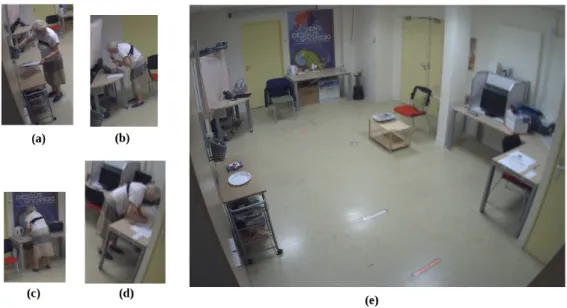
room and Figure 7 describes the set of activities that we aim to recognise. 412
Each video lasts 1 hour. 413
414
c) CHU dataset: It consists of a set of 30 videos associated to 30 patients 415
in the same room of HOSPITAL dataset. This dataset is more challenging 416
than HOSPITAL dataset, since the person performed a non-guided activities 417
of daily livings. The activities of interest are given in Figure 8-(a-d). 418
The classification results for HOMECARE and HOSPITAL datasets are 420
based on leave-one-out cross validation. The evaluation is performed by 421
learning the scene (Section 4.1.2) and activity (Section 5.2.2) models from the 422
training videos and by recognising activities in a test video. In the HOME-423
CARE dataset, the scene and activity models are learned after processing 424
6 videos. The remaining video from the HOMECARE dataset is used for 425
recognition procedure. First, activities are discovered in the remaining video 426
using the set of extracted P rimitive Events associated to the person and 427
the scene model learned from 6 videos. Then, for each discovered activity, 428
an activity model is created and compared with the activity model learned 429
from training videos (Section 5.2.3). Similarly, in the HOSPITAL dataset the 430
scene and activity models are learned using 3 videos and one video is selected 431
to recognise activities. For the CHU dataset, we have randomly selected 10 432
videos for learning the scene and activity models. The remaining videos are 433
used to recognise activities. 434
To evaluate the framework, we have used True Positive (T P ), False Posi-435
tive (F P ), False Negative (F N ) and calculated Sensitivity and P recision 436
as follows: 437
438
P recision = T P
T P + F P (12)
439
An example of learned scene model for the HOMECARE dataset is repre-440
sented in Figure 2. The performance of our framework for HOMECARE, 441
HOSPITAL and CHU datasets are displayed in Table 1-(a), Table 1-(b) and 442
Table 1-(c), respectively. The recognition results of the proposed framework 443
are obtained by comparing with manually annotated ground truths. It can 444
be seen from Table 1 that the proposed method proved to be very reliable 445
for activities between two areas (e.g.“armchair” to “table” in Table 1-(a), 446
”exercise 1” in Table 1-(b) and “office desk” to “drugs desk” in Table 1-(c)). 447
The proposed method is also good at recognising activities occurring in one 448
area (e.g. “reading in the armchair” in Table 1-(a), “preparing coffee” in 449
Table 1-(b) and “preparing drugs” in Table 1-(c)). Thanks to the proposed 450
hierarchical model of activities (section 5.2), we are able to recognise differ-451
ent activities performed within a particular area. For example, the Table 452
1-(a) shows that the system has detected two different activities (standing 453
and reading) when the person is in the armchair area (2nd area for k = 5 in
454
Figure 2-(b)). The discovery and distinction between two different activities 455
occurring in the same area are possible thanks to the use of the local dy-456
namics (section 4.2.2). This can also be seen in Table 1-(b) where the two 457
different exercises (Up/down and Balance) occurring in the same area are 458
not confused. 459
460
The reason of failure in detecting an activity (i.e. False Negative) is the 461
failure in motion detection. The process of trajectory extraction described in 462
Section 4.1 sometimes fails to track people. Because of the inadequate tra-463
jectory information, we have many FNs in CHU dataset. For HOMECARE 464
and HOSPITAL dataset, the false detection of an activity (i.e False Positive) 465
usually happens when the person stops an activity without changing his/her 466
place (e.g. the person stays still for a while at the end of eating activity). 467
Recognizing non-guided ADL is more challenging. In CHU dataset, we have 468
high FP rates because some of the learned zones are very close to each other. 469
For instance, for the actions of ”preparing tea“ and “talking on the phone”, 470
we obtain a high rate of FP, because the zones where the actions occur in 471
are very close to each other. Therefore, these actions are misclassified. 472
473
a high rate of True Positive and a low rate of False Negative. In total, ma-475
jority of the performed activities are recognised by the framework. 476
477
The concept of primitive events together with hierarchical activity models 478
also enables us to handle the problem of occlusion. In the case of occlusion, 479
as long as some motion is detected on the visible body parts we could be able 480
to create primitive events and, then, activity models. In severe cases, our 481
framework may miss some instances of primitive events. In fact, occlusion 482
is one of the reasons that causes FNs in Table 1. However, since we statis-483
tically learn activity models, it is still possible to build the model from the 484
discovered activities (not occluded) and perform recognition. 485
486
We have also analysed the effect of the number of clusters in topology learn-487
ing phase (k parameter in Section 4.1.2). We have tested the performance 488
of the proposed method by selecting different number of clusters. Table 2 489
shows the average sensitivity and precision values obtained by selecting the 490
number of clusters as 5,10,15; 7,10,15 and 7,11,16 in CHU dataset. It can be 491
seen that the number of clusters does not significantly affect the recognition 492
performance of the framework. 493
494
In Table 3, we have compared the proposed framework with our previous 495
work described in [28] and a rule-based method proposed in [35] where the 496
activities are manually modelled by setting rules and constraints. In [35], 497
they cannot differentiate finer activities inside an area (e,g, “sitting at the 498
table” and “eating“) and recognition performance for some activities are not 499
presented. Thus, for the method in [35], we have given only the results they 500
have presented and the accumulated recognition rate for merged activities. 501
The bold values in the table show the best result for each activity class. It 502
can be seen that for all activity classes the proposed method gives a better 503
rate of sensitivity and precision compared to the method in [35]. Unlike in 504
[35], it can be seen that the HAM is capable of differentiating finer activities. 505
Compared to the method in [28], the proposed HAM enables us to enhance 506
the recognition results. In two activities (”eating“ and ”preparing meal“) we 507
achieve better sensitivity and precision rates and in two activities (”inside 508
bathroom“ and ”from armchair to table“) we achieve better precision rates. 509
7
Conclusion
510
In this paper, we have proposed a complete unsupervised framework for dis-511
covering, modelling and recognising activities of daily living using a fixed 512
camera in an unstructured scene. This framework includes all steps from 513
the low-level processing to the semantic interpretation of the motion in the 514
scene. Global and local human features are extracted from the video and 515
used to learn meaningful areas (topologies) of the scene in an unsupervised 516
way. Combining global and local features with topologies enables us to build 517
primitive events in the video at different levels of resolution. Following these 518
steps, we have proposed a new model for representing activities: Hierarchical 519
Activity Model which benefits from the multi-resolution structure in primi-520
tive events. 521
522
The contributions of the framework are twofold: primitive events and hi-523
erarchical activity models. To bridge the semantic gap we have proposed 524
an intermediate layer of primitive events which are used to link semantics 525
with perceptual information. Thanks to this intermediate layer, the proposed 526
method overcomes the problem of manually describing the target activities. 527
The hierarchical activity model give us the opportunity to categorize complex 528
activities using increasing granularity levels of the spatio-temporal structure 529
of basic activities. 530
531
This framework has been successfully tested for recognising ADL by exper-532
imenting in an apartment and in a hospital room. Although there are some 533
missed activities because of failure in detecting finer motion, the experimental 534
results show that the framework is a successful system that can automati-535
cally discover, learn and recognise ADL. In addition, it can be observed that 536
the framework can be used in medical applications in order to monitor older 537
persons suffering from Alzheimer or dementia. The statistical information in 538
HAM provides an important data to learn the normal behaviour models and 539
life pattern of people. Hence, the change in behaviour models can be easily 540
detected and used to evaluate the status of people. We believe that by using 541
motion descriptors such as HoG and HoF [21] we can capture finer motion 542
in the video and obtain better performance. 543
544
The framework can also be used in many other fields such as video surveil-545
lance of metros and airports. Our future work is going to be the extension 546
addi-tion, we are going to test our framework in online-learning mode by updating 548
(or creating) the zones and activity models in time with new trajectory in-549
formation. 550
References
551
[1] G. Acampora, P. Foggia, A. Saggese, and M. Vento. Combining neural 552
networks and fuzzy systems for human behavior understanding. In IEEE 553
Ninth International Conference on Advanced Video and Signal-Based
554
Surveillance (AVSS), pages 88–93, 2012.
555
[2] JK Aggarwal and Michael S Ryoo. Human activity analysis: A review. 556
ACM Computing Surveys (CSUR), 43(3):16, 2011.
557
[3] AJ Bharucha, C Atkeson, D Chen, et al. Caremedia: Automated video 558
and sensor analysis for geriatric care. In Annual Meeting of the American 559
Association for Geriatric Psychiatry, 2006.
560
[4] Aaron F. Bobick and Andrew D. Wilson. A state-based approach to 561
the representation and recognition of gesture. IEEE Transactions on 562
Pattern Analysis and Machine Intelligence, 19(12):1325–1337, 1997.
563
[5] Jean-Yves Bouguet. Pyramidal implementation of the affine lucas 564
kanade feature tracker description of the algorithm. Intel Corporation, 565
2001. 566
[6] Simone Calderara, Rita Cucchiara, and Andrea Prati. Detection of ab-567
normal behaviors using a mixture of von mises distributions. In IEEE 568
Conference on Advanced Video and Signal Based Surveillance (AVSS),
569
pages 141–146. IEEE, 2007. 570
[7] Yuanyuan Cao, Linmi Tao, and Guangyou Xu. An event-driven context 571
model in elderly health monitoring. In Symposia and Workshops on 572
Ubiquitous, Autonomic and Trusted Computing, UIC-ATC ’09., pages
573
120–124, July 2009. 574
[8] Pedro Chahuara, Anthony Fleury, Franois Portet, and Michel Vacher. 575
Using markov logic network for on-line activity recognition from non-576
visual home automation sensors. In Ambient Intelligence, volume 7683 577
of Lecture Notes in Computer Science, pages 177–192. Springer Berlin 578
Heidelberg, 2012. 579
[9] T.V. Duong, H.H. Bui, D.Q. Phung, and S. Venkatesh. Activity recogni-580
tion and abnormality detection with the switching hidden semi-markov 581
model. In IEEE Computer Society Conference on Computer Vision and 582
Pattern Recognition (CVPR), volume 1, pages 838–845 vol. 1, 2005.
[10] Alireza Fathi, Jessica K Hodgins, and James M Rehg. Social interac-584
tions: A first-person perspective. In IEEE Conference on Computer 585
Vision and Pattern Recognition (CVPR), pages 1226–1233. IEEE, 2012.
586
[11] Alireza Fathi, Yin Li, and James M. Rehg. Learning to recognize daily 587
actions using gaze. In Proceedings of the 12th European Conference on 588
Computer Vision - Volume Part I, ECCV’12, pages 314–327, Berlin,
589
Heidelberg, 2012. Springer-Verlag. 590
[12] Anthony Fleury, Michel Vacher, and Norbert Noury. Svm-based multi-591
modal classification of activities of daily living in health smart homes: 592
sensors, algorithms, and first experimental results. IEEE Transactions 593
on Information Technology in Biomedicine, 14(2):274–283, 2010.
594
[13] David A. Forsyth, Okan Arikan, Leslie Ikemoto, James O’Brien, and 595
Deva Ramanan. Computational studies of human motion: part 1, track-596
ing and motion synthesis. Found. Trends. Comput. Graph. Vis., 1(2-597
3):77–254, 2005. 598
[14] Qingbin Gao and Shiliang Sun. Trajectory-based human activity recog-599
nition with hierarchical dirichlet process hidden markov models. In IEEE 600
China Summit International Conference on Signal and Information
Pro-601
cessing (ChinaSIP), pages 456–460, July 2013.
602
[15] Shaogang Gong and Tao Xiang. Recognition of group activities using 603
dynamic probabilistic networks. In Computer Vision, 2003. Proceedings. 604
Ninth IEEE International Conference on, pages 742–749. IEEE, 2003.
605
[16] Somboon Hongeng, Ram Nevatia, and Francois Bremond. Video-based 606
event recognition: activity representation and probabilistic recognition 607
methods. Computer Vision and Image Understanding, 96(2):129–162, 608
2004. 609
[17] Weiming Hu, Xuejuan Xiao, Zhouyu Fu, Dan Xie, Tieniu Tan, and 610
Steve Maybank. A system for learning statistical motion patterns. IEEE 611
Transactions on Pattern Analysis and Machine Intelligence, 28(9):1450–
612
1464, 2006. 613
[18] Gowun Jeong and H.S. Yang. Context-aware activity recognition by 614
markov logic networks of trained weights. In 16th International Con-615
ference on Virtual Systems and Multimedia (VSMM), 2010, pages 5–12,
616
Oct 2010. 617
[19] Tim L.M. Kasteren, Gwenn Englebienne, and Ben J.A. Krose. Hier-618
archical activity recognition using automatically clustered actions. In 619
Ambient Intelligence, volume 7040 of Lecture Notes in Computer
Sci-620
ence, pages 82–91. Springer Berlin Heidelberg, 2011.
621
[20] Ivan Laptev and Tony Lindeberg. Space-time interest points. In Pro-622
ceedings of Ninth IEEE International Conference on Computer Vision
623
(ICCV), pages 432–439. IEEE, 2003.
624
[21] Ivan Laptev, Marcin Marszalek, Cordelia Schmid, and Benjamin Rozen-625
feld. Learning realistic human actions from movies. In IEEE Conference 626
on Computer Vision and Pattern Recognition (CVPR), pages 1–8. IEEE,
627
2008. 628
[22] James MacQueen et al. Some methods for classification and analysis of 629
multivariate observations. In Proceedings of the fifth Berkeley symposium 630
on mathematical statistics and probability, volume 1, page 14. California,
631
USA, 1967. 632
[23] G´erard Medioni, Isaac Cohen, Fran¸cois Br´emond, Somboon Hongeng, 633
and Ramakant Nevatia. Event detection and analysis from video 634
streams. IEEE Transactions on Pattern Analysis and Machine Intel-635
ligence, 23(8):873–889, 2001.
636
[24] B.T. Morris and M.M. Trivedi. Trajectory learning for activity under-637
standing: Unsupervised, multilevel, and long-term adaptive approach. 638
Pattern Analysis and Machine Intelligence, IEEE Transactions on,
639
33(11):2287–2301, Nov 2011. 640
[25] Matthai Philipose, Kenneth P Fishkin, Mike Perkowitz, Donald J Pat-641
terson, Dieter Fox, Henry Kautz, and Dirk Hahnel. Inferring activities 642
from interactions with objects. Pervasive Computing, IEEE, 3(4):50–57, 643
2004. 644
[26] Hamed Pirsiavash and Deva Ramanan. Detecting activities of daily 645
living in first-person camera views. In IEEE Conference on Computer 646
Vision and Pattern Recognition (CVPR), pages 2847–2854. IEEE, 2012.
647
[27] Fatih Porikli. Learning object trajectory patterns by spectral clustering. 648
In IEEE International Conference on Multimedia and Expo (ICME’04), 649
volume 2, pages 1171–1174. IEEE, 2004. 650
[28] Guido Pusiol, Francois Bremond, and Monique Thonnat. Unsupervised 651
discovery, modeling, and analysis of long term activities. In Computer 652
Vision Systems, volume 6962 of Lecture Notes in Computer Science,
653
pages 101–111. Springer Berlin Heidelberg, 2011. 654
[29] Christian Schuldt, Ivan Laptev, and Barbara Caputo. Recognizing hu-655
man actions: a local svm approach. In Proceedings of the 17th Inter-656
national Conference on Pattern Recognition (ICPR), volume 3, pages
657
32–36. IEEE, 2004. 658
[30] Jianbo Shi and Carlo Tomasi. Good features to track. In IEEE Com-659
puter Society Conference on Computer Vision and Pattern Recognition
660
(CVPR’94)., pages 593–600. IEEE, 1994.
661
[31] Arnold W. M. Smeulders, Marcel Worring, Simone Santini, Amarnath 662
Gupta, and Ramesh Jain. Content-based image retrieval at the end of 663
the early years. IEEE Transactions on Pattern Analysis and Machine 664
Intelligence, 22(12):1349–1380, 2000.
665
[32] Ekaterina H. Spriggs, Fernando De La Torre, and Martial Hebert. Tem-666
poral segmentation and activity classification from first-person sensing. 667
In IEEE Computer Society Conference on Computer Vision and Pattern 668
Recognition Workshops (CVPR Workshops), pages 17–24. IEEE, 2009.
[33] Raghav Subbarao and Peter Meer. Nonlinear mean shift over riemannian 670
manifolds. International Journal of Computer Vision, 84(1):1–20, 2009. 671
[34] A. Subramanya, A. Raj, J. Bilmes, and D. Fox. Hierarchical models 672
for activity recognition. In IEEE 8th Workshop on Multimedia Signal 673
Processing, pages 233–237, 2006.
674
[35] Nadia Zouba, Francois Bremond, and Monique Thonnat. An activity 675
monitoring system for real elderly at home: Validation study. In Seventh 676
IEEE International Conference on Advanced Video and Signal Based
677
Surveillance (AVSS), pages 278–285. IEEE, 2010.
(a) Global trajectory and Pixel tracklets (b) PFC features
Figure 1: Global trajectories (green) and Pixel Tracklets (purple to pink) to construct Perceptual Feature Chunks.
Figure 2: (a) The empty scene for HOMECARE. (b) Example of the scene model with l = 1, 2 and 3 obtained by k-means clustering (k = 5, 10 and 15) for HOMECARE dataset described in section 6.
Figure 3: Example of the abstraction of P ixelT rackletsP F C (pink) into
LocalDynamicsP E (green). Each, LocalDynamicsP E is displayed as a strait
line corresponding to the start and end points of an abstracted tracklet (blue line).
Figure 4: Example of discovered activities (coloured segments) for 4 hours video of one person performing everyday activities. 5 actions in the armchair (a, b, c, n and p), 3 cooking (f, g and j) and eating (h, k and m) actions and 2 actions in the bathroom (d and o) are discovered.
(a)
(b)
Figure 5: (a) Hierarchical Activity Model (HAM) constructed from all DAl
s (i.e.{Ai}1≤i≤2 for level 1, {Bi}1≤i≤3 and {Ci}1≤i≤2 for level
2 and {Di}1≤i≤4, {Ei}1≤i≤4 , {Fi}1≤i≤2 and {Gi}1≤i≤2 for level 3 (b)
Figure 6: Everyday activities in HOMECARE dataset: (a) In the bathroom, (b) Eating, (c) Preparing meal, (d) Reading in the armchair, (e) Sitting at eating place, (f) Standing at armchair.
Figure 7: Guided activities in HOSPITAL dataset (a) Balance: Standing on one foot at at time, (b) Up/Down: Standing and sitting down in a continuous way, (c) Reading at the table, (d) At the computer, (e) Preparing coffee, (f) Exercise1/Exercise2: moving from the chair to a marked position and coming back.
Figure 8: Non-guided activities in CHU dataset: (a) Preparing drugs, (b) Talking on the phone, (c) Preparing tea, (d) Paying bill. (e) Overview of the hospital room in HOSPITAL and CHU datasets.
Table 1: Recognition results for (a) HOMECARE, (b) HOSPITAL and (c) CHU datasets.
TP FP FN Sensitivity (%) Precision (%)
Eating 31 1 0 100 96.87
Reading in the armchair 24 5 0 100 82.75
Preparing meal 54 2 1 98.18 96.42
Standing at armchair 11 2 0 100 84.61
Sitting at eating place 8 0 1 88.89 100
Inside the bathroom 14 2 0 100 87.5
From armchair to table 32 2 0 100 94.11 From armchair to kitchen 15 1 0 100 93.75
(a)
TP FP FN Sensitivity (%) Precision (%)
Balance 3 0 0 100 100
Up/Down 3 0 0 100 100
Reading at the table 10 1 1 90.91 90.91
Preparing coffee 7 1 0 100 87.5 At the computer 6 1 0 100 85.71 Exercise 1 3 0 0 100 100 Exercise 2 3 0 0 100 100 (b) TP FP FN Sensitivity (%) Precision (%) Preparing drugs 21 9 1 95.45 70
Talking on the phone 37 12 4 90.24 75.51
Preparing tea 53 11 10 84.12 82.81
Paying bill 40 8 9 81.63 83.33
From office desk to drugs desk 4 1 0 100 80 From drugs desk to tea desk 7 1 1 87.5 87.5
Table 2: Average sensitivity and average precision for three different level of clusters for CHU dataset.
Clusters Average sensitivity (%) Average precision (%)
5,10,15 87.74 77.56
7,10,15 84.06 75.99
7,11,16 80.43 78.37
Table 3: Comparison of recognition rates between the approach in [35], in [28] and the proposed method (specified as “HAM”) for HOMECARE dataset.
[35] [28] HAM
Sensitivity (%) Precision (%) Sensitivity (%) Precision (%) Sensitivity (%) Precision (%) Eating
78.26 81.81
81 76 100 96
Sitting at eating place 88.88 100 88.88 100
Reading in armchair 85.96 80.32 100 85.71 100 82.75
Preparing meal 80 57.14 88 85 98.18 96.42
Standing at arm chair - - 100 84.61 100 84.61
Inside the bathroom - - 100 77.78 100 87.5
From armchair to table - - 100 88.89 100 94.11