Publisher’s version / Version de l'éditeur:
Proceedings of the ASME, pp. 1-2, 2008
READ THESE TERMS AND CONDITIONS CAREFULLY BEFORE USING THIS WEBSITE. https://nrc-publications.canada.ca/eng/copyright
Vous avez des questions? Nous pouvons vous aider. Pour communiquer directement avec un auteur, consultez la première page de la revue dans laquelle son article a été publié afin de trouver ses coordonnées. Si vous n’arrivez pas à les repérer, communiquez avec nous à [email protected].
Questions? Contact the NRC Publications Archive team at
[email protected]. If you wish to email the authors directly, please see the first page of the publication for their contact information.
NRC Publications Archive
Archives des publications du CNRC
This publication could be one of several versions: author’s original, accepted manuscript or the publisher’s version. / La version de cette publication peut être l’une des suivantes : la version prépublication de l’auteur, la version acceptée du manuscrit ou la version de l’éditeur.
Access and use of this website and the material on it are subject to the Terms and Conditions set forth at
Secondary stability of a composite biomimetic cementless hip stem
Caouette, Christiane; Bureau, Martin; Yahia, L’Hocine
https://publications-cnrc.canada.ca/fra/droits
L’accès à ce site Web et l’utilisation de son contenu sont assujettis aux conditions présentées dans le site LISEZ CES CONDITIONS ATTENTIVEMENT AVANT D’UTILISER CE SITE WEB.
NRC Publications Record / Notice d'Archives des publications de CNRC:
https://nrc-publications.canada.ca/eng/view/object/?id=2bdfaea6-edef-4856-85d3-87577ade9b8a
https://publications-cnrc.canada.ca/fra/voir/objet/?id=2bdfaea6-edef-4856-85d3-87577ade9b8a
Copyright © 2008 by ASME 1
INTRODUCTION
Total hip replacement is one of the most successful and frequent surgery in the world; over a million of these procedures are performed every year, and the numbers are growing with the ageing of the general population. The patients who receive these implants also are younger nowadays. Major problems however still subsist with traditional hip stems: aseptic loosening is a common cause of revision surgery. The main causes of aseptic loosening are both mechanical and biological in origin. Mechanical causes include stress shielding and micromotions at bone-implant interface, and biological causes are mainly osteolysis triggered by wear debris formation and bone remodeling. To remedy the mechanical issues, a biomimetic concept was developed (patent pending): an osseointegrated stem with mechanical properties close to those of the surrounding bone would avoid both stress shielding and micromotions phenomena. To evaluate this concept, a finite element model (FEM) was developed and used to simulate bone resorption, stress shielding and micromotions [1]. The preliminary results were promising as those problems were significantly reduced with the new prosthesis, but the model still remained to be proved accurate; its bone-implant interface was of particular interest because of its decisive influence on micromotions.
OBJECTIVES
The objectives of this project were to evaluate and improve the bone-implant interface of the FEM and to use it to assess the performance of the new biomimetic hip stem.
MATERIALS AND METHODS Stem Concept
A carbon fiber-reinforced polymer was used to manufacture a stem coated in the proximal region with a crystalline hydroxyapatite
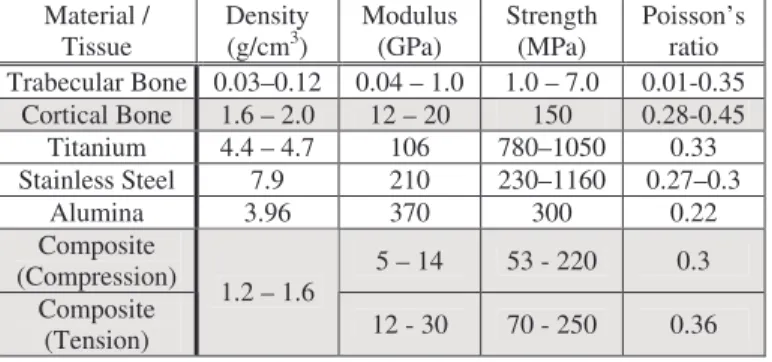
layer to facilitate bone ingrowth and integration. The stem shape is anatomical to improve load transfer to the surrounding bone, and the mechanical properties of the material are very close to those of cortical bone in the human femur (Table 1).
Table 1: Properties of our material compared with bone and other traditional stem materials (www.matweb.com)
Material / Tissue Density (g/cm3) Modulus (GPa) Strength (MPa) Poisson’s ratio Trabecular Bone 0.03–0.12 0.04 – 1.0 1.0 – 7.0 0.01-0.35 Cortical Bone 1.6 – 2.0 12 – 20 150 0.28-0.45 Titanium 4.4 – 4.7 106 780–1050 0.33 Stainless Steel 7.9 210 230–1160 0.27–0.3 Alumina 3.96 370 300 0.22 Composite (Compression) 5 – 14 53 - 220 0.3 Composite (Tension) 1.2 – 1.6 12 - 30 70 - 250 0.36
Bone implant interface
A small model of two hollow tubes with a taper angle of 6° was used to study the surface-to-surface contact elements used in the FEM. Normal ant tangential stiffness, static friction coefficient and contact cohesion were identified as key parameters affecting micromotions at interface and load transfer to the femur; a brief survey in the literature was conducted to assign values to those parameters.
Finite element model
An initial three-dimensional FEM was developed to predict the biomechanical performance of the new stem. Whereas the simulated Proceedings of the ASME 2008 Summer Bioengineering Conference (SBC2008)
June 25-29, Marriott Resort, Marco Island, Florida, USA
SBC2008-192176
SECONDARY STABILITY OF A COMPOSITE BIOMIMETIC CEMENTLESS HIP STEM
Christiane Caouette (1), Martin N. Bureau (1,2), L'Hocine Yahia (1)
(1) Laboratory for Innovation and Analysis of
Bioperformance (LIAB)
École Polytechnique Montréal
Montréal, Québec
Canada
(2) Industrial Materials Institute
National Research Council Canada
Boucherville, Quebec
Canada
Copyright © 2008 by ASME 2
femur was made of tetraedric solid elements of orthotropic material, the stem itself was modeled with hexahedral elements with a uniform thickness of 3 mm and an orthotropic material. The stem model was validated experimentally. The bone-implant interface was simulated using standard type surface-to-surface contact elements. Bone remodeling was simulated using the Huiskes strain energy dissipation model [2]. A Ti stem model of the same shape was also build for comparison purposes. Three load cases applied to the model were based on literature data and biomechanically represent a one km/h walk, stair climbing and gait in a healthy individual.
RESULTS & DISCUSSION
Key parameters and their chosen values for bone implant interface are summarized in Table 2. As secondary stability (i.e., after osseointegration has occurred) of the stem is modeled, the proximal and distal zones have different parameters; contact cohesion has been set to 0 MPa in the proximal zone, and its friction coefficient and normal rigidity are slightly higher than the distal zone. These conditions represent a worst case scenario of weak biological fixation.
Table 2: Parameters used in contact elements simulating bone-implant interface
Parameter Value Normal stiffness (proximal zone) 2000 N/mm3
Normal stiffness (distal zone) 1000 N/mm3 Static friction coefficient (proximal zone) 0.4
Static friction coefficient (distal zone) 0.3 Contact cohesion (proximal zone) 0 MPa
Tangent stiffness 1000 N/mm3
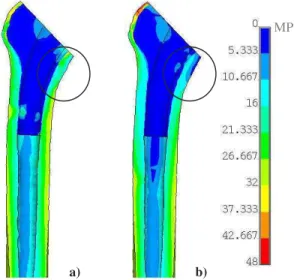
These conditions were applied to both the composite and Ti FEMs of the stem; resulting stress intensity for the healthy gait load case is presented in Figure 1. Whereas the general stress distribution is alike in both femurs, the calcar region (circled region) is noticeably submitted to higher stresses with the composite stem than it is with the titanium stem. The proximal region is also slightly submitted to higher stresses with the composite stem.
Figure 1: Stress intensity for healthy gait loading in femoral bone with a) composite stem, b) Ti stem
In addition, micromotions at bone implant interface are higher for the composite stem than the titanium stem. This result is not unexpected, as stiffer metallic stems are known to cause less micromotions but more stress shielding; the main objective of the current work is to keep micromotions below a threshold value for osseointegration to occur and maintain itself. This threshold value can be as high as 150 m according to some authors [3] or as low as 50 m according to others [4]. The micromotions results for the stair climbing load case are presented in Figure 2.
As shown in Figure 2, the composite stem shows a maximum micromotion value of 125 m whereas Ti stem shows only 85 m; both values are above the conservative threshold value of 50 m. However, higher micromotions are contained within a small zone on both stems; the rest of the stem surface shows very low micromotions (e.g, below 40 µm). Under these conditions, and provided that the hypothesis of 50 µm for micromotion threshold is valid, osseointegration would be possible on both stems, if not on the whole surface. This is consistent with results found in the literature for osseointegration of stems with lower elastic modulus [4].
Figure 2: Micromotions at bone-implant interface in HA-coated proximal part of stem for stair climbing load case
for a) composite stem b) Ti stem CONCLUSIONS
FEM indicated that the composite stem allows for reduced stress shielding when compared with a traditional Ti stem. Micromotions were slightly higher with the composite stem, but osseointegration seems possible on most of the HA-coated surface. Therefore, a biomimetic composite stem might offer a better compromise between stress shielding and micromotions than the Ti stem. Further validation work on a canine model is in progress.
REFERENCES
1. Bougherara H., Bureau M. N., Campbell M., Vadean A. and Yahia L’H., 2007, “Design of a biomimetic polymer-composite hip prosthesis,” J Biomed Mater Res A, Vol. 82, pp. 27-40. 2. Van Rietbergen B., Huiskes R. and al, 1993, “The mechanism of
bone remodeling and resorption around press-fitted THA stems,” J Biomech, Vol. 26, pp. 369-382.
3. Bragdon C. R., Burke D. and al, 1996, “Differences in stiffness of the interface between a cementless porous implant and cancellous bone in vivo in dogs due to varying amounts of implant motion,” J Arthroplasty, Vol 11, pp. 945-951.
4. Moreo P., Pérez M. A., García-Aznar J. M., & Doblaré M., 2007, “Modelling the mechanical behavior of living bony interfaces,” Comput Methods App Mech Engrg, Vol. 196, pp. 3300-3314.
a) mm b) MPa b) a)