Publisher’s version / Version de l'éditeur:
Macromolecules, 42, 8, pp. 2891-2894, 2009-04-01
READ THESE TERMS AND CONDITIONS CAREFULLY BEFORE USING THIS WEBSITE. https://nrc-publications.canada.ca/eng/copyright
Vous avez des questions? Nous pouvons vous aider. Pour communiquer directement avec un auteur, consultez la première page de la revue dans laquelle son article a été publié afin de trouver ses coordonnées. Si vous n’arrivez pas à les repérer, communiquez avec nous à [email protected].
Questions? Contact the NRC Publications Archive team at
[email protected]. If you wish to email the authors directly, please see the first page of the publication for their contact information.
NRC Publications Archive
Archives des publications du CNRC
This publication could be one of several versions: author’s original, accepted manuscript or the publisher’s version. / La version de cette publication peut être l’une des suivantes : la version prépublication de l’auteur, la version acceptée du manuscrit ou la version de l’éditeur.
For the publisher’s version, please access the DOI link below./ Pour consulter la version de l’éditeur, utilisez le lien DOI ci-dessous.
https://doi.org/10.1021/ma900364c
Access and use of this website and the material on it are subject to the Terms and Conditions set forth at
A High-Mobility Low-Bandgap Poly(2,7-carbazole)Derivative for
Photovoltaic Applications
Zou, Yingping; Gendron, David; Badrou-Aı¨ch, Re´da; Najari, Ahmed; Tao,
Ye; Leclerc, Mario
https://publications-cnrc.canada.ca/fra/droits
L’accès à ce site Web et l’utilisation de son contenu sont assujettis aux conditions présentées dans le site LISEZ CES CONDITIONS ATTENTIVEMENT AVANT D’UTILISER CE SITE WEB.
NRC Publications Record / Notice d'Archives des publications de CNRC:
https://nrc-publications.canada.ca/eng/view/object/?id=011d4d82-bada-42c5-b616-a530beb20af8 https://publications-cnrc.canada.ca/fra/voir/objet/?id=011d4d82-bada-42c5-b616-a530beb20af8A High-Mobility Low-Bandgap Poly(2,7-carbazole) Derivative for Photovoltaic Applications
Yingping Zou,†David Gendron,†Re´da Badrou-Aı¨ch,†,‡ Ahmed Najari,†Ye Tao,‡and Mario Leclerc*,†
De´partement de Chimie, UniVersite´ LaVal, Quebec City, QC, Canada, G1K 7P4, and Institute of Microstructural Sciences, National Research Council of Canada, Ottawa, ON, Canada, K1A 0R6
ReceiVed February 17, 2009
ReVised Manuscript ReceiVed March 17, 2009
Harvesting energy directly from sunlight using photovoltaic cells is recognized worldwide as an important solution to the growing energy crisis and environmental pollution. Polymer solar cells (PSCs) have attracted considerable attention in recent years due to their unique features such as low cost, lightweight, solution-processability, and their potential application in large area flexible devices.1Since the discovery of the photovoltaic effect in bulk heterojunction (BHJ) devices, there has been a considerable development in PSCs.2
In such BHJ devices, when blended with PCBM, the processable and high molecular weight polymeric semiconductor should exhibit a bandgap between 1.2 and 1.9 eV with a HOMO level lower than -5.2 eV to allow air-stability and a LUMO level near -3.8 to -4.0 eV to allow electron transfer to PCBM while maximizing the open circuit voltage. Furthermore, the polymer should show a hole mobility higher than 10-3 cm2V-1
s-1
.2b Along these lines, a series of new poly(2,7-carbazole) derivatives were recently reported that show high solubility together with relatively high molecular weights and mobilities.3One particular derivative, PCDTBT, has revealed a power conversion efficiency (PCE) up to 6%.4This value is close to its anticipated maximum with PCBM since it has a bandgap of 1.9 eV and a LUMO energy level near -3.6 eV.2b,3 In parallel, Winnewisser and co-workers5 reported a new donor-acceptor low-bandgap polymer (BBTDPP1) containing thiophene (electron rich unit) and diketopyrrolopyrrole (DPP) (electron deficient) units that exhibits excellent ambipolar charge transport properties. Mobilities up to 0.1 cm2V-1
s-1
for holes and up to 0.09 cm2V-1
s-1
for electrons were obtained. Studies on DPP-based polymers for energy conversion have also emerged. Very recently, Janssen and co-workers6used a similar low-bandgap (about 1.4 eV) polymer (pBBTDPP2) for polymer solar cells. They investigated the effect of processing conditions on the performances. When the polymer is processed from a mixture of chloroform and ortho-dichlorobenzene (ODCB) and blended with [70]PCBM, the PCE goes up to 4.0%. Although other DPP-containing polymers have also exhibited some interesting opto-electrical characteristics,7studies on DPP-based polymers remain still scarce, especially in PSCs and FETs.
Taking all of these results into account, the development of new low-bandgap copolymers based on carbazole and DPP should therefore lead to some interesting features for photo-voltaic applications. Here, we report a new processable, high molecular weight, low bandgap poly(2,7-carbazole) derivative
(PCBTDPP), namely poly[N-9′ -heptadecanyl-2,7-carbazole-alt- 3,6-bis(thiophen-5-yl)-2,5-dioctyl-2,5-dihydropyrrolo[3,4-]pyr-role-1,4-dione]. This new conjugated polymer exhibits a high hole mobility, optimized HOMO-LUMO energy levels together with good thermal and air stability.
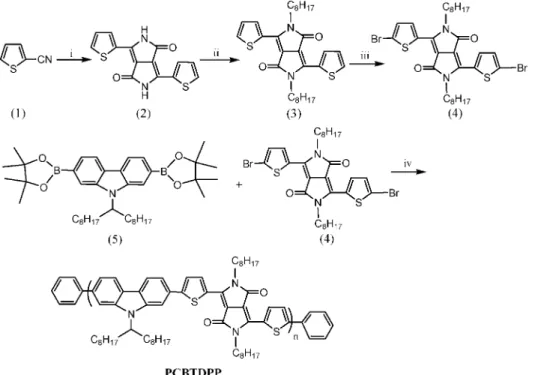
The synthetic route of monomer and PCBTDPP is illustrated in Scheme 1 and synthesis details are described in the Supporting Information. To obtain processable and high molecular weight poly(2,7-carbazole) derivatives, 2,7-bis(4,4,5,5-tetramethyl-1,3,2-dioxaborolane-2-yl)-N-9′-heptadecanylcarbazole was syn-thesized in four steps.3bThe other comonomer, 3,6-bis(5-bromo-thiophen-2-yl)-2,5-di-n-octylpyrrolo[3,4-c]pyrrole-1,4-dione, was synthesized from slight modifications of reported procedures.8 Starting from 2-cyanothiophene, a condensation reaction was performed to get compound 2; this step was then followed by an alkylation reaction and a dibromination reaction to yield comonomer 4. As shown in Scheme 1, both comonomers were copolymerized through versatile Suzuki cross-coupling polym-erization to afford PCBTDPP with a 94% yield. Pd(PPh3)4was used as catalyst. An end-capping reaction was performed using bromobenzene and phenyl boronic acid to increase the stability of the polymer. The polymer structure was verified by1H NMR (see Figure S1). After purification and according to size-exclusion chromatography (SEC) experiments based on mono-disperse polystyrene standards with tetrahydrofuran (THF) as the solvent, the polymer has a relatively high number-average molecular weight (Mn) of 30 kg/mol with a polydispersity index of 2.1. Indeed, free-standing films can be easily obtained from solutions of this polymer. Thermogravimetric analysis (Figure S2) shows that the polymer exhibits good stability up to 430°C. DSC experiments (Figure S3) were performed on this polymer and reveal a high glass transition temperature (Tg; ca. 120°C). This polymer is easily soluble in chloroform, THF, chloroben-zene (CB), ODCB, and 1,2,4-trichlorobenchloroben-zene (TCB).
The optical properties were characterized by UV-vis-NIR spectrocopy as shown in Figure 1a. In solution, the UV-vis-NIR absoption spectrum shows two absorption bands at 368 and 642 nm, a pure PCBTDPP thin film shows a broad absorption band around 680 nm with an absorption onset at 792 nm. The optical band gap deduced from the polymer film absorption edge is 1.57 eV. The HOMO and LUMO energy levels of PCBTDPP were measured by cyclic voltammetry (CV). As shown in Figure 1b, one reversible oxidation process (Eonox
) 0.74 V versus SCE) and one quasi-reversible reduction process (Eonred) -0.78 V versus SCE) were observed. Based on the recorded oxidation potential, the neutral PCBTDPP should show a good air stability.9Furthermore, the HOMO and LUMO energy levels of the polymer were calculated to be -5.44 and -3.92 eV, respectively from the onset oxidation and reduction potentials, assuming SCE level to be at -4.7 eV.10The energy levels estimated from these electrochemical measurements fit very well with the required electronic levels (EHOMO level between 5.2-5.8 eV; ELUMO level between 3.8-4.0 eV) for efficient polymeric bulk heterojunction solar cells utilizing PCBM as the electron acceptor.2b,10b,11 The optical bandgap (1.57 eV) and electrochemical bandgap (1.52 eV) are within the experimental errors. On the basis of these electrochemical data, and taking into account a LUMO energy level for PCBM at -4.3 eV and using semiempirical estimation equation,11the calculated open circuit voltage (Voc) is ca. 0.84 V.
* To whom correspondence should be addressed. E-mail: Mario.Leclerc@ chm.ulaval.ca.
†De´partement de Chimie, Universite´ Laval.
‡Institute of Microstructural Sciences, National Research Council of
Canada.
10.1021/ma900364c CCC: $40.75 2009 American Chemical Society Published on Web 04/01/2009
In addition to optical absorption and energy levels, charge carrier mobility is another major concern in the design and synthesis of new conjugated polymers for applications in PSCs.12To obtain a general evaluation of this property,
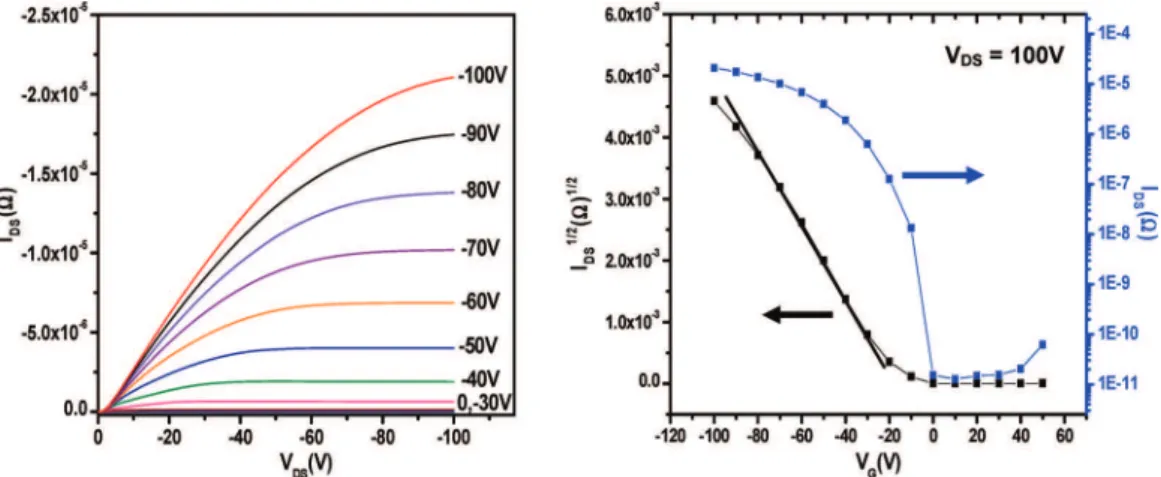
top-contact organic field effect transistors (OFET) were fabricated using gold as source and drain electrodes. We spin-coated a 20-nm thick polymer film from a 4 mg/mL PCBTDPP/ chloroform solution on heavily doped n-type Si wafers with SiO2 (300 nm) treated with octyltrichlorosilane (OTS) as described in the SI. Before gold contact deposition, fresh deposited films were heated under nitrogen at 50 °C for 10 min to remove the residual solvent. Without further thermal treatment, these transistors made of PCBTDPP (Figure 2) exhibited a hole mobility of 0.02 cm2V-1
s-1
together with an on/off ratio of 1.4 × 10⁶and a threshold voltage of -16 V.
All these characteristics (low bandgap, good hole mobility, preferred energy levels, etc.) indicate that PCBTDPP should be an excellent candidate for photovoltaic applications. We therefore fabricated some photovoltaic devices with a struc-ture of ITO/PEDOT:PSS/PCBTDPP:PCBM(1:2)/LiF/Al. Af-ter spin coating a 50-nm thick layer of poly(3,4-ethylene dioxythiophene):poly(styrenesulfonate) (PEDOT:PSS) onto a precleaned indium-tin oxide(ITO) coated glass substrate, a polymer/PCBM(1:2, w/w) solution in ODCB was spin-coated. The resulting active layer was dried for 24 h in a glovebox and 6 h under vacuum before the cathode evapora-tion to remove all residual solvent. The devices were completed by evaporating LiF/Al metal electrodes with an active area of 36 mm2. The detailed conditions of the device fabrication and characterization are described in the SI. The photovoltaic performance presented in Figure 3 was tested under AM 1.5G illumination of 100 mW.cm-2
, which was calibrated using a KG5 filter covered silicon photovoltaic solar cell calibrated at the National Renewable Energy Laboratory (NREL). This I-V curve reveals a relatively good current density of 5.2 mA · cm-2
, a moderate fill factor of 0.37, and a relatively high open circuit voltage (Voc)0.85 V). It is worth noting that this open circuit potential agrees quite well with its
Scheme 1.Synthesis of the Co-Monomer and PCBTDPPa
aReagents and conditions: (i) 0.5 equiv of diisopropylsuccinate, Na, tert-amyl alcohol, 120°C, 24 h, 75% yield; (ii) C
8H17Br, DMF, K2CO3,120 °C, 1 h, then 130°C, 24 h, 84% yield; (iii) 2.2 equiv of NBS, CHCl3, dark, room temperature, 48 h, 83% yield; (iv) Pd(PPh3)4, K2CO3, THF/H2O,
80-85°C for 72 h, 94% yield.
Figure 1.a) UV-vis-NIR absorption spectra of PCBTDPP in dilute CHCl3(solid line) and in the solid state (-9-); (b) Cyclic voltammogram
of PCBTDPP films cast on platinum wire in Bu4NBF4/acetonitrile at
50 mVs-1. SCE: standard calomel electrode.
anticipated value. As a result, a PCE of 1.6% was achieved. The present data seem to indicate that the electron transfer and therefore, the morphology are not yet optimized but it is firmly believed that by optimizing the interpenetrating network mor-phology of these PCBTDPP-based devices through different polymer/acceptor ratios, processing additives, or annealing, higher Jsc, FF, and PCE values should be obtained.
In conclusion, a new high-mobility low-bandgap DPP-containing poly(2,7-carbazole) derivative, PCBTDPP, was designed and synthesized. This polymer combines a high glass transition temperature, good solubility, relatively high molecular weight, and air stability. Organic field-effect transistors were investigated and at room temperature, the hole mobility reaches 0.02 cm2V-1
s-1
with an on/off ratio of 1.4 × 10⁶. Preliminary results on the photovoltaic device based on PCBTDPP: PCBM bulk heterojunction give a power conversion efficiency of 1.6%. These results show that PCBTDPP is a promising polymer material for its use in field-effect transistors and solar cells. Further investigations on PCBTDPP and further syntheses of new low-bandgap DPP-containing poly(2,7-carbazole) derivatives are currently in progress and will be reported in due course.
Acknowledgment.This work was supported by grants from NSERC and a research contract from the Sustainable Development Technology Canada (SDTC) program. The authors thank Mrs. Rodica Neagu-Plesu for the SEC measurements.
Supporting Information Available:Text giving the experi-mental details, synthesis of the monomers and polymer, instru-mentation, fabrication details and characterization procedures of the PSC and FET devices and figures showing the NMR spectrum, TGA curve, and DSC thermogram of PCBTDPP. This material is available free of charge via the Internet at http://pubs.acs.org.
References and Notes
(1) (a) Brabec, C. J.; Sariciftci, N. S.; Hummelen, J. C. AdV. Funct. Mater.
2001, 11, 15–26. (b) Brabec, C. J. Sol. Energy Mater. Sol. Cells 2004,
83, 273–292.
(2) (a) Yu, G.; Gao, J.; Hummelen, J. C.; Wudl, F.; Heeger, A. J. Science
1995, 270, 1789–1791. (b) Dennler, G.; Scharber, M. C.; Brabec, C. J. DOI:10.1002/adma.200801283. (c) Li, Y. F.; Zou, Y. P. AdV. Mater.
2008, 20, 2952–2958. (d) Thompson, B. C.; Fre´chet, J. M. J. Angew.
Chem., Int. Ed. 2008, 47, 58–77.
(3) (a) Blouin, N.; Michaud, A.; Gendron, D.; Wakim, S.; Blair, E.; Plesu, R. N.; Belleteˆte, M.; Durocher, G.; Tao, Y.; Leclerc, M. J. Am. Chem.
Soc. 2008, 130, 732–742. (b) Blouin, N.; Michaud, A.; Leclerc, M.
AdV. Mater. 2007, 19, 2295–2300. (c) Blouin, N.; Leclerc, M. Acc.
Figure 2.Output at different gate voltage (VG) and transfer characteristics in the saturation regime at constant source-drain voltage (VDS) -100V) for OFET using PCBTDPP films spin-coated on OTS-treated SiO2/Si substrates.
Figure 3.I-Vcurves of the polymer solar cells based on PCBTDPP in the dark and under the illumination of AM 1.5 G, 100 mW · cm-2 .
Chem. Res. 2008, 41, 1110–1119.
(4) Verified by NREL (see on www.konarka.com, press release of 12.09/
2008), to be published.
(5) Burgi, L.; Trubiez, M.; Pfeiffer, R.; Bienewald, F.; Kirner, H. J.; Winnewisser, C. AdV. Mater. 2008, 20, 2217–2224.
(6) Wienk, M. M.; Turbiez, M.; Gilot, J.; Janssen, R. A. J. AdV. Mater.
2008, 20, 2556–2560.
(7) (a) Zhang, K.; Tieke, B. Macromolecules 2008, 41, 7287–7295. (b) Zhu, Y.; Rabindranath, A. R.; Beyerlein, T.; Tieke, B. Macromolecules
2007, 40, 6981–6989. (c) Rabindranath, A. R.; Zhu, Y.; Heim, I.; Tieke, B. Macromolecules 2006, 39, 8250–8256. (d) Cao, D. R.; Liu, Q. L.; Zeng, W. J.; Han, S. H.; Peng, J. B.; Liu, S. P. J. Polym. Sci.
A; Polym. Chem. 2006, 44, 2395–2405.
(8) Tamayo, A. B.; Tantiwiwat, M.; Walker, B.; Nguyen, T. Q. J. Phys.
Chem. C 2008, 112, 15543–15552.
(9) de Leeuw, D. M.; Simenon, M. M. J.; Brown, A. R.; Einerhand,
R. E. F. Synth. Met. 1997, 87, 53–59.
(10) (a) Bard, A. J.; Faulkner, L. R. Electrochemical Methods:Fundamentals
and Applications, 2nd ed.; Wiley: New York, 2001. (b) Thompson, B. C.; Kim, Y. G.; Reynolds, J. R. Macromolecules 2005, 38, 5359– 5362.
(11) Scharber, M. C.; Muhlbacher, D.; Koppe, M.; Denk, P.; Waldauf, C.; Heeger, A. J.; Brabec, C. J. AdV. Mater. 2006, 18, 789–794. (12) (a) Morana, M.; Koers, P.; Waldauf, C.; Koppe, M.; Muehlbacher,
D.; Denk, P.; Scharber, M.; Waller, D.; Brabec, C. AdV. Funct. Mater.
2007, 17, 3274–3283. (b) Sang, G. Y.; Zou, Y. P.; Li, Y. F. J. Phys.
Chem. C 2008, 112, 12058-12064. (c) Zou, Y. P.; Wu, W. P.; Sang, G. Y.; Yang, Y.; Liu, Y. Q.; Li, Y. F. Macromolecules 2007, 40, 7231–7237.
MA900364C