Automotive Industry Marketing Channels:
Conflicts and Solutions
By
Xiaoxuan Song
B.E. Automotive Engineering
Tsinghua University, 2012
SUBMITTED TO THE MIT SLOAN SCHOOL OF MANAGEMENT IN
PARTIAL FULFILLMENT OF THE REQUIREMENTS FOR THE DEGREE OF
MASTER OF SCIENCE IN MANAGEMENT STUDIES
AT THE
MASSACHUSETTS INSTITUTE OF TECHNOLOGY
JUNE 2018
2o18 Xiaoxuan Song. All rights reserved.
The author hereby grants to MIT permission to reproduce
and to distribute publicly paper and electronic
copies of this thesis document in whole or in part
in any medium now known or hereafter created.
Signature of Author:
Signature redacted
MIT Sloan School of Mnagement
May 11, 2018
Certified by:
Signature redacted
Juanjuan Zhang
Epoch Foundation Professor of International Management
and Professor of Marketing
Thesis Supervisor
Accepted by:
Signature redacted
Jacob>-ohen
Senior Associate Dean f r U d graduate & Master's Program
MASSACHUSETTS INSTITUTE IT Sloan School of Management
OF TECHNOLOL
[Page intentionally left blank]
Automotive Industry Marketing Channels:
Conflicts and Solutions
By
Xiaoxuan Song
Submitted to MIT Sloan School of Management
on May 11, 2018 in Partial Fulfillment of the
requirements for the Degree of Master of Science in
Management Studies.
ABSTRACT
In the dynamic market, manufacturers constantly seek for optimal
channel alignment for maximizing the channel benefits, which needs joint
efforts by both manufacturer and channel partners. Driven by their own
interests, dealers act very differently in the marketing channel cooperation. To
motivate dealers to behave in a more cooperative way, the marketing channel
incentive system is commonly used as the most effective tool. However,
aiming at maintaining a high marketing channel efficiency in the dynamic
market, OEMs need to develop good internal controls and a more scientific
approach in adjusting dealer marketing target. In this paper, current channel
marketing status in automotive industry will be introduced, conflicts in the
marketing channel cooperation will be identified, channel stakeholders will be
analyzed to identify the key influencing factors and build a more reasonable
MERT adjusting methodology, and finally, recommendations will be provided
for manufacturer's in-house executives.
Thesis Supervisor: Juanjuan Zhang
Title: Epoch Foundation Professor of International Management and
[Page intentionally left blank]
Acknowledgements
To my parents, for encouraging and supporting me unconditionally to accomplish my dream, for helping me get through the tough times, and for letting me know that life is about to explore the unknown and create value for a better world. Without them, I can never be where I am today.
To Xingzhao Liu, for supporting me on the big decisions, for understanding and believing in me all the time, and for facing the uncertainties in life positively with me together.
To my thesis supervisor Professor Juanjuan Zhang, for providing the inspiring ideas, insightful advice and enormous encouragement for my thesis. Without her help and recognition, I would not have been able to finish the thesis so smoothly.
To Jessie Jiao and Serena Ding, for the great help on providing the important information that my thesis proposal idea is based on. It was and is always enjoyable to work with you.
To all MSMSers, Peipei, Hugo, Sihang, Chengang, Una, for all the memorable moments in the precious year we have spent together in MIT. I hope our friendship would last forever, and all of us can realize our value in the world.
[Page intentionally left blank]
Table of Contents
Chapter 1: Auto Manufacturer and Dealer Channel Introduction...11
1.1 Auto OEM's Channel Choice -Franchised Dealer Model ... 12
1.2 Current Auto OEM and Dealer Collaboration Process ... 13
1.2.1 Vehicle Flow in Distribution Channel... 14
1.2.2 Capital Flow in Distribution Channel... 16
1.3 Different Interests of Auto Manufacturer and Dealers ... 20
1.4 Relationship Development with the Market Saturation ... 22
Chapter 2: Current Marketing Incentive System ... 24
2.1 M arketing Co-investment Facts ... 24
2.2 Dealer's Annual Marketing Expense Target...26
2.3 Problem in Current Marketing Incentive System ... 27
2.4 Determine A More Scientific Approach to Channel Marketing ... 29
2.5 Research Significance and Business Value ... 30
Chapter 3: OEM-Dealer Channel Relationship Analysis ... 32
3.1 Optim al Channel Alignment ... 32
3.2 Identify the Type of Channel Relationship ... 33
3.3 Dealers' Behavior Patterns under Current Marketing Incentives...35
Chapter 4: Stakeholders' Influence on Dealer Marketing Behaviors ... 44
4.1 A uto O EM ... 44
4.1.1 OEM's Interest in Channel (BSC) ... 45
4.1.2 OEM's Dealer Incentive Policy ... 49
4.1.3 H idden Stock Level... 50
4.3 Non-franchised Dealer ... 55
4.3.1 Benefits in Non-franchised Distribution ... 55
4.3.2 Drawbacks in Non-franchised Distribution...57
4.4 Competitors (Local Competition) ... 61
4.4.1 Local Competitors... 61
4.4.2 Local Price W ar ... 62
4.4.3 Local Market Share Ranking... 63
4.4 Consum er ... 64
Chapter 5: Critical Variables and Influences on Model ... 67
5.1 OEM's Retail Sales Target ... 69
5.2 OEM's National Market Share ... 69
5.3 Dealer's Local Market Share Ranking ... 70
5.4 Hidden Stock Level...70
5.5 Marketing Underperformance Level of Last Year... 71
5.6 Sales Discount Level (Retail Transaction Price) ... 72
5.7 Stock D epth ... 73
5.8 Market Sales Trend ... 74
5.9 Summary of Variables Selected...74
Chapter 6: Qualitative Model and Recommendations ... 76
6.1 Qualitative MERT Adjusting Model...76
6.2 Recommendations for Executives...78
Table of Figures
Figure
1:
Dealer Management System Functions ... 14Figure 2: Vehicle Flow in Distribution Channel ... 15
Figure 3: Capital Flow in Distribution Channel... 16
Figure 4: Normal Sales Process by Dealer's Salespeople...19
Figure 5: The Business Functions of Auto Dealership... 21
Figure 6: An Example of ATL and BTL Marketing Activities by Dealer ... 25
Figure 7: Marketing Expense Rate Target (MERT) of OEMs in Premium Segment in 20 12-20 16 ... 28
Figure 8: Channel Strategy Framework for Optimal Channel Alignment...33
Figure 9: A Dangerous Triad of Temptation to Misbehave ... 35
Figure 10: Dealers' Behavior Patterns under Current Marketing Incentives ... 38
Figure ii: BMW 2015 Dealer Excellence Ranking Award (in RMB) ... 46
Figure 12: BMW 2015 YTD May Registration and Market Share...48
Figure 13: An Example of Dealer's Value Map... 54
Figure 14: BMW Franchised Dealer Showroom in Premium Segment ... 59
Figure 15: Non-franchised Dealer Showroom with Multiple Brands ... 59
Table of Tables
Table 1: Vehicles Global Sales Volume from 1990 to 2017 ... 22
Table 2: Dealer's Annual Marketing Expense Target Calculating Example ... 27
Table 3: Identify Type of Relationship Between Auto OEM and Dealers...34
Table 4: Methodology -2015 BMW Dealer Performance Ranking ... 46
Table 5: 2018 BMW Dealer Policy - Local Marketing Incentive...50
Table 6: Dealer Marketing Behavior Influencing Factors Evaluation ... 67
Table 7: Adjusted Variables and Influences on MERT ... 77
Chapter
1:Auto Manufacturer and Dealer Channel Introduction
The automotive industry is a wide range of companies and organizations involved in the design, development, manufacturing, marketing, and selling of motor vehicles.1 It is one of the world's most important economic sectors, and also one of the supporting pillar industries for many countries, such as the United States, Japan, Germany, and China, etc.
The automotive industry has a history of more than one century, and it has experienced exponentially growth globally in the past two decades. According to OICA Production Statistics, 95 million vehicles were produced globally in 2016, increased by 4.5% year-on-year. In the industrial development, China is playing an increasingly important role, representing 29.6% of the global production volume and
14.5% annual increase rate in 20162.
There are many stakeholders in automotive industry, and the most important two stakeholders are Auto Original Equipment Manufacturer (hereinafter referred to as "Auto OEM") and franchised dealers. The Auto OEMs are responsible for designing, developing and manufacturing vehicles, and then wholesaling the vehicles to the distribution channels for retailing. The franchised dealers, working as distribution channel, are responsible for selling the vehicles to end customers, with a series of functions that bring sales, service, spare parts and surveys together.
In this chapter, the importance of the channel collaboration will be analyzed, the partnership and cooperation model between Auto OEMs and dealers will be introduced, and the development of their relationship based on different interests regarding the market changes will be elaborated.
I Wikipedia contributors. (2018, February 20). Automotive industry. In Wikipedia, The Free Encyclopedia. Retrieved February 24,2018,
from https://en.wikipedia.org/w/index.php?title=Automotive industry&oldid=826702218
2
OICA.
(n.d.). In OICA, 2016 Production Statistics. Retrieved February 20, 2018, from http: I /www.oica.net/category/production-statistics/2o16-statistics1.1 Auto OEM's Channel Choice -Franchised Dealer Model
There are several channel options for manufacturers to choose to distribute the products to the end customers conveniently.3 The first is direct channel, which requires the manufacturers to do direct marketing or use their own direct sales force to sell products to customers. The direct channel is usually quite costly that mainly the products with high unit value or high profitability are fit for justification, for example, airplane engine under GE Aviation. The second is indirect channel with two layers of distributers and dealers, which in cooperation can weave a huge network penetrating every corner of the market, and the fast-moving consumer goods company is a good example under this indirect channel. The third is indirect channel with one layer of dealers, which is usually brand franchised dealers - also known as franchisee, such as IKEA furniture franchised dealers.
"How do customers want to buy" is the first thing to consider when deciding on the channel options.4 For Auto OEM, the direct selling channel is impossible regarding the high demanding customer needs for touch and feel, shopping convenience, and services such as test drive, maintenance and warranty, and the transportation fee for each order is also too high to be realistic. The indirect two-layers channel is not an ideal option since the increasing layers of channel partners are also accompanied with decreasing control by Auto OEMs. With the indirect one-layer channel - franchised dealer, Auto OEMs can allocate more operation cost to be undertaken by dealers, get more cooperation benefits on better local marketing and services to acquire and retain more customers, and get better guaranteed cash flows from dealers.
Auto OEM's channel choice on collaborating with franchised dealers is a great channel model which create a win-win-win situation among the stakeholders. As the
3 ATC Industrial. (2014, August 22). What Are Distribution Channels. In A TC. Retrieved February 20, 2018, from http://www.argoturbo.com/blog /what-are-distribution-channels
4 Anne, T. Coughlan, & Sandy, D. Jap. (2016). A Field Guide to Channel Strategy: Building Routes to Market. United States of America: CreateSpace.
franchised dealers are distributed in many cities, customers are happy since they can shop the vehicles conveniently without travelling outside the city, as well as when they need the aftersales services. The franchised dealers are happy, since they can get the brand authorization which makes them differentiated directly with other dealers, and also gain plenty of resources in staff training, store performance guidance, OEM sponsored marketing, different kinds of incentives, etc. Besides all the benefits gained
by OEMs stated above, OEMs also saved large amounts of capital in building the
dealerships by themselves, and they can invest and focus better on paving the path to a better competitive position.
Risk comes with benefits. In the channel cooperation model, there are also many potential risks for OEMs to undertake and manage. As the franchised dealers run by themselves, OEMs have very little control over the dealer operations, therefore they are not able to ensure that the brand image and product values will be conveyed to potential customers accurately. All the benefits and risks work together to motivate OEMs to invest in designing reasonable incentives to dealer partners, thus building a robust and productive channel relationship.
1.2 Current Auto OEM and Dealer Collaboration Process
In the channel collaboration, Auto OEM is running the B-to-B business, and dealers are running the B-to-C business. Auto OEMs usually cooperate with hundreds to thousands of dealers globally based on their business scale.
To better manage the dealerships and monitor their business performance, Auto OEMs adopt different kinds of Dealer Management Systems (hereinafter referred to as "DMS"), in which they can track dealers' performance regarding business functions of sales, after-sales service, spare parts and finance5. Each dealer has a separate account to access the dealer-end DMS to update the data, and dealer's data
5 Autologica. (n.d.). In AUTOLOGICA Dealer Management System, BMWDMS Project. Retrieved February 24, 2018, from https://www.autologica.com/clients/DMS-BMW.html
and information are organized thoroughly, including vehicle pipelines, wholesales numbers, declared sales to end customers, vehicle and spare parts stock status, used car flow in and out, after-sales service items, customer file and transaction history, etc. With DMS centralized managing system, Auto OEM is able to track dealer performance and provide guidance and resources support accordingly.
Customer Relationship Sales Management
Management
Finance & Insurance Pipeline and Stock
Leads Management After-sales Service
Spare Parts
Figure 1: Dealer Management System Functions
In the DMS, all data and information are recorded for tracking two most important flows -vehicle flow and capital flow.
1.2.1 Vehicle Flow in Distribution Channel
Vehicle flow shows all related information regarding certain vehicle, including basic Vehicle Identification Number (VIN), model and configuration, wholesale information, customs clearance, transportation status, in-stock status with certain dealer, sold to certain customer, etc. In the chart below, stakeholders in the sales process and vehicle flow are elaborated.
Wholesale Process Retail Process
FD-:L
FD-2 - Vehicle Flows
OEM FD-3 Customers FD] Franchised Dealers
Non-franchised Dealers
FD-n
Figure 2: Vehicle Flow in Distribution Channel
Firstly, the dealer orders certain number and models of vehicles from Auto OEM in the DMS, and the OEM will arrange shipping them from vehicle plants in and/or outside the country to the dealership. If the vehicles ordered are only manufactured
by factories abroad, customs clearance process will be needed. When these vehicles
are shipped to the dealer side, the titles of the vehicles will be transferred to the dealer in the DMS as dealer stock. And this is the wholesale process.
When dealers have vehicles in stock, they usually sell them in two channels. The first is to sell to the end customers, which is the traditional B-to-C business. The second is to sell to non-franchised dealers, and non-franchised dealers then sell the vehicles to end customers, which is a B-to-B-to-C business. The second option is usually adopted by dealers who want to get rid of their high stock as soon as possible, and they are sold to the non-franchised dealers with a relatively lower price. This option is also not encouraged by Auto OEM, because non-franchised dealers usually carry many vehicle brands, and they attract customers by low price and no after-sales service instead of providing premium service and conveying brand message. In the long-term perspective, though solving a portion of the sales problem, non-franchised dealers are weakening the brand image by unqualified customer sales process and store layout design.
attract potential customers, including above the line (ATL) advertisements and below the line (BTL) activities. Salespeople in the dealership performs a whole set of sales processes from welcoming to test drive, until they get the sale and hand over the car to the customer, which is required by Auto OEM to provide standardized excellent service conveying brand image.6
And this is the retail process.
1.2.2 Capital Flow in Distribution Channel
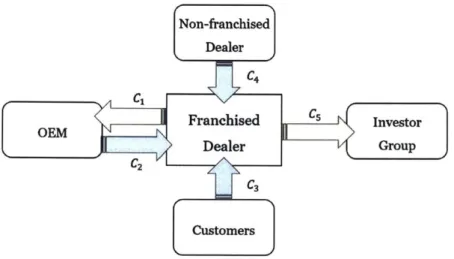
Capital flow shows how do stakeholders exchange the capital for vehicles, and how does each business partner make money in the sales process. The dealership usually deals with four main stakeholders (see the figure below), including Auto OEM, Non-authorized Dealer, Customer, and Investor Group. And all four main stakeholders cast indispensable influences on the collaborative relationship between the Auto OEM and dealers.
Non-franchised Dealer C1C4 W e vFranchised t Investor C2 Dealer Group C3 Customers
Figure 3: Capital Flow in Distribution Channel
i. Dealer and Auto OEM.
When vehicle models are launched by the OEM, they are ticketed with a Manufacturer Suggested Retail Price (hereinafter referred as to "MSRP"). However, this price is just a suggested price for customer's information, with no compulsive
6 BMW Group China. (2018). BMW Guideline ofStandardized Sales Process. Corporate Files.
influence on dealer's retail pricing decision. Dealers have their sole discretion to decide the final retail price in each sales case, and any pricing hint or pressure from Auto OEM is strictly regulated by the Anti-Trust Law, and huge amount of fine could be charged as penalty.
When dealers order vehicles from the OEM, wholesale price is calculated with a discount off the MSRP. The wholesale discount amount (p%) is usually ranging from
5% to 10%. This is the capital paid by dealers to purchase vehicles from the OEM. To motivate dealers' enthusiasm in achieving higher sales volume and investing more in local marketing activities, dealer targets in sales and marketing are usually set by Auto OEMs as the minimum in the way that whoever achieves this target will be rewarded with substantial incentives. Setting the dealer incentive policy is usually the most important method that Auto OEMs adopt to negotiate with dealers and invest in their channel partnership.7 The incentive system will be elaborated more in detail in the following chapters.
Dealer holdback is another kind of sales commission provided by the OEM to supplement dealer's cash flow. The holdback is also a percentage of MSRP, usually ranging from 1% to 3%8. Not all OEMs adopt this method to support dealers, but this
is a substantial amount of capital to dealers.
Summarizing the three main kinds of capital flow between Auto OEM and dealers, the balance of capital flow can be formulated as:
i=N
CDealer-OEM - MSRPi *
(1
-p%)
+ Incentives + HoldbackN - The number of vehicles ordered by dealer from the OEM annually
p% - The wholesale discount amount set by the OEM
7 Anne, T. Coughlan, & Sandy, D. Jap. (2016). A Field Guide to Channel Strategy: Building
Routes to Market. United States of America: CreateSpace.
8 Philip Reed. (2013). In Edmunds, Dealer Holdback. Retrieved February 24, 2018, from https://www.edmunds.com/car-buying/dealer-holdback
ii. Franchised Dealer and Non-Franchised Dealer.
As is stated in Chapter 1.2.1, non-franchised dealers purchase vehicles from franchised dealers, and then sell them to end customers. The profit model of non-franchised dealers is to make profit from the price difference between the final retail price and the resale price from franchised dealers, without caring about anything regarding brand franchised fee, premium sales service, customer satisfaction and after-sales service. In this process, the capital flow of franchised dealer and non-franchised dealer can be formulated as:
i=nl
CDealer - Non-authorized Dealer = D--resale,i
i=1
i=nl i=nl
CNon-authorized Dealer = ','ND-Ri ~~ D-resale,i
i=1 i=1
ni - The number of vehicles sold through non-franchised dealers
PND-R - The retail price by non-franchised dealers
PD-resale -The resale price set by franchised dealers to non-franchised dealers
iii. Dealer and Customer.
Most vehicles are sold from franchised dealer to end customers in this way directly. The normal process that a car is sold by salespeople to customer starts from collecting prospects contact information from ATL and BTL marketing activities. Then the salespeople will invite the prospects to visit and shop in their 4S store through email, texting or phone calls. Besides invitation, there are also many walk-in prospects who visit the dealer showroom directly. When potential customers show up in the showroom, salespeople will ask about their needs, preferences, and recommend proper models. After test drive of certain models, if the customer is satisfied with the vehicle performance, model configuration and final price, contracts will be signed, and payments will be conducted. In the car hand-over process, salespeople will help the customer test the stock car together, coach him on necessary
car basics, and provide guidance on how to register car plate. After one week, the salespeople will follow up with a phone call to see if the customer has any problems with the car and how satisfied the customer is.
Walk-ins
Marketing Activities
Follow Up Registration HI N dear Tew Car Paymen
Figure 4: Normal Sales Process by Dealer's Salespeople9
As the models, configuration, selected accessories and applicable discount options are different, the final retail price of each car is likely to be different. For customer's convenience and its own profitable benefit, dealers also provide insurance service to customers, where they can make an extra commission from insurance companies. In this process, the capital flow from customers to the dealer can be formulated as:
i=n2 i=m
CDealer- Customer -- Pretai,i + Pinsurance commision,i
i=1 i=1
n2- The number of vehicles sold from franchised dealers to customers directly Pretaji - The retail price of vehicle sold from franchised dealers to customers directly
m - The number of vehicle insurance handled by dealer
iv. Dealer and Investor Group.
The Investor Group is the parent company of the dealer. The investor group
evaluates and makes the decision on which OEM brand to join, and it invests capital and human resources to build the dealership. The purpose of the investor group is to make profit, and each year, dealer will divide the annual profit into two parts - one part is to be kept in the dealer side for investing in next-year growth, the other part (W%) is delivered to the investor group. In this process, the capital flow from dealer to the investor group can be formulated as:
CDealer-investor Group - Annual ProfitDealer * a%
c% - The portion of dealer profit that is delivered to the investor group
To sum up, all four stakeholders in this process have indispensable influences on the partner relationship between the Auto OEM and dealers. To build a better incentive system for Auto OEMs to motivate dealers, more analysis and suggestions will be elaborated in Chapter 4 regarding different stakeholder's role, interest, behavior and the influence on dealer.
1.3 Different Interests of Auto Manufacturer and Dealers
Chapter 1.2 elaborates that dealer's profit is flowing to the investor group, and the only transactions between Auto OEM and dealers are vehicles wholesale and incentives as commission by dealer's performance. Therefore, the Auto OEM and dealers are independent organizations with different interests from each other.
The Auto OEM devotes a lot of efforts to build brand image, invest in marketing, drive market share, enhance dealer network sales, and emphasize on customer satisfaction, and these results cannot be achieved by the OEM alone without the cooperation of dealers in the local markets. Eventually, all the efforts are served to achieve the OEM's ultimate goal - maximize the long-term overall sales.
However, there are more aspects to be balanced and taken care of to drive the healthy growth of long-term overall sales. For example, developing more dealers into the brand franchised network will bring more wholesales, but too many dealerships with certain market capacity will create fierce competition which drives the network
business to an unhealthy price war.
The dealer's interest is to maximize profitability and meet certain KPIs required
by its investor group. Usually, a 4S dealership operates four to five business functions,
including new car sales, after-sales service, spare parts, used car, and finance & Insurance. Among them, the after-sales service and spare parts business generate the greatest profits to support the dealer running the whole business. Specially, the service and parts absorption rate is to evaluate how much percentage of dealer's cost and expenses can be absorbed by the after-sales service and parts profitability. The new car sales do bring a portion of the profit, but it serves more as adding into the large quantity base to the after-sales and parts business for more profits. The dealer is more likely to focus on the synergies created by the cooperation of five business functions to generate more profits. And the sales, which is valued most by the OEM, is only one part of the whole business.
New Car Sales After-Finance& , . sales Insurance ervice Used Ca pare Sales Parts
Figure 5: The Business Functions of Auto Dealership
The different interests of the OEM and dealers creates interesting dynamic relationships. When the automotive market capacity is growing rapidly, all channel partners make lots of profits easily. In this environment, dealers collaborate very actively to sign and hit every sales and marketing investment targets set by the OEM just to get more of the most popular vehicle models. However, when the market is tough, dealers' profitability is weak, anymore wholesale targets adds the pressure on
their stock, and they are not willing to invest in local marketing, which poses the brand exposure and long-term sales into risks.
1.4 Relationship Development with the Market Saturation
Chapter 1.3 elaborates that the different interests of the OEM and dealers creates dealer's dynamic cooperative altitude through the channel collaboration.
In the past decades, the global automotive market has experienced tremendous expansion with the growth of global economy, especially in developing countries where vehicles for normal families are becoming more and more approachable. In the past l0 years, China is playing an increasingly important role in global vehicle consumption, taking over the percentage from 10% to 30%.
Table
1:
Vehicles Global Sales Volume from 1990 to 201710INTERNATIONAL CAR SALES OUTLOOK
1090-0 2000-12 TOTAL SALES North America Canada United States Mexico Western Europe Germany Eastern Europe Russia Asia China India South America Brazil 39.2 16-36 1.27 14.55 0.54 13.11 3.57 1.18 0.78 6.91 0.43 0.31 1.64 0.94 53-74 17.74
1.61
15-15 o.98 13-79 3.25 3-03 1.83 16.08 6.52 1.18 3-1 1.9 2014 2015 2016 71-18 72.61 77.29 19.42 20.64 21.05 1.85 1.9 1.95 16.44 17.39 17.5 1.13 1.35 1.6 12.11 13-2 13-97 3-04 3.21 3.35 3.81 3-15 3-14 2.49 1.6 1.43 31.69 32.29 36.06 18.37 20.01 23.57 1.87 2.06 2.09 4-15 3-33 3.07 2.5 1.82 1.39Sources: Scotiabank Economics, Ward's Automotive Reports, Bloomberg.
10 Scotiabank. (n.d.). Number of cars sold worldwide from 1990 to 2017 (in million units). In
Statista -The Statistics Portal. Retrieved February 25, 2018, from
https:://www.statista.com/statistics/200002/international-car-sales-since-loo 22 / 80 20171 79.56 20-73 2.03 17.1 1.6 14-39 3.47 3-39 1-55 37-58 24.28 2.23 3.47 1.53
In the meantime, the number of auto dealers are also expanding rapidly. Investor groups paid high franchise fee to develop new brand franchised dealers and broke even quickly in a few years. With a fast-expanding pie, all stakeholders were happy in those years with few conflicts in the collaboration.
However, with the market saturation in recent years, restrictive policies and slower year-on-year growth of automotive market are leading to growing pressure in dealer's profitability, and some dealership quit the network due to bankruptcy. Many dealers are suffering from sales growth downturn and weaker profitability. Dealers have less enthusiasm in their local marketing, which poses a major threat to both Auto-OEM branding and retail performance in the long run. Increasing complaints and resistance from dealers have risen and put the partnership into risk.
Chapter 2: Current Marketing Incentive System
In last chapter, the cooperation model, different interests and relationship between Auto OEM and dealers are elaborated, and the different interests of Auto OEM and dealers are posing more conflicts in the channel collaboration in difficult market conditions.
For Auto OEM's interest to ensure the long-term sales, marketing investment in Automotive industry plays an extremely important role in branding enhancement and sales promotion. Besides brand central marketing, the OEM needs more collaboration from dealers to invest in the local marketing. To stimulate dealers' enthusiasm in marketing, a marketing incentive policy is usually introduced by the OEM to achieve the co-investment in marketing activities. The Marketing Expense Rate Target (hereinafter referred to as "MERT") based on dealers' sales target is usually set by Auto-OEMs as the minimum in the way that whoever achieve this target will be rewarded with substantial incentives.
In this chapter, the current OEM and dealer co-investment facts in marketing will be introduced, the problem in the current incentive system will be identified, and the methodology to develop a more scientific approach to adjust the next-year dealer marketing expense target based on the dealer's performance of current year will be discussed.
2.1 Marketing Co-investment Facts
Marketing co-investments by both Auto OEM and dealers are essential to achieve the short-term and long-term sales goal. Auto OEM's central marketing works to build the brand image, brand awareness and convey the right brand message to all existing and potential customers. Dealer's local marketing works to engage the customer relationship and drives the retail sales.
In the joint efforts of marketing, Auto OEM is responsible for the central marketing, which aims to enhance the brand overall image, maintain brand digital
marketing, and provide support and instructions to dealer's local marketing activities. Auto OEM's central marketing usually invests in mass customer facing online advertisements, publish brand digital media contents continuously, designs brand national campaigns, monitors dealer's marketing performance, and provides sufficient supports to dealer marketing (Mage Wang, personal communication, January 2018).
In the joint efforts of marketing, dealers are responsible for the local marketing. The local marketing is categorized into ATL and BTL marketing. Dealer's ATL marketing is targeting at a wider spectrum of audience through television, digital media, print media, outdoor display advertisements. Dealer's BTL marketing is targeting at a more focused customer group, who has a higher willingness to make a sales deal. The BTL marketing usually includes roadshow, new car launch, holiday activities, showroom activities, special test drive day, co-branding activities, direct mail and other promotion activities. The dealer local marketing plays an extremely important role in driving the dealer showroom or activity traffic and converting more new car sales.
BTL Marketing
Direct Mail * 0.6%
Promotion Materials a o.7% Others 1.8% Event Marketing 24%
Sponsorship 36%
Joint Brands Activity 3sW New Car Launch 4.0%
Special Holidays 6.5%
Golf Activity 7.3%
Field Test Drive 9.%
Showroom Auto Show io.9%
Customer Activity 14.0%
Regional Auto Show
Road Show 19.9% Others Digital Media Television Advertisement Print Advertisement Media Promotion Outdoor Display 10.7% Us.0% 2Aa
Figure 6: An Example of ATL and BTL Marketing Activities by Dealer"
Volkswagen Imported China. (2014). Volkswagen Imported China 2014 Dealer Network Retail Marketing Annual Report. Corporate Files.
To realize a better collaboration in marketing, Auto OEM usually designs the dealer marketing incentive policy to motivate dealers to invest in local marketing in the way that OEM prefers. The main part of the incentive policy is about to set an annual marketing expense target for each dealer, and dealers whoever achieves the annual target will be rewarded with substantial incentive bonus after year-end evaluation. Sometimes, if there is a special national campaign lead by the OEM, such as the new car launch or special model promotion, additional policy on co-marketing the national campaign will be released right before the event. Dealers who participate in promoting the national campaigns designed by the central marketing might get their marketing expense reimbursed or get additional subsidies.
2.2 Dealer's Annual Marketing Expense Target
Dealer's annual marketing expense target is usually calculated based on the product of dealer's annual sales volume target, the average MSRP of certain model, and the MERT rate.2
In terms of an individual car, it indicates the lowest amount of marketing budget should be allocated to the car which is suggested to be sold at the price of its MSRP.
i=n
Dealer's Annual MET = MSRP * Sales Targeti * MERT(%)
n - The number of vehicle models sold in the market
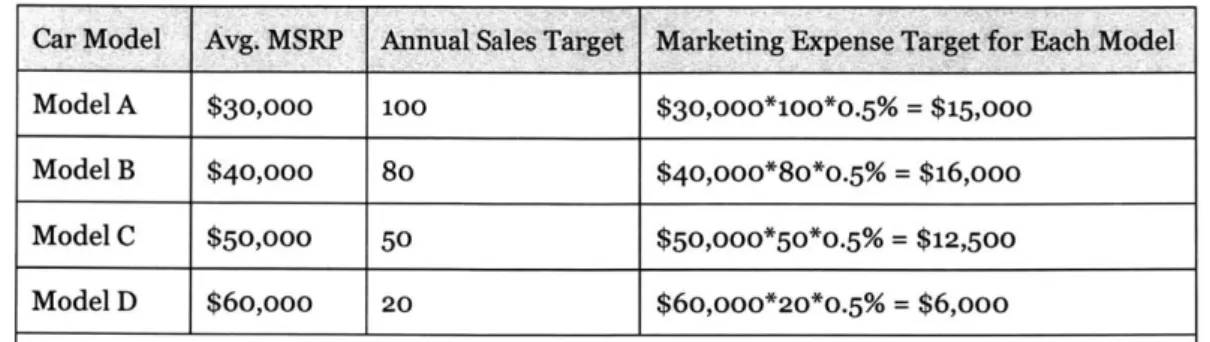
For example, an Auto OEM has 4 vehicle models (A to D) selling in the market. The dealer's annual sales volume target and the average MSRP of each model with different configuration is displayed in the following table. Assume the MERT of the OEM is 0.5%.
12 PwC Consulting Team. (2015). VGIC 2015 Dealer Marketing Expense Review Guideline.
Corporate Files.
Table 2: Dealer's Annual Marketing Expense Target Calculating Example
Car Model Avg. MSRP Annual Sales Target Marketing Expense Target for Each Model
Model A $30,000 100 $30,ooo*100*o.5% = $15,000
Model B $40,000 80 $40,ooo*8o*o.5% = $16,000
Model C $50,000 50 $50,ooo*50*o.5% = $12,500
Model D $60,000 20 $6o,ooo*20*o.5% = $6,000
Dealer's Annual Marketing Expense Target = $15,000+$16,ooo+$12,500+$6,ooo=$49,500
In this example, the dealer's annual marketing expense target is 49,500 dollars, which means in the minimum requirement by the OEM, 49,500 dollars need to be
invested in the local marketing to ensure a healthy environment to enhance brand
image and generate local sales.
2.3 Problem in Current Marketing Incentive System
With different market positioning, the Marketing Expense Rate Target (MERT) of Auto OEMs is usually segmented differently. For premium automotive brands, such as BMW, Mercedes Benz, Volkswagen Imported, and Jaguar and Land Rover, the MERT is usually set higher than the low-end brands, because they need to invest more in marketing to communicate the brand value, educate the customers, and enhance the premium brand awareness.
Besides market positioning, factors such as Auto OEM's product and market strategy, market competition, dealer's feedback, are also influencing in adjusting the Auto OEM's MERT decision. The figure below shows some MERT data extracted from annual dealer policy of premium brands in China, and the trend shows that the MERT level have changed greatly with market dynamics for the past several years.
1.1% 1.0% 1.0% 1.0% 0.7% 0% 0.5% 0.15% 0.15% 0 -2012 2013 2014 2015 2016
-- VGIC -+-BMW -*Mercedes Bez
Figure 7: Marketing Expense Rate Target (MERT) of OEMs in Premium Segment in
2012-201613141516
From the figure above, huge adjustments in the MERT level were made by OEMs during the past several years, and it is interpreted as attempts to cope with the market changes, and sometimes with hypercorrection indicating loss of marketing efficiency.
For Mercedes Benz in China, the average MSRP of vehicle models ranges from 236,000 to more than 1 million RMB (37,000 to more than 150,000 US dollars)17, a
slight drop of 0.1% in MERT will result in a marketing budget difference dropping by
236 to 1,000 RMB (37 to 156 US dollars) for an individual vehicle. While from 2012
13 Volkswagen Imported China. (2012, 2013, 2014, 2015). VGICAnnual Dealer Policy
-Dealer Marketing Incentive Policy. Corporate Files.
14 Mercedes-Benz China. (2013, 2014, 2015, 2016). Mercedes-Benz China Annual Dealer
Policy - Dealer Marketing Incentive Policy. Corporate Files.
15 BMW Group China. (2015, 2016). BMWAnnual Dealer Policy - Dealer Marketing Incentive Policy. Corporate Files.
16 MERT of BMW Group China is significant lower than VGIC and Mercedes-Benz because
BMW adopts a different marketing incentive methodology - marketing central funds.
17 Mercedes-Bez. (2018). Car Models and Manufacture Suggested Retail Price. In
Mercedes-Bez Official Website. Retrieved March 2, 2018, from
https://www.mercedes-benz.com.cn/content/china/mpc/mpc china website/zhng/home mpc/passengercars/home/new cars/model overview.html
to 2016, the MERT of Mercedes Benz and VGIC declined significantly, with nearly 50%
marketing expense investment cut off.
Every adjustment in MERT by Auto OEMs casts a tremendous influence in allocating dealer's resources differently and relieving dealer's financial pressure. Therefore, adjusting the MERT is a very critical task to deal with. Lowering the MERT as the minimum required marketing expense target is always welcomed by dealers, but increasing the MERT after the hypercorrection last year will meet with more resistance from dealers to implement.
The huge fluctuations in MERT levels also reveals that Auto OEMs are attempting to find the right MERT for the current market. However, the market situation changes quickly in these years, and any wrong moves in adjusting the MERT will result in the incapability of adapting to the current market changes in a flexible and rational way. Therefore, how to determine a reasonable MERT by a more scientific approach to improve marketing efficiency is an essential marketing management problem.
2.4 Determine A More Scientific Approach to Channel Marketing
As is elaborated in Chapter 1, besides Auto OEM and dealers, there are more stakeholders in the distributing channel that cast influence on the OEM-dealer relationships simultaneously. Understanding how the other stake holders influence the dealer's behavior in achieving its own interests is significant to find out the critical variables lying behind.
In Chapter 3, the framework of optimal channel alignment will be introduced, and the most important elements regarding relationship building between Auto OEMs and dealers will be identified. After that, marketing tools will be utilized to identify whether it is the right economic valued decision to invest more in maintaining the partnership. Finally, dealers' collaborating patterns under the current marketing pressure will be categorized into four sections, and the more
reasonable MERT is their common demand to move dealers towards the most desired section.
In Chapter 4, how and why the stakeholders are influencing dealer's behavior and enthusiasm in marketing will be analyzed. By researching the OEM channel policy, Balanced Scorecards, dealer's value map, benefits and drawbacks, etc., the critical variables lying behind each stakeholder's influence will be identified.
In Chapter 5, all influencing variables identified in Chapter 4 will be evaluated to see the difficulty in collecting the data, the reliability and accuracy of the collected data, the data collection level (national level or dealer level) and in what way (positively or negatively) the variable should influence the MERT adjusting model to determine the next-year MERT.
In Chapter 6, a brief qualitative model will be built with the identified variables, and recommendations will be provided to high level management to better the design of channel incentive policies for safeguarding the channel activities in similar channel models.
2.5 Research Significance and Business Value
The purpose of this method design is to optimize the target setting approach, capable of improving marketing management efficiency in the presence of market changes, as well as benefiting both Auto OEMs and franchised dealers.
The method design is very important because the interaction between central policy and dealer marketing affects marketing efficiency directly. Either too high or too low marketing target will result in certain kinds of efficiency loss. By setting a more reasonable MERT, dealers are more easily to be motivated in their local marketing investment.
Despite automotive industry has developed for over one hundred years, there still exist many dilemmas in management that need to be addressed with more scientific approaches instead of an empirical manner. Henceforth, this research topic
will assist to standardize the way in improving management practice, which is highly valued by companies and organizations, and is widely applicable to many other groups to manage and motivate their own dealer network in other industries.
Chapter 3: OEM-Dealer Channel Relationship Analysis
In last chapter, the co-investment in marketing by Auto OEM and dealers is introduced, the current sales-based dealer marketing target is shown step by step, the problem in current marketing incentive system is identified, and the proposal to develop a more scientific approach to adjust the next-year dealer marketing expense target is raised with significance and business value.
Before digging into the basics of building model directly, a closer look into the type of channel relationship and the necessity to applying the more accurate adjusting model is necessary to ensure the model's business practicability.
In this chapter, the framework of optimal channel alignment will be introduced, and the most important elements regarding relationship building between Auto OEMs and dealers will be identified. After that, marketing tools will be used to identify what type of channel collaboration should Auto OEMs adopt, and whether it is worthwhile to invest more in designing the incentives to better serve the channel relationship. Finally, the current collaborating patterns of dealers will be categorized into four sections by dimensions of collaborating level and quality of the marketing activities. The suggested solutions to move dealers towards the desired section will be given, and besides all suggested solutions, a more reasonable MERT will be identified to be most important in building a sustainable and healthy channel relationship.
3.1 Optimal Channel Alignment
The optimal channel alignment is the for all channel partners. To achieve optimal channel alignment, four key aspects - channel benefits, channel functions, relationships and incentives - should be considered carefully in deciding the channel cooperation8.
18 Anne, T. Coughlan, & Sandy, D. Jap. (2016). A Field Guide to Channel Strategy: Building Routes to Market. United States of America: CreateSpace.
Channel Channel Benefits LRelationships Optimal Channel Alignment
2
Channel Channel Functions IncentivesFigure 8: Channel Strategy Framework for Optimal Channel Alignment
In the four key aspects, channel benefit is to solve the problem of how customers want to buy, and channel functions is to decide what channel activities are needed to enhance channel benefits. And in Auto OEM-dealer channel relationship, the above two factors depend more on the dealer side in implementing and providing the channel benefits to customers, although with Auto OEM's requirements and guidance.
For the other two key aspects in the framework, the relationship mainly emphasizes on reviewing the channel partnership to see what type of channel relationship the Auto OEMs should have with their channel partners, and the incentives is to help ensure their channel partners do the right activity at the right price. A closer look into the relationship and incentives in Auto OEM's perspective is essential to achieve its the optimal channel alignment. In Chapter 3.2 and 3.3, the type of the relationship between Auto OEM and dealers will be identified, and dealers' behavior patterns under current marketing incentive system will be discussed with proposed solutions.
3.2 Identify the Type of Channel Relationship
A high level of channel cooperation is not always efficient for partners in all
business collaboration. According to Anne T. Coughlan and Sandy D. Jap (2016), developing and maintaining a channel relationship requires plenty of investments in
time, efforts and willingness to coordinate activities and share information. To determine the efficient level of channel cooperation, the economic value of the partnership needs to be evaluated to decide whether to keep the relationship more transactional or more collaborative. There are six dimensions - transaction frequency, key outcomes, competitive orientation, information exchange, operational linkages, specific adaptations and shared risks - to measure the continuum of cooperation types from one-off transactional exchanges to high cooperative strategic exchanges.19
Table 3: Identifyr Type of Relationship Between Auto OEM and Dealers
More Transactional Continuum Dimensions More Collaborative
Infrequent/one-shot Transaction Frequency -1 Regular and repeated
Price is king Key Outcomes
4
Intangible valueSelf-maximization Competitive Orientation I/ Joint maximization
Minimal Information Exchange V Open sharing of useful info
None Operational Linkage I Shared and connected
None NonehaedRik Specific Adaptations and Greater than average Shared Risk
With huge investment in building a franchisee dealer 4S shop by investor group and great efforts in training the dealership by Auto OEM, both Auto OEM and dealers are intended to build a long-term beneficial relationship. The transactions between two sides are frequent and complex, and they are working together to build the brand image for a higher premium retail price. They share many information regarding market, product, competition, policy and business performance, and their goal of sharing information is to achieve the joint benefits maximization by expanding the total pie. They share the operational information and some risks. Measured by the six dimensions, the partnership between Auto OEM and dealers should be highly cooperative.
'9 Anne, T. Coughlan, & Sandy, D. Jap. (2016). A Field Guide to Channel Strategy: Building
Routes to Market. United States of America: CreateSpace. 34 / 80
Especially for the current dynamic market with frequent policy changes, increasing competition, and new emerging market for electric vehicles, huge investments should be devoted to make the relationship more efficient, quicker response to the market change and more long-term benefits for both sides.
3.3 Dealers' Behavior Patterns under Current Marketing Incentives
Channel temptation to misbehave is activated when three conditions - pressure, opportunity, rationalization - exist simultaneously,20 especially for dealers who are highly self-interested. The imperfection of channel marketing incentives provides the
opportunity, the market saturation and thin profit margin poses pressures on dealers, and dealers who do not recognize the channel cooperation benefits would easily rationalize the misbehavior for their own goods. In this condition, some dealers misbehave in the way that weakens the channel cooperation.
Rationalization
Pressure Temptation to Opportunity
< Misbehave
Figure 9: A Dangerous Triad of Temptation to Misbehave
Source: Robert Simons, Strategy Execution Module 13: Identifying Strategic Risk Among all kinds of channel opportunistic misbehaviors, (1) dealer marketing manipulation, (2) giving up dealer marketing target totally, and (3) free-riding problems are the most common ones that reduce the overall channel marketing effectiveness and efficiency.
20 Simons, Robert. (November 2016). Strategy Execution Module
13:
Identifying Strategic
(W) Marketing Manipulation.
For every dollar saved in marketing investment, it becomes part of the dealer profit in the short run. For a better profitability outcome, especially in a harder market environment, some dealers tend to invest much less than the dealer marketing expense target required by Auto OEM, as well as getting as much incentive bonus as possible. How can it be done without actually investing in local marketing? Some opportunistic dealers give the answer by manipulation.
Dealers declare to the Auto OEM that they have planned and implemented certain marketing activities with manipulated supporting documents, such as photoshopped activity photos, old photos from other activities, fake invoices from non-existing service providers, manipulated customer information, and marketing expense per activity way much higher than what it should be. Some Auto OEMs will hire an external agency to review the validity of the declared marketing activities, but chances still exist that some dealers might survive the review, and get the marketing bonus which in real cases they should not have obtained. But the high output/input opportunism lures many dealers to follow, in which way harms both the OEM's benefits and dealer's long-term local sales.
(2) Giving Up Dealer Marketing Target Totally.
Dealer's annual marketing expense target is set based on its annual sales target and the average MSRP of the vehicles ordered, regardless of dealer's special reasons for incapability to fulfill the target, such as dealer's financial pressure, or investor group's instruction on marketing strategy. When the marketing target is too high to be achieved in dealer's perspective, the dealer will usually give up the OEM required target totally, in a negative way that some of them just don't do marketing at all. In other words, some dealers either achieve ioo% of the OEM required dealer marketing target, or in the other way do 0%~2o%, never choose to fall in the middle of the positive investment interval 50%~90% (Cloud Bai, personal communication, January
2018). This also indicates that an unreasonably high marketing target set by the Auto
OEM will have more negative influence than no marketing target does.
(3) Free-riding Problems.
Free-riding problem more common to see in dealers, especially dealers located in the same city. One dealer who does radio advertisements for the brand and vehicles is creating the pre-sale valued externalities for the other dealers located in the same city. Without doing any marketing, they can also get more showroom visits and converted sales. However, if not managed well, the enthusiasm of the dealer who is actively investing in local marketing is likely to wane.
Take a real-life example for totally giving up marketing expense target and free-riding (Cloud Bai, personal communication, January 2018). There were two dealers under the same OEM brand located in Nanking, and one of them (dealer A) gave up the required marketing target directly because it was too difficult for dealer A to achieve. Besides taking advantage on the external benefits of dealer B's online advertisements, dealer A even took advantage in dealer B's BTL activities intentionally. When dealer B was doing a car road show in shopping mall or public square, which involves a substantial amount of expense invested in renting the location space and decorating the exhibition stand. On the day of the road show, dealer A sent several sales people to dealer B's road show, distributing flyers of their own dealership's better retail price to take the customers away. Dealer A used the marketing budget saved to lower the vehicle's retail price, steal away the customer traffic gathered by dealer B and sell their own cars by a malicious price competition. Without timely intervention from the Auto OEM, dealer A's enthusiasm declined quickly, and the two dealers ended up in a negative way that no one investing in marketing or making it more secretly while on the other hand also attracted less traffic than it would otherwise have done. Under unreasonable marketing target, the free-riding problem without timely intervention wakens both dealer's long-term sales, as well as OEM's benefits.
"Dealer Marketing Quality" and "Collaboration Level in Fulfilling Marketing Target" are selected to categorize dealers' behavior patterns. The dimension of "Dealer Marketing Quality" measures ATL/BTL activity quality under similar marketing budget. In other words, with similar marketing expense declared, dealers who try to manipulate with some non-existing activities, or use unfair valued service providers, or hold activities that cannot match the brand image will be perceived as low in "Dealer Marketing Quality". The dimension of "Collaboration Level in Fulfilling Marketing Target" measures dealer's altitude towards fulfilling the assigned marketing expense target. In other words, dealers who invest actively in local marketing with the goal of achieving assigned targets will be perceived as high in "Collaboration Level in Fulfilling Marketing Target". In this way, four sections with different patterns of dealer behavior are shown in figure 10.
High
Q Low
Low High
Collaboration Level in Fulfilling Marketing Target
Figure 10: Dealers' Behavior Patterns under Current Marketing Incentives () L-L Dealers in Section A
For dealers in section A, they have low enthusiasm in local marketing and low quality in marketing activities. The root causes of this kind of negative behavior are usually imbedded in negative mindset and lack of competency. They might:
. Have a stronger mindset in "price is king" over marketing, and/or
. Haven't realized the value of marketing, and have no confidence in the output effect of local marketing, and/or
38 / 80
C D
. Lack the capability and enough guidance to implement qualified marketing activities, and/or
. Disheartened by unreasonable marketing expense target, that they give up the target totally without the basic attempts to improve their marketing. When dealers are discouraged by either of the root causes above, it casts negative influence on both the dealer and Auto OEM's central marketing management. Without active local marketing, dealer's local brand awareness is low, for which it is difficult to drive showroom traffic and generate sales. With the continuous negative influence on dealer's short-term and long-term sales, market share will be lost to local competitors gradually with an increasing difficulty in dealer's operation and profitability. For Auto OEM, there is also a loss of efficiency from central marketing management in rolling off the incentive system to motivate dealers investing in local marketing.
To influence the mindset and behaviors of dealers in section A in a positive way, the following proposed action plans could be taken by Auto OEM for a better channel marketing cooperation:
. Spend more efforts on educating the dealers about the value of marketing and try to change their mindset from low price to active marketing (Sharmila
C. Chatterjee, personal communication, October 2017).
. Provide more targeted coaching and guidance to dealers who are not competent to implement marketing activities as is required by the OEM. . Give more flexibility in adjusting the conditional marketing target policy for
special dealers.
(2) H-L Dealers in Section B
For dealers in section B, they have high enthusiasm in local marketing and low quality in marketing activities, and this case is usually covered by the illusion of high enthusiasm from declared high marketing expense by dealer. The root causes of this
kind of negative behavior are usually imbedded in opportunism and fraud. They might have the motivations to:
. Be totally self-interest focused, and seek the loophole in management systems as opportunity to take benefits, and/or
. Manipulate the fulfillment of marketing requirements, and fraud to take the marketing incentives that in reality do not belong to them.
When dealers are instigated by either of motivations above, it casts very negative influence on Auto OEM's franchised dealer network. The moral hazard exposes the
OEM's dealer network under unfairness and huge risk of opportunistic imitation.
If dealer's manipulation behavior was not detected timely by the OEM, and the
dealer is awarded with substantial incentives, it is very unfair to those dealers who actively invest in marketing but just earn as much the incentive bonus as the fraud dealers do. Unfairness in the incentive system will undermine the enthusiasm of good performers and foster the spread of moral hazard. More dealers in the network will notice or figure out what is happening gradually, and start to imitate the marketing manipulation, in which case the OEM invests large amount of support to the channel partnership but seeing much lower returns than what it would otherwise bring.
Not only the OEM suffers great loss in the channel support, but also the dealers who manipulate to get the incentives spend less than enough in local marketing, which in the long run will weaken the local brand awareness and sales performance.
To prevent this problem from going worse, a governance strategy must be adopted to regulate dealer's behavior and enhance the fair and equitable marketing incentive system. Essential elements of a governance strategy are defined by the establishment, communication, monitoring, and enforcement of appropriate rules of conduct and associated consequences21. Using this framework, Auto OEM should
21 Anne, T. Coughlan, & Sandy, D. Jap. (2016). A Field Guide to Channel Strategy: Building
Routes to Market. United States of America: CreateSpace.
protect the healthy channel cooperation by:
* Establish the compliance in rules of conduct under the incentive system, clearly communicate the requirements and boundaries of marketing behaviors with all network dealers.22
" Communicate the consequence of violating the compliance rules clearly.23 When there is any dealer violating the pre-agreed compliance, penalties could be applied to punish the dealer and warn other network dealers. . Set a monitor system to review the dealer's marketing behaviors regularly.
Some OEMs hire a third-party company to monitor dealer's marketing regularly, and some other OEMs randomly pick dealers to do onsite check quarterly or annually with less expense compared to hiring an agency. . If certain dealer is found to manipulate in marketing investments, penalty
should be applied to make the dealer pay the price for non-compliance behavior, such as canceling the dealer's bonus and its qualification in participating other kinds of reward ranking for a reasonable period of time. The non-compliance behavior and penalty should also be announced in the network to show to other dealers.
(3) L-H Dealers in Section C
For dealers in section C, they have low enthusiasm in local marketing and high quality in marketing activities. Dealers in this section usually have developed their own methodology in local marketing based on the past experience:
. They learned from experience about what kinds of marketing activities are most cost-effective in generating sales in their local markets. Therefore, they
22 Simons, R. L. (2005). Levers of Organization Design: How Managers Use Accountability
Systemsfor Greater Performance and Commitment. Boston, MA: Harvard Business School Press.
23 Simons, R. L. (2005). Levers of Organization Design: How Managers Use Accountability
Systemsfor Greater Performance and Commitment. Boston, MA: Harvard Business School Press.