Analysis of Japanese Land Prices Using Prefectural Data by Kenji Kamio B.A. in Law Keio University, 1986 Submit to
the Department of Urban Studies and Planning in Partial Fulfillment of the Requirements for
the Degree of Master of Science in Real Estate Development at the
Massachusetts Institute of Technology © 2000 Kenji Kamio
All Rights Reserved
The author hereby granted to MIT permission to reproduce and to distribute publicly paper and electrical copies of this thesis document in whole or in part.
Signature of the Author
Kenji Kamio Department of Urban Studies and Planning August 4, 2000 Certified by
Accepted by
William C. Wheaton Professor of Economics and Urban Studies and Planning
Thesis Advisor
William C. Wheaton Chairman Interdepartmental Degree Program in Real Estate
ASSiUSliEfTS INTITRT
OF TECHNOLOGY
SEP
:)1 4 2 0 00
ROTCH,
Analysis of Japanese Land Prices Using Prefectural Data By
Kenji Kamio
Submitted to the Department of Urban Studies and Planning on August 4, 2000
in Partial Fulfillment of the Requirements for the Degree of Master of Science in Real Estate Development at the Massachusetts Institute of Technology
Abstract
The purpose of the thesis is to examine what economic factors determined or strongly influenced the Japanese land prices especially in the Bubble Period using prefectural data.
This paper provides a Land Price Table which makes possible an understanding of real movements from 1970 through 1999 in land prices in each prefecture and compares the differences among prefectures. The table indicates the two peaks where land price jumped and then sharply fell within quite a short period in almost all prefectures. This paper provides explanations of the reason for the phenomena from both time-series
and cross section levels.
Utilizing the data in the Land Price Table, the research runs several cross section regression analyses setting up movements in land prices in each prefecture as the dependent variable and four fundamental data, density, population growth, job growth, and stock growth as independent variables. The analyses show unique features in land prices movements in each prefecture in each of three periods: Pre-Bubble Period (1975-1985), Bubble Period (1986-1991) and Post-Bubble Period (1992-1999). The results show which economic and other factors determined these movements of land price in each period.
Thesis supervisor: William C. Wheaton
TABLE OF CONTENTS
Chapter 1. Introduction & Thesis Outline
1.1. Introduction ... - -...5
1.2. Thesis O utline ... 6
Chapter 2. Definitions 2.1. Prefecture... ... 8
2.2. Land Price ... 10
2.3. Characteristics of Japanese Real Estate Market (In General)...12
2.4. Bubble...15
Chapter 3. Methodology 3.1. General...18
3.2. Land Price Table... ... - ... 19
3.3. Independent Variables...20 3.3.1. Density...20 3.3.2. Population Growth... 21 3.3.3. Job Growth... ... 21 3.3.4. Stock Growth... 22 3.4. Tim e Period... ... 22 3.4.1. Pre-Bubble Period (1975-1985)...22 3.4.2. Bubble Period (1986-1991)...23 3.4.3. Post-Bubble Period (1992-1999)...23
Chapter 4. Results 1 - From Land Price Table 4.1. Observations...24
4.1.1. R eal B asis...24
4.1.2. Geographical Gaps... ... 26
4.1.3. Gaps between Commercial and residential Properties...30
4.2. A nalyses...32
4.2.1. Peak of 1974... ... 32
4.2.2. Peak of 1990... -33-...-
Chapter 5. Results 2 - From Cross Section Analyses
5.1. 1975-1985 (Pre-Bubble Period)...36
5.2. 1986-1991 (Bubble Period)...38
5.3. 1992-1999 (Post-Bubble period)...41
5.4. Limit of Analyses...43
5.4.1 Prefectural Internal Problems...43
5.4.2. Gaps in Observation Points...43
Chapter 6. Conclusion 6.1. Findings from Land Price Table...45
6.2. Findings from Cross Section Regression Analyses...46
Appendices: Appendix 1 Appendix 2 Appendix 3 Appendix 4 Land Price Table...48
Data Set (1975-1985)...72
Data Set (1986-1991)...73
Data Set (1992-1999)...74
Chapter 1
Introduction and Thesis Outline
1.1. Introduction
Until the early 1990's, land was considered the safest and the most profitable asset in Japan. Actually, land prices increased year by year and experienced an almost 130-fold in the 45 years from 1955 through 1990. The conventional Japanese customs of clinging to land, the taxation giving advantages to landowners, the continuous speculative activities in real estate by companies made Japanese people believe that land would perpetually increase its value and, thus, this belief created a symbolic phrase "Tochi Shinwa" (Myth of the Land), meaning that land price rises perpetually.
However, after the climax of Japanese economic prosperity accompanying the surprisingly substantial rise in real estate values from the mid 1980's through early 1990's, (which gives it the name "Bubble Economy"), land prices dramatically fell. As it
was the first time that Japan had experienced a decline of land price and the magnitude of collapse was so drastic, Japanese people and companies fell into chaos. The government could not implement proper remedies to treat it so far, and, as the result, overall land prices are still declining even in 2000.
speculation. However, in economics, boom and bust behaviors of land are not necessarily products of speculations and irrational activities. Land prices even in a Bubble period might be determined or strongly influenced by economic factors.
The objective of this thesis is to make clear such influence of economics in land price. This thesis attempts to model the Japanese land price mainly focusing on its movements in the Bubble Period on a prefectural basis. The results should give us an idea of the characteristic of the overall Japanese real estate market as well as regional movements in land prices.
1.2. Thesis Outline
The thesis is comprised of six chapters.
Chapter 2 provides the definitions of Japanese prefecture and land price, and introduces historical trends of the key characteristics of the Japanese real estate market. Also, the chapter explains the concept of the Bubble from the economics side.
Chapter 3 explains the methodologies and tables that this thesis uses in analyzing the movements of Japanese land price. It also explains the concept of the dependent variable and independent variables for the regression analysis the thesis runs.
Chapter 4 indicates the findings from the Land Price Table about movements of land price in each prefecture and makes explanations about the results.
economic fundamentals and runs several cross section regression analyses. The results of the analyses indicate the characteristics of land prices movements in each of the three periods, Pre-Bubble Period, Bubble Period, and Post-Bubble Period. Also, the chapter analyzes which factors influenced the movements in land prices in each period.
Chapter 6 concludes the thesis with findings from the Land Price Table and the cross section regression analyses.
Chapter 2 Definitions
2.1 Prefecture
As this paper's data in land prices are almost all drawn from prefectures, I will first explain Japanese prefectures.
There are 47 prefectures in Japan as shown in Figure 2.1. A prefecture is a local government that controls its subordinating cities, towns and villages. A prefecture has a parliament as its legislative organization and a governor as its executive organization and has a right to impose local taxes and to issue local bonds for its budget. There are several geographical and demographical features among prefectures. For example, prefectures range from 83,452 square kilometers (Hokkaido) to 1,861 square kilometers (Kagawa) in area size, from 5,403 (Tokyo) to 68 (Hokkaido) in density (number of persons per square kilometer) in 1995, and from 86,226,108 million yen (Tokyo) to 2,103,690 million yen (Tottori) in 1996 in Gross Regional Output.
In general, the following three zones are urban areas where big cities are located and people, jobs, capitals, and information mainly concentrate.
(1) Greater Tokyo area (Tokyo, Kanagawa, Saitama, Chiba)
(2) Aichi (the prefecture including Nagoya City, the fourth densest city) (3) Osaka area (Osaka, Hyogo, Kyoto)
Figure 2.1. Japanese Prefectures
Toyama Fukui Okayama- Kyot Yamagu6hi Fukuoka Saga Kumamoto
/
Miyazaki Kagoshima Tochigi iunma - Saitama Tokyo' .. ' n ...... O kinawa Kagawa Q 4'2.2 Land Price
In Japan, several public and private organizations regularly issue Land Price for several purposes. I will explain typical four land prices that are frequently referred to in real estate transactions and as inheritance benchmarks.
(1) Koji Chika
The National Land Agency issues Koji Chika, land prices that are measured every year on January 1st on all Japanese land depending on property types such as residential, commercial, industrial and so on. The prices are shown on a square meter basis. The observation points are revised annually and amounted to 30,800 points in
1999's survey. Each point is evaluated by certified real estate appraisers based on the actual real estate transactions. Koji Chika is usually utilized as one of the most reliable indices in evaluating properties and a standard of expropriations.
(2) Kijunchi Kakaku
Each prefecture annually issues Kijunchi Kakaku for the land prices within its prefecture as of July 1st. Observation points are determined by each prefecture and total number of points amounts 30,000 points all over Japan in 1999. Kijunchi Kakaku is measured by the same method as Koji Chika and is also mainly used as an index of real estate transactions.
(3) Rosen Kakaku
For the index of inheritance and donation tax, the National Tax Administration issues Rosen Kakaku. It adopts a unique evaluation method that determines values of facing roads and calculates the land value adjusting the ratio of adjoined roads and the land shape. Rosen Kakaku is arranged to be 80% of Koji Chika to relieve the burden for taxpayers.
(4) Koteishisan Hyokagaku
Cities, towns, and villages determine Koteishisan Hyokagaku every three years to evaluate the bases of the property tax. Like Rosen Kakaku, Koteishisan Hyokagaku is also restricted; it is 70% of Koji Chika for the purpose of relieving tax burden of landowners who hold huge properties.
Among these land prices, for the paper, I chose Koji Chika as the index for the following two reasons.
First, the main purpose of this paper is trying to explain characteristics of the movements in Japanese land prices by reviewing 47 prefectures' data. For this work, it is vital to choose land prices that were evaluated by the same method among prefectures. Koji Chika is the best index since it has been issued by the same organization (The National Land Agency) in relatively long term (from 1975 to all prefectures) by the same method (evaluated by certified real estate appraisers based on recent real transactions).
Second, Koji Chika is considered to be the most reliable index reflecting real land prices among land price indices. As described, other methods such as Rosen Kakaku and Koteishisan Hyoukagaku adjust land prices for virtues of taxpayers and intentionally reduce the issued price.
2.3. Characteristics of Japanese Real Estate Market (In General)
After World War II, Japanese land price consistently rose until the early 1990's, except for 1975 right after the oil crisis. Figure 2.2. explains the land price movement compared to those of stock and nominal GDP. Though other assets such as stocks and bonds had cyclical trends in their price movements, real estate values went up regardless of surrounding economic conditions
Figure 2.2.
Long-Term Trend of Land, Stock, and GDP
14000 12000 10000 8000 6000 4000 2000A04 0 4 01*PO4b14 qA,14 J 0 "' '
Year
Source: The
Ministry
of
Construction
The reasons for this continuous rise in Japanese land price are considered to be
derived from the following three situations.
First, overall Japanese area is very small, amounting to only 378 thousand square
kilometers, about 4% of that of the United States. Furthermore, areas where people
can live are very restricted because about 67% of the land is mountain area. On the
other hand, Japan is a highly populated country (126 million in 1999) and population
growth rates were relatively high, annually growing over 1% until the 1970's. In general, as land price is determined by population growth and supply of land, this geographical and demographical characteristic deeply influenced the continuous rise in land price.
The second reason comes from specific Japanese customs and systems. Traditionally, Japanese people have tended to regard land as the special property that their ancestors presented to them. So they thought that land was their heritage and they rarely disposed of it unless they had considerable reasons. Also, as there was no public market for trading real estate and valuation and pricing was done on a case-by-case basis, price competitions hardly ever occurred in real estate transactions. In addition, high transaction costs, especially income gain tax and transaction fees, also prevented trading of real estate.
The third reason was derived from the banking system. Japanese banks heavily stressed the value of land for their loan collateral, based on their belief that land was the safest asset. As Japanese companies usually raised their capital through bank loans until the late 1980's, the importance of land value as collateral increased in parallel with Japanese economic expansion.
2.4. Bubble
According to Noguchi (1992), Bubble can be defined as the price gap between real asset price and fundamentals price.
Fundamentals price can be described as the discounted cash flow (DCF) model. The DCF model explains that the asset price will be determined by the future profitability
of the property and discount rate. This concept can be described with the following equation.
Pt
=dt+1/r-g
where, P is the present asset price, d is the cash flow from the land, r is the discount rate, and gis the expected growth rate.
In the real estate market, land price (1P can be determined by the change of the real rent
(d
and the capitalization rate (r-g). If rents grow as the same pace as the consumer price index (CPI), the causes of the increase in rents is economic fundamentals even if the magnitude is very large.However, if growth of rents occurs following after that of CPI, it means that investors' expectation forces to decline capitalization rate and, thus, causes a Bubble in the near future. This Bubble can be called as the rational Bubble because the rise in land price can be expectable in some extent in advance from the movements of fundamentals. If the growth of rent has no relation with CPI and rise in land price cannot be
explained by economic fundamentals, it can be defined that the increase in land price is the irrational Bubble.
I will apply above concepts of Bubble to the Japanese real estate market. Following Figure 2.3. compares historical movements in annual percentage change of real rent in Tokyo with that of CPI.
Figure 2.3 Historical Movements of growth rates in Real Rent and CPI
60% 50% 40% -+-Rent +U zCPI 30% -20% 10% 0% -20%---
-Source: Real Rent: Japan Building Association CPI: Economic Planning Agency of Japan
From the graph, we can see two significant peaks in the movements in real rent, around 1974 and around 1988. However, the two peaks are quite different in the relation with the movements of CPI.
real rent fell from 7.8% to 3.8%. At that point, investors expected that rent would rise in the near future and became aggresive to invest to properties. This attitude forced the capitalization rate to fall sharply and, as the result, rent jumped 55.8% in 1974. This sudden soaring in rent also reflected to investors' future expectation to continue this trend and it caused a shot up of land price. Though growth gap between real rent and CPI was quite outstanding in this period as shown in Figure 2.3., this rise in rent and land price were predictable, so it can be defined to be the rational Bubble.
On the other hand, in the late 1980's, CPI was continuing to decline and was quite stable through 1986 to 1988. However, the rent was suddenly shot up especially in the CPI's stable period. As the sudden rise around 1988 cannot be explained by the fundamental prices, it can be thought to be the irrational Bubble.
Chapter 3 Methodology
3.1. General
The purpose of this paper is to explain what determined geographical gaps in the Japanese land price movements, what kind of factors caused and influenced the "Bubble" land price, and why the land price collapse occurred so suddenly.
To resolve these problems, first, I developed a Land Price Table as the core index for observing Japanese land prices.
Second, I chose several fundamental factors that might be expected to determine or deeply influence the fluctuation of land prices in terms of prefecture-basis. After consideration, I determined four independent variables: density, population growth, job growth, and stock growth in all prefectures.
Third, I ran several cross-section regression analyses and tried to find what independent variables really influence the movement of land prices. The dependent variable is the annual average percentage changes of commercial and residential land prices in all 47 prefectures, and independent variables are four fundamental factors described above. Also, I divided the observation period into three parts, Pre-Bubble Period from 1975 to 1985, Bubble Period from 1986 to 1991, and Post-Bubble Period
from 1992 to 1999, because movements of land prices are quite unique in each of three periods.
Finally, I tried to find proper independent variables that fit the movements of land price in each period and explain whether fundamentals influenced movements of land price especially in the Bubble Period or not, and if so, what kind of factors determined or influenced the unique movements in Japanese land prices.
3.2. Land Price Table
The Land Price Table is shown in Appendix 1. For the land price standard, I adopted Koji Chika for the reasons explained in Section 2. I picked land prices from 1970, the year Koji Chika was first issued. But, as it had not been applied to all prefectures until 1975, the data set is not fully equipped in the first five years, so cross-section
regression analyses were run from 1975.
For the observing property type, I picked commercial zones and residential zones of each prefecture because land price movements in these zones are quite sensitive to fundamentals and other economic factors. For each prefecture of commercial and residential zones, I set up time series data, (1) Land price (yen/rM), (2) Land price index under the condition that the price of 1990 equals 100, (3) Year-to-year percentage change in land price (nominal), (4) Year-to-year percentage change in land price (real), and (5) Number of observation points, respectively.
For (3) and (4), I implemented some adjustments to make up for a significant disadvantage of Koji Chika. As each prefecture's observation points have been revised over the course of years, the year-to-year percentage change in land price might fluctuate because of merely the revision of the observation points.
To resolve this structural disadvantage, I devised the year-to-year percentage change by comparing the prices between the previous year's prices and the next year's prices,
adjusting to previous year's position. Continuing this method for all comparisons, the objectivity of the data can be maintained, making possible to make apple-to-apple comparisons among all prefectures'land prices.
3.3. Independent Variables
3.3.1. Density
Density is the key factor to determine the land price. According to DiPasquale and Wheaton (1996), the relationship between density and land value moves in both directions: a higher value not only encourages greater density, but a greater density also increases the value of land.
To determine the density per prefecture, I used data from the National Census that has been held every five years and the Population Estimation that has been calculated every year except census years. Both of these have been issued by the Statistics Bureau. Dividing population of each prefecture by its area, I fixed each prefecture's
density, the number of persons per square kilometer.
3.3.2. Population Growth
Population growth is also a prime determinant of land prices. Faster growth causes increasing land rents and the capitalized value of these increases forms the basis of increasing land prices. By examining the difference in dynamic of population growth among prefectures, the movements and magnitudes in change in land price can be predicted.
To make this time series data, I use the same resources as with the density data and calculated the population growth rate.
3.3.3. Job Growth
According to DiPasquale and Wheaton (1996), the real estate market is deeply related to the output market and labor market. If the demand for a region's products expands, output prices, wages, and real estate prices all rise, as do the quantities of output produced, employment, and stock of real estate. On the other hand, from the supply side, excessive supply of labor leads the fall in output price and wages, while the quantity of output produced and employment both rise, resulting in the increase in stock of real estate and a rise in real estate prices.
To examine this relationship, I referred to the annual number of employees who work in the prefecture from the data issued by the Economic Planning Agency. The number
includes employees who work in one prefecture while living in another prefecture.
3.3.4 Stock Growth
From the same reason as that of Job Growth, I picked Stock Growth as one of probable determinants that influence the fluctuation of land prices.
I referred to the number of annual construction starts issued by The Ministry of
Construction. As it was impossible to sum up commercial buildings into a prefectural level, I only adopted residential buildings by using the unit of households.
3.4. Time Periods
For the time series, I divided the period from 1975 to 1999 into following three parts in terms of the different trends of land prices.
3.4.1 Pre-Bubble Period (1975-1985)
I defined the period from 1975 to 1985 as Pre-Bubble Period. In this period, land prices of both commercial and residential properties have calmly risen year by year accompanying the Japanese economic expansion. This period's land price movements have a good contrast with those of after periods in that overall price change is very small.
3.4.2. Bubble Period (1986-1991)
From 1986, land prices suddenly soared especially in urban prefectures. For example, the change in residential land price in Greater Tokyo area, Osaka area, and Nagoya area in this Bubble Period were 227%, 228%, and 181%, respectively. As explained in Chapter 2, the rise in land price in this period was an anomaly in that consumer prices were quite stable, but, prices of investment objects such as real estate and stock skyrocketed
3.4.3. Post-Bubble Period (1992-1999)
In 1992, land price suddenly declined in contrast to the rising tendencies of the previous years. For example, the change in residential land price in Tokyo, Osaka, and Kyoto prefectures in 1992 were annually -15.1%, -23.8%, and -27.5% respectively. Though the downward magnitudes improved year-by-year, land prices still continued declining even in 1999.
Chapter 4
Results 1 - From Land Price Table
By reviewing movements in land price in each prefecture from the Land Price Table, I
found that almost all prefectures experienced two peaks when land prices dramatically jumped, around 1974 and around 1990. These two periods are also similar in that the expanded overvalued land prices suddenly fell in quite a short time. However, the table shows different characteristics between the two periods as follows,
4.1. Observations
4.1.1. Real Basis
The rises in land price in 1974 closely correlated to the movements in the consumer price index (CPI). For example, in Kanagawa, the third densest prefecture and a part of the Greater Tokyo area, percentage change of land price in commercial areas in 1974 is 31.2%, while the percentage change of CPI was 23.2%. On the other hand, percentage change of land price in commercial areas in 1988 was 90.6%, while percentage change of CPI in 1988 was only 0.7%. The correlation and gap between CPI and land prices are made clear by comparing following Figure 4.1. (nominal-base) and Figure 4.2. (real-base).
Figure 4.1 Year-to-year Percentage Change of Land Price in Kanagawa (nominal)
Figure 4.2 Year-to-year Percentage Change of Land Price in Kanagawa (real)
100% 80% 60% 40% -4-commercial -4--residential 20% 0% -20% -40%
As the inflation rate was extremely high around 1974, land prices were drastically declined when measured and illustrated by its real base. Around 1990, land price jumped while CPI remained very stable, so if we compare two peaks in real level, the
rise in land prices of the Bubble Period turn out to be more outstanding.
4.1.2. Geographical Gaps
Around 1974, increases of land price in undeveloped prefectures were significant. For example, in Niigata, the mid-north prefecture with low density, increased its real residential land prices by 50.4% in 1974 compared to previous year, while, Tokyo, the densest prefecture, raise its real residential land price by 11.7% in the same year. On the other hand, around 1990, increases of land price in urban prefectures were significant, while those in undeveloped prefectures were not so high. In Tokyo, the annual percentage change in real residential land price in 1988 was 67.0% compared to the previous year, while in Niigata, the value was only 0.7%.
Following figures illustrate above trends graphically. Figure 4.3. shows the percentage changes of commercial land prices in undeveloped prefectures (Hokkaido, Niigata, and Kagoshima) and Figure 4.4. shows those in urban prefectures (Tokyo, Aichi, and Osaka). We can see that peaks in undeveloped areas are significant in 1974 while those in urban areas are outstanding in 1990.
Figure 4.3. Year-to-year Percentage Change
Prefectures (commercial, real)
-30%
in Land Prices of Undeveloped
Figure 4.4. Year-to-year Percentage Change
in
Land Price of Urban Prefecture
(commercial, real)
-- Tokyo-Commercial
-+-- Aichi-Commercial
Also, the graphs of land index that fix land price in 1990 to be 100 indicate that land prices of undeveloped prefectures (Aomori, Shimane, and Miyazaki) did not soared in the Bubble Period, so the curves look "Plateau Shape" (Figure 4.5.). But, as land prices of urban prefectures (Tokyo, Aichi, and Osaka) soared in the Bubble Period, clear peaks can be seen in that period (Figure 4.6.).
Figure 4.5. Land Price Index in Undeveloped Prefecture (commercial)
~Y
-- Price Index-Aomori
-U--Price Index-Shimane
-A- Price Index-Miyazaki
0
Figure 4.6. Land Price Index in Urban Prefecture (commercial)
140 +4-Price In 120 V O 1201-- Price In +Price Ir 100 80 60 40 20 140 120 100 80 60 40 20
0 1 1 1 1
. . . .. . . . . 'A ACV "I A% QD 'V Z'J-
-4.1.3. Gaps between Commercial and Residential Properties
By reviewing the Land Price Table, we can find that, in the Bubble Period, the
percentage change in land prices of commercial zone are much higher than those in land prices of residential zones in almost all prefectures. For example, in Chiba, a part of Greater Tokyo with relatively high density, the percentage change in commercial land price was 87.0% in 1989 in real basis while that in residential land price was 60.7%. Also, in Toyama, mid-northern prefecture with lower density, the percentage
change in commercial land price was 10.3% in 1989 in real level while that in residential land price was 4.7%. Following Figure 4.5. and Figure 4.6. illustrate these features clearly.
Figure 4.5. Year-to-year Percentage Change of Land Price
in
Chiba (real)
Figure 4.6. Year-to-year Percentage Change of Land Price in Toyama (real)
-25% ' 15% 10% 5% 0% -5% -10% -15% -20%
4.2 Analyses
These differences can be explained as follows.
4.2.1 Peak of 1974
Around 1974, "Nixon Shock" (1971) and the change to a floating currency exchange system (1973) led to an excessively strong Japanese yen. After that, the oil crisis (1973) attacked the Japanese economy from supply side and caused a serious shortage
of materials. Also, a drastic cut of the official discount rate (from 6.25% to 4.25%) created hyper-inflation and promoted skyrocketing land prices. To make matters worse, "The Plan for Remodeling the Japanese Archipelago" (1972) advocated by Prime Minister Kakuei Tanaka to improve the wealth gap between urban and undeveloped areas induced speculative investment to undeveloped areas.
The radical rise in land price was soon restrained in 1975 by the monetary policy of raising the official discount rate from 4.25% to 9.00% during only about one year and the scandal and downfall of Tanaka (Dec.1974). The inflation was suddenly suppressed and the land price calmed down in the same way as consumer prices.
As described, in this period, the fundamentals dramatically changed and hyper-inflation pushed up the land price. As fundamentals can explain the rise in land price except for the radical rise in that of undeveloped prefectures, it can be said that the phenomenon in this period was the rational Bubble.
4.2.2. Peak of 1990
The rise in land price in the early 1990s, the Bubble Period, can be also considered to have been triggered by a steep decline in interest rates and a strong Japanese yen, the
same as same those for 1974's rise.
In September 1985, the Plaza Accord was held to remedy financial deficits in the United States by cutting the other developed countries' interest rates. In Japan, within only one year after that, the official discount rate was pushed down from 5.25% to 2.75%, and as a result, the Japanese yen grew from $1=252 yen to $1=153 yen. The internationalization and strength of the Japanese yen made both domestic and foreign investors expect that Tokyo must be a future international financial center and, thus, made speculative investments into especially commercial properties in the Greater Tokyo, Nagoya, and Osaka area. This fact explains the trend that, in the Bubble Period, commercial land price was much dramatically soared than residential land especially in urban prefectures.
Other than economic factors as described above, financial factors spurred the extreme rise of land price much more.
Though Japanese companies had usually capitalized their funds from bank loans until that period, the continuous rise in the stock market and financial deregulation in the mid-1980's made it possible for these Japanese companies to raise cheap capital from equity markets. This condition forced Japanese banks to change their main customer from major companies to other customers. In addition, in June 1988, the decision of
Bank for International Settlements (BIS) to force international bankers to ensure risk asset ratio more than 8% made Japanese banks rush to increase their loans. In this situation, Japanese banks chose as their new customers developers and investors who mainly invest stocks and real estate. Because of these changes in bank lending stances, the amount of investment for real estate especially in urban areas soared as described in the following graph (Figure 4.5).
Figure 4.5 Real Estate Investment Index (1970=100)
-*- Tokyo Central 3 Wards
--- Osaka City
-*r Nagoya City
* Nationwide
0A
'D
AC
'gl 'C 'U '0''
Source: MTB-IKOMA Real Estate Investment Index
The magnitude of increase in land price was very surprising. For example, the 1400 1200 1000 800 600 400 200
percentage change in Koji Chika in commercial land price was 376% in Tokyo prefecture, 481% in Aichi prefecture, 576% in Osaka prefecture.
This unprecedented rise in land price, especially in urban areas caused drastic reactionary falls because of the monetary policy to raise the official interest rate from 2.75% to 6.25% in about three and a half years, immediate financial re-regulation to
let banks strictly restrict lending to real estate investors, and the raising of the bad loan problems among Japanese banks caused by hasty lending to speculative real estate investors. The land prices in commercial areas have fallen almost the same level or below those in 1985 and the prices are still declining even in 2000.
Unlike the soaring of land prices around 1974, the case of 1990 cannot be explained by the change of fundamentals; it must be defined as the irrational Bubble.
Chapter 5
Results 2 -From Cross-Section Analyses
5.1. 1975-1985 (Pre-Bubble Period)
For the Pre-Bubble Period, I ran cross-section regression analyses to try to find what factors influenced the movements in land price in each prefecture using the data set shown in Appendix 2.
Since correlations among independent variables, population growth, job growth, and stock growth are too strong as shown in Table 5.1., I tried to combine density and one of these three growth rates and ran regression analyses by two independent variables. If I can find significant correlations by this method, it can be considered that land
prices were influenced by all these independent variables.
Table 5.1.
Population Stock
Density growth Job growth growth
Density 1
Pop growth 0.034709 1
Job growth 0.310236 0.848728 1
Stock growth 0.121182 0.878858 0.834814 1
The result is that none of those growth rates correlated to the movements of land prices. When I ran regression analysis by setting density as single independent variable, the result indicated relatively high correlation with the movements in land
prices by R square scoring 0.58 for commercial land price and 0.40 for residential land price.
The result shows that, against the economics theory, in this period in Japan, population growth, job growth, and stock growth did not influence the variance in land price in each prefecture.
I considered two reasons for this result.
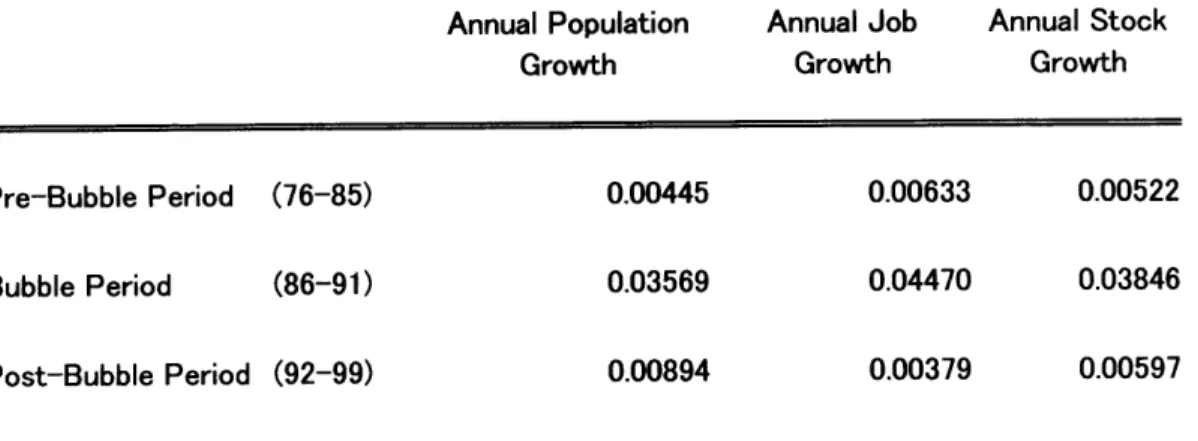
(1) In this period, gaps of percentage change among prefectures in population growth, job growth, and stock growth are almost the least among three periods. Standard deviations in each independent variable in each period are indicated in Figure 5.2..
Table 5.2. Standard Deviations in Independent Variables
Annual Population Annual Job Annual Stock
Growth Growth Growth
Pre-Bubble Period (76-85) 0.00445 0.00633 0.00522
Bubble Period (86-91) 0.03569 0.04470 0.03846
Post-Bubble Period (92-99) 0.00894 0.00379 0.00597
From reviewing the data set, it can be recognized that the growth rates in urban prefectures such as Greater Tokyo (Tokyo, Kanagawa, Chiba, Saitama), Aichi, and Osaka area (Osaka, Hyogo, Kyoto) are outstanding in this period. However, it can be seen that the magnitude of these gaps between urban and other prefectures were not
so significant that annual percentage change of land price could not be determined or influenced by these three independent variables.
(2) It can also be thought that in this period, there was still much available vacant land within and surrounding urban areas enough to absorb people and jobs from other areas. So the inflow of people and jobs to such an extent into urban areas were not reflected in the land prices, but only made expand city borders in the urban prefectures. The high growth rates in surrounding Greater Tokyo area such as Tochigi and Ibaragi and surrounding Osaka area such as Shiga and Nara also indicate the efficiency of this hypothesis.
5.2. 1986-1991 (Bubble Period)
Using the data set shown in Appendix 3, I tried the same analysis as that of the Pre-Bubble Period. Since correlation among independent variables in three growth rates are too strong as in the case of the Pre-Bubble Period, I tried to combine density and one of these three growth rates and ran regression analyses by two independent variables. The results were that independent variables were well fitted to average percent change of land prices. Following are the equations that I could obtained from these regression analyses.
ZIP commercial = 3.11E-0.5ZD + 1.10POP + 0.059 R2= 0.67 ZP residential = 2.86E-0.5ZD + 0.95ZPOP + 0.036 R2= 0.69 where, P = percentage change of annual land price, D = density, POP = percentage change of annual population growth:
In the same way, equations when the independent variables are density and job growth, and density and stock growth, are following
ZP commercial = 2.46E-0.5ZD + 0.86ZJOB + 0.044 R2= 0.62 ZP residential = 2.34E-0.5ZD + 0.73ZJOB + 0.023 R2= 0.63 where JOB = percentage change of annual job growth.
ZP commercial = 3.3E-0.5ZID + 0.87ZSTOCK - 0.022 R2= 0.59 ZP residential = 3.03E-0.5ZD + 0.76ZSTOCK + 0.035 R2= 0.61 where STOCK = percentage change of annual stock growth.
In the Bubble Period, the Japanese economy was in good condition especially in service businesses such as finance and real estate because of the background that I explained in Chapter 4. Almost all these companies located their headquarters in urban areas especially Tokyo and Osaka, and employees concentrated on these areas. Also, foreign firms, especially in financial business, launched in Tokyo to expand or start their business in the expected future global financial center. This situation created many jobs in the urban areas and, thus, people outside those areas came to get
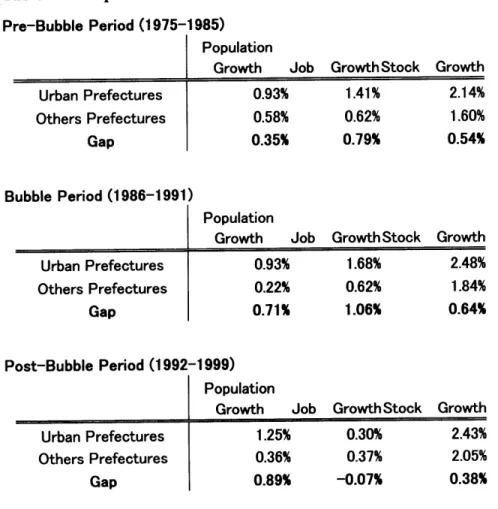
good opportunities and jobs. Actually, the growth rates gaps between eight urban prefectures and other prefectures comparing Pre-Bubble Period, Bubble Period, and Post-Bubble Period are almost the largest in the Bubble Period as shown in Table 5.3..
Table 5.3. Gaps in Growth Rates between
Pre-Bubble Period (1975-1985) Population
Growth Job
B
P
Urban and Other Prefectures
Growth Stock Growth
Urban Prefectures 0.93% 1.41% 2.14%
Others Prefectures 0.58% 0.62% 1.60%
Gap 0.35% 0.79% 0.54%
ubble Period (1986-1991)
Population
Growth Job GrowthStock Growth
Urban Prefectures 0.93% 1.68% 2.48%
Others Prefectures 0.22% 0.62% 1.84%
Gap
0.71%
1.06%
0.64%
ost-Bubble Period (1992-1999) Population
Growth Job GrowthStock Growth
Urban Prefectures 1.25% 0.30% 2.43%
Others Prefectures 0.36% 0.37% 2.05%
Gap 0.89% -0.07% 0.38%
* Numbers are averages of each categorized prefecture's growth rates.
The gaps of these independent variables among prefectures in the Bubble Period became so significant that the land prices in urban prefectures were influenced to soar by these fundamentals' changes.
businesses and were obliged to reduce their population and job supplies. As a result, land prices did not rise as much as those of urban prefectures.
However, relatively low R square scores indicate that independent variables cannot be described as determinants of land prices. As described in the last chapter, financial factors strongly influenced the movements in land price.
In sum, fundamentals such as density, population, job, and stock growth influenced, but did not determine the land price in the Bubble Period.
5.3. 1992-1999 (Post-Bubble Period)
For the Post-Bubble Period, I tried the same analysis as these in previous two periods using data set shown in Appendix 4. That is, I tried to combine density and one of these three growth rates and ran regression analyses by two independent variables.
The results were that density and three growth rates turn out to have negative correlation to land prices and high t ratios indicate strong significance. It can be explained that the more the population, job and stock grew, and the more densely it is, the more steeply the land price declined in the Post-Bubble Period. The results indicate that, in this period, land price moved quite against the economics theory.
To find the real determinant, I picked the data of percentage changes in land price of the Bubble Period as the independent variable because I found in the data set that urban prefectures' decreases in land prices were significant in the Post-Bubble Period.
I thought it could be explained from the concept of cyclical movement of land price. I
reran cross-section regression analyses setting annual average percentage changes in land prices in 1992-1999 as the dependent variable and those in land prices during
1986-1991 as the independent variable
The results were that both commercial and residential land price indicated significant negative correlations to the percentage change of land prices in the Bubble Period. For example, R square of commercial land price in Post-Bubble period scored to 0.90 and that of residential scored 0.91.
As explained Chapter 3, it can be said that two big factors, drastic monetary policy to suddenly increase the interest rate and re-regulation to restrict real estate investment, triggered the decline in land prices. In addition, several shocks, such as the breaking of banks' bad loan problems and the pulling out of foreign companies, promoted the falling tendency of land price still more. As the rises in the Bubble Period were extremely high in urban areas, the rebounds suffered the steep drops in land price in the same areas.
5.4. Limit of the Analyses
The methods that I utilized in this chapter are statistically reliable in that they apply objective data (Koji Chika and four independent variables) into homogeneous geographical units (prefectures). On the other hand, the stiff methods might have some notable disadvantages such as the following
5.4.1. Prefectural Internal Problem
As introduced in Chapter 2, each prefecture has its indigenous characteristics. Among these, demographical factors influence much in this analysis. For example, though Hokkaido is least dense prefecture amounting only 68 persons per square kilometer, Sapporo, the fifth most populated city (1,809 thousands people) in Japan is located in this prefecture. It goes without saying that movements of land prices are quite different between Sapporo and a village in a great plain in Hokkaido. Each prefecture has such population gaps within it and their magnitudes are quite different depending on prefecture. This factor makes it difficult to compare land prices on a prefectural basis.
5.4.2 Gaps in Observation Points
Among prefectures, numerical gaps of observation points in Koji Chika are very significant. For example, in 1999, there were 2,906 observation points in Tokyo, but only 152 points in Tottori. Also, the revisions in number of observation points have been arbitrarily implemented year by year. In addition, in the earlier period that Koji Chika was issued, observation points were very few compared to these of the current period. For example, Akita had only 20 observation points for commercial areas in 1975.
Chapter 6 Conclusion
6.1. Findings from Land Price Table
" After World War II, Japan experienced two significant peaks in which land price jumped and then sharply declined within quite a short period, around 1974 and around 1990. For each period, extremely law interest rate and expected growth rent pushed up the land price. However, as the peak in 1974 was correlated with overall CPIs, the significance in boom and bust of land prices was much declined on a real level. On the other hand, the peak in 1990 was a kind of anomaly in that CPI was quite stable but speculative objects such as real estate and stocks raised
their prices. To the extent that fundamentals can explain the movements of land prices, the peak in 1974 can be called to be the rational Bubble, but the peak in
1990 as the irrational Bubble.
" In the 1974 peak, the rises of land prices in undeveloped prefectures were significant but those of urban prefectures were not. In contrast, in the 1990 peak, rises in land prices in urban prefectures were much larger than those in undeveloped prefectures. In the 1974 peak, land prices were derived mainly by the policy to adjust the economic gaps between urban areas and other areas. On the other hand, in the 1990 peak, growth expectation in the urban office market and
the changes of banks stance to focus on lending real estate investors induced speculation into urban prefectures especially in commercial properties.
6.2. Findings from Cross Section Regression Analyses
" In the Pre-Bubble Period, land prices were influenced only by density among fundamentals. Population growth, job growth, and stock growth, all of which are thought to be the determinants in economics, did not influence the movements in land prices on the prefectural level. The reason for the unexpected result can be explained in the following way. The gaps among these growth rates were not so significant that the difference could not influence the movements in land prices. Also, urban and surrounding prefectures had much vacant land enough to absorb
the inflows of people and jobs in that period.
" In the Bubble Period, contrary to the notion that the Bubble was caused only by speculation, fundamentals such as density, population growth, job growth, and stock growth strongly influenced the movements in land prices. Stimulated by good economic conditions, people flew into urban prefectures to get good jobs and, thus, job and housing stock grew. These changes in fundamentals pushed up the soaring of the urban land prices.
" In the Post-Bubble period, though growth rates were still increasing in urban prefectures, the collapse in land prices in these areas was the most significant
among all the prefectures. It can be said that shocks such as breakout of banks' bad loan problems, pulling out of foreign capital from real estate investment, and sudden changes in monetary policy and re-regulation caused falling trend in land price and it suffered the areas where land prices mostly soared in the Bubble Period.
~1
'it
~
I 1 Y' L I+--L- --4-L I I - 8-stse22$ U -sa a U -. sa 9 smaxmiy8 i x -U§ -A a U-a -a -siaugat a U-. a U-9 2sasat arsi i a 2 as
N~aagui .1. ia a ii 9 0 Cr0
. . . s -0i i Me.$ ; Egaxi22jE 5 2asm .x 9 5 2asae a s ; ssiii i s asim i 2siea & % i ssseE A s i 2ss2R -. Ui3 6 2 E U mnsgR S asias i issi a : i 5229s2 8.s a a a~i i~
[lit
'" r 9e7 97 >gel
F___
ill~
.s Ii
itssaaM§ES .a . .5amsa15
.5 .. a 8~.i
saas
it
I 231 53 -Mi aiia
iE
S A . * a ssNR Bi
asas
se
$
aiis
ag
a s-;sa~ssa*si
.3 .a S. a s.Its
A-. as ;Aox:a mli aa-!2. i as We ab v 5 saas ;age S3 M C a3 a J. a M. i* st. i s ;alas salE a -L a a. a -. 9 s 4rle -al a E .3 &sUAssI#LII 1974 1978 '"* 1984 I- '.. I03 '...,,,, les0Ign~pasagt ! gg:g pagrzne ' -g y ggag pag' 5 ';A fgn e -sgg g s j§en~sg se g§g A§2ngses 3§3 aS?4§gg esu -5g is -ggfgaI a Egezt gagga -ga a 4 §W T§~C sat se me Le -a e e a aa e La -U
I..
5' -g q flge r4I!*g Uggns fgensa2§2 gg't ';" *aV 'eistl -N aa an31SA§sUg agI ne s§k' Cgsg LU -ta -n wg 1 *lgt Lnget 4 -f V 3ga*eng2*ge glut i;go5 -a 'A agIf
I
Lift SjI
Met Mt oat Uot Ket a 8 a a 1?tFL
"iii
Ii"
-3 '1 C I ~ . e- ±§3 u a 1ii lra na 14 "s4ssia E '4ri s i * U U a..~..-ifase 33 EE .e. * V-8 N.. *e istaAEi 1* hi
-~ug
ausa se 8a N-MIssis* kas13
IN3 .7-7791
b i
i aaii
-W-is a!lti ;bi is ;J 8v Is a . 3. A 9 1 i ss iwIas a I. a -auEs axi a I. .919 .3 .. a ... 4 ase .ee U *. 8 V..sas ifssaki S E. Us ass .. o a 9.48~i i~
si o IR*f;; se time g eg e a Tq§Qxga Sa ;Rg 5v 8;w f q A z ;gag pgsV 4t Solzggs i -ga Ues -A e ges "g g I§ a ea m 8 ent Mt its S netG I __ 'L6t
aj
i
IM
I=
eI
-'Ue 9 if 5A--9 8 A ggn iiggeti 6 4 't e gu i§g eag e A g4 I§8 a'I ' g- a -egs -gar Uose Egg~ae a Ugee ag gga -e 3 ge g Atfgge ggaRi gegn gg Ae~i I§r gea g gg Bea i ggU" giga '" U g O O O O OO~II
Si-i'ii~~~..1
T -G#P
lii
1972 1974 1970 -7 I i ,,,, 977m
W71 U' 5 19 193 9U7N1
:
-I
r
K Is19is a 9 I H -a $.i a V. 8 . aseu sE 2 5i
i
S 0.i
sEssi
8 8 -i . ; Essas~ i p " a as ! I s svu 2a aII-§ emsas;a:§§ v Is it ; M. a 2. K 3. ? L-i =Esa2e
~a
i m !sma 8 8. i a 2x:E i 2Fi
I P 3. § -3. 6 -1311 s4is~
n
A A [Pi *R*a-1
-i- -499 -cs j e Keg -t K -13s Mee3tE! t -K -t KCE -Hf 'i ' -p 9%:9 115 ENh N A K -A K A K 5* '11 3 A K £3'5 51655 IN & aA
I
.4 7 ? 1 -' K -i 7~j i~
~1 Si LU' SKI OW, 'SI a 596% SN gseNNE-7 -p -A K Ai K S I -A a Aga
-K K -3I C5' 53' A ge g3gs 555514 A t A j S -L 'SI I~ InHI
till
i
a i
6
l I
W3 mi i
1974 1078 1973 19 134 im19"i
iliji
Ii"
1
7 17M 1[
is
i
ia Stue
i
a
i
5 i s s a a . I sa nss 9us X M as ;:.!gas 2§1l r a r, ;H ml S s lita ar v a:$ ea a ;6 8: 3§ I .I-i ta ". * asamaee
amass
iE
* N. aasa
iIs
n s
: EO
aiiat
i
B eats aEi
ease
ae
-I.i
ass
sl
8 . 3 8aishee tsi 1974 1970 1978 low 1" 134 im I- 1902 1934 low 1930 Iia *9 a m.
a
I
zI
V -8x i aN is $$-. ; 2i saimml
i
s sami
* Ni
a
iami
8 3 i3 sa 18aa B 3 8 . . ; 8. a LMasieas
8 s.$ aasi
l
i
ass~R
i as aj i s2
5
i ,2 8 8..esa-f if
A a a s j;; a g sa gg g- ge A A v g§gNsaga -i S -v u geB eagege 3-maggge 8rgs e -gg g 'gUe gg gsge sa gss i 8agaa v -s -*§
*
I
I
E.1
ELjjj
ml los tI
Sol .. CLO, 8owli
1cml
A g -A g gga s~ 'U ggg engg S Egieg g §gEN gg§sg sagsg sa -g U ige'~UgereN -i 3 ggUg e~Na SN -g S -I E *§g 4 -g I 8 --u U -u N 8$ $$ $ 5 m e- neiia
mt ml t Lst s 106! LU. guthi
thu
3*33*333; z so ISHSH st
t.uA-333a a 9999 s.o its i a f 133~~~ " a~m s s I -~ i-. 83 2usub asa a s. 3: a a I;; 9. as 3a .E 83 9.~M
~I
-. .. .3 M * .. 8s3as ai U I E . 83 aj s s a 3s E .8 9.. 8: ima .E 2 3 ise -t i a§~N-Ea sas
sE
9* asine # II
i
au as x a x .4 a i Tx a a a i '2 § a si a Uaa i 41e n:9 ii g -asasas xe a 5 as assn a a a 2 9. s Ii
ssa
a
s
~g
K-2. se :aI s 9 3 sies . ai 9t 9A i
i i
N N
1077 1974 IND. 1M1M it I- 1900 "" 104 "Uas
I vr v E g c 117 rig94 9 ex 3 ; 0g re t O
ia
Uiareg"an
e"eans
' N§i agen's *i; "g~esg
jeg gae a n 9 -e "g-~I
C, flog95 t 9 4N . 1 i g~ 5 a ggug gggi -g ' gwa9fgtig 3 --g g gggesag ' *gasag3a~gg
g3ngg'N -eg ;esa -ge eUa a area~ 'I -i em Ua
u -a 'N a sg 'Ng -e -ga 'N anaannn-*
"
on[j
Lt
11
I--f
Jill!
g. a -We CAVA59 V g g -if 9 --g 6 U a
~
eg...Wg.,c g A -a -N-9 N -gg Ngggs-I
"
gggIggg
-mt *te ,, I OLLII
'?
L
II * age 1§e1goig r 9 g -g * a 9 Aa esseA 1.9 s;g neee igng saee -g e g s gag e gg usng i -ga iw *sse hesages -gg g-an -gg -g -*9 * I I I I I ~ S IlLGl~i j~
I
I
di
~~1iii
1970 1972 1974 1970 1978 . 1
IMI
I- M is 1964IiMi
II
iN
Ia %Nu. mumI
IV Mrss 10i 3; 108!5 ail a 4: -S r p -. ., 3~. -I -p -if: flssa: i§ I -. im iar a-.E S- U N: fAt: i~
ai i EN s IbI .1 .E. eIesN.* humi .1 , fat-t humsasii
IaI
i
9;; a 8~-.9
3 Nay aS. a ala dai Ui ktsan ns s itavi ;: wasba 1; e a i A 8. N St %i assag* g #3N -: sU s:gl 7' V a t S I 3* as§s assas N-ss . i t U pi is . N-i a S 36* sbifsiA Oai
i Na
5
'Id
1972 1974 1978ImI
"
1se I 1902 979 sa --M3[m ii
5s ina in & a 3. 5 is g I s entisiin i Ii 8 .as
ise
s5
8 3. 3bmsa s3.a
5.
i ,. i 5 1.~ i 8 3.samat 3 . 3 a 5a et K E. En a a iN..i 5 .. eS ItMi*it si N K 3 esih siy
5
go I * i i sa §ass i 7am s a a i sirsi 8 . A 5 x sieaai
i
sst
S in Ls20 i s sa sas .. U. i ssimA s S..~i
2Eai i 2 sa i.s
9
Im
. aii "" "" : "H r ""Im ff411 H
A # '
~
a 8 *g aea a gag Eng g tg g -V~
a U gHet saggt 'g -a c ggRgt"seg!t nA ya -g ca e gjaga e gaci ci gg sag e 4 4 'c eri gut Lwt I -a m, sees LLBL GtL 8 a a v a iox; 9'Uf$F A 1 Jim~ag
c give FAM fe-~
. 2 a -m ; c"a a f ag A of jus Is; ea u- t SRRRR -i i -i -g K gg Vng e L§g m'"Retsa "g -; VII
I
L S961 mi .1 1861 Lu'I t R u a a v RIm
mI
-WefMe i Idi
liii'
4 i a -3 4 5 3 5 3 a g Uaeg a 5 N4 R I .- s ai -a 4ga 5 -g geU -"uging 5 -n a U
Ac A
A
j
-g -a -am ESg igmns Ic $gA0 gMNA gV a V e II s§s" 3 n e g~g e gag 2; g~ gae a s *1 3 -aaa U0jj
LLLL)9K?1
552946NI
I
U.'Phl
H
I--I
I"
1982 M64 -41 -I 197 1974 19763 -1 1.4 I--t '.4ow
i
I
a
.5 ;IX !a u . i g I-a E.~
Au*ssass3 -.5
tss
es * s saa si~
~3~§83.
3 a sna t! S a2 L 3~ S N Sis eE i *ais ss .s 0 3 emsa at a . i mMis Essi i I.. 5 i Uin Es si i S Es~ss~i i ..i
a
Esa2E
S N- !~ i a 4S* EE 3 2. g5
sts*
st
-.x t 3 e s 8 p . i a asems 8 E5
a
:smE 8 s esas a si
a
ssae a s * a s r i s i saiass a 3 a i a ieas 83It33:E8 ; m sais U 3 33ss* is 3 i a sais a L. P 2 2. , a 9 8 a s s awa.C5u uS I eF -t U ea *qgoi* FgIR Fig x $1 s so f R I a 3 -t Sags*S jgS -aIstI S '-S a9g e S A 3 -g ... ga§R- CW3- C -"em U' e I F 5f55 us' sagsg es * a; qagge 's '-I s A s -g
s
sgea
Ag S linge S!Rs S gSte SI ggert~AC
53 gA rgsgs 'g 3 -tg tsegguqt
s~ug a -aaa 3 aWijl
C * ues cige mel Wit C m- Will us. u. 6±6 d 16 Lee552 6 Sm I m -Los 11511
ill'
'iii'
*§3fag fa U a g§eefeNgei g1 s Hg e3§UAg? -gr sg?? N§*$9eP§!t