ANCIENT WEST MEXICAN BELLMAKING
byShawn Patrick Doherty
Submitted to the Department of Materials Science and Engineering in Partial Fulfillment of the Requirements for the
Degree of Bachelor of Science at the Signature of Author: Certified by: /1O1 Certified by:
Massachusetts Institute of Technology
June 1998
1998 Massachusetts Institute of Technology All rights reserved.
Signature redacted
Department of Materials Science and Engineering May 8, 1998
Signature redacted
V
Signature redacted
Samuel M. Allen
Professor of Physical Metallurgy
Thesis Supervisor
Dorothy Hosler Associate Professor of Archaeology and Ancient Technology Thesis Supervisor
Accepted by:
Signature redacted
DaviV K. Ro'lance Chairman, Undergraduate Committee
AN 2 1 0I.
-A - - f -
77 Massachusetts Avenue
Cambridge, MA 02139 http://Iibraries.mit.edu/ask
DISCLAIMER NOTICE
Due to the condition of the original material, there are unavoidable flaws in this reproduction. We have made every effort possible to provide you with the best copy available.
Thank you.
The images contained in this document are of the best quality available.
MITLibraries
---ANCIENT WEST MEXICAN BELLMAKING
bySHAWN PATRICK DOHERTY
Submitted to the Department of Materials Science and Engineering on
May 8, 1998
in partial fulfillment of the requirements for the Degree of Bachelor of Science
in Material Science and Engineering
ABSTRACT
About 600 A.D. the people of West Mexico incorporated metallurgy into their culture. Some of the objects that they made were utilitarian, but most had ceremonial value. The objects that were most prevalent were bells. These bells were produced using a lost-wax casting method. The only historical record of this process was the Florentine Codex, written by Fray Bernardino de Sahagun in 1555. Based on the artifact records and the Codex, a process was designed to mimic the
technique used by the ancient West Mexicans. The process is described along with the problems that occurred during the casting runs. The cast objects and molds were examined to determine their similarity to their ancient counterparts. Based on the findings in this study, the process set forth is a reasonable replication of the one used by the West Mexican craftsmen.
Thesis Supervisor: Samuel M. Allen Title: Professor of Physical Metallurgy Thesis Supervisor: Dorothy Hosler
Table of Contents
Title Page... .. ... 1
Abstract... .. 2
T able of C ontents... 3
List of Illustrations and Figures ... 4
L ist of T ables ... . 5
A cknow ledgm ents... 6
I. Introduction... . 7
M esoam erican Prehistory ... 7
The West Mexican Metalworking Zone ... 9
Symbolism and Production of Lost-wax Cast Bells... 10
II. Statem ent of Purpose... 11
III. Experimental Procedure... 12
Original Lost-wax Casting Process... 12
Modified Lost-wax Casting Process... 13
Process Param eters... 15
IV . Experim ental Results ... 18
C asting R un # 1... 18
C asting R un #2...20
C asting R un #3... 2 1 Casting Runs #4 and #5... 23
C asting R un #6... 27
V. Results and Discussion... 28
Summary of Casting Results ... 28
Core and Mold Compositions ... 29
B ell Shape ... . 3 1 Sprue Shape ... 32
Core to Outer Mold Connection...32
Analysis of Cooling Rates ... 33
V I. C onclusions ... 36
Evaluation of Process ... 36
F uture W ork ... 37
R eferences C ited... 40 A ppendix A ... 4 1
List of Illustrations and Figures
Figure 1: Map of Mesoamerican archaeological sites... 7
Figure 2: Topographical map showing the limits of the West Mexican metalworking zone... 9
Figure 3: Lost-wax casting process: (a) core. (b) wax mold. (c) sprue and vent. ... 14
(d) outer mold material. (e) wax burnout. (f) pouring metal. (g) break away mold Figure 4: Clay and Charcoal Mold after pouring (from casting run #5)... 16
Figure 5: Bell from Casting Run #1 (front view)... 19
Figure 6: Bell from Casting Run #2 (front view)... 21
Figure 7: Bell from Casting Run #3 (front view)... 23
Figure 8: Bell from Casting Run #4 (front view)... 25
Figure 9: Bell #1 from Casting Run #5 (front view)... 26
Figure 10: Bell #2 from Casting Run #5 (front view) ... 26
Figure 11: Bell #2 from Casting Run #5 (side view) ... 26
Figure 12: Bell #3 from Casting Run #5 (front view) ... 27
Figure 13: Location of sample taken from bell wall for microscopic analysis... 34
Figure 14: Micrograph of dendrite arm spacing for 11% Sn-bronze bell wall (mag. 15x) ... 34
List of Tables
Table 1: Heat Treatment of Molds After Burnout and Prior to Casting ... 17
Table 2: Process Parameters for Casting Run #1 ... 19
Table 3: Process Parameters for Casting Run #2... 20
Table 4: Process Parameters for Casting Run #3 ... 22
Table 5: Process Parameters for Casting Run #4... 24
Table 6: Process Parameters for Casting Run #5... 24
Table 7: Process Parameters for Casting Run #6 ... 27
Table 8: Summary of Casting Parameters and Problems ... 28
Acknowledgments
I would like to thank Professor Allen for leading me through this process. He was always there to encourage and direct me. I would also like to thank Professor Hosler, who taught me everything I know about ancient West Mexican bells and pushed me to follow my instincts and do this project. Thanks also goes to Toby Bashaw, without whom none of this work would have gotten done. His guidance and assistance in the casting process were irreplaceable. Finally, I would like to thank Matt Neumann, who started down this path and whose work I used as my starting point and reference.
I.
IntroductionMesoamerican Prehistory
Mesoamerica comprises the regions of central and southern Mexico, Belize, El Salvador, Guatemala, and western Honduras. This region was one of the few areas of the Western
Hemisphere in which civilization first developed. Mesoamerican people lived in a variety of settlements, from large cities, such as the Aztec capital of Tenochtitlan, to smaller towns and agricultural villages. Over several thousand years the peoples of Mesoamerica developed from small, foraging bands to a population of approximately 25 million people at the time of the Spanish invasion in 1521 (Fig. 1).
Figure 1: Map of Mesoamerican archaeological sites
SINALOA
GULF OF MEXICO
Amapa', YUCATAN
PENINSULA
PACIFIC OCEAN Ixtl'
-I' -r "MEXICO
To citdn iU
Autidn Tzintzuntzan acn
-- z io Tingmba co Teinchtitlan.
' - Tikal. BELZE
MICHOA'- M San Lorenzo
GUERRERO/ '
G H \ *Monte Albdn
//// Limit of West Mexican Metalworking Zone HONDURAS
By 2000 B.C., Mesoamericans had developed agriculture and some regions began to become settled. The earliest complex social forms appear during the Formative Period (2500 B.C. to 150 A.D.) among the Olmec in the Southeastern Lowlands region of Mexico, such as the city of San Lorenzo. Complex societies also developed at this time in Cuicuilco in the Central Highlands region. These civilizations had social distinction, resource distribution, labor management, and skilled laborers and craftsmen. By 1200 B.C., public buildings were in the central highlands and by 400 B.C., small polities were flourishing (Hosler 1994).
During the Classic Period (150 A.D. to 900 A.D.), urban areas were flourishing in the Central Highlands region and smaller cities were in the lowlands area. Complex societies were developing throughout Mesoamerica during this period. The largest of these urban centers was Teotihuacin, which was one of the largest cities in the world at the time. The city covered over 20 square kilometers and was home to over 125,000 people by around 600 A.D. Teotihuacin
exploited its resources to gain political control of the entire region. However, in all of the accomplishments of this great civilization, there was no use of metal. The Maya civilization also developed during the Classic Period. They had several cities in the Yucatan region, Guatemala, and Belize. The largest of them, Tikal, had a population of over 20,000 people. The Maya had complex technologies, architecture, writing, pottery, and agriculture, but also did not use metalworking.
By the beginning of the Postclassic period (900 A.D. to 1521 A.D.), many of the large and developed civilizations declined and collapsed. Smaller city-states formed to take their place. Metalworking did not become known to these areas until this period, when it entered from West Mexico. The only region in which metallurgy developed before the Postclassic period was in West Mexico.
The West Mexican Metalworking Zone
The West Mexican metalworking zone encompasses the modern states of Jalisco,
Michoacin, Nayarit, Colima, and parts of the states of Mexico, Sinalo, and Guerrero. The region is topographically diverse, but unified by the abundance of metals and ores throughout the region (Fig. 2).
Figure 2: Topographical map showing the limits of the West Mexican metalworking zone
SY Y" -CENTRAL
MEXICAN GULF OF MEXICO
PLATEAU .~'14
14~
S YUCATAN
PACIFIC OCEAN RK -a PENINSULA
S Transverse 'Micanic Axis ~EI ~ ~ g ,
---Limit of West Mexican Metalworking Zone
~-i* On.
) 100 200 300 400km
-.14
During the Formative Period, small villages and hamlets were formed in areas suitable for
agriculture. By the Early Classic Period, polities with ceremonial structures began to be built, but were not as large or complex as those in the Southeastern Lowlands or Central Highlands. From 600 A.D. to 1000 A.D., political hierarchies developed in the area, such as the city of Teuchitlan These cities had monumental public architecture, plazas, ball courts, pyramids, and other
Metallurgy was introduced to the western region of Mexico between 600 A.D. and 700 A.D. At this time, Mesoamerica was one of the last regions of the world to develop metallurgy. By the time metallurgy arrived, the West Mexican people had a well-developed civilization, with architecture, writing, a calendar, and astronomy. The West Mexicans had already developed tools using non-metallic materials, so there was little need for metallurgy for utilitarian purposes.
Instead, metal working was used primarily for ceremonial purposes. Objects, including tweezers, rings, ax monies, and bells were made using metal working. Some of these objects, such as the tweezers, were cold worked, but most of the metal working was done by lost-wax casting. The primary objects produced by lost-wax casting were bells. For example, in Amapa, an
archeological site in the northern region of West Mexico, over half of all the excavated metal objects were lost-wax cast bells. In addition, at the Regional Museum of Guadalajara, the metal collection consists of approximately 3200 pieces of which 1934 of the objects, over 60%, are bells. The bells, and their production, were an important part of the lives of the ancient West Mexican people.
Symbolism and Production of Lost-wax Cast Bells
The ancient West Mexicans used objects such as bells for ceremonial purposes, hence these objects were produced with properties that would enhance their symbolic value. Sound and color played a vital role in West Mexican society. The ringing of bells was associated with fertility and regeneration as well as an invocation of protection during battle. An object's color also held symbolic value. The golden color was associated with the sun god and the silver color was associated with the moon god. To produce objects with these desired physical characteristics, the West Mexicans had to produce the bells using specific materials and techniques (Hosler 1995).
The ancient West Mexicans produced bells by a lost-wax casting technique using copper and copper-based alloys. From the initial introduction of metallurgy until approximately 1200 AD, the West Mexicans primarily used pure copper in their castings. After 1300 AD, they began to
exploit a variety of alloys, primarily tin bronzes and arsenic bronzes. These two alloys were not used for their mechanical properties, rather for their physical properties. In many of the objects found in West Mexican sites, high concentrations of tin or arsenic are found in the bronzes. These percentages were much greater than necessary to maximize their mechanical properties. High concentrations of tin in bronze give the material a more golden color, while high arsenic
concentrations give bronze a more silvery appearance. This color change is the most likely reason that the concentrations are so high (Hosler 1995). Although much is known about the materials in the bells, not much is known about the techniques used to produce them.
Most of the ethnographic information about the West Mexican bell making techniques was documented by Fray Bernardino de Sahagiin in 1555. In his General History of Things of New
Spain or Florentine Codex, he documented much of the Mexican civilizations as the Spanish
invaded during the 16th century. Included in this document was a process used by the native people for casting gold. It is assumed that the process used in the 16th century was the one developed in West Mexico during the previous 900 years.
II. Statement of Purpose
In my work, I tried to reproduce the techniques used by the ancient west Mexicans for casting bells. The study of the techniques was a process of reverse engineering. By using the ethnographic evidence along with archaeological objects, I proposed a process that the ancient West Mexican craftsmen may have used. I tested this hypothesis by building molds and casting bells using these methods and materials similar to ones used by the ancient craftsmen. From the results that I gathered, I determined problems that may have confronted the West Mexicans when attempting this process. I then altered the process, so that future results were more similar in nature to the artifacts. Finally, I evaluated the final process and the cast objects to determine if the process was likely the one used in ancient West Mexico.
This research did determine a process that produced objects similar to ancient ones by using the ancient techniques. However, all of the factors for casting in a similar fashion to the West Mexicans have not been evaluated. Only through continuing research in this area will we be able to find a more proper technique to the one that was used. In the following paper, I hope to shed new light on the way that the ancient people of West Mexico developed a metal technology and take those first steps towards understanding the methods completely.
III. Experimental Procedure
Original Lost-Wax Casting Process
The process of lost-wax casting is a method for producing metal objects that has been used for thousands of years. The process, also called investment casting, consists of the production of several molds and concludes with molten metal being poured into the final mold to produce the finished piece. The Florentine Codex described the lost-wax casting process used by the Mexican craftsmen in 1555. It lists many of the steps needed for the process, but it is not an instruction manual, just a series of observations.
The craftsmen fashioned [and] designed objects by the use of charcoal [and clay molds] and beeswax [models] to cast gold and silver. With this [step] they made a beginning in their craft. To start with, he who presided distributed charcoal among them. First they had ground it, then they added it to, they mixed it with, a little potter's clay; this was the clay which served for ollas. Thus they worked it into a cohesive mass, so that it would dry and harden.
And also they prepared it: in just the same manner [as tortillas] they made it into flat cakes, which they arranged in the sun; and others were likewise formed of clay which they set in the sun. In two days [these cakes] dried; they became firm, they hardened. When they had dried well, when they had hardened, then the charcoal [and clay core] was carved, sculpted, with a small metal blade.
When the charcoal [core of the mold] had been prepared, designed, carved, then the beeswax was melted. It was mixed with white copal [a pine resin], so that it would [become firm and] and harden well. Then it was purified, it was strained, so that its foreign matter, its dirt, the impure wax, could fall. And when the beeswax had been prepared, it was then flattened, rolled out, upon a flat stone with a round piece of wood. It was a very smooth, flat stone on which [the wax] was flattened [and] rolled.
When it was flattened, just like a cobweb, nowhere of uneven thickness, then it was placed over the [carved] charcoal [and clay core]; the surface was
covered with it. And carefully it was placed on the core; cautiously little pieces of wax were cut off or pared away. By means of a stick [or sliver of wood] they went making it adhere [to the core].
And when it was prepared, when everywhere the beeswax was placed, then a paste of powdered charcoal was spread on the surface of the beeswax. Well was the charcoal ground, pulverized; and a rather thick coating [of paste] was spread on the surface of beeswax.
And when it was so prepared, again a covering was placed over it, to wrap, to envelop completely the [thus far] completed work, in order for the gold to be cast. This covering was also of charcoal, also mixed with clay -not pulverized but relatively coarse (Sahag'n 1959: 73-75).
The mold was allowed to dry for several days. During the drying time, a sprue and vent were attached to the mold. After drying, the mold was placed into a brazier or crucible to melt out the wax. When the wax was removed, the molten metal was poured through the sprue and into the mold. When it was solidified the clay and charcoal mold was broken away and the core was removed with a sharp tool (Hosler 1994). This description was not a very detailed one since it was probably written by an observer of the techniques not a practitioner. In order to replicate the process, I had to make assumptions about some of the steps that were not described or not described in detail. In addition, I modified some of the steps of the process described by Fray Bernardino de Sahaguin in order to simplify the process.
Modified Lost-wax Casting Process
The process used in this study was a modified version of the one illustrated in the Florentine Codex, but still contained much of the original steps used by the ancient craftsmen.
Figure 3: Lost-wax casting process: (a) core. (b) wax mold. (c) sprue and vent. (d) outer mold material. (e) wax burnout. (f) pouring metal. (g) break away mold
(b )
First, the core was created from a mixture of clay and pulverized charcoal. The mixture was molded into the desired shape of the core and allowed to air dry for one or two days (Fig. 3a). Unlike the ancient craftsmen, I chose to shape the core prior to drying. I felt that this alteration would reduce wasted time and energy, while still obtaining a core similar to the ancient ones. Second, beeswax was rolled flat and applied uniformly to the surface of the core (Fig. 3b). The wax was applied in pieces that were smoothed together once on the core. A narrow, elongated opening or slit-shaped area was left wax-free on the core. This region would form the mouth of the bell and provide a place for the core to be attached to the outside mold material. Third, a sprue
and vent made of beeswax were attached to the wax mold (Fig. 3c). When the wax is removed, the sprue will provide a channel for the metal to enter the mold, and the vent will allow gases to escape from the cavity as the molten metal enters. The Codex was not very clear about the composition and attachment methods of the sprue and vent, but this method is similar to modem techniques and it was assumed that a similar process was used. Fourth, the wax mold was covered by a layer of charcoal and clay, so that it was totally enveloped except for the top of the sprue and vent (Fig. 3d). This coating creates the outside of the mold into which the molten metal will eventually be poured. The molds were allowed to dry for a day or two in order to harden and gain structural stability. The molds were then heated so that the wax melted and flowed out of the mold (Fig. 3e). During this burnout process, the wax leaves a cavity that gives the lost-wax process its name. Then, molten metal was poured into the sprue and allowed to fill the mold completely (Fig. 3f). After the metal had cooled completely, the outer mold material was broken away and the core carved out with a sharp tool (Fig. 3g). What remained was a metal object in the shape of a bell; an exact copy of the original wax model.
Process Parameters
When attempting to test this process, there were numerous variables and parameters that had to be determined. Because of the scope of the project, I had to limit myself to testing only a few different parameters. The other parameters were predetermined and remain constant for the entire testing process. Many of the initial and variable parameters that I chose were based on similar work done by Matt Neumann. In his project, he tried to replicate the casting process of the West Mexicans. Early castings from this study used plaster molds, but later molds used clay. The cores were made of clay and charcoal, and the outer mold was made of pure clay. During the casting runs, both pure copper and tin-bronzes were used to make the bells (Neumann 1997). From this initial research, I chose the parameters to use for my castings. First, the alloy with which I chose to cast the bells was an 11% tin /89% copper bronze. I chose this alloy because it
was similar to the composition of many of the artifacts found in West Mexico and because it was a
composition that was readily available. Second, I chose materials for the molds. The clay was a white stoneware clay, a common potter's clay, and was used because of its availability and the information available about its properties. The charcoal was a hardwood charcoal purchased from a wholesale charcoal and coal supplier. The pieces of charcoal were pulverized and screened through a 14 mesh per inch screen so that all particles were smaller than 1.17 mm. The mold design was also standardized for all the casting runs. For each mold, the wax pattern was covered by approximately 2 cm of clay mixture, so that it would retain heat and be structurally stable. Near the top of the molds, two tabs of clay mixture were placed on the sides of the mold, one on each side. These tabs were designed to balance the molds upside down when the wax was removed and to provide a region that was able to be gripped with tongs during the pouring process (Fig. 4)
Figure 4: Clay and Charcoal Mold after pouring (from casting run #5)
The final variables held constant were the heating parameters. The wax burnout process occurred at 100*C for 180 minutes. This temperature was higher than the melting point of beeswax
(62.80C), and high enough to melt the wax quickly so it could drain out of the mold. After the burnout and prior to the pouring of the metal, the molds were heated to 1 100*C, so that the clay would bake and harden. The molds were held at a low temperature for several hours, then the
temperature was slowly raised over several more hours. Table 1 shows the specific heating process, which was done in a laboratory furnace.
Temperature Hold Time Ramp Rate Ramp Time Final Temperature
(OC) (minutes) (*C/min) (minutes) (*C)
150 1020 1.25 900 1100
Table 1: Heat Treatment of Molds After Burnout and Prior to Casting
The molds were kept at 1 100*C and then removed from the furnace immediately prior to pouring the molten metal. This elevated temperature was to prevent the metal from solidifying in the mold before it was entirely filled. With these parameters held constant, several others were varied during this project to study their effects on the casting process.
The parameters that were changed during the study had to do with one of three areas: clay to charcoal ratios, the wax pattern, and the core to mold connection. The first two parameters were the ratio of clay to charcoal in the core and in the outer mold material. The core needed to be structurally stable and not crumble when dried, but it also had to be able to be removed easily after the bell had been cast. By varying the amount of charcoal, I had to find a balance between these qualities. Similarly, the outer mold material needed to have structural stability, so that it did not crack or crumble during the heating or casting processes. It also needed to be porous enough to let gases through, but not allow metal to flow through the mold. Charcoal composition was also varied to maximize those qualities. Another parameter altered was the shape of the mold. Different shaped molds were used to see if problems occurred on molds with sharp corners or different dimensions. The locations and shape of the sprue and vent relative to the bell were altered to determine their effect on the casting process. Also, in some molds a suspension ring was added to the top of the bells. This structure was used by the ancient West Mexicans to hang the bells from their ankles, waists, and clothing (Hosler 1994). The suspension ring was originally left off the bells for simplicity, but added later to determine its effects on the process. The last parameter that
was changed in the study was the connection between the core and the outer mold. In each of the casting runs, the parameters will be defined followed by observations of the process and
preliminary conclusions about the results. After presenting results from all of the runs, I will present a summary of the results and discuss conclusions that can be drawn from them.
IV.
Experimental Results
Casting Run #1
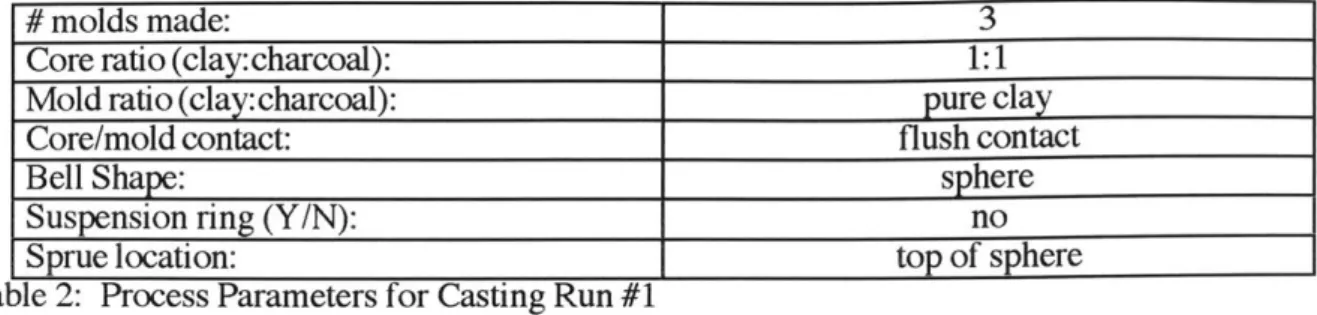
The goals of the first casting run were to produce a mold that was simple, so that the overall process could be evaluated easily. The core was designed to be easily removable, so a mixture was made with a clay to charcoal ratio of 1:1 by weight. I mixed 8g of clay with 8g of pulverized charcoal plus enough water to make a thick paste. The mixture was shaped into a sphere and allowed to dry. After drying the core, beeswax was rolled out into a sheet with a thickness about 2 mm and applied to the core, so that it covered all of the core except for a thin elongated area on the bottom of the core. Then the wax sprue and vent were attached. They were connected to the wax surface by heating the surfaces over a flame and then pressing them together. The sprue was attached on the top of the wax-covered core, opposite the opening in the wax. The vent was attached to the side of the core. The wax mold was then covered with clay so that there was about 2 cm of clay around all of the mold. No charcoal was added to the outer mold material, in order to maximize the structural stability of the outer mold. The connection between the core and outer mold material was a flush connection. The exposed core was dampened with water and scored to improve adhesion, and the clay was pressed up against it forming the connection. A total of three molds were made in this run.
# molds made: 3
Core ratio (clay: charcoal): 1:1
Mold ratio (clay: charcoal): pure clay
Core/mold contact: flush contact
Bell Shape: sphere
Suspension ring (Y/N): no
Sprue location: top of sphere
Table 2: Process Parameters for Casting Run #1
After the molds had dried and the wax had burned out, I noticed that in two of the three molds, the core was not attached to the outer mold. The core could move around within the cavity of the outer mold material. When the metal was poured, the sprue and vent both filled completely with metal, so the mold seemed to fill completely. When the mold was broken away, several problems were observed. First, there were large voids on the top surfaces of the bells. The top third of the bells was devoid of metal except for several thin pieces connecting the sprue to the bottom portion of the bell. When the core was removed, several other problems were observed. The opening left by the core was smaller in size than the original size of the core. Also, the bottom wall of two of the bells was thicker than the wax mold and the connection between the core and outer mold was filled with metal.
Figure 5: Bell from Casting Run #1 (front view)
1 cm
Void
From these observations, I made several conclusions. Indeed the cores of two of the bells were not attached when the metal was poured, and when the molten bronze filled the cavity, the
core floated to the top of the cavity. The size difference between the core and the inner cavity of the bell was due to shrinkage of the core that occurred during the heating process or due to erosion of the bell from its structural instability.
Casting Run #2
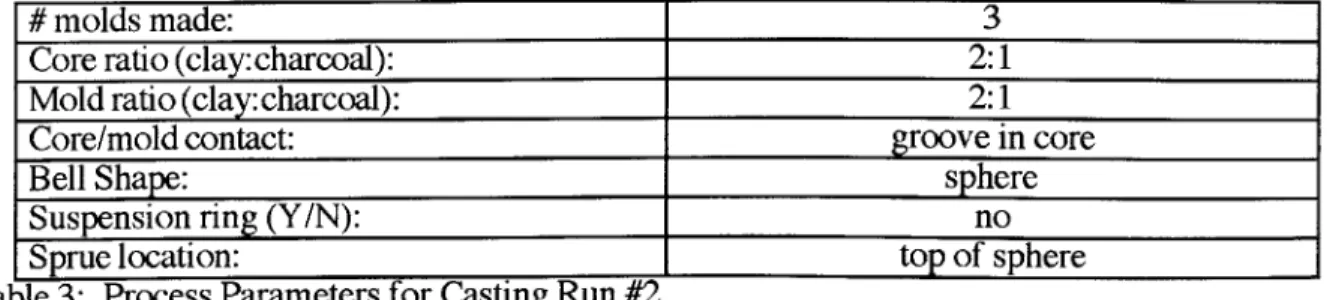
The goals of the second run were to stop the problems that occurred in the first run, by altering the clay to charcoal ratios and by making a better core to outer mold connection. First, the core composition was altered so that it had a clay to charcoal ratio of 2:1. The cores were slightly larger than from casting run #1 since each core contained 16g of clay and 8g of pulverized
charcoal. The outer mold material was also changed to a 2:1 ratio. The reasons for this change were that the pure clay molds had cracked in the first run and charcoal was a component of the molds originally described in the Florentine Codex. I mixed 400g of clay with 200g of pulverized charcoal and enough water to form a paste (about 100g) and covered the wax mold. The wax mold itself and the sprue and vent placement were similar to the setup in casting run #1, but the
connection method between the core and outer mold used was different. A groove was cut into the core where it was not covered with wax. The groove was as wide as the slit and extended halfway into the core. When the wet outer mold material was applied to the wax mold, it was pressed in this groove, creating a tongue of clay and charcoal in the core. The surface of the groove was dampened and scored to improve adhesion.
# molds made: 3
Core ratio (clay: charcoal): 2:1
Mold ratio (clay: charcoal): 2:1
Core/mold contact: groove in core
Bell Shape: sphere
Suspension ring (Y/N): no
Sprue location: top of sphere
After the molds were baked and the metal poured, my first observation was that the molds had changed from a dark black color to an off-white or grey color. I suspected that this was because the charcoal in the mold material was burnt away when the molds were heated to 1 100'C. When the bells were removed from the molds, they each had a large piece of flashing attached tangentially to the surface of the bell. Each of these pieces of flashing was several centimeters across, but did not extend to the edge of the mold, since no metal leaked from the molds during pouring. In this run, all three cores remained attached to the outer core material, since the bell thickness was uniform, the opening was not filled with metal, and there was no voiding in the bell.
Figure 6: Bell from Casting Run #2 (front view)
-Vent
F1ashirq
-Bell Opening 1
cml
Although the problems from the first run had not reoccurred, the flashing problem had appeared and there was no clear cause. The outer mold was allowing metal to flow into it. The flashing could have been caused by high porosity in the mold, a crack caused by thermal shock, or a crack caused by poorly joined pieces of the outer mold material. The latter of these options seemed most logical since the mold material was thick and not very cohesive.
Casting Run #3
The third casting run attempted to solve the flashing problem, but also included a new mold design and core to outer mold connection. Since the core material did not have any problems with
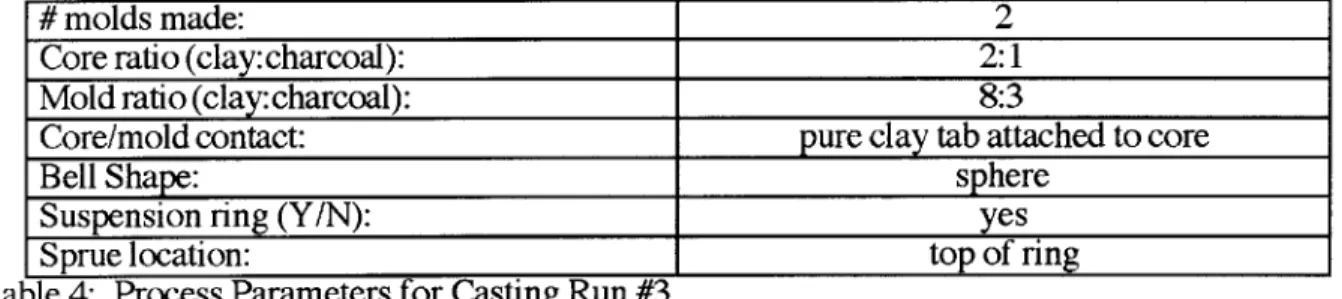
shrinkage or difficulty in removal from the bell, the core composition remained a 2:1 clay to charcoal ratio. On the other hand, the outer mold material was changed so that its clay to charcoal ratio was 8:3. This change in outer mold material composition was made to prevent the flashing from reoccurring. In this mixture, 400g of clay was mixed with only 150g of pulverized charcoal and water to make a paste (about 80g). Two other changes of note were made for this run. First, a suspension ring was added to the wax mold. It was made from a curved tube of wax and
attached between the sprue and the wax around the core. The sprue and riser remained in the same locations relative to the slit in the wax. The other change was the connection method. Although the groove in the core worked well in the second run, I altered this tongue and groove method so that the core had a tongue on it. The tongue was a piece of pure clay that was attached to the core and allowed to dry. Its dimensions were identical to the slit in the wax and 5 mm in length. After the wax was applied, the 8:3 outer mold mixture was placed around the wax mold.
# molds made: 2
Core ratio (clay: charcoal): 2:1
Mold ratio (clay: charcoal): 8:3
Core/mold contact: pure clay tab attached to core
Bell Shape: sphere
Suspension ring (Y/N): yes
Sprue location: top of ring
Table 4: Process Parameters for Casting Run #3
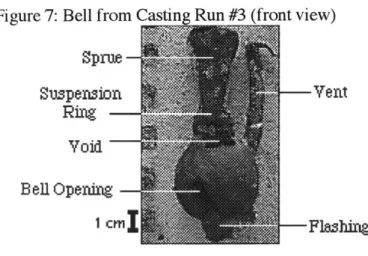
After the molds were broken and the bells removed, two problems were observed. The first was metal covering the clay tongue of the core. The metal had flowed between the clay tongue and the outer mold material and blocked most of the opening on the bell. The second problem occurred on the top of the bells. There were large voids on the surface near the connection between the suspension ring and the bell itself.
Figure 7: Bell from Casting Run #3 (front view) Sprie
Su~pet
T1orY I Ringit Bell Opering F lashingNo flashing was present on these bells, which indicates that the higher clay composition improved the properties of the outer mold. The metal between the tongue and the mold indicated that there was a poor connection between the core and outer mold. There was no indication that the core was totally separate from the mold, only that there was enough space for metal to flow. The voids on top of the bells were not the same type of voids as the ones found in casting run #1. In this case the voids were formed due to metal shrinkage during the cooling process. The metal in the sprue cooled before the metal in the bell, so when the solidifying metal shrank, it pulled molten metal out of the bell. Usually the sprue remains molten longer than the actual casting, so any voids that occur would occur in the sprue, but in this case, the metal in the bell remained molten longer. The metal remained molten in the bell because the mold has a central core. The core was able to
retain the heat from the metal and hold it longer than the outer of the mold, so the metal
surrounding the core stayed molten longer than the sprue. A solution to this problem was not apparent at the time, so it was not addressed immediately and attention was focused on solving other problems with the process.
Casting Runs #4 and #5
The fourth and fifth casting runs were conducted separately, but used the same process parameters. First, the outer core composition was altered again, in order to try to improve the
adhesion between the outer mold material and the core. Less charcoal was added to the clay (100g vs. 150g for 400g of clay), so that the clay charcoal ratio changed from 8:3 to 4:1. Second, the connection between the core and outer mold was altered. Instead of a pure clay tongue attached to the core, the core was molded so that it had a tongue made out of the 2:1 clay and charcoal mixture. By having the tongue made as part of the core, there was less chance of the connection separating and metal entering into the joint. The final change in these two casting runs was the alteration of the shape of the cores. In the first three casting runs, the cores were spherical. No problems arose in filling the molds properly, so the cores were altered into two different shapes. The cores from casting run #4 were rectangular prism in shape with rounded corners, while the cores from casting run #5 were pear-shaped. The molds were made in the same fashion as the previous runs,
including suspension rings on the top of each bell with the sprue attached to the ring.
Tal
# molds made: 3
Core ratio (clay: charcoal): 2:1
Mold ratio (clay: charcoal): 4:1
Core/mold contact: core tab
Bell Shape: rounded rect. prism
Suspension ring (Y/N): yes
Sprue location: top of ring
ble 5: Process Parameters for Casting Run #4
# molds made: 3
Core ratio (clay: charcoal): 2:1
Mold ratio (clay:charcoal): 4:1
Core/mold contact: core tab
Bell Shape: pear-shaped
Suspension ring (Y/N): yes
Sprue location: top of ring
Table 6: Process Parameters for Casting Run #5
When the bells were removed from the molds in casting run #4, it was obvious that the problems from casting run #3 had not been solved. Voids were found on the top surface of the bells and in the suspension rings. Some of the bells had voids completely through the top surface of the bell, while others had cavities in the suspension rings. From these results, its was apparent
that the voids were still being caused by the shrinkage of the metal in the sprue before the metal in the bell cooled. The second problem was flashing around the mouths of the bells. It was not the same type of flashing as in casting run #2. This flashing extended vertically from the lip of the opening of the bell down into the mold material. The cause of the flashing was due to poor
adhesion of the outer mold material to the core, similar to the problem in casting run #3. I believed that the problem was not materials-based, but processing-based. By making a more coherent connection when the outer mold material was applied, I thought that I could solve the problem.
Figure 8: Bell from Casting Run #4 (front view)
Suspension
V id
Flashiing
2
Bell Opening
In casting run #5, I took special care to assure that the outer mold material made a good connection to the core tongue. I dampened the tongue and used a very wet mixture of clay and charcoal in the region of the outer mold that made direct contact with the core. All of the other processing steps remained the same, and no attempt was made to correct the voiding problem. The bells from the fifth casting run, had some of the same problems as the fourth, but the flashing problem had been almost completely eliminated. One of the three bells had a piece of flashing running along one side of the opening of the bell (Fig. 9), one bell had a small piece of flashing attached to the opening of the mouth (Fig. 12), and one bell had no flashing on it at all (Figs. 10 &
11). Since I was able to reduce the amount of flashing , I believe that I was correct in suggesting that the problem was not a materials-related one. Since the flashing problem was under control, I shifted my focus to the voiding problem.
Figure 9: Bell #1 from Casting Run #5 (front view) icmI -XX- Spr-ue Vent Suspension Vold Ring AL Bell Openirq F - X&hirg
Figure 10: Bell #2 from Casting Run #5 (front view)
Vent-- Suspension
V 8 Ring
Bell Opening
CMT
Figure 11: Bell #2 from Casting Run #5 (side view)
suspension Void
Figure 12: Bell #3 from Casting Run #5 (front view) Vent XX r prue Suspension Void Bell Openg Flashing Casting Run #6
In the sixth casting run, I used the same parameters as in the fifth casting run, except for a change in the sprue configuration. Since the goal of this casting run was to eliminate the voiding at the top of the bells, I modified the mold by leaving off the suspension ring and changing the shape of the sprue. I believed that since the metal was solidifying in the sprue first, I had to alter the mold so as to extend the time that metal was molten in the sprue. The original shape of the sprue was an inverted, truncated cone. Its purpose was to provide a wide opening for the molten metal to enter, and a small connection to the bell for easier sprue removal after the bell was cast. The modified version of the sprue was cylindrical-shaped. It had a similar opening for the metal to enter, but it did not narrow until several millimeters before the connection to the bell. The sprue was designed to provide a molten core of metal inside it, so that the sprue would solidify after the metal in the bell had cooled.
# molds made: 3
Core ratio (clay: charcoal): 2:1
Mold ratio (clay: charcoal): 4:1
Core/mold contact: core tab
Bell Shape: pear-shaped
Suspension ring (Y/N): no
Sprue location: top of bell
I ~ - - ---- -
.-After the bells were poured and removed from the molds, I observed flashing on all three of the bells. Two of the bells had flashing along one side of the bell opening, while the other one had flashing around the entire opening, although it was smaller in length than on the others (2 cm vs. 1 cm). On the bell with the smaller flashing, a large void was located on the bell where the sprue attached to the bell's surface. The other two bells had no voids at all. It was not clear why one of the bells had voids, while the other two did not, but it seemed clear that the voiding could be corrected by using this modified sprue design. In this run, there was still flashing on the bells around the openings, which was caused by a poor connection of the outer mold material to the core tongue.
V. Results and Discussion
Summary of Casting Runs
In all six casting runs performed in this study, new methods were attempted and other methods were improved in the goal of finding a process that would produce bells that were free from defects. By examining the parameters that altered the bell's properties, it is possible to determine what factors were crucial to the success of the process.
Run# 1 2 3 4 5 6
Core Ratio 1:1 2:1 2:1 2:1 2:1 2:1
(clay:charcoal)
Mold Ratio pure clay 2:1 8:3 4:1 4:1 4:1
(clay:charcoal)
Core / Mold flush groove in clay tongue tongue as tongue as tongue as Connection connection core on core part of core part of core part of core
Bell shape sphere sphere sphere rounded pear-
pear-rectangular shaped shaped
prism
Sprue shape truncated truncated truncated truncated truncated cylindrical
cone cone cone cone cone
Suspension no no yes yes yes no
Ring ?
Hashing ? none on side of covering around around around
bell surface clay tongue opening opening opening
Voiding ? yes none yes yes yes no
Notes and detached none none none one bell w/ one bell w/
Exceptions core I no flashing voiding
Table 8: Summary of Casting Parameters and Problems
Core and Mold Compositions
During the six casting runs, the compositions of the core and outer mold material were altered to maximize their properties. The core composition was only altered once after the first casting run. After the second run, there were no problems with the core itself. It was easy to remove with a sharp metal tool, and it did not crumble when the wax was applied or when the molten metal was poured. The core also did not shrink during the heating process, and the bell cavity stayed the same size during the entire casting process. Although there may be a composition other than a 2:1 clay to charcoal ratio that has more optimized properties, this one had no problems and suggests that there is no reason to alter the core composition further. On the other hand, it was not until the fourth casting run that the optimal composition of the outer mold material was firmly established. The two problems that most altered the outer mold composition were the flashing due to poor mold quality and flashing due to poor connection between the core and outer mold. The former appeared first, which led to a reduction in the amount of charcoal in the mold material, so the outer mold would be more cohesive. That alteration eliminated that problem, but flashing was
still occurring due to the poor core to outer mold connection. This later problem led to a further reduction of the charcoal content to a final composition with a clay to charcoal ratio of 4:1.
Although the flashing around the opening of the bell was still occurring in the final casting runs, I do not believe that altering the composition of the outer mold material would solve that problem.
One of the reasons that the outer mold composition was altered to include charcoal after the first run was to increase the porosity of the mold. During the heating process the molds changed from black to white implying that the charcoal had been burned away, leaving the mold porous. I examined the molds from casting runs that had an outer mold ratio of 4:1 to determine if this effect was occurring. Weight measurements of the molds were taken after the wax was removed but before the heating process and taken after the metal was poured into the molds. From those measurements, I calculated the percentage of weight lost during the heating process using this formula.
[1 - Mpre /(Mpost - Mmetal)]* 100 = % wt loss
where Mp. is the weight of the mold before heating, Mpost is the weight of the mold and metal after casting, and Mmetai is the weight of the metal after the mold material has been removed. For the nine molds that had an outer mold composition with a 4:1 clay to charcoal ratio, the average percentage of weight lost was 28.78%
Bell # Mpre Mpost Mmetal Mpost -Mmetai weight loss
(g) (g) (g) (g) (%) 1 535 546 162 384 28.22 2 541 540 150 390 27.91 3 548 568 172 396 27.74 4 444 534 225 309 30.41 5 454 568 248 320 29.52 6 451 571 250 321 28.82 7 391 577 301 276 29.41 8 386 686 411 275 28.76 9 382 608 334 274 28.27 Average 459.11 577.56 250.33 327.22 28.78
Table 9: Weights and weight loss for molds with 4:1 ratio of clay to charcoal
The composition of the mixture was a 4:1 ratio, so it would appear that only twenty percent of the material was charcoal. Since over 28% of the material was removed during the heating, some other material must have also left the mold during heating. Some of this material may have been wax that did not drain out of the molds, but most of the remaining mass was the water that had been added to the mixture during formation and mixing. Although some of this water had evaporated during the wax burnout stage and from air drying, a significant portion of water still remained in the molds. To determine if the amount of weight loss calculated was reasonable, I ran some hypothetical cases in which different amounts of water evaporated prior to the heating process. If the original mold mixture contained 400g of clay, 100g of pulverized charcoal, and 80g of water, then prior to drying it would weigh 580g. If none of the water evaporated prior to the heating process and then all the charcoal and water left during the baking process, then percent of weight loss would be 31.0%. This is an extreme estimate, since the molds did dry some before the heating process. If half of the water evaporated prior to heating then the preheat weight would be 540g. If the remainder of the water and all of the charcoal left the mold during the heating process, then the percent weight loss would be 25.9%. This value is similar to the values
calculated from the actual molds. If less water was in the mold before heating, or less than all of the charcoal left the mold during heating, then the percent weight loss would be lower. From the results of the actual molds and the comparison to the hypothetical molds, I concluded that during the heating process all of the water and charcoal were removed from the mold.
Bell Shape
During the casting runs, the shape of the bells was altered several times to determine the effect that the shape of the bell had on the casting process. The original bells were in the shape of spheres. This shape was thought to be the easiest for the metal to flow through, which would decrease the chance of the metal solidifying during the pouring process. No problems were found to occur due to the sphere shape, so the bells were altered to two other shapes, the rounded
rectangular prism and the pear shape. Both of these shapes had sharper corners for the metal to flow through, but no problems occurred due to the altered shape. The most important reason that the metal did not have trouble flowing through these molds, regardless of shape, was the thickness of the mold cavity. The ancient bells had wall thicknesses on the order of 1 mm, while the bells I cast had an average wall thickness of 3 mm. The thicker walls allowed the metal to cool more slowly and fill the mold completely before solidifying. It is not clear if the difference in shape of the bells would have presented difficulties if the walls had been thinner.
Sprue Shape
For most of the casting process, the bells had voids on the top surface or in the suspension rings due to the cooling of the sprue before the bell wall. It was only in the sixth casting run that this problem was addressed and possibly solved. The use of a sprue with a large diameter near the bell allowed the sprue to cool slower than the bell, so that molten metal would not be drawn out of the bell when the sprue cooled. In all of the casting runs that included suspension rings, voiding occurred. It is possible that if the cylindrical-shaped sprue is attached to the top of the suspension ring, the voiding will not occur. However, it might be more advantageous to attach the sprue to the bell surface instead, so that the voiding would not occur in the suspension ring. Another possibility to prevent the voiding would be to widen the connection between the sprue and bell. A wider base would provide a larger region of the metal at the bell surface, which would allow the sprue to remain molten until the bell solidified. This method would only make it more difficult to remove the sprue from the bell after the casting was complete.
Core to Outer Mold Connection
The connection between the core and the outer mold material proved to be the most difficult problem faced in this study. In all, three different methods of attachment were attempted, although
one, the tongue as part of the core, was the most prevalently tested. One looming difficulty was the absence of an historical record about how this connection was made. The biggest problem with the connection between the core and the outer mold was that if it was not a tight fit, metal would flow into the connection and cause flashing attached to the bell. From the testing done, there needed to be more than just a flush connection between the core and mold material. No flashing problems occurred around the opening of the bells in casting run #2, when a groove was cut in the core and outer mold material was placed into the groove to form a tongue. However, when this tongue-and-groove method was reversed, so that the core had the tongue and the groove was built around it, flashing problems did occur in most cases. The technique appeared to be sound, since several of the bells produced using this method had little or no flashing on them. However, the procedure for attaching the mold material to the core seemed to be a difficult task to master, so that no spaces occurred in the connection. Perhaps the bells could be produced more easily and with less voiding using the connection method with a groove in the core. Another method of improving the connection would be to attach the outer mold material when the core was wet or very moist. In my procedure, the core dried for a day so that it would be hard and the wax could be applied without deforming the core. The tongue was moistened before the outer mold material was attached, but it may still have been too dry for a coherent connection. If the core, or at least the tongue, could remain moist, perhaps a better connection could be made between it and the wet, outer mold material.
Analysis of Cooling Rates
After the molds were baked at 1 100"C, they were kept at the same temperature until the molten metal was poured into them. The molds were kept hot, so that the metal would solidify more slowly when poured into the molds. During the casting process, no problems occurred with the metal solidifying too soon. On the contrary, problems were caused by the molds cooling too slowly. Specifically, the metal in the bell was remaining molten longer than the metal in the sprue
causing the voiding problems. Although this provided a logical explanation for the voids found in the bells, I wanted to verify that the metal in the bells was cooling at a slow rate. Cross-sections of one of the bells were taken and micrographs were made to examine the dendrite growth patterns in the metal. The samples were taken from the side wall of a bell cast during the fifth casting run (Fig. 13).
Figure 13: Location of sample taken from bell wall for microscopic analysis
Sample S1,rP
removed I
The samples were mounted, polished and etched before the micrographs were made. From the micrographs, measurements of the dendrite arm spacing were taken to determine the cooling rate of the metal (Figs. 14 and 15).
Figure 15: Micrograph of dendrite arm spacing for 11% Sn-brone bell wall (mag. 35x)
The dendrites in the bell wall had an average primary arm spacing of 0.53 mm and an average secondary arm spacing of 0.12 mm. By comparing these measurements to ones taken from West Mexican artifacts, I was able to determine the difference in cooling rates. One sample from the archaeological bell had an average primary dendrite arm spacing of 0.2 mm and an average secondary arm spacing of 0.08 mm (Hosler 1986). The archaeological bell sample used was not the best comparison, since it was made from a 3% tin-copper alloy instead of 11% tin-copper, and the thickness of the bell wall was 0.8 mm. Because of the order of magnitude difference in wall thickness, it is expected that the cooling rate of the thicker bell would be slower. In fact, the wide spacing of the dendrites in the bell from casting run #5 is an indication that the cooling rate was much slower than for the artifact. This information confirms the theory that the voiding in the bells was caused by the metal in the bell wall cooling at a slower rate than in the sprue.
VI.
Conclusions
Evaluation of Process
Based on the results from the casting runs and the analysis of the mold material and metallography, the process used in this study is a valid representation of the process used by the ancient West Mexicans. From the six casting runs, several parameters have been optimized, while others are still under consideration. The core material should have a clay to charcoal ratio of 2:1, so that it remains firm, yet is easy to remove from the bell. The core should be covered with a uniform layer of beeswax with a slit along the bottom of the core. The sprue should be cylindrical in shape, which rapidly tapers down as it approaches the bell surface. The outer mold material should have a clay to charcoal ratio of 4:1, so that it is porous, structurally stable, and malleable when wet. The outer mold material should be attached to the core using a tongue and groove method. The optimal configuration is not known, but the methods appears to work with either the tongue or the groove on the core. From the results of the casting runs, no further modifications have to be made to these parameters, but other parameters still need to be changed, due to problems that occurred during the process.
Originally, the heating process for the molds was a set parameter that was not to be altered during the casting runs. However, the question of whether the molds should be kept at 1 100*C during the pouring became an issue. The molds should be heated to harden them, but their optimal temperature during pouring is not clear. Molds kept at an elevated temperature will help the metal to fill the mold completely, but may cause voiding in the bell walls. It was apparent that the core of the mold was remaining hot longer than the outer mold material which kept the bell metal molten. To solve this problem, the metal in the sprue had to cool more slowly than the metal in the bell. There are several manners in which to approach this problem. First, the sprue could be insulated so that it retains its heat longer than the bell metal. By increasing the thickness of the mold material around the sprue or decreasing the amount of mold material around the bell, the bell would be able
to dissipate heat to the air more rapidly than the sprue. Second, the mold could be lowered to room temperature or a temperature less than 1 100 C. If the molds were not preheated, then the core would not have excess heat trapped inside it when the metal is poured into it. Having a cooler core and mold would allow the metal in the bells to cool quicker, which allows the bells to solidify prior to the sprue. Other methods would include using a heat sink to cool the bell metal or an exothermic material to heat the sprue during pouring, but these methods would have not been used by the West Mexican craftsmen and should not be considered as alternatives.
Overall, the process designed and revised in this study has proven its ability to produce bells that are similar in nature to the bells from ancient West Mexico. Although each of the bells individually had problems, such as flashing or voiding, each of the process steps has shown that it is possible to overcome those problems. Many of the problems were caused by poor construction techniques, unrelated to the actual casting method or material, and therefore should not be used to refute the validity of the technique. With careful execution of the revised techniques, a repeatable procedure should be obtainable. Although this study has increased the amount known about the process used by the ancient West Mexican craftsmen, there is much more to be learned.
Future Work
The type of work that can be done on this process is divided into two categories: improve the process and alter additional parameters. The first step is to improve the process that has been set forth at the present time. Six casting runs were sufficient to test several different parameters, but there were not enough runs to find a process that was reliable and repeatable. By attempting additional casting runs that use the same parameters as the last few casting runs, the technique will be refined and able to be evaluated more easily. In addition, variations of these parameters could also be retested. Only one casting run used a groove in the core as the connection method. Further runs using this method would allow it to be properly compared to the tongue on core connection method. Only on the last casting run was a cylindrical sprue used. Other runs with this
configuration would determine if the voiding problem was actually corrected, or if it was an anomalous result.
After the current parameter set is repeatable, other variables can be altered to make the process more successful and more true to the methods of the ancient West Mexicans. The most important of these parameters is the thickness of the bell walls. The objects made by the West Mexican craftsmen had wall thicknesses between 0.5 mm and 1.3 mm. Reduction in the thickness of the bell walls may create problems with several other parameters. The thinner walls allow the bell to cool faster, which can lead to solidification before the entire mold is filled. Parameters, such as bell shape, which were not an issue when the bell walls were thicker, may cause problems. Another parameter that would alter the process would be the thickness of the outer mold. Different regions of the outer mold could be thickened or thinned to change the thermal characteristics of the mold. In addition during the experimental casting runs, the alloy concentration was always 89% copper and 11% tin. Altering the alloy concentration would present another set of problems. Pure copper has a melting point of 1083'C which is higher than that of the tin bronze used. A Cu-Sn phase diagram can be found in appendix A (Westbrook 1992). Lower concentrations of tin would increase the chances of the metal solidifying before the mold has completely filled. However, the narrower freezing temperature of alloys with less tin could help correct the voiding problem. The lower solidification point would have to be compensated with higher mold temperatures or thicker bell walls. The final parameter that could be changed to more closely approximate the ancient West Mexican artifacts is a bell design with some of the intricate wirework found on many of the artifact bells. The wax models for these archaeological bells were constructed from individual threads of wax wrapped around the core, building the bell using a technique similar to coiling pottery. Additional strands of wax were placed over areas requiring reinforcement (Hosler 1994). These complex patterns formed from thin strands of wax are difficult to cast for two reasons. First, the intricacy of building the wax designs would be difficult for all but a skilled craftsmen to
accomplish. Second, the wirework created a varied thickness of the wall of the bell. The molten metal would have to flow through narrow channels followed abruptly by wider passages. These
types of bells could be cast only if the metal was able to flow freely through these regions without solidifying too soon.
All of these changes in parameters will make recreating the ancient process more difficult. However, if the actual process is to be fully understood these parameters will have to be altered and studied. The process described by Sahagen in 1555 is one that is only beginning to be understood, but the process that he described can be duplicated and the artifacts made by the West Mexicans can be replicated. It will take more studies and more casting runs, but the intricacies of the process will eventually be understood. When they are, we will have a better understanding of what the ancient craftsmen had to do in order to perfect their craft and why they chose to use the process that they did.
References Cited
Hosler, Dorothy. "The Origins, Technology, and Social Construction of Ancient West Mexican Metallurgy." Ph.D. diss., University of California, Santa Barbara, 1986.
Hosler, Dorothy. The Sounds and Colors of Power: the Scared Metallurgical Technology of Ancient West Mexico. Cambridge, MA: The MIT Press. 1994.
Hosler, Dorothy. "Sound, color, and meaning in the metallurgy of Ancient West Mexico." World Archaeology. 30, no. 1 (1995): 100-115.
Neumann, Matthew. "Ancient Mexican Bells: an empirical rediscovery of the casting process." B.S. Thesis, Massachusetts Institute of Technology, 1997.
Sahagiin, Fray Bernardino de. Florentine Codex: General History of the Things of New Spain (Book 9) Translated by C. Dibble and A. Anderson. Santa Fe: The school of American Research and the University of Utah, 1959. (original work published in 1555). Westbrook, Jack H., ed. Moffatt's Handbook of Binary Phase Diagrams. Schenectady, NY:
Genium Publishing Company. 1992.
Appendix A
Phase Diagram for Copper and Tin
Cn ~ ~ ~ ~ ~ 1 TegtPYte1.T :;
---- --- ..
Source: Jack H. Westbrook, ed. Moffatt's Handbook of Binary Phase Diagrams. Schenectady, NY: Genium Publishing Company. 1992