HAL Id: hal-02137049
https://hal.sorbonne-universite.fr/hal-02137049
Submitted on 22 May 2019
HAL is a multi-disciplinary open access
archive for the deposit and dissemination of
sci-entific research documents, whether they are
pub-lished or not. The documents may come from
teaching and research institutions in France or
abroad, or from public or private research centers.
L’archive ouverte pluridisciplinaire HAL, est
destinée au dépôt et à la diffusion de documents
scientifiques de niveau recherche, publiés ou non,
émanant des établissements d’enseignement et de
recherche français ou étrangers, des laboratoires
publics ou privés.
Polyacenes and diffuse interstellar bands
A. Omont, H. Bettinger, C. Tönshoff
To cite this version:
A. Omont, H. Bettinger, C. Tönshoff. Polyacenes and diffuse interstellar bands. Astronomy and
As-trophysics - A&A, EDP Sciences, 2019, 625, pp.A41. �10.1051/0004-6361/201834953�. �hal-02137049�
Astronomy
&
Astrophysics
https://doi.org/10.1051/0004-6361/201834953
© A. Omont et al. 2019
Polyacenes and diffuse interstellar bands
A. Omont
1, H. F. Bettinger
2, and C. Tönshoff
21Institut d’Astrophysique de Paris, Sorbonne Université, UPMC Université Paris 6 and CNRS, UMR 7095, France
e-mail: [email protected]
2Institut für Organische Chemie, Universität Tübingen, Auf der Morgenstelle 18, 72076 Tübingen, Germany
Received 21 December 2018 / Accepted 7 March 2019
ABSTRACT
The identification of the carriers of the diffuse interstellar bands (DIBs) remains to be established, with the exception of five bands
attributed to C+60, although it is generally agreed that DIB carriers should be large carbon-based molecules (with ∼10–100 atoms)
in the gas phase, such as polycyclic aromatic hydrocarbons (PAHs), long carbon chains or fullerenes. The aim of this paper is to investigate more specific possible carriers among PAHs, namely elongated molecules, which could explain a correlation between the
DIB wavelength and the apparent UV resilience of their carriers. More specifically, we address the case of polyacenes, C4N+2H2N+4,
with N ∼ 10–18 fused rectilinear aligned hexagons. Polyacenes are attractive DIB carrier candidates because their high symmetry and large linear size allow them to form regular series of bands in the visible range with strengths larger than most other PAHs, as confirmed
by recent laboratory results up to undecacene (C46H26). Those with very strong bands in the DIB spectral domain are just at the limit of
stability against UV photodissociation. They are part of the prominent PAH family of interstellar carbon compounds, meaning that only
∼10−5of the total PAH abundance is enough to account for a medium-strength DIB. After summarizing the limited current knowledge
about the complex properties of polyacenes and recent laboratory results, the likelihood that they might meet the criteria for being carriers of some DIBs is addressed by reviewing the following properties: wavelength and strength of their series of visible bands; interstellar stability and abundances, charge state and hydrogenation; and DIB rotation profiles. No definite inconsistency has been
identified that precludes polyacenes from being the carriers of some DIBs with medium or weak strength, including the so-called C2
DIBs. But, despite their many interesting properties, additional experimental data about long acenes and their visible bands are needed to make robust conclusions.
Key words. astrochemistry – ISM: molecules – ISM: lines and bands – dust, extinction – line: identification – line: profiles
1. Introduction
Since their discovery almost one century ago the origin of the diffuse interstellar bands (DIBs) has remained an outstanding problem (see, e.g., Herbig 1995; Sarre 2006; Tielens & Snow 1995; and especially Cami & Cox 2014; see also, e.g.,Omont 2016; Fan et al. 2017; Cami et al. 2018 for more recent ref-erences). Today, the number of bands confirmed as DIBs has reached almost 500 (see e.g., Hobbs et al. 2008, 2009). The strongest bands are conspicuous and ubiquitous, not only along lines of sight in the Galactic disk, but also in other galaxies.
While the carriers of only five DIBs (in the near infrared) have been identified as C+60 (Foing & Ehrenfreund 1994;
Campbell et al. 2015,2016a,b;Walker et al. 2015,2016,2017;
Campbell & Maier 2017a, 2018;Spieler et al. 2017;Lallement et al. 2018), they are still the only DIBs whose carriers are iden-tified. However, there is more or less general agreement that DIB carriers should be large carbon-based molecules (with &10 to ∼100 atoms) in the gas phase (e.g.,Tielens 2014), although other possibilities remain open (see e.g.,Snow 1995,2014).
In addition to a precise and consistent wavelength match across the whole spectrum, the most stringent constraint on such possible DIB carriers comes from the strength (equivalent width) of the bands, which can be expressed as the product of the molec-ular (M) carrier abundance χMby the band strength (e.g.,Cami
2014;Omont 2016). For medium-strength DIBs with equivalent width per unit reddening, EW ∼ 20 mÅ mag−1, it may be written
as
XCM × f ≈ 2 × 10⁻⁶or χM × f ≈ 10−10, (1)
where f is the oscillator strength and XCM denotes the fraction
of total interstellar carbon locked up in the molecule M with NC∼ 60 carbon atoms. This implies for example XCM∼ 10−4for
f ∼2 × 10⁻²or X
CM∼ 10−6for f ∼ 2.
The most popular candidates for DIB carriers are therefore found among the three main allotropic forms of known inter-stellar carbonaceous particles: linear carbon chains, polycyclic aromatic hydrocarbons (PAHs), and fullerene-like compounds. Despite intensive spectroscopic efforts, all attempts to identify DIBs with known spectra of long carbon chains and PAHs have been unsuccessful up to now (see, e.g.,Campbell & Maier 2017a;
Zack & Maier 2014;Salama et al. 2011;Salama & Ehrenfreund 2014). Although it remains possible that the three varieties of carbon compounds could include many DIB carriers, all three suffer from various difficulties.
For example, most fullerene compounds seem to lack the required combination of strong band strength and large inter-stellar abundance (Cami 2014;Omont 2016). For most of them, f-values of the visible bands are at most a few times 10−2,
although those with endohedral metals may well have high f-values as discussed byKroto & Jura (1992), and the abun-dance of the most obvious compound, C+60, is only a few times 10−4of interstellar carbon. But various types of molecules, such
as fullerene cages with endohedral metals, various C60adducts,
and open cages, cannot be excluded.
Carbon-chain derivatives, which are known in dense molec-ular clouds with Cn skeleton and n. 10, and in diffuse clouds
as C2 and C3, have been repeatedly proposed as DIB
car-riers (see, e.g., Douglas 1977; Thaddeus 1995; Snow 1995;
A41, page 1 of12
Allamandola et al. 1999;Maier et al. 2004;Zack & Maier 2014). Despite questions about their formation and interstellar stabil-ity and the exclusion of short chains (n. 10) from the lack of coincidence of their known wavelengths with those of DIBs (e.g.,Zack & Maier 2014), they remain good candidates for DIB carriers. Their spectral properties, including a series of strong bands throughout the visible range for which both λ and f -values can be roughly proportional to the number n of carbon atoms, have made them especially appealing as DIB-carrier candidates (e.g.,Campbell & Maier 2017a). But there is still no evidence of chains long enough to be stable in the diffuse interstellar medium (ISM), that is, with n& 25. Furthermore, the proposed processes for their formation from grain shattering (e.g.,Duley 2000;Jones 2016) remain tentative.
On the other hand, the prominent mid-IR emission bands of PAHs (Léger & Puget 1984;Allamandola et al. 1985) show that PAHs as a whole contain several percent (up to &10%) of the total interstellar carbon (e.g., Puget & Leger 1989;
Tielens 2008,2013). After their identification as carriers of the mid-IR bands, it was a logical step to propose that PAHs are also major DIB carriers (van der Zwet & Allamandola 1985;Léger & D’Hendecourt 1985,Crawford et al. 1985;Salama et al. 1996). However, to this day all attempts to identify a single specific interstellar PAH have failed (Salama & Ehrenfreund 2014). Only interstellar detection of two aromatic molecules with a single six-membered ring, benzene (C6H6) and benzonitrile (C6H5CN),
was achieved by Cernicharo et al. (2001) and McGuire et al.
(2018), respectively. In view of the failure to identify individual PAHs and the expected chemical variety for interstellar PAHs, it seems unlikely that any randomly selected PAH could be abun-dant enough to be responsible for a strong DIB (e.g.,Steglich et al. 2011).
However, from their detailed discussion of the proposal that the PAHs might be the main carriers of the DIBs,Salama et al.
(1996) concluded that this proposal seems extremely promising, provided that “the interstellar PAH distribution is dominated by a small, finite number of species (100–200)”, especially in the form of cations. Among the immense variety in size, isomers, hydrogenation, and ionization of PAHs, it is generally believed that the most abundant ones are the most compact (“pericondensed”) with a number of carbon atoms large enough to be stable against photodissociation, such as circumcoronene C54H18. These latter are often referred to as “grandPAHs” (e.g.,
Tielens 2013;Andrews et al. 2015). However, such large PAHs remain difficult to study and most gas-phase PAH spectroscopic studies have been limited to a number of carbon atoms NC.
20–25 (e.g.,Gredel et al. 2011;Salama et al. 2011;Huisken et al. 2014;Hardy et al. 2017;Kofman et al. 2017) with few exceptions (Steglich et al. 2011;Campbell & Maier 2017b;Zhen et al. 2016,
2018), thereby hampering the search for any coincidence with known DIBs. It could be that most of the well-studied PAHs are too small to survive photodissociation in the diffuse ISM, while the variety of larger PAHs and their isomers and the lack of sym-metry of most of them distribute their global visible interstellar absorption among many weak bands (e.g.,Cocchi et al. 2014).
A peculiar class of PAHs has perhaps been overlooked as potential DIB carriers, namely long “catacondensed” PAHs (but see, e.g.,Ruiterkamp et al. 2002,2005;Halasinski et al. 2003). In particular, linear acenes or polyacenes C4N+2H2N+4 (with N
fused hexagons on a straight line; Fig.1) may appear especially promising. Their structure can be seen as two coupled polyene chains, which makes them somewhat similar to “long carbon chains”, explaining that their optical spectrum also displays a series of strong bands, shifted into the visible range for N & 10
2.5-2.8 eV for N = 5, 10, 20, respectively, see, e.g., Malloci et al. 2011;
Fig. 1.Example of a polyacene, dodecacene (N= 12), C50H28. In the
normal hydrogenated form there is an H atom bound to each outer C atom.
(e.g.,Ruiterkamp et al. 2005;Malloci et al. 2011;Bettinger et al. 2016). Recent measurements (Bettinger et al. 2016;Shen et al. 2018; see Sect. 2.3, Fig.2) show the existence of very strong bands ( f ∼ 3–4) in the range ∼4000–5000 Å for N= 9 and 11, and provide very precise values of their wavelength in argon matrix. Similar strong bands of higher acenes, from N= 12 to ∼16–18, should cover the whole main DIB spectral range ∼5500–7000 Å. In addition to their high symmetry and strong bands, other important features of polyacenes could point to good candidates as carriers of some DIBs, especially those sensitive to UV destruction of the “C2” and “ζ” families (Sect.4.2). Their
inter-stellar photodissociation could match the varied behaviour of these DIBs versus extinction (Sect.4.2). The large value of one of their rotation constants could explain DIB profiles (Sect.4.3). But the higher reactivity and instability of polyacenes compared to other PAHs might make their interstellar formation difficult (Sect.2.4). As other PAHs, they could be formed by shattering of carbon interstellar grains or larger PAHs, but specific proof is lacking.
In this paper, we review the properties of polyacenes and present a series of arguments showing that they are potentially interesting carriers of some DIBs. The paper is organized as follows. Section 2 summarizes the known properties of small acenes and presents what can be inferred from our understand-ing of longer, more complex acenes. Section 3 discusses the expected properties of polyacenes in the diffuse ISM: charge, hydrogenation, photodissociation, possible formation, and abun-dance. Section4addresses the likelihood of polyacenes meeting the various criteria for DIB carriers: wavelength and strength of their visible bands; interstellar abundances, charge and hydro-genation; DIB rotation profiles. Finally, Sect.5summarizes the reasons why polyacenes could be potential DIB carriers and pro-vides suggestions for future theoretical and experimental work to further explore this possibility.
2. Summary of polyacene properties 2.1. Overall and electronic structure
Acenes or polyacenes are the most threadlike PAHs made up of N linearly fused benzene rings, C4N+2H2N+4 (Fig. 1). With
their derivatives they are a typical organic semiconductor mate-rial that is being intensively studied (e.g.,Anthony 2008;Ye & Chi 2014). However, beyond pentacene they become extremely reactive (Sect. 2.5) and unstable, which explains why their syn-thesis was achieved only very recently, especially for octacene, nonacene, decacene, and undecacene (Bettinger & Tönshoff 2015; Zuzak et al. 2017, 2018; Krüger et al. 2017; Shen et al. 2018), and not beyond yet.
In some way, polyacenes are the most extreme catacon-densed PAHs, the opposite of periconcatacon-densed compact ones. More characteristically, they are among the most symmetric PAHs, with D2h point group symmetry. However, distortion is
possible by out-of-plane deformation. Their rotation structure is that of a very elongated, near-prolate, slightly asymmetric top. For instance, the rotation constants of pentacene are (Heinecke et al. 1998): A= 44.5, B = 3.9 and C = 3.6. × 10−3 cm−1. For
higher acenes, A-values scale roughly as N−1 and B and C as N−3, meaning that the ratio A/(B or C) is ∼50–100. Table C.1
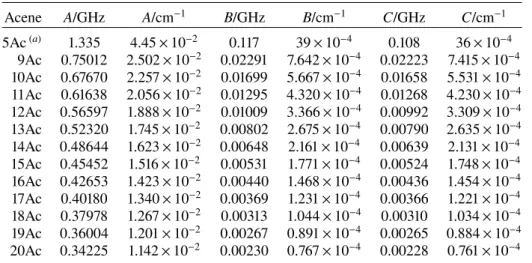
gives the values of the three rotational constants for N= 9–20 derived from density functional computations using the B3LYP hybrid functional in the spin-unrestricted formalism (UB3LYP) and the 6-31G(d) basis set as implemented in Gaussian 09 (see
Becke 1993;Lee et al. 1988;Frisch et al. 2009). For instance, for N= 14, rotational constants A = 1.62 × 10⁻², B= 2.16 × 10⁻⁴and C= 2.13 × 10⁻⁴cm−1were computed.
Such high symmetry and elongation make their PAH elec-tronic structure peculiar. Although their aromaticity is limited to a single Kekulé hexagon, the delocalisation of the latter makes the conjugation of the π electrons extremely extended. It may result in very peculiar structures of the electronic distribution including biradical singlet states (see, e.g., Zade & Bendikov 2012and references therein) and even higher polyradical char-acter, depending on the length, as was predicted by theory (e.g.,
Hachmann et al. 2007;Plasser et al. 2013). A characteristic fea-ture is the low gap between the highest occupied molecular orbital (HOMO) and the lowest unoccupied molecular orbital (LUMO). Similarly, the singlet-triplet energy splitting decreases to less than 1 eV for large N.
Their complexity contributes to the uncertainty about the vis-ible spectra of polyacenes beyond those which have been actually observed (Bettinger et al. 2016;Shen et al. 2018, see Sect.2.2). In any case, the acenes should keep the very rich structure of electronic and vibronic excited states of other large carbona-ceous molecules with a comparable number of carbon atoms NC, resulting in a high probability the excited states have a very
short lifetime and efficient internal energy conversion (IEC); see Sect.2.2.
As noted byRuiterkamp et al.(2005), polyacene ionization potentials are significantly smaller than those of pericondensed PAHs (from ∼6.5 eV for pentacene and hexacene, ∼5 eV for N ∼10–20, to a limit of probably.4.5 eV for very large values of N; Wu et al. 2016). This could make their photoioniza-tion by interstellar UV radiaphotoioniza-tion easier. As for long “carbon chains” and other PAHs, high values of the electron affinities of acenes (1.4 eV, ∼2–2.3 eV, ∼2.5–2.8 eV for N= 5, 10, 20, respec-tively, see, e.g.,Malloci et al. 2011;Chai 2014;Wu et al. 2016) should favor anions in interstellar regions that are somewhat UV shielded.
While acenes are the most extreme and symmetric cases, various other catacondensed PAHs may be considered as DIB-carrier candidates, as done in general byRuiterkamp et al.
(2005) who pointed out their possibly large f-values. Such molecules, especially of the broader acene family, share many of the polyacene properties (e.g., polyphenacenes and other similar elongated isomers of polyacenes, Luzanov et al. 2017; pyrene-fused acenes, Li et al. 2016; azethrenes, Huang et al. 2016; azaacenes,Li & Zhang 2015). However, we limit our discussion to pure acenes because other catacondensed PAHs do not appear to be as good candidates as acenes for carriers of strong DIBs1.
The same is true for hetero-acenes where, for example, at least one CH group is replaced by an N atom, because of their lower symmetry and lower expected interstellar abundances.
Together with their linear form, the cyclic form of acenes, [N]cyclacenes, C4NH2N, might be present in the interstellar
medium (Jones 2016). Although they have not yet been syn-thesized because of their instability, theoretical studies of their
1 Other compounds, such as oligorylenes, have been proposed as
attractive candidates for DIB carriers (Ruiterkamp et al. 2002;
Halasinski et al. 2003); but seeRuiterkamp et al.(2005).
electronic properties (Wu et al. 2016;Battaglia et al. 2017) have confirmed that the properties of cyclacenes with an even number of benzene rings are similar to linear acenes. Similar elementary belts, such as [12]cyclophenacene, whose carbon skeletons may also be regarded as constituents of carbon nanotubes (CNTs), have recently been synthesized (Povie et al. 2017, 2018 and references therein).
2.2. Spectra and oscillator strengths
Despite the uncertainty on the structure of their electronic levels for N > 11 (Sect.2.1), it is clear that all acenes have a number of important bands in the visible domain, as do other PAHs of similar size. Some of these bands may be much stronger (at least a factor ∼3) than visible bands of other PAHs with similar NC
(e.g.,Malloci et al. 2007) because of the high symmetry and the elongation of polyacenes.
This can be seen more precisely from Fig.2which displays the wavelengths of optical bands of higher acenes based on argon matrix and theoretical values fromBettinger et al.(2016), includ-ing new results for undecacene (N= 11) which displays a strong band ( f ∼ 4) located at 543 nm in a matrix of polystyrene (Shen et al.(2018) and at 495 nm in a matrix of argon (Bettinger et al., in prep.). For N ≤ 9, the strongest bands with f > 1 are confined to the UV range. Nonacene has already a strong band close to 4000 A, and it is clear from Fig.2that, despite the uncertainties, the trend toward redder wavelengths will bring at least a strong band into the visible range for N ≥ 10 probably up to N ∼16–20. This means that a series of strong bands of neutral acenes with f& 1 is expected in the main DIB spectral range from ∼4500 to ∼7000 Å. However, the complexity of the behaviour of electronic excited states of polyacenes does not allow one to extrapolate the gas-phase position of these strong visible bands for N ≥ 12 with the precision required for the identification of DIB carriers (Fig.2).
In addition, relatively strong visible bands should also exist for polyacene cations and anions, as has been measured up to nonacene (Mondal et al. 2009; Tönshoff & Bettinger 2010). Strong infrared bands are also expected for ions (Mondal et al. 2009;Malloci et al. 2007) and weaker ones for neutrals. 2.3. Internal energy conversion and fluorescence
Similarly to other PAHs, strong internal energy conversion is expected among electronic excited states of polyacenes (espe-cially the highest ones even above the ionization limit; e.g.,
Leach 1995;Zhen et al. 2015) and their vibronic components. For neutral acenes, after absorption of a near- or far-UV pho-ton, IEC may end with the usual pattern where the energy is shared between fluorescence (and possible phosphorescence) and mostly conversion to pure vibrational energy through tran-sit to a triplet state. For many PAHs, fluorescence may be either direct emission from a low-lying excited state, or delayed after transit through a triplet state of slightly lower energy (“Poincaré” fluorescence, Leger et al. 1988; see Ji et al. 2017 for its evi-dence in anthracene). But Poincaré fluorescence seems unlikely for higher polyacenes, since the extrapolated optical gap is ∼1 eV (Shen et al. 2018), while the triplet state is computed to be only a few kilocalories per mole above the ground singlet state. There-fore, a significant population of the first bright singlet state from the triplet state would be very unlikely due to the ∼1 eV energy difference.
Fluorescence is known to be strong in the case of pen-tacene but weak for hexacene (Nijegorodov et al. 1997). The
10000
9000
8000
7000
6000
5000
4000
3000
2000
W
a
v
e
le
n
g
th
(A
)
1L
ath 1L
aexp 1L
bthD1
th 1B
bth 1B
bexpD2
thD2
exp4 5 6 7 8 9 10 11 12 13 14 15 16
N
C2DIBs 0.08 Main ζDIBs
0.06 0.04 0.001 0.02 0.02 0.01 0.0 0.003 0.001 0.001 0.01 0.02 0.03 0.08 0.03 0.05 0.03 0.004 3.7 2.6 2.8 3.1 3.9 4.1 4.2 1.8 3.4 2.9 3.9 2.75
Fig. 2.Wavelengths of optical bands of higher acenes with N hexagons fromBettinger et al.(2016) andShen et al.(2018): full symbols, theoretical
values with f -values; open symbols, experimental Ar-matrix data taken fromTönshoff & Bettinger(2010), except for undecacene (N= 11; Bettinger
in prep.). See the symbol explanation in the right column, with the names of the excited molecular levels and the labels “exp” for measured
wavelengths and “th” for theoretical estimates. See text (Sect.4.3) for estimates of order of magnitude of matrix shifts. The short horizontal blue
lines on the left show the wavelength of the C2DIBs (Thorburn et al. 2003), and the main ζ DIBs (Fig.4) are marked by short horizontal red lines
on the right. The expected extrapolation to longer wavelengths shows that similar strong bands of higher polyacenes, N ∼ 12–16, should extend
through the whole main spectral domain of DIBs from ∼5000 to ∼7000 Å (Fig.3).
fluorescence properties of higher acenes remain unknown. They should depend on the detailed IEC transfer between excited sin-glet and triplet states. However, it is possible that fluorescence is strong for high-N neutral acenes due to the very high f -values of some visible bands (Fig. 2). On the other hand, this seems less likely for ions whose level structure is dominated by doublet states.
2.4. Reactivity
Long acenes are known for their extreme reactivity which makes them unstable and has yet prevented their laboratory study beyond N= 11. As quoted, for example by Zade & Bendikov
(2012), the reactivity of the smaller acenes increases with their length, especially on the central carbon rings, and a greater ten-dency towards a biradical structure is observed (see alsoYang et al. 2016).
We note that all the rings of polyacenes are susceptible to reaction with a carbon atom by inserting it into a peripheral six-membered ring. Through this process, a seven-membered carbon ring is formed as suggested by experiments and quan-tum chemical computations byKrasnokutski et al.(2017)2. This
possibility is more reduced for pericondensed PAHs such as circumcoronene because C cannot be inserted into a CC bond common for two aromatic rings. As with other PAHs, polyacenes should easily react with atomic oxygen. The most important
2 See also similar reactions between atomic carbon and benzene,
Kaiser et al.(1999,2003);Hahndorf et al.(2002).
outcome should be ejection of CO, either directly or after intermediate formation of an epoxy.
3. Expected properties of polyacenes in the diffuse interstellar medium
3.1. Photodissociation
Polyacenes should be present in the diffuse ISM just as the multi-tude of other PAHs, and share most of their properties, especially those of other catacondensed PAHs. Photodissociation is the main cause of processing interstellar PAHs. Its modelling has been intensively discussed in the last 30 yr, as summarized in AppendixAfor the diffuse ISM, with the following main conclu-sions. The H-loss photolysis may result from single UV-photon absorption for medium-size PAHs (NC. 40, N(C+H). 55) and
should proceed first before C-fragment ejection from the carbon skeleton. Because of the roughly exponential dependence of the photodissociation rates on the activation energy EAfor
photoin-duced dissociation and the vibrational temperature, interstellar PAHs should be either mostly normally hydrogenated or mostly totally dehydrogenetated.
For polyacenes, as discussed in Appendix A, there should thus exist a critical value of N, Ncr, around which they rapidly
pass from fully hydrogenated to fully dehydrogenated in nor-mal diffuse clouds. However, it is possible that for N very close to Ncr, partially dehydrogenated polyacenes may exist, that is,
including the coexistence of several hydrogenation states for the same carbon skeleton. Quantitatively, it is roughly expected that
such partially dehydrogenated polyacenes might be the dominant form in the diffuse ISM for perhaps N ∼ 11 or 12. Fully hydro-genated polyacenes could then be found with N& 12–13 in the diffuse ISM, and with N& 11–12 in “C2” translucent clouds,
but these values remain uncertain.
The carbon skeleton should be stable in most of this range of Nvalues for normal hydrogenated polyacenes. But this appears questionable for smaller N values, with NC< 40, and even
for higher N values, in all cases when full dehydrogenation (carbon nanoribbons) is expected. In the latter case, it is proba-ble that the acene linear carbon skeleton rapidly transforms into a more stable isomer that could be either more compact (graphene nanosheets, also known as graphene quantum dots), or include carbon pentagons, heptagons, or larger rings (Mackie et al. 2015;
Parneix et al. 2017). In addition, as other PAHs, polyacenes should be prone to erosion and eventual destruction, either by chemical reactions, in particular with atomic oxygen, or by more energetic processes than single-photon absorption, such as two-photon absorption (Montillaud et al. 2013;Andrews et al. 2016) and carbon-atom knock-out or disintegration by energetic parti-cles (Micelotta et al. 2010;Chabot et al. 2017). However, because of their likely greater efficiency in accreting C+ (Sect. 2.4), the decay of their carbon skeleton might be slowed com-pared to pericondensed PAHs. With partial dehydrogenation, this could be important by successive edge accretions of interstellar C+ions.
3.2. Charge state
Like other PAHs, it is expected that interstellar polyacenes exist in various charge states – neutral, cation, and anion – in the dif-fuse ISM. But the ratio of cations to neutrals should be higher than for pericondensed PAHs since the ionization potential of acenes is significantly lower (Sect.2.1). However, the expected ionization fractions are at least as uncertain as those derived in the various models for general PAHs (see, e.g.,Le Page et al. 2001,2003;Montillaud et al. 2013;Andrews et al. 2016), mostly because of the uncertainty in the electronic recombination rates. On the other hand, due to the high values of the electron affini-ties of neutral acenes, the importance of the polyacene anions should not be overlooked, especially in translucent regions that are UV shielded.
3.3. Possible formation, growth, and abundances
Although polyacenes present exceptional symmetry and prop-erties, their actual interstellar abundance remains uncertain. Because of the general ignorance about the generation of inter-stellar PAHs and their shape and isomer distribution, one may only propose qualitative arguments about the role of polyacenes. In the frame of the most likely top-down generation processes of PAHs from disruption of carbonaceous grains and large PAHs (e.g., Scott et al. 1997; Duley 2000; Jones et al. 2014; Chiar et al. 2013; Zhen et al. 2014), it is often proposed that thread-like carbonaceous compounds might be favored (Scott et al. 1997;Duley 2000;Chabot et al. 2017). Elongated partially aro-matic compounds may be produced as a result of the expected structure of the interstellar hydrogenated carbon grains (e.g.,
Pendleton & Allamandola 2002). Further interstellar processing of such chain-like compounds (UV ablation and isomeriza-tion, C+accretion, etc.) might therefore favor elongated PAHs, but their instability should penalize polyacenes. For instance, polyacenes should be less thermodynamically stable than their phenacene isomers, since for example the heat produced by the
formation of anthracene is more positive (53 kcal mol−1) than that of phenanthrene (48 kcal mol−1).
More generally, it is believed that the general interstel-lar processing of all PAHs favors the most stable PAHs in pericondensed shapes, especially a small number of so-called grandPAHs (e.g.,Andrews et al. 2015). This might well rule out any significant interstellar abundance of polyacenes. However, in the absence of any individual identification of interstellar PAHs and of their actual isomer distribution, we may also consider the above arguments in favor of polyacenes. The growth of the polyacene carbon skeleton might perhaps proceed by successive edge accretions of interstellar C+ ions onto the edge of dehy-drogenated forms. Similar reactions of partially dehydehy-drogenated PAHs with C2Hxor C4Hxhave been proposed for the observed
PAH formation on nanoparticles of silicate or SiC (Tian et al. 2012;Zhao et al. 2016).
In principle, the variety of possible alterations of polyacenes should also be considered, such as superhydrogenation (with sev-eral H atoms bound to the same edge C atom), methylation, C addition, hetero atoms, sputtering by atomic oxygen, ring opening and other isomerization, and even perhaps cyclization from partially dehydrogenated polyacenes. Of course, most of these peculiarities would disqualify them as carriers of most DIBs. But it may be expected that they cannot survive for long in the harsh UV environment of the diffuse ISM which could favor the evolution into elongated PAHs.
4. Could polyacenes meet criteria for DIB carriers? In this section, we address the evidence for and against poly-acenes being significant carriers of some DIBs. Aspects that are reviewed include the wavelength and strength of visible bands of polyacenes, their interstellar abundance, charge, and hydrogena-tion and finally their expected interstellar band profiles.
4.1. Wavelengths, strengths, and ionization of visible bands From Fig.2, it is striking to see how the series of the expected strongest visible bands of the polyacenes from N ∼ 11 to ∼16–18 matches the main DIB wavelength domain (∼4000–7500 Å).
It is interesting to note that the required amount of carbon locked in a given polyacene carrier of an average DIB would remain quite modest. Assuming f ∼ 1, which seems warranted for the first values of N ≥ 11 (Fig. 2), and a medium-strength DIB with EW= 20 mÅ mag−1, Eq. (1) yields XC≈ 2 10−6for the
fraction of total interstellar carbon locked in such an acene. This is only about 2 ×10⁻⁵of the total carbon amount in PAHs.
The various ionization states of polyacenes might also partly account for the different “families” of DIBs (see, e.g., Vos et al. 2011; Thorburn et al. 2003; Fan et al. 2017), although the strength of the visible bands of N& 11 acene ions could be smaller than for neutrals, and the expected ionization per-centages remain uncertain as for all PAHs because of unknown electron recombination rates (Sect.3.2). The “C2” DIBs, which
need the shielded environment of translucent clouds (Thorburn et al. 2003,Ka´zmierczak et al. 2010;Elyajouri et al. 2018, and references therein), might be carried by relatively small neutral polyacenes (Sect.4.2; or by anions).Ruiterkamp et al. (2005) considered such a possibility for the “C2” DIBs observed on
the translucent line of sight of HD 147889. Also note that most heavy ionized acenes have strong near-IR bands (Malloci et al. 2007), meaning that they might account for various near-IR DIBs, together with visible DIBs.
C2 non C2 4000 4500 5000 5500 6000 6500 7000 7500 8000 8500 9000 40 35 30 25 20 15 10 5 0
Fig. 3.Wavelength distribution of C2DIBs fromThorburn et al.(2003)
andCami et al.(2018) compared to the other DIBs fromHobbs et al.
(2009).
4.2. The dependence of C2and ζ DIBs on λ
A characteristic feature of the series of strong optical bands of polyacenes either observed for N ≤ 11 or expected for higher N values is the strong dependence of their wavelength on the length of the molecule (see Fig. 2 and also Ruiterkamp et al. 2005). Maybe this size dependence could be correlated with the DIB-wavelength dependence of the fragility to UV exposure of the ζ and C2DIB carriers. It is well known that the most fragile
DIB carriers are those of the C2DIBs which need UV-shielded
environments to survive (e.g.,Thorburn et al. 2003), while these DIBs have shorter average wavelengths than others. This is seen in Fig. 3 which displays the wavelength distribution of the C2
DIBs compared with the other DIBs. It is striking that all C2
DIBs but three are confined below 5800 Å.
This λ dependence of the sensitivity to UV may be some-what extended to other DIBs as a whole. One may roughly characterize the DIB fragility to UV exposure by the ratio of their equivalent widths, R21, in the UV-shielded line of sight
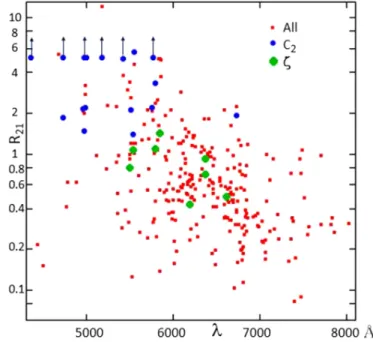
HD 204827 (Hobbs et al. 2008) to the unshielded one HD 183143 (Hobbs et al. 2009). The wavelength dependence of this ratio is displayed in Fig.4 for all the DIBs detected in both sightlines (260) and it is compared with the C2 DIBs listed byThorburn
et al.(2003). The general decrease of R21with λ is clear. It may
be inferred that the average UV resilience of the DIB carriers increases with λ.
In addition, there are 168 confirmed DIBs on the line of sight of HD 183143 which are not detected in HD 204827 (2/3 at λ > 6500 Å), implying R21. 1; similarly, 107 DIBs on the line
of sight of HD 204827 are not detected in HD 183143 (85% at λ < 6200 Å), implying R21& 1. This behavior is consistent with
the trends of the R21/λ correlation displayed in Fig.4.
A possible explanation is that λ strongly depends on the number of carbon atoms NC of these carriers, since we expect
an exponential dependence of the H photolysis rate on the number of vibration modes (Appendix A) and hence on NC.
Such a dependence with NCof the wavelength of strong bands is
especially marked for elongated molecules such as carbon chains (e.g.,Campbell & Maier 2017a), elongated catacondensed PAHs (Ruiterkamp et al. 2005), including polyacenes (Fig.2). We may infer that elongated molecules play a significant role among DIB carriers. However, other origins for the correlation of R21
with λ are possible, such as the predominance of cationic bands at large λ.
Fig. 4.Wavelength dependence of the ratio R21of the equivalent widths
of the C2DIBs (4364, 4727, 4735, 4964, 4969, 4980, 4985, 5004, 5176,
5419, 5513, 5542, 5546, 5763, 5769, 5793, 6729 Å,Thorburn et al. 2003)
and of the main ζ DIBs (5494, 5545, 5797, 5850, 6196, 6376, 6379,
6614 Å) listed byEnsor et al.(2017), on the lines of sight of HD 204827
and HD 183143 (Hobbs et al. 2008,2009). The vertical arrows indicate
a lower limit of this ratio for the C2 DIBs not detected on the line of
sight of HD 183143. Small red dots denote all other 260 DIBs detected
on both lines of sight (Hobbs et al. 2008,2009).
As seen in Fig. 4, the correlation between R21 or the
resilience with λ also holds in particular for the main ζ DIBs listed by Ensor et al. (2017), whose best definition is the correlation with the H2column density (see, e.g.,Lan et al. 2015;
Ensor et al. 2017). This probably extends to the whole family of ζ DIBs whose other members are not yet as well characterized. Such a λ behavior of the C2 and ζ DIB families and their
car-riers, which should be neutral, might be compatible with the λ dependence of the strong visible D2band of polyacenes (Fig.2).
As regards the main λ range of C2bands, ∼4700–5700 Å, first,
it is seen in Fig.2that it corresponds roughly to the gas-phase wavelength of the D2 band of neutral polyacenes with N ∼ 11–
123. As discussed in Sect. 3 and Appendix A, these acenes
with N ∼ 11–12 could be partially dehydrogenated in the nor-mal diffuse ISM, but might be nornor-mally rehydrogenated in the UV-shielded C2clouds.
For instance, we may wonder whether the strong band of undecacene observed at 4950 Å in an argon matrix (Fig.2 and Sect. 2.2) corresponds to a C2 DIB. This requires an estimate
of the argon-matrix shift of the undecacene band. An approxi-mate value for this shift could be its value for the 5362.8 Å band of pentacene, 779 cm−1 (Halasinski et al. 2000; Salama et al. 2011). This would yield a gas-phase wavelength of the order of 4755 Å for undecacene. Taking into account the uncertainty on the matrix shift, this wavelength could be compatible either with the very strong and blended C2 DIB at 4727 Å or with a weak
C2DIB at 4734 Å. Matching the strong part of the blended DIB
at 4727 Å seems unlikely because of the lack of a similar DIB counterpart for dodecacene of which the D2 band is expected
3 Polyacene anions might also be considered as carriers of the C
2DIBs.
However, the same λ specificity favoring shorter wavelengths is not expected as it is for neutral acenes.
around 5100 Å. A match with the C2DIB at 4734 Å or the weak
part of the blended DIB at 4727 Å seems possible, but it lacks significance because of the weakness of the DIBs and the wave-length uncertainty. Similarly, a coincidence of the D2 band of
dodecacene is not excluded with one of the C2DIBs in the range
∼5000–5100 Å (and perhaps of the D2band of decacene with the
C2DIB at 4364 Å).
If we next consider the ζ DIBs in Fig.4, their main λ range, ∼5500–6500 Å, corresponds roughly to the gas-phase wave-length of the D2band of neutral polyacenes with N ∼ 13 to 16–18
(Fig. 2). Such a size range might be expected for the smallest acenes that could be stable against H photodissociation in the normal diffuse interstellar medium, with a decreasing stability from N = 16 to 13 although the actual photodissociation behav-ior of polyacenes in this N range remains uncertain (Sect. 3.1
and AppendixA). If it seems difficult that such polyacenes can account for the strongest ζ DIBs, it is not impossible that they carry some of the numerous weaker ζ DIBs.
Let us stress again however that such a correlation between the wavelength and the carrier stability against UV photodisso-ciation through the whole DIB spectral domain is not unique to polyacenes. It could also occur for other kinds of elongated car-riers, such as long carbon chains or other classes of elongated PAHs, which have strong visible bands whose λ increases with molecular length.
4.3. Band profiles
It is clear that the profiles of the DIBs and their variation in dif-ferent environments contain key information about the nature of their carriers by putting strong constraints on the param-eters of the molecular transitions involved. Going on various pieces of evidence, there is a general agreement that the observed profiles of DIBs result from a combination of several processes, mainly: (i) Lorentz broadening, corresponding to an extremely short (ps) lifetime of the excited state because of rapid inter-nal conversion (ii) rotatiointer-nal broadening (see, e.g., review by
Sarre 2014 and references therein) and (iii) vibrational broad-ening from hot bands (Marshall et al. 2015; Oka et al. 2013). To summarize, the broadest profiles must be dominated by IEC, including the most extreme case of the 4428 Å DIB (Snow 2002); the narrow ζ profiles and their resolved fine structure seem well accounted for by pure rotational broadening (e.g., Cami et al. 2004;Sarre 2014and references therein), as well as the similar profiles of the C2 DIBs (Elyajouri et al. 2018), while many σ
DIBs seem to need a combination of several processes, includ-ing the C+60 bands (Campbell et al. 2016a,b;Campbell & Maier 2018).
It is recognized that a key constraint on the DIB carrier identification is the variations of their width with the environ-ment and especially the radiation field. These variations are particularly pronounced for the line of sight towards the star Herschel 36 (Her 36). The increased width is generally inter-preted as an enhancement of the rotational temperature mostly induced by the strength of local UV and/or IR radiation field.
It has been shown, especially byOka et al.(2013),Huang & Oka(2015), that such a large broadening cannot be achieved by the small rotational constants of large molecules, such as heavy pericondensed PAHs, fullerenes or very long carbon chains. These authors have thus proposed that the required large rota-tional constants imply that the carriers of these DIBs are small molecules with no more than about ten heavy atoms. However, this could be in contradiction with the fragility of such small
molecules to photodissociation in the UV radiation of the diffuse ISM, which explains why they are not observed there.
However, as noted, for example by Huang & Oka(2015), a similarly large broadening may be achieved by a nonlinear molecule if only one of its rotational constants A is large enough (a few 0.01 cm−1). This could be a key advantage for polyacenes
(TableC.1) since it is expected for example that A ∼ 0.016 cm−1 for N ∼ 14 (Sect. 2.1).
For a transition moment polarized along the long axis of the molecule, as expected for the main D2 band of polyacenes
(Fig.2), AppendixCshows that a typical ζ DIB width of ∼1.5– 2.5 cm−1may be achieved with a difference of ∼1–2% between
the A rotation constants of the excited and ground states, for a rotational temperature of ∼100 K.
The prediction of the rotation temperature(s) of interstellar PAHs remains difficult because of the number and complexity of physical processes to be considered. AppendixBsummarizes previous discussions and their adaptation to the particular case of elongated polyacenes which are close to prolate symmetric tops. A dominant process is the internal exchange of energy between the vibrations and the rotation (IVRET). It forces the distribu-tion between the K-sublevels of rotadistribu-tion along the main axis of the molecule to be governed by a temperature TKequal to the
vibration temperature Tvib. For polyacenes, the combination of
IVRET and periodic absorption of UV-visible photons should result in high values of TKbetween photon absorptions, perhaps
&100 K in the diffuse ISM and even higher values for stronger radiation fields.
Although all these processes remain uncertain, it is not impossible that they could explain both the DIB profiles observed in the normal diffuse ISM and their broadening in sightlines with enhanced radiation intensity such as Her 36 (Dahlstrom et al. 2013).
5. Concluding remarks and prospects
In this paper, we described the characteristics of polyacenes and explored their potential role as carriers of the DIBs. In this con-text, the existence of a possible general correlation of the DIB wavelength with the UV resilience of their carriers (Fig. 4) is worth stressing. It could be an indication of the important role of elongated molecules among these carriers, since the dependence of λ on NC is expected to be significantly stronger for
elon-gated molecules than for compact ones, as found for polyacenes (Fig.2).
Although there is still no decisive argument, the number of indicative clues in support of higher acenes being signif-icant DIB carriers is noteworthy. Polyacenes are members of the PAH family, which includes the most abundant contenders as DIB carriers, and they display unique properties of sym-metry and elongation that induce regular series of very strong bands throughout the DIB wavelength domain (Fig.2). It is not excluded that those with very strong visible bands are just at the limit of stability against UV photodissociation (for N& 11–14 in the diffuse and translucent ISM). They should exist in various forms of ionization and degrees of dehydrogenation which might fit with the properties of the different DIB families. Despite the lower stability of linear polyacenes compared to compact PAHs, some processes might compensate for that in such a way that they reach significant abundances, while only ∼10−5of the total PAH abundance is enough to account for a medium-strength DIB. The characteristic rotational profiles displayed by a number of DIBs and their broadening in strong radiation fields might also
be accounted for by special properties of polyacene bands and their large A rotational constant.
All in all, no definite inconsistency has been identified precluding N ∼ 11–13 polyacenes from being carriers of main C2 DIBs, including undecacene with its measured strong
D2 band, and those with N& 13–14 being carriers of some
medium-strength DIBs. However, in the absence of precise labo-ratory data on the higher acenes and their visible bands, no firm conclusions can be drawn. In addition, the properties of poly-acene photodissociation are uncertain. Furthermore, the mode of formation of interstellar acenes remains largely hypothetical, as is the case for the formation of PAHs in general, and the known higher reactivity and instability of polyacenes compared to other PAHs might make their interstellar formation difficult. Nevertheless, despite all these uncertainties, the many interest-ing properties of polyacenes warrant further exploratory work to determine with greater likelihood whether or not they could eventually be important carriers of the DIBs.
On the experimental side, any eventual acene-carrier identi-fication would need confirmation from gas-phase or He-droplet spectroscopy, including a careful consistency check of the full spectrum of the putative carrier with the observed spectra (see, e.g., Snow 1995, 2014). However, because of the difficulty of such experiments with extremely unstable compounds, the extension of matrix spectroscopy of linear N-acenes beyond N= 11 is fundamental.
On the theoretical side, the extension of existing quantum chemical structure modeling to higher linear acenes than N= 11 is important for understanding their complex electronic struc-ture and the properties of their visible bands. If such results could prove to be encouraging in view of DIB-carrier identifi-cation, it would be desirable to extend the computation to N-polyacene ions and dehydrogenated forms. In parallel, it would be important to precisely model the interstellar photodissociation (H atoms first and then the C skeleton) of acenes.
If the importance of higher acenes as DIB carriers was further supported by experimental and theoretical work, mod-elling the profiles of the corresponding DIBs assuming rotational broadening of acene bands would provide important further information.
Finally, high-quality observations with the best ground- and space-based telescopes will be critical to further improve the constraints on DIB carriers, and more importantly, once DIBs carriers are identified, to extract all the information they can provide on the physics and properties of the interstellar medium.
Acknowledgements.We are indebted to Sydney Leach and Benoit Soep for many discussions and important suggestions, and to Pierre Cox for his careful reading of the manuscript and his suggestions for improving it. We would like to thank Rosine Lallement, Olivier Berné, Christine Joblin, Thomas Pino, Farid Salama, Elisabetta Micelottta, etc. for discussions and comments on various aspects. We also thank Madeleine Roux-Merlin for her precious help in finding references. We thank the referee for his/her helpful detailed suggestions. This work was sup-ported in part by the German Research Foundation (DFG). The computations were performed on the BwForCluster JUSTUS. The authors acknowledge sup-port from the state of Baden-Württemberg through bwHPC and the DFG through grant no INST 40/467-1 FUGG.
References
Ali-Haïmoud, Y. 2013,Adv. Astron., 2013, 462697
Ali-Haïmoud, Y., Hirata, C. M., & Dickinson, C. 2009,MNRAS, 395, 1055
Allamandola, L. J., Tielens, A. G. G. M., & Barker, J. R. 1985,ApJ, 290, L25
Allamandola, L. J., Hudgins, D. M., Bauschlicher, C. W., Jr., & Langhoff, S. R. 1999,A&A, 352, 6
Andrews, H., Boersma, C., Werner, M. W., et al. 2015,ApJ, 807, 99
Andrews, H., Candian, A., & Tielens, A. G. G. M. 2016,A&A, 595, A23
Anthony, J. E. 2008,Angew. Chem. Int. Ed., 47, 452
Battaglia, S., Faginas-Lago, N., Andrae, D., Evangelisti, S., & Leininger, T. 2017,
J. Phys. Chem. A, 121, 3746
Becke, A. D. 1993J. Chem. Phys., 98, 5648
Bettinger, H. F., & Tönshoff, C. 2015,Chem. Rec., 15, 364
Bettinger, H. F., Tönshoff, C., Doerr, C. M., & Sanchez-Garcia, E. 2016,J. Chem. Theory Comput., 12, 305
Cami, J. 2014,IAU Symp., 297, 370
Cami, J., & Cox, N. L. J. 2014, The Diffuse Interstellar Bands,IAU Symp., 297
Cami, J., Salama, F., Jiménez-Vicente, J., Galazutdinov, G. A., & Krełowski, J. 2004,ApJ, 611, L113
Cami, J., Cox, N. L., Farhang, A., et al. 2018,The Messenger, 171, 31
Campbell, E. K., & Maier, J. P. 2017a,J. Chem. Phys., 146, 160901
Campbell, E. K., & Maier, J. P. 2017b,ApJ, 850, 69
Campbell, E. K., & Maier, J. P. 2018,ApJ, 858, 36
Campbell, E. K., Holz, M., Gerlich, D., & Maier, J. P. 2015,Nature, 523, 322
Campbell, E. K., Holz, M., Maier, J. P., et al. 2016a,ApJ, 822, 17
Campbell, E. K., Holz, M., & Maier, J. P. 2016b,ApJ, 826, L4
Castellanos, P., Candian, A., Andrews, H., & Tielens, A. G. G. M. 2018a,A&A, 616, A166
Castellanos, P., Candian, A., Zhen, J., Linnartz, H., & Tielens, A. G. G. M. 2018b,
A&A, 616, A167
Cernicharo, J., Heras, A. M., Tielens, A. G. G. M., et al. 2001,ApJ, 546, L123
Chabot, M., Béroff, K., Dartois, E., Pino, T., & Godard, M. 2017, ArXiv e-prints [arXiv:1709.07803]
Chai, J. D. 2014,J. Chem. Phys., 140, 18A521
Chiar, J. E., Tielens, A. G. G. M., Adamson, A. J., & Ricca, A. 2013,ApJ, 770, 78
Cocchi, C., Prezzi, D., Ruini, A., Caldas, M. J., & Molinari, E. 2014,J. Phys. Chem. A, 118, 6507
Crawford, M. K., Tielens, A. G. G. M., & Allamandola, L. J. 1985,ApJ, 293, L45
Dahlstrom, J., York, D. G., Welty, D. E., et al. 2013,ApJ, 773, 41
Douglas, A. E. 1977,Nature, 269, 130
Duley, W. W. 2000,ApJ, 528, 841
Elyajouri, M., Lallement, R., Cox, N. L. J., et al. 2018,A&A, 616, A143
Ensor, T., Cami, J., Bhatt, N. H., & Soddu, A. 2017,ApJ, 836, 162
Fan, H., Welty, D. E., York, D. G., et al. 2017,ApJ, 850, 194
Foing, B. H., & Ehrenfreund, P. 1994,Nature, 369, 296
Frisch, M. J., Trucks, G. W., Schlegel, H. B. et al. 2009,Gaussian 09, Revision A.02
Gredel, R., Carpentier, Y., Rouillé, G., et al. 2011,A&A, 530, A26
Hachmann, J., Dorando, J. J., Avilés, M., & Garnet Chan, G. K. 2007,J. Chem. Phys., 127, 134309
Halasinski, T. M., Hudgins, D. M., Salama, F., & Allamandola, L. J. 2000,J. Phys. Chem. A, 104, 7484
Halasinski, T. M., Weisman, J. L., Ruiterkamp, R., et al. 2003,J. Phys. Chem. A, 107, 3660
Hahndorf, I., Lee, Y. T., Kaiser, R. I., et al. 2002,J. Chem. Phys., 116, 3248
Hardy, F.-X., Rice, C. A., & Maier, J. P. 2017,ApJ, 836, 37
Hehre, W. J., Ditchfield, R., & Pople, J. A. 1972,J. Chem. Phys., 56, 2257
Heinecke, E., Hartmann, D., Müller, R., & Hese, A. 1998,J. Chem. Phys., 109, 906
Herbig, G. H. 1995,ARA&A, 33, 19
Hoang, T., Draine, B. T., & Lazarian, A. 2010,ApJ, 715, 1462
Hoang, T., Lazarian, A., & Draine, B. T. 2011,ApJ, 741, 87
Hobbs, L. M., York, D. G., Snow, T. P., et al. 2008,ApJ, 680, 1256
Hobbs, L. M., York, D. G., Thorburn, J. A., et al. 2009,ApJ, 705, 32
Huang, J., & Oka, T. 2015,Mol. Phys., 113, 2159
Huang, R., Phan, H., Herng, T. S., et al. 2016,J. Am. Chem. Soc., 138, 10323
Huisken, F., Rouillé, G., Steglich, M., et al. 2014,IAU Symp., 297, 265
Ji, M., Bernard, J., Chen, L., et al. 2017,J. Chem. Phys., 146, 044281
Jones, A. P. 2016,R. Soc. Open Sci., 3, 160223
Jones, A. P., Ysard, N., Köhler, M., et al. 2014,Faraday Discuss., 168, 313
Kaiser, R. I., Hahndorf, I., Lee, Y. T., et al. 1999,J. Chem. Phys., 110, 6091
Kaiser, R. I., Vereecken, L., Peeters, J., et al. 2003,A&A, 406, 385
Ka´zmierczak, M., Schmidt, M. R., Bondar, A., & Krełowski, J. 2010,MNRAS, 402, 2548
Kofman, V., Sarre, P. J., Hibbins, R. E., ten Kate, I. L., & Linnartz, H. 2017,Mol. Astrophys., 7, 19
Krasnokutski, S. A., Huisken, F., Jäger, C., & Henning, T. 2017,ApJ, 836, 32
Kroto, H. W., & Jura, M. 1992,A&A, 263, 275
Krüger, J., Giarca, F., Eisenhut, F., et al. 2017,Angew. Chem. Int. Ed., 56, 11945
Lallement, R., Cox, N. L. J., Cami, J., et al. 2018,A&A, 614, A28
Lan, T.-W., Ménard, B., & Zhu, G. 2015,MNRAS, 452, 3629
Leach, S. 1995,Planet. Space Sci., 43, 1153
Lee, C., Yang, W., & Parr, R. G. 1988,Phys. Rev. B, 37, 785
Léger, A., & D’Hendecourt, L. 1985,A&A, 146, 81
Leger, A., & Puget, J. L. 1984,A&A, 137, L5
Leger, A., D’Hendecourt, L., & Boissel, P. 1988,Phys. Rev. Lett., 60, 921
Le Page, V., Snow, T. P., & Bierbaum, V. M. 2001,ApJS, 132, 233
Le Page, V., Snow, T. P., & Bierbaum, V. M. 2003,ApJ, 584, 316
Li, J., & Zhang, Q. 2015,Appl. Mater. Interfaces, 7, 28049
Li, J., Chen, S., Wang, Z., & Zhang, Q. 2016,Chem. Rec., 16, 1518
Luzanov, A. V., Plasser, F., Das, A., & Lischka, H. 2017,J. Chem. Phys., 146, 064106
Mackie, C. J., Peeters, E., Bauschlicher, C. W., Jr., & Cami, J. 2015,ApJ, 799, 131
Maier, J. P., Walker, G. A. H., & Bohlender, D. A. 2004,ApJ, 602, 286
Malloci, G., Mulas, G., Cappellini, G., & Joblin, C. 2007,Chem. Phys., 340, 43
Malloci, G., Cappellini, G., Mulas, G., & Mattoni, A. 2011,Chem. Phys., 384, 19
Marshall, C. C. M., Krełowski, J., & Sarre, P. J. 2015,MNRAS, 453, 3912
McGuire, B. A., Burkhardt, A. M., Kalenskii, S., et al. 2018,Science, 359, 202
Micelotta, E. R., Jones, A. P., & Tielens, A. G. G. M. 2010,A&A, 510, A37
Mondal, R., Tönshoff, C., Khon, D., et al. 2009, J. Am. Chem. Soc., 131, 14281
Montillaud, J., Joblin, C., & Toublanc, D. 2013,A&A, 552, A15
Nijegorodov, N., Ramachandran, V., & Winkoun, D. P. 1997,Spectrochim. Acta A, 53, 1813
Oka, T., Welty, D. E., Johnson, S., et al. 2013,ApJ, 773, 42
Oka, T., Welty, D. E., Johnson, S., et al. 2014,ApJ, 793, 68
Omont, A. 2016,A&A, 590, A52
Parneix, P., Gamboa, A., Falvo, C., et al. 2017,Mol. Astrophys., 7, 9
Pendleton, Y. J., & Allamandola, L. J. 2002,ApJS, 138, 75
Planck Collaboration Int. XV., 2014,A&A, 565, A103
Plasser, F., Pasˇali´c, H., Gerzabek, M. H., et al. 2013,Angew. Chem. Int. Ed., 52, 2581
Povie, G., Segawa, Y., Nishihara, T., Miyauchi, Y., & Itami, K. 2017,Science, 356, 172
Povie, G., Segawa, Y., Nishihara, T., Miyauchi, Y., & Itami, K. 2018,J. Am. Chem. Soc., 140, 10054
Puget, J. L., & Leger, A. 1989,ARA&A, 27, 161
Rai, D. K., & Shukla, K. 2018, ArXiv e-prints [arXiv:1810.03482v2] Rouan, D., Leger, A., Omont, A., & Giard, M. 1992,A&A, 253, 498
Rouan, D., Leger, A., & Le Coupanec, P. 1997,A&A, 324, 661
Ruiterkamp, R., Halasinski, T., Salama, F., et al. 2002,A&A, 390, 1153
Ruiterkamp, R., Cox, N. L. J., Spaans, M., et al. 2005,A&A, 432, 515
Salama, F., & Ehrenfreund, P. 2014,IAU Symp., 297, 364
Salama, F., Bakes, E. L. O., Allamandola, L. J., & Tielens, A. G. G. M. 1996,
ApJ, 458, 621
Salama, F., Galazutdinov, G. A., Krełowski, J., et al. 2011,ApJ, 728, 154
Sarre, P. J. 2006,J. Mol. Spectr., 238, 1
Sarre, P. J. 2014,IAU Symp., 297, 34
Scott, A., Duley, W. W., & Pinho, G. P. 1997,ApJ, 489, L193
Shen, B., Tatchen, J., Sanchez-Garcia, E., & Bettinger, H. F. 2018,Angew. Chem. Int. 57, 10506
Silsbee, K., Ali-Haïmoud, Y., & Hirata, C. M. 2011,MNRAS, 411, 2750
Simon, A., Champeaux, J. P., Rapacioli, M., et al. 2018,Theor. Chem. Acc., 137, 106
Snow, T. P. 1995, inThe Diffuse Interstellar Bands, eds. Tielens, A. G. G. M. & Snow, T. P. (Dordrecht: Kluwer), 202
Snow, T. P. 2002,ApJ, 567, 407
Snow, T. P. 2014,IAU Symp., 297, 3
Spieler, S., Kuhn, M., Postler, J., et al. 2017,ApJ, 846, 168
Steglich, M., Bouwman, J., Huisken, F., & Henning, T. 2011,ApJ, 742, 2
Stephens, T., P. J., Devlin, F. J., Chabalowski, C. F., & Frisch, M. J. 1994,J. Phys. Chem., 98, 11623
Thaddeus, P. 1995,Astrophys. Space Sci. Lib., 202, 369
Thorburn, J. A., Hobbs, L. M., McCall, B. J., et al. 2003,ApJ, 584, 339
Tian, M., Liu, B. S., Hammonds, M., et al. 2012,Phys. Chem. Chem. Phys., 14, 6603
Tielens, A. G. G. M. 2008,ARA&A, 46, 289
Tielens, A. G. G. M. 2013,Rev. Mod. Phys., 85, 1021
Tielens, A. G. G. M. 2014,IAU Symp., 297, 399
Tielens, A. G. G. M., & Snow, T. P., 1995,The Diffuse Interstellar Bands, Astrophys. Space Sci. Lib. (Dordrecht: Kluwer), 202
Tönshoff, C., & Bettinger, H. F. 2010,Angew. Chem., Int. Ed., 49, 4125
van der Zwet, G. P., & Allamandola, L. J. 1985,A&A, 146, 76
Vos, D. A. I., Cox, N. L. J., Kaper, L., Spaans, M., & Ehrenfreund, P. 2011,A&A, 533, A129
Walker, G., Bohlender, D., Maier, J., & Campbell, E. 2015,ApJ, 812, L8
Walker, G. A. H., Campbell, E. K., Maier, J. P., Bohlender, D., & Malo, L. 2016,
ApJ, 831, 130
Walker, G. A. H., Campbell, E. K., Maier, J. P., & Bohlender, D. 2017,ApJ, 843, 56
West, B., Useli-Bacchitta, F., Sabbah, H., et al. 2014,J. Phys. Chem. A, 118, 7824
West, B., Castillo, S. R., Sit, A., et al. 2018,Phys. Chem. Chem. Phys., 20, 7195
Wu, C., Lee, P., & Chai, J. 2016,Sci. Rep., 6, 37249
Yang, Y., Davidson, E. R., & Yang, W. 2016,Proc. Natl. Acad. Sci. USA, 113, E5098
Ye, Q., & Chi, C. 2014,Chem. Mater., 26, 4046
Ysard, N., & Verstraete, L. 2010,A&A, 509, A12
Zack, L. N., & Maier, J. P. 2014,IAU Symp., 297, 237
Zade, S. S., & Bendikov, M. 2012,J. Phys. Org. Chem., 25, 452
Zhao, T. Q., Li, Q., Liu, B. S., et al. 2016,Phys. Chem. Chem. Phys., 18, 3489
Zhen, J., Castellanos, P., Paardekooper, D. M., Linnartz, H., & Tielens, A. G. G. M. 2014,ApJ, 797, L30
Zhen, J., Castellanos, P., Paardekooper, D. M., et al. 2015,ApJ, 804, L7
Zhen, J., Rodriguez Castillo, S., Joblin, C., et al. 2016,ApJ, 822, 113
Zhen, J., Candian, A., Castellanos, P., et al. 2018,ApJ, 854, 27
Zuzak, R., Dorel, R., Krawiec, M. et al. 2017,ACS Nano, 11, 9321
Appendix A: Summary of PAH photodissociation in diffuse clouds and the case of polyacenes Absorption of UV photons is the most important source for processing interstellar PAHs. For large PAHs, it is expected that most of the ∼6–13.6 eV energy of an absorbed photon is rapidly redistributed among the numerous energy levels of these large molecules, eventually ending in various outcomes – ioniza-tion, various dissociation channels, and isomerization – before cooling by emission of photons mostly in the infrared range. The ionization yield following the absorption of a UV photon remains low, close to the ionization threshold, but increases con-siderably for the most energetic interstellar UV photons (Leach 1995,1996;Zhen et al. 2015,2016).
Photodissociation is a key process for small and medium-size PAHs. It can result from the absorption of a single UV photon with energy ∼10 eV, especially for releasing H atoms with typi-cal binding energy (BDE) and activation energy, EA, in the range
∼4.5–5 eV. The rate of such processes is directly proportional to the UV radiation intensity G0, which is generally expressed in
Habing units (1.6 × 10⁻³erg cm−2 s−1between 6 and 13.6 eV).
G0 varies mostly between 3 and 10 Habing units in the regions
of the diffuse ISM where the DIBs are formed (see, e.g., Fig. 18 ofVos et al. 2011). But it is well established that a two-step pro-cesses with the successive absorption of two photons may be dominant for larger binding energy (e.g.,Montillaud et al. 2013;
Andrews et al. 2016;Castellanos et al. 2018a). It is not impos-sible that such two-step processes are important when there is a low-energy metastable isomer accessible with a lower activation energy, EA∼ 4 eV, and a lower BDE. Such a case was analyzed
in detail by Castellanos et al. (2018a) for the perylene cation (C20H+12), where the transfer of an H within a trio-H may form an
aliphatic CH2with EA∼ 3.81 eV. Such a situation should be
sim-ilar for all trio-H and quarto-H of PAHs, including the quarto-H of polyacenes. But it seems unlikely that such metastable isomers can survive until the arrival of a second photon in interstellar conditions.
It is generally thought that the use of simple statistical theo-ries is justified for modeling the photodissociation of interstellar PAHs (Le Page et al. 2001; Montillaud et al. 2013; Andrews et al. 2016;Castellanos et al. 2018b;West et al. 2018, and ref-erences therein). As expected, the results of these models show a steep exponential variation of the photodissociation rates with activation energy, the size of the PAH, and the energy of the absorbed photon. This makes modeling the photodissociation rates relatively difficult, because varying, for example, an acti-vation energy by a few 0.1 eV may change a photodissociation rate by several orders of magnitude. In addition, it is increasingly accepted that PAH photodissociation is significantly more com-plicated than assumed in such simplified models. For instance,
Parneix et al. (2017) show that ring opening and formation of pentagonal rings should occur in parallel or in competition with hydrogen loss, especially for high levels of dehydrogena-tion. Complete molecular dynamics studies might eventually be required, as performed for example bySimon et al.(2018).
In the absence of similar modeling for the actual case of polyacenes, one may try to infer the qualitative behav-ior of their photodissociation rates from these models for PAHs of similar number of atoms. It seems well established that interstellar photodissociation of PAHs proceeds first with release of atomic hydrogen, before producing small CnHm molecules
with erosion of the carbon skeleton. This should apply to poly-acenes as well. Quantitatively, for N-polypoly-acenes, we attempt to infer the value of N for which dehydrogenation proceeds in the
diffuse ISM (G0 ∼ 5) from existing models for other PAHs with
similar number of carbon atoms NC. For the relevant range of
N ∼11–14 (Fig. 2), i.e. NC∼ 46–58, N(C+H)∼ 72–84, the case
of circumcoronene, C54H18, seems suitable. It was discussed in
detail in particular byAndrews et al.(2016) andCastellanos et al.
(2018a,b). They show that H-loss for circumcoronene proceeds at a very low rate, only by two-photon absorption, meaning that the dehydrogenation should be negligible in the diffuse ISM. This should also be the case for N-acenes with N ≥ 14 (NC≥ 58). On
the other hand, Castellanos et al. (2018a,b) show that ovalene (C32H14) should be completely dehydrogenated.
Due to the very steep variation of the dehydrogenation rate with N, there should be a value Ncrof N around which the
poly-acene hydrogenation passes from normally fully hydrogenated to at least partiallly dehydrogenated for a very small variation of N, δN = 1–3. If the polyacenes were found to behave like pericon-densed PAHs such as ovalene and circumcoronene with similar activation energies and isomers, one could infer that the critical value Ncrfor dehydrogenation should be about 9 or 10. However,
it is possible that the photodissociation of heavy polyacenes or their cations might be made significantly easier by various pecu-liarities of these molecules such as the quarto H atoms at the two ends of the molecule, the richness of their low-energy electronic levels, and especially the possibility of nonplanar distortions which might lower some activation energies for isomerization. We therefore tentatively estimate that it is not even excluded that Ncr∼ 11–13.
Looking for the detailed properties of the dehydrogenated states of polyacenes, it is generally agreed that the C–H bind-ing energy is lower from two adjacent vicinal H on a same C–C bond (in “duo”, “tertio” or “quarto” position) than for a single (“solo”) H atom at peri positions (e.g., Andrews et al. 2016; Castellanos et al. 2018a). We have verified that by DFT calculations (B3LYP/6-31G*) for the quarto H atoms at the two ends of polyacenes for N= 11 and 13. We find that the “solo-H” have bond dissociation energies (E + ZPVE) ranging from 4.8 to 5.3 eV for N= 11 and 5.1–5.6 eV for N = 13. The quarto H atoms have much lower BDE of 4.7–4.8 eV both for N= 11 and N= 13.
In addition, the likely lower activation energy from states with odd number of H atoms might favor partially dehydro-genated states with even H number. It is therefore expected that the first step of dehydrogenation should be the loss of two H at each end of the polyacene molecule, yielding C4N+2H2N.
However, it seems that the loss of four additional Hs should rapidly follow because of the still low BDE of the remaining quarto H after partial dehydrogenation, as given in general by
Castellanos et al.(2018a), yielding C4N+2H2N−4. Such partially
dehydrogenated polyacenes might be the dominant form for one or a few values of N in the diffuse ISM, for N in the possi-ble range ∼11–12. Fully hydrogenated polyacenes could thus be found with N& 12–13 in the diffuse ISM, and with N & 11–12 in “C2” translucent clouds, but these values remain uncertain.
However, distortion of the hexagonal C-skeleton may arise simultaneously with dehydrogenation, and completely dehydro-genated polyacenes produced by subsequent dehydrogenation seem unstable with formation of carbon pentagons or larger rings (Parneix et al. 2017;Mackie et al. 2015).
Appendix B: Rotational excitation of interstellar polyacenes
The prediction of the rotation temperature(s) of interstellar PAHs remains difficult because of the number and the complexity of
physical processes to be considered (e.g., Rouan et al. 1992,
1997;Ali-Haïmoud et al. 2009;Ali-Haïmoud 2013;Ysard & Ver-straete 2010;Hoang et al. 2010,2011;Silsbee et al. 2011;Planck Collaboration Int. XV 2014; and references therein). However, the modeling framework developed in these references may provide basic clues for polyacenes as well, although it was gen-erally designed for the case of disk (i.e., oblate) symmetric-top PAHs, while elongated polyacenes are close to prolate symmetric tops.
As stated by Rouan et al. (1992), the internal exchange of energy between the vibrations and the rotation (IVRET) is a dominant mechanism (see also, e.g., Ali-Haïmoud 2013). It forces the distribution between the K-sublevels of rotation along the main axis of the molecule to be governed by a temperature TKequal to the vibration temperature Tvib. For prolate tops such
as polyacenes, the result is indeed different and somewhat sim-pler than for disk PAHs since, through the large A value, TK
determines the main effects of rotation levels on the profiles of parallel visible bands, while the J distribution has only minor effects. Just after the absorption of a UV-visible photon, Tvib
and hence TKare determined by the rate of IR-vibration
cool-ing (Appendix A). However, this phase which lasts as long as thermal relaxation is achieved through internal vibration redis-tribution (IVR) and IVRET, is very brief (.hours). It stops when IVR breaks down because the vibration excitation energy is too low, maybe when Tvib reaches about 200 K in the diffuse
ISM (e.g., Ysard & Verstraete 2010). Therefore, an interstel-lar polyacene molecule spends most of its life between photon absorptions (∼0.2 yr) in an uncertain state where only a few lower vibration levels are populated out of thermal equilibrium. In parallel, IVRET breaks also down for similar values of Tvib,
probably of at least a couple of hundred Kelvin (Ali-Haïmoud 2013). Then, TK cannot decay by rotational damping because
the permanent electric dipole is zero in such symmetric poly-acenes. Despite some possible additional slow cooling through residual IVRET and vibration-IR emission, it is then likely that TKkeeps a high value, perhaps&100 K in the diffuse ISM, before
the absorption of the next photon, and even a higher value for stronger radiation fields. Although all these processes remain highly uncertain, it is not impossible that they could explain both the DIB profiles observed in the normal diffuse ISM and their broadening in sightlines with enhanced radiation intensity such as Her 36 (Dahlstrom et al. 2013).
Appendix C: DIB rotational profiles
In interstellar conditions, the rotational broadening of the expected profiles of absorption bands of polyacenes may be roughly estimated as follows. As quoted in Sect. 2.1, typical values for the rotation constants, for example for N= 14, are A ∼1.6 × 10⁻²cm−1 (∼ 2.3 × 10⁻²K), B ∼ 2.2 × 10⁻⁴cm−1 and C ∼2.1 × 10⁻⁴cm−1, that is, A/(B or C) ∼ 75. We may therefore
neglect the terms depending on B or C in the rotational energy, and assume the molecule to be a symmetric top with rotational energy,
Erot≈ A × K2≈ 0.023 × K2 Kelvin. (C.1)
Therefore, at rotational temperature Trot, a typical value of K
is Km= p 44 × Trot= 67 p Trot/100. (C.2)
Rotational broadening occurs because of the variation of the energy difference between the ground and the excited levels f and e of the molecule. For a transition moment polarized along the long axis of the molecule, as expected for the main D2band
of polyacenes (Fig. 2), Ke= Kf= K. The shift of the K line is
thus such that
∆ν = (Ae− Af) × K2= δA × K2. (C.3)
Writing Af/δA = 100 p yields a typical shift for K= Kmand
N= 14,
∆νm= 0.7 × p × (Trot/100) cm−1. (C.4)
As we may expect that the spread in ∆ν, that is, the width of the DIB, may reach up to 2 ×∆νm, values of p ∼ 1–2, or (Ae–
Af)/Af∼ 1–2%, and Trot∼ 100 K (in agreement with values of
AppendixB) might explain the observed widths of ζ DIBs ∼2.0– 2.5 cm−1in normal lines of sight (e.g.,Hobbs et al. 2008,2009).
Such values of (Ae−Af)/Af do not appear unlikely, but they
should be proved by detailed calculations for such polyacenes. We note that for the case of the B2uband of pentacene
mea-sured byHeinecke et al.(1998), Ae–Af has a reverse sign with
(Ae–Af)/Af∼ −1%. However, this is a band with a different
sym-metry with its transition moment perpendicular to the long axis of the molecule. We also note that its large broadening at low temperature is due to the transitions with ∆K = ±1 for such a symmetry.
Table C.1. Calculated rotational constants of polyacenes (UB3LYP/6-31G*).
Acene A/GHz A/cm−1 B/GHz B/cm−1 C/GHz C/cm−1
5Ac(a) 1.335 4.45 × 10⁻² 0.117 39 × 10−4 0.108 36 × 10−4 9Ac 0.75012 2.502 × 10⁻² 0.02291 7.642 × 10⁻⁴ 0.02223 7.415 × 10⁻⁴ 10Ac 0.67670 2.257 × 10⁻² 0.01699 5.667 × 10⁻⁴ 0.01658 5.531 × 10⁻⁴ 11Ac 0.61638 2.056 × 10⁻² 0.01295 4.320 × 10⁻⁴ 0.01268 4.230 × 10⁻⁴ 12Ac 0.56597 1.888 × 10⁻² 0.01009 3.366 × 10⁻⁴ 0.00992 3.309 × 10⁻⁴ 13Ac 0.52320 1.745 × 10⁻² 0.00802 2.675 × 10⁻⁴ 0.00790 2.635 × 10⁻⁴ 14Ac 0.48644 1.623 × 10⁻² 0.00648 2.161 × 10⁻⁴ 0.00639 2.131 × 10⁻⁴ 15Ac 0.45452 1.516 × 10⁻² 0.00531 1.771 × 10⁻⁴ 0.00524 1.748 × 10⁻⁴ 16Ac 0.42653 1.423 × 10⁻² 0.00440 1.468 × 10⁻⁴ 0.00436 1.454 × 10⁻⁴ 17Ac 0.40180 1.340 × 10⁻² 0.00369 1.231 × 10⁻⁴ 0.00366 1.221 × 10⁻⁴ 18Ac 0.37978 1.267 × 10⁻² 0.00313 1.044 × 10⁻⁴ 0.00310 1.034 × 10⁻⁴ 19Ac 0.36004 1.201 × 10⁻² 0.00267 0.891 × 10⁻⁴ 0.00265 0.884 × 10⁻⁴ 20Ac 0.34225 1.142 × 10⁻² 0.00230 0.767 × 10⁻⁴ 0.00228 0.761 × 10⁻⁴