HAL Id: halshs-00455743
https://halshs.archives-ouvertes.fr/halshs-00455743
Submitted on 6 Mar 2010
HAL is a multi-disciplinary open access
archive for the deposit and dissemination of sci-entific research documents, whether they are pub-lished or not. The documents may come from teaching and research institutions in France or abroad, or from public or private research centers.
L’archive ouverte pluridisciplinaire HAL, est destinée au dépôt et à la diffusion de documents scientifiques de niveau recherche, publiés ou non, émanant des établissements d’enseignement et de recherche français ou étrangers, des laboratoires publics ou privés.
Crisis Propagation and Governance
Hanene Ezzine, Bernard Olivero, Ridha Shabou
To cite this version:
Hanene Ezzine, Bernard Olivero, Ridha Shabou. Crisis Propagation and Governance. La place de la dimension européenne dans la Comptabilité Contrôle Audit, May 2009, Strasbourg, France. pp.CD ROM. �halshs-00455743�
CRISIS PROPAGATION AND GOVERNANCE
Hanene Ezzine
Doctorante en Finance à la FSEG de Sfax et l’IAE de Nice
Cité Bahri 3 Ouganda secteur 31
Rue 959 Sfax 3064 Tunisie
[email protected]
Bernard Olivero
Professeur à l’université de Nice
[email protected]
Ridha Shabou
Professeur à l’université de Sfax
[email protected]
Abstract
Following the appearance of the recent scandals, the question of the efficiency of the corporate governance mechanisms to appease the financial crisis can be raised. The purpose of this paper is to study the impact of the board of directors effectiveness on the firm’s ability to resist the Asian stock market crisis. The firm ability to resist the Asian stock market crisis is assessed by minimization of financial return’s conditional volatility estimated by ARCH and GARCH models. Using a data from 94 listed and industrial firms in four East Asian countries: Malaysia, Thailand, Indonesia, and the Philippines between 1996 and 1998, we find that the board size and the presence of the outside directors are negatively linked to the financial return’s conditional volatility. This result seems to be compatible with the argument which supposes that the efficient boards can increase the ability to control the managers and the capability of firms to resist the crisis. The leadership structure would be without effect on the resistance to the crisis and the CEO turnover would have a positive effect on the financial return’s conditional volatility.
Key words: corporate governance, board of directors, propagation of crisis, financial return’s
Introduction
The studies of Johnson and al (2000), Claessens and al (2002) and Sang-Woo and Il Chong (2005) establish a relation between the origin of crisis and financial scandals and the practices of corporate governance. These researches centred on the Asian crisis show that the seriousness of the financial crises was linked to the deficiency of many corporate governance mechanisms, the most known of which is the deficiency of the board of directors. If the board of directors is according to the Anglo-American model, a scholarly dosage of expertise, experience and independence to the service of the interest of the firm and its shareholders, it endures in Asia several limits. Most Asian companies are controlled by families who dominate the board of directors. These families dispose of many strong factors that enable them to a vast control of the firm in order to maximize their profits at the expense of the minority shareholders. The Asian financial crisis puts in evidence that the boards of directors of the Asian firms don't functions in accordance with the law. The main tasks and responsibilities of the board of directors defined by the law of the Asian countries before the crisis comply with those of the western countries. Finally, theses studies show that the boards of directors of the Asian countries are generally little efficient in carrying out their duties especially those relating to selection, the control and the turnover of the Chief Executive Officer, and the executive director’s compensation. The boards of directors seems to be especially deficient in the assessment of the performance of the managers and the research of the support of outside directors in terms of access to information, to external professional services of audit, and to education and formation.
The theoretical and empirical studies accepted nowadays show a relationship between the amount of manager expropriation and the firm performance. In the case of a declining performance, the efficient corporate governance mechanisms reduce the managers’ breathing space. Weak mechanisms in controlling shareholders bring about an amplifying effect and spread the counter-performance on the markets. The main purpose of this study is to enrich the financial and economic literature concerning the efficient study of the mechanisms of corporate governance by analyzing the effect of the characteristics of board of directors on the capacity of firms to resist the Asian stock market crisis. It seems that the internal characteristics of the board of directors influence directly the stability of the firm and its potential of resistance in period of crisis. Traditionally, we find the size of the board, the fusion of the incumbency of the rôles of chair and CEO, the independence of directors and the
CEO turnover. Our paper is organized as follows: Section 1 discusses related conceptual framework and develops hypotheses. In Section 2, we present methodological aspects and empirical models. Section 3 analyses and discusses results. Finally, we provide concluding remarks.
I- The Conceptual framework and the research hypotheses
The theoretical setting of the governance is rich of numerous researches. The characteristics of the board of directors are generally analyzed in the setting of the efficiency of the mechanisms of corporate governance. The question that one asks is to know if these results remain even valid in period of crisis and what would be the impact of the theoretical recommendations to limit the propagation of the stock crisis.
1-The efficiency drivers of the board of directors
1-1 The size of the boardIf the studies dealing with the impact of the board size on its ability to function effectively are varied (Jensen 1993, Yermack 1996), those carried out in the Asian countries during the financial crisis are much more scarce (Sang Woo 2005 and Salmon 2000). Two research tendencies were opposed. The first justifies the preference of a board composed of a high number of directors since the latter ones are capable of supervising the managers’ behaviour as it is difficult for these ones to dominate a larger board. The high number of directors who have some specific knowledge is the cause of the favourable transactions thanks to an improving coordination between firms, a reduction of transaction costs, and an easy access to expertise (Pearce and Zahra1989). The second tendency stipulates that the board size doesn’t must be large to the point that makes productive debates impossible and decision making difficult. Board of directors composed of a large number of directors would not function efficiently and they would be strongly controlled by the managers. They cost a lot in terms of directors’ remuneration and require more time and effort by the managers to build a consensus about the way of action, which has a direct impact on the firm value (Jensen 1993, Yermack 1996).
The empirical evidence of Sang Woo and II Chong (2005) using a sample of Asian countries comes to back up the first research tendency by showing that the board size must be large enough to acquire on one hand, the competence, the experience required by the board and on the other hand, to increase the board’s ability to control and the firm’s ability to limit the propagation of the crisis. Salmon (2000) suggests that smaller boards are more exposed to
difficulties with the board committees (audit, remuneration and nominating committees) and can make the firms more vulnerable to the crisis. Pearce and Zahra (1992) find that large boards are associated with higher firm performance. We will put the first hypothesis so:
Hypothesis 1a: The firm’s ability to resist the Asian stock market crisis is positively linked to
the board size.
Yermack (1996) has empirically tested the relationship between the board and the firm performance. He finds that smaller boards have the higher performance. He also finds that remuneration and the threat of dismissing managers are high in firms having a board with a limited number of directors. Empirical findings by Eisenberg et al. (1998), based on Finnish firms, and Mak and Kusnadi (2005) based on Singapore and Malaysia firms, support Jensen’s hypothesis and find that large boards are associated with lower firm value (as measured by Tobin’s Q). Alternately, we can put:
Hypothesis 1b: The firm’s ability to resist the Asian stock market crisis is negatively linked to
the board size.
1-2 The leadership structure
Two diametrically opposed theories can argue the leadership structure efficiency in order to ensure the stability of the firm during the financial crisis. The adherents of the agency theory (Jensen and Meckling (1976) and Jensen (1993)) consider that fusion of the incumbency of the rôles of board chair and CEO as handicap for the efficiency of mechanisms in controlling the managerial actions. The strong concentration of power due to CEO duality can increase the managerial opportunism, weaken the quality of control and raise the probability of information retaining by the managers (Forker 1992). The partisans of stewardship theory (Donaldson (1990) and Barney (1990)) consider the manager as a steward of the corporate assets who needs to perform a good job rather than a rational economic agent who seeks maximising his own personal economic gain. In this case, the separation of the rôles of chair and CEO, being a means among others in improving the board’s independence, could have a detrimental effect on firm performance. It could weaken the strategic direction and the firm’s duties, and might trigger damaging power struggles at the top ranks of corporations.
The empirical research of Sang-Woo and II Chong (2005) confirms the disciplinary theory of agency by showing that the separation of the rôles of chair and CEO constitute a strong
mechanism which can dilute the power of CEO and increase the board’s capacities for monitoring, evaluate in a critical way the managing performance, and improve the firm financial performance. Rechner and Dalton (1991) examined the relation between CEO duality and organisational performance. Their study supports agency theory expectations about inferior shareholder returns from CEO duality. They found that corporations which had independent chair-CEO structures had higher return on equity (ROE), return on investment (ROI) and profit margins. We suppose in our study that:
Hypothesis 2a: The ability of the firm to resist the Asian stock market crisis is positively
associated with the leadership structure
however, the researches Davis and al (1997) and Muth and Donaldson (1998) reinforce the stewardship theory and states that fusion of the incumbency of the rôles of board chair and CEO holding depth of knowledge, information, contribute to the firm prosperity and everlastingness especially in period of crisis. The empirical study of Berg and Smith (1998) supports the positive relationship between duality CEO and return of equity. We can suppose the following alternative hypothesis:
Hypothesis 2b: The capacity of the firm to resist the Asian stock exchange crisis is negatively
related to the leadership structure
1-3 The board composition
The researchers on the corporate governance and the defenders of the reform always sustained that the outside directors are more independent and better placed to control the managerial actions than the inside directors. Their argument is based on the agency theory which states that the board’s effectiveness increases with the proportion of the outside directors who are independent of the management. These last being independent of the direction, they can oppose the opportunism of managers (Fama et Jensen 1983). Their only link with the firm is the involvement to the board of directors.
Many empirical studies have fought for the presence of independent outside directors within the board of directors. Sang-Woo and II Chong (2005), for example, consider that appointment of independent directors is a key measure of the Asian reform which can increase the board’s independence in order to make it more responsible and more efficient to behave in the interests of firms (in all the shareholders and not to limit only to the interests of
controlling shareholders). Moreover, Empirical findings by Piman and Thomas (2004), based on Thailand firms, shows that the massive involvement of outside directors in the board represents a real source of independence infringement of the board because of their ties with the managers in place. They are less involved than the independent outside directors in playing their role of control. Many advantages can be attributed to the presence of independent outside directors in the board. We will state the reduction of fraud in the financial statements (Beasley 1996), the improvement of the audit quality (O’Sullivan 2000), the increase of disclosure extent (Haniffa and Cooke 2002), the significant increase of the firm value (Rosentein and Wyatt 1990). We suppose in our study that the independent outside directors play an active role in the increase of the firm’s ability to resist the Asian stock exchange crisis.
Hypothesis 3a: The massive presence of independent outside directors acts positively on the
firm’s ability to resist the Asian stock exchange crisis.
Contrary to the recommendations of the disciplinary theory of agency, the theory of stewardship recommends a community of action between management and board. This theory estimates that the important presence of inside directors guarantees an efficient functioning of the board. They hold an experience and a highly technical expertise in the firm. Baysigner and Hoskisson (1990), Goodstein and al (1994) state that the inside directors’ presence in the board is necessary in so far as they have a sufficient knowledge of their firm and can exercise their role of monitoring easily considering their easier access to information. If the stewardship theory predicts a positive relationship between the presence of inside directors in the board and the performance of the firm, then we consider the following hypothesis:
Hypothesis 3b: The massive presence of inside directors acts positively on the firm’s ability to
resist the Asian stock market crisis.
2-The CEO turnover
The empirical researches relating to the association between the CEO turnover probability and the firm performance are abundant but they are very rare in a context of crisis. The first researches of Warner and al (1988) and Weisbach (1988) showed a negative relationship between the firm performance and the CEO turnover. The deterioration of the vicious circle of
the leadership group weakens the firm performance. Schwatz and Menon (1985) find that the probability of the CEO turnover increase the firm’s financial distress.
Other studies consider that the frequency of CEO turnover is a measure of the importance of the control to which make face the CEO (Wellace et al 1990, Dennis et al 1995 et Kang et Shivdasani 1995). The CEO turnover is a sign of an effort directed towards the change of the internal and external organisational components. It can result from several events as the change of the strategy, the organization, the existing structures or the internal processes. The anticipated result is improved perception of the organisational image and the renewed confidence in the organisation’s future. Dennis and al (1995) and Kang and Shivdasani (1995) observed, to this subject, the improvements of the performance following the CEO dismissal, we suppose that:
Hypothesis 4: The ability of the firm to resist the Asian stock market crisis is positively linked
with the CEO turnover.
3-The control variables
In order to improve the reliability of our empirical results, we use other variables to control for factors that could affect the firm’s ability to resist the Asian stock crisis. They are the debt ratio, the firm size and the country volatility.
3.1 Debt ratio
Taken as a mechanism for controlling managers, debt can be analysed by two different approaches, the debt can be analyzed according to two different optics. The first optic, proposed by the theory of the agency and most widespread in financial theory, appreciates the indebtedness through its disciplinary role on the managers. The second optic is suggested by entrenchment theory and according to which an important indebtedness can help the manager to entrench more. Empirical evidence by Friedman and Johnson (2000), and Johnson and al (2000) and Mitton (2002) show that the poor stock market performance and the vulnerability of firm to the Asian crisis are attributable to higher debt levels.
3.2 Firm size
The firm size is often used as an indicator of the importance of the systems of internal control of the firm (Kenney and McDaniel 1989, Defond and Jiambalvo 1991). The empirical observations of Johnson and al (2000) find a positive association between the firm size and the financial performance. Other studies show that the larger firms have low market risks.
They are characterized by a strong stability and benefit from an economy of scale (Sengupta 1998). We suppose that the larger firms are more capable to slow down the propagation of the Asian stock crisis.
3.3 Country volatility
Since the financial Asian crisis is a crisis that shook all countries Asian, an additional control variable also important is the country volatility. We suppose in this paper that the firm volatility increases with the level of that of the country. The firms of the least volatile countries have a bigger capacity to reduce the propagation of the Asian stock crisis.
II- The methodological aspects and empirical models
The purpose of this empirical survey is to validate the hypotheses according to which firms having specific characteristics in their board of directors would have been more capable to resist the crisis than the others. This situation is verified when the financial return’s conditional volatility is weaker for the firms that respect these characteristics.
2.1 Sample and study period
Our sample consists of 94 industrial listed firms from four Asian countries, Indonesia, Malaysia, Thailand, and the Philippines. Each firm must be identified in Worldscope as being included in the International Finance Corporation’s (IFC) global index. The IFC includes firms in the global index only if they are among the largest and most liquid firms in a given market. Our data have been collected mainly from two different sources of information. First, emerging market database (EMDB) permits to identify the values of local price index and dividends expressed in the local currencies paid every week. Second, the data relating to board variables have been gathered manually from the annual reports downloaded by Thomson One Baker’s database.
In accordance with the work of Mitton (2002) and Claessons and al (2002), we subdivide the whole crisis period into three sub-periods. The whole crisis is from January 1 1996 to August 31, 1999. The pre-crisis period is between January 1, 1996 and June 30, 1997. The crisis period is between July 1, 1997 and August 31, 1998. Finally, the post-crisis period is from September 1, 1998 to August 31, 1999.
2.2 Measuring variables
2.2.1 dependent variable measure
The firm’s ability to resist the Asian stock market crisis is assessed by minimization of financial return’s conditional volatility (FRCV). We applied for every weekly serial of financial return the models of ARCH and GARCH which present the particularity to better modal the temporal variation of the first and second moments of the different types of assets1 and which permit a better understanding the dynamics of the investors’ behaviour during the crisis periods (Engle 1982 and Bollersev 1986).
2.2.2 Board variables
The board variables are: board size (BSIZE) is the total number of directors in the board; a dummy variable representing leadership structure which equals 1 if the chairman is also the CEO of the company and 0 otherwise (LSTRU); a proportion of executive and independent directors (PEXEC, PINDEP)2; and a dummy variable representing CEO turnover which equals 1 if there is a change of CEO and zero if not and 0 otherwise (CEOTUR).
2.2.3 Control variables
The firm size (FSIZE) is measured by the logarithm of total assets. An additional control variable is the firm’s debt ratio (DRATIO), measured as the book value of total debt divided by the book value of total capital. We include country volatility (CVOLATILITY), modelled by the models ARCH and GARCH of Engle (1982) and Bollerslev (1986). We also include dummy variables for ten of 11 industries (IDUMMY), where defined broadly, as in Campbell (1996)3.
2.3 Model Specification
Using a panel data, we estimate the following model to assess the impact of the board of directors’ effectiveness on the firm ability to resist the Asian stock market crisis.
FRCVit = a + b1BSIZEit + b2 LSTRUit + b3 PINDEPit+ b4 PEXECit+ b5 CEOTURit
+ b6FSIZEit + b7DRATIOit + b8 CVOLATILITYit + b9 IDUMMYit + ε
it
1 The financial assets, the stock index, the monetary assets (exchange rate spot, and the forward contracts), etc. 2
We define executive directors (insiders) as those directors who are employed by the firm (CEO, Managing Director and other managers who are involved in the day-to-day business), and independent directors as those directors who are non-executive and have no affiliation with the firm beyond their responsibility as board members.
3
The industries defined by Campbell (1996) are: Petroleum, consumer durable, basic, Food / Tobacco, construction, capital goods, transportation, utilities, textiles / Trade, Service, leisure.
i: firm; t: time
III- Results
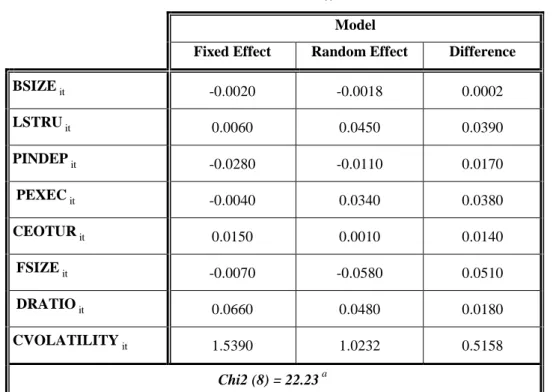
The panel data estimation presents the advantage to treat jointly the individual effects and the temporal effects and to increase the degrees of freedom and the precision of the inferences. However, the panel data’s models present the problem of a good specification according to whether the specific individual effect is fixed or random. Hausman’s test (1978) represents the standard test of the individual effect specifications. The results of this test privileged the results of the fixed model since the p value associated with Hausman’s test is close to zero which implies the rejection of the null hypothesis of the absence of correlation between the individual effects and the exogenous variables (Table 1a).
Table 1b presents the results of regressions of crisis-period financial return’s conditional volatility on measures of board of directors. The first five models apply the regression on every variable of the board of directors. The last model takes in consideration the potential interactions between the different characteristics of the board of directors. All models include the control variables and industry fixed effects. Our discussion and interpretation of the results will be based on the estimation output of the last model. Regressions are globally significant. The F-value for all the models is significant at the 1% level and therefore the hypothesis that all the coefficients for the explanatory variables are zero is rejected for all the models. Similarly, the R-square for all the models is about 0.45, which implies that the board and control variables explain about 45% of the variation in conditional volatility. The most important results are interpreted as follows:
First, the coefficient on board size (BSIZE) is negative and significant at 1% level. This result indicates that larger board present the most reduced financial return’s conditional volatility. These results are in accordance with those of Sang-Woo and II Chong (2005). These last find that the high number of directors multiplies the activities of monitoring and control and decrease the conflicts of interests between managers and shareholders. These factors could increase the firm’s ability to resist the crisis. However, this result could seem against intuitive; a limited size board being more reactive in period of crisis. But in the Asian context, the most large corporations owned and controlled by families, the board size is a pledge of diversity of the points of view and a better control of managers. This result reinforces hypothesis H1b.
Second, the hypotheses H2a and H2b not being validated. Leadership structure (LSTRUC) is not related to financial return’s conditional volatility. Indeed, if the leadership structure could not explain the firm’s ability to resist the Asian stock market crisis, it also failed to explain other phenomena. The Empirical findings by Mak and Kusnadi (2005) based on Singapore and Malaysia firms, suggest that leadership board is not related to firm valuation. For them, the separation of the CEO and chairman roles is more in form than in substance. Most firms also have a separate CEO and chairman, although in many cases, the chairman is an executive chairman who is a controlling shareholder and closely involved in the day-to-day management of the company.
Third, our results are consistent with our hypothesis H3a suggesting that presence of independent outside directors weakens the financial return’s conditional volatility. The coefficient on CA-IND is significant at the 10% level. With all control variables, this coefficient is 0.028, indicating a lower volatility of 0.28% for each increase of 10% in the proportion of independent outside directors. These results support the agency theory and find that the board’s efficiency increases with the proportion of the independent outside directors. Their presence in the board represents a guarantee of success and viability of the board of directors and contributes to increase the company’s ability to resist the crisis. However, the weak significance of this variable is essentially explained by the strong criticisms to the notion of independence. Sang-Woo and II Chong (2005) stressed the main sources of infringement of the directors’ independence in the Asian boards of directors.
Fourth, the coefficient on ROD is positive and significant at 5% level, it is 0.015. The increase of 10% in the rate the companies having a change of CEO rises the level of the financial return’s conditional volatility of 0.15%. We reject the hypothesis H4. Our results confirm that the frequent change of CEO during the crisis period is a symptom of a fierce expropriation of the minority shareholders and of a high vulnerability of firms during crisis periods.
With included industry fixed effects, all control variables have a significant effect on the financial return’s conditional volatility. In fact, the coefficient on DRATIO is significant at the 1% and reaches its predicted sign, it is 0.066. The firm with higher debt levels had, on average, an additional higher financial return’s conditional volatility of 6.6% over the crisis period. Besides, the coefficient on FSIZE is negative and significant at 5% level, which implies that the larger firms have less chance to be struck by the crisis. This result is not
surprising since larger companies are generally endowed by better monitoring systems. Finally, we find that the firm’s volatility increases with the country’s volatility. The coefficient on CVOLATILITY is positive and significant. These are the firms of the least volatile countries during the crisis period that have a bigger capacity to resist the Asian stock crisis. All these results are in conformity with the intuition that we could have a priori.
TABLE 1A: Hausman’s different tests
Model
Fixed Effect Random Effect Difference
BSIZEit -0.0020 -0.0018 0.0002 LSTRUit 0.0060 0.0450 0.0390 PINDEPit -0.0280 -0.0110 0.0170 PEXECit -0.0040 0.0340 0.0380 CEOTURit 0.0150 0.0010 0.0140 FSIZEit -0.0070 -0.0580 0.0510 DRATIOit 0.0660 0.0480 0.0180 CVOLATILITYit 1.5390 1.0232 0.5158 Chi2 (8) = 22.23a TABLE 1B: Panel data regressions
MODELS
Model a Model b Model c Model d Model e Model f
Coefficient (T-stat) Coefficient (T-stat) Coefficient (T-stat) Coefficient (T-stat) Coefficient (T-stat) Coefficient (T-stat) BSIZE -0.003a (-3.082) -0.002a (-2.748) LSTRU 0.002 (0.320) 0.006 (0.731) PINDEP -0.018b (-1.977) -0.028b (-1.982) PEXEC -0.002 (-0.138) -0.004 (-0.024) CEOTUR 0.019b (2.039) 0.015b (1.981) FSIZE -0.020b (-1.987) -0.006b (-1.903) -0.007b (-2.286) -0.005b (-1.986) -0.007b (-2.286) -0.007b (-1.915) DRATIO 0.073a (6.440) 0.072a (6.149) 0.066a (5.651) 0.066a (5.563) 0.072a (6.220) 0.066a (5.443) CVOLATILITY 1.371a (7.367) 1.460a (7.794) 1.606a (7.933) 1.583a (7.594) 1.438a (7.648) 1.539a (7.376) Industry
dummies Included Included Included Included Included Included
Intercept 0.092b (2.180) 0.109b (2.581) 0.134b (2.950) 0.128b (2.748) 0.098b (2.279) 0.146b (2.994) R2 0.430 0.404 0.478 0.475 0.410 0.482 F-statistic 14.544a 13.277a 13.366a 13.061a 13.464a 10.674a
Conclusion
The purpose of this paper is to enrich the financial and economic literature about the company’s effectiveness of corporate governance mechanisms related to the board of directors on the firm’s ability to resist the Asian financial crisis. Our study of Asian firms shows that the board size, the independence of members and the CEO turnover constitute the most important attributes of the board of directors in the context of the Asian crisis. The preference for a larger board is justified by the fact that the latter ones are capable of supervising the managers’ behaviour since it is difficult for these ones to dominate a larger board. These same results underline the role played by the independent directors in exercising an efficient monitoring management as well as in maintaining firm’s stability in periods of crisis. The appointment of the directors is a key measure of the reforms of the governance of the period of survey. It permits to increase the board independence in order to make it more responsible and more efficient. So are respected the interests of firm and all shareholders and no the only interests of majority shareholders.
Moreover, frequent change of CEO during the crisis period is a symptom of a fierce expropriation of the minority shareholders and of a high vulnerability of firms during financial crisis.
The leadership structure is not related to firm’s capacity to reduce the crisis transmission. Two explanations are plausible. First, the separation of the CEO and chairman roles is more in form than in substance. Most firms also have a separate CEO and chairman, although in many cases, the chairman is an executive chairman who is a controlling shareholder and closely involved in the day-to-day management of the company. Second, in period of crisis, the strong reactivity of a management associated to board’s chair could be a factor determining resistance. This survey is to replace in its context, the Asian crisis. This discerns on the one hand, patrimonial characteristics of the particular firms and on the other hand, a period of structuring of the governance systems in these countries.
However, the empirical results deserve that one becomes attached to some extrapolations in the situation of crisis that we cross. The most managing firms resist better to the crisis and so limit its propagation.
References
Barney, J. (1990), The debate between traditional management theory and organizational economics: substantive differences or intergroup conflict? , Academy of Management Review, 15, 382-393.
Baysinger, B., et Hoskisson, R. (1990), The composition of Board of Directors and Strategic Control, Effects of Corporate Strategy, Academy of Management Review, 15, 72-81.
Berg, S., et Smith, S. (1978), CEO and Board chairman: A quantitative study of dual vs.unitary board leadership, Directors and Boards, 3 (1), 34-39.
Bollerslev, T. (1990), Modelling the Coherence in Short-run nominal exchange rates: a multivariate generalized ARCH model, Review of Economics and Statistics.
Campbell, J. (1996), Understanding risk and return, Journal of Political Economy, Vol 104, 298-345.
Claessens, S, Simon, D., et Larry, L. (2002), The separation of ownership and control in East Asian corporations, Journal of Financial Economics, 58.
Defond, M., et Jiambalvo, J. (1994), “Debt Covenant Violation and Manipulations of Accruals”, Journal of Accounting and Economics, 145-176.
Dennis, D., et Dennis, K. (1995), “Performance changes following top management dismissals”, Journal of Finance, Vol 50, pp 1029-1058.
Donaldson, L., et Davis, D. (1991), Stewardship Theory or Agency Theory: CEO Governance and Shareholder Returns, Australian Journal of Management, 16, 49–64.
Engle, R. (1982), Autoregressive Conditional heteroscedasticity with estimates of variances of united kingdom inflation, Econometrica, 30, 987-1007.
Fama, E., et Jensen, M. (1983), The Separation of Ownership and Control, Journal of Law
and Economics, 26, 301-325.
Forker, J. (1992), Corporate governance and disclosure quality, Accounting and Business Reserach, 22, 111-124.
Goodstein, J, Gautam, K., et Boeker, W. (1994), The effects of Board Size and Diversity on Strategic change, Strategic Management Journal, 15, 241-250.
Haniffa., et Cooke T. (2002), Culture, corporate governance and disclosure in Malaysian corporation, Abacus, 38, 317-349.
Jensen, M. (1993), The Modern Industrial Revolution, Exit, and the Failure of the Internal Control Systems, Journal of Finance XLVIII, 831-880.
Johnson, S, Peter, B, Alasdair, B., et Eric, F. (2000), Corporate governance in the Asian Financial crisis, Journal of Financial Economics, 58.
Kang, J., et Shivdasani, A. (1995), Firm performance, corporate governance and top executive turnover in Japan, Journal of Financial Economics, 38, 1-30.
Mak, Y., et Kusnadi, Y. (2005), Size really matters: Further evidence on the negative relationship between board size and firm value, Pacific-Basin Finance Journal, 13, 301– 318. Mitton, T.( 2002), A cross-firm analysis of the impact of corporate governance on the East Asian financial crisis, Journal of Financial Economics, 64, 215-241.
Muth, M., et Donaldson, L. (1989), Stewardship theory and Board Structure: a contingency approach, Corporate Governance, 6, 5-28.
O’sullivan, N. (2002), The impact of Board composition and Ownership on audit quality: Evidence from large UK companies, British Accounting Review, 32, 397-414.
Pearce, S., et Zahra, J. (1989), Board of Directors and Corporate Financial Performance: A review and Integrative…, Journal of Management, 15, 291-334.
Piman, L., et Thomas, C. (2004), Corporate Governance in Thailand, Review of Corporate Governance in Asia.
Rechner P., et Dalton, D. (1989), The impact of CEO as board chairperson on corporate performance: evidence vs. rhetoric, The Academy of Management Executive, 3, 141–143. Rosenstein, S., et Wyatt, J. (1976), Inside Directors, Board Effectiveness and Shareholder Wealth, Journal of Financial Economics, 44, 229-250.
Salmon, J. (2000), Crisis Prevention: How to Gear Up Your Board, Harvard Business Review on Corporate Governance (Harvard Business Review Paperback series).Boston: Harvard Business School Press.
Sang-Woo, N., et Il Chong, N. (2005), Corporate governance in Asia: Recent Evidence from Indonesia, Republic of Korea, Malaysia, and Thailand, Review of Corporate Governance in Asia.
Schwartz, K., et Menon, K. (1985), Executive succession in failing firms, Academy of Management Journal, 28, 680-686.
Sengupta, P. (1998), Corporate disclosure quality and the cost of debt, The Accounting Review, 73, 459-474.
Warner, J, Watts, R., et Wruck, K. (1988), Stock prices and top management changes, Journal of Financial Economics, 20, 461-492.
Weisbasch, M. (1988), Outside directors and CEO turnover, Journal of Financial Economics, 20, 431-460.
Wellace, N, Worrel, D., et Cheng L. (1990), Key executive succession and stockholders wealth: The influence of successor’s origin, position, and age, Journal of Management, 16, 431-460.
Yermack, D. (1996), Higher Market Valuation of Companies with a small Board of Directors, Journal of Financial Economics, 40, 185-211.