Academic and Research Staff
L. D. Braida
S. K. Burns
H. S. Colburn
L. S. Frishkopf
J.
L.
Goldsteinjt
J. J. Guinan, Jr.
R.
G. MarkS
W. T. Peakeft
Baer
L. Benn
E. Berliner
Cintron
Demko, Jr.
O. Frost
Gaiman
Hasan
Prof. W. M. Siebert Prof. T. F. Weisst *, Dr. J. S. Barlowf~f Mr. N. I. Durlach Dr. R. D. Hallt
- Dr. N. Y. S. Kiang? Dr. E. P. Lindholm Prof. Prof. Prof. Prof. Prof. Prof. Prof. Prof. T. D. J. R. P. D. B. Z. D. W. Altmannt R. M. BrownT F. H. Byerst D. J. Callahan A. H. CristT W. F. Kelley L. H. Seifel S. N. Tandon C. MoxonNedzelnitsky
M. Rabinowitz V. Reed J. Shillman O. Stahl II P. Tripp, Jr. R. WolfeA. STATISTICAL RELATIONSHIPS BETWEEN THE FIRING OF TWO AUDITORY-NERVE FIBERS
PATTERNS
The firing patterns of action potentials (spikes) in single auditory nerve fibers of the 1-4
cat have been studied extensively in our laboratory for the past few years. A knowl-edge of the relationships between firing patterns in different fibers, as well as the timing of spikes in each auditory-nerve fiber, is important for understanding the coding of
acoustic stimuli into spike trains. In this report we present results that suggest that the firing patterns of auditory-nerve fibers can be considered as independent random
processes. 5
Data were obtained simultaneously from two auditory nerve fibers by means of two micropipettes. The data were then analyzed "off-line" on a PDP-4 com-puter.
This work was supported principally by the National Institutes of Health (Grant 5 P01 GM14940-03).
tAlso
at the Eaton-Peabody Laboratory of Auditory Physiology, Massachusetts Eye and Ear Infirmary, Boston, Massachusetts.tInstructor in Medicine, Harvard Medical School, Boston, Massachusetts.
Instructor in Preventive Medicine, Harvard Medical School, Boston, Massachusetts. ttResearch Affiliate in Communication Sciences from the Neurophysiological Labora-tory of the Neurology Service of the Massachusetts General Hospital, Boston,
Massachusetts.
QPR
No. 97
Graduate Students L. Hicks J. M. Houtsma W. James H. Johnson W. Kress, Jr. K. Lewis Y-S. Li 173(XV. COMMUNICATIONS BIOPHYSICS)
1. Analysis of Spike Activity Modeled as a Renewal Process: Spontaneous Activity and the Responses to High-Frequency Tones
In the absence of acoustic stimulation, a spontaneous sequence of action potentials can be recorded from an auditory-nerve fiber. Statistical analyses show that the spon-taneous activity of auditory-nerve fibers can be modeled as a renewal process1,6 (i. e. the interspike intervals are modeled as independent, identically distributed, random variables). In response to high-frequency tonal stimuli (greater than 3-7 kHz), the instantaneous rate of firing is also constant. Preliminary results7 show that the spike trains of auditory-nerve fibers in response to high-frequency tones can also be modeled as a renewal process.
First, we shall explain our test for the independence of two renewal processes. Let us define T to be an instant of time chosen at random.
DEFINITION. The interval u measured from time T until the next event in the renewal process occurs is called the forward recurrence time.
The probability density function (pdf) of u, fu(L), is given by
f (L) = f (x) dx, (1)
u E[T] L
where f (x) is the probability density function of the interspike interval T, and E(T) is the expected value of T.
One way of estimating f (L) is to determine the interval distribution of the renewal process f (x), and then apply Eq. 1.
A second method of estimating fu(L) makes direct use of the definition of the forward recurrence time. We can use a train of sampling pulses to define a sequence of times {Ti} from which we measure the forward recurrence times. If the sampling train is
itself a renewal process independent of the sampled renewal process, this estimate will converge to fu(L) as the number of samples becomes large.8
Our test for the independence of two renewal processes compares these two methods of estimating fu(L). If the difference between the two estimates E(L) lies within some
"allowable error" bound (AEB), we shall call the renewal processes statistically independent. If E(L) crosses the AEB, we shall say that the renewal processes are not independent. For the purposes of this analysis, we have chosen the AEB to be two and one-half standard deviations of the error E(L). It can be shown9 that the
variance of E(L) is of the form
N
L+AL
+AL
ms 120
(a)
0 50 0 -50Fig. XV-1.
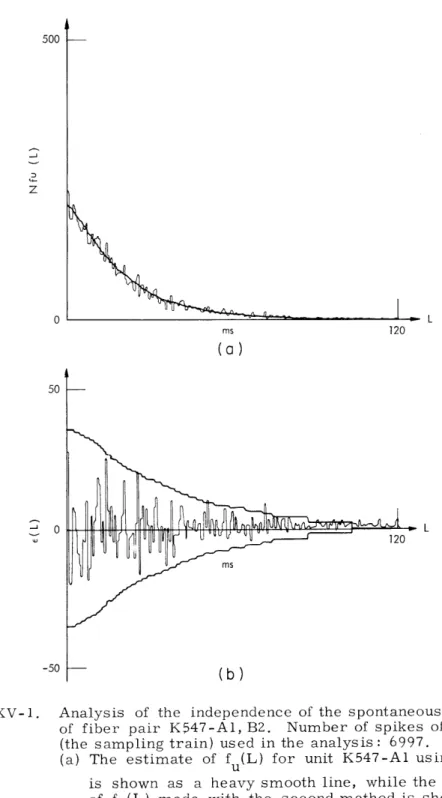
Analysis of the independence of the spontaneous activity of fiber pair K547-Al, B2. Number of spikes of unit B2 (the sampling train) used in the analysis: 6997.(a) The estimate of f (L) for unit K547-Al using Eq. 1 is shown as a heavy smooth line, while the estimate of fu(L) made with the second method is shown as a jagged line.
(b) The AEB is shown as an envelope about E(L), the dif-ference between the two estimates of f (L).
QPR No. 97
ms
(b)
(XV. COMMUNICATIONS BIOPHYSICS)
where AL is the resolution of histograms used to estimate f (x), and N is the number of samples in the estimate of f u(x).
A typical result of the application of this test to auditory-nerve fiber data is shown in Fig. XV-1. For almost every value of L the estimate of the difference E(L) is within the allowable error bound (AEB). Hence, this pair of spike trains can be con-sidered statistically independent. Spontaneous activity was analyzed for a total of 23 fiber pairs. The spontaneous rates ranged from 10 spikes/s to 105 spikes/s. Of this population, all fiber pairs but one were judged to be statistically independent.
Eight fiber pairs have been considered in the analysis of responses to high-frequency tones. Seventeen stimulus presentations covering stimulus frequencies from 8 kHz to 25 kHz at sound levels ranging over 60 dB were made. All but one fiber pair were judged to be statistically independent on the basis of our criterion.
2. Analysis of Responses to Low-Frequency Tones
For low-frequency sinusoidal stimuli (less than 3-7 kHz) the instantaneous rate of firing of auditory-nerve fibers is periodic, with a period equal to the period of the stim-ulus. A stationary characterization of this periodic firing pattern can be obtained by defining statistics that average over a period of the process. We need to calculate statistics that depend upon the following functions:
1. p(n), the probability of n spikes occurring in one period
2. c(k), the correlation function of the number of events in period i and in period i + k.
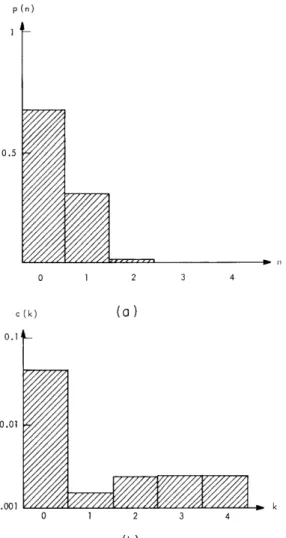
The functions p(n) and c(k) were each estimated for 12 auditory-nerve fibers. The examples shown in Fig. XV-2 are typical and no fiber that was examined showed results that deviated significantly from those shown. The results may be summarized as follows.
1. The probability of more than one spike in one period of the stimulus is much less than the probability of one spike.
2. The correlation function reveals that the firings in intervals separated by more than 4 periods of the stimulus are uncorrelated. Intervals separated by less than 4 periods of the stimulus are negatively correlated.
In order to test for the independence of two processes having the characteristics described above, we would need to know p(n) and c(k) for each process. To simplify the calculations, we have made the following assumptions: (a) no more than one spike occurs in any one period of the stimulus, and (b) the firings in disjoint intervals are independent. These assumptions allow us to describe the time-locked firing pattern of an auditory-nerve fiber as a Bernoulli process. It can be shown that the AEB found from the Bernoulli-process model is a lower bound on the AEB computed from the more
0.5 0 1 2 3 c(k) (a) 0.1 0.01 0.001 0 1 2 3
(b)
Fig. XV-2. (a) The function p(n) is shown for unit K545-B17. Stimulus frequency: 0. 499 kHz at a level of -50 dB re 200 V peak-to-peak to the earphone; number of periods of the stim-ulus used in this estimate: 28, 775.
(b) The function c(k) is shown for unit K545-A12. Since c(k) is an even function, only the values for positive k are shown. Stimulus frequency: 1. 212 kHz at a level of -40 dB; number of periods of the stimulus used in this estimate: 106, 280. A total of 7270 spikes occurred in the run.
SPIKES 2000 J 2000 -I I
( b)
2000 -3 -2 -1 0 1 2 3(c)
Fig. XV-3.
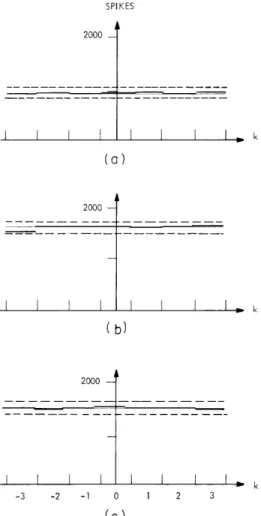
Analysis of the independence of the time-locked activity of fiber pair K546-A8, B5. Number of joint occurrences in periods of the two spike trains as a function of k is indicated by the heavy line. The expected number of joint occurrences (independence assumed) is indicated by the light line. The dashed line denotes the AEB. Stimulus frequency: 0. 393 kHz. (a) Stimulus level = -60 dB; N = 34, 767. (b) Stimulus level = -50 dB; N = 38, 183. (c) Stimulus level = -40. dB; N = 34, 816., , i I
The test for the independence of two Bernoulli processes (A and B) is based upon the following property of joint probabilities: The probability of the joint occur-rence of two events is the product of the probabilities of each event if the events
are independent. Therefore, if the Bernoulli processes are independent, the probability of an event in trial i of process A and an event in trial (i-k) of pro-cess B is the product of the probability of an event in propro-cess A and the probabil-ity of an event in process B. Our test of independence is to measure the number of events in each spike train and the number of joint events in intervals separated by k periods in the two trains. The number of joint events can be estimated by assuming that the processes are independent. We have chosen the AEB placed upon the excursions of the difference between the measured and estimated values of the number of joint events to be two and one-half standard deviations:
AEB(k) = 2. 5 '/NPAPB(1-PA)(1-pB),
where PA(PB) is the probability of an event in spike train A(B) during one period of the stimulus, and N is the number of periods of the stimulus.
Thirty-two fiber pairs were analyzed with a total of 119 stimulus presentations covering frequencies from 0. 150 kHz to 7. 076 kHz over a sound level range of
80 dB. A typical result of this analysis is shown in Fig. XV-3. All but three fiber pairs showed results consistent with statistical independence.
3. Conclusions
For our statistical tests, we would expect data from two independent processes to sometimes exceed the AEB. The population of fiber pairs that we examined showed a small number of cases in which the AEB was exceeded at one or two points. Thus we may conclude: This small number of fiber pairs represents a
small subpopulation (less than 10% of the total number) that has dependent firing patterns, and/or these cases represent the occasional, expected crossings of the AEB. If the former were the explanation we might expect the statistical
depen-dence of firing patterns of fiber pairs to be maintained for small changes in stim-ulus level. This we did not find for more than one case. Also the physiological
characteristics (CF, spontaneous rate, threshold) of the fiber pairs that were found to be dependent did not show any consistency. We, therefore, tentatively conclude that firing patterns of auditory-nerve fibers can be modeled as independent random
processes.
Some interpretations of these results, as well as details of the statistical analyses, may be found in the author's thesis.9
D. H. Johnson
(XV. COMMUNICATIONS BIOPHYSICS)
References
1. N. Y. S. Kiang, T. Watanabe, E. C. Thomas, and L. F. Clark, Discharge Pat-terns of Single Fibers in the Cat's Auditory Nerve (The M. I. T. Press, Cambridge, Mass., 1965).
2. J. L. Goldstein and N. Y. S. Kiang, "Neural Correlates of the Aural Combina-tion Tone 2fl -f2," Proc. IEEE 56, 981-992 (1968).
3. P. R. Gray, "A Statistical Analysis of Electrophysiological Data from Auditory Nerve Fibers in Cat," Technical Report 451, Research Laboratory of Elec-tronics, M. I. T., Cambridge, Mass., June 21, 1966.
4. M. B. Sachs and N. Y. S. Kiang, "Two-Tone Inhibition in Auditory Nerve Fibers," J. Acoust. Soc. Am. 43, 1120-1128 (1968).
5. The data used in this analysis were obtained by Dr. N. Y. S. Kiang and the staff of the Eaton-Peabody Laboratory, Massachusetts Eye and Ear Infirmary,
Boston, Mass.
6. D. R. Cox, Renewal Theory (John Wiley and Sons, Inc., New York, 1962). 7. T. F. Weiss, Personal communication, 1969.
8. S. C. Port and C. J. Stone, "A Large Sample Test for the Independence of Two Renewal Processes," Ann. Math. Statist. 38, 1037-1041 (1967).
9. D. H. Johnson, "Statistical Relationships between Firing Patterns of Two Auditory Nerve Fibers, " S. M. Thesis, Department of Electrical Engineering, M. I. T., Cambridge, Mass., 1970.